PART 2: The 40-Day-Old Puppy Waited Beside the Road for 24 Hours—Still Wearing the Leash of the Person Who Left Him
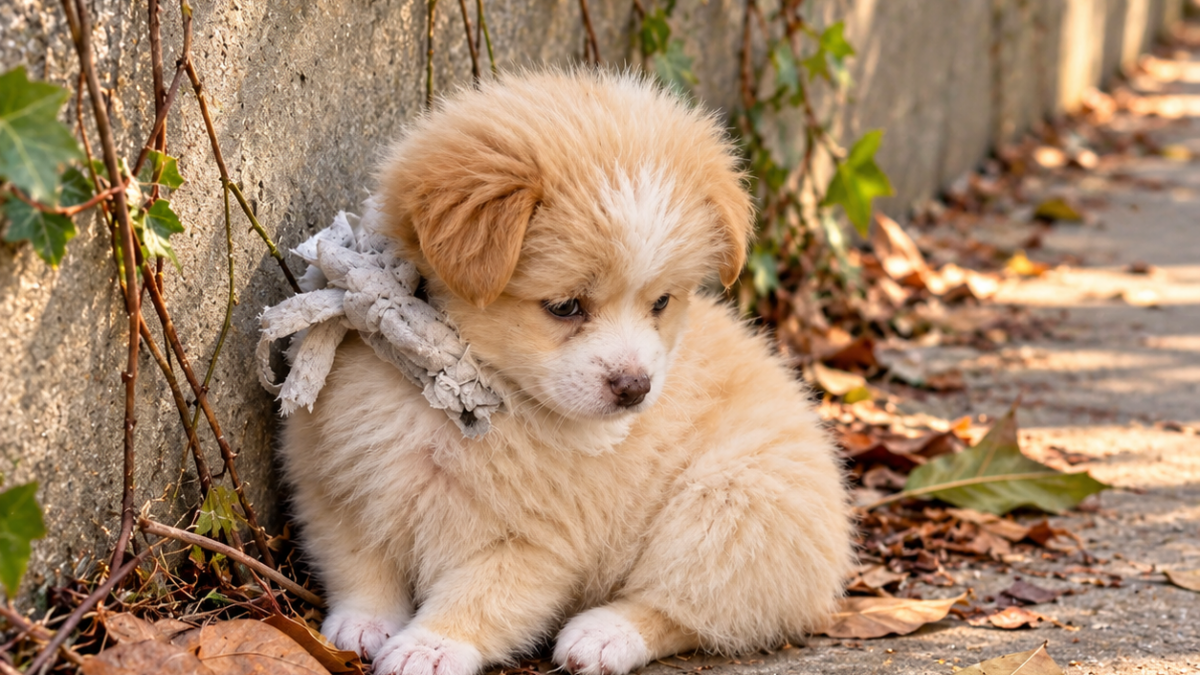
PART 2
I sent her the location.
She arrived faster than I expected.
I recognized her before she introduced herself because she came toward us looking directly at the puppy, barely noticing anything else around her.
“Is that him?”
“Yeah.”
She stopped a few feet away.
For a moment, she didn’t touch him.
I appreciated that immediately.
A lot of people see a frightened puppy and their first instinct is to scoop him up, squeeze him, kiss him and overwhelm him with affection because they mean well.
She crouched instead.
“Hi, baby.”
The puppy lifted his head.
She slowly placed her hand on the ground, palm up.
He looked at it.
Then at her.
Then he put his head down again.
Her face changed.
“How long was he really out there?”
“I saw him yesterday morning. When I came back tonight, he was still in the same place.”
“Nobody took him?”
“Apparently not.”
“And nobody has claimed him?”
“Not so far.”
She looked at the leash.
“Someone left that on him?”
“I don’t know exactly what happened. I don’t want to accuse anybody without knowing. But he didn’t act lost. He acted like he was waiting.”
She swallowed.
“He’s so little.”
That was the part I couldn’t stop thinking about.
We later estimated that he was only around forty days old.
Not forty weeks.
Forty days.
At that age, the world should still have been simple.
Warmth.
Food.
Sleep.
Play.
A familiar voice.
Instead, he had spent more than twenty-four hours beside a road waiting for a person who never returned.
The young woman reached toward him again.
This time, the puppy sniffed her fingers.
“Can I pick him up?”
“Go ahead.”
She slid one hand beneath his chest and another beneath his back legs.
He became stiff for half a second.
Then he melted against her.
“Oh,” she whispered.
I knew exactly what she meant.
He wasn’t fighting.
He wasn’t excited.
He was surrendering.
She held him close.
“You’re done waiting out here.”
The words were quiet.
The puppy closed his eyes.
We both knew he needed more than a home.
He seemed weak, and after sitting beside a road for that long, I didn’t want to assume that food and sleep would solve everything.
“We should get him checked.”
She nodded immediately.
“Tonight.”
That answer told me a lot about her.
There was no hesitation over the inconvenience.
No “maybe tomorrow.”
No “let’s see how he does.”
Tonight.
We took him to a veterinary hospital.
The puppy stayed curled in her lap during the drive.
Every few minutes, she looked down to make sure he was breathing normally.
Once, she whispered, “You’re okay.”
Then she looked at me.
“He probably has no idea what we’re saying.”
“Maybe not.”
She stroked one finger between his ears.
“I’m going to keep saying it.”
At the hospital, a technician carried him to an examination room.
The bright lights made him squint.
The veterinarian checked his temperature, gums, hydration, heart, lungs and abdomen.
“Do we know anything about his history?”
“No,” I said.
“Nothing?”
“Just where I found him.”
The young woman explained how long he had apparently been outside.
The veterinarian looked at the puppy again.
“He’s very young.”
“About how young?” she asked.
“Roughly six weeks, give or take.”
Her eyes widened.
“That’s it?”
“Approximately.”
She looked down at him.
Six weeks.
The number somehow made the abandonment harder to comprehend.
He wasn’t just a small dog.
He was a baby.
Tests were recommended because of his weakness and condition.
We agreed.
While we waited, the young woman sat with the puppy wrapped in a small blanket.
He didn’t explore the room.
Didn’t chew the blanket.
Didn’t try to climb down.
He simply rested against her.
“Shouldn’t a puppy this age be more active?” she asked.
“Usually,” I said.
Neither of us said the rest.
That’s why we were there.
When the veterinarian returned, he explained that the puppy was sick and needed treatment and monitoring.
Thankfully, there was a plan.
Medication.
Nutritious food appropriate for his age.
Rest.
Close observation.
Follow-up care.
The young woman listened carefully.
“Can he come home with me?”
“If he remains stable and you follow the treatment plan, yes. But I want you watching him closely.”
“I will.”
“If he stops eating, becomes markedly weaker, vomits repeatedly or anything seems significantly worse, bring him back.”
“I will.”
She said it with such certainty that the veterinarian smiled.
“All right.”
Then came the practical question.
“What are we calling him?”
We both looked at the puppy.
He had finally opened his eyes.
The young woman thought for a moment.
“Latte.”
I laughed softly.
“Latte?”
She nodded.
“I don’t know. He just looks like a Latte.”
The veterinarian wrote it down.
And just like that, the puppy beside the road had a name.
Latte.
It was such a small thing.
A name doesn’t cure sickness.
It doesn’t erase abandonment.
It doesn’t guarantee a future.
But something changed the moment we started using it.
He was no longer “the puppy.”
No longer “the stray.”
No longer “the dog by the road.”
He was Latte.
And someone was already planning where he would sleep that night.
Before we left the hospital, the young woman asked the veterinarian question after question.
How often should he eat?
How much?
What if he didn’t want his medication?
How much should he sleep?
Was he old enough for certain foods?
Could he be around other dogs?
How should she keep him warm?
What signs meant she should call immediately?
I watched her taking notes on her phone.
At one point, she caught me smiling.
“What?”
“Nothing.”
“Why are you looking at me like that?”
“Yesterday he was waiting beside the road.”
She looked down at him.
“Not anymore.”
She meant it.
At her home, she had already started preparing.
A soft bed appeared.
Small bowls.
A blanket.
A few puppy toys she had stopped to buy.
Latte stood on the floor and looked around.
For the first time, I saw him take several purposeful steps.
Not toward either of us.
Toward the wall.
Then he stopped.
The young woman crouched nearby.
“You can look around.”
Latte didn’t.
He sat.
His little head lowered.
She glanced at me.
“He’s scared.”
“Probably.”
“Of the house?”
“Maybe not the house itself.”
I thought about the roadside.
“He might just not understand what’s happening.”
She sat on the floor.
She didn’t call him.
Didn’t pull him toward her.
She simply stayed there.
After a few minutes, Latte looked at her.
Then he took one small step.
Another.
He stopped again.
She remained still.
Finally, he reached her knee.
He sniffed her pants.
Then sat beside her.
She covered her mouth with one hand.
I whispered, “Don’t make a big deal out of it.”
“I’m trying not to.”
Latte leaned against her leg.
That was enough.
His first night wasn’t magically perfect.
He ate only a little.
He slept heavily.
Every unfamiliar sound made his head rise.
When the young woman stood to walk across the room, his eyes followed her.
When she disappeared into another room, he became alert.
The first time she went to the bathroom and closed the door, Latte dragged himself from his bed and sat outside it.
She opened the door and nearly stepped on him.
“What are you doing here?”
Latte stared up at her.
She picked him up.
Then she sent me a message.
**He followed me to the bathroom and waited outside.**
I replied:
**He may be afraid you’re disappearing.**
Several seconds passed.
Then she answered:
**Then I’ll keep coming back until he learns.**
I read that sentence twice.
That became the quiet center of Latte’s recovery.
She kept coming back.
Every morning he opened his eyes and she was there.
When she left the room, she returned.
When she went to prepare food, she returned.
When she stepped outside briefly, she returned.
When she went to sleep, he woke up and found her again.
At first, he monitored everything.
If she stood, he watched.
If she picked up her keys, he watched.
If a door closed, he listened.
He didn’t understand schedules.
He didn’t understand errands.
He only understood presence and absence.
And somewhere in his very young life, absence had become frightening.
His treatment continued.
Some days he ate eagerly.
Other days required patience.
She learned how to give his medication without turning it into a battle.
At first, she tried placing it in his mouth gently.
Latte spit it out.
She tried again.
He spit it out again.
She stared at him.
“You’ve been alive for approximately six weeks and you’re already doing this?”
Latte looked innocent.
She sent me a photo of the medication sitting on the floor beside his paw.
**He has rejected medical advice.**
I laughed.
That was actually good news.
The puppy who had barely reacted beside the road was beginning to object to things.
He was developing preferences.
Attitude.
Energy.
Personality.
The sadness didn’t disappear immediately.
That was the part people often misunderstood when they first met him.
He was safe now, so they expected the fear to vanish.
But animals don’t always work that way.
Neither do people.
Safety can arrive in a single moment.
Feeling safe can take much longer.
Latte had to learn that food wasn’t temporary.
He had to learn that a bed still belonged to him after he got out of it.
He had to learn that hands could reach toward him without taking something away.
And most of all, he had to learn that a person leaving his sight didn’t necessarily mean abandonment.
A few days after he arrived, the young woman needed to step outside for several minutes.
She left Latte in a secure area with his bed and toys.
When she returned, he was sitting near the door.
Not barking.
Not scratching.
Just sitting.
Waiting.
She froze when she saw him.
It reminded her too much of the roadside.
“Latte.”
His head lifted.
Then something happened.
His tail moved.
Once.
She crouched.
“I’m back.”
Latte walked toward her.
The tail moved faster.
By the time he reached her, his whole rear end was wiggling.
She scooped him up.
That evening, she called me.
“He wagged his tail when I came back.”
I smiled.
“That’s huge.”
“I know it sounds stupid.”
“It doesn’t.”
“He waited at the door, and for a second I felt terrible.”
“You came back.”
“I know.”
“That’s what he needs to learn.”
There was silence.
Then she said, “I wish I knew who left him.”
I understood.
Part of me wanted to know too.
Had someone become overwhelmed by an unwanted litter?
Had somebody decided veterinary care would cost too much?
Had Latte been a gift someone didn’t want?
Had the person convinced themselves that leaving a puppy near houses meant somebody would eventually take him?
We could imagine a dozen possibilities.
None changed what he had experienced.
So we stopped trying to invent answers we didn’t have.
No owner ever came forward.
No credible person contacted us to say the puppy belonged to them.
The leash remained the only tangible connection to whatever life he’d had before.
Eventually, the young woman removed it from where she’d stored it.
She held it in one hand.
Latte was on the floor chewing a toy.
“What should I do with this?”
I looked at the leash.
“I don’t know.”
She turned it over.
Part of it was still stained with dirt from the roadside.
“I hate it.”
“Then throw it away.”
She hesitated.
Latte suddenly abandoned his toy and walked toward her.
She lowered the leash.
He sniffed it.
For one second, both of us became quiet.
I wondered if the smell meant anything to him.
Latte sniffed once more.
Then walked away and picked up his toy.
The young woman looked at me.
“Well.”
“Apparently he’s made his decision.”
She dropped the old leash into the trash.
The next time Latte went outside, he wore a new one.
That detail probably meant more to us than it meant to him.
But I remember seeing him trot ahead, the new leash stretching gently between him and the woman who had adopted him.
This time, somebody was holding the other end.
His health gradually improved.
His appetite grew.
His eyes became brighter.
His movements became quicker.
The first time he truly played, neither of us was prepared for it.
The young woman had bought him several small toys, but until then he’d mostly sniffed them or slept near them.
One morning, she rolled a tiny ball across the floor.
Latte watched it.
It stopped against a chair.
She rolled it again.
He tilted his head.
Then he lunged.
His feet slipped.
He scrambled upright and attacked the ball as if it had personally offended him.
She burst out laughing.
Latte froze.
He looked at her.
Then at the ball.
Then he pounced again.
Within minutes he was bouncing around the room.
She filmed a few seconds and sent them to me.
**LOOK AT HIM.**
I watched the video at least five times.
The puppy in it didn’t look like the one I remembered beside the road.
His eyes were alive.
His ears moved with every sound.
His tail never seemed to stop.
At one point he tried to run around the ball too quickly, tripped over his own feet, rolled onto his side, jumped up and continued as though nothing had happened.
That became Latte’s personality.
Once he discovered joy, he approached it with absolutely no moderation.
Toys weren’t something to play with calmly.
They had to be conquered.
Meals weren’t merely eaten.
They were anticipated with dramatic enthusiasm.
Attention wasn’t accepted politely.
It was demanded.
If the young woman sat down, Latte climbed into her lap.
If she used her phone too long, he found ways to interrupt.
One day she sent me a picture of his face pressed directly against the screen of her phone.
**Apparently my phone has exceeded its allowed daily attention.**
Latte also began learning commands.
At first, training was simple.
His name.
“Latte.”
Look at her.
Reward.
“Latte.”
Look again.
Reward.
Then “sit.”
He learned it quickly.
Too quickly.
Soon he started sitting without being asked whenever he suspected food was involved.
She would walk into the kitchen and find him already planted on the floor, staring up at her.
“I didn’t say sit.”
Latte remained perfectly still.
“There’s nothing for you.”
Still sitting.
“That doesn’t work every time.”
His tail tapped the floor.
She usually gave in.
Then came “paw.”
That took longer.
She held a treat.
“Paw.”
Latte stared at the treat.
“Paw.”
He sniffed her hand.
She gently touched his front foot.
“Paw.”
Eventually, he raised it.
“Yes!”
Her reaction startled him.
He pulled the paw back.
She laughed.
“Sorry. Sorry. Again.”
Within days, Latte understood.
Sit.
Paw.
Wait.
Come.
He wasn’t flawless.
Sometimes “come” meant “look at her and decide whether the offer was worthwhile.”
Sometimes “wait” became “wait for approximately half a second.”
But he was learning.
More importantly, he enjoyed learning.
His confidence grew every time he figured something out.
The young woman started buying him little outfits.
The first was practical.
A tiny shirt to help keep him warm.
Latte stood stiffly when she put it on him.
He looked down.
Then up at her.
Then he took one strange step as though clothing had disabled all four legs.
She laughed.
“You can still walk.”
Latte took another exaggerated step.
“Oh, you’re being dramatic.”
Within a minute, he forgot he was wearing it.
Soon there were more.
Small shirts.
A little jacket.
Something with a hood that made him look deeply offended whenever it fell over his ears.
She sent pictures constantly.
In one, Latte sat perfectly upright in an outfit that made him look far more serious than he actually was.
In another, he was halfway through attacking the sleeve.
The puppy who had once sat beside a road in nothing but the leash he’d been left with now had more clothing than some people I knew.
And he was becoming spoiled.
Wonderfully, unapologetically spoiled.
His bed was upgraded.
Then upgraded again.
He received more toys.
Then a toy basket.
Then apparently decided the basket itself was also a toy.
He learned that the refrigerator sometimes contained things that interested him.
The sound of a bag opening could summon him from another room.
He developed favorite sleeping positions.
Favorite toys.
Favorite spots in the house.
Favorite people.
And a very strong opinion about sharing attention.
That became clear when another puppy appeared in a video on the young woman’s phone.
Latte was sitting beside her while she watched.
A puppy barked through the speaker.
Latte’s ears shot up.
He looked behind the phone.
Another bark.
Latte stood.
The young woman laughed.
“Where is he?”
Latte looked around the room.
The puppy on the screen made another sound.
Latte moved closer to the phone.
Then he looked at the young woman.
His expression had changed.
She played the sound again.
Latte climbed directly into her lap.
“Are you jealous?”
He pushed his face against her hand.
She laughed so hard the video shook.
“Latte, it’s a video.”
Another bark.
Latte pressed even closer.
When she later sent me the clip, I couldn’t stop smiling.
A puppy who had once seemed resigned to being unwanted had become jealous that someone else might receive his person’s attention.
There was something beautifully absurd about it.
He had gone from expecting nothing to assuming love belonged to him.
That was exactly what we wanted.
But his progress wasn’t completely smooth.
There were reminders.
One evening, the young woman had to leave him alone longer than usual.
Not dangerously long.
Just longer than his normal routine.
When she returned, Latte was waiting near the door.
She opened it.
He didn’t immediately bounce toward her.
He stood there.
Watching.
She crouched.
“Hey.”
Latte remained still.
“I’m sorry I took longer.”
His ears lowered slightly.
She put her bag down.
Then sat on the floor.
No reaching.
No forcing.
“I’m here.”
Several seconds passed.
Latte walked toward her.
Slowly at first.
Then faster.
By the time he reached her, the hesitation was gone.
He climbed against her chest.
She held him.
That incident worried her.
“Do you think he remembered?”
“Maybe.”
“I feel awful.”
“You came back.”
“But what if leaving him scares him every time?”
“It probably won’t forever.”
“How do you know?”
I thought before answering.
“I don’t. But look at everything else he’s learned.”
The puppy who wouldn’t play now played.
The puppy who barely responded now demanded attention.
The puppy who watched every closed door now sometimes slept through her leaving the room.
Healing wasn’t the absence of difficult moments.
It was the difficult moments becoming smaller.
Less frequent.
Easier to recover from.
Weeks passed.
Latte grew.
His legs became longer.
His puppy belly changed shape.
His face began losing some of that newborn roundness.
But some habits remained.
He still loved sleeping close to his person.
He still followed her from room to room when he felt like it.
And he still reacted to the front door.
The difference was what happened afterward.
At first, a closed door had made him anxious.
Eventually, he learned another sound.
Keys in the lock.
That sound meant she was coming back.
One afternoon, I visited.
Latte was asleep when she stepped outside briefly.
He lifted his head when the door closed.
I watched him carefully.
He looked at the door.
Then looked at me.
Then put his head back down.
I smiled.
A few minutes later, keys rattled.
Latte exploded.
He raced toward the door so fast his feet slid on the floor.
When she entered, he bounced around her ankles.
“You were gone forever!” she said dramatically.
It had been perhaps four minutes.
Latte didn’t care.
She picked him up.
He licked her face.
I leaned back in my chair.
That was when I understood just how far he had come.
The roadside puppy had waited because he didn’t know whether anyone would return.
This puppy waited because experience had taught him somebody would.
The waiting looked similar from the outside.
Inside him, it was completely different.
His veterinary follow-ups went well.
The illness that had worried us in those first days responded to treatment.
His strength returned.
His appetite became so healthy that portion control replaced encouragement.
The young woman laughed when the veterinarian mentioned watching his weight.
“Do you remember when I was begging him to eat?”
The veterinarian smiled.
“Problems evolve.”
Latte sat at her feet staring at a treat container.
“Apparently.”
As the medical worry receded, ordinary puppy problems took its place.
Chewing.
Running away with things he wasn’t supposed to have.
Selective hearing.
Demand barking.
Attempts to negotiate bedtime.
Once, Latte stole a sock and refused to surrender it.
The young woman followed him around the room.
“Latte.”
He ran.
“Give me the sock.”
He ran behind the couch.
“That isn’t a toy.”
His face appeared at the other end.
Sock still in mouth.
“Do not make me crawl back there.”
Latte disappeared again.
She called me afterward.
“I rescued a criminal.”
“Call the authorities.”
“They won’t take him. He’s too cute.”
Eventually she traded the sock for a treat.
Latte apparently decided this was an excellent economic system.
Sock equals treat.
The stealing increased.
Training had to be adjusted.
But even those ridiculous little battles mattered.
Normal misbehavior is a privilege.
The first time I met Latte, I would have given anything to see him energetic enough to steal a sock.
Now he was doing it professionally.
His world expanded too.
Once his veterinarian considered it safe, he began going on more little outings.
Nothing overwhelming.
Short walks.
Quiet places.
Safe introductions.
The first time he returned near the road where I’d found him, it wasn’t planned as some symbolic journey.
We simply happened to pass through the area.
I realized where we were before the young woman did.
“Wait.”
“What?”
“That’s the place.”
She looked outside.
Latte was secured safely with her.
His ears were up as he watched the world moving past.
“Here?”
“A little farther.”
We slowed.
Then I saw the patch of dirt.
It looked completely ordinary.
Of course it did.
Roads don’t remember what happens beside them.
There was no mark where a tiny puppy had waited.
No evidence that he had once rested his head there believing somebody might return.
The young woman became quiet.
“That’s where he was?”
“Yeah.”
She looked down at Latte.
He wasn’t staring at the spot.
He was trying to investigate something on the other side.
She rubbed his chest.
“Do you think he remembers?”
“I hope he doesn’t.”
She nodded.
We didn’t stop.
There was nothing for him there.
His life was ahead of us.
Months after the rescue, the changes became almost comical when we compared videos.
We put the first photograph beside a recent one.
In the first image, Latte’s body seemed to fold into itself.
Head down.
Eyes exhausted.
Leash lying beside him.
In the newer picture, he was standing with his chest forward in a ridiculous little outfit, staring directly at the camera as though he owned the entire house.
“That’s the same dog?” someone asked.
The young woman laughed.
“Oh, unfortunately, yes.”
Latte barked from the floor.
“See? He heard that.”
Another video showed him performing his tricks.
“Sit.”
Latte sat.
“Paw.”
He offered his paw.
“Other paw.”
He hesitated.
She waited.
Latte switched paws.
“Good boy.”
Then she said, “Wait.”
She put a treat in front of him.
Latte stared at it.
His whole body became tense.
“Wait.”
He looked at her.
Then the treat.
Then her.
“Okay.”
The treat vanished.
She cheered.
Latte immediately sat again, ready to repeat the transaction.
He had learned that people could ask things of him without frightening him.
That mattered too.
Training wasn’t just tricks.
It was communication.
A shared language.
A way for Latte to predict what was happening.
A way for his person to tell him what she wanted and reward him for understanding.
Predictability built trust.
Trust built confidence.
Confidence allowed joy to take up more space than fear.
One day, I asked the young woman when she had realized Latte truly believed the house was his home.
She thought about it.
“I don’t know.”
“There wasn’t one moment?”
“Maybe there was.”
She smiled.
“What?”
“The first time he got mad at me for moving his bed.”
I laughed.
“What happened?”
“I was cleaning. I moved his bed to the other side of the room.”
“And?”
“He stared at me like I’d committed a crime. Then he grabbed the edge and started dragging it back.”
“Seriously?”
“Absolutely.”
“Did he succeed?”
“No. But he was furious.”
We both laughed.
Then she looked at Latte asleep nearby.
“I think that’s when I realized he wasn’t asking permission to be here anymore.”
That sentence stayed with me.
Not asking permission.
When I found him, even his body seemed apologetic.
Small.
Still.
Trying not to demand anything.
Now he had preferences about furniture placement.
He protested delayed meals.
He complained when attention shifted elsewhere.
He brought toys to people and expected them to participate.
He occupied the center of the room.
Latte didn’t merely live in the house.
He belonged there, and he knew it.
One afternoon, I arrived while he was wearing another tiny outfit.
“What is this?”
The young woman looked offended.
“It’s fashion.”
Latte looked less convinced.
He had a small hood resting between his ears.
I crouched.
“Blink twice if you need help.”
Latte launched himself at me.
She laughed.
“Traitor.”
He covered my hand in puppy kisses.
Then a sound came from her phone.
Another dog barking.
Latte froze.
His head turned.
The bark came again.
Immediately, he abandoned me and climbed against her.
“There it is,” I said.
“What?”
“Jealous Latte.”
“He is not jealous.”
Another bark.
Latte pushed his nose under her hand.
I stared at her.
She sighed.
“Fine. Maybe a little.”
A little was an understatement.
He had become possessive of affection in the harmless, comical way puppies sometimes do.
If another dog appeared, Latte needed reassurance that his place had not been taken.
She never encouraged true guarding behavior, of course.
She redirected him.
Rewarded calm behavior.
Made sure he learned that affection wasn’t scarce.
There was enough.
That lesson felt especially important for a dog whose life had begun with loss.
Love didn’t disappear because somebody else received some too.
Food returned after the bowl became empty.
People returned after doors closed.
Home remained home even after bedtime.
His early fear had taught him uncertainty.
His new life taught him patterns.
I think that was what healed him more than anything.
Consistency.
Not one enormous gesture.
Hundreds of small ones.
Breakfast arriving.
Medicine being given.
A blanket washed and returned.
His name spoken kindly.
A toy replaced when it wore out.
A door opening.
A person coming home.
Again.
Again.
Again.
The world proved itself to him through repetition.
Eventually, I noticed something else.
I stopped thinking about Latte as “the abandoned puppy.”
I would visit and simply think, Latte is being ridiculous.
Latte stole something.
Latte learned another trick.
Latte gained weight.
Latte hates this outfit.
Latte loves that toy.
The rescue story became part of his history instead of the center of his identity.
That was exactly how it should have been.
There was no dramatic confrontation with the person who had left him.
No confession.
No explanation that suddenly made the roadside make sense.
And maybe that was appropriate.
Latte’s life didn’t need to remain attached to the unknown person who had walked away.
The person who mattered was the one who stayed.
On the anniversary of the day I’d found him, the young woman sent me two pictures.
The first was the original photograph from the roadside.
I almost didn’t recognize how small he had been.
His head was on the ground.
The leash lay beside him.
His eyes seemed too tired for his face.
The second photograph had been taken that morning.
Latte was standing on a bed surrounded by toys.
He wore a tiny shirt.
His ears were alert.
His mouth was open slightly.
And his whole posture seemed to say that the room existed for his convenience.
Under the pictures, she wrote:
**One year of Latte. He still thinks every toy is his, every meal is late, and every person who enters the house came specifically to see him.**
I laughed.
Then I zoomed in on the first photograph.
I could still remember approaching him.
Still remember asking where his person was.
Still remember walking away the first time because I’d convinced myself somebody would come back.
For a while, I carried guilt about that.
What if something had happened to him during those hours?
What if he had walked into traffic?
What if he hadn’t been there the next day?
I had mistaken a leash for proof that somebody cared.
It wasn’t.
A leash is only a piece of material.
What matters is whether someone is holding on.
The second picture answered the first.
Latte had somebody holding on now.
I visited not long afterward.
He met me at the door.
No hesitation.
No lowered head.
No defeated eyes.
He ran in circles, rushed toward me, raced away, found a toy and brought it back.
“Hello to you too.”
Latte shoved the toy against my leg.
“You want me to throw it?”
His tail went wild.
I tossed it across the room.
He chased it.
The young woman leaned against the doorway.
“He’s been waiting for you.”
I looked at her.
The word caught me.
Waiting.
For one second, I saw the roadside again.
Then Latte came racing back.
He dropped the toy.
I looked down at him.
The same dog.
A completely different kind of waiting.
This time he had known I was coming.
And if I’d been late, he would have had food.
Water.
Toys.
A warm bed.
And someone beside him.
I threw the toy again.
He disappeared around the corner after it.
A moment later there was a crash.
The young woman closed her eyes.
“What did he do?”
Latte reappeared carrying the toy proudly.
“Nothing good,” I said.
She laughed.
“That’s my boy.”
Later that afternoon, she put one of his little shirts on him because the weather had turned cooler.
Latte stood patiently now.
No stiff-legged protest.
No confusion.
When she finished, she tapped the floor.
“Sit.”
He sat.
“Paw.”
Paw.
“Other paw.”
He switched.
“Good boy.”
She rewarded him.
Then her phone made a sound.
A puppy barked from a video someone had sent her.
Latte’s ears rose.
He looked at the phone.
Then immediately climbed into her lap.
I laughed.
“Still jealous.”
“Very.”
She kissed the top of his head.
Latte settled against her like he’d been doing it his entire life.
Maybe someday the last fragments of those first frightened days would disappear completely.
Maybe some small part would always remain.
There was no way to know.
But I knew this:
Latte no longer watched the road.
He watched the kitchen when food was being prepared.
He watched hands holding treats.
He watched balls roll across the floor.
He watched the front door because people he loved came through it.
He watched his person because she had become the safest thing in his world.
That evening, I stayed until Latte grew tired.
His energy finally disappeared all at once, the way it often does with young dogs.
One minute he was carrying a toy.
The next he climbed onto the couch beside the young woman.
He turned around twice.
Then curled against her leg.
His eyes became heavy.
She rested one hand gently on his back.
“Remember when he wouldn’t even lift his head?” I asked.
She looked down at him.
“I remember.”
“He waited there more than a whole day.”
“I know.”
Latte sighed.
His body relaxed.
The room became quiet.
I looked at the puppy asleep beside the person who had rushed to him after seeing one photograph.
The old leash was long gone.
The roadside was miles away.
Whatever footsteps Latte had once listened for would never return, and by then they didn’t need to.
He had stopped waiting for the person who left.
He had fallen asleep beside the person who stayed.
The first time I saw him, I almost kept walking.
He was so small that from a distance I thought someone had set a stuffed animal beside the road. Then he lifted his head, and I saw the leash still hanging from his neck.
That leash was the reason I didn’t understand what I was looking at.
A puppy that young couldn’t possibly be alone, I thought.
Someone had to be nearby.
Maybe his owner had stepped into a shop. Maybe they were talking to someone across the street. Maybe they’d tied him somewhere and he’d somehow gotten loose.
There had to be an explanation.
I was already on my way to work, but I slowed down and walked toward him.
“Hey, little guy.”
The puppy looked up.
He didn’t bark.
He didn’t wag his tail.
He didn’t run toward me the way most puppies would when a stranger crouched down and spoke gently.
He simply stared at me for a few seconds with tired, dark eyes.
Then he lowered his head back onto the ground.
That reaction bothered me immediately.
He looked much too young to be that defeated.
I glanced up and down the road.
“Where’s your person?”
No answer, of course.
Only passing cars.
I took another step closer and held out my hand.
The puppy barely moved.
His leash lay in the dirt beside him.
That leash kept telling me the same thing.
Someone owns him.
Someone will come back.
I stood there longer than I should have, trying to convince myself I was overthinking it.
Eventually, because I was late for work and because I truly believed whoever had left him there temporarily would return, I walked away.
But his face followed me.
All morning, I kept seeing those eyes.
At lunch, I wondered whether somebody had picked him up.
By the afternoon, I found myself regretting that I hadn’t taken a picture.
When work ended, I deliberately drove home along the same road.
I told myself I was only checking.
I expected the spot to be empty.
Instead, I saw the little body almost immediately.
My hands tightened around the steering wheel.
“No.”
He was still there.
Same place.
Same leash.
Same small body curled near the side of the road.
For a moment, I just sat in the car staring at him.
More than twenty-four hours had passed since I’d first seen him.
That meant he’d been there through the rest of the day.
Through the evening.
Through the night.
Through another morning.
People had passed.
Cars had passed.
And whoever had left him there had not returned.
I pulled over and hurried toward him.
This time, the puppy raised his head before I reached him.
His eyes followed me.
“You’re still here.”
I crouched beside him.
Up close, he seemed even smaller than I remembered.
He couldn’t have been more than a few weeks old.
Later, we would estimate he was only around forty days old.
Forty days.
A baby.
He should have been learning how to play.
He should have been sleeping somewhere warm.
He should have been eating regularly and following someone he trusted from room to room.
Instead, he had spent more than a day beside a road.
Waiting.
The leash was dirty now.
Dust covered the part that had been dragging along the ground.
I touched him carefully.
He didn’t pull away.
That wasn’t reassuring.
A puppy that age should have been curious.
Instead, he acted like he had run out of reasons to react.
“Did somebody really leave you here?”
His ears barely moved.
I slid one hand beneath his chest and lifted him.
He tensed for a second.
Then his body softened against me.
He was light.
Far too light.
I could feel how small he was underneath his fur.
“You can’t stay here.”
I carried him to my car.
Before leaving, I took a photo.
The image captured exactly what had bothered me from the beginning.
The tiny puppy.
The leash.
The tired expression.
The roadside.
I posted it in a neighborhood group.
I kept the message simple.
I explained that I had seen the puppy in the same location on two consecutive days, that he was very young, still wearing a leash, and that I was trying to determine whether anyone recognized him.
Then I waited.
Comments appeared quickly.
Some people asked where he had been found.
Others shared the post.
One person said they thought they had noticed a puppy in that area the previous evening.
Nobody said he was theirs.
Nobody said they’d been searching for him.
Nobody explained why a forty-day-old puppy had spent more than twenty-four hours alone beside a road.
I kept checking the post anyway.
Part of me hoped there had been some terrible misunderstanding.
Maybe someone had lost him and had been searching somewhere else.
Maybe his family didn’t use social media.
Maybe the person responsible had been in an accident.
Anything felt easier to accept than the possibility that somebody had placed him there and simply walked away.
Then a private message appeared.
It was from a young woman I didn’t know.
Her first question wasn’t whether he was a particular breed.
She didn’t ask how big he would get.
She didn’t ask whether he was free.
She wrote:
“Where is he now?”
I answered that he was safe with me.
Her response came almost immediately.
“Please don’t put him back outside. If nobody claims him, I’ll take care of him.”
I looked down.
The puppy was lying near my feet.
His head was resting exactly the way it had been beside the road.
He still didn’t seem to understand that anything had changed.
I sent her the location.
She arrived not long afterward.
The moment she saw him, her expression changed.
“That’s him?”
“That’s him.”
She crouched several feet away instead of rushing toward him.
That impressed me.
“Hi, baby.”
The puppy lifted his head.
He looked at her.
Then lowered it again.
She swallowed.
“How long was he there?”
“I saw him yesterday morning. When I came back today, he hadn’t left.”
“More than a day?”
“At least.”
Her eyes moved to the leash.
“Nobody came?”
“Not that I saw.”
She sat on the ground.
The puppy watched her.
She placed her hand palm-up between them.
She didn’t move closer.
Eventually, curiosity seemed to overcome exhaustion.
He leaned forward slightly.
Sniffed.
Then stopped.
“He’s so little,” she whispered.
“We think he’s around forty days.”
She looked at me sharply.
“Forty days?”
“Approximately.”
Her eyes returned to him.
“Oh, sweetheart.”
This time, when she moved her hand closer, he didn’t pull away.
She touched his chin gently.
Then the side of his face.
“Can I pick him up?”
“Yes.”
She lifted him carefully.
The puppy stiffened.
For one second, I thought he might struggle.
Instead, he settled against her chest.
His head rested beneath her chin.
She closed her eyes briefly.
“You’re not going back there.”
The words were barely above a whisper.
But she sounded certain.
We agreed immediately that before anything else, he needed a veterinary examination.
He seemed weak.
He wasn’t behaving like a healthy puppy.
We didn’t know how long he’d gone without proper food.
We didn’t know whether he’d been exposed to disease.
And at his age, small problems could become serious quickly.
We took him to a veterinary hospital that evening.
During the drive, the young woman held him on a blanket.
Every few minutes, she checked his face.
“You okay?”
The puppy blinked.
She stroked his head.
“You’re okay.”
I smiled slightly.
“You’ve said that about twenty times.”
“I know.”
“He probably doesn’t understand.”
“I know that too.”
She looked down at him.
“I’m going to keep saying it.”
At the hospital, the veterinarian examined him from nose to tail.
Temperature.
Gums.
Heart.
Lungs.
Abdomen.
Hydration.
Weight.
Everything.
“Any medical history?”
“Nothing,” I said.
“We don’t even know where he came from.”
The young woman explained how he’d been found.
The veterinarian’s expression became serious.
“He’s extremely young.”
“How young?”
“Roughly six weeks.”
She looked down at him.
“He’s basically a baby.”
“Yes.”
Tests were recommended because of his condition.
We agreed.
While we waited, the puppy stayed bundled in a small blanket on her lap.
He didn’t investigate the room.
Didn’t chew anything.
Didn’t try to jump down.
That worried me almost as much as anything the veterinarian might tell us.
Healthy puppies are inconvenient.
They chew things.
Climb things.
Demand things.
This puppy asked for nothing.
When the veterinarian returned, he explained that the little dog was sick and needed treatment.
Thankfully, there was a treatment plan.
Medication.
Nutritious food.
Warmth.
Rest.
Monitoring.
Follow-up care.
The young woman listened without interrupting.
Then she started asking questions.
“How much should he eat?”
The veterinarian explained.
“How often?”
He answered.
“What if he refuses?”
Another answer.
“What symptoms mean I bring him back immediately?”
The veterinarian listed them.
“What about tonight?”
“He needs rest.”
“Can he sleep near me?”
“That’s fine.”
She nodded as though committing every word to memory.
Finally, the veterinarian asked, “Does he have a name?”
We looked at each other.
Until then, we’d called him “the puppy” or “little guy.”
The young woman stared down at him.
His coat reminded her of the soft color of coffee with milk.
She smiled.
“Latte.”
“Latte?” I repeated.
“Yeah.”
She touched his nose.
“You’re Latte.”
The veterinarian wrote it on the chart.
And somehow, seeing that name attached to him affected me more than I expected.
Latte.
A few hours earlier, he had been the abandoned puppy beside the road.
Now he had a name.
A treatment plan.
And somebody asking where his bed should go.
The young woman took him home.
She had already prepared a small sleeping area.
Soft blankets.
Food and water bowls.
A few toys.
A warm place away from drafts.
When Latte was placed gently on the floor, he stood there.
For several seconds, he didn’t move.
He looked around.
Then he sat down.
The young woman crouched.
“It’s okay.”
Latte looked at her.
She didn’t reach for him.
That was important.
He needed time to decide for himself whether this place was safe.
Several minutes passed.
Then Latte took a small step toward her.
Another.
He stopped.
She waited.
Finally, he crossed the remaining distance and sat beside her knee.
She glanced at me with wet eyes.
I quietly shook my head.
Don’t make a big deal out of it.
She understood.
Instead of grabbing him, she rested one hand on the floor beside him.
Latte leaned slightly against her leg.
That was enough.
His first night wasn’t easy.
He ate only a small amount.
He slept a lot.
Every unfamiliar noise woke him.
If she stood up, he opened his eyes.
If she walked away, his head lifted.
The first time she disappeared behind a closed door for a few minutes, Latte left his bed and sat outside.
When she opened the door, he was waiting there.
She immediately sent me a message.
“He followed me and sat outside the bathroom door.”
I replied that he might be afraid she wouldn’t return.
Her answer came a moment later.
“Then I’ll keep coming back.”
That became one of the most important things anyone ever did for Latte.
She kept coming back.
Morning after morning, he opened his eyes and found her there.
When she left the room, she returned.
When she went outside briefly, she returned.
When she disappeared behind a door, it opened again.
At first, Latte monitored every movement.
He watched her shoes.
Her hands.
Her keys.
The front door.
He didn’t understand that people could leave without abandoning him.
So she taught him.
Not through one dramatic moment.
Through repetition.
She left.
She returned.
Left.
Returned.
Again.
Again.
Again.
His medication became part of their routine too.
At first, Latte swallowed it without much protest.
Then he started feeling better.
That was when the trouble began.
One evening, she sent me a photo.
A pill sat on the floor.
Latte sat beside it.
His expression was almost smug.
The message said:
“He pretended to swallow it and then spit it out when I looked away.”
I laughed.
“Good sign.”
“How is being a criminal a good sign?”
“He has energy to argue.”
She tried hiding the medicine in food.
Latte ate around it.
She tried again.
He found it.
Eventually, she learned which method worked.
Latte learned that resistance sometimes earned better treats.
Their negotiations continued.
Meanwhile, his appetite improved.
The puppy who initially needed encouragement to eat began recognizing the sound of his food being prepared.
At first, he’d simply raise his head.
A few days later, he’d stand.
Then he started following her toward the kitchen.
Soon he was arriving before she did.
She sent another message.
“I think he’s cured. He believes he’s starving every fifteen minutes.”
I wrote back:
“Congratulations. You now have a normal puppy.”
His personality seemed to emerge in pieces.
First came the appetite.
Then curiosity.
Then stubbornness.
Then play.
One morning, she rolled a small ball toward him.
Latte watched it cross the floor.
The ball bumped gently against his paw.
He stared down at it.
She rolled it again.
This time, he reached out.
The ball moved.
Latte jumped.
She laughed.
That sound made him look at her.
Then back at the ball.
She nudged it again.
Latte pounced.
His front feet landed on either side.
The ball shot away.
He chased it.
His paws slipped.
He nearly rolled onto his side.
Then he scrambled up and chased again.
Within minutes, the puppy who had spent his first days in that house sleeping and watching doors was bouncing around the room.
She filmed him.
When the video reached me, I watched it several times.
There was still something cautious in Latte.
But joy was beginning to compete with it.
Each week, joy took up more space.
Latte discovered toys.
Not one toy.
All toys.
Anything remotely chewable became a candidate.
A stuffed animal.
A rubber ball.
A rope.
A sock.
Especially socks.
The first time he stole one, the young woman thought it was funny.
She chased him.
“Latte!”
He ran faster.
“Give me that!”
Latte disappeared behind the couch.
She knelt down.
“I can see you.”
Only his eyes appeared beneath the furniture.
The sock was still in his mouth.
She offered a treat.
Latte immediately surrendered it.
That should have solved the problem.
Instead, Latte learned a lesson nobody intended to teach him.
Steal sock.
Receive treat.
The next day, another sock disappeared.
She called me.
“I have accidentally created organized crime.”
I laughed.
“What did he steal?”
“Guess.”
“Sock.”
“Two.”
Normal puppy chaos had arrived.
And we loved every second of it.
Latte began learning simple commands.
His name came first.
“Latte.”
Look.
Reward.
Then sit.
He learned that quickly.
Too quickly.
Soon he began sitting automatically whenever anyone went near food.
The young woman would open the refrigerator, turn around, and Latte would already be sitting perfectly.
“I didn’t ask you.”
His tail moved.
“There’s nothing for you.”
Still sitting.
“That face isn’t working.”
It usually worked.
Then came “paw.”
At first, Latte didn’t understand.
She touched one foot gently.
“Paw.”
He stared at the treat.
“Paw.”
Eventually, he lifted his foot by accident.
“Yes!”
Her excitement startled him.
He jumped backward.
She laughed.
“Sorry. Come back.”
Within days, he could do it consistently.
Then he learned the other paw.
Wait.
Come.
Simple routines that turned communication into a game.
Every new thing he learned gave him more confidence.
He wasn’t only learning tricks.
He was learning that people could ask things of him without scaring him.
He was learning that human voices could predict rewards.
That hands could guide without hurting.
That attention could be safe.
His young adopter also started buying him little clothes.
The first one was mostly practical because he still needed warmth.
It was a tiny shirt.
When she put it on him, Latte froze.
All four legs stiffened.
She stepped back.
“You can still move.”
Latte looked down at himself.
Then at her.
He took one exaggerated step.
She laughed.
“You’re ridiculous.”
Another step.
Then suddenly he forgot about the shirt and ran toward a toy.
That was the beginning.
Soon there were little sweaters.
A small jacket.
One outfit with a hood that sometimes fell over his ears and made him look personally offended by fashion.
Pictures arrived regularly.
In one, Latte sat upright wearing a tiny shirt as though posing for an official portrait.
In the next, he was chewing the sleeve.
The puppy who had once owned nothing except the leash hanging from his neck now had a wardrobe.
His bed multiplied too.
One became two.
Then there was a blanket specifically for the couch.
Then another favorite sleeping spot.
Soon it became obvious that nobody had officially decided these locations belonged to Latte.
Latte had decided.
One afternoon, his adopter moved his bed while cleaning.
Latte walked into the room.
Stopped.
Looked at the empty spot.
Then looked at her.
“What?”
He went to the bed in its temporary location.
Grabbed the edge.
Pulled.
She laughed.
“What are you doing?”
Latte pulled again.
He clearly wanted it returned.
When she told me later, she said, “That’s when I realized this is absolutely his house.”
She was right.
Something fundamental had changed.
The roadside puppy had waited for permission to exist.
This Latte had opinions about interior design.
He no longer seemed to wonder whether he belonged.
He assumed he did.
The fear of people leaving improved gradually.
There were setbacks.
If she was gone longer than usual, Latte sometimes waited close to the door.
When she returned, he’d stare for several seconds before rushing toward her.
But even that changed.
Eventually, he learned the sound of keys in the lock.
That sound became one of the happiest sounds in his world.
The instant he heard it, his tail started.
By the time the door opened, he was ready.
One day I was visiting when his adopter stepped out briefly.
Latte lifted his head as the door closed.
I watched him.
He stared at it.
Then looked at me.
Then walked back to his bed.
That simple action almost made me emotional.
A few months earlier, a closed door could represent disappearance.
Now it meant:
She’s coming back.
A few minutes later, the keys turned.
Latte exploded off the bed.
He raced toward the door.
When she entered, he bounced around her legs.
“You survived!” she laughed.
She had been gone four minutes.
Latte acted as though she’d returned from another country.
His health continued improving.
Follow-up visits showed that treatment was working.
His appetite became strong.
His body filled out.
His eyes became bright.
His coat looked healthier.
The veterinary conversations slowly shifted from illness to normal puppy care.
Feeding schedules.
Vaccinations.
Growth.
Training.
Healthy weight.
Exercise.
At one appointment, the veterinarian mentioned making sure Latte didn’t become overweight.
His adopter stared at him.
“A few weeks ago, I was begging him to eat.”
The veterinarian smiled.
“Now you’ll be begging him to stop.”
Latte was sitting beside her staring at a treat container.
She looked down.
“I think we’re already there.”
As soon as he was medically ready for more experiences, his world expanded.
Short walks.
Safe environments.
New people.
Careful introductions to other dogs.
At first, Latte approached unfamiliar things cautiously.
But curiosity usually won.
The more positive experiences he had, the faster confidence replaced hesitation.
Then we discovered something hilarious.
Latte was jealous.
His adopter was watching a video on her phone one evening.
Another puppy appeared.
The puppy barked through the speaker.
Latte’s ears went straight up.
He looked behind the phone.
The barking continued.
Latte walked closer.
His adopter laughed.
“It’s just a video.”
Another bark.
Latte looked at her.
Then immediately climbed into her lap.
She laughed harder.
“Are you jealous?”
Latte pressed himself against her chest.
The puppy on the phone barked again.
Latte pushed his head beneath her hand.
She sent me the recording.
I replayed it twice.
The transformation behind that silly moment hit me immediately.
Once, Latte hadn’t been certain anyone wanted him.
Now he was offended that another puppy might receive his person’s attention.
He had become secure enough to expect love.
That expectation needed boundaries, of course.
His adopter didn’t reward possessive behavior.
She taught him to remain calm around other animals.
She made sure attention wasn’t something he needed to fight for.
But his dramatic little jealousy became part of his personality.
Someone could play a puppy sound on a phone from across the room, and Latte would immediately investigate.
If his person paid too much attention to another dog, Latte appeared.
Not aggressive.
Just deeply concerned that management had forgotten its priorities.
Months passed.
One day, we happened to drive near the road where I’d first found him.
I recognized the area before anyone else did.
“That’s it.”
His adopter looked over.
“What?”
“The road.”
She became quiet.
Latte was safely secured, looking out at the scenery.
We slowed.
I saw the patch of ground.
It looked exactly like what it was.
A patch of dirt beside an ordinary road.
Nothing marked it.
No sign.
No reminder.
Traffic passed as usual.
“That’s where he waited?”
“Yes.”
She looked down at Latte.
He wasn’t watching the spot.
Something on the other side of the road had caught his attention.
“Do you think he remembers?”
“I don’t know.”
I watched him.
“I hope he doesn’t.”
We didn’t stop.
There was nothing there for him anymore.
Whatever part of his life had existed at that roadside had ended.
His real life was elsewhere.
As Latte grew, we sometimes compared old pictures.
The difference was almost difficult to accept.
In the original photo, he looked folded into himself.
Tiny.
Tired.
Waiting beside the leash.
Months later, he stood proudly on furniture he technically wasn’t supposed to be on, surrounded by toys, wearing a ridiculous little shirt.
His ears were up.
His tail was moving.
His expression said he expected the world to cooperate with him.
Someone once saw the two pictures and asked, “That’s really the same puppy?”
His adopter laughed.
“Unfortunately, yes.”
Latte barked.
She looked down.
“See? He’s offended.”
His trick collection grew too.
Sit.
Paw.
Other paw.
Wait.
Come.
Spin.
Sometimes he performed perfectly.
Sometimes he decided whether a command deserved compliance based on the visible quality of the reward.
One evening, his adopter held up a treat.
“Sit.”
Latte sat.
“Paw.”
Paw.
“Other paw.”
Done.
“Wait.”
She placed the treat in front of him.
Latte stared at it.
His entire body seemed focused on not moving.
“Wait.”
He looked at her.
Then the treat.
Then her.
“Okay.”
Gone.
She applauded.
Latte immediately sat again.
“You’re done.”
Still sitting.
“No.”
Tail wag.
“That was the last one.”
Latte raised a paw without being asked.
She laughed.
“That is manipulation.”
He gave her the other paw.
“Stop negotiating.”
He didn’t stop.
He knew exactly what worked.
By then, I barely thought of him as an abandoned puppy anymore.
He was just Latte.
Latte who stole socks.
Latte who hated being ignored.
Latte who knew tricks.
Latte who became jealous of puppies on phones.
Latte who owned too many outfits.
Latte who somehow occupied most of a bed despite being relatively small.
That change mattered.
Being abandoned was something that had happened to him.
It was not who he was.
We never discovered who had left him beside the road.
No owner ever came forward with a credible explanation.
There was no dramatic confrontation.
No apology.
No moment when someone finally admitted what they’d done.
For a while, I wanted that.
I wanted an answer.
I wanted to understand how a person could walk away from a puppy that young and leave the leash hanging from his neck as if they might return.
Eventually, I realized an explanation wouldn’t change Latte’s life.
The person who left mattered less every day.
The person who stayed mattered more.
On the anniversary of his rescue, his adopter sent me two pictures.
The first was the roadside photo.
I stared at it longer than I expected.
The second showed Latte that morning.
He stood on a bed wearing one of his little outfits.
Toys surrounded him.
His head was tilted toward the camera.
He looked alert, spoiled and completely certain of his place in the world.
The message beneath the pictures said:
“One year of Latte. He still thinks every meal is late and every visitor came specifically to see him.”
I laughed.
Then I looked again at the first picture.
For a long time, I had felt guilty about walking away that first morning.
I had seen him.
I had approached him.
Then I had convinced myself his leash meant somebody cared.
That decision could have ended differently.
He could have wandered into traffic.
He could have become sicker.
Someone could have taken him somewhere unsafe.
I couldn’t change those hours.
But when I looked at the second photo, the guilt loosened.
He had been found.
He had survived.
And the leash I once thought proved somebody would return had been replaced by something far more reliable.
A routine.
A home.
A person.
A life built around hundreds of ordinary promises being kept.
Food in the morning.
Medicine when he needed it.
Walks.
Training.
Playtime.
Warm blankets.
Toys scattered across the floor.
A door opening after it had closed.
A familiar voice saying his name.
Consistency had repaired what uncertainty had damaged.
When I visited him again, he greeted me at the door.
There was no hesitation.
Latte ran toward me, circled once, rushed away, grabbed a toy and came back.
“Hi to you too.”
He shoved the toy against my leg.
“You want me to throw it?”
Tail wag.
I tossed it.
Latte chased it down the hallway.
His adopter leaned against the doorway.
“He was waiting for you.”
That word still caught me.
Waiting.
But now it meant something entirely different.
Latte waited for dinner because he knew dinner would come.
He waited by the door because someone he loved was coming home.
He waited for his ball to be thrown.
He waited for a treat after doing a trick.
His waiting was no longer hopeless.
It had expectation behind it.
Trust.
Latte came running back.
He dropped the toy.
I threw it again.
He disappeared around the corner.
A crash followed.
His adopter closed her eyes.
“What did he hit?”
Latte reappeared looking completely innocent.
“Nothing, apparently.”
“Of course.”
He carried the toy proudly back toward us.
Later, she dressed him in another little shirt because the temperature had dropped.
Latte stood patiently now.
No frozen legs.
No confused staring.
She adjusted it.
“Sit.”
Latte sat.
“Paw.”
He gave her one.
“Other paw.”
He switched.
“Good boy.”
Then her phone made a sound.
A puppy bark.
Latte froze.
His ears lifted.
Another bark.
He looked directly at the phone.
Then at her.
Then he climbed into her lap.
I started laughing.
“Still jealous.”
She wrapped an arm around him.
“He’s not jealous.”
The puppy barked again.
Latte pushed his face beneath her chin.
I stared at her.
She sighed.
“Fine. He’s jealous.”
She kissed the top of his head.
Latte settled against her, satisfied.
A few minutes later, she put him down.
He ran to his toy basket.
He selected a ball.
Carried it over.
Dropped it at her feet.
She threw it.
He bounced after it.
That was the ending I wished I could have shown the puppy beside the road.
Not some grand rescue scene.
Not an inspirational speech he couldn’t understand.
Just this.
Latte running around a warm home in a ridiculous little outfit.
Latte proudly performing tricks because he knew praise would follow.
Latte becoming hilariously jealous whenever another puppy made noise.
Latte stealing socks.
Latte demanding treats.
Latte choosing between more toys than any one dog reasonably needed.
Latte falling asleep wherever he wanted because nobody would force him to leave.
Latte waking up and finding the same person there.
Again.
And again.
And again.
That evening, after running himself tired, he climbed onto the couch beside his adopter.
He turned around twice.
Then curled against her leg.
Within minutes, his eyes began closing.
She rested her hand on his back.
His breathing slowed.
I watched him.
The road came back to me for one last moment.
The tiny puppy resting his head on the dirt.
The leash beside him.
Cars passing.
His eyes lifting whenever someone approached.
Waiting for footsteps that never returned.
Then I looked at him now.
His head rested against someone who loved him.
A soft blanket covered part of his body.
Toys were scattered across the floor.
One of his tiny outfits hung over a chair.
His food bowl had already been washed for the night.
Tomorrow morning, he would wake up and demand breakfast.
He would probably steal something.
He would ask for attention.
He would practice his tricks if treats were involved.
He might hear another puppy on a phone and insist on reminding everyone that he was still the most important dog in the room.
He would play until he became tired.
Then he would sleep again.
None of those things sounded extraordinary.
That was exactly why they mattered.
Latte finally had the ordinary life a puppy should have had from the beginning.
He didn’t need to spend his days proving he’d survived abandonment.
He didn’t need to carry sadness in his eyes forever so that people would remember where he’d come from.
He could simply be spoiled.
Silly.
Jealous.
Playful.
Loved.
I quietly stood to leave.
Latte opened one eye.
For a moment, he watched me walk toward the door.
A year earlier, that movement might have made him get up.
He might have followed.
He might have sat beside the door waiting because he didn’t understand whether leaving meant forever.
This time, he didn’t move.
He simply closed his eye again.
He knew I could leave.
He knew people came back.
More importantly, he knew he wasn’t being left.
His adopter gently rubbed his back.
Latte sighed and pressed closer to her.
I opened the door.
Before stepping outside, I looked at him one last time.
The puppy who had once spent more than twenty-four hours staring down a road no longer needed to watch anyone disappear.
He had food waiting for tomorrow.
Toys that belonged only to him.
A warm bed.
A closet containing more tiny outfits than he could possibly need.
A person who laughed at his jealousy, celebrated his tricks, treated him when he was sick and returned every time she walked out the door.
The old leash had disappeared long ago.
It no longer mattered who had once held the other end.
Latte had learned what mattered instead.
A person didn’t prove they loved him by promising never to leave the room.
They proved it by coming back.
And as I closed the door behind me, Latte never even lifted his head.
He was already asleep.
Safe enough not to wait anymore.
[END OF STORY]
:::








