PART 2: Terrified of People and Covered in Painful Tumors, She Hid in a Storm Drain—Getting Her Out Was Only the Beginning
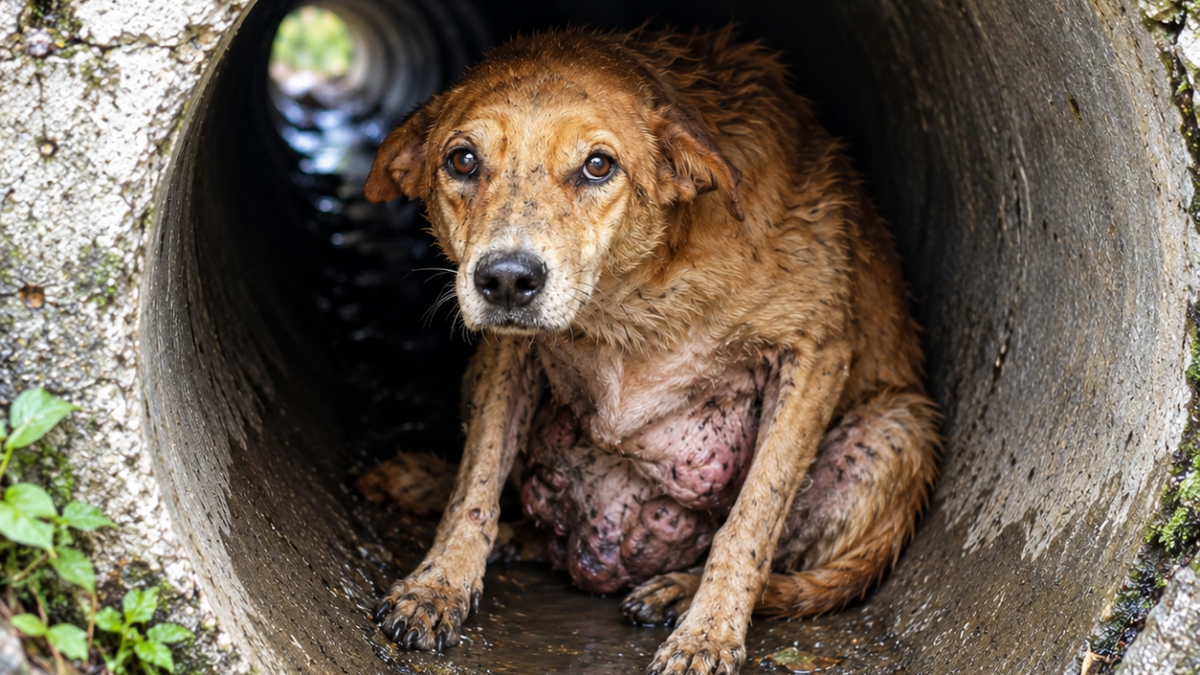
PART 2
“Call the fire department,” I said.
Rick already had his radio in his hand.
Within minutes, the entire atmosphere changed.
Until then, we had been treating the situation like a difficult animal rescue. Once the second storm began approaching, it became a confined-space emergency.
Rain began tapping against the leaves around us.
At first it was light.
Then steadier.
Lena stood beside me staring into the culvert.
“You’re thinking about crawling in.”
“I’m thinking about options.”
“That means yes.”
I didn’t answer.
She stepped directly in front of me.
“No.”
“She’s seventy feet in.”
“And if that pipe floods while you’re seventy feet in?”
I looked at the dark opening.
Lena’s voice softened.
“We save animals. We don’t create two victims.”
She was right.
I hated it, but she was right.
The first fire engine arrived twelve minutes later.
Captain Morales stepped out before the truck had completely stopped. He was a broad-shouldered man in his forties with a calm face and the kind of manner that made everybody nearby lower their voices automatically.
Rick showed him the drainage map.
I showed him the camera footage.
Morales watched it twice.
“That dog is farther in now?”
“About seventy feet.”
“And there’s access from this junction?”
Rick nodded.
“Maintenance cover downhill.”
“Open it.”
Two firefighters followed Rick toward the junction box.
Morales turned to me.
“Nobody crawls into this pipe from here.”
“We weren’t planning—”
Lena made a noise beside me.
Morales looked at her.
“She was planning.”
“I know.”
I gave her a look.
She ignored it.
Morales crouched beside the entrance.
“How frightened is the dog?”
“Extremely.”
“Will she bite?”
“Any dog in that much pain might bite.”
“Can she walk?”
“Barely.”
He nodded.
“We’ll approach from both directions. Nobody chases her. We just reduce her options.”
“That could work.”
“It has to.”
Rain struck the pavement harder.
Downhill, somebody shouted that the junction cover was open.
Morales radioed his crew.
A firefighter wearing a harness and carrying a gas monitor entered from the downstream access point.
We fed the inspection camera toward Ruby again—although at that moment, she did not yet have a name.
She had turned around.
The movement was agonizing to watch.
One of the tumors dragged against the concrete.
She jerked violently.
Her back legs slipped.
For a moment, she simply lay there breathing hard.
Lena whispered, “Come on, baby.”
The dog could not hear us through the camera.
We moved the food closer.
I crawled only a few feet into the entrance, staying where Morales allowed me.
“Hey, sweetheart.”
Her head lifted.
“You smell that?”
I placed pieces of cooked chicken in a line leading toward the opening.
Then I backed away.
For ten minutes, nothing happened.
Rainwater began forming a thin stream beneath the pipe.
Morales looked at Rick.
“How much rain before we have a problem?”
Rick shook his head.
“This system drains half the road above us. Could be twenty minutes. Could be forty.”
“That’s not an answer.”
“It’s the best one I have.”
The radio crackled.
The downstream firefighter had visual contact.
Morales answered.
“Do not advance unless instructed.”
I watched the camera.
A faint light appeared behind the dog.
She noticed it immediately.
Her head turned.
Her body tightened.
The firefighter remained still.
The dog stood.
Slowly.
Painfully.
She moved toward us.
“Good,” I whispered.
Ten feet.
Five more.
She stopped.
Her nose lifted.
She smelled the chicken.
I lowered myself into the mud outside the opening so I would appear smaller.
“Come on.”
The dog took another step.
I could see her now without the monitor.
Her coat was darker with water.
Her ribs showed through her sides.
The masses beneath her body looked even larger in person.
One had blood along the edge.
I felt anger rising in me.
Somewhere, somehow, this dog had reached this condition while the world kept moving around her.
But anger was useless right then.
I pushed it away.
She needed calm.
Her eyes locked on mine.
I immediately looked down.
Direct staring can feel threatening to a terrified dog.
I turned my shoulder slightly.
“You can have the food.”
She stretched her neck.
Another step.
Then a truck crossed the road above us.
The vibration echoed through the pipe.
The dog spun.
“No!”
She scrambled backward.
One tumor struck the concrete.
She cried out.
It was the first full sound we heard from her.
High.
Sharp.
Terrified.
And then she disappeared deeper inside.
I stood too quickly.
Lena grabbed my arm.
“Don’t.”
“She hurt herself.”
“And chasing her makes it worse.”
I clenched my jaw.
The rain intensified.
Water now ran continuously through the culvert.
Morales checked the drainage ditch.
“We don’t have another hour.”
I knew.
He knew.
Everybody knew.
We changed tactics.
The firefighter downstream moved forward just enough for the dog to see him.
Not chasing.
Not reaching.
Simply occupying the space behind her.
I returned to the entrance.
This time I brought a blanket.
Chicken.
A slip lead.
And a capture pole as a last resort.
Morales handed it to me.
“I don’t want to use that.”
“Neither do I.”
“If she panics—”
“You prevent her from going back in.”
I nodded.
The dog appeared again.
Forty feet.
Thirty.
Her legs shook.
She paused every few steps.
I kept my voice low.
“That’s it.”
Twenty feet.
“You’re doing good.”
Fifteen.
She could see me clearly now.
I held a piece of chicken in my open palm.
“You don’t have to trust me.”
Her nose moved.
“Just come eat.”
A surge of water moved beneath her paws.
The dog startled.
For once, fear worked in our favor.
She stepped forward.
Ten feet.
Eight.
Five.
Then she stopped at the mouth of the culvert.
Her front paws remained inside.
Her back legs trembled in running water.
I did not reach.
She looked at me.
I looked at the chicken.
After several seconds, she stretched her neck.
She took the food from my palm.
The contact lasted perhaps half a second.
Behind me, somebody shifted.
Her head snapped up.
A second surge of water rushed through the pipe.
It hit her back legs.
She stumbled.
Instinct took over.
I caught the slip lead and guided it over her head.
She panicked instantly.
Her body twisted.
She snapped at empty air.
“Blanket!”
Lena dropped the blanket over her.
The dog collapsed against the ground.
Not because she had suddenly accepted us.
She was simply exhausted.
I tightened the lead enough to keep her secure.
“Easy.”
She trembled beneath the blanket.
“I know.”
When we lifted her, a deep moan came from her throat.
Everybody around us went silent.
The sound was pure pain.
We carried her toward the rescue van.
Behind us, rainwater poured into the culvert.
Rick stood beside the ditch watching the level rise.
He looked at Morales.
“How long before that pipe is full?”
Morales shook his head.
“Not long.”
I climbed into the van beside the dog.
Lena took the driver’s seat.
“We good?”
“No.”
She looked back.
I added, “But go.”
The drive to Dr. Harris’s clinic took twenty-two minutes.
I spent every one of them sitting on the floor several feet from the crate.
The dog had pressed herself into the far corner.
Every bump made her flinch.
Every movement of my hand made her eyes widen.
I wanted desperately to touch her.
Instead, I kept my hands in my lap.
“You’re okay.”
She did not believe me.
“That’s fine.”
Her breathing remained fast.
“You don’t have to believe me yet.”
At the clinic, Dr. Harris and two technicians were waiting near the side entrance.
When the van door opened, he leaned inside.
For several seconds he said nothing.
Then he whispered, “That’s worse than the video.”
We carried her directly into an examination room.
Because she was terrified and painful, Harris decided against forcing a full conscious examination.
“We’ll sedate her lightly.”
“Is that safe?”
“Safer than wrestling with her.”
I watched the medication take effect.
At first she fought it.
Her head lowered.
Then lifted.
Lowered again.
Her eyes kept finding the door.
Finally, her muscles relaxed.
For the first time, I reached through the blanket and touched the top of her head.
Her fur was coarse with dirt.
“I’m sorry,” I whispered.
Dr. Harris began examining her.
There were more problems than we had seen.
Dehydration.
Significant weight loss.
Anemia.
Skin infection.
Ulcerated mammary masses.
Overgrown nails.
Old scars on her legs.
One ear had evidence of a previous untreated infection.
He listened to her lungs.
Then her heart.
He palpated her abdomen gently.
Finally he stepped back.
“Blood work first. Then chest X-rays.”
“Cancer?”
“Possible.”
“How possible?”
He looked at the largest tumor.
“Enough that we need to take it seriously.”
I felt my stomach tighten.
“Can you remove them?”
“Eventually.”
“Eventually?”
“She’s not stable enough for a major surgery tonight unless one of those masses starts hemorrhaging.”
“What do we do?”
“Fluids. Antibiotics. Pain management. Nutrition. Diagnostics. We get her stronger.”
I looked at the sleeping dog.
“And if we wait too long?”
“We won’t.”
The certainty in his voice steadied me.
They checked for a microchip.
Nothing.
No collar.
No tag.
No evidence that anyone was actively looking for her.
Animal control circulated her photograph.
Nearby shelters checked missing-animal reports.
We posted only a limited notice because we wanted any potential owner to provide identifying details before we released information.
No one called that first evening.
I stayed until nearly midnight.
The dog woke slowly from sedation.
When she realized she was inside a kennel, panic returned.
She pressed herself against the back wall.
A bowl of food sat untouched.
One technician approached.
The dog froze.
“Back off,” I said.
The technician stopped.
“Sorry.”
“It’s okay. Give her space.”
We dimmed the lights.
I sat on the floor outside the kennel.
Not close.
Just visible.
An hour passed.
Dr. Harris eventually came down the hallway.
“You going home?”
“Soon.”
“You said that earlier.”
“I meant it differently then.”
He leaned against the wall.
“She needs sleep.”
“So do I.”
“Yes.”
Neither of us moved.
Eventually he looked inside the kennel.
“She may not eat while you’re watching.”
That was enough to make me stand.
Before leaving, I placed one piece of chicken several feet from her bed.
The same kind we had used at the storm drain.
“Good night.”
She turned her face toward the wall.
I drove home.
I slept badly.
At six the next morning, I was back.
The chicken was gone.
So was half the food.
I smiled so hard my face hurt.
One of the technicians laughed.
“That’s the happiest I’ve ever seen somebody about missing dog food.”
“It’s progress.”
“It’s breakfast.”
“Same thing today.”
For the next several days, progress came in tiny pieces.
The dog ate if nobody stood too close.
She drank.
Her temperature improved.
The inflammation around the open masses began responding to antibiotics.
She allowed the technicians to change her bedding if they moved slowly.
She did not allow touching unless necessary.
We started calling her Ruby.
Lena chose the name.
“Because she’s red?”
“Because ‘storm-drain dog’ sounds terrible.”
“We don’t know whether she already has a name.”
“We don’t know anything about her.”
Ruby was watching us from the kennel.
Lena crouched.
“Ruby?”
One ear moved.
Lena pointed triumphantly.
“See?”
“That proves absolutely nothing.”
“It proves she likes it.”
“It proves she has ears.”
Ruby’s ear moved again.
Lena smiled.
“Two votes against one.”
The name stayed.
Her fear patterns became clearer.
Men frightened her more than women.
Heavy boots frightened her.
Raised voices frightened her.
Metal clanging frightened her.
A mop handle leaning against a wall sent her scrambling into the corner.
We never knew exactly what had happened to her before the tunnel.
I refused to create a dramatic history we could not prove.
Fear can come from abuse.
It can also come from neglect, isolation, pain, lack of socialization, or a thousand frightening experiences on the street.
What we did know was simple.
Human beings were not safe in Ruby’s mind.
So we decided not to demand trust.
We would earn it.
On day three, I sat about ten feet from her kennel while she ate.
When I moved to eight feet, she stopped.
I backed up.
She resumed eating.
The next morning, I sat nine feet away.
Then eight.
Then seven.
We built the distance slowly.
One afternoon, a metal tray crashed in the treatment room.
Ruby slammed herself into the back wall.
I remained seated.
“It’s okay.”
She trembled.
I didn’t move closer.
Five minutes passed.
Then ten.
Her breathing slowed.
I slid a piece of chicken toward her.
She stared at it.
Then me.
Then the chicken again.
She stepped forward.
Grabbed it.
Retreated.
The following day she did the same thing.
The day after that, she took the chicken from my fingertips.
Her lips brushed my skin.
I froze.
Lena happened to walk past.
She stopped.
“What?”
“Nothing.”
“You look like you’re about to cry.”
“I’m not.”
“Did she bite you?”
“No.”
“Then you’re crying because she touched your hand.”
“I’m not crying.”
“You’re absolutely crying.”
I wiped my eye.
“Dust.”
“In a veterinary clinic.”
“Very dusty.”
She laughed and walked away.
The medical results were cautiously encouraging.
Her chest X-rays did not show obvious metastatic disease.
Her abdominal imaging showed no immediate crisis.
But the tumors needed surgery.
Dr. Harris estimated that the largest mass alone weighed several pounds.
He showed me the blood work.
“Her anemia is improving.”
“When can you operate?”
“If she keeps eating and the infection keeps responding, maybe four more days.”
“Four?”
“She’s survived with these tumors for months. Four days of stabilization could be the difference between tolerating anesthesia and crashing on the table.”
That ended my argument.
Ruby gained strength.
She began standing when I entered the room.
Not greeting me.
Just standing.
Then she began moving toward the front of the kennel.
One evening, I placed my fingers against the bars.
She stared.
I waited.
She took one step.
Then another.
Her nose touched my hand.
She smelled me.
I didn’t move.
For several seconds, she remained there.
Then she pressed the side of her muzzle lightly against my fingers.
My throat tightened.
“Hey.”
She stepped back.
But she did not retreat to the corner.
That night, I sat beside her longer than usual.
“Tomorrow’s surgery day.”
Her ears moved.
“I wish I could explain this.”
She watched me.
“You’re going to wake up hurting.”
I swallowed.
“But it should be a different kind of hurt.”
I stopped myself.
I was talking as if success were guaranteed.
It wasn’t.
So I changed the promise.
“Whatever happens, you won’t wake up alone.”
The surgery began shortly after eight the next morning.
I thought I understood waiting.
I did not.
The first hour passed slowly.
The second barely moved.
During the third, I reorganized supplies that did not need reorganizing.
Lena finally took a box from my hands.
“You’re making everybody nervous.”
“I’m doing inventory.”
“You’ve inventoried the same gauze three times.”
“It keeps changing.”
“Gauze does not change.”
“You don’t know.”
She stared at me.
“You need coffee.”
“I need an update.”
As if summoned, a technician opened the surgical door.
I stood so quickly the chair behind me moved.
“Is she okay?”
“She’s stable.”
“Why are you out here?”
“To tell you she’s stable.”
“That’s it?”
“That’s it.”
She smiled.
“Dr. Harris predicted you’d assume somebody died if we opened the door without warning.”
“He knows me.”
She disappeared again.
Another hour passed.
Then Harris emerged.
His surgical cap was still on.
His shoulders looked exhausted.
But he smiled.
“She’s awake.”
I closed my eyes.
“Everything went okay?”
“As well as we could hope.”
He explained that they had removed the largest ulcerated masses and affected mammary tissue on one side.
They had also collected samples for pathology.
“There are smaller masses on the opposite chain.”
“You didn’t remove them?”
“Too much surgery at once. Her body has limits.”
“So another operation?”
“Possibly. First she heals.”
I nodded.
“When can I see her?”
“Five minutes.”
I was waiting outside recovery in three.
Ruby looked impossibly small beneath the blankets.
The massive growths that had defined her silhouette were gone.
Bandaging covered the surgical area.
Her eyes opened.
They found me.
“Hey, tunnel girl.”
Her eyes closed again.
Then I heard something beneath the blanket.
Thump.
I looked at Lena.
“Did you—”
Thump.
Lena covered her mouth.
“Her tail.”
Ruby’s tail moved again.
It was the first time she had wagged it for us.
I laughed.
Then I cried.
This time I didn’t blame the dust.
Recovery was difficult.
Ruby was nauseated the first night.
She refused breakfast.
The incision developed swelling.
One section became irritated enough that Dr. Harris worried about fluid accumulation.
For almost twenty-four hours, I felt as though we had taken one step forward and ten backward.
But her temperature stayed normal.
Her blood work remained acceptable.
The swelling began to decrease.
Then she ate.
Not a little.
An entire bowl.
Dr. Harris carried the empty bowl into the hallway.
“She ate everything.”
“That’s good?”
“That’s excellent.”
“Can she have more?”
He gave me a look.
“Do not turn my recovering cancer patient into an obese recovering cancer patient.”
“Understood.”
Ruby received small meals.
She disagreed with this policy.
Her appetite became one of the first glimpses we had of her actual personality.
She loved chicken.
She tolerated kibble.
She considered green beans an insult.
She was suspicious of cheese until she tried it.
Then cheese became extremely important.
When the pathology report arrived eight days later, Dr. Harris called me into his office.
I hated the phrase “sit down” before I even heard it.
He placed the report in front of him.
“Most of the masses were benign mammary tumors.”
I exhaled.
“Most?”
“One was malignant.”
The room seemed smaller.
“What kind?”
“Mammary carcinoma.”
I stared at him.
“Did it spread?”
“We don’t have evidence that it did.”
“That’s not the same as no.”
“No.”
He appreciated precision even when I hated it.
“The margins around the removed tumor are clean. The lymph node sample was negative. Her chest films were encouraging. Those are all good signs.”
“Good enough?”
“Good enough to be hopeful.”
I looked through the office window toward the treatment area.
Ruby was asleep in her kennel.
“What happens now?”
“She heals. We repeat imaging later. And once she’s strong enough, we remove the remaining suspicious mammary tissue.”
“Another major surgery.”
“Yes.”
I looked down at the pathology report.
“How much time does she have?”
Harris shook his head.
“No honest veterinarian can answer that.”
“Years?”
“Possibly.”
“Months?”
“Also possible.”
“That’s a terrible answer.”
“It’s the truthful one.”
I hated it.
But truth was what Ruby needed.
Not promises.
She was discharged from the clinic two weeks after the first surgery.
Then we faced the question nobody had really discussed.
Where would she go?
Our rescue relied on foster homes.
Most were wonderful.
Most were also busy.
Children.
Other dogs.
Visitors.
Doorbells.
Neighborhood noise.
Ruby needed quiet.
Routine.
Predictability.
Lena found me reviewing the foster list.
“You have a spare room.”
“No.”
“You haven’t even heard the rest.”
“I know where this is going.”
“You live ten minutes from the clinic.”
“No.”
“You have a fenced yard.”
“No.”
“You have Milo.”
I looked at her.
Milo was my eleven-year-old shepherd mix.
He had seen dozens of foster dogs come and go.
His philosophy toward most living creatures was calm indifference.
“Ruby is afraid of everything.”
“Milo is afraid of nothing except thunderstorms and empty food bowls.”
“He’s old.”
“Exactly. He won’t chase her.”
I crossed my arms.
Lena crossed hers.
Ruby watched us from her bed.
“This is temporary.”
“Of course.”
“I mean temporary.”
“Absolutely.”
“I foster emergency cases. I’m not adopting another dog.”
“Nobody said adoption.”
The look on her face said otherwise.
That afternoon, Ruby came home with me.
I carried her crate into the spare room.
Set water nearby.
Placed a bed beneath the desk.
Opened the crate.
Then left.
For three hours, she did not come out.
I watched through a small camera.
Eventually her nose appeared.
Then one paw.
Then another.
She stepped into the room.
Smelled the floor.
Looked toward the door.
Then crawled beneath the desk.
That became her safe place.
For the first week, I designed my life around not frightening Ruby.
I left food nearby.
I sat on the floor across the room and worked on my laptop.
I spoke quietly.
Sometimes I read emails aloud simply so she could hear my voice without anything happening afterward.
Milo knew immediately that another dog was in the house.
He sniffed beneath the door.
Ruby froze.
Milo sneezed.
Then wandered away.
The next day, he did it again.
By day four, Ruby no longer panicked at the sound of his collar tags.
I installed a baby gate across the doorway and opened the door.
Milo walked past.
Ruby watched him from beneath the desk.
Five minutes later, he came back.
Stopped.
Saw her.
Sat down.
Ruby stared.
Milo yawned.
Then he lay on the hallway carpet and went to sleep.
I almost laughed.
“You’re very impressive.”
Milo opened one eye.
Ruby leaned forward.
That was their first conversation.
Their second happened in the yard.
I kept both dogs on leash with plenty of distance.
Ruby froze when her paws touched grass.
For several seconds, she simply stood there.
The sun was warm.
Leaves moved in the breeze.
A bird called from the fence.
Ruby lifted her nose.
She smelled everything.
After surviving inside concrete and then spending weeks in a veterinary clinic, grass seemed to confuse her.
Milo walked ahead and began investigating a bush.
Ruby watched him.
Then she followed.
Five feet behind.
Then three.
Milo did not care.
Ruby did.
By the end of ten minutes, she was walking behind him as if he were showing her how the yard worked.
From that day forward, Milo became Ruby’s interpreter for ordinary life.
If Milo walked through a doorway, Ruby became more willing to follow.
If Milo slept through the washing machine, Ruby gradually stopped trembling when it ran.
If Milo approached me for affection and remained alive afterward, Ruby watched.
Very closely.
Every ordinary interaction became evidence.
Humans could touch dogs without causing pain.
Doors could open without danger.
Bowls could be filled more than once.
Leashes did not always lead somewhere frightening.
Cars sometimes ended at parks instead of clinics.
Learning those things took months.
The first time Ruby voluntarily entered the living room while I was sitting there, I pretended not to notice.
She stood in the doorway.
Milo was beside me having his chest scratched.
Ruby watched.
Then took one step.
Stopped.
Another.
Stopped.
She reached Milo first.
Sniffed his back.
Then my sleeve.
I kept my hand still.
Ruby sniffed my wrist.
Her nose was cold.
She looked at me.
I looked slightly away.
Then she pushed her head under my palm.
My chest tightened.
Slowly, I scratched beneath her chin.
Her eyes closed.
Three seconds.
Maybe four.
Then she backed away.
She stayed in the room.
That mattered more.
After that, progress accelerated.
Ruby began following me into the kitchen.
She waited beside Milo when I prepared meals.
She started sleeping outside the spare room.
First in the hallway.
Then beside the sofa.
One night I woke at two in the morning and found her standing beside my bed.
“Hey.”
She lowered her head.
I reached down.
She sniffed my hand.
Then walked away.
The next night she returned.
On the fourth night, she lay beside the bed.
I woke in the morning and nearly stepped on her.
“You know you have six dog beds.”
Her tail moved.
“That’s not an apology.”
She stretched.
I smiled.
Ruby’s second surgery took place six weeks after the first.
By then, she had gained weight.
Her blood counts looked much better.
The original incision had healed.
Dr. Harris removed the remaining suspicious mammary tissue and spayed her during the same hospitalization.
When the technician took her leash, Ruby turned toward me.
She pulled backward.
Toward me.
The technician stopped.
“Well.”
I crouched.
“It’s okay.”
Ruby tried to move closer.
“She’s never done that,” I said.
The technician smiled.
“She knows where home is.”
I didn’t respond to that.
I told Ruby, “I’ll be here.”
She allowed herself to be led away.
The second procedure went more smoothly.
The pathology was better too.
No additional malignant tumors were identified.
We still had to monitor her.
But for the first time, Dr. Harris used a word I had been waiting months to hear.
“Excellent.”
I stared at him.
“Excellent?”
“Yes.”
“You never say excellent.”
“I sometimes say excellent.”
“You say ‘acceptable.’ You say ‘encouraging.’ Once you said ‘not terrible.’”
He smiled.
“Fine. Her results are excellent.”
I crouched beside Ruby.
“Did you hear that?”
She licked my chin.
Harris pointed at her.
“That does not mean unlimited cheese.”
Ruby’s ears dropped.
“Cruel man,” I whispered.
After recovery, we listed her for adoption.
That had always been the plan.
At least, that was what I kept telling myself.
The rescue received dozens of messages.
Ruby’s story had spread through our local network.
People wanted to help.
But wanting to help was not the same as being suitable for a fearful dog.
One family had three young children.
They were kind.
They were loving.
They were not right for Ruby.
Another applicant owned two high-energy huskies.
Ruby would have spent her life hiding.
One man wrote that fearful dogs needed “firm discipline.”
His application was rejected within five minutes.
Then Claire applied.
She lived alone in a quiet neighborhood.
Worked from home.
Had previously owned a severely shy rescue dog.
No children.
No other pets.
Fenced yard.
Few visitors.
On paper, she looked almost perfect.
Her first visit confirmed it.
Claire entered the house and completely ignored Ruby.
No baby voice.
No staring.
No reaching.
She sat sideways on the floor.
We talked.
Every few minutes, Claire tossed a treat several feet away without looking.
Ruby watched from the hallway.
Twenty minutes passed.
Then Ruby stepped forward.
Claire kept talking to me.
Ruby collected the treat.
Retreated.
Claire threw another.
Ruby came closer.
After forty minutes, Ruby was within six feet of her.
“Most people would have tried to touch her by now,” I said.
Claire smiled.
“My last dog took three months before he let me touch him.”
“What happened?”
“He became the clingiest dog on earth.”
I liked her immediately.
We arranged another visit.
Then another.
Ruby tolerated Claire surprisingly well.
The fourth time, Claire sat on my patio while Ruby rested beside Milo.
“She’s beautiful,” Claire said.
I looked at Ruby.
Her scars were visible along her abdomen.
“Yeah.”
Claire watched me.
“You’re going to have trouble.”
“With what?”
“Letting her leave.”
“I foster.”
“That isn’t an answer.”
“She needs her own family.”
Claire nodded.
“I agree.”
We scheduled a trial adoption for Saturday.
Friday night, I packed Ruby’s belongings.
Food.
Medication history.
Veterinary records.
Favorite blanket.
Leash.
Harness.
A rubber toy she had finally learned to play with.
Milo watched from his bed.
Ruby followed me around the room.
“You’re making this harder.”
Her tail moved.
“This is a good thing.”
She tilted her head.
“Claire is great.”
Ruby walked away.
I looked at Milo.
“Say something useful.”
He went back to sleep.
That night, Ruby came into my bedroom.
She rested her chin on the mattress.
I opened my eyes.
“What?”
Her tail tapped the dresser.
I scratched behind her ear.
“You’re leaving tomorrow.”
She leaned closer.
“You’ll like it there.”
She looked at me.
I had the irrational feeling she understood every word.
“You’ll have your own yard.”
Her ears moved.
“No Milo stealing treats.”
Milo snored from the hallway.
Ruby remained beside the bed.
Eventually she lowered herself onto the floor.
Directly beside me.
I stared at the ceiling.
“That’s manipulative.”
Her tail thumped once.
“You’ve had months to sleep there.”
No response.
I did not sleep much.
Claire arrived at ten the next morning.
Ruby recognized her.
Accepted a treat.
We reviewed everything at the kitchen table.
Triggers.
Food.
Medication.
Follow-up appointments.
Emergency numbers.
Behavioral routines.
Claire listened carefully.
Ruby lay beside Milo.
Every few minutes, I noticed her looking at me.
Claire noticed too.
Eventually she closed the folder.
“I have a question.”
“Sure.”
“Does she always do that?”
“Do what?”
“Watch you.”
I looked at Ruby.
Her eyes were fixed on me.
I shifted in my chair.
Her head moved.
“I guess.”
“You guess?”
“I stopped noticing.”
Claire smiled.
“That’s because you’re part of her environment now.”
I looked down.
“She’ll adapt.”
“Probably.”
Claire paused.
“But I don’t think she should have to.”
I frowned.
“What do you mean?”
“I came here because I wanted to adopt Ruby.”
“Okay.”
“But the dog I read about in the adoption profile needed a quiet person and a safe home.”
“That’s you.”
Claire nodded.
“The dog sitting over there already has both.”
I looked toward Ruby.
“She’s my foster.”
Claire laughed softly.
“I know.”
“I foster dogs so they can leave.”
“Usually.”
I rubbed my forehead.
“This isn’t fair to you.”
“Why?”
“You went through four visits.”
“Because I wanted to make sure.”
“Make sure of what?”
“That I wasn’t imagining it.”
I stared at her.
Claire nodded toward Ruby.
“She chose you a long time ago.”
The room became very quiet.
Ruby stood.
Walked across the kitchen.
Stopped beside my chair.
Then leaned against my leg.
Claire smiled.
“That’s what I mean.”
I looked down at Ruby.
“What am I supposed to do with you?”
Her tail moved.
Claire laughed.
“Apparently sign different paperwork.”
She left without Ruby.
Two months later, Claire adopted another dog through our rescue—a shy hound mix who hid from almost every visitor.
Within three weeks, Claire sent me a photograph of the hound sleeping upside down on her couch.
Ruby stayed with me.
Officially.
Lena brought the adoption papers to the clinic.
She placed them on the counter with exaggerated ceremony.
“Ladies and gentlemen.”
“Don’t.”
“Today we witness the final collapse of the phrase ‘temporary foster.’”
“Please go work.”
Dr. Harris looked up.
“I recall ‘absolutely temporary.’”
“You too?”
“I’m a medical professional. Accuracy matters.”
Lena handed me the pen.
Ruby stood beside my leg.
I signed.
“There.”
Lena looked at Ruby.
“Congratulations.”
Ruby wagged her tail.
“Traitor,” I told her.
Life did not magically become easy after adoption.
Ruby still had fear.
Serious fear.
Some days were harder than others.
A repairman came to fix the air conditioner and dropped a metal wrench.
Ruby disappeared under the desk.
She remained there for four hours after he left.
At one veterinary appointment, a man wearing heavy work boots walked through the lobby.
Ruby flattened herself against the floor and urinated.
We changed the way we handled appointments.
I checked in from the parking lot.
We waited in the car.
The staff brought us directly into a room.
Visitors were instructed not to approach Ruby.
If she wanted contact, she initiated it.
We used a secure harness and backup collar on walks.
No retractable leash.
No casual introductions with strangers.
No forcing her into environments she could not handle.
Progress was measured by recovery, not by whether she became fearless.
The goal was never to turn Ruby into a dog who loved everybody.
The goal was to give her enough confidence to live comfortably in the world she had.
Milo helped constantly.
Our first walk beyond the neighborhood lasted eight minutes.
Ruby startled at a trash truck and tried to reverse out of her harness.
Milo barely looked up.
She watched him.
A few seconds later, she stopped pulling.
The second trip lasted fifteen minutes.
By the fifth, Ruby sniffed trees.
By the tenth, she wagged when I brought out the leash.
The quiet park became her favorite place.
We went early in the morning before crowds arrived.
She walked beside Milo.
Sometimes she ran through wet grass.
The first time she tried to play, I almost didn’t understand what she was doing.
She lowered her front half.
Raised her back end.
Bounced sideways.
Milo stared at her.
Ruby bounced again.
Milo looked at me as if asking whether he really had to participate.
“Come on, old man.”
He gave one half-hearted play bow.
Ruby exploded into motion.
She ran a circle around him.
Then another.
Her ears flew backward.
Her mouth opened.
For the first time, I saw what Ruby looked like when her body was not organized around pain or fear.
She looked young.
She looked ridiculous.
She looked free.
Milo tolerated approximately forty seconds of this before sitting down.
Ruby continued alone.
I laughed until my stomach hurt.
Six months after the first surgery, we returned to the clinic for repeat imaging.
I hated those appointments.
Ruby had improved so much that cancer sometimes felt like part of another life.
Then every follow-up dragged the fear back into the room.
Dr. Harris reviewed the films.
I watched his face instead of the screen.
“Well?”
He zoomed in.
Scrolled.
Looked again.
“Harris.”
He turned.
“I don’t see evidence of metastatic disease.”
I exhaled.
“Nothing?”
“Nothing obvious.”
“That’s good?”
“That’s very good.”
I crouched beside Ruby.
She licked my chin.
Harris looked down at her chart.
“However.”
I froze.
“What?”
“She gained two pounds.”
I stared at him.
“That’s your however?”
“Yes.”
“You nearly killed me.”
“Ruby needs to lose weight.”
“For months you told me to fatten her up.”
“You have completed that assignment.”
Ruby stared at the treat jar.
I pointed at her.
“This is your fault.”
Harris said, “It is definitely your fault.”
Ruby received half a treat anyway.
The anniversary of the storm-drain rescue arrived with another thunderstorm.
I remembered the date immediately.
There are some days that settle into your body permanently.
The weather forecast had predicted rain.
By evening, the sky turned almost the same dark gray it had been the day we found her.
I was standing in the kitchen when thunder rolled.
Ruby lifted her head.
Storms were still difficult for her.
During her first months with me, thunder sent her under the desk.
Later, she began hiding in the hallway instead.
Eventually, she learned to remain in the same room if Milo was nearby.
That evening, Milo was asleep in the living room.
Ruby stood beside the back door.
Another rumble came.
She looked toward the hallway.
I expected her to run.
She walked toward me instead.
I lowered my hand.
Ruby pushed her head beneath it.
“You okay?”
Her ears were back.
She leaned against my leg.
Rain began striking the windows.
I sat on the floor.
Ruby lowered herself beside me.
Her heart was beating quickly.
Milo entered the kitchen, glanced at us, and apparently decided we were doing something that might involve snacks.
He collapsed beside Ruby.
Thunder rolled again.
Ruby flinched.
Then she pressed closer to Milo.
I thought about the concrete tunnel.
Water rising around her feet.
Tumors rubbing against stone.
The terrified eyes that disappeared every time we approached.
I thought about the first piece of chicken she took from my hand.
The first tail wag.
The first time she slept beside my bed.
The adoption papers.
All of it had begun because somebody heard a faint cry beneath a road and decided not to ignore it.
The storm continued.
Ruby stayed beside me.
By the second year, her veterinary visits became less frightening.
Not easy.
Just less frightening.
She recognized Dr. Harris.
He respected her rules.
He never reached directly over her head.
He entered sideways, spoke to me first, tossed a treat away from himself, and waited.
Eventually Ruby began approaching him.
The first time she voluntarily smelled his hand, he looked at me.
“I’d like it noted that this is historic.”
“You’re getting emotional.”
“I’m not.”
“Dust?”
“Very dusty clinic.”
I laughed.
Ruby took another treat.
Her cancer screening remained clear.
One year became two.
Then three.
Milo slowed down.
Age came for him quietly.
His back legs weakened.
His hearing faded.
Walks became shorter.
Ruby adjusted before I did.
She stopped trying to make him run.
At the park, she would sprint ahead, then circle back.
If he stopped to rest, she waited.
One evening, I found Ruby licking the side of Milo’s face while he slept.
He opened one eye.
Did not move.
Ruby lay beside him.
I stood in the doorway longer than I intended.
Milo had taught her how to be a dog inside a home.
Now she was taking care of him.
His decline accelerated that winter.
Dr. Harris treated his arthritis.
We changed medications.
Added rugs so he would not slip.
Raised his food bowl.
Used a ramp for the car.
Ruby adapted to every change.
Then one morning, Milo could not stand.
I carried him to the clinic.
Ruby stayed home.
I already knew before Harris finished the examination.
There are moments when medical language becomes a kindness because ordinary language is too painful.
Neurological decline.
Severe mobility loss.
Poor prognosis.
Quality of life.
I listened.
I understood.
I still did not want to hear it.
Harris sat across from me.
“You’ve given him time.”
“It doesn’t feel like enough.”
“It never does.”
I looked at Milo.
He was resting on the blanket.
His face had gone almost completely gray.
“Can I take him home tonight?”
“Yes.”
“Tomorrow?”
Harris nodded.
“We’ll do it tomorrow.”
At home, Ruby knew something was wrong immediately.
She smelled Milo.
Then me.
Then Milo again.
That night, she slept beside him.
I lay on the floor with both dogs.
Milo’s breathing was slow.
Ruby placed one paw across his front leg.
I did not sleep.
The next morning, we went back.
I brought Ruby.
I was not sure whether it was the right decision, but I wanted her to understand that Milo had not simply disappeared.
After he was gone, Dr. Harris gave us time.
Ruby approached slowly.
She smelled Milo’s face.
His shoulder.
His paws.
Then she stood beside him for a long moment.
She did not panic.
She did not whine.
Eventually she turned and came to me.
I wrapped my arms around her.
For once, she did not pull away.
The house felt enormous afterward.
Milo’s bed remained beside the sofa for weeks.
Ruby smelled it every day.
For a while, she became quieter.
She followed me more closely.
At night, she stopped sleeping beside my bed.
Instead, she climbed onto Milo’s old bed.
I almost moved it once.
I couldn’t.
Spring arrived.
Ruby slowly became herself again.
We returned to the park.
The first few visits were difficult.
She kept looking behind us.
I knew who she expected to see.
One morning, she stopped in the middle of the path.
The same place where Milo used to rest.
Ruby looked toward me.
Then toward the field.
I unclipped her long training line.
“Go.”
She ran.
Not away.
Across the field.
A wide circle.
Then back to me.
She stopped with her chest heaving.
Her tail wagging.
I crouched.
“You miss him too?”
Ruby pressed her forehead against my shoulder.
We stayed there until the sun climbed over the trees.
A few months later, our rescue received another emergency call.
A young dog had been found abandoned near a warehouse.
Terrified.
Underweight.
Would not let anyone touch him.
I initially said no to fostering.
Ruby was comfortable.
Stable.
My house had finally become predictable.
Then I saw the photograph.
The dog was pressed into the back corner of a kennel, eyes wide, body folded inward.
I knew that posture.
I knew the calculation behind those eyes.
Distance means survival.
Darkness means safety.
People mean danger.
I drove to the shelter.
His name was eventually Toby.
He was a black-and-white mixed breed with enormous ears and absolutely no confidence.
When I brought him home, Ruby stood behind the baby gate.
Toby froze.
Ruby sniffed.
He backed away.
I expected Ruby to become nervous.
Instead, she did something I had seen years earlier.
She sat down.
Then yawned.
Exactly like Milo.
I started laughing.
Ruby looked at me.
“You remember.”
Over the next several weeks, Ruby became Toby’s interpreter.
If Ruby walked through the doorway, Toby followed.
If Ruby ate beside me, Toby moved closer.
If Ruby slept during the washing machine cycle, Toby eventually stopped trembling.
One evening, I sat on the floor.
Ruby came for scratches.
Toby watched from the hallway.
I kept my eyes on Ruby.
Toby moved closer.
Then closer again.
The scene felt so familiar that my chest hurt.
He sniffed Ruby.
Then my sleeve.
Ruby remained calm.
Toby touched my wrist with his nose.
I did not move.
He backed away.
I looked at Ruby.
She was watching him.
“You taught him that.”
Her tail moved.
Toby eventually found an adopter.
A quiet retired couple.
No children.
Large fenced yard.
They understood fearful dogs.
When he left, Ruby watched from the window.
This time, I did not become a foster failure.
Lena congratulated me.
“You’re recovering.”
“From what?”
“Permanent adoption syndrome.”
“I adopted one foster dog.”
“One very dramatic foster dog.”
Ruby barked from the hallway.
Lena pointed.
“She agrees.”
Years passed.
Ruby’s scars faded beneath her coat.
Her medical records grew thicker.
Her fear never disappeared completely.
Certain noises still made her flinch.
Storms still sent her looking for me.
Men in heavy boots remained suspicious.
But her life became much larger than fear.
She learned to love car rides.
She developed an obsession with sleeping in sunbeams.
She stole socks but never damaged them.
She carried them from room to room like trophies.
She learned that the refrigerator opening might mean cheese.
She learned that veterinary technicians could be manipulated with sad eyes.
Dr. Harris accused her of becoming spoiled.
I accused him of contributing.
He denied everything while handing her treats.
On the fourth anniversary of her rescue, Rick contacted me.
I had not heard from him in almost three years.
His message was simple.
Is that storm-drain dog still around?
I sent him a photograph.
Ruby was lying upside down on my couch with all four legs in the air.
Rick replied immediately.
No way.
I wrote:
Way.
A few days later, he asked whether he could visit.
I hesitated.
Ruby still did not love unfamiliar men.
But Rick had been part of the reason she was alive.
So we arranged to meet outside in the yard.
He came without work boots.
I noticed that.
“I remembered what you said.”
“Good.”
Ruby stood twenty feet away.
Rick crouched sideways.
“Hey, girl.”
Ruby watched him.
He tossed a treat.
She approached slowly.
Took it.
Backed away.
Rick smiled.
“I can’t believe that’s her.”
“She’s changed.”
He looked at the scars beneath her belly.
“I remember carrying that blanket.”
“So do I.”
He stared at Ruby for several seconds.
“You know what I think about sometimes?”
“What?”
“If we hadn’t turned the equipment off.”
I knew what he meant.
The workers heard Ruby only when the machines went quiet.
“If you hadn’t heard her.”
“Yeah.”
Ruby approached again.
Rick placed another treat on the ground.
This time she ate it and remained nearby.
He looked at me.
“She got lucky.”
I looked at Ruby.
“Yes.”
Then I thought about it.
“She got lucky eventually.”
That distinction mattered.
Luck had not protected her from pain.
Luck had not prevented the tumors.
Luck had not kept her from ending up alone inside a storm drain.
But luck had put workers nearby who listened.
It had brought rescue volunteers.
Firefighters.
A veterinarian.
Foster space.
Milo.
A hundred small chances.
Ruby had survived because those chances accumulated.
Before Rick left, Ruby allowed him to touch the side of her shoulder.
Only once.
He looked stunned.
“I’m honored.”
“You should be.”
He laughed.
Ruby walked back to me.
That evening, another storm moved across town.
Not severe.
Just rain and distant thunder.
Ruby was older now.
Gray had begun appearing around her muzzle.
She climbed onto the couch beside me without invitation.
Thunder rolled.
Her ears lifted.
I placed my hand against her chest.
Her heart accelerated.
But she did not run.
“Remember that tunnel?”
Ruby looked at me.
“Of course you don’t.”
Maybe that was the best thing.
Animals do not tell their stories the way we do.
They do not sit awake replaying the exact dates and conversations.
I had no idea whether Ruby remembered the storm drain.
The darkness.
The rising water.
The pain.
Maybe certain sounds remained somewhere inside her body.
Maybe the fear survived even after the memory faded.
But she knew the couch.
She knew my hand.
She knew the kitchen.
She knew the sound of the leash.
She knew that food appeared every morning.
She knew that when thunder came, she could move toward me instead of away from everyone.
At her next annual checkup, Dr. Harris spent longer than usual listening to her chest.
I noticed.
“What?”
He did not answer immediately.
That was enough.
“Harris.”
He stood.
“I’m hearing something I want to investigate.”
My stomach dropped.
“What?”
“A heart murmur.”
“Cancer?”
“No. Different issue.”
I almost laughed from relief.
Then realized how strange that was.
“What does it mean?”
“Could be age-related valve disease. Could be mild. We need an echocardiogram.”
Ruby looked between us.
I touched her shoulder.
“How worried should I be?”
“Concerned enough to investigate. Not panicked.”
I had learned his vocabulary.
“Not panicked” meant we had time.
The cardiac evaluation showed early degenerative valve disease.
Manageable.
Monitorable.
Not immediately dangerous.
I drove home feeling strangely grateful.
Years earlier, every medical finding had sounded like a countdown.
Now Ruby was developing ordinary older-dog problems.
Arthritis.
A heart murmur.
Gray fur.
Slower mornings.
There was something beautiful about that.
She had lived long enough to become old.
Dr. Harris eventually retired.
On his last day at the clinic, I brought Ruby.
He sat on the floor.
She approached without hesitation.
No treats required.
He rubbed her neck.
“Remember when you wouldn’t come within ten feet of me?”
Ruby leaned against him.
“That answers that.”
I smiled.
“You’re going to miss her.”
“I’m going to miss both of you.”
“Mostly her.”
“Obviously.”
He opened a drawer.
Took out a small envelope.
“What’s this?”
“Something I kept.”
Inside was a printed photograph.
Ruby inside the clinic after her first surgery.
Wrapped in blankets.
Eyes half open.
I had forgotten someone took it.
She looked tiny.
Broken.
Terrified.
I stared at the picture.
“She doesn’t even look like herself.”
Harris glanced at the older Ruby beside him.
“She was herself.”
I looked at him.
“She just hadn’t had the chance to become all of herself yet.”
That sentence stayed with me.
I put the photograph in a frame.
At home, I placed it on a shelf.
Beside it went another picture.
Ruby running through the park.
Mouth open.
Ears flying.
The difference between them was not just medical.
It was everything.
Her final years were slower.
She still loved the park.
But we walked shorter loops.
She stopped jumping onto the couch and waited for the little ramp I bought.
Her hearing faded slightly.
She slept deeper.
Sometimes I would enter the room and she would not wake until I touched the floor beside her.
Then her eyes opened.
Her tail moved.
Always the tail.
One winter night, nearly eight years after we found her, Ruby did not finish dinner.
That was unusual enough to frighten me immediately.
By morning she was breathing faster.
I took her to the clinic.
Different veterinarian.
Same examination room.
Blood work.
X-rays.
Ultrasound.
I sat beside Ruby on the floor.
The doctor came in.
She closed the door.
I recognized the expression.
“We found a mass near her spleen.”
My hand remained on Ruby’s shoulder.
“Cancer?”
“We don’t know yet.”
I almost laughed.
After all those years, we were back to the same words.
We don’t know yet.
“What are the options?”
The veterinarian explained them carefully.
More imaging.
Possible surgery.
Biopsy.
But Ruby was older now.
Her heart disease mattered.
Anesthesia mattered.
Recovery mattered.
This was not the young dog we had pulled from the tunnel.
I listened.
Asked questions.
Took notes.
Then I went home.
That night Ruby ate chicken from my hand.
Just like the first day.
I sat on the floor.
She rested her chin on my leg.
“We’ve been here before.”
Her eyes closed.
“You were tougher then.”
Her tail moved.
“Actually, you’re still tougher than me.”
The specialist determined that surgery was possible but risky.
The mass had not ruptured.
There was no obvious widespread disease.
I had to decide.
Years earlier, every decision had been easy because Ruby wanted to live and her body still had strength.
Now the calculation was different.
Would surgery give her meaningful time?
Or would it take what comfortable time she still had?
I spoke with three veterinarians.
Nobody told me what to do.
That was frustrating.
It was also appropriate.
Finally, one of them said something that clarified it.
“Don’t ask whether you can buy more time. Ask what kind of time you’re buying.”
I looked at Ruby.
She still wanted walks.
Food.
Affection.
She still carried socks.
She still barked when delivery trucks stopped outside.
She still had a life she enjoyed.
We chose surgery.
I hated leaving her at the hospital.
The procedure lasted two hours.
The spleen was removed.
The mass had not ruptured.
Ruby woke slowly.
The pathology returned several days later.
Benign.
I read the word three times.
Then called Lena.
“Benign.”
She screamed into the phone.
Ruby survived another year and a half.
Not dramatic years.
Good years.
Quiet years.
She slept in sunlight.
Ate too much cheese.
Walked slowly around the neighborhood.
She became surprisingly bossy.
If dinner was five minutes late, she stared at me.
If I ignored the stare, she barked once.
If I continued ignoring her, she brought me a sock.
I never understood the logic.
It worked.
Her favorite place became the porch.
Every evening, she lay beside my chair while the neighborhood settled around us.
Children rode bicycles.
Cars passed.
Dogs barked.
People walked by.
Years earlier, any one of those sounds might have sent her hiding.
Now she watched them.
Sometimes she slept through them.
That felt like victory.
Then age finally caught her.
Her back legs weakened.
Her heart disease progressed.
She developed kidney problems.
Medications helped.
Until they didn’t.
One morning, Ruby tried to stand and could not.
I helped her.
She looked embarrassed.
Dogs can look embarrassed.
Nobody will convince me otherwise.
“It’s okay.”
We went outside.
She stood in the grass for several minutes.
The sun was warm.
She smelled the air.
Then looked at me.
I knew.
Not because she was dying at that moment.
Because she was tired.
There is a difference between fighting for life and being unable to let go.
Ruby had fought enough.
The veterinarian came to our house the next afternoon.
I chose home because I did not want Ruby’s last experience to be a clinic.
We sat on the porch.
Her favorite place.
I gave her chicken.
Then cheese.
Then more chicken.
“No dietary restrictions today.”
Her tail moved.
The veterinarian sat nearby.
We talked quietly.
I told Ruby everything I had probably told her a thousand times.
“You were supposed to be temporary.”
Her tail moved again.
“You were terrible at that.”
I scratched behind her ears.
“You taught me a lot.”
The words became harder.
“You don’t have to be scared.”
That was the sentence that broke me.
Because it was the first promise I had made beside the storm drain.
I had told her we would not hurt her.
I had told her she did not have to trust me.
Now, after all those years, I could finally say something stronger.
“You don’t have to be scared anymore.”
Ruby placed her head across my arm.
The veterinarian gave the first medication.
Ruby relaxed.
Her breathing slowed.
I whispered into her ear.
“You were such a good girl.”
Her eyes closed.
The final injection was peaceful.
One breath.
Then another.
Then nothing.
I kept my hand against her chest long after her heart stopped.
Rain began later that evening.
Of course it did.
I sat alone on the porch.
For the first time in nearly a decade, there was no dog beside my chair.
The silence felt enormous.
I thought about removing Ruby’s bed.
I didn’t.
Her leash stayed by the door.
Her food bowl remained in the kitchen.
One of my socks was still under the coffee table.
I left everything exactly where it was.
For a while.
Grief is strange.
The worst moments were not dramatic.
They were automatic.
Opening the refrigerator and expecting Ruby to appear.
Turning toward the hallway when thunder sounded.
Stepping around the place where her bed had been.
Waking at night and lowering my hand toward the floor before remembering there was nobody there.
Two weeks after she died, Lena came over.
She carried a cardboard box.
“What is that?”
“Before you panic, it’s not a puppy.”
“Good.”
“It’s worse.”
She opened the box.
Inside were photographs.
Dozens of them.
Ruby at the clinic.
Ruby with Milo.
Ruby running.
Ruby asleep.
Ruby beside Claire during one of the adoption visits.
Ruby with Toby.
Ruby on the porch.
I sat on the floor sorting through them.
Then I found one I had never seen.
It had been taken the day of the rescue.
I was sitting in the mud outside the storm drain.
The rain had started.
My hand was extended.
Ruby was standing just inside the pipe.
The piece of chicken was between us.
Neither of us was touching the other.
Her body was still inside the darkness.
My body was outside.
For some reason, that photograph affected me more than all the others.
Because I knew what came after.
The surgery.
The fear.
Milo.
The park.
The adoption papers.
The storms.
The years.
But in that image, none of it existed yet.
There was only a frightened dog deciding whether to move one step closer to a stranger.
I framed that picture too.
Months later, the rescue organization asked whether they could use Ruby’s story in training new volunteers.
I agreed.
Not because her story was extraordinary in the way people often mean.
There was no miracle cure.
No magical transformation.
No moment when fear vanished forever.
Ruby remained Ruby.
Scarred.
Complicated.
Brave in uneven ways.
What mattered was that rescue had not ended when we pulled her from the drain.
Getting her body out had taken an afternoon.
Helping her believe she was safe took years.
That distinction changed how I approached every frightened animal afterward.
I stopped measuring progress by speed.
I stopped expecting gratitude.
I stopped assuming an animal understood good intentions.
Trust became something practical.
Distance.
Routine.
Predictable movement.
Respect.
Food.
Time.
Lots of time.
Years after Ruby died, I drove past the road where we had found her.
The drainage system had been replaced.
The old concrete culvert was gone.
A larger modern storm channel ran beneath the road.
I pulled over.
For a moment, I sat inside the car.
Then I got out.
The area looked smaller than I remembered.
The ditch had been cleared.
New guardrails lined the road.
Cars passed without slowing.
Nobody driving there would know that a terrified red dog had once hidden beneath their tires while tumors pulled against her body and rainwater rose around her legs.
I stood there longer than necessary.
Then thunder sounded in the distance.
I almost laughed.
Some things never leave you.
The first drops began falling.
I walked back toward the car.
Before opening the door, I looked at the drainage ditch one last time.
I remembered two frightened eyes appearing in darkness.
I remembered telling a dog who did not trust me that she did not have to.
I remembered the first time she touched my hand.
The first tail wag.
The first run across the park.
The last afternoon on the porch.
Then I understood something I had never really put into words.
The most important moment had not been when we pulled Ruby from the storm drain.
It had happened a few seconds earlier.
She had been standing inside the tunnel with rising water behind her and a stranger in front of her.
Every experience she had told her to retreat.
Every frightened instinct in her body told her darkness was safer.
Yet somehow, for one moment, she stepped forward.
I had always thought I rescued Ruby that day.
Standing beside the road years later, I finally understood that she had made a choice too.
She had chosen one more step.
Then another.
Then another.
And eventually those frightened steps carried her out of the darkness, through surgery, into my house, across fields beside Milo, onto my porch, and through nearly a decade of life she had almost never gotten to have.
Rain fell harder.
I climbed into the car.
On my keychain was a small metal tag engraved with Ruby’s name.
I rubbed my thumb across it.
Then I started the engine.
As I drove away, the storm water moved through the new drainage channel beneath the road.
Fast.
Dark.
Cold.
But this time, there was no frightened dog hiding inside.
Ruby had already made it home.
[END OF STORY]








