PART 2: Someone Tied a Cat Beneath a Pier and Left Her for the Rising Tide—We Had 22 Minutes Before the Water Took Her
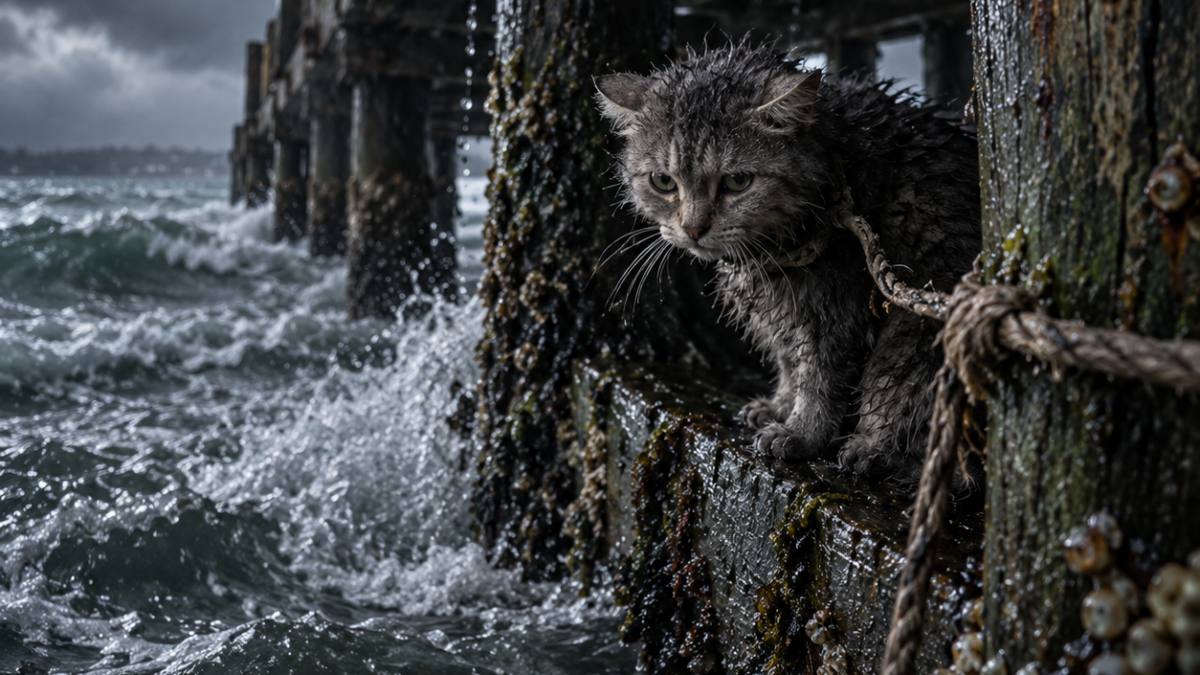
PART 2
Misty weighed almost nothing.
That was the first thing I registered when I got my arm beneath her.
A frightened adult cat should have been twisting, clawing, fighting desperately to escape.
She didn’t.
Her hind legs kicked once against the beam.
Then stopped.
The rope around her neck had pulled tight when she slipped.
I shoved my forearm underneath her chest to take the weight off it.
“Marcus!”
“I’ve got you!”
“Give me slack!”
The safety line loosened slightly.
A wave rushed underneath us.
Misty’s claws dug into my wetsuit.
Good.
That meant she still had strength.
“That’s right,” I whispered. “Hold on.”
I shifted her weight against my chest and reached for the rope with my right hand.
The knife was still there.
I placed the blade beneath the wet fibers.
The rope was cheap nylon but swollen from seawater.
One cut.
Nothing.
Second.
Fibers began separating.
Misty made that broken rasp again.
“I know.”
Another wave struck.
This one reached almost to her belly.
I saw Marcus above us checking the time.
“Fifteen minutes!”
“Stop telling me!”
“I thought you wanted updates!”
“I changed my mind!”
The caller above shouted:
“Is she okay?”
Neither of us answered.
I sawed harder.
The rope snapped.
Misty collapsed completely into my arm.
Free.
But getting her free was only half the problem.
Now I had to get both of us out.
The incoming tide had covered the rocks I had crossed.
The route back was gone.
Marcus understood before I said anything.
“Don’t descend.”
“I wasn’t planning to.”
“I’m lowering the rescue bag.”
We carried reinforced animal bags for exactly this kind of situation.
Usually dogs trapped on ledges.
Occasionally seabirds.
Never a cat deliberately tethered below a tidal pier.
A red bag dropped beside me.
I opened it.
Misty saw the opening and suddenly found some fight.
She twisted.
One claw caught my chin.
Pain flashed.
“Good girl.”
Marcus yelled:
“She scratch you?”
“Yes.”
“You’re bleeding.”
“She can scratch me all day if it means she’s awake.”
Getting her into the bag took nearly a minute.
I kept one hand around her shoulders.
She trembled violently.
The moment she was secured, I clipped the bag to the haul line.
“Cat coming up.”
Marcus began pulling.
Misty rose slowly.
A wave hit underneath.
The bag swung.
She cried.
I put one hand against it until it cleared my reach.
“Easy.”
Marcus hauled her onto the deck.
The stranger who had called us immediately took off his coat.
“Can I—?”
“Don’t open the bag.”
Marcus wrapped the coat around it.
Then looked back down at me.
“Your turn.”
By the time I climbed onto the deck, I was breathing harder than I wanted anyone to notice.
Marcus saw the cut under my chin.
“You look terrible.”
“Thank you.”
“You’re welcome.”
The stranger wasn’t listening.
He was kneeling beside the bag.
“Is she alive?”
Misty made a faint sound.
The man’s shoulders dropped.
“Thank God.”
I checked the time.
Nine minutes to predicted high tide.
I looked through the boards.
The beam where she had been crouching was already being washed repeatedly.
Within minutes, it disappeared under the surface entirely.
I stood there staring at it.
Marcus joined me.
“If he hadn’t looked down…”
“I know.”
“If dispatch had taken five minutes longer…”
“I know.”
“If traffic—”
“Marcus.”
He stopped.
We both looked at the red rescue bag.
Misty was alive.
That had to be enough for the moment.
We drove her directly to a veterinary emergency hospital.
The man who found her came too.
His name was Samuel Bennett.
Sixty-four.
Retired electrician.
He had walked that pier almost every afternoon for six years.
He kept apologizing.
“I should’ve seen her sooner.”
“You saw her,” I said.
“But what if she’d been there hours?”
“You saw her.”
“What kind of person does something like that?”
That question stayed with all of us.
The veterinarian, Dr. Elena Morris, took Misty immediately.
Hypothermia.
Dehydration.
Rope abrasions around the neck.
Saltwater exposure.
Possible aspiration.
Low body weight.
A small cut on one paw.
None of it looked impossible to treat.
Then Elena examined her neck more closely.
The rope marks were new.
But beneath them, hidden by wet fur, were older bruises.
Misty had been handled roughly before the pier.
I told the police officer who met us at the clinic.
Officer Rachel Kim wrote everything down.
“Do you still have the rope?”
Marcus lifted the evidence bag.
“And the section tied to the pier?”
“Harbor patrol secured it.”
“Good.”
Then I remembered the tag.
“Misty has an identification number.”
Elena came out carrying a tablet.
“We already called.”
Samuel stood.
“Her owner?”
Elena didn’t answer immediately.
That bothered me.
“What?”
“The phone number belongs to a woman named Rebecca Lawson.”
“And?”
“She started crying before I finished telling her why I was calling.”
Rachel closed her notebook.
“Did she say the cat was missing?”
Elena looked at us.
“Three days.”
The room became silent.
Rebecca lived less than four miles from the pier.
She said Misty had disappeared from her backyard late Sunday afternoon.
She was an indoor cat, but Rebecca occasionally allowed her into a small enclosed garden while she worked outside.
That Sunday, Rebecca had gone inside to answer a phone call.
Ten minutes.
When she came back, Misty was gone.
The garden gate stood open.
Rebecca had searched.
Neighbors helped.
She printed flyers.
Posted online.
Called shelters.
Walked streets after dark shaking a bag of treats.
Nothing.
Then Tuesday afternoon, a veterinarian called to say someone had found her cat tied under a pier.
Rebecca arrived twenty minutes later.
She didn’t walk through the clinic doors.
She ran.
“Where is she?”
Elena stepped out.
“She’s stable.”
Rebecca covered her mouth.
“Can I see her?”
“In a few minutes.”
“Is she—did somebody—”
She couldn’t finish.
Elena nodded gently.
“She was tied beneath the pier.”
Rebecca folded.
Not fainted.
Her knees simply stopped supporting her.
I caught one elbow.
Samuel caught the other.
“Why?”
Nobody had an answer.
She looked at me.
“You found her?”
“Samuel found her. We got her out.”
Rebecca turned toward him.
Samuel looked immediately uncomfortable.
“I just saw something move.”
Rebecca grabbed him and hugged him.
The old electrician stood rigid for half a second.
Then put one hand carefully against her back.
“You saw her.”
“You saved her.”
“I made a phone call.”
“You saw her.”
She turned to me.
I raised both hands.
“Don’t hug me. I’m wet.”
She hugged me anyway.
Misty remained hospitalized overnight.
Rebecca stayed until the clinic made her go home.
Before leaving, she gave Rachel a detailed timeline.
Sunday, 4:30 p.m. Misty disappears.
Sunday evening, search begins.
Monday, flyers.
Tuesday, rescue.
“Anyone angry with you?” Rachel asked.
Rebecca shook her head.
“Anyone threaten the cat?”
“No.”
“Neighbor disputes?”
“No.”
“Ex-partner?”
Rebecca hesitated.
That pause changed the room.
Rachel noticed.
“So there is one.”
“My ex-boyfriend.”
“Name?”
“Jason Pike.”
“How long ago did you separate?”
“Five months.”
“Bad breakup?”
Rebecca looked at the clinic door behind which Misty slept.
“He didn’t like being told no.”
Rachel’s voice became careful.
“Has he threatened you?”
“Not directly.”
“Indirectly?”
“He sent messages.”
“What kind?”
Rebecca took out her phone.
At first, the messages looked like ugly breakup nonsense.
You owe me.
You think you can erase me.
I know you care more about that cat than people.
Then one message from six weeks earlier:
One day you’ll learn what it’s like when something you love disappears.
My skin went cold.
Rachel took the phone.
“Did you report this?”
Rebecca shook her head.
“I thought he was trying to upset me.”
“Do you still have everything?”
“Yes.”
“Don’t delete anything.”
Jason Pike was thirty-six.
Worked irregular construction jobs.
No serious criminal record.
One old charge for assault after a bar fight.
One restraining order filed by another woman six years earlier but later withdrawn.
He denied knowing anything about Misty.
Police spoke to him that night.
According to Rachel, his reaction was almost insultingly calm.
Cat missing?
Didn’t know.
Pier?
Hadn’t been there.
Rebecca?
Barely thought about her.
Threatening messages?
Emotional language taken out of context.
Could police search his truck?
No.
Not without a warrant.
And at that point they didn’t have one.
I tried not to become personally invested.
That lasted less than twelve hours.
The next morning Elena called.
“Misty is awake.”
“How is she?”
“Angry.”
I smiled.
“Excellent.”
“She tried to bite me.”
“Even better.”
Rebecca was already there.
I stopped by after shift.
Misty sat inside a warmed kennel wrapped in a blanket.
She looked smaller dry.
Gray fur.
White patch under the chin.
One ear slightly nicked.
When she saw Rebecca, she pushed her face against the kennel door.
Rebecca cried again.
“Hey, baby.”
Misty started purring.
I had never understood how loud a small cat could purr.
It filled the room.
Rebecca put two fingers through the bars.
Misty rubbed against them.
“She never stays angry long.”
Elena raised an eyebrow.
“She disagrees with you.”
Rebecca laughed through tears.
Then Misty saw me.
She froze.
Probably recognized the wetsuit smell.
Or maybe nothing.
I crouched.
“You scratched me.”
Misty blinked.
“I forgive you.”
She turned around and showed me her back.
Elena laughed.
“I don’t think she asked.”
The investigation might have remained a suspicion centered on Rebecca’s ex.
Then Samuel called me.
Three days after the rescue.
“Daniel?”
“Yeah?”
“I found something.”
He was at the pier.
“What?”
“You should come.”
“Call police first.”
“I did.”
By the time I arrived, Rachel was already there.
Samuel pointed to the parking area.
“There.”
At first I saw nothing.
Then he showed us a small security camera above a seafood kiosk across the street.
The owner had been away during the rescue.
Samuel knew him.
Asked about the footage.
The camera covered the pier entrance.
Sunday night.
Monday.
Tuesday.
Police obtained the recording.
At 1:17 a.m. Monday, a dark pickup stopped near the pier.
A man got out.
He carried something.
The object moved.
Cat carrier.
He walked onto the pier.
Fourteen minutes later he returned.
Without it.
The camera angle was poor.
Face hidden beneath a hood.
No readable plate.
But the pickup had a distinctive white toolbox behind the cab and damage near one rear light.
Rachel requested traffic camera footage from nearby intersections.
Slowly, a route emerged.
A dark pickup.
Same toolbox.
Same damage.
It came from the north.
Passed a gas station.
Turned toward the pier.
Hours later it traveled back in the opposite direction.
Rachel showed Rebecca a still.
She went pale.
“That’s Jason’s truck.”
Not enough.
Many dark pickups.
But better.
Police obtained a warrant for vehicle inspection.
Jason had replaced the damaged rear light.
The toolbox remained.
In the truck bed, forensic technicians found several short gray cat hairs.
Jason said Rebecca’s cat had ridden in his truck when they were dating.
Rebecca said that was true.
Again, explanation.
But in the back corner of the bed, technicians found a short piece of wet nylon rope.
Same diameter.
Same weave.
Same uncommon blue tracer filament as the rope used beneath the pier.
Jason said he used rope for construction.
Possible.
Then they examined the cut ends.
The rope in his truck had been cut with a serrated blade.
So had the pier rope.
Still circumstantial.
Then Misty’s carrier was found.
A teenager fishing near a drainage ditch discovered a plastic pet carrier partially hidden beneath brush.
Rebecca identified it immediately.
Pink handle.
Scratch across one side.
Sticker from Misty’s veterinary clinic.
Inside were gray hairs.
And one fingerprint.
Jason Pike.
He was arrested.
I thought that would be the end.
It wasn’t.
Because people who do cruel things don’t always begin with their worst act.
Sometimes there is a trail behind them.
Jason’s phone was seized.
Deleted searches were recovered.
Tide schedule Harbor Point.
How fast does tide rise under pier.
How long can cat survive cold water.
Those searches were made Sunday evening.
Before Misty disappeared.
Then investigators found photographs.
Misty inside the carrier.
Taken in Jason’s garage.
One timestamped Sunday at 10:52 p.m.
Four hours before the pier camera.
Rebecca saw that photograph later during evidence review.
She had to leave the room.
Rachel went with her.
I stayed.
I looked at Misty staring through the plastic carrier door.
Her eyes wide.
She had trusted humans enough to allow someone close to her garden.
Maybe Jason had called her.
Maybe she remembered him from when he dated Rebecca.
Maybe she had walked straight toward him.
I thought of her hanging from that rope when the wave hit.
For the first time since the rescue, I felt anger strong enough to frighten me.
Marcus saw it.
“Don’t.”
“I didn’t say anything.”
“You don’t have to.”
I looked at him.
“You ever think some people deserve—”
“Yes.”
His answer was immediate.
Then he shook his head.
“But they don’t get to choose what we become.”
That annoyed me because it was exactly what I needed to hear.
Jason’s attorney claimed the act was meant to frighten Rebecca, not kill Misty.
That argument somehow made everyone angrier.
The rope placement said otherwise.
The tidal schedule searches said otherwise.
The photos said otherwise.
He had tied the cat below the expected high-water line.
At night.
Where almost nobody would look.
He had researched the tide.
He knew.
The prosecution treated the animal cruelty case seriously, but investigators also saw it as part of a pattern of coercive behavior toward Rebecca.
Jason had sent hundreds of messages after the breakup.
Created new accounts after she blocked old ones.
Driven past her house.
Once left flowers on her car after she told him to stay away.
Another time sent a photograph of her front door from across the street.
Rebecca had normalized each incident because no single one seemed “bad enough.”
Misty changed that.
The cat couldn’t rationalize his behavior.
Couldn’t tell herself he was just upset.
Couldn’t say maybe the message meant something else.
Someone had taken her, restrained her, and placed her where the tide would eventually cover her.
Cruelty removed ambiguity.
Rebecca filed for a protective order.
It was granted.
Then another woman came forward.
Her name was Hannah Cole.
She had dated Jason seven years earlier.
She saw his photograph in the news.
She called police.
Years before, during their breakup, Hannah’s rabbit had disappeared from an outdoor enclosure.
Jason told her a fox probably took it.
She believed him.
There was never proof otherwise.
But after Misty, she remembered something.
The enclosure latch had not been broken.
It had been opened.
Then closed again.
Another ex-girlfriend came forward.
She described Jason threatening to let her dog loose if she didn’t answer his calls.
No case had resulted.
No record tied everything together.
Until Misty.
Jason became less a man who made one terrible decision and more a man who had learned that threatening animals could frighten people he wanted to control.
His lawyer hated that characterization.
The prosecutor had evidence to support parts of it.
Not everything could be admitted.
Courts have rules.
Real trials are frustrating because facts people know and facts jurors are legally allowed to consider are not always the same thing.
But the core case was strong.
Misty recovered quickly physically.
Emotionally was different.
The first night home, she refused to approach the garden door.
Rebecca left it open for a few minutes.
Misty stood at the hallway.
Looked outside.
Turned away.
Before the kidnapping, she loved lying in the enclosed garden.
Now she wouldn’t cross the threshold.
Rebecca didn’t force her.
Weeks passed.
Misty slept inside.
Played.
Ate.
Followed Rebecca room to room.
But every sound near the garden sent her running upstairs.
One day I visited because Rebecca wanted to thank the entire rescue unit and apparently couldn’t simply mail cookies like a normal person.
She had cooked enough food for twenty people.
Misty watched me from the stairs.
“Still hates me,” I said.
Rebecca smiled.
“She hates your boots.”
“Personal attack.”
“She associates them with the rescue.”
“I saved her.”
“She was having a terrible day.”
“Fair.”
I sat on the floor.
After ten minutes, Misty came down one step.
Then another.
I ignored her.
Cats appreciate people who understand the value of pretending not to care.
She reached the bottom.
Sniffed my sleeve.
Then walked away.
“Progress.”
Rebecca laughed.
Eventually Misty reclaimed the garden.
It happened by accident.
A moth flew through the open door one evening.
Misty chased it.
She crossed the threshold before realizing she had gone outside.
Rebecca froze.
Misty froze.
For several seconds neither moved.
Then the moth moved again.
Misty pounced.
Rebecca sat at the kitchen table and cried.
The garden became hers again.
I liked that more than any courtroom update.
Meanwhile the prosecutor’s office built the case.
The charges included aggravated animal cruelty, stalking-related offenses, unlawful taking of an animal, property offenses, and violations connected to harassment.
The exact counts changed before trial.
Some were combined.
Some dismissed.
Others strengthened.
Jason rejected a plea deal.
He insisted Rebecca had exaggerated their relationship.
He claimed someone else must have used his vehicle.
Claimed the photograph of Misty in his garage was taken months earlier.
Digital forensic timestamps contradicted him.
Claimed the tide searches were because he liked fishing.
A search made immediately afterward—
“how long until high tide kills animal trapped below dock”
—was harder to explain.
The defense argued someone else could have typed it.
Then investigators recovered location history placing his phone at Rebecca’s street when Misty disappeared and at the pier later that night.
His attorney attacked the accuracy.
Experts testified.
The trial began nine months after the rescue.
I testified on the third day.
I hated court.
People imagine rescuers love telling heroic stories.
We don’t.
The dramatic part often lasts ten minutes.
Then you spend hours being asked whether a rope was sixteen inches or eighteen inches.
Whether the wind was east or southeast.
Whether you personally checked the tide table or Marcus did.
Whether I could be certain Misty would have drowned.
That question made me look directly at Jason.
His attorney asked:
“Mr. Mercer, you cannot state with absolute scientific certainty that the cat would have died had you not intervened, correct?”
I answered:
“When the water reached the beam, she had eighteen inches of rope around her neck.”
“That wasn’t my question.”
“I know.”
“Could she possibly have climbed?”
“No.”
“Could the tide have been lower than forecast?”
“It could have.”
“So death was not certain?”
The prosecutor objected.
The judge directed me to answer narrowly.
I looked at the jury.
“No outcome is certain until it happens.”
The attorney nodded.
Then I added:
“But when we left, the beam was underwater.”
He stopped smiling.
Marcus testified after me.
Samuel after him.
Samuel was the witness people remembered.
He was ordinary.
Retired.
No rescue training.
No police experience.
No reason to perform.
The prosecutor asked what made him stop.
“I saw something move.”
“Did you know it was a cat?”
“No.”
“What did you think?”
“Trash.”
“Why keep looking?”
Samuel shrugged.
“Trash doesn’t usually look back at you.”
A few jurors smiled.
Then the prosecutor showed a photograph of Misty beneath the pier.
Samuel stopped smiling.
“What did you do?”
“I called for help.”
“Why didn’t you leave?”
He looked confused.
“Why would I leave?”
Simple.
That was Samuel.
The defense tried suggesting the scene had attracted public attention and perhaps witnesses remembered events more dramatically afterward.
Samuel stared at the attorney.
“I was there before it was a story.”
That ended that line of questioning rather quickly.
Rebecca testified for almost four hours.
Her testimony wasn’t really about Misty at first.
It was about Jason.
How the relationship began.
How charming he was.
How disagreements slowly became tests.
Why didn’t she answer quickly?
Why did she need friends he didn’t know?
Why spend money without discussing it?
Why let Misty sleep in the bedroom?
That last one sounded ridiculous.
Until it didn’t.
Jason hated the cat on the bed.
Rebecca once woke to him pushing Misty off with his foot.
Not kicking hard.
Not enough to injure.
Just enough to make the message clear.
Rebecca put Misty back on the bed.
Jason slept on the couch.
Months later, during an argument, he said:
“You always choose that animal over me.”
Rebecca thought he was being childish.
After the breakup he sent:
Maybe when she’s gone you’ll remember who mattered.
Rebecca hadn’t connected that sentence to literal danger.
Nobody wants to believe someone they once loved is capable of something monstrous.
The prosecutor showed the jury the photo from Jason’s garage.
Misty inside the carrier.
Rebecca began crying.
“Is that your cat?”
“Yes.”
“Did you give Mr. Pike permission to take her?”
“No.”
“Did you ask him to transport her?”
“No.”
“Did you know where she was?”
“No.”
“What were you doing while this photograph was being taken?”
Rebecca wiped her face.
“Walking the neighborhood calling her name.”
Nobody moved.
That sentence hit harder than anything.
Jason had Misty inside a carrier while Rebecca walked streets searching for her.
He knew.
He could imagine exactly what she was doing.
That was the point.
The prosecution argued that Misty’s suffering wasn’t incidental to hurting Rebecca.
It was the instrument.
Elena testified about Misty’s condition.
Her neck.
Body temperature.
Water aspiration risk.
Exhaustion.
She explained why a cat trapped under an incoming tide would deteriorate rapidly.
The defense asked whether Misty had recovered.
“Yes.”
“So no permanent physical disability?”
“Not that we have identified.”
The defense seemed pleased.
Elena wasn’t.
“Survival does not make the act harmless.”
Silence.
“Doctor, please answer only the question.”
“I did.”
Rachel testified about the investigation.
Traffic cameras.
Pickup.
Carrier.
Rope.
Phone searches.
Location evidence.
Jason’s defense attacked every individual item.
Cat hair?
Misty had been near Jason before.
Rope?
Common.
Truck?
Thousands of similar models.
Carrier fingerprint?
He had handled it while dating Rebecca.
Location?
Phone tracking isn’t perfect.
Searches?
Shared device possibility.
Each explanation could breathe alone.
Together, they suffocated.
Then the prosecutor produced one fact I hadn’t known.
The knot.
The rope securing Misty to the pier had been tied with a specific double constrictor knot.
Not impossible.
Not unique.
But uncommon among casual users.
Photographs on Jason’s construction company social media showed him using the same knot to secure tarps and materials.
His former coworker testified:
“Jason always tied that knot.”
“Why?”
“He said normal knots were for people who wanted things to come loose.”
I felt sick.
A knot designed not to slip.
Around a cat’s neck.
Below a tide line.
Jason finally testified against his attorney’s apparent preference.
That was when the case broke open emotionally.
He denied everything.
Calmly.
Too calmly.
He said Rebecca was vindictive.
Said Misty scratched him.
Said Rebecca had tried turning friends against him.
Said women frequently invented stories about former partners.
The prosecutor asked:
“You didn’t like the cat, did you?”
“I didn’t care about the cat.”
“You complained she slept on the bed.”
“Lots of people don’t want animals in bed.”
“You messaged Ms. Lawson, ‘One day you’ll learn what it feels like when something you love disappears.’”
“Figure of speech.”
“You searched the tide schedule.”
“I fish.”
“You searched how long an animal trapped beneath a dock could survive.”
Jason paused.
“Curiosity.”
“You photographed Misty in your garage the night she disappeared.”
“I don’t remember when that was taken.”
“The timestamp does.”
“Phones can be wrong.”
“You drove to the pier.”
“I did not.”
“Your truck did.”
“Apparently.”
“Your phone did.”
He looked at the jury.
“I don’t know what she did.”
The prosecutor stopped.
“What who did?”
Jason realized it immediately.
Too late.
The prosecutor stepped closer.
“You said, ‘I don’t know what she did.’ Who is she?”
“My ex.”
“Rebecca?”
“Yes.”
“You’re claiming Rebecca took her own cat?”
“I’m saying I don’t know.”
“You just testified you didn’t know the cat was at the pier.”
“I didn’t.”
“Then what exactly were you suggesting Ms. Lawson did?”
His attorney objected.
Sustained.
But the jury had heard it.
Jason became angry after that.
The controlled version disappeared.
He accused Rebecca of staging things.
Said she loved attention.
Said everyone had decided he was guilty because “people care more about one stupid cat than facts.”
I heard someone behind me inhale.
The prosecutor didn’t react.
She waited.
Then:
“Stupid cat?”
Jason tried to recover.
“I mean this entire situation.”
“Your position is that you didn’t care about Misty?”
“Correct.”
The prosecutor showed the photograph of him holding Misty at Rebecca’s home eighteen months earlier.
Smiling.
Then another.
Misty on his lap.
Another.
Jason feeding her treats.
“You knew her.”
“Yes.”
“She knew you.”
“Probably.”
“So if you approached her in the garden Sunday afternoon, she might not run.”
Objection.
Sustained.
But again, the question had landed.
The jury deliberated for almost seven hours.
Rebecca couldn’t sit still.
Samuel brought coffee nobody drank.
Marcus played a game on his phone without looking at the screen.
I walked the hallway until Rachel told me I was making everyone nervous.
When the jury returned, the courtroom filled.
Jason stood.
The clerk read the first count.
Guilty.
Rebecca shut her eyes.
Second.
Guilty.
Third.
Guilty.
Not every charge resulted in conviction.
One stalking count failed because of a technical evidentiary issue.
Another lesser property count was dismissed earlier.
But the serious animal cruelty conviction stood.
So did multiple harassment-related offenses.
At sentencing, Rebecca was allowed to speak.
She held one photograph.
Not Misty under the pier.
Misty in the garden.
Sunlight.
Green grass.
Cat asleep on a chair.
Rebecca looked at Jason.
“For months I thought what you did to her would be the image I carried forever.”
Jason stared ahead.
“It isn’t.”
She raised the photograph.
“This is.”
Misty sleeping.
Safe.
“You wanted me to remember that you could take something I loved.”
Rebecca’s voice shook.
“But what I remember is how many strangers helped me get her back.”
She named Samuel.
Marcus.
Me.
Elena.
Rachel.
Clinic staff.
Neighbors.
People who searched.
Then she looked directly at Jason.
“You wanted me afraid of what one person could do.”
She paused.
“You accidentally taught me what ten good people can undo.”
That was revenge.
Not the sentence.
Though there was one.
Not the fines.
Though there were those.
Not the restrictions.
Though he received them.
The revenge was that the fear he intended to create became the reason Rebecca stopped being alone.
Jason lost access to her.
Lost the ability to approach her home.
Lost his freedom for a period of incarceration.
Lost his job after the conviction.
And his attempt to make Misty disappear became the most documented thing he had ever done.
Meanwhile Misty became locally famous.
Rebecca hated that at first.
People recognized her at the veterinarian.
“Oh, is that the pier cat?”
Misty did not care.
If they had treats, they were acceptable.
If not, she ignored them.
A local animal welfare charity asked Rebecca whether Misty’s story could support an emergency microchip and identification program.
Rebecca agreed on one condition.
“No photos of her tied up.”
The charity used the garden photograph.
Misty asleep in sunlight.
Their campaign helped hundreds of owners update identification records.
Samuel volunteered twice a week.
Not because anyone asked.
He said retirement was boring.
Within six months he had somehow become the person responsible for repairing cages, shelves, washing machines, and anything else electrical.
Elena called him “our unpaid maintenance department.”
Samuel called Elena “the woman who keeps giving me jobs.”
Marcus adopted a black kitten from the same charity.
He named him Tide.
I told him that was disgusting.
He told me my opinion was irrelevant.
Tide destroyed three curtains.
Justice exists in many forms.
Rachel remained in contact with Rebecca during the protective order period.
Eventually professionally necessary contact ended.
They became friends anyway.
And me?
I kept rescuing people and animals.
But Misty stayed with me.
Maybe because of the clock.
Twenty-two minutes.
There was something brutal about knowing exactly how long an animal might have.
Most emergencies don’t give you numbers.
They give uncertainty.
Misty had a timetable.
Water rising.
Minute by minute.
For months afterward, whenever I worked near that pier, I checked underneath.
I knew there wouldn’t be another cat.
Still checked.
Samuel did too.
One afternoon almost a year later, I found him leaning over the railing.
“Anything?”
“No.”
“Good.”
He looked toward the water.
“High tide in an hour.”
“You memorized the schedule now?”
He shrugged.
“Habit.”
We stood there.
The pier had new warning signs.
A harbor camera had been installed.
The metal structure where Misty had been tied was still there.
The exact section of rope had been removed as evidence.
I could still picture it.
Samuel said:
“I keep thinking about that first second.”
“When you saw her?”
“When I almost didn’t stop.”
He stared at the pilings.
“I thought she was trash.”
“But you stopped.”
“Yeah.”
“If you hadn’t—”
“I know.”
He looked at me.
“Don’t say it.”
We both laughed.
That was the strange thing about happy endings.
They don’t erase what almost happened.
They simply allow you to live beside it.
Misty changed slowly.
Rebecca sent updates occasionally.
At first Misty avoided water sounds.
The bathtub faucet.
Heavy rain against windows.
Even the washing machine draining could make her freeze.
Then one summer afternoon, Rebecca found her sitting at the edge of a small decorative fountain in the garden.
Watching water.
Calm.
No panic.
Rebecca filmed ten seconds.
Sent it to all of us.
Marcus replied:
She’s taunting the ocean now.
Samuel:
Good.
Rachel:
Please keep her away from actual piers.
I wrote:
Ask if she wants my wetsuit.
Rebecca:
She says your wetsuit smells terrible.
Fair.
Two years after the rescue, the charity held a small event near the harbor.
Rebecca almost didn’t bring Misty.
Crowds weren’t her favorite.
But they created a quiet fenced area with a covered carrier.
Misty arrived wearing a green harness.
No rope around her neck.
Ever.
Rebecca had stopped using collars except a lightweight breakaway identification collar at home.
Misty stepped from the carrier.
She sniffed.
A little girl approached slowly.
“Can I pet her?”
Rebecca crouched.
“Let her decide.”
The girl held out one finger.
Misty sniffed.
Then rubbed her cheek against the child’s hand.
The girl’s entire face changed.
I remembered the cat under the pier.
Wet.
Trembling.
Barely making sound.
Same animal.
Different world.
Samuel stood beside me.
“That’s worth more than prison.”
“What?”
He pointed.
“That.”
I nodded.
He was right.
People like Jason measure power by fear.
Can I make you panic?
Can I make you answer?
Can I make you come back?
Can I take something?
Can I control what you love?
But fear has an expiration date when someone survives it.
Rebecca moved.
Not because she had to.
Because she wanted a fresh start.
She bought a small house farther inland.
Big windows.
Enclosed sunroom.
Misty claimed it within twenty minutes.
Rebecca sent a photograph of three expensive cat beds sitting empty while Misty slept inside a cardboard box.
Marcus replied:
Perfect recovery.
Misty became older.
Rounder.
Opinionated.
She developed arthritis in one hip.
She required medication.
She hated medication.
Rebecca learned to hide tablets in food.
Misty learned to detect them.
A cold war followed.
Veterinary science lost repeatedly.
At twelve, Misty developed kidney disease.
Manageable at first.
Special diet.
Fluids.
Regular blood tests.
Elena remained her veterinarian.
“She’s impossible,” Elena told me.
“Still scratching?”
“Only emotionally.”
The cat had become remarkably good at making professionals feel judged.
Samuel visited her too.
Misty liked him more than me.
I objected.
“You only made the call.”
Samuel scratched her chin.
“I know.”
“I went into the water.”
“You smell like neoprene.”
Rebecca laughed.
Misty purred.
Traitor.
By then Jason had completed the custodial portion of his sentence.
Protective restrictions remained.
Rebecca no longer followed news about him.
When someone mentioned he had moved to another region, she shrugged.
That was another form of victory.
Indifference.
For years he had wanted to occupy her thoughts.
Eventually he didn’t.
Misty did.
Friends did.
Work did.
Life did.
The man who wanted to become unforgettable became irrelevant.
The cat he tried to erase became family.
Misty lived nearly six years after the pier.
Six years.
If Samuel had walked five minutes later, maybe none.
Six Christmases.
Six summers.
Hundreds of mornings in the sunroom.
Thousands of meals.
Arguments over medicine.
Naps.
Vet appointments.
Garden moths.
Boxes.
Guests.
Rainstorms she eventually stopped fearing.
Those years were the part Jason never calculated.
He had searched the tide.
Measured the rope.
Chosen the hour.
But he couldn’t calculate Samuel looking down.
He couldn’t calculate a retired electrician deciding a movement between wet pilings deserved a second glance.
Couldn’t calculate dispatch answering quickly.
Couldn’t calculate Marcus checking the tide table.
Couldn’t calculate my knife cutting through wet nylon.
Cruelty plans for helplessness.
It rarely plans for strangers.
Misty’s final year was quieter.
Kidney disease progressed.
She lost weight.
Slept more.
Rebecca adjusted everything.
Low steps to the bed.
Warm blankets.
Water bowls everywhere.
Misty had once been surrounded by rising water she couldn’t escape.
Now Rebecca placed water in five different rooms because kidney disease made her thirsty.
I thought about that irony once.
Then decided it wasn’t irony.
It was correction.
A life once denied choice became almost absurdly full of choices.
Which bowl.
Which blanket.
Which window.
Which person.
Which food she would reject dramatically.
One evening Rebecca called me.
Her voice told me before the words did.
“Elena says it’s time.”
I sat down.
“When?”
“Tomorrow morning.”
“You want us there?”
A pause.
“Would you come?”
“Yes.”
Marcus came.
Samuel came.
Rachel came later.
We did not crowd the room.
Misty would have hated that.
Rebecca sat on the floor with her.
Misty lay on her favorite blanket.
Green.
Same color as the harness she wore after the rescue.
Elena gave her something for comfort first.
Misty relaxed.
Rebecca pressed her face into the gray fur.
“You know how much trouble you caused?”
Misty’s eyes were almost closed.
Rebecca laughed through tears.
“Everybody knows your name because you had to go under a pier.”
Samuel turned away.
Marcus pretended to inspect a bookshelf.
I stared at my boots.
Then Rebecca said something I’ll never forget.
“You don’t have to hold on anymore.”
The cat that had once held herself against a beam while the sea rose around her exhaled.
Her body softened.
No rope.
No cold water.
No tide.
Just Rebecca’s hands.
Elena listened.
Then nodded.
“She’s gone.”
Nobody spoke.
Eventually Samuel sat in a chair.
“I only saw something move.”
Rebecca looked at him.
“I know.”
“That’s all.”
“No.”
She wiped her eyes.
“You looked twice.”
He started crying then.
Hard.
Six years of pretending he was only a man who made a phone call finally broke.
Rebecca hugged him.
Misty was cremated.
Her ashes went into a small wooden box.
No dramatic inscription.
Just:
**MISTY**
Rebecca placed it in the sunroom.
Beside the box she put one photograph.
Not the rescue.
Not the pier.
Misty asleep in sunlight.
Same photograph she had carried to court.
A year later, Samuel and I walked the pier again.
We were both older.
My knees complained climbing down ladders now.
Samuel’s hair had become almost completely white.
He stopped at the railing.
The water below was calm.
“Do you remember exactly where?”
I pointed.
“Third support after the stairs.”
He nodded.
We watched waves move around the pilings.
Nothing trapped.
Nothing crying.
Good.
“I used to think the story was about someone terrible,” Samuel said.
“Jason?”
“Yeah.”
“And now?”
He leaned against the railing.
“I think it’s about everyone else.”
I looked at him.
“The woman who loved the cat. You. Marcus. The vet. Rachel. All those people.”
He shrugged.
“Jason gets one part.”
That was true.
We give cruel people too much space in stories sometimes.
Because cruelty creates the crisis.
It creates the dramatic photograph.
The danger.
The anger.
But cruelty wasn’t what saved Misty.
Attention did.
A man looked twice.
A dispatcher listened.
Rescuers moved.
A veterinarian stayed late.
Police followed rope fibers and camera footage.
A woman refused to let fear define the rest of her life.
A cat learned to walk into her garden again.
Those were the bigger parts.
Sometimes people asked why anyone would tie an animal beneath a tide line.
I stopped trying to answer.
There is no explanation satisfying enough.
Jealousy.
Control.
Revenge.
Cruelty.
Whatever word you choose, the cat still ends up on the beam.
Understanding the person who tied the knot never mattered as much as becoming the person willing to cut it.
Years later, the pier was renovated.
Some old supports were replaced.
The metal section where Misty’s rope had been tied was removed.
Samuel found out because of course he did.
He called me.
“They’re taking it apart.”
“Okay.”
“Feels weird.”
“Want to go?”
“Yes.”
We watched workers remove old beams.
The pier looked naked.
Broken open.
I expected to feel sad.
Instead, I felt relieved.
The place no longer had to preserve the scene.
Memory could do that.
A worker found us staring.
“You guys know this place?”
Samuel smiled.
“A little.”
The worker gestured toward new decking.
“It’ll be safer.”
“Good.”
Before we left, Samuel touched one of the new railings.
“Think they’ll put a plaque up?”
“For Misty?”
“Maybe.”
I thought about Rebecca.
She had never wanted Misty defined by the worst thing someone did to her.
“No.”
Samuel nodded.
“Probably better.”
Months later, there was a plaque.
Not for Misty.
For coastal safety.
Tide warnings.
Emergency number.
I liked that more.
Useful.
Maybe someone else would look at it someday and make a good decision.
Rebecca eventually adopted another cat.
She resisted for two years.
Said no cat could replace Misty.
Elena answered:
“Correct.”
That surprised her.
“Then why are you showing me kittens?”
“Because replacement and continuation are different things.”
Rebecca adopted an orange male with one white paw.
She named him Samuel.
Human Samuel was furious.
“This is ridiculous.”
The kitten climbed into his lap.
Samuel stopped complaining.
Cat Samuel grew into a twenty-pound criminal who opened cabinets.
Rebecca sent me a picture.
Caption:
MISTY WOULD HATE HIM.
I replied:
Misty would train him.
Life continued.
That is the ending people often skip because it’s less dramatic.
But I think continuation is the point.
After court.
After headlines.
After the rescue photograph disappears from social media.
Someone still has to fill a water bowl.
Clean litter.
Give medicine.
Open the garden door.
Sit beside an old animal when the kidneys fail.
Love is mostly what happens after the emergency.
I learned that from Misty.
I still work near the water.
Not full rescue duty anymore.
Training now.
New recruits sometimes hear the story.
I show them the tide chart.
The pier layout.
The rope.
Not the most disturbing photographs.
I ask:
“What was the most important piece of equipment in this rescue?”
They say knife.
Wetsuit.
Safety harness.
Radio.
All reasonable.
Then I tell them:
“No.”
They look confused.
“The most important thing was a retired man deciding to look twice.”
Equipment matters after somebody notices.
Sometimes rescue begins with attention.
That is what I teach.
Because the world contains countless things people almost walk past.
A sound behind a wall.
A dog in a hot vehicle.
An elderly neighbor not collecting mail.
A frightened child.
A wet bundle under a pier.
Most are nothing.
Some aren’t.
Samuel almost saw trash.
Then the trash looked back.
He stopped.
That decision gave Misty six more years.
Six.
People talk about saving a life as though it’s one moment.
It isn’t.
When you save a life, you save everything that life might contain afterward.
Misty’s sunroom naps.
Her garden moth.
Her war against medication.
The child who petted her.
The charity campaign.
Rebecca learning fear could shrink.
Samuel repairing shelter equipment.
Marcus adopting Tide.
All of that sat invisibly inside the trembling cat under the pier.
We just didn’t know yet.
The last time I visited Rebecca, she showed me Misty’s wooden box.
It still sat in the sunroom.
Sunlight fell across the name.
Cat Samuel slept beside it.
“He likes that spot,” Rebecca said.
“Misty’s spot?”
“Yeah.”
“Dangerous.”
“Why?”
“She’ll haunt him.”
Rebecca smiled.
“She probably already is.”
We stood quietly.
Then she touched the top of the box.
“You know what I remember most?”
“The court?”
“No.”
“Finding out she was alive?”
“No.”
“The garden?”
She shook her head.
“The first night she came home.”
“What happened?”
“Nothing.”
I waited.
Rebecca smiled through wet eyes.
“She slept.”
That was it.
“She slept for almost fourteen hours. Curled against me. Every few hours I’d wake up and put my hand on her because I was afraid she’d disappear again.”
She looked toward the sunlight.
“And she was still there.”
That was the ending she chose.
Not the rope.
Not the tide.
Not the man who tried to use Misty’s death as a weapon.
A bed.
A sleeping cat.
A hand checking in the dark.
Still there.
Whenever I pass the harbor now, I sometimes think about the twenty-two minutes.
At first that number terrified me.
Twenty-two minutes until the tide.
Twenty-two minutes between rescue and drowning.
But I don’t think of it that way anymore.
I think of everything after those twenty-two minutes.
Six years.
More than three million minutes, roughly.
Time Jason never planned for.
Time Misty stole back simply by staying alive.
Maybe that’s the revenge people want in stories like hers.
Not somebody getting hurt in return.
Something better.
A plan failing completely.
He tied her where he believed nobody would see.
Someone saw.
He used a knot he thought would never loosen.
We cut it.
He relied on the tide erasing what he had done.
The tide left evidence.
He wanted Rebecca terrified and alone.
She ended up surrounded by people.
He wanted Misty gone.
Misty came home.
He wanted to become the person Rebecca could never forget.
Eventually she stopped caring where he lived.
And Misty?
Misty lived long enough to grow old.
For an animal someone tried to deny even one more sunrise, old age was the most satisfying ending imaginable.
So when I remember that afternoon, I don’t stop at the wave knocking me against the pier.
I don’t stop at the rope tightening.
I don’t stop at Misty hanging for one terrifying second.
I remember cutting through the final fibers.
I remember her weight falling into my arm.
I remember Marcus hauling the red bag upward.
I remember her first angry attempt to bite Elena.
I remember the purr when Rebecca touched her.
I remember the moth.
The fountain.
The sunroom.
The green blanket.
I remember Samuel saying:
“I only saw something move.”
And Rebecca answering:
“You looked twice.”
That is the whole story, really.
A tiny gray cat was tied beneath a pier.
The tide was coming.
Somebody had decided she was disposable.
Then a stranger looked twice.
And because he did, the sea didn’t get her.
Cruelty didn’t get the final word.
Fear didn’t get the final word.
Even the rope didn’t.
Misty did.
She answered with six more years of life.
And sometimes, that’s the strongest revenge there is.








