PART 2: Someone Left Six Newborn Puppies on the Railroad Tracks—Their Mother Was Tied Beside Them as the First Train Approached
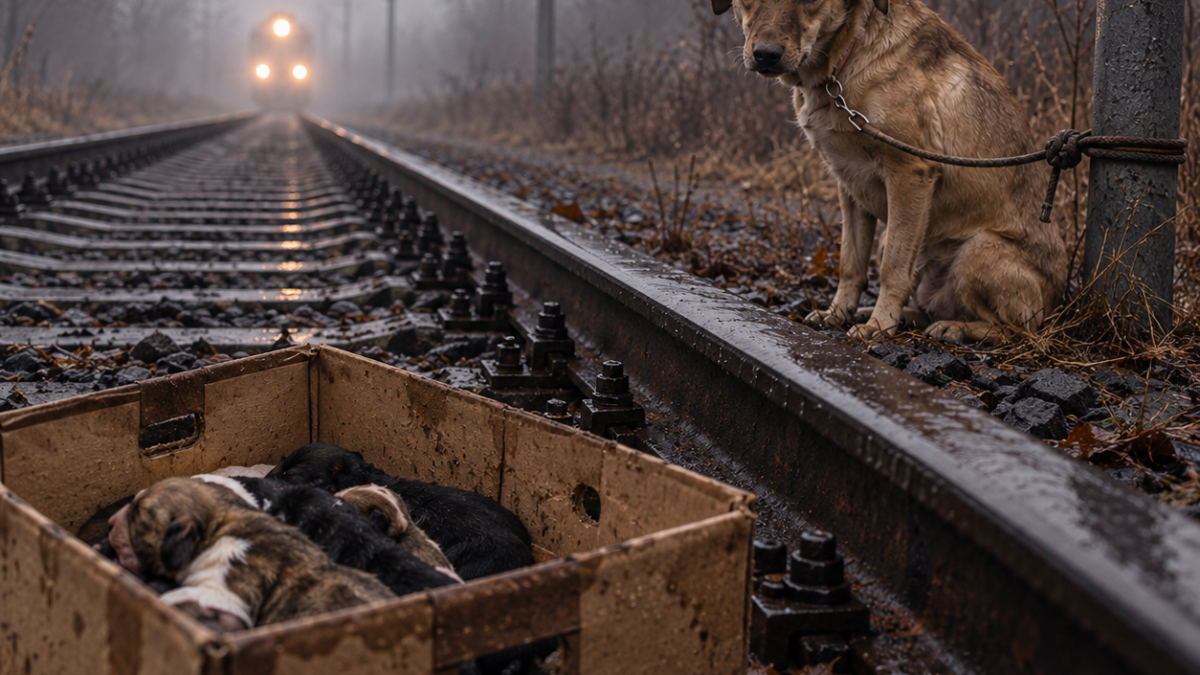
PART 2
I dropped the box.
Not carelessly.
But fast.
I shoved it into the grass beside the drainage ditch and threw myself back toward the dog.
The locomotive was close enough now that I could see its headlights burning through the fog.
The engineer had the horn down continuously.
The mother dog did not understand what was coming.
She understood only one thing.
Her puppies were moving away from her.
She pulled toward them.
The rope crossed dangerously close to the rail.
I grabbed the knife from my belt.
My hands felt twice their normal size.
Too slow.
Too clumsy.
“Come on.”
The blade caught the rope once.
Slipped.
The dog jerked.
The horn was deafening.
“Hold still!”
I cut again.
The rope split halfway.
Not enough.
The mother lunged toward the ditch.
The damaged rope tightened.
I saw fibers separating.
I grabbed it with both hands.
Pulled.
Something tore.
The rope snapped.
The dog shot past me.
I fell backward into the gravel.
The locomotive roared by less than twenty feet away.
Wind and grit hit my face.
My hat disappeared.
For several seconds, there was nothing except steel, noise, and rushing air.
Then the last car vanished into the fog.
Silence returned almost unnaturally.
I lay there staring upward.
My heart was pounding so hard it hurt.
Then I remembered the dogs.
I rolled over.
The cardboard box was still in the ditch.
And the mother was standing over it.
She lowered her head inside.
Six tiny bodies began squirming toward her scent.
She made a sound I had never heard from a dog before.
It was not quite a whine.
Not quite a cry.
Something softer.
She climbed halfway into the ditch and lay beside the box, trying to press her body against it.
One of the puppies found her.
Then another.
I stayed where I was.
She knew I was there.
Her head lifted.
For a second, I thought she might attack again.
Instead, she looked at me.
Then back at the puppies.
I sat slowly.
“All right.”
My hands were shaking.
“You win.”
The radio on my belt crackled.
“Victor? Victor, respond.”
I had forgotten completely about it.
I grabbed it.
“I’m here.”
“What happened?”
“The track is clear.”
“Are you hurt?”
“No.”
That was not entirely true.
My left forearm hurt where the dog had bitten through several layers of coat, but I could move my fingers.
The dispatcher cursed.
“You reported an obstruction and then stopped answering.”
“I was busy.”
“With what?”
I looked at the mother curled around her puppies.
“Moving it.”
There was a long pause.
Then:
“Train 204 reported a man beside the track.”
“That would be me.”
“Victor.”
“I’m fine.”
Another voice came over the radio.
My supervisor, Pavel.
“Do not move. I’m coming.”
“I need a veterinarian.”
“For you?”
“For seven dogs.”
Silence.
Then Pavel said, “I’ll make the call.”
I put the radio down.
The mother watched every movement.
She was shaking.
Now that the immediate danger had passed, I could see how thin she really was.
Her hip bones protruded.
There were bald patches along her neck where the rope had rubbed.
Her paws were bleeding.
One of her ears had an old tear.
She must have been exhausted.
Yet when one puppy squeaked, her head snapped toward the sound instantly.
I knew enough about animals not to try touching her.
I took my lunch from my bag.
Bread.
Sausage.
A boiled egg.
I broke off a piece of sausage and tossed it several feet from her.
She stared.
Then smelled it.
She did not move.
“Eat.”
Her eyes went back to the puppies.
I threw another piece closer.
Still nothing.
Finally, I backed away.
She rose cautiously.
Her legs trembled.
She grabbed the sausage.
Swallowed without chewing.
I gave her another.
Then another.
“Slow down.”
She did not know that phrase any more than she knew the others.
But my voice mattered.
Each time I spoke quietly, the tension in her body softened slightly.
The first vehicle arrived about fifteen minutes later.
Pavel climbed out before it fully stopped.
He was fifty-five, built like an old refrigerator, and had spent thirty years behaving as though nothing surprised him.
He took three steps toward me.
Then saw the box.
His face changed.
“What is that?”
“Six puppies.”
He looked toward the post.
Then the severed rope.
Then the rails.
“You’re telling me someone put them here?”
“Yes.”
“On purpose?”
“Look at the box.”
It was perfectly centered between the rails.
No animal had dragged it there.
Pavel stood silent.
His jaw tightened.
“Who does that?”
I had been asking myself the same thing.
Another maintenance truck arrived.
Then a local police vehicle.
Then Dr. Elena Morozova from the animal clinic in town.
Elena was barely thirty, but she had the kind of calm manner that made frightened animals tolerate things I would never have attempted.
She approached slowly.
The mother growled.
Elena stopped.
“Good.”
I looked at her.
“She’s growling and you say good?”
“Growling is communication.”
She crouched about ten feet away.
“She’s warning me instead of attacking.”
The dog’s eyes moved between Elena and me.
“Does she trust you?” Elena asked.
“Not exactly.”
“She let you near the puppies.”
“She bit my coat.”
Pavel stared at my sleeve.
“You were bitten?”
“Coat was.”
“Victor.”
“I’m fine.”
Elena said, “Let me see your arm.”
“Dog first.”
“Victor.”
“Dog.”
She rolled her eyes.
“Stubborn old man.”
“You came all the way out here to insult me?”
“I came because somebody decided railroad tracks were an appropriate maternity ward.”
She opened a soft transport crate.
Then she looked at me.
“We need the mother inside.”
“You’re the veterinarian.”
“And you’re apparently her favorite.”
“That is a very low standard.”
I crouched.
The dog’s ears moved.
I took another piece of sausage.
This time, I held it.
“Come on.”
She stared at my fingers.
I waited.
Eventually she stepped forward.
One pace.
Another.
She took the food.
I did not move.
Elena whispered, “Again.”
Another piece.
The dog came closer.
By the fourth, she was standing within arm’s reach.
I could see the exhaustion in her eyes.
Not aggression.
Fear.
“Easy.”
I reached slowly toward her neck.
She flinched.
I stopped.
Waited.
Tried again.
This time, my fingers touched her fur.
She froze.
Then one of the puppies cried.
She turned immediately.
That gave Elena enough time to slip a soft lead around her neck.
The dog panicked.
I grabbed the leash loosely.
“Easy!”
She twisted.
Elena spoke calmly.
“No pressure. Don’t pull.”
We waited.
The dog’s breathing slowed.
Then Elena guided her toward the crate.
I moved the puppy box beside the entrance.
The mother followed immediately.
That was the key.
She would go anywhere if the puppies went first.
Within minutes, all seven were loaded into Elena’s van.
Before she closed the door, the mother looked directly at me.
Something about that look stayed with me.
Not gratitude.
Dogs do not owe us gratitude for cleaning up disasters humans created.
It was closer to uncertainty.
Are you finished hurting us?
I touched the crate bars.
“You’re safe.”
Pavel stood beside me.
“You really think she understands you?”
“No.”
“Then why keep talking?”
I watched the mother curl around her puppies.
“Maybe I need to hear it.”
At the clinic, the situation was worse than we thought.
The puppies were only a few days old.
Maybe five.
Their umbilical areas were barely healed.
They were cold and mildly dehydrated.
Two had signs of respiratory distress from exposure.
The mother was severely underweight.
Elena estimated she had been poorly fed for weeks, possibly throughout pregnancy.
There were bruises around her neck beneath the rope marks.
Her paws had been torn from digging at the ground.
“What are her chances?” I asked.
“Better now.”
“And the puppies?”
“We’ll know more in twenty-four hours.”
She weighed them one by one.
Five males.
One female.
The smallest male weighed less than half a pound.
He was weak.
Elena rubbed him gently with a towel.
The mother became restless.
“Bring him back,” I said.
“I need to examine him.”
“She thinks you’re taking him.”
Elena glanced at me.
“Then hold him where she can see.”
I did.
The puppy fit in one hand.
His eyes were closed.
His nose was barely larger than my thumbnail.
The mother stared.
“It’s okay.”
I moved closer.
She sniffed him.
Her body relaxed.
Elena completed the examination while the puppy remained in my hands.
When I put him back beside his mother, she licked him from head to tail.
“Does she have a name?” Elena asked.
“No.”
“She needs one for the paperwork.”
“Why are you asking me?”
“You’re the one she trusts.”
“I told you, she doesn’t trust me.”
The dog put her head on my boot.
Elena smiled.
“Yes. Terrible relationship.”
I looked down.
The dog closed her eyes.
“All right.”
I thought about where I had found her.
The rails.
The fog.
The fact that despite everything, she had tried to stand between me and her babies.
“Ruby.”
Elena raised an eyebrow.
“Why Ruby?”
“She’s red.”
“That’s your entire creative process?”
“I repair railroads.”
“Ruby it is.”
The puppies were temporarily labeled One through Six.
Pavel objected.
“You saved them and you’re calling them numbers?”
“They’re five days old.”
“Still.”
“You name them.”
He stared at the six tiny animals.
Then pointed randomly.
“That one is Boris.”
“Why?”
“He looks like Boris.”
“He doesn’t have his eyes open.”
“Still looks like Boris.”
Within ten minutes, the railroad maintenance crew—six men with a combined age of more than three hundred years—had named all six puppies.
Boris.
Milo.
Rex.
Sam.
Tiny.
And the only female, Lucy.
When Elena came back into the room and saw six maintenance workers leaning over the warming enclosure, she stopped.
“I thought you all had work.”
Pavel answered without looking up.
“We’re on break.”
“At seven in the morning?”
“Early shift.”
One of the younger workers, Anton, held Tiny carefully.
“He sneezed.”
“Puppies sneeze.”
“Is that bad?”
“No.”
“He sneezed twice.”
“I am going to remove all of you from my clinic.”
None of us moved.
That was when Tiny stopped breathing.
It happened so quickly nobody understood at first.
Anton looked down.
“Elena?”
She turned.
“Put him here.”
Her entire manner changed.
The joking disappeared.
Tiny’s body had gone limp.
Elena worked on him immediately.
One technician brought oxygen.
Another prepared medication.
Ruby heard the commotion.
She stood in her kennel.
Whined.
We watched through the glass.
I had been around rail accidents.
I had seen men injured badly.
I had once spent forty minutes helping paramedics free a driver from a crushed maintenance vehicle.
But I had never felt so helpless watching something that fit in two hands.
Elena rubbed Tiny’s chest.
Nothing.
“Come on.”
A technician whispered, “Heart rate dropping.”
Ruby began scratching at the kennel door.
I went to her.
“Easy.”
She ignored me.
She heard her puppy.
“Elena.”
“Not now.”
“She’s panicking.”
“I know.”
I opened the kennel only enough to slip my hand inside.
Ruby pressed against it.
Her entire body trembled.
Across the room, Elena kept working.
Then Tiny made a sound.
So small we almost missed it.
A gasp.
Anton covered his face with one hand.
Pavel turned away.
Elena continued another thirty seconds.
Tiny squeaked.
His chest began moving.
Nobody spoke.
Elena finally exhaled.
“We have him.”
Pavel wiped his eyes with the back of his hand.
I looked at him.
“Are you crying?”
“No.”
“You are.”
“Clinic has dust.”
“There’s no dust.”
“Shut up.”
The story should have ended there.
Seven dogs alive.
No train tragedy.
People helping.
But someone had placed that box on the tracks.
Someone had tied Ruby where she could see her puppies but could not reach them.
That was not ordinary abandonment.
And the police knew it.
Officer Daniel Ionescu returned to the site with railway security.
They photographed everything.
Box.
Rope.
Footprints.
Tire marks near a service access road.
They also checked our cameras.
Railroad property had several.
Most pointed toward switches and signaling equipment rather than the surrounding road.
But one camera near an equipment shed caught part of a vehicle.
White van.
No readable plate.
Arrived at 4:51 a.m.
Left at 5:03.
Twelve minutes.
I had found the dogs at approximately 5:47.
The first train arrived shortly after six.
Whoever had done it knew enough to leave them shortly before scheduled traffic.
That detail bothered me.
Pavel said it out loud.
“This wasn’t someone who dumped dogs randomly.”
I looked at him.
“You think they knew the timetable?”
“Everybody can check passenger schedules.”
“Not freight movements.”
“There wasn’t freight scheduled.”
“Exactly.”
He understood.
The passenger service was predictable.
Someone had wanted the box found by a train.
Not necessarily by a person.
Police issued a public request for information about the van.
By afternoon, our quiet little district knew the story.
People began calling the clinic.
Some wanted to donate money.
Others wanted to adopt puppies immediately.
A few called simply to yell about whoever had done it.
Elena stopped answering the phone personally after the twentieth call.
Ruby remained suspicious of everyone except me.
That became inconvenient.
When Elena needed to examine her wounds, I had to stand nearby.
When they moved her to a cleaner kennel, I had to walk ahead.
When she refused food, Elena called me.
“You have a job.”
“So do you.”
“Your dog won’t eat.”
“She is not my dog.”
“She has apparently not been informed.”
I came over after work.
Ruby ate from the bowl while I sat beside her.
The puppies improved slowly.
Tiny worried everyone.
Two days after his breathing episode, he stopped nursing effectively.
Elena taught us supplemental bottle feeding.
By “us,” I mean me.
Pavel claimed his hands were too large.
Anton claimed he had never held anything that small.
Both were lying.
They were afraid.
So was I.
Tiny fit against my palm.
I fed him every few hours during the periods the clinic was short staffed.
One night, I sat alone beside Ruby’s enclosure at two in the morning because Elena had been called to an emergency surgery.
Ruby watched me bottle-feed her puppy.
“You know,” I whispered, “I should be home asleep.”
She rested her chin on her paws.
“You have six children. I have none living at home. How did this become my night shift?”
Her eyes closed.
“That’s exactly the attitude I expected.”
Tiny drank.
Slowly.
Stubbornly.
When he finished, I placed him beside Ruby.
She cleaned his face.
Then she looked at me.
“You’re welcome.”
Her tail moved once.
The next morning, police got their first real lead.
A gas station camera had captured the white van.
The plate was readable.
It belonged to a forty-one-year-old man named Adrian Popescu.
He lived nine miles away.
I knew the name.
Not personally.
But I had seen his van.
He did small delivery jobs.
Furniture.
Appliances.
Farm supplies.
Police visited his house.
He claimed the van had been parked at home all night.
His wife confirmed it.
Then investigators showed her the photograph.
She changed her story.
Adrian had left around four thirty.
“Where did he say he was going?” Officer Ionescu later told me.
“Delivery.”
“At five in the morning?”
“That’s what she asked.”
“And?”
“He told her to mind her own business.”
That was not proof of the dogs.
But it was enough for more questions.
Police searched the van with consent.
They found dog hair.
Again, not proof.
Adrian claimed he had transported animals before.
Then they found rope.
The same type used on Ruby.
Still common.
Still not enough.
The cardboard box became more useful.
A faded shipping sticker remained on one side.
The box had originally contained kitchen equipment delivered to an address.
Adrian’s address.
That moved the case considerably.
He said he had thrown the box away weeks earlier.
Possible.
Then police found the puppies’ origin.
A woman named Irina recognized Ruby’s photograph online.
She called the clinic.
“I think that’s my neighbor’s dog.”
Officer Ionescu contacted her.
Ruby had been living behind a rental property owned by Adrian’s cousin.
The tenant was a man named Sorin who had moved away suddenly after losing his job.
He had owned Ruby.
But according to Irina, Sorin had not abandoned her intentionally.
“He asked Adrian to watch the dog for three days,” she told police.
Sorin had gone to stay with family while arranging temporary housing.
He planned to return for Ruby.
He knew she was pregnant.
When officers reached him by phone, he was devastated.
“I was coming back Sunday.”
He sent messages proving it.
One read:
Please keep Ruby in the shed at night. She’s close to delivering.
Adrian replied:
Fine.
Another:
Make sure she eats twice. I left money for food.
Adrian:
Got it.
Three days later:
She had the pups?
No response.
Sorin sent again.
Adrian?
Still nothing.
Then the dogs appeared on the tracks.
Why?
Money, partly.
Resentment, mostly.
The full explanation emerged during interviews.
Adrian did not want seven dogs on the property.
Ruby had given birth unexpectedly overnight.
The puppies cried.
His wife complained.
Adrian had been drinking.
He called Sorin and demanded he collect them immediately.
Sorin said he could not return until Sunday.
They argued.
According to messages recovered later, Sorin told him:
If you can’t handle them for two days, put them in the shed and I’ll pay someone else.
Adrian replied:
You think everyone works for you.
Sorin:
I asked you for one favor.
Adrian:
Come get your garbage.
The next message from Sorin came thirty minutes later.
Don’t touch my dog. I’m arranging somebody.
But by then Adrian had loaded Ruby and the puppies into the van.
He told investigators he intended to leave them at an animal shelter.
There was one problem.
The shelter was in the opposite direction.
He then claimed he panicked.
That explanation did not account for putting the box between railway tracks.
Or tying Ruby where she could not reach it.
The prosecutor described that part later with a phrase I never forgot.
“This was not abandonment by convenience. It was abandonment designed to produce an outcome.”
Death.
No one needed to say it.
The railroad would erase the problem.
And perhaps Adrian assumed people would believe the animals wandered onto the tracks.
But puppies with closed eyes do not carry cardboard boxes.
Ruby did not tie herself to a post.
The case became public.
Adrian initially denied everything.
Then blamed alcohol.
Then anger.
Then Sorin.
He said he had been overwhelmed.
His attorney argued there had been no intention to hurt animals, only a reckless attempt to get rid of them.
The placement of the box made that argument difficult.
So did another discovery.
His phone.
At 4:57 that morning, Adrian had taken a photograph.
Ruby tied to the post.
Box visible on the track.
He had sent it to Sorin.
The message beneath it read:
Come get them now if you care so much.
Sorin had been asleep.
He did not see the message until after six.
By then I had already found them.
When Officer Ionescu showed me a copy, I stared at the photograph.
The fog.
The box.
Ruby pulling toward her puppies.
Everything exactly as I had seen it.
Except there were no rescuers yet.
Only Adrian standing behind the phone.
I wanted to find him.
Pavel knew.
“Don’t.”
“I didn’t say anything.”
“You don’t need to.”
“He photographed them.”
“I know.”
“He left.”
“I know.”
“The train schedule—”
“Victor.”
I looked at him.
“Police have him.”
“That doesn’t feel like enough.”
“It has to be.”
He was right.
Again, I hated it.
For the next month, my attention returned to Ruby and the puppies.
All six survived.
Tiny remained smaller than the others but gradually became the loudest.
Boris was the first to open his eyes.
Lucy was the first to crawl out of the bedding area.
Milo learned how to growl before he learned how to walk properly.
Rex slept constantly.
Sam bit everyone.
Not hard.
He simply believed every finger was food.
The maintenance crew began visiting after shifts.
Men who once complained about having to attend safety meetings now spent twenty minutes debating whether puppies preferred blue blankets or green ones.
Anton bought six identical stuffed trains.
Elena confiscated them.
“Small parts.”
He looked offended.
“They’re railroad puppies.”
“They are puppies found on a railroad.”
“Same thing.”
“No.”
Pavel secretly bought safer toys the next day.
I did not expose him.
When the puppies reached six weeks, adoption planning began.
Sorin came to see Ruby for the first time since the incident.
I was there.
I had mixed feelings.
He had trusted the wrong man.
But Ruby had suffered because of that trust.
When Sorin entered, Ruby stood.
Her ears lifted.
For several seconds she stared.
Then she ran.
Not fear.
Recognition.
She jumped against him.
Sorin dropped to his knees.
“I’m sorry.”
Ruby licked his face.
He held her so tightly Elena finally said, “Let her breathe.”
Sorin cried.
Not quietly.
“I’m sorry, girl.”
I stood near the wall.
Part of me softened.
Another part remained angry.
He eventually looked at me.
“You’re Victor?”
“Yes.”
“You saved them.”
“I moved a box.”
“You saved them.”
I did not argue.
He wiped his face.
“I made the wrong choice.”
“Leaving her with Adrian?”
“Yes.”
“Did you know what kind of man he was?”
Sorin looked down.
“I knew he had a temper.”
“That’s not what I asked.”
He met my eyes.
“I knew he could be cruel when angry.”
The answer disappointed me.
“Then why leave her?”
“I didn’t think…”
He stopped.
I waited.
“I didn’t think he’d hurt an animal.”
There it was.
The sentence people say after warning signs become consequences.
I looked at Ruby.
“She didn’t get to make that assumption.”
He nodded.
“I know.”
“Do you?”
His face tightened.
“I have thought about nothing else.”
Elena touched my arm.
Enough.
I stepped back.
Sorin wanted Ruby back.
Legally, once the investigation allowed it, he had that right.
He also wanted to keep two puppies and place the others himself.
Elena objected.
So did animal welfare officers.
Not because Sorin had abused them.
Because his housing remained unstable.
He was staying with relatives.
No fenced yard.
No certainty his landlord would allow seven dogs.
To his credit, Sorin eventually understood.
“I want Ruby,” he said.
Elena replied, “Then build a stable situation first.”
“How long?”
“As long as it takes.”
Ruby became a temporary foster.
With me.
I objected.
Loudly.
“No.”
Elena stared.
“Why?”
“I work.”
“So?”
“I live near the rail yard.”
“Fenced yard?”
“Yes.”
“Warm house?”
“Yes.”
“Dog likes you?”
Ruby sat against my leg.
I looked down.
“Traitor.”
Elena smiled.
“You’re approved.”
“I did not apply.”
“You signed emergency caretaker paperwork.”
“For clinic transport.”
“Close enough.”
“This is corruption.”
“Take your dog home.”
“She is not my dog.”
Ruby followed me out to the truck.
That first night, she refused to enter the house.
She stood on the porch.
Looked inside.
Backed away.
I sat in the doorway.
“Your choice.”
She stared.
I waited.
After ten minutes she stepped over the threshold.
Sniffed the floor.
The chairs.
My boots.
Then she found the kitchen.
That helped.
I prepared her food.
She ate.
Then returned to the front door.
She lay beside it.
Not on the bed Elena had given me.
Beside the door.
Facing outward.
For the first week, that was where she slept.
Always between me and the entrance.
I wondered whether she was guarding me.
Or guarding herself from being surprised again.
The puppies remained with Elena until old enough for adoption.
I visited every day.
Ruby came with me.
The reunions were chaos.
Six puppies attacked her at once.
She endured nursing for approximately thirty seconds before standing and looking at me as if asking why motherhood had no retirement benefits.
By eight weeks, the puppies had homes.
Carefully selected ones.
Tiny went to Anton.
That surprised nobody.
Lucy went to a teacher with two children.
Boris and Milo were adopted by brothers who lived on neighboring farms.
Rex went home with one of the train engineers who had been driving Train 204 that morning.
His name was Michael.
When he came to meet the litter, I recognized him immediately.
“You were driving.”
He nodded.
His face changed.
“I saw you.”
“I know.”
“I thought I was going to hit you.”
“I know.”
He crouched beside Rex.
“I hit the emergency brake.”
“I figured.”
“At that speed…”
“You couldn’t have stopped.”
“No.”
He looked at me.
“I’ve had nightmares about that box.”
I did not know what to say.
He picked up Rex.
The puppy licked his chin.
Michael laughed awkwardly.
“My wife is going to kill me.”
“Tell her I forced you.”
“You have that kind of authority?”
“No.”
“Worth trying.”
He adopted Rex that afternoon.
Sam went to a retired police officer.
Every few months, Elena organized reunions.
The six puppies grew.
Tiny did not stay tiny.
Anton complained constantly.
“You named him.”
“You agreed.”
“You said he was the smallest.”
“He was.”
“He weighs sixty pounds.”
“Take it up with genetics.”
Ruby’s future remained uncertain.
Sorin visited often.
He found steady work.
Then an apartment that allowed dogs.
He brought paperwork.
References.
Food.
A bed.
He did everything correctly.
By early summer, animal welfare approved Ruby’s return.
That was the day I discovered how deeply she had become part of my life.
I packed her things.
Harness.
Bowl.
Blanket.
Toy she never played with but carried from room to room.
Sorin arrived after work.
He looked nervous.
“So.”
“So.”
“She ready?”
I looked toward Ruby.
She was lying beside my chair.
“Yes.”
I clipped on her leash.
She stood.
Sorin crouched.
“Come on, girl.”
Ruby approached him.
Tail wagging.
She remembered him.
Loved him.
That made what happened next harder.
He walked toward the door.
Ruby followed.
At the threshold, she stopped.
Sorin gently pulled.
She did not move.
“Ruby.”
Her head turned toward me.
I looked away.
“Go.”
She stayed.
Sorin tried again.
Ruby took three steps outside.
Then turned.
Pulled free of his loose grip.
Ran back inside.
Sat beside me.
The room went silent.
I felt terrible.
Sorin stared.
I stood.
“Ruby.”
She pressed against my leg.
Sorin looked at the floor.
“I guess that answers it.”
“No.”
“It does.”
“She’s confused.”
“No.”
“You’re her owner.”
He gave a small, painful laugh.
“Not anymore.”
I wanted to argue.
He raised a hand.
“Victor.”
His eyes were wet.
“You were there when she thought her puppies were going to die.”
“That doesn’t make her mine.”
“You fed her.”
“So did the clinic.”
“She slept in your house.”
“Temporary.”
“She chose your door.”
I had no answer.
Sorin crouched.
Ruby came to him.
He held her face in both hands.
“I’m sorry, girl.”
She licked his nose.
He laughed.
Then he looked at me.
“Keep her.”
I shook my head.
“No.”
“I’m asking you.”
“Sorin.”
“I failed her once.”
“You made a mistake.”
“I know.”
His voice cracked.
“And maybe fixing it isn’t taking her back because I feel guilty.”
He scratched behind Ruby’s ears.
“Maybe fixing it is letting her stay where she feels safe.”
That settled it.
Ruby became my dog.
I did not change her name.
She liked my truck.
She hated loud horns.
That was understandable.
For months, every time a train passed near the house, she lifted her head sharply.
If we walked near the tracks, she became tense.
So I did not take her there.
The railroad had already taken enough from her.
Adrian’s case went to court that fall.
I testified.
The prosecutor asked me to describe finding the box.
I did.
Then the mother.
Then the train.
Adrian sat at the defense table.
He never looked at me.
His attorney asked whether I personally saw Adrian leave the animals.
“No.”
“Then you cannot say my client intended the animals to be struck by a train.”
“I can say where the box was.”
“Please answer yes or no.”
“No.”
“Thank you.”
He started to sit.
I added, “And I can say the first train was less than fifteen minutes behind whoever left them.”
The judge looked toward the attorney.
He changed topics.
The strongest testimony came from Adrian himself.
Against his lawyer’s advice, he chose to speak.
He said he had been angry.
Tired.
Drinking.
He said he wanted Sorin to understand what responsibility felt like.
The prosecutor asked:
“Why the railway?”
Adrian answered, “I wasn’t thinking.”
“Why put the box between the rails?”
“I don’t know.”
“Why tie the mother where she could see the puppies?”
Silence.
“I don’t know.”
“Why photograph them?”
He looked down.
“I was angry.”
“At whom?”
“Sorin.”
“Were the puppies Sorin?”
“No.”
“Was the dog Sorin?”
“No.”
“So who did your anger actually punish?”
Adrian did not answer.
The courtroom became silent.
The judge waited.
Finally Adrian whispered, “The dogs.”
That admission mattered.
He was convicted on multiple animal-cruelty charges and reckless endangerment-related offenses tied to the placement on active railway property.
He received jail time, probation, fines, restitution for veterinary care, and a lengthy ban on owning animals.
Railway authorities also pursued separate penalties for interference with rail operations.
I did not feel happy.
I had imagined that I would.
Instead, I felt tired.
Outside the courthouse, Officer Ionescu approached.
“You all right?”
“Yes.”
“You don’t look satisfied.”
“Should I?”
“No.”
We stood watching people leave.
I said, “He almost killed seven animals because he was mad at somebody else.”
“I know.”
“And nearly put a train crew through that.”
“I know.”
Michael, the engineer, had also testified.
He told the court what it felt like to see a box and a man on the tracks knowing a train could not stop in time.
His voice had broken once.
That stayed with me.
Ionescu said, “Justice doesn’t undo the morning.”
“No.”
“It only answers it.”
I understood.
Years passed.
Ruby became known along my section of railway.
Workers brought treats.
She learned every maintenance truck by sound.
Whenever Anton arrived with Tiny, Ruby immediately inspected her son as if she still suspected him of being underweight.
He outweighed her.
It made no difference.
The puppy reunions continued for years.
All six survived into healthy adulthood.
Michael sent photographs of Rex sleeping in the locomotive crew office whenever his schedule allowed him to bring the dog to the depot.
Lucy became inseparable from the teacher’s youngest daughter.
Boris and Milo spent their lives running between neighboring farms.
Sam, fittingly, became the most disciplined dog of the group after his retired police officer adopter trained him in obedience.
Tiny remained a giant baby.
Anton never stopped complaining about the name.
Ruby aged beside me.
Her ribs filled out.
Her coat grew thick and glossy.
The rope scars around her neck faded but never completely vanished.
She stopped flinching when I reached for her collar.
Eventually she slept anywhere in the house.
Not just beside the door.
The first time I found her asleep on her back in the middle of the living room, all four legs in the air, I stood watching for nearly a minute.
Trust can look ridiculous.
That day, it looked like a sleeping dog occupying half my rug.
When I retired at sixty-seven, my coworkers threw a party at the depot.
I hated retirement parties.
Too many speeches.
Pavel was already retired but came anyway.
Anton brought Tiny.
Michael brought Rex.
By pure coincidence—or perhaps Elena’s planning—all six of Ruby’s grown puppies appeared.
I should have suspected something when I saw the parking lot.
Ruby walked through the depot door.
Six adult dogs turned.
For one second, nobody moved.
Then chaos.
Tails.
Barking.
Running.
Ruby stood in the middle of them looking overwhelmed.
Pavel leaned toward me.
“Think she recognizes them?”
“I don’t know.”
Then Tiny lowered himself and began licking her face.
Ruby licked him back.
One by one, the others gathered.
Around the room, men who had spent careers repairing steel in freezing weather suddenly became extremely interested in ceilings, windows, and coffee cups.
I looked at Pavel.
His eyes were wet.
“Dust?”
He nodded.
“Terrible dust problem.”
“Still?”
“Never fixed it.”
Years after that morning, the railway replaced the old steel post where Ruby had been tied.
A younger maintenance crew removed it.
One of the men called me.
“We found something.”
“What?”
“The old rope mark.”
I drove out.
Ruby was slower by then.
Her muzzle was gray.
I did not bring her.
I went alone.
The post lay beside the track.
Near its base were scratches in the old surface.
Marks from rope rubbing against metal.
I knew they meant nothing to anyone else.
To me, they were part of the worst morning of Ruby’s life.
“Want the post?” the young worker asked.
“No.”
“You sure?”
“Yes.”
I did not need it.
I walked to the spot where the box had been.
The ballast had been replaced several times.
Nothing remained.
Trains passed exactly as they always had.
That comforted me.
The place had returned to being ordinary.
Ruby died when she was about thirteen.
Elena was with us.
So was Sorin.
He had continued visiting her every few months for years.
There was no bitterness between us anymore.
He arrived that final afternoon carrying the same kind of treats he had always brought.
Ruby was lying on a blanket in my living room.
Her heart was failing.
She no longer wanted food.
But when Sorin sat beside her, she raised her head.
“Hey, girl.”
Her tail moved.
Once.
Sorin cried before I did.
“I’m sorry.”
I put a hand on his shoulder.
“You told her that years ago.”
“Still true.”
Ruby licked his fingers.
Then rested her head again.
That evening, Elena helped her go peacefully.
I sat on one side.
Sorin on the other.
For a dog who had once been tied alone beside her newborn puppies waiting for a train, there was something almost unbearable about seeing how many people had come to love her.
Afterward, I buried Ruby on a small hill behind my house.
Not near the railway.
I did not want tracks anywhere near her final resting place.
Pavel helped dig.
Anton came.
So did Michael.
All six of Ruby’s grown puppies were represented either in person or through their families, though two lived too far away to travel.
Tiny sat near the grave the entire time.
He was old himself.
When we finished, Anton placed a small photograph beside the marker.
It was taken at my retirement party.
Ruby in the center.
Six grown puppies around her.
“What are you doing?” I asked.
“Leaving it.”
“It’ll get ruined.”
“That’s okay.”
The marker had only her name.
RUBY.
Nothing else.
I considered adding words.
Mother.
Survivor.
Railroad dog.
None felt right.
Her life had been larger than the worst thing that happened to her.
I did not want her grave to describe the cruelty of a man who had occupied only twelve terrible minutes of it.
So just Ruby.
A year later, I visited the depot.
The old crew had mostly moved on.
A photograph hung in the break room.
I stopped.
It showed me kneeling beside Ruby years earlier.
I did not remember anyone taking it.
One hand rested on her shoulder.
Behind us were the six puppies at about eight weeks old.
Underneath, someone had attached a small brass plate.
MILE 47 — SEVEN SAVED.
I stared at it.
A young worker I barely knew came over.
“You’re Victor?”
“Yes.”
“My supervisor tells that story.”
“I’m sorry.”
He laughed.
“Every new guy hears it.”
“What version?”
“That an old lunatic jumped in front of a train for puppies.”
“I did not jump in front of a train.”
“That’s not how Pavel tells it.”
“Pavel is a liar.”
From behind me came a familiar voice.
“I improve stories.”
I turned.
Pavel stood in the doorway with two coffees.
“You’re supposed to be retired.”
“So are you.”
He handed me one.
We sat.
For a while, neither of us spoke.
Then the young worker asked:
“Were you scared?”
I looked at him.
“That morning?”
“Yeah.”
“Of course.”
“You didn’t look scared in the reports.”
“Reports don’t have room for that.”
Pavel smiled.
The young man continued.
“What made you go back for the mother? You already had the box off the track.”
I had been asked versions of that question before.
I usually answered practically.
There was time.
She was tied too close.
It was my responsibility to clear the right-of-way.
All true.
But incomplete.
I thought about Ruby scratching the dirt until her paws bled.
About the way she tried to stand between me and six newborn puppies even while a train approached.
“She went toward danger because her babies were there,” I said.
The young worker waited.
“So leaving her behind never really felt like an option.”
He nodded.
Pavel looked down at his coffee.
I added, “Besides, she already thought I was stealing her family. Would’ve been rude to prove her right.”
That made them laugh.
Good.
I preferred laughter.
The years had taught me something about that morning.
People always focused on the train.
The countdown.
The box.
The dramatic part.
I remembered smaller things.
Ruby refusing sausage until I stepped away.
Tiny taking a breath after we thought he had stopped.
Six railroad workers naming newborn puppies during work hours.
Michael adopting Rex after spending months dreaming about the box he had almost been unable to avoid.
Sorin eventually understanding that loving Ruby meant letting her choose another home.
Those were the parts that lasted.
The train passed in seconds.
Ruby lived for years.
When I was seventy-five, one of my grandchildren asked why I still kept my old railway radio in the garage.
It no longer worked.
Battery corroded.
Antenna cracked.
“Because I had it that morning.”
“What morning?”
I showed him the photograph.
Ruby.
Her puppies.
Me.
He knew the short version.
“Was that really all of them?”
“Yes.”
“Which one was Tiny?”
I pointed.
He stared.
“He was tiny.”
“Briefly.”
“What happened to them?”
“They got old.”
He frowned.
“All?”
“Eventually.”
“That’s sad.”
“A little.”
He studied the photograph.
“But they lived?”
“Yes.”
“All six?”
“Yes.”
“And the mom?”
“Ruby lived with me.”
He smiled.
Then he asked the kind of question children ask that adults often spend years avoiding.
“Why would somebody put them on train tracks?”
I looked at the old radio.
“I don’t know.”
“But the police knew who.”
“Yes.”
“So why?”
“I know what he said.”
“What?”
“He was angry.”
My grandson frowned.
“That’s stupid.”
“Yes.”
“Being angry doesn’t make you do that.”
“No.”
He looked at the picture again.
“Then he was mean.”
“Maybe.”
“Was he a bad person?”
I thought about Adrian in court.
Ordinary clothes.
Ordinary face.
One terrible decision built from anger, alcohol, entitlement, and the belief that helpless lives could be used to hurt another man.
“I think people can do very bad things without looking like monsters.”
My grandson was quiet.
“Did Ruby know?”
“Know what?”
“That he was bad?”
“I don’t know.”
“Did she know you were good?”
I smiled.
“I’m not sure she thought in those terms.”
“What did she think?”
I looked at the photograph.
“She knew I moved the box.”
He considered that.
“That was enough?”
“For the first day.”
“And after?”
“I kept showing up.”
He nodded.
That answer seemed to satisfy him.
It satisfied me too.
Not because I had saved Ruby in one heroic moment.
I had never thought of it that way.
Heroism is a word people use after danger ends.
At the time, there was only the next thing that needed doing.
Move the box.
Cut the rope.
Feed the dog.
Warm the puppies.
Return tomorrow.
Return again.
Sit beside the kennel.
Take Ruby home.
Open the door.
Wait for her to enter.
Keep showing up.
Sometimes that is what rescue actually looks like.
Not one brave act.
A hundred ordinary ones afterward.
On the twentieth anniversary of the morning I found them, I went back to Mile 47.
The railway had changed.
New signals.
New fencing.
New gravel.
The old maintenance shed had been replaced.
I stood safely beyond the track boundary and watched the morning passenger train approach.
Not the same locomotive.
Not the same crew.
Nothing physically remained from that day.
The train passed.
Wind pressed my coat against me.
Then it was gone.
I looked at the empty rails.
For a moment, memory put the cardboard box there again.
Six newborn puppies.
Ruby pulling against a rope.
Fog.
A horn.
My younger hands trying to cut fibers before steel arrived.
Then the image disappeared.
There was only track.
Exactly as there should be.
I took one old photograph from my pocket.
Ruby surrounded by six adult dogs.
I had carried it there deliberately.
I looked at it for several seconds.
Then put it back.
I did not leave flowers.
No plaque.
No memorial.
That place did not deserve to own their story.
The tracks were only where somebody tried to end seven lives.
Their lives happened afterward.
In kitchens.
On couches.
Across farm fields.
Beside children.
Inside railroad depots.
At family tables where dogs waited hopefully for food to fall.
In my house, where Ruby eventually learned to sleep so deeply that trains no longer woke her.
I walked back toward my car.
Behind me, the rails began humming again.
Another train was coming.
I did not turn around.
For most of my career, that vibration had meant one thing.
Move away.
Danger approaching.
But whenever I remembered Ruby, I remembered something else too.
The cardboard box was no longer between those rails.
The rope was cut.
The puppies grew up.
And the mother who had once clawed bloody lines into frozen ground because she could not reach her babies eventually spent years sleeping in a warm house where nobody ever tied her away from anything she loved again.
That was the ending I chose to remember.
The cardboard box was sitting directly between the rails.
For a second, I could not understand what I was looking at.
Fog still hung low over the tracks, turning everything beyond fifty yards into a pale gray wall. I had walked that section of railroad almost every morning for thirty-seven years, and I knew every signal post, drainage ditch, switch box, and loose patch of ballast along that line. Anything out of place caught my eye immediately.
But a cardboard box was not what stopped me.
It was the sound coming from inside.
A thin, broken cry.
Then another.
I stood frozen with one boot between the ties.
At first, I had thought I was hearing a child somewhere beyond the embankment.
Now I knew better.
I moved closer.
The box was old and damp, one side sagging from moisture. Someone had placed it carefully—not tossed it, not dropped it—right in the center of the track.
Inside were six newborn puppies.
Their eyes were still sealed shut.
Their ears were folded close to their tiny heads.
Their wet bodies pressed against one another, trembling so hard the entire pile seemed to move.
For one impossible second, I simply stared.
Then I heard another sound to my right.
A low, desperate whine.
I turned.
About fifteen feet from the track, tied to a steel maintenance post, was their mother.
She was a reddish-brown dog, medium-sized, badly underweight, with ribs showing beneath her dirty coat. Her teats were swollen with milk. A piece of coarse rope circled her neck and ran to the post.
The rope was so short she could get only a few feet from it.
The earth in front of her had been torn apart.
She had been digging.
Pulling.
Scratching.
Trying to reach the box.
Her paws were bleeding.
When our eyes met, she stopped moving.
I will never forget that look.
She was afraid of me.
But she was more afraid for them.
Her puppies.
The moment I stepped toward the rails, she lunged.
The rope snapped tight.
She nearly flipped herself backward.
“Easy.”
She bared her teeth.
“Easy, girl.”
Another puppy cried.
The dog twisted toward the sound so violently that the rope cut harder into her neck.
“Jesus.”
I dropped my inspection bag.
Then the rail beneath my boot began to hum.
Every railroad man knows that vibration.
You do not need to see a train.
You do not need to hear one.
The steel tells you.
A train was coming.
I looked at my watch.
5:58.
The 6:12 northbound passenger service had already cleared the previous signal block.
My chest tightened.
I grabbed my radio.
“Dispatch, this is maintenance Victor Petrov, Mile 47, Track One. Emergency obstruction.”
Static burst back.
“Victor, repeat.”
“Emergency obstruction on Track One. Box on the rail.”
“What kind of box?”
“Animals.”
There was a pause.
“Animals?”
“Six newborn puppies.”
Another pause.
Longer.
Then the dispatcher’s voice sharpened.
“Train 204 is already in the block.”
“How far?”
“Stand by.”
I could hear clicking in the background.
The mother dog growled as I moved closer.
The dispatcher came back.
“Approximately two minutes, maybe less.”
“Can you stop him?”
“We’re sending an emergency stop order now, but Victor, you know the distance.”
I knew.
A passenger train moving at line speed does not stop because somebody asks nicely.
Even if the engineer responded instantly, steel wheels on steel rails needed distance.
Too much distance.
I looked at the box.
Then the dog.
Then the fog.
“Victor?”
“I’m moving it.”
“Do not put yourself in front of that train.”
I clipped the radio back to my jacket.
“Wasn’t planning to.”
The mother dog was now standing as far forward as the rope allowed.
Her lips pulled back.
She was exhausted, starving, injured—and ready to fight me.
I took one step toward the box.
She attacked.
Her jaws snapped inches from my arm.
I jumped back.
“Damn it.”
The puppies cried louder.
The dog spun toward them, then back toward me.
She did not understand that I was trying to help.
Why would she?
Someone had brought her out there.
Someone had tied her to a post.
Someone had taken her babies and placed them where she could see them but could not touch them.
As far as she knew, I was another human coming to hurt them.
The rails vibrated harder.
Then the horn sounded.
Far away.
But not far enough.
The mother dog froze.
Her ears lifted.
The noise came again.
Long.
Low.
The fog carried it straight down the track.
I felt the first real stab of fear.
Not the kind that makes you panic.
The kind that makes your thoughts suddenly very simple.
Box.
Dog.
Train.
Move.
I pulled off my heavy work coat.
The dog watched me.
I wrapped the coat around my left forearm several times.
“What are you doing?” I muttered to myself.
The answer was obvious.
Something stupid.
I stepped toward her.
She lunged.
This time I did not move away.
Her teeth closed around the padded sleeve.
The force almost pulled me off balance.
“Good.”
She shook her head.
“Good girl. Hold on.”
I moved sideways.
She followed because she was biting my arm.
The rope stretched behind her.
I stepped closer to the rails.
She snarled through the fabric.
The box was just beyond my reach.
I bent.
She jerked.
I nearly fell.
The horn sounded again.
Much louder.
“Come on.”
I grabbed the box by one side.
The wet cardboard tore.
One puppy rolled toward the edge.
I shoved my other hand beneath the bottom.
The dog released my coat and snapped toward the box.
“Easy!”
I lifted it.
The bottom sagged.
I pressed the box against my chest.
Now the mother completely forgot about attacking me.
She followed the puppies.
The rope stopped her.
She screamed.
I have no better word for it.
It was not a bark.
Not a growl.
Not a normal whine.
It was a sound of pure panic.
I jumped off the track and slid down the gravel shoulder into the ditch.
The box nearly left my hands.
One puppy squealed.
I set it down in wet grass.
The mother pulled harder.
And then I realized something that made my stomach drop.
She was close enough to the track to be struck.
Not by the center of the train.
But by the locomotive’s side clearance.
Her rope let her reach almost to the rail.
The train horn became deafening.
I could see headlights through the fog.
Two white circles.
Growing.
The dog was pulling toward the box.
Toward me.
Toward danger.
I ran back.
“Victor!” my radio screamed.
I ignored it.
I pulled my knife.
The mother dog snapped at me when I reached for the rope.
“Not now.”
I grabbed the rope six inches from the post.
The blade cut halfway through.
The dog jerked.
The knife slipped.
The locomotive lights expanded out of the fog.
I cut again.
Fibers separated.
Not enough.
I could hear wheels now.
A rising metallic roar.
The dog pulled.
I grabbed the damaged rope with both hands.
Pulled in opposite directions.
Nothing.
I braced one boot against the post.
Pulled harder.
A strand snapped.
Then another.
“Come on!”
The dog twisted.
The rope tore.
I fell backward.
She shot toward the ditch.
I rolled away from the rail.
The locomotive erupted past us.
Wind slammed into my body.
Ballast dust and cold air struck my face.
The sound filled everything.
For several seconds, there was no world except steel.
I lay flat beside the track with one arm over my head.
Car after car thundered past.
When the last one disappeared into the fog, silence came back so quickly it felt unreal.
My ears rang.
I sat up.
The dog.
The box.
I looked toward the ditch.
She was there.
Standing over the cardboard box.
Alive.
All six puppies were alive too.
She shoved her nose inside.
The puppies began moving toward her scent.
She tried to climb into the box.
It collapsed under one of her paws.
I pushed myself up.
She heard me.
Her head snapped around.
For a second, I saw the same defensive look.
Then she looked back at her puppies.
I stayed where I was.
“All right.”
My voice shook.
“You won.”
She bent into the box.
One tiny puppy found her belly.
Then another.
She lay awkwardly beside the cardboard, trying to curl around them.
The ground beneath her was soaked.
Her paws left red marks in the mud.
My radio crackled.
“Victor! Respond immediately.”
I picked it up.
“I’m here.”
“What happened?”
“The track is clear.”
“Are you hit?”
“No.”
“Are you sure?”
I looked at my torn coat.
The sleeve had tooth marks through two layers.
“I’m sure.”
“Train 204 reported seeing someone fall beside the track.”
“That was me.”
“Victor—”
“I’m fine.”
There was silence.
Then my supervisor’s voice came through.
Pavel.
“Stay where you are.”
“I need a veterinarian.”
“You need an ambulance.”
“I need a veterinarian.”
“For what?”
I looked down at the ditch.
“For seven dogs.”
Pavel did not speak for several seconds.
Then he said, “I’m coming.”
I put the radio away.
My knees felt weak.
I had spent my career around dangerous machinery.
I had seen accidents.
I had seen men lose fingers.
I had watched one coworker get thrown fifteen feet when a maintenance vehicle struck loose equipment.
But only after the train was gone did I understand how close that morning had been.
I sat on the gravel.
My hands started shaking.
The mother dog watched me.
She was nursing two puppies now.
The other four crawled blindly over one another.
I opened my lunch bag.
Bread.
Sausage.
A boiled egg.
I broke off a piece of sausage.
The dog stiffened when I moved.
I tossed it six feet from her.
She stared at it.
Then at me.
“Eat.”
She did not move.
I threw another piece closer.
Nothing.
The puppies squirmed beneath her.
She lowered her head protectively.
I understood.
She still thought food might be a trap.
I backed away.
About ten feet.
Sat.
Looked in another direction.
After a moment, I heard movement.
She crept toward the sausage.
Sniffed.
Grabbed it.
Swallowed it immediately.
I tossed another.
Then another.
This time she ate while watching me.
“You need more than that.”
Her ribs were visible even beneath thick fur.
How long had she been underfed?
Days?
Weeks?
Had whoever owned her stopped feeding her during pregnancy?
Had they decided puppies were a problem only after they were born?
Questions stacked up faster than answers.
I broke the boiled egg in half.
She ate that too.
Then she returned to the puppies.
I watched one of them search blindly along her belly.
He found a teat.
His entire tiny body relaxed.
Something about that almost undid me.
Ten minutes earlier, they had been between two rails.
Now they were nursing in a ditch.
That difference was so small in distance and so enormous in everything else that I had trouble processing it.
The first maintenance truck arrived fifteen minutes later.
Pavel stepped out.
Behind him was Anton, one of our younger workers.
Pavel took one look at me.
“What did you do?”
“Good morning to you too.”
He walked closer.
“Your coat is torn.”
“Yes.”
“Your hand is bleeding.”
I looked.
A shallow cut crossed my knuckle.
I had not noticed.
“That’s nothing.”
He stared at the ditch.
Then his face changed.
“Oh.”
Anton came around the truck.
“What?”
Then he saw them.
“Holy…”
Pavel pointed toward the box.
“That was on the track?”
“Yes.”
“And the dog?”
“Tied to that post.”
Anton looked at the severed rope.
“Somebody did that?”
“No, Anton. She tied herself up and ordered a cardboard box online.”
Pavel gave me a look.
“You almost got hit by a train and you’re still sarcastic.”
“Means my brain works.”
“Debatable.”
Another vehicle approached.
County animal services.
Behind it came a small veterinary van.
Dr. Elena Morozova stepped out carrying a medical bag.
She was young enough to be my daughter but had already developed the expression of someone who had seen more animal cruelty than any person should.
She approached the ditch slowly.
The mother dog growled.
Elena stopped.
“That’s fine.”
I looked at her.
“She wants to bite you.”
“No. She wants me to stay back.”
“Same outcome if you keep walking.”
Elena crouched.
“Good girl.”
The dog’s ears flattened.
Elena did not move closer.
“How old are the puppies?” I asked.
“Let me get a look.”
“Not sure she’ll allow that.”
Elena glanced at me.
“She allowed you.”
“She bit my coat.”
Pavel pointed.
“Nearly took his arm off.”
“She did not.”
“She tried.”
“Pavel.”
“What?”
“Go be useful.”
He muttered something and walked away to speak with the animal-control officer.
Elena watched the mother.
“She keeps looking at you.”
“Unfortunately.”
“That’s useful.”
“To whom?”
“To me.”
“No.”
“Victor.”
I hated when people used my name in that tone.
“You’re going to help me.”
“I already helped.”
“Now help again.”
She opened a soft transport crate.
The dog growled louder.
Elena stopped.
“Bring the box closer to the crate.”
“That seems dangerous.”
“She’s not leaving her babies.”
That was obvious.
I picked up the cardboard carefully.
The puppies weighed almost nothing collectively.
The mother rose instantly.
Her body tensed.
“Easy.”
I moved slowly.
She followed.
One step.
Another.
No rope now.
Nothing stopped her.
She could have run.
She did not.
She stayed with the box.
That told me everything about where her priorities were.
We set the box near the crate.
Elena placed a blanket inside.
Then, one at a time, she moved the puppies.
The mother became frantic.
I knelt beside her.
“Hey.”
She turned toward me.
“Look.”
I pointed toward the crate.
I know dogs do not understand pointing the way humans do in every situation.
But this one followed my hand.
She saw the puppies.
Elena placed the sixth inside.
The mother tried to push past us.
Elena opened the door wider.
The dog climbed in immediately.
No coaxing needed.
She curled around the puppies.
Elena shut the crate.
The dog’s eyes locked onto mine through the bars.
I felt something strange in my chest.
Not pride.
Not ownership.
Responsibility.
I had moved her from one uncertain place to another.
Now I needed to know where this ended.
“I’m going with you.”
Elena looked at me.
“You have a railroad job.”
“Pavel can cover.”
From behind us, Pavel said, “Pavel can hear.”
“Good.”
“You’re getting your arm checked first.”
“Dog first.”
“Victor.”
“Pavel.”
Anton covered his mouth to hide a smile.
Pavel pointed toward the veterinary van.
“Fine. But if you bleed on my truck later, you clean it.”
At the clinic, we learned how bad things really were.
The mother weighed almost twenty pounds less than she should have.
Her gums were pale.
She had abrasions around her neck.
Her front paws were torn and inflamed from digging.
There were signs of chronic malnutrition.
Her coat was dull.
Several patches of skin showed old irritation.
The puppies were perhaps four or five days old.
Six of them.
Five males.
One female.
All mildly hypothermic.
Two dehydrated.
One dangerously weak.
The smallest male barely moved when Elena picked him up.
I stood near the table.
“What’s wrong?”
“He’s cold.”
“They’re all cold.”
“He’s colder.”
She took his temperature.
Her expression tightened.
“How bad?”
“Bad enough.”
She wrapped him in a towel and placed him near a warming unit.
The mother stood in her kennel.
She whined.
“She hears him,” I said.
Elena nodded.
“She can’t see him.”
“Then let her.”
“I’m working.”
“Move the warming unit.”
“Victor.”
“She thinks you took him.”
Elena looked at the mother.
Then at me.
Then sighed.
“Fine.”
We repositioned the smaller puppy where the mother could see him.
Immediately, her whining softened.
I looked at Elena.
“You’re welcome.”
“You’re very irritating.”
“I’ve been told.”
She examined the remaining puppies.
One had mild congestion.
Another had a small bruise near the ribs.
The female seemed strongest.
The mother needed fluids, food, treatment for her paws, and monitoring for infection.
“Does she have enough milk?” I asked.
“Some.”
“Enough?”
“Not for six if she’s this undernourished.”
“So?”
“We supplement.”
“Bottle feeding?”
“Yes.”
“How often?”
“Every two to three hours, depending on how much they nurse.”
I stared.
“You’re telling me someone has to feed six puppies every two hours?”
“Welcome to neonates.”
“That sounds unreasonable.”
“They didn’t design themselves for your convenience.”
I watched the smallest puppy.
His breathing looked shallow.
“Will they survive?”
Elena did not answer immediately.
“I think most have a good chance.”
“Most?”
Her eyes moved toward the smallest.
“We’ll know more tonight.”
I did not like that.
“What about her?”
I pointed at the mother.
“She should recover if there aren’t complications.”
“Should?”
“Victor, medicine doesn’t promise things.”
I looked at the dog.
She watched us.
“Does she need a name?”
“For records, yes.”
“You name her.”
“You found her.”
“I find broken signal housings too. I don’t name those.”
Elena almost smiled.
“She’s reddish.”
“Ruby.”
The word left my mouth before I thought about it.
“Ruby?”
“Fine. Ruby.”
Elena wrote it down.
“Ruby it is.”
Then she looked at the puppies.
“And these six?”
“Numbers.”
A voice behind me said, “Absolutely not.”
Pavel had arrived.
He stood holding two cups of coffee.
“You’re naming them.”
“I am not naming newborn dogs.”
“Why?”
“Because I’m not twelve.”
Pavel handed me coffee.
He leaned over the warming box.
“That one looks like Boris.”
I stared at him.
“He has no visible personality.”
“Boris.”
Anton appeared at the door.
“The female should be Lucy.”
Elena looked between us.
Within twenty minutes, six men from the maintenance crew had rotated through the clinic and somehow every puppy had a name.
Boris.
Milo.
Rex.
Sam.
Tiny.
Lucy.
The smallest became Tiny.
At the time, it seemed accurate.
Later it would become a joke.
That morning, nothing about him was funny.
Tiny stopped breathing just after nine.
I was standing beside Ruby when Anton called Elena’s name.
Not loudly.
That made it worse.
“Elena.”
She turned.
Tiny was limp in his hands.
Everything happened at once.
Elena took him.
A technician brought oxygen.
Someone moved equipment.
Ruby heard the change in voices.
She stood.
Whined.
Then scratched at the kennel door.
I went to her.
“Easy.”
She did not look at me.
Her attention was locked on Tiny.
Elena rubbed his tiny chest.
“Come on.”
No response.
Anton turned pale.
Pavel looked away.
One of the technicians said, “Heart rate very slow.”
Ruby began whining louder.
I slipped my fingers through the kennel door.
She pressed her shoulder against them.
I could feel her shaking.
“Come on, little guy,” I whispered.
Elena did not stop.
Seconds became a minute.
Then Tiny gasped.
A tiny jerking breath.
Elena kept working.
Another breath.
Then a squeak.
Anton covered his face.
Pavel turned his back.
I felt my throat close.
“He’s breathing?”
“Yes.”
Elena’s voice stayed professional.
But her eyes were wet.
“Come on, Tiny.”
The puppy moved one front paw.
Ruby barked once.
A sharp sound.
Then she went still.
Elena worked another minute before finally relaxing her shoulders.
“We have him.”
Nobody spoke.
Pavel wiped his face.
I looked at him.
He glared.
“Don’t.”
“Were you crying?”
“No.”
“Looks like crying.”
“Clinic air.”
“Clinic air?”
“Dry.”
Elena said without turning, “It’s seventy percent humidity.”
Pavel pointed at her.
“You stay out of this.”
For men who had spent decades around steel, grease, diesel, and dangerous equipment, six half-pound puppies dismantled us remarkably quickly.
The story reached local police before noon.
Not because we called the news.
Because placing objects on active railroad tracks was more than animal cruelty.
It was a railway safety offense.
Officer Daniel Ionescu arrived carrying a notebook.
He had worked several theft and vandalism cases with our department.
He listened while I described everything.
“How was the box positioned?”
“Centered between the rails.”
“Lengthwise?”
“No. Crosswise.”
“Meaning whoever put it there intended the train to strike it.”
“That would be my assumption.”
He looked up.
“I’m asking what you saw, not what you assume.”
I had known Daniel long enough not to take offense.
“Crosswise. Centered.”
“Mother?”
“Tied to maintenance post fifteen feet away.”
“Rope?”
“Still at the scene.”
“Did you touch it?”
“I cut it.”
“With?”
“My knife.”
He wrote that down.
“Coat?”
“What about it?”
“Dog bit it.”
“Yes.”
“Keep it.”
“For evidence?”
“Maybe.”
“Pavel wants it mounted in the depot.”
Daniel ignored that.
“Any vehicle?”
“No.”
“Footprints?”
“Probably. Fog, damp ground. I wasn’t examining footprints while a train approached.”
He nodded.
“Understandable.”
He closed the notebook.
“Rail security will pull camera footage.”
“There’s no camera directly there.”
“Nearest?”
“Equipment shed two hundred yards west.”
“Angle?”
“Mostly track.”
“Road access visible?”
“Maybe the far edge.”
“We’ll see.”
He looked at Ruby.
“She yours?”
“No.”
Ruby had her head resting against my boot again.
Daniel raised one eyebrow.
“Looks complicated.”
“She’s tired.”
“Sure.”
The first major clue came that afternoon.
A maintenance camera had captured a white delivery van entering the service access road at 4:51 a.m.
The image was grainy.
Fog blurred the edges.
No plate.
At 5:03, the same van left.
Twelve minutes.
I had found Ruby and the puppies at 5:47.
“Forty-four minutes,” Pavel said when Daniel showed us.
“What?”
“They were out there at least forty-four minutes.”
I looked at Ruby’s injured paws.
She had spent almost three quarters of an hour watching her newborn puppies on the track.
Maybe longer.
That thought angered me more than the train.
The puppies did not understand.
Ruby did.
Not the train, perhaps.
But separation.
Fear.
Her inability to reach them.
Someone had designed that suffering.
“Anybody recognize the van?” Daniel asked.
Anton leaned closer to the image.
“White van in this district?”
“That narrows it to about seven thousand.”
“There’s a dent near the rear door.”
Daniel zoomed in.
Maybe.
A darker patch.
Pavel crossed his arms.
“Could be shadow.”
“Could be.”
I hated those words.
Could be.
Possibly.
Maybe.
Evidence moved slower than outrage.
At the clinic, life became measured in grams.
Puppy weights.
Milk intake.
Body temperature.
Tiny gained twelve grams.
Lost six.
Gained nine.
Lucy gained steadily.
Boris screamed before every feeding.
Milo fell asleep while eating.
Sam discovered how to crawl farther than expected and was found beneath a towel twice.
Rex seemed determined to sleep through every crisis.
Ruby ate like she had never seen food.
Elena had to limit portions at first.
“She’s starving.”
“I know.”
“Then feed her.”
“We are.”
“That bowl is tiny.”
“Her digestive system needs time.”
Ruby stared at me as if I should intervene.
“You’re asking the wrong person.”
Elena smiled.
“Good.”
I sat beside the kennel.
Ruby had allowed Elena to treat her paws without growling as long as I stayed nearby.
That made my daily schedule absurd.
5:00 a.m. railroad inspection.
7:30 clinic.
Work.
Lunch clinic visit.
Work.
Evening clinic visit.
Pavel finally said, “You’ve adopted her.”
“No.”
“You’re there more than the veterinarian.”
“She called me.”
“Every day?”
“Ruby won’t cooperate.”
Pavel stared.
“That is the oldest excuse in human history.”
“What does that mean?”
“Nothing.”
“Say it.”
He walked away smiling.
On the fourth day, Tiny developed pneumonia.
Elena heard crackles in his lungs.
His breathing became rapid.
He stopped nursing.
I arrived after work and found him in an oxygen enclosure.
“What happened?”
“Possible aspiration or exposure-related infection.”
“Is he going to die?”
Elena looked at me.
I hated that look.
“Answer me.”
“He’s very small.”
“That’s not an answer.”
“It’s the only one I have.”
Ruby paced.
She could see the enclosure but could not reach him.
I pulled a chair close.
Sat.
Ruby eventually lay down.
Her head rested on my boot.
We stayed like that until midnight.
At one point, Elena came in holding coffee.
“You can go home.”
“No.”
“He won’t know you’re here.”
“I know.”
“Ruby might.”
“That’s enough.”
Elena sat opposite me.
For a while, we watched Tiny breathe.
Then she said, “Why does this matter so much to you?”
I looked at her.
“What kind of question is that?”
“A real one.”
“They were put on railway tracks.”
“Yes.”
“I found them.”
“Yes.”
“That’s enough.”
She nodded.
But she waited.
I knew what she was asking.
Not why it mattered.
Why it mattered this much.
“My wife loved dogs,” I said.
Elena’s expression changed.
“I didn’t know you were married.”
“Widowed.”
“I’m sorry.”
“It was eight years ago.”
“What happened?”
“Cancer.”
I stared at Tiny’s oxygen box.
“She always wanted another dog after ours died.”
“You said no?”
“Yes.”
“Why?”
“Because she was sick.”
I could still hear Anna arguing with me.
A dog will make the house feel alive.
We have enough to deal with.
Maybe that was true.
Maybe I had simply been afraid of loving something else I could lose.
After Anna died, the house became quiet.
I told myself quiet was easier.
No responsibility.
No waiting.
No grief.
Elena spoke softly.
“You still think saying no was the right choice?”
“I don’t know.”
Ruby shifted against my foot.
Tiny moved inside the enclosure.
“I know she would’ve hated seeing this.”
“Most people would.”
“No.”
I shook my head.
“Anna would have taken all seven home.”
Elena laughed.
“That would have been medically irresponsible.”
“She wouldn’t have cared.”
Tiny survived the night.
Then the next.
By the end of the week, his breathing had improved.
Ruby’s paws began healing.
Her milk production increased as she received proper nutrition.
The puppies grew.
And Daniel’s investigation moved forward.
A gas station five miles from the service road had a camera facing the highway.
At 4:32 a.m., a white van passed east.
At 5:16, the same van returned west.
The plate was visible.
Adrian Popescu.
Forty-one.
Delivery contractor.
Lived nine miles from Mile 47.
Daniel called me.
“We have a vehicle.”
“Arrest him.”
“That’s not how this works.”
“Why not?”
“A van on a public road isn’t proof.”
“It entered our service road.”
“Probably.”
“The times match.”
“Yes.”
“Then—”
“Victor.”
I stopped.
“We’re interviewing him.”
“What did he say?”
“We haven’t yet.”
“Call me after.”
“No.”
“Daniel.”
“No.”
He hung up.
I called him something impolite.
Pavel heard me.
“What?”
“Police.”
“That usually happens when you annoy them.”
Two hours later, Daniel called back.
“He says he was making a delivery.”
“At five in the morning?”
“He says early warehouse pickup.”
“To where?”
“Wouldn’t say.”
“That’s suspicious.”
“It’s not proof.”
“Did he own a dog?”
“Claims no.”
“Search the van.”
“Victor.”
“Search—”
“We got consent.”
I stopped.
“And?”
“Dog hair.”
My heart jumped.
“But he transports animals sometimes.”
My hope dropped.
“Rope?”
“Yes.”
“Same?”
“Common hardware rope.”
“Box?”
“No.”
“Anything useful?”
“Rear cargo area had milk stains.”
“What?”
“Could be anything.”
“Could be puppies.”
“Could be spilled coffee with milk.”
“You enjoy this.”
“What?”
“Destroying every satisfying possibility.”
“It’s my job.”
Then he said, “His wife lied.”
I leaned against the wall.
“About?”
“She initially said he was home all night.”
“And?”
“Camera footage from their neighbor shows him leaving at 4:21.”
“Why lie?”
“She says he told her to.”
That mattered.
Not enough.
But something.
Two days later, a woman named Irina called animal control after seeing Ruby’s picture.
“I know that dog.”
Daniel interviewed her.
I learned the details later.
Ruby had belonged to a man named Sorin.
He rented a small house on property owned by Adrian’s cousin.
Sorin worked seasonal construction.
He had lost his job.
His new housing would not allow dogs immediately.
He needed three days to arrange a place.
Adrian sometimes handled maintenance on the rental property.
Sorin asked him to care for Ruby temporarily.
Ruby was heavily pregnant.
Messages proved it.
Please keep her inside the shed at night. She could deliver anytime.
Adrian answered:
Fine.
Sorin:
Food is in the bin. Twice a day. I left money.
Adrian:
Got it.
Three days later, Ruby gave birth.
Adrian sent no message.
Sorin texted:
How is Ruby?
No answer.
Later:
Did she have pups?
No response.
Then:
Adrian?
Nothing.
Around 4:00 a.m. the morning I found them, Adrian called Sorin.
The call lasted four minutes.
Sorin later told police Adrian was furious.
Puppies had been crying.
His wife had complained.
One had soiled a blanket in the shed.
Adrian told Sorin to come get them immediately.
Sorin said he could not.
They argued.
Then came the messages.
Adrian:
Come get your garbage.
Sorin:
They’re animals, not garbage. I’ll be there Sunday.
Adrian:
Not my problem.
Sorin:
Put them in the shed. I’ll pay someone to check them.
Adrian:
You think everyone works for you.
Sorin:
Don’t touch my dog. I’m arranging someone now.
At 4:46 a.m., Adrian’s phone disconnected from his home Wi-Fi.
At 4:51, the van entered our service road.
At 4:57, Adrian took a photograph.
That photograph broke the case.
Ruby was tied to the steel post.
The box sat between the rails.
Fog behind them.
The puppies visible inside.
Adrian sent it to Sorin.
Under the photograph:
Come get them now if you care so much.
Sorin was asleep.
His phone was on silent.
He saw the message after six.
By then Train 204 had already passed.
By then I had already moved the box.
By then Ruby’s rope was cut.
Daniel showed me the photograph in his office.
I stared at it.
I recognized the exact angle.
Adrian had been standing close to where I later dropped my inspection bag.
Ruby was pulling toward the puppies.
One front paw lifted.
Her body strained against the rope.
The box was perhaps fifteen feet away.
“Why?” I asked.
Daniel sat across from me.
“He says he wanted Sorin to come get them.”
“Then why put them on the track?”
“He says he was angry.”
“That doesn’t answer the question.”
“No.”
“Why tie her there?”
“He says he didn’t want her following the van.”
“Why not leave them together?”
“He doesn’t have a good answer.”
I pushed the photograph away.
“He knew the train schedule.”
“We can’t prove that.”
“Passenger schedule is public.”
“Yes.”
“He grew up here?”
“Yes.”
“Everybody knows the first northbound.”
Daniel did not disagree.
“Did he admit he expected the train to hit them?”
“No.”
“Of course not.”
“He says he thought someone from the railway would find them.”
I laughed once.
“Before dawn?”
“That’s his statement.”
“He centered the box between the rails.”
“Yes.”
“Then photographed it.”
“Yes.”
“Then left.”
“Yes.”
I stood.
Daniel looked up.
“Sit.”
“I’m going to work.”
“Victor.”
“What?”
“Do not go near Adrian.”
I stared.
“What makes you think I would?”
“Your face.”
“My face always looks like this.”
“I know your face.”
He pointed at the chair.
“Sit.”
I sat.
“He’s been arrested.”
That surprised me.
“For?”
“Animal cruelty, abandonment, interfering with rail operations. Charges may change.”
“Good.”
“Good is not the same as finished.”
“I know.”
“You’re a witness.”
“I know.”
“So don’t become a defendant because you decide to educate him manually.”
“I’m sixty-three.”
“You nearly fought a dog beside a moving train.”
“She started it.”
Daniel stared at me.
I looked away.
At the clinic, Ruby did not care about Adrian.
Dogs are often wiser than people in that way.
They care about what is happening now.
Food.
Pain.
Safety.
Their young.
Ruby’s world had narrowed to six puppies and a handful of humans she tolerated.
Tiny improved enough to leave oxygen.
The day Elena returned him fully to the litter, Ruby washed him for nearly ten minutes.
Tiny protested the entire time.
“Ungrateful,” I told him.
He squeaked.
“Your mother almost lost her mind over you.”
Ruby looked at me.
“Don’t defend him.”
The puppies opened their eyes one by one.
Boris first.
Lucy second.
Tiny last.
The first time Tiny looked directly at me, his eyes were dark blue-gray and unfocused.
“He looks disappointed,” Pavel said.
“He can barely see.”
“Still disappointed.”
By three weeks, they began trying to walk.
It was chaos.
Sam took two steps and fell sideways.
Milo walked backward by accident.
Lucy climbed over everyone.
Rex remained committed to sleeping.
Tiny, still smaller, followed Ruby relentlessly.
Whenever she moved, he crawled after her.
Anton started visiting more.
He claimed it was because we needed to discuss maintenance schedules.
We never discussed maintenance schedules.
He always ended up holding Tiny.
One afternoon, Elena watched him.
“You know he’ll need a home eventually.”
Anton froze.
“My apartment is small.”
“Okay.”
“I work long shifts.”
“Okay.”
“My girlfriend will kill me.”
“Okay.”
“You’re not helping.”
“I’m not trying to.”
Tiny chewed Anton’s sleeve.
Anton sighed.
“This is manipulation.”
I recognized the problem.
Ruby was doing the same thing to me.
She became strong enough to leave the clinic before the puppies were old enough to be adopted.
Animal welfare needed a foster home where she could remain with them.
Elena approached me with paperwork.
“No.”
“You haven’t read it.”
“I know what it is.”
“Temporary foster.”
“No.”
“Fenced yard?”
“Yes.”
“Quiet house?”
“Yes.”
“Experience?”
“No.”
“You’ve spent five weeks helping here.”
“That is not experience.”
“Ruby trusts you.”
“She tolerates me.”
Ruby was sitting on my boot.
Elena looked down.
“Clearly.”
“I work full time.”
“The puppies will stay at the clinic another two weeks. I’m asking you to foster Ruby overnight and bring her in daily.”
“That’s worse.”
“How?”
“I become a taxi.”
“You already come twice a day.”
“That is unrelated.”
“It is exactly related.”
Pavel, traitor that he was, said, “Take the dog.”
I looked at him.
“You take her.”
“My wife has two cats.”
“So?”
“They would murder me.”
“Coward.”
“Married.”
Ruby came home with me that night.
She refused to enter the house.
I opened the door.
She stood outside.
“Come on.”
Nothing.
I put a food bowl inside.
She stared.
I moved it closer to the doorway.
Nothing.
“Ruby.”
She backed away.
Then I understood.
Doors.
Enclosed spaces.
Being led somewhere by a human.
Maybe the last person who took her through a door had loaded her into Adrian’s van.
I sat in the doorway.
“All right.”
I took off my boots.
Set them beside me.
Ruby watched.
Five minutes.
Ten.
I did not call.
Did not pull.
Did not reach.
Eventually she stepped forward.
One paw across the threshold.
Stopped.
Sniffed.
Another step.
Then she backed out.
“Your choice.”
I went inside.
Left the door open.
Made coffee.
Five minutes later, I heard nails on the floor.
Ruby stood in the hallway.
She looked around.
Sniffed the wall.
The chair.
My work bag.
Then she found the kitchen.
Food made negotiations easier.
She ate.
Drank.
Then returned to the front door.
She lay beside it.
Not on the bed Elena had sent.
Not on the blanket.
Right beside the exit.
Facing the door.
That was where she slept.
The first night.
Second.
Third.
Always between me and the outside world.
I did not know whether she was guarding herself or me.
Maybe both.
The house changed.
There was suddenly a water bowl near the refrigerator.
Dog hair on the floor.
A leash on a hook.
The click of nails in the hallway.
I had spent eight years learning how to live alone.
Ruby ignored the arrangement.
At five in the morning, she stood beside my bed and breathed on my face.
I opened one eye.
“No.”
She stared.
“No.”
Her tail moved once.
“I get up in ten minutes.”
She sneezed.
I sat up.
“You’re very demanding for somebody living here free.”
She followed me to the kitchen.
At the clinic, the puppies recognized her before we entered the room.
Their squeals began immediately.
Ruby pulled toward them.
Six tiny dogs climbed over one another to reach her.
She lay down.
They attacked.
After three minutes, she stood.
Looked at me.
“You wanted children.”
She walked away.
Elena laughed.
As the puppies grew, the story attracted attention.
A local newspaper called.
I refused.
A television station called.
I refused more aggressively.
Pavel accepted an interview.
I nearly killed him.
“You said what?”
He shrugged.
“They asked.”
“You told them I used my coat to make Ruby bite me.”
“You did.”
“That sounds insane.”
“It was insane.”
“You told them I jumped toward the train.”
“Technically.”
“I did not jump toward the train.”
“You moved toward the track while train approached.”
“That is not the same sentence.”
“It’s better television.”
I threatened to replace his coffee with decaf.
He apologized.
Mostly.
The publicity brought donations to the clinic.
Food.
Blankets.
Heating pads.
People offered to adopt the puppies.
Some were sincere.
Some wanted “the railroad puppies” because the story made them special.
Elena rejected those applicants quickly.
“A puppy is not a souvenir.”
She required home checks.
Veterinary references where appropriate.
Landlord approval.
Fenced yards for some.
Plans for training and sterilization.
Anton complained.
“You’re stricter than a mortgage company.”
“Good.”
“Tiny already knows me.”
“That does not make you qualified.”
“I have a job.”
“You work twelve-hour shifts.”
“My girlfriend works from home.”
“Is she on the application?”
Anton stopped.
“No.”
“Then you haven’t discussed this with her.”
He looked guilty.
“Discuss it.”
The next morning, his girlfriend arrived.
She held Tiny for ten minutes.
Then said, “We’re taking him.”
Elena smiled.
“Application first.”
Anton looked betrayed.
“You invited her?”
“No.”
I had.
The puppies left one by one at eight to ten weeks.
Boris went to a farm family.
Milo to Boris’s adopter’s brother who lived two miles away.
Lucy went to a schoolteacher with two children.
Sam went to retired police officer George Bennett, who claimed he wanted a “calm companion.”
Sam bit his shoelace during the interview.
George smiled.
“Perfect.”
Rex went to Michael Hart, the engineer from Train 204.
Michael visited the clinic several times before choosing him.
The first time, he stood outside the puppy room and did not enter.
I found him there.
“You okay?”
He nodded.
Then shook his head.
“I saw the box.”
“I know.”
“Through the fog.”
He stared through the glass.
“I saw you too.”
“I figured.”
“I applied emergency braking.”
“You did what you could.”
“It wasn’t enough.”
“It didn’t need to be.”
He looked at me.
“You moved them.”
“Yes.”
“What if you hadn’t?”
I knew that question had been living in his head.
“It didn’t happen.”
“But—”
“It did not happen.”
He looked toward Rex.
“I keep dreaming it does.”
I understood that kind of mind.
The one that rewrites the past with worse endings.
“Take the puppy.”
Michael blinked.
“What?”
“Hold him.”
“I don’t know if—”
“Hold him.”
Elena handed Rex over.
Rex opened one eye.
Then fell asleep against Michael’s chest.
Michael froze.
“He’s asleep.”
“He does that.”
“I mean instantly.”
“You’re boring.”
Michael laughed.
The sound came out broken.
He looked down at the puppy.
Two weeks later, he adopted Rex.
That left Tiny.
Anton completed every requirement.
His girlfriend completed the rest.
Tiny went home with them.
By then, he was no longer tiny.
“He’s almost nine pounds,” Anton complained.
“Return him.”
Anton pulled him closer.
“No.”
“Then stop whining.”
“He was supposed to stay small.”
“Based on?”
“His name.”
“That is not how biology works.”
When the last puppy left, Ruby returned home with me.
The house felt different.
Quieter.
She wandered room to room.
Looked at the empty transport crate.
Sniffed the blanket the puppies had used.
Then sat by the front door.
I understood.
Her entire identity since we found her had been mother.
Now suddenly there were no puppies.
For two nights she paced.
Whined.
Looked toward the truck every morning as though expecting me to take her back.
On the third night, she finally slept in the dog bed.
Not beside the door.
Inside the house.
Deep enough that when I dropped a spoon in the kitchen, she did not wake.
I stood there staring.
Trust can look very ordinary.
A sleeping dog.
That was all.
But I knew what it meant.
Sorin returned when the criminal case was still pending.
He wanted Ruby.
I had known that day would come.
Legally, he had never surrendered ownership.
Animal welfare had kept temporary custody while assessing his situation.
He now had a job.
An apartment that allowed dogs.
References.
A plan.
He had done what authorities asked.
I wanted to dislike him.
It would have made everything easier.
Instead, when he walked into Elena’s clinic and Ruby saw him, she ran to him.
Tail wagging.
Whole body moving.
Sorin dropped to his knees.
“Ruby.”
She licked his face.
He cried.
Not quietly.
“I’m sorry.”
Ruby climbed against him.
I looked away.
That relationship existed before me.
I could not pretend otherwise.
Later, Sorin approached.
“You’re Victor.”
“Yes.”
He held out his hand.
I looked at it.
Then shook.
“Thank you.”
“I didn’t do it for you.”
“I know.”
That answer hurt him.
I did not apologize.
He deserved some discomfort.
We sat in Elena’s office.
“I made a mistake,” he said.
“Leaving her with Adrian.”
“Yes.”
“You knew he had a temper.”
His jaw tightened.
“I knew.”
“Did you know he could be cruel?”
Sorin looked down.
“Sometimes.”
“That’s not good enough.”
“I know.”
“You left a pregnant dog with him.”
“I thought—”
I raised a hand.
“I know what you thought.”
He went quiet.
I had heard the phrase from too many people.
I didn’t think he would.
I didn’t think it could.
I didn’t think.
“I was desperate,” Sorin said.
“Desperate people still have responsibilities.”
“I know.”
“Do you?”
He looked at me.
“I woke up at six twelve that morning and saw the photograph.”
His voice changed.
“Adrian had sent it at 4:57. I called him. No answer. I called police. Then I drove here.”
He swallowed.
“I heard on the radio there had been an emergency stop on the railway.”
I had not known that.
“I thought I was too late.”
The anger inside me shifted.
Not disappeared.
Shifted.
Sorin continued.
“I pulled over because I couldn’t drive.”
He covered his face.
“I thought Ruby and the puppies were dead because I left her with someone I knew I shouldn’t trust.”
I sat back.
There was no satisfaction in seeing another person carry guilt.
Only weight.
“You came to the clinic?”
“Police wouldn’t let me see her immediately.”
“Why?”
“Investigation. They wanted to make sure I hadn’t been involved.”
Reasonable.
Painful.
“I’ve thought about it every day.”
He looked toward the door where Ruby was lying outside.
“I want her back.”
There it was.
I had expected it.
Still, something inside me tightened.
“She’s yours.”
The words tasted wrong.
But they were true.
Elena looked at me.
Sorin nodded.
“I need another week to finalize the apartment.”
“She can stay with Victor,” Elena said.
I looked at her.
“Apparently.”
For the next seven days, I behaved like a man who did not care that his dog was leaving.
Not my dog.
Ruby.
The dog.
I washed her bed.
Packed her food.
Organized veterinary records.
Bought a new leash because the old one was fraying.
Pavel watched me.
“You’re miserable.”
“No.”
“You bought her a new leash.”
“Her owner needs one.”
“You’re angry at the leash.”
“I’m not angry at an object.”
“You threw it on the table.”
“It slipped.”
“You called it stupid.”
“Pavel.”
He raised both hands.
The day Sorin arrived, Ruby seemed happy to see him.
That helped.
And hurt.
I clipped the new leash to her collar.
Sorin took it.
“You ready, girl?”
Ruby wagged.
They walked toward the door.
I stayed by the kitchen table.
Ruby crossed the threshold.
Three steps outside.
Stopped.
Sorin looked down.
“Come on.”
Ruby turned.
Looked at me.
I did not move.
“Go.”
She stayed.
Sorin gently pulled.
Ruby took two steps.
Then twisted free when his grip loosened.
She ran inside.
Straight to me.
Sat against my leg.
My throat closed.
“Ruby.”
She leaned harder.
Sorin stood in the doorway.
Neither of us spoke.
Finally he gave a small laugh.
It sounded awful.
“I guess that’s clear.”
“No.”
He looked at me.
“She’s confused.”
“She isn’t.”
“She knows you.”
“She knows both of us.”
“Yes.”
“She was yours first.”
Sorin came back inside.
He crouched in front of Ruby.
She licked his hand.
He stroked her face.
“I’m sorry, girl.”
She wagged.
He looked at me.
“Keep her.”
I shook my head.
“You’ve done everything they asked.”
“That’s not the point.”
“It is.”
“No.”
He stood.
“I want her because I feel guilty.”
“You love her.”
“Yes.”
“That matters.”
“So does what she wants.”
“She’s a dog.”
He flinched.
Not because I meant it cruelly.
Because Adrian had probably used the same kind of logic.
Just a dog.
Sorin looked down.
“She slept beside your door?”
I nodded.
“She stopped?”
“Yes.”
“When?”
“After the puppies left.”
He smiled sadly.
“She feels safe here.”
“She could feel safe with you.”
“Maybe.”
He picked up the leash.
Then set it on my table.
“But she already does here.”
I did not know what to say.
“You sure?”
“No.”
That honesty broke something in me.
Sorin wiped his eyes.
“I’m not sure about anything anymore.”
He touched Ruby’s head.
“But I know I failed her once because I made a decision based on what was easiest for me.”
He looked at me.
“I’m not doing that again.”
He left without her.
Ruby watched the door.
Whined once.
Then came back to my side.
I sat on the floor.
She put her head in my lap.
“All right.”
Her tail moved.
“Apparently you live here.”
The criminal case reached court six months after the rescue.
Adrian’s attorney tried to frame everything as reckless abandonment rather than intentional cruelty.
He had been drinking.
He was angry.
He wanted Sorin to retrieve the animals.
He assumed railroad workers would find them.
He did not intend for them to die.
The prosecutor had one problem for each excuse.
If he wanted them found, why leave them before dawn?
If he wanted Sorin to retrieve them, why tie Ruby so she could not move?
If he expected railroad workers, why center the box between active rails?
If he did not intend harm, why leave before anyone arrived?
And most damaging:
Why send a photograph showing exactly what he had done?
I testified.
The courtroom was smaller than I expected.
Adrian sat in a clean shirt beside his lawyer.
He looked ordinary.
That disturbed me.
People want cruelty to have a face.
It usually doesn’t.
The prosecutor asked me to describe the morning.
I did.
The fog.
The whimper.
The box.
Ruby.
The vibration.
The train.
“Did you believe the puppies were in immediate danger?”
“Yes.”
“Why?”
“They were between active rails.”
“Did you believe Ruby was in danger?”
“Yes.”
“Why?”
“Her rope allowed her close enough to the track to be struck.”
“What did you do?”
I explained.
The coat.
The bite.
Moving the box.
Cutting the rope.
The defense attorney stood.
“You did not see my client at the scene.”
“No.”
“You do not know what he intended.”
“No.”
“You cannot testify that he expected a train to hit those animals.”
“No.”
“Thank you.”
He began to sit.
I added, “But I know the first scheduled passenger train arrived minutes after I found them.”
The attorney turned.
“Please answer only the question asked.”
The judge looked at me.
“Mr. Petrov.”
“Yes, Your Honor.”
“Answer directly.”
I nodded.
Adrian eventually testified too.
His lawyer probably regretted it.
The prosecutor asked why he used the railway.
“I wasn’t thinking.”
“Why place the box on the rails?”
“I don’t know.”
“You carried a box containing six newborn puppies out of your van, walked onto railroad property, placed it between two steel rails, tied their mother to a post fifteen feet away, took a photograph, sent it to the owner, and drove off.”
Adrian looked down.
“Yes.”
“And your position is that you do not know why you selected that exact location.”
“I was angry.”
“At whom?”
“Sorin.”
“Were the puppies Sorin?”
“No.”
“Was Ruby Sorin?”
“No.”
“Then who suffered from your anger?”
Silence.
Adrian’s lawyer shifted.
The judge waited.
Finally Adrian whispered, “The dogs.”
No one moved.
The prosecutor let silence sit for several seconds.
Then asked one final question.
“When you drove away, did you know a train used that track?”
Adrian hesitated.
“I knew trains used it.”
“At that time of morning?”
“I didn’t check.”
“Did you grow up in this district?”
“Yes.”
“Were you familiar with the 6:12 passenger service?”
His attorney objected.
The judge allowed a limited answer.
Adrian swallowed.
“I’d seen it.”
“Regularly?”
“Yes.”
That was enough.
He was convicted on multiple animal cruelty counts and rail safety offenses.
The sentence included jail time, probation, restitution, fines, and a prohibition on possessing animals for years.
The railway imposed additional penalties.
People asked if I felt vindicated.
I did not.
A courtroom cannot erase memory.
It cannot make Ruby’s paws unbleed.
It cannot remove Tiny from oxygen.
It cannot make Michael forget headlights on a box he thought he was about to hit.
Justice matters.
But it does not travel backward.
Outside court, Daniel found me sitting on a bench.
“You okay?”
“Yes.”
“You look tired.”
“I am.”
“Want coffee?”
“Yes.”
We walked to a small café.
Daniel sat across from me.
“You know you did good.”
“I moved a box.”
“You saved seven dogs.”
“I moved a box and cut rope.”
“Why are you allergic to compliments?”
“Occupational hazard.”
He smiled.
Then became serious.
“Michael told me something.”
“What?”
“He considered transferring routes.”
“Because of that morning?”
“Yes.”
I looked out the window.
“I didn’t know.”
“He stayed.”
“Good.”
“He adopted one of the puppies.”
“I know.”
Daniel smiled.
“Maybe that helped.”
It did.
I saw it months later at the first puppy reunion.
Elena organized it in a fenced field behind the clinic.
All six came.
Ruby entered last.
For one second, the young dogs froze.
Then exploded toward her.
Tiny—now thirty-five pounds—reached her first.
Ruby braced.
He collided with her chest.
She licked his face.
Lucy shoved between them.
Sam ran circles.
Rex stayed close to Michael.
Boris and Milo wrestled.
I stood with Sorin, Pavel, Anton, Michael, and several adoptive families.
Elena looked around.
“This is the loudest mistake I’ve ever organized.”
Pavel had tears in his eyes.
I waited.
He noticed me.
“Don’t.”
“Dust?”
“Pollen.”
“Autumn.”
“Late pollen.”
“Sure.”
Tiny grew.
And grew.
By his first birthday, he weighed sixty-three pounds.
Anton confronted me at the depot.
“You named him Tiny.”
“You participated.”
“You allowed it.”
“You were an adult.”
“He was the smallest.”
“Was.”
“He takes up my entire couch.”
“Buy a larger couch.”
“My girlfriend agrees with you.”
“Smart woman.”
Tiny became the unofficial railroad mascot.
Not officially.
Safety rules prevented that.
Unofficially, everyone knew him.
Anton brought him on weekends when he was not working active track.
Michael occasionally brought Rex to the crew facility.
Lucy’s family sent photographs of her sleeping beside two children.
Boris and Milo spent their days on adjacent farms and learned how to slip through a shared fence so often their families stopped trying to prevent it.
Sam completed advanced obedience training with George.
“He needed structure,” George told me.
Sam stole my sandwich while George was saying this.
“Impressive structure.”
George blamed me for leaving food accessible.
Ruby became healthier than I had imagined possible.
Her coat turned rich copper.
Her ribs disappeared beneath muscle.
The scars around her neck remained.
For months, she hated ropes.
Any rope.
A garden hose startled her.
A long extension cord made her back away.
I stopped using a rope leash.
Bought flat fabric.
The first time I clipped it on, she froze.
I waited.
Did not pull.
Eventually she moved.
Recovery happened in tiny negotiations.
Doorways.
Hands.
Leashes.
Vehicles.
The truck was hardest.
She refused to approach it at first.
Understandable.
The last van ride before rescue had ended at Mile 47.
I stopped trying to force the issue.
I sat on the tailgate and ate lunch.
Ruby watched.
Next day, same.
Third day, I placed food near the bumper.
A week later, she put her front paws inside.
Two weeks, climbed in.
A month later, she jumped into the passenger side before I opened my own door.
“You’re taking my seat.”
She wagged.
That became our routine.
When I retired at sixty-seven, Ruby rode with me to the depot on my final day.
Pavel had retired before me but showed up anyway.
“Thought you’d died,” I told him.
“Disappointed?”
“Deeply.”
There were speeches.
I hated them.
A cake shaped like a locomotive.
I hated that too.
Then the side door opened.
Anton entered with Tiny.
Michael with Rex.
Lucy’s family.
Sam and George.
Boris.
Milo.
All six.
I stared at Elena.
“You did this.”
“No idea what you mean.”
Ruby stood.
The room went quiet.
Six grown dogs looked at her.
She looked back.
Tiny moved first.
He lowered himself.
Approached.
Then wagged so hard his back end twisted.
Ruby sniffed him.
Licked his muzzle.
That was enough.
Chaos followed.
Six adult dogs crowded around her.
Ruby tolerated it with the exhausted expression of a mother who had been done parenting for years but whose children had ignored the announcement.
Men laughed.
Women cried.
Pavel became fascinated with the ceiling again.
Michael took a photograph.
Ruby in the center.
Her six grown puppies around her.
Me kneeling beside them.
I would keep that photograph for the rest of my life.
Years later, it would matter more than any photograph from the rescue.
Because I learned something slowly.
The worst moment of a life should not be the image that defines it.
Ruby was not “the dog tied beside the tracks.”
She was the dog who learned to sleep on my rug.
The dog who stole boiled eggs.
The dog who barked at the mail truck.
The dog who spent ten minutes choosing exactly where to lie and then chose my feet.
The dog who gave birth to six puppies and later looked deeply offended whenever all six visited at once.
Her puppies were not “the railroad puppies.”
They were Rex.
Lucy.
Tiny.
Sam.
Boris.
Milo.
They had homes.
Habits.
People.
Lives.
Adrian had occupied less than one hour of those lives.
I refused to let him own the rest.
Sorin remained part of Ruby’s life.
At first I was uncomfortable.
Then ashamed of that discomfort.
He had loved her before me.
He had made a serious error.
He also accepted responsibility in a way Adrian never had.
Every few months, Sorin visited.
Ruby greeted him happily.
He brought treats.
Sat on my porch.
Sometimes we talked.
Sometimes not.
One afternoon, years after the court case, he said, “I used to hate you.”
I laughed.
“That’s rude.”
“You had my dog.”
“She chose.”
“I know.”
He looked toward Ruby sleeping beneath the table.
“That made it worse.”
“Sorry.”
“No, you’re not.”
“No.”
He smiled.
“I’m glad she chose you.”
I looked at him.
“That took a while.”
“I’m slow.”
“So am I.”
Sorin later got another dog.
Not immediately.
Years later.
A shelter dog named Max.
Before adopting, he called me.
“Am I allowed?”
“What kind of question is that?”
“I don’t know.”
“You don’t need my permission.”
“I know.”
“Then why call?”
Silence.
Then:
“I don’t want to fail another one.”
I understood.
“Have you got stable housing?”
“Yes.”
“Work?”
“Yes.”
“Time?”
“Yes.”
“Emergency plan?”
“Yes.”
“People you trust?”
He paused.
“Yes.”
“Actually trust?”
“Yes.”
“Then go meet the dog.”
He adopted Max.
Sent me photographs.
Ruby approved when they met.
That mattered to Sorin more than it should have.
It mattered to me too.
Ruby slowed around age ten.
Stairs took longer.
Cold mornings stiffened her joints.
Elena prescribed medication.
I bought a rug runner because Ruby started slipping on hardwood.
Pavel visited and laughed.
“Your house looks like a nursing home.”
“We’re both old.”
“Speak for yourself.”
“You’re older than me.”
“Technically.”
Ruby’s hearing faded.
Trains no longer made her lift her head.
That was a gift.
For years, passing horns had caused her body to tense.
Then one day a locomotive sounded half a mile away.
Ruby slept through it.
I stood by the window and realized I was smiling.
The railway had finally become just noise.
Nothing more.
At twelve, her heart began failing.
Not catastrophically.
Slowly.
A cough.
Fatigue.
Longer recovery after walks.
Medication helped.
For almost a year, she stayed comfortable.
Sorin visited more often.
So did Tiny and Anton.
Ruby tolerated Tiny’s enormous head in her bed.
One winter afternoon, all six puppies returned again.
Older now.
Gray around muzzles.
Slower.
No chaos.
They gathered around Ruby quietly.
Lucy lay beside her.
Rex curled near the fireplace.
Sam rested his chin on George’s boot.
Boris and Milo slept nose to tail.
Tiny, still the largest, wedged himself against Ruby like he was five days old.
Elena looked around.
“This might be the last time.”
Nobody answered.
We knew.
Ruby died the following spring.
She was approximately thirteen.
Maybe fourteen.
We never knew her exact age.
That morning she refused breakfast.
Unusual.
Then water.
More unusual.
She struggled to stand.
I helped her.
Her legs shook.
She looked at me.
I knew.
There are moments when hope becomes selfish.
I had promised her—and myself—that I would not let fear of losing her turn into unnecessary suffering.
Promises are easy until they cost you.
I called Elena.
Then Sorin.
“Today?” he asked.
“I think so.”
He arrived within an hour.
Ruby lifted her head when he entered.
Her tail moved once.
Sorin dropped to his knees.
“Hey, girl.”
He cried immediately.
“I’m sorry.”
I put my hand on his shoulder.
“You already said that.”
“Not enough.”
Ruby licked his fingers.
“That’s her answer.”
We drove to Elena’s clinic.
The same place where Ruby had arrived years earlier exhausted, bleeding, surrounded by newborn puppies.
This time she walked in slowly beside me.
No fear.
She lay on a blanket.
Elena explained the medication.
I knew it already.
Still, I made her explain.
Delay by procedure.
Sorin sat on Ruby’s other side.
I held her head.
“Remember the first time you saw me?”
Her eyes moved toward mine.
“You tried to bite my arm.”
Sorin laughed through tears.
“Good girl.”
“You’re not helping.”
Ruby breathed slowly.
I touched the scar beneath her fur.
The old rope mark.
Almost invisible now.
“You were difficult from the beginning.”
Her tail moved.
Once.
Elena gave the first injection.
Ruby relaxed.
Her head became heavier in my lap.
I put my face close to hers.
“You don’t have to guard anything.”
Her eyes half closed.
“The puppies are fine.”
Tiny was twelve.
The others too.
All loved.
All safe.
“You did your job.”
Ruby exhaled.
“You can rest.”
The second injection went in.
Her breathing slowed.
Then stopped.
No panic.
No rope.
No train.
No cold ground.
Just hands she knew.
Voices she trusted.
People who loved her.
Sorin bent over her and cried.
I did not cry immediately.
That came later.
At home.
When I opened the door and no nails clicked across the floor.
When I saw the empty bed.
When I filled a glass of water and automatically glanced toward her bowl.
Grief hides in habits.
We buried Ruby on the hill behind my house.
Far from the railway.
I insisted.
Pavel came.
Anton.
Michael.
George.
Elena.
Sorin.
Several adoptive families.
Not all the puppies could travel.
Tiny came.
He sat beside the grave.
Old.
Gray.
Still enormous.
Anton placed the retirement photograph beside the marker.
Ruby and six grown puppies.
“What are you doing?”
“Leaving it.”
“It’ll be ruined.”
“That’s okay.”
The marker said only:
RUBY
Nothing about Mile 47.
Nothing about the tracks.
Nothing about cruelty.
Nothing about survival.
Just her name.
Because I had come to believe that survival stories sometimes make the suffering too important.
Ruby’s life deserved more than being remembered for what someone did to her.
She spent years being loved.
That mattered more.
After Ruby died, the house became quiet again.
Not the same quiet as after Anna.
I had changed.
Grief still hurt.
But I no longer believed avoiding love prevented it.
It only prevented everything before grief.
Pavel called every few days at first.
“You alive?”
“Unfortunately.”
“Eating?”
“Yes.”
“Liar.”
“I’m hanging up.”
Anton brought Tiny over.
Tiny walked into my house and immediately lay in Ruby’s old bed.
I nearly told him not to.
Then stopped.
He slept there for two hours.
When he left, the bed smelled faintly like dog again.
I did not wash it.
A year later, I visited the depot.
Most of my old crew had moved on.
Young workers I barely recognized were repairing equipment that had been new when I retired.
In the break room hung a photograph.
Me.
Ruby.
Six puppies.
Under it, a brass plaque:
MILE 47 — SEVEN SAVED.
I stood looking at it.
A young worker approached.
“You’re Victor?”
“Yes.”
He grinned.
“You’re the guy.”
“That depends.”
“The puppies.”
I sighed.
“Pavel?”
“He tells everybody.”
“Of course.”
“Says you jumped in front of a train.”
“I did not.”
“He says—”
“Pavel lies.”
A voice behind us said, “I improve.”
I turned.
Pavel stood holding coffee.
“You’re supposed to be dead.”
“So are you.”
He handed me a cup.
The young worker stared between us.
“Were you scared?”
I looked at him.
“That morning?”
“Yes.”
“Terrified.”
He seemed surprised.
“Really?”
“Courage is not absence of fear.”
Pavel groaned.
“Listen to him. Retirement made him philosophical.”
I ignored him.
The young man asked, “What made you go back for Ruby after moving the puppies?”
I thought about that.
For years, people had focused on the train.
The dramatic part.
The countdown.
The coat.
The rope.
But the answer was simpler.
“She went toward danger because her babies were there.”
I took a sip of coffee.
“Leaving her wasn’t an option.”
The young worker nodded slowly.
Then asked, “Do you think she knew you saved her?”
I smiled.
“Not that morning.”
“When?”
“I don’t know.”
Pavel said, “When she moved into his house and took over his furniture.”
“That’s probably closer.”
Twenty years after the rescue, I returned to Mile 47.
Not for a ceremony.
No cameras.
No plaque.
Just me.
The old maintenance post was gone.
Replaced years earlier.
Track ballast had been renewed.
Signals upgraded.
Trees along the embankment had grown.
The exact place looked ordinary.
That was good.
I stood safely beyond the right-of-way.
A morning passenger train approached.
Not Train 204.
Different equipment.
Different crew.
The rails began to hum.
I felt the vibration through my shoes.
For most of my career, that sensation had meant danger approaching.
Move.
Check.
Clear the track.
That morning, I let the train pass.
Wind pulled at my coat.
Then it disappeared north.
Silence returned.
I closed my eyes.
For a moment, the old scene came back.
Fog.
Cardboard.
Six blind puppies.
Ruby pulling against a rope.
Her paws bleeding.
The horn.
My knife slipping.
The train filling the world.
Then I opened my eyes.
Nothing was there.
No box.
No rope.
No blood.
Only steel.
I took the retirement photograph from my pocket.
Ruby in the middle.
Six adult dogs around her.
That was the image I chose.
Not Adrian’s photograph.
Not the one taken before he drove away.
Not Ruby stretched toward a box she could not reach.
This one.
After.
That word matters.
After.
There was a life after Mile 47.
Thousands of mornings after.
Breakfasts.
Walks.
Vet visits.
Puppy reunions.
Furniture covered in hair.
Boiled eggs disappearing from kitchen counters.
Trains passing without danger.
Sorin learning how to forgive himself enough to adopt again.
Michael learning to drive that route without seeing a phantom box ahead.
Anton learning that a puppy named Tiny could become sixty pounds.
Pavel continuing to lie about how close I had come to being hit.
Me learning that a quiet house was not the same thing as a peaceful one.
Ruby learning doors could open without something terrible waiting on the other side.
The tracks were only where someone had tried to end seven lives.
Their lives happened elsewhere.
I put the photograph back into my pocket.
Then walked toward my car.
Behind me, the rails began humming again.
Another train.
I did not turn.
I had spent enough years looking backward.
What mattered was simple.
The box was moved.
The rope was cut.
The puppies grew.
Ruby came home.
And for the rest of her life, nobody ever tied her away from anything she loved again.
[END OF STORY]








