PART 2: Someone Covered Two Dying Puppies in Motor Oil—Months Later, I Barely Recognized the Dogs Standing in Front of Me
PART 2
I stayed another twenty minutes.
I told myself it was because I wanted to make sure Drogon actually slept, but the truth was that I wasn’t ready to leave either of them.
There are some rescue cases you can separate from your personal life fairly quickly. You provide treatment, you follow the protocol, you document progress, and you trust the process.
Then there are the animals that get under your skin on the first night.
Rhaegal and Drogon did that to me.
Maybe it was because they were so young.
Puppies are supposed to enter the world believing everything is interesting.
Shoelaces.
Leaves.
Empty cardboard boxes.
The mysterious possibility that dinner might somehow arrive twice if you stare hard enough at the person holding the food.
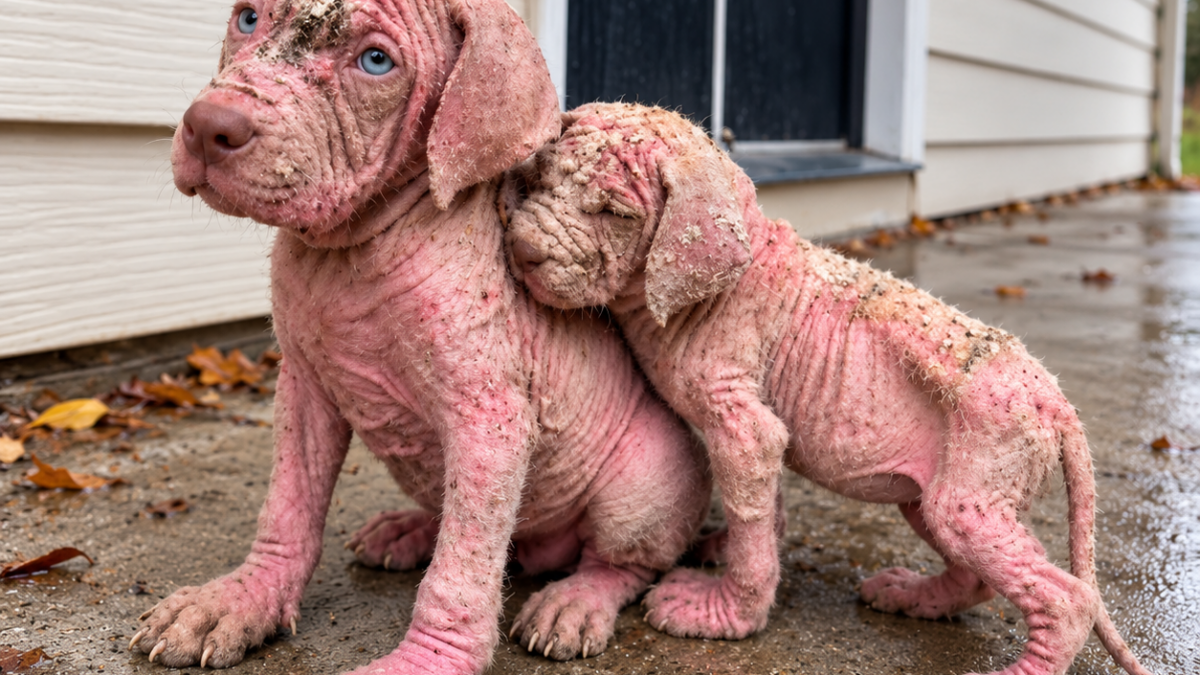
These two had barely started living, and their bodies were already carrying the consequences of neglect, poor nutrition, parasites, and treatment that had done nothing to address the actual disease.
I watched Rhaegal sleeping with his nose tucked against my wrist.
Then I looked at Drogon.
His breathing had finally become slow.
I whispered, “We’ll start again tomorrow.”
That became the rhythm of their recovery.
Start again tomorrow.
The first morning began with bathing.
We could not simply scrub the puppies aggressively and expect to wash away what had happened.
Their skin was too fragile.
The oil had worked itself into every fold, mixed with flakes of damaged skin and dirt, and some areas were already painfully inflamed.
Our veterinarian had given us specific instructions.
Warm water.
Veterinary cleanser.
No harsh rubbing.
Dry them carefully.
Keep them warm.
Treat the mange properly.
Nutrition according to the plan.
Monitor everything.
Rhaegal treated bath time like a social event.
The moment I placed him in the shallow basin, he tried to lick my chin.
“Sir,” I told him, “you are supposed to object to this.”
He wagged.
The warm water turned cloudy around him.
As the oil slowly came away, I could see the condition of his skin more clearly.
It made my smile disappear.
There were scratches everywhere.
Some shallow.
Some deeper.
His tiny feet had spent God knew how long trying to relieve an itch that never stopped.
Imagine having an itch covering nearly your entire body.
Now imagine having no way to understand why.
No medication.
No relief.
Just scratching until the scratching itself becomes another injury.
Rhaegal whimpered when I cleaned one especially sore area.
“I know.”
He immediately licked my arm.
That was Rhaegal from the beginning.
Pain came into his world and somehow he kept answering it with affection.
Drogon was different.
The moment we prepared his bath, he backed away.
Not aggressively.
Just terrified.
His body flattened.
His ears went back.
I stopped.
Another volunteer named Emily looked at me.
“Should we hold him?”
“No.”
“He needs the bath.”
“He does.”
“We can’t wait forever.”
“No. But we can wait five minutes.”
I sat on the floor.
Drogon stared at me.
Rhaegal, freshly washed and wrapped in a towel, waddled over and tried to climb onto my knee.
“You are not helping.”
Rhaegal disagreed.
He walked toward his brother.
Drogon sniffed him.
Then sniffed the wet towel.
I dipped my fingers in the warm water and let Drogon smell them.
Nothing happened.
I touched his shoulder.
He flinched.
I removed my hand.
Again.
Slowly.
Eventually he allowed me to lift him.
His entire body was rigid.
“I’m not going to drop you.”
I lowered him into the basin.
For the first thirty seconds, Drogon looked convinced we had betrayed him.
Then the warm water touched his skin.
Something changed.
His shoulders relaxed.
Emily poured water gently along his back.
Drogon looked down.
Then at me.
“Better?”
He did not wag.
That would have been too much to ask.
But he stopped trembling.
We counted that as progress.
When the bath was over, I wrapped him in a clean towel and held him loosely.
He could have moved away.
Instead, for perhaps three seconds, he stayed against my chest.
Then he climbed down.
Three seconds.
That was enough.
People who only see the final photographs of rescue animals sometimes imagine recovery as one dramatic transformation.
Before.
After.
Bald puppy.
Fluffy dog.
Suffering.
Happiness.
There is an entire world between those photographs.
Medication schedules.
Laundry.
Skin scrapings.
Veterinary appointments.
Meals measured carefully.
Weight charts.
Cleaning.
Disinfecting.
Watching poop with an intensity that would disturb normal people.
Worrying about whether a leg looks slightly more bowed than yesterday.
Wondering whether a patch of red skin means healing irritation or a secondary infection.
And in the case of Rhaegal and Drogon, watching two personalities emerge at completely different speeds.
Rhaegal trusted everybody.
At least that was what it seemed like.
He loved volunteers.
He loved the veterinarian.
He loved the receptionist.
He loved the man who delivered pet food.
He probably would have loved a burglar.
Whenever anyone entered the kennel area, Rhaegal dragged himself toward the gate with his whole body wagging.
His weakened legs made his movement awkward, but enthusiasm compensated for technique.
Drogon watched.
Always from slightly farther away.
He was not terrified of humans in the classic sense.
He did not panic.
He did not snap.
He simply expected us to prove ourselves.
Every single time.
Bring food?
Maybe trustworthy.
Sit quietly?
Better.
Reach too quickly?
Trust reset.
The first week taught me that the brothers would need the same medicine but different emotional care.
Rhaegal needed boundaries.
Drogon needed permission.
Rhaegal would exhaust himself following us if we allowed it.
Drogon needed to know he could retreat without being pursued.
So we created routines.
Breakfast at the same time.
Medication at the same time.
Short handling sessions.
Rest.
More food.
Gentle play.
Skin treatment.
Rest again.
Their nutritional plan was especially important because of the rickets.
Growing bones require the right balance of nutrients.
Their bodies had been trying to build skeletons without the materials required.
The result was visible in their legs and posture.
I hated looking at it because it represented something so preventable.
These were not congenital deformities we had no control over.
Their bodies had simply been deprived while they were trying to grow.
Dr. Patel, the veterinarian overseeing much of their treatment, explained it carefully.
“Puppies can be resilient because they’re young.”
“So their legs can straighten?”
“We may see significant improvement as nutrition improves and muscles strengthen. But we monitor. We don’t force anything.”
“No surgery?”
“Nothing indicates that right now.”
That became our second piece of good news.
The first was that their mange was treatable.
The second was that their bones still had time to respond.
No promises.
But time.
I began taking photographs once a week.
Same room.
Similar angle.
Not because I intended to show anyone.
I needed proof for myself.
Daily change is almost invisible.
When you see a puppy every morning, you notice everything wrong.
The baldness.
The bowed legs.
The irritated skin.
The scratching.
The first photographs let me see something else.
Week two.
Their skin looked less angry.
Week three.
A faint haze appeared along Rhaegal’s shoulders.
I thought I imagined it.
“Emily.”
“What?”
“Come here.”
She looked.
“What am I seeing?”
“Hair.”
“Where?”
“There.”
“That’s three hairs.”
“It counts.”
She leaned closer.
“Four.”
We laughed.
Four hairs became our major achievement for the morning.
Drogon’s fur returned more slowly.
His skin had been particularly irritated along his back and neck.
But the scratching eased.
That mattered more than appearance.
The first night Drogon slept for hours without waking to scratch himself, I stood by the kennel just watching.
He was on his side.
Rhaegal had somehow positioned himself halfway on top of him.
Drogon appeared deeply offended even in sleep.
But he didn’t move.
I took a photograph.
Emily saw me.
“Are you becoming one of those people with nine thousand pictures of their dogs?”
“They’re not my dogs.”
She looked at my phone.
“You have sixty-three photos from this week.”
“Medical documentation.”
“Thirty of them are Rhaegal sleeping upside down.”
“Neurological observation.”
“You’re hopeless.”
Maybe I was.
By the fourth week, both puppies had gained weight.
Not dramatically.
But visibly.
Their shoulders were filling out.
Their bellies looked less distended.
Their movements became stronger.
They still walked awkwardly.
Rhaegal in particular had an almost bouncing gait that made him look like he was navigating a boat in rough water.
He did not care.
The first time we took them outside together after the veterinarian cleared them for a small controlled area, Rhaegal lost his mind.
Grass.
Apparently grass was the greatest invention in the history of dogs.
He smelled it.
Bit it.
Rolled in it.
Sneezed.
Then ran three feet and fell over.
I rushed toward him.
He stood immediately.
Tail going.
“Are you okay?”
Rhaegal attacked a leaf.
That answered the question.
Drogon remained at the doorway.
He looked outside.
Then back into the familiar kennel.
I sat in the grass.
“You can stay there.”
Rhaegal ran toward him with a leaf in his mouth.
Drogon stepped backward.
Rhaegal dropped the leaf.
Then ran away again.
Drogon watched.
Five minutes.
Ten.
Eventually one paw crossed the threshold.
He froze.
Nothing happened.
Second paw.
Then his whole body.
He stood on grass for the first time since coming to us.
The breeze moved across his nearly bare skin.
He smelled the air.
I wanted desperately to call him toward me.
I didn’t.
That moment belonged to him.
Drogon walked three steps.
Stopped.
Then seven more.
Rhaegal crashed into him from the side.
Drogon stumbled.
I expected him to retreat.
Instead, he turned and chased his brother.
Only a few yards.
Their legs were not strong enough for more.
But that was the first time I saw Drogon play.
I sat in the grass laughing.
Emily looked at me.
“You’re crying.”
“No.”
“Yes.”
“Wind.”
“There is no wind.”
“Dust.”
“You’re terrible at lying.”
The brothers wrestled awkwardly until we stopped them before they exhausted themselves.
That night they slept like stones.
The fifth week brought the first real conflict surrounding their case.
A man called the rescue.
He told the receptionist he knew who Rhaegal and Drogon had belonged to.
I called him back.
“My name is Sarah.”
“You have the two puppies?”
“Yes.”
“They weren’t abused.”
The speed of the statement made me sit up.
“I didn’t say they were.”
“People are talking.”
“We haven’t publicly identified anyone.”
“I know who had them. They were trying to help those dogs.”
“With the motor oil?”
“Yes.”
His tone sharpened.
“That’s how people have treated mange for years.”
I closed my eyes.
“No. Motor oil is not appropriate veterinary treatment for mange.”
“My grandfather did it.”
“That doesn’t make it medically safe.”
“The dogs didn’t die.”
That sentence made anger climb into my throat.
I kept my voice controlled.
“They arrived malnourished, covered in mange, suffering severe skin inflammation and rickets.”
“That’s because they were already sick.”
“And sick puppies need veterinary care.”
“Some people can’t afford fancy vets.”
That was different.
That argument I understood.
Veterinary access is real.
Money is real.
Desperation is real.
But none of those realities turn petroleum products into medicine.
“If someone cannot afford treatment,” I said, “there are rescue organizations, low-cost clinics, community programs—”
“Not everywhere.”
“No. Not everywhere.”
“So maybe stop acting like people are monsters because they used what they knew.”
I paused.
“I haven’t called anyone a monster.”
He went quiet.
“What I am saying is that what was done did not treat the mange. The puppies were still suffering when they arrived. They needed proper care.”
“So what happens now?”
“They recover.”
“And then?”
“We find appropriate homes.”
He hesitated.
“The family might want them back.”
I looked through the office window.
Rhaegal was chewing the edge of a blanket.
Drogon was watching him.
“Then the ownership situation will be handled through the rescue process and whatever documentation applies.”
“They should get a chance.”
“The puppies will get the chance that matters.”
He did not like that answer.
Neither did the former caretakers when they contacted us directly two days later.
It was a couple, younger than I expected.
Carlos and Elena.
Their circumstances were complicated.
They had not intentionally tried to poison the puppies.
They genuinely believed motor oil would cure mange because older relatives had told them it would.
They also had limited money.
Carlos had recently lost work.
They were living with family.
Neither puppy had seen a veterinarian before rescue.
I listened.
Then I asked the question that mattered.
“How long were they losing fur?”
Elena looked down.
“A few weeks.”
“And scratching?”
“Yes.”
“And their legs?”
“We thought they were just growing strangely.”
“Did you ask anyone for veterinary help?”
Carlos shook his head.
“We knew we couldn’t pay.”
“Did you contact a rescue?”
“No.”
“Why?”
He looked embarrassed.
“I thought they would take them.”
I glanced toward the kennel wing.
“That is what happened.”
“I know.”
His face changed.
Not anger.
Regret.
“I thought I could fix it.”
That sentence softened something in me without erasing anything.
A lot of preventable animal suffering begins exactly there.
I thought I could fix it.
I thought the home remedy would work.
I thought they would get better.
I thought we could wait another week.
Good intentions do not refill an empty body with nutrients.
They do not kill mites.
They do not strengthen bones.
But understanding intent helps prevent the next mistake.
I did not scream at them.
I did not humiliate them.
That would have felt satisfying for thirty seconds and accomplished nothing.
Instead, Dr. Patel showed them the medical findings.
Skin scrapings.
Weight records.
Photographs of the puppies’ legs.
He explained mange.
Nutrition.
Rickets.
Why motor oil does not belong on an animal’s skin.
What warning signs require professional care.
Elena cried.
Carlos barely spoke.
Finally, he asked, “Are they going to be okay?”
Dr. Patel answered the way he always did.
“They’re improving.”
“That means yes?”
“That means improving.”
Carlos nodded.
He deserved no false reassurance simply because he looked ashamed.
Before leaving, Elena asked whether she could see them.
I hesitated.
Then agreed, provided the interaction remained calm.
Rhaegal saw them first.
His whole body wagged.
He walked forward.
Elena burst into tears.
“Oh, baby.”
She crouched.
Rhaegal went directly into her arms.
That told me something important.
Whatever neglect had occurred, Rhaegal did not associate her with terror.
Drogon stayed back.
Carlos looked at him.
“He was always like that.”
“Cautious?”
“Yeah.”
He sat on the floor without reaching.
For several minutes, nothing happened.
Then Drogon approached slowly.
He sniffed Carlos’s shoe.
Carlos wiped his face.
“I’m sorry.”
Drogon did not understand the words.
Maybe that was merciful.
Animals live with what we do more than what we say.
When the couple left, they signed the remaining surrender documentation rather than contesting the rescue’s placement decisions.
Elena asked one thing.
“Can you tell us when they’re adopted?”
“If the adopters are comfortable with updates being shared, yes.”
She nodded.
“Please make sure they get good homes.”
“That’s the plan.”
There was no dramatic arrest.
No villain marched away in handcuffs.
No revenge scene.
Reality was more useful.
Two people who had relied on a dangerous folk remedy sat in a veterinary room and had to look at what that choice had failed to treat.
Then they let the puppies go somewhere better.
Sometimes accountability is not punishment.
Sometimes it is being forced to learn before ignorance hurts another animal.
We also connected them with a local low-cost veterinary program and educational resources in case they ever cared for animals again.
I told Carlos directly:
“If another animal gets sick, asking for help early is not losing the animal. Waiting until the animal is collapsing is what removes choices.”
He nodded.
“I understand.”
“I hope you do.”
That was the end of our conflict with them.
The puppies’ story continued.
By week six, Rhaegal had enough fur on his back that you could no longer count individual strands.
We still did, obviously.
Because rescue workers are ridiculous.
Emily ran into the office.
“Sarah.”
“What?”
“Come look at Rhaegal.”
I panicked.
“What happened?”
“He has pants.”
“What?”
“Fur pants.”
She was right.
Hair had started growing thicker along his hindquarters before the rest of his body.
It looked like he was wearing fuzzy shorts.
I laughed so hard I had to sit down.
Drogon developed a dark stripe of fur along his spine first.
Then patches near his shoulders.
The brothers who had arrived with nearly naked bodies were slowly acquiring colors we had barely known existed.
Rhaegal was lighter than I expected.
Warm brown and tan.
Drogon grew in darker.
His coat gave him a more serious expression, which matched his personality perfectly.
As fur returned, the skin beneath it calmed.
Red became pink.
Pink became normal.
Scabs disappeared.
Scratching went from constant to occasional.
Then one afternoon, I realized I had not seen either puppy scratch once in nearly an hour.
I checked my watch.
Then another hour.
Nothing.
I nearly cried again.
People underestimate what the absence of pain looks like.
It looks ordinary.
A puppy sleeping instead of scratching.
A dog eating without stopping to bite at his skin.
A body lying peacefully against a blanket.
Ordinary can be miraculous when suffering has been constant.
The rickets demanded more patience.
Hair can appear quickly compared with bone strength.
The puppies were improving nutritionally, but muscles had to catch up.
We followed Dr. Patel’s exercise restrictions carefully.
No long runs.
No jumping from furniture.
No forcing their limbs.
Controlled play.
Appropriate nutrition.
Rechecks.
Rhaegal considered all restrictions deeply offensive.
He wanted to run.
Climb.
Launch himself from impossible surfaces.
“Your skeleton is under construction,” I told him one afternoon as I lifted him down from a low bench.
He licked my face.
“You are not listening.”
Drogon, ironically, became the more sensible puppy.
He moved carefully.
Observed first.
Then acted.
His growing trust meant he began following me without my asking.
At first, only inside the kennel room.
Then down the hallway.
Then into the yard.
One morning I noticed him lying outside the office door while I worked.
Rhaegal was somewhere committing a crime involving a cardboard box.
Drogon simply watched me.
I opened the door.
“You need something?”
He stood.
Walked inside.
Lay beside my chair.
I smiled.
“You know you’re becoming affectionate.”
He looked away.
I respected his privacy.
At eight weeks with us, Drogon climbed into my lap for the first time.
There was no dramatic setup.
I was sitting on the floor sorting medication supplies.
Rhaegal was sleeping.
Drogon approached.
He smelled my shirt.
Placed one paw on my leg.
Then another.
I froze.
He climbed onto my thighs.
Turned.
Lay down.
I did not move for twenty-five minutes.
My foot went numb.
Emily walked past.
She stopped.
Her eyes widened.
I whispered, “Don’t.”
She whispered back, “I didn’t say anything.”
“Your face is loud.”
She took a photograph.
Drogon slept.
That photograph became my favorite from his entire recovery.
Not because he looked dramatically transformed.
He still had thin fur.
His legs were still strengthening.
His skin was still healing.
But trust had become physical.
He had chosen a human lap.
No one placed him there.
He chose it.
Rhaegal’s version of emotional progress was less subtle.
He believed all laps were public property.
He also developed a particular obsession with Dr. Patel.
At appointments, Rhaegal would see him and immediately attempt to climb the veterinarian’s pants.
Dr. Patel pretended annoyance.
“You realize most patients don’t do this.”
“He likes you.”
“He likes anyone with hands.”
“Fair.”
During their ten-week recheck, Dr. Patel examined both sets of legs.
He moved joints.
Watched them walk.
Studied posture.
Then smiled.
“The improvement is significant.”
I had learned not to get excited until he finished.
“So?”
“So the bone development is responding well. Their gait is improving. We continue monitoring, but I’m pleased.”
“Pleased as in—”
“Sarah.”
“What?”
“Accept good news.”
I laughed.
“Fine.”
He looked at Rhaegal.
“Your little disaster is doing well.”
Then Drogon.
“And so is the suspicious one.”
Drogon licked his fingers.
Dr. Patel looked surprised.
“Well.”
I grinned.
“You’ve been approved.”
We began discussing adoption more seriously.
That terrified me.
Not because I thought they were unready.
Because I knew we were approaching the point where my home and the rescue would stop being theirs.
Foster and rescue work asks you to perform a strange emotional trick.
Love completely.
Then let go deliberately.
Every time.
People say, “I could never foster. I’d keep them all.”
I understand.
Sometimes I want to.
But keeping every animal I love would eventually make me unable to save the next one.
The goal is not to become indispensable.
The goal is to build an animal strong enough to leave.
Still, when applications opened, I became unreasonable.
“Too many work hours.”
“Sarah, they work from home three days a week.”
“Three is not seven.”
Emily stared at me.
“Rejected because they have employment.”
“Next.”
“This woman has twenty years of dog experience.”
“Fence is four feet.”
“They’re puppies.”
“They could learn parkour.”
“Sarah.”
“I’m being thorough.”
“You’re trying to sabotage adoption.”
“I am protecting standards.”
“You asked one applicant whether they believe couches are a human right.”
“For dogs.”
“Exactly.”
Eventually Dr. Patel intervened.
“You know they cannot live in the clinic forever.”
“They don’t.”
“Your office is part of the clinic.”
“Technicality.”
“You have to let them have families.”
I knew.
The difficult part was that Rhaegal and Drogon did not necessarily need the same family.
We had originally assumed the brothers might be adopted together.
They loved each other.
Played together.
Slept together.
But as they became healthier, something interesting happened.
They became more independent.
Rhaegal wanted every person.
Every dog.
Every experience.
Drogon loved his brother but increasingly sought quiet spaces and one-on-one attention.
We asked a behavior consultant to evaluate them.
Her conclusion surprised us.
“They’re bonded, but not in a way that requires placement together.”
“Are you sure?”
“Yes.”
“Would separating them hurt?”
“There’ll be adjustment. But the right individual homes may actually suit their personalities better.”
I looked through the window.
Rhaegal was dragging a toy toward a volunteer.
Drogon was lying peacefully beside another person.
“What if they miss each other?”
“They probably will at first.”
That hurt.
“But missing someone does not mean you can’t thrive without them.”
That sentence was not only about dogs.
We decided to consider both joint and separate applications.
Rhaegal’s family found us first.
Their names were Jason and Megan Brooks.
They had two teenage children and an adult mixed-breed dog named Cooper.
Their house had a secure yard.
Megan worked from home.
Jason ran in the mornings and wanted a dog who might eventually join him when fully grown and medically cleared.
When they met Rhaegal, the interview essentially ended.
Rhaegal chose them before I finished introductions.
He ran to Megan.
Then Jason.
Then both kids.
Then Cooper.
Then came back to Megan.
Then attempted to steal her shoelace.
Megan laughed.
“He’s confident.”
“That is one word.”
“What’s another?”
“Unsupervised.”
Jason knelt.
Rhaegal climbed halfway onto his shoulder.
“He seems terrible.”
“Completely.”
“We’ll take him.”
“Absolutely not.”
Jason laughed.
“I know. Process.”
Good answer.
They completed everything.
References.
Home visit.
Veterinary discussion.
Education about his history.
Nutrition.
Joint monitoring.
Skin care.
The possibility that orthopedic problems might still appear later.
They listened.
Asked intelligent questions.
Never once said they wanted him because his story was sad.
That mattered.
On their second visit, Megan asked, “Who is he when you stop thinking about the rescue?”
I looked at Rhaegal.
He was upside down biting his own leash.
“An idiot.”
She burst out laughing.
“A happy idiot?”
“Very.”
“Perfect.”
Drogon’s match took longer.
People saw his photographs and loved him.
Then they visited and expected instant gratitude.
Drogon did not perform gratitude.
He did not run into strangers’ arms because they had submitted an application.
One couple spent ten minutes trying to coax him forward.
“Kiss, kiss, come here!”
Drogon moved farther away.
I almost joined him.
Afterward, they said, “He doesn’t seem affectionate.”
I replied, “He doesn’t know you.”
They chose another dog.
Good.
Drogon needed someone who understood that love is not a vending machine.
Then a woman named Claire Holloway applied.
She lived with her husband David in a quiet home outside town.
No children.
One calm nine-year-old shepherd mix named Luna.
Claire had previously adopted a fearful dog who took six months to voluntarily approach visitors.
In her application, under “What do you expect during the first week?” she wrote:
Nothing. I expect to feed him, keep him safe, and let him watch us.
I circled the sentence.
Emily saw it.
“That’s her.”
“Maybe.”
“It’s her.”
“I said maybe.”
Claire came alone for the first meeting.
She sat on the floor.
Drogon watched from across the room.
Claire did not call him.
Did not pat the floor.
Did not hold out a treat.
She talked to me.
After ten minutes, Drogon moved three feet closer.
Claire continued ignoring him.
After twenty minutes, he smelled the back of her hand.
She did not move.
After thirty, he sat beside her.
I wanted to scream.
Instead I said, very casually, “He seems comfortable.”
Claire smiled without looking at him.
“I’m glad.”
Then Drogon leaned against her hip.
My eyes filled.
Emily was across the room making an unbearable face at me.
I ignored her.
Claire finally touched Drogon’s shoulder.
One slow stroke.
Then stopped.
Drogon stayed.
Second stroke.
He closed his eyes.
That was it.
Not dramatic.
No instant adoption-movie montage.
Just a cautious puppy discovering a person who knew how to wait.
David visited later.
He did exactly the same.
Luna met Drogon during a neutral walk.
She barely cared about him.
Perfect.
Drogon followed her.
Also perfect.
We had two homes.
That meant we had a new problem.
Separation.
The night before Rhaegal’s trial adoption, I sat between the brothers.
Their fur had grown so much that touching them still surprised me.
Rhaegal’s coat was soft.
Drogon’s darker fur had filled in beautifully.
I ran both hands along their backs.
“You know tomorrow is going to be weird.”
Rhaegal chewed a toy.
Drogon looked at me.
“One of you is leaving.”
That sentence hurt.
Rhaegal rolled onto his back.
I rubbed his belly.
“You have no idea.”
Drogon moved closer.
The brothers slept touching that night.
I took another photograph.
Maybe for medical documentation.
Maybe not.
Megan’s family arrived the next morning.
They had a new bed.
Toys.
The food we recommended.
A folder with every instruction I had already given them twice.
Rhaegal sensed excitement immediately.
He wagged through the entire goodbye.
That made it easier and worse.
I knelt.
“You’re leaving.”
Rhaegal licked my mouth.
“Disgusting.”
He licked me again.
“Listen to me.”
Impossible.
I held his face.
“Be good.”
Jason laughed.
“Is that realistic?”
“No.”
Rhaegal walked toward the car.
Then Drogon appeared behind us.
He had followed from the kennel.
The brothers looked at each other.
I held my breath.
Rhaegal ran back.
They sniffed.
Then wrestled.
Right there in the parking area.
No solemn goodbye.
No tragic final look.
They rolled in dust for thirty seconds.
Then Rhaegal saw Megan open the car and ran toward her.
He climbed inside.
Drogon stood watching.
My chest tightened.
The vehicle pulled away.
Drogon remained still.
Then he looked at me.
I crouched.
“Come here.”
For once, he did immediately.
That night Drogon searched.
He checked Rhaegal’s bed.
The yard.
The kennel gate.
He ate dinner, but slower.
I slept in the rescue office.
Drogon lay beside the desk.
At two in the morning, I woke and found him standing at the door.
I opened it.
He walked into the empty kennel.
Smelled Rhaegal’s blanket.
Then came back.
I sat on the floor.
“I know.”
He lay against my leg.
“Missing him is allowed.”
The next morning, something unexpected happened.
Drogon ate breakfast.
Then brought me Rhaegal’s old toy.
We played.
His world had changed.
It had not ended.
Rhaegal, meanwhile, apparently spent his first night in the Brooks home sleeping across Megan’s neck.
She sent a photograph.
Caption:
Personal space has been canceled.
I showed Drogon.
He smelled my phone.
“That’s your brother.”
Drogon sneezed.
“You seem appropriately emotional.”
Over the next two weeks, Rhaegal settled beautifully.
Cooper taught him household routines.
Megan taught him not to attack shoelaces.
That lesson failed.
The teenage kids taught him several commands and accidentally taught him that the refrigerator opening meant sprinting into the kitchen.
Jason sent videos of Rhaegal running across the yard on legs that looked stronger every week.
The first video made me watch three times.
I remembered the bowed puppy struggling across our kennel floor.
Now he chased Cooper.
Not perfectly.
But freely.
Drogon’s adoption trial started shortly afterward.
Claire and David arrived quietly.
No balloons.
No giant celebration.
Exactly right for him.
Claire sat on the floor.
Drogon approached.
She placed his harness on slowly.
He looked at me.
There are moments in rescue where you know you are projecting human emotions onto an animal.
That was probably one.
I still felt like he was asking a question.
Is this safe?
I scratched his chest.
“Yes.”
Claire waited.
Drogon stepped toward her.
Then the door.
We walked outside together.
At the car, he hesitated.
David opened the rear door.
Luna was already inside, secured comfortably.
Drogon looked at her.
Luna yawned.
Drogon climbed in.
Just like that.
The puppy who once backed into the corner when I reached toward him entered a stranger’s car because that stranger was no longer a stranger.
I stood beside the door.
Claire said, “You can visit.”
“I know.”
“I mean it.”
“I know.”
“You look like you’re sending a child to college.”
“He’s less financially destructive.”
David looked at the back seat.
Drogon was chewing the seat-belt cover.
“Debatable.”
I laughed.
Then cried after they drove away.
Emily found me in the kennel.
Both beds empty.
“You okay?”
“No.”
“Good.”
I stared at her.
“What kind of response is that?”
“The day you stop feeling this is the day you should stop rescuing.”
She sat beside me.
“We have three new puppies arriving tomorrow.”
I groaned.
“There it is.”
The next animals.
Always.
That is why you let go.
Rhaegal’s adoption became permanent after the trial period.
Drogon’s did too.
Separate homes.
Separate families.
Different lives.
The brothers had arrived together because suffering did not care about individuality.
Recovery gave it back.
Rhaegal became exactly the dog we expected.
Outgoing.
Chaotic.
Friendly.
He eventually grew into a large, handsome dog whose thick coat made his early photographs almost unbelievable.
Megan sent me a side-by-side image.
Arrival.
Now.
In the first, his skin was almost naked and inflamed.
His legs looked weak beneath him.
In the second, he stood in a yard with a full coat, strong chest, bright eyes, and a tennis ball in his mouth.
I stared.
Jason called later.
“Something wrong?”
“No.”
“You didn’t reply.”
“I was looking.”
“At what?”
“The picture.”
“Pretty crazy.”
I swallowed.
“You can’t see the puppy anymore.”
“What do you mean?”
“I mean if I didn’t know, I’d never guess.”
Jason was quiet.
Then he said, “We know.”
“Do you think about it?”
“Sometimes. Mostly when people ask why we’re so strict about his diet and vet checks.”
I smiled.
“You’re still doing them?”
“Of course.”
“Good.”
“We promised.”
That mattered.
Drogon’s transformation was quieter but, to me, even more emotional.
His fur returned thick and dark.
His legs strengthened.
His posture changed.
But the biggest transformation could not be seen in photographs.
He began greeting Claire at the door.
Then David.
Then trusted visitors.
Not everyone.
Drogon remained Drogon.
Selective.
Thoughtful.
He did not become Rhaegal simply because he healed.
That was another mistake people make.
They think recovery should produce a certain personality.
Confident.
Outgoing.
“Grateful.”
No.
Recovery means an animal becomes free enough to be himself.
Drogon liked quiet mornings.
He loved Luna.
He preferred women initially, then gradually bonded deeply with David.
He enjoyed car rides after learning where they went.
He hated thunderstorms.
He liked sleeping under tables.
And after several months, he began climbing onto Claire’s bed every morning at exactly 5:40.
Not 5:45.
Not 6:00.
5:40.
He would stand beside her pillow.
Stare.
If she ignored him, one paw touched her shoulder.
Claire sent me a message:
Your shy dog has become a dictator.
I replied:
He learned from Rhaegal.
She answered:
He demands breakfast with his entire soul.
That was healing.
Not a dramatic before-and-after photograph.
A once-cautious puppy feeling entitled enough to wake someone for food.
Around six months after the brothers left us, we arranged a reunion.
I was nervous.
People expect siblings to recognize each other in some cinematic way.
Reality can disappoint.
Sometimes dogs who lived together as puppies meet later and simply behave like dogs.
We chose a fenced field.
Rhaegal arrived first.
He dragged Megan across the parking lot.
“Still no manners?”
“None.”
“Good.”
Then Claire arrived with Drogon.
The two dogs saw each other.
Stopped.
For perhaps one second, nothing happened.
Then Rhaegal’s entire body exploded.
He pulled free of Megan’s loose grip inside the fenced area and ran.
Drogon froze.
Rhaegal reached him.
Smelled his face.
His neck.
His ears.
Drogon smelled him back.
Then, without warning, Drogon launched sideways.
Rhaegal chased him.
They ran.
That was the moment I lost whatever composure I had left.
They ran.
Not on weak, bent legs.
Not across clinic mats.
Across an entire field.
Full coats moving in the wind.
Rhaegal faster.
Drogon smarter.
They circled us.
Wrestled.
Separated.
Ran again.
Megan laughed.
Claire cried.
I did both.
Dr. Patel had come too.
He stood beside me.
“You’re doing it again.”
“What?”
“Not accepting good news normally.”
I wiped my face.
“They’re running.”
“Yes.”
“Look at them.”
“I am.”
“They’re running.”
“I can confirm.”
Months earlier, we had watched them take careful steps because their growing bodies had been weakened by nutritional disease.
Now they ran until we had to make them rest.
Rhaegal dropped onto the grass.
Drogon lay several feet away.
Then eventually moved closer until their sides touched.
I took the photograph.
That one became my favorite of them together.
Not the arrival.
Not the dramatic skin recovery.
Two adult dogs lying in grass after exhausting themselves doing something once difficult.
Rhaegal looked at the camera.
Drogon looked away.
Perfect.
Carlos and Elena eventually received one photograph of each dog.
Only after both families agreed.
We did not share addresses.
Names were limited.
Privacy mattered.
Elena replied with a message.
I read it several times.
Thank you for saving them. We were wrong. We thought we were helping, but we were wrong. I’m glad they are okay. We tell people now not to use oil when their dogs have skin problems. We tell them to ask a vet or rescue.
That was a form of justice I valued.
The mistake had not repeated itself in silence.
The people who made it were now warning others.
Carlos later helped a neighbor contact a low-cost clinic when their dog developed hair loss.
He called us first.
“I don’t know if it’s mange.”
“Good.”
He seemed confused.
“Good?”
“Good that you don’t know.”
“I don’t understand.”
“You’re calling instead of guessing.”
He laughed awkwardly.
“Yeah.”
“That’s the lesson.”
The dog turned out to have a fungal skin infection, not mange.
Motor oil would have helped nothing.
The animal received proper medication.
Sometimes the most satisfying ending is not watching someone punished.
It is watching the chain of ignorance break.
That became part of Rhaegal and Drogon’s legacy.
Our rescue started a small community education program.
Nothing grand.
We created simple handouts about mange, skin disease, puppy nutrition, and when to seek veterinary help.
We worked with a low-cost clinic.
People could send photographs, describe symptoms, and receive guidance about whether a dog needed immediate examination.
We made one sentence large:
HOME REMEDIES CAN DELAY THE TREATMENT YOUR ANIMAL ACTUALLY NEEDS. ASK BEFORE YOU APPLY ANYTHING TO DAMAGED SKIN.
The first month, seven families contacted us.
The next month, twelve.
One woman brought in a puppy with early mange.
Early.
Not bald.
Not malnourished.
Not suffering rickets.
Treatment started quickly.
The puppy recovered without ever reaching the condition Rhaegal and Drogon had.
I sent Dr. Patel a photograph.
His reply:
This is the win nobody posts about.
He was right.
Prevention is not dramatic.
There is no shocking rescue image.
No long rehabilitation.
No viral transformation.
Just suffering that never happens.
That is better.
A year after their adoption, Rhaegal injured his paw chasing a squirrel.
Megan called me in a panic.
“He’s limping.”
“Vet?”
“Appointment in twenty minutes.”
I smiled.
“Good.”
“You sound happy.”
“I’m not happy he’s hurt.”
“You’re weirdly cheerful.”
“Because you saw a limp and called a veterinarian.”
She laughed.
“That’s what normal people do.”
“Exactly.”
The paw injury was minor.
Rest for a few days.
Rhaegal considered this torture.
Megan sent a photograph of him staring through the window at squirrels with the bitterness of a wrongly imprisoned man.
His bones, Dr. Patel said at the next annual recheck, had developed remarkably well given his early condition.
Not perfect.
But strong.
Drogon also continued doing well.
His annual photographs became increasingly ridiculous because Claire liked seasonal accessories.
A scarf.
A raincoat.
Once a sweater with tiny snowflakes.
Drogon’s expression in every photograph suggested he was considering legal action.
“You’re humiliating him,” I told her.
“He’s warm.”
“He has fur now.”
“And beautiful fur.”
That still stopped me.
Fur now.
Sometimes we forget what we once begged for after it becomes ordinary.
I enlarged the photograph.
Drogon’s coat was thick enough that my fingers almost remembered the feel of his bare inflamed skin by contrast.
Claire said, “People don’t believe me when I show the old pictures.”
“Good.”
“Good?”
“It means he changed enough to make the truth look unbelievable.”
She was quiet.
“Did you think he’d look like this?”
“No.”
“Really?”
“I hoped.”
“That’s different?”
“Very.”
Hope is not prediction.
In rescue, you learn that quickly.
You hope the skin heals.
Hope the bloodwork improves.
Hope the bones strengthen.
Hope the dog trusts.
You do the work without requiring the universe to promise a result.
Sometimes it gives you more than you dared to expect.
Rhaegal and Drogon gave us that.
Two years after rescue, we reunited them again.
This time their families brought food and folding chairs.
The brothers recognized each other more calmly.
No explosive sprint at first.
They sniffed.
Then walked the field together.
Within ten minutes, Rhaegal started wrestling.
Drogon tolerated him.
Some relationships never change.
I sat beside Dr. Patel.
“Remember the oil?”
“I remember the smell.”
“I thought it would never come out.”
“It came out.”
“Remember counting hairs?”
He laughed.
“You people made me look at four hairs under clinic lighting.”
“They mattered.”
“They did.”
Rhaegal ran past.
Drogon followed.
I watched their legs.
Old habit.
Straight enough.
Strong enough.
No obvious pain.
“They almost didn’t get this.”
Dr. Patel looked at me.
“Don’t do that.”
“What?”
“Turn the good moment into grief for the bad one.”
I frowned.
“That sounds suspiciously philosophical for a veterinarian.”
“Occupational hazard.”
He pointed toward the dogs.
“They got this.”
I understood.
Rescue can trap you in the before picture.
Sometimes you have to let the after exist without dragging suffering into every happy moment.
So for the rest of the afternoon, I did not think about mange.
I did not think about rickets.
I did not think about motor oil.
I watched two dogs run.
Years passed.
Rhaegal became the neighborhood celebrity his family should probably have expected.
He loved children.
Delivery drivers.
The mail carrier.
People walking past.
Megan finally put a sign near their front door:
DOG WILL DEMAND FRIENDSHIP.
Rhaegal considered it official policy.
He had a habit of carrying a stuffed dragon to greet visitors.
The toy had been a joke because of his name.
It became his favorite possession.
Jason sent me a photograph of Rhaegal asleep with the dragon under his chin.
I saved it.
Drogon became the opposite kind of beloved.
He had a smaller circle.
But if you were in it, you were everything.
Claire.
David.
Luna until she passed away.
Then eventually a rescued cat named Olive whom Drogon treated with absurd gentleness.
The dog who had once feared my hand allowed a tiny cat to sleep against his stomach.
Claire sent me videos.
I watched all of them.
One evening she called.
“You know the strangest thing?”
“What?”
“I sometimes forget he was sick.”
I smiled.
“That’s the goal.”
“Is it?”
“Yes.”
“To forget?”
“Not erase it. Just stop making it the center.”
Drogon barked in the background.
“What’s he doing?”
“Demanding dinner.”
“What time?”
“Five minutes early.”
“Clearly traumatized.”
She laughed.
That became another lesson from the brothers.
People love transformation stories because they contain contrast.
The worse the beginning, the more satisfying the end.
But the animals themselves deserve lives where the beginning eventually becomes irrelevant.
Rhaegal did not wake thinking, I used to have mange.
Drogon did not stare at his coat remembering bald skin.
They woke thinking about breakfast.
Walks.
Their families.
Whatever animal had trespassed into the yard overnight.
That freedom from narrative is one of rescue’s greatest gifts.
We humans keep the story.
They get the life.
Years after their adoption, Maria—the rescuer who made the original call—visited our shelter.
I had not seen her in months.
She brought a folder.
“What’s that?”
“Old cases.”
“That sounds ominous.”
She pulled out a photograph.
Two nearly hairless puppies wrapped in towels.
Rhaegal and Drogon.
I stared.
They looked smaller than I remembered.
Sicker.
Memory had softened them.
Photographs didn’t.
Maria sat beside me.
“I almost didn’t call.”
I looked at her.
“What?”
“The day I found out about them.”
“Why?”
“I thought you were full.”
“We were.”
“You said yes before I finished.”
“I remember.”
“I was going to call another rescue first.”
“What changed?”
She smiled.
“I knew you’d be mad if I waited.”
“Correct.”
We looked at the photograph.
“Do you ever wonder what would have happened?”
“Don’t.”
“I do.”
“Maria.”
“I do.”
I sighed.
“So do I.”
That is the shadow behind every rescue success.
What if the call comes tomorrow?
What if nobody notices?
What if someone waits?
What if the animal is weaker?
What if the folk remedy causes worse injury?
What if?
There is no useful end to that road.
So we focus on the next call.
The next family that needs education.
The next dog whose skin problem could be treated early.
The next animal whose food needs to be better before bones suffer.
The next owner embarrassed to admit they cannot afford a veterinarian.
Shame delays help.
I learned that from Carlos and Elena too.
They had waited partly because they feared being judged.
By the time help arrived, judgment was unavoidable.
So our outreach message changed.
ASK EARLY. WE WOULD RATHER HELP BEFORE IT BECOMES AN EMERGENCY.
That sentence brought people in.
A man with a puppy losing fur.
A grandmother whose dog stopped eating.
A family whose litter had bowed legs.
Some needed medical care.
Some needed nutritional advice.
Some needed financial assistance.
Some needed to surrender.
Not every case was happy.
But several never became catastrophic.
That was Rhaegal and Drogon continuing to matter without knowing it.
At five years old, Rhaegal returned to our clinic for a reunion check because Megan wanted Dr. Patel to see him.
He walked into the building like he owned it.
Dr. Patel came out.
Rhaegal immediately stood on his hind legs and placed both front paws against him.
Dr. Patel staggered backward.
“Absolutely not.”
Rhaegal wagged.
“He remembers you,” I said.
“He weighs seventy pounds.”
“He loves you more now.”
“Dangerously.”
Dr. Patel examined him.
Heart good.
Skin excellent.
Muscle excellent.
Gait good.
Mild structural quirks likely connected to early development but nothing interfering with normal life.
“Beautiful.”
Megan smiled.
“I know.”
Dr. Patel looked at me.
“She means the dog.”
“I assumed.”
Then he ran his hand through Rhaegal’s thick coat.
“Hard to believe.”
We were all quiet.
Megan had brought the original rescue photograph.
She held it beside him.
Rhaegal tried to eat it.
“Stop!”
Jason laughed.
“He’s destroying evidence.”
I took the paper away.
Rhaegal looked proud.
The contrast was almost absurd.
The photograph showed exposed inflamed skin.
The dog standing beside it had a coat so thick you had to part it to see skin at all.
Someone once poured oil over a puppy because they thought they had no better answer.
Now the adult dog had a medical record, annual exams, vaccinations, appropriate diet, and two humans who called the veterinarian over a minor paw limp.
That was the reversal.
Not revenge against people.
A complete reversal of circumstance.
Drogon’s five-year visit happened a month later.
He entered more cautiously.
Of course.
Then saw me.
He stopped.
My heart stopped too.
“Hey.”
Drogon stared.
I wondered if five years had changed my scent enough.
Then his tail moved.
One wag.
Two.
He walked toward me.
Not ran.
Drogon never wasted dignity.
He pressed his head into my stomach.
I wrapped my arms around him.
Claire smiled.
“I told you.”
“What?”
“He remembers.”
I buried my face in his coat.
That coat.
Thick.
Warm.
Healthy.
I had spent weeks touching bare skin.
Now my fingers disappeared into fur.
“You took your time growing this.”
Drogon leaned harder.
Dr. Patel entered.
Drogon looked at him.
Then walked over.
No flinch.
No retreat.
He smelled the veterinarian’s hand.
Accepted a scratch.
Dr. Patel raised his eyebrows.
“Full approval.”
“Five years late.”
“I’ll take it.”
His exam was good too.
Strong body.
Stable joints.
No skin disease.
No signs that rickets limited his daily life.
Claire asked, “Will anything come back because of what happened as a puppy?”
“His early nutritional history may be relevant as he ages, so continue regular exams and maintain a healthy weight. But look at him.”
We did.
Drogon stood calmly.
Healthy.
Present.
Enough.
Luna had died by then, and Drogon had struggled with the loss for several weeks.
Claire told us how he searched for her.
Then how he eventually settled.
“How did he handle Olive arriving?”
Dr. Patel asked.
Claire laughed.
“He became a mother.”
“Male dog.”
“You explain that to him.”
Drogon had spent his early life with one brother.
Maybe caring for another small creature came naturally.
Or maybe he was simply gentle.
We sometimes over-explain animals.
They are allowed to have personalities without trauma being the reason for everything.
As the brothers entered middle age, their families stayed in contact.
Not constantly.
That is another good sign.
When adopters stop needing rescue support because the dog has simply become part of their household, we have done our job.
Updates came on birthdays.
Holidays.
Medical checks.
Ridiculous photographs.
Rhaegal in snow.
Drogon sleeping with Olive.
Rhaegal stealing a hamburger bun.
Drogon refusing to walk in rain.
Ordinary life.
Then one winter, I received a message from Elena.
The woman who had helped surrender them years earlier.
She sent a photograph of a dog I did not recognize.
Healthy coat.
Brown eyes.
Sitting inside a small house.
The message said:
This is Maya. She belongs to my sister. She started scratching badly last month. They wanted to try oil because an uncle told them to. I stopped them. We went to the clinic you gave me. She had mites and an infection. She got medicine and she’s better. I thought you should know.
I sat at my desk for a long time.
That message felt like closure.
Not because it erased Rhaegal and Drogon’s suffering.
Nothing erases suffering after it has happened.
But the knowledge purchased at their expense had finally protected another dog.
I replied:
I’m very glad you called the clinic. Thank you for stopping them.
Elena responded:
I learned. I wish I had learned before.
I believed her.
That is one of the difficult truths of animal welfare.
People can do harmful things without wanting to be cruel.
If we only know how to punish, sometimes we lose the chance to teach.
If we only excuse because intent was good, animals keep suffering.
Both things matter.
Intent.
Impact.
Compassion for people does not require pretending the animal was fine.
Accountability does not require hatred.
Rhaegal and Drogon taught me that balance.
They deserved better than they received at the beginning.
They also deserved for their story to create better choices afterward.
It did.
By their seventh year, the brothers’ reunions became less frequent.
Life changed.
Families moved.
Schedules became difficult.
The dogs were still healthy.
Then Megan called me one afternoon.
Her voice was gentle.
“Rhaegal’s slowing down a little.”
My stomach tightened automatically.
“How much?”
“Nothing dramatic. He’s seven, Sarah.”
“I know.”
“You sound like I said he’s dying.”
“You called a rescuer about a dog.”
“I called because I thought you’d like to see him.”
“Oh.”
“Come over.”
I did.
Rhaegal met me at the door with the stuffed dragon.
The same ridiculous toy.
Older now.
Missing one wing.
Rhaegal’s muzzle had begun turning lighter.
Not white.
Just enough.
He pushed the dragon into my hand.
“You still have this?”
Megan laughed.
“We have purchased six replacements.”
“He rejected them?”
“Every one.”
I sat on the floor.
Rhaegal leaned against me.
He was calmer than he had been as a puppy.
Thank God.
Still social.
Still convinced visitors existed for him.
But maturity had softened the chaos.
I ran my fingers through his coat.
“Look at you.”
Megan brought out the old photograph again.
“I keep it in his medical folder.”
“Why?”
“To remember.”
“Does it make you sad?”
“Not anymore.”
She handed it to me.
I looked from the nearly bald puppy to the adult dog beside me.
“What does it make you feel?”
Megan thought.
“Lucky.”
That was the right word.
Not triumphant.
Not vindicated.
Lucky.
Rhaegal rested his head on my knee.
“We almost missed you,” I whispered.
Megan heard.
“But you didn’t.”
No.
We didn’t.
Drogon aged differently.
At eight, he became grayer around the face.
Still cautious with strangers.
Still adored Claire.
David joked that he had spent nearly a decade trying to become Drogon’s favorite person and remained second place.
“Third,” Claire corrected.
“Who is second?”
“Olive.”
The cat.
David was offended.
Drogon did not apologize.
When I visited, he walked with me around the yard.
No bowed puppy legs.
No weak little body.
Just an older dog.
His pace was slower because of age, not rickets.
That distinction filled me with gratitude.
We sat beneath a tree.
Claire brought coffee.
Drogon lay at our feet.
“Do you remember how he wouldn’t come out onto grass?” I asked.
“I remember the video.”
“He stood at the door forever.”
“Now I can’t get him inside when it’s sixty degrees.”
“Progress.”
Claire looked at him.
“Do you think he remembers Rhaegal?”
“Probably in some way.”
“Do they need to see each other?”
I thought.
“Need? Probably not.”
“Want?”
“Maybe.”
We arranged one more reunion.
The brothers were older.
No wild sprint.
Rhaegal arrived carrying his dragon.
Drogon approached.
They smelled each other.
Walked in a circle.
Then Rhaegal tried to play.
Drogon gave him a look that said, We are adults.
Rhaegal disagreed.
Eventually Drogon chased him for perhaps fifteen seconds.
Everyone laughed.
Then the brothers settled in the grass.
Side by side.
Not touching at first.
Then Rhaegal shifted.
Their shoulders met.
There it was again.
The same position from years before.
Two puppies once slept together because their bodies were sick and the other warm body was familiar.
Two older dogs now rested together because they had chosen to.
I took one final photograph of them.
I did not know it would be the last time they met.
None of us ever knows which ordinary moment becomes the last.
That is probably good.
A year and a half later, Rhaegal developed cancer.
Megan called me after the diagnosis.
I sat down.
“What kind?”
She told me.
The prognosis was guarded.
Treatment options existed, but his specific case was advanced.
I visited the next day.
Rhaegal greeted me.
Slower.
Still carrying the dragon.
Of course.
“You ridiculous dog.”
He pressed against me.
Megan cried.
“We’re treating for comfort.”
I nodded.
“How long?”
“We don’t know.”
That answer again.
Years later.
Different problem.
Same unbearable uncertainty.
Rhaegal had lived a good life.
Knowing that did not make losing him easy.
He received palliative care.
Pain control.
Favorite foods.
Short walks.
Time with family.
He spent his final weeks surrounded by people he had spent his entire life trying to befriend.
In that sense, Rhaegal’s personality had won completely.
One evening Megan called.
“It’s tomorrow.”
I closed my eyes.
“Do you want me there?”
“Yes.”
I went.
Rhaegal lay in the backyard on a blanket.
His family around him.
Cooper had passed years earlier.
The kids were adults now.
Both came home.
Jason sat on the grass.
Megan held Rhaegal’s head.
I brought his original rescue photograph.
I wasn’t sure why.
Maybe because I needed to see the whole distance at once.
The veterinarian came to the house.
Rhaegal ate pieces of hamburger.
Real hamburger.
No nutritional lecture.
No restriction.
He deserved it.
I showed Megan the photograph.
She looked at the hairless puppy.
Then at the old dog beside her.
“He got so much life.”
“Yes.”
“I wish it felt like enough.”
“It never does.”
The first medication made him sleepy.
His head rested against Megan.
His stuffed dragon lay beside him.
I touched his shoulder.
The fur beneath my hand was thick.
That detail destroyed me.
I remembered celebrating four hairs.
Now I was crying into a full coat.
“Good boy.”
Rhaegal opened his eyes briefly.
His tail moved once.
Then he relaxed again.
The veterinarian gave the final medication.
He died peacefully.
No itching.
No hunger.
No weak bones.
No fear.
Just old enough to have cancer.
Loved enough that people gathered for him.
Afterward, Megan gave me the stuffed dragon.
“I think you should have it.”
“No.”
“He’d want you to.”
“He’d want it.”
She laughed through tears.
“Fine. He’d want to eat the hamburger wrapper.”
“That sounds more accurate.”
I eventually accepted the dragon.
It sits in our rescue office today.
One wing missing.
Chewed beyond repair.
A reminder that a puppy once arrived almost hairless and lived long enough to destroy the same toy for years.
When Claire learned Rhaegal had died, she watched Drogon closely.
Would he know?
Probably not in the way we did.
The brothers had not lived together for years.
Still, she gave Drogon extra attention.
A few months later, we brought the stuffed dragon during a visit.
Drogon smelled it.
For a long time.
Then lay down beside it.
Claire started crying.
“Do you think—”
“I don’t know.”
We never finished the question.
Not knowing was okay.
Drogon lived another two years.
He became very old.
His hips eventually stiffened.
His hearing weakened.
His dark coat turned silver around the face.
Olive the cat remained with him.
Claire sent me photographs of them sleeping together.
Every image reminded me of the cautious little puppy who needed twenty minutes before touching a stranger.
Old age had not made him universally friendly.
He still had standards.
I respected that.
When he reached the end of his life, there was no sudden catastrophe.
Just gradual decline.
Appetite smaller.
Walks shorter.
More sleep.
The veterinarian helped Claire monitor comfort.
One evening she called.
“I think it’s time.”
I went.
Drogon was lying beneath the kitchen table.
His favorite place.
I sat on the floor.
He lifted his head.
For a moment, his eyes focused on me.
His tail moved.
I smiled.
“Still remember?”
He rested his head again.
Claire sat beside us.
“I found something.”
She brought out an old photograph.
Drogon in my lap.
Eight weeks into recovery.
The first time he had chosen to climb onto me.
I laughed.
“My foot went numb.”
“You told me.”
“I stayed there forever.”
“He still does that to me.”
We looked at the old picture.
His fur thin.
Body small.
Eyes cautious.
Then at the old dog beside us.
Claire stroked his face.
“You trusted the right people eventually.”
The veterinarian arrived.
Drogon had small pieces of roast chicken.
He ate three.
Refused the fourth.
Claire knew.
The medication made him sleepy.
Olive walked over and smelled him.
Then settled near his back.
I placed my hand on Drogon’s shoulder.
The same shoulder he once flinched away from.
Now he relaxed beneath it.
That was the final transformation.
Not fur.
Not legs.
Trust.
The veterinarian gave the last medication.
Drogon died quietly in the home he had chosen one careful step at a time.
Afterward, Claire cried into his fur.
David stood behind her with his hand on her shoulder.
Olive remained nearby.
I sat on the floor and thought about two puppies arriving in towels smelling like motor oil.
Both gone now.
But not young.
Not forgotten.
Not unfinished.
They had received entire lives.
That is all rescue can ever really try to give.
Not immortality.
Time.
Good time.
Safe time.
Enough time to become more than the condition in which somebody found you.
Later, we placed photographs of Rhaegal and Drogon together on the rescue-office wall.
Not their intake photographs.
I made that decision deliberately.
The photo we chose was from the field.
The brothers running.
Full coats.
Strong legs.
Mouths open.
Rhaegal slightly ahead.
Drogon chasing.
Beneath it we put a small plaque:
RHAEGAL & DROGON
THEY ARRIVED NEEDING EVERYTHING.
THEY LEFT KNOWING THEY WERE LOVED.
Visitors often asked about them.
“Were those the motor-oil puppies?”
“Yes.”
Then I would tell the rest.
Not just the oil.
Not just mange.
Not just rickets.
Rhaegal’s terrible manners.
Drogon’s careful trust.
Four hairs.
The grass.
Separate homes.
The reunion.
The dragon toy.
The cat.
Old age.
Because no animal should spend eternity defined by the worst photograph ever taken of them.
Carlos and Elena visited our education table once years later.
That surprised me.
They had volunteered to help at a community animal-care day.
Carlos carried boxes.
Elena handed out clinic information.
At one point a man asked whether motor oil really worked for mange.
Elena answered before I could.
“No.”
He shrugged.
“My dad always did it.”
“So did my family.”
She looked toward me briefly.
“We almost lost two puppies because we waited and used the wrong thing. Take your dog to somebody who can diagnose it.”
The man took the clinic flyer.
I said nothing.
That was the moment the story came full circle.
Years earlier, I had wanted anger.
I wanted someone to blame for two hurting puppies.
Anger has its place.
It gets you moving.
It makes you say, Bring them now.
But if I had humiliated Elena into silence, she would never have become the person stopping someone else from repeating the same mistake.
That mattered more.
The most satisfying revenge against ignorance is knowledge that spreads farther.
The most satisfying revenge against neglect is a healthy dog.
The most satisfying revenge against a miserable beginning is a long ordinary life.
Rhaegal and Drogon got that.
They got separate families who knew their quirks.
They got medical care before problems became disasters.
They got birthday photographs.
Mud.
Beds.
Car rides.
Squirrels.
A ridiculous stuffed dragon.
A cat sleeping against a dog who once feared touch.
They got to age.
And perhaps most importantly, they became proof that an animal’s first chapter does not have the authority to write the ending.
When I think of them now, I can still smell the motor oil if I let myself.
Memory does that.
I can see the irritated skin.
The bowed little legs.
Rhaegal pressing himself into my hand.
Drogon backing into the kennel.
But I do not stay in that room anymore.
I move forward.
Rhaegal running toward Megan with a tennis ball.
Drogon climbing into Claire’s lap.
Two brothers meeting in a field.
Strong enough to chase one another until we forced them to rest.
That is where I keep them.
There is one photograph I never posted publicly.
It was taken at the first reunion.
Rhaegal and Drogon had finished running.
They were lying in the grass.
The sun was behind them.
Rhaegal’s fur almost glowed around the edges.
Drogon looked darker beside him.
Their bodies touched at the shoulder.
If you knew nothing about them, the photograph would look boring.
Two dogs resting.
No drama.
No visible rescue.
No suffering.
That is exactly why I love it.
The happiest ending to a rescue story should eventually stop looking like a rescue story.
It should look ordinary.
Two dogs.
Grass.
Sunlight.
A family waiting nearby.
Nothing hurting.
Nothing missing.
Nothing to prove.
And if someone had shown me that photograph on the night Rhaegal and Drogon arrived—two nearly bald puppies scratching inflamed skin, weakened by poor nutrition, their growing legs already affected—I am not sure I would have believed it.
I would have wanted to.
That is different.
We hoped their skin would heal.
It did.
We hoped fur would return.
It did.
We hoped their bodies could grow stronger.
They did.
We hoped Rhaegal’s affection would survive.
It became impossible to contain.
We hoped Drogon would learn that hands could be safe.
He eventually sought them out.
We hoped for homes.
They got families.
We hoped for years.
They got enough years to become old dogs.
That is more than a dramatic ending.
That is a complete life.
Whenever a new volunteer sees their photographs and says, “I can’t believe those are the same dogs,” I always answer the same way.
“They are.”
The sick puppies were real.
So were the healthy dogs.
Both truths belong to them.
But only one truth got the final word.
Rhaegal and Drogon were not the puppies covered in motor oil forever.
They were brothers.
They were survivors.
They were troublemakers.
They were family.
They were loved.
And by the time their lives were over, the most shocking thing about those first photographs was not how terrible they looked.
It was how completely the world had changed around them.
They arrived with bare skin.
They left this life wrapped in fur people had stroked for years.
They arrived on weak legs.
They spent years walking wherever they wanted.
They arrived without the care their bodies desperately needed.
They spent the rest of their lives surrounded by people who noticed every limp, every itch, every missed meal.
And the people who once believed motor oil was medicine learned to tell others something better.
Ask for help.
Ask early.
Do not guess with a living creature’s body.
That, to me, is the ending Rhaegal and Drogon deserved.
Not a revenge built from more pain.
A revenge built from change.
Two lives that became beautiful.
Two families that cherished them.
And one harmful mistake that stopped being repeated because two little puppies survived long enough to teach everyone watching what real care should look like.





