PART 2: HOA Karen Built 9 Luxury Homes on My 15 Acres—Then Every Family Started Paying Me Rent
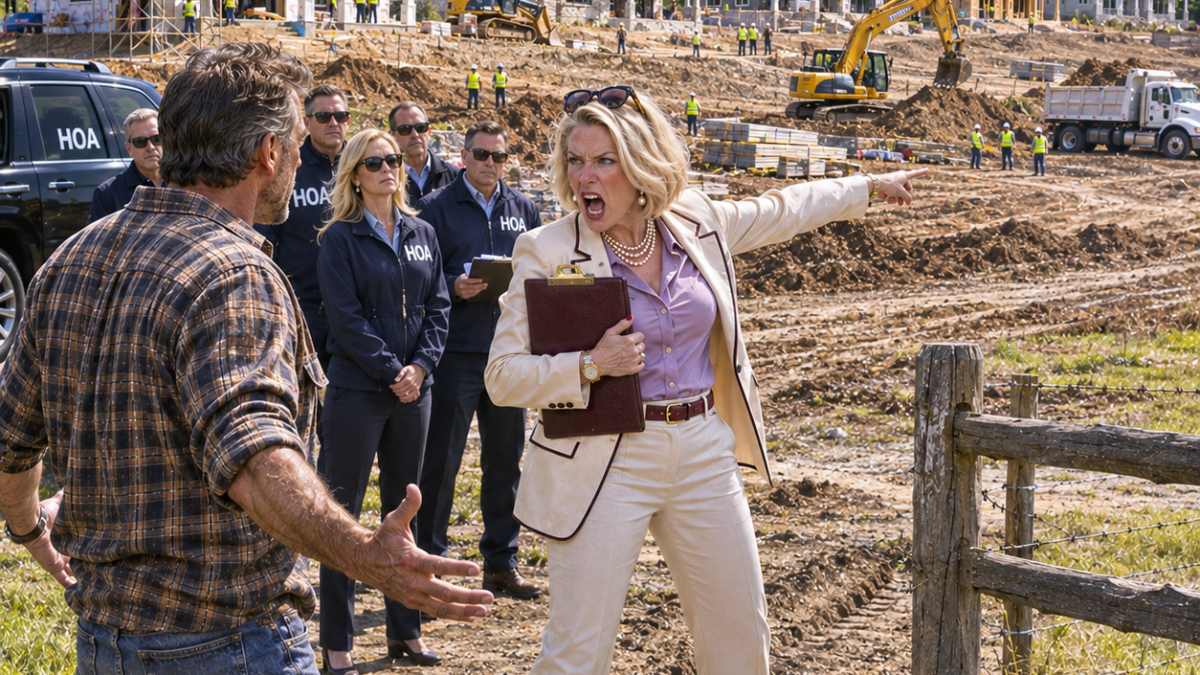
I came home after three months away and found nine brand-new houses rising from the field my grandfather had spent half his life protecting.
The HOA president calmly told me my fifteen acres had been “annexed” while I was gone, then warned me not to interfere with the construction because the project was already approved.
What she didn’t understand was that I wasn’t looking at nine houses that morning—I was looking at nine pieces of evidence built on top of a lie.
My name is Tom Bennett.
That land had been in my family longer than Meadowbrook Estates had existed.
Longer than its stone entrance sign.
Longer than its matching mailboxes.
Longer than the neighborhood pool, clubhouse, landscaping committees, holiday-decoration rules, and the small army of people who apparently believed grass could be measured with moral significance.
My grandfather bought the acreage in the 1950s.
Fifteen acres.
Not enormous by farm standards.
But enough for a field, a narrow creek, old hardwoods, a small barn, and one stubborn man who believed land meant freedom.
When I was a kid, Grandpa would take me along the property line and show me the markers.
The maple tree at the north corner.
The stone near the creek.
The old wooden survey stake he had driven into the ground decades earlier.
“Remember them,” he’d tell me.
“Why?”
“Because people remember promises differently when money gets involved.”
I thought he was being dramatic.
He wasn’t.
Another thing he always said was:
“Tom, land’s the only thing they aren’t making more of.”
When he died, the property eventually came to me.
By then I was a civil engineer.
I spent most of my career studying roads, drainage, grading, load distribution, utilities, and the hundred invisible systems people only notice when one of them fails.
I could have sold the acreage.
Developers had asked.
More than once.
Meadowbrook Estates had been creeping closer for years.
First one subdivision phase.
Then another.
Perfect lawns.
Stone walls.
Walking paths.
Strict HOA rules.
Homes designed to look different enough to be expensive and similar enough to make individuality suspicious.
But I never sold.
I didn’t need the money badly enough to erase my grandfather’s place.
My plan was simpler.
Someday I would build a small cabin near the pond.
Plant fruit trees.
Maybe spend retirement pretending I knew how to fish better than I actually did.
Then I accepted a short consulting job out of state.
Three months.
Good money.
Easy project.
Before leaving, I locked the cabin.
Chained the gate.
Checked the tax bill.
Walked the property one last time.
Nothing unusual.
When I returned, I almost drove past my own entrance.
The old oak trees were gone.
The field had been graded flat.
The creek had been redirected into a new storm drain.
Fresh asphalt cut across soil where my grandfather’s barn once stood.
And beyond the tree line were nine houses.
Not plans.
Not stakes.
Houses.
Foundations.
Framed walls.
New roofs.
Concrete drives.
Workers in reflective vests.
A cement truck idling beside a banner:
**MEADOWBROOK ESTATES**
**EXPANSION — PHASE THREE**
For several seconds, I sat behind the steering wheel without moving.
My first thought was that I had made some mistake.
Wrong parcel.
Wrong entrance.
Wrong world.
Then I saw the old maple.
The one Grandpa used as a boundary marker.
Everything inside me went cold.
I walked toward the construction site.
A foreman stopped me near the safety tape.
“Sir, you’ll need to stay back.”
“What are you building?”
He glanced at the houses.
“Phase Three.”
“Of what?”
“Meadowbrook.”
“This isn’t Meadowbrook.”
He frowned.
“Board-approved expansion.”
“This is private land.”
He checked his clipboard.
“HOA owns it.”
“No.”
He pointed toward the paperwork.
“President signed everything.”
“Who?”
“Linda Prescott.”
I knew the name.
Everybody near Meadowbrook knew Linda Prescott.
Fifteen years as HOA president.
Fines over grass length.
Arguments over holiday lights.
Mailboxes.
Trash cans.
Fence stains.
A woman residents privately called Karen with a clipboard.
I looked past the foreman at nine houses standing on my grandfather’s field.
Then back at him.
“Tell Linda Prescott something for me.”
He raised an eyebrow.
“What?”
“She didn’t build Phase Three.”
I looked down at the soil beneath my boots.
“She built nine houses on Tom Bennett’s land.”
And by the time I was finished proving it, those houses were going to become the most expensive mistake her HOA had ever made.
PART 2
I spent that first night at the kitchen table.
No television.
No music.
No dinner.
Just paper.
Grandpa had taught me something else that turned out to matter.
Never trust one copy of anything important.
My deed sat in a fireproof box.
The original survey was rolled in a cardboard tube.
Tax receipts filled a folder going back years.
There were photographs.
Aerial maps.
Old engineering plats.
The legal description was so familiar I could almost recite it without looking.
**Lot 18. County Parcel 47B13. Beginning at the north maple reference…**
I traced the lines.
Again.
Then again.
Every one of the nine houses sat within them.
Not close.
Not a few inches over.
Not a disputed fence.
The entire development.
Road.
Utilities.
Foundations.
Yards.
All of it.
My land.
At two in the morning, I walked to the window.
Construction equipment sat dark beyond the field.
Nine roofs stood against the night.
I tried imagining Grandpa seeing them.
That hurt more than the money.
He had cleared those woods himself.
Sweated through summers there.
Rebuilt the barn after a storm.
Taught me to drive an old tractor in that field.
Now somebody had bulldozed it while I was away and called the destruction an improvement.
I didn’t sleep.
At eight the next morning, I was waiting at the county recorder’s office.
Vince Marshall worked behind the desk.
He had known my grandfather.
Knew me too.
“Tom?”
“Morning.”
“You look terrible.”
“Thank you.”
“What happened?”
I placed my deed on the counter.
“Tell me who owns Parcel 47B13.”
He laughed.
“You do.”
“Check.”
His smile disappeared.
He turned to his computer.
Typed.
Scanned.
Then leaned closer to the screen.
“Huh.”
My stomach tightened.
“What?”
“There’s a newer overlay.”
“What overlay?”
“Community expansion.”
“Filed by who?”
He clicked.
“Meadowbrook.”
“I never signed anything.”
“I know.”
He opened the image.
The document showed my acreage shaded as part of an abandoned tract.
A notation claimed the parcel had been incorporated into a development expansion plan.
Owner authorization section?
Not my signature.
Instead, Linda Prescott’s name appeared on supporting documentation.
I stared.
Vince lowered his voice.
“Tom.”
“Yeah?”
“You didn’t authorize this?”
“No.”
“You didn’t transfer ownership?”
“No.”
“You didn’t grant development rights?”
“No.”
He leaned back.
“Then somebody has a serious problem.”
I pointed at the screen.
“How did this get filed?”
“Someone submitted the overlay with supporting land-use documentation.”
“Survey?”
“Looks like it.”
“Licensed?”
He zoomed in.
His expression changed.
“This seal…”
“What?”
“Looks wrong.”
I felt my anger become very still.
Not hot.
Cold.
The kind of anger I knew from engineering disasters.
When you stop shouting because you realize the failure isn’t random.
It has a structure.
“Can I get certified copies?”
“Everything.”
“Original submission history?”
“I’ll pull what I can.”
“Timestamp?”
“Yes.”
“Uploader?”
“If the system logged it.”
He glanced at me.
“Tom, get a lawyer.”
“I will.”
“Today.”
“I will.”
Before leaving, I asked him one more question.
“Does anything in your records show that the title moved away from me?”
He checked.
Then shook his head.
“No.”
“So I still own it.”
“Yes.”
“All fifteen acres.”
“Yes.”
I folded the certified documents.
“Good.”
Vince frowned.
“You don’t look relieved.”
“I’m not.”
“Why?”
I looked toward the window.
“Because somebody knew enough to manipulate the overlay without actually taking title.”
His eyes narrowed.
“You think this was intentional?”
I thought of nine houses.
“You don’t accidentally build a neighborhood.”
—
I called the Meadowbrook HOA office that afternoon.
The secretary answered brightly.
“Meadowbrook Estates. This is Carol. How may I assist you?”
“My name is Tom Bennett.”
Pause.
A tiny one.
“I own the acreage beside Phase Two.”
Another pause.
“I’d like Linda Prescott.”
“One moment.”
Soft hold music.
Then Linda.
“Mr. Bennett.”
Her tone told me everything.
She was not surprised.
“You’ve been expecting me.”
“I assumed you’d have questions.”
“That’s interesting.”
“Why?”
“Because I have nine of them.”
Silence.
Then:
“If this is about the expansion—”
“It is.”
She sighed.
“Your deed references an outdated boundary.”
“No.”
“The parcel was annexed.”
“No.”
“Mr. Bennett, please don’t interrupt.”
“I own it.”
“You owned the original tract.”
“Still do.”
“Our legal team reviewed the expansion.”
“Then your legal team needs new glasses.”
Her voice sharpened.
“You don’t understand zoning.”
I almost laughed.
“I’m a civil engineer.”
“That does not make you a land-use attorney.”
“No.”
I looked at the deed.
“But it does teach me the difference between rezoning land and stealing title.”
She went quiet.
I continued.
“You cannot annex my privately owned acreage into your HOA without my consent and then build houses on it.”
“Annexation occurred through the expansion overlay.”
“An overlay doesn’t transfer ownership.”
“Mr. Bennett—”
“Did I sign a deed?”
“No answer.
“Did I grant an easement?”
Silence.
“Did I sign a development agreement?”
Nothing.
I said:
“Linda.”
She snapped:
“Construction will continue.”
That answered a different question.
Not:
Was this a mistake?
Instead:
Can I intimidate you into accepting it?
“You’re knowingly continuing work after the owner objected?”
“Our board has approved the project.”
“Your board doesn’t own my land.”
“The neighborhood needs growth.”
I actually pulled the phone away from my ear.
Then put it back.
“What?”
“Your acreage was underutilized.”
“Underutilized?”
“It had weeds, old structures, unmanaged drainage.”
“My grandfather’s field.”
“You weren’t developing it.”
“So you did?”
“We improved the property.”
I closed my eyes.
There it was.
The philosophy behind the theft.
Not:
We own it.
But:
You weren’t using it correctly, so we deserved it.
“I want construction stopped.”
“No.”
“I want the boundary restored.”
“No.”
“I want every document your board used to authorize this.”
“You can submit a records request.”
“I will.”
“Good.”
Then came that thin, patronizing laugh.
“And Mr. Bennett?”
“Yes?”
“I strongly advise you not to interfere physically with our contractors.”
I stared at the phone.
“Linda.”
“Yes?”
“You built nine houses on my property.”
“That’s your interpretation.”
“No.”
I looked at the certified deed.
“That’s the county’s.”
I hung up.
—
The next morning, I drove to Meadowbrook’s office.
The building looked like someone had designed a courthouse for people who hated colorful mailboxes.
Beige brick.
Perfect hedge squares.
Polished sign.
**RESIDENT PARKING ONLY**
**VIOLATORS WILL BE TOWED**
The irony nearly made me smile.
I carried a folder inside.
Carol sat at reception.
“Do you have an appointment?”
“No.”
“I’m afraid Mrs. Prescott is busy.”
“Tell her Tom Bennett has the certified title record.”
Carol’s eyes flicked toward the office.
Interesting.
She knew.
Not everything, maybe.
Enough.
Two minutes later, Linda appeared.
Pink blazer.
Pearls.
Clipboard.
Perfect hair.
“Mr. Bennett.”
“Linda.”
“This is quite inappropriate.”
“I found a subdivision on my land.”
“That does tend to interfere with etiquette.”
Her smile tightened.
“Come in.”
Her office overlooked the development.
Of course it did.
A framed Meadowbrook map covered one wall.
Phase One.
Phase Two.
And penciled beyond the boundary:
Phase Three.
My land.
I placed the deed on her desk.
Then the survey.
Then certified recorder documents.
“Tell me where I signed it away.”
She didn’t touch them.
“The acreage was reclassified.”
“Zoning does not equal ownership.”
“That’s your opinion.”
“No.”
I leaned forward.
“That is literally how property works.”
She sighed.
“Tom, let’s be reasonable.”
Whenever someone begins by asking you to be reasonable after stealing fifteen acres, prepare for nonsense.
“The community needed additional homes.”
“Buy land.”
“Developable acreage is limited.”
“That’s why land costs money.”
“Yours was sitting empty.”
“It wasn’t yours.”
“Look at what we’ve created.”
She gestured toward the window.
Nine roofs.
“You had scrub field.”
“We’ve added value.”
“To property you don’t own.”
“Those homes will increase values throughout Meadowbrook.”
“You sold things built on my land?”
Her eyes flickered.
There.
A reaction.
“How many?”
She said nothing.
“Linda.”
“You need to leave.”
“How many deposits did you take?”
“Get out.”
“Who is the developer?”
She stood.
“This conversation is over.”
I gathered nothing.
I left the documents on her desk for a moment.
“Read the deed.”
She stared.
“Take your papers.”
“Why?”
“I don’t want them.”
“Of course not.”
I picked them up.
At the door, Linda said:
“You have no idea who you’re dealing with.”
I stopped.
Turned.
“That’s funny.”
“What?”
“I was about to say exactly the same thing.”
—
I hired Sarah Chen the following morning.
Sarah was the best real-estate attorney I knew.
We had met years earlier when I consulted on a roadway-access dispute.
She had two qualities that made her dangerous in litigation.
She listened.
And she never got emotionally attached to an argument she couldn’t prove.
She read my deed.
Survey.
Overlay.
Recorder submission.
Photos.
Then leaned back.
“First reaction?”
“Please.”
“This is insane.”
“Second reaction?”
“Much worse.”
She pointed at the overlay.
“This signature isn’t yours.”
“No.”
“You never conveyed title?”
“No.”
“Never granted development rights?”
“No.”
“Never signed an annexation agreement?”
“No.”
“Taxes current?”
“Every year.”
She opened the permit packet.
“Who submitted this?”
“Meadowbrook.”
“Linda?”
“Her name appears.”
Sarah looked toward the construction site outside my window.
“You want construction stopped?”
“Yes.”
“Emotionally?”
“Yes.”
“Strategically?”
I hesitated.
“What are you thinking?”
“We can seek an emergency injunction.”
“Good.”
“Work stops.”
“Good.”
“Buyers panic.”
“Not my problem.”
“Maybe.”
I frowned.
“Maybe?”
“Tom, how far along are those houses?”
“Some nearly complete.”
“Deposits?”
“I suspect several.”
“Families?”
“Probably.”
She folded her hands.
“Who do you want to punish?”
“Linda.”
“Then don’t accidentally punish nine families harder.”
That shut me up.
Sarah continued.
“If we stop everything immediately, houses remain unfinished.”
“Linda loses money.”
“So do buyers who may have no idea they are part of a fraud.”
“She built on my land.”
“I agree.”
“Then why should I wait?”
“I didn’t say you should.”
“What did you say?”
“I asked what outcome you want.”
I looked outside.
Grandpa’s field was already gone.
Even if I won tomorrow, the oak trees wouldn’t come back.
The creek wouldn’t return to its exact old course without major work.
The barn site had concrete across it.
I could force demolition.
Eventually.
Nine houses reduced to rubble.
Legally satisfying.
Emotionally?
I didn’t know.
Sarah said:
“You have leverage.”
“How much?”
“If the title is as clean as it looks, a lot.”
“Could the houses become mine?”
She paused.
“Structures affixed to land can create very complicated fixture and improvement claims, especially when construction occurred through fraud rather than innocent encroachment.”
“So?”
“So don’t assume anything yet.”
“I hate lawyer answers.”
“You pay for them.”
She smiled.
“But if they finish houses on land you unquestionably own, the cost of unwinding the situation becomes enormous.”
“Meaning settlement pressure.”
“Yes.”
“On them.”
“And you.”
I thought.
“Could I lease the land?”
“Potentially.”
“To the occupants?”
“Potentially.”
“Could they stay?”
“Potentially.”
I stared.
“You have another word?”
“Yes.”
“Which?”
“Evidence.”
She tapped the overlay.
“Before we plan revenge, we prove fraud.”
I smiled slightly.
“Now you sound like me.”
“That worries me.”
—
We built the case.
Not loudly.
Not publicly.
Quietly.
First, Sarah filed notices to preserve the record and prevent title documents from disappearing or being altered again.
Then we pulled submission histories.
County system logs.
Permit applications.
Developer filings.
Business registrations.
Contractor data.
The deeper we went, the uglier it became.
The altered boundary map had been uploaded using an incorrect parcel reference.
The surveyor’s signature did not match known specimens.
The seal wasn’t valid.
Someone had taken enough pieces of a real survey format to fool a clerk who wasn’t looking for fraud.
Then came the developer agreement.
A company connected to a private builder had partnered with Linda on the expansion.
Not the HOA in some clean, properly voted arrangement.
Linda.
An LLC associated with her.
Profit participation.
Sales incentives.
Seven deposits already accepted.
Seven.
I called Sarah.
“You sitting down?”
“I don’t stand while billing you.”
“Seven buyers.”
Silence.
“You have proof?”
“Bank/developer records available through the filing trail and documents we obtained.”
“Send.”
I did.
Ten minutes later:
“Tom.”
“Yeah?”
“This is no longer a boundary dispute.”
“I know.”
“We need to be precise.”
“I know.”
“No public accusations yet.”
“I know.”
“Stop saying I know.”
“I know.”
She hung up.
I smiled for the first time in days.
—
At night, I walked the old property line.
Construction lights burned beyond the trees.
I photographed survey stakes.
Utility trenches.
Truck plates.
Contractor names.
I measured from the old reference points.
Not because my measurements replaced a licensed survey.
They didn’t.
Because I wanted a chronological record.
Then I found Grandpa’s marker.
The wooden stake.
Half buried.
Splintered from age.
Still there.
The new Phase Three boundary marker had been driven several feet beyond it.
I knelt.
Touched the old wood.
I could remember Grandpa’s hand.
“Right here, Tommy.”
I was ten.
Maybe eleven.
He had tapped the stake.
“This is where ours ends.”
“Why does it matter?”
“Because a good neighbor knows where his land stops.”
I sat in the dirt.
For the first time since returning, anger gave way to grief.
The field was not just acreage.
It held memory.
Linda called it underutilized because she couldn’t see any of that.
Developers had looked at empty land.
Grandpa had looked at security.
I looked at history.
That was why stealing land is different from stealing money.
Money does not remember who taught you to drive.
I whispered:
“You were right, old man.”
Then stood.
Took a photograph of the marker.
Logged the coordinates.
And walked home.
—
David and Rachel Miller became our first resident witnesses.
I met them accidentally at a café near the county offices.
Rachel recognized me.
“You’re the guy fighting Phase Three.”
“I’m the guy who owns Phase Three.”
She laughed.
Then realized I wasn’t joking.
“Wait.”
David leaned closer.
“What?”
I explained enough.
Not confidential evidence.
Just the deed and disputed boundary.
Rachel’s face turned red.
“Linda.”
“You know her well?”
“She fined us five hundred dollars because our recycling bin was out ten minutes late.”
David shook his head.
“She’s run that HOA like a prison.”
“Would residents back her in a land dispute?”
They looked at each other.
Rachel answered:
“They’re afraid of her.”
“Not what I asked.”
“No.”
She leaned forward.
“They hate her.”
Stories poured out.
Threats.
Fines.
Board members forced out.
Preferred contractors.
Rules applied differently depending on whether you were loyal to Linda.
By the time coffee went cold, David said:
“If you take her to court, we’ll testify.”
Rachel nodded.
“We’re done being scared.”
That sentence mattered.
Because Linda’s greatest asset wasn’t paperwork.
It was isolation.
Everyone thought they were the only one.
I had seen that dynamic in engineering projects too.
One inspector notices something.
One contractor knows something.
One neighbor complains.
Nobody compares notes.
Then a bad system survives for years.
We began connecting people.
Quiet conversations.
No mob.
No social-media circus.
Documents.
Dates.
Witnesses.
Sarah insisted on that.
“Facts only.”
“Always.”
“No rumors.”
“Yes.”
“No ‘everybody knows Linda is corrupt.’”
“Understood.”
“If you can’t prove it, don’t say it.”
“Fine.”
She looked at me.
“You’re enjoying this.”
“No.”
“You absolutely are.”
“Maybe five percent.”
“Keep it below ten.”
—
Then somebody tampered with the property markers.
One evening, I found Grandpa’s stake partly pulled from the ground.
Fresh splinters.
White paint smeared near the base.
A Meadowbrook maintenance truck had white paint damage along its rear utility rack.
Not conclusive.
Interesting.
I photographed everything.
Reported it.
Preserved the stake.
No accusations.
Then an anonymous note appeared.
**DROP IT, TOM. THIS IS BIGGER THAN YOU.**
No signature.
Sarah read it.
“Keep the envelope.”
“I did.”
“Don’t touch more than necessary.”
“Already bagged.”
“Do not respond.”
“Wasn’t planning to.”
Then a developer liaison messaged me.
**We can compensate you. Think pragmatically. No need to damage the community.**
I wrote back through Sarah:
**No informal compensation. Resolve title and ownership through counsel.**
Linda called that evening.
“Tom.”
“Linda.”
“We can end this.”
“Good.”
“There’s no need to create chaos.”
“You already created nine houses.”
“Think reasonably.”
“I am.”
“We could offer you a significant payment.”
“For what?”
“Your cooperation.”
“You mean my land.”
Silence.
“Transfer ownership properly or negotiate through Sarah.”
Her voice hardened.
“Do you understand what happens if you disrupt those sales?”
“Do you understand what happens if buyers discover you sold houses on land you don’t own?”
She hung up.
Sarah later told me:
“That was almost a useful call.”
“Almost?”
“You didn’t get it recorded in a way I can automatically rely on.”
“I know.”
“Stop saying—”
“I know.”
She sighed.
—
By then, the homes were nearly finished.
Fresh paint.
Appliances.
Driveways.
Landscaping.
Young maple trees.
It hurt to watch.
Part of me wanted to drive a bulldozer through the access road and stop everything.
But every time that anger rose, I thought of Sarah’s question:
Who do you want to punish?
Not the buyers.
They were victims too.
Maybe less obvious victims.
But victims.
So I waited.
That was the hardest part.
People assume patience feels calm.
It doesn’t.
Sometimes patience feels like standing still while somebody steals from you because moving too early ruins the larger strategy.
I hated it.
Every hammer strike sounded like arrogance.
Every delivery truck reminded me Linda was building confidence on my silence.
But the evidence kept growing.
Seven deposits became more buyer interest.
Closing packages moved forward.
Linda held photo opportunities.
She installed a banner:
**MEADOWBROOK EXPANSION**
**COMMUNITY FIRST**
I drove past it and laughed.
Community first.
Owner last.
Sarah called one Friday.
“Grand opening Saturday.”
“I know.”
“You going?”
“Yes.”
“Do not improvise.”
“That’s insulting.”
“You’re an engineer.”
“Exactly.”
“You people improvise bridges.”
“No, we don’t.”
“Good. Don’t start tomorrow.”
—
Saturday morning looked like a real-estate commercial.
Balloons.
White ribbon.
Lemonade.
Tiny sandwiches.
Sales brochures.
Prospective buyers.
A local blogger.
A photographer.
Linda on a small stage wearing pearls and the smile of someone certain history would remember her kindly.
I parked my truck down the road.
Carried one thin leather folder.
Nothing dramatic.
No bullhorn.
No protest signs.
Sarah had told me:
“If you want to win the room, be the calmest person in it.”
I walked toward the tent.
Linda saw me.
For half a second, her smile vanished.
Then returned.
“Mr. Bennett.”
“Morning.”
“This is a private event.”
I looked around.
“On private property.”
Her eyes narrowed.
“Not today.”
A microphone sat on a table.
The blogger had been using it for interviews.
I picked it up.
“Good morning.”
The speakers carried my voice.
Conversation stopped.
Linda moved toward me.
“Put that down.”
“I’ll be brief.”
“No.”
People turned.
Phones came out.
A man holding a baby stepped closer.
I opened the folder.
Certified deed.
Certified survey.
County map.
Overlay.
I placed them on the table.
“My name is Thomas Bennett.”
I pointed beyond the houses.
“My family has owned this fifteen-acre parcel for decades.”
The realtor smiled nervously.
Linda said:
“Tom, this is inappropriate.”
I continued.
“These nine homes were built entirely inside my recorded property boundary.”
Silence.
Somebody whispered:
“What?”
Linda laughed.
“That is false.”
I pointed at the certified map.
“This is the county deed.”
Then the survey.
“This is the recorded property survey.”
Then the overlay.
“This is the altered development submission used to classify the acreage as an abandoned tract.”
Linda’s face tightened.
The man with the baby asked:
“Altered?”
I said:
“That is now part of an ongoing legal review.”
Linda lunged toward the documents.
“Stop making defamatory statements.”
I looked at her.
“Did I sign a deed transferring this land?”
She said nothing.
“Did I authorize Phase Three?”
Nothing.
“Did I sign a development agreement?”
She turned toward security.
Two men approached.
One said:
“Sir, you need to leave private property.”
I looked at him.
“That’s the issue.”
He stopped.
A woman standing near one of the model-home kitchens stepped forward.
“My husband and I put down eighty thousand dollars.”
Her voice shook.
“Are you telling me this house is on your land?”
I looked at her.
“Yes.”
Her face went white.
Linda immediately said:
“There’s a clerical discrepancy.”
“Linda.”
I turned.
“You told me the land was annexed.”
“It was.”
“Without my signature?”
“Through community expansion authority.”
“Show them.”
“Tom—”
“Show these buyers the document transferring title from me.”
She couldn’t.
The crowd changed.
Not loud at first.
Just movement.
Couples whispering.
Brochures lowering.
Phones raised.
One man shouted:
“I want to see the deed.”
Another:
“Who owns the ground under my house?”
The realtor tried calming everyone.
Linda spoke into another microphone.
“This is a misunderstanding.”
I watched her carefully.
“There are historical boundary issues.”
No.
There weren’t.
But I did not interrupt.
Let her talk.
The more she talked, the more nervous she became.
“The HOA acted in good faith.”
A buyer shouted:
“Did you know he was claiming ownership?”
Linda hesitated.
That was enough.
The crowd erupted.
I raised my hand.
“Please.”
Surprisingly, people quieted.
“I need everyone to understand something.”
The woman who had mentioned her deposit looked at me.
“I am not here to throw families out.”
Her eyes filled.
“You’re not?”
“No.”
“I didn’t create this.”
I looked toward Linda.
“But I’m not going to solve fraud by punishing people who were lied to.”
The man with the baby asked:
“What happens?”
“First, we stop panicking.”
A few nervous laughs.
“Second, every buyer gets independent legal advice.”
“Third, ownership and title get resolved through court or settlement.”
“And fourth…”
I looked at the homes.
“I will not agree to any resolution that treats innocent families like disposable pieces.”
That changed everything.
Until that moment, I had been a threat.
The angry landowner.
The man who could destroy their homes.
Now they understood who the real threat was.
Linda.
Not because I told them to hate her.
Because I gave them room to see the documents.
Sarah appeared near the edge of the crowd.
She hadn’t planned to speak.
But when Linda’s developer representative approached me saying:
“We can arrange refunds.”
Sarah stepped forward.
“Counsel.”
He looked at her.
“Sarah Chen.”
His face changed.
Good.
She handed him her card.
“All further discussions go through me.”
By noon, the grand opening was dead.
No ribbon cut.
No celebration.
The blogger had thousands of live viewers.
Buyers surrounded Linda.
The developer’s people disappeared into a side office.
When I walked back to my truck, the woman from the model kitchen followed.
“Mr. Bennett.”
I turned.
She was crying.
“My husband and I used almost everything we had.”
“I’m sorry.”
“Are we going to lose the house?”
“I don’t know yet.”
That was the honest answer.
“But I’m not trying to make you lose it.”
She nodded.
“Thank you.”
That meant more than humiliating Linda ever could.
—
Monday morning, Sarah served notices.
Not theatrical.
Precise.
Every occupant received written notice of the title dispute and an invitation to participate in a negotiated solution.
The source documents were attached.
We did not demand immediate physical removal.
The original notices in my case strategy had preserved that possibility.
But Sarah strongly recommended we frame negotiations around occupancy and title rather than panic.
“This is where you decide what kind of man you want to be,” she said.
“I know.”
“You have leverage.”
“I know.”
“Stop.”
“Sorry.”
She continued.
“If court confirms ownership, you may end up controlling the land and possibly the structures subject to whatever equitable claims the court recognizes.”
“And then?”
“You could seek removal.”
“Eviction.”
“Potentially.”
“Sale.”
“Potentially.”
“Lease.”
“Yes.”
“That.”
She studied me.
“You’ve decided.”
“I’m not demolishing homes because Linda is corrupt.”
“Good.”
“I’m also not giving away fifteen acres.”
“Also good.”
“So they stay and pay for the right.”
“Maybe.”
“Fair rent.”
“Maybe.”
“I hate you.”
“You’ll survive.”
—
Linda went on television.
Standing outside her house.
Pearls.
Makeup.
Perfectly arranged background.
“This is a clerical misunderstanding being exploited by an aggressive landowner.”
Aggressive.
I sat at home watching.
Laura—no, in this story I lived alone at that point; I stopped and smiled at myself for mentally borrowing someone else’s family structure. Stress does funny things.
I turned off the television.
Then my phone rang.
Linda.
“You destroyed these families.”
“No.”
“You waited.”
“Yes.”
“You knew houses were being built.”
“Yes.”
“You could have stopped construction.”
“Yes.”
“And you didn’t.”
There was genuine anger in her voice now.
Not performance.
“Why?”
I looked toward the nine roofs.
“Because if I stopped you at foundation stage, you would tell everyone it was a boundary misunderstanding.”
“You’re sick.”
“No.”
“You set a trap.”
“No.”
“I let your records speak.”
“You wanted this.”
“I wanted proof.”
“You’re going to pay.”
“Good night, Linda.”
“You think you’ve won?”
“No.”
I paused.
“I think you finally have to explain yourself to someone who isn’t afraid of your clipboard.”
She hung up.
—
The county arrived two days later.
Survey teams.
Title investigators.
Zoning staff.
Real-estate commission representatives.
The spectacle made Meadowbrook furious.
Orange tape.
Drones.
Tripods.
Survey markers.
People took photographs.
One headline read:
**MEADOWBROOK PHASE THREE BUILT ON WRONG LAND?**
Another:
**HOA EXPANSION UNDER INVESTIGATION**
Linda filed an emergency injunction against me.
Harassment.
Interference with contracts.
Damage to community reputation.
Sarah read it.
Then smiled.
“What?”
“She has now voluntarily put ownership before a judge.”
“Good?”
“Very.”
At the emergency hearing, Linda arrived in a beige pantsuit.
Her lawyer looked young.
Nervous.
I wore jeans.
Boots.
Sarah told me:
“You could at least own a suit.”
“I do.”
“Then why?”
“My grandfather farmed the land in boots.”
“This isn’t a memorial service.”
“Still wearing them.”
She gave up.
Judge Harold Monroe reviewed the filings.
“Mrs. Prescott asserts the HOA holds development authority over the disputed parcel.”
Her attorney nodded.
“Yes, Your Honor.”
“And Mr. Bennett?”
Sarah answered:
“Holds recorded title, continuous tax history, certified surveys, and historic records.”
The judge looked at Linda’s counsel.
“Do you have a deed?”
“No.”
“Recorded easement?”
“No.”
“Owner-executed annexation instrument?”
“We have the expansion overlay.”
“That wasn’t my question.”
“No.”
The judge turned toward us.
“Mr. Bennett, your proof?”
Sarah placed the packet on the bench.
Deed.
Taxes.
Survey.
Historical aerial imagery.
Grandfather’s notarized boundary documentation.
Updated licensed survey.
The judge read quietly.
Then:
“On the present record, title remains with Thomas Bennett.”
Linda stiffened.
Her attorney whispered.
The judge continued.
“All further sale or development activity on the disputed tract is suspended pending resolution.”
Linda’s lawyer stood.
“Your Honor—”
“Counsel.”
The judge looked at the map.
“If you find authority for accidentally constructing nine homes on property owned by someone else, I will read it.”
Silence.
“Until then, no closings.”
Gavel.
Outside, Sarah said:
“That went well.”
I looked toward Linda.
She stood beside her lawyer.
For once, no smile.
“How long until final trial?”
“Depends.”
“Months?”
“Likely.”
“What happens to the families?”
“We negotiate interim occupancy.”
“Good.”
Sarah studied me.
“You’re serious about keeping them.”
“Yes.”
“Why?”
I thought of Grandpa.
“He protected land.”
“So?”
“He didn’t raise me to destroy people who didn’t steal it.”
—
Then Linda sent the note.
Handwritten.
Blue ink.
Taped to my gate after dark.
**Tom, let’s end this.**
**$250,000.**
**You sign a lease exemption and recognize Phase Three. We forget the rest. No one gets hurt.**
Signed:
**Linda**
Heart over the “i.”
I stared.
Then laughed once.
Not because it was funny.
Because after forging maps, accepting deposits, and building nine houses on my land, she had somehow decided handwritten bribery was the next smart move.
Sarah’s reaction was even better.
“She wrote this?”
“Yes.”
“In her own handwriting?”
“Yes.”
“On paper?”
“Yes.”
“With her name?”
“Yes.”
I waited.
Sarah took off her glasses.
“Sometimes my job is very difficult.”
“I’m sensing this isn’t one of those times.”
She photographed it.
Bagged it.
Preserved it.
“Do not respond.”
“I wasn’t going to.”
“Do not call her.”
“I wasn’t.”
“Do not send a laughing emoji.”
“I hadn’t thought of that.”
“Tom.”
“Fine.”
—
The months before trial destroyed Linda’s empire without my help.
Board members resigned.
Developers froze accounts.
Buyers hired their own counsel.
The state commission opened an inquiry.
The altered survey was examined.
A county surveyor concluded the submitted map had been digitally manipulated.
Bank records showed buyer funds moving through accounts linked to Linda’s private business interests.
The developer agreement contradicted her public statements.
Then the contractors started talking.
The foreman who had laughed when I first showed up?
He testified.
“We were told title was clean.”
“By whom?”
“Mrs. Prescott and the developer liaison.”
Another worker described being told:
“Build fast. Don’t get distracted by the neighbor.”
People who had treated me like an obstacle began realizing they had been used too.
The final trial drew reporters.
I hated that part.
Grandpa would have hated it more.
The courtroom was packed.
Buyers sat behind me.
David and Rachel sat nearby.
Linda looked exhausted.
The perfect hair was gone.
Her shoulders rounded.
For one second, I felt sorry for her.
Then Sarah began presenting evidence.
The sympathy disappeared.
Deed.
Survey.
Altered overlay.
Digital file history.
Fake or unauthorized seal.
Deposit records.
Developer contracts.
LLC trail.
Her handwritten offer.
The county surveyor testified.
“The original Bennett boundary is clear.”
“Any legitimate transfer?”
“No.”
“Any basis for Meadowbrook claiming title?”
“No.”
“Did the submitted expansion map match the official parcel?”
“No.”
“How?”
“It moved the boundary.”
“Accidentally?”
The surveyor hesitated.
“That is for the court to infer, but the change was specific.”
Then the bank evidence.
Then Linda.
Her attorney argued clerical error.
Reliance on consultants.
Community benefit.
Good faith.
Sarah stood.
“Good faith?”
She held up my documented calls and office visit.
“Mr. Bennett told Mrs. Prescott the land was his before the homes were finished.”
Linda looked down.
“He produced the deed.”
Another page.
“He produced the survey.”
Another.
“He demanded construction stop.”
Another.
“She continued.”
The courtroom was silent.
Sarah continued.
“Then she accepted more buyer money.”
No drama.
Just chronology.
That was devastating.
At closing arguments, Sarah said:
“This case is not about whether nine houses are attractive.”
“It’s not about whether Meadowbrook needed expansion.”
“It’s about the simplest principle in property law.”
She pointed toward me.
“You cannot sell what you do not own.”
—
Judge Monroe returned with the ruling.
The disputed land belonged to me.
The development had no valid ownership basis.
The HOA and related parties were liable for damages and costs as determined under the judgment.
And because the structures had been built as permanent improvements on my land under the fraudulent development scheme, ownership and equitable remedies would be resolved in my favor subject to the buyers’ innocent-party claims and settlement framework.
The practical result:
The houses stayed.
The land stayed mine.
And any continued occupancy required agreement with me.
Outside court, buyers gathered around.
The same woman from the grand opening was there.
“What happens now?”
I looked at nine families.
Some had children.
One man held a sleeping toddler.
They weren’t Linda.
They weren’t the HOA.
They had signed contracts believing somebody else had the right to sell them a future.
“You stay.”
Silence.
The woman cried.
“You’re not evicting us?”
“No.”
A man asked:
“Then what?”
“Sarah will prepare leases.”
“You own our houses?”
“The legal structure is complicated.”
Sarah stepped in.
“But Mr. Bennett is offering a path that keeps families in place.”
I nodded.
“Fair terms.”
The man with the toddler asked:
“Why?”
I looked at him.
“Because you didn’t steal my land.”
A woman covered her face.
Someone hugged me.
I didn’t know what to do with that.
Engineers are not trained for spontaneous hugging.
So I patted her shoulder awkwardly.
Sarah watched.
“You handled that beautifully.”
“Shut up.”
—
We held a community meeting the following week.
Same clubhouse Linda once ruled.
Different atmosphere.
Folding chairs.
Burnt coffee.
Nine families.
Sarah.
Me.
No gavel.
I stood.
“My name is Tom Bennett.”
A few people smiled.
“I think everyone knows that now.”
Small laugh.
Good.
“I want to make one thing clear before we talk money.”
People stiffened.
“You were lied to.”
Silence.
“So was I.”
I held up the lease packet.
“I am not offering charity.”
“I am not giving up ownership.”
“And I am not asking you to pretend the past didn’t happen.”
I looked around.
“I’m offering stability.”
Five-year leases.
Below comparable market rates.
Maintenance responsibilities clearly defined.
No surprise fees.
No invented fines.
No HOA president entering homes.
No retaliation clauses.
Just rent.
Insurance.
Repair obligations.
Renewal options.
One man raised his hand.
“How much?”
“Two thousand five hundred per month on the initial standard form.”
That figure came directly from our negotiated framework in the original settlement planning.
Several people exchanged looks.
One woman said:
“That’s below what we expected.”
“Yes.”
“Why?”
“I’m not trying to profit from panic.”
Sarah looked at me.
I corrected myself.
“I am trying to profit.”
That got a laugh.
“I’m simply not trying to bankrupt you.”
More laughter.
The room relaxed.
A buyer named Daniel asked:
“So we’d pay you instead of Linda’s development company?”
“Yes.”
“And no HOA fines?”
“Your actual community association may still have lawful common-area rules once it’s reformed.”
Groans.
I raised a hand.
“But I personally will not fine anybody because a Christmas wreath is two inches too enthusiastic.”
That was the first real laugh of the night.
Seven families signed within a week.
Those seven initial leases produced seventeen thousand five hundred dollars a month.
The remaining households took longer.
Their attorneys reviewed everything.
I did not rush them.
Eventually, all nine homes entered stable occupancy arrangements under negotiated terms.
From that point on, every month, money arrived from houses Linda had built on land she tried to take.
I couldn’t have invented a stranger ending.
—
The first rent deposit hit my account at 8:12 on a Tuesday morning.
I was drinking coffee.
The description read:
**BENNETT PROPERTY LEASE**
I stared.
Then another.
Another.
By the end of the week, the first group of leases had funded.
I opened a separate account.
**MEADOWBROOK RENTAL INCOME**
Not because I needed to see the irony every morning.
Maybe a little.
Sarah called.
“Congratulations, landlord.”
“I hate that.”
“No, you don’t.”
“I’m an engineer.”
“You’re an engineer with nine houses.”
“Technically—”
“Don’t start.”
I looked toward the rooftops.
“You know the weirdest part?”
“What?”
“I still miss the field.”
She went quiet.
That was the truth nobody put in headlines.
I won the land.
But not the old land.
The oaks were gone.
The creek had been altered.
The barn site sat under roads and foundations.
Court could restore ownership.
It could not restore time.
Sarah said:
“You can still protect what’s left.”
“I know.”
“And maybe make what’s there mean something.”
I looked at the homes.
Children rode bicycles along the new lane.
A woman watered flowers.
Maybe.
—
Linda resigned.
Officially for health reasons.
Nobody believed that explanation.
Criminal charges followed from the separate state and county investigations involving the altered documents, financial activity, and real-estate representations.
I stayed out of that process except where called as a witness.
By then, I had what I wanted.
Title.
Control.
Protection for the occupants.
The HOA itself nearly collapsed.
Remaining board members held an emergency meeting.
David and Rachel helped organize it.
Residents demanded records.
Rules changed.
Preferred-vendor arrangements were reviewed.
Board powers narrowed.
Financial reporting became transparent.
Linda’s influence evaporated.
Meadowbrook felt different.
People stopped lowering their voices when they talked about the board.
That sounds small.
It isn’t.
Fear trains people to whisper.
Freedom is often just normal-volume conversation.
David and Rachel were eventually elected to leadership roles in the reformed neighborhood structure.
Their first priorities were boring.
Good.
Actual maintenance.
Drainage.
Road repairs.
Insurance.
Budget disclosure.
The work an HOA should have been doing while Linda measured recycling bins and built secret subdivisions.
One evening, David raised a beer at a neighborhood barbecue.
“To Tom.”
I groaned.
“No speeches.”
He ignored me.
“The man who taught Meadowbrook that paperwork is mightier than a clipboard.”
Everyone cheered.
I raised my cup.
“To certified surveys.”
Rachel laughed.
“You really are an engineer.”
“Occupational disease.”
—
The new neighborhood growing on my acreage slowly stopped feeling like an invasion.
That took time.
At first, every house irritated me.
Every porch light reminded me:
Not supposed to be here.
Every driveway:
Stolen field.
Every mailbox:
Linda.
Then children arrived.
That changed things.
A little boy named Mason started riding his bike past my cabin every afternoon.
He would shout:
“Hi, Mr. Bennett!”
At first I waved.
Eventually he started stopping.
One day:
“Did you really own this place before the houses?”
“Yes.”
“All of it?”
“Yes.”
“Even our backyard?”
“Yes.”
His eyes widened.
“Cool.”
I laughed.
“What does your dad say?”
“He says you let us stay.”
I looked toward his house.
“Your family pays rent.”
“I know.”
He thought.
“Mom says you’re nice.”
“Don’t spread that around.”
He grinned.
Then rode away.
A week later, he returned carrying a small tree.
“What is that?”
“Apple.”
“Why?”
“Mom says you used to have a farm.”
“Sort of.”
“We thought you should have trees again.”
His parents came behind him.
Embarrassed.
“We hope it’s okay.”
I took the sapling.
For some reason, my throat tightened.
“Yeah.”
I nodded.
“It’s okay.”
We planted it near the old north line.
Then another family brought a pear tree.
Then cherry.
Soon I had a small orchard.
Not Grandpa’s field.
Something new.
That was when I understood rebuilding didn’t mean pretending nothing happened.
It meant deciding what grew afterward.
—
Six months after the judgment, the new community voted on a name for the former Phase Three.
I refused to participate.
“Absolutely not.”
Rachel frowned.
“You own the land.”
“Exactly. I don’t need my name on a sign.”
“You don’t get a vote.”
“That is not how voting works.”
“In this case it is.”
Two weeks later, a wooden sign appeared.
**WELCOME TO BENNETT GROVE**
Underneath, in smaller letters:
**COMMUNITY BUILT BY MISTAKE — SAVED BY PATIENCE**
I nearly spit coffee all over my truck.
David stood nearby laughing.
“You approved this?”
“No.”
“I hate all of you.”
Mason rode past.
“Hi, Mr. Bennett!”
I pointed at the sign.
“This your fault?”
He nodded enthusiastically.
Traitor.
But I left it.
—
The money helped.
I won’t pretend otherwise.
Every month, rental income came in.
Some went to property maintenance.
Insurance.
Repairs.
Legal expenses.
Taxes.
I put the rest into a separate account.
For years, I had talked about building the cabin Grandpa always wanted near the water.
So I finally did.
Not huge.
Cedar siding.
Metal roof.
Wide porch.
One bedroom downstairs.
Small loft.
Rocking chair facing the pond.
The first night I slept there, rain moved across the roof.
I could smell fresh wood.
For the first time since returning from the consulting job, I felt completely still.
On the porch, I kept Grandpa’s old photograph.
Him standing beside the barn.
Young.
Work shirt.
Hands dirty.
I raised a glass.
“You were right.”
No answer.
Of course.
But the wind moved through the trees.
That was enough.
—
Linda’s criminal case ended months later.
I attended only when I had to testify.
I did not enjoy seeing her diminished.
That’s an important distinction.
People expected me to.
Reporters asked:
“Do you feel vindicated?”
“Do you think she deserves prison?”
“Is this karma?”
I answered carefully.
“I think evidence should decide consequences.”
Boring.
Correct.
Linda had become a villain in local storytelling.
Some of that she earned.
Some became exaggerated.
I didn’t need exaggeration.
The truth was enough.
She had used documents and authority to attempt a private development on property she did not own.
Buyers lost trust.
Residents lost money.
My family land was altered.
Those were facts.
Her sentence and restitution obligations became matters for the courts.
I was done building my life around her choices.
That was another thing Grandpa taught me without ever saying it.
If somebody steals a fence post, you fix the fence.
You don’t spend the rest of your life staring at the thief’s house.
—
One winter afternoon, Sarah came to the cabin carrying a thick envelope.
“What now?”
“Offer.”
“From?”
“A developer.”
I laughed.
“No.”
“Read it first.”
“I’ve had enough developers.”
“This one did title work before contacting us.”
“Progress.”
She handed me the offer.
I looked.
Then looked again.
“That’s…”
“Yes.”
“Triple?”
“Approximately.”
“For everything?”
“Fifteen acres, houses, current lease interests, associated development rights.”
I put the paper down.
“No.”
Sarah smiled.
“You didn’t even think.”
“I fought to keep the land.”
“Then think.”
“About selling?”
“About what you’re protecting.”
That irritated me.
“You sound like a therapist.”
“I bill more.”
I walked outside.
Snow covered the edges of Bennett Grove.
Smoke rose from chimneys.
Kids had built a crooked snowman near the sign.
The orchard saplings were bare.
My cabin lights reflected on the pond.
Selling felt like betrayal.
Grandpa had told me:
Protect it.
But what did that mean?
Never sell?
Or never let someone take it from you?
Those are different.
I spent a week thinking.
Then I visited the nine families.
Not as landlord.
As Tom.
I explained the offer.
The buyer intended to preserve the homes as part of a “heritage smart neighborhood” concept.
Long-term occupancy protections would transfer.
Existing lease rights would be honored.
Infrastructure would improve.
The families asked questions.
Good ones.
One woman said:
“Do you want to sell?”
“I don’t know.”
Mason, now older, asked:
“Will they cut down the apple tree?”
Everyone laughed.
I looked at the developer.
He said:
“No.”
“Put it in writing.”
Sarah smiled.
“Tom.”
“What?”
“Of course you asked that.”
They did.
—
I signed.
That surprised everyone.
Including me.
After taxes, fees, obligations, and closing costs, I walked away with more money than I ever expected the acreage to produce.
But the check wasn’t what mattered.
The night before closing, I walked the boundary one last time.
Maple.
Old survey location.
Creek.
Road.
Houses.
Orchard.
I stopped where Grandpa’s wooden marker had once stood.
The original had been preserved as evidence and later returned to me.
I kept it in the cabin.
I thought of the boy I had been.
“Why does the line matter?”
Because ownership matters.
But ownership is not worship.
Grandpa had protected the land because it gave the family choices.
That was what I had done too.
Linda tried to take my choice.
I took it back.
Now selling was my choice.
There was no betrayal in that.
At closing, the developer shook my hand.
“Mr. Bennett, it’s been an honor.”
“Don’t build anywhere the surveyor hasn’t marked.”
He laughed.
“I’ve heard the story.”
“Then you know I’m serious.”
“Very.”
—
They invited me to the formal ribbon ceremony months later.
I almost declined.
Ribbon cuttings had history for me.
Sarah said:
“Go.”
“Why?”
“Symmetry.”
“You’re getting sentimental.”
“Don’t tell anyone.”
So I went.
Same neighborhood.
Different stage.
No Linda.
No forged map.
No fake expansion overlay.
Survey monument displayed beside the entrance.
Clean title.
Recorded agreements.
Resident protections.
The Bennett Grove sign remained.
Mason, now a teenager, stood beside the apple tree.
“You came.”
“I own less now. Easier to attend.”
He laughed.
They handed me giant scissors.
I looked at Sarah.
“This is ridiculous.”
“Cut.”
I did.
Applause.
For once, it didn’t feel like someone celebrating a lie.
—
That night I returned to the cabin.
I had kept the cabin parcel outside the sale.
Just enough land around the pond to remain mine.
The developer offered to buy that too.
No.
Some things are not investments.
I poured bourbon.
Sat in Grandpa’s rocking chair.
The moon reflected on the water.
Nine houses glowed in the distance.
Years earlier, those lights would have made me angry.
Now they looked like life.
That surprised me.
I had spent months thinking revenge would feel like Linda losing.
Her office empty.
Her HOA collapsing.
Her reputation destroyed.
Maybe prison.
Maybe bankruptcy.
But none of that stayed satisfying for long.
The part that stayed was quieter.
A family signing a fair lease.
A child planting an apple tree.
Neighbors speaking openly.
The old acreage becoming valuable without becoming poisonous.
That was justice.
Linda had tried to own people through paperwork.
I used paperwork to give people stability.
She used land to make power.
I used it to make choices.
She built nine houses because she thought I was absent.
Those same houses funded my future.
Eventually they helped multiply the value of the property she tried to steal.
If you wanted revenge, that was enough.
But I didn’t need to call it revenge anymore.
It was consequence.
—
Years later, people still told the story incorrectly.
Some said I discovered fully occupied homes and immediately started charging rent.
Not exactly.
Some claimed I waited for construction intentionally from day one because I wanted free houses.
Wrong.
I wanted my land back.
The strategy evolved after Sarah helped me understand what stopping everything would do to innocent buyers.
Some claimed the judge simply handed me nine houses like winning a raffle.
Real property law is never that simple.
There were fixture issues.
Equitable claims.
Buyer rights.
Fraud issues.
Settlement mechanics.
Insurance.
Contracts.
The final result came from court findings and negotiated resolutions, not a magic gavel.
But the basic truth remained wonderfully absurd.
An HOA president built nine houses on land she didn’t own.
And afterward, the people living there paid me for the right to stay.
Sometimes reality does not need embellishment.
—
One afternoon, a young engineer visited me.
He had read about the case in a professional newsletter.
“Mr. Bennett?”
“Tom.”
He sat on the porch.
“I’m dealing with a boundary problem on a project.”
“What kind?”
“Developer thinks a survey discrepancy is minor.”
“Is it?”
“Probably.”
I stared.
“That’s not an engineering unit.”
He laughed nervously.
“They’re pressuring us to continue while title counsel clears it.”
“What does your surveyor say?”
“Stop.”
“What does title counsel say?”
“Stop.”
“What are you asking me?”
He looked embarrassed.
“I guess I wanted to know if sometimes you push forward.”
I pointed toward Bennett Grove.
“You see those houses?”
“Yes.”
“They are the answer.”
He nodded.
“Stop?”
“Until you know what you own.”
He wrote that down.
“Don’t write that like it’s wisdom.”
“It is.”
“No.”
I leaned back.
“It’s basic competence.”
That’s another lesson Linda accidentally created.
People think catastrophic fraud requires sophisticated villains.
Sometimes all it requires is a confident person telling everyone:
Keep going.
Don’t ask.
It’ll be fine.
The builder keeps building.
The clerk trusts the paperwork.
The buyer trusts the builder.
The HOA trusts the president.
Until somebody stops.
My greatest power wasn’t that I owned the land.
It was that I finally asked:
Show me the document.
—
The cabin became my retirement home.
I planted more trees.
Apple.
Pear.
Cherry.
Every spring, children from Bennett Grove came over to help.
Mason grew tall enough to reach branches I couldn’t.
One year he asked:
“You ever wish the houses weren’t built?”
I looked toward them.
“Sometimes.”
“Really?”
“Yes.”
“Then why didn’t you tear them down?”
“Because wishing something hadn’t happened doesn’t mean destroying what exists is the best answer.”
He considered that.
“That’s complicated.”
“Life gets worse.”
He laughed.
“What did the field look like?”
I told him.
Tall grass.
Barn.
Creek.
Oak trees.
Grandpa.
Mason listened.
Then said:
“I wish I could’ve seen it.”
“Me too.”
We stood quietly.
Then I pointed toward the orchard.
“But you helped plant this.”
He smiled.
“Yeah.”
“That’s what we get.”
“What?”
“We don’t get to redo yesterday.”
I handed him the pruning shears.
“We decide what grows next.”
—
On the anniversary of the judgment, Rachel baked a cake.
That was unnecessary.
She wrote:
**HAPPY LANDLORD DAY**
in icing.
I stared.
“No.”
David laughed.
“Yes.”
“Take it away.”
Mason cut the first slice.
Traitors.
We ate at the neighborhood pavilion.
Someone asked me for a speech.
I refused.
Then everyone stared until I stood.
“Fine.”
I looked around.
Families.
Children.
Neighbors.
The people Linda once expected to control.
“I don’t have anything dramatic.”
Rachel shouted:
“Liar.”
Laughter.
I waited.
“When this started, I thought the fight was about land.”
I looked toward the old boundary.
“It was.”
“But land was only the first thing.”
People quieted.
“It became about whether paperwork exists to protect ownership or to fake authority.”
“Whether rules protect people or frighten them.”
“And whether being legally right gives you permission to stop caring about who gets hurt.”
I looked at the residents.
“I could have tried to tear those houses down.”
Silence.
“Some days I wanted to.”
A few people laughed nervously.
“But Linda made enough victims.”
“I didn’t need to make nine more.”
The woman from the grand opening wiped her eyes.
I continued.
“The leases weren’t mercy.”
“They were business.”
“They protected my ownership.”
“They also protected your families.”
“That’s what a fair agreement should do.”
I raised my glass.
“To reading deeds.”
Everybody laughed.
David shouted:
“To paying rent on time!”
More laughter.
That was enough.
—
I kept Grandpa’s wooden survey stake above the fireplace.
Ugly thing.
Splintered.
Faded.
White paint from the night someone tried to remove it.
Visitors asked:
“What is that?”
“Boundary marker.”
“It looks like trash.”
“Expensive trash.”
I once had it appraised.
Financial value?
Almost nothing.
Personal value?
More than the entire development.
Because that stake had survived.
Grandpa put it there.
Linda tried to erase what it represented.
The county records outlived her.
So did the line.
That piece of wood reminded me that truth can look unimpressive.
A fake seal looks official.
A glossy sales brochure looks expensive.
A press conference looks convincing.
A nine-house development looks permanent.
Then one old deed defeats everything.
The truth doesn’t always arrive dressed for the occasion.
Sometimes it’s a piece of paper in a metal file cabinet.
Sometimes a wooden stake in weeds.
Sometimes a tax receipt nobody thinks matters.
That is why I never stopped documenting.
—
I heard about Linda only occasionally after the case.
She moved away.
Legal consequences consumed much of what she had.
Rumors said she tried getting involved in another neighborhood organization.
Other residents found the news articles.
That effort died quickly.
I didn’t celebrate.
By then, pity had replaced anger.
Not soft pity.
I still believed consequences were deserved.
But I understood something about Linda.
She didn’t only want money.
Money was evidence that she had control.
The HOA presidency.
The fines.
The expansion.
The buyers.
The developer.
She needed everything to move because she said move.
People like that eventually become trapped by the same illusion.
The more power they accumulate, the more terrified they become of hearing no.
One no feels like rebellion.
Then they push harder.
Then they make bigger mistakes.
Eventually reality says no.
Reality tends to win.
—
The final developer preserved the Bennett Grove name.
I asked them not to.
They ignored me politely.
For once, I let somebody else win.
A plaque near the entrance eventually appeared.
I did not approve the wording.
**BENNETT GROVE**
**ESTABLISHED THROUGH RESOLUTION OF THE MEADOWBROOK LAND DISPUTE**
Underneath:
**Ownership begins with truth. Community begins with fairness.**
Too dramatic.
Sarah loved it.
“Of course you do.”
“I’m a lawyer.”
“You like plaques?”
“We like permanent evidence.”
Fair.
One evening, I drove past it on the way to the cabin.
A young family was unloading groceries.
The father waved.
I waved back.
No one thought about Linda.
No one thought about fraud.
That was the best possible outcome.
A neighborhood should not remain permanently defined by the person who hurt it.
—
When the sale proceeds cleared, I had enough money to stop consulting permanently.
I didn’t become extravagant.
The biggest luxury I bought was time.
Morning coffee without airport schedules.
Fishing badly.
Pruning trees.
Reading.
Helping younger engineers.
Occasional travel.
I donated part of the proceeds to a county land-record modernization project after Vince mentioned how outdated systems had helped make the original fraud possible.
He laughed when I told him.
“You finally letting government spend your money?”
“Only if you stop accepting fake seals.”
“Fair.”
The county improved digital verification.
Surveyor credentials linked directly.
Ownership changes required stronger cross-checking.
Would that prevent every future scheme?
No.
Systems improve after someone shows where they break.
That mattered to me.
Maybe Grandpa’s land protected more than our family in the end.
—
One morning, years later, I woke before sunrise.
Coffee.
Porch.
Birds.
The exact kind of quiet morning that had been stolen from me when this story began.
The sky brightened behind Bennett Grove.
Nine rooftops.
I tried remembering the shock of first seeing them.
I could.
But the memory no longer hurt the same way.
My grandfather’s field was gone.
That loss stayed.
I wouldn’t romanticize it away.
But the land had not been erased.
It had changed.
Some change was forced.
Some repaired.
Some chosen.
And at the end, choice was what I recovered.
Linda tried to decide the future of my property without me.
The court gave that decision back.
I chose leases.
I chose not to evict.
I chose to plant trees.
I chose the cabin.
I chose to sell most of the property years later.
Those choices mattered more than keeping every acre forever.
That was what ownership meant.
Not just possession.
Agency.
—
A reporter once asked me:
“What was the sweetest revenge?”
She expected:
Rent.
The houses.
Linda’s conviction.
The sale.
I told her:
“The first peaceful morning after everything settled.”
She looked disappointed.
“No, seriously.”
“I am serious.”
“What about the rent?”
“Useful.”
“The multimillion-dollar sale?”
“Very useful.”
“Linda losing control?”
“Necessary.”
“So none of those felt like revenge?”
I thought.
“Revenge is exciting.”
“Peace lasts longer.”
She didn’t use that quote.
Too quiet.
But it was true.
The first months, I loved the rent deposits.
I would see them and think:
You built these on my land.
Now they pay me.
That felt delicious.
Eventually, though, the deposits became ordinary.
Mortgage.
Rent.
Taxes.
Numbers.
What never became ordinary was walking outside without anger.
That was the real profit.
—
Sarah retired before I did.
At her retirement dinner, I gave her a small framed photograph.
Grand opening.
Me at the table.
Linda in the background.
Deed visible.
Sarah stared.
“You’re terrible.”
“What?”
“I spent years telling you not to enjoy revenge.”
“And?”
“You frame the worst day of my professional life.”
“Look at the bottom.”
She turned it over.
I had written:
**THE DIFFERENCE BETWEEN REVENGE AND JUSTICE IS EVIDENCE.**
She smiled.
“You stole that from yourself.”
“Still counts.”
She hugged me.
Then whispered:
“You know I thought your plan was insane.”
“Which part?”
“Letting them finish.”
“You said it could work.”
“I said it was risky.”
“Same thing.”
“No.”
She laughed.
“I’m glad you didn’t destroy those houses.”
“So am I.”
“Why?”
“Because I would’ve spent the rest of my life looking at nine empty scars.”
She nodded.
“Instead?”
I looked toward the people at her dinner.
“Families.”
That was all.
—
One fall, Mason came to the cabin in a university sweatshirt.
“Engineering?”
I asked.
He smiled.
“Civil.”
I groaned.
“What?”
“Another one.”
“You influenced me.”
“I apologize.”
He sat.
“I have to write about an ethics case.”
“No.”
“I haven’t asked.”
“No.”
“Come on.”
“Absolutely not.”
“Your land dispute is perfect.”
I stared.
“You people need new material.”
He laughed.
“What do you think the ethical mistake was?”
“Which one?”
“Main one.”
I thought.
“Treating legal review like an inconvenience.”
He wrote.
“Not greed?”
“Greed mattered.”
“Forgery?”
“Mattered.”
“Power?”
“Mattered.”
“But?”
I pointed toward the houses.
“Lots of people had chances to stop.”
“The clerk?”
“Maybe.”
“Contractor?”
“Yes.”
“Developer?”
“Yes.”
“Board?”
“Yes.”
“Buyers?”
“Harder. They relied on professionals.”
He nodded.
“The failure wasn’t one person?”
“Linda drove it.”
I looked at him.
“But systems fail when everybody else decides checking is somebody else’s job.”
Mason wrote that down.
Then asked:
“Would you do the same thing again?”
“Wait for completion?”
“Yes.”
I shook my head.
“Maybe not.”
He looked surprised.
“Why?”
“Because I know how it ended.”
“So?”
“Hindsight makes risky strategy look brilliant.”
I leaned back.
“At the time, it could have gone much worse.”
“How?”
“Innocent buyers could’ve suffered more.”
“Linda could’ve destroyed records.”
“Developer could’ve collapsed.”
“Insurance could’ve failed.”
“Court could’ve ordered remedies nobody expected.”
He frowned.
“But you won.”
“That doesn’t make every decision wise.”
I liked the way he looked at me then.
Less like a hero.
More like a man.
Good.
Stories become dangerous when people confuse success with perfection.
—
On the twentieth anniversary of Grandpa’s death, I carried his marker to the pond.
I had never moved it from the fireplace before.
I sat in the rocking chair.
Held the wood.
Then walked to the orchard.
The original field boundary no longer mattered legally in the same way.
Most of the land had been sold.
But I found a place near the oldest apple tree.
Dug a hole.
Set the stake.
Not as a survey marker.
A memorial.
I added a small brass plate:
**HAROLD BENNETT**
**HE TAUGHT ME TO KNOW WHERE THE LINE WAS.**
That meant more than:
He taught me to protect land.
Because Grandpa’s real lesson was never ownership alone.
It was boundaries.
Know yours.
Respect everyone else’s.
Protect them without becoming cruel.
And when somebody crosses them, respond firmly enough that the line means something.
Linda had crossed mine.
Far.
Fifteen acres.
Nine houses.
But in the end, I didn’t need to destroy everything she touched.
I only needed to reclaim the right to decide what happened next.
—
That evening, several Bennett Grove residents came over.
No special occasion.
Just food.
Rachel brought potato salad.
David brought beer.
Mason brought his engineering ethics paper and insisted I read it.
Children ran near the orchard.
The apple tree he had planted years earlier was heavy with fruit.
Someone asked:
“Tom, do you ever miss being our landlord?”
I laughed.
“No.”
“Come on.”
“I liked the checks.”
Everyone laughed.
Then Rachel said:
“The checks were the funniest part.”
“Why?”
“Because Linda built the thing specifically to profit off land she stole.”
David raised his beer.
“And then every month it paid Tom instead.”
That was funny.
Still.
I raised my glass.
“To passive-aggressive income.”
Everyone laughed.
But then I looked around.
“Seriously.”
They quieted.
“I’m glad you stayed.”
The woman from the original grand opening was there.
Older.
Her kids nearly grown.
She smiled.
“We’re glad you let us.”
I shook my head.
“We figured it out together.”
No heroic line.
No revenge speech.
Just true.
—
Late that night, after everyone left, I sat alone.
Moon on the pond.
Crickets.
The nine homes beyond the trees.
Bennett Grove.
The place that started as evidence.
Then became income.
Then community.
Then part of a sale that gave me retirement.
I thought about Linda.
Not with anger.
Not even pity.
Just distance.
She had looked at my grandfather’s land and seen an opportunity to take.
I eventually looked at the houses she built and saw an opportunity to repair.
That difference shaped everything.
People like to say karma built me nine houses.
That isn’t true.
Fraud built them.
Workers built them.
Buyers funded them.
Courts protected the title.
Lawyers structured the leases.
Residents rebuilt the community.
And I made a choice not to burn it all down.
Karma is too simple a word.
Justice was messier.
But better.
I finished my drink.
Looked toward the orchard.
Then whispered:
“You were right, Grandpa.”
Land is something they can’t make more of.
But I learned something he never got the chance to tell me.
Protecting land does not always mean keeping it unchanged.
Sometimes it means protecting your right to choose its future.
Linda tried to steal that choice.
She failed.
The nine houses stayed.
The families stayed.
For years, the rent arrived every month.
Then the land became more valuable than anyone imagined.
And when I finally sold, I sold because I wanted to.
Not because somebody pressured me.
Not because a fake boundary erased my rights.
Not because an HOA president decided my land was underutilized.
Because I chose.
That was the victory.
Not watching Linda fall.
Not the court ruling.
Not the rent.
Not even the multimillion-dollar sale.
The victory was that the story ended with my decision.
Exactly the way ownership is supposed to work.
I leaned back in Grandpa’s rocking chair.
The moon rose higher.
Bennett Grove was quiet.
And somewhere beyond those nine rooftops, the old maple tree still stood near the line where everything had begun.
Fifteen acres.
Nine houses.
One forged boundary.
One woman who thought nobody would notice.
She tried to turn my inheritance into her private empire.
Instead, for years, that empire paid me rent.
And in the end, the land she tried to steal gave me something far more valuable than revenge.
It gave me my peace back.

