PART 2: Someone Covered a Tiny Kitten in Blue Paint and Left Her Crying in the Rain—Then She Did Something We Never Expected
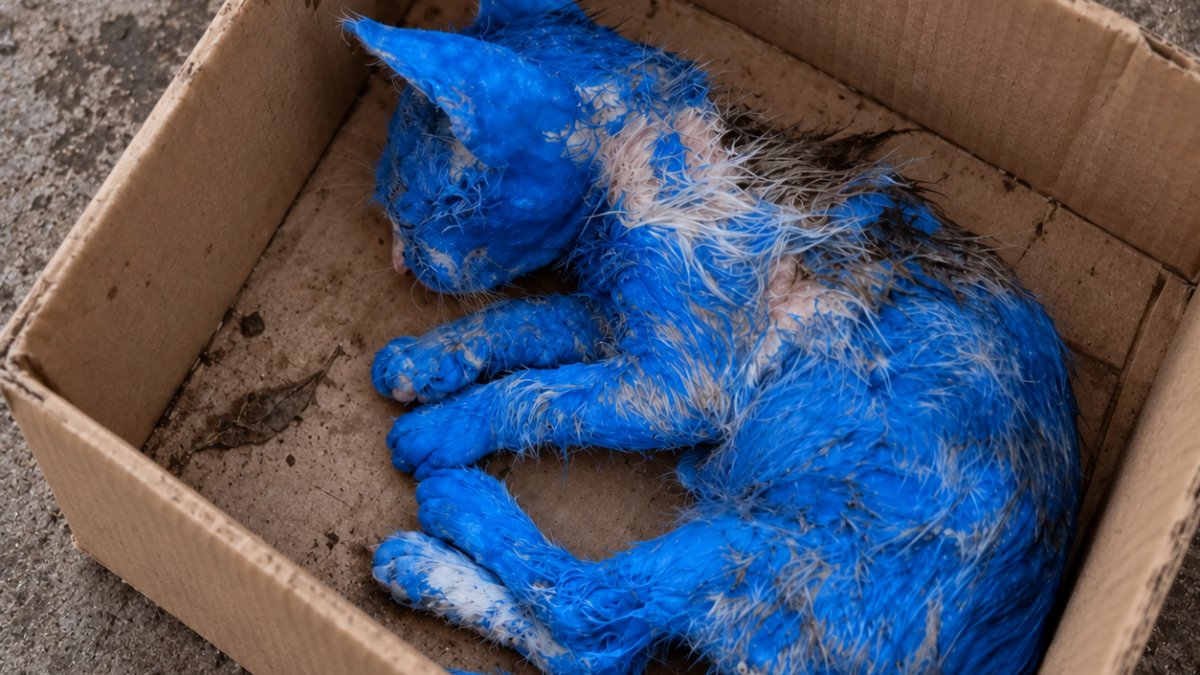
PART 2
She was purring.
At first I thought the sound was coming from somewhere else.
It was too soft.
Barely louder than the refrigerator humming behind me.
Then Blue took another step, and the vibration became stronger.
I crouched in front of the playpen.
“Are you serious?”
She reached the edge, placed both front paws against the low wall, and looked up at me.
Still purring.
After everything people had done to her.
After being handled long enough for someone to paint nearly her entire body.
After being abandoned in the rain.
After hours of clipping, cleaning, and painful pulling against skin that was already sore.
She saw another human being and moved closer.
I lifted her carefully.
Blue tucked herself beneath my chin.
The paint remaining around her shoulders made her coat stiff against my neck.
I stood there holding her longer than I intended.
Elena called fifteen minutes later.
“How is she?”
“She’s purring.”
Silence.
Then she said, “Already?”
“Apparently.”
“That kitten is ridiculous.”
“You say that like it’s bad.”
“It isn’t.”
Blue’s eyes were closed.
“She came toward me.”
Elena was quiet again.
We had both seen rescued animals recover physically while remaining terrified of hands for months.
Sometimes years.
There is no timetable for trust.
Blue did not seem interested in timetables.
Her body was weak.
Her trust was not.
Dr. Marinova had warned me not to romanticize purring. Cats can purr when comfortable, but also when anxious, frightened, or hurting.
I understood that.
Still, when Blue kneaded one tiny paw against my shirt and pushed her face deeper beneath my chin, I allowed myself to believe at least some of that sound belonged to comfort.
That morning she ate another syringe feeding.
Four milliliters.
Pause.
Four more.
She swallowed carefully, then turned her face away.
“Done?”
Blue licked her nose.
“Apparently.”
I wrote the amount down because the clinic had told me to track everything.
Food.
Water.
Urination.
Stool.
Energy.
Any vomiting.
Any change in breathing.
Any attempt to lick or chew remaining paint.
That last part mattered.
We did not know exactly what kind of paint had been used.
There was no container.
No label.
No witness who could tell us whether it was water-based craft paint, household paint, industrial coating, or something else.
The veterinarian’s concern was simple: if Blue ingested enough residue while grooming herself, she could become sick.
So she wore a soft recovery collar whenever I could not watch her.
Blue hated it.
That was the first thing I learned about her personality.
The second was that hatred made her determined.
I put the collar on.
Blue backed up.
The collar hit the wall of the playpen.
She turned.
Hit the opposite side.
Stopped.
Stared at me.
Then sat down with an expression that somehow communicated deep personal betrayal.
“I didn’t invent it.”
She stared.
“The veterinarian did.”
Still staring.
“You can complain to her tomorrow.”
Blue gave one tiny meow.
There it was.
A voice.
Not the desperate crying I had heard beneath the rain.
An opinion.
That felt like progress.
The second cleaning session happened that afternoon.
I dreaded it more than Blue seemed to.
Dr. Marinova examined her before we started.
“She maintained her temperature.”
“Good?”
“Very good.”
“Weight?”
“Up slightly, but don’t celebrate yet. Some of that is hydration.”
“I’m celebrating hydration.”
She smiled.
“That’s fair.”
Blue weighed a little more than a pound and a half.
Far too thin for the age we estimated.
Her bloodwork was better than I had feared.
Mild anemia.
Dehydration.
Low blood sugar on arrival, corrected after feeding.
No obvious kidney or liver crisis.
Fleas.
Several superficial abrasions.
A mild respiratory infection beginning.
The paint had damaged her coat badly, but most of the skin underneath was not chemically burned.
That mattered.
“We got lucky,” I said.
Dr. Marinova looked at Blue.
“She got lucky.”
I understood the distinction.
I had not found her early enough to prevent suffering.
Only early enough to stop more of it.
We placed Blue on a warm towel.
Sofia, one of the veterinary technicians, had small clippers designed for delicate work.
Some sections of paint softened with warm water and veterinary-safe cleansing products.
Others did not.
Where the paint had soaked through the fur and dried into thick, solid sheets, shaving was the only humane option.
Blue tolerated the buzzing surprisingly well.
Until we reached her right side.
The moment Sofia touched one rigid patch, Blue cried out.
Everything stopped.
“Skin?” I asked.
Sofia examined underneath.
The paint had glued several layers of hair together so tightly that moving one section pulled hard against the skin.
“We’re cutting around it.”
“Will that hurt?”
“Less than trying to peel it.”
We worked in tiny sections.
Clip.
Pause.
Warm towel.
Reassure.
Another section.
At one point Blue became so exhausted that she laid her head in my hand and stopped watching the clippers.
I hated seeing that.
I would have preferred anger.
A bite.
A scratch.
Anything that told us she had energy to fight.
“Five-minute break,” Sofia said.
Blue remained still.
I scratched the small clean patch behind her ear.
Her eyes closed.
The purr came back.
Very faint.
Sofia looked at me.
“She’s unbelievable.”
“Maybe she thinks if she cooperates, we’ll stop sooner.”
“Maybe.”
We did stop.
Long before every trace of paint was gone.
The goal was not to make her look normal in one afternoon.
The goal was to avoid turning rescue into another trauma.
That distinction became important later.
People saw photographs of Blue during the cleaning process and asked why we had not shaved her entire body immediately.
Because she was cold.
Because she was underweight.
Because shaving large areas of a tiny kitten can create its own medical problems.
Because some paint sat close to the skin folds around her legs and belly.
Because her face required delicate work.
Because she was already exhausted.
Because “get it off” sounds simple until the paint is attached to a living animal.
Recovery often moves more slowly than photographs make it seem.
That evening, Blue ate from a shallow dish for the first time.
Not much.
I mixed formula with wet kitten food until it was almost liquid.
She approached cautiously.
Smelled it.
Put one paw directly into the bowl.
Then looked offended.
“You did that.”
She shook the paw.
Food landed on the floor.
“Also you.”
Blue licked her paw.
Then stared at the dish again.
This time she lowered her mouth.
Three laps.
Pause.
Five more.
I held my breath like an idiot.
Blue continued for almost a minute.
Then climbed away with food still on her nose.
I took a photograph.
That was the first picture of her I genuinely loved.
Not the rescue picture.
Not the blue body in the rain.
Blue with gray fur beginning to appear around her forehead, one uneven shaved patch along her side, wet food on her nose, and absolutely no idea that she looked ridiculous.
I sent it to Elena.
She responded immediately.
**There she is.**
I knew exactly what she meant.
We were starting to see the kitten under the evidence.
The next several days followed a routine.
Eat.
Sleep.
Clinic.
Clean.
Rest.
Repeat.
The paint came away in stages.
Her back first.
Then the chest.
Then the legs.
The face took longest because we refused to rush.
Small blue sections remained around both ears for more than a week.
The name Blue started as a practical joke.
We needed something to write on the chart besides “paint kitten.”
Sofia wrote:
**BLUE — female kitten — approximately 7–8 weeks.**
I objected immediately.
“You’re naming her after the worst thing that happened to her.”
Sofia looked at me.
“Or the thing she survived.”
I considered that.
Blue looked up from her blanket.
“Fine.”
The name stayed.
Within days, it stopped making me think about paint.
It became her.
Blue hated closed doors.
Blue slept with both front paws over her face.
Blue preferred food slightly warm.
Blue attacked towel corners.
Blue liked being held for exactly as long as she decided, after which she climbed onto my shoulder and attempted to relocate herself.
Blue screamed inside the carrier.
Blue loved crinkled paper.
Blue feared running water.
That last one took longer to understand.
The first time I turned on the kitchen faucet while holding her, she stiffened so violently I nearly dropped her.
I shut it off immediately.
“Okay.”
Her claws were hooked into my shirt.
“No faucet.”
She remained frozen.
I moved into the living room.
Only then did she relax.
Had someone used water while putting paint on her?
Had the rain itself become associated with fear?
Had she been washed roughly somewhere?
I did not know.
I refused to invent details simply because they would make the story more dramatic.
What I knew was enough.
Running water frightened her.
So we worked around it.
No unnecessary bathing.
Water bowls far from noisy taps.
No forced exposure.
Weeks later, the fear softened on its own.
Not every fear needs to become a battle.
The fifth day was when Blue first played.
That became the photograph that changed the way I understood her recovery.
It started with a plastic bottle cap.
I was sitting on the kitchen floor organizing medication when the cap slipped from my fingers.
It bounced once.
Rolled.
Blue’s head turned.
I froze.
Until then, she had watched objects.
Smelled them.
Touched them cautiously.
She had not played.
The cap rolled near her front paws.
Blue crouched.
Not from fear.
Her rear end lifted slightly.
Her shoulders lowered.
I looked toward Elena, who had stopped by to help.
“Don’t move.”
“I’m not.”
Blue extended one paw.
Tap.
The cap moved.
She jumped backward.
Then forward.
Tap.
It rolled farther.
Blue chased it.
Two steps.
Three.
She slipped slightly.
Recovered.
Pounced.
The movement was clumsy because she was still weak, but there was no mistaking it.
She was playing.
Elena covered her mouth.
I grabbed my phone.
The first picture blurred.
The second caught Blue in mid-pounce.
Front legs stretched forward.
One ear still stained blue.
Most of the body shaved unevenly.
White chest visible.
Gray patches finally emerging.
Bottle cap beneath one paw.
Eyes wide.
Alive.
That photograph hit me harder than the pictures from the rain ever had.
The rescue photographs showed what somebody had done to her.
This one showed what they had failed to take away.
Curiosity.
Play.
The belief that life might still contain something worth chasing.
I sat on the floor and cried.
Elena looked at me.
“You okay?”
“No.”
Blue attacked the cap again.
Elena sat beside me.
“Good no or bad no?”
“I don’t know.”
She understood.
We watched Blue play until she exhausted herself.
Less than three minutes.
Then she curled against my ankle and fell asleep.
That night, I kept looking at the photograph.
Blue still looked rough.
Anyone seeing it without context might have thought she was still seriously ill.
But I knew what happened one second before and one second after that frame.
Movement.
Choice.
Joy.
That image became more important to me than any polished “after” picture that came later.
By the end of the first week, Blue could eat independently.
The syringe stayed nearby in case she needed supplemental feeding, but she no longer relied on it.
Her weight climbed steadily.
The anemia improved.
The flea treatment worked.
The respiratory infection remained mild.
Her irritated skin began healing.
The biggest medical concern shifted from immediate survival to delayed toxicity.
Repeat bloodwork stayed reassuring.
Kidney values normal.
Liver values normal.
No vomiting.
No tremors.
No mouth burns.
That allowed us to breathe.
Not completely.
Rescuers are terrible at completely.
But more.
Animal welfare authorities received the case.
I gave them the location.
Photos.
Time.
Paint samples.
Everything.
A nearby convenience store had a security camera aimed partly toward the alley where Blue had been found.
For one afternoon, I convinced myself we were going to identify whoever had done it.
We did not.
The useful camera angle missed the exact section near the storm drain.
Another camera had not recorded that night because the system was malfunctioning.
A resident remembered several teenagers near the dumpsters the previous evening but could not say whether they had a kitten.
Another claimed she had seen a child carrying “something blue.”
A third insisted Blue had already been painted when she first appeared.
Stories multiplied.
Evidence did not.
I hated that.
I wanted a face.
A name.
Someone I could point at and say, “You did this.”
Reality refused to cooperate.
Without evidence, there was no responsible way to accuse anyone.
The investigation slowed.
That frustrated me more than I admitted.
One evening Elena found me reading the report again.
“You think something changed?”
“No.”
“Then why are you reading it?”
“I don’t know.”
“Yes, you do.”
I looked toward Blue.
She was sleeping on the couch now, most of the paint finally gone.
“What if they do it again?”
Elena sat across from me.
“What if who does it again?”
“Whoever did this.”
“We don’t know who.”
“That’s the problem.”
“No. That’s the limit.”
I hated the word.
She continued.
“You can’t rescue backward.”
“What does that even mean?”
“You can’t change the night before you found her.”
“So we just accept it?”
“No.”
She shook her head.
“We document. We report. We educate. We intervene when there’s evidence.”
Then she nodded toward the couch.
“And we give the animal in front of us a life.”
Blue woke at that exact moment.
She stretched.
Rolled too close to the edge.
Slid off the cushion.
Caught herself halfway.
Looked deeply offended.
Elena laughed.
“Very dignified life.”
That helped.
The last blue patch disappeared from behind Blue’s left ear eleven days after rescue.
Sofia clipped the final stained hairs.
Then held Blue beneath the examination light.
White chest.
Gray saddle across her back.
Gray cap over the head.
White feet.
Pink nose.
No blue.
Sofia smiled.
“Look at you.”
Blue immediately tried to chew the corner of the towel.
Elena compared the new photograph with the first.
The difference looked impossible.
The kitten in the first picture seemed physically smaller.
Not only because she had been thinner.
Because she had folded herself inward.
Head low.
Legs tucked.
Body trying to occupy as little space as possible.
The kitten in front of us sprawled across the examination table.
Tail moving.
One paw hanging over the edge.
Completely inconvenient.
“She looks like a different cat,” Elena said.
“She isn’t.”
That mattered to me.
I did not want the blue kitten erased.
She had been Blue too.
Afraid Blue.
Hungry Blue.
Hurting Blue.
The healthy version did not replace her.
She grew out of her.
At three weeks, Blue received her first routine vaccinations after Dr. Marinova was satisfied she had gained enough weight and strength.
At four weeks, she discovered windows.
That changed my mornings.
There was a tree outside my living room.
Birds used it.
Blue noticed.
The first sparrow landed at 6:14 one morning.
Blue made a noise I had never heard before.
A rapid, excited chatter.
I sat up.
“What?”
Another chatter.
I followed her gaze.
Sparrow.
“Oh.”
Blue crouched.
Tail twitching.
The bird remained completely unaware it was being threatened by a kitten who had recently lost a fight with a sock.
I took another photograph.
No paint.
No clinic.
No rescue context.
Just a kitten watching a bird.
That photograph felt more miraculous than the dramatic ones.
Normality often does.
Blue’s confidence grew faster than her body.
She began climbing things she had no business climbing.
Chair backs.
Laundry baskets.
Curtains.
My leg.
One afternoon I heard a crash in the bedroom.
“Blue?”
Silence.
I entered.
A small plant lay on the floor.
Soil everywhere.
Blue sat beside it with dirt on her nose.
“What happened?”
She blinked.
“You have no idea?”
Nothing.
“You were not involved?”
Blue stepped directly into the soil.
That was when I understood the quiet, compliant kitten from the clinic had not been her personality.
It had been exhaustion.
Healthy Blue was trouble.
I was thrilled.
The only lingering behavioral issue that worried me involved restraint.
If held too firmly around the torso, Blue panicked.
Not every time.
But sometimes.
Her body would go rigid.
Then she would twist desperately.
So we changed how we handled her.
Support underneath.
No squeezing.
Let her see the hand coming.
Release before she struggled.
Gradually, she learned that being picked up did not always mean losing control.
We never made that into a training goal.
Blue did not need to become a cat who tolerated anything humans wanted.
She needed to learn that she had choices.
That distinction became one of the most important lessons she taught me.
People sometimes praise rescued animals for being “so forgiving.”
I stopped using that word.
Forgiveness belongs to stories we tell about human motives.
Blue was doing something more practical.
She was learning which people were safe.
That was enough.
At five weeks, we began discussing adoption.
I hated the conversation.
Not because Blue was unready.
Because I was.
Elena noticed immediately.
“You’re making the face.”
“What face?”
“The foster-failure face.”
“I don’t have one.”
“You named your Wi-Fi password after her.”
“That’s unrelated.”
“Your phone wallpaper is the bottle-cap photo.”
“Also unrelated.”
She stared.
I looked away.
Blue was asleep on my desk.
I had fostered animals before.
Some stayed days.
Some weeks.
A few months.
I loved many of them.
Then they went to good homes.
That is the work.
Let them leave.
Make space.
Help the next one.
Blue felt different.
Maybe because she had trusted me before having any reason to.
Maybe because I had fed her at two in the morning.
Maybe because I knew exactly where the final blue patch disappeared.
Maybe because she slept against my ribs every night as though we had agreed on that arrangement years earlier.
None of those things automatically meant my home was the best home.
So I forced myself to think like a foster instead of like someone afraid to lose a cat.
Blue needed another cat.
That became clear.
She had too much kitten energy for a human-only household.
She attacked my hands more when excited.
Not aggressively.
Playfully.
But kittens learn boundaries from other cats in a way humans cannot fully reproduce.
I could adopt a second cat.
Possible.
Or find a home with a suitable young companion.
We listed her.
The applications came immediately.
Her rescue photographs had circulated.
That created a problem.
People wanted the famous painted kitten.
Not necessarily Blue.
One message said:
**We follow rescue stories and would love the blue kitten for our kids.**
I deleted it.
Another applicant said she would be “amazing for social media.”
No.
Another had never owned a cat, worked twelve-hour shifts, and wanted a single kitten because “two seems like too much.”
No.
One family seemed wonderful until they told us they planned to allow Blue outside immediately because “cats need freedom.”
No.
I became difficult.
Elena accused me of sabotaging every application because I wanted to keep Blue.
She was partly right.
That annoyed me.
Then an application arrived from a woman named Marissa.
Thirty-four.
Veterinary receptionist.
One resident cat, a two-year-old male named Oliver.
Indoor-only home.
Screened balcony.
No small children.
Excellent references.
Her application barely mentioned Blue’s rescue story.
Instead she asked:
**Does Blue still show fear around running water? What kind of play does she prefer? Has she been introduced to other cats? Does she tolerate nail trimming? Does she eat both wet and dry kitten food?**
I called her.
“You read the behavior notes?”
“All of them.”
“What do you know about the paint?”
“That it was removed safely, her repeat bloodwork was good, and no one proved who did it.”
That last part mattered.
“You don’t think she needs some kind of trauma rehabilitation?”
Marissa paused.
“I think she needs whatever she shows us she needs.”
Good answer.
“What if she never likes running water?”
“Then she doesn’t need to.”
Better.
“What if she hides for a week?”
“I’ll let her hide.”
“Oliver?”
“Slow introduction.”
“What if they hate each other?”
“Then you take her back.”
Direct.
Practical.
I liked her.
We arranged a meeting.
Blue liked her less.
That was useful.
People love the idea that rescued animals magically recognize perfect adopters and run into their arms.
Blue did not.
She smelled Marissa.
Walked away.
Attacked a paper ball.
Climbed onto me.
Ignored her.
Marissa laughed.
“Apparently I’ve been rejected.”
“Give her time.”
“I’m not offended.”
She sat on the floor.
Did not reach.
Blue played.
Ten minutes.
Fifteen.
At minute eighteen, the paper ball rolled near Marissa’s shoe.
Marissa rolled it gently back.
Blue chased.
Again.
Again.
Eventually Blue climbed across Marissa’s leg.
No dramatic moment.
No instant bond.
Just a kitten discovering that a new person could participate in something fun.
That was better.
Oliver’s scent introduction began before the home visit.
Blankets exchanged.
Blue smelled his.
Tail high.
No hissing.
Oliver reportedly smelled hers and slept on it.
Promising.
The home was quiet.
Stable.
No exposed balcony openings.
No toxic houseplants within reach.
Plenty of vertical space.
Oliver looked healthy and relaxed.
Marissa had already purchased a second litter box and feeding station.
“You didn’t have to do this yet.”
“I know.”
“What if I say no?”
“Then Oliver becomes the richest cat in the building.”
I almost laughed.
Then I saw Blue watching Oliver through a cracked door.
He noticed her too.
Both froze.
Blue puffed slightly.
Oliver blinked.
Then walked away.
“Good,” I said.
Marissa looked confused.
“That was good?”
“He didn’t rush her.”
The home trial started two weeks later.
I cried in the parking lot after handing over the carrier.
I waited until Marissa drove away.
Then Elena, who had followed in her car, rolled down her window.
“You’re crying.”
“No.”
“Don’t say rain.”
The sky was completely clear.
“Dust.”
“Parking lot dust?”
“Very aggressive dust.”
She handed me tissues.
The first night, Blue hid beneath Marissa’s bed.
I stared at the update.
**She ate. Used the litter box. Still hiding. All normal.**
I wanted to call.
I did not.
One hour later:
**She came out for the paper ball.**
I breathed again.
Oliver remained behind a closed door.
Day two, they smelled each other underneath it.
Blue hissed once.
Oliver walked away.
Day three, visual introduction through a barrier.
Oliver stared.
Blue puffed.
Both accepted treats.
Day five, supervised room together.
Oliver approached too quickly.
Blue slapped him.
He sat down looking shocked.
Marissa sent a photograph.
Caption:
**Boundaries established.**
I laughed.
Day seven, Blue followed Oliver down the hallway.
Day nine, they slept at opposite ends of the couch.
Day twelve, Marissa sent a photograph without explanation.
I opened it.
Blue and Oliver were sleeping together.
Not merely nearby.
Together.
Blue’s face tucked beneath his chin.
Oliver’s front leg across her back.
I stared at the screen.
That one hurt.
In a good way.
The trial ended at two weeks.
Marissa called.
“I assume you want her back.”
My stomach dropped.
“What happened?”
She started laughing.
“That was cruel. Sorry.”
“Marissa.”
“I’m adopting her.”
I sat down.
“Don’t ever do that again.”
“I apologize.”
“No, you don’t.”
“Not really.”
I looked at Blue’s empty bed.
“You’re sure?”
“Yes.”
“Completely?”
“Yes.”
“Because if there’s anything—”
“She’s currently hanging from my curtain.”
A crash sounded in the background.
“Blue!”
I smiled.
“She sounds settled.”
“She’s a criminal.”
“Excellent.”
The adoption became official the next day.
I signed the transfer.
Marissa signed.
Blue walked across the paperwork and sat on my signature.
No respect for procedure.
I carried her one last time before they left.
She purred against my neck.
I thought I would lose control.
Instead I whispered, “Go ruin her house.”
Blue bit the zipper on my jacket.
Then Marissa took her.
That should have been the end.
It wasn’t.
Blue stayed in my life.
Marissa sent updates.
Not every day.
Enough.
Blue grew.
The shaved patches filled in.
Her coat became thick and soft.
Gray across the back.
White chest.
White legs.
Only photographs preserved the blue.
At six months, she became obsessed with running water.
That surprised everyone.
Marissa sent a video.
Blue sat in the bathroom sink staring at the faucet.
Marissa turned it on slightly.
A thin stream appeared.
Blue extended one paw.
Touched it.
Pulled back.
Touched again.
Then tried to bite the water.
I watched the video three times.
The kitten who once froze when I turned on a faucet was playing with one.
I called Marissa.
“When did this start?”
“Last week.”
“You didn’t force anything?”
“Of course not.”
“She just decided?”
“She watched Oliver drink from the faucet.”
That detail mattered.
Blue had not conquered water because we exposed her repeatedly until fear disappeared.
She watched another cat.
Saw safety.
Chose curiosity.
The difference was enormous.
That became the photograph Marissa later framed.
Not the video.
A still image.
Blue sitting in the sink with one wet paw lifted, staring at the faucet.
No fear.
No paint.
Just curiosity.
When I saw it, I had to sit down.
That was the photograph that changed everything for me.
I had thought recovery meant returning Blue to the kitten she had been before the cruelty.
But we had never known that kitten.
There was no way to restore a past we could not see.
Recovery meant something else.
Blue could build new associations.
New routines.
New preferences.
A sound that once meant fear could become play.
A hand that might once have restrained her could become somewhere to sleep.
A color that began as evidence could become only her name.
That was more powerful than returning to “before.”
She was moving forward.
At one year, Blue had a routine veterinary examination.
Dr. Marinova happened to be working that day.
I joined Marissa.
The moment Blue came out of the carrier, she tried to hide behind the computer monitor.
Dr. Marinova laughed.
“Definitely healthy.”
Blue had grown into a medium-sized cat with strong shoulders and an impressive ability to resist examination.
The first time we met, she had resisted nothing.
Now she objected to the thermometer.
Objected to having her ears checked.
Objected to nail trimming.
We celebrated every complaint.
“Heart sounds good,” Dr. Marinova said.
“Bloodwork?”
“Normal.”
“Weight?”
“Perfect.”
Marissa looked at me.
“You hear that? Perfect.”
“Don’t encourage her.”
Blue tried to bite the stethoscope.
Dr. Marinova caught it.
“Same kitten?”
I looked at Blue.
“Apparently.”
She pulled up the original intake photo on the computer.
We placed the images side by side.
Day one.
One year.
The transformation looked almost fake.
Blue in the first image was unrecognizable beneath hardened paint.
Blue in the second sat upright with bright eyes and a full gray-and-white coat.
Marissa touched the screen.
“Do you ever wonder what she remembers?”
“Yes.”
“What do you think?”
“I don’t know.”
The honest answer.
Animal memory is not a book we can open.
Blue had reacted to some things early in recovery.
Water.
Restraint.
Certain sudden movements.
Those reactions changed.
What she consciously associated with the paint, I could not know.
Maybe nothing.
Maybe more than we imagined.
It was enough to respect what she showed us.
Blue’s second year was ordinary in the best possible way.
She became obsessed with the top of Marissa’s refrigerator.
No one understood how she reached it the first time.
Marissa moved a chair.
Blue found another route.
She discovered cabinet doors could be opened if they were not latched.
Once, Marissa returned from work to find three kitchen cabinets open and Blue asleep inside one among the clean towels.
Oliver was sitting nearby looking embarrassed on her behalf.
Another time, Blue stole an entire piece of lettuce.
Not chicken.
Not fish.
Lettuce.
She carried it into the hallway, growling at Oliver while he watched in complete confusion.
Marissa sent me a video.
I called.
“Why lettuce?”
“I was hoping you could tell me.”
“She’s your cat.”
“You’re the original expert.”
“There is no training manual for vegetable theft.”
Blue eventually abandoned the lettuce.
Oliver ate none of it.
Mystery unresolved.
That was the life I wanted for her.
Problems without tragedy.
At two years old, Blue developed a habit of waiting outside the shower.
Not inside.
Never that brave.
But nearby.
Running water no longer made her flee.
She would sit on the bath mat and watch Marissa.
Sometimes she reached one paw toward drops sliding down the glass.
The first time Marissa told me, I thought she was exaggerating.
Then I visited.
Blue followed us into the bathroom.
Marissa turned on the faucet.
Blue jumped into the sink.
No hesitation.
I stood there staring.
Marissa smiled.
“Still hard to believe?”
“Yes.”
Blue drank directly from the stream.
Her whiskers became wet.
She sneezed.
Then tried again.
I thought about the first morning in my kitchen when her entire body had gone rigid at the sound of water.
There was no ceremony to this change.
No training milestone.
No moment when we declared the trauma overcome.
One day, water had become safe enough to investigate.
That was how much of Blue’s healing happened.
Quietly.
Without anyone naming it.
The old apartment complex where I found her was renovated during her third year.
The dumpsters disappeared.
The storm drain was replaced.
The broken wall was repaired.
A small grocery store opened on the corner.
I drove past one afternoon after another rescue call.
I almost missed the place.
I pulled over.
Rain had started lightly.
Of course.
For several seconds, I could see the first night again.
Tiny blue shape.
Crying.
My hand reaching.
Then, unexpectedly, what came to mind was not the rescue photograph.
It was the bottle-cap picture.
Blue mid-pounce.
That surprised me.
The worst image no longer owned the story.
I messaged Marissa.
**How’s Blue?**
Two minutes later, a photograph arrived.
Blue lying across Oliver.
Both asleep.
Caption:
**Oppressing her brother.**
I laughed aloud beside the road.
That was enough.
At four, Blue became less remarkable to everyone except us.
That was exactly what I wanted.
She was no longer “the painted kitten.”
At Marissa’s house, she was the cat who opened doors.
The cat who screamed when breakfast was seventeen seconds late.
The cat who attacked broom bristles.
The cat who groomed Oliver’s forehead and then bit his ear.
The cat who stole pens.
The cat who slept with one paw over Marissa’s face.
Ordinary identity replaced rescue identity.
Sometimes people who had followed the original case would recognize her online and ask for dramatic updates.
Was she still traumatized?
Did she still remember?
Had the person been caught?
Was she afraid of blue objects?
That last question actually came more than once.
Blue owned a blue toy mouse.
She loved it.
Life had not arranged itself around symbolism as neatly as people wanted.
The person responsible was never identified.
That remained frustrating.
But over time, my anger changed.
Not disappeared.
Changed.
I stopped measuring justice only by whether someone was punished.
Blue had survived.
The case had prompted local rescue groups to distribute information about safe handling of animals exposed to chemicals.
The veterinary clinic developed a small protocol based partly on what we learned.
Animal-control officers became quicker about collecting material samples before bathing animals in similar cases.
Those things were not justice in the legal sense.
But they mattered.
The absence of a culprit did not mean nothing useful came from what happened.
At four, Blue also had her first real health scare.
Marissa found a small lump near the shoulder.
She called me before calling the clinic.
“Tell me not to panic.”
“Call the clinic.”
“That’s not what I asked.”
“Panic after the appointment.”
“You’re terrible at reassurance.”
“I know.”
I drove there even though nobody asked me.
Marissa looked at me in the parking lot.
“You realize this is probably nothing.”
“I realize.”
“You’re acting like it’s something.”
“I’m aware.”
Dr. Marinova examined the lump.
Likely a benign cyst.
Needle sample confirmed.
Nothing serious.
I nearly collapsed with relief.
Marissa laughed.
“You’re worse than I am.”
“I met her when she was blue.”
“That is not a medical diagnosis.”
“It should be.”
Blue sat on the table cleaning one paw.
Completely unconcerned.
That appointment taught me something unpleasant.
The first rescue never truly leaves the people who were there.
Blue had moved on.
I was still capable of seeing the painted kitten whenever anything went wrong.
That was my work to do.
Not hers.
At five, Oliver became sick.
He developed severe intestinal inflammation and spent three nights hospitalized.
Blue searched the apartment.
Marissa called me.
“She keeps checking his bed.”
“That makes sense.”
“She’s barely eating.”
“That matters.”
We spoke with the veterinarian.
Blue was physically fine.
Stress.
Routine disruption.
We kept everything else stable.
Meals at normal times.
Play.
No rearranging rooms.
No replacing Oliver’s bedding yet.
On the fourth day, he came home.
Weak.
Shaved patch on one leg.
Smelling strongly of the clinic.
Blue approached.
Sniffed.
Then hissed.
Marissa looked horrified.
“Why?”
“Clinic smell.”
Blue backed away.
Oliver went to his bed.
For almost ten minutes, Blue watched from across the room.
Then she approached again.
Smelled his head.
Shoulder.
Shaved leg.
Her posture softened.
She began grooming his forehead.
Oliver closed his eyes.
By evening, they were sleeping together.
Marissa sent me the picture.
“Remember when she didn’t know how to be safe?” she asked later.
I corrected her gently.
“She always knew how to look for safety.”
We had simply given her more places to find it.
At six, Blue became a donor cat.
Not blood.
Something far less dramatic.
A motherless kitten arrived at Marissa’s clinic.
Three weeks old.
Weak.
Bottle-fed.
The clinic needed a temporary foster overnight while arranging placement.
Marissa brought the kitten home.
Blue hated it.
The tiny animal cried.
Blue puffed.
Retreated to the bookshelf.
Oliver, surprisingly, approached first.
The kitten attempted to crawl under him.
Oliver left.
Blue watched.
That night, Marissa placed the kitten in a secure pen beside her bed.
Around 2:00 a.m., she woke to silence.
Blue was sitting outside the pen.
Watching.
Not touching.
The next evening, same thing.
On day three, Blue lay beside the mesh wall.
The kitten slept pressed against the other side.
That photograph became another favorite.
I looked at Blue’s face.
Calm.
Curious.
Not maternal exactly.
Just present.
The kitten transferred to a specialized foster the following day.
Blue searched for the pen once.
Then resumed normal life.
Nothing dramatic.
Still, I thought about how far she had traveled from the tiny animal who once needed syringe feeding herself.
At seven, Blue started slowing down slightly.
Not medically.
Maturity.
She still played, but not with the same frantic energy.
Bottle caps remained sacred.
Every birthday, Marissa gave her one clean cap before giving her actual toys.
Blue ignored the expensive toys.
Chased the cap.
Tradition.
By then Oliver was nine.
They had become deeply bonded in a quiet way.
They did not spend every moment together.
They fought over the sunny window.
Blue sometimes slapped him if he groomed too long.
Oliver stole her heated pad whenever she stood up.
But each night, one eventually found the other.
That was family.
At eight, Oliver developed lymphoma.
The diagnosis came after weeks of weight loss and intermittent vomiting.
Treatment bought time.
Three months.
Good months.
Then the cancer stopped responding.
Blue changed during those months.
She groomed him more.
Waited beside him while he ate.
Followed him slowly instead of chasing.
Animals notice weakness.
How they understand it, we cannot know.
But Blue adjusted.
Oliver’s final week was quiet.
He slept more.
Ate less.
Spent hours beside the window.
Blue often lay nearby.
The night before his euthanasia, Marissa sent me a photograph.
Oliver was asleep.
Blue’s forehead rested against his shoulder.
The next morning, the veterinarian came to the house.
Blue remained in another room during the procedure.
Afterward, Marissa allowed her to see him.
Blue approached cautiously.
Smelled Oliver’s face.
Chest.
Paws.
Then walked away.
She came back.
Smelled again.
Sat beside him for several minutes.
Then left.
After his body was taken away, Blue searched the bedroom that evening.
Then again the following morning.
Less each day.
She slept in Oliver’s bed.
For a week, she called occasionally at night.
Not constantly.
A few short meows.
Marissa sat with her.
There was no easy solution.
Grief is not a behavior problem.
We kept routine steady.
Blue continued eating.
Used the litter box.
Still sought affection.
Gradually the searching decreased.
One evening, Marissa called.
“She played with the cap.”
I knew exactly what she meant.
“How long?”
“Almost five minutes.”
“Good.”
She became quiet.
“I miss him.”
“I know.”
“Blue does too.”
“Probably.”
We allowed the silence to exist.
Several months later, Marissa fostered an orange kitten.
Temporarily.
That was the plan.
The kitten was ten weeks old.
Male.
Fearless.
Loud.
Completely unaware of social boundaries.
Blue hated him for forty-eight hours.
She hissed.
Avoided.
Stared with contempt.
The kitten kept approaching.
Blue slapped him.
He returned.
She slapped harder.
He returned again.
“I don’t think he understands rejection,” Marissa told me.
“He’s orange.”
“That feels discriminatory.”
“It’s observational.”
On the third night, Marissa sent a photograph.
The kitten was asleep against Blue’s belly.
Blue’s front paw lay over his back.
Caption:
**This is not adoption.**
I called.
“You understand how stupid that message is?”
“We are fostering.”
“Sure.”
The orange kitten became Theo.
Permanent.
Blue became what Oliver had once been for her.
Older.
Steadier.
The cat who modeled the house.
Theo followed her everywhere.
To the food.
Water.
Litter boxes.
Windows.
Bathroom sink.
The first time he played with the faucet, Blue sat beside him.
Marissa sent another picture.
Two cats.
Wet paws.
I saved it.
Blue never mothered Theo in a sentimental way.
She corrected him.
Ignored him.
Groomed him when she felt like it.
Sat on him when he occupied her bed.
Theo adored her anyway.
At nine, Blue developed dental disease.
Nothing related to the paint.
Just teeth.
Routine cleaning and two extractions.
I was absurdly grateful.
The veterinarian said, “You know most people are not happy about dental surgery.”
“It’s normal.”
“Painful teeth are still not good.”
“I know.”
I looked at Blue.
“She got old enough to have boring cat problems.”
That mattered to me.
She had survived long enough for ordinary maintenance.
Long enough for the original rescue to become history rather than prognosis.
At ten, Dr. Marinova retired.
We brought Blue for one final appointment.
Dr. Marinova held the intake photo.
Looked at Blue.
Then the photograph again.
“I still hate this picture.”
“So do I.”
She touched one corner.
“But I’m glad we have it.”
I understood.
Evidence matters.
Not because suffering should define an animal.
Because it proves how far the life traveled afterward.
Blue sat on the examination table licking one paw.
Dr. Marinova smiled.
“I remember worrying she would ingest the paint.”
“She remembers hating the collar.”
“You don’t know that.”
“No.”
I smiled.
“But I do.”
The veterinarian scratched beneath Blue’s chin.
Blue purred.
“Still trusting.”
“Still demanding.”
“Better.”
We took a photograph together.
Dr. Marinova.
Me.
Marissa.
Blue in the middle.
Theo was not invited because Theo had the social discipline of falling furniture.
That photograph joined the others.
First day.
Bottle cap.
Sink.
Oliver.
One year.
Ten years.
A life assembled in rectangles.
Blue’s eleventh year brought the first evidence of kidney changes.
Mild.
Early.
Nothing immediately dangerous.
More water.
Diet adjustment.
Repeat testing.
Marissa became obsessive.
I reminded her anxiety was not a treatment plan.
She reminded me I had once driven across town because Blue had a benign cyst.
Fair.
The kidney values stayed stable for more than two years.
Blue remained active.
Not kitten active.
Senior-cat active.
She stopped climbing the refrigerator.
I pretended to miss it.
Marissa did not.
Blue used the bathroom sink less often but still visited the faucet when water ran.
Theo, much younger, became the one racing through the apartment.
Blue watched him like a tired parent.
Sometimes he launched himself toward her.
Blue raised one paw.
One precise slap.
Finished.
Efficiency comes with age.
At thirteen, arthritis appeared.
First in the hips.
Then lower spine.
Blue hesitated before jumping onto the bed.
Marissa added steps.
Blue ignored them for three days.
Then used them when no one was watching.
A low stool appeared beneath the window.
Heated pad beside the radiator.
Litter box with lower entry.
Nothing dramatic.
Small adaptations.
I had seen the same thing repeatedly in rescue.
Love often looks less like heroic acts and more like making the edge of a litter box two inches lower.
At fourteen, Blue’s kidneys worsened.
Subcutaneous fluids began.
The first session went badly.
Not medically.
Emotionally.
Marissa called me.
“She hates me.”
“No.”
“She hid afterward.”
“You stuck a needle under her skin.”
“Exactly.”
“She’ll forgive you when dinner happens.”
“I thought you said we shouldn’t call it forgiveness.”
I paused.
“Fine. She’ll reassess your usefulness after dinner.”
Marissa laughed.
Blue did.
Within an hour she emerged for food.
The fluid sessions became routine.
Warm the bag slightly.
Hang it.
Prepare line.
Blue on favorite blanket.
Needle.
Treat.
Fluids.
More treat.
Done.
She tolerated them better over time.
Sometimes she pressed her forehead against Marissa’s hand while the fluids ran.
The first time I saw that, I had to look away.
It was exactly what she had done to me during paint removal.
Same posture.
Different meaning.
Back then, she had no control over what happened to her.
Now she could leave.
She chose to stay because the person beside her had spent fourteen years proving what touch meant.
Context changes everything.
At fifteen, Blue became almost completely deaf.
We noticed gradually.
She stopped reacting to the food cabinet from another room.
Vacuum cleaner no longer sent her running until she saw it.
Theo could sneak up on her and startle her, which he found entertaining exactly once.
Blue corrected him violently enough that he learned.
Marissa began tapping the floor before approaching from behind.
Turning lights on and off gently to announce herself.
Blue adapted.
Again.
She always adapted.
Her final year began with good months.
She ate.
Used the sink occasionally.
Sat in sunlight.
Groomed Theo.
Demanded breakfast.
Then winter came.
Blue stopped climbing to the bathroom sink.
At first I thought it was arthritis.
Then she stopped using the window stool.
Then one morning she refused breakfast.
Marissa called.
I heard the answer in her voice before she spoke.
We went to the clinic.
Kidney values were high.
Very high.
Dehydration despite home fluids.
Nausea.
Weight loss.
The veterinarian recommended hospitalization.
Forty-eight hours.
IV fluids.
Anti-nausea medication.
Appetite support.
Blue stayed.
I hated leaving her.
Marissa hated it more.
The apartment felt wrong without her.
Theo searched each room.
Slept near the carrier.
On the second day, the clinic called.
Blue had eaten.
Not much.
Enough.
Kidney values improved.
Not normal.
Better.
She came home.
Theo smelled her.
Hissed once because of clinic scent.
Then followed her everywhere.
For six days, Blue ate.
Small meals.
Walked.
Sat in sunlight.
On day seven, she refused breakfast again.
Day eight, she needed help reaching the litter box.
Marissa called before sunrise.
“I think we’re there.”
I drove over.
Blue lay on her heated pad.
Gray fur thinner now.
White chest still soft.
Her eyes opened when I entered.
I sat on the floor.
“Hey.”
She looked at me.
No dramatic reaction.
Why would there be?
I had been part of her world for sixteen years.
I offered my hand.
Blue smelled my fingers.
Then pressed her forehead against them.
The same gesture.
Always the same.
My throat closed.
Marissa sat opposite me.
“I keep seeing the first photo.”
“So do I.”
“I don’t want that to be why I keep her alive.”
“That’s important.”
“She survived so much.”
“Yes.”
“Doesn’t that mean we should keep trying?”
I thought about the question carefully.
Survival stories can become traps.
People start believing an animal who fought once owes us another fight.
And another.
And another.
As if resilience is a contract.
It isn’t.
“What does she still enjoy?” I asked.
“Being with us.”
“Food?”
“Barely.”
“Window?”
“No.”
“Sink?”
“No.”
“Grooming?”
“Almost stopped.”
“Pain?”
“Probably manageable.”
“Nausea?”
“Yes.”
Marissa looked down.
“I know.”
We sat in silence.
Finally she said, “I promised her I’d never let what happened before become the reason I ignored what she needed now.”
That was the answer.
The veterinarian agreed to come to the apartment the following afternoon.
We chose home.
Blue had entered my life in rain beside a storm drain.
She would leave on a blanket with heat beneath her and people around her.
The morning of her final day, Blue surprised us.
She walked slowly into the bathroom.
Stopped below the sink.
Marissa looked at me.
“You think?”
I lifted Blue carefully and placed her inside.
She sat.
The faucet was off.
Marissa turned it just enough to create a thin stream.
Blue watched.
Her eyes were cloudy.
Body thin.
But one paw lifted.
Touched the water.
Pulled back.
Then touched again.
I laughed and cried at the same time.
Sixteen years old.
A cat who once froze at the sound of running water.
Still curious.
Still Blue.
Theo jumped onto the counter.
He tried to drink too.
Blue slapped him.
Even better.
The veterinarian arrived that afternoon.
Quiet voice.
No rush.
She examined Blue first.
Listened to her heart.
Checked hydration.
Touched the abdomen.
Then looked at Marissa.
“You’re making a kind decision.”
Marissa shook her head.
“It doesn’t feel kind.”
“It rarely does.”
That answer was better.
We chose the couch.
Blue’s favorite blanket.
Theo nearby.
Marissa held her.
I sat beside them.
Before the sedative, Blue ate a tiny amount of tuna.
Not much.
Enough.
The veterinarian placed the catheter.
Blue did not fight.
Marissa whispered, “Good girl.”
Blue purred.
Faint.
Steady.
I closed my eyes.
That sound carried me backward sixteen years.
The playpen.
The blue paint.
A tiny kitten walking toward me.
The sedative relaxed her.
Blue’s head became heavy in Marissa’s hand.
Theo approached.
Smelled her.
Then sat nearby.
No one rushed.
When the veterinarian prepared the final medication, Marissa looked at me.
“I hate this.”
“I know.”
“She trusted us.”
“Yes.”
“What if I’m betraying that?”
“You’re not.”
“How do you know?”
I looked at Blue.
Because trust had never meant forcing her to endure everything.
It meant being there when she needed help.
The first time, helping meant removing paint.
Feeding.
Warmth.
Treatment.
A home.
Years.
Now helping meant not asking an exhausted body for one more painful day simply because we were not ready to lose her.
I placed my hand beneath Blue’s chin.
“You’re okay.”
The veterinarian gave the medication.
Blue took one slow breath.
Another.
The purr faded.
Her heart stopped.
Marissa bent over her.
Theo moved closer.
I kept my hand where it was.
Sixteen years earlier, I had found a kitten under rainwater and hardened blue paint who could barely stand.
Now the fur beneath my fingers was soft.
White and gray.
No blue.
No clumps.
No pain.
Only the cat she had become.
Afterward, Marissa made a box of photographs.
She asked me to help choose them.
The rescue photo went in.
So did the first clean picture.
The bottle cap.
The sink.
Oliver.
Theo.
The final faucet photograph.
When we finished, one image remained on the table.
The bottle-cap photo.
Blue mid-pounce.
One ear still blue.
Fur shaved unevenly.
Body thin.
Eyes completely alive.
Marissa picked it up.
“This one.”
“What about it?”
“If I only keep one out, I want this.”
“Not the beautiful after photo?”
“This is the after photo.”
I understood.
Because “after” had not begun when every trace of blue paint disappeared.
It began the first moment Blue chose something beyond survival.
A moving bottle cap.
A game.
Curiosity.
That photograph remained on Marissa’s bookshelf.
Years later, people who visited sometimes asked about the strange blue stain still visible near the kitten’s ear.
Marissa told them the story briefly.
Not to make Blue famous.
Not to make cruelty entertaining.
Just enough.
“She was found covered in paint.”
Then she would point toward the bottle cap.
“And five days later, she decided she had better things to do.”
That was Blue.
Her story began with someone treating her like an object.
But it did not stay there.
The cruelty was an event.
Not an identity.
The paint was something put onto her.
Not something she carried forever.
When I think of Blue now, I almost never see the kitten crying in the rain.
I see the bottle cap sliding across my kitchen floor.
I see her shoulders lower.
One paw reach.
That first uncertain tap.
Then the sudden pounce.
I see a kitten hidden beneath hardened blue paint make a choice that had nothing to do with fear, hunger, cold, or pain.
Play.
Such a small thing.
But that was the moment I knew the person who hurt her had already failed in the only way that mattered to Blue.
They had covered her body.
They had frightened her.
They had left her cold and crying.
They had made people look at her and see evidence of cruelty before they saw a kitten.
But they had not managed to convince her that the world contained nothing worth reaching for.
Five days later, Blue reached anyway.
And for the next sixteen years, she kept reaching.
For food.
For toys.
For water running from a faucet.
For Oliver.
For Theo.
For Marissa.
For my hand.
For every ordinary piece of a life nobody could have predicted while she crouched beside that storm drain.
That is the part of Blue’s story I remember now.
Not the color someone forced onto her.
The life she chose after it came off.
[END OF STORY]








