PART 2: She Went Door to Door With a Rope Buried in Her Neck—Then the Vet Found What Her Owner Had Tried to Hide
PART 2
I stared at the screen until the letters seemed to stop making sense.
THOMAS REED.
The address was less than three miles from my house.
I looked at Dr. Harris.
“No.”
“You know him?”
“Yes.”
“How?”
“He owns Reed Lawn and Fence.”
Dr. Harris waited.
“He did my backyard fence two summers ago.”
The memory came back immediately.
Tom Reed standing in my yard with a tape measure clipped to his belt, talking about cedar posts and drainage.
Friendly.
Polite.
Always early.
He had brought his teenage son one afternoon and apologized because the boy needed somewhere to sit while Tom finished the job.
The man I remembered did not fit with the dog lying behind surgery doors.
But I had learned enough in forty-five years to know that memory was not evidence either.
“Could the chip be old?”
Dr. Harris nodded.
“Absolutely.”
“Could he have given her away?”
“Yes.”
“Could someone else have done this?”
“Yes.”
I exhaled.
“Then we don’t know.”
“No.”
He glanced toward the treatment room.
“But we know she was once registered to him.”
I looked down at the evidence bag.
Inside was the rope they had removed.
It looked worse outside her body.
Brown utility cord.
Knotted.
Parts of it dark from blood.
I turned away.
“Can I see her?”
“In a little while.”
“What happens now?”
“I’m contacting county animal control.”
“Do we have to?”
His face hardened.
“Emily, somebody allowed a rope to become embedded in that dog’s neck badly enough to obstruct her breathing. Yes. We have to.”
I nodded.
“I know.”
“You’re angry.”
“Yes.”
“Don’t call him.”
“I wasn’t going to.”
He looked at me.
“You were thinking about it.”
“I was thinking many things.”
“Think quietly.”
That was good advice.
I did not take it especially well.
Animal Control Officer Marissa Grant arrived forty minutes later.
Marissa was in her thirties, calm, precise, and had the unnerving ability to make questions sound casual even when they were not.
She photographed the rope.
Photographed the wound before and after removal.
Copied the chip number.
Then she sat across from me.
“Tell me exactly where you saw her.”
I did.
“Did anyone touch the rope before you reached the clinic?”
“No.”
“Anyone feed her?”
“Water only. Dr. Harris told us not to offer food until she was evaluated.”
“Did she have a collar?”
“No.”
“Tags?”
“No.”
“Anything else attached?”
“No.”
She wrote everything down.
Then she asked, “You know Thomas Reed?”
“Casually.”
“Friend?”
“No.”
“Family?”
“No.”
“Business?”
“He installed a fence at my house.”
“When?”
“Two years ago.”
“Any contact since?”
“A wave if I see his truck.”
“Opinion of him?”
I hesitated.
“Before today?”
“Yes.”
“He seemed decent.”
Marissa nodded.
“That’s useful.”
“Why?”
“Because I need what you actually knew before this, not what you feel now.”
I looked toward the treatment-room door.
“What I feel now isn’t useful?”
“Not to the investigation.”
Fair.
Painfully fair.
She asked whether I had seen the dog before.
I had not.
Dr. Harris joined us.
“She’s probably five to seven years old.”
“Breed?” Marissa asked.
“Mixed. Some terrier. Maybe shepherd. Hard to say.”
“Sex?”
“Female. Spayed.”
“Any sign she recently had puppies?”
“No.”
“Other injuries?”
“Malnutrition. Dehydration. Severe neck infection. Pressure wounds on the paws. Old scarring on both elbows.”
“Could she have been tied for a long time?”
Dr. Harris looked at her.
“I can say the neck injury developed over a prolonged period. I cannot say exactly where or by whom.”
Marissa nodded.
“Good.”
I watched them talk clinically about the dog who had put her head in my lap.
It felt cold.
Necessary.
But cold.
At 9:15 that night, I was finally allowed to see her.
She lay inside a large recovery kennel.
The rope was gone.
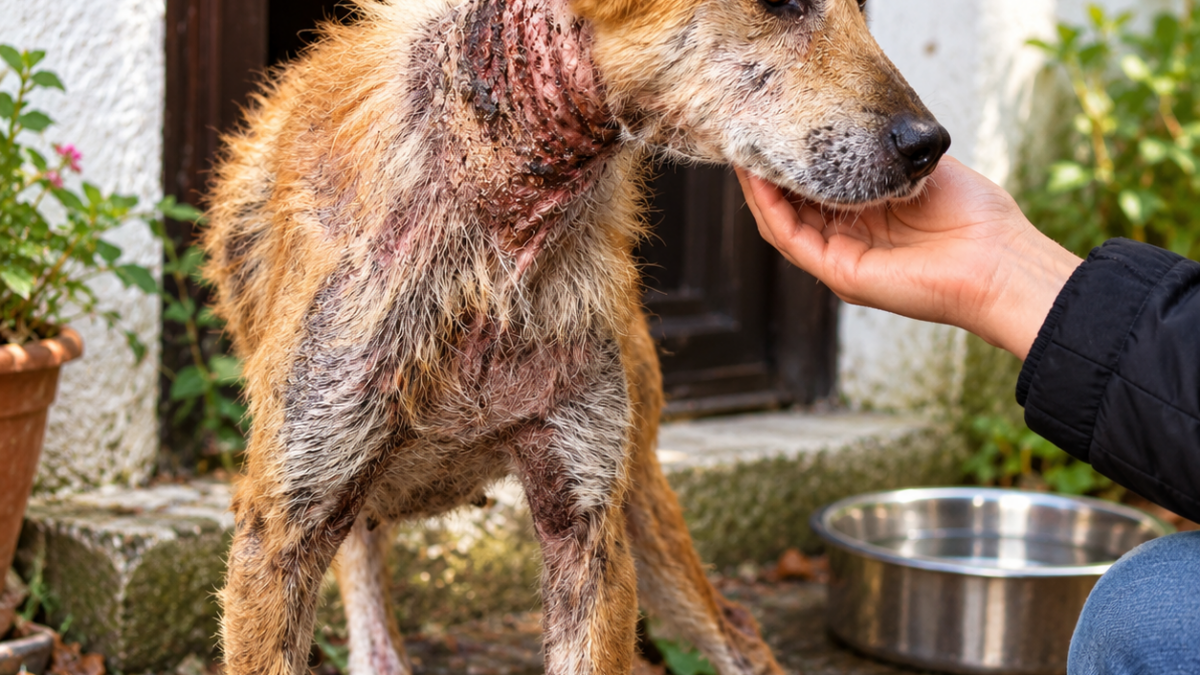
In its place was a broad shaved band around her neck, red and swollen beneath layers of clean dressing.
A small oxygen line rested nearby.
Her eyes opened when I approached.
“Hey.”
Her tail moved.
Once.
Then again.
I sat on the floor.
Dr. Harris stood beside me.
“She’s heavily medicated.”
“Good.”
“She has to stay several days.”
“Fine.”
“She may need another procedure if part of the wound breaks down.”
“Fine.”
“She may also have scar tissue affecting her airway.”
I looked up.
“Will she bark again?”
“I don’t know.”
That question felt strangely important.
She had walked door to door unable to call for help.
I wanted her to get her voice back.
“What are you calling her?”
“Nothing yet.”
I looked at the chart.
“Female stray?”
“Until somebody gives me a name.”
I thought for a moment.
“Grace.”
Dr. Harris glanced at me.
“Why?”
“Because she shouldn’t still trust anyone.”
He wrote it down.
GRACE.
The next morning, Marissa called.
“I spoke with Thomas Reed.”
I gripped my coffee.
“And?”
“He says Grace belonged to him.”
My stomach dropped.
“He admits it?”
“He admits the chip is his dog.”
“What does he say happened?”
“He says she disappeared nine months ago.”
“Nine months?”
“Yes.”
“Did he report her missing?”
“That’s where it gets interesting.”
My hand tightened around the mug.
“He says he did.”
“Did he?”
“We’re checking.”
“What was her name?”
“Lulu.”
I looked toward the clinic bag sitting on my kitchen chair.
Grace.
Lulu.
Two names.
One dog.
“He says she escaped?”
“Yes.”
“How?”
“Gate left open.”
“Who left it?”
“He doesn’t know.”
“Was she wearing rope around her neck when she escaped?”
“He says no.”
“Did he ever tie her?”
“Sometimes.”
My chest tightened.
“With what?”
Marissa paused.
“Rope.”
I stood.
“What kind?”
“Emily.”
“What kind?”
“He claims standard braided utility rope.”
“The rope they cut out of Grace is braided utility rope.”
“Yes.”
“So—”
“No.”
Her voice sharpened.
“No conclusions yet.”
“He tied her with rope.”
“Many people tether dogs with rope. That does not prove the rope removed yesterday is his.”
“Did you show it to him?”
“Not yet.”
“Why?”
“Because I enjoy knowing things before suspects know I know them.”
The word caught me.
“Suspect?”
“Person of interest. Better?”
“Not really.”
Marissa continued.
“He also gave us photographs.”
“Of Grace?”
“Lulu. Yes.”
“Can I see them?”
“Eventually.”
“Was she healthy?”
Silence.
“Marissa.”
“She looked healthier.”
“Healthier than almost dead is a low standard.”
“Yes.”
That afternoon, Marissa brought copies to the clinic.
Grace before.
A tan dog with alert ears, clear eyes, and a dark muzzle.
Standing in a backyard.
Another picture showed her beside a boy around fourteen.
Thomas Reed’s son, Mason.
Grace—Lulu—was pressing against the boy’s legs.
Happy.
The third photograph bothered me.
Grace was tied beside a shed.
Around her neck was not a collar.
It was rope.
Blue and white braided rope.
I looked at Marissa.
“The one they removed was brown.”
“Yes.”
“So not the same.”
“Correct.”
“Unless it got dirty.”
“Maybe.”
“You tested it?”
“Evidence lab will compare fiber composition.”
“How long?”
“Not fast enough for you.”
I hated her a little.
She seemed amused.
“Good investigators make terrible entertainment.”
“I don’t want entertainment.”
“I know.”
Grace improved.
That became my only relief.
On day two, she ate.
Not much.
Three tablespoons of prescription food.
I sat beside her while she did it.
Every swallow seemed uncomfortable.
But she kept going.
On day three, she stood.
Her legs shook.
She walked from the back of the kennel to the door.
Four steps.
Then rested her head against the bars near my hand.
“Show-off.”
Tail wag.
Dr. Harris watched.
“You know she may need foster care.”
“I know.”
“Our shelter is full.”
“I know.”
“Her wound requires medication every six hours.”
“I know.”
He smiled.
“So your house?”
I sighed.
“My house.”
He nodded as if this had been settled before I arrived.
I had two cats.
One hated dogs.
The other hated everything.
This was going to be excellent.
Grace remained hospitalized for another four days.
During that time, the case got stranger.
There was no missing-dog report from nine months earlier.
No county shelter report.
No social-media post that investigators could find.
No flyers.
No local veterinary alerts.
Thomas Reed claimed he had called a private rescue.
Which rescue?
He did not remember.
He claimed his wife had posted online.
His wife said she thought Thomas had done it.
Their stories did not match.
Then Mason Reed contacted animal control himself.
He was sixteen now.
Marissa interviewed him with appropriate parental arrangements because of his age.
Mason told a different story.
Grace had not disappeared nine months ago.
He had seen her three months earlier.
At his father’s equipment yard.
When Marissa told me, I stopped breathing for a second.
“Three months?”
“Yes.”
“Tom said nine.”
“Yes.”
“What did Mason say?”
“He says his parents separated last year. Grace stayed with Thomas.”
“Did Mason visit?”
“Some weekends.”
“And he saw her?”
“Yes.”
“What condition?”
“Thin.”
“Rope?”
Marissa looked at me.
“Yes.”
Around her neck?
“Yes.”
I gripped the edge of the clinic counter.
“What did the boy do?”
“He argued with his father.”
“What did Tom say?”
“That Grace was difficult to keep inside because she chewed doors and escaped fences.”
“So he tied her.”
“Yes.”
“How long?”
“Mason doesn’t know.”
“Did he ever see the wound?”
“He says no. Grace had thick fur around her neck.”
That was plausible.
Terrifyingly plausible.
Embedded tether injuries can hide beneath fur until they become advanced.
“What happened three months ago?”
“Mason says he came back the next weekend and Grace was gone.”
“What did his father say?”
“That she got loose.”
Again.
“How?”
“Rope broke.”
The room felt smaller.
“What kind of rope?”
“Brown utility rope.”
I closed my eyes.
There it was.
Marissa did not celebrate.
Investigators rarely celebrate when evidence gets worse for someone.
“Did Mason believe him?”
“No.”
“Why?”
“Because he asked to see where the rope broke.”
“And?”
“Thomas refused.”
I looked through the glass.
Grace was asleep.
I could see the clean bandage around her neck.
“Do you think he abandoned her?”
“I think we have more questions.”
“You always say that.”
“Because questions are safer than accusations.”
Two days later, they got answers from someone Thomas did not expect.
His former employee.
A man named Dale Watkins had worked for Reed Lawn and Fence for eleven years.
He had quit four months earlier after a pay dispute.
Marissa found him through payroll records.
Dale remembered Grace.
“Tom kept that dog at the equipment yard?”
“Yes.”
“Why?”
“His wife kicked him out for a while. He couldn’t keep the dog at his rental.”
“What was she tied to?”
“Fence post near the storage shed.”
“Collar?”
“Sometimes rope.”
“Did you ever see an injury?”
Dale hesitated.
“Not at first.”
“And later?”
“Around springtime, she started scratching at her neck.”
“What did you do?”
“Told Tom.”
“What did he say?”
“That she was always scratching.”
“Did you see the rope becoming tight?”
“Yes.”
“How tight?”
Dale looked down.
“Too tight.”
“Did you tell him?”
“Yes.”
“What did he say?”
“That he’d fix it.”
“When?”
“I don’t know.”
“Did he?”
“No.”
Dale had photographs.
Not of abuse.
Work photos.
Fence installations.
Trucks.
Equipment.
Grace appeared in the background of two.
One image was dated four months before we found her.
Grace sat beside the shed.
Brown rope from neck to post.
Another was three months old.
Same location.
She was thinner.
The rope still there.
Her neck fur looked disturbed.
The evidence tightened.
Then the lab report came.
The rope removed from Grace contained the same synthetic fiber composition and braided pattern as a spool seized from the Reed equipment yard.
That did not prove it came from that exact spool.
The rope was commercially available.
But combined with everything else, it mattered.
Marissa and a sheriff’s investigator returned to Thomas.
He changed his story.
Now he said he had not meant nine months.
Maybe six.
Maybe four.
He had been stressed.
He had mixed up dates.
He admitted Grace had stayed at the equipment yard.
He admitted tying her.
But he insisted the rope had been loose.
He claimed she escaped.
“When?” the investigator asked.
“July.”
“Your employee photographed her in August.”
Thomas stared.
“Then September.”
“Mason saw her in September too.”
He stopped.
His attorney ended the interview.
Grace came home with me the following afternoon.
I converted my laundry room into a recovery space.
Soft bedding.
Baby gate.
Water.
Medication chart.
Humidifier.
No collar.
Nothing around her neck.
My cats watched from a distance.
Arthur hissed once.
Grace backed away.
“Arthur.”
He hissed again.
“Your entire personality is unnecessary.”
Grace looked at me.
Her tail moved.
That first night, she refused the dog bed.
Instead, she slept beside the back door.
I moved the bed there.
She moved off it.
I gave up.
At 2:14 a.m., I woke because I heard a sound.
Not barking.
A rough scrape.
I went downstairs.
Grace stood near the kitchen doorway.
Her head lifted.
Another sound came from her throat.
A breathy little “woof.”
I froze.
“Grace?”
She looked at me.
I crouched.
“Do that again.”
Nothing.
I waited.
She stepped toward me.
Then another tiny rasp.
Not a normal bark.
But closer.
I started crying.
Grace immediately looked worried.
“No, no. Good thing.”
I sat on the floor.
She came to me.
Placed her head against my chest.
I could feel the healing tissue beneath the loose protective wrap.
“You found your voice.”
Not all of it.
Not yet.
But something.
The next morning, Dr. Harris examined her.
When Grace made the sound again, he smiled.
“Scar tissue may limit her volume permanently.”
“I don’t care.”
“She may never have a normal bark.”
“She went door to door without one.”
He looked at me.
“Yes.”
“She doesn’t need to be loud.”
At home, we developed routines.
Medication at six.
Breakfast.
Wound cleaning.
Short walk.
More medication.
Rest.
Grace hated the antibiotic.
Loved chicken.
Distrusted men in baseball caps.
Panicked when she saw rope.
That last reaction happened by accident.
My neighbor was carrying a coil of clothesline.
Grace saw it.
Her body froze.
Then she backed against my porch.
I moved between her and the rope.
“Linda, can you put that away?”
Linda understood immediately.
She dropped it behind the fence.
Grace remained tense for five minutes.
Then came to me.
Trauma does not leave when the wound closes.
That became clear quickly.
The criminal case moved slowly.
Thomas hired an attorney.
His business posted a statement saying the allegations were false.
He claimed Grace had repeatedly escaped and that “unknown persons” might have restrained her after she left his property.
People took sides.
Some customers defended him.
“He built my fence.”
“He loves dogs.”
“He donated to the shelter.”
“He coached Little League.”
As if decent acts in one part of life erase cruelty in another.
Others attacked him viciously online.
Posted his home address.
Threatened his family.
Mason received messages at school.
I hated that too.
Mason had tried to help Grace.
He was a kid caught between loyalty to his father and the truth.
Justice was supposed to be specific.
Not contagious.
I told Marissa I wanted no part of the online mob.
“Good.”
“They’re threatening his wife.”
“Separated wife.”
“Still.”
“Good.”
“Stop saying good.”
“Then stop doing reasonable things.”
I laughed despite myself.
The next major break came from Thomas’s own security system.
The equipment yard had cameras.
He told investigators the recordings were automatically overwritten after thirty days.
That was partially true.
But the company that installed the system maintained cloud snapshots triggered by unusual movement at night because Thomas had once reported tool theft.
A search warrant obtained those snapshots.
One photograph showed Grace at the yard approximately six weeks before she reached my house.
Thin.
Rope attached.
Another showed Thomas beside her.
He was holding something near her neck.
The angle did not show exactly what.
But Grace’s body language mattered emotionally even if it did not prove a crime.
She was crouched.
Head low.
A third image, taken three weeks later, showed the post.
The rope still attached.
No dog.
Investigators needed more.
They got it from a gas station.
The station sat two blocks from the neighborhood where I lived.
A traffic-facing camera captured Thomas’s work truck late on a Sunday night.
The date was six days before Grace came to my door.
In the open bed of the truck was a dog crate.
At another camera farther down the road, the truck entered an industrial service lane.
Ten minutes later, it came out.
The crate appeared empty.
Grace had first been seen wandering near that industrial area the following morning.
A delivery driver told animal control he had noticed a skinny dog near the warehouses.
The timeline narrowed.
Thomas denied transporting her.
He said the crate held landscaping materials.
Then the investigator showed him another image.
Grace’s tan face was visible between the crate bars.
He stopped talking.
His attorney asked for a break.
That was the first time I thought the case might actually hold.
But the worst evidence had not surfaced yet.
Mason found it.
He came to my house with his mother.
I knew something was wrong before they reached the porch.
Mason held a phone.
His mother, Karen, looked exhausted.
“Can we come in?”
Grace was behind the baby gate.
When she saw Mason, everything changed.
Her ears lifted.
Tail moved.
Mason stopped breathing.
“Lulu.”
Grace stared.
Then ran.
Not fast.
Still weak.
But she ran to him.
Mason dropped to his knees.
Grace pressed against him so hard he almost fell backward.
He buried his face in her coat.
“I’m sorry.”
The same words over and over.
“I’m sorry.”
I turned away.
Karen cried quietly.
Eventually Mason sat on my kitchen floor with Grace across his lap.
“She remembers me.”
“Of course.”
“I thought she might hate me.”
“She doesn’t.”
“I left her there.”
“You were fifteen.”
“I saw the rope getting tight.”
“You told your dad.”
“I should’ve cut it.”
“What would have happened?”
He looked at me.
“I don’t know.”
“Exactly.”
He stared at Grace.
“My dad got mad when people touched his equipment.”
“That’s not your fault.”
“I could’ve called someone.”
“Yes.”
He flinched.
I hated hurting him.
But lying would not help.
“You could have.”
He nodded.
“So could Dale. So could other employees. So could your father most of all.”
Grace rested her chin on his knee.
“What matters now is that you came.”
Mason unlocked his phone.
“I found this on my old account.”
A video.
Short.
Twenty-three seconds.
He had recorded it three months earlier.
Not intentionally as evidence.
He had been filming a broken mower to show a friend.
Grace entered the background.
Thomas’s voice came from off-screen.
“Get back.”
Grace approached.
Thomas appeared.
He grabbed the rope attached to her neck.
Pulled hard.
Grace collapsed.
Mason said, “Dad, stop.”
Thomas responded, “She needs to learn.”
Mason said, “It’s cutting her.”
Thomas looked toward the camera.
The video ended.
I felt sick.
“Has animal control seen this?”
“No.”
“Don’t send it to me.”
“Why?”
“Send it directly to Marissa.”
He did.
That video changed the case.
Not because it showed the final wound at its worst.
It showed knowledge.
Thomas had been explicitly told the rope was cutting Grace.
On video.
He continued using it.
The prosecutor later described that as the point where neglect became difficult to explain as ignorance.
Then investigators found a text message between Thomas and Dale.
DALE: Dog’s neck looks bad. Need to cut that rope off.
THOMAS: I’ll handle it.
Two days later:
DALE: You didn’t handle it.
THOMAS: Stop worrying about the dog and finish the north fence.
Knowledge.
Again.
Thomas had not merely failed to notice.
He knew.
The rope tightened over time as swelling, infection, and tissue growth worsened.
Maybe it began loose.
Maybe he never intended the injury.
Intent became less important than what he did after he knew.
Nothing.
Then when Grace became visibly ill and hard to hide, he loaded her into a crate and drove away.
Investigators believed he abandoned her near the industrial lane because he assumed she would be picked up by animal control as a stray.
He did not leave a note.
Did not call a shelter.
Did not surrender her legally.
He simply removed her from his property.
Grace did the rest.
She walked.
One house.
Another.
Another.
Looking for the help he had denied.
The irony would later become the most satisfying part of the case.
Thomas tried to make Grace disappear where nobody could connect her to him.
Instead, Grace walked directly into a neighborhood where someone recognized his name on the microchip.
His own failure to update the registration led investigators back to him.
His cameras contradicted his timeline.
His employee contradicted his story.
His son supplied the video.
His own messages proved knowledge.
He had built the case against himself one choice at a time.
Grace’s recovery was less linear.
The infection improved.
Then worsened.
A section of tissue around her neck broke down.
Dr. Harris called me.
“We need another surgery.”
I sat in the clinic.
“What happened?”
“Dead tissue. We have to remove it.”
“Is this normal?”
“Not unexpected with this kind of injury.”
“Will she survive?”
“Yes, barring complications.”
“Her airway?”
“Still stable.”
I exhaled.
“Do it.”
This surgery lasted three hours.
They debrided damaged tissue and reconstructed part of the wound.
Grace came home two days later wearing no collar, only a loose protective garment over her shoulders that avoided pressure on the neck.
She looked miserable.
I slept on the floor beside her.
At 3:00 a.m., she woke.
Looked at me.
Then made the strangest noise.
A low, hoarse bark.
One.
Then another.
I laughed.
“You picked now?”
She wagged.
“Everybody is sleeping.”
Another bark.
Rough.
But unmistakable.
I put one finger to my lips.
She barked again.
It was terrible.
I loved it.
Over the next several weeks, her voice grew stronger.
Never normal.
Always raspy.
But it belonged to her.
The first time she barked at the mail carrier, I called Dr. Harris.
“She barked.”
“That’s what dogs do.”
“You said she might not.”
“I said I didn’t know.”
“She barked four times.”
“Emily.”
“What?”
“I have surgery.”
“Fine.”
He hung up.
I sent him a video.
He replied with one word.
SHOW-OFF.
Mason visited Grace every Saturday.
At first, Karen stayed.
Later, after everyone agreed it was safe, she dropped him off.
Grace adored him.
I started wondering whether she should eventually return to him.
That possibility scared me.
Not because I distrusted Mason.
Because I loved her.
I had told myself I was fostering.
Temporary.
Medical.
Responsible.
Then I bought her a custom orthopedic bed.
My sister saw it.
“You’re keeping the dog.”
“No.”
“You bought a seventy-dollar bed.”
“Medical necessity.”
“You cook her chicken.”
“She needs protein.”
“She sleeps in your bedroom.”
“Monitoring.”
“You call her baby.”
“Clinical term.”
My sister laughed.
“You’re doomed.”
Maybe.
But Mason complicated everything.
Grace had been part of his childhood.
She knew him.
Loved him.
He had lost her through his father’s actions.
Was it fair for me to keep her?
I talked to Marissa.
She shook her head.
“Not a legal question yet.”
“I’m asking personally.”
“Then ask Grace.”
“That’s not helpful.”
“It’s more helpful than you think.”
The court placed Grace under protective custody through the county while the case proceeded.
No permanent adoption could happen yet.
So we had time.
Maybe too much.
Thomas’s attorney attacked the microchip registration.
Argued Grace technically belonged to Thomas and that removing her from county custody violated property rights.
The court rejected immediate return because of the active cruelty case and veterinary evidence.
Still, Thomas fought.
That hurt Mason.
“How can he want her back?”
“He may not.”
“Then why?”
“Control. Legal strategy. Pride. I don’t know.”
Mason stared at Grace.
“He didn’t even like her.”
Karen, sitting nearby, said quietly, “Sometimes people fight hardest over things they don’t value because losing them feels like losing authority.”
I looked at her.
That sentence had history behind it.
She noticed.
“He was like that in our marriage.”
I said nothing.
Karen continued.
“He wasn’t always cruel.”
That mattered.
People like clean villains.
Karen did not give me one.
“When we got married, Tom worked seventy-hour weeks. He built the business from one mower and a pickup truck. He was good with Mason. Good with me.”
“What changed?”
“Stress. Money. Anger. Maybe he was always controlling and I didn’t see it.”
She rubbed her hands together.
“After the business grew, everything became about obedience. Employees. Me. Mason. Even the dog.”
“Did he hurt you?”
She looked at Mason.
He had gone to the other room with Grace.
Karen lowered her voice.
“Not the way people mean when they ask that.”
I waited.
“He punched walls. Broke things. Blocked doors. Controlled money. Made you feel stupid for wanting something different.”
She looked toward Grace.
“An animal can’t argue back.”
That explained more than I wanted.
Thomas’s cruelty toward Grace was not random.
It fit a pattern.
Control through pressure.
Punishment.
Ignoring distress if compliance mattered more.
But motive was not excuse.
The trial began seven months after Grace arrived at my door.
By then she looked completely different.
Healthy weight.
Shiny tan coat.
Strong legs.
The scar around her neck remained dramatic.
A pale uneven band beneath the fur.
She still could not wear a traditional collar.
We used a padded body harness instead.
Her bark remained raspy.
Mason called it her “smoker bark.”
I told him never to repeat that around Dr. Harris.
He did.
Dr. Harris laughed for five minutes.
The criminal case included aggravated animal cruelty allegations, abandonment, and related violations. Some counts were modified during pretrial proceedings depending on what prosecutors believed they could prove.
The case that went forward was strong.
Not because of one shocking photograph.
Because of timeline.
Knowledge.
Choice.
Dr. Harris testified.
He described the injury.
“How long would a rope need to remain in place to become embedded to this degree?”
“Long enough for chronic inflammation, infection, tissue damage, and skin growth around portions of the material.”
“Hours?”
“No.”
“A day?”
“Extremely unlikely.”
“Weeks?”
“Consistent.”
“Would the condition have been visible?”
“Yes.”
“To someone seeing the dog regularly?”
“Almost certainly by the advanced stage.”
The defense attorney approached.
“Doctor, you cannot state when the rope was first applied.”
“No.”
“You cannot state my client tightened it.”
“No.”
“You cannot state that my client intended it to embed.”
“No.”
“So this could have begun as an ordinary tethering method.”
Dr. Harris looked at him.
“It could have begun in many ways.”
The attorney seemed satisfied.
Then Dr. Harris added, “The medical issue is not only how it began. It is that it continued after severe injury became obvious.”
The attorney frowned.
“Doctor—”
“The wound smelled of infection from several feet away.”
The courtroom became silent.
Dr. Harris continued.
“A reasonable person regularly handling that dog would know she needed urgent medical attention.”
No further question.
Dale testified.
He looked uncomfortable.
The prosecutor asked whether he had warned Thomas.
“Yes.”
“Once?”
“No.”
“How many times?”
“Three, maybe four.”
“What response?”
“He said he would handle it.”
“Did he?”
“No.”
“Why did you not report it?”
Dale stared at his hands.
“I should have.”
“That was not my question.”
“I didn’t want to lose my job.”
There it was again.
Fear.
Not noble.
Not monstrous.
Human.
The prosecutor asked, “Did you understand the dog was suffering?”
“Yes.”
“And you chose your job.”
“Yes.”
Dale’s voice broke.
“I hate that answer, but yes.”
His testimony mattered because he did not pretend innocence.
Then Mason testified.
That was the hardest part.
Thomas looked at his son when he entered.
Mason did not look back.
The prosecutor asked about Grace.
“What was her name in your family?”
“Lulu.”
“Did you love her?”
“Yes.”
“Did your father tether her?”
“Yes.”
“Did you ever become concerned?”
“Yes.”
“When?”
“When the rope started leaving a mark.”
“What did you do?”
“Told him.”
“Did he respond?”
“He said she was fine.”
The video played.
Grace being pulled.
Mason’s younger voice:
Dad, stop.
It’s cutting her.
Thomas on screen:
She needs to learn.
The courtroom became still.
The prosecutor paused the video.
“Mason, did your father know the rope was hurting Grace?”
“Yes.”
The defense attorney stood.
He approached slowly.
“Mason, you’re angry with your father.”
“Yes.”
“You live with your mother now.”
“Yes.”
“You and your father have had disagreements unrelated to the dog.”
“Yes.”
“You told a counselor last year you wished he would lose the business.”
Mason looked embarrassed.
“Yes.”
“So you wanted bad things to happen to him.”
“I was angry.”
“And you remain angry.”
“Yes.”
“Could that affect how you interpret the video?”
Mason looked toward the screen.
“The video isn’t my interpretation.”
The attorney paused.
“He says the dog needs to learn. He does not say he intends to hurt her.”
“No.”
“Your father pulled the rope. He did not beat the dog.”
“No.”
“He did not know, at that moment, that the wound would become severe.”
Mason looked at his father.
“I told him it was cutting her.”
The attorney stopped.
That sentence held.
The gas-station footage came next.
Thomas’s truck.
Crate.
Grace inside.
Then the empty crate.
His attorney argued that Thomas planned to leave Grace near a rescue facility.
There was a rescue several blocks away.
Closed at night.
No call.
No note.
No surrender form.
No attempt the next day to verify she had been found.
The prosecutor asked Thomas about it when he testified.
He had chosen to take the stand.
Maybe he believed he could explain.
At first, he almost did.
He talked about his separation.
Business debt.
Employees quitting.
A landlord who prohibited dogs.
A son who hated him.
A dog who chewed through two gates and damaged equipment.
He sounded exhausted.
I believed that part.
Then the prosecutor asked, “Why not surrender Grace legally?”
“I didn’t know where.”
“You had donated to three rescue groups.”
Thomas’s jaw tightened.
“I didn’t want people asking questions.”
“About?”
“The wound.”
There it was.
Not ignorance.
Fear of exposure.
“When did you first realize the wound was severe?”
Thomas stared ahead.
“I don’t know.”
“Mr. Watkins texted you.”
“I get hundreds of messages.”
“Your son told you.”
“He exaggerates.”
“The video shows him saying, ‘It’s cutting her.’”
Thomas said nothing.
The prosecutor moved closer.
“When Grace stopped eating normally, did you notice?”
“Yes.”
“When she had difficulty barking?”
“Yes.”
“When the wound began to smell?”
Thomas’s face changed.
“Yes.”
“Did you take her to a veterinarian?”
“No.”
“Why?”
“Money.”
A clean answer.
One I almost respected for its honesty.
“You operated a business with six trucks.”
“Financed trucks.”
“You donated five hundred dollars to a shelter fundraiser that month.”
His attorney objected to relevance.
The judge allowed limited questioning.
The prosecutor continued.
“You had money to make a public charitable donation.”
“That was marketing.”
The answer slipped out.
The courtroom shifted.
Thomas realized too late.
The prosecutor waited.
“Marketing?”
He looked at his lawyer.
“Yes.”
“Meaning the donation benefited your business.”
“It was community involvement.”
“Did Grace benefit from your community involvement?”
His attorney objected.
Sustained.
But the damage was done.
The prosecutor returned to the truck footage.
“Why did you place Grace in a crate?”
“To take her somewhere.”
“Where?”
“Near the rescue.”
“Why not the rescue itself?”
“It was closed.”
“Why not return in the morning?”
“I was done.”
The room changed.
The prosecutor’s voice became quiet.
“Done with what?”
“The whole situation.”
“The dog?”
“Yes.”
Mason shut his eyes.
Thomas continued as though he no longer cared about appearing sympathetic.
“I had a business failing, divorce bills, employees stealing from me, and a dog whose neck was infected because she wouldn’t stop fighting the rope.”
I gripped the bench.
The prosecutor asked, “The rope was hurting her because she fought it?”
“Yes.”
“So whose responsibility was the wound?”
Thomas looked at her.
“She kept pulling.”
The words sounded terrible the moment they existed.
He blamed the dog.
Even after everything.
The prosecutor let silence do the work.
Then:
“Did Grace tie herself?”
Thomas said nothing.
“Did she choose the post?”
Nothing.
“Did she decide whether to receive veterinary care?”
Nothing.
“Did she drive herself to the industrial lane?”
His attorney objected.
The judge sustained the final question.
It did not matter.
The jury had heard enough.
The verdict came two days later.
Guilty on the principal cruelty and abandonment counts.
Guilty on related neglect violations.
Some lesser counts were dismissed or merged.
No cheering.
No dramatic collapse.
Thomas sat quietly.
Mason cried.
Not because his father lost.
Because there is no victory in watching a parent become legally accountable for the thing you begged them not to do.
The sentencing hearing was worse.
Karen spoke.
Not about revenge.
About pattern.
She said Grace’s suffering had forced her to recognize how many times everyone in their family had learned to adjust themselves around Thomas’s anger.
Dale spoke too.
He admitted his own failure.
Then Mason stood.
“I don’t want my dad destroyed.”
Thomas looked up.
“I wanted him to stop.”
Mason’s voice shook.
“I told him the rope was hurting Lulu. He told me she needed to learn. I think what she learned was that asking him to stop didn’t matter.”
Thomas lowered his head.
Mason continued.
“But she kept asking other people.”
I felt my throat tighten.
“She went to houses until someone listened.”
Then Mason looked at me.
“She found Emily.”
I had to look down.
The judge imposed a custodial sentence that reflected the proven cruelty and related conduct, followed by probation. Thomas was ordered to pay restitution toward Grace’s veterinary treatment and investigation costs. He received a substantial prohibition on owning, keeping, or supervising animals, along with additional conditions.
Separate business consequences followed.
Two commercial clients terminated contracts after reviewing the court record.
A financing company repossessed equipment after missed payments.
Reed Lawn and Fence downsized dramatically.
That was not something I celebrated.
Employees had families too.
Collateral damage is still damage.
The satisfying part came from the thing Thomas had relied on most.
His reputation.
He had used public charity to make himself look compassionate while ignoring Grace in private.
Once his own words and records became public evidence, that reputation could no longer shield him.
But even then, I stopped thinking of punishment as revenge.
The real reversal was Grace.
The dog he abandoned because her wound might expose him became the reason every hidden decision came into daylight.
His microchip registration.
His rope.
His cameras.
His truck.
His employee’s warnings.
His son’s video.
His own testimony.
Grace had walked door to door asking for help.
Eventually, the evidence did the same thing.
One witness.
Then another.
Until somebody opened the door.
After sentencing, Mason came to my house.
Grace met him at the gate wearing her harness.
Her scar was mostly covered by new fur now.
Not completely.
Probably never completely.
Mason sat on the porch.
“Can I ask you something?”
“Sure.”
“Are you keeping her?”
There it was.
The question we had both avoided.
The legal hold had finally been lifted.
Thomas’s ownership rights were terminated.
Grace could be adopted.
I looked at Mason.
“What do you want?”
He stared at her.
“To say I want her back.”
“That’s honest.”
“But?”
He took a long breath.
“My mom’s apartment allows dogs now. We moved.”
“I know.”
“She could live with us.”
“Yes.”
Grace walked over and put her head against his leg.
Mason scratched her chest carefully, nowhere near the scar.
“But she sleeps at your house.”
“Yes.”
“When she’s scared, she goes to you.”
“Yes.”
“She likes me.”
“She loves you.”
He looked at me.
“Not the same way.”
I did not answer.
Because it was true.
Not more.
Not less.
Different.
Mason had been part of her first life.
I had become safety in the second.
He rubbed his face.
“I don’t want to be another person who decides for her.”
That sentence settled it.
Not immediately.
But enough.
We created a transition.
Grace stayed with me.
Mason visited.
Then weekend stays with Mason and Karen.
At first Grace panicked when I left.
She stood by their door.
Would not eat for an hour.
Then Mason sat on the floor without touching her.
Eventually, she climbed beside him.
The next weekend was easier.
Then easier again.
I expected the process to tell us where she belonged.
Instead, Grace decided she had two homes.
She slept at mine most nights.
Spent some weekends with Mason.
Attended his high-school graduation.
Appeared in every Christmas photograph at Karen’s.
And somehow remained convinced that my couch belonged entirely to her.
I formally adopted her.
Mason signed a letter saying he supported it.
He cried.
I cried.
Grace stole the pen.
That felt appropriately undignified.
Dr. Harris cleared her medically almost a year after she first walked onto my porch.
“Airway?”
“Stable.”
“Voice?”
“Probably always raspy.”
“Pain?”
“None.”
“Scar?”
“Permanent.”
Grace barked at him.
That rough, smoky bark.
Dr. Harris smiled.
“You know, I remember when we weren’t sure she’d vocalize again.”
Grace barked twice more.
“She remembers too.”
I looked at her.
“I think she just wants the treats behind you.”
Also possible.
The rope went into evidence during the case.
Afterward, the county asked whether I wanted it returned because technically it had been removed from Grace.
“No.”
The clerk seemed surprised.
“You sure?”
“Yes.”
I never wanted to see it again.
The microchip registration was updated instead.
Owner:
EMILY CARTER.
Secondary contact:
MASON REED.
That meant more.
Grace changed after the first year.
Not completely.
A coiled garden hose could still make her freeze if she saw it from the wrong angle.
She disliked being approached from behind.
No one touched her neck unless necessary.
But fear no longer controlled every choice.
She discovered sprinklers.
Hated them.
Discovered hamburgers.
Worshipped them.
Discovered snow.
Tried to eat it.
Discovered that my cats were not afraid of her.
Arthur slapped her nose once.
Grace looked at me as if expecting law enforcement.
“You are forty pounds.”
Arthur hissed.
“Handle your own litigation.”
They became friends eventually.
Or at least hostile roommates with shared heating vents.
Mason grew up.
At eighteen, he started community college.
Studied veterinary technology.
When he told me, I laughed.
“Because of Grace?”
“Partly.”
“What’s the other part?”
“I’m good with animals.”
“You are.”
He looked at Grace.
“I should’ve done more sooner.”
She rested her chin on his shoe.
I said, “Then do more now.”
He did.
Mason eventually became a licensed veterinary technician.
His first job was at Dr. Harris’s clinic.
The same clinic where they had spent two hours cutting rope from Grace’s neck.
His first week, Dr. Harris gave him an emergency intake.
Dog with an embedded collar.
Not as severe.
But similar.
Mason called me afterward.
“I almost threw up.”
“You okay?”
“Yeah.”
“Dog?”
“Yeah. We got it off.”
I heard his voice break.
“Mason.”
“What?”
“You got it off.”
Silence.
Then:
“Yeah.”
Grace was beside me on the couch.
I put the phone near her.
“Say hi.”
Mason said, “Hey, Lulu.”
Grace’s ears lifted.
Then she gave one rough bark.
Mason laughed.
“Tell her she still sounds terrible.”
“She heard you.”
Another bark.
Years passed.
Grace aged beautifully.
Her muzzle whitened.
The scar became less visible beneath thick fur.
Her bark never changed.
I stopped hearing it as damaged.
It was simply Grace.
Our neighborhood changed too.
Linda moved.
The man who had closed his door on Grace sold his house.
Before leaving, he came over.
I did not expect that.
He stood on my porch.
“I owe you an apology.”
“For?”
“The dog.”
Grace was inside.
He looked through the screen.
“I saw her that day.”
“I know.”
“I closed the door.”
I said nothing.
“I was scared of the wound.”
“That’s understandable.”
“I told myself somebody else would help.”
That phrase.
Somebody else.
It appears in almost every story of neglect.
“I’ve thought about it ever since.”
“What do you want me to say?”
“I don’t know.”
He seemed ashamed.
I softened.
“Next time, make the call.”
He nodded.
“I will.”
That was enough.
Not every failure requires lifelong punishment.
Some require changed behavior.
The next family who moved into his house found an injured stray cat six months later.
They called animal control.
I smiled when I heard.
Grace became known around the veterinary clinic.
Not publicly famous.
Not an internet mascot.
Just Grace.
Technicians who had cared for her puppy-sat.
Mason brought her into staff training when new employees learned low-stress handling.
She tolerated demonstration harnesses.
No neck pressure.
Ever.
One afternoon, a new technician reached toward her too quickly.
Grace flinched.
The technician immediately stopped.
“Sorry.”
Grace stared.
Then walked toward the woman voluntarily.
Mason smiled.
“That’s the whole lesson.”
The technician looked confused.
“What?”
“You stop when they tell you.”
I looked at Mason.
He did not seem to realize what he had just said.
I did.
So did Dr. Harris.
Nobody said anything.
Some lessons do not need speeches.
At eleven or twelve—her exact age remained uncertain—Grace developed a heart murmur.
Nothing serious at first.
Then arthritis.
Then mild kidney disease.
We adjusted.
Medication hidden in chicken.
Shorter walks.
More blankets.
A ramp beside the couch she refused to use until we placed cheese on it.
The raspy bark got weaker.
Still there.
Always there.
One cold November evening, she stood at the front window and barked.
Once.
Then again.
I looked outside.
A stray dog stood at the edge of my yard.
Thin.
No collar.
Grace barked again.
I went out.
The stray backed away.
I put food and water near the driveway.
Called animal control.
The dog was collected the next morning.
No dramatic injury.
No hidden cruelty.
Just lost.
Microchip reunited him with an elderly couple three neighborhoods away.
When I brought Grace inside, I laughed.
“You’re dispatch now?”
She looked pleased.
Years earlier, she had been the dog nobody heard.
Now she had made sure someone else was.
Mason married at twenty-six.
Grace attended the backyard ceremony.
She wore a flower attached to her harness.
Not collar.
Never collar.
During vows, she barked once.
Everyone laughed.
Mason looked at her.
“I know, Lulu.”
Later, he knelt beside her.
“You made it.”
I knew he meant more than the wedding.
Grace licked his chin.
His wife, Erin, said, “She likes me more.”
“Impossible.”
Grace walked to Erin.
Mason looked betrayed.
I laughed.
The last year came quietly.
Kidney disease progressed.
Grace lost weight.
Her appetite became unpredictable.
She slept more.
One morning, I found her standing in the hallway staring toward the front door.
“You want outside?”
Tail movement.
I opened it.
She walked onto the porch.
Slow.
Careful.
Then down the walkway.
At the sidewalk, she stopped.
I realized where we were.
The same path she had taken the day she found me.
House to house.
Door to door.
She stood there for a long time.
Then looked back.
I crouched.
“Not going anywhere today.”
She walked toward me.
Placed her head against my knee.
Exactly as she had the first afternoon.
My throat closed.
“Okay.”
I carried her inside.
Two weeks later, Dr. Harris called after bloodwork.
“It’s time to talk.”
I hated the sentence.
“What changed?”
“Kidneys worse. Heart weaker. We can adjust treatment, but we are running out of options that improve comfort rather than simply extend time.”
I stared at Grace sleeping nearby.
“Is she suffering?”
“Some days.”
“That’s not enough.”
“What do you mean?”
“I need to know.”
“You know her better than I do.”
That was the answer I had feared.
Because it made the decision mine.
Grace still ate chicken.
Still wagged when Mason came.
Still barked at delivery trucks.
But she struggled to rise.
Some nights she panted even at rest.
Then one morning, she refused water.
She tried to stand.
Fell.
Looked at me.
No panic.
Just tired.
I sat beside her.
“All right.”
She rested her head against my thigh.
I called Mason.
He answered on the first ring.
“Emily?”
“You need to come.”
He went silent.
“I’m coming.”
He arrived twenty minutes later in scrubs.
Grace heard his voice.
Her ears lifted.
“Hey, Lulu.”
Tail movement.
He knelt.
She tried to rise.
“Don’t.”
He put both hands beside her.
“You don’t have to.”
Grace licked his wrist.
Mason cried.
Not quietly.
Not trying to hide it.
“I’m sorry.”
I touched his shoulder.
“For what?”
“I should’ve cut that rope.”
He had carried that guilt for more than a decade.
“Mason.”
“I knew.”
“You were a kid.”
“I knew enough.”
“Yes.”
He looked at me.
I did not lie.
“You knew enough to understand something was wrong.”
His face collapsed.
“And you told someone.”
“My dad.”
“You told the person who was supposed to protect both of you.”
He stared at Grace.
“You could not control what he did with that warning.”
Mason rested his forehead against hers.
“She walked away from him.”
“Yes.”
“And found you.”
“Yes.”
Grace’s rough breath filled the room.
Then Mason smiled through tears.
“She was smarter than all of us.”
“By a lot.”
Dr. Harris came to the house.
He was older too.
Gray hair.
Slower movements.
He examined Grace on her bed.
Then sat back.
“She’s ready.”
Mason closed his eyes.
I asked, “Are we?”
Dr. Harris looked at me.
“We almost never are.”
We placed Grace on the quilt I had used to lift her into my car the first day.
I had kept it.
I do not know why.
Old faded blue fabric.
One corner permanently stained.
Mason sat on one side.
I sat on the other.
No collar.
No rope.
Nothing around her neck.
Her airway unobstructed.
Her head free.
I put my hand near her face.
She lowered her head into my palm.
Exactly like the first day.
“You remember?”
Her eyes rested on mine.
I whispered, “You knocked on the right door.”
Mason started crying again.
Dr. Harris administered the sedative.
Grace relaxed.
Her breathing became slower.
Then something happened.
She opened her eyes.
Lifted her head slightly.
And barked.
One rough, broken little bark.
The room froze.
Mason laughed and cried at once.
“You had to get the last word?”
Grace lowered her head again.
Dr. Harris wiped his face.
“I have never liked this dog.”
“Liar.”
“Complete menace.”
The final medication went in.
I kept my hand beneath her cheek.
Mason held her paw.
Grace breathed once.
Again.
Then exhaled.
Quiet.
Free.
Dr. Harris listened.
Then whispered, “She’s gone.”
For several minutes, nobody moved.
I looked at her neck.
The scar was still there beneath the fur.
A pale ring.
Evidence of the worst thing someone had done to her.
But it was not the last thing.
That mattered.
The next weeks were strange.
I still woke at medication time.
Still looked toward the front door when delivery trucks arrived.
Still avoided leaving rope or cords on the floor even though Grace was gone.
Trauma creates habits in witnesses too.
Mason called often.
Neither of us had much to say.
Then, two months later, he came over carrying something.
A framed photograph.
Grace on my porch.
Healthy.
Harness on.
Mouth open.
Her eyes bright.
No view of the scar.
No bandage.
No wound.
Underneath the photograph, he had engraved a small metal plate.
SHE FOUND HER DOOR.
I cried immediately.
“You made this?”
“Erin helped.”
“It’s terrible.”
“I know.”
“I hate it.”
“Good.”
I hung it beside the front entrance.
Years later, it is still there.
Not a photograph of suffering.
I never wanted Grace defined by the rope.
People who heard the story often remembered the injury first.
I understood.
It was shocking.
But when I remember her, I remember other things.
The first horrible bark at two in the morning.
Her stealing chicken.
Arthur slapping her nose.
Mason lying on my kitchen floor while she covered his face in kisses.
Her flower harness at his wedding.
Her standing on the sidewalk years later, looking back toward the house she chose.
The cruelty case changed people too.
Dale later became the person at his next workplace who reported an injured yard dog instead of assuming the owner would handle it.
Karen volunteered with a domestic-abuse program.
Mason built a career helping animals who could not explain what happened to them.
Even Thomas changed, according to Mason.
Not quickly.
Not cleanly.
Prison and probation did not transform him into a different man.
But years later, during one of their cautious attempts to rebuild contact, Thomas said something Mason repeated to me.
“I kept thinking she was fighting the rope because she was stubborn. I never considered that the rope was the problem.”
Mason told him, “That was true about more than the dog.”
Thomas apparently sat silent for a long time.
Maybe that was as close to understanding as he ever got.
I did not need more.
The doorbell rang one rainy afternoon almost three years after Grace died.
I opened it.
A girl around seventeen stood on the porch.
Behind her was a skinny dog.
No major wounds.
No rope.
Just frightened.
“Ma’am?”
“Yes?”
“I’m sorry. I didn’t know who else to ask.”
She pointed toward the dog.
“I found him near the highway.”
The dog watched me cautiously.
For one second, the years folded.
Grace.
Shaking legs.
Broken breath.
Head against my knee.
I stepped outside.
“Okay.”
The girl looked relieved.
“What do we do?”
I crouched several feet from the dog.
“First, we don’t rush him.”
The dog sniffed.
I placed my hand low.
He took one step.
Then another.
Eventually his nose touched my fingers.
Behind me, Grace’s photograph hung beside the door.
SHE FOUND HER DOOR.
I smiled.
“So did you.”
The dog came closer.
And this time, nobody closed it.
[END OF STORY]
:::








