PART 2: She Was Hanging by Her Neck, Fighting for Every Breath—But Her Five Tiny Puppies Still Believed Their Mommy Would Come Down
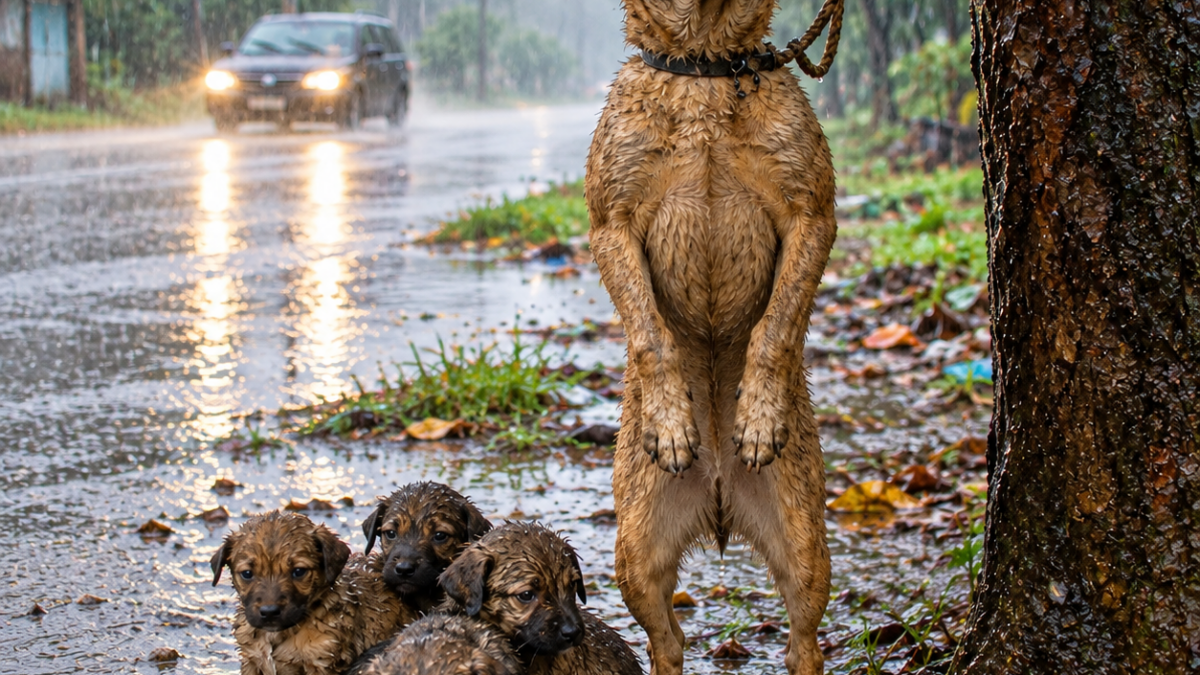
PART 2
The object beneath the mud was a short piece of blue nylon rope.
At first, I couldn’t understand why it bothered me.
Then I realized it had been cut cleanly at one end.
Not torn.
Not broken by the storm.
Cut.
There were two separate lengths of rope.
One had been tied around the mother dog’s neck and secured high to the branch.
The other had been tied around the smallest puppy.
Both were made from the same coarse material.
And both had knots that looked far too deliberate to be accidents.
I stared at them for several seconds while the rain hammered my shoulders.
Then the smallest puppy cried again.
That sound brought me back to what mattered.
Whatever had happened here, these animals were still in danger.
I didn’t have time to stand in the mud trying to understand the cruelty of another human being.
The mother was barely breathing.
The puppies were soaked.
The water in the ditch was rising.
I pulled out my phone.
My hands were trembling so badly that I dropped it once before managing to dial 911.
“Emergency services. What’s your location?”
I gave the dispatcher the county road number and described the nearest intersection.
“What’s the emergency?”
“Six dogs,” I said. “A mother and five puppies. Somebody tied the mother to a tree by her neck. She was hanging when I found her.”
There was a brief silence.
Then the dispatcher asked, “Is the dog breathing?”
“Yes. But barely.”
“Are you injured?”
“No.”
“Are the animals in the roadway?”
“Not yet. They’re in a ditch, and it’s flooding.”
She asked me to stay on the line.
I explained that I had cut the rope to get the mother down.
I told her about the second cord around the puppy.
She said she would notify the sheriff’s office and animal control.
Then she gave me the name of an emergency veterinary clinic about twelve miles away.
“Can you transport them safely?”
I looked at the mother.
She had lowered her head again.
Her puppies were crowded against her body.
One was trying to nurse.
I swallowed.
“I have to.”
Before moving anything else, I took several photographs with my phone.
The branch.
The remaining rope.
The blue cord.
The place where the puppies had been lying.
I didn’t know whether those pictures would ever matter.
I only knew that if someone had done this deliberately, I didn’t want the evidence disappearing into the floodwater.
Then I carefully loosened the cord around the smallest puppy’s neck.
He was so little that he fit almost entirely inside my palm.
His coat was cream-colored with one dark patch above his left eye.
He trembled violently.
“You’re okay, little man.”
He gave a thin cry.
I tucked him inside my shirt, close to my chest.
Then I turned toward his mother.
She was trying to stand.
Every time she lifted her front legs, her back legs slipped in the mud.
“Easy, girl.”
I wrapped my jacket around her more securely.
She looked at me.
I will never forget those eyes.
They were dark brown, almost black, and filled with something I couldn’t quite describe.
Fear.
Exhaustion.
And a desperate need to stay close to her babies.
I gathered the puppies into a dry storage bin from my truck, lining it with the clean towels I kept behind the seat.
The mother watched every movement.
When I carried the first puppy away, she tried to follow.
Her legs buckled.
“He’s right here,” I told her.
I brought the bin close enough for her to see.
“Nobody’s taking them away from you.”
She sniffed the edge.
The puppies cried.
Then she lowered her head.
I lifted her as carefully as I could.
She wasn’t a large dog, but her wet coat and exhausted body made her feel much heavier.
I managed to carry her to the passenger side of my truck.
The cab was high off the ground.
Getting her inside without putting pressure on her injured neck was difficult.
I used a blanket beneath her body, supporting her chest and hips as I lifted.
She made one soft sound.
I stopped immediately.
“I’m sorry.”
She looked at me.
Then rested her head against my arm.
That nearly broke me.
A dog who had just been hurt by a human being was allowing another human being to carry her.
I didn’t know whether she trusted me.
Maybe she was simply too exhausted to resist.
But I made myself a promise right there.
Whatever happened next, I would not give her another reason to be afraid.
I placed her on a thick blanket behind the passenger seat.
The puppies went into the lined bin beside her.
She immediately stretched her head toward them.
One by one, she sniffed each little body.
Five puppies.
Five quick inspections.
Only then did she settle down.
I climbed behind the wheel.
My clothes were soaked.
Mud covered my hands.
My pocketknife lay on the floor.
I started the engine and turned toward the emergency clinic.
The entire drive, I kept looking into the mirror.
The mother dog was lying on her side.
Her puppies pressed against her.
Every few minutes, one would cry.
She would lift her head.
Sometimes she managed to lick a tiny ear.
Sometimes she was too weak.
“Stay with me,” I whispered.
The road seemed endless.
Every curve felt dangerous.
Rain blurred the windshield.
Twice, I had to slow almost to a stop because water was crossing the pavement.
I called the clinic while driving through the truck’s hands-free system.
A woman answered.
“Emergency veterinary hospital.”
“My name is Elías. I’m bringing in a mother dog and five puppies.”
“What’s their condition?”
I explained.
When I mentioned the rope, her voice changed.
“How long was she suspended?”
“I don’t know.”
“Is she breathing normally?”
“No.”
“Any loss of consciousness?”
“She wasn’t moving when I cut her down. Then she started coughing.”
“We’ll be ready.”
I glanced in the mirror.
“Please have somebody waiting.”
“We will.”
I ended the call.
Then I spoke to the mother dog.
“You hear that, sweetheart?”
Her eyes moved toward me.
“People are waiting for you.”
She lowered her head beside the puppies.
“Good people.”
I hoped I was right.
The clinic doors opened before I reached them.
Two veterinary technicians hurried into the rain with a stretcher.
A woman wearing dark blue scrubs took one look inside my truck.
“Oh, honey.”
I wasn’t sure whether she was speaking to me or the dog.
Probably both.
“I’m Dr. Avery Chen,” she said. “Is this the mother?”
“Yes.”
“And all five puppies are hers?”
“Yes.”
“Any others at the scene?”
“I didn’t see any.”
She nodded.
“We’re taking her first.”
One technician lifted the bin containing the puppies.
The mother immediately raised her head.
“Wait,” I said.
Everyone stopped.
“She panics when she can’t see them.”
Dr. Chen looked at the bin.
“Keep them close.”
They moved together into the treatment area.
I followed until someone gently stopped me at the door.
“We need to work now.”
I looked past her shoulder.
The mother was being placed on an examination table.
Her puppies were in a warmed enclosure nearby.
She was still trying to lift her head toward them.
“Please save her,” I said.
Dr. Chen looked at me.
“We’re going to do everything we can.”
Then the doors closed.
I stood in the hallway.
Water dripped from my jacket onto the tile.
My hands were covered in mud.
There was a scratch across my wrist I hadn’t noticed.
I looked down at it.
Then at the doors.
I had seen injured animals before.
I’ve spent more than two decades driving rural highways.
I’ve found dogs wandering along shoulders.
I’ve helped move deer away from traffic.
Once, I stopped for a box of kittens someone had left beside a gas station.
But this was different.
I had watched that mother dog struggle to breathe.
I had felt the rope tightening when my boot slipped.
I had heard five puppies screaming beneath her.
And now there was nothing I could do.
That was the hardest part.
Waiting.
A technician eventually brought me a towel.
“You’re freezing.”
“I’m okay.”
“You’re shaking.”
I looked at my hands.
She was right.
I took the towel.
“Thank you.”
She brought me coffee too.
I couldn’t drink it.
After about forty minutes, Dr. Chen came into the hallway.
I stood immediately.
“Is she alive?”
“Yes.”
I let out a breath.
“But she’s in serious condition.”
The relief disappeared.
“What’s wrong?”
“She has significant swelling and bruising around her neck. We’re concerned about injury to her airway and possible complications from the pressure she experienced.”
“Can she recover?”
“She can. But the next twenty-four to forty-eight hours are important.”
I rubbed my face.
“What about the puppies?”
“All five are alive.”
I closed my eyes.
“Thank God.”
“They’re hypothermic and exhausted. We’re warming them gradually and checking for complications.”
“Will they be okay?”
“Right now, I’m cautiously optimistic.”
She hesitated.
“One puppy worries me more than the others.”
My stomach tightened.
“Which one?”
“The smallest. Cream-colored. Dark patch above one eye.”
The puppy with the cord.
“What happened to him?”
“He’s having some respiratory difficulty, and he’s weaker than his littermates.”
I remembered holding him inside my shirt.
His tiny body trembling against my chest.
“Please.”
Dr. Chen rested a hand on my shoulder.
“He’s getting treatment. We’re watching him closely.”
I nodded.
She looked at my soaked clothes.
“You need to go home and change.”
“I’m not leaving.”
“Elías—”
“I can’t.”
She studied my face.
Then she said, “There’s a waiting room down the hall. You can stay there.”
I sat in that waiting room until morning.
I called my boss.
I told him what happened.
He listened quietly.
Then he said, “Don’t worry about tomorrow’s deliveries.”
“I can still—”
“No.”
“Len, I need the hours.”
“You’ve covered enough shifts for everybody in that yard. Take tomorrow.”
I stared at the coffee in my hands.
“Thanks.”
“How many puppies?”
“Five.”
“All alive?”
“So far.”
He was quiet.
Then he said, “Call me when you know.”
I hung up.
Next, I called my daughter.
Her name is Clara.
She’s twenty-nine, married, and lives about forty minutes from me.
She answered on the fourth ring.
“Dad?”
“Sorry. Did I wake you?”
“It’s almost midnight.”
“I know.”
“Are you okay?”
I looked toward the treatment-room doors.
“I found some dogs.”
There was a pause.
“What kind of dogs?”
“A mother and five puppies.”
“Are they okay?”
I tried to answer.
My voice broke.
Clara immediately became alert.
“Dad?”
“Somebody tied the mother to a tree.”
“What?”
“By her neck.”
“Oh my God.”
“And the puppies were underneath her.”
She didn’t speak.
“I got them to a clinic.”
“Where are you?”
I told her.
“I’m coming.”
“No, sweetheart. The roads are terrible.”
“I’m coming.”
“Clara—”
“Dad, you’ve spent your whole life helping everybody else. Let somebody sit with you.”
I couldn’t argue with that.
Forty-five minutes later, my daughter walked into the waiting room wearing jeans, rain boots, and the same stubborn expression she’d had since childhood.
She took one look at me.
Then hugged me.
I held on longer than usual.
Neither of us spoke.
Sometimes the best thing another person can do is simply arrive.
The sheriff’s deputy came just after midnight.
Her name was Maren Brooks.
She was assigned to the county’s animal cruelty investigations.
She carried a notebook, an evidence bag, and the tired expression of someone who had been working through the storm for hours.
“Elías?”
“That’s me.”
“I’m Deputy Brooks.”
I shook her hand.
She looked at my clothes.
“You were the person who found the dogs?”
“Yes.”
“Can you tell me exactly what happened?”
I told her everything.
The movement near the road.
The lightning.
The mother hanging from the branch.
The puppies in the ditch.
The rope.
The cord around the smallest puppy.
I showed her the photographs.
She studied them carefully.
“Did you move the second rope?”
“Only enough to free the puppy.”
“Did you keep it?”
“No. I left it by the tree.”
“That’s fine.”
She zoomed in on one photograph.
“What’s this?”
I leaned closer.
The blue nylon rope was visible beneath the mud.
Near its cut end was a small black plastic fastener.
I hadn’t noticed it before.
“I don’t know.”
Brooks examined the image.
“Looks like part of a cargo tie-down.”
“Does that mean anything?”
“Not yet.”
She wrote something in her notebook.
“Did you see another vehicle?”
“No.”
“Anyone nearby?”
“No.”
“Any buildings?”
“An old equipment shed about a quarter mile away. Nothing else close.”
She nodded.
“We’ll send a team back when the weather improves.”
I looked at her.
“Do you think somebody did this on purpose?”
She stopped writing.
“Elías, a rope tied around a dog’s neck and secured high enough to suspend her doesn’t happen by accident.”
I swallowed.
“And the puppy?”
“That’s something we need to investigate.”
My hands tightened into fists.
“Who does something like that?”
She looked at me for a long moment.
“People who think nobody will find out.”
I looked toward the treatment-room doors.
“Then I hope you find them.”
“So do I.”
Before leaving, she asked whether I would be willing to provide a formal statement.
“Anything you need.”
“Thank you.”
She closed her notebook.
“And Elías?”
“Yes?”
“You did the right thing by cutting that rope.”
I looked at the floor.
“I nearly drove past.”
“But you didn’t.”
She left.
Clara sat beside me.
For several minutes, neither of us spoke.
Then she asked something I hadn’t expected.
“Do you think Mom would’ve stopped?”
I looked at her.
“Your mother?”
She nodded.
I almost smiled.
“She would’ve made me stop before I saw the puppies.”
Clara laughed softly.
“Yeah.”
“Then she would’ve climbed into the ditch herself and yelled at me for not moving fast enough.”
We both laughed.
Then we both cried.
My wife, Marisol, had been gone for four years.
Cancer.
Forty-eight years old.
Twenty-six years of marriage.
After she died, the house became so quiet that I started volunteering for extra driving routes just to avoid going home.
I told everyone I liked working.
That wasn’t entirely a lie.
But sometimes the cab of a truck felt easier than the house where she was missing.
Marisol loved animals.
Every stray dog she ever saw became an emergency.
Every injured bird deserved a phone call.
Every neglected animal made her furious.
She used to tell me, “Elías, the world is full of people who walk past suffering because they’re busy. Don’t become one of them.”
That sentence stayed with me.
And somewhere along that flooded road, I had heard her voice.
Not literally.
But clearly enough.
Stop.
Look again.
Something needs you.
I sat beside Clara in the clinic waiting room and realized that for the first time in years, I was thinking about getting home for a reason other than sleeping before my next shift.
I wanted to know whether six dogs would still be alive when morning came.
Just before dawn, Dr. Chen returned.
She looked exhausted.
I stood.
Clara stood beside me.
“The mother is stable for now.”
My knees weakened.
“And the puppies?”
“Four are responding well.”
My heart dropped.
“The fifth?”
“He’s still struggling.”
Dr. Chen explained that the little cream-colored puppy was breathing with more effort than his siblings.
He had likely inhaled some water during the storm, and his body temperature had fallen dangerously low.
“We’ve warmed him, provided supportive care, and started appropriate treatment. But he’s very small.”
“Can I see him?”
“Briefly.”
She led us into the treatment area.
The mother dog lay on a padded table inside a recovery enclosure.
A soft oxygen line supplied additional support.
Her neck was swollen.
There were pressure marks beneath her wet, clipped fur.
Her eyes were closed.
But her chest rose and fell.
I stopped beside her.
“Hey, girl.”
One ear moved.
“It’s me.”
Her eyes opened slightly.
I reached toward her.
Then stopped.
I didn’t want to frighten her.
Dr. Chen nodded.
“She seems comfortable with you.”
I rested two fingers gently against her shoulder.
She released a long breath.
I nearly fell apart.
Behind us, the puppies were resting in a warmed enclosure.
Four were sleeping close together.
The fifth was separated just enough for monitoring.
He looked impossibly small.
His little chest moved rapidly.
The dark patch above his eye made him easy to recognize.
“That’s the one with the cord,” I whispered.
Dr. Chen nodded.
“Yes.”
I watched him struggle.
He had already survived the rain.
The ditch.
The cold.
A cord around his neck.
And now his tiny body was still fighting.
Clara put her arm around me.
“He’s tough, Dad.”
I wanted to believe her.
Dr. Chen allowed us a few minutes.
Before we left, the mother dog lifted her head.
Just slightly.
Her eyes moved toward the puppies.
Dr. Chen noticed.
“We’re keeping them close enough that she can smell and hear them.”
I looked at her.
“She’s still worried about them.”
“Of course she is.”
I smiled through tears.
“Even now.”
The veterinarian looked at the mother.
“Especially now.”
By the following afternoon, the storm had passed.
The sky was still gray, but the rain had stopped.
I returned to the clinic wearing clean clothes and carrying a bag of dog-safe treats I had bought without thinking.
The receptionist smiled when she saw me.
“You’re back.”
“How are they?”
“Doctor’s with another patient. She’ll be out shortly.”
I sat.
Five minutes later, Dr. Chen appeared.
This time, she was smiling.
“The little one ate.”
I stared at her.
“He what?”
“A small amount, but he ate.”
I covered my mouth.
“And his breathing?”
“Improving.”
I leaned against the wall.
For the first time since the rescue, I felt something other than fear.
Hope.
Real hope.
Not the desperate kind you cling to because the alternative is unbearable.
The kind that arrives with evidence.
A puppy eating.
A mother breathing more comfortably.
Five little bodies getting warmer.
The smallest puppy was eventually given a name by one of the technicians.
Pip.
It fit him.
Tiny.
Determined.
Always making the most noise despite being the smallest.
His siblings received names too.
Scout was the bold brown male who kept crawling over everyone.
Fern was a soft-eyed little female with a white stripe down her nose.
Copper was a reddish-brown puppy with enormous paws.
Dot was the smallest female, marked by one round white patch on her chest.
And their mother?
For two days, we simply called her Mama.
Then Dr. Chen asked me whether I had thought of a name.
I looked through the glass at the dog.
She was resting with her puppies tucked against her body.
The morning sunlight touched her face.
I thought about the storm.
The darkness.
The flooded road.
The lightning.
And the first quiet morning afterward.
“June,” I said.
Dr. Chen looked at me.
“June?”
“Yeah.”
“Why June?”
I watched the mother lift her head and gently lick Pip.
“Because everything feels different after a storm when the sun finally comes out.”
Dr. Chen smiled.
“June it is.”
The name suited her.
Strong.
Gentle.
Ordinary.
She didn’t need a dramatic name.
She had already survived enough drama for one lifetime.
The investigation began moving the next day.
Deputy Brooks returned to the scene with an animal control officer and a sheriff’s evidence technician.
The rain had washed away some tracks, but not everything.
They documented the branch.
Recovered the remaining rope.
Collected the blue cord.
Photographed tire impressions near the muddy pull-off.
And discovered something important.
The equipment shed I had noticed belonged to the county road maintenance department.
A security camera had been installed near the entrance after several incidents of fuel theft.
It faced the access road.
Not directly toward the tree.
But toward the only practical place a vehicle could pull off without getting stuck.
Deputy Brooks called me that evening.
“We found footage.”
My stomach tightened.
“Of the person?”
“Of a vehicle.”
“Can you see the driver?”
“Not clearly.”
I paced my kitchen.
“What kind of vehicle?”
“A white cargo van.”
I stopped.
“License plate?”
“Partially visible.”
“Anything else?”
“Missing rear hubcap. Damage near the passenger-side bumper.”
I stared through my kitchen window.
“Can you find it?”
“We’re working on it.”
She hesitated.
“There’s one more thing.”
“What?”
“The van was recorded leaving the area about thirty minutes before the worst of the storm.”
I closed my eyes.
Thirty minutes.
Whoever had left June there had driven away knowing she was tied to a tree.
Knowing her puppies were beneath her.
Knowing the sky was turning black.
I thought of June clawing at the air.
Pip jumping toward her feet.
Five puppies crying in the rising water.
My hand tightened around the phone.
“Please find them.”
“We intend to.”
After the call, I sat at the kitchen table for a long time.
The house was silent.
Marisol’s photograph stood on the shelf beside the window.
I looked at it.
“Somebody left them there.”
Of course, she didn’t answer.
But I knew exactly what she would have said.
Then make sure they don’t get forgotten.
So I decided I wouldn’t let them be.
Three days after the rescue, June stood.
Not for long.
Not confidently.
But she stood.
Dr. Chen called me immediately.
“Are you sitting down?”
“That depends. Is this good news?”
“Very.”
“What happened?”
“Your girl got up.”
I felt my throat tighten.
“June?”
“She stood on her own and took several steps toward her puppies.”
I laughed.
A ridiculous, shaky laugh.
“Of course she did.”
Dr. Chen chuckled.
“Yes. Of course she did.”
June’s neck remained sore.
She needed medication and careful monitoring.
But the swelling was decreasing.
Her breathing had improved.
Her appetite was returning.
And she had begun showing the veterinary staff exactly what kind of mother she was.
Whenever someone checked the puppies, June watched.
Not aggressively.
Not threateningly.
But closely.
If a puppy cried, she lifted her head.
If Pip was taken for treatment, she refused to settle until he returned.
One technician described her as “the most exhausted security guard in the world.”
I loved that.
Because beneath everything June had endured, she was still doing the job she understood best.
Protecting her babies.
On the fifth day, I was allowed to sit beside her recovery area.
I lowered myself into a chair.
“Hey, June.”
She looked up.
I offered my hand.
She sniffed it.
Then something happened.
She leaned forward and pressed her forehead against my fingers.
I froze.
Dr. Chen watched from across the room.
“Well,” she said softly.
June kept her head against my hand.
I scratched gently behind her ear, away from her injured neck.
She closed her eyes.
I stayed like that for nearly twenty minutes.
At one point, Pip crawled over her front leg.
June lifted her head, nudged him closer, then returned to my hand.
I laughed.
“You’re trying to do two things at once.”
Her tail moved.
Just once.
But I saw it.
And that tiny movement stayed with me all the way home.
The next challenge came when June and her puppies were ready to leave the hospital.
They couldn’t go straight to a busy shelter.
June needed rest.
The puppies needed warmth and frequent monitoring.
They were still nursing, and separating them too early would have created new problems.
A foster home was the best option.
The rescue group working with the clinic found one.
Her name was Joanne Bell.
Sixty-two years old.
Retired elementary schoolteacher.
Twenty years of fostering experience.
She lived in a small house with a sunroom, a fenced backyard, and more blankets than any reasonable person could own.
When I first met her, she was carrying a laundry basket filled with puppy pads.
“You must be Elías.”
“Yes, ma’am.”
“Don’t call me ma’am. Makes me feel ancient.”
I smiled.
“Sorry.”
She looked toward June’s carrier.
“And that must be our brave girl.”
June watched her carefully.
Joanne didn’t approach.
Instead, she crouched several feet away.
“Hello, sweetheart.”
June lowered her head.
Joanne remained still.
“We’re not in a hurry.”
I liked her immediately.
Inside, Joanne had prepared a quiet room with washable flooring, a large padded bed, and a low barrier to keep the puppies safely contained.
Sunlight entered through two windows.
A soft blanket covered the floor.
There were no loud televisions.
No barking dogs.
No chaos.
Just warmth.
June stepped out of the carrier slowly.
Her first instinct was to check the puppies.
Then she sniffed the room.
The bed.
The water bowl.
The blanket.
She looked toward the doorway.
I recognized the expression.
She was searching for something.
Maybe danger.
Maybe a way out.
Maybe simply trying to understand whether this new place was temporary.
Joanne sat on the floor.
“It’s okay, honey.”
June watched her.
Then walked toward the puppies.
She lay down beside them.
One by one, they crawled close.
Pip took his usual position nearest her front legs.
Scout climbed directly over Copper.
Fern settled beneath June’s chin.
Dot curled against her belly.
For the first time since finding them, I watched all six dogs rest in a room where the roof kept the rain out.
I didn’t realize I was crying until Joanne handed me a tissue.
“First foster visit?” she asked.
“No.”
“First one that got under your skin?”
I looked at June.
“Yeah.”
Joanne smiled.
“Those are the ones that change things.”
I didn’t know how right she was.
I began visiting every few days.
At first, I told myself it was just to check their progress.
I wanted to know the puppies were eating.
That June was healing.
That Pip was breathing normally.
That nobody had developed complications.
Those were reasonable concerns.
But soon I realized something.
I was looking forward to the visits more than anything else in my week.
I would finish a driving route, wash up, and head toward Joanne’s house.
Sometimes I brought puppy supplies.
Sometimes towels.
Sometimes a bag of food approved by the veterinarian.
Once I arrived carrying six stuffed animals.
Joanne raised an eyebrow.
“Are you planning to start a toy store?”
“They looked lonely.”
She glanced at the puppies wrestling over a blanket.
“Terribly lonely.”
I laughed.
Then June appeared in the doorway.
She saw me.
Stopped.
And began wagging her tail.
Not wildly.
Not jumping.
Just a steady, gentle wag.
I crouched.
“Hey, sweetheart.”
She walked toward me.
Slowly.
Then pressed her head against my chest.
I wrapped my arms around her carefully.
“Missed you too.”
Behind me, Joanne said nothing.
But when I looked up, she was smiling.
Over the following weeks, June grew stronger.
Her neck healed.
The bruising faded.
Her breathing returned to normal.
The veterinarian cleared her for gentle exercise.
But emotionally, recovery was not so simple.
One afternoon, Joanne picked up a coil of garden hose.
June saw it.
Her entire body froze.
Her tail dropped.
She backed toward the wall.
Joanne immediately stopped.
“Oh, sweetheart.”
She placed the hose on the ground.
June continued staring at it.
I was standing nearby.
I crouched beside her.
“June.”
She didn’t look at me.
“Hey, girl.”
Her body trembled.
I had not seen her that frightened since the night of the storm.
Joanne quietly moved the hose out of sight.
Then we sat with June.
No touching.
No forcing.
No trying to convince her there was nothing to fear.
Because to June, there was.
The object was different.
But the shape was familiar.
A long thing.
A loop.
A memory her body recognized before her mind had time to decide whether the danger was real.
Eventually, June looked at me.
I held out my hand.
She approached.
Rested her head against my knee.
I scratched her shoulder.
“Nobody’s putting anything around your neck again.”
She leaned closer.
I meant it.
From then on, we used a comfortable body harness for walks and allowed June plenty of time to become familiar with it.
We never forced anything over her head.
We let her sniff.
Choose.
Step forward.
Step back.
And eventually, with patience, she learned that a harness did not mean danger.
It meant the backyard.
Grass.
Sunshine.
A chance to walk beside someone who wasn’t going to leave her tied to a tree.
Every small victory mattered.
Because June’s body had survived the storm.
Now her heart needed to believe the storm was truly over.
The puppies changed faster.
At five weeks, they were clumsy.
At six, they became trouble.
By seven weeks, Joanne’s house sounded like a tiny herd of cattle lived inside.
Scout was the leader.
He was always the first to investigate anything new.
If Joanne opened a cabinet, Scout appeared.
If someone moved a chair, Scout needed to inspect the new location.
If a towel fell onto the floor, Scout attacked it as though it had personally insulted him.
Copper was larger and slower.
He loved food.
He loved naps.
He especially loved stealing whatever toy another puppy had.
Fern was gentle.
She liked sitting beside people and watching everything.
Dot was clever.
Too clever.
She learned how to squeeze through the smallest gaps and developed an unfortunate interest in shoelaces.
And Pip?
Pip was a miracle wrapped in cream-colored fur.
The puppy who had nearly drowned now chased his siblings across the floor.
His lungs had recovered.
His appetite was excellent.
And he seemed determined to prove that being the smallest did not mean being the weakest.
One afternoon, I sat on the rug while the puppies played.
Pip climbed into my lap.
I picked him up.
His little paws rested against my chest.
I looked into his face.
The dark patch above his eye was still there.
So was the memory of the cord around his neck.
I swallowed.
“You have no idea how close you came.”
Pip licked my chin.
I laughed.
“Yeah. That’s probably for the best.”
June approached.
She sniffed him.
Then looked at me.
I lowered Pip.
He immediately ran after Scout.
June watched him go.
Then sat beside me.
For several minutes, we watched her puppies tumble around the room.
I rested one hand on the floor.
June placed her paw across it.
I looked at her.
She looked back.
There was no way to know exactly what she remembered.
But I knew what I remembered.
The mud.
The rope.
The rain.
The moment her body fell into my arms.
And now this.
Five healthy puppies.
A mother sitting in sunlight.
Her paw resting on my hand.
I thought about Marisol.
For the first time in a long while, remembering her didn’t make my chest feel quite so empty.
It made me grateful.
Because she had taught me to stop for animals who needed help.
And June was teaching me something else.
Sometimes the life you save changes the life you thought was already over.
Meanwhile, Deputy Brooks was building a case.
She called me one afternoon while I was unloading equipment at the freight yard.
“Elías, do you have a minute?”
“Of course.”
“We identified the white van.”
I stopped moving.
“Who owns it?”
“A man named Travis Cole.”
The name meant nothing to me.
“Where does he live?”
“Outside the county line.”
“Did he admit anything?”
“Not yet.”
I waited.
Brooks continued.
“The van matches the one in the footage. Same damaged bumper. Same missing hubcap.”
“Was he there?”
“We have evidence placing the vehicle there.”
“What about the rope?”
“We’re still working on that.”
I looked toward my truck.
For weeks, I had tried not to imagine the person responsible.
Now he had a name.
Travis Cole.
A real person.
Somebody who woke up in the morning.
Ate breakfast.
Went about his day.
And, according to the evidence investigators were gathering, had driven six helpless animals to a roadside tree.
I felt anger rise so quickly it frightened me.
“Where can I find him?”
Brooks was silent.
Then she said, “Elías.”
“I just want to talk.”
“No.”
“He needs to see what he did.”
“That’s what the legal process is for.”
I clenched my jaw.
“He nearly killed them.”
“I know.”
“He tied a puppy too.”
“I know.”
“Then how am I supposed to just—”
“By remembering June and those five puppies need you more than Travis Cole does.”
That stopped me.
Brooks continued.
“If you confront him, you risk making this case harder. You could also put yourself in danger.”
I looked down.
She was right.
I hated that she was right.
“So what do I do?”
“Keep caring for the dogs. Keep your records. Let us finish the investigation.”
I breathed out slowly.
“Okay.”
She softened her voice.
“And Elías?”
“Yeah?”
“You’re not the only person who wants accountability.”
I ended the call.
Then stood beside my truck for several minutes.
The freight yard was loud.
Engines running.
Workers shouting.
Metal doors slamming.
But all I could hear was the mother dog’s breathing.
That terrible, broken sound beneath the tree.
I closed my eyes.
Then I got back to work.
The investigation took time.
More time than I wanted.
Investigators interviewed people who lived near the access road.
They collected surveillance footage from nearby businesses.
They reviewed vehicle records.
They examined the recovered ropes.
They compared the cargo fastener with equipment associated with Cole’s van.
And they spoke with people who knew him.
Eventually, they learned that Travis had occasionally sold puppies through private advertisements.
Not through a registered kennel.
Not through an established rescue.
Just small, informal sales.
People looking for inexpensive dogs.
The kind of transactions that often happen in parking lots.
One person told investigators that Travis had been trying to sell a litter of five puppies several weeks earlier.
Another had seen a brown-and-white female dog at his property.
The descriptions were consistent with June.
Then came the detail that changed the investigation.
A woman named Linda Parker contacted Deputy Brooks.
She had previously bought a puppy from Travis.
When she saw the rescue photographs circulating locally, she recognized June.
Not because she knew her name.
Because of a small white marking on the mother’s chest.
Linda had taken photographs during her visit to Travis’s property months earlier.
June appeared in the background of two images.
Same markings.
Same coat pattern.
Same distinctive dark patch near her right shoulder.
The investigation was no longer built on one blurry van.
There was a possible connection between the suspect and the exact dog I had rescued.
A search warrant followed.
Investigators recovered additional rope and tie-down equipment.
They also obtained records and messages relating to puppy sales.
I didn’t know every detail.
I wasn’t supposed to.
But Deputy Brooks told me enough to understand that the evidence was becoming stronger.
When Travis was finally questioned, he denied hanging June.
He claimed he had taken the dogs to the roadside because he could no longer keep them.
He said he had tied June to the tree so she wouldn’t follow his vehicle.
He insisted he never intended for her to be suspended.
Then investigators showed him photographs of the high branch.
The tight rope.
The cord around Pip.
The storm warnings issued that afternoon.
His explanation changed.
That was when I realized something important.
The truth did not need to be dramatic.
It only needed to be documented.
The branch was real.
The rope was real.
The injuries were real.
The five puppies were real.
And no explanation could turn those facts into something harmless.
The hardest day came when the rescue group received a request for June’s medical records.
The county prosecutor wanted everything.
The first examination.
The airway injuries.
The photographs of the rope marks.
The condition of the puppies.
Pip’s respiratory distress.
The veterinary costs.
Every piece of evidence supporting the allegation of cruelty.
Dr. Chen prepared the records.
Joanne helped organize the rescue documentation.
I wrote a detailed statement.
Then I was asked to identify the exact location where I had found June.
Deputy Brooks met me at the roadside.
The weather was beautiful that day.
Blue sky.
Dry pavement.
Warm breeze.
Birds singing in the trees.
It felt wrong.
I stood beside my truck and looked toward the ditch.
Without the storm, the place looked ordinary.
The grass had grown back.
The water had drained.
The tree stood quietly beside the road.
There was no visible trace of what had happened.
Brooks joined me.
“You okay?”
I nodded.
Then shook my head.
“I don’t know.”
She followed my gaze.
“That’s the tree?”
“Yes.”
“Can you show me where you parked?”
I pointed.
“And where the puppies were?”
I walked toward the ditch.
My boots sank slightly into the soft ground.
I stopped near the tree.
“Right here.”
Brooks photographed the area.
“And June?”
I looked up.
The branch was still there.
The same branch.
My stomach tightened.
“Up there.”
I pointed.
“That’s where the rope was tied.”
For a second, I wasn’t standing in sunlight anymore.
I heard rain.
Thunder.
Puppies crying.
I saw June fighting for air.
My hands began shaking.
Brooks noticed.
“Elías?”
I stepped backward.
“I’m okay.”
She lowered the camera.
“We can take a minute.”
I stared at the branch.
“Somebody stood right here and tied her up.”
Brooks said nothing.
“They heard those puppies.”
Still nothing.
“They knew she couldn’t get away.”
My voice broke.
“And they left.”
Brooks looked toward the road.
“That’s why we’re doing this.”
I wiped my eyes.
She waited.
Then I said, “Let’s finish.”
We did.
I showed her where the blue cord had been.
Where I had slipped.
Where June had fallen.
Where I had gathered the puppies.
By the time we returned to the truck, I felt exhausted.
Brooks closed her notebook.
“Thank you.”
I looked toward the tree one last time.
“Will this be enough?”
“I can’t promise an outcome.”
“I know.”
“But I can promise we’re not treating this like nothing.”
I nodded.
For the first time, that was enough.
As the investigation continued, June’s puppies approached adoption age.
Their personalities had become impossible to ignore.
Scout was fearless.
Copper was a champion napper.
Fern loved children.
Dot could escape almost anything.
And Pip behaved as though the entire world had been built for his personal entertainment.
Joanne began reviewing adoption applications.
Not quickly.
Carefully.
The puppies had already experienced more danger than they should have.
We wanted their next homes to be permanent.
A young couple applied for Scout.
They had a fenced yard and a four-year-old mixed-breed dog who loved other animals.
Their first meeting was a disaster.
Not because anything went wrong.
Because Scout immediately stole the older dog’s toy and ran away with it.
The couple laughed.
The older dog looked offended.
Joanne smiled.
“Well, that answers one question.”
Scout went home with them two weeks later.
Copper was adopted by a retired firefighter named Martin.
Martin had recently lost his senior Labrador.
When he met Copper, the puppy climbed into his lap and fell asleep.
Martin sat there without moving for almost an hour.
“I think he made his decision,” I said.
Martin smiled through tears.
“Good. Because I already made mine.”
Fern went to a family with two older children who had been helping at the rescue.
They had visited repeatedly.
Fern knew them.
When they arrived for adoption day, she ran straight toward the youngest boy.
He crouched.
Fern climbed into his arms.
The boy began crying.
“I told you she remembered me,” he whispered.
Joanne turned away quickly.
She claimed something had gotten in her eye.
Dot went to a woman named Rebecca who worked from home and had another gentle dog.
Dot spent the entire adoption meeting trying to climb into Rebecca’s tote bag.
Rebecca laughed.
“Apparently she’s packed.”
That left Pip.
My little cream-colored fighter.
The puppy who had nearly lost his life in the storm.
He had attracted plenty of interest.
But Joanne was careful.
Because Pip’s medical history meant his adopters needed to understand the importance of veterinary follow-up.
A couple named Daniel and Amy eventually visited.
They had no children.
They lived near a park.
They had recently lost a dog to old age.
And they were willing to give Pip whatever care he needed.
During their visit, Pip raced across the room.
Jumped onto Daniel’s shoe.
Bit his shoelace.
Then climbed into Amy’s lap and fell asleep.
Amy looked at me.
“Is he always like this?”
“Usually worse.”
She laughed.
“I love him.”
Pip opened one eye.
Then went back to sleep.
Two weeks later, he went home.
On adoption day, I held him for a long time.
He was bigger now.
Healthy.
Warm.
Strong.
I ran my fingers through the soft fur beneath his chin.
There was no cord.
No swelling.
No injury.
Just a little dog who trusted the arms holding him.
“You did it,” I whispered.
Pip licked my cheek.
Then Daniel gently took him.
I watched them walk toward their car.
Amy opened the back door.
Pip climbed into a secured travel crate with a blanket inside.
He looked out at me.
For a moment, I remembered him jumping toward June’s hanging legs in the storm.
Then Daniel closed the door.
The car pulled away.
And Pip began his own life.
I stood in the driveway until they disappeared.
Joanne joined me.
“Hard one?”
“Yeah.”
“Because he was the smallest?”
I shook my head.
“Because I was so afraid he wouldn’t get to grow up.”
Joanne rested a hand on my shoulder.
“But he did.”
I nodded.
“He did.”
June watched her puppies leave over several weeks.
We made the transitions gradually and followed the veterinarian’s guidance.
By then, they were eating solid food and no longer dependent on nursing.
Still, each goodbye felt important.
June sniffed the puppies before they left.
Sometimes she followed them toward the door.
Sometimes she returned to her bed.
Joanne watched her carefully for changes in appetite or behavior.
For a few days after the final adoption, June seemed quieter.
She walked through the room where the puppies had played.
Sniffed their blankets.
Stood near the low barrier that had once kept five little troublemakers contained.
Then she returned to her bed.
I sat beside her.
“They’re okay.”
She looked at me.
“Every one of them.”
Her tail moved.
“Scout has a big yard.”
I scratched behind her ear.
“Copper has a man who thinks he’s the greatest dog alive.”
June leaned against my knee.
“Fern has two kids who adore her.”
I smiled.
“Dot is probably causing trouble.”
Her tail moved again.
“And Pip?”
My throat tightened.
“Pip has a family.”
June rested her head against my leg.
I stayed with her until the sunlight moved across the floor.
Then Joanne came into the room.
“Elías.”
I looked up.
“Yeah?”
“Have you thought about what happens to June?”
I felt something tighten inside me.
“She’s staying here until she’s ready.”
“She’s nearly ready.”
I looked at June.
She was watching me.
Joanne sat on the other side.
“We’ll have applications.”
I nodded.
“Of course.”
“People already love her story.”
“I know.”
“She’ll need a quiet home.”
“Yes.”
“Someone patient.”
“Absolutely.”
“Someone who understands her fear of ropes and sudden movements.”
I stared at her.
Joanne smiled.
“Elías.”
“What?”
“Are you really going to make me say it?”
I looked away.
My heart was beating harder than it should have.
“She’s a wonderful dog.”
“She is.”
“She deserves the best home.”
“She does.”
I swallowed.
Joanne waited.
Then I admitted the truth.
“I’ve been thinking about it.”
She nodded.
“For weeks.”
“I know.”
“I drive trucks.”
“Yes.”
“I’m gone long hours.”
“Yes.”
“My house is quiet.”
“Yes.”
“I haven’t had a dog since Marisol died.”
Joanne’s expression softened.
“I know that too.”
I looked down at June.
She had placed her paw across my boot.
“What if I can’t give her everything she needs?”
Joanne leaned forward.
“Then we talk honestly about what she needs.”
I looked up.
“And if you can?”
She smiled.
“Then maybe you stop looking for reasons to believe you can’t.”
That night, I drove home with June’s paw still lingering in my memory.
I walked into the kitchen.
The house was silent.
I opened the refrigerator.
Ate dinner standing at the counter.
Then sat at the table.
Across from me was Marisol’s empty chair.
I had not moved it.
Not in four years.
I looked around the room.
The house had become a place where I slept between shifts.
Nothing more.
But for weeks, every time I visited Joanne, June ran toward me.
She pressed her head against my chest.
She followed me through the room.
And when I left, she watched the door.
I hated that part.
I hated seeing her look toward the doorway.
Because I knew she had already watched one human walk away and never return.
I sat at the table for a long time.
Then I called Clara.
“Dad?”
“I need your opinion.”
“About June?”
I smiled.
“How did you know?”
“Because you’ve talked about that dog every day for two months.”
I laughed.
“That obvious?”
“Painfully.”
I looked toward the empty chair.
“I want to adopt her.”
Clara was quiet.
Then she said, “I know.”
“But my work—”
“You can change your routes.”
“Not all of them.”
“Then you arrange help.”
“The yard—”
“Is fenced.”
“The house—”
“Has plenty of space.”
I laughed.
“You’ve already planned this.”
“Dad, Mom would’ve brought June home the first week.”
My throat tightened.
“I know.”
Clara softened her voice.
“But I don’t think you should adopt June because Mom would’ve wanted you to.”
I closed my eyes.
“Then why?”
“Because you want her.”
I didn’t answer.
“And because June wants you.”
I looked toward the dark window.
Clara continued.
“You’ve spent four years pretending you don’t need anything at home.”
My eyes filled.
“Sweetheart—”
“Mom is gone, Dad. That doesn’t mean the rest of your life has to be empty.”
I sat quietly.
Then I whispered, “I miss her.”
“I know.”
“Every day.”
“I know.”
“And sometimes I feel guilty about being happy.”
Clara’s voice broke.
“Dad, Mom loved you. She didn’t want you to stop living when she died.”
I covered my face.
For a long time, neither of us spoke.
Then Clara said, “Go get your dog.”
I laughed through tears.
“She’s not my dog yet.”
“She has been since the storm.”
The next morning, I went to work early.
My boss, Len, was in his office drinking coffee.
He looked up.
“What’s wrong?”
“Nothing.”
“Then why are you here before sunrise looking like you’re about to ask for money?”
I smiled.
“I need to change my schedule.”
He leaned back.
“For how long?”
“Maybe permanently.”
His expression changed.
“Everything okay?”
“Yeah.”
I took a breath.
“I want to adopt a dog.”
Len stared at me.
Then he laughed.
“That’s it?”
“It’s a little more complicated.”
“How?”
“She’s the mother from the storm.”
His laughter stopped.
“Oh.”
I nodded.
“The one you found hanging?”
“Yes.”
He leaned forward.
“How’s she doing?”
“Good. Really good.”
“And the puppies?”
“All adopted.”
Len smiled.
“That’s something.”
I looked at him.
“I can’t keep doing the longest routes if I bring her home.”
He considered that.
“Would local deliveries work?”
“Most days.”
“I can probably arrange it.”
I stared.
“Just like that?”
“Elías, you’ve worked here twenty-three years. You covered holidays, weekends, and every terrible route nobody wanted.”
I said nothing.
Len smiled.
“Maybe it’s time somebody gives you the easier roads.”
My throat tightened.
“Thanks.”
He waved a hand.
“Don’t make it emotional.”
I laughed.
“Too late.”
He shook his head.
“Bring her by sometime.”
“I will.”
“And Elías?”
“Yeah?”
“Give that dog a good life.”
I smiled.
“That’s the plan.”
Two days later, I returned to Joanne’s house.
June was lying in the sunroom.
When she heard my truck, her head lifted.
By the time I reached the door, she was standing.
Her tail moved.
I crouched.
“Hey, sweetheart.”
She walked straight into my arms.
I held her carefully.
Then looked at Joanne.
“I want to adopt her.”
Joanne smiled.
“I was wondering how long you’d make us wait.”
I laughed.
“Is that a yes?”
“That’s a very big yes.”
I looked at June.
She was leaning against my leg.
“How do we do this?”
Joanne brought the paperwork.
We reviewed her medical needs.
Her follow-up appointments.
Her harness training.
Her sensitivity to certain sounds and objects.
Her feeding schedule.
Her exercise limitations while she continued rebuilding strength.
Then I signed.
Elías Rivera.
Adopter.
I stared at my name.
It felt different from signing a delivery receipt.
Different from signing bills.
Different from the thousands of documents I’d put my signature on over the years.
This one meant someone would be waiting at home.
Joanne placed the papers in a folder.
“Congratulations.”
I looked at June.
“You’re coming with me.”
She wagged her tail.
Joanne laughed.
“I think she understands.”
I brought out a soft blue harness.
June sniffed it.
Then looked at me.
I let her take her time.
She stepped forward.
I fastened it gently.
No rope around her neck.
No pressure on her throat.
Just a comfortable harness that allowed her to walk safely beside me.
When we reached the truck, June hesitated.
I remembered the night of the rescue.
Rain.
Mud.
A frightened mother watching her puppies.
Now the sun was shining.
I opened the passenger door.
Laid a blanket across the seat.
Then helped her into the secured travel area I had prepared.
June settled down.
She looked through the window.
Joanne stood in the driveway.
“Take care of him, June!”
I laughed.
“That’s supposed to be my line.”
Joanne smiled.
“Trust me. He needs it.”
I started the engine.
June looked at me.
“Ready, girl?”
Her tail moved.
Then we drove home.
Together.
The first evening was quiet.
June explored the house slowly.
She sniffed the living room.
The kitchen.
The hallway.
The bedroom.
She stopped beside Marisol’s old armchair.
Sniffed the fabric.
Then looked at me.
I smiled sadly.
“That belonged to somebody very special.”
June rested her nose against the chair.
Then moved on.
I had prepared a thick bed beside mine.
A water bowl.
Food.
Toys.
A soft blanket Joanne said she liked.
June inspected everything.
Then walked back into the living room.
I followed.
She stopped beside the couch.
Looked at me.
I sat down.
“Come here.”
She approached.
Placed her head on my knee.
And sighed.
A long, deep sound.
I rested my hand on her shoulder.
The house was still quiet.
But the silence had changed.
It no longer felt empty.
It felt peaceful.
That night, June slept beside my bed.
Around two in the morning, I woke to a soft sound.
I looked down.
June was standing.
She had lifted her head toward the window.
Thunder rumbled far away.
A small storm was moving through.
Her body stiffened.
I sat up.
“June.”
She looked at me.
Another rumble.
She stepped backward.
I climbed out of bed and sat on the floor.
“Come here, sweetheart.”
She hesitated.
Then walked toward me.
I rested my hand near her.
She pressed her head into my chest.
Her body trembled.
I held her gently.
“It’s just thunder.”
Rain began tapping against the windows.
June lifted her head.
Her breathing quickened.
I didn’t try to tell her she had nothing to fear.
That would have been a lie to her body.
Instead, I stayed.
I let her choose where to sit.
I kept my voice soft.
I made sure she could move away if she wanted.
Eventually, she settled beside me.
Thunder rolled again.
June flinched.
Then looked at my face.
I rubbed her shoulder.
“You’re home.”
Her breathing slowed.
The storm continued outside.
But inside, June slept.
And for the first time since finding her, I understood the difference between rescuing an animal from danger and helping that animal believe the danger was gone.
The first could happen in minutes.
The second might take a lifetime.
I was willing to give her mine.
The court case moved forward that summer.
Travis Cole was charged under the state’s animal cruelty laws.
The allegations centered on the deliberate restraint of June, the abandonment of all six animals during dangerous weather, and the resulting injuries.
There were hearings.
Legal filings.
Arguments over evidence.
Delays.
More delays.
At one point, I wondered whether the case would ever end.
Deputy Brooks kept me updated when she could.
She never promised more than she knew.
And she never allowed my anger to become the investigation.
That helped.
Because I was angry.
Every time I remembered June hanging from the branch, anger returned.
Every time I saw Pip’s first clinic photograph, anger returned.
Every time June flinched at a rope-shaped object or thunder, anger returned.
But then I would look at her lying on my living room rug.
Tail moving.
Eyes soft.
And the anger would loosen.
Not disappear.
Just make room for something else.
Love.
One evening, Clara came for dinner.
June greeted her at the door.
My daughter crouched.
“Hello, beautiful.”
June wagged her tail.
Clara scratched behind her ear.
Then looked at me.
“She’s getting comfortable.”
I smiled.
“She owns the place.”
“Good.”
We ate dinner at the kitchen table.
June lay nearby.
Afterward, Clara helped me wash dishes.
She glanced toward the living room.
“You know, Dad, I haven’t heard you laugh this much in years.”
I stopped.
“Really?”
She nodded.
I looked toward June.
She was sleeping on a blanket near Marisol’s old chair.
“She’s good company.”
Clara smiled.
“She’s more than that.”
I didn’t argue.
Because she was right.
The courtroom was smaller than I expected.
I had imagined something dramatic.
Tall ceilings.
Rows of people.
A judge delivering a speech that would make the person responsible understand exactly what he had done.
Reality was quieter.
Wooden benches.
Fluorescent lights.
Folders.
Attorneys.
People whispering.
Travis Cole sat beside his lawyer.
He looked ordinary.
That bothered me.
He wore a pressed shirt and dark pants.
His hair was neatly cut.
He looked like someone you might pass in a grocery store without noticing.
I stared at him.
For months, I had imagined a monster.
Instead, I saw a man.
A man who had made a cruel decision.
That was somehow worse.
Clara sat beside me.
Deputy Brooks was near the front.
Dr. Chen had been called to testify.
So had the animal control officer who helped recover the rope.
I was there to describe the rescue.
When my name was called, I stood.
My legs felt heavy.
I took my place.
Swore to tell the truth.
Then the prosecutor asked me to explain what I had seen.
I began with the road.
The storm.
The movement beneath the tree.
The puppies.
Then I described the lightning.
The rope.
June’s paws clawing at the air.
My voice shook.
I paused.
The judge waited.
The prosecutor asked gently, “Do you need a moment?”
I swallowed.
“No.”
I continued.
I described cutting the rope.
June falling into the mud.
The moment she didn’t move.
The sound of her first breath.
The puppies rushing toward her.
Then the second cord.
The one around Pip.
The prosecutor displayed my photographs.
I looked at the large screen.
The tree.
The mud.
The rope.
June lying beside the puppies.
I felt sick.
The prosecutor asked, “Why did you cut the rope before police arrived?”
I stared at him.
“Because she was dying.”
The courtroom went quiet.
I continued.
“I didn’t know how long she’d been hanging there. I didn’t know if she’d survive another minute. I only knew that if I stood there waiting, those puppies might lose their mother right in front of me.”
The prosecutor nodded.
“No further questions.”
The defense attorney stood.
He asked whether I had seen Travis Cole tie June to the tree.
“No.”
Had I seen him abandon the dogs?
“No.”
Could I personally identify the driver of the white van?
“No.”
He paused.
“So you cannot testify that my client committed these acts.”
I looked at him.
“I can testify to what I found.”
He nodded.
“Nothing further.”
I stepped down.
Clara squeezed my hand when I returned to the bench.
“You did good.”
I shook my head.
“I just told the truth.”
She smiled.
“Exactly.”
Dr. Chen’s testimony was harder to hear.
She described June’s injuries.
The neck swelling.
The respiratory distress.
The danger posed by prolonged pressure around the throat.
She explained why the injuries were consistent with suspension or severe tightening of the rope.
Then she described the puppies.
Hypothermia.
Exhaustion.
Dehydration.
Pip’s respiratory complications.
The risk that one or more could have died without treatment.
She spoke calmly.
Professionally.
But when the prosecutor asked whether June had been in danger of dying, her answer was simple.
“Yes.”
The room was silent.
“And the puppies?”
“Yes.”
I looked toward Travis.
For the first time, he lowered his head.
I couldn’t tell what he was feeling.
Remorse.
Fear.
Embarrassment.
Perhaps nothing.
I decided it didn’t matter.
Because June’s suffering was not dependent on whether he eventually felt sorry.
Then investigators presented the other evidence.
The white van.
The damaged bumper.
The missing hubcap.
The recorded route.
The ropes.
The photographs taken at Travis’s property.
The messages relating to the puppies.
The witness statements.
Each piece mattered.
No single photograph told the whole story.
But together they formed a picture that became difficult to explain away.
During testimony, the prosecutor read part of Travis’s recorded statement.
He had admitted taking the animals to the roadside.
He claimed he intended to leave them where someone would find them.
He claimed he tied June to the tree because she kept trying to follow him.
I felt my hands curl into fists.
Follow him.
Of course she had.
She had been taken from the only place she knew.
Her puppies were with her.
She was frightened.
She had probably tried to climb back into the van.
And he had tied her to a tree.
Then walked away.
The prosecutor asked the investigator whether the weather warnings had already been issued.
“Yes.”
“Was heavy rain forecast?”
“Yes.”
“Was flash flooding possible in that area?”
“Yes.”
“And the defendant left the dogs beside a drainage ditch?”
“Yes.”
I closed my eyes.
The storm hadn’t been an unforeseeable accident.
The danger had been there.
Visible.
Predictable.
And June had been left anyway.
The case did not end in a dramatic courtroom explosion.
There was no shouting confession.
No sudden arrest during testimony.
No one stood and pointed across the room.
Instead, the legal process continued.
The defense challenged parts of the evidence.
The prosecution responded.
The court considered the records.
Then, before the case proceeded further, Travis entered a guilty plea to animal cruelty charges as part of a negotiated resolution.
He admitted responsibility for leaving the dogs restrained and exposed to dangerous conditions.
The court accepted the plea after reviewing the factual basis.
At sentencing, I was allowed to speak.
I had prepared a statement.
Three pages.
I had rewritten it nearly a dozen times.
At first, it was angry.
I wanted him to understand what he had done.
I wanted to describe every detail.
Every cry.
Every breath.
Every shivering puppy.
Then I realized something.
The photographs already showed the suffering.
Dr. Chen had explained the injuries.
The investigators had presented the evidence.
I didn’t need to make the courtroom hurt more.
I needed to tell them what had happened afterward.
So I stood.
Held my paper.
And began.
“My name is Elías Rivera. I’m the truck driver who found June and her five puppies during the storm.”
I looked toward the judge.
“When I saw June, I thought she was standing beneath the tree. Then lightning flashed, and I realized her feet weren’t touching the ground properly.”
My voice shook.
“I cut the rope because I thought she was about to die.”
I paused.
“The puppies were beneath her. All five. They were cold, wet, and crying. One was trying to reach his mother’s legs.”
I swallowed.
“I want the court to understand that these were not objects left beside a road. They were six living animals. One was a mother doing everything she could to protect her babies.”
I looked down at my paper.
“Every one of them survived.”
The judge listened.
“All five puppies recovered and were adopted into loving homes. Their mother recovered too.”
My throat tightened.
“Her name is June.”
I glanced toward Travis.
He was looking at the table.
“June lives with me now.”
I took a breath.
“She likes sleeping in the sun. She loves soft blankets. She follows me into the kitchen every morning. She has learned to walk in a harness without being afraid.”
I looked back toward the judge.
“But when thunder rolls, she sometimes trembles. When she sees something shaped like a rope, she remembers fear.”
My voice broke.
“That is what cruelty leaves behind.”
I paused.
Then continued.
“I don’t want revenge through more suffering. I want accountability. I want the law to recognize that what happened mattered. And I want the next person who thinks an unwanted dog can be tied to a tree and forgotten to understand there may be consequences.”
I lowered my paper.
“June survived because someone stopped. But she should never have needed rescuing from another person’s decision in the first place.”
The courtroom was silent.
I returned to my seat.
Clara took my hand.
I stared at the floor.
For the first time since the storm, I felt I had said everything I needed to say.
The sentence included incarceration, supervised probation, restrictions on owning or possessing animals during the court-imposed period, and restitution toward veterinary and rescue expenses.
The court also imposed conditions intended to prevent further cruelty.
It wasn’t the dramatic punishment some people online wanted.
But it was real.
A conviction.
A criminal record.
Financial responsibility.
Restrictions.
Consequences.
The judge spoke directly to Travis.
The words were measured.
Serious.
The judge explained that abandoning animals was not an acceptable solution to unwanted responsibility and that the deliberate restraint and exposure of June and her puppies had created a substantial risk of death.
I watched Travis.
He said very little.
At the end, he was escorted away.
I expected to feel something powerful.
Victory.
Relief.
Maybe satisfaction.
Instead, I felt tired.
Deeply tired.
Months of fear, anger, waiting, and legal proceedings had finally reached an end.
But the only thing I wanted was to go home.
To June.
Outside the courthouse, Deputy Brooks approached me.
“You okay?”
I nodded.
“Yeah.”
She smiled.
“You did well.”
“Thanks.”
She looked toward the building.
“Case is finally over.”
I took a breath.
“For him, maybe.”
Brooks looked at me.
I continued.
“June still gets scared during storms.”
She nodded.
“That’s true.”
“But she’s getting better.”
Brooks smiled.
“That matters too.”
I looked at her.
“Thank you for not letting this disappear.”
She shrugged.
“That was the job.”
“No.”
I shook my head.
“You cared.”
Her expression softened.
“Animals can’t walk into a station and file a complaint.”
I smiled sadly.
“No.”
“So somebody has to speak for them.”
I shook her hand.
Then Clara and I drove home.
When I opened the front door, June came running.
Not fast.
Not wildly.
But with that happy, bouncing walk she had developed over the previous months.
Her tail swept from side to side.
I crouched.
“Hey, girl.”
She pressed her head into my chest.
I wrapped my arms around her.
For a long moment, I stayed there.
Clara stood quietly behind me.
June pulled back.
Licked my cheek.
Then looked toward the kitchen.
I laughed.
“Of course.”
She wagged her tail.
“You want dinner.”
And suddenly, the courtroom felt very far away.
Because June didn’t know a judge had accepted a guilty plea.
She didn’t know about probation.
Or restitution.
Or criminal records.
She knew that I had come home.
She knew dinner was waiting.
She knew this house was safe.
And somehow that felt like the most satisfying part of the entire day.
Autumn arrived.
The leaves changed.
The mornings cooled.
June discovered that fallen leaves were apparently one of the greatest inventions in the history of dogs.
She would step into a pile.
Sniff.
Turn in a circle.
Then flop down as though she had personally discovered a luxury mattress.
I began taking short walks with her every morning before work.
At first, we stayed close to home.
Then we ventured farther.
June loved quiet streets.
She loved watching squirrels.
She loved the little park near the library.
She did not love motorcycles.
She did not love fireworks.
And she was deeply suspicious of umbrellas.
We worked around her fears.
Patiently.
There were good days.
There were difficult ones.
One afternoon, a truck backfired near the park.
June dropped to the ground.
Her body trembled.
I crouched beside her.
“It’s okay.”
She stared toward the road.
I waited.
Eventually, she looked at me.
I held out my hand.
She approached.
Pressed her forehead against my palm.
Then stood.
We walked home slowly.
That evening, I called Joanne.
“Sometimes I worry she’ll always be scared.”
Joanne listened.
“Of certain things?”
“Yeah.”
“Maybe.”
I sighed.
“That’s not what I wanted to hear.”
She laughed softly.
“Elías, healing doesn’t always mean forgetting.”
“I know.”
“June can remember something frightening and still have a wonderful life.”
I looked toward the living room.
June was asleep on the rug.
“She seems happy.”
“She is happy.”
“How do you know?”
“Because she trusts you enough to show you who she is.”
I smiled.
Joanne continued.
“Fear used to be her whole world. Now it’s only one small part of it.”
That stayed with me.
Because she was right.
June’s life had become much bigger than what happened beneath the tree.
She had favorite places.
Favorite foods.
Favorite people.
She had learned that the sound of my truck in the driveway meant I was coming home.
She greeted Clara like a long-lost friend every time she visited.
She had started carrying one of her stuffed toys into the bedroom at night.
And every morning, she followed me into the kitchen and sat politely while I prepared breakfast.
Sometimes I looked down at her and remembered the first time I saw her.
Hanging beneath the tree.
Body twisting.
Paws searching for ground.
Then I looked at the dog sitting patiently beside my refrigerator.
And I reminded myself that both moments belonged to the same story.
But only one of them would decide what came next.
Near Thanksgiving, Joanne invited us to a small reunion.
All five puppies were coming.
With their adoptive families.
I almost didn’t believe it.
“All five?”
“Every one.”
“And June?”
“Especially June.”
I looked at the dog sleeping beside my chair.
“Well, girl.”
One ear lifted.
“You’re having a family reunion.”
She wagged her tail.
The reunion took place in Joanne’s fenced backyard.
The weather was cool.
The sun was shining.
There were blankets on the grass and a table filled with food for the humans.
I arrived with June on her blue harness.
At first, she stood quietly beside me.
Then a young brown dog came racing across the yard.
Scout.
He had grown enormously.
His legs were longer.
His chest broader.
But his enthusiasm had not changed.
He ran toward June.
Stopped.
Sniffed her face.
June sniffed him back.
Then her tail began moving.
Scout dropped into a play bow.
I laughed.
“Still the same troublemaker.”
Copper arrived next.
He was nearly as large as June now.
He walked straight toward the treat table.
Of course he did.
Fern came with her family.
She was gentle and affectionate, just as she’d been as a puppy.
Dot arrived wearing a bright red harness.
She immediately attempted to climb through a gap beneath a garden bench.
Rebecca laughed.
“She hasn’t changed.”
And then Pip arrived.
My little Pip.
Only he wasn’t little anymore.
He was a healthy young dog with bright eyes and a strong body.
The dark patch above his left eye remained.
I recognized him instantly.
“Pip!”
He turned.
For half a second, he stared.
Then he ran toward me.
I crouched.
He jumped into my arms.
I laughed so hard I could barely speak.
“Look at you!”
He licked my chin.
My cheeks.
My nose.
Then he wriggled free and ran toward June.
She watched him approach.
Pip slowed.
They sniffed each other.
Then June’s tail moved.
Pip pressed against her shoulder.
I don’t know what dogs remember of their early weeks.
I won’t pretend I can translate their thoughts.
But watching those two standing together made something inside me ache.
The smallest puppy.
The mother who had almost died trying to stay near him.
Both alive.
Both healthy.
Both standing beneath a clear blue sky.
No rope.
No floodwater.
No storm.
Joanne came beside me.
“Look at them.”
I nodded.
My eyes were filling.
“All six.”
She smiled.
“Every single one.”
The puppies began playing.
Scout chased Dot.
Copper chased Scout.
Fern followed more slowly.
Pip ran circles around everybody.
June stood beside me, watching.
Then something unexpected happened.
Pip darted past her.
Scout followed.
And June joined in.
Not for long.
Not at full speed.
But she ran.
A beautiful, awkward, happy run.
Her ears lifted.
Her tail waved behind her.
She chased Pip across the grass.
I stood frozen.
Joanne grabbed my arm.
“Elías!”
“I see her.”
“Look!”
June turned.
Pip bounced.
Scout tumbled into Copper.
The entire yard erupted into happy chaos.
I started crying.
I couldn’t help it.
I remembered her hanging from the branch.
Her feet clawing at the air.
Her body falling into the mud.
And now she was running.
Running because she wanted to.
Running because she could.
Running because the world had finally become a place where movement meant joy instead of survival.
Clara stood beside me.
She had brought her camera.
She lowered it slowly.
“Dad.”
I looked at her.
“Mom would’ve loved this.”
I smiled through tears.
“Yeah.”
Clara wiped her cheek.
“She really would’ve.”
We stood together and watched June play.
And for one beautiful afternoon, the storm existed only in our memories.
The following winter, June became even more attached to me.
She followed me from room to room.
If I sat on the couch, she lay beside it.
If I worked in the garage, she watched from the doorway.
If I cooked, she supervised with the seriousness of a restaurant inspector.
Sometimes she climbed onto the rug beside Marisol’s old chair and slept there for hours.
At first, that made me sad.
Then one afternoon, I noticed something.
The chair no longer looked like a reminder of absence.
It looked like part of our home again.
June’s blanket lay nearby.
Her toys were scattered across the rug.
Sunlight crossed the floor.
And for the first time in four years, I considered rearranging the living room.
That might sound like nothing.
But grief can freeze a house in place.
You leave the furniture where it was.
The photographs where they were.
The dishes in the same cabinet.
As if changing anything means losing the person all over again.
June didn’t understand that.
She simply wanted a warm place to sleep.
One Saturday, Clara came over.
I asked her to help move the furniture.
She looked surprised.
“Really?”
“Yeah.”
We moved the couch closer to the window.
Shifted the coffee table.
Opened more floor space for June.
Then I picked up Marisol’s chair.
I stood holding it.
Clara watched me.
“You don’t have to move that.”
I looked at the chair.
Then at the sunlight falling across the other side of the room.
“I think she’d like it over there.”
Clara smiled.
“Yeah.”
We placed it beside the window.
June immediately climbed onto the rug beneath it.
Turned in a circle.
Lay down.
And sighed.
Clara laughed.
“Apparently she approves.”
I sat in Marisol’s chair for the first time in years.
June rested her head against my foot.
I looked toward the window.
The room felt different.
Not because Marisol was gone.
She had always been gone.
But because life had finally started moving around the grief.
And June was part of that movement.
One year after the rescue, I returned to the road where I found her.
I went alone.
June stayed safely at home with Clara.
I didn’t want to make her revisit the place where she had suffered.
But I needed to see it.
The weather was clear.
The road was dry.
The tree stood beside the ditch.
The branch was still there.
I parked my truck on the shoulder.
Switched on my hazard lights.
Then walked toward the tree.
For a long time, I simply stood beneath it.
I remembered everything.
The lightning.
The rain.
The puppies.
The rope.
My shaking hands.
The moment June fell into my arms.
I looked up.
The branch moved gently in the breeze.
I thought about how close I had come to driving past.
How easily I might have mistaken those little cries for wind.
How quickly the floodwater had been rising.
A few minutes later might have changed everything.
I sat on the muddy bank.
Not because I wanted to relive the fear.
Because I wanted to acknowledge what had happened there.
Six lives had nearly ended beneath that tree.
And six lives had continued because somebody stopped.
I took out my phone.
Opened a photograph Clara had taken at the reunion.
June standing in the middle of her five grown puppies.
All six looking toward the camera.
Healthy.
Bright-eyed.
Alive.
I stared at it.
Then looked toward the branch.
“You didn’t get them,” I whispered.
I wasn’t speaking to the tree.
I was speaking to the cruelty that had happened there.
To the decision that had nearly destroyed a family.
To the belief that unwanted animals could be discarded without consequence.
“You didn’t get them.”
The wind moved through the leaves.
I put my phone away.
Then I stood and walked back to the truck.
Before leaving, I took one final look toward the ditch.
For the first time, I didn’t see June hanging there.
I saw her running across Joanne’s backyard.
Pip beside her.
Scout chasing Copper.
Fern and Dot tumbling through the grass.
Six dogs alive beneath the sun.
I started the engine.
And drove home.
That evening, June greeted me at the door.
She pressed her head against my leg.
I crouched.
“Miss me?”
Her tail wagged.
“Yeah. I missed you too.”
I scratched behind her ear.
Then sat on the floor.
June leaned against my chest.
I rested my cheek against her head.
For a long time, we stayed like that.
There was no dramatic music.
No crowd.
No courtroom.
No one watching.
Just a man and a dog sitting in a quiet house.
And somehow, that moment felt larger than everything that had happened before it.
Because the true ending of June’s story wasn’t the rescue.
It wasn’t the conviction.
It wasn’t the adoption papers.
It was this.
A dog who once fought for every breath now sleeping peacefully beside someone she trusted.
A dog who once watched her puppies cry beneath her now knowing every one of them was safe.
A dog who had been abandoned during the worst storm of her life now living in a home where storms happened outside the windows.
Not around her neck.
Not beneath her paws.
Not inside her heart.
Spring returned.
June became obsessed with the backyard.
She loved lying beneath the maple tree near the fence.
She loved watching birds.
She loved rolling in the grass after a bath, usually while I stood nearby wondering why I’d bothered washing her.
One afternoon, I brought out a small plastic pool.
I filled it with a few inches of water.
June approached.
Sniffed.
Looked at me.
“Go ahead.”
She stepped backward.
“Not interested?”
She watched the water.
I remembered the flooded ditch.
My smile faded.
Maybe water still carried memories for her.
I started to empty the pool.
Then June stepped forward.
She placed one paw inside.
Stopped.
Looked at me.
I remained still.
Then she placed her second paw inside.
She stood there for several seconds.
Then stepped out.
I laughed softly.
“That’s enough for today.”
The next afternoon, she put both front paws in again.
A week later, she splashed around happily for almost ten minutes.
I took photographs.
Sent them to Joanne.
She replied immediately.
“Look at our brave girl.”
I stared at the picture.
June standing in shallow water.
Tail wagging.
Sunlight on her brown-and-white coat.
It wasn’t proof that she had forgotten the storm.
It was proof that water no longer had to mean only danger.
That mattered.
Because healing often looks ordinary from the outside.
A dog stepping into a plastic pool.
A dog sleeping through distant thunder.
A dog accepting a harness.
A dog walking confidently beside a human being.
But when you know what came before, those ordinary moments become extraordinary.
The five puppies continued growing.
Their families sent updates.
Scout became a hiking companion.
Copper developed a habit of sleeping with his head beneath Martin’s recliner.
Fern loved accompanying the children on quiet neighborhood walks.
Dot learned three tricks and used all of them to demand treats.
Pip became a handsome, energetic dog who still believed every visitor existed solely to play with him.
Every photograph made me smile.
But sometimes, late at night, I would look through the pictures and remember their first hours at the clinic.
Tiny bodies.
Warming blankets.
The sound of oxygen equipment.
Dr. Chen’s tired face.
Her cautious voice.
“All five are alive.”
That sentence had been enough to keep me going through the night.
Now I had hundreds of photographs showing what those five lives had become.
A family sitting on a couch with Scout between them.
Martin asleep in his chair while Copper rested at his feet.
Fern lying beside a child reading a book.
Dot wearing a ridiculous birthday hat.
Pip racing across a field with his tongue hanging out.
Five futures.
Five homes.
Five chances.
Every one of them had almost disappeared beneath the same tree.
I never forgot that.
But I no longer let it be the first thing I remembered.
There was one last unexpected moment in June’s story.
It happened during a heavy thunderstorm almost two years after the rescue.
Rain hammered the roof.
Wind rattled the windows.
The sky flashed white.
I was sitting in the living room when the first loud thunderclap rolled across the neighborhood.
June lifted her head.
I watched her carefully.
Normally, she would come close to me.
Sometimes she trembled.
Sometimes she paced.
I had learned to let her choose what she needed.
But this time, something was different.
June stood.
Walked toward the window.
Looked outside.
Another flash of lightning illuminated the yard.
She watched the rain.
Then turned toward me.
Her tail moved.
Once.
Twice.
She walked across the room.
Climbed onto her bed.
Turned in a circle.
And lay down.
I stared.
Another thunderclap sounded.
June opened one eye.
Then closed it again.
I laughed softly.
“Well, would you look at that.”
She didn’t move.
I sat beside her.
The storm continued.
Rain pounded the windows.
Wind bent the branches outside.
But June slept.
Deeply.
Peacefully.
No trembling.
No frantic search for shelter.
No desperate attempts to escape.
Just sleep.
I watched her for a long time.
Then I reached down and rested my hand against her shoulder.
She sighed.
I thought about the first storm.
The tree.
The rope.
The five puppies.
The rain.
I had once believed that sound would always terrify her.
Maybe sometimes it still would.
Healing is not a promise that fear will never return.
But that night, June listened to the storm and decided she was safe enough to sleep.
And I realized something.
The weather had not changed.
The sound of thunder was the same.
The rain still fell.
The wind still shook the trees.
What had changed was everything around June.
She was warm.
She was dry.
She was loved.
And she knew that when morning came, she would still be home.
Years later, when people ask me about the most important delivery I ever made, I don’t tell them about the heavy equipment I transported.
Or the thousands of miles I drove.
Or the storms I crossed.
I tell them about six animals.
One exhausted mother.
Five frightened puppies.
A flooded ditch.
And a road I almost drove past.
I tell them how June’s paws clawed at the air.
How my knife struggled through the wet rope.
How she fell into the mud.
How she coughed.
How her puppies rushed toward her.
I tell them about Pip.
The little cream-colored puppy with the dark patch above his eye.
The one with the cord around his neck.
The one who nearly died.
The one who eventually grew into a healthy dog with a family who loved him.
I tell them about Joanne.
And Dr. Chen.
And Deputy Brooks.
And every person who helped turn six frightened animals into six safe lives.
I tell them about the court case.
Not because I enjoy remembering Travis Cole.
I don’t.
But because accountability mattered.
A person who nearly destroyed six lives faced consequences.
That mattered.
Still, the most important part of the story always comes afterward.
When June came home.
When she learned to trust.
When she discovered the backyard.
When she began sleeping beside my bed.
When she stopped being afraid every time I left the house.
When she realized I always came back.
And when I realized that after four years of grief, I finally wanted to come home again.
June didn’t erase Marisol’s absence.
Nothing could.
But she reminded me that loving someone again does not mean loving the person you lost any less.
Love isn’t a room that becomes full.
It grows.
It makes space.
Sometimes in ways you never expected.
Sometimes through a frightened animal who arrives in your life during the darkest storm you’ve ever seen.
One evening, Clara visited with her children.
My grandchildren adore June.
They call her Grandma June because she’s gentle and patient with them.
She follows them through the yard.
Watches them play.
Then settles beneath the porch where she can see everyone.
That afternoon, my youngest grandson sat beside her.
He was only six.
He gently stroked her shoulder.
Then looked at me.
“Grandpa?”
“Yeah, buddy?”
“Was June really hanging from a tree?”
I looked at him.
His mother had told him part of the story.
I nodded.
“She was.”
He looked horrified.
“Why?”
I took a breath.
“Because somebody made a very cruel choice.”
He looked at June.
She was lying in the grass, eyes half closed.
“Did it hurt?”
“Yes.”
His face changed.
“Did she cry?”
I swallowed.
“She did.”
He wrapped his little arms around June’s shoulders.
She lifted her head.
Then rested her chin against his knee.
My grandson whispered, “Don’t worry, June. Nobody’s gonna do that again.”
I had to look away.
He continued stroking her.
Then asked, “Grandpa, why didn’t the person just give her to somebody nice?”
I looked at Clara.
She looked back at me.
There was no easy answer.
“That’s what they should’ve done,” I said.
He frowned.
“Then why didn’t they?”
“Sometimes people make choices that hurt others because they don’t want to take responsibility.”
He considered that.
Then looked at June.
“That’s stupid.”
I laughed through tears.
“Yeah, buddy.”
He scratched behind her ear.
“Really stupid.”
June wagged her tail.
And I thought about how simple compassion can be when nobody tries to explain cruelty away.
A six-year-old child understood something the adult who abandoned June had refused to understand.
If you cannot care for an animal, you ask for help.
You don’t leave it tied to a tree.
You don’t walk away from crying puppies.
You don’t make helpless lives pay for your inconvenience.
It’s not complicated.
It never was.
That night, after everyone left, June followed me into the bedroom.
She settled onto her bed.
I sat beside her.
Her muzzle had begun turning gray in a few places.
She was older now.
Not old enough to worry me.
But old enough that time was beginning to show.
I scratched her gently.
“You know something?”
She looked at me.
“I thought I was saving you.”
Her tail moved.
I smiled.
“Turns out you had a little saving to do yourself.”
June leaned closer.
I remembered the empty house.
The extra driving shifts.
The evenings when I came home only because I had nowhere else to go.
The way grief had made everything feel unfinished.
Then I looked at June.
A dog who had nearly lost her life beneath a tree.
A mother who had protected five puppies with everything she had left.
A survivor who had somehow taught me to live again.
I rested my forehead against hers.
“Thank you.”
She licked my cheek.
Then curled onto her bed.
Within minutes, she was asleep.
I sat beside her in the quiet.
And I finally understood why the rescue had changed me so much.
I had spent years believing the most important things in life were the things I could control.
Work.
Schedules.
Money.
Routes.
Deliveries.
Then a storm forced me to stop.
And there, beneath a tree, I found six lives depending on one decision.
Keep driving.
Or stop.
I stopped.
And everything changed.
The final photograph I keep beside my bed was taken on June’s third adoption anniversary.
It shows her sitting beneath the maple tree in our backyard.
The sun is setting.
Her brown-and-white coat glows in the warm evening light.
Her eyes are soft.
Her mouth is slightly open.
She looks happy.
Not dramatically happy.
Not running.
Not jumping.
Just content.
Clara took the photograph while I was sitting beside her.
My hand rests on June’s shoulder.
She is leaning against my leg.
Behind us, the house is visible.
The porch.
The open back door.
The warm light spilling from the kitchen.
Everything ordinary.
Everything safe.
Sometimes I look at that picture before bed.
And I think about the one I took beneath the tree on the night of the rescue.
The rope.
The mud.
The rain.
The frightened mother.
The puppies.
Those photographs show the beginning and the ending of something I never expected to become part of my life.
One shows what human cruelty can do.
The other shows what patience and love can rebuild.
I cannot undo what Travis did.
No court can.
No sentence can erase June’s memories.
No amount of money can return the hours she spent fighting for air.
But justice ensured the cruelty was recognized.
Rescue ensured she survived.
And love ensured survival wasn’t the end of her story.
It was the beginning.
Five puppies grew up.
Five families opened their doors.
One mother learned that rain could fall outside a window without threatening her life.
One lonely truck driver found a reason to come home.
And somewhere in all of that, the darkness of one terrible evening became the beginning of something far larger.
The man who abandoned June drove away believing those six animals were no longer his responsibility.
He was right about one thing.
They weren’t his anymore.
They belonged to people who valued their lives.
People who would feed them.
Protect them.
Care for them when they were sick.
And stay.
Especially when staying became difficult.
That was the ending he never imagined.
Not more suffering.
Not another act of cruelty.
Six lives continuing long after the moment he tried to discard them.
Six animals who no longer needed him.
Six futures he couldn’t take away.
And if someone asks me whether that is enough justice, I tell them something simple.
The law gave Travis consequences.
Life gave June and her puppies something better.
Tomorrow.
And another tomorrow.
And another.
Until the storm became a memory instead of a sentence.
I still drive that county road sometimes.
When the weather is clear, the tree looks like every other tree along the shoulder.
The ditch is just a ditch.
Cars pass.
Trucks rumble by.
People go about their lives.
Most have no idea what happened there.
They don’t know about the mother who struggled for air.
Or the five puppies crying beneath her.
They don’t know about the truck driver who nearly kept going.
They don’t know about the veterinary team who worked through the night.
They don’t know about the foster home filled with sunlight and blankets.
They don’t know about the five adoption days.
The courtroom.
The reunion.
The first peaceful thunderstorm.
And maybe that’s okay.
Because June is no longer defined by what happened beneath that tree.
She’s the dog who sleeps beside my bed.
The dog who follows me into the kitchen.
The dog who loves her blue harness because it means another walk.
The dog who once ran across a sunny backyard with all five of her grown puppies.
The dog who sometimes rests her head on my knee when she wants attention.
The dog who made my house feel like home again.
She is not the rope.
She is not the storm.
She is not the cruelty someone chose.
She is June.
And every time I open my front door after work, she reminds me why stopping that night mattered.
Her tail begins wagging before I even step inside.
She walks toward me with those calm, trusting eyes.
I crouch.
She presses her head against my chest.
And I whisper the same words I’ve said since the day I brought her home.
“Hey, sweetheart.”
Then I hold her close.
Not because she’s frightened.
Not because she’s hurt.
Not because she’s fighting to survive.
But because she’s happy.
Because she’s safe.
Because she belongs.
And because neither of us has to face the quiet alone anymore.
We found each other in the middle of a storm.
But we built our life in the sunlight.
THE END








