PART 2: She Was Chained Three Yards From Shade in 40° Heat—What I Found After Cutting Her Free Made Me Turn Around
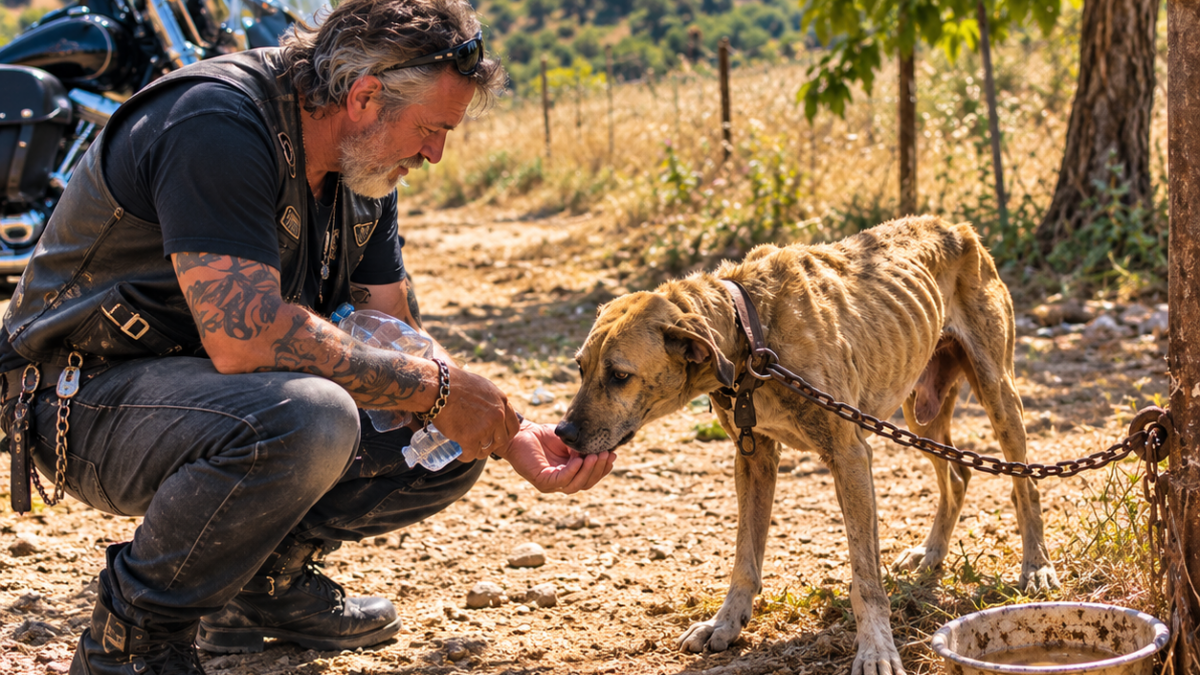
PART 2
The pickup came down the dirt track slowly.
Too slowly.
That was the first thing that bothered me.
If someone had seen a stranger kneeling beside their dog in dangerous heat, a normal owner would have hurried.
They would have jumped from the truck.
Demanded an explanation.
Asked whether the animal was alive.
This driver rolled toward me as if he had all the time in the world.
I remained beside the dog.
She was stretched on her side beneath the tree now.
Her breathing had become shallow and irregular.
I soaked the edge of my bandanna with water and touched it to her paws and belly.
Not ice cold.
Just cool.
I knew enough not to dump freezing water over an overheated animal.
The pickup stopped twenty yards away.
A man got out.
Maybe forty.
Lean.
Sunburned neck.
Work boots.
Gray T-shirt.
He looked at me.
Then at the broken chain.
He did not look at the dog.
That told me more than anything else.
“What are you doing?”
His tone wasn’t worried.
It was angry.
I stood.
“Trying to keep her alive.”
“You cut my chain.”
I looked down at the dog.
“You’re worried about the chain?”
His jaw tightened.
“You had no right to come onto my property.”
I glanced toward the road.
The dog had been chained within a few feet of the roadside fence.
There wasn’t even a visible sign marking private property where I had stopped.
“She needs a veterinarian.”
“She’s fine.”
I stared at him.
The dog’s ribs were rising too quickly.
Her gums looked dark.
There was dried saliva around her mouth.
The skin beneath her collar was raw.
“She is not fine.”
He stepped closer.
“Put her back.”
For a second I wasn’t sure I had heard him correctly.
“What?”
“Fix the chain and put her back.”
I actually laughed.
Not because anything was funny.
Sometimes anger comes out that way.
“You want me to chain an overheated dog back in direct sunlight?”
“It’s my dog.”
“That’s not an answer.”
“It’s the only answer you need.”
I had spent enough years around men who wanted fights to recognize the change in his posture.
Chest slightly forward.
Hands loose.
Weight shifted.
He wanted intimidation to finish the conversation.
Maybe my age fooled him.
Maybe the gray beard did.
Maybe he hadn’t noticed the motorcycle vest folded over my seat.
I didn’t care.
I had no interest in fighting him.
Not with a dog dying at my feet.
I took out my phone.
“I’m calling animal control and the police.”
His expression changed.
Just for an instant.
Fear.
Then anger again.
“There’s no need for that.”
“There is now.”
He took another step.
I raised my hand.
“Don’t.”
He stopped.
I dialed emergency services.
I explained the heat.
The condition of the dog.
The chain.
The owner’s refusal to seek care.
The dispatcher told me officers and an animal welfare unit were being notified.
The man heard enough.
He swore.
Then he returned to his pickup.
Before climbing in, he pointed at me.
“You should have kept riding.”
The truck reversed.
He drove toward the farmhouse.
I watched until it disappeared behind a barn.
Then I looked down at the dog.
“You know him?”
One ear moved weakly.
“That’s what I was afraid of.”
The nearest veterinary clinic was almost twenty minutes away.
I didn’t believe she had twenty minutes to waste.
When I called, a veterinarian named Dr. Sophie Arnaud answered after her receptionist explained the situation.
“Is she conscious?”
“Barely.”
“Can she stand?”
“No.”
“Do you have a vehicle with air-conditioning?”
“My motorcycle.”
There was a pause.
“You have a motorcycle?”
“With a sidecar.”
Another pause.
“Can you make shade inside it?”
“Yes.”
“Do it. Damp towels around the paws, groin, belly. Not ice water. Small amounts of drinking water only if she can swallow. Bring her immediately.”
“What about the owner?”
“If police are coming, tell them where you’re taking her.”
The dog opened her eyes when I slid the blanket underneath her.
She made no attempt to resist.
That frightened me.
A healthy frightened mastiff mix could have made moving her nearly impossible.
This dog barely had enough strength to lift her head.
“I need to move you.”
No reaction.
“I know you don’t know me.”
Her eyes shifted toward mine.
“But for the next twenty minutes, you’re going to have to trust me.”
I lifted carefully.
She weighed far less than she should have.
The bones beneath her body surprised me.
I laid her in the sidecar on top of the blanket.
I raised the small canopy.
Placed damp cloth around her paws.
Then poured a little water into my hand.
She licked twice.
Stopped.
A police vehicle appeared as I was fastening the sidecar cover.
Two officers got out.
I gave them the quick version.
One walked toward the farmhouse.
The other looked at the dog.
His expression changed instantly.
“Go,” he said.
“What about—”
“We have your details.”
He looked at the dog again.
“Go now.”
I went.
I had never driven that road so carefully.
Every stop felt too long.
Every slow car felt personal.
I kept looking down.
“Stay with me.”
Her eyes were closed.
“Come on.”
I had no idea whether she could hear me.
At one intersection I reached down and touched her shoulder.
She inhaled.
Still there.
I accelerated.
Dr. Sophie was waiting outside when I arrived.
Two technicians brought a stretcher.
They moved her inside immediately.
I followed.
A receptionist stopped me.
“You’ll have to wait.”
“I found her.”
“I know.”
“Her name—”
I stopped.
I didn’t know her name.
That bothered me.
The man at the farmhouse hadn’t said it once.
Not when he saw her.
Not when he told me to chain her back.
I sat in the waiting room.
My clothes were soaked through.
Part sweat.
Part spilled water.
My hands shook from adrenaline.
I looked down and noticed a small smear of blood on my wrist.
From her neck.
I washed it off in the restroom.
When I returned, two police officers were standing near the reception desk.
One was the officer from the roadside.
The other was a woman I hadn’t seen before.
“Mr. Delmas?”
“Yes.”
“I’m Lieutenant Camille Roche.”
She held out her hand.
“I need to ask you exactly what happened.”
We sat.
I told her everything.
The dog.
The chain.
The empty bowl.
The tree.
The man.
The threat.
“Exact words?”
“He said I should have kept riding.”
Camille wrote it down.
“Did he identify himself?”
“No.”
“We did.”
I waited.
“His name is Alain Veyrac.”
“Does he own the property?”
“No.”
That surprised me.
“Then whose property is it?”
“His uncle died two years ago. Ownership is still tied up in an estate dispute. Veyrac uses the land.”
“And the dog?”
“He says she belongs to him.”
“Did he tell you her name?”
Camille looked at her notes.
“Roxie.”
Roxie.
For the first time, she had a name.
“Roxie.”
I said it softly.
The veterinarian emerged almost an hour later.
Sophie removed her gloves.
“She’s alive.”
My shoulders dropped.
“But?”
Sophie sat opposite me.
“Severe dehydration. Heat exhaustion approaching heatstroke. Malnutrition. Pressure injury and infection around the neck. Her body temperature was dangerously high.”
“Will she survive?”
“I think so.”
I closed my eyes.
“But she needs hospitalization.”
“Do it.”
Sophie hesitated.
“The legal ownership issue may complicate authorization.”
“I’ll pay.”
Camille looked toward me.
“You don’t have to do that.”
“I said I’ll pay.”
Sophie nodded slowly.
“We’ve already begun treatment.”
“How long had she been out there?”
“Impossible to say exactly.”
“Hours?”
Sophie’s face hardened.
“Not just today.”
I looked at her.
“What do you mean?”
“The malnutrition is chronic. The collar injury is not new. Her paw pads have thermal damage of different ages.”
Camille stopped writing.
“Different ages?”
Sophie nodded.
“This animal has been repeatedly exposed to hot ground.”
A silence settled over us.
Then one of the technicians appeared at the doorway.
“Sophie?”
The veterinarian stood.
“What?”
The technician whispered something.
Sophie looked at Camille.
Then at me.
“Stay here.”
Of course I didn’t.
I followed them down the corridor until Camille blocked me.
“Marc.”
“What happened?”
“They found something.”
“What?”
Sophie returned carrying a small clear evidence bag.
Inside was a tiny piece of blue plastic attached to a fragment of metal.
“What is that?”
“A broken tag.”
She turned it.
Most of the writing had been scraped away.
One thing remained.
A number.
Not a telephone number.
An identification number.
Camille photographed it.
“Could be nothing.”
Sophie looked at her.
“You don’t believe that.”
“No.”
Neither did I.
By evening, Roxie’s temperature had begun coming down.
Her bloodwork showed kidney stress but no irreversible failure yet.
I was allowed to see her for less than a minute.
She lay beneath a light blanket with an IV line running into her leg.
I stood near the kennel.
“Hey, Roxie.”
Her eyes opened.
That was all.
“Turns out you have a name.”
One small movement of her tail.
Maybe I imagined it.
I went home after dark.
I should have slept.
Instead, I kept thinking about the tag.
At 11:47 p.m., Camille called.
“Did I wake you?”
“No.”
“We identified the number.”
I sat up.
“And?”
“It isn’t registered to Roxie.”
“What?”
“The number belonged to another dog.”
“What dog?”
“A female mastiff named Bella.”
“Where is Bella?”
Camille was silent.
Then:
“Reported missing eighteen months ago.”
I swung my feet onto the floor.
“You’re saying Roxie had another missing dog’s tag?”
“A fragment of it.”
“How?”
“That’s what we need to find out.”
“Who reported Bella missing?”
“A family outside Arles.”
“Was she ever found?”
“No.”
Something cold settled in my stomach.
“Camille.”
“Yes?”
“How many dogs does Veyrac have?”
“According to him?”
I hated that answer immediately.
“According to him.”
“One.”
“And according to you?”
Another silence.
“We don’t know yet.”
The next morning, police returned to the farmhouse.
This time they had an animal welfare inspector.
Veyrac cooperated just enough to avoid immediate escalation.
He showed them the yard.
The barn.
An equipment shed.
No other dogs.
He claimed Roxie had only been chained outside temporarily because workers were expected.
He said the bowl had been full that morning.
He said I must have spilled it.
That made me laugh when Camille told me.
“He says I spilled her water?”
“Yes.”
“Before or after I magically caused weeks of malnutrition?”
“We know.”
“He also says the shade moved during the day.”
“He does.”
“Camille.”
“I know.”
But suspicion isn’t evidence.
Not enough.
The fragment of Bella’s tag mattered, but Veyrac claimed he had found old collars and identification tags in abandoned buildings left by his uncle.
His uncle, according to him, used to take in stray dogs.
Convenient.
The investigation might have stalled there.
Then Roxie woke up properly.
Three days after I found her, Sophie called.
“She’s standing.”
I rode to the clinic.
Roxie was outside in a shaded rehabilitation yard.
She had gained almost no visible weight yet, but her eyes were different.
Alert.
She watched every movement.
When she saw me, she froze.
I crouched.
“Remember me?”
Her head tilted.
Then she took one step.
Stopped.
Another.
She reached me and pressed her nose against my forearm.
I had spent decades around bikers who would rather swallow broken glass than admit to crying.
That afternoon, I understood them.
I scratched lightly beneath her jaw, careful to avoid the bandaged area.
“You scared the hell out of me.”
Her tail moved.
Sophie smiled.
“She seems to like you.”
“I bribed her with half a bottle of water.”
“Excellent foundation for a relationship.”
Then Roxie saw something beyond the fence.
Her entire body changed.
She stiffened.
Tail down.
Eyes wide.
I turned.
A white pickup was entering the clinic parking lot.
Not Veyrac’s.
Different make.
Different driver.
But Roxie didn’t know that.
She backed away.
Then tried to hide behind me.
Sophie’s smile disappeared.
“Interesting.”
“What?”
“Her reaction.”
“To white trucks?”
“Possibly.”
Roxie began trembling.
I stepped between her and the parking lot.
“You’re safe.”
She pressed against my leg.
Sophie watched closely.
“Marc, we need to document this.”
“Why?”
“Because sometimes behavior tells us where to look.”
That afternoon Camille reviewed traffic cameras near the farmhouse.
White pickups appeared regularly.
Several.
One especially often.
No company name.
No permanent logo.
Just interchangeable magnetic signs depending on the day.
Landscaping.
Farm maintenance.
Animal transport.
The registration belonged to a business called Veyrac Rural Services.
Alain Veyrac’s company.
A legal business.
At least on paper.
What followed took weeks.
Camille didn’t tell me everything.
She couldn’t.
I learned pieces.
Veyrac had old citations related to animal transport.
Nothing serious enough to stop him.
He had worked for kennels.
Farms.
Private security trainers.
He transported livestock and occasionally dogs.
His uncle’s farmhouse sat near several secondary roads.
A good place for vehicles to come and go without attracting attention.
Then a woman named Élodie Fournier contacted police.
She had seen Roxie’s photograph after the rescue became local news.
She did not recognize Roxie.
She recognized the chain.
That seemed absurd at first.
A chain was a chain.
But Élodie had once delivered feed to the Veyrac property.
Behind the barn she had seen several identical chains attached to stakes.
Five or six.
She remembered because there were no dogs on them.
Only bowls.
“When?” Camille asked her.
“Last summer.”
“Why didn’t you report it?”
“Report empty chains?”
Fair point.
“Did you see anything else?”
Élodie hesitated.
“A trailer.”
“What kind?”
“Animal transport.”
“Dogs?”
“I heard them.”
“How many?”
“I don’t know.”
“What happened?”
“Alain told me the feed delivery belonged at the front and I had no reason to be back there.”
“Was he angry?”
“He smiled.”
I understood what she meant when Camille repeated it.
Some smiles are worse than shouting.
Police began looking into Veyrac Rural Services.
Invoices.
Clients.
Vehicle movements.
Transport records.
Most appeared normal.
Some didn’t exist.
Cash payments.
Unclear destinations.
Repeated trips at night.
Then the family who had lost Bella was contacted.
Their names were Thomas and Julie Perrin.
Bella had disappeared from their fenced property eighteen months earlier.
No broken gate.
No hole.
No blood.
Just gone.
Their twelve-year-old daughter, Emma, had searched every afternoon after school for two months.
Julie still had Bella’s original identification records.
The number matched the fragment found beneath Roxie’s collar.
I met them accidentally at the clinic.
Roxie was walking beside me when a woman entered.
She saw Roxie.
Stopped.
Her face fell.
For one terrible second, she thought Roxie might be Bella.
Then she knew.
Different markings.
Different eyes.
Still, she crouched.
“Hey, sweetheart.”
Roxie watched her.
Julie started crying.
“I’m sorry.”
She stood quickly.
“I’m sorry. I know she isn’t ours.”
“You’re Bella’s family?”
She nodded.
A man behind her put his hand on her shoulder.
Their daughter stood between them.
Thirteen now.
She held a photograph.
Bella.
A big gray female with white paws.
Roxie sniffed the photograph.
Emma’s mouth trembled.
“Do you think she knew her?”
I had no answer.
Maybe not.
Maybe yes.
I looked at Sophie.
Sophie didn’t pretend to know.
“We’ll keep looking.”
Emma reached through the fence.
Roxie sniffed her fingers.
Then licked them.
Emma broke.
So did her father.
That scene did something to me.
I had been angry from the moment I touched the burning chain.
But anger is vague until it gets a face.
Bella’s face was in that photograph.
Emma’s face was standing beside it.
I wanted Veyrac caught.
Not beaten.
Not threatened.
Caught.
Exposed.
Forced to answer.
The temptation for men like me is to believe revenge means using your hands.
I was old enough to know better.
A punch lasts seconds.
Evidence lasts longer.
So when my motorcycle friends heard what happened and offered to “have a conversation” with Veyrac, I told them no.
Luc, who had ridden beside me for twenty-two years, stared across the clubhouse table.
“He left her to cook.”
“I know.”
“And you want us to do nothing?”
“I want us to do something useful.”
Luc leaned back.
“That doesn’t sound like you.”
“It sounds exactly like me.”
“What do you want?”
I had been thinking about it.
“People.”
“What kind?”
“Everyone in the region who lost a dog under suspicious circumstances.”
Luc frowned.
Then understood.
Our motorcycle club had hundreds of contacts.
Mechanics.
Farmers.
Bar owners.
Truck drivers.
Security guards.
Retired police officers.
Animal volunteers.
People in towns police databases did not necessarily connect quickly.
Within days, stories began arriving.
A shepherd vanished from a farm.
A Cane Corso disappeared from a secure yard.
Two hunting dogs gone after a gate was found mysteriously open.
A young mastiff missing after someone claiming to be a dog trainer visited.
Not all connected.
Probably most weren’t.
But some patterns emerged.
Large dogs.
Mostly rural.
Mostly within a broad radius.
Several owners remembered white utility vehicles.
One remembered a man asking whether the dog was aggressive.
Another remembered someone offering cash.
Another remembered a magnetic business logo.
Camille was furious when she learned what we were doing.
“You cannot conduct your own investigation.”
“We’re collecting public information.”
“You are interfering.”
“We’re sending everything to you.”
“Marc.”
“I’m not confronting anyone.”
She stared at me.
“Promise me.”
“I promise.”
“Your biker friends?”
“They’re behaving.”
“That sentence does not comfort me.”
Despite herself, she almost smiled.
The information helped.
One lead mattered more than the rest.
A retired truck driver named Gérard remembered transporting empty kennel panels to a property connected to Veyrac Rural Services.
Not the farmhouse where Roxie had been found.
Another property.
An abandoned greenhouse complex almost thirty miles away.
Police checked ownership.
A shell company controlled it.
The company director was Alain Veyrac’s cousin.
A warrant took time.
Too much time for my patience.
But they got it.
Camille called me afterward.
Her voice was flat.
“We found dogs.”
“How many?”
“Marc—”
“How many?”
“Eleven alive.”
I gripped the phone.
“And?”
Silence.
My stomach dropped.
“How many not alive?”
“I’m not discussing that.”
That was answer enough.
“Bella?”
“We haven’t identified everyone.”
“Roxie?”
“No evidence she was housed there yet.”
“What did you find?”
“Transport cages. Medication. Blank ownership transfer forms. Microchip scanners. Collars.”
“Tags?”
“Yes.”
I closed my eyes.
“How many?”
“Enough.”
The operation was larger than one neglected dog.
Dogs were being acquired from multiple sources.
Some legitimately.
Some through deception.
Some almost certainly stolen.
Large dogs were sold to private buyers.
Some were transported abroad.
Some were used in illegal guard-dog training.
Animals deemed unsuitable became difficult to account for.
Roxie was one of those.
Investigators found an old intake sheet containing her photograph.
She had originally been named Ruby.
Not Roxie.
Ruby had belonged to an elderly man named François Leclerc.
When François suffered a stroke, his nephew placed Ruby through an online rehoming advertisement.
The person who collected her used a false name.
Police traced the phone.
Prepaid.
But vehicle camera records eventually connected the pickup to Veyrac’s company.
François had died believing Ruby had gone to a family with land.
That fact hit me differently from everything else.
He had tried to protect her.
Someone had used his trust against him.
Veyrac’s records showed Ruby was initially classified for resale.
Then “difficult.”
Then “nonresponsive.”
Then moved.
The final notation beside her number read:
HOLD — SOUTH PROPERTY.
The farmhouse.
The chain.
The sun.
I stared at a copy of that line during the preliminary hearing.
Hold.
Such a clean word.
As though she had been a package.
A chair.
A machine part.
Not a living animal standing three yards from shade.
Veyrac was arrested on multiple charges.
His lawyer immediately called the investigation exaggerated.
He claimed dishonest employees had misused company property.
He claimed stolen-dog records had been planted.
He claimed Ruby had been placed outside only briefly.
Then police recovered messages.
One employee had texted Veyrac the morning I found her.
“She won’t work. What do you want done?”
Veyrac replied:
“Leave her south side. I’ll decide later.”
A second message came after noon.
“Too hot there.”
The response:
“Then she’ll stop being a problem.”
I read those words only once.
That was enough.
Luc read them over my shoulder.
For the first time since I had known him, he said nothing.
He walked outside.
I followed.
He stood beside his motorcycle with both hands on the seat.
“Still don’t want a conversation?”
“No.”
He looked at me.
I held up the evidence copy.
“This is the conversation.”
The case became regional news.
Then national outlets picked it up.
Not because animal cruelty was rare.
Because one photograph spread everywhere.
Ruby beneath the mulberry tree after rescue.
Bandaged neck.
Thin body.
Eyes looking toward the camera.
And behind her, clearly visible, the broken chain.
People were furious.
Donations flooded the clinic.
Some were five euros.
Some five hundred.
One envelope contained twenty euros and a handwritten note from a nine-year-old child.
FOR THE DOG WHO COULDN’T REACH THE TREE.
Sophie taped that note inside the staff room.
Ruby improved.
Slowly.
She gained weight.
Her kidney values normalized.
The wounds around her neck healed.
Her coat became darker and richer.
Her personality emerged.
She was stubborn.
Very stubborn.
She disliked rain.
Loved watermelon.
Hated closed doors.
Would steal bread if left unattended.
And she was terrified of chains.
One day a technician dropped a metal leash.
Ruby hit the floor.
Flat.
Trembling.
I sat beside her.
No touching at first.
Just close.
“It’s okay.”
She stared at the leash.
Sophie removed it.
Ruby’s breathing slowed.
I stayed twenty minutes.
When I finally stood, Ruby followed.
“Looks like she picked you,” Sophie said.
“No.”
“Yes.”
“I ride motorcycles.”
“You have a sidecar.”
“I’m gone often.”
“You’re home every night.”
“I have no fence.”
“Install one.”
“You’ve thought about this.”
“For several weeks.”
I looked at Ruby.
She sat beside my boot.
“You want to come live with an old man?”
Tail wag.
“That is not legally binding.”
Tail wag.
Sophie laughed.
Two weeks later, Ruby came home with me.
I kept the name Ruby.
Roxie belonged to Veyrac.
Ruby belonged to the man who had loved her before any of this happened.
I built a fence.
A high one.
No chains.
Never.
The first day, Ruby walked every inch of the yard.
Then she found the largest patch of shade beneath my fig tree and lay down.
She stayed there almost an hour.
The sight nearly broke me.
Shade.
Something ordinary.
Something free.
The trial began almost ten months after I found her.
By then Ruby looked like a different dog.
Her ribs no longer showed.
Her neck had healed, though a thin hairless scar remained beneath the jaw.
She weighed almost twenty pounds more.
She still watched white pickups.
But she no longer hid behind me every time one passed.
The prosecution built its case from records, recovered animals, transport documents, electronic messages, witnesses, and owners of missing dogs.
Several former employees testified.
One man named Rémi admitted he had helped move dogs between properties.
“Why?” the prosecutor asked.
“Money.”
“Did you know some were stolen?”
“Eventually.”
“And you continued?”
Rémi looked at the floor.
“Yes.”
“Did you know Ruby?”
He swallowed.
“Yes.”
My hands tightened in my lap.
“How?”
“She wouldn’t bite.”
The prosecutor paused.
“Explain.”
“They tested some dogs for guarding.”
“What kind of test?”
Defense objected.
The judge allowed careful questioning.
Rémi explained that prospective guard dogs were pressured with unfamiliar people, noises and controlled confrontation.
Ruby refused aggression.
She backed away.
When cornered, she shut down.
Veyrac called her useless.
“Did you see her chained?”
“Yes.”
“Was water available?”
“Sometimes.”
“Shade?”
Rémi hesitated.
“Not where the chain reached.”
“Was that accidental?”
The courtroom went silent.
“No.”
I felt Luc beside me move.
I grabbed his arm before he could do anything stupid.
He wasn’t going to.
But I grabbed it anyway.
The prosecutor displayed photographs taken by investigators.
Multiple stakes.
Chains of similar length.
The mulberry tree.
Measurements.
Three yards from Ruby’s maximum reach to the nearest reliable afternoon shade.
Then she displayed the text messages.
“She won’t work. What do you want done?”
“Leave her south side. I’ll decide later.”
“Too hot there.”
“Then she’ll stop being a problem.”
Veyrac stopped looking at the jury.
The defense claimed the wording was sarcastic.
No one laughed.
The most emotional testimony came from families.
Emma Perrin testified about Bella.
She was fourteen by then.
Small voice.
Steady hands.
“Did you ever find Bella?” the prosecutor asked.
“No.”
“Did police find her identification tag?”
“A piece of it.”
“Where?”
“On Ruby.”
“Do you blame Ruby?”
Emma looked shocked.
“No.”
“Why not?”
“Because somebody did that to both of them.”
I saw jurors look away.
Bella’s remains were never conclusively identified.
Neither were several other missing dogs.
That absence haunted the trial.
But the case did not depend on solving every disappearance.
Enough was proven.
Illegal possession.
Falsified records.
Animal cruelty.
Trafficking offenses.
Theft-related charges.
Fraud.
Multiple counts connected to neglect and unlawful transport.
When the verdict was read, Veyrac stood straight.
Guilty.
Again.
Guilty.
Again.
Guilty.
Some charges resulted in acquittal.
Others in conviction.
It took nearly twenty minutes.
I expected satisfaction to feel explosive.
It didn’t.
It felt quiet.
Like the moment after shutting off my motorcycle on that road.
A long noise finally stopping.
Outside court, reporters surrounded people.
I avoided them.
Luc did too.
We walked toward the motorcycles.
“You happy?” he asked.
“No.”
“Me neither.”
Then he nodded toward my sidecar.
Ruby sat inside wearing a harness.
The clinic had advised against bringing her into the crowd, so she had waited with a friend in a quiet parking area.
The moment she saw me, she stood.
Tail hammering.
Luc smiled.
“Maybe that’s the point.”
“What?”
He touched the sidecar.
“This.”
I looked at Ruby.
He was right.
Punishment wasn’t the best part.
Recovery was.
Veyrac had tried to reduce animals to usefulness.
Sellable.
Trainable.
Disposable.
Ruby’s revenge was becoming useless in the best possible way.
She became nobody’s guard dog.
Nobody’s breeding asset.
Nobody’s commodity.
She spent mornings asleep on my sofa.
She stole my blankets.
She chased lizards badly.
She barked at the vacuum cleaner.
She sat beside my motorcycle whenever she heard keys because she loved riding in the sidecar.
The first time I took her back toward the road where I found her, I almost turned around.
I wasn’t sure what memory would do.
We stopped half a mile away.
I walked her on a harness.
No collar at first.
Never attached around her neck.
As we approached the old property, Ruby slowed.
The farmhouse had been seized as part of the legal process and was empty.
The stake was gone.
The chain was evidence.
The mulberry tree remained.
Ruby stopped.
She stared toward it.
I didn’t pull.
“Your choice.”
She sniffed.
Then walked.
Not toward where the stake had been.
Toward the tree.
She entered the shade.
Circled twice.
Lay down.
I sat beside her.
For several minutes, neither of us moved.
Cars passed in the distance.
Cicadas screamed from the dry grass.
Ruby rolled onto her side.
Completely relaxed.
I put my hand against the cool soil beneath the tree.
Three yards.
That was all.
Three yards had once been impossible.
Now she had the whole world.
I laughed softly.
“You won.”
Ruby opened one eye.
“No idea what I’m talking about, do you?”
Her tail moved against the dirt.
I stayed there until the afternoon cooled.
The story could have ended there.
I thought it had.
Then, almost a year later, Camille called again.
“Marc, are you sitting down?”
“No.”
“Sit.”
I did.
“What happened?”
“We found Bella.”
I stopped breathing.
“Alive?”
“Yes.”
I stood again immediately.
“You told me to sit for nothing.”
Camille laughed for the first time I had ever heard.
“Alive.”
“Where?”
“A woman in northern Italy adopted her through an unofficial private sale eighteen months ago.”
“Does she know?”
“She had no idea Bella was stolen.”
“Bella’s family?”
“We contacted them.”
“And?”
Camille’s voice softened.
“They’re going to see her tomorrow.”
I put my free hand over my face.
“Jesus.”
“She’s older. Has some health issues. But she’s Bella.”
“How did you find her?”
“One of the microchip records recovered in the Veyrac investigation connected to an export document. Italian authorities followed it.”
I looked at Ruby sleeping near the kitchen door.
The broken tag beneath her collar had started the chain.
One tiny piece of plastic.
One missing dog.
One family.
The next afternoon, Sophie called.
“Come to the clinic.”
“Why?”
“Just come.”
I took Ruby.
When we arrived, a car with Italian plates was parked outside.
I understood immediately.
Emma stood in the yard.
Older now.
Taller.
Her parents beside her.
Across from them, an elderly gray mastiff stepped from a vehicle.
Bella.
Emma made one sound.
Not a word.
A sound from someplace deeper.
Bella stopped.
Her ears lifted.
Emma crouched.
“Bella?”
The dog stared.
Then started walking.
Slowly at first.
Emma repeated her name.
Bella accelerated.
Not running exactly.
Her old joints couldn’t.
But she tried.
Emma dropped to both knees.
Bella hit her chest.
The girl wrapped both arms around her.
Her mother folded over them.
Her father covered his mouth.
Nobody at the clinic pretended not to cry.
Ruby stood beside me.
Bella eventually noticed her.
The two dogs looked at each other.
I wondered whether they had ever met.
Maybe not.
Bella sniffed Ruby’s face.
Then her neck.
Ruby sniffed Bella.
No dramatic recognition.
No miracle.
Just two dogs.
That was enough.
Emma walked over after nearly half an hour.
She knelt beside Ruby.
“You helped us find her.”
Ruby licked her chin.
Emma laughed through tears.
“You don’t even know.”
I did.
Ruby never knew what that broken tag meant.
Never knew Bella.
Never understood trials or evidence.
She had simply survived long enough to carry a clue out with her.
The Perrins were able to bring Bella home after legal arrangements were completed with the Italian adopter, who had bought her in good faith and agreed to the reunion once the evidence was clear.
Emma sent me photographs.
Bella asleep on her old rug.
Bella in the backyard.
Bella beside a framed childhood picture of herself.
The last photo showed Emma studying at a desk while Bella slept across her feet.
Normal life.
That was the victory.
Not headlines.
Normal life.
Three summers after I found Ruby, temperatures climbed again.
Not quite as high.
Still brutal.
I was riding with Luc when we passed the turnoff near the old farmhouse.
He looked at me.
I nodded.
We turned around.
The property had been sold.
A young couple now lived there.
They knew the history.
They had removed the old stakes.
Repaired the barn.
And planted three additional trees along the fence.
When they recognized Ruby, they invited us in.
The woman knelt.
“So this is her.”
Ruby wagged.
The man pointed toward the mulberry tree.
“We kept it.”
“Good.”
“We almost cut it down. It’s old.”
“Don’t.”
He looked surprised by the force in my voice.
I softened.
“Please.”
He nodded.
“It stays.”
Ruby walked toward it.
This time she didn’t hesitate at all.
She lay in the shade.
Luc sat beside me.
“Remember when you said evidence was better revenge than a beating?”
“Yes.”
“I hated that.”
“I know.”
“You were right.”
“I know.”
“I hate that too.”
I laughed.
Ruby rolled onto her back.
The scar beneath her jaw was still visible.
It probably always would be.
I used to hate seeing it.
Eventually I changed my mind.
Scars are not always reminders of what someone did to you.
Sometimes they’re proof that what someone did failed to finish the story.
Ruby grew older.
The sidecar became hers completely.
If anyone else tried sitting there, she stared until they moved.
My club made her a little leather harness.
No metal around the neck.
On the back was a patch.
THREE YARDS.
People often asked what it meant.
Sometimes I told them.
Sometimes I didn’t.
The men understood.
Three yards between suffering and relief.
Three yards between captivity and shade.
Three yards between being someone’s property and becoming her own living creature again.
As years passed, Ruby’s story became less painful to tell.
The anger softened.
Not forgiveness.
I have never believed forgiveness is mandatory.
But anger stopped owning the memory.
What remained was the moment after I cut the chain.
Ruby standing there.
Free.
Not moving.
That image taught me something I had not understood before.
Sometimes freedom arrives before the body is ready to believe it.
If you’ve spent long enough restrained, the absence of a chain can feel confusing.
You may still stop where it used to tighten.
Ruby did that for months.
In my yard, she had full space.
Yet she often walked a circle approximately the size of her old chain’s reach.
She would approach an invisible boundary.
Stop.
Turn.
There was nothing there.
No stake.
No chain.
No fence.
But memory had drawn one.
The first time she crossed it without thinking, I nearly missed it.
She was chasing a falling leaf.
She ran past the imaginary limit.
Then another ten feet.
Then twenty.
She stopped.
Looked around.
No punishment came.
So she ran again.
That day I stood on my porch crying over a dog chasing a leaf.
Nobody tells you rescue works like that.
People imagine one dramatic moment.
You cut the chain.
Open the cage.
Carry the dog away.
Saved.
No.
Sometimes the visible chain is the easiest one to break.
The invisible chain takes months.
Years.
Patience.
Ruby taught me that too.
She stopped fearing white pickups eventually.
Metal noises took longer.
She never liked collars.
So we used a harness.
She never slept outside alone.
Fine by me.
She always wanted access to shade.
I made sure there was plenty.
On the hottest days, she stayed indoors with air-conditioning.
Sometimes I caught her lying where sunlight came through the window.
Voluntarily.
That mattered.
Heat was no longer something done to her.
Sunlight could just be sunlight again.
One evening, years later, Emma visited with Bella.
Bella was very old by then.
Ruby was gray around the muzzle.
They rested together beneath my fig tree.
Emma sat beside me.
“Do you ever think about what would have happened if you hadn’t stopped?”
More than I wanted to admit.
“All the time.”
“She would have died?”
“Probably.”
“And then maybe Bella…”
She couldn’t finish.
“Maybe.”
Emma watched the two dogs.
“My mom says one good decision can keep moving.”
I liked that.
“One good decision?”
“You stopped.”
I shook my head.
“Ruby lifted her head.”
Emma looked confused.
“If she hadn’t moved, I might have thought she was a bag.”
She smiled sadly.
“So Ruby saved herself.”
“In a way.”
Then I thought about it.
“No. Lots of people saved her.”
Sophie.
Camille.
The technicians.
Witnesses.
Former employees who finally talked.
Families who came forward.
Police in two countries.
Even frightened people who had stayed silent and eventually decided not to.
Rescue is rarely one hero.
It is usually a chain too.
A different kind.
One person connects to another.
Someone notices.
Someone speaks.
Someone believes.
Someone acts.
And eventually something terrible loses its grip.
Bella died the following spring.
At home.
Emma beside her.
She had been back with her family almost four years.
Emma called me.
“She slept in my room last night.”
“Good.”
“She always used to.”
Her voice cracked.
“I got four years back.”
I thought about eighteen months stolen from them.
Then four years returned.
Not equal.
Nothing could make it equal.
But life is not an equation.
Sometimes what comes back is simply precious because it came back at all.
Ruby lived longer.
She reached thirteen.
Maybe fourteen.
Nobody knew her exact age.
Her last summer was mild.
I was grateful for that.
She could no longer climb into the sidecar without help, so I built a small ramp.
Luc laughed when he saw it.
“You built your dog motorcycle accessibility.”
“Yes.”
“You’re ridiculous.”
“Yes.”
He helped reinforce it.
On Ruby’s final ride, we went nowhere important.
Just country roads.
Slow.
No destination.
She sat in the sidecar with her nose in the wind.
Her harness patch had faded.
THREE YARDS.
We passed vineyards.
Stone walls.
Olive groves.
Then I took the road toward the mulberry tree.
The new owners still welcomed us.
Ruby walked slowly.
I helped her across the yard.
She reached the tree.
Lay down.
I lowered myself beside her.
The ground was cool.
“You made it.”
Her eyes closed.
“You always make it now.”
I sat with one hand resting on her shoulder.
I thought about that first afternoon.
The overturned bowl.
The burned dirt.
The chain.
The impossible three yards.
And the man telling me to put her back.
That part almost made me laugh now.
Put her back.
As if freedom could be undone once someone had witnessed the cruelty.
As if a broken chain could be repaired and the world would forget.
It didn’t.
Ruby didn’t need violence for revenge.
She needed time.
Every year she lived was revenge.
Every bowl of clean water was revenge.
Every nap in the shade.
Every motorcycle ride.
Every stolen piece of bread.
Every veterinarian appointment she complained through.
Every child she allowed to pet her.
Every night she slept without metal around her neck.
Every time she crossed an open yard without reaching the end of a chain.
Veyrac had decided she would “stop being a problem.”
Instead, she became the problem that ended him.
His records exposed him.
His messages convicted him.
His victims connected through her case.
Bella came home because of evidence found on Ruby.
Other dogs were identified.
Properties were searched.
An operation collapsed.
All because one exhausted dog lifted her head beside a road.
People call that karma.
I call it consequences.
Ruby died that winter.
At home.
On a thick bed near the fireplace.
I was lying on the floor beside her.
She had stopped eating the previous day.
Sophie came to the house.
She examined Ruby quietly.
Then looked at me.
I knew.
There are moments when you want love to become selfish.
One more day.
One more ride.
One more morning.
But if you love an animal long enough, eventually they ask you for the hardest kindness.
I put my face beside hers.
“You remember me?”
Her cloudy eyes looked at mine.
“I was the idiot with the motorcycle.”
One weak tail movement.
“Yeah. That guy.”
I scratched the fur above her shoulder.
“You scared me half to death.”
Another tiny movement.
I wanted to say something important.
Something worthy.
Instead, I told the truth.
“You can rest.”
Ruby exhaled.
Sophie gave the medication.
I kept my hand on her.
No chain.
No heat.
No fear.
Ruby died with her head against my arm.
For a while, I didn’t move.
Later, Luc came.
He didn’t say anything.
He sat on the floor.
Two gray-haired men covered in old tattoos sitting beside an empty dog bed.
That was us.
Eventually Luc noticed Ruby’s harness hanging by the door.
He touched the patch.
“Three yards.”
“Yeah.”
“You keeping it?”
“Always.”
We buried Ruby’s ashes beneath my fig tree.
Not because it was dramatic.
Because that was her favorite shade.
Emma came.
Sophie.
Camille.
Luc and several members of the club.
The couple who owned the old farmhouse even came.
Emma placed Bella’s old photograph beneath the tree for a minute.
Then took it home.
Camille stood beside me afterward.
“You know, the first report called her ‘unidentified female dog.’”
I smiled.
“She would have hated that.”
“She hated paperwork?”
“She hated everything she didn’t personally approve.”
Camille laughed.
Then she looked at the little stone marker.
RUBY.
Nothing else.
“Do you regret stopping that day?”
I stared at her.
“That’s a stupid question.”
“I know.”
“No.”
“Even after everything?”
“Especially after everything.”
She nodded.
Before leaving, she looked toward the sidecar.
“You still ride?”
“Until I can’t.”
“Feels strange without her?”
I looked at the empty seat.
“Very.”
It still does.
Sometimes I catch myself slowing near places where she used to stand up and sniff the air.
Sometimes I open the house door expecting to hear her nails.
Memory is stubborn.
Like Ruby.
The mulberry tree still stands.
I visit once a year.
The current owners know why.
They never ask questions.
One summer afternoon, I brought water and sat beneath it.
The temperature was high.
Not like that day.
But hot enough.
The shade stretched far across the ground.
Far beyond the place where the old chain had ended.
I walked to the approximate spot where Ruby had stood.
Then I counted the steps.
One.
Two.
Three.
That was it.
I looked back at the tree.
Three yards.
Such a small distance.
I had ridden hundreds of thousands of miles in my life.
Across countries.
Over mountains.
Along coasts.
But the most important distance I ever saw was three yards of burned earth between a dying dog and a patch of shade.
Somebody had used those three yards to cause suffering.
Ruby spent the rest of her life erasing them.
She crossed yards.
Roads.
Cities.
Borders in the evidence that found Bella.
She rode beside me for thousands of miles.
She chased leaves far beyond the invisible circle of her old chain.
She lived.
That was the ending Veyrac had never planned for.
People sometimes ask why I did not simply keep riding.
I don’t have a noble answer.
I saw something move.
I stopped.
That’s all.
Maybe that is what frightens me most about cruelty.
It often depends on ordinary people deciding something is none of their business.
A dog behind a fence.
A child crying next door.
An elderly neighbor suddenly disappearing.
An animal too thin.
A bowl always empty.
Someone assumes somebody else will act.
I almost could have been that person.
The road was hot.
I was tired.
I wanted to get home.
If Ruby had not lifted her head at exactly that moment, perhaps I would have passed.
I have forgiven myself for many things in fifty-odd years.
I don’t think I could have forgiven that.
So when people remember Ruby’s story, I hope they do not remember me as the biker who rescued the chained dog.
Remember the distance.
Three yards.
Remember that suffering sometimes sits painfully close to relief.
Remember that chains are often designed to make hope visible but unreachable.
And remember that sometimes the difference between those two things is one person willing to stop.
Ruby could see the shade.
She could not reach it.
Until someone cut the chain.
After that, she spent the rest of her life choosing where to stand.
Where to sleep.
Where to run.
Where to ride.
Who to trust.
And where to rest.
No one ever measured her world with a chain again.
That was her victory.
That was her revenge.
And for me, that will always be enough.








