PART 2: She Walked Five Miles Back to the Road Where Her Kittens Vanished—Then Four Months Later, a Car Finally Stopped
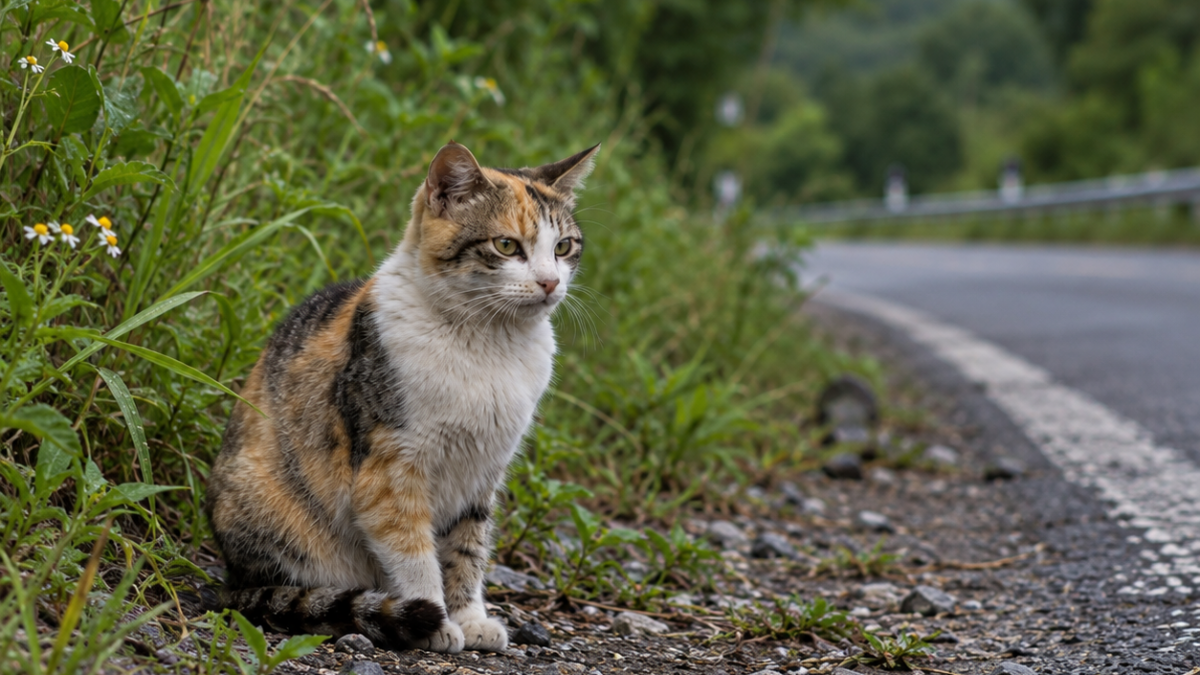
PART 2
For a second, Callie did not move toward the SUV.
She simply stood there.
Every part of her body seemed to tighten at once.
Her ears went forward.
Her tail lowered.
Then the sound came again.
A tiny, questioning cry from inside one of the carriers.
Callie took three steps.
Stopped.
The woman beside the vehicle covered her mouth.
“Oh my God.”
I stood slowly.
“Who are you?”
“My name is Laura Bennett.”
She was maybe forty, wearing jeans, a thick green coat, and the expression of somebody who was afraid she had arrived both too late and exactly on time.
“I volunteer with North Hills Cat Rescue.”
I looked at the four carriers.
My heart started pounding.
“What’s in there?”
Laura stared at Callie.
“I think I know what happened to her kittens.”
Callie approached the SUV.
Not running.
Carefully.
Her nose lifted.
Another meow came from the back.
She answered.
The sound that came out of her was not loud.
It was the soft, rolling call I had heard her make toward the ditch more than once.
Laura’s eyes filled immediately.
“Those are them.”
I looked at her.
“You’re sure?”
“No.”
That answer surprised me.
She wiped one cheek.
“I’m almost sure.”
“Tell me.”
“Not beside the road.”
She looked at Callie.
“Can we move somewhere safer?”
Walter had already come across from his farmhouse.
“What’s going on?”
Laura recognized him.
“You’re Mr. Greene?”
He frowned.
“Yes.”
“I think I’m the person you’ve been looking for.”
Walter’s face changed.
“You took that box?”
Laura looked horrified.
“Yes.”
Then she immediately added, “I was trying to save them.”
Callie cried again.
From inside the carriers, two voices answered.
I felt the entire morning narrow to those sounds.
Walter gripped his cane.
“Open them.”
Laura hesitated.
“We need to do this carefully.”
He stared at her.
“They’re hers.”
“I know. But they’ve been separated four months. We don’t know how they’ll react. Cats don’t always have the reunion people imagine.”
That brought me back to reality.
She was right.
Four months was a long time.
The kittens were no longer newborns.
Their scent would have changed.
Callie’s hormones had changed.
Whatever bond existed might not work like a human family reunion.
We could not just release four adolescent cats beside a county road.
So I called Dr. Nathan Cole, the veterinarian who had examined Callie.
Twenty-five minutes later, we were driving toward his clinic.
Callie rode in my carrier.
Laura followed with four others.
Walter insisted on coming.
He climbed into my passenger seat and said, “I’ve waited four months. I’m not missing this because my knees are bad.”
At the clinic, Dr. Cole listened to the story.
Then looked at the five carriers lined along the wall.
“So we believe these four cats are Callie’s kittens.”
Laura nodded.
“I found them the morning they disappeared.”
“Walk me through it from the beginning.”
She sat.
Callie watched the carriers.
Laura took a breath.
“I was driving to work around seven-thirty that morning. I saw a cardboard box near the ditch.”
“Did you see Callie?”
“No.”
Walter shifted in his chair.
“She’d run into the field.”
Laura nodded.
“I never saw her. I pulled over because one kitten was crying loudly enough that I could hear it with the windows up.”
“What condition were they in?”
“Cold. Very young. Umbilical cords still attached to two of them.”
Dr. Cole frowned.
“No mother in sight?”
“I searched.”
“How long?”
“Maybe twenty minutes.”
Walter muttered, “She came back.”
Laura looked at him.
“I know that now.”
There was no defensiveness in her voice.
Only pain.
“I looked under bushes. Walked both directions. Called. Waited.”
“How long total?”
“Maybe half an hour.”
“And then?”
“One kitten felt cold enough that I thought it was dying.”
She looked toward the carriers.
“So I took all four to Riverside Veterinary Hospital.”
I knew Riverside.
It was forty minutes away in the opposite direction from our rescue network.
That explained why nobody in our immediate area had heard anything.
“What did they say?” I asked.
“They estimated they were one or two days old.”
“No mother?”
“No.”
“Did you return?”
Laura closed her eyes.
“That evening.”
I leaned forward.
“To the road?”
“Yes.”
“Did you see Callie?”
“No.”
Walter spoke.
“She was there most of the day.”
Laura looked stricken.
“I came after dark. I brought a flashlight. Food. I searched for almost two hours.”
“Why didn’t you leave the kittens there?”
Dr. Cole answered before she could.
“At that age, after hours away from a nursing mother, leaving them outside overnight would have been risky.”
Laura nodded.
“The hospital started bottle-feeding them. I took them home as emergency fosters.”
She opened her phone.
“I posted everywhere I knew.”
She showed us.
Facebook rescue pages.
Lost-pet groups.
Neighborhood apps.
Four orphaned neonatal kittens found on County Road 18.
Searching for mother cat.
The posts existed.
Dates matched.
The problem was geographic fragmentation.
She had posted in North Hills groups.
We had been searching in Maple County groups.
Different rescue networks.
Different pages.
Different volunteers.
Two communities barely thirty miles apart operating like separate worlds.
Walter sat back.
“Well, I’ll be damned.”
Laura swiped to another image.
Four newborn kittens arranged beneath a heating pad.
One calico-and-white female.
One orange male.
One black male with white paws.
One mostly gray tabby.
All tiny.
Alive.
“Were these the same kittens from the box?” I asked.
“I took the box too.”
“What happened to it?”
“I still have photographs.”
Why would anyone photograph a cardboard box?
Because rescuers document things.
Stains.
Labels.
Condition.
Possible evidence.
She showed us.
The box had a torn shipping label.
Only part of an address remained.
No useful name.
At the time, Laura had assumed somebody had dumped the kittens without their mother.
“I thought she might be feral and hiding,” she said. “I went back three times that week.”
“And never saw her?”
“No.”
Walter shook his head.
“She went farther up toward the grain sheds during the day after that.”
The explanation fit.
Painfully.
Callie and Laura had missed each other by hours, maybe minutes, again and again.
Dr. Cole looked toward Callie.
“Let’s handle introductions one at a time.”
He took the first carrier into a quiet examination room.
Inside was the calico-and-white female.
Now around four months old.
Bright eyes.
Healthy coat.
Laura called her Penny.
She had been adopted three weeks earlier but her adopters had agreed to bring her when Laura explained the situation.
“Adopted?”
I asked.
“All four were.”
My heart dropped.
Laura noticed.
“The families know this may be their mother. Nobody is taking anything away from anyone today.”
That mattered.
Dr. Cole opened Callie’s carrier first.
She stepped out.
Low posture.
Alert.
Then Penny’s carrier door opened.
The younger cat did not run out.
She sniffed.
Callie froze.
Penny made one short chirp.
Callie answered.
My hand went to my mouth.
They approached.
Slowly.
Noses almost touched.
Then Penny backed up.
Callie followed.
No dramatic rush.
No instant embrace.
Just intense sniffing.
Recognition?
Curiosity?
We could not know.
Then Callie began licking Penny’s forehead.
Laura started crying.
Walter whispered, “There it is.”
Dr. Cole lifted one hand.
“Easy. Don’t assign too much human meaning.”
He was right.
Still, nobody in that room could pretend the moment meant nothing.
Penny tolerated three licks.
Then smacked Callie lightly on the face.
Walter laughed.
“That’s family.”
Even Dr. Cole smiled.
The second kitten was Jasper, the orange male.
He walked out confidently.
Callie hissed once.
Jasper stopped.
Then sat.
Callie sniffed him for almost a minute.
He eventually rubbed his cheek against her shoulder.
The third, Bean, was the black male with white paws.
He was timid.
He hid under a chair.
Callie crouched three feet away.
She made the same low sound I had heard beside the ditch.
Bean’s head appeared.
Laura sat down hard on the floor.
“That sound.”
“What?”
“I heard it.”
“When?”
“When the kittens were tiny.”
She looked at Callie.
“One of them used to cry like that during bottle feeding, and I kept wishing the mother could hear.”
The fourth kitten was the gray tabby, Scout.
He had almost died the first week.
Laura had fed him every ninety minutes for days.
Scout came out, sniffed Callie, and then climbed directly over her to investigate a paper bag.
The reunion was not the movie scene everyone expected.
It was better.
It was real.
Cautious.
Confusing.
Gentle.
Four growing kittens and one mother who had spent months waiting by a road slowly sharing a room as though testing an old scent they could almost remember.
For two hours, Callie did not go near the door.
That was the first thing that struck me.
For four months, every indoor space had become temporary to her.
A cage meant escape.
A foster room meant find the window.
A house meant locate the door and begin the journey back.
Now she lay beneath a chair while Penny slept three feet away.
When I lifted the carrier to take Callie home that afternoon, she did something she had never done before.
She walked into it herself.
I looked at Laura.
“Did you see that?”
“Yes.”
Walter whispered, “Maybe she’s done looking.”
I wanted to believe him.
But rescue work teaches you to distrust perfect endings.
The next morning, Callie escaped my laundry room.
Not outside.
Just into the house.
She reached the back door.
Sat there.
My stomach sank.
“You’re going back.”
She looked up.
I opened the door only to the screened porch.
She walked out.
Sat.
Looked toward the road beyond the yard.
Then turned around.
Walked back inside.
It was the first time she had ever chosen not to leave.
I sat on my kitchen floor and cried.
That should have been the ending.
It wasn’t.
Because Laura had brought more than kittens back into Callie’s life.
She had brought the box.
And on one photograph of that box, Walter noticed something none of us had seen.
A blue-and-white hardware-store sticker.
Not unusual.
But beneath it was part of a handwritten inventory number.
Walter enlarged the image on Laura’s phone.
“Wait.”
“What?”
He tapped the screen.
“I know that handwriting.”
Laura looked at him.
“How?”
Walter stared.
“Because I’ve seen it on feed bags for twenty years.”
The number ended with the initials R.M.
I asked, “Whose?”
Walter’s face hardened.
“Raymond Morrow.”
The name meant something locally.
Ray Morrow owned Morrow Feed & Supply six miles from County Road 18.
He sold livestock feed, farm tools, pet supplies, and cardboard shipping boxes reused from bulk deliveries.
Half the county probably had one of his boxes.
That alone meant nothing.
I said exactly that.
Walter nodded.
“I know.”
“Then why does the handwriting matter?”
“He marks delivery holds with initials and route numbers.”
Laura zoomed in.
The label read something like:
RM-4 / HOLLOW RD.
Walter sat back.
“Hollow Road.”
“What’s there?”
“Morrow’s rental house.”
I looked at him.
“Does he have cats?”
Walter did not answer immediately.
Then he said, “His tenant did.”
That was the beginning of the second story.
The story none of us had known we were standing inside.
Ray Morrow’s rental house had been occupied by a woman named Teresa Blake and her twelve-year-old daughter, Hannah.
Teresa moved out the same week the kittens disappeared.
That became public information only because Walter knew Teresa’s brother.
When I called him, he gave Teresa my number rather than sharing hers.
She called that evening.
“Is this about the calico cat?”
My whole body tightened.
“Yes.”
Silence.
“Is she alive?”
“Yes.”
Teresa started crying.
Her cat’s name had been Marbles.
Callie had another name.
Marbles.
“She belonged to my daughter.”
“What happened?”
Teresa’s story came out in pieces.
She had adopted Marbles two years earlier after finding her behind a restaurant.
When Teresa’s marriage ended, she rented the small house on Hollow Road from Ray Morrow.
She worked nights at a nursing facility.
Money was tight.
Marbles became pregnant before Teresa could afford to have her spayed.
“I had an appointment,” Teresa said. “I know that sounds like an excuse.”
“I’m not calling to judge you.”
“I should’ve done it sooner.”
“What happened when the kittens were born?”
“They were born the night before we moved.”
I closed my eyes.
That fit Laura’s estimate exactly.
Teresa had been evicted.
Not through a dramatic sheriff’s removal.
Her lease had ended after she fell behind.
Ray had agreed to let her have two extra days.
Then, according to Teresa, he changed his mind.
“I was at work when he called.”
“What did he say?”
“That everything left in the house would be removed by noon.”
“Where was Marbles?”
“At the house.”
“With kittens?”
“Yes.”
“Did he know?”
“Yes.”
My chest tightened.
“What did you do?”
“I left work early.”
She stopped.
I heard her breathing.
“When I got there, the door was locked.”
“Ray changed it?”
“Yes.”
“What did he say?”
“That animal control had taken the cat and kittens.”
“Did you call animal control?”
“Of course.”
“And?”
“They had no record.”
“What did Ray say then?”
“That maybe one of his employees handled it.”
“Did you report Marbles missing?”
“Yes.”
That surprised me.
“Where?”
“North County shelter.”
Our rescue had not checked that shelter.
Different jurisdiction.
Again.
Another gap in systems.
Another piece of the reason nobody connected the cat to anyone.
Teresa had searched for two weeks.
Her daughter had made flyers.
They had no photograph of the kittens because they had been born only hours before Teresa’s final work shift.
They did have photographs of Marbles.
She sent one.
I knew immediately.
Same orange patch over the left eye.
Same black saddle across the back.
Same white front feet.
Callie was Marbles.
I sat at my table staring at the image.
“How far is your new place from County Road 18?”
“About five miles.”
That stopped me.
“Did Marbles ever come there?”
Teresa went silent.
“What?”
“I saw her once.”
“When?”
“About a week after we moved.”
“Where?”
“Behind the apartment building.”
“Did you catch her?”
“I tried.”
Her voice broke.
“She ran.”
My mind raced.
Mrs. Collins had found Callie near a barn almost five miles from the road.
The barn was less than half a mile from Teresa’s apartment.
Callie had made it all the way back toward her family.
Then left again.
Why?
We could not know.
Maybe she was searching for kittens rather than her human family.
Maybe the unfamiliar apartment frightened her.
Maybe hunger.
Maybe coincidence.
But she had been there.
Teresa asked the question I knew was coming.
“Can Hannah see her?”
“Yes.”
The reunion with Hannah happened two days later.
By then, I had learned enough not to promise anything.
Cats remember people through scent, voice, routine—but four months of survival can change behavior.
Hannah was thirteen.
Thin.
Nervous.
She came into my foster room carrying nothing.
No treats.
No carrier.
No expectations.
Callie was lying on a blanket.
I said, “Let her decide.”
Hannah nodded.
Then whispered, “Marbles?”
Callie’s head lifted.
Instantly.
Hannah’s face collapsed.
“Marbles.”
Callie stood.
For several seconds, she did not move.
Then Hannah sat on the floor.
“I’m sorry.”
Callie walked toward her.
Not cautiously.
Not like with the kittens.
Straight toward her.
She climbed into Hannah’s lap.
The girl wrapped both arms around her.
Callie began purring so loudly I could hear it from the doorway.
Hannah cried into her fur.
“You came back.”
I had to step out.
Some scenes belong to the people living them.
Teresa came into the hallway.
“I should’ve found her.”
“You tried.”
“I should’ve tried harder.”
“You filed a report.”
“I stopped after two weeks.”
“You were moving. Working. Raising a child.”
“That doesn’t change what happened to her.”
“No.”
I let that sit.
“But what happened isn’t the same as what you intended.”
Teresa looked through the doorway.
Hannah was still holding Callie.
“Ray told me animal control took them.”
“That’s the part we need to prove.”
Teresa’s eyes hardened.
“You think he dumped them.”
“I think somebody put four newborn kittens in a box beside County Road 18. I think Callie was there. I think the box may have come from his store. That’s what I know.”
“He did it.”
“Maybe.”
“I know him.”
“That still isn’t evidence.”
She hated that answer.
So did I.
But after the cases I had seen, I knew the difference between anger and proof.
We contacted county animal control.
Officer James Keller took the report.
Then sheriff’s deputy Maria Chen became involved because the allegations included possible animal abandonment and misleading statements connected to an eviction dispute.
The investigation began with records.
Teresa’s lease.
Text messages.
Animal-control logs.
North County shelter report.
The timing matched.
Teresa had messaged Ray the morning after the kittens were born.
TERESA: Marbles had kittens last night. I’m moving everything today. Please don’t go inside until I get there.
Ray replied:
RAY: Property must be cleared.
TERESA: I know. I’ll be there by 11.
RAY: Too late.
TERESA: Do not touch my cat.
No reply.
At 10:23 a.m., Teresa sent:
I’m outside. Why are locks changed?
At 10:31:
Where are Marbles and the babies?
At 10:44, Ray finally answered:
Handled.
That word chilled me.
Handled.
Not safe.
Not surrendered.
Handled.
At 11:02, Teresa wrote:
WHAT DOES THAT MEAN?
Ray:
Animal people took them.
There was no animal-control pickup.
No rescue intake matching the location.
No municipal contractor dispatched.
Deputy Chen interviewed Ray.
He denied abandoning anything.
He claimed one of his employees had removed “some stray cats” from the rental property.
Which employee?
Could not remember.
Where were they taken?
He thought a shelter.
Which shelter?
Didn’t know.
Did he personally see the kittens?
Maybe.
Did he know they belonged to Teresa?
He said the mother cat was a stray.
Teresa’s photographs contradicted that.
So did veterinary records.
Marbles had been vaccinated the previous year under Teresa’s name.
No microchip.
That was one reason finding her had been difficult.
But proof of ownership existed.
Ray changed direction.
He claimed abandoned property rules gave him authority to remove animals left behind.
Deputy Chen asked whether newborn kittens counted as property he could discard.
His attorney ended the interview soon afterward.
For a week, the case went nowhere.
Then Walter called me.
“Emma, you need to come see this.”
“What?”
“I found the camera.”
“What camera?”
“My old deer camera.”
I was already grabbing my coat.
Walter owned woodland along the road.
Years earlier, after people began dumping trash, he mounted a trail camera on a tree facing the pull-off where Laura had found the box.
He had forgotten about it.
The camera was old.
Battery-powered.
It saved images to an SD card.
“Wouldn’t the card have overwritten?”
“No.”
Walter looked almost offended.
“It doesn’t work that fancy.”
The camera had stopped functioning in early summer when the batteries died.
The card was still inside.
We did not inspect it ourselves beyond confirming dates existed.
Deputy Chen took it.
Forensics copied the contents.
Two days later, she called.
“Emma.”
“What did you find?”
“You were right not to touch the card.”
“That’s not an answer.”
She exhaled.
“At 6:42 that morning, a white pickup stopped at the pull-off.”
My heart started pounding.
“Plate?”
“Partial.”
“Driver?”
“Not clear.”
“Box?”
“Yes.”
I sat down.
“What happens?”
“Someone gets out carrying a cardboard box.”
“Can you identify them?”
“Not from the trail camera.”
“Then we still don’t have Ray.”
“No.”
“But?”
She knew me already.
“You always hear the but.”
“Because there is one.”
“The truck has a damaged passenger-side taillight and a black ladder rack.”
I knew Morrow Feed & Supply trucks.
White pickups.
Blue lettering.
Black ladder racks.
That still was not unique.
“Can you see a logo?”
“No.”
My hope dropped.
Chen continued.
“But Walter’s camera caught something else.”
“What?”
“Callie.”
I went quiet.
“At 6:44 she comes into frame from the passenger side of the truck.”
“So she was with whoever dumped the box.”
“Looks that way.”
“She didn’t just happen to be there.”
“Probably not.”
The next image showed the truck leaving.
Callie running several yards behind it.
Then stopping.
Then returning to the box.
I could barely look at the still photographs when Chen later showed them.
The story everyone had told was partly wrong.
Callie had not simply been beside the box.
She had been transported there with it.
Whoever abandoned the kittens had abandoned her too.
A truck came down the road several minutes later.
Callie ran into the weeds.
At 7:31, Laura’s SUV appeared.
She stopped.
Loaded the box.
Drove away.
At 7:58, Callie came back.
The camera captured her standing exactly where the box had been.
That image stayed with me more than any other.
A little calico cat staring at an empty patch of gravel.
No understanding of rescue groups.
No idea four kittens were in a warm veterinary hospital.
No way to know Laura had saved them.
She knew only absence.
Deputy Chen found the next piece through Morrow Feed & Supply’s own service records.
One company pickup had damaged its passenger-side taillight three days before the abandonment.
Repair invoice dated the following afternoon.
Truck description matched.
The driver assigned that morning was not Ray.
It was his warehouse manager.
A man named Curtis Hale.
That changed everything again.
Curtis was fifty-two.
Worked for Ray twelve years.
No criminal record.
Married.
Grandfather.
He admitted driving the route.
Denied abandoning cats.
Said he had transported boxes to several customers.
When shown the trail-camera image, he stared at it.
“That looks like my truck.”
“Was it?”
“Probably.”
“Who is the person carrying the box?”
“Can’t tell.”
“Were you alone?”
Curtis hesitated.
Deputy Chen waited.
Finally:
“No.”
“Who was with you?”
“Ray.”
There it was.
Curtis’s attorney requested a break.
Afterward, his statement changed.
Ray had called him early.
Asked for help clearing an evicted tenant’s belongings.
Curtis picked him up.
They loaded trash bags, a broken chair, two boxes, and a cat carrier.
“What was in the carrier?” Chen asked.
“The adult cat.”
“And kittens?”
“In a cardboard box.”
“Who put them there?”
“Ray.”
“Did you object?”
Curtis looked down.
“I asked where we were taking them.”
“What did he say?”
“County road.”
“Why?”
“He said somebody would find them.”
My stomach turned.
“Did you know the kittens were newborn?”
“Yes.”
“Did you know the mother belonged to the tenant?”
Curtis paused.
“I figured.”
“Did you ask why he didn’t call a shelter?”
“Yes.”
“What did he say?”
“Didn’t have time for ‘her drama.’”
“Whose drama?”
“Teresa’s.”
Curtis said Ray made him stop at the pull-off.
Ray put the box down.
Opened the carrier.
Callie bolted.
Then a truck approached.
Callie ran into the weeds.
Curtis told Ray they should wait for her.
Ray refused.
“What did he say?”
Curtis closed his eyes.
“Not my problem.”
The phrase hit me like a door slamming.
“What did you do?”
“I drove.”
“Why?”
Curtis rubbed both hands over his face.
“Because he was my boss.”
Deputy Chen did not soften.
“That explains your decision. It does not remove it.”
“I know.”
“Why didn’t you come forward after the story about the waiting cat began spreading?”
Curtis’s answer mattered.
“Ray told me if anyone talked, he’d say I did it alone.”
That was intimidation.
Not dramatic.
Not a threat of violence.
A threat to shift blame onto the employee who physically drove the truck.
Curtis had stayed silent.
Then he learned the kittens were alive.
That changed something.
He gave investigators his phone.
Texts remained.
RAY: Pick me up at Hollow at 6:15.
CURTIS: Thought she had til noon.
RAY: Lease is over.
Later:
CURTIS: What about the cat?
RAY: Taking care of it.
At 7:01:
CURTIS: Should go back for mom cat.
RAY: No.
CURTIS: Babies need her.
RAY: Then whoever finds them can figure it out.
That message ended Ray’s claim that Curtis acted independently.
The case escalated quickly after that.
Ray’s attorney argued that he had believed the cats were feral and that Teresa had abandoned them.
The lease timeline hurt him.
So did her messages saying she was coming at eleven.
He had changed the locks before the agreed deadline.
That became a civil issue in addition to the animal case.
Teresa eventually obtained legal assistance.
Her case against Ray was not some enormous million-dollar lawsuit.
It was more ordinary.
Wrongful disposal of property.
Improper lockout procedure.
Losses connected to the eviction.
Veterinary and rescue expenses.
The animal-abandonment charges were handled separately.
The community turned on Ray fast.
Too fast for my comfort.
People threatened to boycott his store.
Some vandalized a sign.
One person dumped cat litter across his parking lot at night.
I hated that.
Not because I wanted Ray protected from consequences.
Because random revenge damages the truth.
If he was guilty, let evidence say it.
Not broken windows.
Not threats.
Not people frightening his employees.
Curtis’s wife worked in that store.
Teenagers worked weekends.
They had not abandoned Callie.
I told Laura the same thing.
She agreed.
“So what does justice look like?”
I thought about Callie sitting beside the road.
“The truth sticking.”
That was what I wanted.
Not rage.
Something that would remain after rage got bored.
Meanwhile, Callie was changing.
The road obsession faded after the kitten reunion.
Not instantly.
For the first week, she still paced by my back door around sunrise.
But she stopped trying to escape.
Laura arranged more controlled visits with the kittens.
Their adopters agreed.
Nobody was forced to give up their cats.
That mattered.
Penny lived with a retired nurse.
Jasper lived with a young couple.
Bean had gone to a teacher and her son.
Scout belonged to Laura’s sister.
Once every two weeks, we brought one or two to my foster room.
Callie seemed calmer afterward.
Did she know these were her kittens?
I cannot prove it.
Dr. Cole would not let me romanticize beyond the evidence.
But she groomed Penny.
Slept beside Bean.
Played with Scout.
Allowed Jasper to steal food from her bowl without delivering the correction he absolutely deserved.
That was enough for me.
Hannah visited too.
Callie never hesitated with her.
The girl would sit cross-legged on my floor doing homework while Callie slept across her notebook.
“She never used to do this.”
“What?”
“Sit still.”
“Maybe she has four months of resting to catch up on.”
Hannah smiled.
Teresa watched from the doorway.
She was still ashamed.
I could see it every time she looked at Callie.
One evening, she asked me, “Do you think she should come back to us?”
I had been expecting the question.
“What do you think?”
“She loves Hannah.”
“Yes.”
“She knows me.”
“Yes.”
“But your house is stable.”
“So is yours now?”
She nodded.
They had moved into a small duplex that allowed pets.
Teresa worked the same job.
Money was still tight.
Hannah had a room.
A landlord who liked cats.
“You want her back?”
Teresa looked at Callie.
“I want to give Hannah back what Ray took.”
“That’s not the same question.”
She went quiet.
“What does Callie need?”
“I don’t know.”
“Then we don’t rush.”
That became our plan.
Weekend visits.
First daytime.
Then overnight.
Callie did well.
Too well for my selfish heart.
At Teresa’s, she slept in Hannah’s bed.
Used the litter box immediately.
Ate.
Played.
Did not pace at the door.
When Hannah brought her back after the first overnight, I crouched.
“Hey.”
Callie walked past me to inspect the food bowl.
Hannah laughed.
“She missed you terribly.”
“Clearly.”
The right answer became obvious.
I had been her bridge.
Not her destination.
That hurt.
It was also what rescue was supposed to be.
Callie returned permanently to Hannah and Teresa six weeks later.
I cried in my car afterward.
Then Laura called.
“You okay?”
“No.”
“Good foster.”
“I hate fostering.”
“You always say that.”
“This time I mean it.”
“You always say that too.”
The court process began in spring.
By then, Callie had been home for months.
The four kittens were nearly grown.
Ray’s attorney attempted to negotiate reduced charges.
Curtis accepted responsibility for his role early.
He entered an agreement that included fines, community service, cooperation, and restrictions related to handling animals in a business context for a period of time.
Some people said he got off too lightly.
Maybe.
But he had driven the truck.
He had also preserved evidence.
Testified.
Accepted blame.
And most importantly, he stopped protecting Ray.
The prosecution used Ray’s own messages against him.
His defense had one central argument:
Teresa had effectively abandoned the property.
The cats were left behind.
Ray believed he had authority to remove them.
The prosecutor did not need to prove he hated cats.
Only that he intentionally abandoned dependent animals in a place and manner that put them at risk.
The newborn kittens were the hardest fact to explain away.
The veterinary expert testified that kittens that young required feeding every few hours and could not regulate body temperature effectively.
The defense asked, “If a passerby found them quickly, would they survive?”
“Yes.”
“So Mr. Morrow’s assumption that someone might find them was not necessarily unreasonable.”
The veterinarian looked at him.
“Leaving neonatal kittens beside a rural road is not an accepted animal-care plan.”
Even the judge looked up.
Laura testified next.
She described finding them.
“How long do you believe they had been there?”
“I can’t know exactly.”
“Were they cold?”
“Yes.”
“Was any kitten in immediate danger?”
“Scout was weak and hypothermic.”
“Could he have died?”
“Yes.”
“What did you do?”
“I took them to veterinary care.”
The defense tried to suggest her action proved the kittens were easily discoverable.
Laura did not take the bait.
“You found them within an hour.”
“Approximately.”
“So the location was not so remote that nobody would pass.”
“No.”
“Then the defendant’s belief somebody could find them was correct.”
Laura leaned slightly toward the microphone.
“He was lucky someone did.”
Silence.
The attorney moved on.
Walter testified about Callie returning daily.
The defense objected when prosecutors tried to turn her behavior into proof of emotional suffering.
The judge appropriately limited it.
That was fine.
The case did not need people pretending they knew exactly what Callie thought.
Her physical actions were enough.
She returned.
Again.
And again.
The trail-camera photographs came next.
At 6:42, the truck.
At 6:44, Callie.
At 6:46, truck leaving.
At 7:31, Laura arriving.
At 7:58, Callie returning.
The prosecutor displayed the last image.
Callie standing beside the empty gravel where the box had been.
No emotional commentary.
None needed.
Then Teresa testified.
Ray’s attorney pushed hard.
“You were behind on rent.”
“Yes.”
“Your lease had expired.”
“Yes.”
“You left possessions in the house after the end date.”
“Yes.”
“You left animals there.”
“For several hours while I worked.”
“You knew the landlord wanted the property cleared.”
“Yes.”
“So this situation began because you failed to remove the cat before your tenancy ended.”
Teresa’s face reddened.
“Yes.”
That answer surprised him.
He continued.
“You accept some responsibility.”
“Yes.”
“For creating the situation.”
“Yes.”
He seemed pleased.
Then Teresa said, “But I told him I was coming.”
The attorney paused.
The prosecutor later showed the messages.
I’ll be there by 11.
Do not touch my cat.
At 10:23:
I’m outside. Why are locks changed?
Ray had not waited.
Why?
That question became central.
Curtis answered it.
When he testified, he looked older than I remembered from the first interview photographs.
The prosecutor asked, “Why was Mr. Morrow clearing the house before eleven?”
Curtis swallowed.
“He had another tenant coming to look at it.”
“So?”
“He wanted it empty.”
“Did he know Ms. Blake was returning?”
“Yes.”
“Did he know the mother cat and kittens belonged to her?”
“Yes.”
“Did you tell him the kittens needed the mother?”
“Yes.”
“What did he say?”
Curtis looked toward Ray.
“Whoever finds them can figure it out.”
The courtroom went quiet.
The prosecutor displayed the text.
Exactly those words.
Curtis confirmed them.
Ray’s attorney attacked Curtis’s credibility.
“You received favorable treatment for testifying.”
“I received consequences for what I did.”
“Less severe consequences than you feared.”
“Yes.”
“So you have reason to blame Mr. Morrow.”
“Yes.”
“Thank you.”
Curtis held up one hand slightly.
“But I’m not blaming him for driving.”
The attorney stopped.
Curtis continued.
“I drove.”
His voice shook.
“I’m blaming him for telling me to stop. I’m blaming myself for stopping.”
That was one of the strongest moments in the trial because he refused the easy version.
Ray did not act alone.
Curtis could have said no.
Could have taken the cats to a shelter.
Could have driven back for Callie.
He did not.
His honesty made the rest of his testimony harder to dismiss.
Then Hannah testified.
I wish she had not needed to.
She was fourteen by then.
Her mother sat behind her.
Hannah told the court about Marbles.
Her cat.
The kittens.
The move.
The lost-pet flyers.
The months without answers.
The defense attorney approached carefully.
“Hannah, you weren’t at the house when the animals were removed.”
“No.”
“You did not see Mr. Morrow place them beside the road.”
“No.”
“You cannot personally tell the court what he intended.”
“No.”
“So your testimony is mostly about how much you missed your cat.”
The prosecutor objected.
The judge sustained.
Hannah looked at the attorney.
Then asked, “Can I answer anyway?”
“No,” the judge said gently. “Only the question asked.”
She nodded.
The attorney moved on.
But the room had already changed.
The last major witness was Ray himself.
He chose to testify.
His attorney likely believed he needed to explain motive.
Ray was sixty-one.
Gray hair.
Broad shoulders.
The kind of man people trusted to fix gates, deliver feed, and tell them which seed mix would survive a dry summer.
He did not look cruel.
That mattered.
Cruel decisions do not require cruel faces.
He talked about Teresa owing rent.
His own mortgage.
Rising business costs.
Employees.
A new tenant waiting.
He said he had given extensions.
Said he was tired of being taken advantage of.
I believed some of that.
The prosecutor asked, “Were you frustrated with Ms. Blake?”
“Yes.”
“Angry?”
“Yes.”
“Did that influence your decision to clear the property early?”
“Probably.”
“Did you see the kittens?”
“Yes.”
“How old did they appear?”
“I don’t know anything about kittens.”
“Could they walk?”
“No.”
“Eyes open?”
“I don’t remember.”
Laura later told me their eyes had barely begun opening.
The prosecutor asked, “Why not call animal control?”
“They take forever.”
“A rescue?”
“Didn’t know one.”
“You own a feed and pet-supply business.”
“That doesn’t mean I know rescues.”
“Did you call a veterinarian?”
“No.”
“What did you do?”
Ray looked at the jury.
“I put them somewhere they’d be found.”
“Why County Road 18?”
“Traffic.”
Walter nearly made a sound behind me.
The prosecutor continued.
“What about the mother?”
“She jumped out.”
“From what?”
“The carrier.”
“So she had been transported with the kittens.”
“Yes.”
“You previously told investigators you believed she was a stray.”
“I meant she acted wild.”
“Did you know she belonged to Hannah Blake?”
Ray hesitated.
“I knew they fed her.”
“Fed her?”
“She was a cat around the property.”
The prosecutor displayed a photograph Teresa had taken months earlier.
Hannah asleep on a couch.
Callie curled against her chest.
“Does this appear to be a cat merely ‘around the property’?”
Ray’s attorney objected.
The judge allowed the photograph for ownership context.
Ray looked away.
The prosecutor changed screens.
Teresa’s message.
DO NOT TOUCH MY CAT.
“Did you receive this?”
“Yes.”
“So you knew she claimed ownership.”
“Yes.”
“Why tell police you thought the cat was feral?”
“I was trying to explain.”
“Or minimize?”
Objection.
Sustained.
The prosecutor returned to the road.
“When Callie ran into the weeds, Mr. Hale suggested waiting.”
“Yes.”
“You refused.”
“Yes.”
“Why?”
“I had work.”
“The kittens needed her.”
“That’s what Curtis said.”
“Did you believe him?”
“I didn’t know.”
“What did you say?”
Ray looked at the message projected behind him.
WHOEVER FINDS THEM CAN FIGURE IT OUT.
“That.”
The prosecutor waited.
“Were you aware nobody might find them?”
“It was possible.”
“Were you aware they could die?”
Ray said nothing.
“Mr. Morrow?”
“Yes.”
“Then why leave?”
His face changed.
For the first time, anger showed.
“Because I was done with the whole mess.”
There it was.
The same emotional truth beneath so many abandonment cases.
Done.
Not unable to act.
Done caring about the consequences.
He continued.
“She had owed me almost two months’ rent. The place was filthy. I had another tenant ready. I had a business to run. I wasn’t running a free animal shelter.”
The prosecutor nodded.
“No one asked you to run a shelter.”
Ray stopped.
“You were asked to wait until eleven.”
Silence.
“You were asked not to touch Hannah’s cat.”
Silence.
“You could have called animal control.”
Silence.
“You could have brought the kittens to a clinic.”
Silence.
“You could have allowed Ms. Blake back inside.”
Silence.
“You could have waited for the mother cat to return to the box.”
Ray’s jaw tightened.
“Yes.”
“But you did none of those things.”
“No.”
The prosecutor stepped back.
“Instead you left four newborn kittens beside a county road and drove away from their mother.”
His attorney objected to the phrasing.
The judge instructed the jury to rely on evidence.
The prosecutor sat.
Ray remained on the stand for several seconds longer.
For all the anger I had carried, I felt no pleasure.
Only sadness.
Because his explanation was so ordinary.
Money.
Pride.
Frustration.
Schedule.
The belief that somebody else would clean up the consequences.
That was all it had taken to break a small animal family apart for four months.
The verdict came the next afternoon.
Ray was found responsible on the principal animal-abandonment and neglect counts that survived to trial.
There were also civil findings in Teresa’s housing dispute, though that process concluded separately.
His criminal sentence was not theatrical.
Probation.
Fines.
Restitution toward veterinary and rescue costs.
Community-service requirements under approved conditions.
Restrictions on possessing or commercially handling animals for a set period.
His store faced licensing consequences because pet sales and animal handling formed part of his business.
He eventually sold that portion of the business and continued only with agricultural feed and hardware.
Some people wanted prison.
Some wanted bankruptcy.
Some wanted his entire life destroyed.
I did not.
I wanted the lesson to land exactly where the harm had been.
He treated animals as disposable because they were inconvenient.
The law made that choice expensive.
His customers learned what he had done.
His employees learned they could refuse orders involving cruelty.
His business lost the part of its operation that required people to trust him with animals.
And Teresa got restitution for part of what she had lost.
Not everything.
No court can restore four months to a cat.
The most satisfying consequence happened outside court.
Ray tried to blame Curtis publicly.
He told several customers that his employee had “taken things too far.”
Curtis responded by releasing, through his attorney, the full text exchange already admitted in court.
Pick me up at Hollow.
What about the cat?
Taking care of it.
Should go back for mom cat.
No.
Babies need her.
Then whoever finds them can figure it out.
Ray’s own words ended the argument.
He had spent months saying everybody misunderstood.
There was very little to misunderstand.
After sentencing, I expected Callie’s story to finally become quiet.
It did.
And quiet was good.
She lived with Hannah and Teresa.
Penny, Jasper, Bean, and Scout stayed with their adoptive families.
Once every few months, we held what Laura jokingly called “family reunions.”
Mostly it involved five cats ignoring each other after ten minutes and the humans becoming emotional.
Callie usually greeted each kitten.
Sniff.
Occasional grooming.
Then she returned to Hannah’s lap.
The road had lost its power over her completely.
For the first year, I still checked County Road 18 whenever I passed.
Part of me expected to see her beside the post.
I never did.
The wooden shelter locals built remained beneath the tree.
Walter kept it there.
“Maybe another cat needs it.”
One winter, another cat did.
A large orange tom moved in.
Walter named him Congressman because, according to him, “he showed up without permission and immediately expected food.”
I did not argue.
Laura and I became friends.
She carried guilt about taking the kittens.
For months.
Even after everyone explained she had almost certainly saved their lives.
One afternoon we sat at a café after a rescue event.
She said, “If I had waited another hour—”
“Scout might have died.”
“I know.”
“If you had taken the box and then put it back—”
“They might have gotten cold.”
“Yes.”
“But Callie came back.”
“You didn’t know.”
“I should’ve searched longer.”
“You searched thirty minutes.”
“Not enough.”
“According to what information?”
She looked at me.
“Now.”
“Exactly.”
Hindsight is merciless because it gives us facts we did not possess when we made the original decision.
Laura had done the reasonable thing.
Find newborn kittens alone beside a road.
Search.
Wait.
Seek veterinary care.
Return later.
Post.
Search again.
The tragedy was not that she rescued them.
The tragedy was that the systems never connected her search to Teresa’s.
Different shelter.
Different county.
Different online groups.
Different terminology.
“Found kittens.”
“Missing calico with litter.”
Pieces that belonged together remained apart.
We changed that afterward.
Laura, Dr. Cole, county animal control, and three local rescues created a shared intake alert for neonatal kittens found without a mother.
Nothing fancy.
An email list.
Photos.
Exact location.
Time found.
Mother search status.
Nearby missing-pet reports.
A box on one form:
HAS THE FINDER RETURNED TO SEARCH FOR THE MOTHER?
Another:
CHECK REPORTS IN ADJACENT JURISDICTIONS.
Simple.
The first year, it reunited three mother cats with litters.
Not every time.
But enough.
Walter loved that.
“Callie fixed government.”
“She improved an email list.”
“Same thing around here.”
Hannah grew up.
She kept Callie through high school.
Then college applications.
When she was accepted to a university two hours away, she called me.
“I have a problem.”
“Callie?”
“How did you know?”
“She is most of your problems.”
“That’s rude.”
“Accurate.”
Her first-year dorm did not allow pets.
Teresa could keep Callie.
But Hannah felt guilty leaving her.
“Do you think she’ll think I abandoned her?”
The question hurt.
“No.”
“How do you know?”
“Because you’re not disappearing.”
“I’ll only be home weekends.”
“You’ll come back.”
“She won’t understand college.”
“No.”
“Then how is it different?”
I thought about that.
“Because trust isn’t built from explanations. It’s built from what keeps happening.”
Hannah went quiet.
“You leave.”
“Yes.”
“You come home.”
“Yes.”
“You call your mom and she puts you on speaker while Callie ignores your voice because she’s a cat.”
Hannah laughed.
“You keep showing up.”
That seemed to help.
Her first semester, Callie slept in Teresa’s room.
When Hannah came home after six weeks, Callie ran down the hallway.
Not dramatically.
Cats maintain standards.
She walked fast.
Then climbed into Hannah’s suitcase before it was unpacked.
“You see?” I said.
“She’s preventing me from leaving.”
“Also possible.”
The four kittens aged too.
Penny became overweight and was placed on a diet she considered a human-rights violation.
Jasper grew enormous.
Bean remained shy.
Scout, once the weakest, became the loudest cat Laura’s sister had ever owned.
Every time Scout screamed for breakfast, Laura sent me a recording.
“That’s the cry.”
“The one you heard by the road?”
“Same tone.”
Years later, it still gave me chills.
The sound that caused her to stop her car.
One kitten calling.
One stranger listening.
A whole chain of consequences starting because she did not keep driving.
Ray completed probation.
Curtis finished community service.
He eventually left Morrow Feed & Supply.
Opened a small delivery business.
A year later, he called Teresa.
Not to ask for forgiveness.
To apologize.
She told me because she did not know what to do with it.
“What did he say?”
“That he should’ve refused.”
“That’s true.”
“He said he was scared of losing his job.”
“Also true.”
“He said that wasn’t enough.”
I nodded.
“What did you tell him?”
“That Hannah cried for four months.”
She looked down.
“I wanted him to know.”
“Did it help?”
“No.”
“Did it hurt?”
“Also no.”
Some apologies do not repair things.
They simply put the responsibility back where it belongs.
That can still matter.
Years passed.
Walter died when Callie was around ten.
His daughter asked whether I wanted anything from his farmhouse before the estate sale.
I chose the old wooden post.
Not the utility post itself—county property—but a short section of fence he had built beside Callie’s shelter.
His daughter laughed.
“All that furniture and you want rotten wood?”
“Yes.”
“You rescue people are strange.”
“Correct.”
I kept it in my garage for months.
Then Hannah had an idea.
We cut a small piece.
Sanded it.
Mounted Callie’s first post-rescue photograph on it.
Not the roadside photo.
A later one.
Callie asleep on Hannah’s bed with one paw across her eyes.
On the back, Hannah wrote:
SHE STOPPED WAITING HERE.
We placed it inside the small shelter under the tree on County Road 18.
Not permanently.
Weather would ruin it.
We took a picture.
Then brought it home.
Walter would have hated the sentimentality.
I could almost hear him saying, “Put food in the shelter instead.”
So we did that too.
At eleven or twelve, Callie developed kidney disease.
Nothing dramatic at first.
More drinking.
Weight loss.
Special food.
Medication.
Dr. Cole was still her veterinarian.
He had gray hair now.
So did I.
He looked at her bloodwork.
“She’s doing well for her age.”
Hannah, home from college, asked, “How much time?”
Dr. Cole sighed.
“Everyone asks that.”
“Because we want to know.”
“I know.”
“Months?”
“Could be.”
“Years?”
“Could be.”
“That’s not helpful.”
He smiled.
“Medicine is full of disappointing honesty.”
Callie continued.
Two years.
Good years.
Shorter jumps.
Longer naps.
She still sat near windows whenever cars stopped outside.
That worried Hannah.
“She still watches cars.”
“She’s a cat.”
“You know what I mean.”
I did.
Maybe some memories never leave entirely.
But watching is different from waiting.
Callie watched.
Then turned away.
Then slept.
The distinction mattered.
When she was fourteen or maybe fifteen, her kidneys worsened.
Hannah was working by then as an elementary-school teacher.
She had moved back near Teresa.
Callie lived with her.
One rainy October morning, Hannah called me before sunrise.
Her voice broke on my name.
“Emma.”
I sat up.
“What happened?”
“She won’t stand.”
I was dressed in two minutes.
Dr. Cole opened the clinic early.
Callie lay in Hannah’s lap beneath a blanket.
She looked tiny again.
Almost like the roadside cat.
But not exhausted in the same way.
Old.
That was different.
Dr. Cole examined her.
Bloodwork.
Fluids.
Ultrasound.
Then he closed the door.
Hannah knew.
I knew.
Teresa started crying before he spoke.
“Her kidneys are failing badly.”
“Can you fix it?” Hannah asked.
“We can hospitalize her.”
“Will she recover?”
“She may improve temporarily.”
“How temporarily?”
“Days. Maybe weeks.”
Hannah stared at Callie.
“Will she be comfortable?”
“We can keep her comfortable while we try.”
“Would you?”
Dr. Cole looked at her.
“I would make the decision based on who she is today.”
Callie lifted her head.
Weakly.
Hannah rubbed her cheek.
“She ate yesterday.”
“Yes.”
“She slept with me.”
“Yes.”
“She watched a bird.”
“Yes.”
Hannah looked at us.
“Then I want one day.”
Dr. Cole nodded.
Callie received fluids.
Anti-nausea medication.
Pain control.
By afternoon, she ate a teaspoon of food.
Hannah smiled as though she had been handed a year.
We took her home.
That evening, Callie walked to the window.
Slowly.
She sat.
A car passed.
She watched.
Then turned toward Hannah.
Climbed onto the blanket beside her.
The next morning, she did not eat.
By noon, she could not stand again.
Hannah called Dr. Cole.
Then me.
When I arrived, Callie was on the same faded quilt Hannah had used since childhood.
Teresa sat on one side.
Hannah on the other.
Four framed photographs rested on the table.
Penny.
Jasper.
Bean.
Scout.
The kittens were old cats now too.
Penny had died the previous year from cancer.
Jasper and Bean were still alive.
Scout remained loud.
Hannah had placed their pictures there without explanation.
I understood.
“Do you think she knows?”
She asked me.
“What?”
“That they lived.”
My throat tightened.
“I don’t know.”
“I wish I could tell her.”
“You have.”
“How?”
“By letting her stop searching.”
Hannah cried.
Dr. Cole arrived at the house.
He listened to Callie’s heart.
Checked her breathing.
Then looked at Hannah.
“She’s tired.”
Hannah nodded.
“I know.”
We had time.
Nobody rushed.
Teresa told stories.
About Callie knocking over a lamp.
Stealing chicken.
Giving birth under Hannah’s bed the first time years earlier before they learned to schedule the spay that never happened in time.
Hannah laughed.
Then cried harder.
I sat near Callie’s feet.
After a while, Hannah asked me, “Do you remember the road?”
“Yes.”
“Do you remember what she looked like?”
“Yes.”
“Was she sad?”
That question had followed us for years.
I answered carefully.
“She looked like she was searching.”
“Same thing.”
“Not exactly.”
Hannah looked at me.
I touched Callie’s paw.
“Searching has direction.”
She waited.
“Sadness can be still. Callie kept moving.”
Hannah smiled faintly.
“That sounds like her.”
Dr. Cole gave the sedative.
Callie relaxed.
Her eyes remained half open.
Hannah placed one hand beneath her chin.
“I’m here.”
Teresa stroked her back.
“No more roads.”
Callie breathed slowly.
Hannah whispered, “They were okay.”
Everyone went still.
“The babies.”
Her voice broke.
“They were all okay.”
Callie’s ear moved.
Probably reflex.
Maybe not.
It did not matter.
“Penny got fat.”
I laughed through tears.
“Very fat.”
“Jasper became huge. Bean found a little boy who loved him. Scout never stopped yelling.”
Callie’s breathing slowed.
“You didn’t lose them forever.”
Hannah pressed her forehead against Callie’s.
“You just didn’t know where they were.”
Dr. Cole looked away.
Hannah continued.
“And I didn’t lose you either.”
The final medication went in.
Callie exhaled.
Quiet.
No fear.
No road.
No post.
No waiting.
Dr. Cole listened.
Then nodded.
Hannah kept holding her.
For a long time.
Months later, Laura called me.
Scout had died.
He was almost fifteen.
We met for coffee.
“Last one,” she said.
“Bean?”
“Died in spring.”
I had forgotten.
“So Scout was the last.”
She nodded.
For a while, neither of us spoke.
Then Laura smiled.
“You know what I still think about?”
“The road?”
“The box.”
“What about it?”
“If I had driven past.”
I did not answer.
She continued.
“I spent years feeling guilty because I took them before Callie came back.”
“You saved them.”
“I know that now.”
“You knew it then.”
“No.”
She shook her head.
“Then I knew only that I had to do something.”
That was probably the most truthful sentence anyone ever said about the story.
Most lives are changed by people who do not know the ending.
Laura did not know Callie was nearby.
Walter did not know who took the box.
Mrs. Collins did not know why Callie escaped.
Teresa did not know Ray had dumped them.
Curtis did not know whether refusing his boss would cost him his job.
I did not know whether forcing Callie into foster care helped or harmed.
Hannah did not know whether Callie would remember her.
We acted with partial information.
Sometimes well.
Sometimes badly.
What mattered was what people did when new information arrived.
Laura searched again.
Curtis testified.
Teresa admitted her own mistakes.
Hannah kept showing up.
Even Walter changed from trying to catch Callie to simply making the roadside safer.
And Callie—
Callie kept returning until she no longer needed to.
The little shelter under the oak eventually rotted.
County crews removed it.
The post was replaced.
The road widened.
The pull-off where the box had been left disappeared beneath new gravel.
Years later, I drove County Road 18 and almost missed the spot.
No cat.
No bowl.
No shelter.
Just grass moving in wind.
I pulled over anyway.
I stood there for a few minutes.
Nothing dramatic happened.
No ghostly meow.
No perfect sign.
A truck passed.
Then another.
I looked at the ditch where Callie once stared every morning.
For four months she had sat there because it was the last place where the world still made sense to her.
Her kittens had been there.
Then they were not.
So she returned to the place where the answer should have been.
We spend a lot of time believing rescue means carrying something away from danger.
Sometimes it does.
Laura carried four kittens away.
I carried Callie away more than once.
But the part that finally healed her was not removal.
It was connection.
One woman’s old photograph.
One trail camera.
One foster network.
One child’s voice.
Four adult cats in carriers.
Pieces finding each other after months apart.
Before I left, I walked to the old wooden post.
The original had been replaced, but Walter’s fence line remained farther back.
Tucked between two boards was a tiny metal tag.
I did not recognize it at first.
Then I turned it over.
Hannah had placed it there.
CALLIE.
On the back:
HOME IS WHERE YOU STOP WAITING.
I laughed.
Walter would have hated it.
Far too sentimental.
I left it anyway.
Then I drove home.
And for the first time in years, I passed that stretch of road without looking for a little calico cat beside the ditch.
Because I finally knew where she had gone.
Not back to the post.
Not into the weeds.
Not toward some impossible sound only she could hear.
Home.
[END OF STORY]








