PART 2: She Walked 23 Miles on Three Legs to Find Her Kitten—Then One Woman’s Lie Led Us to a Locked Garage
PART 2
The woman did not finish right away.
She stood in the doorway of her little yellow house with one hand braced against the frame and the other pressed flat against her chest, as if the memory itself had pushed the air out of her.
“What happened after the car came?” I asked.
Her eyes flicked past me toward the long, empty road.
“It was a blue SUV,” she said. “I remember because the back bumper was tied up with wire. It stopped by the ditch right there.”
She pointed toward the far end of her property, where the shoulder dipped beneath a row of cedar trees.
“I thought maybe they were lost,” she continued. “A woman got out first. Then a boy, maybe sixteen or seventeen. The kitten was near the culvert. That little gray one. He had been playing in the grass while the mother watched from under my porch.”
“The three-legged cat?”
“Yes. She stayed close to him all morning.” The woman swallowed. “I was going to bring them some tuna after I finished my tea. Then that SUV pulled over.”
“What did they do?”
“The woman picked up the kitten.”
My stomach tightened.
“And the mother?”
“She ran after them.” Her voice trembled. “As best she could, anyway. Poor thing could barely keep up on three legs. She was crying. I heard her all the way from the porch.”
I looked at the road, imagining that little cat dragging herself forward, desperate and confused, while a stranger carried her baby away.
“Did the woman see the mother?” I asked.
“Oh, she saw her.” The old woman’s eyes hardened. “She waved her foot at her and shouted, ‘Go on, get out of here.’ Then she got in the car with the kitten.”
The world seemed to narrow around that sentence.
“Do you remember anything else?” I asked. “A license plate? A sticker? A name?”
She closed her eyes, thinking.
“There was a sticker on the back window,” she said. “Something about second chances. Paw prints around the words. I remember because I thought it was strange, the way she acted.”
“Second chances,” I repeated.
“And there was mud all over the plate. I couldn’t read it.” She looked ashamed. “I should have written it down. I should have called someone.”
“You didn’t know,” I said softly.
“But the mother did.” The woman’s eyes filled. “That cat chased them until she couldn’t run anymore. She kept going down the road, stopping, crying, then going again. I thought she’d come back by dark. But she never did.”
I looked at the photograph on my phone.
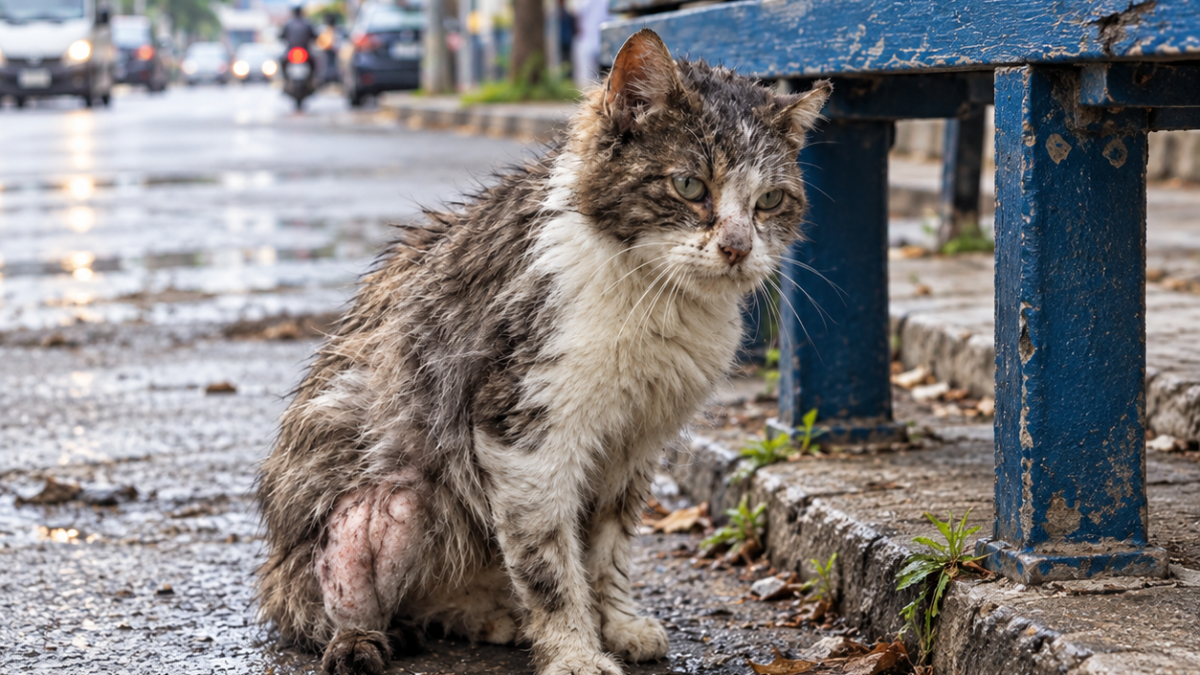
The three-legged cat under the gas station bench.
Thin. Filthy. Exhausted.
Staring at the road.
Now I knew.
She had not been wandering.
She had been tracking the car that took her kitten.
Twenty-three miles.
That was the distance from the woman’s property to the gas station, if you followed the rural roads and cut across the fields the way a desperate animal might.
Twenty-three miles on three legs.
Not for a home.
For her baby.
“What’s your name?” I asked the woman.
“Eleanor Whitcomb.”
“Mrs. Whitcomb, would you be willing to tell animal control what you told me?”
She stood straighter.
“Yes,” she said. “I should have done something then. I can do something now.”
I thanked her and drove back toward town with my hands shaking.
At the gas station, the cat was not under the bench.
For one terrifying second, I thought I had lost her.
Then I saw her at the edge of the lot, half-hidden behind a stack of propane tanks. She was standing again, facing the road, her body swaying with exhaustion.
I got out slowly.
“Sweetheart,” I whispered. “I know now.”
She turned her head toward me.
There was no trust in her eyes. Not yet. Only pain and a kind of stubborn fire that made my throat ache.
“You’re looking for your kitten.”
Her ears lifted.
I knew she did not understand the words. But maybe she heard something in my voice. Maybe she heard that I finally believed her.
I sat on the ground, opened the same wet food she had refused before, and waited.
For almost ten minutes, nothing happened.
Then she limped one step closer.
Then another.
She ate three bites.
Only three.
But it was the first time anyone at the gas station had seen her eat.
I named her Mercy.
Not because life had shown her any.
Because she deserved some.
Catching Mercy took another hour. I did not chase her. A cat like that had already been chased enough by headlights, hunger, and fear. I placed the carrier sideways, lined it with a towel, and set the food just inside the door.
She stared at it.
She stared at me.
Then she looked down the road one more time.
That nearly broke me.
Even starving, even shaking, even barely able to stand, some part of her still wanted to keep searching.
“I’ll search now,” I said. “You can rest.”
I do not know why, but after that, she stepped inside.
The moment the carrier door clicked shut, she let out a cry so sharp the gas station clerk came running.
“She okay?” he asked.
“No,” I said. “But she’s alive.”
I drove her straight to Willow Creek Animal Hospital.
Dr. Aaron Wells met us in the exam room, pushing his glasses up with the back of his wrist as he looked into the carrier.
“She’s the one you called about?”
“Yes.”
Mercy crouched low, eyes wide, breathing fast.
“We’ll go slow,” he said.
He always said that, and he meant it.
The first exam told us what I already feared. Mercy was dehydrated, underweight, and dangerously exhausted. Her front paws were scraped from walking on rough ground. Her remaining back leg was swollen from overuse. Her stump scar was old, clean, and fully healed, meaning she had lost that leg months, maybe years, before this journey.
“She’s been pushing far beyond what her body can handle,” Dr. Wells said.
“She walked twenty-three miles,” I said.
He stopped writing.
“On three legs?”
“To find her kitten.”
Dr. Wells looked at Mercy again. This time, his professional calm cracked.
“Well,” he said quietly, “then we’d better find him.”
We scanned Mercy for a microchip.
Nothing.
That made the search harder.
No owner. No old vet records. No way to trace her past.
All we had was a blue SUV, a second-chance sticker, a teenage boy, a missing gray kitten with a white patch on his chest, and a mother cat who had nearly destroyed herself trying to follow.
That night, I made calls.
First animal control.
Then the county shelter.
Then every rescue group within fifty miles.
“Did anyone bring in a gray kitten with a white patch on his chest?”
“No.”
“Did anyone report finding one near Whitcomb Road?”
“No.”
“Do you know anyone driving a blue SUV with a second-chance paw-print sticker?”
That question got me silence.
Then suspicion.
By the sixth call, a woman at a small rescue twenty miles east paused.
“What kind of sticker?” she asked.
“Something about second chances. Paw prints around the words.”
Her voice lowered.
“You might want to look into Second Chance Home Pets.”
“That’s a rescue?”
“They call themselves one.”
I sat up straighter.
“What does that mean?”
“It means they pull animals from wherever they can and charge adoption fees online. Some are fine. Some aren’t. They’re not county-approved. They’ve been reported before, but nothing sticks.”
“Who runs it?”
A pause.
“Woman named Denise Harlan.”
“Does she drive a blue SUV?”
“I’ve seen one in her driveway.”
I wrote the name down.
Denise Harlan.
For the first time since I saw Mercy under that bench, anger sharpened into direction.
The next morning, I searched for Second Chance Home Pets online.
The page was full of soft music, pastel graphics, and phrases designed to make people feel generous.
Rescuing the forgotten.
Saving the voiceless.
Giving every baby a home.
There were photos of puppies in baskets, kittens on blankets, smiling families holding adopted pets. But something about the posts felt wrong. Too many animals, too few updates. Kittens appeared in one photo and vanished from the next. Adoption fees were listed in private messages only. Comments asking for medical records went unanswered.
I scrolled until my thumb froze.
There he was.
A tiny gray kitten.
White patch on his chest.
Sitting in a pink fleece bed.
The caption read:
“Little Stormy was found all alone near a country road. Sweet boy needs a loving home. Adoption fee applies.”
Found all alone.
I stared at those words until they blurred.
Mercy had followed him for twenty-three miles.
And the woman who took him had posted him as “found all alone.”
I took screenshots of everything.
Then I called Deputy Mark Ellis.
He had helped us before in neglect cases, and unlike some officers, he never treated animal suffering as a nuisance.
“Rachel,” he said when he answered. “What happened now?”
“I found a stolen kitten.”
There was a beat of silence.
“Start at the beginning.”
I did.
Mercy. The gas station. Mrs. Whitcomb. The blue SUV. The fake rescue page. The gray kitten.
When I finished, Deputy Ellis let out a slow breath.
“You’re sure it’s the same kitten?”
“I’m not one hundred percent sure,” I said. “But the timing, the description, the location, the car—it all lines up. And Mercy led us there. She was tracking the road toward town.”
“Send me the screenshots.”
“I already did.”
“Of course you did.”
I heard paper moving on his end.
“Do not contact Denise directly,” he said.
“I wasn’t planning to.”
“Rachel.”
“I wasn’t.”
“You were thinking about it.”
I looked across the clinic recovery room at Mercy, who lay curled on a warm blanket with fluids running beneath her skin. Even half-asleep, her front paws twitched as though she were still walking.
“I’m thinking about a lot of things,” I said.
“Let me handle the door-knocking.”
But waiting is the hardest part of rescue.
Not the blood. Not the dirt. Not the sleepless nights. Waiting.
Waiting while an animal hurts.
Waiting while someone lies.
Waiting while the system moves at the speed of paperwork, and a tiny life can disappear in an afternoon.
I checked the Second Chance Home Pets page every twenty minutes.
At 2:14 p.m., the post changed.
“Stormy has an adoption visit tonight.”
My chest went cold.
I called Deputy Ellis again.
“He’s being adopted tonight.”
“We’re working on it.”
“That means he could be gone by tomorrow.”
“I know.”
“No, you don’t understand. If she sells him to someone out of county, we may never find him again.”
“I said we’re working on it.”
His voice was firm, but not careless.
Still, I hung up shaking.
Mercy lifted her head from the blanket.
Her eyes were dull with exhaustion, but when I played the kitten video from the post, something happened.
The sound was faint. Just one tiny mew from the gray kitten as someone moved him in the fleece bed.
Mercy froze.
Then she tried to stand.
“Mercy, no.”
Her legs wobbled. She dragged herself toward my phone, crying in a way I had never heard from an animal before. Not loud. Not dramatic. Worse.
Small.
Desperate.
She pressed her nose to the screen and pawed at it with one scraped front foot.
Marisol, our vet tech, turned away and covered her mouth.
“That’s him,” she whispered.
I did not need a DNA test in that moment.
Mercy knew.
A mother knows.
By 5:30 that evening, Deputy Ellis called.
“I need you at Harlan’s property,” he said. “Bring the screenshot, Mrs. Whitcomb’s written statement, and the cat if the vet says she can travel.”
“The cat?”
“If the kitten is there, her reaction may help establish connection. But only if transport won’t hurt her.”
Dr. Wells frowned when I asked.
“She’s medically fragile.”
“I know.”
He looked at Mercy. Mercy looked at the carrier as if she understood more than any of us wanted to believe.
“Short trip,” he said. “No handling unless necessary. Keep her warm. If she crashes, you leave immediately.”
“I promise.”
Denise Harlan lived at the end of a gravel lane behind a property lined with white plastic fencing. From the road, it looked charming. A painted sign hung near the driveway: SECOND CHANCE HOME PETS. Little paw prints decorated the border.
Behind the house, I heard barking.
Too much barking.
Not happy barking. Not the normal chaos of dogs playing.
Stress barking.
High, frantic, overlapping.
Deputy Ellis was already there with an animal control officer named Nadia Brooks. A county truck idled behind them. Another patrol car pulled in as I parked.
Denise Harlan stood on the porch in leggings and a sweatshirt that said RESCUE MAMA.
She was in her forties, blonde hair pulled into a messy bun, phone clutched in one hand.
“This is harassment,” she called before I even stepped out of my car. “I run a rescue. You people should be thanking me.”
Deputy Ellis kept his voice calm.
“Ms. Harlan, we have a report that a kitten in your possession may have been removed from a property where the mother cat was present.”
“That is ridiculous. He was abandoned.”
“Who found him?”
“I did.”
“Where?”
“On the roadside.”
“Which roadside?”
She folded her arms. “I don’t remember exactly. I pick up animals everywhere.”
I carried Mercy’s carrier carefully to the county truck and set it on the tailgate, away from the dogs, covered partly with a towel. Mercy was awake, her eyes wide.
Denise glanced at the carrier.
“What’s that?”
“The mother,” I said.
Something flickered across her face.
Not surprise.
Recognition.
Then it vanished.
“I don’t know that cat.”
Mercy knew her.
The sound that came from the carrier was low and raw. Her body pressed forward so hard the carrier shifted against my hand.
Denise looked away.
Deputy Ellis noticed.
“May we see the kitten?”
“He’s not here.”
I stepped forward. “Your page says he has an adoption visit tonight.”
“He already left.”
My heart dropped.
“With whom?” Nadia asked.
“A family.”
“Name?”
“I protect adopter privacy.”
Deputy Ellis’s jaw tightened.
“This is an active investigation.”
“And I’m telling you I don’t have him.”
From somewhere inside the house, a kitten cried.
Mercy’s head snapped toward the sound.
The carrier shook.
Denise’s face changed.
Everyone heard it.
A tiny, high-pitched cry came again from inside the house, followed by a muffled thump, as if something had knocked against a crate door.
Nadia stepped closer to the porch.
“Ms. Harlan, how many animals are currently on this property?”
“I don’t have to answer that without a warrant.”
Deputy Ellis looked at Nadia.
Nadia looked toward the side yard.
There were three kennels visible behind the fence. Two had dogs pacing inside. One had no shade. Several plastic carriers were stacked near a garage door.
The smell reached us then.
Urine. Bleach. Damp bedding. Too many animals in too little space.
Deputy Ellis turned back to Denise.
“You can cooperate now, or we can secure the property and request a warrant.”
Denise laughed, but the sound cracked.
“You people are insane. Over one kitten?”
“No,” Nadia said. “Over every animal we can hear from the driveway.”
That was when Denise made her mistake.
She stepped backward and pushed the front door closed with her heel.
“Come back with a warrant.”
Then she locked it.
Deputy Ellis spoke into his radio.
The next hour felt endless.
Mercy lay inside the carrier wrapped in towels, but she did not sleep. Every time the kitten cried inside the house, she lifted her head and answered.
A weak, aching trill.
The third time she did it, the crying inside stopped.
Then came another sound.
A smaller answering mew.
Mercy began to shake.
I knelt beside the carrier.
“I know,” I whispered. “I know he’s close.”
Denise watched us from behind the curtain.
She filmed us with her phone.
She posted a video online while we were still standing in her driveway.
“County officials and a so-called rescuer are harassing me and trying to steal animals from my rescue.”
Within minutes, comments appeared.
People defended her.
People attacked us.
People wrote, “Some people hate real rescuers.”
I watched the lies spread in real time while Mercy’s kitten cried behind a locked door.
That was the moment I decided Denise Harlan would not get away with hiding behind pretty words.
If she wanted an audience, I would give her the truth in front of one.
The warrant came just after sunset.
Deputy Ellis read it aloud on the porch while Denise shouted over him. She said we were jealous. She said we were targeting her. She said the kitten had been abandoned and she had saved him.
No one argued.
That is something I have learned about liars.
They want you to argue because arguments create fog.
Evidence clears it.
When the door opened, the smell hit us so hard Marisol, who had arrived with emergency supplies, gagged into her sleeve.
There were animals in the laundry room.
Animals in wire crates stacked in the hallway.
Animals in the spare bedroom.
Three puppies with diarrhea in a plastic playpen. Two adult cats in a bathroom with no litter box. A rabbit in a cage so small it could not stretch. Kittens in carriers lined with newspaper. Bowls tipped over. Water green with hair and dust.
Denise kept saying, “They’re in transition.”
Nadia took photos.
Deputy Ellis counted.
I stood at the doorway with Mercy’s carrier, waiting for permission, trying not to let anger make me careless.
Then I heard him.
A tiny cry from the garage.
Mercy heard it too.
She slammed her body against the carrier door.
“This way,” I said.
Nadia and Deputy Ellis followed me through the kitchen to the garage entrance. Denise tried to block us.
“Those are quarantined animals,” she snapped.
Nadia held up the warrant.
“Move.”
Denise did not.
Deputy Ellis stepped between them.
“Now.”
She moved.
The garage was dim and cold. Metal shelving lined the walls. Bags of donated food were stacked beside plastic tubs of blankets. At the far end, under a folding table, sat a small wire crate covered by a towel.
The kitten cried again.
Mercy answered.
The sound inside the crate became frantic.
My hands shook as Nadia lifted the towel.
There he was.
A tiny gray kitten with a white patch on his chest.
Too thin.
Eyes crusted.
Fur dull.
But alive.
He pressed himself against the bars, screaming now, not from fear but recognition.
Mercy cried back from her carrier.
Denise said, “That proves nothing. Kittens cry at everything.”
I turned on her.
For the first time all night, I let her see exactly what I felt.
“No,” I said. “People lie at everything. Animals don’t.”
Nadia opened the kitten’s crate.
I opened Mercy’s carrier just enough for them to see each other, keeping one hand ready so Mercy would not hurt herself trying to leap out.
The kitten pushed forward.
Mercy reached one paw through the gap.
He pressed his tiny face against her toes.
Then he began to nurse through the bars, even though there was no way he could latch from there, even though she was too weak, even though everyone in that garage had gone completely still.
Nadia whispered, “That’s her baby.”
Deputy Ellis looked at Denise.
Denise said nothing.
The rescue mask slipped then. Just for a second.
Her face hardened with irritation, not guilt.
“He was worth three hundred dollars,” she muttered.
The garage went silent.
Deputy Ellis slowly turned his head.
“What did you say?”
Denise’s mouth opened.
Closed.
“I said his adoption fee was three hundred. That covers care.”
“What care?” Nadia asked coldly. “He has eye discharge, he’s underweight, and there are no intake records.”
“There are records.”
“Where?”
Denise pointed vaguely toward a plastic bin.
Nadia opened it.
Receipts. Blank forms. A few vaccine stickers not attached to any animal file. No proper intake sheet for the kitten. No vet exam. No proof he had been alone. No proof she had searched for a mother.
Because she had not.
She had seen a tiny, adoptable kitten and taken him.
Mercy was inconvenient.
A disabled stray mother with a missing leg was not cute enough for her page, not profitable enough for her adoption posts, not easy enough to sell.
So Denise left her behind.
And Mercy walked twenty-three miles anyway.
Animal control removed thirty-one animals from that property that night.
Thirty-one.
Dogs, cats, kittens, puppies, the rabbit, and two guinea pigs found in a cracked aquarium in the laundry room.
Denise stood on the porch screaming as carriers were loaded into county vehicles.
“You’re killing my rescue!” she shouted.
Nadia did not look at her.
“No,” she said. “We’re rescuing it from you.”
Mercy and her kitten rode with me to the clinic.
We named him Scout because somehow, even as a tiny baby, he had survived long enough to be found.
At first, Dr. Wells would not let them fully reunite.
Mercy was too weak. Scout needed evaluation. Both needed fluids, warmth, and testing. But he placed their exam tables side by side.
Scout cried until he saw her.
Mercy lifted her head.
Her whole body changed.
For days, I had watched her move like pain was the only thing holding her together. But when she saw that kitten, something came back into her eyes that no medicine could have given her.
Scout stumbled toward the edge of his towel.
Mercy tried to rise.
“Easy,” Dr. Wells said gently. “Both of you.”
We moved them onto a clean fleece blanket in a large recovery crate, supervised, warm, and quiet.
Scout crawled straight into Mercy’s chest.
She wrapped her front legs around him and pulled him close.
Then she began to wash his head.
Slowly.
Carefully.
As if she were counting every place she had feared she would never touch again.
Marisol cried openly.
I did too.
Dr. Wells pretended to update the chart for nearly five minutes without writing a single word.
Mercy was not producing much milk anymore. Her body had been too starved, too stressed, pushed too far beyond its limits. But Scout did not seem to care. He kneaded her chest, tucked his face beneath her chin, and fell asleep to the sound of her breathing.
For the first time since I had found her, Mercy stopped looking toward the door.
That night, I slept in the clinic on a folded blanket outside their recovery room.
Every few hours, I woke to check them.
Mercy slept curled around Scout like a comma around a secret.
If he shifted, her eyes opened.
If he squeaked, she touched him with her nose.
If someone walked past, her body stiffened until she recognized us.
She had crossed fields, roads, ditches, and exhaustion to find him.
Now that she had him back, she was not taking chances.
The next morning, Denise’s online story collapsed.
At 7:10 a.m., she posted again.
“Corrupt county workers stole my rescue animals based on lies from a jealous competitor.”
At 7:22, Mrs. Whitcomb gave her statement publicly to the local reporter who had covered animal welfare stories before.
At 7:35, the gas station clerk sent security footage showing Mercy arriving night after night, limping from the direction of the county road, refusing food, then leaving at dawn.
At 8:03, someone found Denise’s old adoption post for Scout and compared it to our photo of Mercy reaching for him through the carrier door.
At 9:15, three former volunteers from Second Chance Home Pets began posting screenshots of messages from Denise.
One said: “Kittens move fastest. Don’t waste space on sick adults.”
Another said: “No one adopts ugly strays. Take the babies.”
Another said: “If there’s no collar, it’s ours.”
By noon, Denise had deleted the page.
By evening, the county had opened a wider investigation.
That was the revenge she never saw coming.
Not screaming.
Not threats.
Not cruelty returned for cruelty.
Truth.
Documented, witnessed, photographed truth.
The kind that does not need to shout because it can stand up in court.
In the following days, Mercy and Scout became the center of a storm I wished they had never needed.
News vans came.
Donations came.
Angry messages came.
People who had adopted animals from Denise called, terrified.
Some animals were healthy and loved. Others had never received promised vaccines. Several had been sold too young. One family discovered the puppy they adopted had a different medical record than the one Denise had shown them.
The county seized her paperwork.
What little of it existed.
Denise was charged with animal neglect, fraudulent solicitation, improper transfer of animals, and obstruction. Additional charges were pending based on the condition of the animals removed from her home.
But charges are only one part of justice.
The living animals still needed care.
Every kennel in the shelter filled overnight. Foster homes were called. Blankets were washed until the machines overheated. Volunteers bottle-fed kittens around the clock. Dr. Wells and two other clinics treated animals at reduced cost.
And Mercy stayed with Scout.
She gained weight slowly.
Scout gained faster.
He had the round belly of a kitten who had decided the world owed him several meals at once. His eyes cleared. His fur softened. The white patch on his chest brightened into the shape of a crooked little heart.
Mercy watched all of it with fierce suspicion.
If Scout climbed over her side, she nudged him back.
If he tried to wander too far across the recovery crate, she hooked him gently with one paw.
If I reached in to change the bedding, she gave me a look that said I had exactly three seconds to explain myself.
“You walked twenty-three miles,” I told her one afternoon. “You can boss me around.”
She blinked.
I accepted that as agreement.
Two weeks later, Deputy Ellis came to the clinic.
He stood outside the recovery room holding a folder.
“How are they?” he asked.
“Better.”
Scout was wrestling with the corner of the blanket. Mercy was pretending not to enjoy it.
Deputy Ellis watched them for a while.
“You know,” he said, “my wife saw their story.”
“Oh?”
“She says we have room for a cat.”
I looked at him.
“Deputy Ellis, that sounds like a dangerous statement.”
“We have two kids, a dog who’s afraid of butterflies, and a quiet house in the country.”
“Mercy needs indoor-only. Soft surfaces. No stairs at first. Patience. She may never be a lap cat.”
“I figured.”
“And Scout is chaos in a small gray body.”
“I have a seven-year-old son. I understand chaos.”
I studied him.
He had been there in the driveway. He had seen the garage. He had helped carry out animals. He had heard Mercy cry for Scout.
Some people want the happy part of a rescue story.
Few are willing to adopt the scars.
“Maybe,” I said.
He smiled.
“High praise.”
But the decision was not mine alone.
Mercy would choose as much as we could let her.
A month passed before they were healthy enough for adoption consideration. During that time, Denise Harlan appeared in court for her first hearing.
I went because I needed to see it.
Not because I wanted revenge in the ugly sense.
I did not want Denise hurt.
I wanted her stopped.
The courthouse hallway smelled like floor polish and old paper. Denise arrived wearing a blazer and carrying a folder, her hair neat, her face pale but defiant. Her attorney walked beside her.
When she saw me, she stopped.
“This is your fault,” she said.
I looked at her for a long second.
“No,” I said. “Mercy walked twenty-three miles because of what you did. All I did was follow her.”
Her mouth tightened.
“You ruined my life over a stray cat.”
That was when Mrs. Whitcomb stepped from behind me.
She was small, but her voice was steady.
“Not a stray,” she said. “A mother.”
Denise looked away first.
In the courtroom, the prosecutor laid out the evidence.
The witness statement.
The screenshots.
The video from the gas station.
The lack of records.
The seized animals.
The conditions inside the home.
The online adoption fees.
Denise’s attorney argued that she was overwhelmed, underfunded, and doing her best. He said the county should support small rescuers, not criminalize them. He said animals in rescue often came in sick, and the presence of sick animals did not prove neglect.
Some of that was true in other cases.
That is how lies survive. They wrap themselves in pieces of truth.
But then Nadia Brooks testified.
She described the garage.
The crates.
The urine.
The animals without clean water.
The kitten listed for adoption without any medical exam.
Then the prosecutor played the short video from my phone.
Scout crying.
Mercy in the carrier.
The moment they saw each other.
The moment the kitten pressed his face to her paw.
No one in that courtroom moved.
Even the judge leaned forward.
The prosecutor paused the video on Mercy’s face.
“This animal had traveled an estimated twenty-three miles on three legs after her kitten was removed,” she said. “The defendant’s claim that the kitten was found alone is contradicted by witness testimony, behavioral evidence, and her own lack of intake documentation.”
Denise stared at the table.
For the first time, she looked small.
But small is not the same as sorry.
The judge ordered Denise not to possess, foster, adopt, sell, or transfer animals while the case proceeded. Her fundraising accounts were frozen pending review. The county revoked her ability to operate as an animal organization. The seized animals remained in protective custody.
Outside the courtroom, a reporter asked me whether I was satisfied.
I thought of Mercy under the gas station bench.
I thought of her ignoring food because grief was stronger than hunger.
I thought of Scout crying in that garage.
“No,” I said. “I’ll be satisfied when every animal from that house is safe.”
That took time.
Some recovered quickly.
Some did not.
One old terrier needed dental surgery.
The rabbit had sore feet from wire flooring.
Two kittens fought respiratory infections for weeks.
But slowly, one by one, they moved into foster homes, then permanent homes.
A retired teacher adopted the rabbit and built him an indoor pen larger than Denise’s entire laundry room.
A mechanic took the anxious hound who had barked himself hoarse and let him sleep in the office at his repair shop.
The three sick puppies went together to a foster family with warm floors, medication schedules, and children who read books to them every night.
Each placement felt like a small light turning on.
Mercy and Scout stayed at the clinic until spring.
Not because no one wanted them.
Because I was careful.
Their story had gone too far. People wanted to adopt the idea of them. The viral mother. The miracle kitten. The happy ending.
But animals are not symbols when you bring them home.
They are litter boxes and vet bills.
They are trauma responses at 2 a.m.
They are patience when affection does not come quickly.
They are commitment after the internet stops watching.
Deputy Ellis brought his family to meet them three times.
His wife, Claire, sat on the floor and let Mercy approach when she was ready.
Their daughter, Lily, whispered instead of squealing.
Their son, Owen, brought a toy mouse and placed it several feet away from Scout, then backed up like he had been coached by someone wise.
Scout loved him immediately.
Mercy took longer.
On the third visit, Mercy limped over to Deputy Ellis, sniffed his boot, and sat beside it.
He did not move.
I watched from the doorway.
“That means something,” Claire whispered.
“Yes,” I said. “It does.”
A week later, I drove Mercy and Scout to the Ellis home.
The house sat back from a quiet road, surrounded by trees and a fenced yard where their gentle old dog slept in the shade. Inside, the family had prepared a room just for the cats.
Soft rugs.
Low bed.
Wide window.
No stairs.
Food and water away from the litter.
A heated pad under a fleece blanket.
Scout leaped out of the carrier like he owned the place.
Mercy stayed inside.
No one rushed her.
We sat on the floor for almost an hour.
Finally, she stepped out.
She sniffed the rug, the bed, the food, the window. Then she looked at Scout, who was already attacking a feather toy with the seriousness of a tiny warrior.
Mercy limped to the window and sat in the sunlight.
Her shoulders lowered.
Just a little.
But I saw it.
She understood.
No highway.
No garage.
No locked door between her and her baby.
When I stood to leave, my throat closed.
I had done this hundreds of times. Foster, heal, place, repeat. But some animals leave paw prints in places you do not get back.
Mercy watched me from the window.
Scout tumbled over his own feet and ran to my shoe.
I bent and touched one finger to his little white chest.
“You stay out of trouble,” I whispered.
He bit my finger.
Fair enough.
Deputy Ellis walked me to the door.
“We’ll send updates,” he said.
“I’ll pretend not to need them every day.”
He smiled.
Then his expression grew serious.
“You found them because you believed her.”
I looked back through the doorway.
Mercy had turned toward Scout, washing his ear while he tried to wrestle her chin.
“No,” I said. “She found him. I just learned how to follow.”
Denise Harlan’s final hearing happened two months later.
By then, Mercy had gained nearly two pounds. Scout had doubled in size and developed the bold confidence of a kitten who knew his mother had once crossed a county for him.
The courtroom was full again, but this time not with outrage.
With witnesses.
Former adopters.
Former volunteers.
Veterinarians.
Animal control officers.
People who had once believed Denise’s soft words and now understood how carefully those words had been used.
Denise pleaded guilty to several charges in exchange for a sentence that included probation, restitution, community service outside animal care, a long-term ban on owning or handling animals, and repayment of fraudulent adoption fees where records could be proven. Her online rescue accounts were permanently shut down. The county also referred financial evidence for further review.
Some people wanted jail.
Some wanted worse.
I understood that feeling.
But when the judge read the condition that Denise could not operate, advertise, collect money for, foster, sell, transfer, or possess animals for ten years, I felt something loosen inside me.
She had used the word rescue as a disguise.
Now she could not use it at all.
That was enough for me to breathe.
Before sentencing ended, the judge allowed victim impact statements from the animal welfare agencies involved.
I had not planned to speak.
Then I thought of Mercy walking.
Step. Hop. Pause. Breathe.
Twenty-three miles.
I stood.
“Your Honor,” I said, “Mercy cannot speak for herself, so I will keep this simple. She was a disabled mother cat. Her kitten was taken from her, posted online, and nearly adopted out under a false story. Mercy did not understand the law. She did not understand rescue pages, adoption fees, or courtrooms. She only understood that her baby was gone. So she walked until her body nearly failed.”
The room was silent.
I looked at Denise.
“She did what a mother does. She searched. And because she refused to stop, the truth came out. Not just for her kitten, but for thirty other animals who needed someone to open that door.”
Denise did not look at me.
I faced the judge again.
“I’m not asking the court for revenge. I’m asking that she never again be allowed to turn compassion into a business built on suffering.”
The judge nodded.
“That condition is already ordered,” he said. “And it will remain.”
When I sat down, Mrs. Whitcomb reached over and squeezed my hand.
Outside, the air smelled like rain.
Mrs. Whitcomb stood beside me on the courthouse steps.
“I keep thinking about the day it happened,” she said. “If I had moved faster, maybe—”
“No,” I said gently. “Denise made the choice. Not you.”
“But Mercy paid for it.”
“She did,” I said. “And then she made sure Denise paid too.”
Mrs. Whitcomb smiled through tears.
“That little cat got her revenge.”
“She got her baby,” I said. “That’s better.”
A few weeks later, I visited the Ellis home.
I found Scout on top of a bookshelf.
No one knew how he had gotten there.
He looked extremely proud.
Mercy sat below him on the rug, staring upward with the tired expression of every mother who has ever raised a fearless child.
“Scout,” Claire said, hands on her hips, “you are not a mountain lion.”
Scout disagreed.
Deputy Ellis brought a step stool. Owen held a blanket as if preparing for a rescue mission. Lily whispered encouragement. Mercy watched all of them, calm but alert.
Finally, Scout jumped into the blanket, bounced once, and ran directly to his mother.
Mercy sniffed him, gave him one firm lick across the face, and then smacked him lightly on the head.
I laughed so hard I had to sit down.
“She’s doing great,” Claire said.
I looked at Mercy.
Her coat had filled in. Her eyes were bright. Her stump no longer looked like a symbol of loss; it was simply part of her body, one more thing she had adapted to because she was stronger than anyone had known.
She still limped.
She always would.
But now she limped across soft rugs toward food bowls that were always full, windows that were always safe, and a kitten who never had to wonder whether his mother was coming back.
Mercy came to me while I sat on the floor.
She did not climb into my lap. That was not her way.
Instead, she touched her forehead to my knee.
Once.
Then she returned to Scout.
For Mercy, that was a speech.
Months passed.
The story faded from the internet, the way stories do. People moved on to new heartbreaks, new outrages, new miracles.
But in our county, something changed.
Gas station employees called sooner when they saw injured strays.
The shelter created a policy for verifying “orphaned” kittens before transferring them.
Animal control built a public list of approved rescues.
Mrs. Whitcomb started keeping cat food and a carrier on her porch.
And at Willow Creek Animal Hospital, we hung a framed photo in the lobby.
Mercy lying in a square of sunlight.
Scout curled against her chest.
Beneath it, a small plaque read:
Mercy’s Rule:
Never assume a baby is alone until you have looked for the mother.
People asked about it all the time.
So we told them.
Not the viral version.
The real version.
A three-legged cat under a gas station bench.
A road she would not stop watching.
A woman who remembered a blue SUV.
A garage door that finally opened.
A mother who had been dismissed as worthless until her love exposed everyone who had underestimated her.
One year after Mercy first appeared at the gas station, the clerk called me.
“She’s here,” he said.
My heart stopped.
“Who?”
“The cat. Mercy. I mean, I think it’s her. But she’s in a car.”
I drove over immediately, half afraid something had gone wrong.
When I arrived, Deputy Ellis’s truck was parked by pump three. Claire stood near the passenger door, smiling. Owen and Lily were in the back seat.
Mercy sat in a travel carrier on the front seat, calm and watchful.
Scout sat in another carrier behind her, screaming his opinion about travel to the entire gas station.
“Is everything okay?” I asked.
Deputy Ellis nodded. “We were driving back from her checkup. Thought maybe it was time.”
“For what?”
He looked toward the old bench.
“For her to see this place without having to search anymore.”
We carried Mercy’s closed carrier to the bench and set it on top, not beneath it.
The morning was warmer than the one when I had found her. The air smelled like coffee and gasoline. Cars passed on the road beyond the lot.
Mercy looked out through the carrier door.
Her ears moved.
Her eyes followed the highway.
Then Scout cried from his carrier.
Mercy turned away from the road.
Just like that.
No panic.
No desperate stare.
No body leaning toward a direction her heart could not abandon.
She turned toward her kitten.
Claire wiped her eyes.
“She knows he’s here,” she whispered.
“Yes,” I said. “She knows.”
The clerk came outside carrying two small cups of water, even though no one needed them. His eyes were wet.
“I used to feel so bad,” he said. “Watching her leave every morning.”
“You helped keep her alive,” I told him.
He nodded, looking at Mercy.
“She ever eat good now?”
Deputy Ellis laughed. “She eats like we’re personally responsible for every hungry day she ever had.”
“Good,” the clerk said. “Good.”
We stayed only a few minutes.
Long enough for the past to meet the present.
Long enough for Mercy to sit above the place where she had once hidden beneath a bench, starving and broken, and understand in whatever way animals understand that the search was over.
Before we left, Lily placed a small laminated card inside the gas station window with the owner’s permission.
It had Mercy’s photo and one sentence:
If an animal keeps looking down the road, there may be a reason.
No hashtags.
No slogans.
Just the truth.
On the drive back, Mercy slept.
Scout finally stopped yelling and curled into a gray ball.
I followed behind them in my car for a while, watching Deputy Ellis’s truck turn toward home.
A home where Mercy’s bowls were full.
Where Scout climbed things he should not climb.
Where children knew to sit quietly and wait.
Where a three-legged mother cat no longer had to prove the size of her love by bleeding for it.
That night, Deputy Ellis sent me a photo.
Mercy was lying on the couch, Scout stretched across her like a blanket. His white chest patch was bright against her fur. One of her front paws rested over his back, holding him close even in sleep.
The message said:
“She’s done searching.”
I stared at that photo for a long time.
Then I saved it beside the first picture I had ever taken of her—the one under the gas station bench, dirty and trembling, eyes fixed on the road.
Before and after.
Loss and rescue.
Fear and home.
People often ask me why I keep doing this work when it hurts so much.
I think about Mercy when they ask.
I think about how easy it would have been to see a dirty stray and assume there was no story behind her eyes. I think about how many people must have passed her on that road, never realizing she was not lost.
She was loyal.
She was grieving.
She was determined.
She was a mother with three legs and one purpose.
And she was right.
Her baby was out there.
Her baby was waiting.
The woman who took him thought Mercy did not matter because Mercy was disabled, dirty, and alone. She thought no one would follow a stray cat’s trail. She thought a fake rescue page and a pretty caption could cover the truth.
She was wrong.
Mercy followed first.
Then I followed Mercy.
And that was how a three-legged cat brought down a liar, saved thirty-one animals, and carried her kitten home without ever being able to say a single word.
Some stories do not end with everything restored.
Mercy never got back the miles she walked.
She never got back the days she spent hungry under that bench.
Her body still carries the cost of what happened.
But she got Scout.
She got safety.
She got a family who understood that love is not measured by perfection, speed, or strength.
Sometimes love limps.
Sometimes love bleeds.
Sometimes love crosses twenty-three miles on three tired legs because the world took something precious and expected a mother to simply give up.
Mercy did not give up.
And because she didn’t, her kitten grew up beside her in sunlight.








