PART 2: She Survived 38 Days Beneath a Collapsed House—But What We Found Curled Against Her Changed the Entire Rescue
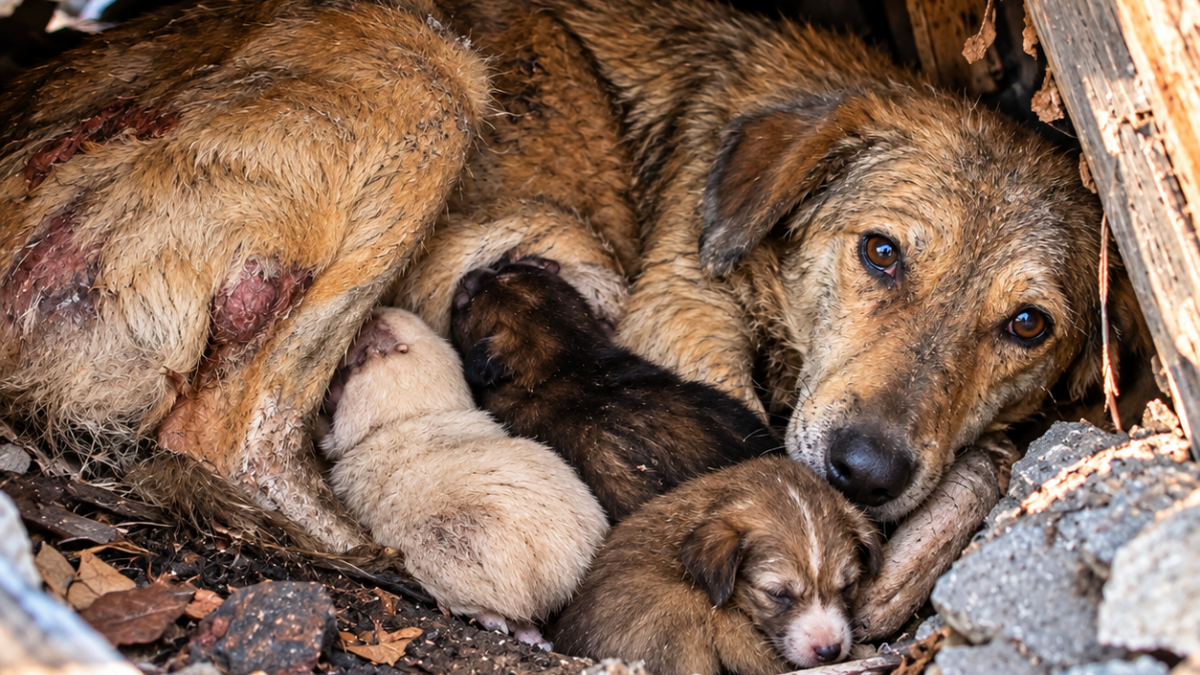
PART 2
“Daniel?”
Luis’s voice came through my radio.
“You okay?”
I realized I had stopped responding.
“Yeah.”
My voice sounded wrong even to me.
“I’ve got a mother and four puppies. All alive.”
For several seconds the radio was silent.
Then three people spoke at once.
“What?”
“Four puppies?”
“You’re serious?”
I looked at Molly again.
She had lowered her head but kept her eyes on my hand.
“Five dogs total. Mother is critical. I need a rigid basket, blankets, oxygen, and animal control. Tell Dr. Foster we’re bringing in a severe dehydration case with possible crush injuries.”
Our team had worked with Dr. Emily Foster for years. Her veterinary clinic handled police dogs, injured wildlife when the county shelter was overwhelmed, and more than a few animals recovered from fires.
Luis answered.
“Copy.”
I put the tag into the small evidence pouch clipped inside my vest.
I did not yet know whether it mattered.
But I knew enough not to lose it.
Getting Molly out took another hour.
People imagine rescues as fast, dramatic things.
Sometimes they are.
Sometimes the bravest thing you can do is spend twenty minutes removing one board because the wrong angle could move half a wall.
We reinforced a beam.
Cut another.
Placed cribbing beneath the concrete.
Then I returned to the cavity with a veterinary transport board.
The puppies were the easier part.
They were so small they fit inside two towels.
The mother was harder.
Molly tried to move when I reached beneath her.
Her body shook.
“Easy.”
She turned her head toward the puppies.
“I know.”
One of them squeaked.
Molly immediately tried to crawl toward it.
That was when something inside me shifted.
She was barely alive.
Still, she was protecting them.
I put the puppies where she could see them.
“Everybody goes together.”
Her eyes stayed on the towel.
We moved her slowly.
When daylight finally touched her face, Molly closed her eyes.
Someone behind me swore softly.
Luis stood at the edge of the debris pile.
He had worked demolition for nineteen years.
I had seen him remain calm while a suspended wall cracked above us.
Now he wiped his face with the back of his glove.
“Thirty-eight days.”
I nodded.
The date was right.
The structure had collapsed thirty-eight days earlier.
“Impossible,” one firefighter whispered.
Maybe.
But impossible things do not care what we call them when they are breathing in front of us.
The veterinary transport unit arrived before the county shelter truck.
Dr. Foster herself climbed out.
She took one look at Molly.
“Straight to the clinic.”
“What about the puppies?”
“With her.”
“You think they were born under there?”
She looked at their size.
“Almost certainly.”
“When?”
“I’ll tell you after I examine them.”
Molly opened her eyes as the stretcher moved.
Her head turned toward the towels.
Dr. Foster noticed.
“They stay where she can smell them.”
I followed the ambulance in our truck.
I could not explain why.
The rescue was technically over.
We had handed the animals off.
Our job was to return to the site.
Instead I told my captain I needed thirty minutes.
He looked at me.
“You found her.”
“Yes.”
“You’re not going to get anything useful done until you know.”
“No.”
“Go.”
At the clinic, Molly went straight into treatment.
Warm IV fluids.
Bloodwork.
X-rays.
Ultrasound.
Pain medication.
The puppies were examined one by one.
Three males.
One female.
Two dehydrated.
One dangerously weak.
All apparently no more than ten days old.
I stared at Dr. Foster.
“Ten days?”
“Approximately.”
“So she gave birth under there.”
“Yes.”
I pictured it.
Darkness.
No space to stand.
Dust.
Rainwater dripping through a crack.
A trapped pregnant dog giving birth beneath tons of wreckage with nobody knowing she existed.
“How?”
Dr. Foster looked at me.
“Animals survive under conditions we underestimate.”
“For thirty-eight days without food?”
She shook her head.
“I wouldn’t assume she had literally nothing for thirty-eight days.”
“What would she eat?”
“There could have been insects, rodents, stored pet food, organic material. The cavity extends beyond where you reached?”
“Yes.”
“Then she may have had access to small pockets you couldn’t see.”
She glanced through the treatment-room window.
“Still, her condition tells us she has been starving for a long time.”
Molly weighed twenty-nine pounds.
Dr. Foster estimated she should weigh closer to forty-five.
Her ribs, spine, and hips were sharply visible.
She had an infected wound on one flank.
One front leg showed an older injury, not from the collapse.
That bothered me.
“How old?”
“The leg injury?”
“Yes.”
“Weeks or months before the collapse.”
I thought of the tag in my pocket.
DO NOT LEAVE.
I took it out.
Dr. Foster read it.
Her expression changed.
“What is that?”
“Found under her.”
“Is the number readable?”
“Yes.”
“Call it.”
I hesitated.
“Should animal control do that?”
“Probably.”
She handed it back.
“You’re learning restraint.”
“Slowly.”
The county animal-control officer arrived twenty minutes later.
Her name was Jasmine Cole.
I had worked with her twice.
She photographed the tag.
Ran the phone number.
Then stared at her tablet.
“What?”
She looked at me.
“Owner is listed as Rebecca Sloan.”
“Local?”
“Address is this property.”
“The collapsed house?”
“Yes.”
I leaned against the counter.
“Was she one of the residents?”
Jasmine scrolled.
“Property ownership is under Sloan Holdings LLC. Rebecca Sloan is one of the registered contacts.”
“So where is she?”
“That’s what I’m going to find out.”
She called the number.
Disconnected.
Another number associated with the LLC went to voicemail.
Jasmine requested county records.
I went back to the site.
But now the house looked different.
Before, it had been damaged structure.
Now it was a timeline.
Where had Molly been when the collapse happened?
Why was she inside?
If the owners had moved out, why hadn’t anyone reported her missing?
Who scratched DO NOT LEAVE onto her tag?
And why did she have an older leg injury?
I found Luis near the rear foundation wall.
“Look at this.”
He pointed toward a narrow opening we had uncovered after Molly was removed.
Inside the cavity were objects.
A plastic food bowl.
A torn blanket.
A length of rope.
The bowl was empty.
The blanket was filthy.
The rope had one end tied around a broken basement pipe.
The other end was frayed.
I crouched.
“Was she tied down here?”
Luis’s face hardened.
“Looks like it.”
The rope length was approximately seven feet.
Enough to move inside the basement section.
Not enough to reach the staircase.
My chest tightened.
“If she had been loose when the house started shifting…”
“She might have gotten out.”
Maybe.
We could not know.
But somebody had tied her in a basement.
We photographed everything.
Then we found a half-empty bag of dog food crushed behind a fallen cabinet.
Split open.
Most of it ruined by water and insects.
But not all of it had been inaccessible.
That probably explained part of Molly’s survival.
She may have eaten what she could reach during the first days after the collapse.
Then rainwater seeped through the cracked pipe.
Enough to keep her alive.
Barely.
The next discovery was worse.
Inside a rusted metal shelf, protected by debris, Luis found a plastic folder.
Utility bills.
Property documents.
And a veterinarian receipt.
MOLLY SLOAN.
Female mixed breed.
Approximately four years old.
Pregnancy confirmed.
Date: eleven days before the collapse.
I sat back on my heels.
“She knew.”
Luis looked at the receipt.
“Who?”
“Whoever took her to the vet.”
The owner line read:
Rebecca Sloan.
Molly had been pregnant.
The owner knew.
Eleven days later the house collapsed.
Thirty-eight days after that, we found Molly beneath it with puppies.
No missing-dog report.
No call to animal control.
No search request.
Nothing.
My anger started building before the evidence was ready.
That was dangerous.
I knew it.
I also knew what the rope looked like.
Jasmine arrived at the site an hour later.
I handed her the vet receipt.
She stared at it.
“Okay.”
“That’s all?”
“No. That is not all. That is me trying not to say something unprofessional.”
“Good.”
“You found the rope?”
“Yes.”
“Photographed before moving anything?”
“Yes.”
She nodded.
“Then I’m calling Detective Park.”
“Police?”
“This stopped looking like simple abandonment.”
Detective Hannah Park arrived that afternoon.
She worked property crime and fraud, but animal cruelty cases involving possible criminal conduct often crossed departments in our county.
She was small, direct, and had the irritating habit of letting silence make people talk.
She walked the entire site.
Examined the rope.
Read the veterinary receipt.
Looked at the tag.
Then she asked me, “Who initially searched the house after the collapse?”
“Our team and local fire.”
“Any dogs found?”
“No.”
“Were you told there were animals inside?”
“No.”
“Were you told the property was vacant?”
“Yes.”
“By whom?”
I pulled up the incident report.
Property representative: Travis Sloan.
Rebecca’s older brother.
Park looked at the name.
“What did he tell you?”
“House cleared two days before the collapse. No occupants. No pets.”
She stared at the paper.
“So either he didn’t know Molly was here…”
“Or he lied.”
Park looked at me.
“Don’t finish my sentences.”
“Sorry.”
“No, you’re not.”
“Not really.”
She almost smiled.
“Where’s Molly now?”
“Foster Veterinary Center.”
“Alive?”
“For now.”
That phrase had become harder to hear.
By evening, Molly’s smallest puppy was fading.
I went back to the clinic.
Not because anyone asked.
Because I needed to know.
Dr. Foster was warming the puppy in an incubator.
Molly lay nearby.
Her eyes opened when I entered.
She tried to lift her head.
“Hey.”
Her tail moved once.
I did not touch her until she leaned toward my hand.
Then I scratched under her chin.
Dr. Foster glanced at me.
“She recognizes you.”
“She associates me with being pulled through a hole.”
“Apparently positively.”
“How’s the little one?”
“Not good.”
The puppy weighed less than the others.
Low glucose.
Weak suck reflex.
“Can you save him?”
“I’m trying.”
I hated the answer.
Trying is honest.
Trying is also terrifying when you desperately want certainty.
Molly watched the incubator.
Every time the puppy cried, her ears moved.
Dr. Foster eventually returned him to her for supervised nursing.
Molly immediately curled around him.
She had almost no reserves left.
Still, her body gave whatever it could.
I sat beside the kennel until midnight.
At some point Dr. Foster brought me coffee.
“You’re a firefighter.”
“Rescue lieutenant.”
“You have a home?”
“Yes.”
“A bed?”
“Yes.”
“Use it.”
“I’m fine.”
“You look like drywall.”
“Occupational.”
She sat beside me.
“Daniel.”
I looked at her.
“She’s stable tonight.”
“Tonight.”
“Yes.”
“And tomorrow?”
“We’ll deal with tomorrow tomorrow.”
I stared at Molly.
“Do you think she knew the house was coming down?”
“No idea.”
“Do animals sense that?”
“Sometimes they react to sounds and movement we miss.”
“She was tied.”
“I heard.”
“If she tried to escape—”
“Don’t.”
“What?”
“Don’t build a movie in your head from evidence you don’t have.”
That sounded exactly like Detective Park.
“I hate people who are right.”
“You must hate yourself occasionally.”
“Rarely.”
She laughed.
The smallest puppy survived the night.
By morning, he was nursing better.
We named none of them yet.
Dr. Foster refused.
“First they survive. Then you get sentimental.”
“You named Molly immediately.”
“Her tag did.”
Jasmine finally reached Rebecca Sloan that afternoon.
She was in Arizona.
That surprised everyone.
According to her initial statement, she had moved there three weeks before the collapse.
She claimed Molly had been left temporarily with her brother Travis.
She said she believed Molly had been rehomed before she left Pennsylvania.
Detective Park asked, “Rehomed to whom?”
Rebecca did not know.
“Your dog was pregnant.”
Silence.
“Yes.”
“You took her to a veterinarian eleven days before the collapse.”
“Yes.”
“And then?”
“I told Travis I couldn’t take her with me.”
“Why?”
“My housing didn’t allow dogs.”
“Did you ask him to find a home?”
“Yes.”
“Did he tell you he had?”
“Yes.”
“When?”
“Before I left.”
“Did you ask for the adopter’s name?”
“No.”
“Photographs?”
“No.”
“Contact information?”
“No.”
Another silence.
Park said, “Ms. Sloan, your dog was found today under the collapsed house.”
Rebecca started crying.
That part was real.
I heard the recording later.
“Oh my God.”
Park continued.
“She was alive.”
Rebecca sobbed.
“Molly?”
“Yes.”
“Is she okay?”
“No.”
The answer landed hard.
“She gave birth while trapped.”
Rebecca stopped crying for one second.
“What?”
“Four puppies.”
Then the sobbing started again.
Whether guilt, shock, grief, or all three, I could not tell.
Park asked about the words scratched into Molly’s tag.
DO NOT LEAVE.
Rebecca went quiet.
Then she said, “I did that.”
My hands tightened when Park told me.
“Why?”
“She said Molly had separation anxiety. She used to run after the car. Rebecca scratched it into the tag years earlier as a joke.”
A joke.
DO NOT LEAVE.
Not evidence of abuse.
Not a secret warning.
Just a sentence with terrible new meaning.
I felt foolish for having built so much around it.
Park saw that.
“That’s why we investigate.”
“I know.”
“Say it without sounding angry.”
“I know.”
“Better.”
But the rope remained.
The vet receipt remained.
And Travis had told rescuers there were no animals inside.
Park located him that evening.
He lived thirty miles away.
He agreed to an interview.
At first, his story was clean.
Rebecca moved.
Molly stayed with him for several days.
He found a family interested in adopting her.
They picked her up.
Who?
“Guy named Aaron.”
Last name?
Couldn’t remember.
Phone?
Lost it.
Where did they live?
“Near Butler.”
When?
About four days before the collapse.
Contract?
No.
Payment?
No.
Texts?
Deleted.
Detective Park asked whether Molly was pregnant.
Travis said he did not know.
That was the first clear problem.
Rebecca had texted him the veterinary report.
Digital records showed it.
REBECCA: Vet confirmed puppies. Please make sure whoever takes her knows.
TRAVIS: I know.
Park placed the printout in front of him.
Travis read it.
Then said, “I forgot.”
“Pregnant dog your sister asked you to rehome, and you forgot she was pregnant?”
“I had a lot going on.”
Park changed subjects.
“Why was Molly’s food bowl in the basement?”
“Old bowl.”
“Why was her blanket there?”
“Could have been there already.”
“Why was a rope tied to a pipe?”
“I don’t know.”
“Why did your sister’s veterinarian receipt end up beside it?”
“I don’t know.”
“Why did you tell rescuers there were no pets in the house?”
“Because Molly was gone.”
“Where?”
“With Aaron.”
“Aaron who?”
“I told you, I don’t remember.”
Park leaned back.
“How did the house collapse?”
Travis stared.
“What does that have to do with the dog?”
“Answer.”
“Rain. Foundation failed.”
“Were you doing renovation work?”
“Yes.”
“Permitted?”
His jaw tightened.
“Some.”
That word mattered.
Some.
The house had been under renovation before Rebecca moved.
Interior walls removed.
A support post replaced.
Drainage trench opened near the foundation.
County inspection records showed work had been ordered to stop two weeks before the collapse because structural modifications were not properly permitted.
Travis was not a licensed contractor.
He had been overseeing much of the work himself.
Now the case had two questions.
Why was Molly trapped inside?
And had illegal work contributed to the collapse?
I wish I could say we uncovered everything quickly.
We did not.
Weeks passed.
Molly improved slowly.
That became the good part.
She gained two pounds.
Then three.
The wound on her flank healed.
The swollen leg turned out not to be broken, though the old injury showed evidence of having gone untreated.
Dr. Foster suspected a previous impact injury.
Molly remained cautious with men.
Except me.
I do not know why.
Maybe because my voice had been the first she heard when the debris opened.
Maybe because dogs make choices we cannot explain.
Every time I visited, she tried to stand.
The first week, she failed.
The second week, she stood for five seconds.
The third, she walked across the treatment room.
Eight steps.
Her puppies grew faster.
Once they were stable, Dr. Foster finally allowed names.
Luis named the loudest male Brick.
I told him that was insensitive.
He said it was historically accurate.
The smallest became Whisper because his cry had led us to them.
The female became Rain.
The last male became Beam.
Search-and-rescue humor is not sophisticated.
Molly tolerated our naming choices with dignity.
Whisper remained my favorite.
I denied it.
Everyone knew.
One afternoon I arrived to find him asleep inside my helmet.
Dr. Foster said, “He chose.”
“He weighs two pounds.”
“He chose.”
“This is theft.”
Molly watched from her bed.
Her tail moved.
I sat beside her.
“You’re raising criminals.”
She rested her head on my knee.
Meanwhile, the investigation grew darker.
A neighbor named Carla Benson came forward.
She had security cameras facing Miller Road.
The day before the collapse, her camera captured Travis’s pickup at the house.
That alone meant nothing.
Then another clip showed him carrying a large bag into the rear entrance.
Dog food.
The timestamp was 6:11 p.m.
Molly was supposedly already living with “Aaron” near Butler.
Detective Park confronted him.
Travis changed his story.
He now claimed Aaron had returned Molly because she was pregnant and difficult.
“When?”
“The day before.”
“Why didn’t you tell us?”
“I forgot.”
“Again?”
“I panicked.”
“What did you do with Molly?”
“I put her in the basement overnight.”
“Tied?”
“For safety.”
“Why?”
“She kept trying to follow me upstairs.”
“Then the house collapsed.”
“Yes.”
“Where were you?”
“Home.”
“Why didn’t you tell rescuers Molly was inside?”
He looked down.
This was the question.
The one that had bothered me from the beginning.
Travis rubbed his palms over his jeans.
“I thought she got out.”
Park said nothing.
Silence worked.
He continued.
“When I came back after the collapse, the back door was open.”
“The back door was crushed.”
“Part of it.”
“You knew she had been tied in the basement.”
“I didn’t remember.”
“You tied a pregnant dog to a pipe and forgot?”
His face flushed.
“I had just lost a house worth two hundred thousand dollars.”
Park’s voice changed.
“And she had just been buried under it.”
Travis said nothing.
He asked for an attorney soon after.
The evidence moved outward.
Insurance.
Property records.
Messages.
Contractor invoices.
The state building inspector became involved.
Then an insurance investigator.
The house had been insured.
Two weeks before the collapse, the insurer had sent a notice requiring corrective work after a field inspection found foundation excavation and removal of interior supports.
Travis knew.
He continued work anyway.
A subcontractor named Marcus Bell told investigators something worse.
“I warned him.”
“When?”
“Three days before the collapse.”
“What did you say?”
“That basement wall was moving.”
“How much?”
“Enough that I refused to work inside.”
“What did Travis say?”
Marcus looked uncomfortable.
“That I was being dramatic.”
“Did he ask you to return?”
“Yes.”
“Did you?”
“No.”
“Did you know a dog was being kept there?”
Marcus paused.
“I saw one.”
My stomach tightened when I later read the statement.
“When?”
“Two days before the collapse.”
“Where?”
“Basement stairs.”
“Pregnant?”
“Very.”
“Was she tied?”
“Yes.”
That destroyed the Aaron story completely.
Two days before the collapse, Molly was still in the basement.
Tied.
Travis knew.
Marcus also said Molly limped.
That explained the older leg injury but not how she got it.
When asked, Marcus said he once saw Travis shove her away with his boot because she kept following him.
“Kick her?”
“Not hard like you’re imagining.”
“How hard?”
“Hard enough that she yelped.”
One incident did not prove the old injury came from Travis.
But the picture was forming.
Control.
Neglect.
Impatience.
Not a cartoon villain.
A man who treated a dog as one more inconvenience.
Then came the insurance documents.
Travis had filed a claim after the collapse.
In his sworn statement, he said the property was unoccupied and that “no animals or personal property of material value remained inside.”
That sentence mattered.
Because if he admitted Molly was inside, questions would follow.
Why was she there?
Why tied?
Why had he ignored a stop-work order?
Why had renovation continued after warnings?
His lie to our rescue team was not isolated.
It matched the insurance claim.
He needed the house to look empty.
Molly complicated the story.
So he erased her from it.
Detective Park explained this to me one evening while we stood outside the clinic.
“You wanted motive.”
“I didn’t want this motive.”
“He may not have intended to kill the dog.”
“But he knew she was there.”
“We have evidence he knew she had been there shortly before the collapse. We have evidence he tied her. Proving exactly what he believed after the collapse is harder.”
“He told us there were no animals inside.”
“Yes.”
“He could have sent us back in.”
“Yes.”
“We would have searched longer.”
“Maybe.”
I hated the word.
“Thirty-eight days.”
“I know.”
“She gave birth down there.”
“I know.”
“He went home.”
Park’s face hardened.
“I know.”
I leaned against the wall.
“How do you not lose your mind doing this?”
“I do.”
She looked at me.
“Later.”
That answer made me respect her more.
The case attracted media attention after charges were filed.
Not because of Travis.
Because of Molly.
Mother dog survives thirty-eight days.
Four puppies born beneath rubble.
The headline traveled.
News trucks appeared.
People donated food.
Money poured into the veterinary fund.
Dr. Foster hated cameras.
Molly hated microphones.
I hated almost all of it.
But the donations helped.
Her medical bills were substantial.
So were the puppies’ costs.
The attention also brought something unexpected.
A woman named Melissa Sloan called the police.
Travis’s ex-wife.
She had been divorced from him for three years.
She told Detective Park she had information about Molly.
I was not part of that interview, but I later read the transcript.
Melissa said Molly originally belonged to her daughter, Sophie.
Sophie was fourteen.
After the divorce, she lived primarily with Melissa but spent weekends with Travis.
Molly stayed at Travis’s house because Melissa’s apartment restricted pets.
Rebecca, Travis’s sister, had technically registered the dog because she helped Sophie adopt her.
That explained the confusing ownership.
“Did Travis like Molly?” Park asked.
Melissa answered, “He tolerated her.”
“Was he abusive?”
“To Molly?”
“Yes.”
Melissa hesitated.
“Not in front of Sophie.”
“What does that mean?”
“When Sophie was there, he acted fine. When she wasn’t, he got impatient.”
“Did you see him hurt her?”
“Once I saw him yank her leash hard enough to knock her down.”
“When?”
“Last winter.”
“Did you report it?”
“No.”
“Why?”
Melissa became quiet.
“Because I was still afraid of him.”
That changed the context.
Travis had not only been careless.
He had a history of controlling behavior toward Melissa.
No convictions.
No dramatic police file.
But messages.
Threats.
Financial control during the marriage.
Arguments that ended with broken doors.
Molly had lived inside that atmosphere.
Then came Sophie.
Detective Park waited before interviewing her because she was a minor and because the case involved her father.
When they finally spoke, Sophie asked one question first.
“Is Molly really alive?”
“Yes.”
“And babies?”
“Yes.”
She cried.
Then she told them something nobody else knew.
The night before the collapse, Sophie had called her father.
She asked whether she could visit Molly.
Travis said no.
“He said Aunt Rebecca gave her away.”
“When did he say that?”
“The night before the house fell.”
“But Molly was still there.”
Sophie nodded.
Tears ran down her face.
“I knew he was lying.”
“How?”
“He sent me a picture by accident.”
Park showed her several phone records.
Sophie pointed to one.
A photograph timestamped that night.
It showed the basement floor.
A toolbox.
Part of Travis’s boot.
And in the corner—
Molly.
Pregnant.
Tied.
The photograph was blurry.
But the white stripe on her chest was visible.
Sophie had saved it.
“Why didn’t you tell anyone after the collapse?”
“I tried.”
My chest tightened when I heard that.
“Who?”
“My dad.”
“What did you say?”
“I asked if Molly was inside.”
“And?”
“He said no.”
“Did you tell responders?”
“I wasn’t there.”
“Your mother?”
“She didn’t know where Molly was either.”
Then Sophie showed them the final message.
SOPHIE: Please tell me Molly wasn’t there.
TRAVIS: Stop. The dog is gone. Do not make this harder.
The dog is gone.
Not safe.
Not adopted.
Gone.
Park asked Sophie what she believed it meant.
Sophie whispered, “I thought she was dead.”
I sat in my truck for a long time after Park told me.
The rescue story had already affected me.
But this was different.
There was a fourteen-year-old girl who had spent thirty-eight days believing the dog she loved might have been killed—and believing her father knew.
When authorities finally allowed Sophie to see Molly, I was at the clinic.
Dr. Foster asked whether I wanted to stay.
“I can leave.”
“No.”
“Why?”
“Because Molly trusts you. If she panics, I want you nearby.”
Sophie entered slowly.
Molly was lying on a blanket.
The puppies were asleep beside her.
For one second, nothing happened.
Then Sophie whispered, “Molly?”
Molly’s head snapped up.
Her entire body changed.
She tried to stand too fast.
Her back legs slipped.
Sophie dropped to her knees.
“Molly.”
The dog limped toward her.
Three steps.
Four.
Then she reached Sophie.
The sound the girl made is something I will never forget.
Not a word.
Not really crying.
Just years of love and thirty-eight days of grief coming out at once.
She wrapped her arms around Molly’s neck.
Molly pressed against her.
Tail beating the floor.
Licking her face.
Sophie kept saying the same thing.
“I’m sorry.”
Over and over.
“I’m sorry. I’m sorry.”
I stepped back.
Dr. Foster wiped her eyes.
Nobody spoke.
Finally Sophie looked at me.
“You found her?”
“Yes.”
“Did she fight you?”
“A little.”
A weak smile appeared.
“She hates strangers touching her babies.”
“She didn’t have babies before.”
“She does now.”
Sophie looked down.
Four puppies.
“I thought she was dead.”
“I know.”
“My dad said—”
Her voice broke.
I crouched several feet away.
“You don’t have to talk about that here.”
She nodded.
Then Molly placed one paw on Sophie’s knee.
The girl laughed through tears.
That laugh did more for me than every news headline.
The custody issue became complicated.
Rebecca technically held registration.
Sophie had been the primary emotional owner.
Travis was under investigation.
Melissa wanted Molly with Sophie but lived in an apartment.
Eventually, with legal agreements and help from the rescue organization, Melissa moved to pet-friendly housing.
But Molly could not leave medical foster immediately.
She needed recovery.
So Sophie visited.
Every day at first.
Then every other day.
She helped feed the puppies.
Learned how to clean Molly’s wound.
Sat beside her during rehabilitation.
The puppies grew.
Brick became enormous.
Rain became fearless.
Beam followed Sophie everywhere.
Whisper stayed small.
And yes, Whisper still liked me best.
Nobody believed my denial anymore.
Luis visited one Saturday.
Whisper climbed into his lap.
Luis looked betrayed.
“I thought he was yours.”
“He has poor judgment.”
“You named him.”
“Dr. Foster named him.”
Dr. Foster shouted from the other room, “Liar.”
Molly watched us.
For the first time since I had found her, she looked peaceful.
The legal case moved toward a grand jury.
Travis faced charges related to animal cruelty and abandonment, insurance fraud, reckless endangerment tied to the illegal structural work, and violations of building orders.
Not every charge was as severe as social media demanded.
People wanted attempted murder charges for the dog.
That was not how the law worked.
The prosecutor focused on what evidence could prove.
Travis’s attorney attacked the timeline.
He argued Molly might have broken free before the collapse and returned afterward.
The rope contradicted that.
He argued Sophie’s photograph could have been taken earlier.
Metadata contradicted that.
He argued Marcus Bell disliked Travis because of unpaid wages.
Invoices and messages supported Marcus’s account.
He argued the collapse was caused entirely by weather.
Engineering experts disagreed.
The rain triggered it.
But the illegally excavated foundation and removed structural support made failure far more likely.
An engineer testified that the house might have remained standing if the compromised work had been stabilized when ordered.
That was not just about Molly.
The house could have killed workers.
Neighbors.
Firefighters.
Us.
My anger shifted.
Travis had not merely endangered a dog.
He had treated warnings like inconveniences.
Stop-work order.
Ignored.
Contractor warning.
Ignored.
Pregnant dog.
Ignored.
Structural movement.
Ignored.
When consequences arrived, he lied.
That pattern mattered.
Then Travis did something stupid.
He contacted Sophie.
The court had not prohibited all communication, but Melissa had asked him not to discuss the case with their daughter.
He sent a message.
YOU KNOW I NEVER MEANT TO HURT MOLLY. TELL THEM THAT.
Sophie did not answer.
He sent another.
THEY ARE TRYING TO MAKE ME LOOK LIKE A MONSTER.
Then:
IF YOU LOVE ME, YOU’LL TELL THE TRUTH.
Sophie showed her mother.
Melissa showed Detective Park.
The prosecutor obtained the messages.
Witness pressure.
Maybe not enough for a dramatic new felony on its own, depending on context.
But devastating in court.
Because again, Travis’s instinct was control.
Not remorse.
Control the story.
Control the witness.
Control the consequence.
The prosecutor eventually added a condition preventing him from discussing testimony with Sophie outside counsel-approved channels.
He blamed Melissa.
He blamed Park.
He blamed me in one media interview.
That surprised me.
A reporter showed me the clip.
Travis said, “The rescue lieutenant turned this into a circus because he wanted publicity.”
I laughed.
“What?”
The reporter asked if I wanted to respond.
“No.”
“You don’t want to correct that?”
“No.”
“Why?”
“Because I crawled under a house and found a dog. The evidence came afterward.”
“What about his claim you exaggerated the rescue?”
“Ask the veterinarians.”
“What about thirty-eight days?”
“Ask the incident records.”
“What about the puppies?”
“Ask Molly.”
The reporter smiled.
“She doesn’t give interviews.”
“Smartest one involved.”
I walked away.
That clip ended up online anyway.
People found it funny.
I did not care.
The trial began eleven months after we found Molly.
By then she looked almost unrecognizable.
Forty-three pounds.
Healthy coat.
Strong enough to run.
A faint limp remained from the old injury.
The puppies had been weaned and placed except Whisper, whose adoption was delayed because I was, according to every person I knew, “living in denial.”
I had not adopted him.
I had merely purchased a bed.
And toys.
And food.
And a custom tag.
This proved nothing.
Molly stayed with Melissa and Sophie under temporary foster placement once medically cleared.
The reunion became permanent after the court resolved custody.
But before that happened, Sophie testified.
The prosecutor had tried to avoid putting her on the stand.
The defense challenged too many facts.
So she came.
Fifteen by then.
Small.
Nervous.
Brave in the way frightened people sometimes are when they decide they are tired of being controlled.
Travis looked at her from the defense table.
She did not look back.
The prosecutor asked simple questions.
“Who was Molly to you?”
“My dog.”
“Who cared for her after your parents separated?”
“Mostly my dad and Aunt Rebecca.”
“Did you know she was pregnant?”
“Yes.”
“How?”
“My aunt told me after the vet appointment.”
“Did your father know?”
“Yes.”
“How do you know?”
“I told him. My aunt texted him too.”
Then the photograph.
The basement.
Molly in the corner.
“Did you receive this from your father?”
“Yes.”
“When?”
“The night before the collapse.”
“What did you ask afterward?”
“If Molly was inside.”
“What did he tell you?”
“That she was gone.”
The prosecutor put the message on screen.
STOP. THE DOG IS GONE. DO NOT MAKE THIS HARDER.
Sophie’s eyes filled.
The prosecutor paused.
“Would you like a moment?”
“No.”
Her voice shook.
But she continued.
“When did you learn Molly had actually been inside?”
“When Detective Park called my mom.”
“And that she had survived?”
“Yes.”
“What did you do?”
“I threw up.”
The courtroom went completely still.
The prosecutor sat down soon after.
Travis’s attorney stood.
He approached carefully.
“Sophie, you love your father.”
Her face changed.
“Yes.”
“You’re angry with him.”
“Yes.”
“So your feelings could affect how you remember events.”
“No.”
“No?”
“My phone remembered them.”
A sound moved through the courtroom.
Not laughter exactly.
Something close.
The attorney looked at the judge, then back at Sophie.
“Your father told you he believed Molly was gone.”
“Yes.”
“He did not tell you she was dead.”
“No.”
“He did not say he intentionally left her beneath the house.”
“No.”
“So you don’t know what he believed after the collapse.”
Sophie looked at her father.
For the first time.
“No.”
Then she added, “But he knew where he tied her before it.”
The attorney stopped.
That was enough.
Marcus Bell testified.
The structural engineer testified.
The building inspector testified.
Detective Park testified.
Animal control.
Dr. Foster.
And eventually me.
The prosecutor asked about the initial search.
“Were you informed of any animal inside?”
“No.”
“Would that have affected the search?”
“Yes.”
“How?”
“We would have searched known confinement areas specifically. We use cameras, acoustic devices, and targeted access when animals are reported trapped.”
“Could you guarantee Molly would have been found?”
“No.”
“Could the information have changed your actions?”
“Absolutely.”
The defense attorney approached.
“Lieutenant Mercer, the structure was considered unstable.”
“Yes.”
“Entering posed danger.”
“Yes.”
“You had already searched.”
“Yes.”
“So even if someone told you a dog might be inside, you cannot say with certainty that you would have recovered her.”
“No.”
“Then Mr. Sloan’s failure to mention a dog did not necessarily cause her to remain trapped.”
“Not necessarily.”
He seemed pleased.
I continued.
“But it removed information we use to decide where to look.”
He frowned.
“That was not my question.”
“I answered your question.”
The judge told us both to slow down.
The attorney tried again.
“You became emotionally attached to this dog.”
“Yes.”
“You visited her repeatedly.”
“Yes.”
“You adopted one of her puppies.”
I looked toward Whisper’s photograph in my phone, then corrected him.
“I am fostering one.”
The prosecutor coughed.
The judge almost smiled.
The attorney continued.
“So you had a personal interest in seeing someone punished.”
“No.”
“No?”
“I had a personal interest in understanding why a dog we were told did not exist spent thirty-eight days buried under a house.”
He paused.
“That is emotional language.”
“It is also what happened.”
The judge instructed us to keep responses limited.
I did.
Mostly.
Dr. Foster’s testimony came next.
She described Molly’s starvation.
Dehydration.
Wounds.
Pregnancy.
The puppies’ approximate age.
The defense challenged the thirty-eight-day premise.
“Doctor, can you scientifically prove Molly remained under the rubble every minute of those thirty-eight days?”
“No.”
“So the headline that she survived thirty-eight days under debris is not something you can medically certify.”
“No.”
The attorney smiled.
Then Dr. Foster continued.
“But her location, confinement evidence, body condition, and the dates supplied by other records are consistent with prolonged entrapment.”
“Could she survive that long?”
“With access to water and some caloric source early on, yes, though it would be extraordinary.”
“Did you find food in her stomach?”
“Very little material.”
“So we don’t know what she ate.”
“No.”
“Exactly.”
Dr. Foster looked at him.
“We rarely receive meal plans from disaster victims.”
I nearly choked.
The judge hid a smile.
The attorney moved on.
Then came the engineering testimony.
That hurt Travis more than the animal evidence.
The state engineer showed photographs from before the collapse.
Foundation trench too deep.
Temporary support inadequate.
Interior bearing wall partially removed.
Stop-work order posted.
Text from Marcus:
WALL MOVED AGAIN. I AM NOT WORKING THERE UNTIL ENGINEER SIGNS OFF.
Travis replied:
IT’S FINE. FINISH THE BEAM TOMORROW.
Marcus refused.
Travis continued alone.
Rain arrived.
The foundation failed.
The house folded inward.
The prosecutor asked the engineer, “Was weather a factor?”
“Yes.”
“Was the collapse inevitable because of weather alone?”
“No.”
“Did unauthorized structural work increase the risk?”
“Significantly.”
“What should have happened when movement was observed?”
“Property evacuated. Work stopped. Structural engineer called.”
“Was that done?”
“No.”
Travis stared ahead.
Then the insurance investigator testified.
The sworn claim.
No occupants.
No animals.
No material personal property.
He wanted compensation without questions.
That gave prosecutors their cleanest motive for lying after the collapse.
If Molly existed inside, she tied Travis to the property at the exact time he claimed it had been cleared.
Her presence could expose his illegal use of the basement.
Her confinement could expose neglect.
Her veterinary record contradicted his claim that she had been rehomed.
Molly was not just a dog he failed to mention.
She was a fact that ruined his story.
Finally, Travis testified.
Against advice, according to rumors.
He wanted to explain himself.
People like Travis often do.
He began well.
He talked about his sister moving.
His divorce.
Money problems.
Renovation costs.
The bank threatening foreclosure.
Insurance pressure.
A daughter who barely spoke to him.
A pregnant dog he had not agreed to keep.
For a few minutes, he sounded human.
Overwhelmed.
Not monstrous.
That mattered to me.
Because I wanted to understand how someone gets from overwhelmed to leaving a living animal buried beneath a house.
The prosecutor asked, “Did you tie Molly in the basement?”
“Yes.”
“Why?”
“She kept following me while I worked.”
“Why not put her upstairs?”
“She scratched doors.”
“Why not take her home with you?”
“My landlord didn’t allow pets.”
“Why not contact a rescue?”
“I planned to.”
“When?”
“I don’t know.”
“Before or after the puppies?”
“I don’t know.”
The prosecutor placed Sophie’s photograph on screen.
“Was this taken the night before the collapse?”
“Yes.”
“Did you know Molly was pregnant?”
“Yes.”
“You previously told investigators you forgot.”
“I was scared.”
“Of what?”
“Everything.”
“Did you know the structure was unstable?”
“I knew there were concerns.”
“Did Mr. Bell tell you the wall moved?”
“Yes.”
“Did the county issue a stop-work order?”
“Yes.”
“Did you continue entering the building?”
“Yes.”
“Did you leave Molly tied there?”
Silence.
“Yes.”
The prosecutor let that sit.
“When did you first learn the house collapsed?”
“About six in the morning.”
“Did you go there?”
“Yes.”
“Were rescue crews present?”
“Yes.”
“Did Lieutenant Mercer ask whether anyone or any animals were inside?”
Travis swallowed.
“Yes.”
“What did you say?”
“That it was empty.”
“Was that true?”
“I thought Molly might have escaped.”
The prosecutor’s voice stayed calm.
“From a rope?”
“I thought it might have broken.”
“Had you checked?”
“No.”
“Could you see the basement?”
“No.”
“Did you tell rescuers she had been tied there?”
“No.”
“Why?”
Travis rubbed his hands together.
“I panicked.”
“About Molly?”
“About everything.”
“What did you think would happen if you told them?”
“They’d ask why she was there.”
“Why was that a problem?”
“I wasn’t supposed to be using the property.”
“And?”
“The work order.”
“And?”
“My insurance.”
The prosecutor nodded.
“So you withheld information because telling the truth might expose your violations.”
Travis’s attorney objected.
The judge allowed a narrower question.
“Did concern about your renovation violations influence your decision not to tell rescuers about Molly?”
Travis stared down.
“Yes.”
The room changed.
Not loudly.
But everyone felt it.
The prosecutor continued.
“Did you think Molly could still be alive?”
“I didn’t know.”
“That was not my question.”
“I didn’t know.”
“Did you consider the possibility?”
Travis closed his eyes.
“Yes.”
“And you said nothing.”
“Yes.”
Sophie started crying behind me.
Melissa put an arm around her.
The prosecutor did not raise her voice.
“You later filed an insurance claim stating there had been no animals inside.”
“Yes.”
“Why?”
“My lawyer—”
“Your lawyer did not prepare the initial statement.”
Travis stopped.
“Why?”
“I wanted the claim processed.”
“And if you admitted Molly had been inside?”
“Questions.”
“What questions?”
“About why she was there.”
“About the stop-work order?”
“Yes.”
“About whether you were still using the property?”
“Yes.”
“About the rope?”
Travis said nothing.
The prosecutor waited.
Finally:
“Yes.”
That was the moment the case ended emotionally, even before the verdict.
He had not planned the collapse.
He had not buried Molly intentionally.
But once it happened, he chose his own protection over the possibility she might still be alive.
Every hour after that choice became part of the thirty-eight days.
The jury convicted him on multiple counts, including animal cruelty-related offenses and charges connected to the fraudulent insurance representations and reckless violation of building-safety orders. Some lesser allegations were dismissed or merged.
The sentencing hearing happened six weeks later.
I almost did not attend.
Sophie asked me to.
So I went.
The prosecutor read veterinary costs.
Emergency-response risks.
Insurance loss.
Structural violations.
Then Sophie gave a statement.
She stood facing the judge.
Not her father.
Her voice was steady.
“When the house fell, I asked my dad if Molly was inside because I knew he had lied about giving her away.”
Travis lowered his head.
“He told me she was gone.”
Sophie breathed in.
“For thirty-eight days, I pictured every bad thing that could have happened to her. Then I found out she had been there the whole time.”
Her voice shook once.
“I don’t hate my dad.”
That surprised everyone.
“I wish I did. It would be easier.”
Travis looked up.
Sophie finally looked at him.
“But every time I see Molly sleep now, I think about how she was underground protecting puppies while you were protecting an insurance claim.”
No one moved.
“That is the part I don’t know how to forgive.”
She sat down.
The judge imposed jail time on the combined criminal conduct, probation afterward, restitution, fines, and restrictions on animal ownership and unsupervised animal care for a substantial period. The insurance company denied the fraudulent portions of the claim and pursued repayment of funds already advanced. The county also imposed civil penalties related to the prohibited renovation work.
Travis lost the house.
Lost money.
Lost business opportunities.
But none of that felt like revenge.
The real consequence was simpler.
His daughter stopped trusting him.
And trust is harder to rebuild than property.
Months later, after therapy and supervised communication, Sophie began speaking to him again.
Not because the court ordered her to forgive.
Because she chose to decide their relationship for herself.
She set rules.
No excuses.
No blaming Melissa.
No telling her the case had been exaggerated.
No asking her to defend him.
The first time Travis violated those rules, Sophie ended the call.
The second time, he apologized.
I heard that from Melissa, not Sophie.
Maybe consequences had finally taught him something.
Maybe not.
I stopped needing to know.
Molly went home with Sophie and Melissa.
Officially.
The day the adoption paperwork cleared, I brought her to their apartment.
Molly jumped out of my truck.
Her limp was barely visible.
Sophie crouched.
Molly ran to her.
Actually ran.
Four months earlier, she could not stand.
Now her paws skidded across the sidewalk because she was moving too fast.
Sophie laughed.
That sound made the entire case worth something.
Inside, they had prepared a bed.
Three beds, actually.
One in Sophie’s room.
One beside the couch.
One by the window.
Molly ignored all of them and climbed onto Sophie’s bed.
“Good,” I said. “Establish authority immediately.”
Melissa laughed.
Sophie hugged Molly.
Then looked at me.
“Will she miss the puppies?”
“She might for a while.”
“Can she see them?”
“Yes.”
“Promise?”
“Yes.”
I should have known that promise would become my problem.
Because Brick went to Luis.
Rain was adopted by Dr. Foster’s veterinary technician.
Beam went to a retired teacher.
And Whisper—
Whisper went home with me.
Officially.
I lasted three more weeks pretending otherwise.
My captain finally handed me an adoption form.
“What’s this?”
“End the hostage situation.”
“He is a foster.”
“He sleeps in your office on your days off.”
“That proves nothing.”
“You bought him a personalized food mat.”
“Operational equipment.”
“Daniel.”
I signed.
Whisper Mercer.
The smallest puppy under the rubble became a seventy-pound adult who believed personal space was an outdated concept.
Every few months, Sophie organized reunions.
Molly would stand in the middle while four enormous young dogs ran around her.
Brick grew bigger than anyone expected.
Rain became the fastest.
Beam remained attached to humans.
Whisper stayed dramatic.
He still whined when his dinner was three minutes late.
Luis would point at him.
“That noise saved everybody.”
It was true.
If Whisper—or whichever puppy had made that faint cry—had not done it, the excavator might have moved the wrong slab.
I do not like thinking about that version.
The county changed procedures after the case.
When a structurally compromised property was searched, animal occupancy questions became part of the documented checklist.
Not just “Are people inside?”
Pets.
Livestock.
Service animals.
Known basement confinement.
Crates.
Tethers.
Nothing revolutionary.
Just questions that should already have been asked more carefully.
Our rescue team began carrying additional animal oxygen masks and collapsible crates.
Dr. Foster helped train us in safe handling.
Molly became the reason new recruits heard the phrase:
“Empty according to whom?”
That mattered.
Because sometimes information fails before structures do.
The house on Miller Road was eventually demolished completely.
For a long time, I avoided driving past.
Then one spring afternoon Sophie called.
“Can you take me there?”
I hesitated.
“Why?”
“I want to see it.”
“Your mom okay with that?”
“She’s coming.”
So we went.
The lot was mostly grass.
No house.
No debris.
Just a depression where the foundation had been filled.
Molly came too.
The moment she stepped out of the car, I watched her closely.
Would she freeze?
Panic?
Pull away?
She sniffed.
Walked toward the old foundation line.
Stopped.
Then urinated on the grass.
Sophie burst out laughing.
I did too.
“Statement made,” I said.
Molly kicked dirt backward with her hind legs.
Melissa laughed so hard she had to turn away.
For years, I had imagined that place holding some enormous emotional power.
To Molly, apparently, it was a bathroom.
Dogs are often wiser than us.
We stood there for twenty minutes.
Sophie did not cry.
Neither did I.
Before leaving, she placed something on the grass.
The old metal tag.
MOLLY.
DO NOT LEAVE.
I looked at her.
“You sure?”
She nodded.
“I don’t want her wearing it.”
“You could keep it.”
“No.”
“Why here?”
“Because this is where that version of her ended.”
I understood.
We left the tag beneath a small stone.
Not as a memorial to suffering.
As something discarded.
Molly had a new tag now.
SOPHIE & MELISSA.
Two phone numbers.
And on the back, Sophie had engraved:
ALWAYS COMING HOME.
Years passed.
I stayed in rescue work.
Luis retired.
Dr. Foster expanded her clinic.
Detective Park was promoted.
Jasmine became director of county animal services.
Sophie graduated high school.
Then college.
She studied civil engineering.
When she told me, I laughed.
“Seriously?”
“What?”
“Structural engineering?”
“Somebody has to keep houses standing.”
Fair.
For her senior project, she focused on residential collapse prevention after unauthorized foundation modifications.
She never used her father’s name.
Didn’t need to.
Molly aged beside her.
Her face turned white.
The limp became arthritis.
She still attended puppy reunions, though eventually the “puppies” became middle-aged dogs heavier than she was.
Whisper and Molly always greeted each other quietly.
No dramatic recognition.
Just sniffing.
Then standing close.
I liked that.
At thirteen, Molly’s kidneys began to fail.
Sophie called me.
Her voice told me before her words did.
“Daniel.”
“What happened?”
“Dr. Foster says maybe months.”
I sat at my kitchen table.
Whisper lifted his head.
“Is she comfortable?”
“Yes.”
“Then months can be good.”
“I know.”
“Do you?”
“No.”
I drove to see them.
Molly was asleep near the window.
When I crouched, her eyes opened.
Tail thump.
“Hey, Mama.”
She lifted her head.
I scratched under her chin.
Same place I had touched years earlier beneath the rubble.
Sophie sat beside me.
“Do you think she remembers you?”
“I think she remembers I owe her treats.”
“You always say that.”
“It’s usually true.”
Molly leaned against my hand.
We sat quietly.
Eventually Sophie asked, “Were you scared when you crawled in?”
“Yes.”
“You never told me that.”
“You were fourteen. You had enough.”
“What scared you?”
“The slab above her.”
“Not Molly?”
“No.”
“Even when she tried to protect the puppies?”
“She couldn’t stand.”
Sophie looked down.
“She still tried.”
“Yes.”
“That sounds like her.”
It did.
Molly lived nine more months.
Good months.
Short walks.
Pain medication.
Special food.
Sunlight.
One final puppy reunion.
Then one morning she refused breakfast.
By afternoon she could no longer stand comfortably.
Sophie called Dr. Foster.
The clinic offered to have them come in.
Dr. Foster came to the house instead.
Melissa called me.
“You should be here.”
I went.
Whisper came with me.
He was almost eleven then.
Gray around his muzzle.
Still dramatic.
When we entered, Molly was on a blanket in Sophie’s room.
Whisper approached slowly.
He sniffed her face.
Molly opened her eyes.
Her tail moved once.
Then Whisper lay down beside her.
No one spoke for a long time.
Dr. Foster examined Molly.
Heart.
Breathing.
Gums.
Abdomen.
Then looked at Sophie.
“I think she’s tired.”
Sophie cried.
“Can we fix anything?”
“No.”
“Can we give her another day?”
“Yes.”
“Would it be for her?”
Dr. Foster’s eyes filled.
“That is the right question.”
Sophie pressed her forehead against Molly’s.
Molly licked her nose.
One small lick.
Sophie laughed through tears.
“She always does that.”
Dr. Foster gave us time.
Eventually Sophie nodded.
“Okay.”
Molly received a sedative.
Her body relaxed.
Whisper stayed beside her.
I put my hand beneath her head.
For one second, I was back under the house.
Dust.
Concrete.
A flashlight.
Four newborn puppies.
A dog too weak to stand lifting her head anyway.
“You did it,” I whispered.
Sophie looked at me.
“What?”
I swallowed.
“She kept all four alive.”
Sophie rubbed Molly’s ear.
“You kept her alive.”
“No.”
I shook my head.
“We opened a hole.”
Molly breathed slowly.
“She did the hard part.”
The final medication went in.
Sophie held her.
Whisper’s nose rested against her paw.
Dr. Foster listened.
Then whispered, “She’s gone.”
Sophie made the same sound she had made the first day they reunited.
Years apart.
Same love.
Different grief.
I stepped outside afterward.
Rain had started.
Light rain.
Not enough to matter.
But I looked up.
Thirty-eight days beneath debris, Molly had lived partly because water found a crack.
That image stayed with me.
Not as some grand metaphor.
Just physics.
A broken pipe.
A narrow opening.
A few drops reaching the right place.
Sometimes survival depends on things that small.
Whisper lived another three years.
When he died, I buried his collar in my backyard beneath an oak.
I did not return to Miller Road.
I did not need to.
The rescue plaque for Molly sits at our training facility now.
Not a statue.
Not something sentimental.
A metal plate beside the animal-response equipment.
It says:
MOLLY PROTOCOL
VERIFY ALL OCCUPANTS.
ASK TWICE.
New recruits always ask.
“Who was Molly?”
Sometimes Luis tells them.
Sometimes I do.
I keep it short.
“Dog trapped in a collapse.”
“How long?”
“Thirty-eight days.”
They always stare.
“Seriously?”
“Yes.”
“Did she survive?”
“Yes.”
“Puppies too?”
“All four.”
Then someone inevitably asks how.
I used to give the technical answer.
Rainwater.
A protected void.
Food debris.
Body reserves.
Timing.
Luck.
Now I usually say:
“We heard her.”
Because that is the part we controlled.
Someone stopped the machine.
Someone asked for silence.
Someone listened after everyone believed the rescue phase was over.
Years after Molly died, I visited Sophie at a construction site where she worked as a structural engineer.
She wore a hard hat.
Clipboard.
Steel-toed boots.
I felt ancient.
She showed me a residential stabilization project.
Temporary supports.
Foundation reinforcement.
Drainage correction.
Everything Travis should have done.
At one point she stopped near a basement entrance.
A handwritten checklist was taped beside it.
PEOPLE?
PETS?
UTILITIES?
STRUCTURAL MOVEMENT?
CONFIRM BEFORE ENTRY.
I pointed.
“That from us?”
She smiled.
“Partly.”
“Good.”
From somewhere inside the site came a dog bark.
Sophie looked toward it immediately.
A worker laughed.
“That’s the homeowner’s Lab. He comes every day.”
Sophie nodded.
Then she looked at me.
“Still ask twice.”
I smiled.
“Always.”
That afternoon, driving home, I passed near Miller Road.
For the first time in years, I turned.
The old lot had been sold.
A new house stood there.
Smaller.
Modern.
Safe-looking.
A family had moved in.
Two bicycles lay near the porch.
A basketball hoop.
And in the front yard, a brown dog chased a yellow ball.
I stopped at the end of the road.
The dog ran.
Full speed.
No rope.
No basement.
No rubble.
Just grass.
A boy threw the ball again.
The dog raced after it.
I sat there longer than I should have.
Then I thought about the morning we heard Whisper’s faint cry.
Thirty-eight days after everyone stopped expecting life.
Molly had been beneath tons of broken house, ribs showing, body failing, curled around four puppies she had somehow brought into the world in darkness.
When I reached toward them, she tried to stand.
She could not.
But she tried.
That is the image I remember.
Not the collapsed house.
Not Travis.
Not court.
Not headlines.
A mother dog with almost nothing left lifting her head because I reached toward her babies.
We opened the cavity.
We carried them out.
The rest of the story belonged to what they did with the daylight.
And that was more than enough.
[END OF STORY]
:::








