PART 2: She Spent Three Years Locked in a Dark Cage—Then a Wheelchair Gave Dairn the First Choice of Her Life
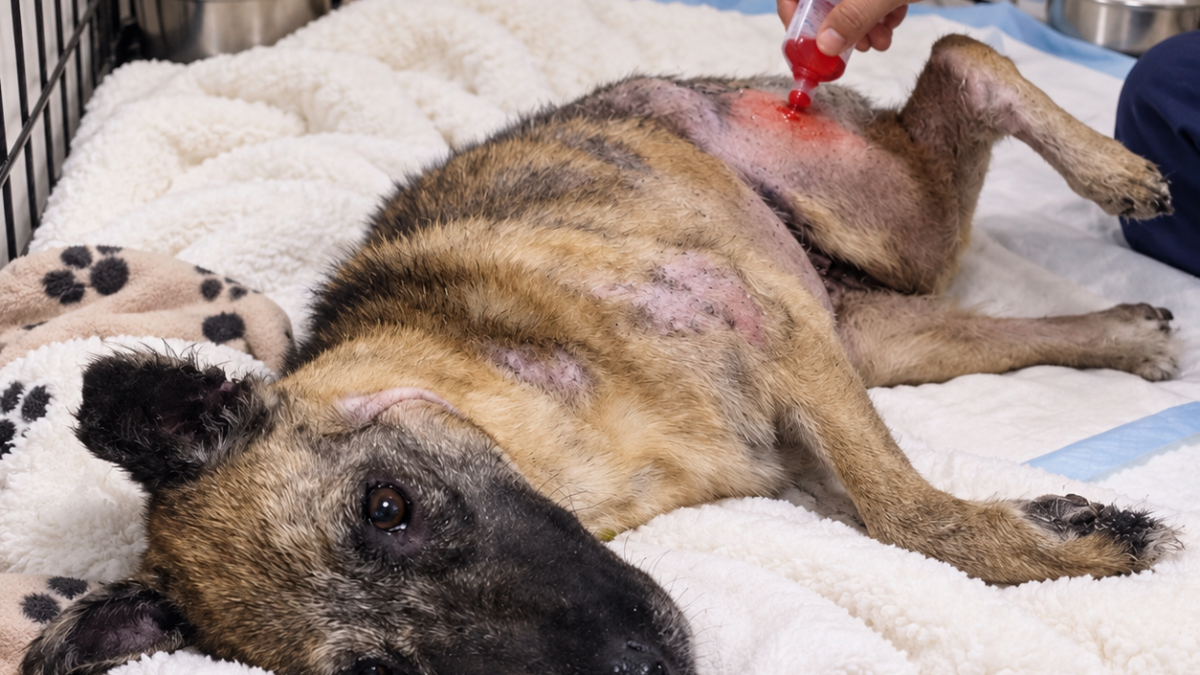
PART 2
On the seventh morning, Dairn ate by herself.
That sentence sounds too small for what it meant to us.
She had eaten before, but only with someone beside her—holding the bowl in the right place, encouraging her, sometimes bringing food almost directly to her mouth because even shifting her body toward it required effort.
That morning, I walked into the treatment room carrying breakfast.
Dairn was awake.
Her head turned toward the bowl.
“Hungry?”
Her eyes followed my hands.
I set the dish where she could reach it and began preparing her medication.
Then I heard the smallest sound behind me.
Her collar tag touching the metal rim.
I turned.
Dairn had moved her head forward.
She was eating.
No hand holding the bowl.
No coaxing.
No one asking her to try.
She had decided she wanted breakfast and had done something about it.
I called the veterinary technician.
“Come here.”
She appeared in the doorway.
“What happened?”
I pointed.
Dairn kept eating.
The technician smiled.
“She’s hungry.”
“I know.”
“That’s good.”
“You don’t understand.”
She looked at me.
Then she did understand.
For a dog who had spent years with virtually no choices, voluntary action mattered.
Dairn wanted something.
And she had acted on that want.
I knelt beside her.
“Good girl.”
She stopped eating.
Her eyes shifted toward me.
I immediately regretted distracting her.
“No, no. Keep going.”
She returned to the bowl.
I laughed.
That morning became our first real celebration.
Not because anyone suddenly believed Dairn would walk.
We didn’t.
Her neurological prognosis remained severe.
Her spinal damage had not vanished because she finished breakfast.
Some injuries were considered permanent.
But hope had changed shape.
At first, hope meant:
Keep her alive.
Now it meant:
Give her reasons to participate.
### Learning Dairn’s Language
The hardest part wasn’t always her body.
It was understanding her.
Dogs communicate constantly.
Eyes.
Ears.
Tail.
Posture.
Movement.
Distance.
Sounds.
Most people who live with dogs learn that language without realizing it.
Dairn had grown up in such profound isolation that many normal social behaviors appeared muted or confusing.
When someone entered the room, she didn’t greet them normally.
She didn’t always look away when nervous.
She didn’t always move toward affection when she enjoyed it.
Sometimes she froze.
At first, freezing frightened me.
“Is she scared?”
The behaviorist watched.
“Maybe.”
“Maybe?”
“With Dairn, we have to learn her baseline.”
Everything required context.
Was she holding still because touch frightened her?
Because movement was physically difficult?
Because she had learned that stillness was safest?
Or because she was simply comfortable?
We could not assume.
So we observed.
When Dairn liked food, her nose moved before her head did.
When she was tired, her eyes softened.
When something overwhelmed her, her breathing changed.
When she recognized a familiar caregiver, eventually her mouth relaxed in a way that almost looked like a smile.
Tiny signals.
Those became our conversations.
And every treatment began the same way.
I approached.
Let her see me.
Touched her gently near the head.
Then kissed her forehead.
“Ready?”
Of course she didn’t answer.
But eventually, when I leaned down, Dairn began lifting her head slightly toward me.
The first time she did it, I froze.
The technician smiled.
“She knows.”
“Knows what?”
“What comes first.”
Love first.
Then medicine.
### What the Tests Told Us
Dairn underwent repeated evaluations.
We wanted answers.
How much sensation remained?
Could physical therapy help?
Could muscle return?
Was pain involved?
Could surgery change anything?
Each answer seemed to create three more questions.
Her spine had suffered severe long-term damage.
Some changes were structural.
Years without normal movement had caused profound muscle wasting.
Neurological impairment affected her ability to control her legs.
And because her deprivation began early and continued so long, the team worried about developmental damage that rehabilitation could improve only partially.
I kept asking some version of the same question.
“What are her chances of walking?”
Finally, one veterinarian looked at me.
“You need to stop making walking the definition of success.”
That stung.
“I’m not.”
“You are.”
I opened my mouth.
Closed it.
She continued gently.
“Caring for Dairn cannot become a project where she has to perform a miracle to justify everything we’re doing.”
I looked toward the treatment room.
Dairn was resting.
“So what is success?”
“Comfort.”
She counted on her fingers.
“Nutrition. Engagement. Health. Mobility in whatever form she can achieve. Relationships. Quality of life.”
“And walking?”
“If we get meaningful function, wonderful.”
She paused.
“But if she needs wheels forever and she’s happy, that is not failure.”
That conversation changed me.
I had been looking at Dairn’s useless legs and seeing the problem.
The veterinarian was asking me to look at the whole dog.
Could she enjoy food?
Yes.
Could she bond?
We thought so.
Could she experience comfort?
Yes.
Could she learn?
Slowly.
Could she have mobility without walking naturally?
Possibly.
Then there was a future.
Different was not the same as absent.
### Her First Smile
A few days after she began eating independently, I arrived late to the clinic.
Another rescue had taken longer than expected.
I rushed through the door.
Dairn was on her padded mat.
“Hi, sweetheart.”
Her head lifted.
Then her mouth opened slightly.
Not panting.
Not stress.
A soft, loose expression.
One corner seemed to rise.
I stopped.
A technician beside her said:
“She does that when you come now.”
“What?”
“That face.”
“She’s smiling?”
The technician laughed.
“Call it whatever you want.”
I crouched.
“Dairn.”
The expression appeared again.
Something inside me broke.
For years, no one had given her a reason to anticipate another person entering the room.
Now she recognized someone.
That was bigger than walking to me.
It meant there was a relationship inside her world.
Her world had once been cage.
Darkness.
Waste.
Food appearing occasionally.
Now her world contained people.
Specific people.
People she differentiated.
People she seemed glad to see.
The cage was already losing territory.
### Day Seventeen
Her medical condition stabilized faster than we expected.
Not healed.
Stabilized.
That difference mattered.
By day seventeen, the veterinary team believed Dairn could safely leave the clinic if we could provide appropriate home care.
I asked the doctor twice.
“Are you sure?”
“Yes.”
“She still can’t move.”
“I’m aware.”
“What if something happens?”
“You call.”
“What if—”
“Take her home.”
Home.
The word hit me.
Dairn had technically existed inside a property for years.
I refused to call that home.
Home implies safety.
Belonging.
Rest.
Someone noticing if you hurt.
Dairn had never had that.
We prepared the car carefully.
Thick padding.
Support around her body.
Blankets.
Supplies.
Medication.
Cleaning products.
Everything we might need.
When the moment came, I slid one arm beneath her chest and another beneath her body.
She was easier to carry than she should have been.
Still too light.
“Ready?”
Her head rested against me.
We walked out of the clinic.
Sunlight touched her face.
Dairn blinked.
I stopped.
The car was only a few yards away.
But I stood there.
Three years of darkness.
Now sunlight.
A nurse behind me whispered:
“She’s looking.”
Dairn’s eyes moved.
Sky.
Cars.
Trees.
People.
She could not understand any of it.
The world was suddenly enormous.
I kissed her head.
“Take your time.”
Then I carried her to the car.
### The First Night at Home
Dairn’s recovery room was prepared before she arrived.
Soft bedding covered most of the floor.
Washable pads underneath.
Food and water positioned for easy access.
No tight corners where her body could become stuck.
Everything quiet.
The other dogs were kept away initially.
Too much stimulation could overwhelm her.
I placed Dairn on the bed.
She remained still.
Her head turned slowly.
Window.
Door.
Ceiling.
Me.
Then back to the window.
I opened the curtain.
Sunlight came through.
Dairn stared.
That became one of her favorite things.
Light.
Sometimes she would lie for twenty minutes with her face turned toward the bright patch on the floor.
I kept thinking about the years in darkness.
How many mornings had happened outside while Dairn never saw them?
How many seasons?
How many sunsets?
Three years is more than a thousand days.
More than a thousand mornings she never watched arrive.
I promised myself we would stop counting what she had lost.
We would count what she had now.
Day one home.
Sunlight.
Food.
Clean bedding.
A person sleeping close enough to hear her.
That was enough.
### Her First Bath
The first bath frightened me.
Not because Dairn fought.
She didn’t.
Because I knew how vulnerable it would make her.
Her immobility meant we had to support her entire body.
The water was warm.
Towels ready.
I lowered her carefully.
Dairn’s eyes widened.
“Easy.”
I placed one hand beneath her chest.
Another caregiver supported her hindquarters.
Water moved over her coat.
Dairn held completely still.
I waited for panic.
Nothing.
Then I began gently massaging her shoulders.
Her eyes softened.
The tension around her mouth released.
“Does that feel good?”
More massage.
Dairn lowered her head against my arm.
The caregiver smiled.
“I think you have your answer.”
I washed years from her skin.
Not literally.
No bath could remove memory.
But that was how it felt.
Warm water instead of filth.
Hands supporting instead of abandoning.
A clean towel afterward.
I wrapped her completely.
Then kissed her forehead.
Dairn closed her eyes.
That night, she slept for almost five uninterrupted hours.
I checked her breathing so many times that I probably slept less than she did.
### Day Twenty-Two
At her next medical check, I prepared myself for bad news.
Rescue teaches you that optimism is dangerous if you confuse it with certainty.
The veterinarian examined Dairn.
Blood work.
Hydration.
Weight.
Skin.
Neurological status.
She looked up.
“She’s stable.”
I smiled.
“Stable good?”
“Stable good.”
“Not stable as in—”
“She’s doing well.”
I exhaled.
Her body had begun tolerating proper nutrition.
Her general condition was improving.
The severe spinal impairment remained.
But she was stronger.
More alert.
More responsive.
The doctor asked:
“Have you considered mobility equipment?”
“Yes.”
That was the conversation I had been waiting for.
A wheelchair.
### The Wheels Arrive
The first wheelchair looked enormous beside Dairn.
Not because it was large.
Because her life had never contained anything like it.
Metal frame.
Support harness.
Wheels.
Freedom, potentially.
Confusion, definitely.
We fitted it carefully under professional guidance.
Her chest was supported.
Hindquarters positioned.
Front legs able to bear what weight they safely could.
Dairn looked at us.
Then at nothing.
“All right.”
I held food several feet ahead.
“Come.”
Nothing.
Another caregiver encouraged her.
No movement.
Ten minutes.
Twenty.
Dairn remained still.
Eventually, we ended the session.
I was disappointed.
The therapist noticed.
“What were you expecting?”
“I don’t know.”
“Running?”
“No.”
She smiled.
“You were.”
“Maybe moving.”
“Her entire life taught her that movement goes nowhere.”
That sentence landed hard.
The wheelchair could give her physical mobility.
Her mind still needed to learn that movement had a purpose.
Next session.
Same result.
Dairn stood supported in the wheels.
Didn’t move.
Third session.
One front paw shifted.
Then back.
Fourth.
Two steps.
I almost screamed.
The therapist raised a hand.
“Calm.”
“She moved.”
“I know.”
“She actually—”
“Don’t overwhelm her.”
I shut up.
Dairn stopped.
Looked at me.
I smiled instead.
“Good.”
Two steps.
That was our new miracle.
### Three Feet
Progress came in ridiculous measurements.
Two steps.
Three.
A foot.
Three feet.
Then stop.
We used food.
Voices.
Another dog at a distance.
Anything that gave Dairn a reason to move.
The hardest part was turning.
Straight was easier.
Turning required coordination she had never developed.
At first, she simply bumped into obstacles.
We padded everything.
“Left.”
Bump.
“Other left.”
Another caregiver laughed.
“She doesn’t speak English.”
“I’m aware.”
Dairn looked at me.
Then pushed again.
One wheel moved.
Then the other.
Her direction changed slightly.
We celebrated.
Eventually, Dairn began understanding that front-leg movement made the world move around her.
That realization transformed her.
She would see food.
Move.
See me.
Move.
Notice sunlight beyond the doorway.
Move.
The wheelchair was not teaching her how to walk.
It was teaching her something more fundamental.
I can go there.
For the first time, destination existed.
### Outside
The first trip outside in her wheelchair lasted less than five minutes.
We chose a quiet yard.
No other dogs.
No strangers.
Soft ground.
Dairn rolled through the doorway.
Stopped.
Wind touched her face.
Her nose began working immediately.
One breath.
Another.
Then another.
Grass.
Soil.
Leaves.
Air.
The sensory world hit her all at once.
She did not move.
I waited.
A bird called somewhere above us.
Dairn looked upward.
Or tried.
Her neck craned.
Then she smelled the grass again.
One wheel shifted.
She pushed forward.
Six inches.
Stopped.
Another six.
She reached a patch of sunlight.
Then something happened.
Her mouth opened into that soft expression again.
The smile.
I sat in the grass and cried.
Dairn stood there in wheels.
Unable to move half her body normally.
Irreversible damage in her spine.
A brain shaped by years of deprivation.
And she looked happy.
That was the day I stopped thinking of her chair as medical equipment.
It was a door.
### The Police Report
While Dairn learned to move, the investigation into her past continued.
Police confirmed details that had initially sounded almost impossible.
Long-term confinement.
Years.
Darkness.
The cage.
Unsanitary conditions.
Severe neglect.
The property history helped establish the timeline.
People who had known pieces of the situation were interviewed.
Some claimed they had not understood how bad it was.
Others said they rarely saw Dairn.
That answer made me angry.
Of course they rarely saw her.
She had been kept where people couldn’t.
The cruelty was partly hidden by design.
The official record mattered because it transformed rumor into documentation.
Dairn had not simply “ended up disabled.”
She had not been born lazy.
She had not chosen isolation.
Her body had been shaped by years of confinement.
When I read part of the report, I had to stop.
I looked across the room.
Dairn was sleeping near the window.
Sunlight over her shoulders.
I closed the papers.
That was enough for the day.
### The Person Who Left Her
Details about responsibility were complicated.
Property ownership had changed.
People pointed fingers.
There were explanations about who was supposed to feed Dairn.
Who had access.
Who had moved away.
Who thought someone else was caring for her.
I hated all of it.
Because Dairn had spent more than three years inside the consequences of everyone else’s excuses.
One person thought another was feeding her.
Another assumed someone had checked.
Someone knew a dog existed but claimed not to know the conditions.
Responsibility dissolved into sentences.
Dairn had no sentence.
Only the cage.
The investigation would determine what could be proven and what consequences were possible.
I stopped waiting for a dramatic moment of justice.
No punishment could return her spine.
No apology could give back three years.
The only thing we could control was what happened next.
So while people argued about the past, Dairn rolled farther.
Five feet.
Ten.
Across the room.
Then down the hallway.
The day she followed me from one room to another, I laughed.
“You’re following me.”
Dairn kept moving.
I turned left.
She struggled with the chair.
Corrected.
Came after me.
I covered my mouth.
She had spent years unable to choose who entered or left her world.
Now she was choosing where I went.
That was our revenge.
### Her First Friend
The first dog we introduced was named Molly.
Older.
Calm.
Uninterested in drama.
Perfect.
Molly entered the room.
Dairn froze.
Molly sniffed the air.
Then approached sideways.
Dairn watched.
No growl.
No wag.
Nothing.
Molly sniffed one wheel.
Then Dairn’s face.
Dairn’s eyes widened.
Molly walked away.
That was it.
The next day, they met again.
Molly lay several feet away.
Dairn watched her.
By the fifth meeting, Dairn moved toward Molly.
Awkwardly.
One wheel bumped a chair.
She corrected.
Molly remained still.
Dairn reached her.
Sniffed.
Molly licked Dairn’s muzzle once.
Dairn froze.
Then her mouth softened.
I laughed.
“Friend.”
From then on, Molly became part of rehabilitation.
If Molly walked outside, Dairn wanted to follow.
If Molly went toward the kitchen, Dairn rolled after her.
If Molly rested in sunlight, Dairn positioned herself nearby.
Dogs teach one another normality.
Dairn had never been given normal.
Molly demonstrated it without trying.
### Wanting More
Weeks passed.
Dairn developed preferences.
That alone felt extraordinary.
She liked chicken more than fish.
She preferred the blue blanket.
She disliked being dried around her ears.
She loved sun.
She tolerated baths.
She adored Molly.
She liked one squeaky toy but ignored three others.
And she hated being left behind.
The first time I walked toward the door without her, Dairn made a sound.
Not a bark.
A little vocal protest.
I turned.
“Was that you?”
Dairn stared.
I stepped toward the door again.
Another sound.
I laughed.
“You want to come?”
Her front paws shifted.
The chair moved.
That was communication.
Not perfect.
Not conventional.
But clear.
Dairn had an opinion.
Take me too.
So I did.
### The Cage Returns
Several months into recovery, investigators needed additional documentation of the original conditions.
Photographs of the cage existed.
I tried not to look.
Then one afternoon, I did.
It was smaller than memory had made it.
That disturbed me.
A physical space can be horrifyingly ordinary.
Metal.
Floor.
Dark wall.
Nothing cinematic.
No dramatic dungeon.
Just somewhere a dog had been left for years.
The photograph showed waste accumulated near one side.
A bowl.
Little else.
I placed a picture of Dairn in her wheelchair beside it.
In the new photograph, she was outside.
Molly nearby.
Sunlight.
Her front legs pushing.
The contrast made me angry enough to shake.
One of the rescuers said:
“Maybe this should be public.”
“Why?”
“So people understand.”
I thought about it.
“Use it for education. Not revenge.”
She looked at me.
“Is there a difference?”
“Yes.”
I pointed at Dairn’s wheelchair photograph.
“If we make the person who did this the center, Dairn stays a victim in the story forever.”
I pointed again.
“She’s more than the cage.”
That became important.
### The Wheelchair Becomes Hers
At first, the chair controlled Dairn.
She bumped into walls.
Got stuck.
Needed constant assistance.
Then gradually, Dairn controlled the chair.
The difference happened almost without us noticing.
One morning, I fitted her into it.
Then stepped away to grab treats.
When I turned back, Dairn was gone.
My heart stopped.
“Dairn?”
I heard a wheel bump somewhere in the hallway.
I ran.
She was halfway to the kitchen.
Alone.
“What are you doing?”
Dairn kept going.
Molly was eating breakfast.
Of course.
Dairn had heard food.
I stood there laughing.
“You did that by yourself.”
She reached the kitchen.
Stopped beside Molly.
Looked at me.
“Fine.”
Breakfast.
From then on, we had a new problem.
Dairn could go places.
The dog who had once been completely immobile now needed supervision because she might roll somewhere inconvenient.
I found her stuck beside a laundry basket.
Once behind a chair.
Once halfway through a doorway because she had attempted a turn too aggressively.
Each problem made me absurdly happy.
Being inconvenienced by Dairn was a privilege.
### Family
At some point, everyone stopped calling me her foster.
Nobody announced it.
No dramatic paperwork moment in my memory.
It simply became obvious that Dairn was not leaving.
Her medical needs were extensive.
Her routines specific.
She trusted the people around her.
She loved Molly.
And I had rearranged my entire home around the width of her wheelchair.
One evening, another rescuer asked:
“Are we listing her for adoption?”
I looked at Dairn.
She was asleep.
“No.”
The rescuer smiled.
“I knew that.”
“You could have told me.”
“You needed to figure it out.”
I crouched beside Dairn.
“Apparently you live here.”
Her eyes opened.
I kissed her forehead.
She relaxed again.
Family.
The dog who had spent three years in a cage now had a home people modified around her body.
We removed narrow obstacles.
Added protective rugs.
Built a small ramp.
Created wider pathways.
Sunlight access.
Safe outdoor area.
Everything designed around one question.
What lets Dairn participate?
Not:
What makes Dairn easier to store?
That had been the old logic.
Contain her.
Feed enough.
Keep alive.
Now the logic was the opposite.
Include her.
### The People Responsible Hear About Her
As Dairn’s story spread, the people connected to the property inevitably heard.
One contacted the shelter indirectly.
They complained that the story made them “look cruel.”
I laughed when I heard.
Not because it was funny.
Because the priorities were astonishing.
Dairn had irreversible damage.
They were worried about appearance.
The message claimed the situation was more complicated.
It probably was.
Neglect cases often are.
But complexity does not erase a dog living for years in filth and darkness.
One of the rescue coordinators asked whether I wanted to respond.
“No.”
“You sure?”
“Yes.”
“What if they keep talking?”
“Let them.”
I looked at Dairn.
She was moving toward the yard.
“We have better things to do.”
That became the moment I realized anger had lost its grip.
I no longer needed them to feel guilty.
I needed Dairn to reach the grass.
She did.
### The First Run
Dairn could never run normally.
Her hind legs would not suddenly recover.
So our definition of running changed.
One afternoon, Molly took off across the yard after a toy.
Dairn watched.
Then she pushed.
Hard.
The wheels rolled quickly.
Her front legs worked.
Again.
Again.
The chair picked up speed.
I gasped.
“Dairn!”
She accelerated after Molly.
Her ears moved in the wind.
Her mouth opened.
That smile.
She crossed the yard faster than I had ever seen her move.
Molly turned.
Dairn turned too sharply.
One wheel lifted.
I screamed.
The chair tipped sideways into the grass.
I ran.
Dairn was fine.
Completely fine.
She lay there looking almost offended that the ride had stopped.
I checked everything.
No injury.
I sat back.
Then started laughing.
“You crashed.”
Dairn looked at me.
Molly returned and sniffed her.
We righted the chair.
Dairn immediately tried going again.
That was her first run.
Not what anyone would have imagined when asking whether she might walk.
Better.
Because it belonged entirely to her.
### What Revenge Looked Like
People asked constantly:
“What happened to the people who did this?”
I understood why.
They wanted justice.
So did I.
But the legal process moved according to evidence and local law, not according to the size of our anger.
Police had documented what happened.
The neglect was no longer invisible.
People had to answer questions.
The conditions became part of an official record.
Whatever consequences could legally be imposed would never give Dairn back what had been taken.
Eventually, I stopped measuring justice by them.
I measured it by Dairn.
A cage had once decided every inch of her life.
Now she chose rooms.
A dark property had hidden her.
Now sunlight was her favorite place.
People had kept her barely alive.
Now we argued with her because she wanted extra chicken.
Her muscles had wasted from confinement.
Now she chased Molly in wheels.
She had once slept beside waste because she could not escape it.
Now she became annoyed if her favorite blanket was temporarily in the laundry.
That was revenge.
Not cruelty returned with cruelty.
A life expanded until the people who reduced it could no longer define it.
### The Baths
Baths became one of Dairn’s favorite routines.
I never expected that.
The first time had been tentative.
Months later, the moment she heard the water running, her expression changed.
I would lift her carefully.
“Bath?”
Her head rose.
Warm water.
Massage.
Clean towels.
Then the best part.
Drying in sunlight.
Dairn would lie there completely relaxed while I rubbed her coat.
Sometimes Molly rested nearby.
I thought about the cage.
Filth.
Waste.
No way to move away.
Cleanliness, which most dogs never have reason to think about, became one more form of dignity.
I never rushed those baths.
They had begun as hygiene.
They became affection.
### Dairn Learns to Ask
Her communication continued developing.
A look toward the door meant outside.
Repeated glance toward the bowl meant water or food.
A particular sound meant she was uncomfortable.
Another meant attention.
She learned her name.
That took time.
“Dairn.”
Eventually, head turn.
“Dairn.”
Eyes on me.
Then one afternoon:
“Dairn, come.”
She started rolling.
I cried.
Not because she understood a command.
Because a name only matters when you live in a world where someone uses it to reach you.
For years, she had been a body in a cage.
Now she was Dairn.
Specific.
Known.
Called.
### A Year in the Light
On the first anniversary of her rescue, we didn’t hold a huge celebration.
Dairn hated crowds.
So we invited only a few people who had been there from the beginning.
The veterinarian.
The technician.
Two rescuers.
Molly, obviously.
Someone brought a small dog-safe cake.
Dairn smelled it and immediately rolled toward it.
I laughed.
“Remember when we celebrated because you ate by yourself?”
The veterinarian smiled.
“Now she’s going to run us over for cake.”
Dairn nearly did.
We showed photographs.
Day one.
Day seven.
Day seventeen.
Day twenty-two.
First wheelchair.
First outside session.
First crash.
Everyone laughed at that one.
Then the newest.
Dairn in the sun.
Healthy weight.
Bright eyes.
Wheelchair.
Molly beside her.
The veterinarian looked at me.
“Remember when you kept asking if she’d walk?”
“I was annoying.”
“You were.”
“I still wish she could.”
“Of course.”
She looked toward Dairn.
“But?”
I knew the answer.
“But she got a life.”
### Another Dog in a Cage
The following year, our rescue received a case involving another dog kept confined for an extended period.
Not as severe.
But bad.
When I saw the cage photograph, I had to sit down.
Dairn’s history flooded back.
I wanted to rush.
Force.
Fix.
Then I remembered what Dairn had taught me.
The second dog needed his own pace.
His own prognosis.
His own story.
We rescued him.
Treatment began.
He was physically capable of walking but terrified of open rooms.
The first day he left confinement, he pressed against a wall.
I sat several feet away.
Did not call.
Did not reach.
Just waited.
Eventually, he took one step.
Then another.
Dairn had never met him.
Still, she helped him.
Because everything I knew about patience came through her.
That is how rescue ripples.
The animal you help today changes how you help the next one tomorrow.
### Dairn Grows Older
Years passed.
Dairn’s body aged around injuries that had already been serious when she arrived.
We knew aging would be complicated.
Her front legs had spent years doing more work because the rear could not.
Her shoulders required monitoring.
Pressure points mattered.
Weight management mattered.
The wheelchair needed adjustments as her body changed.
We became experts in Dairn.
Not veterinary experts.
Dairn experts.
I knew the exact expression she made before becoming uncomfortable.
Which bedding prevented skin irritation.
How long she could enjoy her chair before needing rest.
Which foods made her excited.
Which days she wanted company.
Which days she wanted sun and silence.
That knowledge felt intimate.
It also frightened me because I understood eventually her body would demand more than we could fix.
But I refused to let fear of the ending poison the middle.
We had already lost three years.
We were not going to lose the good years worrying about when they would stop.
### The Day She Didn’t Want the Chair
One morning, I prepared Dairn’s wheelchair.
She looked away.
“That’s new.”
I brought it closer.
Nothing.
Usually she became alert.
I touched her shoulder.
Her breathing was slightly different.
We went to the veterinarian.
Pain in her front leg.
Overuse and age.
Rest.
Medication.
No wheelchair temporarily.
I felt devastated.
Dairn seemed mostly annoyed.
For several days, she stayed on padded bedding.
We carried her outside.
Set her in the sun.
Molly—older now too—lay beside her.
I worried constantly.
Would this be permanent?
Had mobility ended?
The veterinarian warned me:
“One problem at a time.”
Dairn improved.
Slowly.
Then one morning, I brought the wheelchair into view.
Her head lifted.
I smiled.
“You want it?”
She vocalized.
Yes.
We fitted her.
She moved three feet.
Stopped.
Then five.
No pain.
I cried again.
Dairn gave me many reasons to cry.
### Molly
Molly aged faster than Dairn emotionally prepared for.
One winter, she became very ill.
Her family—us—had to make the compassionate decision to let her go.
Dairn was present afterward.
We allowed her to smell Molly’s blanket.
Then Molly.
Dairn became very still.
For the next week, she looked toward the places Molly used to sleep.
That broke my heart.
Her first friend.
The dog who taught her to follow.
The dog who made the world look less frightening.
Gone.
We could not explain death.
So we gave Dairn what we always gave her.
Presence.
Routine.
Time.
Eventually, another rescue dog entered the house.
Dairn did not immediately accept him.
Good.
She had opinions now.
After several weeks, they became comfortable.
Not Molly.
Different.
That mattered.
Love after loss does not replace.
It adds.
### The Final Investigation Update
Years after the original rescue, I received the last meaningful update regarding the investigation.
The official findings remained on record.
Responsibility had been addressed to the extent evidence and the law allowed.
There would be no dramatic new punishment.
No last-minute courtroom scene.
I read the message once.
Then deleted it.
That surprised me.
Years earlier, I would have kept every word.
Now I did not need it.
The people connected to Dairn’s confinement had already lost their final power over her.
They no longer decided where she slept.
Whether she ate.
Whether she saw daylight.
Whether she moved.
Whether she received care.
They had controlled three years.
They did not get the rest.
That was enough.
### The Girl Who Met Dairn
At a small educational event, a little girl met Dairn.
She stared at the wheelchair.
“What happened to her legs?”
I explained simply.
“She was kept somewhere too small for a very long time, and her body got badly hurt.”
“Will she get better?”
“She is better.”
The girl frowned.
“But she can’t walk.”
I smiled.
“She can move.”
Dairn rolled toward us.
The girl looked.
“She’s happy?”
“Yes.”
“How do you know?”
Good question.
I pointed.
“She eats.”
Dairn sniffed the girl’s hand.
“She chooses where she wants to go.”
Dairn moved closer.
“She knows us.”
The girl touched her head.
Dairn relaxed.
“And she likes that.”
The girl thought for a moment.
“So better doesn’t mean fixed?”
I swallowed.
“No.”
That little girl understood in thirty seconds what I had needed months to understand.
Better does not always mean fixed.
Healing does not always mean restoration.
Sometimes healing means building a good life around what cannot be repaired.
Dairn taught us that.
### The Last Years
Dairn grew gray around her face.
It looked strange because part of me still saw the fragile dog carried into the shelter.
But time continued.
And every year felt like stolen property returned.
Four years in the light.
Five.
Six.
Eventually, her wheelchair sessions shortened.
Her shoulders tired.
We adapted.
More rest.
Different support.
A softer harness.
Shorter outdoor sessions.
She still loved sunlight.
That never changed.
On warm mornings, I carried her outside before breakfast.
Placed her on a thick mat.
Sun across her face.
She would close her eyes.
Sometimes I sat beside her doing nothing.
Those became my favorite mornings.
No rehabilitation goal.
No medical milestone.
No social-media update.
Just Dairn existing in light.
That was enough.
### The Night I Knew
Eventually, age and accumulated damage began winning.
Dairn’s appetite became inconsistent.
She could still enjoy favorite foods, then refuse them the next day.
Pain became harder to control.
The wheelchair, once freedom, became tiring.
I kept a notebook.
Good day.
Good morning, tired afternoon.
Ate chicken.
Enjoyed sun.
Didn’t want wheels.
Restless night.
No breakfast.
Comfortable after medication.
Then more bad days appeared.
I knew what that meant.
I hated knowing.
At the clinic, the veterinarian who had known her almost from the beginning sat beside me.
“You kept your promise.”
I cried.
“It doesn’t feel like it.”
“What was the promise?”
“To fight beside her.”
“You did.”
“But if I stop—”
“You’re not stopping.”
She touched my hand.
“You’re changing what the fight is for.”
I looked at Dairn.
“What does that mean?”
“Now you fight for comfort instead of time.”
That was the hardest lesson she ever taught me.
Love is not measured only by how long you can keep someone.
Sometimes love is recognizing when another day belongs more to your fear than to their comfort.
### Her Final Morning
I wanted Dairn’s last morning to happen at home.
The veterinarian agreed.
We carried her outside.
Sunlight.
Of course.
The day was warm.
No wind.
I placed her on the same type of thick mat she had loved for years.
Her wheelchair remained nearby.
I thought about putting her in it one last time.
Then decided against it.
She didn’t need to move.
She had already gone far enough.
I brought chicken.
Dairn ate two pieces.
Then refused the third.
I laughed through tears.
“You’re really going to become picky now?”
Her eyes softened.
I kissed her forehead.
The same ritual.
Love first.
Then medicine.
Exactly as it had begun.
The veterinarian arrived quietly.
A few people who loved Dairn came.
Not many.
She disliked crowds.
We sat around her.
No speeches.
Dairn would not have understood.
She understood hands.
Smells.
Voices.
Sun.
I placed one hand beneath her head.
“You know what you did?”
She looked toward me.
“You survived.”
My voice broke.
“Then you lived.”
That distinction mattered.
Survival had been the cage.
Life came afterward.
The first medication made her sleepy.
Her body relaxed.
I kept my forehead against hers.
“No more cages.”
Her breathing slowed.
“No more darkness.”
Another breath.
“No more trying.”
The final medication entered.
Dairn exhaled.
Then became still.
For years, stillness had once represented imprisonment.
Now it meant peace.
### The Wheelchair
I couldn’t put her wheelchair away.
For months, it stayed near the wall.
Empty.
Sometimes I passed it and imagined the sound of those wheels through the hallway.
One evening, another rescuer visited.
She looked at it.
“We have a dog who might need one like that.”
I stared.
“Same size?”
“Close.”
My first reaction was no.
That was Dairn’s.
Then I looked again.
Metal.
Straps.
Wheels.
Equipment.
Freedom, once.
Maybe freedom again.
“Take it.”
The rescuer hesitated.
“You’re sure?”
“No.”
I laughed through tears.
“But take it.”
The wheelchair was adjusted for another dog.
A young spinal-injury rescue.
The first video I received showed him standing in it.
Confused.
Not moving.
I smiled immediately.
Of course.
Second video.
Two steps.
Third.
Across a room.
Then outside.
When I saw him roll through grass, I cried.
Dairn’s chair was moving again.
That felt right.
### What We Kept
I kept Dairn’s blue blanket.
One photograph.
Her collar.
And a notebook filled with absurdly ordinary observations.
ATE WELL.
SMILED WHEN I ARRIVED.
BATH.
SUN FOR 20 MINUTES.
WHEELS — GOOD SESSION.
CHASED MOLLY.
CRASHED INTO CHAIR.
WANTED CHICKEN.
These records mattered more to me than the police file.
The police file documented what people did to her.
My notebook documented who Dairn became afterward.
That is the record I choose.
### Going Back
I never visited the cage after Dairn died.
I was given the opportunity.
I refused.
There was nothing there I needed.
People sometimes think healing requires returning to the place where pain happened.
Maybe for some people.
Not for me.
Not for Dairn.
She had spent three years trapped there.
Why give the place another minute?
Instead, I went to the yard where she first learned to use her wheelchair outside.
Grass had changed.
A tree was larger.
Nothing dramatic.
I sat where I had cried watching her move through sunlight.
For a while, I closed my eyes.
I could hear wheels in memory.
Then I thought about the first medical exam.
Can she walk?
The question had consumed me.
Years later, it seemed almost embarrassingly narrow.
No.
Dairn never walked normally.
But she went places.
She went into a home.
Into sunlight.
Across rooms.
Across grass.
Toward Molly.
Toward food.
Toward people she loved.
Into years nobody expected her to have.
Walking and going were never the same thing.
Dairn taught me that too.
### The Only Revenge That Mattered
The people who confined Dairn had reduced her existence to survival.
Enough food not to die.
Enough space for a body to remain.
Nothing more.
For a long time, I wanted punishment dramatic enough to balance that.
There wasn’t one.
How do you sentence someone to return three years of sunlight?
How do you repay a spinal cord?
How do you give a dog a childhood back?
You cannot.
So the balance came another way.
They gave her darkness.
She learned sunlight.
They gave her a cage.
She learned a wheelchair.
They gave her isolation.
She learned family.
They gave her waste-covered floors.
She got warm baths and clean blankets.
They taught her not to want anything.
She became picky about chicken.
They reduced her world to one corner.
She learned to chase another dog across a yard.
They made her anonymous.
She became Dairn.
Known.
Loved.
Called by name.
That was the reversal.
That was justice at the level of one dog’s life.
And by the time she died, the people who had hurt her had become almost irrelevant.
The cage was the beginning.
It never got to be the ending.
### The Photograph I Keep
My favorite photograph of Dairn is not the first smile.
Not the wheelchair.
Not even her first day in sunlight.
It was taken years later.
She is outside.
No one is touching her.
Her wheelchair is beside her, but she isn’t using it.
She’s resting on a blanket.
Her face turned toward the sun.
Eyes closed.
Nothing dramatic is happening.
That is why I love it.
Three years of darkness had once defined every day.
In that photograph, light required no effort.
She didn’t have to earn it.
Didn’t have to walk toward it.
Didn’t have to perform a miracle.
She simply existed inside it.
That was what Dairn deserved from the beginning.
A life where good things were not rewards.
They were ordinary.
Food.
Cleanliness.
Warmth.
Touch.
Movement.
Rest.
Sunlight.
Love.
The ordinary things had been stolen from her for years.
We spent the rest of her life giving them back.
And if someone asks me now whether we saved Dairn, I always hesitate.
We did not repair everything.
We couldn’t.
Her spine remained damaged.
Her body carried permanent consequences.
Her communication remained uniquely hers.
She needed help throughout her life.
But rescue was never about making her body erase the evidence.
It was about ensuring that damage did not erase her future.
Dairn never became the dog she might have been without the cage.
We will never know that dog.
That is part of the tragedy.
But she became someone else.
A dog who recognized kisses.
A dog who loved chicken.
A dog who followed Molly.
A dog who learned wheels meant freedom.
A dog who smiled when familiar people entered a room.
A dog who spent afternoons sleeping in sunlight.
A dog who became family.
That life was real too.
And in the end, that is what mattered.
For more than three years, someone kept Dairn in darkness until her body forgot how to walk.
We could not give her those years back.
So we gave her every day that came after.
And Dairn, with a broken spine, wheels beneath her body, and sunlight on her face, showed us something the cage never managed to destroy.
She still knew how to move toward life.
The strange thing about losing Dairn was that silence returned to the house before I was ready for it.
For years, there had always been some sound connected to her.
The soft scrape of her wheelchair turning too tightly against a doorway.
The little metallic click of the frame when I adjusted the straps.
The sound she made when she wanted chicken instead of whatever perfectly acceptable food I had already placed in front of her.
The faint bump of one wheel against furniture when she became impatient and tried to turn faster than her body could manage.
Even at night, I had learned to sleep lightly enough to hear if she needed repositioning.
Then one morning, there was nothing.
No wheels.
No quiet protest.
No breathing from the bed beside the wall.
The room looked cleaner than it ever had while she was alive.
I hated it.
For three days, I left her blue blanket exactly where it had been.
On the fourth day, I folded it.
Then unfolded it again.
It is strange how grief can turn simple objects into decisions.
A blanket becomes:
Am I ready to move this?
A bowl becomes:
Does putting this away mean I accept she is gone?
A wheelchair becomes:
Who am I if nobody needs me to fasten these straps anymore?
That chair was the hardest.
It remained beside the wall.
Clean.
Empty.
I passed it dozens of times a day.
Sometimes my hand automatically reached toward the frame as if I needed to check the padding.
Then I remembered.
No.
Nobody was waiting.
That was when I understood how much my life had reorganized itself around Dairn.
Not just emotionally.
Physically.
Furniture had been moved so she could pass.
Rugs had been placed so her front legs could grip.
Her feeding area had been raised.
A ramp remained outside.
Corners had been padded.
My house still held the shape of her body even after her body was gone.
One evening, I sat on the floor beside the empty wheelchair.
I touched one wheel.
Turned it.
It spun silently.
I thought about the first day we put Dairn into it.
How she simply stood there.
Supported.
Confused.
The therapist telling me:
“Her whole life taught her movement changes nothing.”
Then two steps.
Three.
A doorway.
A hallway.
The yard.
Molly.
Sunlight.
Chicken.
Her entire world expanding because two wheels gave her something confinement had stolen.
Choice.
I started crying before I realized I was.
Then my phone rang.
A rescuer I knew named Elena.
“I’m sorry to call about this.”
I wiped my face.
“What happened?”
“We took in a dog yesterday.”
I looked at the wheelchair.
“What kind of injury?”
“Hit by a vehicle. Spinal damage.”
My stomach tightened.
“Can he use his front legs?”
“Yes.”
“Age?”
“Maybe two.”
“What did the vet say?”
“They think wheels could give him some independence once he’s stable.”
I already knew why she was calling.
Still, I made her say it.
“Why are you calling me?”
Silence.
Then:
“Dairn’s chair might fit.”
My first thought was no.
Not because the dog didn’t deserve it.
Because that chair felt like part of Dairn.
Her straps.
Her scratches on the frame.
One wheel had a small mark from the day she tipped over chasing Molly.
I had never fixed it completely.
I used to joke that it was her racing scar.
Giving the chair away felt like giving away evidence that she had existed.
Elena must have sensed my hesitation.
“It’s okay if you’re not ready.”
I stared at the chair.
Then I heard another voice in my memory.
My own.
Years earlier.
Talking about Dairn’s life.
She still knows how to move toward life.
What did that sentence mean if I kept her wheels parked forever?
“When do you need it?”
“Not tonight.”
“That wasn’t what I asked.”
Elena paused.
“Tomorrow would help.”
I closed my eyes.
“Come get it.”
“Are you sure?”
“No.”
She laughed softly through what sounded like tears.
“Thank you.”
After the call, I sat beside the chair for another hour.
Then I cleaned it again even though it was already clean.
I checked the straps.
The wheels.
The padding.
I found one of Dairn’s hairs caught near the frame.
I held it between two fingers.
For a second, I almost put it back.
Instead, I placed it inside the small box where I kept her collar.
Then I rolled the wheelchair to the front door.
The next afternoon, Elena arrived.
She saw the chair.
Stopped.
“Do you want me to wait?”
“No.”
I handed her the frame.
She took it carefully.
As if it were fragile.
As if it mattered.
It did.
The dog’s name was Simon.
Two years old.
Black and white.
Bright eyes.
Terrified by his own changed body.
The first video Elena sent showed him fitted into Dairn’s wheelchair after it had been adjusted.
Simon stood.
Nothing.
He didn’t move.
I started laughing through tears.
Of course.
A therapist held a treat several feet away.
Simon stared.
No movement.
The next video arrived two days later.
One step.
Then another.
Stop.
I watched it five times.
The third video came a week after that.
Simon moved across a room.
Slowly.
Awkwardly.
The left wheel clipped a chair.
He backed badly.
Corrected.
Then continued.
I covered my mouth.
The chair was moving again.
Dairn was gone.
But the freedom built around her body had not disappeared.
It had changed dogs.
That was the beginning of what I came to think of as Dairn’s second life.
Not literally.
I do not believe she was inside the wheelchair.
Simon was not Dairn.
He had his own history.
His own temperament.
His own pain.
But everything we had learned through Dairn made Simon’s life easier.
How to pad pressure points.
How to fit a harness without rubbing.
How often to check the skin.
How to watch front-leg fatigue.
How to allow the dog to learn the equipment without forcing movement.
How to celebrate three feet without demanding thirty.
Dairn had taught us all of that.
Now Simon benefited from lessons she had paid for with effort.
One morning, Elena called me laughing.
“You need to see this.”
She sent a video.
Simon had figured out speed.
He raced down a hallway.
Missed the turn.
Hit a laundry basket.
The basket tipped.
Clothes exploded across the floor.
Simon stopped.
Looked behind him.
Then kept going.
I laughed until I cried.
“Dairn did that.”
“What?”
“Not the laundry basket. The attitude.”
Elena smiled.
“What attitude?”
“The moment they realize wheels mean they can cause problems.”
That is when you know something important has returned.
Mischief.
Before rescue, Dairn had no opportunity to be inconvenient.
Her entire world had been built to contain her.
Later, one of the clearest signs of recovery was that she began getting herself into places where I had to go retrieve her.
Behind chairs.
Near the kitchen.
Halfway into doorways.
The first time it annoyed me, I felt guilty.
Then I understood:
Being annoyed by someone you love is part of ordinary life.
Dairn had earned ordinary.
Now Simon was earning it too.
Months after Dairn died, the rescue organization asked whether I would help create a guide for caring for severely mobility-impaired dogs.
My first answer was no.
I wasn’t a veterinarian.
I wasn’t a rehabilitation specialist.
They didn’t want medical advice from me.
They wanted practical knowledge from a caregiver.
What does nobody tell you before bringing home a dog who cannot reposition herself?
How many blankets are enough?
More than you think.
How do you protect skin?
Check constantly.
What happens when wheels become part of the house?
You redesign the house.
How do you know whether the dog is enjoying life?
Stop using walking as the only measurement.
That last one became the center.
We brought in veterinary professionals.
Rehabilitation specialists.
Behaviorists.
Other foster families.
The guide grew.
Not a dramatic document.
Practical.
Pressure sores.
Hygiene.
Mobility equipment.
Exercise.
Emotional enrichment.
Signs of pain.
Rest.
Nutrition.
Wheelchair fitting.
The importance of giving disabled animals choices.
The importance of not turning them into inspirational objects.
That mattered deeply to me.
Dairn was not valuable because she was brave.
She was valuable because she was alive.
There is a difference.
People loved calling her courageous.
She was.
But she should never have needed courage simply to receive food, cleanliness, sunlight, and affection.
I never wanted Dairn’s story used to suggest suffering was beautiful.
It wasn’t.
What was beautiful was what happened when suffering stopped controlling everything.
That distinction became part of every talk I gave afterward.
At one community event, a woman approached me after the presentation.
She was crying.
“I have a dog who can’t use his back legs.”
I waited.
“He’s twelve.”
She wiped her face.
“The vet says he might need wheels soon.”
“What scares you?”
“Everything.”
Fair answer.
“Say one thing.”
She thought.
“That he’ll be miserable.”
I understood.
I had once made the same mistake.
Walking equals quality of life.
No walking equals tragedy.
I told her:
“Ask your vet about pain first. Ask about health. Ask about what he still enjoys.”
“He eats.”
“Good.”
“He still barks when someone comes to the door.”
I smiled.
“Very good.”
“He loves being outside.”
“Then talk to your team about mobility.”
She looked uncertain.
“But what if wheels aren’t enough?”
“Wheels don’t need to fix him.”
I paused.
“They need to help him participate.”
That was Dairn’s lesson.
Participation.
Can I go to the kitchen?
Can I reach the yard?
Can I follow the dog I love?
Can I get closer to my person?
Can I choose sunlight?
Life is made of participation.
The woman wrote to us months later.
Her dog had adapted beautifully to his wheelchair.
Not immediately.
First, he froze.
Then two steps.
Then five.
Then across the yard.
Every time I hear that sequence, I smile.
Dairn’s pattern lives everywhere now.
Not because all disabled dogs are the same.
They aren’t.
Because humans repeatedly expect miracles to look big.
Often they begin with one paw moving.
One voluntary bite of food.
One look toward the door.
One decision.
Dairn’s own first real milestone had been breakfast.
Not walking.
Not wheels.
Eating because she wanted to.
Choice began there.
Years after her death, I still remembered the sound of her tag touching that food bowl.
That little metallic sound.
It meant:
I want this.
After three years of having almost nothing to choose, wanting had become rebellion.
That is what I wish the people who confined her could have understood.
Not because I wanted their regret anymore.
I had moved beyond that.
But because neglect is often misunderstood as simply a lack of food or medical care.
Dairn suffered from those things.
But something else had been stolen too.
Agency.
The ability to decide where to place her body.
When to move.
What to investigate.
Who to approach.
Whether to seek sunlight.
The cage did not only hold her physically.
It erased decisions.
Her entire recovery was built around giving them back.
One choice at a time.
I remember the first time she clearly refused something.
It was a bath.
Months after she had begun enjoying warm water.
I prepared everything.
Called her name.
Dairn looked at the bathroom.
Then deliberately turned her wheelchair the other way.
I laughed.
“You’re serious?”
She kept rolling.
I caught up.
“We need the bath.”
Another turn away.
I laughed harder.
I eventually persuaded her with chicken.
But afterward, I thought:
She said no.
That would have sounded like a behavioral problem to some people.
To me, it was progress.
For years, no one had cared what she wanted.
Now Dairn had preferences strong enough to argue.
I started including that story in presentations too.
Disabled animals do not need only physical accommodation.
They need dignity.
And dignity includes the right to have opinions.
Sometimes annoying ones.
Especially annoying ones.
Several years after Dairn died, I was asked to visit the shelter where she first received emergency care.
Much had changed.
New equipment.
Different staff.
Some familiar faces.
Her old veterinarian was still there.
She hugged me.
Then immediately said:
“You look older.”
“So do you.”
“Fair.”
We walked through the clinic.
In one treatment room, a young dog was recovering from spinal surgery.
His back legs were weak.
A therapist supported him.
The veterinarian looked at me.
“Remember Dairn?”
“As if I could forget.”
“She changed this place.”
I stopped.
“How?”
“We ask different questions now.”
“What questions?”
She leaned against the counter.
“Before cases like hers, staff sometimes focused heavily on whether an animal could regain normal mobility.”
“That was me too.”
“I know.”
She smiled.
“Now we ask: Can we control pain? Can they interact? Can they engage? Can mobility support create quality of life?”
I looked through the window at the young dog.
“You would’ve asked those anyway.”
“Maybe.”
She shook her head.
“But Dairn made the questions real.”
That meant more to me than any memorial could.
A dog who had been hidden from the world for three years had changed how professionals looked at another disabled animal.
She was still moving things.
Invisible now.
But moving them.
That afternoon, we went into the old room where Dairn had spent part of her first week.
It had been repainted.
Different equipment.
No physical trace of her.
I expected sadness.
Instead, I remembered the smile.
The first time I walked in and her face changed because she recognized me.
I stood where her mat had once been.
The veterinarian asked:
“What are you thinking?”
“That this is where she first became someone.”
She understood.
Before that, Dairn had existed.
Here, people began learning her.
Food preference.
Facial expression.
Comfort signals.
Name.
Relationship.
An individual life is built partly by being known.
That was what the cage had denied.
Not just sunlight.
Witness.
Someone paying attention closely enough to know the difference between tired and overwhelmed.
Between hungry and uncomfortable.
Between wanting touch and wanting space.
Dairn had become someone because people finally looked long enough to learn her.
I realized that day that maybe this was what rescue means at its deepest level.
Not simply removing an animal from danger.
Seeing them.
Really seeing them.
Long enough that their preferences become specific.
Their fears become understandable.
Their joy becomes recognizable.
Their name begins to mean one particular being instead of one case file.
The rescue later created a small quiet space for mobility-impaired animals.
Wide pathways.
Non-slip surfaces.
Access to sunlight.
Low feeding stations.
Nothing extravagant.
They named it the Light Room.
Not after Dairn officially.
I knew why.
The first time I saw the sign, I cried anyway.
Inside, a paralyzed dog rested near the window.
Another lay on orthopedic bedding.
A third moved slowly in a wheelchair.
Sunlight filled the floor.
I remembered Dairn staring at light in my house.
Three years of darkness.
Then every chance she got, face toward the sun.
A technician asked:
“Do you like it?”
I could barely answer.
“Yes.”
“Anything we should change?”
I looked around.
Then smiled.
“Keep the windows.”
Years passed.
Simon, the dog who inherited Dairn’s wheelchair, grew older too.
His family stayed in contact.
He used the chair for years.
Eventually, arthritis in his front legs limited how much he could use it.
His owners adapted.
Just as we had.
Shorter sessions.
More rest.
Supportive equipment.
When Simon died, Elena called me.
For a moment, neither of us spoke.
Then she said:
“The chair survived both of them.”
I laughed through tears.
“What condition is it in?”
“Terrible.”
“Good.”
One wheel was scratched.
The padding had been replaced several times.
The frame was worn.
We considered passing it on again.
But by then, newer equipment was available and the old chair had become difficult to safely adjust.
So we retired it.
Not as a monument.
As equipment that had completed its work.
Dairn.
Then Simon.
Two dogs.
Years of movement.
The rescue mounted one small wheel from the chair in the Light Room.
Beside it, a plaque read:
MOBILITY IS NOT THE SAME AS WALKING.
No name.
I liked that.
Dairn’s lesson without turning her into decoration.
One afternoon, a family came into the Light Room carrying a young dog with spinal injuries.
The mother saw the plaque.
Read it twice.
Then asked the therapist:
“What does that mean?”
The therapist pointed toward another dog moving in a wheelchair.
“It means we stop asking only, ‘Will they walk normally?’ and start asking, ‘How can they move through their life?’”
The mother looked down at the dog in her arms.
Then nodded.
I stood nearby.
Silent.
Dairn was gone.
Still teaching.
That is how I understand legacy now.
Not fame.
Not a name on a building.
Not people telling the same tragic story forever.
Legacy is when someone behaves differently because you existed.
A rescuer waits instead of forcing.
A vet asks a broader question.
A family chooses wheels rather than assuming paralysis means misery.
A shelter builds wider pathways.
A child learns that “better” does not always mean “fixed.”
A frightened dog gets one extra week because someone remembers Dairn smiling in the sun.
That is a legacy.
I still keep her blue blanket.
It is faded now.
The fibers worn.
I should probably replace the storage box.
I won’t.
Her collar remains beside it.
The tag scratches slightly when I move it.
Sometimes, on difficult rescue days, I take out the notebook.
I never read the police records.
Those are stored elsewhere.
I read my notebook.
ATE WELL.
BATH.
SMILED.
WHEELS.
SUNLIGHT.
MOLLY.
CHICKEN.
CRASHED INTO CHAIR.
GOOD DAY.
That was Dairn’s real record.
Good day.
She had enough terrible ones before we found her.
So the victory became accumulation.
One good day.
Then another.
Then enough of them to become years.
I once thought rescue was about dramatic turning points.
The cage opens.
The clinic saves them.
The wheelchair arrives.
The adoption happens.
Those moments matter.
But Dairn taught me that a life is mostly built between them.
Breakfast.
Bath.
Sun.
Rest.
A favorite blanket.
Someone entering the room.
A dog nearby.
The ordinary repetition of safety.
That is what repaired what could be repaired.
And what could not be repaired?
We stopped demanding that it disappear.
That was healing too.
Her spine remained damaged.
Her body remained dependent.
Her movement remained different.
We adapted the world around her instead of asking her to become a dog she physically could not be.
I think about that often.
How many creatures—and people—are made to feel as if care only counts if it restores them completely?
Dairn was never restored.
She was accommodated.
Loved.
Included.
Known.
And because of that, she had a good life.
Those are not lesser verbs.
They may be the most important ones.
On the tenth anniversary of the day Dairn was found, I went outside early.
No ceremony.
No post.
No crowd.
Just me.
The morning was clear.
Sunlight had started reaching the yard.
I placed her blue blanket on the grass.
Not because I thought she needed it.
Because I did.
I sat.
The yard looked ordinary.
Birds.
Wind.
A neighbor’s car starting.
Nothing dramatic.
I closed my eyes.
Immediately, I could see Dairn in her wheelchair.
The first time outside.
Six inches.
Stop.
Another six.
Face turned toward light.
I remembered crying as though she had crossed a continent.
In a way, she had.
From cage to yard.
From darkness to sun.
From being stored to participating.
From surviving to living.
That distance was enormous.
I opened my eyes.
A rescue dog currently staying with me came outside.
Young.
Healthy.
Four good legs.
He walked across the blanket without caring what it meant.
Then sat beside me.
I laughed.
“Of course.”
He leaned against my shoulder.
I scratched his chest.
The sun moved higher.
For years after Dairn died, I had searched for the right ending to her story.
Was it the wheelchair?
The yard?
The final morning?
The chair helping Simon?
The Light Room?
None of them felt final.
Eventually, I understood why.
There wasn’t one ending.
Dairn’s life stopped.
Her effect didn’t.
That is different.
The people who kept her in darkness had believed, whether consciously or through neglect, that her world could be reduced to one cage.
They were wrong in a way they never could have imagined.
Dairn’s world eventually reached veterinarians, foster homes, other disabled dogs, families, training guides, shelter design, and people who would never meet her.
The cage had been small.
Her impact became larger than it.
That is the final reversal.
Not punishment.
Expansion.
They reduced her.
Life expanded her again.
They hid her.
People learned from her.
They made movement impossible.
She changed how other animals move.
They denied her ordinary care.
Her story taught others how to provide it.
They treated her as something to keep alive in a corner.
She became someone whose preferences shaped rooms.
That is why, when people still ask me what happened to the people responsible, my answer is usually brief.
There was an investigation.
There were findings.
Consequences existed within what the law and evidence allowed.
Then I move on.
Because Dairn did.
Not by forgetting.
She did not need to understand the past to stop living inside it.
Humans kept the records.
Dairn kept moving.
That is the version worth carrying.
If I could speak to the dog we first carried into the shelter, the one whose legs would not hold her and whose world had been dark for more than three years, I would not promise she would walk.
She never did.
I would not promise her body would become normal.
It never did.
I would tell her something better.
You are going to matter to people.
Someone will learn the exact face you make when you recognize them.
Someone will know which food you prefer.
Someone will move furniture because your wheels need room.
Someone will kiss your head before every treatment.
Someone will carry you into sunlight.
Another dog will become your friend.
You will learn what a doorway means.
You will learn that wheels move when you push.
You will chase someone.
You will crash.
People will laugh because you are okay.
You will become picky.
You will complain.
You will have preferences.
You will become family.
And one day, after you are gone, another dog will move because the wheels built for you still know how to roll.
That is what I would tell her.
Not that the damage disappears.
That life appears around it.
And if there is one final image I keep now, it is not Dairn in the cage.
It is not even Dairn in her wheelchair.
It is sunlight on an empty patch of grass.
Because that is what she taught me to understand.
Freedom is not only movement.
Sometimes freedom is simply being somewhere you are allowed to exist without fear.
To rest without filth.
To eat without scarcity.
To receive touch without expecting harm.
To need help without being treated like a burden.
To have a damaged body without having your life declared finished.
Dairn spent three years learning the opposite.
We spent the rest of her life correcting the lesson.
And long after she was gone, the correction kept spreading.
One dog.
Then another.
One room widened.
One family educated.
One wheelchair adjusted.
One frightened animal given more time.
That is how far Dairn finally traveled.
Farther than her broken spine should have allowed.
Farther than any cage could measure.
All the way into lives she would never meet.
And every time another disabled dog rolls into sunlight for the first time, I still think the same thing.
Keep going, sweetheart.
The light is yours now.








