PART 2: She Spent Four Years Giving Birth Inside a Cage So Small Her Body Grew Around It—Then We Heard Her Crying in the Bushes
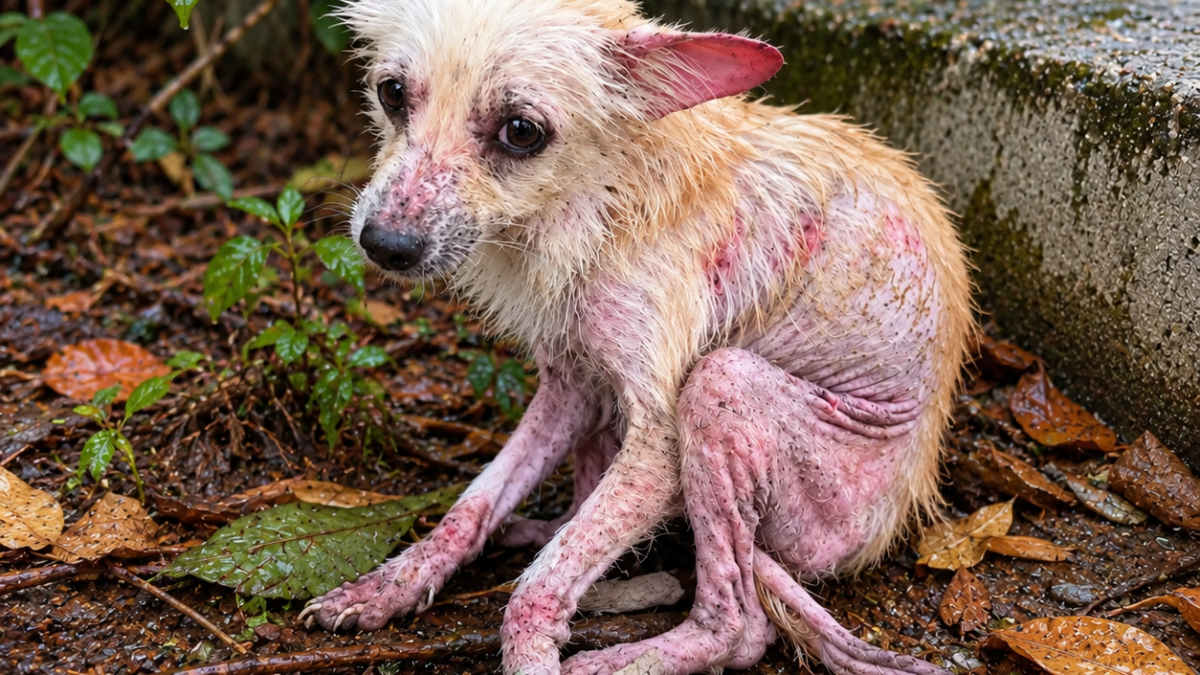
The first thing I heard was crying from somewhere beneath a wall of overgrown brush, and when I finally pulled the branches apart, I found a four-year-old dog curled so tightly into herself that her spine seemed permanently bent—as if her body had learned the shape of a cage long before anyone thought to set her free.
Her skin was raw and bright red, most of her fur was gone, ticks covered the fragile parts of her body, and her nails had curled from years without enough room to walk, yet the most disturbing thing was the way she refused to look at us, trembling harder every time a human hand moved in her direction.
I thought we were looking at another abandoned dog who had been neglected for months, but the veterinarian took one look at her pelvis and spine the next morning and asked me a question that made the entire room go silent.
My name is Sarah Miller, and I had been working with a small rescue organization for almost nine years when I first met Hope.
At the time, she didn’t have that name.
She didn’t seem to have anything.
No collar.
No microchip.
No blanket.
No person looking for her.
Just a patch of tangled woods behind an abandoned property where a neighbor said she had heard an animal crying for two nights.
My rescue partner, Daniel, came with me.
We expected a frightened stray.
Instead, we found a dog who looked as though movement itself hurt.
She was wedged between thorny bushes and a broken section of wire fencing. When Daniel stepped closer, her entire body began shaking.
Not growling.
Not showing teeth.
Just shaking.
I crouched several feet away.
“Hey, sweetheart.”
Her head dropped lower.
That was when I saw her nails.
They were painfully overgrown, some curving sideways beneath her paws.
A dog that walked normally couldn’t have developed nails like that without extreme neglect.
Then Daniel whispered, “Look at her back.”
I already had.
Her spine curved sharply to one side. Her hindquarters sat at an unnatural angle, and when she tried to shift away from us, her rear legs barely supported her.
She took one step.
Collapsed.
“Don’t move,” I said automatically.
Hope froze instantly.
The speed of that reaction bothered me more than if she had tried to bite.
She knew that command.
Or maybe she had simply learned that moving when a person didn’t want her to move had consequences.
I put my hand on the dirt.
Not reaching.
Just letting her see it.
“We’re not going to hurt you.”
She refused to look at me.
Daniel carefully moved around the other side.
Ticks clustered behind her ears and along her belly. Her skin was inflamed. Patches of fur had fallen away from her legs, chest, and sides.
Then I noticed her mammary glands.
Enlarged.
Stretched.
I stared.
“Daniel.”
He followed my eyes.
“She’s had puppies.”
“Recently?”
“I don’t know.”
But something about her body suggested it hadn’t happened just once.
We slid a blanket beneath her without making her stand.
The moment we lifted, she curled inward as if waiting for punishment.
“You’re okay,” I whispered.
She trembled harder.
At my house that night, I placed her in a quiet room with dim lighting, water, soft bedding, and a shallow bowl of food.
She stared at the bowl for almost five minutes.
Then slowly crawled toward it.
Hope ate lying down.
One piece at a time.
Between bites, she stopped and looked toward the doorway.
Watching.
Waiting.
Daniel stood beside me.
“She thinks somebody’s going to take it away.”
I didn’t answer.
Because I thought the same thing.
The next morning, we carried her into Dr. Emily Carter’s clinic.
Hope lowered her head during the entire examination.
Dr. Carter checked her heart, joints, skin, abdomen, and spine.
Then she asked for X-rays.
Twenty minutes later, she called us into the imaging room.
The scans glowed on the screen.
Dr. Carter pointed to Hope’s spine.
Then her pelvis.
Then she looked at me.
“How long do you think this dog was confined?”
“I don’t know.”
She enlarged the image.
“Because these changes didn’t happen in a few months.”
My stomach tightened.
“What are you saying?”
Dr. Carter looked back toward Hope.
“I’m saying her body may have grown around the space she was forced to live in.”
PART 2
For several seconds, nobody spoke.
Daniel stood behind me with both hands on his hips, staring at the X-ray as if looking longer might somehow produce a different image.
I finally said, “Explain that.”
Dr. Carter pulled her stool closer to the monitor.
“This curve here is scoliosis. Significant scoliosis.”
She traced the line of Hope’s spine with one gloved finger.
“It isn’t just posture. The structure has changed.”
“And the pelvis?”
“Also abnormal.”
“How abnormal?”
She switched images.
Hope’s pelvis appeared strangely asymmetrical.
One side seemed rotated. The angles where the hind limbs met the pelvis looked nothing like the diagrams I remembered from healthy dogs.
Dr. Carter said, “I can’t tell you one single cause. Chronic confinement is probably part of it. Malnutrition while she was still growing may have contributed. Lack of normal muscle development. Repeated pregnancies could have added more strain.”
Daniel’s jaw tightened.
“Repeated?”
Dr. Carter looked at Hope’s body through the open treatment-room door.
“I can’t tell you how many litters she had.”
“But she’s had more than one.”
“I would be very surprised if she hadn’t.”
I looked away from the screen.
Hope was lying on a folded blanket.
Still trying to make herself small.
Suddenly the posture didn’t look emotional anymore.
It looked architectural.
Her body was arranging itself to fit a space that was no longer around her.
“How old?” I asked.
“Approximately four.”
“Four?”
“That’s my best estimate.”
“She looks ten.”
“I know.”
The anger hit me so fast I had to step back from the monitor.
Four years.
That was all.
A four-year-old dog should still have energy that drove you crazy.
She should have been carrying sticks too large for doorways.
Destroying tennis balls.
Digging holes.
Barking at delivery drivers.
Instead, her body looked used up.
“What else?”
Dr. Carter took a breath.
“She has a hernia.”
“Where?”
“Abdominal.”
“Dangerous?”
“Not immediately, based on what I’m seeing, but we need to monitor it.”
“What about her skin?”
“Severe dermatitis. Likely secondary infection in places.”
“Ticks?”
“A lot.”
“Anemia?”
“Possibly. Bloodwork is pending.”
“Pain?”
“Yes.”
That answer came too quickly.
I looked at Hope.
“How much?”
“We can’t quantify it perfectly. But with her spine, pelvis, skin, nails, and muscle weakness, I’d assume chronic discomfort.”
I crossed my arms tightly.
“Can she walk?”
“She can take a few steps.”
“That isn’t what I asked.”
Dr. Carter met my eyes.
“I don’t know what her long-term mobility will look like.”
“Can we fix the spine?”
“No.”
“The pelvis?”
“No.”
“Then what are we doing?”
Dr. Carter’s voice stayed calm.
“Helping the body she has.”
I hated that sentence because it sounded too small.
I wanted repair.
Correction.
A straight line where her spine curved.
Strong hips.
A normal gait.
I wanted the damage undone.
Dr. Carter seemed to read my face.
“Sarah.”
“What?”
“Our job isn’t to create the dog she might have been.”
I looked at her.
“It’s to help this dog hurt less and function better.”
Daniel said quietly, “She’s right.”
I glared at him.
“I know she’s right.”
I just didn’t want right.
I wanted impossible.
Dr. Carter continued.
“First we stabilize her. Parasite treatment. Skin infection. Fluids if bloodwork supports it. Nutritional rehabilitation. Pain control.”
“And physical therapy?”
“Eventually.”
“When?”
“When standing for thirty seconds doesn’t exhaust her.”
That brought me back to reality.
Hope could barely remain upright.
I was asking about running.
The first blood results came twenty minutes later.
Mild anemia.
Low protein.
Signs consistent with chronic inflammation.
Dehydration.
Nothing that required immediate hospitalization, but enough to confirm what her body already showed us.
She had been surviving.
Not living.
Dr. Carter wanted to keep her for several hours.
Daniel and I waited.
We watched technicians remove ticks one by one.
Some were swollen with blood.
The sight made me nauseous.
Hope never fought.
That worried me more than aggression would have.
When a technician touched her back leg, Hope flinched.
Then immediately lowered her head.
No growl.
No warning.
No protest.
As if pain was something she believed she wasn’t allowed to object to.
During the nail trim, metal clippers slipped from the counter.
They hit the floor with a sharp crack.
Hope collapsed instantly.
Not stumbled.
Collapsed.
Chin to blanket.
Eyes closed.
Body rigid.
Every person in the room froze.
Dr. Carter whispered, “Nobody move.”
I crouched several feet away.
“Hope.”
She did not know the name.
We had chosen it ten minutes earlier because the paperwork needed something.
“Hey.”
One eye opened.
“That wasn’t you.”
Nothing.
“You didn’t do anything.”
Of course the words meant nothing.
Tone might.
Stillness might.
We waited.
Almost a full minute passed before Hope lifted her head.
Daniel looked at me.
“She expected something.”
“Yeah.”
Neither of us said punishment.
We didn’t need to.
When we brought Hope back to my house, I set up the spare room.
I removed anything unnecessary.
No metal crate.
No tall furniture.
No loud fan.
One thick orthopedic bed.
One thin blanket.
Water.
Food.
Dim lamp.
The door stayed open with a baby gate across the entrance so she could see out without feeling trapped.
Hope ignored the bed.
She lay on the bare floor against the wall.
Daniel looked at the expensive orthopedic cushion.
“Money well spent.”
“Not funny.”
“I’m trying.”
“I know.”
We moved the bed closer to the wall.
Hope shifted farther away.
So we stopped.
That first night, I slept on the couch.
Not because Hope needed me to.
Because I couldn’t make myself go upstairs.
Around two in the morning, I woke and checked the small camera I had placed in the room.
Hope was awake.
She had not moved from the wall.
At 2:17, she drank.
At 2:41, she ate three bites.
At 3:05, she stood.
Two steps.
Then back down.
At 3:32, she curled tighter.
At four, I stopped watching.
I felt like I was spying on grief.
The next morning, food was gone.
That counted.
Daniel arrived with coffee.
“How is she?”
“Alive.”
“That’s a low bar.”
“For now, it’s the right one.”
We sat outside the room.
Hope watched us from the corner.
I put breakfast down.
She stared.
I left.
Through the camera, she waited eleven minutes.
Then ate.
That became the pattern.
Food arrived.
Human left.
Hope ate.
Human returned.
Hope stopped.
On the third day, I tried sitting in the room while she ate.
She refused.
I sat ten feet away for half an hour.
Nothing.
Finally, I left.
The bowl was empty seven minutes later.
I was frustrated.
At myself.
At the people who had taught her that eating around humans was dangerous.
At the slow speed of everything.
Dr. Carter called that afternoon.
“How’s appetite?”
“Good when she’s alone.”
“That’s okay.”
“It doesn’t feel okay.”
“She’s eating.”
“I know.”
“Then stop moving the finish line.”
That irritated me.
Mostly because she was right.
“Any vomiting?”
“No.”
“Diarrhea?”
“Some improvement.”
“Standing?”
“Briefly.”
“Then she’s doing better.”
“She still shakes if I enter too quickly.”
“Sarah.”
“What?”
“You’ve had her three days.”
I sat on the kitchen floor.
“I know.”
“You can’t undo four years in three days.”
“I know.”
“Then act like you know.”
I hung up annoyed.
Five minutes later, I texted her:
You are irritating.
She answered:
Also correct.
I hated veterinarians.
The first week was ugly.
Not medically dramatic.
Emotionally.
Hope didn’t wag.
Didn’t play.
Didn’t seek contact.
Didn’t investigate the house.
Didn’t bark.
Didn’t whine.
Sometimes silence is the most alarming symptom.
The dog who had cried in the bushes no longer cried after rescue.
It was as if being found had used the last outward expression she could manage.
She slept.
Ate alone.
Drank.
Went to the bathroom when carried outside to a small enclosed pen.
Then returned to the wall.
Daniel worried.
“Do you think she wants to live?”
I snapped.
“What kind of question is that?”
He held up his hands.
“A real one.”
“She’s eating.”
“I know.”
“She’s healing.”
“I know.”
“Then don’t say that.”
Daniel was quiet.
I felt guilty.
“Sorry.”
“It’s okay.”
“No.”
I rubbed my face.
“I don’t know what she wants.”
We both looked toward the hallway.
Hope lay on the blanket now.
Not the bed.
The blanket.
That was new.
Daniel said, “Maybe she doesn’t know either.”
That felt closer to the truth.
On day six, I decided to stop trying to make every interaction meaningful.
I brought a book into Hope’s room.
Sat against the opposite wall.
Opened it.
Didn’t look at her.
For twenty minutes, nothing happened.
Then I heard chewing.
I kept reading.
Hope had begun eating with me in the room.
I wanted to turn.
Didn’t.
One bite.
Pause.
Another.
By the time she finished half the bowl, my eyes were full of tears and I had no idea what page I was on.
I closed the book quietly.
“Good night.”
Hope watched me leave.
The next day, I repeated it.
This time, she started eating after seven minutes.
The next day, three.
By the end of the week, she could eat while I sat ten feet away.
She still flinched when I praised her.
So I stopped praising.
That was another lesson.
People love saying “good girl” because it makes us feel kind.
Sometimes kindness is silence.
The second week, Dr. Carter wanted Hope to begin gentle rehabilitation.
I was nervous.
“We’re not making her walk across a room.”
“What are we doing?”
“Weight shifting.”
“That sounds like walking with fewer steps.”
“It isn’t.”
She demonstrated.
Hope stood with assistance while Dr. Carter supported her body under the abdomen.
The hind legs trembled immediately.
“Five seconds.”
“That’s it?”
“That’s plenty.”
At three seconds, Hope started sinking.
Dr. Carter lowered her gently.
“That’s our baseline.”
Five seconds.
That number stayed in my head.
Five seconds standing.
We tried a towel sling at home.
Disaster.
The moment the fabric tightened beneath Hope’s abdomen, she panicked.
She twisted violently.
One hind leg slipped.
I dropped the towel.
“Stop.”
Daniel immediately released his side.
Hope crawled backward against the wall.
I felt sick.
“I hurt her.”
“No.”
“I scared her.”
“Yes.”
“That’s worse.”
“No, Sarah.”
“I knew she hated restraint.”
“We had to try.”
“I pushed too fast.”
Daniel knelt beside me.
“So we learn.”
I hated reasonable people.
We ordered a wide padded support harness instead.
It arrived two days later.
I left it on the floor outside Hope’s room.
No touching.
She sniffed it after six hours.
Next day, I placed treats around it.
Third day, she stepped over it.
Fourth day, I touched it to her side.
One second.
Remove.
Treat on floor.
Again.
By the end of the week, Hope tolerated wearing it for thirty seconds.
Not because we forced her.
Because we had made the object boring.
That became the foundation of everything.
Boring was good.
Boring meant predictable.
Predictable meant safe.
We used food to encourage movement.
Hope still wouldn’t take treats directly from my hand, so I placed tiny pieces of boiled chicken on the floor.
One foot from her.
Then eighteen inches.
Two feet.
Hope stretched.
Shifted.
Reached.
Her hind legs engaged.
The first time she moved three steps without collapsing, I nearly shouted.
Instead, I bit the inside of my cheek.
No celebration.
No pressure.
Just another piece of chicken.
Daniel whispered, “We are running a very corrupt rehabilitation program.”
“Whatever works.”
At the end of the second week, Hope began tolerating massage.
Not everywhere.
Shoulders first.
I would sit beside her, not facing directly.
Touch.
One second.
Remove.
Touch again.
Three seconds.
Stop before she stiffened.
The muscles along her back felt like cables.
Some were overworked because they had spent years compensating for structural problems.
Others were weak because they had barely been used.
Dr. Carter taught us where not to press.
The scoliosis would always require care.
Hope’s pelvis would always change how she moved.
The goal was strength around damage.
Not denial of it.
Three weeks after rescue, I walked into the spare room with breakfast.
Hope looked at me.
I set the bowl down.
Normally, she would wait until I moved away.
That morning, she shifted her front legs beneath her chest.
Then pushed.
Her hindquarters rose.
I stopped breathing.
Hope stood.
Alone.
No harness.
No wall.
Her legs shook so hard I could see the muscles quivering beneath her thin skin.
But she was standing.
Daniel appeared behind me.
I raised one hand.
Don’t speak.
Five seconds.
Seven.
Ten.
Hope’s back legs wobbled.
She lowered herself.
Not a collapse.
A controlled sit.
Daniel pressed both hands over his mouth.
I started crying.
He whispered, “She stood.”
“I know.”
“She stood.”
“I know.”
We laughed like idiots.
Hope stared at the breakfast bowl.
Apparently our emotional collapse was irrelevant.
She crawled forward and ate.
I called Dr. Carter.
“She stood.”
“For how long?”
“Ten seconds.”
“Excellent.”
“That’s all you have?”
“What do you want?”
“More enthusiasm.”
“Sarah, I’m with a cat who swallowed thread.”
“Fine.”
“I’m happy.”
“You don’t sound happy.”
“Because I’m trying to stop a cat from cutting its intestines open.”
“Fine.”
“Send me a video next time.”
“There is no video.”
“Of course there isn’t.”
“I was busy experiencing it.”
“Primitive.”
I hung up smiling.
Hope stood again that afternoon.
Seven seconds.
Next morning, twelve.
Within five days, she could stand long enough to finish part of a meal from a raised bowl.
That reduced strain on her neck and spine.
The improvement changed something in her mind too.
Once standing became possible, curiosity appeared.
The doorway was the first challenge.
Hope had never voluntarily left the spare room.
We had carried her out for bathroom breaks.
One morning, I removed the baby gate.
Sat in the hall.
Put chicken two feet beyond the threshold.
Hope stared.
I waited.
Ten minutes.
Nothing.
I read.
Fifteen.
Hope shifted.
Twenty.
One front paw crossed the doorway.
Then back.
I didn’t react.
Another minute.
Paw again.
Second front paw.
Hope stood with half her body outside the room.
The hallway might as well have been a continent.
Her eyes moved over everything.
Wall.
Door.
Light.
Stairs at the far end.
I put another piece of chicken down.
Hope stretched.
Her hind legs crossed the threshold.
She stood in the hall.
I almost cried again.
Rescue had turned me into a person who cried over hallways.
Daniel was in the kitchen.
I texted:
DO NOT COME OUT.
He answered:
WHY
SHE’S IN HALLWAY.
Seconds later:
OH GOD.
DO NOT COME OUT.
I KNOW.
Hope took one more step.
Then another.
She reached the chicken.
Ate.
Turned awkwardly.
Returned to her room.
That was enough.
The next day, she went farther.
Within a week, the hallway belonged to her.
Then the kitchen.
The kitchen changed everything because the refrigerator existed.
Hope discovered food had a location.
She began watching me prepare meals.
From six feet away.
Then four.
One morning, I opened a container of chicken.
Her tail moved.
One tiny twitch.
I froze.
“Daniel.”
He looked over.
“What?”
“Her tail.”
“What about it?”
“It moved.”
“Balance.”
“No.”
“Could be.”
The tail moved again.
Daniel smiled.
“Okay.”
“Do not say anything.”
“I’m not.”
We both stared like people watching a lunar landing.
Hope looked confused.
The next morning, she wagged three times when breakfast appeared.
Food-related.
Fine.
The next week, she wagged when I entered without food.
That one broke me.
“Hi.”
Tail.
Two movements.
“Hi, Hope.”
Another.
I crouched.
She immediately became uncertain.
I sat instead.
“Sorry. Too much.”
Hope stayed.
The changes became easier to miss because they happened daily.
Her skin slowly healed.
The bright red inflammation faded.
New fur appeared as soft dark fuzz along her shoulders and hips.
Her weight increased.
Her eyes looked less sunken.
The ticks were gone.
Her nails were trimmed enough that standing hurt less.
And she began choosing places that weren’t corners.
At first, the middle of a hallway.
Then the kitchen mat.
Then, one evening, the actual dog bed.
I walked past.
Stopped.
Hope was on it.
All four paws.
Body curved.
Head resting on the edge.
I took a picture from the doorway.
No flash.
Sent it to Daniel.
His response:
FRAME IT.
The next hurdle was outside.
Not bathroom trips.
Freedom.
We had been carrying or supporting Hope into a small pen because the open yard overwhelmed her.
One warm morning, I opened the back door.
Hope stood several feet away.
Wind moved into the kitchen.
Her nose lifted.
I sat on the step.
Daniel went outside and sat in the grass.
Hope approached.
Stopped.
Her paws remained on tile.
She sniffed.
Grass.
Soil.
Leaves.
A distant lawn mower.
Birds.
A truck passing two streets away.
Too many things.
She backed up.
I stayed.
Five minutes later, she returned.
One paw outside.
Back in.
Again.
Two paws.
Pause.
Then all four.
Hope stepped onto grass.
Her toes spread.
Her whole body froze.
The sensation must have been completely foreign.
She lifted one paw.
Placed it down.
Then another.
The grass brushed her legs.
Hope sniffed it.
Sneezed.
Daniel laughed.
Hope jumped backward.
He immediately looked away.
“Sorry.”
She stared at him.
Then sniffed again.
Within ten minutes, she had moved six feet.
Six feet of grass.
That was her universe.
She reached a patch of sunlight and stopped.
Her eyes half closed.
Wind moved over the bare sections of her recovering skin.
I sat on the porch.
No cage.
No walls.
No ceiling.
Nothing forcing her body into one shape.
For fifteen minutes, Hope stood and rested in the yard.
When she was tired, she came back inside.
She had chosen both directions.
That mattered.
By month two, Hope had enough strength for short supported walks around the yard.
Her gait looked unusual.
Front legs doing most of the work.
Rear legs tracking unevenly.
One hip rotating more than the other.
But she moved.
Dr. Carter watched a video.
“She’s compensating.”
“Bad?”
“Not automatically.”
“What do we do?”
“Strengthen carefully. Keep weight low. Avoid slippery floors. No jumping.”
“Running?”
“Not yet.”
I sighed.
“You really dislike fun.”
“I dislike orthopedic emergencies.”
We began formal physical therapy.
A therapist named Kelly came twice a week.
Hope hated Kelly for three days.
Not personally.
Professionally.
Kelly asked her to work.
Standing on different surfaces.
Weight shifting.
Slow steps over very low poles.
Balance exercises.
Hope preferred chicken.
They compromised.
Kelly quickly learned the same lesson we had.
You could not force Hope through fear.
She would shut down.
So sessions were short.
Five minutes.
Rest.
Three minutes.
Done.
There were setbacks.
One morning, Hope woke stiff and refused to stand.
I panicked.
Called Dr. Carter before sunrise.
“She’s worse.”
“How do you know?”
“She won’t stand.”
“Did she overdo yesterday?”
“Kelly worked on rear-leg strength.”
“How long?”
“Ten minutes total.”
“Any falls?”
“No.”
“Eating?”
“Yes.”
“Pain medication given?”
“Yes.”
“Give it time.”
“What if—”
“Sarah.”
“What?”
“Bodies get sore.”
“She can’t afford sore.”
“Everyone can get sore.”
I wanted emergency imaging.
Dr. Carter convinced me to wait two hours.
Hope stood ninety minutes later.
I felt foolish.
Then grateful.
I learned the difference between vigilance and panic.
Slowly.
Not perfectly.
Hope started seeking contact around the third month.
The first voluntary touch happened on a Tuesday evening.
I was sitting on the living-room floor reading.
Hope had been resting near the wall.
She stood.
Walked across the rug.
Stopped beside me.
I kept reading.
She lowered herself.
Her shoulder touched my leg.
Barely.
I stopped breathing.
Thirty seconds.
Maybe forty.
Then Hope stood and walked away.
I stared at Daniel, who had seen everything from the kitchen.
He whispered, “Do not ruin this by making a speech.”
I whispered back, “I hate you.”
He smiled.
A week later, Hope rested her head against my knee.
Two weeks after that, she took chicken directly from my fingers.
The first time her tongue touched my hand, she immediately pulled back.
Then tried again.
Progress was becoming brave enough to repeat things.
We learned more about her fears.
Men wearing baseball caps.
Brooms.
Metal clanging.
Raised voices.
Hands reaching down from above.
Closed crates.
Narrow spaces.
One afternoon, a delivery driver dropped a dolly on my porch.
The crash echoed through the house.
Hope ran.
I expected her to disappear into the spare room.
She didn’t.
She ran to me.
Pressed her body against my legs.
I put one hand gently on her shoulder.
“It’s okay.”
Hope trembled.
But she stayed.
That was the moment I realized something fundamental had changed.
Fear still existed.
But now she had somewhere to take it.
The original cruelty investigation moved more slowly than Hope’s recovery.
We had posted a photograph asking if anyone recognized her.
No graphic images.
Just face, markings, ear shape.
Weeks passed.
Nothing useful.
Then a message arrived from a woman named Melissa.
Subject line:
I think I know this dog.
I called immediately.
Melissa sounded nervous.
“I don’t want my name posted.”
“It won’t be.”
“I used to live near a breeder.”
“What kind?”
“Backyard operation.”
“Dogs?”
“Yes.”
“What makes you think Hope came from there?”
“The ear.”
Hope had a tiny notch along one edge.
“And the markings.”
“How long ago?”
“I saw her there maybe three years.”
My stomach tightened.
“Where?”
“Behind the house.”
“In a yard?”
“In cages.”
I stopped writing.
“What kind of cages?”
“Wire.”
“Large kennels?”
“No.”
She hesitated.
“Small.”
“How small?”
“I don’t know measurements.”
“Could she stand?”
Melissa was silent.
“I don’t know.”
“Turn around?”
“I don’t know.”
“How many dogs?”
“At least six when I lived there.”
“Did you see puppies?”
“Yes.”
“Hope had puppies?”
“I think so.”
“More than once?”
“Yes.”
The room went quiet around me.
Daniel watched my face.
I continued.
“Was she ever outside the cage?”
“Not when I saw her.”
“Walking?”
“No.”
“Playing?”
“No.”
“What happened to the puppies?”
“They disappeared.”
“Sold?”
“I assumed.”
“Did you report them?”
Melissa took a long breath.
“Once.”
“What happened?”
“Animal control came.”
“And?”
“They said they couldn’t see enough from the road.”
“Did you call again?”
“No.”
The word came quietly.
I felt anger rise.
Then shame for feeling it.
Melissa said, “I should have.”
“That isn’t why I asked.”
“Yes, it is.”
“No.”
“I should have done more.”
I closed my eyes.
Rescue is full of these moments.
People looking backward with information they didn’t have courage or certainty to act on earlier.
Blame feels satisfying for seconds.
It rarely helps.
“What do you remember about Hope specifically?”
“She was always in the same cage.”
“How long?”
“Years, maybe.”
“Pregnant?”
“I saw her pregnant twice.”
My hand tightened around the pen.
“Only twice?”
“I moved away. Could have been more.”
Hope was four.
If Melissa saw two pregnancies, there could easily have been more.
“Did anyone ever handle her kindly?”
“I never saw.”
“Did she have a name?”
“I don’t know.”
“Food?”
“They fed them.”
“How often?”
“I can’t say.”
“Water?”
“There were bowls.”
That was the kind of answer that made neglect cases difficult.
Enough to keep animals alive.
Not enough to call it care.
We turned everything over to animal control and the sheriff’s office.
The property was investigated.
By then, most of the breeding operation had been moved.
But not everything.
Three dogs were found.
One female had overgrown nails and chronic skin disease.
A male spun circles repeatedly inside his kennel.
Another dog was underweight and had untreated dental problems.
No one could prove all of Hope’s exact history.
Records were poor.
Ownership changed between relatives.
People lied.
One claimed the dogs belonged to a cousin.
The cousin claimed he had moved months earlier.
Someone else said Hope had been “given away.”
No paperwork.
No veterinary records.
No breeding records.
That last part infuriated me.
They had used her body to produce puppies.
Sold those puppies for money.
And still couldn’t produce one record showing she had ever received medical care.
The legal process began.
Violations.
Neglect charges.
Unlicensed breeding.
Animal removal.
Fines.
Restrictions.
It wasn’t the sweeping justice people imagine when they hear these stories.
Nobody stood in a courtroom and confessed to destroying Hope’s body.
There was no dramatic sentence equal to four years in a cage.
For a while, that consumed me.
I wanted more.
Daniel finally said, “You’re spending more time angry at them than you are watching Hope get better.”
“That’s not fair.”
“It’s true.”
“They did this.”
“I know.”
“Her spine is permanent.”
“I know.”
“Her pelvis—”
“I know.”
He stepped closer.
“But she’s in the yard.”
I looked toward the window.
Hope was outside with Buddy, another foster dog.
Buddy carried a rope toy.
Hope followed.
“Let the authorities handle the rest.”
“I hate that sentence.”
“I know.”
“And if they get away with most of it?”
Daniel looked toward Hope.
“They already lost her.”
I didn’t answer.
Later, I understood what he meant.
They had treated Hope like a breeding machine.
An object.
A body with one purpose.
Now she belonged to no one’s business.
Nobody could force another litter from her.
Nobody could lock her back inside that cage.
Nobody got to decide how much space she used.
They had lost control of her life.
That didn’t erase what happened.
But it mattered.
At around five months post-rescue, Hope’s personality began appearing.
She stole socks.
The first time happened after laundry.
I found one sock missing.
Daniel blamed the dryer.
Then Hope walked through the hallway carrying it.
We both stared.
She stopped.
Sock hanging from her mouth.
I said, “Are you stealing?”
Hope froze.
Then backed up.
I immediately softened my voice.
“No, no.”
She dropped it.
I sat.
“Sorry.”
Hope stared.
I picked up another old sock.
Placed it on the floor.
Walked away.
Five minutes later, she had both.
Daniel said, “You just taught her theft.”
“I taught her she isn’t punished for having things.”
“Same outcome.”
Within a month, Hope had a collection under her bed.
Socks.
One dish towel.
A plush rabbit.
Daniel’s gardening glove.
We stopped retrieving harmless items.
Her hoarding became almost ceremonial.
She would collect something.
Carry it to her bed.
Lie beside it.
As if building proof that things could belong near her without being taken.
Her first bark startled all of us.
Buddy ran past with a toy.
Hope wanted it.
Buddy ignored her.
Hope opened her mouth.
“Woof.”
One bark.
Deep.
Raspy.
Buddy stopped.
Daniel dropped a coffee cup.
Not broke it.
Almost.
“What was that?”
I laughed.
Hope barked again.
Buddy surrendered the toy.
“She found her voice.”
Hope carried the toy away.
Apparently she intended to use it.
Running came later.
Nobody expected it.
Dr. Carter had always been cautious.
“She may never run well.”
I accepted that.
Then one afternoon, Buddy stole the same plush rabbit Hope loved.
He sprinted across the yard.
Hope watched.
Something in her switched.
She moved.
Three fast strides.
Then five.
I stood.
“Daniel.”
Buddy turned.
Hope followed.
Her gait was crooked.
Front end stronger than rear.
One back leg swinging wider.
Her spine curving visibly through the movement.
But she was running.
Not efficiently.
Not gracefully.
Freely.
Ten strides.
Fifteen.
Buddy reached the fence.
Turned.
Hope stopped too quickly.
Nearly fell.
Recovered.
Then barked.
Buddy ran again.
Hope followed.
I started crying.
Daniel put one hand on my back.
“Look at her.”
“I am.”
“She’s running.”
“I know.”
Hope reached Buddy.
He dropped the rabbit.
Hope grabbed it.
Trotted—actually trotted—toward the porch.
Then collapsed in the grass.
Panting.
Eyes bright.
Tail beating against the ground.
I sat beside her.
No praise.
No giant reaction.
Just one hand near her shoulder.
Hope rolled slightly toward me.
The dog we found curled in the bushes had run because she wanted a toy.
That may have been the most ordinary miracle I ever witnessed.
The ocean came at month seven.
Daniel had suggested it repeatedly.
I resisted.
Too far.
Too much stimulation.
Sand difficult for her pelvis.
Waves.
Wind.
Other dogs.
People.
Then Dr. Carter unexpectedly sided with him.
“Take her.”
“You too?”
“Yes.”
“What about sand?”
“Short session.”
“Water?”
“She doesn’t have to enter.”
“Drive?”
“She likes the car now.”
“That’s generous.”
Hope tolerated the car.
Mostly because car rides had begun leading to parks instead of clinics.
Dr. Carter smiled.
“She needs experiences.”
“She has a yard.”
“She spent years in a cage, Sarah.”
I went quiet.
“Give her some world.”
So we did.
We chose a weekday morning.
Quiet beach.
Cool weather.
Support harness packed.
Water.
Medication.
Blanket.
Everything.
Hope refused to leave the car for twelve minutes.
Fine.
We waited.
Eventually she stepped onto the parking lot.
Then the boardwalk.
The smell reached her before the view.
Salt.
Seaweed.
Wet sand.
Wind.
Hope’s nose lifted.
At the top of the dune path, she stopped.
Below us stretched the ocean.
No fence.
No wall.
No visible edge.
Hope stared.
Daniel whispered, “Imagine seeing that after a cage.”
I swallowed.
We walked slowly down.
The dry sand confused her.
Her paws sank.
Hope lifted one leg.
Looked at the ground.
Tried again.
I laughed softly.
“You don’t trust the floor.”
Once we reached firmer sand near the waterline, her gait improved.
Then the first wave came.
Not large.
Foam reaching toward her paws.
Hope jumped backward.
Daniel laughed.
Hope looked at him.
He raised both hands.
“Sorry.”
Another wave.
Hope backed up again.
Third wave.
She stayed.
Water touched her front paws.
Retreated.
Hope sniffed.
The next wave reached all four.
She lifted one paw.
Then put it down.
Within minutes, she was following the waterline.
Wind pushed through the fur that had grown back across her shoulders.
Her ear tilted.
Tail up.
She began trotting.
I could barely breathe.
The dog whose body had grown around a small cage was moving beside an ocean.
Space in every direction.
We stayed twenty-five minutes.
No more.
Hope slept most of the ride home.
Daniel took a photograph that morning.
Hope standing at the edge of the water.
Head lifted.
Wind in her coat.
I framed it.
Not the rescue picture.
Not the X-ray.
That one.
When people later asked what Hope had looked like when we found her, I often pointed to the ocean photograph first.
“This is Hope.”
Then, if necessary, I explained the rest.
Because the worst day of someone’s life doesn’t deserve to become their permanent introduction.
Around eight months after rescue, adoption became a real issue.
Technically, Hope was a foster.
Applications came in.
Excellent ones.
A retired physical therapist with twelve fenced acres.
A veterinarian.
A quiet couple with no children and experience with special-needs dogs.
I read every application.
Then found a reason to dislike it.
Daniel caught on quickly.
“Why did you reject the retired therapist?”
“Not rejected.”
“Marked concern.”
“Porch steps.”
“They offered to build a ramp.”
“Still.”
“The veterinarian?”
“Works long hours.”
“Partner works from home.”
“Possible.”
“The couple?”
“They travel.”
“Twice a year.”
I stared at him.
“You seem invested.”
“You’re keeping her.”
“I foster.”
“You have failed.”
“I have successfully fostered forty-six dogs.”
“And Hope?”
“Forty-seven.”
“No.”
“Daniel.”
“You moved your furniture because she likes the middle rug.”
“That’s management.”
“You bought a second orthopedic bed because she prefers sunlight in the afternoon.”
“That’s comfort.”
“You rearranged your work schedule for therapy.”
“Medical necessity.”
“You call this house ‘home’ when speaking to her.”
I stopped.
He smiled.
“Exactly.”
I looked toward Hope.
She was sleeping on her side.
Not curled.
Legs stretched.
Taking up nearly the entire bed.
“She has complicated needs.”
“Yes.”
“Moving could set her back.”
“Yes.”
“She trusts us.”
“Yes.”
“That’s clinically relevant.”
Daniel laughed.
“You love her.”
I hated how simple he made it sound.
Love wasn’t the issue.
Commitment was.
If Hope stayed, she might need expensive care for the rest of her life.
Arthritis.
Spinal pain.
Hernia repair.
Mobility support.
Physical therapy.
I had to think beyond emotion.
So I made a list.
Money.
Time.
Vet access.
Travel plans.
Backup caregiver.
Work schedule.
Future mobility.
Then I realized I was not looking for reasons to keep her.
I was making a responsible plan for a dog I had already decided was staying.
The adoption paperwork took fifteen minutes.
Hope slept through it.
Daniel signed as witness.
“You’re officially terrible at fostering.”
“Be quiet.”
I knelt beside Hope.
“Apparently you live here.”
Her tail moved once.
Nothing changed.
That was how I knew the adoption was right.
Hope was already home.
The next several years were not dramatic.
I’m grateful for that.
Rescue stories often stop once the dog looks happy.
But life after rescue is mostly ordinary.
Breakfast.
Medication.
Walks.
Nail trims.
Laundry.
Vet appointments.
Weather.
Hope discovering that squirrels existed.
Hope barking at a trash truck.
Hope stealing a banana from the kitchen counter and regretting the peel.
Hope learning the couch was technically forbidden and then discovering enforcement was weak.
At six, she had surgery for the hernia.
By then, she was strong enough.
The operation went well.
The hardest part was keeping her activity restricted afterward.
The same dog who once refused to move now had to be prevented from doing too much.
Dr. Carter laughed when I complained.
“You wanted mobility.”
“I wanted reasonable mobility.”
“No refunds.”
At seven, Hope became fascinated with foster dogs.
Not all of them.
Fearful ones.
There was Daisy, a small terrier mix rescued from a hoarding case.
Daisy hid in a crate for three days.
Wouldn’t eat if humans watched.
Wouldn’t come out.
I sat near the crate.
Hope entered the room.
I expected her to sniff.
Instead, she lay down six feet away.
Facing sideways.
No pressure.
Daisy watched.
Hope slept.
The next day, same.
Third day, Daisy stepped out.
One paw.
Then another.
She approached Hope.
Sniffed her back.
Hope did nothing.
Daisy lay down two feet away.
I walked out and cried in the bathroom.
Daniel found me.
“What happened?”
I pointed toward the room.
“She knows.”
“Maybe.”
“No.”
I wiped my face.
“She knows what not to do.”
That was enough.
Hope became a quiet bridge for several frightened fosters.
She never forced play.
Never crowded.
Never demanded.
She simply occupied space safely.
One afternoon, Daniel said, “She learned from you.”
I shook my head.
“I learned from her.”
At age eight, arthritis appeared more clearly.
Expected.
Still unfair.
Her joints had spent years compensating for deformity.
We adjusted.
More rugs.
Fewer long runs.
Swimming during warm months.
Massage.
Medication.
Weight management.
Hope hated being told she was on a diet.
Her expression whenever I measured food suggested personal betrayal.
“You weigh sixty-three pounds.”
Stare.
“Dr. Carter says sixty is better.”
Stare.
“You can complain to her.”
Tail down.
“Manipulative.”
Hope walked away.
At nine, she started sleeping beside my bed.
She had always preferred her own space.
Then one night during a storm, thunder shook the house.
Hope entered my room.
Paused.
Walked to my side.
Lay down.
I reached toward her.
Stopped before touching.
Hope shifted closer.
I put my hand on her shoulder.
No flinch.
Years earlier, sudden metal sounds had sent her collapsing to the floor.
Now thunder sent her to me.
Fear remained.
But trust had been built around it.
At ten, her muzzle turned gray.
Her crooked spine became more visible as muscle decreased.
People sometimes asked if she was “still doing okay.”
I hated the phrase.
Still.
As if her life after rescue had always been borrowed time.
Hope was doing fine.
Not despite being old.
Because she had become old.
That was the victory.
She had been discarded around four.
Somebody had apparently decided her usefulness was over.
Then she lived six more years.
Then seven.
Then eight.
Every birthday felt like an argument against whoever had thrown her away.
We kept visiting the beach.
Eventually, walking across sand became too difficult.
So Daniel bought a wagon.
A ridiculous red thing with wide wheels.
I laughed when he unloaded it.
“Absolutely not.”
“Why?”
“She is not riding in that.”
Hope stood beside us.
Daniel put a blanket inside.
Hope sniffed.
Chicken appeared.
Hope climbed in.
Traitor.
“You bribed her.”
“Evidence-based rehabilitation.”
“That is my phrase.”
“She prefers my version.”
The wagon changed beach trips.
We pulled Hope from the parking lot to the firmer shoreline.
Then she got out.
Walked as much as she wanted.
When tired, she returned to the wagon.
No pride.
No drama.
Adaptation.
One morning, an older man stopped us.
“What happened to her?”
I looked at Hope.
Her spine curved.
Gray muzzle.
Tail wagging.
“She had a rough start.”
“That why she walks like that?”
“Yes.”
He crouched at a respectful distance.
“She seems happy.”
I smiled.
“She is.”
That was all he needed.
I had stopped telling the entire story to strangers.
Hope didn’t need to be introduced through suffering.
At eleven, the animal-control department contacted us about another breeding investigation.
The officer was new.
Young.
He said, “Your dog’s case is used in training.”
I thought I’d misheard.
“What?”
“Hope.”
He showed me a slide from their internal training material.
No graphic picture.
Just anonymized radiographs and notes about chronic confinement indicators.
Skeletal deformity.
Muscle wasting.
Nail overgrowth.
Reproductive history.
Skin disease.
Cage measurements.
“We started documenting those things better after cases like hers.”
I looked at Hope.
She was sleeping under my desk.
“Does it help prosecutions?”
“Sometimes.”
“Sometimes.”
“I know that isn’t satisfying.”
“No.”
“But it helps us identify chronic confinement earlier.”
That mattered more.
Hope had no idea her damaged body had become evidence that helped officers recognize other dogs in trouble.
Good.
She deserved to be free of responsibility.
At twelve, her kidneys began showing changes.
Mild at first.
Diet adjustment.
Bloodwork every few months.
She disliked the prescription food.
Of course.
“She ate garbage in the bushes when we found her,” Daniel said. “Now she has standards.”
“She evolved.”
Dr. Carter warned us that aging with Hope’s orthopedic history would become harder.
Back legs weakening.
Arthritis.
Potential nerve changes.
We added support harnesses.
Hope accepted them easily.
That fact always moved me.
The first time we tried a sling years earlier, she had panicked.
Now I could slide padded support beneath her belly and lift gently.
Hope leaned into it.
No fear.
She understood my hands.
One morning, I stood behind her in the yard helping her down the ramp.
I suddenly remembered the bushes.
The dog who curled when we approached.
I started crying.
Daniel looked over.
“What?”
“Nothing.”
“Sarah.”
“She trusts us.”
He stared at me.
“After eight years, you’re surprised?”
“No.”
I laughed.
“That’s why.”
Trust had become ordinary.
That was the extraordinary part.
Hope’s final year unfolded slowly enough that we could pretend it wasn’t final.
More sleep.
Less distance.
Longer recovery after walks.
Some mornings she remained in bed until ten.
Then noon.
But if chicken appeared, she could still summon suspicious amounts of energy.
The ocean trip that fall was our last.
We knew it might be.
Hope rode in the wagon almost the entire way.
At the shoreline, Daniel helped her out.
She stood.
Wind came off the water.
Hope lifted her head.
The same movement as the first time.
Older.
Slower.
But there.
She walked maybe twenty yards.
Stopped.
Watched the waves.
I sat beside her in wet sand.
“You remember this place?”
Hope sniffed.
“Probably not.”
Tail movement.
Daniel took a photograph.
Hope standing with me.
Ocean behind us.
No cage.
That became the last picture I framed.
Winter arrived.
Cold made her hips worse.
We kept the house warm.
Rugs covered almost every floor.
Ramps where steps used to be.
Water bowls in three rooms because walking farther was tiring.
Care changes a house.
Eventually the house becomes a map of love.
Not decorative love.
Practical love.
A bowl where it needs to be.
A light left on.
A rug placed where paws slip.
A door kept open.
A bed moved into sunlight.
One January morning, Hope refused breakfast.
I knew immediately.
Daniel tried chicken.
Nothing.
Cheese.
Nothing.
Hope drank a little water.
Then rested her head.
I called Dr. Carter.
She came to the house.
By then, she had more gray hair than I did.
Hope lifted her head when she entered.
Tail moved once.
Dr. Carter smiled.
“Hey, old girl.”
She examined Hope on the living-room floor.
Listened to her heart.
Checked hydration.
Touched her abdomen.
Moved her legs gently.
Hope tolerated everything.
Then Dr. Carter looked at me.
“Kidneys have probably progressed.”
“We can do fluids.”
“Yes.”
“Hospital?”
“If you want.”
“Will it fix this?”
Silence.
I hated silence.
“How much time?”
“I don’t know.”
“Days?”
“Maybe.”
“Weeks?”
“Possible, but less likely.”
“Pain?”
“We can manage some.”
“Some.”
“Yes.”
I looked at Hope.
She was watching me.
Not hiding.
Not looking away.
“Would hospitalization scare her?”
“Probably.”
That settled one part.
“She stays here.”
Dr. Carter nodded.
We gave Hope fluids at home.
Medication.
Comfort.
She ate a little boiled chicken that evening.
My hope surged stupidly.
“She ate.”
Daniel looked at me.
“I know.”
“That’s good.”
“It is.”
“Maybe—”
“Sarah.”
I stopped.
He didn’t have to finish.
One meal wasn’t a reversal.
The next morning, Hope tried to stand.
Her back legs folded.
I grabbed the support harness.
Lifted.
She took three steps.
Then stopped.
Her body trembled.
I lowered her.
Hope looked toward the back door.
“Outside?”
One ear moved.
We carried her on a blanket.
The winter sun was pale but warm enough.
We placed Hope in the grass.
Her body stretched out.
Not curled.
Daniel sat on one side.
I sat on the other.
For a while, none of us spoke.
A breeze moved through her gray fur.
Hope sniffed.
The yard where she had first learned grass existed.
The place where she had run badly and freely after Buddy.
The field where frightened foster dogs had followed her.
I ran my hand carefully along her shoulder.
“Remember when you thought grass was dangerous?”
Daniel laughed softly.
“She thought the entire planet was suspicious.”
“She was probably right.”
Hope’s tail tapped once.
I looked at her spine.
Still curved.
It had never straightened.
Of course it hadn’t.
Yet that same spine had carried her across hallways.
Through yards.
Along beaches.
Into old age.
I whispered, “I’m sorry we couldn’t fix everything.”
Daniel heard.
He put his hand over mine.
“We didn’t need to.”
I looked at him.
“She still hurt.”
“Yes.”
“She lost four years.”
“Yes.”
“We never found every person responsible.”
“No.”
“We never knew how many puppies.”
“No.”
I swallowed.
“I wanted to undo it.”
“I know.”
Hope breathed slowly.
Daniel looked around the yard.
“You gave her room.”
Room.
That word landed harder than anything else.
Hope’s entire body had been shaped by not having enough room.
No room to stand normally.
No room to stretch.
No room to turn.
No room to escape pregnancy after pregnancy.
No room to choose.
Then after rescue, almost everything we gave her could be reduced to that one thing.
Room to decide when we touched her.
Room to approach food.
Room to leave a doorway.
Room to walk into grass.
Room to run.
Room to rest.
Room to age.
I bent close.
“You had room.”
Hope’s eyes opened.
“All the room you wanted.”
Her tail moved.
The next morning, she could not stand at all.
I knew.
Daniel knew.
Dr. Carter knew when I called.
“I’m coming.”
I asked for an hour.
We opened every curtain.
Hope loved morning sunlight.
I brought out the thin blanket she had first accepted when she refused the expensive bed.
That old blanket had survived twelve years of washing somehow.
We spread it in the living room.
Hope rested there.
Not curled.
Never curled anymore unless she wanted to.
Dr. Carter arrived quietly.
No clinic.
No table.
No restraint.
She sat on the floor.
Hope sniffed her hand.
“Ready?” she asked me.
“No.”
She nodded.
“I know.”
That mattered.
Not pretending.
I fed Hope one tiny piece of chicken.
She ate.
Then another.
Refused the third.
“That’s okay.”
I touched her cheek.
“You don’t owe me anything.”
Hope breathed.
“You never did.”
I thought about her puppies.
Unknown number.
Unknown homes.
Maybe some had good lives.
Maybe not.
I would never know.
I hated that mystery.
But Hope was here.
That I knew.
Dr. Carter gave the sedative.
Hope relaxed gradually.
Her head lowered into my lap.
Daniel rested his hand beside her paw.
I ran my fingers gently through the fur along her neck.
She had a full coat now.
Soft.
Warm.
Nothing like the raw skin beneath the bushes.
“I want to tell you something.”
My voice broke.
Hope’s eyes stayed half open.
“When we found you, I thought survival was the miracle.”
I swallowed.
“It wasn’t.”
Daniel looked at me.
“The miracle was all the boring stuff.”
Breakfast.
Beds.
Socks.
Beach trips.
Vet visits.
Sunlight.
Being annoyed when medication tasted bad.
Getting old enough to have arthritis.
Having preferences.
Taking up space.
Hope exhaled.
I bent closer.
“You got to be difficult.”
A tear fell onto her fur.
“You got to be spoiled.”
Another.
“You got to be old.”
Dr. Carter waited.
I nodded.
The final medication went in.
Hope took one slow breath.
Then another.
Then a smaller one.
Her paw rested against my leg.
Her body relaxed completely.
No trembling.
No curling inward.
No trying to disappear.
Her last breath left quietly.
Dr. Carter listened.
Waited.
Then whispered, “She’s gone.”
I stayed exactly where I was.
Daniel cried beside me.
Dr. Carter moved away to give us room.
Room again.
Even then.
I looked down at Hope.
Her body was stretched across the blanket.
Long.
Unfolded.
Taking up space.
That image has never left me.
The dog we found shaped by confinement died without shrinking herself.
We buried her beneath a tree at the edge of the back field.
I refused any mention of the breeder on the stone.
No cage.
No cruelty.
No litters.
The inscription said:
HOPE
SHE FINALLY HAD ROOM TO LIVE.
Months passed.
I kept expecting grief to become dramatic.
It didn’t.
It lived in routines.
Reaching for her medication at breakfast.
Opening the back door automatically.
Looking toward the dog bed when entering the room.
Picking up a sock and realizing no one had stolen the other one.
Daniel kept Hope’s old harness hanging in the mudroom.
I told him to put it away.
He said, “Later.”
Three months later, he did.
The house felt larger without her.
Not better.
Just larger.
One afternoon, the rescue called.
A new breeding seizure.
Multiple dogs.
One female terrified of leaving a crate.
I said no.
“I’m not ready.”
The coordinator said, “I understand.”
Then sent no guilt.
No pressure.
That was good.
Two days later, I asked for a photograph.
The dog was small.
Brown.
Pressed against the back of a crate.
I stared.
Daniel looked over my shoulder.
“No.”
“I didn’t say anything.”
“You are thinking.”
“I’m only looking.”
“Sarah.”
“I am not fostering.”
The next day, I drove to the rescue.
Not to bring her home.
Just to help.
I sat outside the crate.
The dog watched.
I didn’t call her.
Didn’t reach.
A young volunteer named Emma stood nearby.
“What should I do?”
“Nothing.”
She looked confused.
“Nothing?”
“For now.”
“How long?”
“As long as she needs.”
“What if she never comes out?”
“Then we make sure she’s safe where she is until she can.”
Emma sat beside me.
Five minutes passed.
Ten.
The dog shifted.
Emma whispered, “Should I give her a treat?”
“Put it down.”
“Close?”
“Not too close.”
She did.
The dog stared.
We waited.
I remembered Hope.
The wall.
The food bowl.
The hallway.
Grass.
Ocean.
Every step had started with someone not demanding the next one.
The dog finally moved her nose toward the treat.
Emma smiled.
I shook my head gently.
Don’t make it big.
She understood.
We sat quietly.
Afterward, I walked outside.
Daniel was waiting near my truck.
“How was it?”
“Fine.”
“Bringing her home?”
“No.”
“Good.”
I opened the driver’s door.
Then stopped.
“Maybe later.”
He laughed.
“There it is.”
I looked toward the rescue building.
Hope wasn’t replaceable.
No dog is.
But she had changed the shape of my attention.
Before Hope, I saw frightened animals and thought about what I needed to do.
After Hope, I thought about what I needed to stop doing.
Stop crowding.
Stop rushing.
Stop making progress perform for me.
Stop measuring recovery against an imaginary normal.
Give room.
That became her legacy in my life.
Not the cage.
The room after it.
Years later, the rescue replaced the framed photograph of Hope in the lobby.
The old one had faded from sunlight.
They asked which picture I wanted.
I brought three.
Hope standing after three weeks.
Hope running with Buddy.
Hope at the ocean.
The staff chose the ocean.
I was relieved.
They hung it beside a small plaque.
No detailed story.
Just:
HOPE
Rescued at approximately four years old.
She taught us that safety begins with choice.
I stood there a long time.
A new volunteer came beside me.
“She was yours?”
“Yes.”
“What happened to her?”
“Old age.”
The volunteer looked surprised.
“She looks like she had medical problems.”
“She did.”
“How long did she live?”
“About twelve years.”
“Wow.”
Yes.
Wow.
A dog discarded at four lived long enough for people to ask what happened to her and hear the answer:
Old age.
That may be my favorite ending.
Not miracle cure.
Not perfect body.
Not revenge.
Age.
Time itself becoming the thing cruelty failed to take.
Every so often, someone online still reposts Hope’s original rescue photographs.
Raw skin.
Missing fur.
Curved body.
Long nails.
The pictures make people angry.
I understand.
But I rarely look at them anymore.
I look at the ocean.
In that photograph, Hope is standing beside the water.
Her spine is still crooked.
If you know what to look for, you can see it.
Her rear stance is unusual.
Her body is not what it might have been.
But her head is up.
Wind pushes through her coat.
No cage around her.
No person holding her in place.
No litter beneath her.
No purpose assigned to her body.
She is simply there.
A dog watching waves.
The first wave frightened her.
The second confused her.
By the third, she stayed.
Then she walked forward.
That was Hope.
Not fearless.
Not magically healed.
Willing to take one more step when the world gave her enough room to decide for herself.
And whenever I think about the cage that shaped her body, I remember something else.
It shaped only part of her life.
The rest belonged to her.
The hallways she crossed.
The grass she learned to trust.
The socks she stole.
The dogs she comforted.
The couch she claimed.
The beach she discovered.
The years she aged through.
The final patch of sunlight where she stretched her body out instead of folding it small.
Those were hers.
No breeder.
No cage.
No person who used her could take them back.
The last time I visited her tree, the grass beneath it had grown high.
Daniel stood several yards away.
I sat beside the stone.
HOPE.
SHE FINALLY HAD ROOM TO LIVE.
I ran my hand over the letters.
Then I looked across the open field.
Nothing there.
That was the point.
No fences nearby.
No kennel.
No wire.
No limits except trees in the distance and sky above them.
For four years, Hope’s world had been reduced to a cage.
For the rest of her life, we spent every day showing her that the world was larger.
In the end, she believed us.
[END OF STORY]








