PART 2: She Looked Dead in the Ditch—Then Her Tail Moved Once, and I Followed the Road She’d Come From
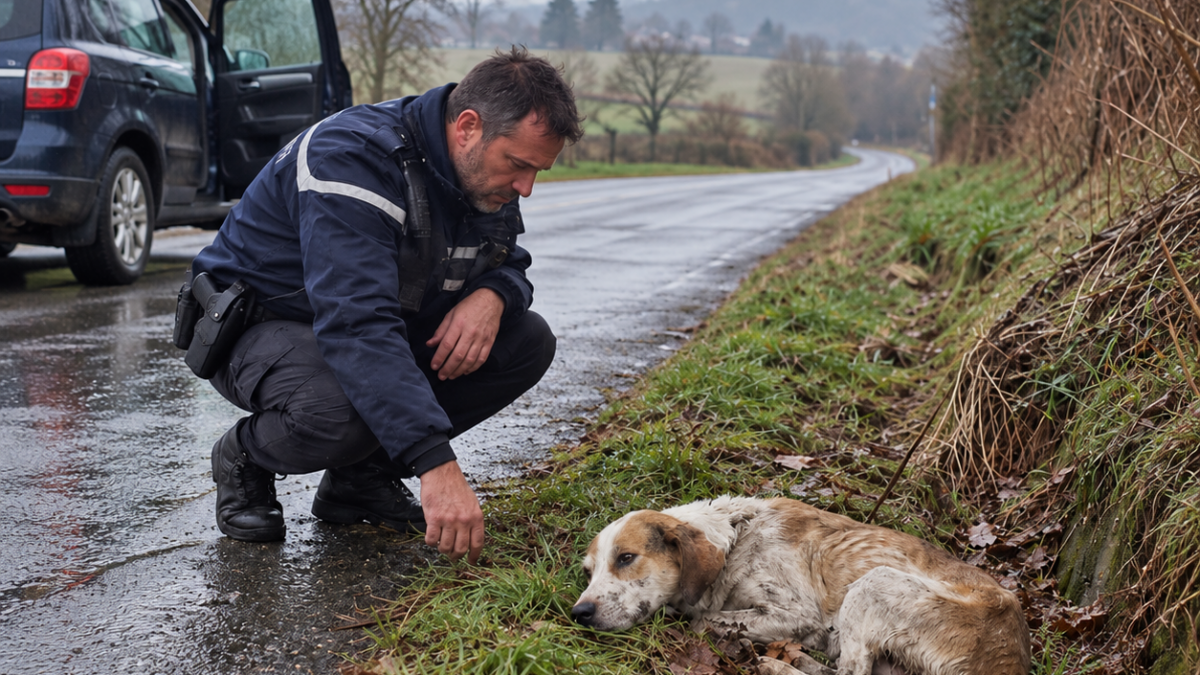
From the road, I thought the beige-and-white dog curled in the ditch had already died, but when I stepped off the shoulder her tail moved once through the wet grass, so weakly that I almost convinced myself I had imagined it.
She was little more than ribs and dirty fur, too exhausted to stand and barely strong enough to open her eyes, yet when I knelt beside her she tried to wag again—as if some part of her had spent whatever strength remained simply to greet the first person who stopped.
I believed my job that morning was to get one dying dog off a dangerous roadside, but what the veterinarian told me a few hours later—and what my partner and I found when we traced where she had come from—turned a routine call into something I would remember for the rest of my career.
“Wait,” I said. “She’s alive.”
I stood beside a narrow departmental road outside Limoges, one boot on the gravel shoulder and the other in wet grass.
My name is Marc Delorme. I was forty-two then and had spent fifteen years as a police brigadier in a small district in Haute-Vienne.
The dispatch that morning sounded ordinary.
**Animal, probably deceased, near roadway. Possible traffic hazard.**
I had answered calls like that dozens of times.
Usually, one look was enough.
This time, it wasn’t.
The dog lay tightly curled at the bottom of the ditch.
Tan-and-white coat.
Damaged ear.
Dust caked around her paws.
Her ribs showed so clearly beneath her skin that I could count them.
“Easy, sweetheart.”
Her eyelids opened.
She looked at me.
No growl.
No teeth.
No attempt to crawl away.
She simply watched.
Then her tail moved again.
A tiny sweep through the grass.
I remember forgetting to breathe for a second.
My partner, Julien Morel, arrived a few minutes later.
He stopped three steps from the ditch.
“She’s breathing?”
“Barely.”
He stared at her.
“How is she still wagging?”
“I don’t know.”
There was no collar.
No tag.
No bowl.
No blanket.
Nothing suggesting anyone planned to return.
We contacted animal protection and an emergency veterinary clinic, but waiting beside the road was not an option.
Her body temperature felt wrong beneath my hands—cold along her legs, feverishly warm near her chest.
When I slid my arms under her, I realized how little she weighed.
Far too little.
I expected panic.
Instead, her head dropped against my sleeve.
Her tail tapped once against my wrist.
That was the moment she stopped being “the animal from dispatch.”
I removed my service jacket and wrapped it around her.
Julien opened the patrol-car door.
“What are we calling her?”
I looked down.
Her eyes had almost closed again.
Under the jacket, the tip of her tail moved.
“Hope.”
Julien nodded.
“Yeah. That fits.”
I placed Hope on the passenger seat.
Then I drove.
Too fast, probably.
Still not fast enough.
Every few seconds I looked at her chest.
The movement was so slight that I had to stare to make sure she was still breathing.
The clinic was ready when we arrived.
Dr. Sophie Martin came outside with two technicians and a stretcher before I had fully shut off the engine.
They moved quickly.
Weight.
Temperature.
Blood glucose.
Hydration.
Gums.
Heart.
Lungs.
Signs of infection.
Every answer seemed worse than the last.
Severe emaciation.
Profound dehydration.
Anemia.
Muscle loss.
Parasites.
Multiple pressure sores and old abrasions beneath the dirty coat.
I stood near the treatment-room door while Hope disappeared beneath warmed blankets and IV lines.
Finally, I asked the only question I cared about.
“Can she survive?”
Dr. Martin looked at me for several seconds.
“The next twelve hours matter.”
“That bad?”
“She has almost no reserves left.”
I looked through the glass.
Hope’s head rested against my folded jacket.
Then Dr. Martin added quietly, “Marc, there’s something else.”
“What?”
She turned one of Hope’s front paws over.
The pad was cracked and raw.
Not from one morning beside a road.
From walking.
A lot.
“She didn’t collapse where you found her by accident,” Dr. Martin said.
I looked back toward Julien.
And for the first time that morning, I began wondering what Hope had been trying to get away from.
PART 2
Julien read my face immediately.
“You’re going back.”
“I’m asking questions.”
“That means you’re going back.”
“Probably.”
Dr. Martin stripped off one glove.
“Not yet.”
I looked at her.
“Why?”
“Because if you’re trying to understand what happened to this dog, the examination is part of the evidence.”
Evidence.
That word brought me back into my profession.
Until then, I had been reacting like anyone else might.
Starving dog.
Roadside.
Get her warm.
Keep her alive.
But Dr. Martin was right.
Hope’s body could tell us things.
Not everything.
But something.
“What can you tell?”
She motioned me closer.
Hope lay beneath a heated blanket.
An IV catheter had been placed in one front leg.
The fur around her neck and shoulders had been cleaned enough to reveal how sharp the bones underneath really were.
“You see the muscle loss?”
“Yes.”
“That didn’t happen in a weekend.”
“How long?”
“I can’t give you an exact timeline. But this is prolonged.”
“Weeks?”
“Almost certainly.”
“Months?”
“Possible.”
Julien moved closer.
“What about the sores?”
“Repeated pressure against a hard surface. Could be concrete, packed earth, wood. We don’t know.”
“Could she have been chained somewhere?”
Dr. Martin looked directly at him.
“She could have.”
“So—”
“That is not the same as saying she was.”
Julien stopped.
Dr. Martin pointed toward Hope’s damaged ear.
“This is old trauma. This abrasion on the flank is newer. The paw pads show extensive wear and cracking. She has parasites. Her coat condition suggests poor nutrition for a long time.”
“Stray?”
“Possible.”
“Neglected pet?”
“Possible.”
“Escaped from somewhere?”
“Possible.”
Julien sighed.
“So medically, everything is possible.”
“Medically, what I can tell you is that she has been severely underfed, dehydrated, and poorly cared for long enough for her body to start consuming itself.”
The room went quiet.
Dr. Martin lowered her voice.
“Do not make the dog tell you the story you already want to hear.”
I had heard versions of that warning in police training.
Do not build a conclusion first and collect facts second.
Still, when I looked at Hope, it was hard not to imagine someone watching her become that thin.
“Can we photograph the injuries?”
“Yes. I already documented everything clinically.”
“Thank you.”
“Marc.”
I stopped at the door.
“She may not make it.”
I looked back.
“I know.”
“No, I don’t think you do.”
Her tone was not cruel.
It was protective.
“She is responding to fluids, but we have to move slowly. A severely malnourished animal can deteriorate during refeeding if the body shifts electrolytes too quickly. Her heart is weak. Her temperature is unstable. Her glucose is low.”
I hated every word.
“Can I do anything?”
“Yes.”
“What?”
“Let us work.”
That was possibly the hardest instruction of the day.
Julien and I returned to the roadside around noon.
The ditch looked strangely ordinary without Hope inside it.
Wet grass.
Tire marks.
A few crushed wildflowers.
Traffic continuing as if nothing had happened.
I stood exactly where I had found her.
Julien looked around.
“What are we actually looking for?”
“Direction.”
“Helpful.”
I ignored him.
Hope had been on the ditch’s inner slope with her head angled toward the road.
That told us almost nothing.
Rain had softened the soil, though.
There were marks.
Some from us.
Some from wildlife.
A faint line of flattened grass continued down the ditch toward a hedgerow.
I followed it.
Julien came behind me.
About thirty meters farther down, the ditch narrowed beside an opening in the hedge.
“Could have come through there,” I said.
“So could every fox in Haute-Vienne.”
“True.”
We pushed through.
Behind the hedge ran an old farm track I had never noticed from the road.
The mud held dozens of impressions.
Tire tracks.
Boot prints.
Animal marks.
Nothing clear enough to identify.
We followed the track.
A hundred meters.
Then two hundred.
A rusted fence appeared.
Beyond it, an abandoned-looking agricultural property stretched up a low hill.
Old stone farmhouse.
Shutters closed.
Roof dark with moss.
One outbuilding partially collapsed.
Another standing behind it.
The place looked unused.
Then Julien stopped.
“What’s that?”
A length of chain lay partly buried in weeds near a fence post.
I put on gloves.
One end held a snap hook.
The other ended in an opened link.
Broken.
“Old,” Julien said.
“Maybe.”
A few feet away sat a blue plastic bowl.
Empty.
Green residue dried along the bottom.
Julien looked toward the buildings.
“That’s less old-looking.”
I photographed the bowl.
Chain.
Track.
Fence.
Everything visible from where we were.
Then a sound came from somewhere uphill.
Metal scraping.
We both turned.
Silence.
“Wind?” Julien asked.
“Could be.”
We did not enter the buildings.
Curiosity is not a warrant.
We returned to the vehicle and checked the property registry.
Owner: René Vautrin.
Seventy-one years old.
Primary residence outside the immediate district.
No registered business at the site.
No current agricultural operation.
Julien checked prior calls.
“Noise complaint eighteen months ago.”
“What kind?”
“Dogs barking.”
My head lifted.
“How many?”
“Caller didn’t specify.”
“Disposition?”
“Officer attended. No contact. Barking had stopped.”
“Anything else?”
“Nothing.”
We contacted the departmental animal protection service.
I spoke with Élodie Marchand, an inspector I had dealt with twice before.
“Starving dog?” she asked.
“Severe.”
“And you found chain and a bowl?”
“Visible from the track.”
“Any dogs audible now?”
“No.”
“Owner?”
“René Vautrin.”
She paused.
“I know the surname.”
“Why?”
“His nephew contacted one of our partner associations last year about surrendering two dogs.”
My stomach tightened.
“What happened?”
“He never followed through.”
“Name?”
“Thierry Vautrin.”
I wrote it down.
“Does he live there?”
“I don’t know.”
That was our first real thread.
Before we could pull it, dispatch redirected us to a road collision twelve kilometers away.
Two cars.
One minor injury.
Traffic control.
Statements.
Tow trucks.
Normal work.
But while I stood beneath flashing blue lights directing drivers around broken glass, Hope stayed in my mind.
Her tail against my wrist.
The chain.
The bowl.
The surname.
At four in the afternoon, my phone rang.
Dr. Martin.
I answered before the second ring.
“She’s alive?”
“Yes.”
My shoulders loosened.
“Stable?”
“More stable.”
“Eating?”
“A little.”
“How much?”
“Marc.”
“What?”
“You are questioning me like I committed the crime.”
“Sorry.”
“She licked a small portion voluntarily.”
“That’s good?”
“It’s good.”
“Temperature?”
“Better.”
“Glucose?”
“Improved.”
“Heart?”
“Still weak.”
I heard the warning in her voice.
Do not turn improvement into safety.
“Can I come?”
“After your shift.”
“I finish at seven.”
“Then seven-thirty.”
“Seven-ten.”
“Seven-thirty.”
She hung up.
At seven-twenty, I was standing in the clinic lobby.
Dr. Martin looked at the wall clock.
“You’re early.”
“Traffic was light.”
“You’re a terrible liar.”
She led me into the back.
Hope looked almost unchanged.
That was the first lesson of her recovery.
Saving a life rarely looks dramatic hour by hour.
She was still skeletal.
Still attached to fluids.
Still under blankets.
But when she heard my voice, her eyes opened.
“Hey.”
I crouched.
Her nose moved.
I extended two fingers through the kennel bars.
Hope smelled them.
Then rested her chin across them.
Her tail moved once against the bedding.
Dr. Martin smiled.
“She remembers you.”
“She met me for twenty minutes.”
“You were useful.”
“Very flattering.”
“Dogs are practical.”
I stayed ten minutes.
Dr. Martin removed me after twelve.
The next morning, René Vautrin answered my call.
He sounded elderly and irritated.
“This is about my property?”
“Yes.”
“I already told the municipality no one should be there.”
“We’re asking whether animals are being kept on the site.”
“Animals?”
“Dogs.”
“I don’t keep dogs.”
“When were you last at the property?”
“Summer.”
It was October.
“Does anyone else use it?”
Silence.
“Mr. Vautrin?”
“My nephew sometimes stores things there.”
“Thierry?”
Another silence.
“Yes.”
“What things?”
“Tools.”
“Vehicles?”
“Sometimes.”
“Dogs?”
“I don’t know.”
“You don’t know whether dogs are kept on property you own?”
“He is an adult man.”
“That doesn’t answer my question.”
René’s tone hardened.
“What exactly are you accusing him of?”
“I haven’t accused anyone of anything.”
“Then why are you calling me?”
“Because yesterday we found a dog near your property in critical condition.”
He said nothing.
“Beige-and-white female. Medium size.”
Another pause.
Then:
“I don’t know anything about that.”
But he had paused too long.
Not proof.
Just something I noticed.
Animal protection requested a formal site visit with René’s consent.
At first, he refused.
Then, after being told the alternative would involve additional administrative steps, he agreed.
He gave permission for access to the outbuildings.
That afternoon, Julien, Élodie, another animal welfare officer, and I returned.
The farmhouse itself was empty.
Dust on the floors.
Old furniture.
No sign anyone lived there.
The first outbuilding contained rusted tools.
Broken machinery.
Nothing.
The second smelled before we opened the door fully.
Urine.
Feces.
Wet straw.
Rot.
Élodie’s expression changed immediately.
“Gloves.”
We entered.
Improvised pens had been built from wooden pallets and wire livestock panels.
Six compartments.
Three appeared empty.
Each had worn bowls.
Dirty bedding.
Dark stains on concrete.
One contained a chain fastened to a wall ring.
I looked at the hook.
Similar style to the broken piece by the track.
Julien photographed everything.
Élodie crouched at one pen.
“Hair.”
Tan-and-white fur caught in the wire.
I thought of Hope.
No conclusion.
Not yet.
Then something scratched behind an interior partition.
All of us froze.
Again.
A faint movement.
Élodie lifted one hand.
“Quiet.”
We moved around the wall.
Three more pens.
In the far one, a black dog stood pressed against the back.
He wore a collar that looked far too tight.
He stared at us without barking.
Beside him, a brown older female lay curled on dirty straw.
Her head lifted.
Her body did not.
“Two,” Élodie said.
Then barking erupted from a separate shed.
Loud.
Frantic.
We moved quickly.
Two more dogs.
One brindle.
One white-and-black.
Both thin.
One had hair loss along the flanks.
The other had an untreated wound near the shoulder.
Four dogs alive.
None healthy.
Élodie immediately called for transport.
Julien walked back toward me.
“Hope came from here.”
It sounded obvious.
I still forced myself to answer correctly.
“Probably.”
He looked at the tan hair.
“The chain.”
“Probably.”
“Marc.”
“Probably is what we know.”
Because that was the job.
Still, inside I already believed it.
The four dogs were removed that afternoon.
The black male panicked when anyone reached for his collar.
Élodie eventually used a slip lead and patience.
The older brown female had to be carried.
When I lifted one end of the stretcher, I felt the same awful lightness I had felt with Hope.
Not as extreme.
Enough.
The white-and-black dog tried eating pieces of stale kibble from the floor even while we were moving around him.
The brindle female drank so fast from the first clean water offered that Élodie had to control the amount.
There were no heroics.
Just professionals doing unpleasant work.
Photographs.
Weights.
Evidence bags.
Transport crates.
Documentation.
Questions.
The property became an investigation.
Thierry Vautrin became central very quickly.
He arrived before we finished.
Blue van.
Work clothes.
Red face.
He jumped out and stopped when he saw the transport vehicle.
“What are you doing?”
I stepped toward him.
“Mr. Vautrin?”
“Yes.”
“I’m Brigadier Delorme.”
“I know who you are. Why are you taking my dogs?”
Élodie answered.
“Because they require immediate veterinary assessment.”
“They’re fine.”
The sentence was so detached from what stood behind us that even Julien looked away.
The brown female was being carried past at that moment.
Thierry pointed.
“She’s old.”
Élodie’s voice stayed calm.
“She cannot stand.”
“She has arthritis.”
“She also has severe weight loss.”
“I feed them.”
“How often?”
“Every day.”
Élodie looked toward the empty bowls.
“With what?”
Thierry’s jaw tightened.
“I don’t have to answer you.”
“You do not have to answer me now.”
She nodded toward the dogs.
“But they are being removed.”
“No.”
He stepped forward.
I blocked him.
“Sir.”
“This is my uncle’s property.”
“Your uncle authorized inspection.”
“He had no right.”
“He owns it.”
Thierry looked as though he had only just realized that point.
His hands clenched.
“They’re rescue dogs.”
Élodie stared at him.
“What organization?”
“My own.”
“Registered?”
“No.”
“Veterinary partner?”
“I handle things myself.”
“Adoption records?”
“Informal.”
“Food supply?”
“I buy food.”
“Vaccination records?”
Silence.
“Microchips?”
Silence.
She pointed toward the black dog.
“How long has that collar been on him?”
Thierry looked away.
That was when I knew his “rescue” explanation was not going to survive close examination.
The truth developed over the next two weeks.
Not all at once.
Thierry had started taking unwanted dogs from acquaintances.
One at first.
Then three.
Then more.
Some people paid him small amounts to take animals.
Others simply gave them away.
He posted occasionally on local classified pages claiming he rehomed dogs.
A few genuinely had been rehomed.
We confirmed two.
But the number entering his care exceeded the number leaving.
Food costs rose.
Veterinary care was avoided.
Conditions deteriorated.
Neighbors complained about barking.
Thierry moved the dogs farther behind the property.
He told himself the situation was temporary.
Then another dog arrived.
Then another.
By the time Hope was there, the structure had become a hidden holding area.
We found no evidence that Thierry had intentionally starved one specific dog as punishment.
The reality was less theatrical.
And in some ways more disturbing.
He had simply allowed conditions to collapse while continuing to take animals.
He could have stopped.
He could have called for help.
He could have surrendered them.
He did not.
Hope had been attached by chain after escaping the enclosure repeatedly.
Thierry admitted that during interview.
“She kept running.”
“Why?” I asked.
“She was nervous.”
“Or hungry.”
“I fed her.”
“The veterinarian estimates prolonged malnutrition.”
“She wouldn’t eat much.”
“What did you give her?”
“Dry food.”
“How often?”
“Every day.”
“How much?”
Thierry hesitated.
“Enough.”
“Define enough.”
“I didn’t measure it.”
“How many dogs were sharing?”
Silence.
“Mr. Vautrin?”
“Sometimes six.”
“And you still believe you gave enough?”
“I did what I could.”
That sentence stayed with me.
I did what I could.
People use it for two very different things.
Sometimes it means:
I tried everything.
Sometimes it means:
I stopped before admitting I had failed.
I pushed a photograph across the table.
Hope in the clinic.
Bones visible.
Thierry looked at it.
“That’s not how she looked.”
“When?”
“When she came.”
“How long before we found her?”
“Maybe two months.”
“So she lost that weight while under your care.”
He looked away.
I placed another photo down.
The broken chain.
“You recognize this?”
“No.”
“Same type as the wall attachment in the pen.”
“Lots of chains look like that.”
True.
Then we showed him the photograph of the beige fur caught in the wire.
Still not definitive alone.
Finally, the most important evidence came from Thierry himself.
“She probably broke out Sunday.”
Hope had been found Tuesday morning.
I looked at him.
“You just said you didn’t recognize her.”
He froze.
Silence.
Julien was sitting beside me.
Neither of us moved.
Thierry rubbed one hand across his jaw.
“I mean if that was her.”
“You called her ‘she.’”
“There were females.”
“Which female escaped Sunday?”
No answer.
“How did you know one escaped?”
“I noticed.”
“Why didn’t you report a missing dog?”
“She always came back.”
My hands tightened beneath the table.
Hope had walked until her pads cracked and then collapsed beside a road.
He had expected her to come back.
“Was she chained?”
“Sometimes.”
“Why?”
“I told you. She ran.”
“Why did she run?”
“I don’t know.”
That was as close to an admission as we ever got emotionally.
Not legally complete.
But enough for me to understand him.
He genuinely seemed to believe the dogs’ attempts to escape were a problem with the dogs.
The proceedings took time.
Animal welfare cases are not solved in a dramatic afternoon.
Statements were taken.
Veterinary findings documented.
Ownership questions resolved.
The dogs were legally removed from Thierry’s care.
Restrictions were eventually imposed on his ability to keep animals.
There were fines and formal penalties connected to neglect.
René cooperated after seeing the condition of the property himself.
I met him once at the site afterward.
He stood in the empty yard looking older than he had sounded on the phone.
“I should have checked.”
I did not answer immediately.
He looked at me.
“I thought Thierry was storing tools.”
“You knew he had dogs.”
“Not like that.”
“You suspected something.”
His eyes dropped.
“I knew there had been barking.”
“That’s not the same thing.”
“No.”
He rubbed his hands together.
“He’s my sister’s boy.”
There it was.
Family loyalty.
Embarrassment.
Avoidance.
All the ordinary human things that give dangerous situations room to continue.
“I did not want trouble,” René said.
“Sometimes not wanting trouble just gives it somewhere to hide.”
He nodded.
We did not need a speech beyond that.
The buildings were cleared.
The improvised pens dismantled.
No dogs returned.
Meanwhile, Hope was still fighting.
The investigation might have grown larger than her, but my emotional attention never moved far from the clinic.
On day two, she improved.
On day three, she developed diarrhea.
Dr. Martin called me.
“It may be parasites and diet adjustment.”
“May?”
“We’re testing.”
“Parvo?”
“We tested again.”
“And?”
“Negative.”
“Good.”
“Yes.”
“Then she’s okay?”
“No.”
I hated how often she said that.
Hope’s protein levels remained low.
Her anemia significant.
She tired after standing.
One morning, she tried to walk across the kennel and collapsed halfway.
Dr. Martin helped her up.
I watched through the glass.
“Why is she getting worse?”
“She isn’t necessarily.”
“She fell.”
“She has almost no muscle.”
“She stood yesterday.”
“Recovery is not a straight line.”
I turned away.
“That phrase should be illegal.”
“It remains true.”
Hope looked toward me.
Tail.
One small wag.
I went closer.
“You’re making me look dramatic.”
Another wag.
By the third evening, she accepted food voluntarily.
A small amount.
Then more.
On the fourth morning, Dr. Martin called at 6:35.
I answered half asleep.
“What happened?”
“Nothing.”
“You called me at six-thirty.”
“You told me to call when she finished a full measured meal.”
I sat up.
“She finished?”
“Yes.”
“All of it?”
“Yes.”
“How long ago?”
“Ten minutes.”
“Did she keep it down?”
“Marc.”
“I’m asking.”
“She is currently glaring at us because the bowl is empty.”
I laughed.
Actually laughed.
The first time since the roadside.
At the clinic that afternoon, Hope stood when I approached.
She was still shaky.
But she stood.
Her tail moved several times.
Dr. Martin leaned against the wall.
“You count them?”
“No.”
“You’re lying.”
“Three.”
She smiled.
“Four.”
Hope’s tail wagged again.
“Show-off.”
The black dog from the property was housed through a partner clinic.
His name became Jules.
The brown older female was called Margot.
The brindle became Nala.
The white-and-black male became Patch.
Élodie sent me their updates.
Jules required treatment for neck wounds and intense fear of restraint.
Margot had arthritis, dental disease, and malnutrition but responded well to pain management and food.
Nala’s skin condition improved.
Patch gained weight almost immediately.
One photograph showed him asleep in a foster home with his head inside an empty food bowl.
I sent it to Julien.
His reply:
**Clearly traumatized by lack of cuisine.**
I laughed.
Humor returned gradually.
That mattered too.
If rescue becomes only suffering, everyone doing it eventually breaks.
Hope remained hospitalized eleven days.
By the second week, she looked different.
Not healthy.
But alive in a way that no longer felt provisional every minute.
Her eyes followed movement.
She raised her head when technicians approached.
She ate.
She drank.
She stood.
On day ten, she barked once at a vacuum cleaner.
Dr. Martin found me in the waiting room.
“Your dog is becoming opinionated.”
“She’s not my dog.”
The receptionist looked up.
Dr. Martin smiled.
“Sure.”
“She belongs to the rescue.”
“Currently.”
“Don’t start.”
The next day she called.
“Discharge tomorrow.”
I went silent.
“Marc?”
“Where is she going?”
There was a longer silence.
Then:
“You visit her every day.”
“That doesn’t answer the question.”
“The association has foster options.”
“Good.”
“But she is most relaxed with you.”
“That’s not medical.”
“It is behaviorally relevant.”
“I work shifts.”
“Many people do.”
“I’ve never owned a dog.”
“You have been carrying dog treats in your pocket for eleven days.”
“That is operational.”
“Operational?”
“For Hope.”
Dr. Martin laughed.
“I can foster temporarily.”
“Of course.”
“Only until she’s fully stable.”
“Obviously.”
Hope came home with me the next afternoon.
Julien arrived before us carrying supplies.
Dog bed.
Bowls.
Blankets.
Medication.
Leash.
Prescription food.
“You bought all this?”
“I borrowed some.”
“The orthopedic bed?”
“Clinic recommendation.”
“Temporary foster dog with orthopedic bed.”
“Shut up.”
Hope entered my apartment slowly.
Her nose worked constantly.
Tile.
Wall.
Sofa.
Table leg.
Hallway.
She reached the new dog bed.
Smelled it.
Then lay down beside it on the floor.
Julien looked at me.
“Excellent purchase.”
“She’s confused.”
“She’s judging your taste.”
I put a blanket on the floor.
Hope shifted onto it.
“See?”
“Victory.”
The first week frightened me more than the clinic had.
At the clinic, professionals were watching.
At home, I was responsible.
I checked her breathing.
Water intake.
Food.
Stool.
Medication.
Walking.
Everything.
Dr. Martin became tired of my calls.
“Her nose is dry.”
“Normal sometimes.”
“She slept four hours.”
“She is recovering.”
“She didn’t finish breakfast.”
“How much did she eat?”
“Eighty percent.”
“Marc.”
“Yes?”
“Go to work.”
The first time I left Hope alone for two hours, I came home expecting disaster.
She was asleep.
I stood in the doorway.
She opened one eye.
Tail moved.
Then she went back to sleep.
I felt insulted.
By week two, she began following me from room to room.
Not close.
Always several feet behind.
Kitchen.
Hallway.
Living room.
Bedroom door.
If I stopped, she stopped.
If I turned suddenly, she sometimes froze.
So I learned to move more slowly.
Heavy boots bothered her.
I began taking them off near the entrance.
The first chain incident happened during a walk.
A farmer opened a metal gate nearby.
The chain rattled.
Hope dropped flat.
No warning.
Body against pavement.
Tail tucked.
Breathing fast.
I crouched.
“Hope.”
Nothing.
I did not pull.
Cars passed.
A cyclist looked at us.
We waited.
Eventually her eyes shifted toward me.
I moved backward.
One step.
She followed.
Another.
We turned around.
Took a different route.
At the next veterinary visit, I told Dr. Martin.
“Can trauma do that?”
“Yes.”
“Will it stop?”
“Maybe.”
“What do I do?”
“Do not make every walk an exam she can fail.”
I frowned.
“Meaning?”
“If she is afraid, give her distance. Do not drag her toward the trigger just to prove she can handle it.”
“So avoid chains forever?”
“No. Let her learn at a pace where she can still think.”
That advice changed how I treated her.
It also changed how I thought about fear generally.
Police work teaches you to move people toward compliance.
Hope taught me that force can destroy trust faster than patience can rebuild it.
We started with quiet streets.
Then busier ones.
Chains at a distance.
Work boots in controlled situations.
Men approaching sideways instead of head-on.
No reaching over her head.
No sudden touching while she slept.
Slowly, the world became larger.
Three weeks after Hope came home, she played.
I almost missed it.
I was sitting on the sofa completing paperwork.
She picked up a rolled sock from the floor.
I looked down.
“Drop that.”
She froze.
Sock in mouth.
Then she shook her head once.
The sock flapped.
Hope startled herself.
Then did it again.
I stared.
She lowered her front legs.
Rear end up.
Play bow.
I put the papers aside.
“Oh, now you’re a dog?”
Tail.
I reached.
She backed away.
I stopped.
Hope shook the sock again.
That was the beginning.
Within a month, she owned three toys.
Within two, she had preferences.
Rubber ball: acceptable.
Rope: good.
Stuffed duck: apparently priceless.
Julien bought the duck.
That became his argument that Hope loved him more.
“She sleeps with my gift.”
“She lives in my apartment.”
“Material evidence favors me.”
Hope adored him.
He came every Sunday with treats.
I told him to stop.
He did not.
Hope learned the sound of his car.
The moment it entered the street, she went to the window.
“I hate this.”
Julien scratched her ears.
“You’re jealous.”
“I feed her.”
“I bring cheese.”
“Exactly the problem.”
Then the rescue coordinator called.
“We have an adoption application.”
My chest tightened immediately.
“For Hope?”
“Yes.”
“That was fast.”
“It’s been almost two months.”
Had it?
Time had shifted.
Clinic days felt like years.
Home weeks vanished.
“What are they like?”
“Couple in their fifties outside Limoges. Fenced garden. Previous dog experience. No young children. Veterinary reference is excellent.”
Everything I should have wanted.
“What do they know about her?”
“Full history.”
“The chain fear?”
“Yes.”
“Men?”
“Yes.”
“Medical follow-ups?”
“Yes.”
I looked at Hope.
She was asleep with the stuffed duck under one paw.
“When?”
“Saturday.”
The meeting went well.
Too well.
The woman, Claire, sat on a bench and ignored Hope until Hope approached.
Her husband, Michel, did not reach.
He turned sideways.
Allowed Hope to smell him.
Then dropped a treat.
No pressure.
Hope accepted it after a minute.
Claire asked intelligent questions.
“What happens when she freezes?”
“Give her space.”
“Does she guard food?”
“No.”
“House trained?”
“Mostly.”
“Separation anxiety?”
“Some vigilance, but improving.”
“Does she need another dog?”
“No.”
“Does she sleep on furniture?”
I said, “No.”
Hope had slept on my sofa the previous night.
The coordinator looked at me.
I ignored her.
After thirty minutes, Hope lay near Claire’s shoes.
The coordinator whispered, “This is promising.”
I nodded.
My stomach felt terrible.
That evening, Hope followed me into the kitchen.
“You met nice people.”
Tail.
“They have a garden.”
Tail.
“Big one.”
Hope sat.
“I have a balcony.”
She yawned.
“This is not helpful.”
I tried imagining the apartment without her.
No bowl.
No leash.
No stuffed duck.
No tail at the door.
The silence felt wrong.
Then I felt guilty.
Fostering was supposed to be temporary.
Keeping animals because goodbye hurt could limit how many others a person helped.
But I was not an established foster.
I had not taken Hope as part of an ongoing system.
She came home because she trusted me.
That distinction mattered.
Still, I made myself think rationally.
Could I afford her?
Yes.
Could I provide care?
Yes.
Would work make it difficult?
Sometimes.
Could I manage?
Already was.
Did she seem secure?
Increasingly.
Did she have to leave for a “better” home simply because it had a garden?
No.
That night, Hope slept just inside my bedroom door.
At four in the morning, I woke.
She was looking at me.
“What?”
Tail moved against the floor.
I sighed.
“You’re staying.”
The next morning I called the coordinator.
“I want to adopt her.”
She laughed.
“Finally.”
“That sounds disrespectful.”
“Dr. Martin owes me twenty euros.”
“You were betting on this?”
“Nothing formal.”
“Unethical.”
“Do you want the paperwork or not?”
I signed the following week.
Hope became legally mine.
I thought the feeling would change dramatically.
It didn’t.
She ate breakfast.
Stole one sock.
Slept.
That was the beauty of it.
Home is rarely a dramatic moment.
Mostly it is the place where ordinary things repeat long enough to become safe.
Hope continued medical follow-ups.
Three months.
Six.
Her anemia resolved.
Protein levels normalized.
Parasites cleared.
She reached a healthy weight.
Her coat transformed.
The dull beige became warm tan and white.
Her eyes brightened.
Muscle returned.
One day, Dr. Martin compared her current photograph to intake.
I stared.
The roadside dog looked almost unreal.
“Was she really that thin?”
Dr. Martin looked at me.
“You were there.”
“I know.”
“Brains are strange.”
“What do you mean?”
“You’ve gotten used to seeing her healthy.”
I looked down.
Hope was trying to smell something under the exam table.
“Good.”
“Yes.”
That was exactly what I wanted.
The worst version of her should become unfamiliar.
The other dogs recovered too.
Jules took months to tolerate collars without panic.
His foster used a harness.
Eventually, he was adopted by a quiet couple with another calm dog.
Margot went to retired teachers who specialized in seniors.
Nala stayed with her foster family permanently.
Patch went to a small farm, where he slept indoors and spent days following his owner between barns.
Élodie sent photos.
I saved all of them.
Not because Hope had consciously saved those dogs.
She hadn’t.
She saved herself.
That was enough.
We followed the evidence.
Four more lives changed because she reached the road.
A year after Hope’s rescue, Julien and I passed the old property.
The sheds were being cleared.
One wall had already been demolished.
“Good,” Julien said.
I agreed.
He looked at me.
“You ever wonder if she remembers?”
“Here?”
“Yeah.”
“She hasn’t been back.”
“Would you bring her?”
“No.”
“Why?”
“What would she gain?”
He nodded.
That question became useful in many situations.
Humans often want symbolic closure.
Animals may not.
Hope did not need to face the shed again.
She needed a life far enough from it that eventually it became irrelevant.
And it did.
At two years, Hope became confident enough to greet visitors.
At three, she began sleeping on the sofa openly instead of jumping down when I entered.
At four, she learned how to open a partially closed kitchen door with her nose.
At five, she became obsessed with a bakery two streets away because the owner sometimes gave her a tiny piece of plain bread.
I changed walking routes to avoid it.
Hope memorized the alternative path and dragged me back toward the bakery.
“You’re exploiting an old man.”
Tail.
“You have food.”
Tail.
“This is corruption.”
The baker waved from the door.
“Hope!”
Traitor.
She became known in the neighborhood.
People who had never seen her at her worst knew only the healthy version.
I loved that.
To them, she was Marc’s dog.
The beige one with the damaged ear.
Friendly.
Cheese addict.
Nothing tragic.
That was success.
My work changed too.
Not officially.
No new policy.
No dramatic career transformation.
But I noticed animals differently.
A dog tied outside too long.
A cat trapped near a road.
A horse with no visible water.
Most situations were harmless once checked.
Some were not.
Once, during a domestic disturbance call, I noticed a terrier locked in a bathroom.
Thin.
Nails overgrown.
The primary call had nothing to do with the animal.
Before Hope, maybe I would have considered it secondary.
After Hope, I documented it.
Animal protection intervened later.
Another time, an elderly man was taken to hospital after a fall.
His dog remained inside the house.
The emergency team focused on the patient.
Correctly.
I remembered the dog.
We arranged temporary care.
Small things.
Not heroic.
Just noticing.
Julien teased me.
“You’re becoming Saint Francis.”
“Say that again and I’m transferring you.”
“You carry dog biscuits.”
“Operational.”
“Still using that word?”
“Still accurate.”
Hope visited the station occasionally.
She loved the reception staff.
Hated the sound of the metal holding cells.
The first time she heard a chain-like rattle in the evidence garage, she froze.
Years had passed.
Her body still remembered.
I immediately took her outside.
Julien followed.
“Still?”
“Still.”
Hope recovered quickly.
Five minutes later, she was sniffing grass.
That taught me something else.
Healing is not forgetting.
A scar can remain without controlling every day.
Hope could be terrified for thirty seconds and still have a good afternoon.
Humans tend to define recovery as the complete absence of old pain.
Dogs are more practical.
Sometimes recovery is simply returning to the present faster.
At six, Hope developed a mild limp.
I panicked.
Dr. Martin did X-rays.
“Arthritis beginning.”
“She’s six.”
“Estimated age six or seven.”
“That’s young.”
“It happens.”
“Could it be from the chain?”
“Maybe old strain contributed. Maybe genetics. Maybe nothing related.”
I hated uncertainty.
Hope did not.
She accepted medication hidden in cheese.
Our walks shortened slightly.
Her life remained good.
At seven, her muzzle started whitening.
Julien noticed first.
“Old lady.”
“Don’t call her that.”
“She has gray hair.”
“So do you.”
“Exactly. Old.”
Hope wagged at him.
“See? She agrees.”
At eight, I began thinking about retirement.
Mine.
Not hers.
Police work had changed.
Or I had.
Fifteen years became twenty.
Then twenty-three.
The road felt longer at night.
Paperwork felt heavier.
I had seen enough collisions, fights, frightened families, and things people do to one another when angry.
Hope was part of what made home feel different.
I would open the door after a difficult shift.
There she was.
No questions.
No need for explanations.
Tail.
Sometimes one wag.
Sometimes twenty.
It sounds sentimental.
It was also biological.
Dogs greet.
Dogs form attachment.
Dogs learn routine.
I knew that.
Knowing the mechanism did not reduce the effect.
One winter night, I returned after an especially ugly call.
A fatal collision.
Young driver.
Family notified.
The kind of shift that stays inside your chest.
Hope met me at the door.
I sat on the floor without removing my boots.
She smelled my sleeve.
Then lay beside me.
No performance.
No miracle.
Just weight against my leg.
I stayed there ten minutes.
Maybe fifteen.
Then I stood.
Fed her.
Took her outside.
Life resumed.
That was one of the things Hope gave me that I had not expected.
Routine after chaos.
Years earlier, I had carried her out of a ditch because she needed a bridge back into life.
Eventually, she became one for me too.
By the time she was ten or eleven, arthritis became more significant.
We used joint medication.
Rugs.
A ramp for the car.
Hope refused the ramp.
I demonstrated.
Julien witnessed this and nearly died laughing.
“You walked up it?”
“Yes.”
“For the dog?”
“She needed to see.”
“Marc, she knows what a ramp is.”
“She refused.”
“Because you looked ridiculous.”
Hope eventually accepted it after cheese was placed along each step.
Dignity had limits.
At twelve, she slept more.
Her hearing decreased.
Her appetite remained excellent.
Dr. Martin called her “medically elderly but professionally demanding.”
Hope ignored her.
At thirteen, kidney values began changing.
Not catastrophic.
Enough to monitor.
We adjusted diet.
More bloodwork.
More appointments.
I became exactly the kind of anxious owner Dr. Martin had predicted.
“She drank more yesterday.”
“How much?”
“I don’t know. More.”
“Measure.”
“I did.”
“Of course you did.”
“She stood slowly this morning.”
“She has arthritis.”
“Slower than normal.”
“How much slower?”
“Four seconds.”
Dr. Martin stared.
“You timed her.”
“I observed.”
“You timed her.”
Hope wagged.
Dr. Martin laughed.
“I have two difficult patients.”
Despite aging, Hope still enjoyed life.
That was our guide.
Food.
Short walks.
Smelling hedges for absurd lengths of time.
Sunlight.
Julien.
Cheese.
Sleeping on my old service jacket.
I had replaced the jacket years earlier.
The original one had a torn lining and faded fabric.
I kept it because Hope loved it.
Maybe it smelled familiar.
Maybe it was simply soft.
I never knew.
Near retirement, I finally brought Hope back to the road.
Not because she needed it.
Because I did.
We were off duty.
Late autumn.
Dry weather.
She was old enough that I helped her out of the car.
We walked maybe thirty meters.
Then stopped.
The ditch was there.
The same curve.
Same hedge.
Different year.
Hope smelled the grass.
No visible reaction.
No panic.
No recognition I could prove.
I stood beside her.
“This is where I found you.”
She sniffed a weed.
“You were terrible company.”
More sniffing.
“Very expensive too.”
Hope looked up.
Tail moved.
I laughed.
“Still doing that.”
She leaned against my leg.
I put my hand on her back.
For a minute, I could see both dogs at once.
The dying animal in wet grass.
The gray-muzzled old dog beside me.
One life.
Huge distance.
Cars passed behind us.
Nobody knew what the place meant.
Good.
We stayed five minutes.
Then left.
A few months later, I retired.
Julien gave a speech at the small station gathering.
I told him not to.
He did anyway.
He mentioned Hope.
Of course.
“Marc spent twenty-five years pretending he was not sentimental.”
People laughed.
“He failed when he named a dying dog Hope.”
More laughter.
I shook my head.
Hope was at home by then.
Too old for a crowded station event.
Julien raised a glass.
“To Marc. And to the dog who trained him.”
I objected.
Nobody listened.
Retirement gave Hope and me more time together.
Morning walks.
Slower.
Longer because she smelled everything.
Afternoons by the window.
Trips to the clinic.
Occasional drives with no purpose.
I realized how many years my schedule had been built around leaving.
Now I stayed.
Hope adjusted instantly.
The first week, she looked confused every morning when I did not put on uniform trousers.
Then she accepted the improvement.
At thirteen, she started having difficult days.
At fourteen—or close to it; her exact age was always an estimate—the difficult days became more frequent.
She stumbled occasionally.
Kidney disease progressed.
Her appetite fluctuated.
Dr. Martin and I had the conversation I had avoided for years.
“How do I know?”
“You know.”
“That’s not an answer.”
“It’s the honest one.”
“What signs?”
“Pain we can’t control. Inability to eat. No interest in what she normally enjoys. Persistent distress. More bad days than good.”
I looked at Hope.
She was asleep under the table.
“What counts as good?”
Dr. Martin smiled gently.
“For Hope? Cheese.”
I laughed.
“Yes.”
“As long as she still wants her life, we support it.”
That became our rule.
Hope still wanted cheese.
Still wanted the garden.
Still wanted Julien’s visits.
Still wagged.
So we continued.
Then one morning, she did not stand.
I found her awake on the old jacket.
Eyes clear.
Body unwilling.
I crouched.
“Hope.”
Tail moved.
One tap.
I knew.
I called Dr. Martin.
She heard my voice.
“I’ll meet you.”
The clinic room felt different that day.
Quiet.
No urgency.
That almost made it worse.
Hope rested on her blanket with my service jacket beneath her head.
Dr. Martin examined her.
Kidneys failing.
Weakness severe.
Pain increasing.
Could we hospitalize?
Yes.
Could we gain days?
Possibly.
Good days?
That was the question.
I sat beside Hope.
She looked at me.
Tail moved.
I laughed and cried at the same time.
“You’re impossible.”
Dr. Martin sat on the floor with us.
“She did that the first day.”
“I know.”
“You asked how she could still wag.”
“Julien did.”
“And you had no answer.”
“Still don’t.”
Hope’s breathing was slow.
I rubbed the damaged edge of her ear.
For almost nine years, I had been measuring distance from the ditch.
Weight gained.
Muscle returned.
Fear reduced.
Years lived.
Now the distance had run out.
I put my forehead against hers.
“Easy, sweetheart.”
Same words.
First day.
Last day.
I did not tell her she was brave.
Dogs do not need speeches.
I did not tell her she saved me.
That would have been more about me than her.
I simply stayed.
My hand on her shoulder.
Her head on the old jacket.
Dr. Martin waited until I nodded.
The medication was given.
Hope relaxed.
Her eyes became heavy.
Her tail moved one final time.
A small tap against the sleeve.
Then her breathing slowed.
Stopped.
The room became completely still.
I kept my hand on her.
A minute.
Five.
Maybe longer.
Dr. Martin remained silent.
Eventually she said, “Marc.”
I nodded.
“She had nine years.”
“I know.”
Nine years.
The number felt enormous and insufficient at the same time.
Almost nine years from a dog who had looked dead in a ditch.
Thousands of mornings.
Thousands of bowls filled.
Walks.
Toys.
Medical appointments.
Visitors.
Cheese stolen.
Brooms feared.
Chains avoided.
Ramps refused.
Socks stolen.
Tail wags.
That was what rescue had created.
Not immortality.
Time.
Enough time for the dying dog to become old.
That may be the greatest outcome anyone can ask for.
I had Hope cremated.
Her ashes stayed at home.
No large memorial.
No dramatic plaque.
I kept her collar.
The stuffed duck.
The old jacket.
The duck eventually fell apart.
The collar remained in a drawer.
The jacket stayed folded beneath it.
Julien came over a week later.
We sat in the kitchen.
Neither of us spoke about Hope for twenty minutes.
Then he said, “Remember the first thing I asked?”
“What?”
“How she could still wag.”
“Yes.”
“You never answered.”
“No.”
He drank coffee.
“Maybe she was just friendly.”
“Probably.”
He laughed.
“You hate when things become sentimental.”
“Yes.”
“Fine.”
He looked toward the empty place where Hope’s bed had been.
“Friendly dog.”
I smiled.
“Very.”
Months passed.
The apartment felt wrong.
No paws.
No bowl.
No need to step around a sleeping body.
I kept expecting Hope behind me.
Eventually, that stopped.
Not completely.
Just enough.
I did not adopt another dog immediately.
People asked.
I said no.
Not because Hope was irreplaceable in some dramatic sense.
Every animal is different.
Because I was not ready to structure my life around another animal yet.
That came later.
A year after Hope died, I volunteered occasionally with the same animal welfare association that had handled the seized dogs.
Transport.
Paperwork.
Nothing major.
Élodie was still there.
One afternoon she handed me a leash.
“Old shepherd mix. Foster transfer.”
“I’m not adopting.”
“I did not ask.”
“Just clarifying.”
The dog was twelve.
Gray.
Slow.
He climbed into my car.
Lay down.
I transported him forty minutes.
Nothing dramatic happened.
He went to his foster.
I went home.
That felt good.
Helping without needing the story to become mine.
Over time, I did more.
Not constantly.
Enough.
I learned Hope had changed me permanently in one specific way.
I noticed.
That was all.
A limping dog beside a road.
A cat under a parked car.
An empty water container during summer.
Most observations required nothing beyond checking.
Some required a phone call.
A few required action.
Attention became habit.
Years after retirement, I drove the departmental road again.
Alone.
I slowed near the ditch.
Not intentionally at first.
Then I realized where I was.
I pulled over safely.
The grass was high.
The old track behind the hedge still existed, but the property farther up had changed ownership.
A newer gate.
Clean field.
No dogs.
I stood beside the shoulder.
Cars passed.
I pictured Hope where I had first seen her.
Then something surprising happened.
The dying version of her did not stay in my mind.
It was replaced almost immediately.
Hope running toward me after my shift.
Hope carrying the stuffed duck.
Hope lying beside the bakery door waiting for bread.
Hope old and gray, leaning against me on that same roadside.
That was when I knew the rescue had finally reached its true ending.
The worst day was no longer the largest memory.
People who heard the story usually focused on the ditch.
Of course.
That was dramatic.
Dog thought dead.
Tail moves.
Police officer stops.
Hidden neglect site discovered.
Other dogs rescued.
Strong narrative.
But life is not only made of the dramatic pieces people retell.
Hope spent perhaps a few terrible months at that property.
She spent almost nine years with me.
The math mattered.
Her life after suffering became larger than her suffering.
That was the victory.
I walked down the shoulder until I reached the place where the hedgerow opened.
The chain was long gone.
Blue bowl gone.
Buildings changed.
Nothing left to collect.
Nothing left to investigate.
I stood there for a moment.
Then returned to the car.
Before getting in, I looked back.
Wet grass moved in the wind.
For a fraction of a second, I remembered that tiny tail movement.
One sweep.
Barely visible.
If I had not seen it, someone else might have.
Or might not.
I do not know.
I stopped creating alternate versions of the story years ago.
We had the version that happened.
I stopped.
She moved.
I carried her.
She lived.
Four other dogs came out.
Then nearly nine years passed.
That was enough.
At home, I opened the drawer containing Hope’s collar.
The old service jacket was folded beneath it.
I lifted it.
The fabric smelled like fabric now.
Nothing else.
Time had removed whatever scent she once left.
I ran my thumb along the sleeve.
That first day, her tail had tapped my wrist there.
One time.
I remembered thinking:
How does she still have enough strength to do that?
Years later, the question seemed less important.
The fact that she did it was enough.
She was alive.
I noticed.
Everything else came after.
And whenever someone asks me why I still slow down when I see something motionless near the side of a road, I think of Hope.
I think of the difference between “probably dead” and alive.
Sometimes the difference is enormous.
Sometimes it is no bigger than a tail moving once through wet grass.
[END OF STORY]








