PART 2: She Kept Trying to Jump the Wall Until Her Starving Body Finally Gave Out—Then I Learned Why She Was So Desperate to Escape
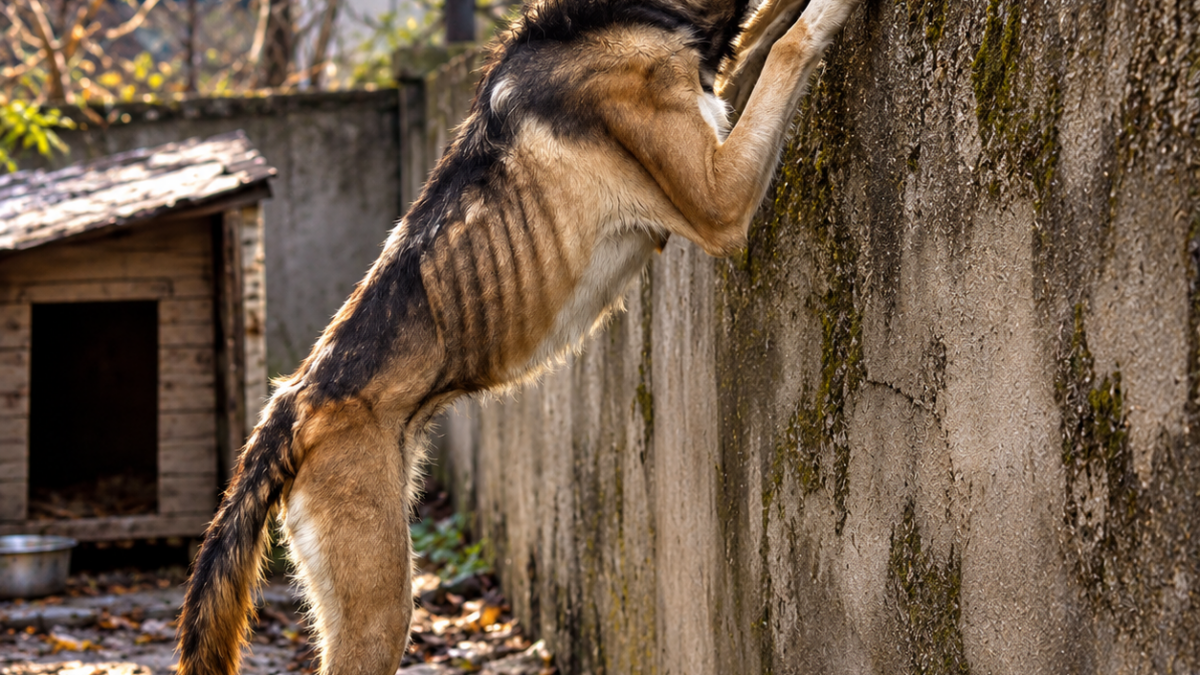
The first time I saw the starving dog throw herself against the concrete wall, she hit it chest-first, dropped onto the dirt, and lay there so still that I thought I had just watched her die.
Then, after several terrible seconds, she dragged herself back onto trembling legs, backed up three steps, and tried to jump again even though every rib showed beneath her skin and there was nothing in her yard except an empty bowl, a rusted chain, and a man inside the house who had stopped caring whether she ate.
I thought she was simply trying to escape hunger, but when she finally collapsed beneath that wall and I climbed into the yard to save her, I found something beside the back door that explained why she had been risking what little life she had left to get out.
My name is Rachel Monroe, and I lived three houses down from that yard.
The dog’s name, I later learned, was Daisy.
Months earlier, she had been beautiful.
A strong tan-and-white mixed breed with a broad chest, bright brown eyes, and the kind of tail that made her whole body move when someone approached.
By the time I really noticed her, that dog was disappearing.
At first, I told myself she was naturally thin.
Then I saw her ribs.
Then her hips.
Then the way her legs shook when she stood.
Her owner, Gary Holt, lived alone in the small brick house behind the high concrete wall. Most people on our street knew he drank. Trucks sometimes sat outside at two in the morning. Music played until sunrise. Empty liquor bottles appeared in his recycling bin faster than groceries ever did.
I had seen Daisy waiting near his back door dozens of times.
Always watching.
Always listening.
But somewhere during that summer, she stopped waiting at the door.
She started watching the wall.
The wall was nearly six feet high.
For a healthy dog, maybe possible.
For Daisy in that condition, impossible.
Still, she tried.
She would step backward, gather herself, run three or four shaky strides, and jump.
Her paws would scrape concrete.
Then she would fall.
The first time I witnessed it, I hurried to the fence.
“Hey! Sweetheart!”
Daisy lifted her head.
I could see her breathing from across the yard.
“Don’t do that again.”
Of course she didn’t understand.
She stood.
Backed up.
Jumped again.
I started leaving food near a gap beneath the side gate.
At first it disappeared overnight.
Then Gary found me doing it.
“What are you doing?”
I stood quickly.
“Feeding your dog.”
“She has food.”
I looked toward Daisy’s bowl.
Empty.
Dry.
There wasn’t even water in it.
“She doesn’t look like she has food.”
Gary’s face changed.
“You need to stay off my property.”
“She’s starving.”
“She’s sick.”
“What kind of sick?”
“That’s none of your business.”
He stepped toward me.
I backed away, but I didn’t leave immediately.
“When did a veterinarian see her?”
“Go home, Rachel.”
The fact that he knew my name bothered me.
I went home.
Then I called animal control.
Someone came two days later.
Gary answered the door.
I watched from my kitchen window.
The officer stayed maybe fifteen minutes.
Daisy did not leave with him.
That evening, Gary put plywood across the gap beneath the gate.
My stomach sank.
Three mornings later, I heard the impact again.
Thud.
I ran outside.
Daisy was lying beneath the wall.
This time she did not stand.
“Daisy!”
Her name had come from a neighbor who remembered her from before Gary’s wife left.
I called again.
No movement.
I shouted toward the house.
“Gary!”
Nothing.
I climbed onto a garbage bin, pulled myself over the wall, and dropped into the yard.
Daisy’s eyes opened when I touched her.
Barely.
“Hey. I’m here.”
Her body felt frighteningly light.
Then I looked toward the back door.
Beside it sat a plastic food container.
Inside was dog kibble.
Full.
Unopened.
On top of it rested a handwritten note.
I picked it up.
And after reading the first line, I understood that Daisy’s empty bowl had never been an accident.
PART 2
The note said:
**STOP FEEDING HER. SHE NEEDS TO LEARN.**
For several seconds, I simply stared at the handwriting.
I read it again.
Not because the words were difficult.
Because my brain kept trying to make them mean something less terrible.
They didn’t.
The container beneath the note held enough kibble to feed Daisy for weeks.
It was sitting three feet from an empty bowl.
A second bowl held a thin ring of dried mineral residue where water had evaporated.
Daisy lay behind me in the dirt, too weak to stand.
My hands started shaking.
I took out my phone.
First, photographs.
The note.
The food.
The bowls.
Daisy.
The yard.
Then I called 911 because at that point I wasn’t going to gamble on another routine animal-control visit.
The dispatcher asked whether I was in immediate danger.
“I’m in my neighbor’s yard.”
“Did you have permission to enter?”
“No.”
“Why did you enter?”
“His dog collapsed. She’s starving.”
The dispatcher paused.
“Is the owner present?”
“I don’t know.”
“Can you leave the property safely?”
I looked at Daisy.
“No.”
“Ma’am—”
“I’m not leaving her.”
I expected an argument.
Instead she said, “Stay where you are if you feel safe. Officers are on the way. Do not enter the residence.”
“I won’t.”
I hung up and called the emergency veterinary clinic we used for our own dog years earlier.
They told me not to give Daisy a large amount of food.
That surprised me.
“She’s starving.”
“Exactly. Severely malnourished animals can become dangerously ill if re-fed too quickly. Water in small amounts if she can swallow. Keep her warm. Get her transported.”
I took off my sweatshirt and slid it beneath Daisy’s head.
Her eyes tracked me.
“You were trying to get out, weren’t you?”
One ear moved.
“That’s what all that jumping was.”
Her tail did not move.
She didn’t have the strength.
I found an old plastic measuring cup near the hose, rinsed it, and brought her a small amount of water.
She tried to lift her head.
Couldn’t.
I held the cup near her mouth.
She licked.
Slowly.
Three times.
Then stopped.
“Okay.”
I pulled it away.
“You don’t have to do everything at once.”
The back door opened.
I turned.
Gary Holt stood there.
Barefoot.
T-shirt wrinkled.
Eyes red.
He looked first at me.
Then Daisy.
Then the food container.
“What the hell are you doing?”
I stood.
“Your dog collapsed.”
“Get out of my yard.”
“Police are coming.”
His expression changed instantly.
Not fear.
Anger.
“You called the cops?”
“Yes.”
“Over a dog?”
I looked at Daisy.
“Over what you did to her.”
“You don’t know anything.”
I held up the note.
His eyes locked on it.
“That yours?”
“Put that down.”
“No.”
“That’s my property.”
“Good. You can explain it to the police.”
He came down the two back steps.
I backed away.
“Stop.”
“You’re trespassing.”
“You’re right.”
That surprised him.
“I’ll explain why.”
“You think you can break into my yard and steal my dog?”
“I’m not stealing her.”
“She’s mine.”
His.
That word.
Not Daisy.
Not she.
Mine.
Property.
Control.
Gary moved closer.
Daisy made a sound.
So faint I almost missed it.
A whine.
Gary stopped.
Then looked at her.
For a moment—just one—I thought I saw something like shame cross his face.
Then it disappeared.
“She does this.”
“What?”
“Acts weak.”
I stared at him.
“She acts weak?”
“She’s manipulative.”
I genuinely did not know what to say.
Gary pointed at Daisy.
“She refuses to eat.”
“There’s no food in her bowl.”
“Because she spills it.”
“There’s no water either.”
“She knocks it over.”
“Then you refill it.”
“She needs to learn.”
I held up the note.
“Learn what?”
His jaw clenched.
“Discipline.”
Daisy tried to move.
Her front paws scraped dirt.
She wanted away from his voice.
That was the moment my anger became something colder.
Not explosive.
Clear.
A police cruiser pulled up out front.
Then another vehicle.
Animal control.
Gary heard the doors.
He looked toward the house.
“You did this.”
“No.”
I looked at Daisy.
“You did.”
Officer Melissa Grant entered through the side gate after Gary unlocked it.
An animal-control officer named Ben Alvarez followed.
I recognized Ben.
He was the same officer who had come after my first complaint.
He recognized me too.
His face tightened when he saw Daisy.
“This is the same dog?”
“Yes.”
He crouched beside her.
For several seconds, he said nothing.
Then:
“Jesus.”
Gary crossed his arms.
“She’s sick.”
Ben looked up.
“With what?”
“I told you before.”
“No, you told me she had stomach problems and was being seen by a vet.”
“She is.”
“Which veterinarian?”
Gary hesitated.
“I don’t remember the name.”
Officer Grant looked at him.
“You don’t remember your veterinarian’s name?”
“It’s a clinic.”
“Which clinic?”
“I’d have to look.”
Ben examined Daisy without moving her more than necessary.
He looked at her gums.
Skin.
Nails.
Then the bowls.
Then the unopened food container.
Then the note.
“Did you write this?”
Gary said nothing.
Officer Grant asked again.
“Mr. Holt, did you write this note?”
“I was trying to stop people from feeding my dog.”
“Why?”
“Because she has dietary issues.”
Ben stood.
“What dietary issue requires starvation?”
Gary’s head snapped toward him.
“I never said I starved her.”
Ben pointed toward Daisy.
“I’m looking at the evidence.”
Gary became louder.
“That woman has been feeding her junk through my fence.”
“I gave her dog food.”
Gary ignored me.
“She interfered with training. Every time Daisy whines, somebody gives her something. She needs structure.”
Ben’s expression changed.
“Your dog can barely lift her head.”
“You don’t know her.”
“No,” Ben said. “But I know a body-condition score of one when I see it.”
Gary stared at him.
Officer Grant asked, “Will you voluntarily release the dog for emergency veterinary treatment?”
“No.”
Everything stopped.
Ben looked at him.
“What?”
“She’s my dog.”
“She needs immediate care.”
“I can take her.”
“Then why haven’t you?”
Gary’s mouth tightened.
“I said I’ll handle it.”
Officer Grant stepped slightly closer.
“Mr. Holt, this is where you need to listen carefully.”
Her voice remained calm.
“The animal-control officer is documenting a medical emergency and probable neglect. If you refuse voluntary transport, we can seek emergency seizure authority.”
“You’re going to steal my dog?”
“No. We are going to prevent an animal from dying.”
Gary’s face reddened.
“I want all of you off my property.”
Ben looked at Officer Grant.
She nodded slightly.
Then Ben took photographs.
Many.
Daisy from every angle.
Bowls.
Food.
Note.
Yard.
Plywood over the gate opening.
Scratch marks on the concrete wall.
That last part stopped me.
Dozens of marks.
Daisy’s claws.
Different heights.
Different days.
A history of attempts.
Ben ran his fingers over them.
“She’s been doing this for a while.”
I said, “Months.”
Gary looked at me.
“Shut up.”
Officer Grant turned.
“Don’t speak to her that way.”
“She’s lying.”
“About what?”
“She hates me.”
“I barely know you.”
“You keep watching my house.”
“I keep seeing your dog starve.”
Officer Grant stepped between us.
“Enough.”
Twenty minutes later, after a supervisor was consulted and emergency authorization obtained, Daisy was placed on a stretcher.
It took two officers to move her because her condition made rough handling dangerous.
When Ben lifted one side, Daisy’s eyes opened.
She looked toward me.
I walked beside the stretcher.
“You’re okay.”
Her ear moved.
Gary stood near the back door.
For the first time since police arrived, he looked uncertain.
“Where are you taking her?”
“North County Emergency Veterinary Center,” Ben said.
“I’m coming.”
Officer Grant looked at him.
“You can follow, but you will not interfere with treatment.”
Gary pointed at me.
“She’s not coming.”
I laughed once.
Nobody else did.
Ben said, “Rachel is a witness. She can go wherever she wants.”
Gary’s eyes met mine.
There was something in them I didn’t like.
“You should’ve stayed out of this.”
Officer Grant heard him.
“Mr. Holt.”
He looked away.
I followed Daisy to the clinic.
The veterinary staff moved fast.
A technician took the stretcher.
Another asked questions.
How long without food?
Unknown.
Vomiting?
Unknown.
Diarrhea?
Unknown.
Urination?
Unknown.
Known medical history?
Unknown.
That was what neglect looked like on a clipboard.
Unknown.
Unknown.
Unknown.
Dr. Elena Morris examined Daisy.
She was perhaps forty, with silver beginning at her temples and a blunt way of speaking that I came to appreciate very quickly.
“She’s critical.”
Ben stood beside me.
“How critical?”
“Severe emaciation, dehydration, muscle wasting, probable anemia, possible organ compromise. Her heart rate is weak. Body temperature is low.”
“Can you save her?”
Dr. Morris looked at Daisy.
“We’re going to try.”
Gary arrived ten minutes later.
The front desk would not let him into treatment.
He argued.
Loudly.
I stayed in the consultation room with Ben.
We could hear him through the wall.
“That’s my dog.”
Then the receptionist:
“Sir, lower your voice.”
“I have rights.”
Then Officer Grant’s voice.
“Not here, you don’t.”
Silence.
Dr. Morris came back after initial bloodwork.
Her expression was serious.
“Her liver values are abnormal. Kidney values elevated. Some of that may improve with hydration. Some may not.”
Ben asked, “How long does a dog have to be underfed to look like this?”
“Not days.”
“Weeks?”
“At minimum.”
“Months?”
“Very possible.”
I thought about summer.
The wall.
The jumps.
The empty bowl.
“I called before.”
Dr. Morris looked at me.
“I know.”
The guilt arrived instantly.
I should have called more.
I should have climbed the wall earlier.
I should have taken pictures earlier.
I should have—
Ben interrupted the thought.
“Rachel.”
I looked at him.
“You called.”
“Once.”
“Twice.”
“Not enough.”
“You don’t get to take his choices and make them your failure.”
I hated the sentence because it sounded like something people say when they want grief to become neat.
But later, I realized he was right.
At that moment, I didn’t.
“I watched her try that wall for weeks.”
Ben nodded.
“You also documented it.”
“After.”
“You fed her.”
“He blocked the gap.”
“And you called us.”
“You left her there.”
The second the words left my mouth, I regretted them.
Ben’s face changed.
He looked toward the floor.
“Yes.”
I swallowed.
“I’m sorry.”
“No.”
He shook his head.
“You’re right.”
“That’s not what I meant.”
“It should be.”
He leaned back against the wall.
“I did a welfare check. Gary showed me dog food. Told me Daisy had chronic digestive disease. The bowl had food when I arrived.”
My stomach tightened.
“What?”
“He staged it.”
“I don’t know.”
“You saw food.”
“Yes.”
“Water?”
“Yes.”
“Daisy?”
“She was thin.”
“How thin?”
“Not this thin.”
“Did you ask for vet records?”
“I told him we would need documentation if there was another complaint.”
“But you left.”
“Yes.”
He looked at me.
“I’ve replayed that visit since I saw her today.”
There are moments when anger has somewhere obvious to go.
Then there are moments when everyone in front of you is already carrying enough of their own.
I said quietly, “He knew you were coming.”
Ben frowned.
“What?”
“Maybe.”
“How?”
I thought about it.
“When I called animal control the first time, did they contact him before the visit?”
Ben’s expression sharpened.
“Our office may call to confirm access.”
“So he had time.”
Ben took out his phone.
“I’m checking.”
That became important later.
Much more important than either of us understood then.
Daisy survived the first six hours.
Then her blood pressure dropped.
Dr. Morris warned us she might arrest.
She didn’t.
They stabilized her.
She received carefully controlled fluids.
Electrolyte correction.
Warming support.
Medication.
Food did not begin with a full bowl.
It began with tiny measured portions.
Dr. Morris explained refeeding syndrome to me.
“When the body has been starving, suddenly giving too many calories can shift electrolytes dangerously. Feeding her has to be medical treatment.”
I stared at the small syringe of nutritional support.
All those weeks of hunger.
Now even food could hurt her if given too quickly.
That felt unfair.
Gary remained in the waiting room until Officer Grant told him to leave.
Before he went, he looked at me.
“Happy?”
I stared at him.
“What?”
“You got what you wanted.”
I genuinely couldn’t understand.
“What do you think I wanted?”
“My dog taken.”
“She’s dying.”
“Because you fed her garbage.”
Something inside me snapped.
I stood.
Officer Grant moved immediately.
“Rachel.”
But I was already speaking.
“Do you know what she did every day?”
Gary laughed bitterly.
“What?”
“She tried to climb that wall.”
His face changed slightly.
“She kept throwing herself against concrete because whatever was outside that yard felt safer than staying with you.”
“Dogs jump fences.”
“She couldn’t even stand.”
“You don’t know why she did it.”
“No.”
I stepped closer.
“But I know she kept trying.”
Officer Grant put a hand between us.
“That’s enough.”
Gary looked at me.
“You think you’re saving her?”
“I hope so.”
“She’ll die anyway.”
The words hit hard.
Officer Grant turned on him.
“Leave.”
“I’m just saying—”
“Now.”
Gary left.
Daisy did not die.
Not that night.
At 3:40 in the morning, Dr. Morris found me asleep in a chair.
“Rachel.”
I woke instantly.
“What?”
“She’s awake.”
I stood.
“Can I see her?”
“For a minute.”
Daisy lay beneath blankets.
An IV line ran into one front leg.
Her eyes were open.
Not bright.
But open.
I approached slowly.
“Hey.”
One ear shifted.
I held my hand near her nose.
She sniffed.
Then, impossibly, her tail moved.
One weak tap against the blanket.
I covered my mouth.
Dr. Morris smiled.
“That’s the most movement she’s given us.”
I touched Daisy’s head.
“You made it through tonight.”
Her eyes closed.
But the tail moved once more.
The next morning, Officer Grant called.
“Rachel, we need a statement.”
“I already gave one.”
“More detail.”
“Why?”
“Because this is getting bigger.”
I sat up.
“What happened?”
“There’s a discrepancy in the welfare-check record.”
“What kind?”
“Gary was contacted twenty-three minutes before Officer Alvarez arrived.”
I remembered the full food bowl Ben had seen.
“So he knew.”
“Yes.”
“What exactly was he told?”
“That an animal welfare complaint had been received and an officer needed access to inspect the dog.”
“He had twenty-three minutes to put out food and water.”
“That’s possible.”
“Possible?”
“Rachel, evidence first.”
I was beginning to hate that phrase.
“What else?”
“Did you ever take video of Daisy jumping at the wall?”
My stomach tightened.
“I think so.”
I searched my phone.
Months of photos.
Work.
Family.
Screenshots.
Then I found one.
Daisy near the wall.
Date from six weeks earlier.
I had recorded because I wanted to show animal control what she was doing.
Twenty-eight seconds.
Daisy backed up.
Jumped.
Hit concrete.
Fell.
Waited.
Stood again.
The bowl was visible in the background.
Empty.
I sent it.
Then found another.
Three weeks later.
Same wall.
Thinner dog.
Same empty bowl.
Sent that too.
Officer Grant texted:
**Keep searching. Do not edit or post anything.**
I did.
Five videos.
Nine photos.
Different dates.
The prosecution would later call them a timeline.
To me, they became evidence of how long I had watched without understanding how close she was to death.
Then another neighbor came forward.
Mr. Lewis from across the alley.
Retired truck driver.
He had security cameras because someone had stolen tools from his garage the previous year.
One camera captured part of Gary’s back yard.
Not enough to see everything.
Enough to see the wall.
Enough to see Daisy.
Mr. Lewis had weeks of footage stored in the cloud.
Animal control obtained it.
What they found made even Ben go quiet.
Daisy was outside almost constantly.
Day.
Night.
Rain.
Heat.
Sometimes Gary came out.
Sometimes he carried a bowl.
Often he didn’t.
On several days, the footage showed Daisy standing near the back door for hours.
Then walking to the wall.
Then trying to jump.
Again.
Again.
Again.
One clip showed Gary coming outside after she fell.
For one hopeful second, I thought he was checking on her.
Instead he pointed toward the ground near the door and yelled.
Audio wasn’t clear.
Then he kicked the empty bowl across the patio.
Daisy flinched and retreated.
No direct physical strike.
No dramatic beating.
Something colder.
Indifference.
The police later searched the house under warrant after enough probable cause accumulated.
They found alcohol everywhere.
Empty bottles.
Boxes.
Receipts.
But also something more relevant.
Dog food.
Multiple unopened bags.
Veterinary supplements.
Old prescription containers.
And Daisy’s records.
She had no diagnosed digestive disease.
None.
Her last veterinarian visit had been fourteen months earlier.
At that visit, she weighed fifty-eight pounds.
At the emergency clinic, she weighed twenty-seven.
Less than half.
Dr. Morris read the previous records.
“She was healthy.”
“Yes.”
“Normal bloodwork.”
“Yes.”
“Normal weight.”
“Yes.”
I looked through the observation window at Daisy.
“So he lied.”
“Yes.”
The veterinarian’s voice became hard.
“He knew what a healthy version of this dog looked like.”
That mattered.
Neglect can hide behind ignorance.
He didn’t have that excuse.
Then investigators found text messages.
Gary had sent them to his sister, Michelle.
Months earlier:
**Dog won’t stop begging.**
Michelle:
**Maybe because she’s hungry?**
Gary:
**She eats enough. She’s just annoying.**
Later:
**She tried jumping the wall again.**
Michelle:
**Then take her inside.**
Gary:
**She needs to learn where she belongs.**
Then one that changed the tone of the entire case:
**If people keep feeding her through the fence, she’ll never stop begging. I’m cutting her back until she learns.**
Cutting her back.
Not forgetting.
Not accidentally failing.
A decision.
Control.
The note by the food container no longer stood alone.
It matched his messages.
He had intentionally restricted food.
Why?
That was the question everyone asked.
The answer turned out to be uglier because it was so small.
Gary’s drinking had worsened after his wife, Allison, left.
Daisy had originally belonged to both of them.
When Allison moved out, she wanted Daisy.
Gary refused.
Not because he loved the dog more.
Because Allison did.
That came from divorce messages later obtained through legal discovery.
Allison had written:
**Please let me take Daisy. You’re barely home and she’s attached to me.**
Gary replied:
**She stays here.**
Allison:
**This isn’t about the dog.**
Gary:
**She’s mine too.**
Then:
**You don’t get to take everything.**
Daisy had become leverage.
A living piece of a broken marriage.
Allison moved two states away to stay with family.
She believed Daisy was still being cared for.
Gary sent occasional old photographs when she asked.
Old.
That mattered.
One photograph he sent in August showed Daisy healthy and muscular.
Metadata revealed it had been taken the previous winter.
He had been hiding her decline.
When Officer Grant contacted Allison, she drove eight hours overnight.
I met her at the veterinary clinic.
She walked into the lobby and stopped when she saw Daisy through the glass.
Then she made a sound I will never forget.
Not a scream.
Not exactly.
A breath collapsing.
“That’s not her.”
She put both hands over her mouth.
“That’s not Daisy.”
I stood beside her.
“It is.”
“No.”
Her knees buckled.
I caught her elbow.
“She was fifty pounds.”
“I know.”
“She was strong.”
“I know.”
Allison cried so hard the receptionist brought tissues and then quietly moved away.
When Daisy heard her voice, everything changed.
Her head lifted.
Allison stepped into the treatment room.
“Daisy?”
The dog’s ears went forward.
“Baby?”
Daisy tried to stand.
Her legs failed.
Dr. Morris moved to support her.
Allison dropped to her knees.
Daisy crawled.
Actually crawled.
Two weak pulls of her front legs.
Then pressed her head into Allison’s chest.
The tail moved.
Once.
Again.
Then faster.
Allison sobbed into Daisy’s neck.
“I’m sorry.”
Daisy licked her chin.
Barely.
“I’m so sorry.”
I walked out.
That moment belonged to them.
Later, Allison found me near the vending machines.
“You’re Rachel?”
“Yes.”
She hugged me before I could answer anything else.
Tight.
Desperate.
“Thank you.”
I stood awkwardly.
“I just—”
“You called.”
“I should’ve called sooner.”
She pulled back.
“No.”
Her eyes were red.
“You called.”
I recognized the sentence.
Ben had said something similar.
Maybe eventually I would learn to accept it.
Allison told us the history.
Daisy had been rescued as a puppy from a rural shelter.
She and Gary adopted her six years earlier.
For most of that time, Gary was functional.
He drank too much on weekends.
Then more.
Then daily.
After he lost his warehouse job, the drinking became constant.
Arguments.
Money.
Broken promises.
Allison left after Gary punched a hole in a bedroom door during a fight.
“He never hit me,” she said.
Then looked at Daisy through the glass.
“I used to say that like it meant everything was okay.”
Her voice broke.
“I wanted to take Daisy.”
“Why didn’t you?”
“Because Gary threatened to report my car stolen.”
I frowned.
“What?”
“The title was in both our names. He said he’d fight every piece of property in the divorce. My lawyer told me not to escalate before temporary orders.”
“You could’ve called animal control.”
“I didn’t know.”
She looked at me.
“He kept sending me pictures.”
Old pictures.
Carefully chosen.
The cruelty became even more calculated.
Gary wasn’t simply too drunk to notice Daisy starving.
He noticed enough to conceal it.
Why restrict food deliberately?
Investigators believed it began as punishment for begging and attempts to escape.
But addiction had warped everything else.
He resented feeding her.
Resented cleaning.
Resented vet costs.
Resented the fact that neighbors were helping.
Each time someone fed Daisy through the fence, Gary interpreted it as challenge.
His response was more control.
Less food.
Blocked gate.
Restricted water.
The wall became Daisy’s only visible exit.
And she kept trying.
Gary was arrested on felony animal cruelty charges after veterinary evidence, video, texts, and witness statements accumulated.
The news spread through the neighborhood.
Then local media picked it up.
I hated that.
Not because he deserved privacy.
Because Daisy became a headline.
**STARVING DOG TRIES TO ESCAPE ABUSIVE HOME**
People shared my wall-jumping video.
I had given it to investigators.
Somehow it reached the news.
Watching strangers comment under it made me sick.
“Why didn’t anyone help sooner?”
“Neighbors are just as guilty.”
“Who films instead of rescuing?”
That one hit hardest.
I stopped reading.
Then started again.
Bad idea.
My daughter Emma called.
“Mom, stop reading comments.”
“How do you know?”
“Because you always do this.”
“Do what?”
“Punish yourself after something already hurts.”
I sat at my kitchen table.
“I watched her.”
“You helped her.”
“Eventually.”
Emma sighed.
“Mom.”
“What?”
“If you’d climbed that wall the first time, Gary could’ve called police on you, taken Daisy inside, moved her, anything.”
“He might’ve.”
“You kept evidence.”
“I didn’t know I was keeping evidence.”
“Doesn’t matter.”
I looked toward the window.
Gary’s house sat dark.
Crime-scene tape had been removed.
The yard was empty.
The wall remained.
Scratch marks still visible.
“I should’ve done more.”
Emma said quietly, “Maybe everybody can always imagine doing more after they know how bad it was.”
That stopped me.
After.
Once the ending is visible, earlier decisions look obvious.
They weren’t obvious then.
That did not erase regret.
It put it in proportion.
Daisy spent twelve days hospitalized.
Day four, she stood without assistance for seven seconds.
Allison recorded it.
Daisy rose.
Shook.
Looked toward her.
Then sat down abruptly.
Allison laughed and cried.
“Seven seconds.”
Dr. Morris said, “Tomorrow we try eight.”
Day five, Daisy ate from a bowl.
A tiny measured portion.
She finished it.
Then looked for more.
That nearly broke all of us.
For weeks, hunger had been unanswered.
Now food existed.
But still in controlled amounts.
Dr. Morris knelt beside her.
“I know, sweetheart.”
Daisy licked the bowl.
“You’ll get more later.”
Allison asked, “Does she understand?”
“No.”
“That seems cruel.”
“It feels cruel.”
Dr. Morris looked at Daisy.
“But her body needs us to go slowly.”
Day six, the kidney values improved.
Day seven, liver markers started normalizing.
Day eight, she walked twelve steps.
Day nine, she wagged her tail when Ben visited.
That surprised me.
Ben looked like he might cry.
“I’m the guy who left you there.”
Daisy walked toward him.
He crouched.
“I’m sorry.”
She sniffed him.
Then licked his hand.
Ben sat on the floor.
I turned away.
Humans crave punishment.
Dogs often offer contact instead.
That doesn’t erase responsibility.
But it can make responsibility heavier.
Ben requested an internal review of the first welfare check himself.
The department changed policy afterward.
For severe weight-loss complaints, officers had to document body-condition score photographically and verify veterinary claims instead of accepting them verbally when possible.
Advance notice for welfare inspections became more limited in urgent cases.
Gary’s lie exposed a procedural weakness.
The department closed it.
That mattered.
Allison wanted Daisy back.
Legally, it was complicated.
Divorce.
Ownership.
Criminal seizure.
Temporary custody.
For weeks, Daisy remained under protective hold with a foster organization after discharge.
A woman named Linda Park took her.
Linda was sixty-three, retired from nursing, and had fostered medically fragile dogs for twelve years.
The first time I visited Daisy there, I almost didn’t recognize the environment.
Soft rugs.
Low bed.
Water in three locations.
Baby gates.
Quiet.
Daisy slept under a blanket.
Linda whispered, “She startles when people move near her bowl.”
I swallowed.
“Guards food?”
“Not aggressively.”
“What does she do?”
“Freezes.”
Linda demonstrated later.
She placed the measured meal down.
Daisy approached.
Ate fast.
Linda shifted one foot.
Daisy stopped instantly and backed away.
Head low.
Linda sat.
“See?”
Daisy watched.
Waited.
Linda moved away.
Only then did she return to the food.
“She thinks someone will take it.”
“Yes.”
“How long until that stops?”
Linda shrugged.
“Maybe weeks. Maybe years. Maybe never completely.”
I hated that.
Gary’s punishment would eventually have an end date.
Daisy’s nervous system might remember forever.
Linda worked gently.
No reaching toward the bowl.
No standing over Daisy while she ate.
Meals at predictable times.
Water always available.
Eventually Daisy stopped freezing.
Then something else happened.
She started sleeping beside the back door.
Linda thought she wanted outside.
She opened it.
Daisy walked into the fenced yard.
Looked around.
Then immediately studied the fence.
My stomach tightened when Linda told me.
“Did she try to jump?”
“No.”
Not yet.
Two days later, she did.
The foster fence was wooden.
Five feet.
Daisy backed up.
Tried.
Her body was stronger but still thin.
She hit the boards and fell.
Linda called me because she knew the history.
I arrived twenty minutes later.
Daisy stood near the fence.
Looking up.
Same posture.
Same calculation.
My throat closed.
“Daisy.”
Her head turned.
She wagged.
I walked toward her.
“No.”
She looked back at the fence.
I understood something then.
Escape had become a learned survival strategy.
Walls meant trapped.
Outside meant possible safety.
Even in a safe place, her body didn’t know the difference yet.
Linda and I installed visual screening, added a second interior barrier, and kept Daisy on leash in the yard until she relaxed.
A trainer specializing in trauma cases came.
His name was Marcus Reed.
He did not talk about dominance.
Did not talk about obedience first.
He talked about predictability.
“Her brain learned that human control equals loss of resources.”
Allison asked, “Can that be fixed?”
“Changed.”
“Not fixed?”
Marcus shook his head.
“Don’t think of her as broken.”
I liked him immediately.
He continued.
“She adapted to survive. Now we teach her different things work here.”
Food comes.
Water stays.
Doors open.
Hands don’t take.
People return.
It took months.
Gary’s criminal case moved slower.
His attorney argued alcoholism.
Depression.
Job loss.
Impaired judgment.
All true.
The prosecution never claimed alcohol caused nothing.
They claimed impairment did not transform deliberate deprivation into accident.
The texts mattered.
The hidden food mattered.
The fake veterinary story mattered.
The old photos sent to Allison mattered.
The note mattered.
**STOP FEEDING HER. SHE NEEDS TO LEARN.**
That note eventually became the center of the courtroom.
The trial started eight months after Daisy’s rescue.
By then she weighed forty-six pounds.
Still below her old healthy weight.
But strong.
Coat shining.
Muscle returning.
She did not attend court.
Thank God.
Animals do not need to sit through human explanations of what happened to them.
I testified first among the neighbors.
The prosecutor asked how long I had observed Daisy.
“Several months.”
“What did you see?”
“Weight loss. Empty bowls. Repeated attempts to jump the wall.”
“Why did those attempts concern you?”
“She was too weak to make it.”
“Did she stop trying as she became weaker?”
“No.”
“What happened the day she was rescued?”
“She jumped. Fell. Didn’t get up.”
I described climbing the wall.
Finding the food.
The note.
Gary confronting me.
The defense attorney stood.
“Ms. Monroe, you entered private property without permission.”
“Yes.”
“You had complained about Mr. Holt previously.”
“Yes.”
“You disliked him.”
“By the end, yes.”
“When you entered his yard, did you know whether Daisy had been offered food earlier that day?”
“No.”
“Did you know whether she had eaten?”
“No.”
“So your claim that she was intentionally starved is not based on seeing Mr. Holt withhold every meal.”
“No.”
The attorney seemed pleased.
Then I added:
“It’s based on the dying dog, empty bowls, full food container, note telling people not to feed her, months of photographs, his messages, the veterinarian’s findings, and his lies about medical treatment.”
The attorney looked at the judge.
“Move to strike the narrative response.”
Sustained in part.
I was told to answer only the question.
Fine.
Dr. Morris testified later.
The defense tried to suggest disease.
“Could cancer cause this degree of weight loss?”
“Yes.”
“Could gastrointestinal disease?”
“Yes.”
“Could endocrine disease?”
“Yes.”
“Did you test for those conditions?”
“Yes.”
“And?”
“No evidence supporting them as the primary cause.”
“Is it possible an underlying disease existed?”
“Medicine rarely deals in absolute impossibility.”
The defense attorney nodded.
“So yes.”
Dr. Morris remained calm.
“You asked whether it was possible. Yes. You did not ask whether it was supported by Daisy’s medical data.”
The attorney stopped.
Dr. Morris continued after the prosecutor redirected.
Daisy’s dramatic improvement with controlled nutrition and hydration strongly supported prolonged inadequate intake as the principal problem.
Then Allison testified.
That was harder.
She described the marriage.
Gary’s drinking.
Her attempts to take Daisy.
The old photographs.
The messages.
The defense attorney pushed.
“You left the dog in Mr. Holt’s care.”
Allison’s face tightened.
“Yes.”
“You knew he drank.”
“Yes.”
“You knew the marriage was unstable.”
“Yes.”
“Yet you moved away.”
I wanted to stand.
The prosecutor objected to relevance.
The judge allowed limited questioning because ownership and knowledge mattered.
Allison looked at the attorney.
“I left because the house was unsafe.”
“But you left Daisy.”
“Yes.”
“Why?”
“Because Gary refused to let me take her, and I believed the photographs he sent.”
The attorney held up one.
“You accepted this without confirming the date.”
“Yes.”
“You didn’t visit.”
“No.”
“You didn’t contact neighbors.”
“No.”
He sat down.
Allison stared at her hands.
I hated him for making her say it.
Then the prosecutor stood.
“Ms. Holt, who made the decision to restrict Daisy’s food?”
“Gary.”
“Who wrote the note?”
“Gary.”
“Who blocked the gate gap?”
“Gary.”
“Who falsely claimed Daisy was under veterinary treatment?”
“Gary.”
“Who sent you old photographs representing Daisy’s current condition?”
“Gary.”
“Did you instruct him to withhold food?”
“No.”
“Did you know he was doing it?”
“No.”
The prosecutor sat.
Responsibility returned to where it belonged.
Ben testified about his first inspection.
He did not protect himself.
That impressed me.
“I accepted the owner’s explanation.”
“Would you handle the same case differently now?”
“Yes.”
“Why?”
“Because he staged compliance.”
“Did you have evidence of that at the time?”
“No.”
“What did you see?”
“Food. Water. A thin dog. Owner claiming veterinary care.”
“What did later evidence show?”
“The food and water were likely placed shortly before my visit. No veterinary care existed.”
The defense asked whether Ben’s failure to remove Daisy earlier meant her condition could not have appeared severe.
Ben replied:
“It means I made the wrong assessment with incomplete information.”
No excuse.
Just truth.
Then Gary testified.
That surprised everyone.
Defendants often don’t.
His attorney clearly believed the jury needed to see addiction rather than a monster.
Gary looked different.
Sober.
Thinner.
Suit.
Hair cut.
He had entered treatment after arrest.
He spoke about alcoholism.
Blackouts.
Depression.
The divorce.
Losing work.
He cried.
I believed the tears.
That was uncomfortable.
He admitted being angry at Daisy.
Admitted reducing food.
But insisted he did not intend serious harm.
“I thought she was begging because neighbors kept feeding her.”
The prosecutor asked:
“Why was begging a problem?”
“Because she was disobedient.”
“Disobedient how?”
“She scratched doors. Tried to get out.”
“Why did she try to get out?”
“I don’t know.”
The prosecutor walked to the evidence table.
Picked up a copy of the note.
“You wrote this?”
“Yes.”
“‘Stop feeding her. She needs to learn.’ What did she need to learn?”
Gary looked down.
“To stop begging.”
“How do you teach a dog not to beg?”
“Consistency.”
“By not feeding her?”
“No.”
“But you did.”
“I cut portions.”
“From what amount?”
“I don’t remember.”
“How often did you feed Daisy during the final month?”
“I don’t remember.”
“Once a day?”
“Sometimes.”
“Every other day?”
“I don’t know.”
“Every three days?”
His lawyer objected.
The prosecutor changed direction.
“Did you ever go twenty-four hours without feeding Daisy?”
Gary closed his eyes.
“Yes.”
“Forty-eight?”
Long pause.
“Yes.”
“Longer?”
His voice dropped.
“Maybe.”
The courtroom went silent.
“Did Daisy have constant water?”
“I tried.”
“That wasn’t the question.”
“No.”
The prosecutor showed the text:
**I’m cutting her back until she learns.**
“What does ‘cutting her back’ mean?”
Gary stared.
“Less food.”
“So this was deliberate.”
“I didn’t mean to starve her.”
“You deliberately gave her less food.”
“Yes.”
“You deliberately told neighbors not to feed her.”
“Yes.”
“You deliberately blocked the opening through which they were giving food.”
“Yes.”
“You deliberately lied to animal control about veterinary treatment.”
Gary’s attorney objected.
Overruled.
Gary swallowed.
“Yes.”
“You deliberately sent your estranged wife old photographs of Daisy.”
“Yes.”
“Why?”
“So she wouldn’t start another fight.”
“Because if she saw Daisy’s actual condition?”
Gary stared at the floor.
“She would take her.”
“And you didn’t want that.”
“No.”
“Why?”
His face twisted.
“She had already left.”
The prosecutor waited.
“What did Daisy have to do with that?”
Gary said nothing.
“Mr. Holt?”
“She wasn’t taking everything.”
There it was.
The whole ugly center.
Not hunger.
Not training.
Not begging.
Possession.
The courtroom became completely still.
The prosecutor did not rush.
“So you kept Daisy because your wife wanted her.”
“I loved Daisy.”
“Did you?”
His lawyer objected.
Sustained.
The prosecutor rephrased.
“What actions did you take during the final months that you believe demonstrated care?”
Gary began crying.
No answer.
The prosecutor returned to the table.
One final photograph appeared on the monitor.
Daisy the morning I found her.
Twenty-seven pounds.
Head on dirt.
Scratch marks visible behind her.
“Is this what you meant to happen?”
Gary whispered:
“No.”
“Did your choices cause it?”
His lawyer objected.
The judge allowed the answer if Gary could answer personally.
He looked at the image.
Then said:
“Yes.”
For the first time, my anger shifted.
Not disappeared.
Changed.
Justice wasn’t going to be Gary denying forever.
It was Gary sitting beneath fluorescent courtroom lights and finally saying yes.
Yes.
My choices did this.
The jury convicted him on the most serious animal cruelty count and related neglect charges.
Sentencing came later.
He received incarceration, probation after release, mandatory substance-abuse treatment, mental-health requirements, and a long prohibition on owning or caring for animals.
He was also ordered to pay restitution toward Daisy’s treatment.
Would he ever pay all of it?
Probably not.
That wasn’t the important part.
At sentencing, the judge said something I remembered:
“Addiction may explain impairment. It does not convert sustained control over a dependent animal’s access to food and water into an accident.”
Gary’s attorney asked for mercy based on recovery.
The judge acknowledged his treatment progress.
Then still imposed consequences.
Both could exist.
That mattered to me.
The most dramatic moment, though, did not happen in court.
It happened afterward.
Allison had been awarded permanent custody of Daisy once the criminal seizure and divorce issues were resolved.
She had moved back to our state.
Rented a small house with a fenced yard.
Lower fence.
Wooden.
No concrete.
She spent weeks preparing.
Food station.
Water.
Soft bed.
Ramps.
Camera.
Trainer.
Everything.
The day Daisy moved in, I went with Linda.
Allison opened the car door.
Daisy stepped out.
She weighed fifty-one pounds.
Almost healthy.
Her coat was thick again.
Her legs no longer trembled.
She walked toward the house.
Stopped at the yard.
Looked at the fence.
My stomach tightened.
Daisy approached it.
Allison stopped breathing.
I could see it in her shoulders.
Daisy sniffed the boards.
Walked along them.
Then backed up.
I whispered, “No.”
Allison’s eyes filled.
Daisy took three steps backward.
My heart pounded.
She looked toward the fence.
Then toward Allison.
Allison crouched.
“Daisy.”
One second.
Two.
Daisy ran.
Not toward the fence.
Toward Allison.
She crashed into her chest.
Allison fell backward laughing and crying while Daisy covered her face in kisses.
I started crying before I realized it.
Linda touched my arm.
“That’s the new pattern.”
I looked at her.
“What?”
“She has somewhere safer to run now.”
That was the ending I had wanted without knowing it.
Not Daisy finally clearing a wall.
Daisy no longer needing to.
Recovery was not perfect.
The first time Allison accidentally let Daisy’s food bowl run empty for twenty minutes past schedule, Daisy panicked.
Paced.
Whined.
Scratched at the pantry.
Allison cried afterward.
Marcus, the trainer, told her:
“You cannot promise her she’ll never feel fear again.”
“What can I promise?”
“That fear will be answered differently here.”
So they built routines.
Breakfast at seven.
Dinner at six.
Water always available.
A small snack after evening walk.
Predictability.
Daisy stopped guarding the pantry.
Stopped checking the fence constantly.
Stopped sleeping beside exits.
She discovered couches.
Then pillows.
Then Allison’s bed.
Within six months, she became intolerably spoiled.
I mean that lovingly.
She refused dry treats if chicken existed.
Stole blankets.
Pretended not to hear the word “off.”
Developed an obsession with riding in the car.
The first time I visited and saw her sleeping belly-up across the sofa, I laughed.
“What?”
Allison smiled.
“She’s comfortable.”
“Apparently.”
Daisy opened one eye.
Saw me.
Then stood.
Tail moving.
She came over.
I crouched.
“Hey, wall jumper.”
Allison said, “We don’t call her that.”
“Sorry.”
Daisy pressed her head into my chest.
For several seconds, I was back in the yard holding a body made of bone.
Then she stepped on my foot.
Hard.
“Ow.”
Allison laughed.
“She’s fifty-six pounds now.”
“I noticed.”
Daisy looked excellent.
The old wall at Gary’s house eventually came down.
The property was sold after foreclosure.
New owners renovated.
One Saturday, a construction crew demolished the back wall.
I watched from my porch.
Concrete fell in sections.
Dust rose.
Scratch marks disappeared.
I expected satisfaction.
Instead I felt strange.
That wall had become a symbol in my head.
Prison.
Barrier.
Evidence.
But Daisy no longer lived behind it.
It mattered less than I thought.
Emma came outside.
“You okay?”
“Yeah.”
“You’re staring.”
“They’re taking down the wall.”
She looked.
“Good.”
“Maybe.”
She frowned.
“What?”
“I thought I’d feel more.”
“Mom.”
“Yeah?”
“It was concrete.”
I laughed.
“Thank you for your emotional insight.”
“I’m serious. Daisy’s not there.”
Exactly.
Healing had already moved somewhere else.
Ben Alvarez stayed in animal control.
He almost quit after Daisy’s case.
I learned that later.
Instead, he became a field-training officer.
New officers had to review Daisy’s first welfare inspection as part of training.
Not to shame him.
To teach what staged compliance can look like.
He showed recruits the photographs.
Full bowls during inspection.
Empty bowls in weeks of neighbor footage.
Vet claim.
No vet record.
Then he told them:
“Trust is not verification.”
He invited me once to speak.
I declined.
“What would I say?”
“Tell them what you saw.”
“You do that.”
“Tell them what it feels like when someone calls and nothing changes.”
That got me.
So I went.
I told a room of twelve officers about the wall.
The jumps.
The first call.
Watching Daisy remain.
The plywood over the gate.
The day she collapsed.
At the end, one young officer asked:
“What should we have done differently?”
I looked at Ben.
He answered.
“Document body condition. Verify medical claims. Understand that food visible during an announced visit doesn’t establish routine access. Talk to neighbors. Look for patterns.”
Then he added:
“And if you’re uncertain, uncertainty is not the same as okay.”
I remembered that.
Allison changed too.
For years she carried guilt.
Sometimes worse than mine.
“She was mine,” she said once.
“So was Gary’s.”
“I should’ve fought harder.”
“You were leaving an unsafe marriage.”
“I left her.”
“You were manipulated.”
“I still left her.”
There was no perfect sentence to erase that.
Eventually she started volunteering with a domestic violence organization.
Not as an animal advocate at first.
As a survivor.
Then she helped create a local partnership for people afraid to leave because of pets.
Temporary foster placement.
Confidential veterinary boarding.
Pet protective orders where legally available.
Because one reason Allison stayed as long as she did had been fear Gary would use Daisy.
And one reason she left without Daisy had been not knowing where to put her safely.
Years later, I attended the program’s first fundraiser.
A banner displayed photographs of animals fostered while their owners escaped unsafe homes.
Dogs.
Cats.
Two rabbits.
One elderly parrot.
Daisy’s picture was on the corner.
Healthy.
Tongue out.
No starvation image.
Allison insisted.
“She is not the worst thing that happened to her.”
I loved that.
Gary served his time.
Completed treatment.
Stayed sober, according to what Allison heard through legal channels.
I never contacted him.
He never contacted me.
One letter went to Allison.
She showed me only one sentence:
**I used Daisy to punish you, and then I punished Daisy when I couldn’t punish you anymore.**
She folded it.
“That’s the first time he said it.”
“How do you feel?”
“I don’t know.”
“You don’t have to answer him.”
“I know.”
She eventually sent one response:
**Stay sober. Never own another animal. Leave us alone.**
That was all.
Not forgiveness.
Not revenge.
Boundary.
Gary complied.
Daisy grew older.
Her body recovered from starvation, but the months of malnutrition probably shortened something.
Dr. Morris couldn’t say what.
At age ten, Daisy developed arthritis earlier than expected.
At eleven, kidney values began changing.
Nothing dramatic.
Age arriving.
That was its own victory.
For a while, I had thought Daisy’s story would end beneath a concrete wall.
Instead she got old.
Slow walks.
Gray muzzle.
Joint supplements.
Expensive orthopedic bed she frequently ignored in favor of Allison’s couch.
Every year on the rescue anniversary, Allison sent me a photo.
Year one: Daisy in a red bandana.
Year two: Daisy asleep on a pile of laundry.
Year three: Daisy beside a Christmas tree.
Year four: Daisy with a ridiculous birthday hat.
Year five: Daisy sitting near the wooden fence, not looking at it.
That one made me cry.
At twelve, Daisy’s hearing faded.
Her appetite remained excellent.
Very excellent.
She would stand in the kitchen pretending nobody had fed her.
Allison texted:
**The formerly starving dog has become a food criminal.**
I replied:
**Let her.**
At thirteen, Daisy stopped wanting long car rides.
She preferred sun patches.
Quiet mornings.
Meatballs.
Allison knew the end was approaching before anyone said it.
One spring afternoon, I visited.
Daisy walked toward me slowly.
No run.
Tail still moving.
I sat on the floor.
She placed her head in my lap.
Her ribs were hidden beneath healthy weight and soft old-dog fur.
I stroked her ears.
“Remember me?”
Allison smiled.
“She does.”
“How do you know?”
“She only drools on people she trusts.”
I looked down.
My jeans were wet.
“Wonderful.”
Daisy slept.
Allison sat across from me.
“Do you ever think about the wall?”
“Sometimes.”
“I don’t.”
That surprised me.
“Really?”
“I think about the day she chose me instead of the fence.”
I smiled.
“Better memory.”
“Yes.”
Then she said:
“I used to think freedom was getting her out of Gary’s yard.”
“And now?”
“Freedom is her knowing she doesn’t have to leave mine.”
Daisy lived another eight months.
One December morning, she refused breakfast.
For Daisy, that was serious.
Allison called Dr. Morris.
Tests.
Kidney failure had progressed.
Treatment options existed.
Hospitalization.
Fluids.
Possible temporary improvement.
Allison asked the hardest question.
“Are we helping her live or helping ourselves avoid losing her?”
Dr. Morris answered honestly.
“Both are possible. But right now, I think the second is becoming larger.”
Allison called me.
I drove over.
Daisy lay on her bed near the window.
Sunlight touched her face.
She lifted her head when I entered.
Tail moved once.
“Hey.”
I sat.
She rested her chin on my hand.
Allison knelt beside us.
“She fought so hard.”
I looked at Daisy.
“No.”
Allison frowned.
“What?”
“She fought when she had to.”
I stroked Daisy’s head.
“She doesn’t have to now.”
We cried.
Dr. Morris came to the house.
No clinic.
No steel table.
No fluorescent lights.
Daisy stayed on her blanket.
Allison fed her one final bite of chicken.
Daisy ate it.
Of course.
Then another.
Dr. Morris laughed softly.
“Still Daisy.”
When the time came, Allison held her.
I sat beside them.
Daisy’s breathing slowed.
Allison whispered:
“You’re safe.”
Those words.
The words Daisy should have been able to believe from the beginning.
“You’re safe.”
One breath.
“You don’t have to go anywhere.”
Another.
“You don’t have to climb anything.”
Daisy’s eyes closed.
Then she was gone.
No wall.
No hunger.
No fear.
Just the woman she had loved before everything went wrong holding her at home.
We sat there a long time.
Allison cried into Daisy’s fur.
I put one hand on her back.
I thought about the first time I saw Daisy fail to clear the wall.
Back then I believed the tragedy was that she was too weak to escape.
Years later I understood the better ending was never that she finally became strong enough to jump higher.
It was that she found a life where nothing on the other side of a wall was more important than what waited beside her.
Allison had Daisy cremated.
A month later, she invited me over.
In the backyard, near the wooden fence, she had planted a small flowering dogwood.
Beside it sat a flat stone.
No dramatic inscription.
Just:
**DAISY**
**SHE MADE IT HOME**
I stood there with my hands in my coat pockets.
“That’s perfect.”
Allison nodded.
“She did.”
The wind moved through the bare branches.
Beyond the fence, people walked dogs.
Cars passed.
Children shouted somewhere down the block.
All the sounds Daisy once heard from behind concrete.
Life on the other side.
Except now, standing in Allison’s yard, I realized something.
For years I had thought Daisy kept jumping because the street meant freedom.
Maybe it did.
But dogs don’t understand freedom the way we do.
Maybe she heard footsteps.
Voices.
Cars.
People.
And understood only one thing:
Somewhere beyond that wall, somebody might see her.
Eventually, somebody did.
[END OF STORY]








