PART 2: She Could Barely See, Yet Six Puppies Followed Her Through the Fog—What I Discovered About Their Mother Broke My Heart
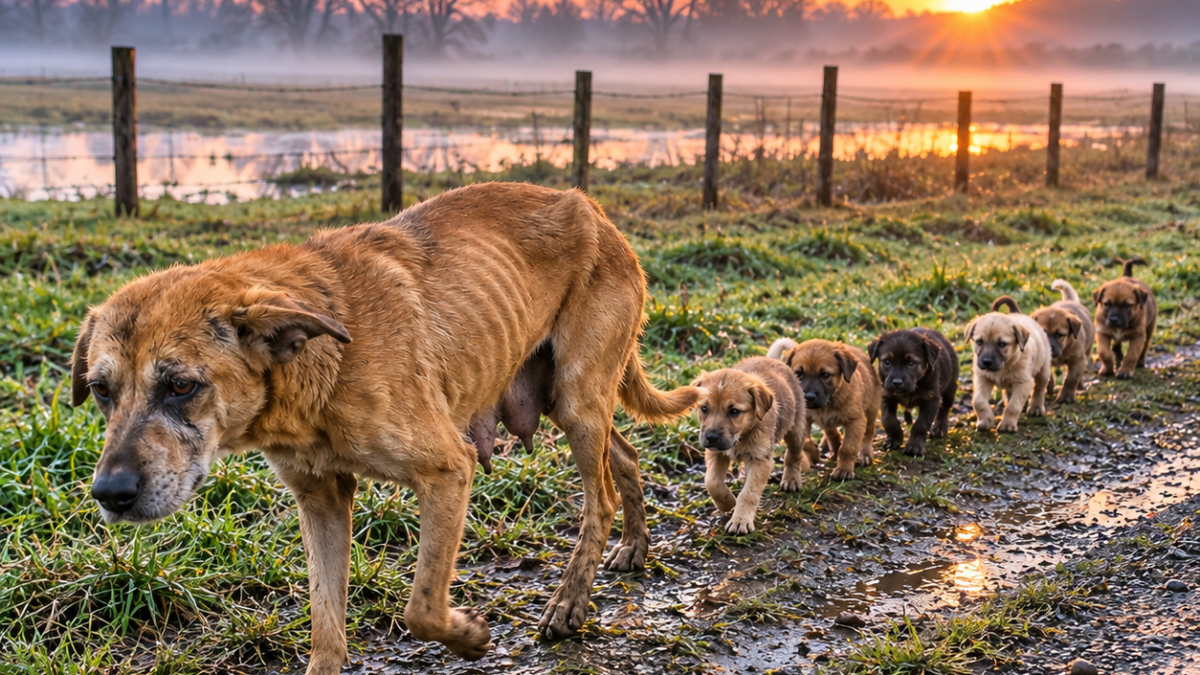
PART 2
Beyond the fence, the valley had almost disappeared.
Where there should have been a narrow creek winding between two fields, there was now a broad, muddy stretch of water. Broken branches floated against the fence. A plastic feed bucket had become tangled in the wire. Farther downhill, half a wooden pallet was wedged against a tree.
The creek had jumped its banks.
I knew that creek. I’d crossed the little bridge over it hundreds of times on my way to work. During a normal summer, you could walk across it without getting your knees wet.
That morning, the water had risen several feet above its usual level.
Rachel pointed toward a stand of willows near the flooded bank.
“Look at the roots.”
I followed her finger.
Under one of the trees was a dark opening in the earth, partly hidden by grass and fallen branches. Water was pouring through it.
My throat tightened.
“That looks like an animal den.”
Emily crouched beside a patch of mud.
“Rachel, come here.”
Pressed into the soft earth were several tiny paw prints.
They led away from the water.
Toward the road.
Toward us.
Rachel didn’t speak immediately.
She looked at the prints, then at the mother dog struggling through the grass farther uphill.
When she finally turned to me, there were tears in her eyes.
“She got them out.”
I stared at her.
“What?”
“Those puppies were probably sheltering somewhere along that creek. When the water started rising, she moved them.”
“All six?”
Rachel nodded.
“Look at the tracks.”
I looked again.
The mud was covered with overlapping little paw prints and the larger, uneven impressions left by their mother.
Some were deep enough to suggest that the animals had been struggling through wet soil.
Others disappeared beneath muddy water.
The mother had brought her puppies through the flooded valley, across the low ground, and up toward the road.
I looked back at her.
She had stopped beside a broken fence post.
All six puppies had gathered around her legs.
One was trying to nurse.
Another lay flat in the grass, breathing hard.
The mother lowered her head and touched each one with her nose.
Then she started walking again.
I felt something inside me break.
She wasn’t confused.
She wasn’t wandering.
She wasn’t even looking for food.
She was trying to get her children somewhere the water couldn’t reach them.
And she was doing it with eyes that could barely distinguish light from darkness.
“How does she know where she’s going?” I asked.
Rachel watched her carefully.
“Dogs don’t depend on sight the way we do. She’s probably using sounds, scents, the slope of the ground, and whatever she remembers about this area.”
“But if she can’t see the ditch—”
“That’s what worries me.”
Rachel looked toward the rising hillside.
“We need to stay close enough to help without frightening her.”
I grabbed the bag of dog food from the back of my truck.
“Can’t we just pick them up?”
“We may have to,” she said. “But a frightened mother can run, and the last thing we want is her taking those puppies back toward the creek.”
So we followed.
I walked on one side of the old fence while Rachel and Emily stayed on the other.
The mother moved with painful determination.
Sometimes she stopped and lifted her nose.
Sometimes she stood perfectly still, listening.
Once, a pickup passed on the distant county road, and she turned her head toward the sound long before any of us heard the engine.
She seemed to understand the landscape in ways I couldn’t.
But her body was failing her.
Every few minutes, her back legs trembled.
Her breathing grew louder.
I kept thinking about the muddy footprints behind us.
How many hours had she been walking?
Had she spent the entire night trying to keep her babies ahead of the water?
Had she gone back for one when it fell behind?
The thought made me sick.
We came to a shallow runoff channel cutting across the field.
It wasn’t wide, perhaps three feet, but rainwater was rushing through it.
The mother stopped.
Her ears lifted.
She approached the edge and put one paw forward.
Then she hesitated.
For the first time, I saw uncertainty.
The six puppies crowded behind her.
One little brown male, smaller than the others, slipped on the wet grass.
He slid toward the water.
“Whoa!”
I moved before I thought.
I dropped to one knee and caught him around the middle just as his back paws reached the muddy current.
He squealed.
The mother spun toward the sound.
A low growl came from her throat.
I froze.
“Easy, girl. Easy.”
She stepped toward me, trembling.
I gently placed the puppy on dry ground.
He scrambled back to her.
She immediately lowered her head, nudging him over and over until she was satisfied he was unharmed.
Then she turned her cloudy eyes toward me.
I couldn’t tell whether she could see my face.
But her growling stopped.
For a moment, neither of us moved.
“I know,” I whispered. “I’d be scared too.”
Rachel approached slowly.
“Good catch.”
My hands were shaking.
“That water would’ve taken him.”
Rachel looked down at the runoff channel.
“Let’s make sure it doesn’t get another chance.”
Emily found a narrow section farther uphill where the water spread thinly over a flat patch of grass.
We moved ahead and waited.
The mother listened to our footsteps.
Then, almost as though she understood what we were doing, she turned toward the gentler crossing.
One puppy followed.
Then another.
I counted them as they came.
One.
Two.
Three.
Four.
Five.
Six.
When the last tiny body reached the other side, I exhaled so hard my chest hurt.
We kept moving.
Another fifteen minutes passed before Emily noticed the shed.
It stood near the crest of a gentle hill, partly hidden behind a row of neglected cedar trees.
An old equipment shed.
Its roof was patched with mismatched metal.
One wall leaned slightly.
The doors hung crooked on rusty hinges.
I’d seen it from the road plenty of times, but I’d never given it a second thought.
The mother dog stopped at the bottom of the hill.
She raised her head.
Her nostrils moved.
Then she began climbing.
Rachel glanced toward me.
“I think she’s found what she was looking for.”
We followed quietly.
The closer we got, the more obvious it became.
The ground was dry.
The shed stood well above the flooded valley.
And there was a gap beneath one of the doors, just large enough for a dog to squeeze through.
The mother approached it without hesitation.
She lowered her body and slipped inside.
The puppies followed her.
One by one, they disappeared into the darkness.
I waited for the sixth.
The little brown male stopped outside, confused by the narrow opening.
He whimpered.
From inside the shed came a soft answering sound.
His mother’s voice.
He pushed through the gap.
Then everything went silent.
Rachel held up one hand.
“Give her a minute.”
We waited.
Inside, I heard claws scraping against the dusty floor.
A tiny puppy sneezed.
Then came a long, exhausted sigh.
Rachel slowly opened the crooked door.
Sunlight spilled across the floor.
And there she was.
The mother dog had collapsed beside an old wooden workbench.
Her puppies were piled against her stomach, crawling over one another in search of warmth.
She was lying on her side, breathing heavily.
Her legs were still trembling.
But her head was raised.
Even at the end of her strength, she was watching over them as best she could.
Rachel knelt a few feet away.
“Hey, beautiful.”
The mother’s ears moved.
A warning growl rumbled in her chest.
Rachel stopped immediately.
“That’s okay. I hear you.”
She placed a little food on the floor and moved her hand away.
The dog sniffed.
Her nose twitched.
But she didn’t eat.
Instead, she shifted her body between Rachel and the puppies.
I looked at that thin, exhausted animal and wondered how she had anything left to give.
“She thinks we’re going to hurt them,” I said.
“Maybe someone has before,” Emily answered quietly.
That sentence stayed with me.
We had seen her scars.
Her damaged eyes.
The way she flinched when a hand moved too quickly.
We didn’t know what had happened to her.
But whatever it was, she had learned to be afraid.
Rachel sat on the floor, keeping a respectful distance.
She spoke softly.
She told the dog she was safe.
She told her nobody was going to take her puppies away.
She told her she could rest.
I don’t know how much of it the mother understood.
Probably the tone more than the words.
But after several minutes, her head lowered slightly.
Rachel slid a shallow bowl of water toward her.
The mother sniffed it.
Then she drank.
Not a little.
She drank with such desperation that Rachel gently moved the bowl away for a moment.
“Slow down, sweetheart. You’ll have more.”
The dog lifted her head, searching for it.
Rachel let her drink again in smaller amounts.
Next came soft food.
This time, she ate.
I watched every movement.
Every swallow.
Every little moment when her ears turned toward her puppies.
She never stopped monitoring them.
Not even while eating.
When Rachel finally touched her shoulder, the dog stiffened.
But she didn’t bite.
She didn’t run.
She simply lay there, too exhausted to resist and perhaps beginning to understand that we weren’t enemies.
Rachel stroked her gently.
“That’s a good girl.”
The mother’s breathing slowed.
Emily knelt beside me.
“What should we call her?”
Rachel looked at the six puppies pressed against their mother.
Then she looked at the dirty, half-blind dog who had somehow gotten them all to safety.
“Hope,” she whispered.
I glanced at her.
“Hope?”
Rachel nodded.
“Because after everything she’s been through, she still hasn’t given up.”
I looked at the dog.
“Hope,” I repeated.
One of her ears twitched.
It was the first time she’d responded to anything that sounded like a name.
And for some reason, that nearly undid me.
We stayed in the shed for almost an hour.
Rachel contacted the veterinarian who worked with the rescue.
Emily prepared the transport crate with clean blankets.
I brought water from my truck and helped clear a path to the entrance.
By the time we were ready to move the family, Hope had eaten a little more.
But she was still too weak to stand comfortably.
Rachel gently gathered the puppies.
At first, Hope raised her head in alarm.
A frightened sound escaped her.
I had never heard anything like it.
Not a bark.
Not a growl.
More like a question.
Where are they going?
Rachel immediately placed the puppies in the open crate beside her.
Their tiny whimpers filled the shed.
Hope’s ears lifted.
She dragged herself toward them.
“That’s right,” Rachel said. “They’re right here.”
She touched each puppy with her nose.
One.
Two.
Three.
Four.
Five.
Six.
Only then did she let Rachel guide her onto the blanket-lined stretcher.
We carried her to the rescue van.
The puppies traveled in a crate secured immediately beside her, where she could hear them and smell them.
I climbed into my truck and followed.
I should have gone to work.
My supervisor had already called twice.
The morning chores were piling up, and I knew the crew was short-handed.
But I couldn’t leave.
Not yet.
I needed to know whether that mother dog was going to survive.
The veterinary clinic sat on the outskirts of Lexington, between a feed store and a small shopping center.
I’d driven past it dozens of times.
That morning, walking through its doors with Rachel, I felt as though I’d entered an entirely different world.
Inside, everything smelled of disinfectant.
Phones rang behind the counter.
A large black Labrador barked somewhere in the back.
Hope heard the barking and tried to lift her head.
Rachel rested a hand on her shoulder.
“Your babies are still here.”
A veterinarian named Dr. Leah Whitmore met us in the examination room.
She was a woman in her early forties with tired eyes and the calm, deliberate movements of someone who had spent years dealing with frightened animals.
She listened while Rachel described what we’d found.
Then she examined Hope.
Her expression grew serious.
“How long has she been outside?”
“We don’t know,” Rachel answered.
“Any history?”
“None.”
Dr. Whitmore checked her gums, heartbeat, hydration, and body condition.
She ran her fingers gently along Hope’s ribs.
Then she looked at the scars on her legs.
“She’s been struggling for a while.”
“Can you tell what happened to her eyes?” I asked.
“I can tell there’s extensive damage. We’ll need a more thorough examination before I can say how much vision remains.”
She moved carefully in front of Hope’s face.
Hope reacted when the room light changed, but she struggled to follow a slow movement near one side of her head.
Dr. Whitmore frowned.
“She may have limited light and shape perception. We need to check for active disease and pain, but some of this scarring looks old.”
“Could somebody have done that to her?”
The veterinarian hesitated.
“Possibly. But infections and untreated injuries can cause severe damage too. I won’t make an accusation without evidence.”
I nodded.
I respected that answer.
Still, looking at Hope’s face, I couldn’t stop wondering what kind of life she’d lived before we found her.
The veterinarian examined each puppy next.
Six tiny patients.
Six different personalities.
One red-brown male tried to chew the stethoscope.
A cream-colored female attempted to hide beneath Rachel’s elbow.
The little brown male I’d caught near the runoff channel kept trying to climb out of the blanket.
Despite their rough journey, they were surprisingly strong.
“Approximately seven or eight weeks old,” Dr. Whitmore said.
“Are they going to be okay?” I asked.
“They’re chilled and need care, but they look much better than their mother. We’ll run tests, check for parasites, and monitor them closely.”
I watched her return to Hope.
The contrast was painful.
The puppies had rounded bellies and enough energy to protest every examination.
Their mother looked as though she had given them every usable ounce of herself.
Dr. Whitmore noticed me staring.
“Mother dogs can become severely depleted while nursing, especially when they don’t have reliable access to food.”
“She kept them healthier than herself.”
“That’s what it looks like.”
Hope suddenly whined.
A puppy had begun crying from the next examination table.
She tried to rise.
Her legs buckled.
I stepped forward.
“Easy, girl.”
Dr. Whitmore gently supported her.
“Bring that little one closer.”
Rachel placed the puppy beside Hope’s shoulder.
Hope immediately touched him with her nose.
Her body relaxed.
Then she closed her eyes.
For the first time since I’d found her, she slept.
Not the brief, uneasy rest of a frightened animal.
Real sleep.
I stood beside the examination table and watched her chest rise and fall.
Dr. Whitmore lowered her voice.
“She’s going to need time.”
“How much?”
“More than a few days. She’s underweight, exhausted, and her eyes need careful evaluation. But there’s no reason to give up on her.”
I looked at Hope.
“She didn’t give up on them.”
“No,” the veterinarian said. “And now somebody needs to do the same for her.”
I stayed until late afternoon.
Rachel finally convinced me to go home.
Before I left, she took me back to Hope’s quiet recovery room.
A clean blanket covered the floor.
The puppies slept in a warm enclosure nearby, close enough for Hope to hear and smell them.
Hope lifted her head when I entered.
Her ears turned toward my footsteps.
I crouched beside her.
“Hey, sweetheart.”
She sniffed the air.
Then, slowly, she moved her nose toward my hand.
For the first time, she touched me without fear.
I scratched gently beneath her chin.
“You did it,” I whispered. “You got them all here.”
Her eyes closed again.
And I went home with mud on my jeans, puppy scratches on my hands, and the strange feeling that my life had changed somewhere along that gravel road.
I couldn’t sleep that night.
Every time I closed my eyes, I saw Hope walking through the fog.
I saw her thin legs trembling.
I saw the puppies following her without hesitation.
And I kept imagining the moment when water had first entered their den.
Had she been sleeping?
Had the puppies cried?
Had she tried to carry them one at a time before realizing they were old enough to follow?
I would never know.
But I knew she had faced something terrifying.
And somehow, she’d found the courage to keep moving.
Around midnight, my phone lit up.
A message from Rachel.
There was a photograph.
Hope was sleeping on a soft blue blanket.
All six puppies were piled against her.
Underneath, Rachel had written:
Everyone is warm, fed, and resting. She’s doing better tonight.
I stared at that photograph for a long time.
Then I sent a reply.
Thank you for not giving up on her.
Rachel answered almost immediately.
She didn’t give us much choice. A mother like that deserves a fighting chance.
The next morning, I arrived at the farm before sunrise.
My supervisor, Tommy Henderson, was waiting beside the equipment barn.
Tommy was fifty-eight, built like a fence post, and not known for sentimental speeches.
He leaned against a tractor with his coffee.
“You’re late yesterday.”
“I know.”
“Didn’t answer your phone either.”
“I’m sorry.”
He studied me.
“Heard you found some dogs.”
I nodded.
“A mother and six puppies.”
“Everybody okay?”
“Looks like they will be.”
Tommy took a slow drink of coffee.
Then he reached into his jacket and pulled out a small envelope.
He handed it to me.
“What is this?”
“Forty bucks.”
I stared at him.
“For what?”
“Dog food.”
I looked up.
Tommy shrugged.
“My wife saw the rescue’s post last night. She told me to give you that.”
“Tommy, you don’t have to—”
“Don’t argue with a woman who’s already made up her mind.”
He turned toward the tractor.
Then he stopped.
“And Nathan?”
“Yeah?”
“Next time you find seven dogs on the side of the road, call me. I can cover the morning feed.”
I watched him walk away.
For the first time since finding Hope, I smiled.
Over the next several days, I visited the rescue whenever I could.
Hope improved slowly.
At first, she barely moved except to eat, drink, and check on her puppies.
But after a week, the change was noticeable.
Her body was still painfully thin, but she could stand without trembling.
She began greeting Rachel with a small movement of her tail.
Sometimes she lifted her head when she heard familiar footsteps.
The puppies were an entirely different story.
Once they recovered from the cold and exhaustion, they seemed determined to make up for every quiet moment they’d spent on that flooded hillside.
They wrestled.
They stole one another’s toys.
They chewed blankets.
They climbed over Hope as if she were a mountain.
Rachel gave each puppy a temporary name.
The brave red-brown female became Scout.
The cream-colored girl who hid behind everyone became Clover.
The smallest brown male became Bean.
A lively reddish male became Rusty.
A black-masked female became June.
And the spotted male with the white chest became Patch.
Within days, I could recognize all six without looking at their collars.
Scout always wanted to investigate.
Rusty always wanted whatever Scout had.
Clover preferred to sit beside Hope.
June barked at everything, including her own reflection.
Patch loved chewing shoelaces.
And Bean seemed to believe the entire world existed for him to climb.
Hope tolerated it all.
Sometimes she raised her head when the noise became too much.
Sometimes she moved to a quieter corner.
But if one puppy cried, she responded immediately.
It didn’t matter whether she was eating or sleeping.
She always knew.
One afternoon, I watched Bean crawl behind a chair and get stuck.
His little paws scratched against the floor.
He began to whimper.
Hope had been lying across the room.
She immediately lifted her head.
Her ears moved.
Then she stood and walked toward the sound.
She bumped gently against the chair.
Stopped.
Adjusted her position.
And lowered her nose until it touched Bean’s head.
He crawled toward her and climbed between her front legs.
I looked at Rachel.
“How does she always know?”
Rachel smiled.
“She’s been listening for those six little voices for weeks. Maybe longer.”
Hope led Bean back toward the others.
And I understood something.
Her damaged eyes hadn’t made her less of a mother.
They had simply forced her to love and protect her puppies in different ways.
By the second week, Dr. Whitmore had finished a more detailed examination of Hope’s eyes.
Rachel called me after receiving the results.
I drove to the clinic during my lunch break.
Hope was lying on a blanket in the examination room when I arrived.
Her coat had been cleaned.
The matted fur had been carefully trimmed.
She looked smaller without all that dirt.
And somehow younger.
Dr. Whitmore showed me photographs of her eyes.
“She has extensive corneal scarring,” she explained. “The damage is consistent with an old, serious infection that wasn’t adequately treated.”
“Can you fix it?”
“Not completely. Some scarring is permanent. She retains limited vision, but she’ll probably never see normally.”
I looked at Hope.
“Does it hurt?”
“There’s no sign of the severe pain we’d expect with an active ulcer, and we’re treating the inflammation we found. We’ll continue monitoring her.”
“Will she need surgery?”
“Not necessarily. Our goal is to keep her comfortable and preserve the vision she has. If her condition changes, we’ll reassess.”
I nodded.
Then I asked the question that had been bothering me.
“How long does something like that take to happen?”
“That depends on the original infection and the care she received. But this wasn’t something that developed overnight.”
I looked down at the old scars across Hope’s shoulder.
“So somebody had time to help her.”
Dr. Whitmore’s expression softened.
“Somebody may have. We don’t know her history.”
Hope lifted her nose toward me.
I rested my hand on her head.
“Well,” I whispered, “you’re not going through it again.”
I believed that would be the end of the worst part of her story.
I thought the danger was behind us.
I thought all we had to do was help her recover and find homes for her puppies.
Then, three days later, a man walked into Bluegrass Animal Rescue and claimed that Hope belonged to him.
And everything changed.
His name was Dale Mercer.
I had seen him around the county before.
He owned a worn-down property beyond the creek, where he kept old equipment and occasionally sold hunting dogs and farm animals.
He was in his late fifties, with a heavy jaw, gray hair, and the kind of voice that filled a room before he did.
Rachel called me shortly after he appeared at the rescue.
“Nathan, I need to ask you something.”
Her tone immediately worried me.
“What’s wrong?”
“Do you know a man named Dale Mercer?”
I straightened in my truck.
“Yeah. Why?”
“He’s here.”
“At the shelter?”
“He says Hope is his dog.”
I felt my stomach turn.
“What?”
“He claims she disappeared from his property months ago.”
“Months?”
“That’s what he said.”
I thought about Hope’s damaged eyes.
Her empty stomach.
The six puppies she’d been protecting.
“Does he have proof?”
“Not much. He’s shown me an old photograph, but we’re checking the details.”
“What does he want?”
There was a pause.
Then Rachel said something that made my hands tighten around the steering wheel.
“He wants the puppies.”
I didn’t speak.
“Nathan?”
“All six?”
“Yes.”
“What about Hope?”
Rachel sighed.
“He says she isn’t worth keeping because she can’t see properly.”
For a moment, I couldn’t find words.
I looked through my windshield at the farm buildings ahead.
The same world where I’d always believed there were decent people and cruel people, and that most of the time you could recognize the difference.
“He’s standing there,” I asked slowly, “telling you he wants the puppies but not their mother?”
“That’s exactly what he said.”
I closed my eyes.
All I could picture was Hope lying in that shed, too exhausted to lift her head, but still putting herself between us and her babies.
“Please tell me you’re not giving them to him.”
“We won’t make any decision without verifying ownership and following the legal process. I’ve already contacted animal control.”
“I’ll be there in twenty minutes.”
“Nathan, don’t confront him.”
I took a breath.
“I won’t.”
But when I ended the call, I was shaking.
Not with fear.
With anger.
Dale Mercer was standing near the shelter’s front desk when I arrived.
He wore a dark jacket and muddy work boots.
His arms were crossed.
Rachel stood behind the counter with a folder in her hands.
Two staff members were nearby.
I heard Dale before he noticed me.
“I don’t understand why this is complicated,” he snapped. “Those are my dogs.”
Rachel kept her voice steady.
“We need to verify that, Mr. Mercer.”
“I told you where I kept her.”
“That doesn’t establish what happened to her or whether you have a legal right to reclaim the animals.”
He leaned over the counter.
“You’re making this harder than it needs to be.”
I stepped forward.
“She’s the dog from the creek?”
Dale turned.
His eyes narrowed.
“Who are you?”
“Nathan Cole. I’m the one who found her.”
He looked me up and down.
“So you’re the guy who took her.”
“I found her starving beside a flooded ditch.”
“She ran off.”
“With six puppies?”
He shrugged.
“Animals wander.”
I stared at him.
“She could barely stand.”
“She was always a skinny dog.”
“And her eyes?”
He looked away.
“Bad infection. Nothing I could do.”
“Did you take her to a vet?”
Dale’s jaw tightened.
“Look, I didn’t come here to answer questions from some farmhand.”
Rachel stepped between us.
“Mr. Mercer, I need you to lower your voice.”
Dale pointed toward the hallway leading to the animal rooms.
“I know you’ve got my puppies back there. I want them returned.”
“What about their mother?” I asked.
He looked at me.
“What about her?”
“Don’t you want her too?”
He laughed.
Not loudly.
Just a short, dismissive sound.
“She’s half blind. What am I supposed to do with a dog like that?”
Something in my chest went cold.
I thought of six tiny puppies crossing muddy ground.
I thought of a mother using her ears to keep track of every frightened cry.
I thought of her refusing to rest until every one of them was safe.
And I looked at the man who was dismissing her as worthless.
“You have no idea what kind of dog she is,” I said.
Dale took a step toward me.
“You got something to say?”
I didn’t move.
“Yeah. I do.”
Rachel touched my arm.
“Nathan.”
I swallowed the words I wanted to say.
Then I looked directly at Dale.
“If she was yours, you owe her a lot more than that.”
He sneered.
“She’s a dog.”
I shook my head.
“She’s the reason you still have six puppies to argue about.”
The room went silent.
Dale’s expression hardened.
He looked at Rachel.
“I’ll be back with paperwork.”
Then he turned and walked out.
The front door slammed behind him.
I stood there listening to the silence.
Rachel exhaled.
“Well, that was unpleasant.”
I looked toward the hallway.
“Does Hope know he’s here?”
“No. She’s in the recovery room.”
“Good.”
Rachel studied me.
“Why?”
I didn’t know how to explain it.
I just couldn’t bear the thought of that dog hearing his voice again.
Animal control began reviewing Dale’s claim.
He had an old photograph that appeared to show Hope standing outside one of his sheds.
In the picture, both her eyes looked healthier, although the image was too blurry to establish much.
He also had veterinary paperwork from nearly two years earlier for a tan female dog.
But the paperwork raised as many questions as it answered.
The dog’s name on the record was Sadie.
She’d been seen for a serious eye infection.
Treatment had been prescribed.
A follow-up examination had been recommended.
There was no record that the dog had returned.
When I heard that, I remembered Dr. Whitmore’s words.
Somebody may have had time to help her.
Hope had once had a name.
She’d once belonged somewhere.
And there had been a moment when her eyesight might have been saved.
Rachel showed the records to Dr. Whitmore, who cautioned us not to jump to conclusions.
The documents supported an important lead, but they didn’t tell us everything.
Maybe Dale had taken the dog to another clinic.
Maybe he’d received treatment elsewhere.
Maybe the infection had progressed despite care.
We needed facts.
But then someone called the rescue with information nobody had expected.
Her name was Linda Carver.
She lived on a small property less than two miles from Dale Mercer’s place.
Linda was seventy-one, recently widowed, and had spent most of her life raising horses.
She’d seen Hope’s photograph online.
And she recognized her immediately.
“That dog’s Sadie,” she told Rachel. “I know her face.”
Rachel asked how.
Linda was quiet for a moment.
Then she said, “Because I’ve been wondering what happened to her.”
I met Linda two days later.
She lived in a white farmhouse with blue shutters and a long gravel driveway.
A faded American flag hung from the porch.
Her dog, an elderly black-and-white Border Collie, lay near the front steps.
Linda invited me inside and poured coffee.
She was a small woman with silver hair pulled into a bun and hands that looked as though they’d spent a lifetime mending fences.
“You found that dog?” she asked.
“Yes, ma’am.”
“With all six babies?”
I nodded.
She pressed her lips together.
“Lord have mercy.”
I told her about the flooded creek.
The fog.
The shed.
How Hope had kept moving even when her legs were shaking.
Linda listened without interrupting.
When I finished, she looked toward the window.
“That sounds like Sadie.”
“You knew her well?”
“As well as you can know a dog that isn’t yours.”
She explained that Hope had lived on Dale Mercer’s property for years.
Linda often saw her wandering along the fence between their fields.
“Sweetest creature,” she said. “Always came running if I called.”
“Even after her eyes got bad?”
“Especially then. She knew my voice.”
Linda stood and walked toward a kitchen drawer.
She returned with a small stack of photographs.
Most showed horses.
One showed a tan dog standing beside a water trough.
Both eyes were clear.
Her coat was clean.
Her tail was raised.
I recognized her immediately.
“That’s Hope.”
Linda nodded.
“That’s Sadie. Took that picture about three years ago.”
I stared at it.
The dog in the photograph looked happy.
Not starving.
Not frightened.
Just a healthy animal enjoying the sunshine.
My throat tightened.
“What happened?”
Linda sat down slowly.
“Her eyes started getting bad. First one, then the other. I asked Dale about it. He said the vet gave him medicine.”
“Did he use it?”
“I don’t know. I wasn’t inside his house.”
She paused.
“But I kept seeing that dog getting worse.”
Linda told me she’d offered to help more than once.
She’d even offered to take Sadie to her own veterinarian.
Dale had refused.
“He told me to mind my business.”
I looked down at the photograph.
“Did you ever see him hurt her?”
“No. And I won’t pretend I did.”
She leaned forward.
“But I know he stopped keeping her in the house. She was outside most of the time after her eyes got bad.”
“Was she pregnant?”
Linda nodded.
“Last time I saw her at his place, she was.”
“When was that?”
“About three months before you found her.”
I felt a chill.
“Three months?”
Linda nodded again.
“Then one day she was gone. I asked Dale where she’d gone.”
“What did he say?”
Linda’s voice grew bitter.
“He said he’d gotten rid of her.”
The room went silent.
I stared at her.
“Those exact words?”
“Those exact words.”
For a moment, I heard nothing except the ticking of the kitchen clock.
Linda wiped her hands against her apron.
“I asked what he meant. He said the dog was useless now and he wasn’t feeding another mouth.”
I looked down at Hope’s photograph.
A healthy young dog with bright eyes.
A dog who had once trusted the people around her.
“Did he tell you where he took her?”
“No.”
“Did you see him leave with her?”
“No. But I remember something else.”
Linda stood and crossed to the window.
She pointed toward the road.
“That week, he was driving his old white pickup with a wooden dog crate in the back. I saw it twice.”
She turned toward me.
“I can’t tell you what was inside it. I didn’t see. But I’ve been wondering ever since.”
I took a slow breath.
It wasn’t proof.
Not yet.
But it was enough to make me want answers.
Linda came back to the table.
“Can I ask you something?”
“Of course.”
“Is she happy now?”
I thought about Hope sleeping on clean blankets.
About the way she turned toward Rachel’s voice.
About the six puppies tumbling over her paws.
“She’s getting there.”
Linda smiled sadly.
“Good.”
Then she pushed the old photograph toward me.
“Give that to whoever’s helping her. Maybe it’ll be useful.”
I looked at the dog in the picture.
Her eyes were clear.
Her face was lifted toward the sunlight.
For the first time, I understood that Hope hadn’t always lived in darkness.
And that realization made what she’d endured even harder to accept.
The next several weeks became a strange mixture of happiness and worry.
Hope was improving.
The puppies were thriving.
But Dale Mercer’s ownership claim hung over everything.
Animal control had opened an investigation after reviewing the veterinary history, Hope’s condition, and the information Linda provided.
The rescue was cooperating and keeping the animals safe while the authorities determined what should happen.
Nobody wanted to make a legal mistake that could put Hope or her babies at risk.
Rachel was careful about everything.
She documented Hope’s weight.
She saved veterinary reports.
She photographed the old scars.
She kept records of every medication and every treatment.
And she made sure the rescue followed its required procedures.
One afternoon, I found her sitting at a desk surrounded by folders.
She looked exhausted.
“You okay?”
She rubbed her forehead.
“Ask me after this is over.”
I pulled up a chair.
“Can I help?”
She looked at me.
“Actually, yes.”
“Anything.”
“I need you to write down exactly what happened the morning you found Hope.”
“I already told animal control.”
“I know. But I want your own detailed account while the memory is still fresh.”
I nodded.
Rachel handed me a notebook.
“Don’t exaggerate. Don’t guess. Just tell the truth.”
So I wrote.
I described the fog.
The muddy road.
The way Hope stumbled near the ditch.
The six puppies walking behind her.
The flooded creek.
The little paw prints leading uphill.
The old shed where she finally collapsed.
I wrote about her ribs showing.
Her trembling legs.
The fear in her face when Rachel first approached the puppies.
And I wrote about the moment she’d counted all six with her nose before allowing us to move her.
By the time I finished, my hand ached.
Rachel read the account quietly.
Then she looked up.
“There’s something I want you to understand.”
“What’s that?”
“Whatever happens with Dale, this story isn’t really about him.”
I looked toward the recovery room.
Rachel continued.
“It’s about a dog who did something extraordinary. Don’t let his behavior become the only thing people remember.”
I sat with that for a moment.
Then I nodded.
“You’re right.”
But I also knew something else.
If Dale had abandoned Hope because she was no longer useful to him, someone needed to make sure he couldn’t simply walk into a shelter and profit from the puppies she’d nearly died protecting.
And I wasn’t willing to look away.
Hope’s progress continued in small, beautiful steps.
She gained weight.
Her coat began to shine.
The thin patches around her shoulders slowly filled in.
She started enjoying short walks in the rescue’s fenced courtyard.
At first, she moved hesitantly.
She kept her head low.
She stopped whenever she encountered an unfamiliar object.
Rachel taught us to speak before touching her.
We learned not to rearrange things unnecessarily.
We made sure pathways stayed clear.
And we began using simple verbal cues.
“Step.”
“Wait.”
“Easy.”
“Good girl.”
Hope learned quickly.
Within two weeks, she could walk from her resting area to the courtyard without needing someone to guide her every inch.
She memorized the turns.
She recognized the texture of the floor beneath her paws.
She learned where the water bowls were.
And she began doing something that made everyone at the rescue stop and smile.
She wagged her tail.
Not just a nervous movement.
A real, sweeping wag.
The first time it happened, I was sitting on the floor beside her.
I’d brought the soft treats Dr. Whitmore had approved.
I held one near her nose.
“Want one, girl?”
Hope sniffed.
Her ears lifted.
Then her tail thumped against the blanket.
I stared at it.
Rachel laughed from the doorway.
“Well, look at that.”
I offered another treat.
The tail moved faster.
And suddenly I was laughing too.
It seemed like such a small thing.
A dog wagging her tail.
But when you’ve watched an animal fight simply to survive, happiness becomes something sacred.
I gently scratched behind her ears.
“That’s right, Hope. You’re allowed to enjoy yourself now.”
She leaned her head into my hand.
And I realized that somewhere along the way, I had stopped thinking of her as a stray I’d found.
She had become someone I worried about.
Someone I looked forward to seeing.
Someone whose good days made mine better.
One afternoon, Rachel invited me to help with Hope’s first supervised playtime outside with all six puppies.
It was a warm day.
The sky was blue.
The grass had finally dried after weeks of rain.
We carried the puppies into a secure play area behind the shelter.
They exploded across the lawn.
Scout immediately chased a butterfly.
Rusty chased Scout.
June barked at both of them.
Patch found a pinecone and decided it was the greatest treasure ever discovered.
Clover stayed close to Hope.
And Bean ran directly into my shoe.
I laughed and picked him up.
“Still causing trouble, huh?”
He licked my chin.
Hope stood near the center of the yard.
Her ears moved in every direction.
She listened to the puppies.
Occasionally she turned her head toward the fence.
But gradually, her posture relaxed.
She took several steps through the grass.
Then she stopped.
Lifted her nose.
And breathed.
For a long moment, she simply stood in the sunshine.
I don’t know what she was thinking.
Maybe nothing.
Maybe she was enjoying the warmth on her face.
Maybe she was realizing she no longer had to listen for rushing water.
Then Clover ran up and bumped against her front leg.
Hope lowered her head.
The puppy pressed against her chest.
And for the first time, I saw Hope initiate a game.
She lowered the front of her body slightly.
Her tail moved.
Clover hopped backward.
Hope stepped toward her.
Clover bounced again.
Rachel covered her mouth.
“Oh, Nathan.”
I looked at her.
“She’s playing.”
Rachel nodded.
Her eyes were wet.
“She’s finally playing.”
The other puppies noticed.
Within seconds, Hope was surrounded.
Six little bodies tumbled through the grass.
She moved carefully, using her nose and ears to keep track of them.
When they became too rough, she gave a soft correction.
When they scattered, she waited.
And when Bean climbed onto her back and promptly slid off, she turned and nudged him gently.
I stood there watching the dog who had once marched through the fog with deathly exhaustion written across her body.
Now she was standing in sunshine, surrounded by the children she’d saved.
And she was happy.
I thought that might be the most beautiful ending I would ever witness.
But Hope’s story wasn’t finished.
Not even close.
Because the man who claimed to own her was about to make one final attempt to take away everything she’d fought for.
The trouble started on a Tuesday afternoon.
I was replacing a broken gate hinge at the farm when Rachel called.
I could tell from the first word that something was wrong.
“Nathan, are you somewhere you can talk?”
I set down my wrench.
“What’s happened?”
“Dale came back.”
My stomach tightened.
“Did he see Hope?”
“No. He didn’t get past the front office.”
“What did he want this time?”
“He brought an attorney’s letter demanding the return of the dogs. He’s threatening to take legal action against the rescue.”
I looked out across the pasture.
“Does he actually have a case?”
“He’s produced enough records to establish that Hope probably lived on his property. That matters. But animal control is investigating the circumstances under which she disappeared and the condition she was found in.”
I rubbed my forehead.
“So what happens?”
“We keep caring for them while the authorities sort this out. But there’s another problem.”
“What?”
“He’s claiming that we’re keeping his animals because the puppies have become valuable.”
I stared at the grass beneath my boots.
“Valuable?”
“He says the publicity increased their value. He wants compensation if we don’t return them.”
I had to sit down.
Somewhere in Lexington, Hope was probably sleeping beside six puppies who had no idea that a man was trying to turn their rescue into a payday.
The thought made me furious.
“What does he think they’re worth?”
Rachel hesitated.
“He mentioned three thousand dollars.”
I closed my eyes.
Three thousand dollars.
That was apparently the price he had placed on six tiny lives.
And the mother who had nearly died saving them?
She wasn’t worth feeding.
I wanted to drive straight to Dale Mercer’s house.
I wanted to ask him how a man could watch a creature grow sick and weak, then demand money when strangers finally gave it the care it needed.
But I remembered Rachel’s warning.
Don’t let anger ruin what we’re trying to do.
“What do you need from me?” I asked.
“Nothing reckless. Just stay available. Animal control may want to speak with you again.”
“I’ll answer anything they ask.”
“Good.”
She paused.
“And Nathan?”
“Yeah?”
“Please don’t go looking for him.”
I stared at the distant tree line.
“I won’t.”
I meant it.
But keeping that promise became harder than I expected.
Two days later, an animal control officer named Teresa Briggs came to the farm.
She was in her mid-forties, with short dark hair and a practical manner that reminded me of Dr. Whitmore.
She carried a notebook and a folder of printed photographs.
We sat at a picnic table behind the equipment barn.
Teresa asked me to describe the rescue again.
I did.
She didn’t interrupt except to clarify details.
“What time did you first see the dog?”
“About six in the morning.”
“Did she have a collar?”
“No.”
“Any identification?”
“Nothing I noticed.”
“Did you observe anyone release or abandon her?”
“No.”
“Did you see evidence suggesting where she’d been living?”
“The flooded den near the creek. That’s all.”
She wrote carefully.
Then she closed her notebook.
“Thank you. That helps.”
I looked at her.
“Can I ask you something?”
“Sure.”
“If Dale really abandoned her, can he still take the puppies?”
“Ownership and animal welfare are separate questions. We’re working to establish what happened and what authority we have to protect the animals.”
“So he might get them?”
“I can’t promise an outcome before we’ve completed the investigation.”
I appreciated her honesty.
I hated her answer.
Teresa must have seen it on my face.
“Nathan, the best thing you can do is give us accurate information. If people exaggerate because they want a particular result, it can undermine the whole case.”
I nodded.
She was right.
I could tell people what I’d seen.
I could describe Hope’s condition.
I could explain how she had protected her puppies.
But I couldn’t testify about something I hadn’t witnessed.
Teresa gathered her papers.
Before she left, she stopped beside my truck.
“There’s something else.”
I waited.
“We’ve been speaking with people who knew the dog before she disappeared.”
“Linda Carver?”
“Among others.”
“Have they found anything?”
She looked thoughtful.
“We’re following a promising lead.”
“What kind of lead?”
“I can’t discuss everything yet.”
I sighed.
“Fair enough.”
She opened her car door.
Then she looked back at me.
“But I will tell you this. Sometimes people who think no one is paying attention turn out to have left more witnesses than they realize.”
I watched her drive away.
For the first time in days, I felt a small flicker of hope.
That evening, I stopped at the rescue.
Hope was in her resting area, curled beside Clover and Bean.
The other puppies were sleeping in a nearby pen.
She lifted her head when she heard my voice.
“Hey, girl.”
Her tail tapped against the floor.
I sat beside her.
“Everybody’s making a big fuss about you, you know that?”
She stretched her neck toward my hand.
I scratched behind her ears.
“People arguing about paperwork. Money. Who owns what.”
Hope sighed.
I smiled sadly.
“You’re smarter than all of us. All you ever wanted was to keep your babies safe.”
She moved closer.
For a few minutes, I forgot about Dale.
I forgot about lawyers.
I forgot about the investigation.
There was only the quiet room, the soft breathing of sleeping puppies, and Hope’s warm head resting against my knee.
Rachel appeared in the doorway.
“She really likes you.”
I looked up.
“She’s probably just hoping I brought more treats.”
“No,” Rachel said. “She knows your voice.”
I looked down at Hope.
Her eyes were half closed.
She seemed completely at ease.
“I wish I could take her home.”
Rachel sat beside us.
“Have you thought seriously about it?”
“Every day.”
“What’s stopping you?”
I hesitated.
“My hours. Some days I’m gone twelve hours. I don’t have a fenced yard. And I live alone.”
“We could talk about options.”
I shook my head slowly.
“She deserves better than being alone while I work.”
Rachel didn’t argue.
After a moment, she said, “Loving a dog doesn’t always mean being the person who takes her home.”
I looked at her.
“Sometimes it means making sure the right person does.”
I sat quietly with that.
Then Hope pushed her nose beneath my hand.
I scratched her ears again.
“Don’t worry, sweetheart,” I whispered. “We’re going to find you somebody wonderful.”
I had no idea how difficult that promise would become.
The rescue’s social media page had attracted attention from across Kentucky.
People wrote messages about Hope and her puppies.
Some offered donations for veterinary care.
Others sent blankets, food, toys, and puppy pads.
A woman from Louisville mailed six tiny blankets she had sewn herself.
A retired carpenter built a low wooden ramp so Hope wouldn’t have to negotiate the small step leading to the courtyard.
A local pet store donated a set of raised bowls and soft harnesses.
But Rachel refused to let publicity replace proper care.
Every donation was recorded.
Every medical decision went through Dr. Whitmore.
And every potential adopter had to pass the shelter’s usual screening process.
Some people called because they wanted “one of the famous puppies.”
Rachel politely explained that puppies weren’t souvenirs.
Others wanted to adopt Hope because her story had made them cry.
But when they learned about her limited vision, medical follow-ups, and need for a predictable environment, their enthusiasm faded.
A few were honest.
They’d never cared for a dog with vision problems.
They weren’t sure they could manage.
Rachel never judged them for that.
“It’s better to find out before adopting,” she told me.
But each declined application reminded me that Hope faced a harder road than her puppies.
They were young.
Healthy.
Playful.
Everyone wanted them.
Hope was older, although the veterinarian estimated she was only about six or seven.
Her face was scarred.
Her eyesight was permanently damaged.
And she needed a home willing to make adjustments for her.
One afternoon, a couple visited specifically to meet her.
The woman cried when Hope approached.
She hugged the dog and told Rachel how beautiful she was.
For ten minutes, everything seemed perfect.
Then the man began asking questions.
“Will her eyes ever look normal?”
Rachel shook her head.
“Probably not.”
“Will she need medicine forever?”
“She may need ongoing monitoring and treatment depending on how her condition progresses.”
He frowned.
“Wouldn’t surgery fix the problem?”
“Not necessarily. There’s permanent scarring.”
The woman looked at Hope.
Then at her husband.
He lowered his voice, but I was standing close enough to hear.
“I thought we’d be getting a normal dog.”
I watched Rachel’s expression change.
Not to anger.
To disappointment.
She answered calmly.
“Hope is a normal dog in many ways. She walks, eats, plays, learns, and loves people. Her needs are simply different.”
The man didn’t respond.
A few minutes later, the couple left.
They said they needed time to think.
We never heard from them again.
I sat beside Hope afterward.
She was chewing a soft rubber toy.
She had no idea she’d just been rejected.
Maybe that was a mercy.
I looked at her scarred face.
“Don’t listen to them,” I whispered.
Hope continued chewing.
“You are exactly the kind of dog somebody needs.”
I believed that.
But I worried the right person might never come.
Then the investigation took an unexpected turn.
Teresa Briggs called me on a Friday morning.
“Nathan, we’ve located someone who may have information about where Hope was left.”
I stood beside my truck.
My heart started pounding.
“Who?”
“A former employee of Dale Mercer’s.”
“Did he see something?”
“He says he did.”
I gripped the phone.
“What?”
Teresa remained careful.
“We’re taking a formal statement and checking his account against the available evidence.”
“Can you tell me his name?”
“Eli Sutton.”
I recognized it.
Eli had worked odd jobs around the county for years.
He’d helped repair fences at our farm one summer.
Quiet guy.
Hard worker.
He was probably in his early thirties.
I hadn’t seen him recently.
“What did he say?”
Teresa paused.
“That he helped load a pregnant tan dog into Dale’s truck.”
I felt the blood drain from my face.
“When?”
“About three months before you found Hope.”
I closed my eyes.
“And?”
“He says he believed they were taking her to someone who would care for her.”
I waited.
Teresa continued.
“But the destination wasn’t a veterinarian or a rescue.”
My stomach twisted.
“Where was it?”
“Near the old creek road.”
I looked toward the distant hills.
The same road where I’d found Hope.
The same creek that had nearly swallowed her puppies.
For a moment, I couldn’t speak.
Teresa asked if I was still there.
“Yeah,” I managed.
“There’s more work to do before we can establish exactly what happened. But his statement may be important.”
I swallowed.
“Did Dale leave her there?”
“That’s what Eli alleges.”
My hands were shaking.
“Was she already nearly blind?”
“According to him, yes.”
I thought about Hope wandering through the countryside while pregnant.
Searching for food.
Searching for shelter.
Trying to survive with damaged eyes.
I sat down on the running board of my truck.
“Did Eli know what happened to her?”
“He says he didn’t know she’d been left there until afterward. He’s cooperating now.”
I stared at the gravel.
“Thank you for telling me.”
Teresa’s voice softened.
“I know this is difficult.”
I swallowed hard.
“That dog spent months thinking nobody was coming.”
There was a pause.
Then Teresa said, “But somebody finally did.”
After the call ended, I remained sitting beside my truck.
I thought about the morning I’d nearly driven past her.
A few more seconds.
A different route.
A phone call that had kept me home.
Any small change could have meant I never saw her.
I looked down at my hands.
They were the same hands that had caught Bean before he slipped into the water.
The same hands Hope now trusted.
And I made myself a promise.
Whatever the investigation uncovered, I was going to see this through.
Not because I wanted to hurt Dale Mercer.
But because a dog who had survived so much deserved to have someone stand up for her when she couldn’t speak for herself.
Eli Sutton agreed to meet with me after giving his statement to animal control.
I found him sitting alone at a small diner outside Lexington.
He was wearing a faded work jacket.
A cup of coffee sat untouched in front of him.
When I approached, he stood.
“Nathan.”
“Hey, Eli.”
We shook hands.
He looked exhausted.
“Thanks for coming.”
I sat across from him.
For a moment, neither of us spoke.
Then Eli rubbed both hands over his face.
“I saw the pictures of that dog.”
I waited.
“Couldn’t believe she was still alive.”
My jaw tightened.
“So it was her?”
He nodded.
“Sadie.”
He looked down.
“That’s what Dale called her.”
I took a slow breath.
Eli stared at his coffee.
“I helped load her into the truck. She was pregnant. Her eyes were already in bad shape.”
“Why?”
Eli swallowed.
“Dale said somebody outside town had agreed to take her. Said she’d be better off with a person who had time to care for her.”
“And you believed him?”
“Yeah.”
He shook his head.
“I wanted to.”
I watched him.
“What happened?”
Eli looked toward the window.
“We drove out near the creek road. He pulled onto an old gravel turnout. I asked why we were stopping.”
His voice grew quieter.
“He told me to open the crate.”
I felt my stomach drop.
“What did you do?”
“I opened it.”
Eli stared at his hands.
“She wouldn’t come out at first. Just stood there sniffing. Dale grabbed her collar and pulled her down.”
I said nothing.
“He took the collar off. Said he didn’t want anybody calling him if she got picked up.”
Eli’s voice cracked.
“I asked him where the person was who was supposed to take her.”
He stopped.
I waited.
“He said nobody was coming.”
The diner suddenly felt too warm.
I looked at Eli.
“What did you say?”
“I told him we couldn’t just leave her.”
“And?”
“He said she’d find a barn somewhere.”
Eli’s hands were trembling.
“Then he got back in the truck and told me to come on.”
I pictured Hope standing beside that road.
Pregnant.
Nearly blind.
Listening to an engine disappear.
“Did you leave?”
Eli closed his eyes.
“Yeah.”
The word was barely audible.
“I left her.”
I stared at him.
A part of me wanted to stand up and walk away.
Another part wanted to shout.
To ask how a grown man could leave a helpless animal behind simply because his boss told him to.
But Eli was already crying.
“I should’ve stopped him,” he whispered.
I looked down at the table.
“Yeah,” I said quietly. “You should have.”
He nodded.
“I know.”
For a long time, neither of us spoke.
Then Eli reached into his pocket.
He pulled out his phone.
“I took a picture that day.”
I looked up.
“Why?”
“Something about the whole thing felt wrong. I took it when Dale was getting the crate out. I didn’t know what I’d do with it.”
He opened the photograph.
There was Dale’s white pickup.
The wooden dog crate.
A tan dog standing beside it.
Her head was lowered.
Her belly was visibly swollen.
The image included the gravel turnout and a recognizable section of broken fence.
I knew that place.
It was less than a mile from where I’d found Hope.
“Did you give this to Teresa?”
Eli nodded.
“Original file and everything.”
I stared at the screen.
For months, I’d been imagining how Hope ended up beside that creek.
Now I was looking at one of the last moments before she was left alone.
I didn’t know how she’d survived the following weeks.
Where she’d slept.
What she’d eaten.
How she’d protected herself.
But I knew something important.
She hadn’t chosen to leave a home.
Someone had taken her away.
Eli put the phone down.
“I quit a couple of weeks later. Couldn’t work for him anymore.”
“Why didn’t you report it then?”
He looked ashamed.
“I was afraid I’d lose the work I depended on. And I kept telling myself somebody would find her.”
I studied him.
“Somebody almost didn’t.”
He nodded.
“I know.”
His eyes filled again.
“When I saw the rescue post, I recognized her. Then I saw those puppies, and I realized she’d been out there the whole time.”
He wiped his face.
“I couldn’t keep quiet anymore.”
I sat back.
I wanted to hate him.
For a moment, I did.
But I also knew he had chosen to tell the truth when staying silent might have been easier.
And that truth could make a difference.
“Tell Teresa everything,” I said.
“I have.”
“Then don’t leave anything out when they ask you again.”
Eli nodded.
“I won’t.”
I stood to go.
He looked up.
“Nathan?”
“Yeah?”
“Is she doing okay?”
I hesitated.
Then I took out my phone.
I showed him a photograph Rachel had sent that morning.
Hope lying on a clean blanket.
Six healthy puppies sleeping around her.
Eli stared at the picture.
His face crumpled.
“Oh, God.”
He covered his mouth.
“She kept them alive.”
I nodded.
“Every single one.”
He looked at me through tears.
“Can you tell her I’m sorry?”
I stared at him for a moment.
Then I shook my head.
“She doesn’t need another apology, Eli.”
He looked down.
“She needs a home where nobody ever leaves her again.”
A few weeks after I found Hope, a heavy storm moved through Lexington.
It began just before evening.
Thunder rolled across the hills.
Rain struck the shelter roof.
I happened to be there helping Rachel move donated supplies into storage.
At the first loud clap of thunder, a frightened bark echoed from the recovery room.
Rachel stopped.
“Hope.”
We hurried down the hallway.
When we opened the door, Hope was standing against the far wall.
Her body shook.
Her ears were pinned back.
The puppies had been moved into their own nearby enclosure as part of the gradual weaning process, but they were still close enough for her to hear them.
Hope couldn’t settle.
She paced in tight circles.
Every time thunder sounded, she flinched.
Then she moved toward the puppy enclosure and pressed her nose against it.
Bean whined.
Hope answered with a desperate little cry.
Rachel knelt.
“Hey, sweetheart. You’re inside. You’re safe.”
Hope kept moving.
She bumped against a chair.
Turned.
Moved toward the sound of the puppies again.
I stepped into the room.
“Hope?”
She froze.
Her ears lifted.
I crouched.
“It’s Nathan.”
For a moment, she stood still.
Then she came toward my voice.
She crossed the room too quickly and brushed against my shoulder.
I wrapped one arm gently around her.
“Easy. Easy, girl.”
Her body was trembling so hard I could feel it through my shirt.
Rachel looked at me.
“She’s terrified.”
I nodded.
“She remembers something.”
We couldn’t know exactly what the sound of rain meant to her.
But watching her that night, I couldn’t help thinking about the flooded creek.
The darkness.
The water rising around six tiny puppies.
The desperate journey uphill.
Hope pressed her head into my chest.
Another thunderclap shook the windows.
She whimpered.
I kept my voice low.
“You’re not out there anymore.”
Her breathing was fast.
I stroked her shoulder.
“Nobody’s leaving you in the rain.”
Rachel dimmed the lights and turned on a small fan to soften the sudden noise.
She brought Hope’s bedding closer to the puppy enclosure, where she could hear and smell her family.
The storm continued for nearly an hour.
I sat on the floor the entire time.
Hope never moved more than a few inches away from me.
Every now and then, she lifted her nose toward the puppies.
I’d whisper, “They’re all here.”
And she would settle for another few minutes.
Around eight o’clock, the rain began to ease.
The thunder moved farther away.
Hope’s breathing slowed.
At last, she lowered herself onto the blanket.
Her head rested against my leg.
I looked at Rachel.
“Do you think she’ll always be afraid of storms?”
“Maybe. Maybe not. We can help her learn that she’s safe now.”
I looked down at Hope.
She was exhausted again.
But this exhaustion was different.
She had nothing left to fight.
No river to escape.
No puppies to lead through darkness.
Just the memory of something frightening.
I scratched her ears.
“We’ll get you through those too,” I whispered.
Rachel sat beside us.
After a while, she said, “You know what I think is remarkable?”
“What?”
“She was terrified tonight, but she still trusted you enough to come closer.”
I looked at Hope.
“Maybe she just needed somebody to stay.”
Rachel nodded.
“Maybe.”
When I finally left the shelter, the parking lot was wet and shining beneath the streetlights.
I sat in my truck for several minutes before starting the engine.
I thought about all the times people describe animals as brave.
We usually mean that they aren’t afraid.
But Hope had taught me something different.
Sometimes bravery was a frightened mother taking one more step because six little lives depended on her.
And sometimes healing was learning that the next storm didn’t have to be faced alone.
The following Monday, Teresa called with news.
The investigation had advanced.
Eli’s statement, his photograph, the older veterinary records, and Linda’s observations had provided investigators with evidence they considered significant.
Dale had initially denied abandoning Hope.
But after being confronted with additional information, his explanation began changing.
First, he said he’d released the dog because he believed she could survive outside.
Then he claimed Eli had misunderstood their arrangement.
Later, through his attorney, he argued that he’d intended to return for her.
I listened as Teresa described what she could disclose.
“He’s still claiming the puppies should be returned to him?”
“Yes.”
“Even after everything?”
“Yes.”
I looked toward the farm gate.
“That makes no sense.”
“It may not make emotional sense to you, Nathan. But we have to deal with the claims being made.”
I rubbed my forehead.
“What happens now?”
“The county is pursuing the matter through the appropriate legal process. There will be a hearing concerning the animals’ custody and welfare.”
I swallowed.
“Will I have to testify?”
“Possibly.”
I stared at the ground.
“I’ve never been in court for anything like this.”
“You’ll be asked about what you actually witnessed.”
“The condition Hope was in?”
“Yes. And the circumstances of the rescue.”
I nodded slowly.
“Then I’ll be there.”
Teresa paused.
“One more thing.”
I waited.
“Rachel says you’ve been spending a lot of time with Hope.”
“Yeah.”
“Why?”
The question surprised me.
I thought for a moment.
Then I answered.
“Because I was there when she finally stopped walking.”
Teresa was silent.
I looked toward the distant hills.
“I don’t want her to think everybody disappears once she’s done what they needed her to do.”
There was another pause.
Then Teresa said quietly, “I understand.”
The hearing was scheduled several weeks later.
By then, the puppies were growing rapidly.
They were eating solid food.
They were receiving their scheduled veterinary care.
And they were slowly becoming independent from Hope.
That process was harder on me than I expected.
Not because the puppies were unhappy.
They were delighted by almost everything.
New toys.
New people.
New smells.
A cardboard box could entertain them for half an hour.
But Hope still counted them.
Every morning, Rachel would open the puppy enclosure and let them join her for a supervised visit.
Hope would lower her head.
Scout first.
Then Clover.
Bean.
Rusty.
June.
Patch.
Six little noses.
Six familiar scents.
Only when she’d accounted for everyone would she settle.
Rachel told me that as the puppies became more independent, Hope was beginning to spend longer periods resting alone.
That was healthy.
Natural.
But I could see how deeply her sense of purpose was tied to them.
One afternoon, I sat beside her while the puppies played across the room.
“You’re going to have to let them grow up, girl,” I whispered.
Hope lifted her head toward Scout’s bark.
I smiled.
“Yeah. I know. Easier said than done.”
My own mother had passed away six years earlier.
She used to call me every Sunday evening, even when I was thirty-five and perfectly capable of taking care of myself.
She’d ask whether I was eating enough.
Whether I’d fixed the loose railing on my porch.
Whether I was driving carefully when the roads were wet.
I used to laugh and tell her I wasn’t a little boy anymore.
She always answered the same way.
“You can grow as tall as you want, Nathan. I’m still your mother.”
I hadn’t thought about that sentence in years.
But watching Hope listen to her puppies, I heard it as clearly as if Mom were standing beside me.
I looked at the little dog sleeping against my leg.
“She would’ve loved you,” I whispered.
Hope shifted closer.
And for a moment, the ache of missing my mother felt less lonely.
Three days before the hearing, I received a phone call from an unfamiliar number.
I answered while loading fencing supplies into my truck.
“Hello?”
“Is this Nathan Cole?”
“Speaking.”
“This is Dale Mercer.”
My chest tightened.
I straightened.
“What do you want?”
“I think you and I ought to talk.”
“About what?”
“About my dogs.”
I closed my eyes.
“Talk to animal control.”
“I already have. I know you’re planning to testify.”
I said nothing.
Dale continued.
“Seems to me you’re making a lot of trouble over something that doesn’t concern you.”
I gripped the phone.
“I found a starving dog and six puppies beside a flooded creek. That concerns me.”
“You don’t know anything about what happened before that.”
“Then you can explain it at the hearing.”
There was a pause.
His voice changed.
“Listen, I don’t want to make this uglier than it needs to be.”
I stared across the pasture.
“Neither do I.”
“Those puppies are worth money. Everybody knows it. I could’ve sold them if that dog hadn’t wandered off.”
My jaw tightened.
He kept talking.
“Maybe we can work something out. You tell the county you aren’t sure how bad her condition really was. I get my animals back. Nobody has to make a big scene.”
I went cold.
“Are you asking me to change my statement?”
“I’m asking you to be reasonable.”
I looked down at the fencing supplies beside my boots.
My voice was steady when I answered.
“No.”
Dale exhaled sharply.
“Don’t be stupid.”
I didn’t raise my voice.
“I know exactly what I saw that morning.”
“You saw a stray dog.”
“I saw a starving mother who couldn’t see properly, leading six puppies away from a flooded creek.”
“That doesn’t prove anything about me.”
“Then you have nothing to worry about when I tell the truth.”
He went silent.
Then he muttered, “You people have turned this into a circus.”
I thought about Rachel sleeping at the shelter during Hope’s first difficult nights.
About Dr. Whitmore carefully examining her damaged eyes.
About volunteers washing blankets, cleaning puppy pens, and feeding animals that nobody else wanted.
“You know what I think?” I asked.
“What?”
“I think you finally found people who care what happens to her.”
I ended the call.
My hands were shaking.
I immediately contacted Teresa and told her what had happened.
She asked me to preserve the call details and write down the conversation while it was fresh.
I did.
Then I sat inside my truck for a long time.
I wasn’t proud of how angry I felt.
But I was proud that I hadn’t agreed to protect a lie.
The night before the hearing, I visited Hope.
Rachel had already turned off most of the lights.
The puppies were asleep in their enclosure.
Hope was resting on a thick blanket.
She lifted her head when I entered.
“Hey, sweetheart.”
Her tail moved.
I sat beside her.
“Big day tomorrow.”
She pushed her nose toward my hand.
I scratched her chin.
“People are going to argue about where you belong.”
Hope sighed.
I looked into her cloudy eyes.
“And you won’t understand any of it.”
She leaned against me.
I swallowed.
“But I’m going to tell them what I saw.”
My throat tightened.
“I’m going to tell them you kept walking when you could barely stand. That you listened for every little cry. That you didn’t lie down until all six were somewhere dry.”
Hope rested her head against my chest.
I held her gently.
“And I’m going to tell them you deserve better than what happened to you.”
We sat together in silence.
After a while, Rachel appeared at the door.
“You ready for tomorrow?”
I looked up.
“No.”
She smiled faintly.
“That’s understandable.”
“I’m scared I’ll say something wrong.”
“Just answer the questions. Tell the truth. You don’t have to make a speech.”
I looked down at Hope.
“Can she tell when I’m nervous?”
Rachel laughed softly.
“Probably.”
I took a slow breath.
Then I stroked Hope’s back.
“All right, girl. Let’s try not to be nervous.”
She yawned.
Rachel smiled.
“At least one of you seems relaxed.”
I laughed.
But when I left that night, I glanced back through the window.
Hope was lying on her blanket.
One ear was turned toward the sleeping puppies.
Even in safety, some habits remained.
And I knew that whatever happened the next day, I could never forget how much that dog had already given.
The courthouse was smaller than I’d imagined.
I arrived early wearing my best button-down shirt and the only sport coat I owned.
I’d borrowed a tie from Tommy.
It was blue, slightly crooked, and tied so tightly that I loosened it twice before entering the building.
Rachel met me near the entrance.
She wore a dark green blouse and carried a folder thick with paperwork.
“You look respectable,” she said.
I glanced down at my clothes.
“Don’t spread that rumor around the farm.”
She smiled.
But the smile didn’t last.
“How are you feeling?”
“Like I’d rather clean twenty stalls.”
“Me too.”
We walked inside together.
Dr. Whitmore was already there.
So was Teresa Briggs.
Linda Carver arrived a few minutes later, carrying her purse with both hands.
She looked pale but determined.
Eli Sutton came in alone.
He avoided looking at anyone.
Then Dale Mercer appeared with his attorney.
He was dressed in a dark suit.
His hair had been carefully combed.
He looked nothing like the man who had stood in the shelter demanding the puppies.
He glanced toward us.
His eyes stopped on me.
I looked away.
Rachel touched my arm.
“Remember why we’re here.”
I nodded.
“Hope.”
“Hope.”
The proceedings began.
I won’t pretend I understood every legal detail.
There were questions about ownership.
Questions about veterinary care.
Questions about how Hope had been transported away from Dale’s property.
Questions about the authority responsible for the animals’ temporary care.
Dale’s attorney argued that a privately owned dog had been taken into a rescue facility and that his client had established a history of ownership.
The county presented evidence concerning the dog’s condition, the reported abandonment, and the welfare of the puppies.
Dr. Whitmore described Hope’s medical findings.
Her severe underweight condition.
Her dehydration and exhaustion.
The old damage to her eyes.
The treatments she’d required after rescue.
She was careful to distinguish what she knew from what she could only suspect.
When questioned about the eye infection, she explained that significant damage had occurred over time.
Then she added something I’ll never forget.
“The animal was capable of learning, adapting, and functioning with limited vision. Her disability did not make her incapable of enjoying a good quality of life.”
I watched Dale.
He stared at the table.
Dr. Whitmore continued.
“She required care. The fact that care would take effort did not make it unnecessary.”
I felt Rachel squeeze my arm.
Linda testified next.
She explained how she’d known Sadie years earlier.
How she had seen her eyes deteriorate.
How she’d offered to help.
And how Dale had told her he’d gotten rid of the dog.
The attorney questioned her carefully.
Had she witnessed the abandonment?
No.
Had she entered Dale’s property to inspect the animal’s living conditions?
No.
Could she establish precisely what medical care Dale had provided?
No.
Linda answered each question honestly.
Then she looked toward Dale.
“But I know what he told me,” she said. “And I know I never saw that dog again.”
Eli Sutton was called next.
He looked terrified.
His hands shook as he took his seat.
He described the truck.
The crate.
The pregnant dog.
The gravel turnout near the creek.
Then he described the moment Dale removed her collar.
The courtroom became painfully quiet.
Eli swallowed.
“I thought we were taking her to somebody.”
He paused.
“When I asked where the person was, Mr. Mercer said there wasn’t anybody.”
Dale shifted in his chair.
Eli looked down.
“I should’ve done something. I didn’t.”
His voice cracked.
“I’ve regretted that every day since I saw the rescue photographs.”
The original photograph from Eli’s phone was presented.
The white pickup.
The wooden crate.
The tan pregnant dog.
The old fence beside the creek road.
I stared at it.
For the first time, people who had never met Hope could see where her lonely struggle had begun.
Then it was my turn.
I stood slowly.
My knees felt weak.
Rachel gave me an encouraging nod.
I walked forward and took my seat.
The questions began simply.
My name.
My job.
How long I’d worked in the area.
Whether I knew the road where I’d found Hope.
Then Teresa’s colleague asked me to describe that morning.
I looked toward the front of the room.
And suddenly, I was back on that gravel road.
I could almost smell the wet grass.
I could hear the stones crunching beneath my pickup tires.
I could see the first faint shape emerging through the fog.
I began.
“I was driving to work a little after sunrise when I saw a tan dog walking beside the ditch.”
I explained how I’d first believed she was alone.
Then how I’d noticed the puppies.
One.
Then another.
Then all six.
I described her stumbling.
Her damaged eyes.
Her thin body.
I explained how she’d stopped whenever a puppy whined.
How she’d used her ears and nose to keep track of them.
And how she had continued uphill despite obvious exhaustion.
The room was silent.
I told them about Rachel and Emily arriving.
About the flooded creek.
The little paw prints leading away from the water.
The old shed.
Then I reached the part I found hardest to describe.
“She finally went inside,” I said.
My voice tightened.
“All six puppies followed her. And when they were safe, she lay down.”
I paused.
I swallowed.
“She could barely lift her head.”
The attorney asked, “What happened when the rescue volunteers approached?”
“She tried to put herself between them and the puppies.”
“Was she aggressive?”
“She was frightened. She growled. But she wasn’t attacking anyone.”
“Did she allow the volunteers to help?”
“Eventually.”
“Why do you believe she did?”
I hesitated.
“I don’t know what she understood.”
I looked down at my hands.
“But she was exhausted. And once the puppies were close to her, she let us move them.”
The attorney nodded.
“Did you observe any evidence that the dog was receiving regular care at that time?”
“No.”
“What condition was she in?”
I took a breath.
“Her ribs showed. Her legs shook. She was dirty and underweight, and she had trouble seeing the ground in front of her.”
Then Dale’s attorney began asking questions.
He was professional.
Not cruel.
But he was determined.
“Mr. Cole, you’re not a veterinarian, correct?”
“Correct.”
“You can’t diagnose an eye condition?”
“No.”
“You don’t know how long that dog had been outside before you found her?”
“No.”
“You don’t know whether my client was searching for her?”
“No.”
“You didn’t witness my client abandon her?”
“No.”
He nodded.
“So your testimony is limited to what you observed on the morning of the rescue.”
“Yes.”
He glanced at his papers.
“And you admit you became emotionally attached to this animal.”
I looked at him.
“Yes.”
“Very attached?”
“Yes.”
“Enough that you visit her regularly?”
“Yes.”
“Enough that you might prefer she remain with the rescue rather than return to her legal owner?”
I took a breath.
“I want her somewhere safe.”
“That’s not quite what I asked.”
I looked toward Rachel.
Then I turned back.
“I want her somewhere she’ll be cared for.”
The attorney paused.
He studied me.
Then he asked, “You can’t tell this court what the dog was thinking when she walked up that hill, can you?”
“No.”
“You don’t know whether she was intentionally protecting her puppies from a flood.”
“No. I can’t know exactly what she was thinking.”
He nodded slightly.
“Thank you.”
I thought he was finished.
But then he asked one more question.
“So you would agree that much of the public attention surrounding this dog is based on an emotional interpretation of ordinary animal behavior?”
I looked at him.
For a moment, the room seemed to narrow.
I thought about the little brown puppy sliding toward the runoff channel.
About Hope turning immediately toward his cry.
About six tiny bodies following their mother through muddy grass.
And about the exhausted animal who finally collapsed when they reached shelter.
I answered carefully.
“I’m not an expert in animal behavior.”
The attorney waited.
“But I know what I saw.”
I felt my voice steady.
“That dog was starving. She could barely see. She had six puppies depending on her, and she kept moving until they were somewhere dry.”
I paused.
“Maybe a veterinarian can explain every instinct involved. I can’t.”
I looked toward the front of the room.
“All I can tell you is that when I found her, she was doing everything she could to keep those puppies alive.”
Nobody spoke.
I continued.
“And when we finally got her somewhere safe, she was so tired she couldn’t stand.”
My throat tightened.
“That’s not an interpretation. That’s what happened.”
The attorney looked down at his papers.
He asked nothing further.
I returned to my seat beside Rachel.
My hands were shaking.
She leaned toward me.
“You did fine.”
I swallowed.
“I hope so.”
She squeezed my arm.
“You told the truth.”
Dale eventually gave his own account.
He acknowledged that the dog in Eli’s photograph was Sadie.
He acknowledged that he’d taken her from his property.
But he insisted he’d believed she would be able to survive in the countryside.
He said he’d been overwhelmed by the cost of caring for a sick animal.
He said he had no intention of causing her harm.
He said he’d planned to return.
The county questioned him about the location where he’d left her.
The absence of food or shelter.
Her limited eyesight.
Her pregnancy.
And the fact that he’d removed her collar.
I watched his attorney lean toward him and whisper something.
Dale shifted uneasily.
Then one question changed the room.
“Mr. Mercer, if you intended to return for the dog, why did you remove her identification?”
Dale looked toward his attorney.
He didn’t answer immediately.
Finally, he said, “I didn’t think she needed it.”
I stared at him.
A dog who could barely see.
Pregnant.
Left beside a rural road.
And he didn’t think she needed identification.
The questioning continued.
Why hadn’t he contacted local shelters when she failed to return?
Why hadn’t he reported her missing?
Why had he told Linda Carver he’d gotten rid of her?
Why had he not sought to recover the dog until her rescue became public?
Dale’s explanations grew increasingly strained.
He shifted between saying he’d expected her to survive independently and insisting he had never meant to surrender ownership.
Then the county raised his request for payment connected to the puppies.
The financial demand.
The claim that the animals had gained value through publicity.
Dale looked angry.
I could see it in the way his jaw tightened.
But the documents were there.
His attorney’s correspondence.
His own statements.
The records of his requests.
For months, Hope had been struggling to keep herself and her puppies alive.
And now the man who had left her was trying to claim their monetary value.
I looked down.
My fists were clenched.
I forced them open.
Rachel whispered, “Easy.”
I nodded.
I didn’t want to give Dale the satisfaction of seeing me lose control.
The hearing continued for what felt like hours.
Finally, the judge announced that the evidence concerning the animals’ condition and the circumstances of their abandonment justified continued protective custody while the legal matter was resolved.
The rescue would remain responsible for their care under the county’s supervision.
Dale would not be permitted to take them from the facility.
Further proceedings would address the remaining allegations and his ownership claims.
It wasn’t the final resolution.
But it meant Hope and her puppies weren’t going back to him that day.
Rachel let out a breath beside me.
I hadn’t realized she was holding it.
Neither had I realized I was holding mine.
Across the room, Dale stared at the table.
For the first time since I’d met him, he had nothing to say.
Outside the courthouse, Linda came toward me.
Her eyes were red.
“You did good, Nathan.”
“So did you.”
She shook her head.
“I should’ve done more when Sadie was still over there.”
I looked at her.
“Linda—”
“No. Let me say it.”
Her voice trembled.
“I saw her getting sick. I offered to help, and when Dale told me to mind my own business, I backed off.”
I didn’t interrupt.
“I kept thinking about that dog after she disappeared. Wondering whether she was hungry. Whether she’d found somewhere warm.”
A tear rolled down her cheek.
“And all that time, she was out there trying to raise those babies.”
I stepped closer.
“She’s safe now.”
Linda nodded.
“I know.”
I thought of Eli sitting alone inside the courtroom.
Of all the people who had seen pieces of Hope’s suffering and hadn’t known how to stop it.
We couldn’t change the past.
But we could decide what happened next.
Linda wiped her face.
“Can I visit her sometime?”
I smiled.
“She’s going to love hearing your voice.”
Linda looked at me.
“Do you really think she’ll remember me?”
I remembered how Hope recognized Rachel’s footsteps.
How she turned toward my voice before I entered a room.
How she tracked six puppies without being able to see them clearly.
“Yes, ma’am,” I said. “I think she will.”
Linda visited the rescue the following Sunday.
I met her in the lobby.
She was carrying a small bag of dog treats and the old photograph of Hope before her eyes became damaged.
Rachel led us into the quiet visiting room.
Hope was lying on her blanket.
When we entered, she raised her head.
Rachel spoke softly.
“Hope, you’ve got a visitor.”
Linda stopped several feet away.
Her hands trembled.
Then she whispered, “Sadie?”
Hope’s ears lifted.
I watched her head turn.
Linda took one small step.
“Sadie girl?”
Hope stood.
For a moment, she remained perfectly still.
Her nose moved.
Then her tail began to wag.
Slowly at first.
Then faster.
Linda covered her mouth.
“Oh, sweetheart.”
Hope crossed the room toward her voice.
She bumped gently against Linda’s knees.
Linda knelt.
And Hope pushed her head straight into the older woman’s chest.
Linda began crying.
Not quiet tears.
The kind that make a person’s shoulders shake.
“I’m sorry, baby,” she whispered. “I’m so sorry.”
Hope pressed closer.
Linda wrapped her arms around her.
“I looked for you.”
Hope’s tail thumped against the floor.
“I asked about you. I didn’t know where you’d gone.”
Rachel stood beside me.
Her eyes were wet.
I looked away for a moment.
Some scenes feel too private, even when you’re standing right there.
Linda scratched behind Hope’s ears.
“You’re still my sweet girl, aren’t you?”
Hope sighed.
Then she sat down beside her.
As though no time had passed.
As though the intervening months hadn’t been filled with hunger, fear, childbirth, and rising floodwater.
As though she still remembered the kindness of a woman who once called to her across a fence.
Linda stayed for nearly two hours.
She helped feed Hope.
She met all six puppies.
Bean immediately tried to climb into her handbag.
Linda laughed through her tears.
“Well, you’re trouble.”
I smiled.
“That’s his official job.”
Before she left, Linda handed Rachel the old photograph.
“I thought maybe you could keep this with her records.”
Rachel studied it.
Hope in the sunshine.
Healthy eyes.
A clean tan coat.
Her tail raised.
Rachel smiled.
“We’ll keep it.”
Linda looked at Hope.
“I wish you could see how beautiful you’ve become again.”
I watched Hope leaning contentedly against her knee.
Then I said quietly, “I think she knows she’s loved.”
Linda looked up at me.
And smiled.
The next part of the legal process moved slowly.
There were additional interviews.
More records.
More discussions between the county, Dale’s attorney, and the rescue.
I didn’t attend every meeting.
Most of the details were handled by people who understood the law far better than I did.
But I followed every development Rachel could share.
Eventually, faced with the evidence against him and the continuing proceedings, Dale agreed to relinquish his claim to Hope and all six puppies.
The agreement was documented formally.
The county arranged for the animals to be released from protective custody into the rescue’s care for permanent placement once the required procedures were completed.
The abandonment matter continued separately.
Later, Dale accepted responsibility through the court process and received penalties that included financial restitution connected to the animals’ care and restrictions on keeping animals during his supervision.
The county also arranged follow-up inspections to ensure those restrictions were observed.
It wasn’t a dramatic movie ending.
Nobody was dragged away in handcuffs.
Nobody delivered a shouting speech.
But the result mattered.
Dale couldn’t reclaim Hope.
He couldn’t take the puppies.
He couldn’t collect money from their rescue.
And the official record now reflected that leaving a disabled, pregnant dog beside a rural road had consequences.
When Rachel called with the news, I was repairing a fence in the far pasture.
I stood in the sunshine with my phone pressed to my ear.
“All seven?” I asked.
“All seven.”
“They’re free to be adopted?”
“Once the remaining administrative steps are complete, yes.”
I closed my eyes.
“Thank God.”
Rachel was quiet for a moment.
Then she said, “Nathan, you know what happened this morning?”
“What?”
“I told Hope we were going to start looking for her forever home.”
I laughed softly.
“What did she say?”
“She sneezed in my face.”
I burst out laughing.
Rachel joined me.
For weeks, we’d worried.
We’d collected documents.
We’d testified.
We’d waited for decisions.
And somewhere in the middle of it all, Hope had continued doing what dogs do.
Eating.
Sleeping.
Loving her puppies.
Learning which volunteers carried the best treats.
She didn’t know about legal ownership.
She didn’t know about court proceedings.
She didn’t know that the man who had abandoned her could no longer claim her babies.
And perhaps that was the greatest relief of all.
She didn’t need to know.
The people around her had finally handled the danger for her.
That evening, I drove to the rescue with a small package on the passenger seat.
Inside was a soft blue collar.
Nothing expensive.
Just a comfortable collar with a simple metal identification tag.
I’d paid extra to have her name engraved on it.
HOPE.
On the back was the rescue’s contact number.
Rachel met me in the hallway.
“What’s that?”
“A present.”
She opened the box.
Her expression softened.
“Oh, Nathan.”
I shrugged.
“Figured she deserved something with her name on it.”
We went into Hope’s room.
She greeted us with a wagging tail.
I crouched beside her.
“Hey, girl. Got something for you.”
Rachel checked the fit and gently fastened the collar around Hope’s neck.
Hope sniffed at it.
Then shook her head.
The little tag jingled.
She froze.
Her ears lifted.
Rachel laughed.
“That’s you, sweetheart.”
Hope shook again.
The tag made another soft sound.
She tilted her head.
I smiled.
“You’re official now.”
Rachel scratched her shoulder.
“Very official.”
I touched the tag.
I thought about Eli’s photograph.
The moment Dale removed her old collar beside the gravel road.
The reason he had given.
He didn’t want anyone calling him if somebody found her.
Now Hope had a new collar.
A new name.
A safe place to sleep.
And people who wanted to be contacted if anything ever happened to her.
I ran my fingers gently over the engraved letters.
“You belong somewhere now,” I whispered.
Hope leaned against me.
And the little metal tag jingled again.
The first adoption happened on a Saturday morning.
Scout was the first puppy to leave.
That didn’t surprise anyone.
She’d always been the bravest of the six, the first to investigate a strange sound and the first to climb onto anything that looked remotely interesting.
Her new family lived on a small horse property outside Georgetown.
Claire, the woman adopting her, worked as a paramedic.
Her husband, Mason, was a mechanic who spent his weekends restoring old tractors.
They already had a friendly twelve-year-old Labrador named George.
Rachel had checked their references, verified that their yard was secure, and arranged a careful introduction between Scout and George.
It went beautifully.
George sniffed the little puppy.
Scout sniffed him back.
Then she stole his tennis ball.
George looked at us as though he couldn’t believe the disrespect.
Everyone laughed.
When adoption day arrived, Claire brought a soft blanket and a small red harness.
I helped carry Scout’s belongings to their truck.
The puppy wriggled happily in Claire’s arms.
She had no idea how much emotion was packed into that morning.
“She’s going to have a wonderful life,” Rachel whispered.
I nodded.
“I know.”
Before Scout left, Rachel allowed one final supervised visit with Hope.
We didn’t make a big ceremony out of it.
There was no reason to upset either dog.
Scout bounded toward her mother and immediately tried to chew her ear.
Hope gave a patient little huff.
Then she lowered her nose and sniffed Scout carefully.
The puppy crawled between her front legs.
For a moment, I was back beside that flooded creek, watching six little bodies gather around their exhausted mother.
Rachel gently lifted Scout.
“Come on, sweetheart.”
Hope raised her head.
Her ears followed the sound.
Then Scout was carried through the door.
Hope remained still for several seconds.
I watched her.
“Is she okay?”
Rachel nodded.
“She’s already been spending time away from them. This is part of growing up.”
Hope lowered her head.
Then she stood, walked toward her water bowl, and took a drink.
The simplicity of it nearly made me cry.
I’d spent so much time imagining how hard these goodbyes would be that I’d forgotten something.
Hope had raised her puppies to survive.
Now they were ready to live.
June went next.
Her new owners were a young couple named Allison and Ben.
Allison worked as a nurse.
Ben taught middle school science.
They lived in a quiet neighborhood with a fenced backyard and had been looking for a dog for nearly a year.
June decided she liked them immediately.
During their first meeting, she climbed into Ben’s lap, seized the drawstring of his sweatshirt, and refused to let go.
Allison laughed so hard she cried.
“I think she’s made her decision.”
Ben looked down at the puppy hanging stubbornly from his sweatshirt.
“I think you’re right.”
Rachel watched them carefully.
“What would you do if she chewed your shoes?”
Ben smiled.
“Buy cheaper shoes.”
It wasn’t the answer alone that convinced Rachel.
It was the way they listened.
They asked about training.
About veterinary care.
About how to help a puppy adjust to a new home.
They weren’t interested in having a famous rescue dog.
They wanted a family member.
And June, who had once barked at her own reflection, found two people delighted by her noisy personality.
A few days after taking her home, Allison sent a photograph.
June was asleep beneath the kitchen table, surrounded by toys.
The message underneath said:
She’s already running this house.
I showed it to Hope.
She sniffed my phone.
Then sneezed.
I laughed.
“Yeah, your daughter’s doing fine.”
Patch found his family through one of the shelter volunteers.
A couple named Megan and Tyler had been fostering dogs for years.
They weren’t planning to adopt another.
Then Patch arrived.
He loved people.
He loved dogs.
He loved carrying things.
Unfortunately, he had no understanding of which things actually belonged to him.
During his first visit to their house, he stole Tyler’s work glove, dragged it beneath the couch, and fell asleep with it between his paws.
Megan took one look at him and said, “Well, I suppose he’s staying.”
Tyler pretended to object.
He lasted approximately fifteen minutes.
By the end of the afternoon, Patch was sleeping on his chest.
The adoption was approved after the same screening process as every other application.
Rachel refused to skip steps simply because she knew the applicants.
When they arrived to complete the paperwork, Tyler carried a new blue leash.
Megan brought a photograph of the bed they’d prepared.
Patch responded by chewing the corner of the adoption folder.
“He’s going to keep you busy,” I warned.
Tyler looked down at him.
“Good. We could use a little chaos.”
I watched them leave together.
Three puppies had gone.
Three were still waiting.
And Hope was beginning to discover a quieter world.
Clover took longer.
She was the most cautious of the litter.
When visitors entered the puppy room, the others rushed forward.
Clover usually stayed behind.
Sometimes she hid beneath a blanket.
Sometimes she sat quietly beside Hope.
People often overlooked her because she didn’t demand attention.
Then Maria Alvarez came to visit.
Maria was a retired elementary school librarian.
She lived alone after losing her husband and had spent the previous year wondering whether she was ready for another dog.
She didn’t rush toward Clover.
She sat on the floor with a book in her lap.
And waited.
For nearly ten minutes, Clover remained beneath a chair.
Maria didn’t move.
She spoke quietly about the weather.
About the flowers in her garden.
About a little dog she’d loved years earlier.
Eventually, Clover emerged.
She approached Maria’s shoe.
Sniffed it.
Then climbed into her lap.
Maria looked at Rachel.
Her eyes filled.
“Oh,” she whispered.
Clover curled into a tiny ball against her sweater.
Maria stroked her gently.
“Well, hello there.”
I stood in the doorway.
Something about that moment made my chest ache.
There was no dramatic rush of excitement.
No loud celebration.
Just a lonely woman sitting quietly enough for a frightened puppy to decide she was safe.
Maria took Clover home the following week.
Two days later, she sent us a photograph.
Clover was asleep beside a stack of books.
Maria wrote:
She doesn’t know it yet, but she’s going to hear a lifetime of stories.
I read that message twice.
Then I looked toward Hope’s room.
“That’s four,” I whispered.
Four puppies who would never have to sleep in a flooded den again.
Rusty found his family after a meeting that nearly brought me to tears.
A man named Andrew arrived at the shelter with his eleven-year-old son, Lucas.
Andrew had recently gone through a difficult divorce.
He and Lucas were settling into a new home, and the boy had been asking for a dog.
Andrew was hesitant.
He wanted to make sure their lives were stable enough before bringing an animal into the family.
Rachel appreciated his honesty.
They visited twice.
During the second meeting, Rusty bounded toward Lucas, climbed into his lap, and immediately began licking his face.
Lucas burst out laughing.
His father watched from the doorway.
I saw something change in his expression.
Later, while Lucas played with the puppy, Andrew spoke quietly to Rachel.
“I haven’t heard him laugh like that in a long time.”
Rachel didn’t answer immediately.
Then she said, “A puppy won’t solve every hard thing in life.”
“I know.”
“He’s going to need training, patience, and structure.”
Andrew nodded.
“So do we, probably.”
Rachel smiled.
He looked through the window at his son.
“I think we’re ready to learn together.”
Rusty went home with them after their application was approved.
A week later, Andrew sent a short video.
Lucas was sitting in the backyard, trying to teach Rusty to sit.
Rusty sat.
Received a treat.
Then immediately jumped into Lucas’s lap and knocked him backward onto the grass.
Father and son laughed together.
I watched the video three times.
There are moments when rescuing an animal changes more than one life.
That was one of them.
And then there was Bean.
Little Bean.
The puppy who had nearly slipped into rushing water.
The puppy who’d scrambled back to his mother with muddy paws and frightened eyes.
The puppy who had spent his first days at the rescue climbing everything he could reach.
By the time the others were adopted, Bean had become the shelter’s unofficial troublemaker.
He chewed the corners of blankets.
He stole toys.
He managed to tip over his water bowl almost every day.
And whenever somebody sat on the floor, he climbed into their lap as though he owned it.
I secretly hoped I might be the one to take him home.
But when I looked honestly at my work schedule, I knew a puppy would need more attention than I could consistently provide.
Rachel never pressured me.
She understood.
Still, every time I visited, Bean ran toward me.
And every time, I had to remind myself that loving an animal wasn’t the same as being able to give it the best home.
One afternoon, a family came to meet him.
A husband and wife with a nine-year-old daughter named Emma.
Emma was quiet.
She wore glasses and held a small stuffed dog against her chest.
Her mother explained that Emma had been frightened of large dogs since one knocked her over when she was younger.
But she’d recently begun asking about adopting a puppy.
Rachel suggested sitting on the floor and letting Bean approach at his own pace.
Emma nodded nervously.
Bean noticed her immediately.
He trotted across the room.
Stopped in front of her.
Sniffed the stuffed dog.
Then sat down.
Emma stared at him.
“Hi.”
Bean wagged his tail.
She slowly reached out.
He sniffed her fingers.
Then he gently licked them.
Emma smiled.
“He’s little.”
Her father laughed softly.
“For now.”
Bean crawled into her lap.
Emma looked up at her parents.
Her face changed.
The nervousness disappeared.
“Mom?”
“Yes, honey?”
“I think he likes me.”
Her mother smiled.
“I think he does.”
Emma wrapped her arms loosely around the puppy.
Bean settled against her.
Then he fell asleep.
I turned away before anyone noticed my eyes.
I knew that little dog.
I’d held him when he was wet, frightened, and barely bigger than my hand.
I’d watched him grow strong.
I’d watched him discover toys, sunlight, and the joy of running through grass.
And now I was watching him discover his person.
A few days later, Bean went home.
He was the last of Hope’s puppies to be adopted.
All six were safe.
All six had families.
All six had warm beds, full bowls, and people who wanted them.
And the mother who had once carried the entire weight of their survival could finally begin a new chapter.
If only finding her own home had been that simple.
The shelter became quieter after Bean left.
Hope had already adjusted to spending much of the day apart from her puppies, but the change was still noticeable.
There were no tiny paws racing across the floor.
No squealing matches over toys.
No puppy trying to climb onto her back while she slept.
Her room was peaceful.
For the first few days, Hope seemed to enjoy the rest.
She slept longer.
She ate without interruption.
She stretched out across her blanket instead of curling tightly around a pile of puppies.
But sometimes, when a young dog barked in another room, her ears lifted.
She would stand.
Listen.
Then walk toward the door.
Rachel gently called her back.
“Come on, sweetheart.”
Hope would return.
And settle beside her.
I began visiting more often.
Sometimes we walked in the fenced courtyard.
Sometimes I sat on the floor while she chewed a toy.
And sometimes we did absolutely nothing.
I would read messages from the puppies’ new families.
Scout chasing a ball beside George.
June sleeping on Allison’s slippers.
Patch proudly carrying a work glove around his yard.
Clover curled beside Maria’s books.
Rusty learning commands with Lucas.
Bean asleep in Emma’s lap.
Each picture made me smile.
Then I’d look at Hope.
And the happiness felt incomplete.
Her children had all found homes.
But their mother was still waiting.
The weeks passed.
Adoption applications continued arriving.
Some were promising.
Others weren’t suitable.
One family wanted Hope to live outside because they believed farm dogs belonged outdoors.
Rachel explained that Hope needed a secure, supervised living environment where her limited vision could be accommodated.
They declined.
Another applicant wanted her as a companion for three large, energetic dogs.
During the introduction, Hope became overwhelmed by their movements.
Rachel ended the session gently.
A third person insisted he could train Hope to run beside his bicycle.
I remember the look Rachel gave me after that conversation.
“She’s not a project,” she said.
I nodded.
“She’s a dog.”
“Exactly.”
But every unsuccessful meeting weighed on us.
Hope was affectionate.
Intelligent.
Gentle.
She loved familiar voices and soft blankets.
She enjoyed lying in sunny patches near the courtyard door.
She liked slow walks and quiet people.
She had learned to navigate the shelter so well that visitors sometimes didn’t realize how limited her eyesight was.
And yet the right family remained out of reach.
One evening, I found Rachel sitting alone in the office.
She was staring at Hope’s adoption profile.
“What’s wrong?” I asked.
Rachel sighed.
“I’m trying to figure out what we’re missing.”
I sat across from her.
“Nothing.”
She looked up.
“Somebody has to want her.”
“They will.”
“I keep telling myself that.”
I glanced toward the hallway.
“Maybe we just haven’t met them yet.”
Rachel leaned back.
“I’ve seen wonderful older dogs wait for months. Sometimes years. People fall in love with puppies because they imagine a whole future ahead.”
“Hope has a future.”
“I know.”
“She’s only six or seven.”
“I know that too.”
I looked at the photographs on her desk.
One showed Hope the day we rescued her.
Thin.
Exhausted.
Her coat matted with dirt.
The other showed her standing in the shelter courtyard, sunlight shining across her clean tan fur.
I picked up the newer photograph.
“Look at her.”
Rachel smiled faintly.
“She’s beautiful.”
“She really is.”
I put the picture down.
“Don’t change anything about her story to make somebody want her. The person who belongs with Hope won’t need convincing that she’s worth loving.”
Rachel was quiet.
Then she nodded.
“You’re right.”
I didn’t know it then, but two hundred miles away, a retired couple had just opened Hope’s photograph on their computer.
And the woman looking at it was already crying.
Their names were Walter and Denise Bennett.
Walter was seventy-two.
Denise was sixty-nine.
They lived in a small town outside Lexington, in a brick house with a wide front porch and a fenced backyard.
Walter had spent most of his career teaching shop classes at a public high school.
Denise had worked as a nurse before retiring.
They’d been married for forty-seven years.
They had two grown children, three grandchildren, and a house that had become far too quiet.
The reason was a dog named Jasper.
Jasper had been a golden-brown mixed breed they’d adopted when he was already ten years old.
He’d been abandoned by his previous family after losing much of his eyesight.
At first, Walter and Denise had worried they wouldn’t know how to care for him.
But Jasper had taught them.
He learned the layout of their home.
He followed Walter’s voice through the garden.
He slept beside Denise’s chair while she knitted.
And every evening, he waited at the kitchen door for the sound of Walter putting away his tools.
They loved him for almost six years.
When Jasper died, the silence in their house became unbearable.
Walter stopped taking his usual evening walks.
Denise couldn’t bring herself to move Jasper’s bed.
For months, they told each other they weren’t ready for another dog.
Then one Sunday afternoon, Denise saw Hope’s photograph.
She clicked on the rescue’s story.
She read about the fog.
The flooded creek.
The six puppies.
The damaged eyes.
The long walk uphill.
And the abandoned shed.
By the time she finished, tears were running down her cheeks.
Walter was sitting across the room.
“What’s wrong, honey?”
Denise turned the computer toward him.
“Come look at this.”
He read the story slowly.
When he reached the photograph of Hope lying beside her puppies, he stopped.
For a long time, he said nothing.
Then he pulled a chair beside Denise.
“She’s got Jasper’s eyes.”
Denise nodded.
“Not the same color.”
“No.”
Walter touched the edge of the screen.
“But that same look.”
Denise watched him.
“What are you thinking?”
Walter sat back.
He thought about the house.
The fenced yard.
The quiet evenings.
The old dog bed still folded in the closet.
Then he looked at his wife.
“I think there’s a dog out there who could use a place to rest.”
Denise smiled through her tears.
“I was hoping you’d say that.”
Rachel called me on a Wednesday afternoon.
“Nathan, I think we may have found Hope’s family.”
I nearly dropped my phone.
“What?”
“A retired couple. Walter and Denise Bennett. They have experience caring for dogs with significant vision loss.”
I sat down on a feed bucket.
“Have you checked them out?”
“We’ve started the usual process. Their references are excellent. Their veterinarian remembers their previous dog very well.”
“Have they met Hope?”
“Not yet.”
I swallowed.
“When?”
“Saturday.”
I looked toward the sky.
For some reason, I suddenly felt nervous.
“What if she doesn’t like them?”
Rachel laughed softly.
“Then we’ll keep looking.”
“What if they don’t like her?”
“Then they aren’t the right family.”
I took a breath.
“Can I be there?”
“Of course.”
After the call ended, I sat for a long time.
I’d been hoping for this moment for weeks.
Now that it was approaching, I felt something I hadn’t expected.
Sadness.
I wanted Hope to find a home.
More than anything.
But I also knew that finding a home meant she would eventually leave the rescue.
She would no longer be waiting when I finished work.
She wouldn’t be there to greet me with that soft wagging tail.
I wouldn’t get to sit beside her every evening.
I looked down at my hands.
Then I laughed at myself.
“Come on, Nathan.”
I’d already watched six puppies find homes.
I knew this was what we wanted.
But Hope was different.
She was the dog I’d found in the fog.
The dog whose quiet determination had changed the way I looked at the world.
And somewhere along the way, I’d begun to love her.
Not as a pet.
Not quite as a friend.
As something harder to explain.
A living reminder that courage could exist in the smallest, most exhausted body.
That love could survive terrible neglect.
That sometimes the strongest creature in the world was a half-blind mother dog who refused to abandon her babies.
I wanted her to have everything.
Even if that meant letting her go.
Saturday arrived bright and clear.
I reached the shelter early.
Rachel had already prepared the visiting room.
There were soft blankets on the floor.
A water bowl near the wall.
A few toys.
And plenty of open space so Hope could move comfortably.
Walter and Denise arrived just after ten.
I recognized them immediately.
Walter was tall and thin, with silver hair and a gentle face.
He wore a plaid shirt tucked into dark jeans.
Denise was shorter, with kind eyes and a blue cardigan.
Neither looked as though they’d dressed for a special occasion.
They looked like two ordinary people coming to meet a dog.
And for some reason, that reassured me.
Rachel introduced us.
“Nathan is the man who found Hope.”
Walter shook my hand.
“So you’re the fellow who stopped that morning.”
“Yes, sir.”
He held my hand a moment longer.
“Thank you.”
I didn’t know what to say.
Denise stepped closer.
“We’ve read her story several times.”
I nodded.
“She’s a special dog.”
Walter smiled.
“That’s what we’re hoping to discover for ourselves.”
Rachel explained Hope’s condition carefully.
The old infection.
The corneal scarring.
Her limited vision.
The need for predictable surroundings.
Her sensitivity to sudden noises.
Her fear during storms.
Walter listened without interrupting.
Then he asked, “Does she respond well to verbal cues?”
“Very well,” Rachel said.
“Does she manage steps?”
“Small ones, with guidance. We’re careful about unfamiliar surfaces.”
“Does she like sleeping near people?”
I smiled.
“More than anything.”
Denise looked at Walter.
He smiled back.
Rachel asked if they were ready to meet her.
Walter nodded.
“Whenever she’s ready.”
Hope was resting in her room when Rachel went to get her.
I stood beside Walter and Denise.
My hands were sweating.
I felt ridiculous.
I’d testified in court without being this nervous.
Then I heard the familiar sound of Hope’s collar jingling down the hallway.
Her footsteps were soft.
Careful.
Rachel spoke as they approached.
“Good girl. Easy.”
Hope appeared in the doorway.
She stopped.
Her ears lifted.
She smelled the air.
Two unfamiliar people.
A different room.
New voices.
Rachel waited.
“Hope, you’ve got some friends here.”
Denise crouched a few feet away.
“Hello, sweetheart.”
Hope’s head turned toward her.
Walter remained standing.
He didn’t reach for the dog.
He didn’t call loudly.
He simply waited.
Hope took two cautious steps.
Then stopped.
Walter knelt slowly.
“Well, hello there, little lady.”
His voice was low.
Warm.
Unhurried.
Hope froze.
Her ears lifted.
She took another step.
Then another.
She moved directly toward Walter.
I stopped breathing.
He held out his hand.
Hope sniffed it.
Then she moved closer.
She rested her forehead against his chest.
Walter’s expression changed.
He didn’t move.
Didn’t laugh.
Didn’t try to make the moment bigger than it was.
He simply placed one hand gently against her shoulder.
“Hello, sweetheart.”
Hope leaned harder.
Then she let out a long, deep sigh.
A sound I’d heard only once before.
In the abandoned shed, after all six puppies were safe.
The sound of a body finally letting go of its fear.
Denise covered her mouth.
Rachel looked at me.
My eyes were already wet.
Walter continued stroking Hope’s shoulder.
“Well,” he whispered, “I guess we’ve met.”
Hope didn’t move away.
She pressed her head against his chest as though she’d known him for years.
Denise knelt beside them.
Hope lifted her nose.
Sniffed Denise’s hand.
Then gently touched her wrist.
Denise began crying.
“Oh, honey.”
Walter looked at his wife.
His own eyes were shining.
“She reminds me of Jasper.”
Denise nodded.
“I know.”
Hope settled between them.
For nearly ten minutes, she remained there.
Walter stroked her back.
Denise scratched her ears.
And I stood in the corner, trying not to cry in front of three people who were already doing a poor job of hiding their own tears.
Finally, Walter looked up at Rachel.
“Can I ask you something?”
“Of course.”
“Do you think she’d be happy with us?”
Rachel smiled.
“I think she likes you already.”
Walter looked down at Hope.
“We’re not very exciting people.”
Denise laughed through her tears.
“Speak for yourself.”
Walter smiled.
“We don’t have puppies running around. We don’t go hiking. Most evenings, we’re home by six.”
He stroked Hope’s head.
“But we’ve got a warm house. A little garden. A quiet porch.”
Hope leaned against him.
“And all the time in the world for a dog who wants to take things slowly.”
Rachel wiped her eyes.
“That sounds pretty wonderful to me.”
Walter looked at Denise.
“What do you think?”
Denise smiled.
“I think she’s already picked us.”
The adoption wasn’t finalized that afternoon.
Rachel wanted everything done carefully.
Walter and Denise understood.
They completed the paperwork.
They discussed Hope’s medical history with Dr. Whitmore.
They reviewed how to keep her environment safe.
They asked about her food.
Her medications.
Her routines.
Her favorite toys.
They wanted to know what frightened her.
What comforted her.
How she signaled that she needed to go outside.
And how best to introduce her to unfamiliar spaces.
Walter took notes in a small notebook.
I watched him carefully write down the words Rachel used to guide Hope.
“Easy.”
“Step.”
“Wait.”
“Good girl.”
Then he asked about the puppies.
“Are they all okay?”
Rachel smiled.
“Every single one has been adopted.”
Walter looked down at Hope.
“Six children raised and off to their own homes, huh?”
Hope lifted her head toward his voice.
Walter chuckled.
“Sounds like somebody deserves a retirement.”
Denise reached over and scratched Hope beneath her chin.
“Maybe we can give her one.”
After the meeting, Walter and Denise agreed to a carefully supervised transition into their home.
Rachel wanted to make sure Hope could navigate the new environment comfortably and that the couple felt confident managing her needs.
Walter and Denise welcomed the plan.
They weren’t in a hurry.
That might have been the thing I liked most about them.
They weren’t looking for a dramatic rescue moment.
They weren’t trying to become heroes.
They simply wanted a dog to love.
I visited their house with Rachel before Hope moved in.
It was a modest brick home at the end of a quiet street.
The front porch had two rocking chairs.
Flowerpots lined the steps.
An old maple tree shaded the yard.
Walter met us at the door.
“Come on in.”
Inside, the house smelled faintly of coffee and fresh bread.
There were family photographs on the walls.
A quilt folded across the back of the couch.
Books stacked neatly beside Denise’s chair.
And near the fireplace sat a brand-new dog bed.
Thick.
Soft.
Blue.
I stared at it.
Walter noticed.
“Think she’ll like it?”
I swallowed.
“She’ll love it.”
Denise showed us what they’d prepared.
They’d moved a small table that might have been difficult for Hope to navigate.
They’d placed nonslip mats along the hallway.
They’d checked the backyard fence carefully.
They’d installed a secure gate near the basement stairs.
Walter had made a gentle wooden ramp for the low step leading onto the porch.
There was a water bowl in a consistent location beside the kitchen.
And they’d prepared a quiet resting area where Hope could retreat if she became overwhelmed.
Denise opened a cupboard.
“These are the treats Dr. Whitmore said were okay.”
Walter pointed toward a small notebook on the counter.
“Her medicine schedule’s right there.”
I looked around.
Everything had been considered.
Every small obstacle.
Every uncertainty.
Every thing that could make life harder for a dog with limited vision.
Hope hadn’t even arrived yet.
And these people were already rearranging their world to make room for her.
I stood near the fireplace, looking at the blue bed.
Denise approached quietly.
“Are you all right, Nathan?”
I nodded.
Then I shook my head.
“I’m sorry.”
She touched my arm.
“Don’t apologize.”
I looked at her.
“When I found her, she was so tired she couldn’t stand.”
My voice broke.
“She was lying in that shed with six puppies around her. I didn’t know if she was going to live.”
Denise’s eyes filled.
I looked around the warm little house.
“And now she’s going to sleep here.”
Walter came closer.
He placed one hand on my shoulder.
“That’s the plan.”
I looked at him.
“Please take care of her.”
He didn’t hesitate.
“We will.”
I swallowed.
“She’s been through so much.”
Walter nodded.
“I know.”
Then he said something I’ve never forgotten.
“Nathan, I can’t change what happened to that dog.”
His voice was quiet.
“But I can promise you she won’t have to earn her place in this house.”
I stared at him.
He continued.
“She won’t have to protect anybody. She won’t have to prove she’s useful. She won’t have to do anything except be our dog.”
I turned toward the fireplace.
And cried.
Hope moved into the Bennett home the following week.
Rachel and I brought her together.
We arrived in the late morning, when the neighborhood was quiet.
Walter and Denise were waiting on the porch.
Hope climbed out of the rescue van with a little help.
She stood in the driveway, sniffing the air.
New place.
New sounds.
New people.
Walter crouched near her.
“Hello, sweetheart. Remember me?”
Hope’s ears lifted.
Her tail moved.
She walked toward his voice.
Walter smiled.
“That’s my girl.”
We took our time.
Nobody pulled her along.
Nobody hurried her toward the front door.
Walter guided her gently across the driveway.
He stopped before the porch ramp.
“Easy, Hope.”
She sniffed.
Placed one paw forward.
Then another.
Walter praised her softly.
“Good girl.”
She reached the porch.
Denise spoke from the doorway.
“Come on in, honey.”
Hope turned toward her voice.
She followed slowly.
Inside, she explored.
The hallway.
The living room.
The kitchen.
She paused at the edge of a rug and sniffed it carefully.
She located the water bowl.
Took a drink.
Then returned toward Walter’s voice.
He guided her into the living room.
Toward the fireplace.
And the new blue bed.
Hope sniffed it.
Circled once.
Then lowered herself onto it.
She stretched out.
Rested her chin on the edge.
And sighed.
Denise covered her mouth.
Walter smiled.
Rachel turned away.
I stared at the dog.
It was such a simple thing.
A tired animal lying down in a comfortable bed.
But I knew what that moment meant.
Months earlier, Hope had collapsed on the dirty floor of an abandoned shed.
She’d been starving.
Exhausted.
Terrified.
The only warmth she’d known came from six little bodies pressed against her.
Now she was lying beside a fireplace, in a house filled with people who loved her.
And she had done nothing to earn it except survive long enough to be found.
I stayed for another hour.
Walter walked me through Hope’s routine.
Denise showed me where they planned to keep her toys.
Hope followed their voices around the room.
She moved carefully but confidently.
Every time she heard Walter, her tail wagged.
It was clear she remembered him.
Then the moment came for me to leave.
I hadn’t prepared for it.
Rachel had already said goodbye.
She was waiting near the door.
I knelt beside Hope’s bed.
“Hey, girl.”
Hope lifted her head.
Her ears turned toward me.
I scratched behind them.
“Well, you did it.”
She leaned into my hand.
“All six babies are safe. They’ve got their own families.”
My voice tightened.
“And now you have yours.”
Hope rested her chin on my knee.
I swallowed.
“I wish I could explain how proud I am of you.”
She sighed.
I scratched her ears again.
“You don’t have to be brave every minute anymore.”
My eyes filled.
“You don’t have to keep walking when you’re tired.”
Hope pressed closer.
I closed my eyes.
“You can just be happy.”
For a moment, I wanted to stay.
To sit beside her until evening.
To hear her breathing.
To watch her fall asleep.
But I knew this wasn’t my goodbye alone.
It was her beginning.
I stood slowly.
Hope lifted her head.
Her ears followed my footsteps.
I looked at Walter.
“Would it be okay if I visited sometime?”
He smiled.
“Nathan, you’re part of this dog’s story. Our door’s open.”
Denise nodded.
“And you can call whenever you want.”
I looked down at Hope one last time.
“Be good, sweetheart.”
Her tail moved.
Then Walter spoke from beside the fireplace.
“Come here, Hope.”
She turned.
Walked toward his voice.
And rested her head against his knee.
I smiled through my tears.
Then I walked out the door.
The first night was difficult.
Walter called Rachel the next morning.
Hope had explored the house carefully.
She’d eaten dinner.
She’d found her water bowl without trouble.
She’d even followed Denise into the kitchen and discovered that the refrigerator sometimes produced interesting smells.
But after dark, a thunderstorm moved through the area.
Hope became frightened.
She paced near the bedroom door.
Her ears flattened.
She whined softly.
Walter heard her and got out of bed.
He found her standing in the hallway, trembling.
He crouched.
“Hey, sweetheart.”
Hope turned toward his voice.
She hurried to him.
Walter sat on the floor.
He didn’t try to force her back to bed.
He didn’t scold her.
He just stayed beside her.
Denise brought a blanket.
They sat together until the thunder moved away.
Walter kept speaking softly.
He told Hope about Jasper.
About the years they’d spent with him.
About the funny things he’d done.
About how he’d learned to find Walter’s chair by listening for the creak in the floor.
Hope rested against him.
Gradually, her breathing slowed.
When the storm ended, Walter guided her back to the living room.
She climbed onto her bed.
He sat beside her until she fell asleep.
The next morning, Denise found him dozing in his rocking chair.
Hope was curled up on the blue bed beside him.
Denise quietly took a photograph.
She sent it to Rachel.
Rachel forwarded it to me.
Underneath, Denise had written:
Our first storm together. Nobody had to face it alone.
I stared at the picture until my eyes blurred.
The following weeks brought small victories.
Hope learned the layout of her new home.
She memorized the route from the living room to the kitchen.
She learned which door led to the backyard.
She discovered that Walter’s rocking chair made a familiar creaking sound when he sat down.
She learned that Denise usually spent the afternoon reading near the window.
And she developed a remarkable ability to appear in the kitchen whenever anyone opened a package of cheese.
Walter called me one evening, laughing.
“Nathan, I think we’ve got a problem.”
My stomach tightened.
“What’s wrong?”
“Your girl has figured out where we keep the treats.”
I laughed.
“That didn’t take long.”
“She follows me to the pantry. Sits down. Wags her tail.”
“Sounds like Hope.”
“Then she looks at me with that face.”
I smiled.
“You mean the one that makes you feel guilty?”
“Exactly.”
I laughed harder.
“Good luck resisting.”
Walter sighed dramatically.
“I don’t think I’m going to win this one.”
Then his voice softened.
“She’s doing real good, Nathan.”
I looked out my kitchen window.
“Yeah?”
“Real good.”
There was a pause.
“She sleeps beside the fireplace every night. Follows Denise around the house. Loves the yard.”
I swallowed.
“Does she still get scared?”
“Sometimes.”
“Thunder?”
“Mostly. And sudden noises.”
I nodded.
“But she’s learning. So are we.”
Walter chuckled.
“She’s a pretty good teacher.”
I smiled.
“Yes, sir. She is.”
Three months later, the Bennetts invited me for Sunday dinner.
I arrived carrying a small bag of approved dog treats and a bouquet of flowers for Denise.
Walter met me on the porch.
“Come on in.”
Before I could step through the door, I heard a familiar jingling sound.
Hope’s collar.
Then soft footsteps.
She appeared in the hallway.
Stopped.
Lifted her nose.
And froze.
I crouched.
“Hey, sweetheart.”
Her ears shot up.
For a moment, she stood completely still.
Then her tail began to wag.
She hurried toward me.
I barely had time to open my arms before she pressed her head against my chest.
I laughed.
“Well, hello to you too!”
Hope leaned harder.
Her tail thumped against the wall.
Walter laughed from the doorway.
“Looks like somebody remembers you.”
I buried my face against her soft fur.
“Of course she does.”
She smelled clean.
Her coat was thick and shiny.
Her ribs were no longer visible.
Her body had filled out.
And her movements were confident.
She didn’t look like the frightened, starving dog I’d followed through the fog.
She looked like a beloved family pet.
Because that was exactly what she had become.
Denise joined us.
“She’s been waiting for you.”
I looked up.
“Really?”
Denise smiled.
“Well, she didn’t know you were coming, but she’s always happy when she hears a familiar car.”
Hope pushed her nose into my hand.
I scratched her ears.
“Still bossing everybody around?”
Walter laughed.
“More than you know.”
We spent the afternoon together.
Denise cooked roast chicken.
Walter told stories about his years teaching shop.
Hope slept beneath the table.
After dinner, we sat on the porch.
The sun was setting behind the maple tree.
Hope lay beside Walter’s chair.
Every few minutes, he reached down and scratched her ears.
She barely opened her eyes.
I watched them.
For a long time, nobody spoke.
Then Walter looked at me.
“You know, Nathan, there’s something I’ve been meaning to tell you.”
“What’s that?”
He looked down at Hope.
“When Jasper died, I thought I was done having dogs.”
Denise nodded quietly.
“Walter took it hard.”
He smiled sadly.
“That old dog was my shadow. Followed me everywhere.”
I waited.
“For months after he passed, I’d catch myself listening for his nails on the floor.”
Walter looked toward the yard.
“Sometimes I’d get out of my chair and start toward the door before remembering he wasn’t there.”
His voice grew quiet.
“I hated how empty the house felt.”
Denise rested her hand on his arm.
Walter stroked Hope’s back.
“Then this little lady showed up.”
Hope sighed in her sleep.
He smiled.
“Funny thing is, I thought we were going to help her.”
I looked at him.
Walter’s eyes shone.
“Turns out she’s helping us too.”
Denise wiped a tear from her cheek.
“We needed somebody to love again.”
I looked at Hope.
The dog who had once been dismissed as useless.
The dog whose damaged eyes had made her unwanted.
Now she was filling a quiet house with laughter.
With companionship.
With purpose.
She had lost so much.
Yet somehow, she still had so much to give.
I looked at Walter.
“I’m glad she found you.”
He smiled.
“We’re glad you found her.”
The puppies kept growing.
Their families sent updates regularly.
Scout became inseparable from George, the elderly Labrador.
Claire told us that Scout learned to bring him his favorite toy every morning.
June became the neighborhood’s most enthusiastic greeter.
Allison said she could hear June’s tail thumping against the door whenever Ben came home from school.
Patch developed a talent for carrying laundry from one room to another.
Unfortunately, he usually carried it in the wrong direction.
Clover slept beside Maria’s chair while she read.
Maria said she had started reading aloud again, just as she used to do for children at the library.
Rusty and Lucas became best friends.
Andrew sent photographs of them hiking, playing in the yard, and falling asleep together after long afternoons.
And Bean?
Bean remained Bean.
Emma sent a photograph of him sitting proudly inside a laundry basket surrounded by stolen socks.
Underneath, she wrote:
He is still the boss.
Every update made me smile.
Six puppies.
Six homes.
Six futures that might never have existed if their mother had stopped walking.
Rachel kept a folder of their photographs.
Sometimes, when the shelter had a particularly difficult week, she’d open it and remind herself why the work mattered.
I kept copies on my phone.
And whenever I visited Walter and Denise, I showed them the newest pictures.
They’d sit beside Hope and laugh at the puppies’ adventures.
Hope usually sniffed the phone, wagged her tail at the sound of familiar voices, and then returned to whatever comfortable place she’d claimed.
She had done her job.
Her children were safe.
Now she had her own life to enjoy.
One year after the morning I found Hope, I drove down that same gravel road.
It was early.
The sun hadn’t fully risen.
A thin layer of fog hung above the fields.
For a moment, the world looked exactly as it had that Thursday morning.
The wooden fence.
The drainage ditch.
The narrow shoulder where I’d parked my pickup.
I slowed.
Then I pulled over.
I stepped out into the cool morning air.
The creek was back within its banks.
Birds sang in the trees.
The grass was green.
There was no sign of the muddy floodwater that had once covered the valley.
I walked toward the place where I’d first seen Hope.
For a moment, I could almost picture her.
Thin body.
Damaged eyes.
Six tiny puppies following every step.
I remembered how close I’d come to driving past.
How easy it would have been.
I remembered the moment she stumbled.
The way she listened for her puppies.
The little brown body sliding toward the runoff channel.
The old shed.
The exhaustion.
The relief.
I looked toward the hill.
The shed was still there.
Its roof had been repaired by the landowner after the storm, and the surrounding ground had been cleared.
It no longer looked quite so abandoned.
I stood beside the fence for several minutes.
Then my phone buzzed.
A message from Walter.
There was a photograph.
Hope was lying in a patch of morning sunlight beside the fireplace.
Her head rested on a blue pillow.
A small stuffed toy lay between her front paws.
She looked completely peaceful.
Walter had written:
Our girl slept through the night. She had breakfast, inspected the backyard, and is now enjoying a very busy retirement.
I laughed.
Then I read the last line.
She’s a little spoiled. We don’t intend to fix that.
I looked from the photograph to the empty gravel road.
A year earlier, that same dog had been walking through fog with six puppies depending on her.
Now she was sleeping in the sunshine.
I sat on the tailgate of my truck and let the tears come.
Not because I was sad.
Because I finally understood how completely her life had changed.
For months, Hope had lived in survival mode.
Every meal mattered.
Every place she slept could become dangerous.
Every sound might signal trouble.
Every step had to be measured.
And when the creek flooded, she had kept moving because stopping wasn’t an option.
But somewhere along the way, strangers had become helpers.
Helpers had become friends.
And friends had found her a family.
I looked down at Walter’s photograph.
Hope’s face was relaxed.
Her body was stretched comfortably across the bed.
There was no tension in her shoulders.
No fear in the way she held her head.
Just peace.
I thought about Dale Mercer.
About the way he’d called her worthless.
About how he had abandoned her because he believed she was no longer useful.
He had wanted to profit from the puppies she’d saved.
Instead, he had lost his claim to all seven dogs and faced consequences for his actions.
Hope had never needed revenge.
She had needed protection, medical care, and a chance to live.
The rest had taken care of itself.
I put my phone away.
Then I looked toward the road one last time.
“Good job, girl,” I whispered.
I climbed back into my truck.
And drove on.
These days, I still visit Hope whenever I can.
Walter and Denise always make me feel welcome.
Sometimes we sit on the porch and talk.
Sometimes we walk slowly around the backyard while Hope follows familiar voices and scents.
Sometimes I bring photographs of the puppies.
But my favorite moments are the quiet ones.
The moments when nothing dramatic happens.
Hope sleeping beside the fireplace.
Hope nudging Walter’s hand when he stops scratching her ears.
Hope following Denise into the kitchen because she knows somebody might be preparing dinner.
Hope lying in the backyard with sunlight warming her tan coat.
Ordinary moments.
The kind most people barely notice.
For a dog who once had to fight for every hour of safety, those ordinary moments are everything.
One evening, I stayed later than usual.
The sun had gone down.
Denise was folding blankets in the living room.
Walter sat beside the fireplace.
Hope was curled up on her blue bed.
Her breathing was slow.
Her collar lay loosely against her neck.
She looked old and young at the same time.
Old enough to have survived things no animal should ever face.
Young enough to enjoy every good day still ahead.
Walter leaned forward.
He scratched behind her ears.
Hope lifted her head just enough to press against his hand.
I watched from the doorway.
He smiled.
Then he spoke softly.
“You know something, sweetheart?”
Hope’s tail moved.
Walter chuckled.
“You did a mighty fine job raising those babies.”
He continued scratching her ears.
“They’re all safe now.”
Hope sighed.
“And you’re safe too.”
For a moment, the room was completely quiet.
Then Walter leaned a little closer.
His voice became the softest whisper.
“You don’t have to lead anyone anymore, sweetheart. You’re finally home.”
Hope rested her head against his hand.
Her eyes closed.
And I stood there remembering the first time I’d seen her.
A half-blind mother walking through cold morning fog.
Six tiny puppies following behind her.
A frightened dog who refused to stop because everything she loved was depending on her.
I had thought I was stopping to rescue a stray.
Instead, I had witnessed the most extraordinary act of motherhood I’d ever seen.
And now, after everything Hope had endured, she no longer had to be a protector, a survivor, or a hero.
She didn’t have to fight the weather.
She didn’t have to search for food.
She didn’t have to listen desperately for six tiny footsteps in the darkness.
She could sleep.
She could play.
She could enjoy a warm home and people who loved her.
For the first time in a very long time, Hope finally got to be what she should have been allowed to be all along.
Just a dog.
A safe dog.
A loved dog.
A dog who was finally, completely home.
[END OF FULL STORY]








