PART 2: Roy Survived the Fire—Then I Found His Name on a Shelter Euthanasia List While His Burns Were Still Raw
PART 2
I read the note twice.
Then I looked at the signature line beneath the transfer agreement.
“How certain are they?”
“They aren’t.”
“Did anyone take chest X-rays?”
She shook her head.
“Not here.”
“Bloodwork?”
“Basic panel. He’s dehydrated. White count is elevated, but that could be inflammation or infection.”
I glanced through the double doors.
“Can I see him before I sign?”
She hesitated.
Then she nodded.
“Stay with me.”
The kennel wing smelled like disinfectant, damp concrete, and dog food. Roy was near the end, curled on a blanket that looked too thin for him.
The photographs had not prepared me.
They had flattened his injuries into something I could look at from the safety of a phone screen.
In person, the damage was impossible to distance myself from.
Much of the hair on his face was gone. The skin around his muzzle and forehead was red, cracked, and covered in ointment. One ear had a darkened edge where the heat had done more damage. Areas along his shoulders and side had been clipped, exposing patches of injured skin beneath gauze and temporary dressings.
His front legs were wrapped.
His breathing looked a little too fast.
But when he heard us, he raised his head.
The shelter worker crouched several feet away.
“Hey, Roy.”
His tail moved.
Once.
Then again.
I swallowed hard.
“That’s the dangerous patient?”
She gave me a tired smile.
“Terrifying, isn’t he?”
I knelt outside the kennel.
Roy stared at me.
I let him decide.
After a few seconds, he stood.
Slowly.
Painfully.
He crossed the kennel and put his nose against the bars.
I held my hand nearby without touching him.
He smelled my fingers.
Then he leaned the unburned side of his face against the gate.
I shut my eyes for half a second.
That was it.
Whatever reasonable concerns I had carried into the building were still real. So were the bills, the unknown lung injury, the wound care, the foster problem, and every complication nobody could predict.
But Roy had crossed that kennel for contact.
He had survived a burning house.
He was still asking people to be kind to him.
I stood.
“Give me the papers.”
The shelter worker looked relieved.
I signed.
Roy stopped being an intake number and became our responsibility at 6:14 that evening.
Getting him into my SUV took nearly twenty minutes.
He wanted to cooperate.
That made it harder to watch.
Every time he tried to climb into the crate, something hurt.
He would place his front paws inside, shift his weight, then pull back.
Finally, I spread a thick comforter across the cargo area and let him ride without the crate while I sat beside him and another volunteer drove.
Roy lowered himself carefully.
His body trembled.
I kept my hands where he could see them.
“You don’t know me,” I whispered. “I know.”
His eyes closed.
“You don’t have to trust me yet.”
A minute later, his paw slid across the blanket until it touched my shoe.
He left it there.
The emergency clinic had already been warned we were coming.
A technician met us at the side entrance with a gurney.
Roy took one look at it and tried to stand.
“Easy,” she said.
“He can walk,” I told her.
“He shouldn’t have to.”
We used a sling under his abdomen and guided him onto the padded surface.
As soon as the wheels began moving, Roy lifted his head and searched for me.
“I’m here.”
His eyes stayed on me until the doors closed.
Dr. Patel came into the consultation room about forty minutes later.
She carried a tablet.
I knew before she sat down that there was no simple version of what she was about to say.
“How bad?”
She rested the tablet on her knee.
“The burns are significant, but most of what I’m seeing appears to be partial-thickness rather than the deepest kind of burn.”
“Meaning?”
“Meaning there’s viable tissue. That’s good.”
I breathed again.
“But.”
She nodded.
“But burns evolve. Tissue that looks salvageable tonight may declare itself differently over the next several days.”
“And his lungs?”
“That concerns me.”
She turned the screen toward me.
A chest X-ray filled it.
“There’s some irritation in the airways. I don’t see catastrophic lung damage right now, but smoke inhalation injuries can worsen after the event.”
“How long after?”
“Depends on when the fire occurred and how much he inhaled. We need to monitor his breathing, oxygenation, temperature, and bloodwork.”
I stared at the X-ray as if I could make sense of the white and gray shadows.
“What are his chances?”
Dr. Patel did not answer immediately.
I appreciated that later.
At the time, I wanted a number.
“He has a real chance,” she said. “That’s the best answer I can give you tonight.”
“A good chance?”
“I said a real chance.”
I looked down.
She softened her voice.
“I know that isn’t what you want.”
“No.”
“But he came in alert. He’s responsive. His oxygen level is acceptable right now. He has burns that will require aggressive care, pain management, infection control, nutrition, and time.”
“How much time?”
“Weeks.”
She paused.
“Possibly months before he’s truly recovered.”
My phone buzzed.
Megan.
I stepped into the hallway to answer.
“Well?”
“He can survive.”
I heard her exhale.
“Okay.”
“But we’re talking weeks of wound care. Maybe more. Possible smoke inhalation. He needs hospitalization.”
“How much?”
“I haven’t asked.”
“That means you’re afraid to.”
“Yes.”
“Ask.”
The initial estimate made both of us silent.
Finally Megan said, “We don’t have that.”
“I know.”
“Can they stabilize him tonight?”
“Yes.”
“Then do that.”
“And tomorrow?”
“Tomorrow we solve tomorrow.”
That became the rhythm of Roy’s recovery.
Tomorrow we solve tomorrow.
The first night, the clinic started IV fluids, strong pain medication, antibiotics because several wounds were already contaminated, and topical treatment for the burns.
They monitored his oxygen saturation.
They cleaned what they safely could.
At 2:08 in the morning, Dr. Patel called me.
Any veterinarian calling at 2:08 a.m. is enough to make your stomach drop.
I answered before the first ring had fully finished.
“What happened?”
“He’s okay.”
I sat upright in bed.
“You cannot begin calls at two in the morning with ‘he’s okay.’”
“I’m sorry.”
“What is it?”
“He developed a harsher cough.”
My hand tightened around the phone.
“His lungs?”
“Possibly airway irritation. His oxygen is still stable. We started humidified oxygen as a precaution.”
“Is he getting worse?”
“Not necessarily.”
“Not necessarily is not the same as no.”
“No.”
I swung my feet onto the floor.
“Do I need to come?”
“He’s resting. Coming here won’t change treatment.”
“I can sit with him.”
“You can also sleep for a few hours so you’re capable of making decisions tomorrow.”
I hated her for being sensible.
“Call me if anything changes.”
“I will.”
I did not sleep.
At 6:30, I drove back to the hospital.
Roy was in a treatment enclosure with oxygen flowing through a clear line nearby.
His face looked worse.
That frightened me until Dr. Patel explained that swelling often became more visible before improving.
His bandages had been changed.
Several areas on his shoulder and side had begun to ooze.
I stood outside his enclosure.
“Hey.”
Roy lifted his head.
His tail tapped the blanket.
Thump.
Thump.
I laughed despite myself.
“You’re ridiculous.”
A technician named Sarah smiled beside me.
“He’s been doing that for everyone.”
“Even during treatment?”
“Not during the painful parts.”
Her smile faded.
“But afterward, yes.”
She opened the enclosure.
“Sit down.”
I did.
Roy got up and leaned against me.
Not dramatically.
He simply shifted until the safest part of his shoulder touched my leg.
I scratched gently beneath his chin where the skin was less injured.
His eyes closed.
Sarah watched.
“You know what’s going to be hardest?”
“What?”
“Not the burns.”
I looked at her.
“The patience.”
She pointed toward him.
“He’s going to feel better before he is better.”
She was right.
By day three, Roy wanted to walk farther.
He could not understand why everyone kept stopping him.
He wanted to investigate the treatment room.
He wanted to meet a tabby cat being carried past in a crate.
The cat hissed.
Roy wagged.
“You just got rejected,” I told him.
He looked at me.
The cat hissed again.
Roy wagged harder.
Sarah shook her head.
“Social skills could use work.”
“His or the cat’s?”
“The cat would say his.”
The humor helped.
Because the treatments were awful.
There was no other word for them.
Burn wounds do not care whether the patient is sweet.
Every day brought cleaning, ointments, dressings, medication, assessment of tissue viability, and the constant balancing act between controlling pain and keeping Roy alert enough to eat and move.
Sometimes he trembled before the bandage change even began.
That was the worst part.
He learned.
The first few times, he walked willingly into treatment.
By the end of the week, he would stop at the door.
His tail lowered.
His feet planted.
He knew what was coming.
One morning I crouched beside him.
“I know.”
He would not move.
Sarah waited.
Nobody dragged him.
I offered a spoonful of canned food.
Roy smelled it.
Turned his head away.
That scared me more than the refusal to walk.
“Is he nauseated?”
“Could be stress.”
“He ate breakfast?”
“Half.”
Roy leaned into my knees.
I felt his body shaking.
For the first time since we rescued him, I wondered whether our decision had been selfish.
Not because treatment was unnecessary.
Because I could not explain it to him.
He did not know that the pain was supposed to create a future.
All he knew was that strangers kept touching wounds that hurt.
I pressed my forehead lightly against the top of his head.
“I’m sorry.”
Sarah touched my shoulder.
“We can give him another few minutes.”
“What if he starts hating us?”
“He might hate treatment.”
“That isn’t what I asked.”
“No.”
She crouched on his other side.
“Dogs live closer to the moment than we do. Right now he knows this room is unpleasant. He also knows what happens after.”
“What happens after?”
She smiled.
“Chicken.”
Roy’s ear moved.
Sarah looked at him.
“You heard that.”
His tail moved once.
We got him through the dressing change.
Afterward, he ate an entire bowl of chicken and rice.
Then he fell asleep with his chin across my shoe.
By the end of the first week, infection became our biggest concern.
One area along his flank developed a smell that had not been there the day before.
The tissue looked darker.
Dr. Patel took a culture.
We adjusted antibiotics while waiting.
For thirty-six hours, Roy’s temperature ran high.
He became quieter.
The dog who had been trying to greet everyone stopped getting up when people entered.
That was when I became frightened in a different way.
A dramatic emergency gives you something to fight.
You run.
You call.
You authorize treatment.
You sign forms.
A slow decline gives you nothing except time to watch.
I sat beside Roy that evening and held a bowl near his nose.
“Come on.”
He looked away.
“One bite.”
Nothing.
“You like chicken.”
Nothing.
I tried turkey.
Then wet food.
Then the expensive recovery food that smelled strong enough to make me nauseous.
Roy closed his eyes.
“Don’t do this.”
His breathing remained steady, but he looked tired in a way that frightened me.
I called Megan.
“He won’t eat.”
“What does the vet say?”
“They’re treating the infection.”
“Then let them.”
“I think he’s giving up.”
“You don’t know that.”
“No.”
My voice cracked.
“But what if we got him out of the shelter just so he could suffer longer?”
Megan stayed quiet.
Then she said, “Ask the veterinarian one question.”
“What?”
“If this were her dog, would she continue?”
Dr. Patel answered without hesitation.
“Yes.”
“Why?”
“Because his problems are treatable.”
“But he’s miserable.”
“Today.”
She emphasized the word.
“Today he is miserable. That matters. We manage that. But I am not seeing a dog in irreversible decline.”
I looked at Roy through the glass.
“So you still think he can recover?”
“I do.”
“What if he stops eating?”
“Then we support him nutritionally.”
“What if the infection gets worse?”
“We change treatment based on the culture.”
“What if—”
She cut me off gently.
“If we reach the point where treatment is only extending suffering, I will tell you.”
I stared at her.
“Promise?”
“Yes.”
That promise allowed me to keep going.
The culture came back the next morning.
The bacteria was resistant to the antibiotic Roy had been receiving.
That explained the fever.
Dr. Patel changed medications.
Within twenty-four hours, his temperature dropped.
The morning after that, Sarah sent me a photograph.
Roy was standing.
In front of him was an empty food bowl.
Her message said:
**Guess who ate breakfast and then tried to steal mine.**
I sat at my kitchen table and cried.
Not elegantly.
Not the quiet single tear people somehow manage in movies.
I put my face in both hands and cried from exhaustion.
That empty bowl felt enormous.
By day twelve, the IV fluids were reduced.
By day fourteen, Roy was eating consistently.
His cough had improved.
Repeat chest imaging still showed irritation, but no progression into the severe lung injury we had feared.
Dr. Patel pointed at the new X-ray.
“I like this.”
I stared at it.
“It looks exactly like the other one.”
“That’s why I went to veterinary school.”
“Helpful.”
She smiled.
“The lungs are not perfect. But they’re stable, and clinically he’s improving.”
“So the smoke damage—”
“May resolve with time.”
I realized I had been holding my breath.
“Can he leave the hospital?”
“Soon.”
That word became the next obsession.
Soon.
But “soon” required a foster.
A hospital could manage wound care because trained people were there around the clock.
A foster home was different.
Roy needed someone comfortable giving medication, monitoring his skin, keeping the environment clean, preventing him from scratching or rubbing healing areas, bringing him to frequent rechecks, and recognizing signs of infection.
He also needed someone who would not panic when the wounds looked ugly.
Megan called six experienced fosters.
Two had other medical dogs.
One was traveling.
One had a dog who did not tolerate large males.
One had just taken three puppies.
The sixth was Jenna.
Jenna had fostered for us for almost eight years.
She worked from home and had the sort of calm personality that made frightened animals settle around her.
But she also had one dog and two cats.
“Roy likes animals,” I told her.
“That doesn’t mean mine like Roy.”
“Fair.”
“I’ll meet him.”
She came to the clinic the next afternoon.
Roy was asleep when she arrived.
Jenna stood outside the enclosure for several minutes.
“That’s him?”
“That’s him.”
“He’s bigger than the photos.”
“Everyone says that.”
She watched him.
“How much care?”
I handed her three pages.
She looked at me.
“Three pages?”
“Some of that is emergency information.”
“How much of it?”
“Half a page.”
“You’re terrible at selling this.”
“I’m trying not to lie to you.”
“Good.”
Roy woke.
Jenna crouched.
“Hi, handsome.”
His tail moved.
She stayed where she was.
Roy approached.
He smelled her fingers.
Then he moved past her hand and pressed his forehead against her knee.
Jenna looked at me.
“That was dirty.”
“I didn’t tell him to do that.”
“You didn’t have to.”
Roy leaned harder.
Jenna carefully rubbed the side of his neck.
“What’s his schedule?”
I smiled.
She pointed at me.
“I have not said yes.”
“Of course not.”
“What time are his medications?”
“Seven, three, and eleven for one of them. Others are twice daily.”
She closed her eyes.
“Eleven?”
“For now.”
“And dressing changes?”
“Some can be done at home. Major ones here.”
She looked at Roy.
He was still leaning against her.
“You are extremely inconvenient.”
His tail thumped.
Jenna sighed.
“When can he come home?”
Three days later, I followed Jenna’s car from the veterinary hospital to her house.
Roy rode in the back seat on a nest of blankets.
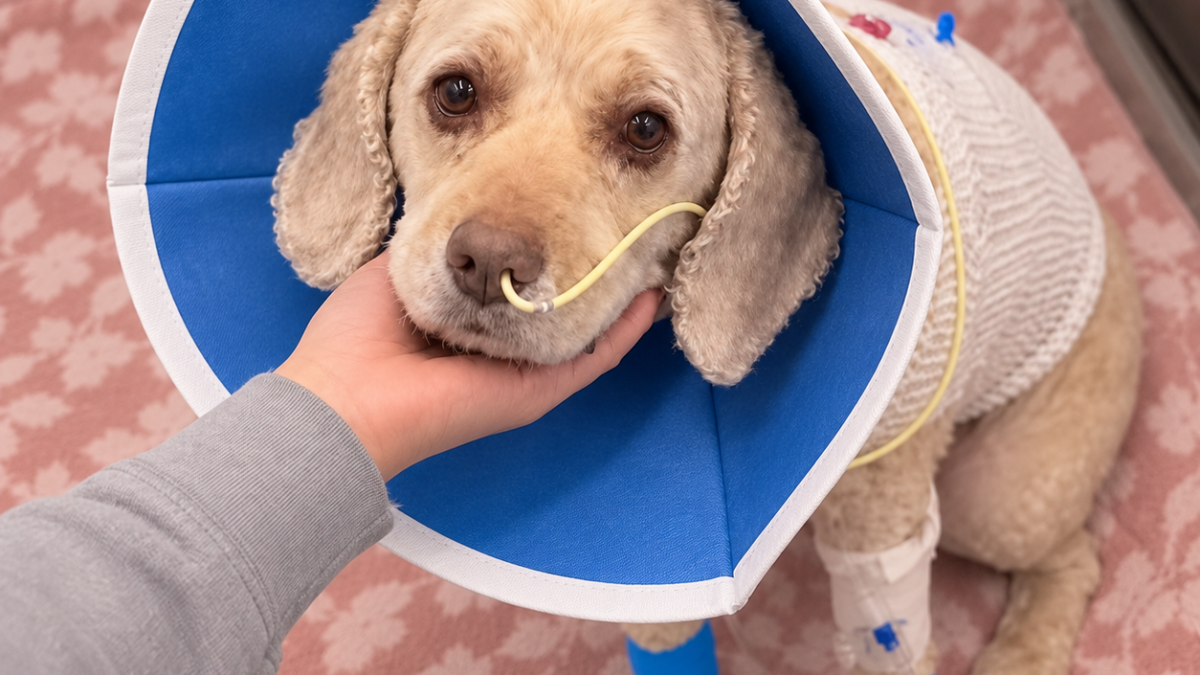
He wore a soft recovery collar instead of a hard plastic cone because his facial burns made the standard one uncomfortable.
When Jenna opened the car door, he stared at her front yard.
Grass.
Trees.
A quiet porch.
No metal kennels.
No treatment tables.
He stepped out carefully.
Then he stopped.
For almost a minute, he did nothing.
He simply stood in the grass.
I watched him lower his nose.
Smell.
Take two steps.
Smell again.
His tail lifted slightly.
Jenna’s dog, a calm older mutt named Rosie, watched from behind a baby gate inside the house.
The first introduction happened through distance and barriers.
Roy wagged.
Rosie sniffed.
Roy tried to approach too quickly.
Rosie gave one sharp bark.
Roy backed up.
“Good choice,” Jenna said.
The cats were less diplomatic.
One disappeared upstairs.
The other, Walter, sat on a counter and stared down at Roy with the expression of a landlord discovering unauthorized construction.
Roy noticed him.
His entire body perked up.
Walter hissed.
Roy wagged.
I laughed.
“He still hasn’t learned.”
Jenna pointed at Walter.
“That animal has bullied every foster dog I’ve had.”
Walter hissed again.
Roy sat.
For some reason, that seemed to offend the cat even more.
The first evening went better than we expected.
Roy explored slowly.
Kitchen.
Hallway.
Living room.
Back door.
Water bowl.
Then he discovered the couch.
Jenna had covered it with washable blankets.
Roy put his front paws on the cushion.
He looked at her.
“No.”
He froze.
She pointed at the dog bed.
“There.”
Roy looked at the bed.
Then at the couch.
Then at me.
I raised both hands.
“Don’t involve me.”
He lowered his paws.
Jenna smiled.
“Good boy.”
Roy turned.
Walked to an armchair.
And climbed into that instead.
Jenna stared.
I started laughing.
“That was not the agreement.”
Roy carefully turned in a circle and lowered himself into the chair.
His face, still scarred and healing, settled against the cushion.
His eyes closed.
Jenna put both hands on her hips.
“That chair cost more than the couch.”
Roy sighed.
She lasted eleven seconds.
Then she walked over and rubbed his head.
“Fine.”
That photograph became one of my favorites from his entire recovery.
Roy asleep in a chair that was supposedly forbidden.
Bandages still visible.
Healing skin across his face.
One paw hanging over the edge.
Safe.
The ordinary moments were what affected me most.
Not the dramatic medical updates.
Not the rescue itself.
Roy drinking water in a kitchen.
Roy sleeping without kennel noise around him.
Roy standing at the back door because he needed to go outside.
Roy discovering that refrigerators contained cheese.
Roy learning the sound of Jenna opening the medication drawer and immediately pretending to be asleep.
“He’s faking,” she told me over the phone.
“How do you know?”
“Because his eyes are closed and his tail is wagging.”
“Maybe he’s dreaming.”
“I said his name and one eye opened.”
“Could still be dreaming.”
“I dislike both of you.”
Roy’s medication arrived inside peanut butter after that.
He never objected again.
His bandage changes remained difficult.
Some wounds healed quickly.
Others took longer.
The burned areas contracted as new tissue formed, creating tightness that had to be monitored.
Part of one ear developed damaged tissue that eventually sloughed away.
We worried about scarring near his eye.
We worried about the skin on his shoulder.
We worried every time he scratched.
We worried when he slept too much.
Then we worried when he became energetic enough to try running.
Recovery makes you irrational.
When a sick animal lies still, you pray for movement.
When he finally moves, you beg him to stop before he injures himself.
At one recheck, Roy pulled toward another dog in the waiting room.
“He’s feeling better,” Dr. Patel said.
“He’s going to rip a bandage.”
“That is the less poetic version.”
Roy sat when asked.
His whole rear end wiggled.
Not just his tail.
His hips.
His shoulders.
Everything.
Jenna laughed.
“There it is.”
“What?”
“The wiggle.”
We had not realized until then that Roy had one.
As the pain eased, pieces of his personality emerged.
Roy did not simply wag his tail when excited.
He bent his entire body into a curve and wiggled from side to side like he could not contain himself.
His mouth opened.
His ears shifted back.
His whole face softened.
The transformation was startling because the first images of Roy showed an animal almost motionless from pain.
Now he greeted us with movement.
“Careful,” Jenna kept saying.
Wiggle.
“Roy, your dressings.”
Wiggle.
“You are going to tear something.”
More wiggle.
Walter the cat remained unimpressed.
One afternoon, Jenna sent me a video.
Roy was lying on the couch.
Apparently couch rules had collapsed completely.
Walter walked across the room, jumped up beside him, and stopped.
Roy froze.
Walter smelled one of Roy’s paws.
Roy did not move.
The cat circled twice.
Then he lay down against Roy’s back.
Jenna whispered from behind the camera, “Nobody move.”
Roy’s eyes shifted toward her.
Walter closed his eyes.
For nearly an hour, they slept that way.
I watched the video six times.
Around day thirty-five, we had our first serious setback since the infection.
Jenna called me just after midnight.
“He’s breathing weird.”
I was awake instantly.
“How weird?”
“Fast. And he coughed three times.”
My stomach tightened.
“Count his breaths.”
“I did.”
“What is it?”
She told me.
Too high.
“Emergency clinic.”
We met there.
Roy walked in on his own but looked restless.
Dr. Patel was not working that night, but another veterinarian reviewed his history and repeated chest imaging.
For two hours, Jenna and I sat beneath fluorescent lights saying almost nothing.
The old fear returned.
Smoke inhalation.
Delayed lung damage.
Pneumonia.
Complication from aspiration.
Every terrible possibility my mind could invent.
Finally, the veterinarian entered.
“He does have airway inflammation.”
Jenna leaned forward.
“From the fire?”
“Likely related. But his oxygen is good.”
“Pneumonia?”
“I’m not seeing the pattern I’d expect.”
“Then why is he breathing fast?”
“Pain may be contributing. Stress certainly is. There’s also some irritation that we need to treat.”
I looked at her.
“Hospital?”
“Tonight, yes.”
Jenna’s face fell.
Roy had been home long enough that sending him back behind a clinic door felt like failure.
We left him anyway.
Responsible care often feels cruel in the moment.
At 4:00 a.m., I was sitting in my car outside the hospital when Jenna knocked on the passenger window.
I unlocked the door.
She climbed in holding two coffees.
“You didn’t go home.”
“Neither did you.”
“I went to get coffee.”
“That does not count.”
She handed me one.
For a while, we watched the entrance.
Then Jenna said, “I think I’m too attached.”
I smiled tiredly.
“You’re a foster. That’s illegal.”
“I’m serious.”
“I know.”
She stared into her cup.
“When he didn’t come home with me tonight, the house felt wrong.”
I did not say anything.
“I looked at the chair.”
“The expensive one?”
“Yes.”
“The one he stole?”
“He didn’t steal it.”
“Revisionist history.”
She smiled, then looked away.
“I’m not adopting him.”
I had not asked.
“Okay.”
“I mean it.”
“Okay.”
“I can’t keep every medical dog.”
“I know.”
“And if fosters keep the easy ones, we lose foster homes.”
“Roy is not the easy one.”
“You know what I mean.”
I did.
Foster homes are not unlimited.
Every permanent adoption by an experienced medical foster can mean one fewer place for the next emergency.
Sometimes foster families adopt.
Sometimes they love an animal enough to let him leave.
Both can hurt.
“Then don’t decide tonight,” I said.
She nodded.
At sunrise, the hospital called.
Roy was stable.
By afternoon, he was back at Jenna’s house with an inhaled medication plan and stricter monitoring.
He walked inside.
Rosie greeted him.
Roy wiggled.
Walter watched from the stairs.
Then Roy went directly to the expensive chair.
Jenna laughed and cried at the same time.
“You absolute jerk.”
Roy climbed up.
She sat on the floor beside him.
I stood in the doorway and watched her rest one hand on the unburned part of his head.
That was when I knew letting him go would be hard for her.
But difficulty is not always a reason not to do something.
Sometimes it is evidence that it matters.
By day fifty, Roy no longer needed IV support.
He had not needed it for weeks, but the milestone still felt important because so much of his early life with us had involved lines, tubes, medications, and constant intervention.
His skin was changing.
The furious red areas softened into pink.
Some hair began growing back.
Other places would remain scarred.
His ears would never look exactly as they had before the fire.
Neither would parts of his face.
We stopped caring.
Roy certainly did.
He cared about breakfast.
He cared about walks.
He cared about whether Rosie had received a treat when he had not.
He cared deeply about cheese.
And he developed an inexplicable fascination with laundry baskets.
Jenna sent me a photo one morning.
Roy was asleep with his head inside a basket of clean towels.
**Explain your dog.**
I replied:
**Your foster.**
She sent back:
**Convenient.**
At day sixty-two, Dr. Patel examined him and smiled before she even finished.
“What?”
I asked.
“I think we can reduce the wound care.”
Jenna nearly dropped Roy’s leash.
“How much?”
“Most areas no longer need daily bandaging.”
I looked at Roy.
He was trying to smell a container of tongue depressors.
“Did you hear that?”
He sneezed.
Dr. Patel laughed.
“I’ll take that as gratitude.”
Several deeper areas still required attention, but the routine that had dominated Roy’s life began loosening.
He had more time simply to be a dog.
Short walks became longer walks.
He learned Jenna’s neighborhood.
He knew which house had the beagle behind the fence.
He knew where squirrels gathered.
He knew that the woman three houses down carried biscuits.
Jenna accused her of undermining training.
The woman denied everything while actively handing Roy a biscuit.
His coat improved.
His weight returned.
His face became expressive again as swelling disappeared.
The scars remained obvious.
People noticed.
Some asked what happened.
Some stared.
One man crossed the sidewalk when he saw Roy approaching.
Jenna came home angry.
“He looked at him like he was dangerous.”
“What did Roy do?”
“Nothing. He was sniffing a mailbox.”
“Then Roy had a better day than the man.”
She sighed.
“I know.”
The next afternoon, a little girl asked if Roy’s face hurt.
Jenna told me about it later.
She had answered carefully.
“It used to.”
The girl studied him.
“Can I pet him?”
“If your mom says yes, and if Roy wants to say hello.”
Roy wanted to.
The child rubbed beneath his chin.
Roy leaned into her.
She smiled.
Then she said, “His face is cool.”
Jenna laughed.
Apparently Roy did too, in his own way.
By day seventy, we started discussing adoption.
Not immediately.
Not carelessly.
Dr. Patel still wanted follow-up.
Roy’s lungs needed monitoring.
His skin required protection.
The scarred areas were more vulnerable.
But medically, the direction was clear.
He was becoming a survivor rather than an emergency patient.
Megan called me.
“We need to list him eventually.”
“I know.”
“Jenna?”
“Still says she isn’t keeping him.”
“You believe her?”
“No.”
“Does she?”
“Also no.”
Megan laughed.
“Give her time.”
We did.
A week later, Jenna called me.
“I’m not adopting Roy.”
This time she sounded certain.
“Okay.”
“I’ve been thinking about it.”
“I figured.”
“I love him.”
“I know.”
“But Rosie is twelve.”
I waited.
“She tolerates him. Sometimes she likes him. But he’s younger and getting more energetic every week.”
“That’s true.”
“And I want to keep fostering medical cases.”
“That’s also true.”
Her voice softened.
“If I keep him because saying goodbye hurts, then eventually I won’t have room for the next Roy.”
I closed my eyes.
“That’s a good reason.”
“It feels terrible.”
“Those are not mutually exclusive.”
There was silence.
Then she said, “Promise me we won’t send him anywhere just because somebody likes his story.”
“We won’t.”
“I mean it.”
“So do I.”
“I want somebody who understands the medical history.”
“Yes.”
“Somebody who won’t treat him like damaged goods.”
“Yes.”
“Somebody who lets him on furniture.”
I laughed.
“That one feels personal.”
“The chair is already ruined.”
“It is not ruined.”
“It smells like dog.”
“You own dogs.”
“Stop arguing.”
We prepared Roy’s adoption profile.
I struggled with the opening line.
How do you introduce a dog without reducing him to the worst thing that ever happened to him?
**House fire survivor.**
True.
But Roy was not a fire.
**Burn victim.**
Also true.
Also incomplete.
I finally wrote:
**Roy is a gentle, social dog who has spent the last several months recovering from severe burns after surviving a house fire. His scars are part of his history, but they are not the most interesting thing about him.**
Then I wrote about the wiggle.
The chair.
The cats.
His medication manners.
His love of soft furniture.
His tendency to stare into refrigerators as if food might materialize through concentration alone.
Applications came in.
More than I expected.
Some were immediate no’s.
One person wanted him as an “inspiration dog” for social media.
No.
Another wanted an outdoor dog for a large property.
Absolutely not.
One family sounded perfect on paper but lived too far from the veterinary specialists we wanted available during the final recovery period.
Then I read an application from a couple named Daniel and Erin.
Two adults.
One teenage son.
A quiet home.
Previous experience with a dog who had chronic skin disease.
No current dogs.
One older indoor cat.
Fenced yard.
Flexible work schedules.
They did not write a long emotional essay about rescuing Roy.
That interested me.
Under **Why are you interested in this dog?**, Erin had written:
**He sounds like he wants a normal life. We can offer one.**
I sent the application to Jenna.
She called three minutes later.
“I hate them.”
“You haven’t met them.”
“I hate how good this looks.”
“That sounds healthy.”
“They have a cat.”
“Roy has passed Walter University.”
“That cat taught him fear.”
“Useful skill.”
The first meeting happened in Jenna’s backyard.
Daniel, Erin, and their son Lucas arrived ten minutes early.
They did not rush Roy.
That mattered.
Roy came outside wearing a light protective shirt over the most sensitive healed areas.
Erin crouched sideways.
Daniel kept his hands at his sides.
Lucas stood slightly behind them.
Roy smelled Erin.
Then Daniel.
Then Lucas.
His tail started.
A small wag.
Then bigger.
Then his whole body bent into the familiar wiggle.
Jenna looked at me.
I pretended not to notice.
Lucas laughed.
“What is he doing?”
“That,” Jenna said, “is the Roy Wiggle.”
Roy leaned against him.
Lucas looked terrified to move.
“Can I pet him?”
“Yes.”
“Where?”
“Chest is safe.”
Lucas rubbed his chest.
Roy melted.
Daniel asked medical questions.
Good ones.
“What happens if the scar tissue cracks?”
“What signs would mean his lungs are becoming a concern again?”
“Does he need sun protection?”
“How often are rechecks?”
“How does he do when left alone?”
Erin asked about fear.
“Does he react to smoke alarms?”
That question stopped me.
We had never tested it deliberately.
Jenna answered.
“My smoke detector went off once when I burned toast.”
Daniel smiled.
“Important medical research.”
“Very.”
“What did he do?”
“He ran out of the kitchen.”
Erin’s face tightened.
“Panic?”
“No. More like he wanted nothing to do with my cooking.”
We laughed, but I saw her make a mental note.
Then she asked something nobody else had.
“Do we know what he remembers about the fire?”
“No,” I said.
She nodded.
“So we don’t assume he’s fine just because he looks fine.”
That was when I started hoping they were the family.
We scheduled a second meeting.
Then a home visit.
The house was not enormous.
It did not need to be.
There was a couch in the living room with an old blanket already spread over one side.
I looked at Erin.
“For Roy?”
She shrugged.
“We’ve seen the photos.”
Jenna stared at the couch.
“Good.”
The cat, Milo, was fifteen and seemed offended by the concept of movement in general.
Roy met him through a gate.
Milo stared.
Roy wagged.
Milo walked away.
“Better than Walter,” Jenna whispered.
We agreed on a foster-to-adopt transition.
Nobody wanted Roy moved abruptly.
The first visit lasted two hours.
The second lasted an afternoon.
The third included dinner.
Daniel sent us a photograph afterward.
Roy sat between the kitchen and dining room staring at the family while they ate.
Caption:
**We are being monitored.**
Jenna replied:
**Do not negotiate with him.**
Ten minutes later another picture arrived.
Roy had his head in Lucas’s lap.
Jenna stared at her phone.
“They gave him something.”
“How do you know?”
“That face.”
“What face?”
“The manipulation face.”
“You created this.”
“I healed him. I did not create this.”
“Yes, you did.”
On day 101, Roy spent his first night with them.
Jenna cried before he left.
Then denied it.
“You’re crying.”
“I have allergies.”
“In December?”
“Severe winter allergies.”
Roy climbed into Daniel’s car.
Then looked back through the open door.
Jenna walked over.
She held his face carefully in both hands.
Most of the skin had healed by then, but she still touched him as gently as she had during those first weeks.
“You be good.”
Roy licked her chin.
She laughed.
“I mean it.”
He licked her again.
Her voice broke.
“Okay. Go.”
Daniel closed the door.
The car drove away.
Jenna stood in the driveway.
I stayed beside her.
For a full minute she did not speak.
Then she said, “I hate fostering.”
“I know.”
“I’m doing it again.”
“I know.”
She wiped her face.
“Do not bring me another burn dog tomorrow.”
“I’ll wait until Wednesday.”
She punched my arm.
Roy’s overnight visit went well.
Almost.
At 1:14 a.m., Erin texted.
**Question: does he normally sleep horizontally across an entire queen bed?**
I sent it to Jenna.
Her response:
**They have been chosen.**
By day 110, Roy was spending more time with Daniel and Erin than at Jenna’s house.
The transition became surprisingly easy for him.
Harder for us.
Roy did not interpret love as a limited resource.
That was one of the things I admired about him.
He could adore Jenna and still run toward Lucas.
He could recognize my car and wiggle so hard his body curved in half, then leave with Daniel without looking betrayed.
We humans are the ones who turn affection into ownership.
Roy simply collected people.
At his day 118 medical recheck, Dr. Patel spent nearly forty minutes examining his skin, listening to his lungs, reviewing weight, checking scar tissue, and comparing photographs from intake.
Finally, she pulled up the first image.
I had not seen it in weeks.
Roy on day one.
Swollen face.
Raw skin.
Exhausted eyes.
Then she looked at the dog standing beside us.
His coat had grown back over much of his body.
The scars around his face were lighter.
His eyes were bright.
He had gained healthy weight.
His tail would not stop moving because Sarah had entered with treats.
Dr. Patel smiled.
“You need to see this.”
“I am seeing it.”
“No.”
She turned the tablet toward me.
“Look at both.”
I did.
For several seconds, I could not speak.
I remembered the shelter.
The red notation.
The transfer form.
The sentence about possible smoke inhalation.
The uncertainty.
The nights when Roy would not eat.
The smell of infected tissue.
The bandages.
The coughing.
Jenna sitting beside me in a parking lot at four in the morning.
And now Roy was trying to convince Sarah that one treat was medically irresponsible.
Dr. Patel scratched his shoulder.
“You did it, buddy.”
Roy wagged.
I shook my head.
“He did most of it.”
Sarah smiled.
“He definitely complained the least.”
That was true.
Through months of treatment, Roy had remained astonishingly gentle.
He did not enjoy everything.
Nobody should romanticize that.
He resisted sometimes.
He trembled.
He turned away.
He planted his feet.
Once, near the beginning, he growled softly during a particularly painful cleaning.
We stopped.
Adjusted his pain control.
Changed the approach.
The growl had been information, not betrayal.
But Roy never became mean.
Pain did not erase his interest in other animals.
Fear did not erase his trust in people.
Even when exhausted, he often raised his head when someone entered.
That gentleness became more remarkable to me the better I knew him.
On day 126, we had another scare.
A small area of scarred skin near his shoulder split after he scratched.
There was blood on the bedding.
Erin called immediately.
“We’re coming in.”
At the clinic, the wound looked much worse to us than it was.
Dr. Patel cleaned it.
No infection.
No deep tissue damage.
Just fragile skin.
Erin stood beside the table.
“I thought we had hurt him.”
“You didn’t.”
“We should have stopped him scratching.”
“You cannot watch a dog every second.”
“I know.”
Dr. Patel looked at her.
“Do you?”
Erin stopped.
The veterinarian smiled.
“You’re allowed to be his family instead of his medical staff.”
Erin’s expression softened.
“I’m trying.”
“That’s good. Keep trying.”
On the drive home, Roy sat between Lucas and me in the back seat.
Lucas rubbed his chest.
“Does this mean the adoption gets delayed?”
The question was quiet.
I looked at him.
“Are you worried about that?”
He shrugged.
“My mom keeps saying foster-to-adopt.”
“That’s what it is.”
“So somebody can still say no.”
I understood then.
Roy was not the only one living through uncertainty.
“How would you feel if that happened?”
Lucas looked at Roy.
“Bad.”
“More specific.”
He frowned.
“Like he was ours and then suddenly he wasn’t.”
Roy pushed his head against the boy’s arm.
Lucas smiled.
“He already sleeps in my room.”
“That is significant legal evidence.”
“I’m serious.”
“So am I.”
He studied me.
“Are you going to take him away?”
“No.”
His shoulders relaxed.
“Unless something changes that makes the home unsafe for Roy, or unsafe for your family, the goal is adoption.”
“For real?”
“For real.”
He nodded.
Then he looked out the window so I would not see how relieved he was.
Day 143 arrived on a Saturday.
I knew the number because Megan had counted from the date Roy entered our care.
One hundred forty-three days.
Nearly five months.
The adoption papers were on Erin’s dining room table.
Jenna came.
Megan came.
Dr. Patel could not leave the hospital, but Sarah came after her shift.
Roy wore no bandages.
That mattered more than any decoration we could have given him.
His scars were visible.
So was new fur.
He had a soft blue collar around his neck and an identification tag that made a quiet sound when he moved.
Daniel signed first.
Then Erin.
Lucas stood beside them.
“You don’t sign,” Erin told him.
“I should.”
“You are fifteen.”
“He sleeps in my room.”
“That still does not make you financially responsible.”
Lucas looked at me.
“This process is discriminatory.”
“Finish high school,” I said.
Roy wandered under the table.
Jenna bent down.
“Of course you’re missing your own adoption.”
His tail hit a chair leg.
Thump.
Thump.
Megan signed the rescue transfer.
Then she slid the papers toward me.
“Witness.”
I looked at the signature line.
For some reason, my hand stopped.
The first papers I had signed for Roy had been at a shelter intake counter.
A transfer out.
An emergency responsibility.
A dog nobody knew whether we could save.
Now the paper beneath my hand meant something completely different.
I signed.
“That’s it,” Megan said.
Lucas looked confused.
“That’s it?”
“That’s it.”
“No ceremony?”
Daniel laughed.
“What were you expecting?”
“I don’t know. Something.”
Jenna stood.
“I can provide a speech.”
“No,” everyone said at once.
She looked offended.
Roy emerged from beneath the table.
Erin crouched.
“Hey.”
He approached her.
She held his face.
“You’re staying.”
Roy licked her.
Lucas dropped to the floor beside them.
Daniel knelt too.
Within seconds, Roy was surrounded.
He started wiggling.
Not a little.
The full-body version.
His hips swung.
His shoulders curved.
His tail knocked into Daniel’s arm.
Lucas laughed.
“Roy!”
More wiggle.
Erin tried to keep him still.
“Buddy, calm down.”
Impossible.
Jenna stood next to me.
Her eyes filled.
I nudged her shoulder.
“Allergies?”
“Shut up.”
Roy broke free from the family circle and came toward us.
He stopped in front of Jenna.
For one second, I wondered whether this would undo her.
Then Roy leaned against her legs.
She knelt.
“My boy.”
She rubbed his chest.
“You got your house.”
His tail moved.
“You got your couch.”
Faster.
“You got your kid.”
Lucas protested from across the room.
“I’m not his kid.”
Jenna looked at him.
“You are absolutely his kid.”
Roy licked her cheek.
She laughed.
Then she whispered something only I heard.
“I would do it again.”
I put my hand on her shoulder.
“I know.”
Those one hundred forty-three days had not been a straight line from burned dog to happy ending.
They had been made of smaller things.
A stable oxygen reading.
A temperature coming down.
One empty food bowl.
A bandage no longer needed.
A cough that became less frequent.
Five extra minutes outside.
The first couch nap.
The first night away from the clinic.
The first time someone saw Roy’s scars and reached for him instead of stepping away.
Recovery rarely arrives as one miracle.
It arrives as ordinary moments becoming possible again.
Months after the adoption, I visited.
I expected Roy to meet me at the door.
He did not.
“That’s rude,” I told Erin.
She pointed toward the living room.
I walked in.
Roy was asleep on the couch.
Not just on it.
Across it.
All four legs stretched in different directions.
His head rested against Lucas’s thigh while the boy did homework.
Milo, the elderly cat, slept near Roy’s back.
I stood there smiling.
Lucas looked up.
“He’ll wake up if you say his name.”
“I know.”
“Do it.”
I shook my head.
“Let him sleep.”
Maybe that was the moment the whole journey finally made sense to me.
The first time I saw Roy, survival had looked dramatic.
A burned dog pulled from a house.
A shelter deadline.
An emergency transfer.
Hospital care.
Oxygen.
Bandages.
Medication.
Those were the moments people noticed.
But this was what survival was actually for.
A couch.
A sleeping dog.
A teenager doing homework.
A cat curled against warm fur.
No alarms.
No treatment table.
No red notation beside his name.
I sat in the chair across from them.
A few minutes later, Roy opened one eye.
He looked at me.
For half a second, nothing happened.
Then his tail moved.
Thump.
His head lifted.
The tail moved faster.
Thump. Thump. Thump.
Lucas laughed.
“He knows you.”
Roy slid off the couch and came toward me.
By the time he reached the chair, his entire body was wiggling.
I dropped to my knees.
“There he is.”
He pushed his scarred face against my chest.
I wrapped my arms around him.
His skin felt different beneath my hands now.
Some places were smooth.
Some rough.
Some covered in new hair.
Some would always carry the fire.
That was all right.
Roy pulled away and looked toward the kitchen.
Erin laughed.
“He thinks everybody who visits is here to feed him.”
“I saved his life.”
“You also introduced him to chicken.”
“That may have been the more meaningful event.”
Roy walked to the refrigerator.
He sat.
Then looked back at me.
Waiting.
I laughed.
“You survived a house fire, months of wound care, a lung scare, infection, and 143 days of recovery, and this is what you became?”
His tail tapped the floor.
A dog waiting for a snack.
A completely ordinary dog.
I opened the refrigerator.
And after everything Roy had fought through to get there, ordinary was exactly what I wanted for him.
[END OF STORY]








