PART 2: Pregnant and Chained to a Tree, She Still Wagged Her Tail When We Found Her—Then Her Body Suddenly Went Rigid
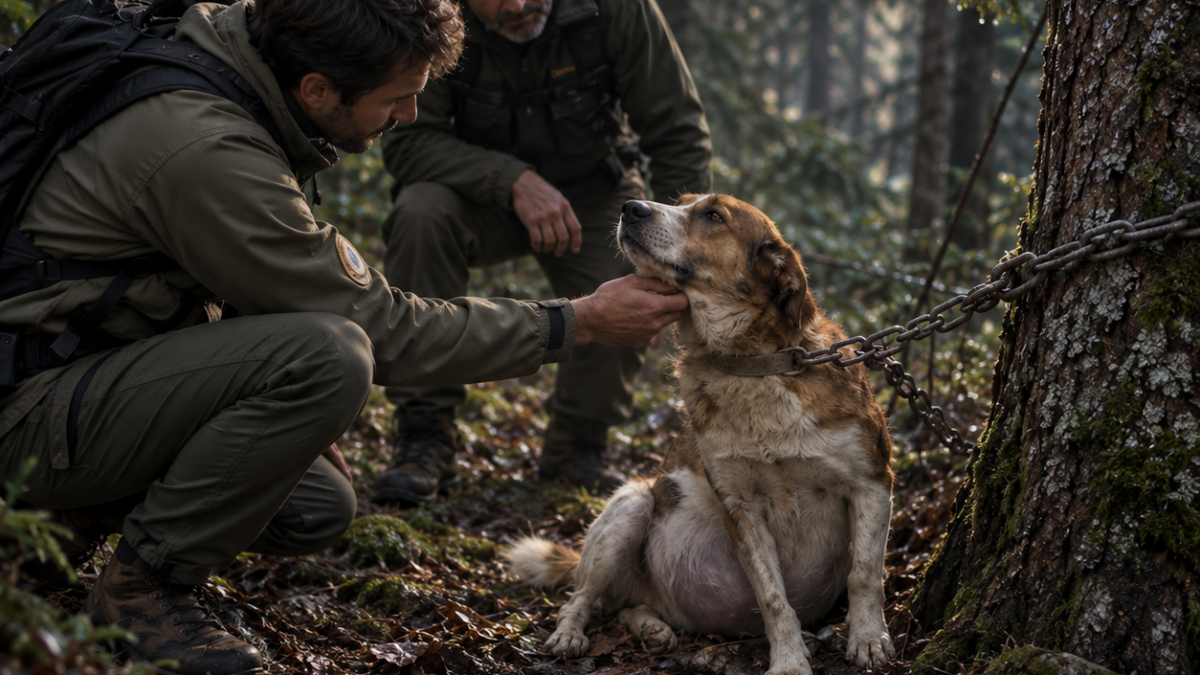
PART 2
For one second, neither Marc nor I moved.
There are moments when training gives you an immediate sequence.
Assess.
Secure.
Call.
Act.
And then there are moments when the thing happening in front of you doesn’t feel real enough for procedure.
A heavily pregnant dog was beginning labor in the middle of an isolated forest with less than two feet of chain around her neck.
I was the first to find my voice.
“Call Sophie.”
Marc already had his phone out.
Dr. Sophie Lambert was a veterinarian who occasionally assisted our unit with injured wildlife and abandoned domestic animals.
Marc climbed a few yards uphill trying to get a signal.
I stayed with the dog.
Another contraction ran through her.
Her front paws scraped at the dirt.
She attempted to turn.
The chain caught.
Her body twisted awkwardly around the tree.
“No. No, no.”
I moved closer.
She watched me.
“I’m going to help.”
Maybe I said it for her.
Maybe for myself.
I reached for the collar.
She flinched.
I stopped.
The skin beneath it was raw.
Not fresh.
The injury had been forming for days.
Possibly longer.
I showed her my hands.
“Okay.”
Her breathing remained fast.
“I’m not grabbing you.”
Marc called down from uphill.
“I’ve got Sophie.”
He put the phone on speaker.
“Tell me exactly what you see,” Sophie said.
Marc described the dog.
Pregnant.
Dehydrated.
Restricted movement.
Possible labor.
“How frequent are the contractions?”
I checked my watch.
“Maybe a minute apart? I’m not sure.”
“Any puppy visible?”
“No.”
“Discharge?”
“Clear fluid.”
Sophie exhaled.
“Listen carefully. Do not pull a puppy if one appears unless I tell you. First priority is getting that chain off and getting her somewhere she can lie flat.”
“Bolt cutters are in the vehicle,” Marc said.
A mile uphill.
I looked at the chain.
Heavy.
Thicker than anything in my small belt tool kit.
There was a padlock attached near the tree.
“Marc.”
He followed my eyes.
“I know.”
“I’ll go.”
“No. Stay with her.”
“You’re faster?”
“No.”
He was right.
At fifty-three, Marc could still walk most younger officers into the ground, but on a steep slope I had twenty-one years on him.
I removed my pack.
“Twenty minutes.”
“Make it fifteen.”
I ran.
I had spent years hiking those trails, but I don’t remember much of that climb.
Only branches slapping my arms.
Loose stones under my boots.
My lungs burning.
And one thought repeating with every step.
Don’t let her have those puppies chained to that tree.
At the vehicle, I threw open the rear compartment.
Bolt cutters.
Blankets.
Water.
First-aid bag.
A folding tarp.
I grabbed everything I could carry.
By the time I reached them again, my shirt was soaked.
Marc was kneeling near the dog.
She was panting.
The chain lay taut.
“No puppy yet.”
I set down the gear.
“Good.”
“I wouldn’t use the word good.”
He poured water into a collapsible bowl and slid it carefully toward her.
The bowl reached the edge of the chain’s radius.
She tried to drink.
Another contraction stopped her.
Her legs trembled.
I positioned the cutters.
Marc moved near her head.
He held out one hand.
“Easy, sweetheart.”
The dog sniffed his fingers.
I closed the cutters around a link.
Metal resisted.
I shifted position.
Pressed again.
The dog startled at the sound.
Marc steadied her without grabbing.
“One more.”
I leaned my weight into it.
The link snapped.
The chain dropped.
The dog remained pressed against the trunk.
Free.
But she didn’t move.
I had seen animals do that before.
The body learns a boundary.
Sometimes faster than the mind can forget it.
I moved the chain away.
“You can go.”
Her eyes remained on me.
“You’re not tied anymore.”
She took one step.
Stopped.
Marc picked up the water bowl and carried it to a patch of flat ground.
That did it.
She followed.
Slowly.
Painfully.
She reached the bowl and tried to drink too quickly.
I pulled it away after several seconds.
She looked at me.
“I know.”
I gave her a little more.
Then waited.
More.
Wait.
Sophie remained on the phone.
“Her gums?”
“Pale.”
“Temperature?”
“No rectal thermometer.”
“Ears and paws?”
“Warm.”
“Can she walk?”
“Barely.”
“You need to get her out.”
The dog tried to lie down.
This time her body could stretch fully.
She lowered herself.
Then another contraction hit.
She cried.
I had never heard that sound from a dog before.
It was not loud.
That made it worse.
Marc looked at me.
“We’re not walking her a mile.”
“No.”
“Stretcher?”
The terrain was too steep for our standard rigid board.
We improvised.
Tarp.
Blanket.
Two strong branches.
Not pretty.
But enough.
Before we could move her, the dog strained again.
Then something appeared beneath her tail.
A small dark sac.
Marc froze.
“Julien.”
“I see it.”
I grabbed the phone.
“Sophie, something’s coming.”
“Good. Let her push.”
The dog turned her head toward us.
Fear entered her eyes for the first time.
Not fear of us.
Fear of what her body was doing.
“Stay calm,” Sophie said through the phone. “Dogs usually know what to do. Your job is to keep her safe and not interfere unless there’s a problem.”
A problem.
We were in the middle of a mountain forest beside the chain someone had locked around her.
Everything already felt like a problem.
The dog strained.
The sac appeared farther.
Then disappeared slightly.
Another push.
Marc whispered:
“Come on, girl.”
The puppy emerged.
Tiny.
Wet.
Still enclosed in membrane.
The mother turned immediately.
Instinct replaced exhaustion.
She tore the sac with her teeth.
Licked.
Licked again.
The puppy didn’t move.
My heart dropped.
“Rub it,” Sophie instructed. “Firmly but gently. Clear the nose.”
Marc lifted the puppy in a towel.
The mother watched every movement.
I could almost feel her deciding whether to trust us.
Marc rubbed.
Nothing.
Again.
A tiny cough.
Then a squeak.
The mother’s ears lifted.
The puppy breathed.
Marc placed it against her belly.
She licked it furiously.
I laughed.
Not because anything was funny.
Because the pressure in my chest needed somewhere to go.
“One,” I said.
Marc nodded.
“One.”
Then another contraction hit.
We hadn’t even started evacuating her.
The second puppy came fifteen minutes later.
Healthy.
The third took longer.
Too long.
Nearly forty minutes passed.
The mother became weaker.
She stopped licking the first two as actively.
Her eyes began closing between contractions.
Sophie didn’t like it.
“Any strong pushing?”
“Less than before.”
“Discharge?”
“Dark green.”
A pause.
“How long since the second puppy?”
“Thirty-eight minutes.”
“Get her moving toward me now.”
Marc and I exchanged a look.
“We have two newborn puppies.”
“Keep them warm. Close to her if possible. There may be several more.”
Several.
I looked at the dog’s belly.
Suddenly our improvised stretcher felt ridiculous.
We wrapped the puppies in towels and placed them in a padded field box near their mother’s chest.
She could smell them.
Touch them with her nose.
We moved slowly.
Every rock mattered.
Every root.
Marc took the front.
I took the rear.
The mother lay on blankets between us.
The box with the puppies rested against her side.
Twenty yards uphill, she began contracting again.
We stopped.
The third puppy arrived on the stretcher.
Alive.
We cleaned it.
The mother did the rest.
We continued.
Halfway to the road, she stopped breathing normally.
“Marc.”
“I know.”
We put the stretcher down.
Her gums were nearly white.
She looked at the puppies.
Then at me.
Her head fell sideways.
I slapped my radio.
“Dispatch, we need veterinary transport at the forest road immediately. Possible obstetric emergency. Severe dehydration.”
A crackling response.
Vehicle coming.
Sophie was already driving toward us.
The fourth puppy appeared before we reached the trail.
It was stuck.
Its back legs and lower body were visible.
The head remained inside.
The mother pushed.
Nothing.
Again.
Nothing.
“Sophie!”
Her voice through the phone sharpened.
“How long?”
“Maybe ninety seconds.”
“Is the sac broken?”
“Yes.”
“Grip the puppy with a clean towel, never the legs alone. During the mother’s next contraction, steady gentle traction downward and backward. Do not twist.”
I looked at Marc.
“You want to?”
“You have steadier hands.”
That was a lie.
But I did it.
The mother strained.
I pulled gently.
Nothing.
“Again.”
She pushed.
I applied steady pressure.
The puppy slid free.
Limp.
Marc took it.
Rubbed.
Cleared the nose.
No breath.
“Come on.”
He rubbed harder.
“No.”
“Come on.”
I watched the mother’s face.
She was watching him.
Marc lowered his head close to the tiny body.
“Don’t do this.”
He rubbed again.
A faint gasp.
Then another.
The puppy squealed.
Marc closed his eyes.
“That’s four.”
I remember thinking we had just witnessed a miracle.
We hadn’t reached the difficult part yet.
When we finally reached the vehicle, Sophie was waiting beside the road with a veterinary assistant.
The back doors of her clinic van were open.
She took one look at the dog.
“She’s crashing.”
Within seconds they had an IV line in.
Fluids began.
Oxygen.
Temperature check.
Blood pressure.
Sophie palpated the abdomen.
Her face tightened.
“How many puppies?”
“Four.”
“There are more.”
“How many?”
“At least three.”
The dog was barely responsive.
“Can she deliver them?”
Sophie looked at us.
“Not safely.”
“What happens now?”
“Emergency C-section.”
She drove.
We followed.
At the clinic, staff took her through double doors.
Marc and I stood in the hallway covered in dirt, blood, amniotic fluid, pine needles, and sweat.
Four puppies were placed in an incubator.
One female.
Three males.
The fourth, the one who had been stuck, needed oxygen.
A technician worked on him.
Marc stood beside the incubator.
He looked enormous next to those tiny bodies.
“You okay?” I asked.
“No.”
That was all.
I understood.
The dog’s surgery lasted more than an hour.
I called our supervisor.
Then police.
Because by then the chain and padlock were evidence.
The location was photographed.
The bowls collected.
Tire marks documented.
There were no houses nearby.
No legitimate reason anyone would chain a pregnant dog there.
This wasn’t neglect by accident.
This was abandonment with preparation.
Somebody had wanted her unable to follow them.
Sophie emerged just after sunset.
Her surgical cap was damp with sweat.
“She made it.”
Marc leaned against the wall.
“And the puppies?”
“Three more delivered surgically.”
“Alive?”
Sophie hesitated.
“Two.”
The hallway went silent.
One puppy had already died before surgery.
Possibly from placental separation.
Maybe because labor had gone on too long.
Maybe dehydration.
Maybe stress.
We would never know.
Six living puppies.
One dead.
I felt anger rise so quickly it surprised me.
Not abstract anger.
Specific.
Someone had driven that mother into the woods.
Someone had looked at her enormous belly.
Locked a chain around a tree.
Put an empty bowl where she could see it.
And left.
Marc looked at Sophie.
“Will she survive?”
“I think so.”
“You think?”
“She lost a lot. She’s severely underweight beneath the pregnancy. She’s anemic. Dehydrated. Her neck is infected.”
“But?”
“But she fought through surgery.”
Marc looked toward the operating room.
“She wagged her tail when we found her.”
Sophie gave a tired smile.
“Then maybe she’s stubborn enough.”
We needed a name for the medical file.
No microchip.
No tag.
Nothing.
The receptionist asked me.
“Name?”
I looked at Marc.
He shrugged.
“You found her first.”
“No, you heard her.”
He thought.
Then looked out the window.
Beyond the clinic parking lot, evening sunlight touched the tops of distant mountains.
“Pine.”
I frowned.
“Pine?”
“She was tied to a pine.”
“That’s terrible.”
“You come up with one.”
The receptionist was waiting.
I looked through the glass at the brown-and-white dog sleeping under blankets.
“Hope?”
Marc stared at me.
“That’s worse.”
The receptionist laughed.
Sophie came over.
“What about Willow?”
“Why Willow?”
“Because willow trees bend without breaking.”
Marc nodded.
“Willow.”
So she became Willow.
The next morning I went back to the forest.
Not because I expected to find the person responsible.
Because scenes look different after the emergency ends.
Yesterday we had seen only a dog.
Now we looked for a story.
A vehicle had stopped near an old forestry access point.
Tire tracks entered soft ground.
Large van or pickup.
A man or woman had walked from there toward the pine.
We found one cigarette butt.
Two footprints.
A torn corner of a blue plastic sack.
The water container carried no useful fingerprints.
The bowls were cheap.
The chain wasn’t.
Heavy hardware-store chain.
Recently cut from a longer length.
The padlock was common.
Still, something bothered Marc.
He crouched beside the tree.
“What?”
“Look.”
On the opposite side of the trunk were scratches.
Not from Willow.
Too high.
Metal against bark.
Older marks.
I looked around.
Another pine fifteen yards away had similar damage.
Then another.
A circle worn into the soil.
I felt the back of my neck tighten.
“You think dogs were tied here before?”
Marc didn’t answer.
He kept walking.
We found four trees with similar marks.
One had a piece of old nylon rope embedded in the bark.
Another had a rusted chain link in the dirt.
This was not the first dog.
Police arrived.
The scene widened.
Marc walked toward me.
“This wasn’t someone panicking because their dog got pregnant.”
“No.”
“Somebody has used this place.”
The forest suddenly felt different.
The quiet didn’t feel peaceful anymore.
For several days, Willow remained at the clinic.
She could not nurse all six puppies immediately.
Her milk supply was poor.
Staff supplemented them by bottle.
Willow hated being separated from them.
Even for five minutes.
When a technician carried one puppy to be weighed, Willow tried to stand despite fresh surgical stitches.
Sophie stopped her.
“Your baby is coming back.”
Willow whined.
The puppy squeaked from across the room.
She answered immediately.
I visited every day after work.
At first I told myself I was checking the case.
By the fourth visit, even I didn’t believe that.
Willow recognized me.
The moment I entered, her tail moved.
Weakly at first.
Then more.
I sat on the floor beside her enclosure.
“You’re making this difficult.”
She leaned her head against the bars.
“I’m supposed to be objective.”
Tail.
“That’s not helping.”
One afternoon Sophie opened the kennel.
“Sit.”
“I am sitting.”
“Then don’t move.”
Willow stepped out.
Slow.
She sniffed my knee.
Then climbed half her body into my lap.
She weighed maybe fifty pounds.
Or should have.
At that moment she felt like thirty.
I put one arm around her.
She exhaled.
A long breath.
Then slept.
I stayed like that for forty minutes.
Marc walked in halfway through.
He smiled.
“You look objective.”
“Go away.”
He sat opposite us.
One of the puppies squeaked.
Willow’s eyes opened instantly.
“Mother of the year,” Marc said.
I looked at him.
“Somebody nearly killed her and her puppies.”
“I know.”
“We’re going to find them.”
Marc’s smile disappeared.
“Yes.”
The first real lead came from the chain.
A hardware shop twenty-five miles away sold the exact type in pre-cut lengths.
Police checked receipts.
Too many.
But the owner remembered something.
A man had purchased multiple chains, padlocks, and large metal dog bowls several times.
Cash.
Usually Friday evenings.
Security video remained from the most recent purchase.
The image was poor.
Baseball cap.
Beard.
Work jacket.
But his vehicle was visible outside.
Dark green van.
Partial plate.
That narrowed things.
Then Willow’s photograph reached local rescue groups.
A woman called.
Her name was Nathalie Perrin.
She had volunteered at an informal dog breeding property two years earlier.
She asked for Willow’s photograph from the left side.
We sent it.
She called back crying.
“I know that dog.”
My pulse jumped.
“What was her name?”
“Daisy.”
Not Willow.
Before that she had been Daisy.
Nathalie sent photographs.
Same white patch around the neck.
Same brown spot above one eye.
Same small scar near the right shoulder.
There was no doubt.
Where had Nathalie seen her?
At a breeding operation owned by a man named Laurent Chabert.
The name was familiar.
Not to me.
To Marc.
He had dealt with Chabert years earlier over illegal dumping and unlicensed kennels.
Nothing serious had stuck.
Chabert described himself online as a “working dog specialist.”
In reality, according to Nathalie, he bred large mixed-breed dogs and sold puppies through private advertisements.
Conditions were poor.
Females were bred repeatedly.
When dogs became sick or stopped producing desirable litters, they disappeared.
Nathalie had left after reporting concerns.
An inspection found fewer dogs than expected.
Chabert claimed he had sold the rest.
“Was Daisy pregnant when you knew her?” I asked.
“She had one litter.”
“And after?”
Nathalie’s voice broke.
“I don’t know. I tried to keep track. Then one day she was gone.”
“Did he sell her?”
“He said a family took her.”
“Did you believe him?”
“No.”
Police searched Chabert’s current records.
He still owned property.
Still advertised puppies.
Legally, on paper, he stayed just inside enough lines to survive.
We needed evidence connecting him to the forest.
The van helped.
Chabert owned a dark green Renault work van.
The plate matched the visible digits from the hardware store camera.
Still not enough.
Buying chains was legal.
Owning a dog previously did not prove abandonment.
Then Marc remembered the blue plastic fragment from the forest.
The corner of a feed sack.
Brand markings remained.
A specialized high-calorie puppy feed sold mostly through agricultural suppliers.
Investigators checked Chabert’s property from public access.
Stacks of the same feed bags were visible beside an outbuilding.
Again, not proof.
But pieces were accumulating.
Sophie examined Willow for signs of previous breeding.
Her body told a history.
This was not her first pregnancy.
Probably her third.
Possibly fourth.
At only four or five years old.
She had a faded identification tattoo inside one ear.
Almost deliberately scarred over.
Under alternate lighting, part of the number became readable.
That number changed the case.
It traced to a registered female puppy sold four years earlier to Laurent Chabert.
Daisy.
The paperwork still existed.
Chabert had never officially transferred ownership.
When police asked him, he claimed Daisy had died two years ago.
“How?” the investigator asked.
“Complications.”
“Veterinarian?”
“No.”
“Burial location?”
“Private land.”
“Which land?”
He couldn’t remember exactly.
Then police showed him a photograph of Willow.
For the first time, according to the interviewing officer, Chabert stopped talking.
He eventually said:
“Looks similar.”
The officer replied:
“It’s her.”
Chabert’s lawyer ended the interview.
That night, someone broke into Nathalie’s shed.
Nothing valuable was stolen.
But documents she had saved from the breeding property disappeared.
The next morning she called police terrified.
Chabert denied involvement.
There were no cameras.
No fingerprints.
No proof.
Marc took the news badly.
“He knows we’re looking.”
“Yes.”
“He’s cleaning.”
“Probably.”
“We need the dogs still there.”
Police and animal welfare authorities were already working toward a search warrant.
But legal processes move slower than anger.
Two days later the warrant came.
I wasn’t part of the search team.
Marc was.
I waited.
Three hours.
Four.
Finally he called.
“Julien.”
His voice sounded wrong.
“What?”
“We found seventeen dogs.”
I closed my eyes.
“Condition?”
“Mixed.”
“How many pregnant?”
“Three.”
“Puppies?”
“Twenty-two.”
“Jesus.”
“There’s more.”
I heard movement behind him.
“What?”
“A back shed.”
I waited.
“Freezers.”
I knew before he said it.
Dead animals.
Some likely died naturally.
Others needed examination.
Records were incomplete.
Microchips had been removed from several dogs.
Ear tattoos damaged.
Breeding logs used numbers instead of names.
And in a metal cabinet police found a notebook.
Dates.
Females.
Litter sizes.
Sale prices.
Notes.
Beside Daisy’s old identification number:
L3 — poor yield.
Then:
L4 accidental.
Then:
Remove.
The last word was dated three days before we found her.
Remove.
I read the photocopy later.
One word.
That was all Willow had become to him.
Not Daisy.
Not a dog.
Not a mother.
Remove.
Marc stood beside me.
“He couldn’t sell another litter?”
“Maybe he didn’t want veterinary costs. Maybe something went wrong with breeding records. Prosecutors are still sorting it.”
“He chained her there to die.”
I stared at the word.
“Yes.”
The question that haunted me was why leave food and water containers at all?
The answer came from one of Chabert’s former workers.
Appearance.
If someone found the dog too soon, Chabert could claim she had been temporarily tethered with provisions.
The bowls created a story.
Never mind that the chain couldn’t reach them.
Never mind that the water had been spilled.
Never mind that she could barely lie down.
Cruelty sometimes comes with props.
Chabert was arrested.
The story spread.
Pregnant dog chained to tree.
Seven puppies.
Six surviving.
Breeding operation raided.
Dozens rescued.
People reacted exactly as people do.
Anger.
Disbelief.
Threats online.
Messages demanding revenge.
Marc and I wanted justice.
Not a mob.
We had seen enough damaged lives.
Willow didn’t need another violent story built around her.
She needed food.
Sleep.
Safety.
And six puppies.
The puppies grew fast.
Sophie named them temporarily by colored collars.
Blue.
Red.
Yellow.
Green.
Purple.
Orange.
Marc refused this.
“They need names.”
“They’ll get names after adoption.”
“That’s ridiculous.”
He pointed to the smallest male.
“That one’s Rocket.”
“Why?”
“He crawls faster than the others.”
The female with the purple collar became Violet.
The large brown male became Bear.
The puppy who had been stuck during birth became Lucky.
Yellow became Sunny.
Orange became Milo.
Sophie gave up.
“Congratulations. You’ve named the litter.”
Marc looked proud.
Lucky worried us most.
He had been oxygen deprived at birth.
For several weeks we watched his development carefully.
He was smaller.
Slower to open his eyes.
Less coordinated.
But stubborn.
When his siblings climbed over him, Lucky climbed back.
When Willow moved, Lucky followed her smell.
At five weeks, he took three clumsy steps and fell into a water dish.
Marc laughed so hard he had to sit down.
“That one is absolutely staying alive out of spite.”
Willow transformed.
The hollow eyes softened.
Her coat became glossy.
She gained weight.
She slept stretched completely across the kennel.
The first time I saw her lie on her back with all four legs loose, I took a photograph.
Not because it was cute.
Because she could.
No chain.
No tree.
No forced posture.
Just a dog sleeping badly.
I sent the picture to Marc.
He replied:
That’s freedom.
The criminal investigation became larger.
Chabert’s phone records revealed communications with buyers in several countries.
Some legitimate.
Some suspicious.
Invoices showed puppy sales under false descriptions.
Veterinary certificates were reused.
A cooperating employee admitted puppies with health problems were sometimes hidden from inspectors.
Females were bred too frequently.
Dogs that could no longer produce profitable litters were “moved.”
The prosecutor asked what moved meant.
“Sometimes sold cheap.”
“And sometimes?”
The employee looked down.
“Dropped somewhere.”
“Alive?”
“Yes.”
“With food?”
“Sometimes.”
“With water?”
“Sometimes.”
“Restrained?”
The man hesitated.
“Sometimes.”
Marc left the courtroom when that testimony was later repeated at trial.
I found him outside near the steps.
“You okay?”
“No.”
“You want to go?”
“No.”
He stared across the parking area.
“You know what I keep thinking?”
“What?”
“She wagged her tail.”
I knew immediately.
“Yeah.”
“After everything those people did, she still wagged her tail when she saw us.”
Marc wiped one hand over his face.
“I don’t know if that makes me feel better or worse.”
“Both.”
He nodded.
“Both.”
The most damaging evidence against Chabert came from a small thing.
A trail camera.
A hunter had installed it months earlier near the forestry access track to monitor wild boar.
He didn’t hear about the case until news reports showed the location.
Then he checked old memory cards.
The camera had captured Chabert’s dark green van.
Date.
Time.
Plate.
It arrived at 10:14 p.m. three nights before we found Willow.
At 10:27, a man walked through the frame holding a chain.
Behind him was a dog.
Pregnant.
Brown and white.
Daisy.
Willow.
She was walking willingly beside him.
That part hurt the most.
She trusted him enough to follow.
At 10:46, the man returned alone.
The van left.
The photograph wasn’t perfect.
But the clothing matched items recovered from Chabert’s property.
The vehicle was his.
The time aligned.
Phone data placed his device in the area.
His defense began collapsing.
And still, Chabert denied intending harm.
He said Willow had become aggressive.
Said he feared for workers.
Said he tethered her temporarily while arranging transport.
Said someone else must have spilled the water.
Said he planned to return.
The prosecutor asked:
“Why did you tell investigators the dog had died two years earlier?”
No useful answer.
“Why did your notebook say remove?”
Administrative shorthand.
“Why was her identification tattoo deliberately damaged?”
No knowledge.
“Why was the chain too short for her to reach food or water?”
Measurement error.
“Why leave a dog close to labor alone overnight?”
He didn’t know she was that far along.
Sophie testified next.
She did.
Willow’s pregnancy was visually obvious.
Labor was imminent.
Malnutrition obvious.
Dehydration obvious.
Neck injury obvious.
A person who had bred dogs for years would have understood every one of those things.
Then Sophie showed the jury photographs.
Not dramatic ones.
Clinical ones.
Willow’s neck.
Body condition.
Damaged pads.
Surgical incision.
Dead seventh puppy.
The defense objected to the final image.
The judge allowed it for limited medical context.
Nobody in the courtroom moved.
That puppy had never opened its eyes.
No name.
No breath in the outside world.
Marc had asked Sophie afterward if they could name it anyway.
She said yes.
He chose Pine.
The tree had been part of its death.
He wanted the name to mean something else.
So Pine became the seventh puppy.
The one we never got to bring home.
Willow couldn’t testify.
But her body had already done it.
My turn came later.
The prosecutor asked me to describe finding her.
I did.
The sound.
The slope.
The chain.
The bowls.
Her belly.
Then:
“What did the dog do when she saw you?”
I looked toward the jury.
“She wagged her tail.”
A pause.
“Was she aggressive?”
“No.”
“Did she attempt to bite either officer?”
“No.”
“How did she behave when you removed the chain?”
“She didn’t understand immediately that she was free.”
“What do you mean?”
“She stayed beside the tree.”
“For how long?”
“Several seconds.”
“Why do you remember that?”
Because I still dreamed about it.
Instead I said:
“Because there was nothing holding her anymore, but she behaved like there was.”
The prosecutor let the silence sit.
Then asked:
“And what happened after she moved?”
“She went into labor.”
Marc testified after me.
He described hearing her from the trail.
“How far away?”
“Several hundred yards.”
“Was the sound loud?”
“No.”
“Then why did you notice?”
Marc looked at Chabert.
“Because the forest was quiet.”
He paused.
“And because she hadn’t given up calling.”
The trial lasted nearly three weeks.
Chabert faced charges related to animal cruelty, abandonment, falsification, illegal breeding practices, commercial fraud, identification tampering, and associated offenses.
Not every allegation could be proven.
Some animals in his old records remained missing.
Some employees blamed one another.
Some buyers had disappeared.
Justice is rarely neat.
The conviction was still substantial.
When the judge read the findings, Chabert finally looked smaller.
Not physically.
In significance.
For months he had occupied enormous space in our minds.
The man who chose the tree.
The man who locked the chain.
The man who wrote remove.
Then suddenly he was simply a defendant listening to consequences.
Prison time.
Heavy fines.
Long-term restrictions on animal ownership and commercial breeding.
Asset seizures related to unlawful proceeds.
Restitution.
The breeding operation was closed.
The surviving animals were transferred to licensed rescues and foster homes.
People outside the courthouse cheered.
Marc didn’t.
Neither did I.
We drove to Sophie’s clinic.
Willow was waiting.
By then the puppies were nearly four months old.
Bear had been adopted by a family with two teenagers.
Violet went to a veterinary nurse.
Sunny joined a retired couple.
Milo went to a young park ranger.
Rocket was adopted by Marc.
Nobody was surprised.
Lucky remained temporarily with Sophie because of mild coordination problems.
Willow had not yet been placed.
That was becoming a subject nobody discussed around me.
I entered the clinic yard.
Willow saw me.
Her entire rear end began moving.
“Hey.”
She ran.
Not fast.
But fast enough.
She hit my legs.
I crouched.
She licked my beard.
“You have terrible judgment in men.”
Marc stood behind me holding Rocket.
“She’s waiting for you to figure it out.”
“Figure out what?”
“That she’s yours.”
“No.”
Willow sat on my boot.
Marc raised an eyebrow.
“I live in an apartment.”
“You’re moving.”
“I am not.”
“You looked at houses yesterday.”
I turned.
“How do you know that?”
“You left a real-estate tab open on your office computer.”
“You spy on coworkers?”
“When they’re stupid.”
I looked down at Willow.
She looked up.
Tail.
“You planned this.”
Marc shrugged.
“I merely support destiny.”
“That’s the dumbest thing you’ve ever said.”
“Take your dog home.”
She became my dog six weeks later.
Technically, adoption required formal surrender through the legal process because the criminal case had complicated ownership.
When the papers cleared, I signed.
Name:
Willow Morel.
Sophie laughed when she saw it.
“She’s keeping your surname?”
“Why not?”
“Nothing.”
“She earned it.”
My new house wasn’t large.
Small yard.
Old fence.
A plum tree.
The first thing I did was remove an unused chain someone had wrapped around a garden post.
Not because Willow had seen it.
Because I had.
Then I built a shaded area.
I put water in three places.
Completely unnecessary.
Didn’t care.
Willow entered the yard slowly.
She walked along the fence.
Sniffed the tree.
Checked the porch.
Then found the open back door.
She went inside.
Came out.
Went inside again.
As though confirming the door remained open.
The first night, she slept beside my bed.
At 3:00 a.m., I woke to movement.
Willow stood in the hallway.
Panting.
I turned on the light.
She walked toward the back door.
I opened it.
She went outside.
Stood beneath the plum tree.
Then looked back.
I followed.
For several minutes she simply stood there.
No chain.
No collar except a loose identification collar.
Nothing attached.
She sniffed the night air.
Then lay down.
Full length.
I sat on the porch.
Maybe she remembered the forest.
Maybe not.
People love assigning human meaning to animals.
I learned to be careful with that.
But I knew one thing.
She could choose where to lie now.
That mattered.
Lucky became the last puppy needing a permanent home.
His coordination improved dramatically.
He would always have a slight tilt when excited.
Marc called it his “built-in turn signal.”
A family applied to adopt him.
Good people.
Large fenced garden.
Experience.
We arranged a meeting.
Willow watched Lucky walk toward them.
She sniffed the mother.
The father.
Their little boy.
The boy sat on the floor.
Lucky climbed into his lap.
It seemed perfect.
Then Willow walked over.
She licked Lucky’s head.
Stepped back.
Looked at me.
I suddenly hated adoption.
Sophie whispered:
“You don’t have to pretend this part is easy.”
I cleared my throat.
“I’m fine.”
“You look like you’re attending a funeral.”
“I’ve had allergies.”
“Indoors?”
“Severe building allergy.”
She laughed.
Lucky left that afternoon.
Willow watched the car drive away.
For two days she searched his sleeping area.
Then she stopped.
A week later we received a video.
Lucky running across grass.
Falling.
Getting up.
Running again.
A seven-year-old boy chasing him.
Willow watched the phone screen.
She tilted her head at his bark.
I played it three times.
Then I put the phone down.
“He’s okay.”
Willow rested her head on my knee.
“You did your job.”
So did she.
Over the next year, the rescued dogs from Chabert’s property found homes.
Not all quickly.
Some had behavioral problems.
One elderly female could not be adopted because of advanced illness and stayed with a foster volunteer until she died.
Two dogs were reunited with previous owners after microchip evidence clarified fraudulent transfers.
Others had no identifiable history.
Nathalie, the former volunteer, started helping again.
At first she struggled with guilt.
“If I’d pushed harder before…”
I stopped her.
“You reported him.”
“Nothing happened.”
“That wasn’t your fault.”
“I should have gone back.”
“Maybe.”
She looked surprised.
I had learned not to erase guilt with easy phrases.
“Maybe all of us could always do more,” I said. “But you did something. Then you came forward again when it mattered.”
She stared at Willow sleeping under a table.
“I remember her as Daisy.”
“She responds to Willow now.”
“Do you mind if I call her Daisy once?”
“No.”
Nathalie crouched.
“Daisy.”
Willow’s ears lifted.
She looked at her.
Nathalie covered her mouth.
Willow approached.
Sniffed her.
Then wagged.
Nathalie cried.
“She remembers?”
“I don’t know.”
Willow put her nose against Nathalie’s hand.
Maybe dogs remember names.
Maybe voices.
Maybe kindness.
Maybe simply emotion.
Whatever happened, Nathalie stayed on the floor with her for a long time.
Later she showed me a photograph from years earlier.
Willow younger.
Healthy.
Standing beside her first litter.
Six puppies.
She looked proud.
I saved a copy.
That was the first proof I had that Willow’s life existed before suffering.
Not everything before us was pain.
That mattered too.
The following spring, Marc and I returned to the pine tree.
Officially we were checking trail damage.
Unofficially we both knew why.
The chain was gone.
The bark still carried scars.
Grass had grown over most of the disturbed soil.
I stood where Willow had been.
Marc measured the old chain radius with his boot.
“Still can’t believe it.”
“What?”
“How short.”
We had both remembered it.
Still, seeing the space without Willow made the cruelty somehow clearer.
Less than two feet.
“Do you ever think about Pine?”
I asked.
Marc nodded.
“Yeah.”
“We saved six.”
“I know.”
“But I think about the one.”
“So do I.”
He leaned against another tree.
“You know what Sophie told me?”
“What?”
“If we’d found her twelve hours later, we probably lose Willow too.”
Twelve hours.
Half a day.
The difference between six puppies growing up and none.
I looked uphill.
“You heard her.”
Marc shook his head.
“She called.”
I understood.
“Fair.”
He touched the pine bark.
“Stubborn girl.”
A year after the rescue, the families agreed to a reunion.
All six puppies came.
It was chaos.
Rocket arrived first with Marc.
Bear nearly pulled his teenage owner out of the car.
Violet wore a purple harness because her family had kept the original color theme.
Sunny had become enormous.
Milo looked almost exactly like Willow.
Lucky still ran with a strange little sideways bounce.
When Willow saw them, she froze.
Six adult-sized young dogs came toward her.
For a second I wondered whether she recognized them.
Then Lucky made a puppy-like squeak.
Willow exploded.
Tail.
Ears.
Running.
She went from one to another.
Sniffing.
Licking.
Correcting Rocket when he became too excited.
Marc laughed.
“She remembers.”
Maybe.
I didn’t care about scientific certainty that afternoon.
She looked happy.
That was enough.
We met at a large fenced field maintained by Sophie’s rescue network.
Someone placed a small plaque near the entrance.
THE WILLOW SIX.
I hated it.
Too sentimental.
Then I secretly took a photograph.
At sunset, the six dogs lay scattered in the grass.
Willow rested in the middle.
For a moment they looked like puppies again.
Marc sat beside me.
“You realize none of this happens if we stay on the trail.”
“I know.”
“If I don’t hear her…”
“I know.”
“If she stops calling ten minutes earlier…”
“I know, Marc.”
He nodded.
“Life is ridiculous.”
“Yes.”
A few minutes passed.
Then he said:
“Rocket ate my couch.”
I laughed.
“Good.”
“Why good?”
“Revenge.”
“Against me?”
“You named him Rocket.”
He considered that.
“Fair.”
The second year after Willow’s rescue, Chabert appealed parts of his conviction.
Some penalties were modified.
Others remained.
People became angry again.
They wanted punishment to be absolute.
Real legal systems rarely provide that clean feeling.
I stopped following every development.
Not because I stopped caring.
Because Willow didn’t.
She cared about breakfast.
Walks.
The neighbor’s cat.
Whether I was going to share chicken.
She cared whether the door stayed open.
Chabert had already taken years from her.
I decided not to give him mine.
That became my version of revenge.
He lost the breeding business.
Lost legal access to animals.
Lost property connected to criminal proceeds.
Lost reputation.
His name became associated not with “working dogs” but with the dog he chained while she was in labor.
But Willow?
She became known for something else.
Surviving.
Mothering six puppies.
Wagging her tail.
The image people remembered was not the chain.
It was a photograph Sophie took months later.
Willow lying on her back in my yard.
Belly exposed.
Four legs in the air.
Sleeping.
Completely unguarded.
That photograph received more attention than the rescue photo.
I’m glad.
Cruelty should be documented.
Recovery deserves to be remembered.
Willow remained nervous about certain things.
Padlocks.
Metal scraping around trees.
Dark green vans.
Once, during a hike, we passed someone chaining a bicycle to a signpost.
The sound of metal links made her stop.
I crouched.
She looked toward the bicycle.
Then at me.
“No one is attaching anything to you.”
Her breathing slowed.
I unclipped her leash inside the fenced recreation area.
She stood.
Then ran.
Straight past me.
Full speed.
Her ears flattened.
Tail high.
She circled the field.
Again.
Again.
Every time she reached the far fence, she turned.
Not because a chain forced her.
Because she chose to.
I watched until my eyes burned.
People often said I rescued Willow.
It never felt correct.
Rescue sounds like one moment.
Cut chain.
Carry dog.
Done.
That was not Willow.
Her rescue took years.
The first chain was metal.
Easy enough.
Bolt cutters.
One squeeze.
The other chains were different.
Fear of being left.
Fear of closed doors.
Fear of metal.
The instinct to eat too quickly because food might disappear.
The need to check where I was when she woke.
The panic when she couldn’t immediately locate an exit.
Those chains had no locks.
You broke them with repetition.
Dinner came every day.
Water remained in the bowl.
Doors reopened.
Hands did not hit.
Cars returned home.
People came back.
Nothing bad followed sleep.
Over and over.
Until one day you realized the dog no longer checked.
That was rescue.
Years passed.
Marc retired first.
His unit gave him a plaque.
He hated ceremonies.
Rocket attended.
Rocket stole a sandwich from the buffet.
Marc called it “the only meaningful part of the event.”
I remained in rural service.
Willow sometimes came with me on unofficial visits where dogs were allowed.
Never near active incidents.
But she became surprisingly useful around frightened rescue dogs.
One autumn afternoon, we assisted a shelter with a young female found near an abandoned cabin.
The dog hid beneath a bench.
Wouldn’t approach anyone.
Willow lay down twenty feet away.
No pressure.
No barking.
Nothing.
After fifteen minutes the young dog moved closer.
Then closer.
Eventually she lay beside Willow.
The shelter worker whispered:
“She knows.”
Maybe.
I smiled.
“She knows something.”
By then Willow’s muzzle was turning white.
Her walks slowed.
The puppies were six.
Then seven.
We kept the reunion tradition.
Not every dog attended every year.
Life happened.
Owners moved.
Schedules changed.
But usually four or five came.
Lucky never missed one.
Neither did Rocket.
At the seventh reunion, Lucky was diagnosed with a heart condition.
His family knew time might be limited.
He still ran toward Willow.
Slowly.
Sideways.
Same awkward gait.
Willow met him halfway.
They touched noses.
I turned away.
Marc noticed.
“Allergies?”
“Shut up.”
Lucky died that winter.
His family sent us his collar.
Blue.
The original rescue color had been red, but they had changed later.
Inside the package was a letter from the boy who had adopted him.
He was fourteen now.
He wrote:
Lucky was never broken. He just walked differently.
I read that line several times.
Then I showed Marc.
He said nothing.
He folded the letter carefully.
“Good kid.”
“Yeah.”
We placed a copy beside Pine’s small memorial plaque at Sophie’s rescue center.
Two puppies gone.
Five from the litter still living.
Willow remained.
But time was catching her.
At ten or eleven, arthritis entered her hips.
Sophie estimated she was older than we originally thought.
Maybe twelve.
Pregnancy and neglect had aged her body.
I added rugs to the floor.
Built a low ramp to the car.
Changed our walks.
Shorter.
More sniffing.
Less distance.
One evening Willow stopped beside a pine tree during a walk.
My stomach tightened automatically.
She sniffed the trunk.
Circled.
Then urinated on it.
I laughed so loudly a couple walking nearby stared at me.
“That’s one way to settle the score.”
Willow wagged.
I began thinking about the original pine less painfully after that.
The forest site had changed.
Authorities later worked with local volunteers to remove illegal dumping, improve patrol access, and install trail cameras.
No more abandoned dogs were found chained there.
A small anonymous marker eventually appeared near the trail.
No agency had installed it.
Nobody admitted responsibility.
It read:
SHE CALLED. SOMEONE HEARD.
Marc claimed he knew nothing.
I didn’t believe him.
“You made that.”
“No.”
“You absolutely made it.”
“Prove it.”
The lettering looked suspiciously like his workshop engraving.
I let it go.
Years after Chabert’s case, a young officer joined our unit.
He asked me about Willow.
He had heard a version of the story.
“Is it true she wagged when you found her?”
“Yes.”
“Why?”
I looked at him.
“How would I know?”
He seemed disappointed.
People want stories to explain animals.
Sometimes animals simply do things.
Maybe Willow wagged because she had heard human voices and associated them with food.
Maybe she recognized uniforms from previous visits.
Maybe she was naturally affectionate.
Maybe she was begging.
Maybe she was saying hello.
Maybe none of those.
What mattered wasn’t why.
What mattered was what it did to us.
That tiny movement changed the atmosphere.
She had every reason to fear people.
Instead she offered one weak gesture of trust.
Marc and I were already going to help.
But after that tail moved, she stopped being an incident.
She became someone.
I told the young officer:
“Don’t spend too much time asking why she wagged.”
“What should I ask?”
“What you’re going to do when something that still trusts people needs you.”
He nodded.
I immediately felt like an old man.
“Forget I said that.”
“No, that’s good.”
“Absolutely not. If you quote me, I’ll deny it.”
He laughed.
Willow reached fourteen, according to our best estimate.
By then Rocket had died too.
Marc called me early one morning.
His voice was different.
“He went in his sleep.”
I drove over.
Rocket lay on his bed.
Gray muzzle.
Still.
Marc sat beside him.
He had been a field officer for decades.
Seen fatal accidents.
Fires.
Bodies.
Loss.
He cried harder over Rocket than I had ever seen him cry about anything.
I sat beside him.
After a while, he said:
“That stupid dog ate three couches.”
“Four.”
“Three.”
“The green one counts.”
“That wasn’t a couch.”
“It had cushions.”
“Bench.”
“Four.”
Marc looked at Rocket.
“Okay. Four.”
We laughed while crying.
That was grief with dogs.
Half memory.
Half absurdity.
All love.
Willow searched for Rocket at the next reunion.
She walked the field perimeter twice.
Marc watched.
“I hate this.”
“So do I.”
Then Bear arrived.
Willow’s attention shifted.
Life did that.
Not replacing.
Continuing.
By Willow’s final year, only four puppies remained.
She moved slowly.
Couldn’t climb stairs.
Sometimes needed help standing.
But her appetite remained excellent.
Especially for roast chicken.
She had become shameless.
If I ate without sharing, she stared until guilt worked.
“You survived a forest, childbirth, surgery, and an animal cruelty case just to extort chicken from me?”
Tail.
“Manipulative.”
Tail.
“Fine.”
Chicken.
Her last summer was unusually cool.
I considered that a gift.
No brutal heat.
No drought.
Even the forest stayed green longer.
Marc and I decided to take Willow back to the Vercors one final time.
Not to the exact tree at first.
Just the accessible trail.
We brought a wagon in case she tired.
She hated the wagon.
Of course.
She walked.
Slow.
Nose working.
Tail low but relaxed.
When we reached the branch of trail overlooking the rescue site, she stopped.
Marc looked at me.
“You want to go down?”
I looked at Willow.
“No idea.”
We let her choose.
I loosened the leash.
Willow sniffed.
Then stepped toward the slope.
“Apparently yes.”
We went slowly.
Very slowly.
The old pine still stood.
Thicker now.
The chain scars almost swallowed by new bark.
Willow approached.
I expected a dramatic reaction.
She sniffed.
Walked around it.
Then moved past.
That was all.
Marc laughed softly.
“All these years we’ve been carrying this tree around, and she doesn’t care.”
“Maybe she’s smarter.”
“Definitely.”
Willow found a patch of soft grass several yards away.
She lay down.
Full length.
We sat beside her.
Marc produced water.
I had chicken.
“Of course you brought chicken.”
“She has standards.”
Willow ate.
Then rested her head on my boot.
I looked at the pine.
In my memory, she was always there.
Thin.
Pregnant.
Chained.
Unable to stretch out.
But that wasn’t who lay beside me anymore.
The dog at my feet had lived years beyond that tree.
Raised six puppies.
Slept on sofas.
Chased birds.
Stolen food.
Comforted frightened dogs.
Attended reunions.
Learned doors reopened.
Learned water stayed.
Learned people came back.
The chain had occupied less than one week of the life I knew.
I had allowed it to become the symbol of her whole story.
That seemed unfair.
I scratched behind her ear.
“Sorry.”
Marc looked over.
“For what?”
“Nothing.”
He understood anyway.
We stayed until late afternoon.
Before leaving, Marc walked to the pine.
He touched the bark.
Then said quietly:
“You lost.”
I laughed.
“Talking to a tree now?”
“Not the tree.”
I knew.
Chabert had wanted Willow gone.
Remove.
That was the word.
Instead, her case removed him from dogs.
Removed his breeding operation.
Removed twenty-nine animals from unsafe conditions.
Exposed false records.
Reunited dogs with owners.
Changed inspection procedures in our area.
Inspired rescue funding.
And gave six puppies lives they were never supposed to have.
If people wanted revenge, there it was.
Not violence.
Not suffering returned.
Consequences.
And life continuing in spite of cruelty.
Willow’s health declined that autumn.
Kidney function.
Arthritis.
Then a mass near her liver.
Sophie ran tests.
She called me into the office.
I knew from her face.
“How long?”
“Could be weeks. Could be months.”
“Pain?”
“Manageable now.”
“Treatment?”
“At her age, with her history…”
She didn’t finish.
I nodded.
“No heroic procedures.”
Sophie looked relieved.
“We keep her comfortable.”
Willow sat beside me.
Completely unaware that two humans had just negotiated the end of her life.
She nudged my hand.
I scratched her neck.
The old collar scar was nearly invisible under fur.
“Still causing trouble.”
Tail.
The puppies came one last time.
Bear.
Violet.
Sunny.
Milo.
Lucky and Rocket were gone.
Four adult dogs, all graying now.
They entered my yard one by one.
Willow was lying beneath the plum tree.
Bear approached first.
He sniffed her carefully.
Then lay beside her.
Violet curled near her back.
Sunny settled near her feet.
Milo pressed his nose to hers.
Four grown puppies around their mother.
The scene hit Marc harder than me.
He walked behind the shed.
I followed after a minute.
“You okay?”
“No.”
“Good talk.”
He wiped his eyes.
“I keep seeing them as those wet little things in towels.”
“Lucky almost died in your hands.”
“I remember.”
“So does my nose. You smelled terrible.”
He laughed.
We stood there until we could go back without embarrassing ourselves.
That afternoon we took a family photograph.
Willow in the middle.
Four surviving puppies around her.
Their humans behind them.
Sophie.
Marc.
Me.
Nobody mentioned that it was probably the last.
Everyone knew.
Violet left first.
Then Sunny.
Bear.
Milo last.
Willow watched each car.
When the final one disappeared, she returned to the plum tree.
I sat beside her.
“You did good.”
Her head rested on my leg.
“Six out of seven.”
I looked upward.
“Seven out of seven mattered.”
Pine mattered.
Always.
Willow’s final night came in December.
Rain touched the windows.
She had refused food all day.
Even chicken.
That told me more than any test.
Her breathing became uncomfortable by evening.
I called Sophie.
She came to the house.
Marc arrived without being asked.
He sat on the floor near the door.
Willow lay on her bed.
I stroked her face.
Her eyes followed me.
Sophie examined her.
Then shook her head slightly.
The message was clear.
I put my forehead against Willow’s.
I remembered the first time.
Her sitting against the pine.
That weak tail movement.
Her body tightening into labor.
All those years existed between that moment and this one.
“You know something?”
Her eyes remained open.
“You scared the hell out of us.”
Tail.
One tiny movement.
Marc laughed and cried at the same time.
“She’s doing it again.”
I looked.
Her tail moved once more.
Weakly.
Exactly like the forest.
I lost whatever control I had left.
“Yeah.”
I kissed the top of her head.
“Still saying hello.”
Maybe goodbye.
Maybe nothing.
Didn’t matter.
Sophie prepared the medication.
I kept my hand on Willow.
“No chain.”
My voice broke.
“No tree.”
Marc lowered his head.
“No empty bowl.”
I continued.
“Just home.”
Willow exhaled.
Her body relaxed.
For the first time since I had known her, she stopped fighting anything.
Her heart slowed.
Then stopped.
The rain continued.
Nobody moved.
Eventually Marc reached over.
He touched her paw.
“Good girl.”
Two words.
That was all.
We buried Willow’s ashes in the yard beneath the plum tree.
I considered the forest.
Then decided no.
The forest was where someone abandoned her.
Home was where she belonged.
Marc installed a small marker.
WILLOW
Underneath:
SHE CALLED. WE HEARD.
I pretended not to notice the similarity to the forest plaque.
He pretended innocence.
Some traditions deserve lies.
The following spring, I visited all four surviving puppies.
Bear still leaned against people like he weighed ten pounds.
Violet bossed everyone.
Sunny had developed a talent for opening cupboards.
Milo had Willow’s exact eyes.
At Milo’s house, I sat on the floor.
He approached.
Placed his head on my knee.
For one second, the resemblance was so strong I couldn’t breathe.
His owner asked:
“Are you okay?”
“Yes.”
I scratched Milo behind the ear.
“Just visiting an old friend.”
Years have passed since then.
I still patrol parts of the Vercors.
Less often now.
My knees complain.
New officers know the story.
Some have heard exaggerated versions.
In one, Marc and I delivered all seven puppies under the tree.
False.
In another, Chabert came back while we were rescuing Willow and we arrested him on the spot.
Also false.
Real stories are usually slower.
Less convenient.
More paperwork.
More uncertainty.
More ordinary people making one decision at a time.
But the important parts remain true.
A dog called from below the trail.
Marc heard her.
We followed.
She was chained to a pine.
Pregnant.
Thirsty.
Unable to lie down.
Her bowls were beyond reach.
When she saw us, she wagged her tail.
Then labor began.
Six puppies lived.
One didn’t.
Willow lived.
The man who abandoned her faced consequences.
The breeding operation ended.
The dogs were removed.
And Willow spent the rest of her life choosing where she wanted to sleep.
That last part matters most to me.
People often focus on the chain because cruelty is dramatic.
I remember the sleeping positions.
Across my doorway.
Under the kitchen table.
In the back seat.
Beside the plum tree.
On my clean laundry.
Once directly in the middle of a hallway where I nearly broke my neck stepping over her.
Every ridiculous place she chose to lie was proof of something.
She had space.
She had choice.
The first day we found her, someone had reduced her entire world to less than two feet of chain.
By the end, Willow’s world included forests, fields, a yard, a house, six puppies scattered across families who adored them, veterinarians who knew her name, officers who carried her photograph, and an old partner who still kept Rocket’s collar beside his chair.
You cannot return suffering to the person who caused it and call that healing.
You can make them answer for it.
You can close their operation.
Take away their access to animals.
Document what happened.
Protect the next dog.
But the most satisfying answer to cruelty is life afterward.
Willow gave us years of it.
That was the revenge Chabert could never take away.
He left a pregnant dog chained to a tree because he had decided she was no longer useful.
Willow answered by becoming important to hundreds of people.
He tried to make her disappear.
Instead, her story exposed what he had hidden.
He called her “poor yield.”
She produced six living dogs whose families treated them like treasures.
He wrote “remove.”
We gave her a surname.
I sometimes return to the old rescue site alone.
The pine is still there.
The bark has almost completely grown over the chain marks.
Nature does that.
Not erasing.
Growing around.
Maybe people do the same.
On my most recent visit, I stood near the tree and listened.
Wind.
Birds.
Branches.
No whimper.
Good.
I hope I never hear that sound there again.
Before leaving, I walked to the little plaque.
SHE CALLED. SOMEONE HEARD.
The metal had weathered.
I cleaned it with my sleeve.
Then I thought about the weak tail moving in the dust.
All those years ago.
She had been exhausted.
In pain.
Probably frightened.
Labor starting.
Yet when strangers finally appeared through the trees, some part of her still believed they might help.
That trust could have died long before we arrived.
It didn’t.
I think that is why Willow never really left me.
Not because she was chained.
Not because she suffered.
Because after people had given her every reason to expect the worst, she still offered us one tiny movement of hope.
A tail.
Once.
Then again.
Almost nothing.
Enough.
Enough for us to come closer.
Enough to begin.
And that is how I choose to remember her now.
Not against the pine.
Not beneath a chain.
Not during surgery.
Willow in my yard.
Years later.
Old.
Gray around the face.
Lying beneath the plum tree with no leash attached.
A bowl of water beside her.
A door standing open behind her.
Sunlight on the grass.
Shade wherever she wanted it.
And six lives in the world because she held on long enough for someone to hear her call.








