PART 2: Our Adopted Beagle Kept Escaping Back to the Shelter—Then We Discovered the Old Dog He Refused to Leave Behind
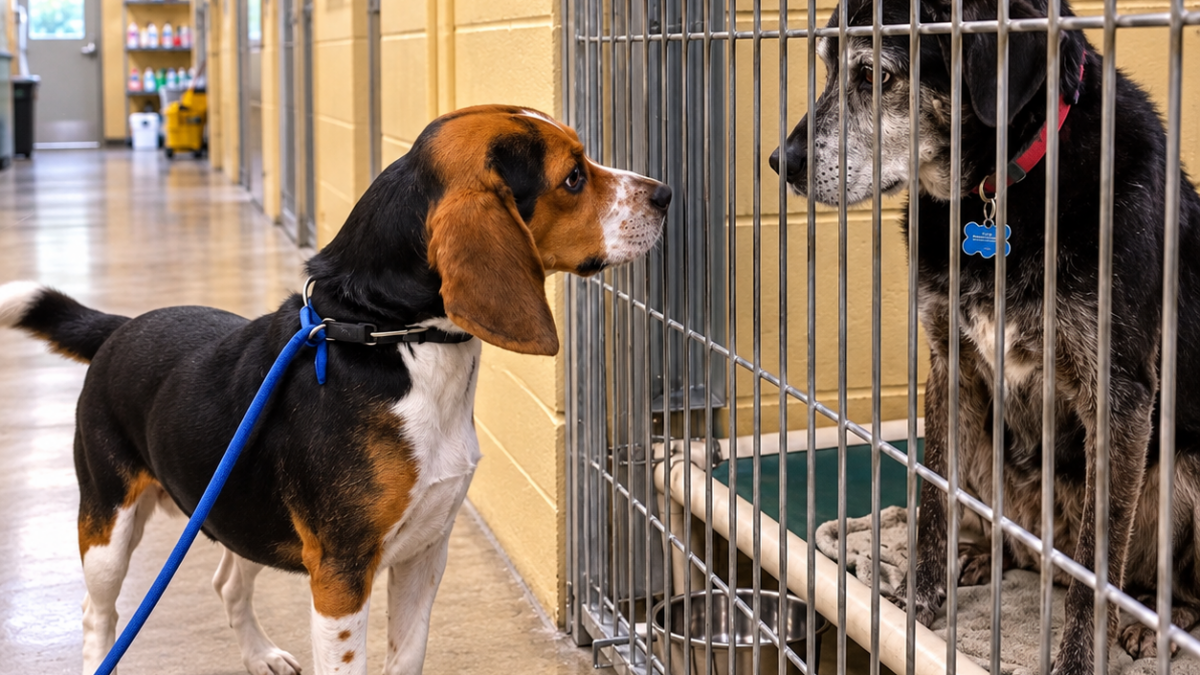
Two days after Rusty was adopted, I unlocked the rescue center in Springfield and found him sitting alone outside the front doors as if he had never left.
His new family came immediately, embarrassed and confused, but when that little Beagle escaped again the very next morning—and then a third time—I started wondering whether he was running away from his new home or desperately trying to return to something we had overlooked.
The answer was waiting behind one kennel door, and the moment Rusty reached it, every person standing in that hallway went completely silent.
I had known Rusty for eight months.
He was the kind of dog who could make a terrible shelter day feel lighter simply by appearing at the gate with his ears bouncing and his tail moving faster than the rest of him.
So when the Miller family adopted him, we celebrated.
They had a fenced yard, a quiet house, flexible work schedules, and enough dog toys to fill half our storage room.
More importantly, they genuinely wanted him.
Emily Miller knelt on the shelter floor during their final visit and wrapped her arms around Rusty’s neck.
“You’re coming home, buddy.”
Rusty licked her chin.
Her husband, Mark, laughed.
“He’s going to own the couch by tonight.”
We took photographs at the front entrance.
Rusty wore a blue bandana.
Emily cried.
I cried.
Even some volunteers who had promised they weren’t going to cry failed miserably.
Then Rusty climbed into their car.
We watched it disappear.
Another dog had gone home.
That was supposed to be the happy ending.
Two mornings later, I arrived before seven and saw a small brown-and-white shape sitting beside the entrance.
For a second, I thought someone had abandoned another Beagle overnight.
Then the dog stood.
Those ears.
That tail.
“Rusty?”
He ran toward me.
I dropped my keys.
“What are you doing here?”
Rusty jumped against my legs as if this were completely normal.
His collar was still on.
His new identification tag hung beneath his chin.
I immediately called Emily.
She answered breathless.
“Please tell me you have him.”
“I have him.”
“Oh, thank God.”
She and Mark arrived twenty minutes later.
They had discovered an opening near the bottom of their backyard gate.
Mark looked horrified.
“I fixed it already.”
“Dogs are talented,” I told him.
Rusty happily climbed back into their car.
Problem solved.
Or so we thought.
The next morning, Rusty was sitting outside our entrance again.
Emily stared at him when she arrived.
“How?”
Mark had checked every fence board.
Every latch.
Every possible gap.
They installed a camera.
They added another barrier.
That night Rusty somehow pushed through a weak section beneath the fence, crossed several blocks, and returned to us.
“You think he hates our house?” Emily asked quietly.
“No.”
She looked unconvinced.
“He has a bed. Toys. He sleeps beside our room. We barely leave him alone.”
“I believe you.”
“Then why does he keep coming back?”
I didn’t know.
The third time Rusty escaped, we decided not to immediately call the Millers.
Instead, we waited.
Rusty entered the shelter through the staff door and moved down the hallway with complete confidence.
I followed several feet behind.
He passed his old kennel.
Didn’t even slow down.
That surprised me.
Then he turned the corner.
His pace quickened.
At the end of the hallway sat one of our senior dogs.
Murphy.
Gray around the muzzle.
Large brown eyes.
A body that moved a little slower than it once had.
Rusty stopped outside Murphy’s kennel.
Murphy lifted his head.
For one heartbeat neither dog moved.
Then Rusty’s entire body started wagging.
Murphy scrambled to his feet.
Both dogs rushed toward the bars.
Their noses met between them.
Rusty whined.
Murphy answered.
I heard one of the volunteers behind me whisper, “Oh no.”
And suddenly I remembered all the little things we should have understood months earlier.
The beds pushed toward the dividing fence.
The shared walks.
Rusty refusing dinner until Murphy had been fed.
Murphy watching every doorway since Rusty had left.
Rusty hadn’t escaped because he hated his new family.
He wasn’t trying to come home.
He had been trying to go back for someone.
I called Emily.
“You need to come here.”
“Is Rusty okay?”
“Yes.”
“Then what’s wrong?”
I looked at the two dogs pressing against opposite sides of the kennel door.
“Nothing is wrong with Rusty.”
I swallowed.
“We just finally figured out why he keeps leaving you.”
PART 2
Emily and Mark arrived less than thirty minutes later.
By then Rusty had refused to leave Murphy’s kennel.
He sat directly outside the door, nose pressed against the bars, while Murphy remained on the other side.
Neither dog seemed particularly interested in the humans gathering around them.
Emily stopped several feet away.
“Oh.”
Mark looked at me.
“That’s Murphy?”
I nodded.
“You’ve mentioned him before.”
“I probably didn’t mention him enough.”
Emily crouched near Rusty.
“Hey, buddy.”
Rusty glanced at her.
His tail moved.
Then he immediately turned back toward Murphy.
Emily looked up at me.
“What is happening?”
I leaned against the opposite kennel.
“Rusty and Murphy came here during the same week.”
Mark frowned.
“I thought Rusty was found as a stray.”
“He was. Murphy was surrendered a few days earlier.”
“What happened to him?”
“His owner had gone into assisted living. The family couldn’t keep him.”
Emily’s expression softened.
Murphy had been nearly nine when he arrived.
Old enough that shelter life hit him differently.
Young dogs adjust faster sometimes.
They bark.
Jump.
Demand attention.
Murphy had spent his first days sitting at the back of his kennel.
He ate only when nobody was watching.
He ignored toys.
He didn’t approach volunteers.
Then Rusty arrived.
Rusty had never respected emotional boundaries.
From the first afternoon, he wanted to meet every dog.
Every person.
Every mop bucket.
Every suspicious leaf.
We introduced him to Murphy during a supervised yard session because both dogs had calm evaluations.
The first meeting wasn’t dramatic.
Rusty sniffed Murphy.
Murphy sniffed Rusty.
Rusty invited him to play.
Murphy walked away.
Rusty followed.
Murphy moved again.
Rusty followed again.
Eventually Murphy turned around as if to say, Fine. What do you want?
Rusty dropped into a play bow.
Murphy stared.
Then, for the first time since arriving, his tail moved.
One volunteer noticed.
“Look at Murphy.”
Rusty bounced sideways.
Murphy followed.
Within minutes the old dog who had refused to engage with anyone was trotting across the yard.
That became their routine.
Every morning we let them exercise together.
Rusty ran.
Murphy followed until his joints told him he had done enough.
Then Rusty would return and lie beside him.
At feeding time, they waited near neighboring kennel doors.
At night, their beds somehow always ended up pressed toward the shared fence.
We joked that they were brothers.
That’s all.
We joked.
Then adoption day came.
Rusty was younger.
Smaller.
Friendly.
Easy to market.
Families noticed him.
Murphy was older.
Mixed breed.
Gray-faced.
Slower.
People would stop outside his kennel and say things like, “He’s sweet.”
Then continue walking.
Rusty got applications.
Murphy did not.
When the Millers chose Rusty, all of us were thrilled.
We never considered that to him, adoption wasn’t simply leaving a shelter.
It meant leaving Murphy.
Emily was staring through the bars now.
“How long were they together?”
“Almost eight months.”
“And Murphy has been like this since Rusty left?”
I nodded.
The difference had been obvious.
I was embarrassed that I hadn’t understood it sooner.
Before Rusty’s adoption, Murphy greeted volunteers each morning.
Afterward, he often remained lying down.
He still ate, but without enthusiasm.
He stopped carrying his favorite rope toy.
During yard time he walked toward the fence where Rusty usually waited.
Then sat.
One volunteer had even said, “He’s looking for him.”
We heard it.
We nodded.
Then moved on.
Shelters are busy.
There is always another dog needing medication.
Another intake.
Another phone call.
Another kennel to clean.
You notice heartbreak, but sometimes you don’t have the luxury of stopping long enough to understand it.
Rusty had understood perfectly.
Emily reached through the bars and let Murphy smell her hand.
Murphy sniffed cautiously.
“He looks so sad.”
“He’s a good dog.”
“How old?”
“About nine and a half now.”
“Medical problems?”
“Arthritis. Nothing unusual for his age. He needs joint medication and can’t run forever.”
Mark looked at Rusty.
“So Rusty has been escaping to see him?”
“That appears to be exactly what he’s doing.”
Mark rubbed both hands over his face.
I couldn’t read his expression.
Then he laughed once.
Not because it was funny.
Because sometimes people laugh when something finally makes sense.
“I thought we were terrible dog owners.”
“You’re not.”
“We installed three cameras.”
“I heard.”
“I reinforced the fence twice.”
“I also heard that.”
“He dug underneath a board last night.”
“Beagle.”
Mark looked at Rusty.
“You could have just told us.”
Rusty wagged.
Emily sat on the floor.
Murphy lowered himself on the other side.
For several minutes, nobody spoke.
Then Emily asked, “Can they visit?”
“Absolutely.”
We arranged supervised time in the exercise yard.
When both kennel doors opened, Rusty exploded.
He ran directly to Murphy.
Murphy came out slower.
Rusty circled him.
Once.
Twice.
Then slowed down.
Murphy bumped his shoulder.
Rusty licked his muzzle.
Mark whispered, “Wow.”
It wasn’t wild play.
Not anymore.
Murphy didn’t have young legs.
But the communication between them was unmistakable.
Rusty checked where Murphy was constantly.
If Murphy stopped, Rusty stopped.
If Murphy moved, Rusty followed.
When Murphy lay down beneath a tree, Rusty lay beside him.
Emily sat on a bench watching.
“So what do we do?”
The question was mostly for Mark.
He knew it.
“Let’s not make a decision because we’re emotional.”
That was sensible.
Very sensible.
I appreciated him for saying it.
Adopting a second dog—especially a senior dog—is not something people should do simply because a story hurts.
Murphy would require medication.
Veterinary expenses.
Possibly mobility care later.
Senior dogs can decline quickly.
The Millers had adopted Rusty only days earlier.
Their household was still adjusting.
I told them everything.
“You don’t have to adopt Murphy.”
Emily nodded.
“I know.”
“You can bring Rusty here for visits.”
“What happens if Rusty keeps escaping?”
“Then we need to address the fencing and behavior regardless.”
Mark laughed.
“Already working on Fort Knox.”
“But don’t take Murphy because you think that’s the only way to keep Rusty.”
Emily watched the dogs.
“What if we take him because we want him?”
I hesitated.
“Then we go through the normal process.”
Mark looked at her.
“We said no immediate decisions.”
“I know.”
She pointed toward Rusty.
“He clearly did not agree to that policy.”
Mark smiled.
For the next week, the Millers brought Rusty to visit Murphy almost every day.
Something unexpected happened.
Rusty stopped trying to escape.
As soon as he learned the routine—home, breakfast, walk, later visit Murphy—he became calmer.
He slept better.
The camera showed him lying on his bed instead of patrolling the fence.
That told us something important.
Rusty didn’t hate his new home.
He simply didn’t trust that Murphy had not vanished from his life forever.
Once the visits became predictable, the urgency faded.
Dogs don’t need explanations in words.
They need reliable patterns.
Rusty learned:
I leave.
I return.
Murphy still exists.
The Millers also spent time with Murphy without Rusty.
That mattered.
If they were considering adoption, Murphy needed his own relationship with them.
Emily began taking him on short walks.
Murphy moved slowly at first.
She matched him.
No pulling.
No rushing.
He stopped often.
At first I assumed he was sniffing.
Then I realized he was watching Emily.
Checking.
Where are you?
Still there?
Every time she waited, his body relaxed.
Mark sat with him in the kennel one afternoon.
No agenda.
Just sat.
Murphy eventually rested his head on Mark’s knee.
Mark looked at me through the kennel gate.
“This is unfair.”
“What?”
“He makes it hard to be rational.”
“Senior dogs specialize in that.”
Mark scratched behind Murphy’s ear.
“We need to think about costs.”
“Yes.”
“Arthritis medication.”
“Yes.”
“Future vet care.”
“Yes.”
“Possibly stairs become a problem.”
“Yes.”
“Rusty is younger. We might have Murphy for one year or five.”
“Correct.”
He was quiet.
Then he said something I never forgot.
“I think that’s what scares me.”
“Which part?”
“Loving him when we already know time might be shorter.”
That fear keeps many good people from adopting seniors.
I understood it.
When you bring home a young dog, you can pretend time is endless.
A gray muzzle doesn’t let you pretend.
Murphy’s age was visible every time he stood.
Every slow step.
Every stretch after lying down.
He carried the reminder.
I sat beside Mark.
“The time is going to pass whether Murphy is here or not.”
He nodded.
“I know.”
“He doesn’t need someone who isn’t afraid to lose him.”
Mark looked at me.
“He needs someone willing to love him anyway.”
Exactly.
But I did not push.
The decision had to belong to them.
Meanwhile, Murphy was changing.
Rusty’s visits had brought him back to life.
He started carrying the rope toy again.
He greeted volunteers.
When the Millers arrived, he stood.
His tail wagged.
One afternoon, Rusty and Murphy were lying together when another family stopped outside the yard.
They watched Murphy.
The mother asked me, “Is the older one available?”
“Yes.”
Emily heard.
I saw her expression change immediately.
Not jealousy exactly.
Something sharper.
Reality.
Murphy could be adopted by someone else.
The family asked questions.
Age.
Temperament.
Medical care.
Compatibility with children.
I answered honestly.
They seemed interested.
Emily remained silent until they left.
Then she looked at Mark.
“We are idiots.”
He knew exactly what she meant.
“Maybe.”
“If someone adopts him…”
“That would be good.”
“I know.”
“But?”
She looked at Murphy.
“But then Rusty loses him again.”
Mark sighed.
“And we lose him too.”
There it was.
Not just Rusty.
Them.
They had become attached.
That evening, they took Rusty home.
At 8:43 the next morning, Emily emailed an adoption application.
At 8:44, she called.
“Did you get it?”
I laughed.
“Yes.”
“Don’t laugh.”
“You waited exactly sixty seconds.”
“I wanted to make sure.”
“We’ll process it like any other application.”
“Good.”
“Home review.”
“Fine.”
“Veterinary references.”
“Fine.”
“Meeting requirements.”
“We’ve had eight.”
“I know.”
“Can we bring him home today?”
“No.”
Silence.
“You’re enjoying this.”
“A little.”
The home visit happened two days later.
I had already seen photographs.
Still, we followed procedure.
The Millers had repaired every possible weakness in the fence.
Mark showed me the buried barrier around the bottom.
“Rusty will need heavy machinery now.”
Emily pointed toward a second dog bed.
It was large.
Orthopedic.
Near Rusty’s smaller bed.
“We bought it before approval,” she admitted.
“I see that.”
“Too optimistic?”
“Maybe.”
Mark opened a cabinet.
Joint supplements.
Medication organizer.
Raised food bowl.
A ramp folded near the back door.
I looked at him.
“You said no emotional decisions.”
“This is strategic preparation.”
I laughed.
The house felt right.
Not perfect.
No home is.
But thoughtful.
The final introduction happened in their backyard.
Rusty arrived first.
Then Murphy.
The moment Murphy crossed the gate, Rusty lost his mind.
He ran circles around him.
Murphy barked.
Rusty barked back.
Emily covered her mouth.
Mark pretended he had something in his eye.
I absolutely did not point that out.
We let them explore.
Rusty led Murphy toward the porch.
Then inside.
He showed him the living room.
The water bowl.
The dog beds.
Then the couch.
Rusty jumped up.
Murphy stood below.
His back legs hesitated.
Mark immediately moved the ramp toward the cushion.
“Try this, old man.”
Murphy sniffed it.
One paw.
Then another.
Slowly, he climbed.
Rusty moved over.
Murphy lay down beside him.
Emily whispered, “That’s it.”
I knew.
Even before paperwork.
That’s it.
The adoption was approved.
A week after Rusty’s last escape, Murphy walked out of the shelter.
For the final time.
We gathered near the entrance.
The same place Rusty had been sitting every morning.
Murphy wore a red bandana.
Rusty wore blue.
Emily held both leashes.
Mark carried Murphy’s medication and the ridiculous amount of paperwork senior dogs accumulate.
One volunteer cried immediately.
Another said, “No crying until the photo.”
Nobody listened.
I knelt beside Murphy.
“You waited long enough.”
He licked my chin.
Rusty shoved between us.
“Jealous.”
His tail moved like a helicopter.
We took the adoption photograph.
Two dogs.
Two people.
One family.
Then the Millers loaded them into the car.
Murphy needed a little help.
Mark lifted his back end gently.
Rusty jumped in beside him.
Before Mark closed the door, Rusty looked toward us.
For eight months, this building had been his entire world.
Then he found a home.
And came back three times because he refused to leave Murphy behind.
Now both were leaving.
The car drove away.
I waited.
Maybe part of me expected Rusty to appear at our door the next morning out of habit.
He didn’t.
Day one.
No Rusty.
Day two.
No Rusty.
Day three.
Still no Rusty.
I texted Emily.
Everything okay?
A photograph came back.
Rusty and Murphy sleeping on the same orthopedic bed.
Despite another perfectly good bed three feet away.
Caption:
Apparently buying two beds was financially irresponsible.
I laughed.
That became their pattern.
They had two beds.
Used one.
Two bowls.
Tried to inspect each other’s.
Two crates.
Preferred the couch.
A large backyard.
Often sat shoulder to shoulder near the same tree.
Rusty had spent days escaping to reach Murphy.
Now that Murphy was home, he apparently felt no need to give him personal space.
The first month wasn’t perfect.
That matters.
Happy endings become less believable when we pretend adoption solves everything overnight.
Murphy struggled with stairs.
The Millers added gates and ramps.
Rusty became protective of one particular toy.
We worked on resource-management exercises.
Murphy had an arthritis flare after a cold weekend.
Medication was adjusted.
Rusty once found a weak section of garden fence.
Mark discovered him digging.
“Absolutely not.”
Rusty looked up.
Murphy stood behind him.
Mark sent me a photo.
Subject:
Attempted jailbreak has been prevented.
I replied:
Ask Murphy if he authorized it.
He wrote back:
Murphy appears retired from criminal activity.
Rusty was the problem child.
Murphy became calmer at home almost immediately.
Shelter noise had affected him more than we realized.
At the Millers’ house, he slept deeply.
The first week, Emily told me he sometimes woke suddenly and looked around.
Then saw Rusty.
Relaxed.
Went back to sleep.
One evening she called.
“I think Murphy had a nightmare.”
“What happened?”
“He woke whining.”
“Did he seem painful?”
“No.”
“What did Rusty do?”
There was a pause.
“He climbed into Murphy’s bed.”
I smiled.
“Then?”
“Murphy stopped.”
Maybe coincidence.
Maybe companionship.
It didn’t matter.
They slept together until morning.
The Millers learned Murphy’s routines.
He liked breakfast early.
Hated rain.
Loved car rides once someone helped him in.
Preferred sleeping with his back against something.
Refused blueberries.
Loved cheese.
Hated having his nails trimmed.
Adored Emily.
Followed Mark into the garage.
And every evening around nine, Rusty and Murphy performed the same ritual.
Rusty climbed into the large bed first.
Murphy circled twice.
Then lowered himself beside him.
Rusty usually placed one paw across Murphy’s back.
Emily sent me pictures so often that I started a folder.
RUSTY + MURPHY.
Hundreds eventually.
People sometimes asked why Rusty kept returning to the shelter.
When we explained, they said things like:
“He wanted to rescue Murphy.”
That’s a beautiful way to put it.
I don’t know if Rusty understood adoption or rescue in human terms.
But I know behavior.
He left comfort.
Crossed distance.
Returned repeatedly to the same building.
Ignored his old kennel.
Went directly to Murphy.
Whatever word we choose, the bond was real.
And Rusty had acted on it.
That story spread locally.
People began asking about bonded dogs.
Something unexpected happened.
Our rescue started receiving more questions like:
“Do these two need to stay together?”
Before, adopters often asked:
“Can I adopt just one?”
The shift was subtle.
But meaningful.
Bonded pairs are harder to place.
Two dogs mean double food.
More medical care.
More space.
More logistics.
Many families simply cannot manage it.
There is no shame in that.
But Rusty and Murphy made people think.
One couple adopted two middle-aged dogs who had been surrendered together.
Another family specifically requested senior companions.
A volunteer who had always said she could never handle an older dog eventually fostered one.
Murphy’s life reached beyond his own house.
I liked that.
But I also resisted turning him into a symbol.
He was a dog.
Not a lesson.
Not inspiration.
Not a tragic senior everyone needed to pity.
He had opinions.
A bad habit of stealing Rusty’s spot on the couch.
A talent for opening partially closed doors with his nose.
And an ability to hear cheese packaging from another floor.
One afternoon I visited.
Murphy greeted me first.
That shocked me.
He trotted across the room, slowly but enthusiastically.
“Look at you.”
Rusty came from behind and shoved his head under my hand.
“Hello to you too.”
Emily laughed.
“They compete for guests.”
Murphy leaned.
Rusty leaned harder.
I nearly fell.
“You two are ridiculous.”
They were.
Wonderful.
Ridiculous.
Murphy had gained a little weight—not too much because of his joints.
His coat looked better.
His eyes were brighter.
Most importantly, he had become engaged again.
The dog who once lay facing Rusty’s empty kennel now followed a family through the house.
He waited at the kitchen.
Barked once when someone knocked.
Brought toys.
That transformation mattered as much as Rusty’s escape story.
Rusty had been the visible one.
Running.
Returning.
Demanding attention.
Murphy had suffered quietly.
People notice noise.
Quiet heartbreak is easier to miss.
That became a lesson I carried into shelter work.
When one dog leaves a bonded relationship, watch the other.
Eating isn’t enough.
Sleeping isn’t enough.
Look for engagement.
Interest.
Behavioral changes.
Loss can exist even when the animal remains medically stable.
We changed procedures.
Bond history became part of adoption assessment.
Volunteers were encouraged to document close relationships.
When possible, we informed adopters if a dog had a significant companion.
Sometimes that meant recommending joint placement.
Sometimes visits.
Sometimes extra transition support.
Not every friendship requires lifelong co-adoption.
But pretending bonds don’t matter can create problems.
Rusty made sure we learned that.
The first major scare happened six months after Murphy’s adoption.
Emily called at 6:30 in the morning.
Her voice was wrong.
“Murphy won’t get up.”
I sat straight up.
“Is he conscious?”
“Yes.”
“Breathing normally?”
“Yes.”
“Eating?”
“Wouldn’t take breakfast.”
“Vet. Now.”
They were already loading him into the car.
I met them at the clinic.
Rusty had stayed home with Mark’s sister because the situation was stressful.
Murphy looked exhausted.
His back legs were weak.
My mind went everywhere.
Neurologic event.
Internal bleeding.
Cancer.
Kidney failure.
Senior dogs make your imagination cruel.
The veterinarian examined him.
Bloodwork.
X-rays.
Pain response.
After two hours we had an answer.
Severe arthritis flare combined with a strained muscle.
Painful.
Treatable.
Not the ending my brain had invented.
Emily cried with relief.
“So he’ll walk?”
“Yes.”
“He’s okay?”
“He’s an older dog with arthritis who overdid something.”
Mark looked at Murphy.
“What did you do?”
We eventually figured it out.
The backyard camera showed Rusty chasing a squirrel the previous afternoon.
Murphy had joined.
Not fast.
But enthusiastically.
Too enthusiastically.
Mark looked at Rusty later.
“You are a bad influence.”
Rusty wagged.
Murphy recovered with medication and rest.
But the episode forced a conversation the Millers had always known would come.
Murphy was aging.
Time mattered.
Emily called me after everyone went to sleep.
“I hate this.”
“I know.”
“What if we only get a year?”
“You’ve already had six months.”
“That’s not enough.”
“No.”
“What if we get two?”
“Still won’t feel enough.”
“What if—”
“Emily.”
She stopped.
“You can’t negotiate with time.”
Silence.
“I know.”
“You can only decide what you do with it.”
She cried.
I let her.
There was no comforting sentence that could make senior adoption emotionally safe.
That’s the bargain.
You choose love without a guarantee of duration.
The next morning, Emily sent me a photo.
Murphy asleep.
Rusty pressed against him.
Message:
We’ll take whatever time he gives us.
That was the right answer.
The year anniversary of Murphy’s adoption arrived.
We invited the family to the rescue.
No ceremony was planned.
Then volunteers found out.
Suddenly there were balloons.
Dog-safe cupcakes.
A sign someone made that read:
NO MORE ESCAPES REQUIRED.
Mark laughed when he saw it.
Rusty barked.
Murphy walked inside slowly.
He recognized the building.
I could tell.
His body changed.
He sniffed the lobby.
Then the hallway.
Rusty pulled toward the old kennel area.
For a second I wondered if returning was a mistake.
Then Murphy followed.
We walked them down the same corridor.
Their old kennels were occupied by different dogs.
Rusty stopped near Murphy’s former door.
Smelled it.
Murphy smelled it too.
Then Rusty turned around.
Walked back toward Emily.
Murphy followed.
No hesitation.
That moment affected me more than I expected.
Once Rusty had come down this hallway because Murphy was trapped behind bars.
Now Murphy could leave whenever he wanted.
They both could.
We went outside.
Rusty and Murphy played in the same exercise yard where they first met.
Murphy tired quickly.
He lay beneath the same tree.
Rusty lay beside him.
One volunteer whispered, “Nothing changed.”
I looked at the Millers.
Everything had.
At the celebration, someone asked Mark:
“Did you ever think about adopting Murphy before Rusty started escaping?”
“No.”
“Why not?”
Mark answered immediately.
“I didn’t see him.”
That honesty silenced the group.
Murphy had been there.
Visible.
Available.
But Mark hadn’t seen him.
Not really.
Rusty had.
That was perhaps the entire story.
There are beings we walk past because our attention goes somewhere easier.
Younger.
Louder.
Prettier.
More energetic.
Then someone—or something—forces us to look again.
Rusty forced the Millers to look at Murphy.
Murphy did the rest.
The next year was good.
Not perfect.
Good.
Murphy’s arthritis progressed slowly.
He began taking medication daily rather than only during flares.
A ramp became permanent beside the couch.
Rusty learned not to knock him over during play.
At least most of the time.
The backyard remained their kingdom.
Murphy preferred sunlight.
Rusty preferred digging.
Mark preferred that Rusty stop digging.
Nobody got everything.
One summer afternoon, Mark called.
“You need to see this.”
He sent a video.
Murphy was lying in a kiddie pool.
Not swimming.
Just lying in six inches of water.
Rusty stood outside barking at him.
“What is happening?” I asked.
“Murphy discovered air conditioning for dogs.”
“Does he like water?”
“Apparently now.”
The old dog looked completely content.
Rusty eventually climbed in.
Murphy left.
Some friendship behaviors never change.
The rescue received Christmas cards from them.
Front photo:
Emily and Mark on the couch.
Rusty between them.
Murphy mostly on top of Rusty despite having plenty of space.
Inside:
Still sharing everything.
One Valentine’s Day, Emily sent a photo of the two dogs sleeping nose to nose.
Caption:
Better love story than ours.
Mark apparently objected.
She ignored him.
By then Murphy had become something of a local celebrity because people remembered the escape story.
Visitors would recognize him.
“Is that Rusty’s friend?”
Emily always corrected them.
“Brother.”
Not biologically.
Emotionally.
Brother fit.
One day a reporter asked whether Rusty had “rescued” Murphy.
Mark answered carefully.
“The shelter rescued both of them. Rusty just refused to move on without him.”
I liked that.
It was more accurate.
Rusty did not pay veterinary bills.
He did not sign paperwork.
He did not build ramps.
But he made the problem impossible to ignore.
Sometimes that is a form of rescue too.
He insisted.
Three times.
Then life gave him what he wanted.
Not every story works that way.
That is important.
Sometimes bonded animals cannot be placed together.
Sometimes one dies.
Sometimes logistics make reunion impossible.
Rusty and Murphy were lucky.
Right family.
Right moment.
Enough resources.
Enough willingness.
The ending could have been different.
Maybe that’s why we valued it so much.
There was no villain to defeat in their story.
No cruel owner to punish.
No courtroom.
No dramatic revenge against a person.
The enemy was separation.
Loneliness.
The quiet assumption that animals simply move on because humans decide it’s time.
If there was revenge, it belonged there.
Rusty took revenge on separation by refusing to accept it.
Murphy took revenge on old age by building another family late in life.
The Millers took revenge on the fear of limited time by loving him anyway.
No one had to suffer for the ending to feel satisfying.
The dogs simply got more.
More mornings.
More shared beds.
More walks.
More ridiculous photographs.
That was enough.
A little over two years after Murphy’s adoption, his health began changing more noticeably.
He slept longer.
Walks shortened.
Some mornings his back legs needed time to warm up.
The veterinarian adjusted medication.
We added supplements.
Then one day his appetite dipped.
Emily noticed immediately.
No waiting.
No “maybe tomorrow.”
Clinic.
Bloodwork showed early kidney changes.
Manageable at first.
Diet adjustment.
Monitoring.
Fluids later if needed.
Emily listened carefully.
Mark took notes.
Rusty sat beneath the exam table.
Murphy rested one paw against him.
I watched the family receive difficult news.
No one left.
No one said an older dog was too expensive.
No one asked whether Murphy was worth the trouble.
They simply asked:
“What does he need?”
That’s what home means.
The following months were quieter.
Murphy still enjoyed life.
That was our measurement.
Food.
Affection.
Interest.
Comfort.
Movement.
Good days remained far more common than bad.
He could no longer chase Rusty.
Rusty adapted.
He brought toys to Murphy instead.
Sometimes he dropped them directly on Murphy’s face.
No relationship is perfect.
Murphy would give him a look.
Rusty would lie down.
They still slept together.
Always.
Even when the Millers bought a second orthopedic bed because Murphy needed more room.
They placed the beds side by side.
The dogs squeezed into one.
Mark sent me the picture.
I replied:
Stop wasting money.
The final winter Murphy spent with the family brought snow.
Springfield doesn’t always get deep snow, but that morning the yard was white enough to transform everything.
Rusty ran outside immediately.
Murphy stopped at the doorway.
Cold bothered his joints.
Emily almost turned him around.
Then Murphy stepped out.
Slowly.
Rusty noticed.
He stopped running.
Came back.
Walked beside him.
They reached the grass.
Murphy sniffed snow.
Rusty bounced.
Murphy made one awkward playful movement.
Rusty responded.
For maybe ten seconds, the old dog looked younger.
Emily filmed it.
I have watched that video more times than I can count.
Not because it is dramatic.
Because of Rusty.
He never outruns Murphy in that clip.
He could.
He doesn’t.
He stays beside him.
Maybe we interpret animal behavior through human emotion too often.
But some things require very little interpretation.
Rusty knew Murphy’s speed.
He chose it.
By spring, kidney disease had progressed.
The veterinarian was honest.
“We are managing now. We are not curing.”
Emily nodded.
“How do we know when?”
“When good days stop outweighing bad.”
The question every senior-dog family fears.
Mark stared at the floor.
Rusty leaned against Murphy.
For months, the Millers documented good days.
Not formally.
They simply paid attention.
Murphy ate breakfast.
Good.
Wanted the yard.
Good.
Leaned into petting.
Good.
Stole Rusty’s bed.
Very good.
Then bad days became more common.
Nausea.
Fatigue.
Less interest in food.
Longer recovery after walking.
One afternoon Emily called me.
“We’re not there today.”
“Okay.”
“But I can see it coming.”
I closed my eyes.
“I know.”
“How do you do this?”
“You don’t do it all at once.”
“What does that mean?”
“You love today.”
She cried.
“So simple.”
“No. Not simple at all.”
Murphy rallied again.
Senior dogs often do.
He had several good weeks.
Then one particularly beautiful Saturday.
Breakfast.
Short walk.
Sun in the yard.
A piece of cheese.
Rusty beside him.
Emily took a family photograph.
Murphy looked tired but content.
Nobody knew it would become one of the last truly good days.
The decline came quickly after that.
Kidney values worsened.
Appetite disappeared.
Medication controlled nausea only partly.
Mobility dropped.
The veterinarian had a long conversation with the Millers.
I joined by phone.
Nobody wanted to say the word first.
Then Mark did.
“We promised him we wouldn’t make him stay because we’re scared to lose him.”
Emily sobbed.
The veterinarian waited.
That sentence told us they already knew.
The appointment was scheduled at home.
Murphy hated the clinic more as he aged.
He deserved his own bed.
His own people.
Rusty.
I went.
I almost didn’t.
Part of me wanted to remember Murphy running in the exercise yard.
But rescue doesn’t only mean arriving for beginnings.
Sometimes you show up at endings.
Murphy lay on the large bed.
Rusty beside him.
Emily on the floor.
Mark behind her.
The veterinarian explained everything quietly.
Murphy ate one final piece of cheese.
Of course he did.
Rusty sniffed his face.
Then lay down.
I sat near Murphy’s paws.
“You old man.”
His tail moved once.
That destroyed me.
Emily leaned over him.
“You were worth it.”
Again.
“You hear me? Every second.”
Mark put one hand on Murphy’s side.
“We should’ve taken you sooner.”
Murphy breathed slowly.
Rusty remained pressed against him.
There was no panic.
No kennel noise.
No shelter hallway.
No wondering why Rusty had disappeared.
Murphy’s last moments happened inside the home Rusty kept running back to bring him toward.
His family held him.
Then he was gone.
Silence filled the room.
Rusty lifted his head.
He sniffed Murphy.
Once.
Then again.
He stayed nearby for several minutes.
We let him.
Animals deserve information too.
Eventually Rusty walked toward Emily and placed his head in her lap.
She cried harder.
For the first time since I had met Rusty, there was somewhere he wanted to be that Murphy could not follow.
That broke all of us.
The next days were difficult.
Rusty searched.
Not constantly.
But enough.
He checked Murphy’s bed.
The backyard.
Sometimes the hallway.
At dinner, he looked toward the second bowl.
The Millers removed nothing immediately.
They let the house change gradually.
Rusty slept alone in the big bed.
The first night, he got up repeatedly.
Emily eventually slept on the floor beside him.
“Fair,” I told her.
“He brought Murphy to us. We can sit with him now.”
Exactly.
Grief is the price of attachment.
Dogs pay it too, in whatever form canine grief takes.
Rusty’s appetite dipped briefly.
We monitored him.
Kept routines predictable.
Walks.
Meals.
Visitors.
The rescue staff visited.
We did not overwhelm him.
Slowly, Rusty adjusted.
The difference this time was important.
Murphy hadn’t vanished behind a shelter wall.
Rusty had been there.
He had smelled him.
Stayed beside him.
There was no reason to escape in search of an answer.
That mattered to me.
Weeks later, Emily called.
“Rusty slept through the night.”
“Good.”
“In his own bed.”
“Good.”
“He stole Murphy’s blanket first.”
I laughed.
“Even better.”
They kept the blanket.
Rusty used it for years.
Murphy’s red adoption bandana was framed with the family photograph from their first day together.
Not the shelter photo.
The home photo.
That distinction mattered.
Murphy had spent eight months in rescue.
He spent over two years in a family.
Some people might call that too short.
It was too short.
And also enormous.
Two years of breakfast.
Shared couch.
Backyard.
Snow.
Cheese.
Arthritis medicine.
Car rides.
Naps.
Love.
What is the value of two good years to an old dog?
Everything.
People sometimes told Emily:
“At least you gave him a good ending.”
She hated that phrase at first.
“So much happened before the ending,” she told me.
She was right.
Murphy didn’t come home simply to die loved.
He came home to live loved.
Those are different stories.
He barked at squirrels.
Stole food.
Learned ramps.
Made friends with a neighbor.
Had kidney disease.
Recovered from an arthritis flare.
Lay in a kiddie pool.
Shared Christmas cards.
Got old.
He lived.
The ending was only one day.
Rusty changed after Murphy died.
Not badly.
Older.
Quieter.
Maybe that would have happened anyway.
He no longer tried escaping.
Not once.
The Millers eventually reinforced the fence again when a storm damaged it.
Mark joked:
“Rusty’s criminal career ended with Murphy.”
Rusty, now with a little gray around his own muzzle, slept through the repairs.
Years passed.
Rusty became the senior dog.
That was difficult to comprehend.
The frantic Beagle who used to slip under fences slowed.
His ears still bounced when he walked, but the walks shortened.
His muzzle whitened.
The Millers gave him the same patience they had given Murphy.
Ramps.
Medication.
Soft beds.
A second dog bed remained in the house.
Unused.
Mostly.
Rusty sometimes slept half on one and half on the other as though occupying both.
One day Emily sent me a picture.
Rusty was curled on Murphy’s old red blanket.
Underneath she wrote:
Still together in some ways.
I didn’t know how to answer.
So I sent a heart.
The rescue changed too.
Our bonded-pair policy became more thoughtful because of them.
We trained volunteers to record relationships.
We watched behavioral changes after adoption or transfer.
If one member of a closely bonded pair was adopted, we discussed transition plans.
We became slower to assume that a dog’s escape behavior meant rejection of a new home.
Behavior always has a function.
Rusty taught us to ask:
What is the dog trying to reach?
Or avoid?
Or recover?
The answer may not be obvious.
One winter, another dog returned after adoption.
A young shepherd.
Everyone immediately joked:
“Who did she leave behind?”
It turned out to be separation anxiety, not another Murphy story.
We treated it appropriately.
But the joke reminded me that Rusty had permanently changed how the shelter thought.
That is a kind of legacy.
Years after the original adoption, a new volunteer asked me about the framed photograph hanging near our office.
Rusty and Murphy.
Blue and red bandanas.
The Millers behind them.
“Who are they?”
I smiled.
“That is a long story.”
She pointed at Rusty.
“Is that the Beagle who kept coming back?”
“Yes.”
“Because of the other dog?”
“Yes.”
“Did the family really adopt both?”
“They did.”
“Are they still alive?”
That question always comes eventually.
I looked at Murphy’s gray face.
“Murphy had a few good years with them. Rusty’s older now.”
She looked sad.
“That’s heartbreaking.”
“It is.”
Then I added:
“But don’t skip the middle.”
“What?”
“People hear an ending and decide the whole story is sad.”
I pointed at the photograph.
“Look at them.”
Rusty was pulling slightly toward Murphy.
Murphy leaned into Emily.
Mark was laughing.
“That isn’t a sad photograph.”
She smiled.
“No.”
Exactly.
The middle matters.
Maybe that’s what Rusty understood from the start.
He wasn’t concerned with a perfect ending.
He wanted Murphy today.
Tomorrow.
The next day.
However many days were available.
Humans spend so much energy protecting ourselves from future grief that we sometimes sacrifice present love.
Rusty didn’t.
He kept going back.
If there was anything heroic in him, it wasn’t that he somehow predicted Murphy needed adoption.
It was simpler.
He knew who mattered.
And he kept choosing him.
Years later, when Rusty’s own health began declining, Emily called me again.
This time her voice had the familiarity of someone who had walked this road before.
“He’s slowing down.”
“How bad?”
“Not bad. Just… old.”
“That happens.”
“I know.”
“We hated it with Murphy too.”
“I know.”
She laughed softly.
“You remember everything.”
“Occupational hazard.”
Rusty’s heart remained good.
Bloodwork showed manageable age-related changes.
He developed arthritis in his hips.
Medication helped.
He still loved food.
Very much.
Some things never changed.
The Millers adopted another rescue eventually.
Not immediately.
Years after Murphy.
A middle-aged hound mix named Daisy.
They worried Rusty might not appreciate a new dog.
Rusty inspected her.
Walked away.
Daisy followed.
Rusty stopped.
She stopped.
He moved.
She followed.
Emily sent me video.
“Look familiar?”
It did.
History wasn’t repeating exactly.
But there was something beautiful in it.
Rusty had once been the younger dog pestering an old one into friendship.
Now he was the older dog.
Daisy learned his pace.
She stopped trying to wrestle after he corrected her twice.
Eventually they slept near each other.
Not the way Rusty and Murphy did.
Different relationship.
That mattered.
No replacement.
Murphy was Murphy.
Daisy became Daisy.
Love expands without erasing.
Rusty taught the household that too.
The last time I visited Rusty while he was still energetic enough to greet me at the door, he walked slowly but with purpose.
I crouched.
“There he is.”
His tail moved.
Not the wild helicopter from shelter days.
A steady wag.
He smelled my clothes.
Then looked toward my hands.
“No treats.”
He continued sniffing.
“Seriously.”
Emily laughed.
“He remembers you’re weak.”
I brought treats.
Of course I did.
We sat in the living room.
Murphy’s framed bandana still hung on the wall.
Rusty slept beneath it.
Daisy on the other side of the couch.
I looked around.
This entire family existed because one Beagle refused to stay where humans had decided he belonged.
Funny how life turns.
The Millers thought they were adopting Rusty.
Rusty apparently thought they were acquiring a vehicle, food service, and housing solution for himself and Murphy.
It worked.
Mark joined us.
“You know what I think about sometimes?”
“What?”
“If we had fixed the fence perfectly the first night.”
I understood immediately.
Rusty might not have escaped.
Might not have returned.
Maybe we eventually would have recognized Murphy’s decline.
Maybe not.
Murphy might have been adopted elsewhere.
Maybe.
Or he might have stayed months longer.
There are too many possible versions.
Emily shook her head.
“Don’t.”
“I know.”
Mark looked at Rusty.
“It’s just strange.”
It was.
An imperfect fence changed a life.
But I don’t believe in romanticizing accidents.
The useful part wasn’t that Rusty escaped.
The useful part was that when his behavior repeated, people paid attention.
We stopped saying:
Bad dog.
Escape artist.
Ungrateful.
Stubborn.
Instead we asked why.
That question opened the story.
Behavior is information.
Rusty was communicating the only way he knew how.
Go back.
Find Murphy.
Again.
Again.
Again.
We finally listened.
On the anniversary of Murphy’s adoption, long after he was gone, the Millers kept one tradition.
Cheese.
Murphy’s favorite.
They gave Rusty a small piece.
Later Daisy too.
No sad ceremony.
Just cheese.
I loved that.
Grief eventually becomes less about the moment of loss and more about the habits love left behind.
A blanket.
A ramp.
An extra bowl stored in a cabinet.
A tradition involving cheese.
A Beagle who no longer sleeps alone.
That was Murphy’s afterlife in their house.
Not mystical.
Practical.
Embedded.
One evening I received a photograph from Emily that became my favorite of all.
Rusty was old.
Very old.
Gray face.
Sleeping deeply.
Daisy lay nearby.
Under Rusty’s front paw was the edge of Murphy’s red blanket.
Nothing about the image announced tragedy.
No text.
No dramatic pose.
Just an old dog asleep in a home.
I thought about the first morning I found Rusty outside the shelter.
He had looked so pleased with himself.
I was confused.
Then annoyed.
Then worried.
If I could return to that morning, knowing everything I know now, I would still say:
“Rusty, what are you doing here?”
But I would ask differently.
Not as accusation.
As curiosity.
What are you trying to tell us?
That question might be one of the most important in rescue.
Animals cannot explain.
We interpret.
Sometimes badly.
A barking dog may be afraid.
A destructive dog may be anxious.
A dog refusing food may be grieving.
A dog repeatedly escaping might not be rejecting the place he leaves.
He might be trying desperately to reach the place where someone he loves is waiting.
Rusty’s story taught us that.
And because we eventually listened, Murphy’s final years looked nothing like his first months with us.
He left the shelter.
He shared a couch.
He had a backyard.
He had medication when his joints hurt.
He had a family notice the moment his appetite changed.
He had someone beside him until his final breath.
Most importantly, he had Rusty.
The friend who wouldn’t leave him behind.
That is why the part of this story people call the “ending” isn’t Murphy’s death.
Not to me.
The ending happened much earlier.
It happened the afternoon Murphy walked through the shelter doors while Rusty waited beside the car.
Murphy paused on the sidewalk.
I remember that clearly.
He looked back once.
Maybe at the building.
Maybe at a sound.
Maybe at nothing meaningful.
Rusty barked from the open car door.
Murphy turned.
Walked toward him.
Mark helped him into the back seat.
Rusty immediately pressed against his side.
Then the door closed.
Two faces appeared through the window.
One young.
One gray.
The car pulled away.
That was the ending of the shelter story.
Everything afterward was life.
And there was a lot of it.
If someone asks me whether Rusty rescued Murphy, I still don’t know how to answer exactly.
Humans did the paperwork.
Veterinarians provided care.
The Millers opened their home.
The shelter facilitated the adoption.
But Rusty did something none of us had done.
He refused to accept Murphy’s disappearance from his world as normal.
He returned once.
We misunderstood.
Twice.
Still misunderstood.
Three times.
Then he led us directly to the answer.
Maybe rescue sometimes looks exactly like that.
Not dragging someone from danger.
Not heroics.
Simply refusing to stop showing people who has been left behind.
Rusty had been given everything people thought a dog wanted.
A soft bed.
Toys.
Food.
Attention.
A yard.
A family.
Yet something essential was missing.
Someone.
When that someone came home too, Rusty stopped running.
Years later, I drove past the Millers’ neighborhood after visiting another foster family.
I wasn’t planning to stop.
Then I saw Mark outside.
He waved.
I pulled over.
Rusty was in the yard.
Older than the last time I had seen him.
He walked toward the fence.
Slowly.
Daisy followed.
I went inside.
Rusty leaned against my legs.
I scratched his ears.
“You remember the shelter?”
His tail moved.
Mark laughed.
“Probably.”
“Think he’d run back now?”
“No chance.”
“How do you know?”
Mark pointed toward the living room.
Murphy’s red blanket was folded over Rusty’s bed.
Daisy lay beside it.
“Everything he ever wanted is here.”
That sentence stayed with me.
Everything he ever wanted is here.
Not everything he would ever lose.
Not everything forever.
Nothing is forever.
But home isn’t about permanent possession.
It’s about belonging while the days exist.
Rusty taught us that too.
Murphy belonged.
For as long as he had.
Rusty belonged.
Daisy belonged.
The Millers belonged to them as much as the dogs belonged to the family.
I knelt and hugged Rusty.
He tolerated it briefly.
Then escaped my arms and walked toward the kitchen.
Food was apparently more important.
Still a Beagle.
I laughed.
As he disappeared around the corner, I looked again at the framed photograph of him and Murphy.
Two shelter dogs who were never supposed to become a package deal.
One younger dog who had a chance to leave.
One senior everyone kept overlooking.
And one stubborn friendship that refused to cooperate with the plan.
Maybe the most emotional part of their story was never Rusty’s escapes.
It was what those escapes meant.
He had found safety.
And still went back.
He had found comfort.
And still went back.
He had found people who loved him.
And still went back.
Not because the new love wasn’t enough.
Because love is not always a replacement.
Sometimes the heart doesn’t want something new instead.
It wants both.
Rusty wanted his family.
And Murphy.
Once the humans understood that, the solution became simple.
Not easy.
Senior care is not easy.
Two dogs are not easy.
Grief is certainly not easy.
But simple.
Open another door.
Add another bed.
Make room.
Murphy walked in.
Rusty never ran away again.
That is the version I carry with me.
Not the empty kennel.
Not Murphy’s final day.
Not even Rusty outside the rescue doors.
I remember their first night together at the Millers’ house.
Emily sent a photograph at 11:08 p.m.
Two beds sat side by side.
One was empty.
Rusty and Murphy were curled together on the other.
Murphy’s gray head rested against Rusty’s back.
Rusty’s paw was draped across Murphy’s shoulder.
Under the picture Emily had written only:
He finally stopped looking at the door.
At the time, I thought she meant Rusty.
Later she told me she meant Murphy.
That old dog had spent days after Rusty’s adoption staring toward shelter doors, waiting for his friend to come back.
Rusty did come back.
Again and again.
Until one day, instead of leaving Murphy behind once more, he took him home.
And from that night forward, neither dog had to wait alone again.




