PART 2: Oliver Cried Every Time She Walked Away—So at 2 A.M., the Vet Tech Made a Decision Nobody Expected
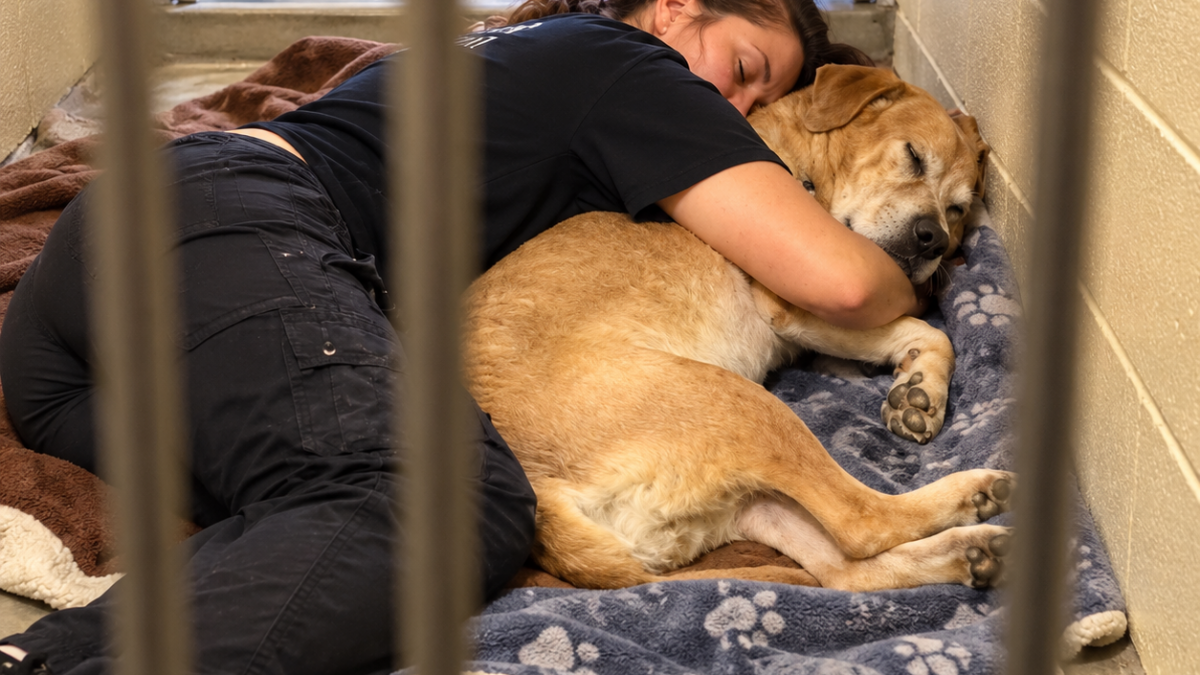
PART 2
His body faced us, but everything about him seemed prepared to retreat farther if that became possible.
“He came from the shelter?”
“Yeah.”
“How’s he doing?”
“Medically, okay for tonight. Emotionally…”
She paused.
Oliver watched us.
“He’s scared.”
I crouched a few feet away.
“Hi, Oliver.”
His eyes moved toward me.
Nothing else.
I did not reach inside.
“Has he eaten?”
“A little.”
“Bathroom?”
“Yes.”
“Any aggression?”
“None.”
Then she lowered her voice.
“He really doesn’t like being alone.”
I looked back at Oliver.
“What happens?”
“He gets restless. Paces if he has room. Trembles. Cries.”
“Separation anxiety?”
“Could be. Could just be everything he’s been through.”
We both knew how little history we had.
Animals arrive at shelters without explanations.
Their bodies tell parts of the story.
Behavior tells other parts.
But there are always missing chapters.
“What calms him?”
“People.”
That answer stayed with me.
People had apparently been part of what hurt Oliver.
And somehow people were still the thing he needed.
I opened the kennel carefully.
Oliver’s body became rigid.
I stopped.
“Okay.”
I rested my hand near the opening, nowhere near him.
“You don’t know me.”
His nose moved slightly.
“I’m Megan.”
Still watching.
“I’m going to be here all night.”
At the time, I meant it as ordinary information.
I did not realize that by morning, those words would feel like a promise.
The day team went home.
The clinic quieted.
I started rounds.
Overnight veterinary work is rarely dramatic for long stretches.
It is routine built around the possibility of emergency.
Check temperatures.
Check IV lines.
Record heart rates.
Give medication.
Clean kennels.
Refill water.
Walk patients when appropriate.
Watch.
Listen.
Write everything down.
Then do it all again.
Oliver remained quiet for the first hour.
When I checked on him, he was lying in the same corner.
His food had barely been touched.
“Not hungry?”
His eyes followed me.
I placed a small amount of something more tempting in the bowl.
He sniffed after I backed away.
Then took a few bites.
“Good.”
I resisted the urge to praise him too enthusiastically.
Frightened dogs can interpret excitement as pressure.
So I simply sat nearby for a minute.
Oliver ate three more bites.
Then stopped.
I moved on to my other patients.
Around eleven, I returned.
Oliver was awake.
Still watching the hallway.
I opened his kennel for a short walk.
He hesitated before coming out.
His paws touched the floor cautiously.
He stayed low.
I clipped the leash on and gave him space.
“Come on.”
He followed.
The clinic hallway must have felt strange to him.
New smells.
New sounds.
The sharp scent of disinfectant.
The distant hum of equipment.
A metallic clink from another room made Oliver flinch.
“It’s okay.”
I stopped instead of pulling him.
He looked toward me.
I waited.
After several seconds, he moved again.
Outside, the night air seemed to help.
Oliver sniffed the ground.
For a moment, he looked more like an ordinary dog.
Nose down.
Ears shifting.
Interested in something beyond humans.
I loved seeing that.
Trauma narrows an animal’s world.
Every sound becomes a possible threat.
Every hand matters.
Every door matters.
Curiosity starts disappearing because there is no energy left for it.
Whenever a frightened animal stops scanning the environment long enough to smell a patch of grass, I consider that meaningful.
Oliver took care of what he needed to do.
Then we returned inside.
At his kennel, he stopped.
I expected him to enter.
He didn’t.
He looked inside.
Then up at me.
I still remember that look.
There was nothing dramatic in it.
But something in my chest tightened.
“You have to go back in for now.”
Oliver remained beside me.
I crouched.
“You’ll be okay.”
I immediately hated the sentence.
Animals like Oliver had probably heard comforting voices before.
Words were cheap.
I put a treat inside.
He followed reluctantly.
When I closed the kennel door, his eyes stayed on me.
“I’ll come back.”
Then I walked away.
I checked him again less than twenty minutes later.
Not because he medically needed it.
Because I wanted him to see me return.
Oliver was standing.
When I appeared, he stopped moving.
“See?”
I crouched.
“Told you.”
His body relaxed a fraction.
That became our rhythm.
I worked.
I returned.
Worked.
Returned.
Each time, Oliver watched me arrive.
I had no idea whether he understood the pattern.
But I hoped repetition would speak more clearly than reassurance.
Midnight passed.
Then one o’clock.
The clinic settled into the deepest part of the night.
The cats were resting.
The senior dog was stable.
The surgical patient’s numbers were good.
I finished notes and sat briefly in the staff room.
The staff room was not comfortable exactly, but it had a chair, a desk, and enough warmth to make the long hours manageable.
I took a drink of water.
Then I heard something.
At first I thought it was equipment.
A faint, uneven sound.
I stopped.
Listened.
Nothing.
Then it came again.
Not a bark.
Not a howl.
A small cry.
Oliver.
I stood and walked into the hallway.
The sound became clearer.
He was trying to keep it quiet.
That somehow made it worse.
If he had been barking loudly, demanding attention, maybe I could have treated it like ordinary kennel stress.
But Oliver sounded like a dog who had learned not to expect anyone to answer.
I approached.
He was standing at the front of the kennel.
His entire body trembled.
“Hey.”
Oliver’s ears shifted.
I crouched.
“What happened?”
Nothing around him had changed.
No medical emergency.
No obvious pain.
No loud noise.
The clinic had simply become too quiet.
Too empty.
Too much like being alone.
I opened the kennel enough to check him carefully.
Heart rate elevated.
Breathing faster.
No sign of acute physical distress.
This was fear.
I sat beside the kennel.
Oliver moved closer.
I placed my hand near the bars.
He sniffed.
Then stepped away.
I stayed.
After several minutes, his trembling lessened.
His eyes grew heavier.
“Try to sleep.”
I sat another ten minutes.
Oliver finally lay down.
I waited until his breathing became slower.
Then I stood carefully.
His head came up immediately.
I stopped.
“It’s okay.”
I took one step.
Oliver stood.
Another step.
His body began trembling again.
I came back.
He settled.
That was when I understood.
He was not afraid of the kennel.
Not exactly.
He was afraid of the moment I disappeared.
I sat again.
The clock moved past 1:30.
I still had work to do.
So eventually, I stood.
This time I spoke quietly the whole way down the hall.
“I’m right here.”
Oliver watched.
I disappeared around the corner.
Less than a minute later, the crying began again.
I closed my eyes.
There are rules in veterinary medicine.
There are protocols.
There are practical realities.
One technician may have several patients.
We cannot spend an entire shift physically beside one animal unless there is a medical reason.
Compassion does not eliminate responsibility.
I knew that.
But I also knew all my other patients were stable.
I had completed the urgent tasks.
For the moment, the clinic did not need me in the staff room.
Oliver needed someone not to disappear.
I finished my next set of checks quickly.
Around two in the morning, I returned.
He was exhausted.
That was obvious.
His eyelids drooped.
His legs looked tired.
But every time his body started relaxing, something inside him seemed to pull him awake.
He would look toward the hallway.
Listen.
Tremble.
Then cry.
I sat on the floor.
Oliver came to the front of the kennel.
I rested my back against the wall.
“What happened to you?”
His eyes stayed on me.
It was a question I would never receive an answer to.
“What made sleeping alone feel this dangerous?”
Oliver lowered his head.
I looked at the hard clinic floor beneath me.
Then toward the staff room.
I thought about the blanket I kept there because night shifts were always colder than expected.
And a pillow.
The decision arrived before I fully considered it.
“Okay.”
I stood.
Oliver immediately tensed.
“I’m coming back.”
I walked away.
He cried.
“Thirty seconds,” I called quietly.
I grabbed the pillow.
The blanket.
Then returned.
Oliver was still standing.
I dropped the pillow outside his kennel.
Spread the blanket over part of the floor.
The tile was hard and cold even through the fabric.
Oliver watched everything.
“You have the better bed, by the way.”
I lowered myself down.
It was not graceful.
My hip protested immediately.
I adjusted the pillow.
Pulled part of the blanket over myself.
Then turned so I was facing Oliver.
For several seconds, he just stared.
Maybe I looked ridiculous.
A veterinary technician lying on a clinic floor at two in the morning.
Honestly, I probably did.
Oliver took one step toward the bars.
Then another.
I stayed completely still.
His nose came close.
He sniffed.
I moved my hand toward him slowly.
He did not retreat.
So I rested my fingers against the edge of the kennel.
Oliver lowered himself.
Not completely.
First his front legs.
Then his chest.
His hindquarters stayed raised another second.
Then he finally lay down.
Close to the bars.
Closer to me than he had chosen to be all night.
I whispered, “There you go.”
His eyes remained open.
But the trembling had stopped.
I did not touch him immediately.
I wanted him to decide what happened next.
Minutes passed.
The clinic hummed around us.
A monitor beeped down the hallway.
The heating system clicked.
Somewhere, one of the cats shifted in a cage.
Oliver kept watching me.
Then slowly, almost cautiously, he moved his body sideways.
Until his shoulder touched the kennel door.
As close to me as he could physically get.
I lifted one hand.
Oliver did not move away.
I placed my fingers gently against him through the bars.
His eyes closed halfway.
I stroked once.
Stopped.
Oliver stayed.
So I did it again.
His breathing changed.
Longer exhale.
Then another.
The tension started leaving his face.
People often imagine trust as a dramatic breakthrough.
A frightened dog suddenly jumping into someone’s arms.
A tail wag.
A kiss.
Sometimes trust looks much smaller.
Sometimes trust is simply closing your eyes while another person is still nearby.
Oliver’s eyes finally closed.
I stopped petting him.
My hand remained near him.
A minute passed.
Then five.
His breathing deepened.
For the first time that night, he was sleeping.
I stared at him through the bars.
“You were really just waiting for someone to stay.”
I felt angry then.
Not at Oliver.
At every invisible moment that had taught him staying was unusual.
I did not know who had neglected him.
I did not know whether there had been one person or several.
I did not know whether someone had intentionally frightened him or whether neglect alone had done the damage.
But I knew a dog should not be shocked by companionship.
Comfort should not feel extraordinary.
Sleeping near a safe person should not be a privilege discovered after years of fear.
Oliver should have learned these things as a puppy.
Instead, he was learning them on the floor of a veterinary clinic in the middle of the night.
I pulled the blanket higher.
The floor was freezing.
Within twenty minutes, my shoulder hurt.
Within thirty, my neck hurt.
I smiled to myself.
Oliver remained asleep.
Worth it.
At some point, I must have drifted off too.
Not deeply.
Overnight technicians become experts at a kind of half-sleep.
Enough to rest.
Not enough to miss alarms.
I woke to the sound of Oliver shifting.
My eyes opened.
He had moved even closer to the bars.
His back was against them now.
I reached out.
My fingers touched his fur.
He sighed.
A real sigh.
The kind a dog gives when the body finally lets go.
I rested my hand there.
Oliver fell back asleep.
What neither of us knew was that the clinic security cameras had captured almost everything.
There was a camera in the hallway for safety.
It showed me arriving with the bedding.
Showed me lying down.
Showed Oliver moving toward me.
Showed the long stretch of time when nothing happened.
And nothing happening was the point.
No treatment.
No procedure.
No dramatic rescue.
A dog slept.
A human stayed.
That was all.
By morning, I felt terrible physically.
My back hurt.
My hair probably looked ridiculous.
The blanket had twisted around one leg.
But when the first daytime staff member came through the hallway, she stopped.
“What are you doing?”
I put one finger to my lips.
Oliver was still asleep.
Her expression changed immediately.
“Oh.”
She looked at him.
Then at me.
“How long have you been there?”
I checked the clock.
“A while.”
She smiled.
“He slept?”
“Yeah.”
“All night?”
“Most of it after two.”
Oliver opened his eyes.
He looked at the new person.
Then immediately looked toward me.
That detail stayed with me.
He checked that I was still there.
“I’m here.”
I sat up.
Oliver stood.
He stretched.
It was the first full-body stretch I had seen from him.
Front legs extended.
Back arched.
Then he shook himself.
Such a normal dog movement.
I laughed.
“Good morning.”
His tail moved.
Once.
I froze.
It was barely a wag.
Maybe even accidental.
Then it moved again.
The technician beside me whispered, “Did you see that?”
“I did.”
Oliver looked confused by our reaction.
I laughed quietly.
“Sorry. You’re allowed to wag.”
He came to the front of the kennel.
This time, when I offered my hand, he leaned slightly toward it.
Not much.
But enough.
Day shift began.
The clinic came alive.
Phones rang.
Doors opened.
Footsteps multiplied.
I gave report.
Medications.
Vitals.
Overnight events.
When I got to Oliver, I tried to sound professional.
“Experienced significant anxiety overnight. Settled with close human presence.”
The daytime tech looked at the pillow.
“Close human presence?”
I shrugged.
“Very close.”
She laughed.
Before I left, I took Oliver outside.
He walked differently that morning.
Not dramatically.
He was still cautious.
But he stayed nearer to me.
We reached the grass.
Oliver sniffed.
Then looked back.
I was there.
He continued.
A few minutes later, we returned.
At the kennel, he hesitated again.
I crouched.
“I have to go home.”
His face changed.
Maybe I imagined that.
I wanted to explain work schedules.
Day shift.
Night shift.
The fact that somebody else would care for him.
Dogs don’t care about staffing logistics.
They care who stays.
I stroked his shoulder.
“You won’t be alone.”
Oliver looked at me.
“I promise.”
I helped him inside.
The day technician immediately sat near the kennel.
Oliver watched her.
Then watched me walk away.
I looked back from the hallway.
He was still standing.
But he was not crying.
I went home.
I slept for a few hours.
When I woke, my phone had several messages from coworkers.
One read:
“You need to see the camera footage.”
I groaned.
My first thought was that I had done something embarrassing while asleep.
“Please tell me I didn’t drool.”
The reply came quickly.
“Just watch it.”
Someone had saved a short section from the security recording.
I opened it.
There I was.
Pillow under one arm.
Blanket dragging behind me.
I looked exhausted.
I watched myself lie down beside Oliver.
Then I watched him.
From the camera angle, I could see things I had not noticed while I was there.
The moment he recognized that I was staying.
The way his shoulders lowered.
The tiny shift closer.
The exact second his head touched the kennel floor.
Then his eyes closed.
I watched in silence.
Something about seeing it from outside broke through all the professional distance I had maintained during the shift.
When you are working, you focus on the next task.
You do what the patient needs.
You move.
You record.
You continue.
On the video, there were no tasks.
Only Oliver.
A dog who had apparently spent years receiving too little care.
And one night when a person chose the floor over a chair.
I watched it again.
Then again.
I noticed the moment my hand rested near the bars.
Oliver pressed himself toward it.
I started crying.
Not because I thought I had done anything extraordinary.
Exactly the opposite.
I was crying because it should not have been extraordinary.
No dog should find simple presence that surprising.
No animal should have to learn late in life that someone can choose inconvenience just to make them feel safe.
The clip spread among the clinic staff.
Then the shelter saw it.
One of the shelter workers messaged me.
“I’ve never seen him sleep that deeply.”
I read that sentence twice.
I asked how Oliver was doing.
“Better today.”
“Eating?”
“Yes.”
“Still anxious?”
“Yes. But different.”
Different became the word we used often over the next days.
Oliver did not transform overnight.
That is important.
One good experience cannot erase years of neglect.
The camera footage did not heal him.
I did not heal him.
Trust is not a switch.
But the night seemed to give Oliver a reference point.
Someone can leave and come back.
Someone can lie down beside me.
Someone can stay until morning.
That was new information.
And new information can slowly challenge old fear.
I worked another overnight shift two days later.
When I entered the kennel area, Oliver was awake.
I said nothing at first.
His head lifted.
Then something happened that made every ache in my back from the previous shift worth it.
His tail moved.
Not once.
Several times.
“Hey, Oliver.”
I crouched.
He stood and came to the front.
No retreat.
No hiding in the corner.
I opened the kennel.
Oliver stepped toward me.
He sniffed my scrub top.
Then pressed his head briefly against my leg.
I froze.
The contact lasted perhaps two seconds.
Then he moved away.
I smiled.
“You remember.”
Tail wag.
“Yeah. I remember too.”
That night was easier.
He still watched when I left.
But he did not panic immediately.
I made sure to return often.
Whenever possible, I sat near him while completing paperwork.
Oliver began sleeping even when I was several feet away.
Progress.
One of the veterinarians noticed.
“He’s associating the clinic with safety now.”
“That feels like a miracle.”
“It’s learning.”
Maybe both.
Oliver’s medical condition improved as well.
His skin treatment began working.
His appetite strengthened.
He started gaining healthy weight.
His coat slowly became softer.
But the emotional changes fascinated me most.
At first, Oliver seemed to divide people into two categories.
Present.
Gone.
If you were present, he watched you.
If you were gone, he worried.
Slowly, a third category appeared.
Coming back.
That was everything.
A technician could leave the room and Oliver might still lift his head.
But after enough repetitions, he stopped immediately standing.
Someone would disappear.
Then return.
Oliver began believing in the return.
I saw it during one overnight shift.
I had been sitting near him while writing notes.
I stood.
Oliver’s eyes opened.
“I’m checking the cats.”
His head lifted.
Normally, he would have stood.
This time, he stayed lying down.
I walked away.
Checked both cats.
Changed a fluid bag.
Returned four minutes later.
Oliver was still lying down.
His eyes followed me.
But he had not panicked.
I crouched.
“That might be the bravest thing you’ve done all week.”
His tail moved against the bedding.
Later, he started playing.
The shelter had sent a soft toy with him.
For days, Oliver ignored it.
Then one evening, I found it moved from one side of the kennel to the other.
“Did you do that?”
Oliver looked at me.
I placed it closer.
He sniffed.
I squeezed it lightly.
A soft squeak.
Oliver jumped backward.
“Sorry.”
I put it down.
He approached again.
Sniffed.
Touched it with one paw.
I stayed quiet.
He mouthed one corner.
Then dropped it.
The next night, he picked it up.
That mattered.
Play requires emotional room.
A dog expecting danger does not waste energy playing.
Oliver was beginning to have extra emotional space.
Soon we discovered he liked gentle tug games.
Not aggressive.
Not wild.
He would hold the toy and pull just enough to test whether you would participate.
The first time I let go and allowed him to “win,” Oliver stood holding the toy with an expression so surprised that I laughed.
“You won.”
His tail wagged.
“Congratulations.”
He carried the toy to his bed.
I thought about the dog trembling at two in the morning.
This was the same animal.
But the story was changing.
The shelter staff visited.
They saw the difference too.
One woman knelt beside Oliver.
“Look at you.”
He approached her.
Sniffed.
Tail wagged.
She covered her mouth.
“He never did that before.”
Oliver leaned closer.
Her eyes filled.
“We thought he might take months just to approach people.”
Maybe he still would with some.
Healing does not follow schedules.
But he had started.
That was enough.
People later asked whether Oliver’s old owner ever faced consequences.
I did not know every detail of what had happened before the shelter.
And I learned not to build the story around someone we could not identify or judge accurately.
For me, Oliver’s real conflict was not with an individual.
It was with what neglect had taught him.
That care could disappear.
That comfort was temporary.
That isolation was normal.
That was the enemy we could actually confront.
And we confronted it in the most repetitive way possible.
We fed him.
Again.
We returned.
Again.
We touched him gently when he invited us.
Again.
We stopped when he asked for space.
Again.
We played.
Again.
We walked.
Again.
We came back.
Again.
Every ordinary interaction challenged something extraordinary that fear had built.
One afternoon, the shelter behavior coordinator visited while Oliver was outside.
I happened to be working.
We walked together.
Oliver sniffed along the edge of the grass.
The coordinator watched him.
“He’s checking in with you.”
“What?”
“Watch.”
Oliver walked several feet ahead.
Then looked back.
At me.
Continued.
A few seconds later, looked back again.
“He wants to know where you are.”
My first reaction was sadness.
Then she continued.
“That isn’t necessarily bad. What matters is whether he can continue exploring after he checks.”
Oliver sniffed a bush.
Looked back.
I was there.
Then he walked farther.
“He’s learning secure attachment.”
I smiled.
“Sounds very technical.”
“It is.”
“What does it mean in normal language?”
She laughed.
“It means he’s starting to believe you won’t disappear just because he stops staring at you.”
That sentence hit me hard.
Oliver moved farther ahead.
Then returned.
Not running in panic.
Just checking.
I crouched.
He came close enough for me to scratch his chest.
“Go explore.”
He did.
I stayed.
Weeks passed.
Eventually, Oliver no longer needed overnight veterinary hospitalization.
Medically, that was excellent news.
Emotionally, I felt strangely nervous.
The clinic had become part of his safe world.
Now he would return to the shelter environment full-time until a permanent home could be found.
I worried about the transition.
Would the anxiety return?
Would the kennel feel different?
Would the nights become hard again?
The shelter prepared carefully.
They gave him a quieter space.
Familiar bedding.
The same toy.
Staff members he already knew.
A routine.
The first night, according to the shelter worker who messaged me, Oliver cried for several minutes after the lights went down.
My heart sank when I read that.
Then I kept reading.
A staff member sat outside his kennel.
Oliver settled.
She stayed until he slept.
I smiled at my phone.
The lesson had spread.
Not just for Oliver.
For us.
One act of compassion can become a protocol without ever being written down.
Someone sees what works.
Then they repeat it.
Another person repeats it.
Eventually kindness stops being exceptional.
It becomes culture.
That is what Oliver deserved from the beginning.
I visited him whenever I could.
The first time I walked into the shelter after he left the clinic, I did not know how he would react.
He was in a meet-and-greet area with a staff member.
I entered quietly.
Oliver looked at me.
His entire body froze.
For one second, I worried he had forgotten me.
Then his tail started.
Slow.
Then faster.
He came toward me.
Actually came quickly.
I dropped to my knees.
“Oliver.”
He pressed into my chest.
Not for two seconds.
For much longer.
I put my arms around him lightly.
He stayed.
His tail kept moving.
The shelter worker laughed.
“I think he remembers the floor.”
I laughed too.
“Apparently humiliation builds strong bonds.”
Oliver pulled back and looked at me.
His face had changed.
Same eyes.
Different expression.
Less scanning.
More curiosity.
His body looked healthier too.
Weight returning.
Coat improving.
Muscle developing.
But again, the physical changes were not what moved me most.
He left my arms voluntarily.
Walked around the room.
Investigated a toy.
Returned.
Walked away again.
Oliver was learning that connection did not require constant contact.
He could leave and return.
So could we.
The shelter began evaluating potential adopters.
That brought a new kind of tension.
Everybody wanted Oliver to find a home.
But not just any home.
A dog with his history needed patience.
No one could promise he would never regress.
A new environment might bring back old fears.
Nighttime could become difficult.
Separation could be hard.
He needed someone who understood that affection was not enough.
Consistency mattered.
One family expressed interest.
They seemed kind.
But they worked long hours and wanted a dog who would be comfortable alone almost immediately.
The staff explained Oliver’s needs.
They reconsidered.
At first, I felt disappointed.
Then relieved.
A wrong home can be another form of abandonment even when nobody intends harm.
Oliver had already experienced enough instability.
Another person came.
A young man who loved dogs.
Oliver liked him.
But the man lived in an apartment with a chaotic schedule and frequent travel.
Again, probably not right.
Weeks passed.
I worried.
“What if everyone thinks he’s too much work?”
A shelter worker shook her head.
“The right person won’t.”
I knew that phrase.
People say it often in rescue.
The right home.
The right person.
It can sound like comforting language when you are waiting.
But with Oliver, “right” mattered.
He did not need perfect people.
He needed predictable ones.
Then a woman named Claire came to meet him.
She did something I noticed immediately.
She did not walk straight toward Oliver.
She entered.
Sat down.
Turned slightly sideways.
Waited.
Oliver watched her.
Claire spoke with the behavior coordinator rather than staring at him.
After several minutes, Oliver moved closer.
Claire did not reach.
He sniffed her shoes.
Then her hand.
She smiled.
“Hi.”
Oliver backed away.
Claire did nothing.
Five minutes later, he returned.
This time, he stood beside her knee.
She still did not touch him.
I was watching through the glass with a shelter employee.
“She gets it,” I whispered.
The employee nodded.
Eventually Oliver pushed his nose beneath Claire’s fingers.
Only then did she stroke him.
One slow movement.
Then she stopped.
Oliver leaned back toward her.
My throat tightened.
During the conversation, Claire asked questions that mattered.
“What does he do when he’s scared?”
“How do I know when he needs space?”
“What happens at night?”
“How long can he comfortably be alone right now?”
“What routine does he know?”
“Does he have a favorite bed?”
“Should I keep the same food initially?”
She did not ask whether he was “fixed.”
She asked how to make the transition easier.
When the overnight crying came up, someone mentioned the clinic story.
Claire had apparently seen the camera clip.
“That was him?”
I felt slightly embarrassed.
The shelter worker smiled.
“That was Oliver.”
Claire looked at him differently.
Not pity.
Understanding.
“So he needs to know somebody is there.”
“At least at first.”
Claire nodded.
“I can do that.”
The adoption process did not happen instantly.
There were additional meetings.
A home check.
Planning.
Oliver met Claire again.
Then again.
Every time, he approached faster.
On the third visit, he brought her his toy.
I knew then.
Animals do not sign contracts.
But that was as close as Oliver could get.
The day he left the shelter, I made sure I was there.
Claire had prepared a quiet space at home.
A bed.
Blankets.
Food.
Water.
The toy Oliver knew.
She had even arranged her work schedule so she could spend the first several days with him.
Oliver seemed excited by everyone’s energy.
Then confused.
The leash went on.
Claire led him toward the door.
Halfway there, Oliver stopped.
His body changed.
He looked back.
At the shelter.
At the people.
At me.
My chest hurt.
He had learned that leaving places sometimes meant being abandoned.
How could he know this departure was different?
I walked toward him.
Crouched.
“You’re okay.”
Oliver watched me.
“This is a good leaving.”
Claire stood quietly.
I placed one hand against his chest.
“You’re going home.”
He could not understand the words.
But Claire could.
Her eyes filled.
“I’ll take care of him.”
I nodded.
“I know.”
Oliver sniffed my face.
Then turned toward Claire.
One step.
Then another.
They walked out together.
I cried after the door closed.
No dignity whatsoever.
The shelter staff pretended not to notice.
Later that evening, Claire sent an update.
Oliver had explored the house.
Slowly.
He had eaten part of dinner.
He had investigated his bed.
Then came the message I had been waiting for.
“Night is starting. He seems nervous.”
I stared at the phone.
A few hours later, another message arrived.
A picture.
Claire was lying on the floor beside Oliver’s new bed.
Pillow.
Blanket.
Oliver beside her.
I laughed through tears.
Of course.
She wrote:
“I figured I’d borrow your method.”
Oliver slept.
Not perfectly.
He woke several times.
He checked where Claire was.
She stayed.
The next night, he needed her close again.
The third night, she moved a little farther away.
The fourth, farther.
Within a couple of weeks, Oliver could sleep in his bed while Claire slept in hers.
The bedroom door remained open.
That seemed to be enough.
He could hear her.
Smell her.
Know she was there.
Then something remarkable happened.
One morning, Claire woke and found Oliver asleep in another room.
On purpose.
He had left.
Chosen a different sleeping place.
And remained asleep.
When she told me, I understood immediately what it meant.
A dog who once could not sleep unless somebody was physically beside him had become secure enough to choose distance.
That was not rejection.
That was healing.
Oliver’s world kept expanding.
He learned the neighborhood walking route.
He developed a fascination with squirrels.
He discovered couches.
Claire originally planned to keep him off the furniture.
That lasted four days.
She sent me a picture of Oliver stretched across half the couch.
Caption:
“I lost.”
I replied:
“You never had a chance.”
Oliver gained healthy weight.
His coat improved dramatically.
His skin healed.
But the biggest transformation remained behavioral.
He became silly.
Nobody had used that word about Oliver when he first arrived.
Now Claire used it constantly.
“He’s ridiculous.”
“He stole my sock.”
“He barked at his own reflection.”
“He carried his blanket into the kitchen.”
“He refuses to go outside when it rains.”
That last one made me laugh.
Maybe he simply had standards now.
Oliver also became affectionate.
Not constantly.
He still preferred control.
But when he wanted closeness, he asked.
He would push his head beneath Claire’s hand.
Lean his body against her leg.
Sometimes climb beside her on the couch and sleep with one paw touching her.
That paw seemed important.
He did not always need to be held.
He only wanted confirmation.
You’re there.
I’m here.
Good.
Months after the adoption, Claire brought Oliver back to the clinic for a routine checkup.
When the appointment appeared on the schedule, everyone became excited.
“Oliver is coming.”
I tried to behave normally.
Failed.
When the front door opened, he walked in wearing a blue harness.
His coat looked beautiful.
His body healthy.
Tail relaxed.
He sniffed the waiting room.
Then he saw me.
I crouched.
“Hey, stranger.”
Oliver ran toward me.
Actually ran.
His front paws nearly knocked me backward.
I laughed and wrapped my arms around him.
“There you are.”
His tail hit everything nearby.
Claire laughed.
“He definitely remembers you.”
Oliver pushed his head against my shoulder.
I thought about the first time I met him.
Corner of a kennel.
Watching.
Trying to disappear.
Now I had thirty pounds of happy dog attempting to climb into my lap.
“I heard you’ve become a criminal.”
Claire smiled.
“Socks.”
“I knew it.”
“Only clean ones.”
“Very selective.”
Oliver looked between us.
I scratched beneath his chin.
The veterinarian examined him.
Everything looked good.
At one point, we passed the kennel area.
Oliver stopped.
I noticed before anyone else.
His body became slightly still.
He looked down the hallway.
Toward the place where he had spent that night.
Claire looked at me.
“Does he remember?”
“Maybe.”
We cannot know exactly how dogs hold memories.
Scent.
Place.
Emotion.
Associations.
Oliver took one step forward.
Then another.
He walked toward the old kennel area.
I followed.
The kennel he had used was empty.
Oliver approached.
Sniffed.
Then looked at me.
For a moment, I saw the terrified dog again.
Not in his body.
In my memory.
Trembling.
Quietly crying.
Unable to rest.
I crouched beside him.
“Different night, huh?”
Oliver’s tail moved.
Claire stood behind us.
I sat down on the floor.
Just for a moment.
Oliver immediately came closer.
Then something happened that made me laugh.
He walked past me.
Completely uninterested in reenacting our emotional history.
Instead, he sniffed the food cart.
“Of course.”
Claire laughed.
“He’s moved on.”
I nodded.
“Yes.”
And suddenly that felt wonderful.
I did not want Oliver trapped forever inside the meaning of that night.
The night mattered because it helped him move forward.
Not because it should become his identity.
He was not “the sad dog from the security video.”
He was Oliver.
Sock thief.
Squirrel enemy.
Couch owner.
Selective rain avoider.
Beloved dog.
That was better.
After the appointment, we went outside.
Oliver explored the grass.
Claire held the leash loosely.
He walked ahead.
Then looked back at her.
She was there.
He continued.
A minute later, he looked toward me.
I was there too.
Then he returned to whatever smell had captured his attention.
Secure.
That word returned to me.
Secure does not mean an animal believes nothing bad will ever happen.
It means they have enough experience with safety that danger is no longer the only thing they expect.
Oliver had learned that.
Not in one night.
But that night had become one brick in the foundation.
Maybe the first important brick.
A year after the security footage was recorded, someone at the clinic brought it up again.
The video had become one of those stories people remembered.
A new employee had heard about it.
“Was that really you sleeping on the floor?”
“Yes.”
“For how long?”
“Long enough to need painkillers the next morning.”
She laughed.
“Why did you do it?”
I looked at her.
The question surprised me because I had never considered there was another option worth defending.
“He was scared.”
“I know, but you could have just sat with him.”
“I did.”
“And?”
“He cried when I left.”
She nodded.
“So you stayed?”
“Yes.”
She smiled.
“That’s it?”
“That’s it.”
The story sounds dramatic because the camera gave it a frame.
Two in the morning.
Dark clinic.
Cold floor.
Neglected rescue dog.
Technician with blanket.
But compassion is often much less cinematic when you are inside it.
You see a need.
You have the ability to help.
You help.
That is all.
I am not saying everyone must sleep on floors.
There are situations where it would be unsafe.
Impossible.
Inappropriate.
Every animal and workplace is different.
The important part was not the floor.
It was noticing what Oliver needed.
He did not need another medication that night.
He did not need a test.
He did not need food.
He needed the opposite of abandonment.
Presence.
Sometimes medicine is incredibly advanced.
Sometimes it is surgery, imaging, chemistry, pharmacology.
And sometimes the thing a frightened animal needs most cannot be measured in milligrams.
Stay.
That was the treatment Oliver needed at two in the morning.
Stay.
So I did.
Claire still sent me updates.
Oliver sleeping on the couch.
Oliver wearing a ridiculous holiday bandana.
Oliver sitting beside the window.
Oliver carrying a shoe he had absolutely not been given permission to touch.
One picture stopped me.
Oliver was asleep on his back.
Completely exposed.
All four legs loose.
Belly visible.
Head turned to one side.
No tension anywhere.
I stared at that photograph for a long time.
Animals only sleep like that when the body believes it can afford vulnerability.
I thought about the kennel.
His head coming up every time I moved.
His fear of closing his eyes.
Now he slept with his stomach exposed in the middle of a home.
I wrote Claire:
“That may be my favorite picture.”
She replied:
“Mine too. He snores.”
I laughed.
Good.
Let him snore.
Let him take up space.
Let him steal the couch.
Let him become inconvenient.
Let him make noise.
Let him want things.
Neglect often teaches animals to shrink.
Healing lets them expand.
Oliver expanded into every corner of his new life.
One evening, much later, Claire invited me over.
I had never visited Oliver at home.
When I arrived, I wondered whether seeing me outside the clinic would confuse him.
The door opened.
Oliver appeared behind Claire.
He stared.
One second.
Two.
Then the tail started.
He came toward me.
I crouched.
He pressed into me.
“Hi.”
Claire smiled.
“He’s going to think you’re staying.”
I laughed.
“Maybe I should have brought a pillow.”
Oliver walked into the living room.
I followed.
There was his bed.
His toys.
Bowls.
Blanket.
Evidence everywhere that he belonged.
A framed photo sat on one table.
Oliver in the grass.
Bright eyes.
Mouth open.
Happy.
Then I noticed another photograph.
A still image from the security camera.
Me on the floor.
Oliver at the bars.
I looked at Claire.
“You framed that?”
She nodded.
“Not because I want to remember him scared.”
She looked toward Oliver.
“I want to remember the night somebody showed him he was worth staying for.”
I could not answer immediately.
Oliver had climbed onto the couch.
He was busy arranging a blanket.
Claire sat beside him.
He leaned against her automatically.
No hesitation.
No checking.
His body knew where it belonged.
I sat in a chair across from them.
The framed security image was visible from where I sat.
Two Olivers in one room.
The dog in the photograph.
The dog on the couch.
Same animal.
Different expectation of the world.
That was the real transformation.
Not appearance.
Expectation.
Back then, Oliver expected people to leave.
Now he expected Claire to come home.
He expected dinner.
Walks.
A warm place to sleep.
He expected affection when he asked for it.
He expected tomorrow to look enough like today that he could relax inside it.
That is an enormous thing.
Perhaps we do not appreciate predictability enough until we see an animal who has lived without it.
People often say rescue animals are grateful.
I am not sure gratitude is the word I would use for Oliver.
I never wanted gratitude from him.
He did not owe humans gratitude for finally providing what should have been ordinary from the start.
What I wanted was confidence.
Entitlement, even.
I wanted Oliver to believe food belonged in his bowl.
Beds belonged beneath him.
Kind hands belonged in his world.
Safety was normal.
He did not owe us a thank-you for that.
He deserved it.
That evening, Claire made coffee.
Oliver fell asleep.
At first, he lay beside her.
Then, sometime later, he got up.
Walked across the room.
Circled on his bed.
Lay down.
Claire looked at me.
“Watch.”
Oliver’s eyes closed.
We kept talking.
He did not check where we were.
He did not lift his head when Claire stood to take a cup into the kitchen.
He slept.
I smiled.
“Wow.”
Claire knew exactly what I meant.
“He does that now.”
The dog who could not survive a thirty-second absence without crying now slept through people leaving the room.
Not because he stopped caring.
Because he believed in return.
When it was time for me to leave, Oliver woke.
He followed me toward the door.
For a second, I felt that old guilt.
The first night.
The kennel.
His eyes when I walked away.
I crouched.
“I’m leaving.”
Oliver sniffed my hand.
“You’ll be okay.”
Claire stood behind him.
He looked at her.
Then back at me.
I scratched his neck.
“See you again.”
I stood.
Opened the door.
Walked outside.
Before it closed, I looked back.
Oliver had already turned toward Claire.
I smiled.
That might have been the happiest ending I could have received.
He did not need me to stay anymore.
Someone else had become home.
The next morning, Claire sent a photo.
Oliver asleep across the couch.
Caption:
“He recovered from your devastating abandonment.”
I laughed out loud.
That was Oliver now.
A dog whose people could joke about somebody leaving because leaving no longer meant the end of his world.
Years of neglect had taught him one version of humanity.
We could not erase it.
But we gave him another version.
One person sat beside a kennel.
Another sat beside a shelter bed.
Another waited for him to approach.
Another brought him home.
Another slept on a floor during his first nights there.
No single act fixed Oliver.
A collection of small ones changed his expectations.
That is why I still think about the security footage.
People sometimes focus on the visual.
A technician sleeping beside a rescue dog.
But the most important moment is almost invisible.
It happens inside Oliver.
Somewhere between trembling and sleep, his body made a decision.
Maybe I can rest.
That is enormous.
Sleep requires surrender.
You cannot monitor everything while sleeping.
You cannot protect yourself from every possibility.
For a dog who had learned vigilance, closing his eyes beside another person required faith.
Oliver gave us a few minutes of that faith.
Then more.
We tried to deserve it.
That is all rescue workers, veterinary teams, foster families, shelter volunteers, and adopters can really do.
An animal takes a risk on us.
We try to deserve it.
Again.
And again.
And again.
Years later, nobody could look at Oliver and immediately know what happened to him.
There were no signs floating above his head.
No label saying neglected.
He looked like somebody’s dog.
Because he was.
A well-fed dog with a comfortable bed.
A dog with favorite walking routes.
A dog who disliked rain.
A dog who stole socks.
A dog who could sleep alone if he wanted to.
A dog who could also climb beside Claire when he wanted company.
That balance mattered.
He was not forced into independence.
He grew into it.
One safe night at a time.
Sometimes people ask me whether I knew the camera was recording.
Of course I knew the clinic had cameras.
But I was not thinking about them.
Nobody lies on a freezing floor at two in the morning because it looks impressive from a security angle.
At two in the morning, the world becomes very simple.
There is an exhausted person.
There is a frightened dog.
There is a blanket.
There is a floor.
And there is a choice.
Go back to the chair.
Or stay.
I stayed.
Oliver slept.
Everything else came later.
The footage.
The attention.
The emotional reaction.
The story people told.
For Oliver, none of that mattered.
He did not know anyone had watched.
He did not know the moment would be remembered.
He only knew that when he opened his eyes, I was still there.
And maybe, in the end, that is the entire story.
Not that I slept beside a dog.
That Oliver woke up and discovered the person had not disappeared.
For most animals, that would be unremarkable.
For him, it was new.
I wish it had always been ordinary.
I wish Oliver had spent his entire life surrounded by people who stayed.
I wish he had never learned fear before learning comfort.
But we do not get to rewrite the first chapters.
We only get to decide what happens when the story reaches us.
When Oliver’s story reached me, it was two in the morning.
He was crying.
So I brought a pillow.
When his story reached the shelter staff, they sat beside him.
When it reached Claire, she lay on her floor too.
Then, eventually, Oliver no longer needed anyone on the floor.
He had learned the lesson we were all trying to teach him.
You are safe enough to sleep.
You are loved enough to take up space.
You are important enough for somebody to stay.
And if they leave the room, they can come back.
The last time I saw Oliver, he was lying in a patch of afternoon sunlight near Claire’s window.
He looked older.
Softer somehow.
At peace.
I sat nearby.
After a while, he stood, stretched, and walked toward me.
He pressed his head into my hand.
I scratched behind his ears.
“You remember me?”
His tail moved.
“I remember you.”
He stayed a moment.
Then walked back to his sunny spot.
Lay down.
Closed his eyes.
I watched him fall asleep.
No trembling.
No crying.
No desperate attempt to keep track of everyone in the room.
Claire walked into the kitchen.
Oliver did not move.
A door closed somewhere in the house.
His eyes remained shut.
I felt tears rise unexpectedly.
The image from the clinic returned.
Dark hallway.
Cold tile.
Kennel bars.
An exhausted dog unable to surrender to sleep.
Then I looked at the dog in front of me.
The transformation was almost invisible if you did not know what to look for.
Oliver was sleeping.
That was all.
And that was everything.
I stood quietly.
Claire returned.
“He’ll probably sleep for another hour.”
I smiled.
“Good.”
I picked up my bag.
Oliver remained asleep.
I walked toward the door.
This time, I did not feel guilty leaving.
I knew something the terrified dog from that first night had not known yet.
Oliver would wake up.
Someone would be there.
Dinner would come.
There would be another walk.
Another evening.
Another morning.
Another safe place to sleep.
And the years that taught him people disappeared would become smaller and smaller compared with all the years that proved some people stay.
I opened the door.
Before leaving, I looked back one last time.
Oliver was still asleep in the sunlight.
I whispered so quietly he could not have heard me.
“Goodnight, buddy.”
Then I left.
And for once, Oliver didn’t have to follow me with his eyes.
He already knew what being loved felt like.








