PART 2: Nobody Wanted These Two “Ugly” Dogs—Until Rescuers Discovered What One Had Been Doing for the Other
PART 2
We left the rest station shortly after three-thirty in the morning.
Outside, the highway was almost empty.
A thin mist hung over the road, and the occasional truck passed us with headlights cutting through the darkness.
Inside our vehicle, the two dogs lay together.
The white one was closest to the door.
The yellow one rested beside him.
Every few minutes, I turned around to check on them.
The white dog always noticed.
Even when he seemed completely exhausted, his eyes followed my movements.
The yellow dog was different.
He barely lifted his head.
“Do you think they’re brothers?” Mina asked.
I glanced at the rearview mirror.
“I don’t know.”
“They don’t look exactly alike.”
“Neither do all brothers.”
She smiled faintly.
Then her expression changed.
“Did you see how the white one kept checking on him?”
“Yes.”
“Even while he was eating.”
“I saw.”
Mina looked out the windshield.
“Maybe that’s how they survived.”
I didn’t answer.
Because I was thinking the same thing.
I had rescued dogs who traveled in groups.
Dogs who shared food.
Dogs who depended on stronger companions for protection.
But there was something unusual about these two.
The white dog seemed frightened of everything except the yellow dog.
He would flinch when I opened the car door.
He would retreat when someone walked too close.
But whenever the yellow dog moved, the white one immediately turned toward him.
Even in pain, he seemed determined not to lose sight of his companion.
I wondered how many nights they had spent that way.
Huddled together in the grass.
Cold.
Hungry.
Listening to distant voices and hoping nobody would come close enough to hurt them.
I wondered whether they had ever known a home.
Whether someone had once called their names.
Whether they had slept beside a warm doorway before their skin became so damaged that people refused to touch them.
And I wondered about the moment someone decided they were no longer worth caring for.
I had no answers.
Only two dogs in the back of my car and a growing fear that we had found them much later than we should have.
Around five in the morning, the yellow dog tried to stand.
He pushed with his front legs.
His back end rose slowly.
Then his swollen paws slipped against the blanket.
He sat down again.
The white dog immediately lifted his head.
“Easy,” I whispered.
I reached back to steady the yellow dog.
The white one tensed.
His eyes widened.
I stopped.
“I’m not going to hurt him.”
Of course he didn’t understand the words.
But I hoped he might eventually understand my voice.
I moved slowly, letting him watch.
When my hand touched the yellow dog’s chest, the frightened white dog leaned forward.
He sniffed my sleeve.
Then the yellow dog’s face.
Only after that did he settle again.
Mina watched through the mirror.
“He’s guarding him.”
“Maybe.”
“He really is.”
I looked at the two exhausted animals.
“Then we need to make sure he understands he doesn’t have to do that forever.”
We reached the veterinary clinic shortly after seven.
The sun had only just risen.
A technician was waiting near the entrance.
When she saw the dogs, her face changed.
“Oh, my goodness.”
We carried them inside.
The yellow dog accepted being lifted with surprising calmness.
His body relaxed against the technician’s arms, almost as though he was too tired to be afraid anymore.
The white dog reacted differently.
The moment we moved him away from his companion, he began struggling.
His legs trembled.
He twisted his head toward the yellow dog.
Then he let out a frightened cry.
“Wait,” I said.
The technician stopped.
“He’s looking for the other one.”
The yellow dog was already being carried toward an examination room.
The white dog stared after him.
His breathing became faster.
I stepped closer.
“It’s okay. He’s right there.”
But the moment the door closed, the white dog panicked.
He struggled against the blanket.
His injured paws scraped against the fabric.
“Open the door,” I said.
The technician immediately turned.
We carried him close enough that he could see the yellow dog resting on the examination table.
His entire body softened.
Not completely.
But enough.
The veterinarian, Dr. Han, watched quietly.
“How long have they been together?”
“We don’t know.”
“Did you find them together?”
“Yes.”
“Any sign they were separated before?”
“Not that we saw.”
Dr. Han looked at the white dog.
“Let’s keep them where they can see each other whenever possible.”
I nodded.
“Thank you.”
He examined the yellow dog first.
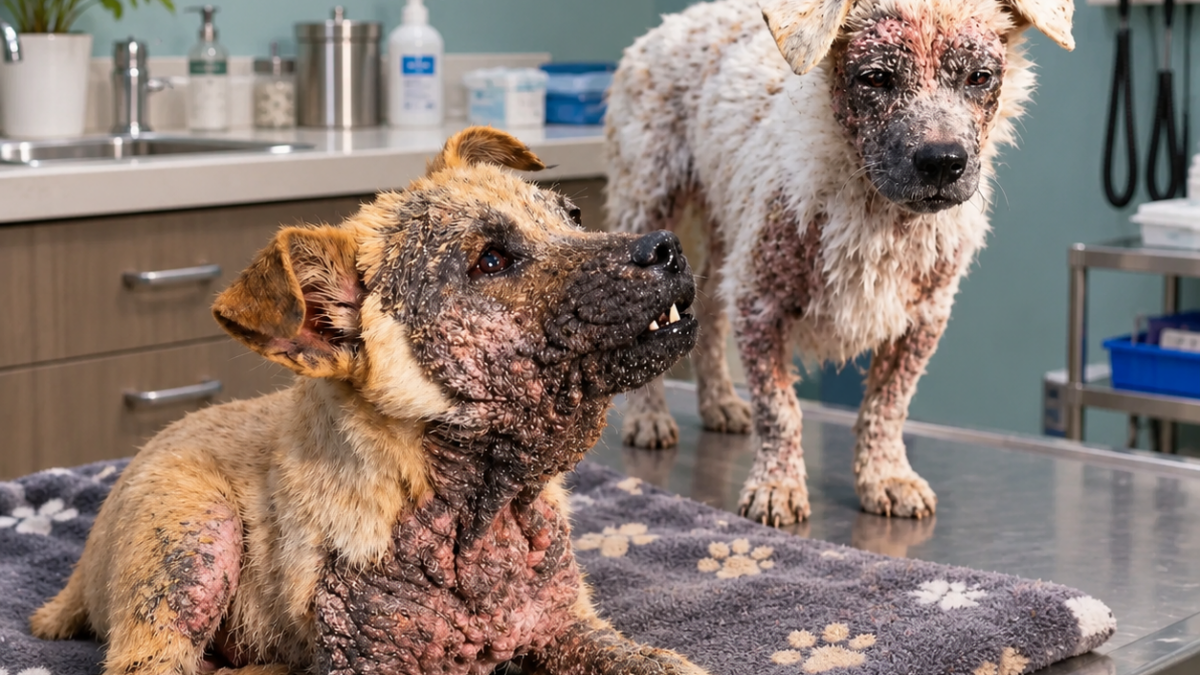
The condition of his skin worried him immediately.
Large areas were inflamed.
The paws were swollen.
Some patches were cracked and painful.
Other areas had thickened, rough skin.
There were places where almost no healthy fur remained.
Dr. Han gently separated the hair along the dog’s shoulder.
The dog leaned into his hand.
“He’s remarkably gentle,” the veterinarian said.
I smiled sadly.
“He was like that when we found him.”
The yellow dog lifted his head and rested it against Dr. Han’s wrist.
The doctor paused.
Then scratched behind his ear.
“Hello, little fellow.”
That was when we decided he needed a name.
“Geumdong,” Mina suggested.
I looked at her.
“Geumdong?”
She nodded.
“It suits him.”
I looked at the yellow dog.
“Geumdong.”
His ears moved.
I smiled.
“Then Geumdong it is.”
The white dog was examined next.
His condition was more severe.
When the technician tried to touch one of his front legs, he pulled away immediately.
The skin along his paws and lower legs was so inflamed that even a gentle examination caused discomfort.
Thick scales covered parts of the skin.
Several cracks began bleeding when the surrounding tissue was moved.
Dr. Han frowned.
“We need to be extremely careful.”
The white dog trembled.
I stayed near his head.
“I’m here.”
His eyes moved toward Geumdong.
The yellow dog was lying on a blanket nearby.
“Your friend is safe,” I whispered.
The white dog lowered his head.
“Eundong,” Mina said quietly.
I looked at her.
“What?”
“His name.”
I repeated it softly.
“Eundong.”
The white dog blinked.
“That’s a good name.”
From that moment, they weren’t simply the two starving dogs from the campground anymore.
They were Eundong and Geumdong.
Two names.
Two lives.
Two patients whose futures were suddenly our responsibility.
The medical tests began immediately.
Blood samples.
Skin scrapings.
Temperature checks.
Imaging.
A full examination of their damaged paws.
The results were devastating.
Both dogs were suffering from severe demodicosis, a skin disease associated with overgrowth of Demodex mites.
Their skin had become severely inflamed and fragile.
The infections and damage were extensive.
Both were also anemic.
Their bodies had been struggling without adequate care for far too long.
But the most disturbing discovery came from the X-rays.
Dr. Han placed the images on a monitor.
I stood beside him.
“At least there are no fractures,” he said.
I exhaled.
That was the first good news we had received.
Then he pointed toward the abdominal images.
“But look here.”
I leaned closer.
“What are those?”
“Foreign material.”
I stared.
“Inside their stomachs?”
“Yes.”
“What kind?”
“The images suggest small stones and other material. Some of it may be plastic.”
For several seconds, I couldn’t speak.
I remembered the garbage near the campground.
The gardens.
The empty ground where people had seen them searching for food.
“Were they eating stones?”
“It’s possible they swallowed them while scavenging.”
“Because they were hungry?”
“That’s one possibility. We can’t determine exactly why from the X-rays.”
I looked back through the examination room window.
Geumdong was lying quietly on his blanket.
Eundong was watching him.
Something inside me tightened.
I thought about how quickly they had eaten at the rest station.
How desperately they had searched every bowl.
How the white dog had once been seen chewing grass.
Maybe we would never know every meal they had missed.
But we were looking at the consequences.
Their bodies were telling a story no one had bothered to listen to.
Dr. Han continued explaining the treatment plan.
Eundong needed intensive care.
His skin was badly compromised, and he was weak enough to require intravenous support and close monitoring.
Geumdong had developed a high fever.
That concerned the veterinary team because of the possibility of significant infection.
Both needed nutritional rehabilitation.
Both needed treatment for the skin disease.
Both needed time.
And neither was strong enough to recover quickly.
“How long?” I asked.
Dr. Han looked at the charts.
“It’s difficult to say.”
“Days?”
“Longer.”
“Weeks?”
“Possibly.”
“And if something goes wrong?”
He didn’t answer immediately.
I understood.
Their condition was serious.
I looked toward the two dogs.
They were barely a year old.
They should have been strong, energetic young animals.
Instead, their bodies looked exhausted.
Their skin was damaged.
Their blood counts were abnormal.
They were carrying foreign material in their digestive systems.
And the one thing they seemed to believe in was each other.
The first night at the clinic was harder than I expected.
Eundong needed intensive treatment.
Geumdong needed his fever monitored.
Medical care required separating them for certain procedures.
Every time that happened, Eundong became distressed.
He would lift his head.
Look toward the doorway.
Then begin whining.
Sometimes he struggled to rise despite the pain in his paws.
“He’s going to hurt himself,” one technician said.
I walked closer.
“Eundong.”
He looked at me.
“Geumdong is okay.”
He continued staring toward the door.
I sat beside him.
“I promise we’re taking care of him.”
Eundong lowered his head.
Then raised it again.
I realized he wasn’t looking at me.
He was looking past me.
Waiting.
When Geumdong finally returned from his examination, Eundong tried to stand immediately.
His legs shook.
“Easy,” I whispered.
The yellow dog was placed on a blanket near him.
Eundong leaned forward.
He stretched his neck as far as he could.
Then touched Geumdong’s face with his nose.
Geumdong closed his eyes.
Eundong settled.
That was all it took.
No food.
No medication.
No reassuring words.
Just the knowledge that his companion was still there.
I sat on the floor watching them.
Mina came in carrying two clean blankets.
“Still awake?”
I nodded.
She followed my gaze.
Eundong had fallen asleep with his nose close to Geumdong’s shoulder.
Mina lowered herself beside me.
“They really can’t stand being apart.”
“No.”
“Do you think they’re brothers?”
“I think they’ve survived too much together for the answer to matter.”
She considered that.
Then she looked at the sleeping dogs.
“Maybe it matters to them.”
She was right.
It might.
The veterinarians estimated that the dogs were approximately the same age.
Their physical characteristics and behavior suggested they could be littermates.
One doctor said he thought there was a very high chance, perhaps around ninety percent, that they were brothers.
Without records or genetic testing, we couldn’t know for certain.
But by then, I had stopped worrying about biological proof.
Whatever their blood relationship, their bond was obvious.
They were family to each other.
And we needed to treat them that way.
The following morning, Eundong refused breakfast.
That frightened me immediately.
At the rest station, he had devoured three bowls.
Now he barely smelled the food.
Rachel, one of the veterinary technicians, checked his temperature.
“He’s exhausted.”
Dr. Han reviewed his chart.
“We need to continue supportive care.”
I watched Eundong lying beneath a clean blanket.
His eyes followed the food bowl.
But he didn’t lift his head.
“Come on,” I whispered.
Nothing.
“Just a little.”
He turned away.
I looked toward Geumdong.
The yellow dog had eaten part of his own meal.
Slowly.
With effort.
But he had eaten.
An idea came to me.
“Can we let Eundong see him?”
Rachel looked at Dr. Han.
He nodded, provided we kept the treatment setup safe.
We moved Geumdong’s bed into Eundong’s line of sight.
The white dog lifted his head.
Geumdong looked back.
For several seconds, they stared at each other.
Then Eundong sniffed his bowl.
He took one bite.
I almost laughed.
Another bite.
Then another.
Rachel smiled.
“He needed an audience.”
“No,” I whispered.
I watched the two dogs.
“He needed to know he wasn’t alone.”
Over the following days, we tried to maintain predictable routines.
The same feeding times.
The same voices.
The same gentle handling.
We placed their beds where they could see each other whenever their medical care allowed.
Eundong remained nervous around unfamiliar people.
Geumdong was more accepting.
When a technician approached, the yellow dog sometimes leaned into her hand.
Eundong would watch.
His ears would lift.
And after a while, he began allowing the same touch.
It was as if Geumdong was teaching him that the people around them could be trusted.
That realization moved me deeply.
During the months before rescue, Eundong appeared to have watched over Geumdong.
Now Geumdong was helping Eundong feel safe.
Their bond wasn’t simply one dog protecting a weaker companion.
It went both ways.
Each gave the other something he needed.
On the fourth day, Geumdong’s fever rose again.
I arrived at the clinic to find Dr. Han examining him.
Geumdong was lying very still.
His breathing was faster than usual.
I stopped in the doorway.
“What’s happening?”
“His temperature is elevated.”
“How high?”
Dr. Han told me.
I looked toward the monitor.
“And?”
“We’re evaluating the cause and adjusting his care.”
My stomach tightened.
Geumdong had seemed slightly stronger the previous evening.
He had eaten.
He had even lifted his head when I called his name.
Now he looked exhausted.
I crouched beside him.
“Hey, handsome.”
His eyes opened.
I touched the blanket near his paw.
“Don’t scare me.”
Eundong was on the other side of the room receiving treatment.
He could not see Geumdong clearly.
He began whining.
Rachel moved closer to him.
“It’s okay.”
He kept whining.
Then he tried to stand.
“Eundong, no.”
His paws trembled.
He fell back onto the blanket.
I looked at Dr. Han.
“Can we move them closer?”
“Not until we’ve finished assessing Geumdong.”
I understood.
I hated it.
But I understood.
Medical needs came first.
For the next several hours, Eundong remained restless.
Geumdong received the treatment he needed.
His fever did not disappear immediately.
We waited.
And waited.
By evening, I was sitting in a chair outside the treatment room.
Mina brought me coffee.
“You need to eat.”
“I’m fine.”
“You haven’t eaten since breakfast.”
I looked at her.
She raised an eyebrow.
“Sound familiar?”
I sighed.
She held out a sandwich.
“Eat.”
I took it.
Neither of us spoke for a while.
Then Mina said, “Do you remember what those campers called them?”
I nodded.
“Ugly.”
She looked toward the treatment room.
“They were begging for food.”
“I know.”
“And people chased them away.”
I stared at the floor.
“I know.”
My voice sounded sharper than I intended.
Mina went quiet.
I closed my eyes.
“I’m sorry.”
She shook her head.
“I’m angry too.”
I looked through the glass.
Geumdong was asleep.
Eundong was still awake.
“I keep thinking about those two months,” I said.
Mina nodded.
“How many times did they approach somebody?”
“How many times did they get rejected?”
“How many people saw their skin and decided that was all they needed to know?”
She didn’t answer.
Neither could I.
That night, Geumdong’s temperature began coming down.
When Dr. Han finally told us, I leaned against the wall.
My legs felt weak.
“He’s improving?”
“For now.”
I nodded.
For now was enough.
We had learned to accept small victories.
The next morning, Geumdong lifted his head and ate.
Eundong saw him.
Then finished his own breakfast.
The medical team continued treating their skin disease.
Both dogs required medication, careful hygiene, and regular monitoring.
Their skin was too fragile for rough handling.
Medicated bathing became part of the treatment plan.
At first, Eundong was terrified.
The sound of running water made him pull backward.
He didn’t want to enter the bathing area.
His paws were painful.
His skin was sensitive.
Everything about the experience was unfamiliar.
Rachel approached slowly.
“Hey, Eundong.”
He stared.
“Nothing bad is going to happen.”
She turned the water off.
Then waited.
Eundong sniffed the floor.
Rachel offered a treat.
He ate it.
The next day, they repeated the introduction.
Eventually, with patient handling and veterinary guidance, we could bathe him without triggering the same level of fear.
He still complained.
Loudly.
Geumdong was different.
He accepted the bath with a resigned expression.
The first time I watched him, I laughed.
“You look like an old man at a spa.”
He closed his eyes.
Rachel scratched his chin.
“He’s enjoying this.”
Eundong barked from nearby.
I looked toward him.
“Your brother disagrees.”
He barked again.
“Strongly.”
Those little moments helped us survive the difficult days.
Because recovery wasn’t dramatic every morning.
Sometimes all we did was clean damaged skin.
Offer food.
Change blankets.
Check temperatures.
Give medication.
Watch.
Wait.
Repeat.
But slowly, their bodies began responding.
The swelling in Geumdong’s paws decreased.
Eundong became less sensitive when his legs were handled.
Their appetites improved.
And their personalities began appearing beneath the exhaustion.
Geumdong loved being scratched behind his ears.
He would lean his entire body toward the person touching him.
If the hand stopped, he nudged it.
Eundong loved food.
But more importantly, he loved knowing food was coming.
He began recognizing the sound of the meal cart.
The moment he heard the wheels, his head lifted.
Then his tail moved.
At first, I thought I imagined it.
I called Rachel.
“Come here.”
She stepped beside me.
Eundong watched the approaching cart.
His tail moved again.
Rachel smiled.
“Oh, sweetheart.”
I looked at the white dog.
“You’re happy.”
He stared at the bowl.
“About food.”
His tail moved faster.
“That’s a good start.”
The first time Eundong wagged his tail because he saw me rather than food, I nearly cried.
It happened on an ordinary afternoon.
I had been away for several hours.
When I returned, Geumdong was sleeping.
Eundong was lying on his side.
I opened the door.
“Hello, boys.”
Eundong lifted his head.
His eyes met mine.
Then his tail moved.
Once.
Twice.
Three times.
I stopped.
He wasn’t looking at my hands.
I wasn’t carrying food.
There was no bowl.
Just me.
“Eundong?”
His tail moved again.
I crouched.
“Are you happy to see me?”
He pushed himself upright.
The movement was awkward because his paws still hurt.
But he tried.
I reached toward him slowly.
He leaned forward.
His nose touched my fingers.
Then he pressed his head into my palm.
My throat tightened.
“There you are.”
Rachel appeared behind me.
“What happened?”
“He came to me.”
She looked at Eundong.
The dog was still pressing against my hand.
“Oh.”
I smiled through tears.
“He came to me.”
Rachel sat beside us.
For several minutes, neither of us tried to move.
Eundong kept his head beneath my hand.
Geumdong woke and looked over.
Then he stood and moved closer too.
Soon I had both dogs leaning against my knees.
I laughed.
“Okay. I only have two hands.”
Geumdong pushed harder.
“That’s not fair.”
Eundong looked offended when my hand moved away.
Rachel laughed.
“They’ve decided you belong to them.”
I scratched both dogs.
“Apparently.”
There was something almost unbearable about their trust.
Not because they were extraordinary dogs.
But because they had been treated as though they weren’t worth touching.
People had called them ugly.
People had driven them away.
And now here they were, asking for affection with the innocence of animals who still wanted to believe humans could be kind.
They hadn’t become different animals.
We had simply given them a place where they no longer needed to be afraid.
By the fifteenth day, the veterinary team had good news.
Their anemia had improved.
Their appetites were stronger.
The treatments for their skin disease were beginning to produce visible results.
The inflammation was decreasing.
The damaged areas were healing.
I stood beside Dr. Han as he reviewed their latest results.
“Better?” I asked.
He smiled.
“Much better.”
I looked at him.
“Both?”
“Both.”
I exhaled.
He pointed to the records.
“Their blood values are moving in the right direction.”
“And their skin?”
“Improving.”
“How long before the fur grows back?”
“That will take more time.”
I nodded.
He continued.
“We need to stay consistent. We aren’t finished.”
“I know.”
But I couldn’t stop smiling.
For two weeks, we had watched them fight through exhaustion.
Now their bodies were finally beginning to recover.
That afternoon, I brought them into a quiet exercise area for a short supervised break.
Geumdong walked beside me.
His paws were still sensitive, but he moved more comfortably than before.
Eundong stayed close to him.
They sniffed the floor.
Then the corners.
Then each other.
It was the first time I had seen them explore a space without looking desperate for food.
Geumdong discovered a soft toy.
He sniffed it.
Pushed it with his nose.
Then jumped backward when it rolled.
I laughed.
“What was that?”
He stared.
The toy rolled again.
He followed it.
Eundong watched.
Then approached.
Geumdong pushed the toy toward him.
Eundong sniffed.
For a moment, both dogs stood looking at the strange object.
Then Geumdong tapped it with his paw.
It rolled between Eundong’s front legs.
The white dog jumped.
Mina burst out laughing.
“Oh, no!”
Eundong turned toward her.
His expression looked almost offended.
Geumdong wagged his tail.
I sat down on the floor.
“That’s right. You two are supposed to be young.”
They had spent months just trying to survive.
Now they were learning how to play.
Their bond remained the most remarkable part of their recovery.
At feeding time, Eundong still watched Geumdong carefully.
Sometimes he stood near the yellow dog’s bowl.
Sometimes he stopped eating and looked toward him.
At first, I assumed it was the same behavior we had noticed at the rest station.
Maybe Eundong had been protecting his companion.
Maybe he had been sacrificing food when supplies were scarce.
But I also knew I couldn’t claim certainty about the past.
We hadn’t watched them survive those two months.
We didn’t know who found food first.
We didn’t know whether they had shared equally.
We didn’t know how often either went hungry.
What we knew was that Eundong cared deeply about Geumdong’s presence.
And their early food behavior suggested that scarcity had shaped both of them.
So we helped them learn a different routine.
Separate bowls.
Enough food for each.
Predictable meals.
No competition.
No need to guard.
No need to hurry.
At first, Eundong still ate quickly.
He would finish his portion and turn toward Geumdong.
Sometimes he tried to move closer.
We gently redirected him to his own space.
“That’s his,” I would say.
Eundong stared.
“Yours is here.”
He looked at the second bowl.
Sniffed it.
Then ate.
Eventually, he learned something important.
Food wasn’t disappearing.
There would be breakfast tomorrow.
And dinner.
And another breakfast.
Over time, his desperate urgency began fading.
He still loved meals.
He still ate enthusiastically.
But he no longer looked as though every bowl might be his last.
That was one of the quietest and most meaningful changes of all.
A starving animal does not simply need calories.
He needs time to learn that hunger is no longer waiting around every corner.
Around the third week, we received a call from someone who had seen the dogs near the campground.
He remembered them.
More specifically, he remembered chasing them away.
His name was Mr. Lee.
He sounded uncomfortable.
“I saw the rescue pictures,” he said.
I remained quiet.
“Are they the two dogs from the gardens?”
“Yes.”
“The white one and the yellow one?”
“Yes.”
He cleared his throat.
“I thought they were sick.”
“They were.”
“Very sick?”
I looked toward Eundong.
He was lying beside Geumdong on a clean blanket.
“Yes.”
There was a long pause.
“I didn’t know.”
I felt anger rise.
“What did you think was happening?”
He didn’t answer immediately.
Then he said, “They looked terrible.”
I closed my eyes.
That was exactly the problem.
“They were starving,” I said.
“I know that now.”
“They had severe skin disease.”
“I understand.”
“They were in pain.”
Silence.
He finally whispered, “I should have helped.”
I looked toward the dogs.
Eundong had rested his head across Geumdong’s front legs.
“Yes,” I said.
“You should have.”
He didn’t argue.
That surprised me.
“I thought they might be dangerous,” he said.
“Did either dog attack anyone?”
“No.”
“Growl?”
“No.”
“Chase anyone?”
“No.”
“Then what frightened you?”
Another pause.
“The way they looked.”
I stared at the wall.
There it was.
Not aggression.
Not danger.
Appearance.
Their suffering had become the reason people refused to help them.
I could hear the shame in his voice.
“I don’t know what to say.”
“Then don’t say anything.”
He remained silent.
“If you see another animal suffering, help it.”
“Yes.”
“Call someone.”
“I will.”
“Don’t wait because you’re afraid it looks ugly.”
His voice broke slightly.
“I understand.”
After the call, I sat beside Eundong.
He lifted his head.
I scratched beneath his chin.
“Somebody finally understood,” I whispered.
But I wished they had understood sooner.
Two months sooner.
Before the swelling.
Before the anemia.
Before the desperate search for food.
Before the stones and plastic inside their stomachs.
Before two young dogs learned to expect rejection whenever a human approached.
I could not change any of that.
All I could do was make sure the rest of their lives looked different.
By the twenty-fifth day, Eundong and Geumdong were becoming difficult patients.
Not medically.
Emotionally.
They had decided the clinic belonged to them.
Geumdong greeted almost every technician who entered.
If someone bent down, he leaned into their knees.
If they ignored him, he followed them.
Eundong was more selective.
He trusted us.
But unfamiliar people still made him cautious.
He would stand beside Geumdong and watch.
Then, if the yellow dog seemed comfortable, Eundong slowly approached.
One afternoon, a new volunteer came in carrying blankets.
Geumdong walked straight toward her.
She laughed.
“Well, hello.”
He pushed his head against her hand.
Eundong remained several feet away.
The volunteer looked toward him.
“Does he bite?”
“No,” I said.
“He’s shy.”
She smiled.
“Can I pet him?”
“Let him come to you.”
She sat on the floor.
Eundong watched.
Geumdong settled beside her.
Several minutes passed.
Then Eundong approached.
One step.
Another.
He sniffed her shoe.
Then her hand.
She remained still.
Finally, he leaned forward.
She scratched beneath his chin.
His tail moved.
The volunteer’s eyes filled.
“Oh, sweetheart.”
I smiled.
“He likes you.”
She looked at me.
“I thought he was going to be scared.”
“He was.”
“What changed?”
I looked toward Geumdong.
“He saw someone he trusted being safe.”
The volunteer scratched both dogs.
I watched Eundong’s face soften.
Every gentle experience made the next one easier.
Not always.
Not perfectly.
But enough.
On day thirty, Dr. Han called me into the examination room.
Both dogs were standing on the table.
I stared.
Their bodies had changed so much that I almost didn’t recognize the dogs from the campground photographs.
The rough scales were disappearing.
The swelling had reduced dramatically.
New fur was growing.
Geumdong’s yellow coat looked softer.
Eundong’s white fur was beginning to regain its healthy texture.
They still had areas that needed continued care.
But the difference was enormous.
Dr. Han smiled.
“Look at them.”
I shook my head.
“I am.”
“Good weight gain.”
I nodded.
“Improved skin.”
Another nod.
“Much better blood values.”
I looked at him.
“Are you going to make me cry?”
He laughed.
“Probably.”
Eundong moved toward the edge of the table.
I steadied him.
“Not so fast.”
He licked my hand.
Geumdong leaned toward Dr. Han.
The veterinarian scratched his chest.
“You two have worked hard.”
I looked at the dogs.
They had.
But so had everyone around them.
Every medicated bath.
Every carefully measured meal.
Every blood test.
Every clean blanket.
Every frightened moment handled slowly instead of forcefully.
Recovery was built from work nobody saw in a single photograph.
And we were finally seeing the result.
Day thirty-five was the day everything changed.
The veterinary team examined both dogs and confirmed that they had recovered enough to leave inpatient care.
They would still need follow-up attention and responsible long-term management.
But they no longer required the same level of constant hospitalization.
When Dr. Han told me, I stared at him.
“Both?”
He smiled.
“Both.”
“You’re sure?”
“Yes.”
“No more staying overnight?”
“Not unless something changes.”
I looked toward Eundong and Geumdong.
The two dogs were wrestling gently over a soft toy.
Eundong had the toy in his mouth.
Geumdong tugged at the other end.
Their tails moved.
Their paws looked healthy enough to support their playful movements.
Their coats had grown fuller.
They were no longer the fragile animals we had carried out of the grass.
I felt tears filling my eyes.
Mina came beside me.
“You’re crying.”
“No.”
“You are.”
I laughed.
“Fine.”
She watched the dogs.
“I remember when we were afraid they wouldn’t survive the drive.”
“So do I.”
“Now look.”
Geumdong stole the toy.
Eundong chased him.
They ran across the room.
Not far.
Not for long.
But they ran.
I covered my mouth.
Because the last time I had seen them running outdoors, they were frightened and hungry.
Now they were running because they were happy.
That difference was everything.
Leaving the clinic was emotional.
The staff had grown attached to them.
Rachel carried Geumdong’s blanket.
Dr. Han gave us instructions for follow-up care.
Another technician brought their favorite toys.
Eundong looked around as though he couldn’t understand why everyone was suddenly paying so much attention to him.
Geumdong wagged his tail at everyone.
Of course he did.
He had never learned to be modest.
When we walked toward the vehicle, Eundong hesitated.
I stopped.
“It’s okay.”
He looked at the open door.
I wondered whether he remembered the night we rescued him.
The net.
The car.
The long drive.
The unfamiliar people.
Geumdong climbed in first.
He turned around.
Looked at Eundong.
And waited.
The white dog took one step forward.
Then another.
Finally, he climbed in.
I smiled.
“Still together.”
Eundong settled beside Geumdong.
For a moment, I simply stood outside the vehicle looking at them.
Thirty-five days earlier, I had been terrified that one or both might die.
Now they were going to begin the next chapter of their lives.
I closed the door gently.
“Let’s go home.”
The shelter was different from the clinic.
More dogs.
More sounds.
Larger outdoor areas.
Toys.
Blankets.
People moving in and out.
Eundong was cautious at first.
He stayed close to Geumdong.
The yellow dog seemed delighted.
He sniffed everything.
Every bed.
Every doorway.
Every corner.
He greeted other dogs with a wagging tail.
Eundong followed several steps behind.
I watched them carefully.
Their bond remained strong, and we didn’t want to create unnecessary stress.
So we gave them adjoining resting spaces and plenty of supervised time together.
The first night, they curled beside each other on a large blanket.
Geumdong rested his head against Eundong’s shoulder.
Eundong closed his eyes.
I stood in the doorway.
For a moment, I remembered the grass beside the campground.
Two exhausted bodies pressed together.
Trying to disappear.
Now they were still sleeping close.
But everything around them had changed.
No cold ground.
No hunger.
No campers waving them away.
No swollen paws scraping against dirt.
Just a soft blanket.
Warmth.
Full stomachs.
And people who were glad they were there.
I whispered, “Good night, boys.”
Geumdong lifted his head.
Eundong opened one eye.
Then they went back to sleep.
Their personalities continued developing.
Geumdong became the social one.
He loved attention.
He would approach visitors and lean against their legs.
Sometimes he became so affectionate that people nearly lost their balance.
Eundong was more thoughtful.
He watched first.
Then decided.
Once he trusted someone, he became deeply affectionate.
He loved having his chest scratched.
He loved lying close to people.
And he absolutely loved food.
But the frantic hunger had faded.
He could leave part of a meal unfinished.
At first, I couldn’t believe it.
I found him resting beside a bowl with a small amount of food remaining.
I stared.
“Eundong?”
He lifted his head.
“Are you finished?”
He wagged his tail.
I looked at Mina.
“There’s food left.”
She smiled.
“I see.”
“He’s not eating it.”
“He’s full.”
I looked back at him.
Full.
Such an ordinary word.
Such an extraordinary thing for him.
I crouched beside his bed.
“You know there’ll be more later.”
Eundong rested his head against my hand.
I smiled.
“You finally know.”
That afternoon, I thought about the white dog at the rest station.
Three bowls.
Desperate eating.
Watching Geumdong.
Now food was no longer something to fight over.
It was something they could trust would arrive.
The first real challenge at the shelter came when a large black dog ran too quickly toward them.
The dog was friendly.
He only wanted to play.
But Eundong panicked.
He jumped backward.
Then moved directly in front of Geumdong.
His body became rigid.
“Easy,” I said.
The black dog stopped.
Eundong remained between him and Geumdong.
I understood immediately.
The white dog still believed he needed to protect his companion from anything uncertain.
We calmly separated the dogs and gave everyone space.
Then we tried again another day.
Slowly.
With controlled introductions.
No forcing.
No crowding.
Geumdong eventually approached the black dog and sniffed him.
Eundong watched from a distance.
Then came closer.
Within a week, all three were playing together.
One afternoon, I watched the black dog race across the yard.
Geumdong chased him.
Eundong followed.
The white dog was no longer moving in front of Geumdong.
He was running beside him.
That mattered.
Protection had once been his job.
Now he was learning that companionship could simply mean sharing happiness.
As their health improved, adoption became a real possibility.
I had known this day would come.
But knowing didn’t make it easy.
The shelter director, Mrs. Park, called me into her office.
“We need to discuss Eundong and Geumdong.”
I sat down.
“What happened?”
“Nothing bad.”
I relaxed slightly.
“Then why do you sound serious?”
She turned her computer toward me.
“Applications.”
I stared.
“For both?”
“Yes.”
I looked at the screen.
Photographs.
Families.
Homes.
People who wanted to adopt.
I should have been thrilled.
Instead, my stomach tightened.
“Together?”
Mrs. Park paused.
“Not necessarily.”
I looked at her.
“They can’t be separated.”
“We need to assess that carefully.”
“They panic when they’re apart.”
“They did during treatment.”
“They’re brothers.”
“Possibly.”
I leaned back.
She continued.
“We want the best outcome for both dogs.”
“They’ve already lost everything once.”
“I know.”
“They shouldn’t lose each other too.”
Mrs. Park nodded.
“That’s why we’re taking our time.”
I looked at the photographs.
Good families.
Warm houses.
Fenced yards.
Experience with rescue animals.
I wanted all of it for Eundong and Geumdong.
But I couldn’t imagine either dog waking up and discovering the other was gone.
That night, I sat beside them.
Geumdong was chewing a toy.
Eundong rested against my leg.
“People want you,” I whispered.
Geumdong continued chewing.
“Good people.”
Eundong looked up.
“But I don’t know how to explain what happens next.”
He rested his head against my knee.
I swallowed.
“We’ll figure it out.”
Over the following weeks, we carefully observed how the dogs handled short, positive separations.
Not forced isolation.
Not frightening experiences.
Just brief moments when one dog played or explored while the other received attention nearby.
Geumdong adjusted more easily.
He enjoyed people.
He enjoyed other dogs.
He enjoyed almost anything involving affection.
Eundong was more cautious.
When Geumdong disappeared behind a door, he looked toward it.
Sometimes he waited.
Sometimes he whined.
But with consistent reassurance and gradual practice, he learned that short separations did not mean permanent loss.
Geumdong always returned.
That lesson took time.
And it needed to be learned gently.
We weren’t trying to break their bond.
We were trying to give each dog confidence that the bond was safe.
Still, I hoped for a home where they could remain close.
Then we received an application unlike the others.
Two related households.
One extended family.
Two neighboring homes with a shared garden.
The adults lived separately but spent much of their time together.
They had been looking for dogs to adopt.
When they saw Eundong and Geumdong’s story, they contacted the shelter.
One family wanted to adopt Eundong.
The other wanted Geumdong.
But they had a plan.
The dogs could spend their days together.
They could play in the same enclosed garden.
They could visit either home.
Their sleeping arrangements would be introduced gradually, with the dogs’ comfort guiding the decisions.
I read the application twice.
Then a third time.
Mina leaned over my shoulder.
“Well?”
I looked at her.
“It sounds too good.”
She laughed.
“You always say that.”
“Because sometimes it is.”
“Then let’s meet them.”
The family arrived on a Saturday morning.
There were four adults.
Two teenagers.
And a grandmother with kind eyes who immediately asked whether the dogs liked soft blankets.
I smiled.
“They love blankets.”
“Good,” she said. “I made two.”
She opened a bag.
Inside were two thick blankets.
One cream-colored.
One pale yellow.
I looked at Mina.
She looked at me.
Neither said anything.
The family didn’t rush toward the dogs.
They sat in the outdoor visiting area.
Geumdong approached first.
Of course.
He walked straight toward the grandmother.
Sniffed her shoes.
Then leaned against her legs.
She laughed.
“Oh, you beautiful boy.”
Beautiful.
The word hit me.
Months earlier, people had called him ugly.
Now a woman who had just met him was looking at him as though he was the loveliest dog she had ever seen.
Eundong remained several feet away.
One of the teenagers crouched.
“Hi.”
Eundong watched.
The boy didn’t move closer.
He placed a treat on the ground.
Then waited.
Eundong approached slowly.
Sniffed the treat.
Ate it.
Then looked at the boy.
Another treat appeared.
The white dog came closer.
Eventually, he allowed the teenager to touch his chest.
His tail moved.
I felt my throat tighten.
Mrs. Park stood beside me.
“They’re doing well.”
I nodded.
The family stayed for nearly two hours.
They asked careful questions.
About the skin disease.
Nutrition.
Follow-up examinations.
Their past fear.
Their bond.
Their feeding routines.
They wanted to understand how to care for the dogs rather than simply admire how beautiful they had become.
That mattered more than anything.
Before leaving, the grandmother knelt beside Eundong.
He approached her.
She touched his head gently.
“You’ve had a hard time,” she whispered.
Eundong leaned forward.
“But you won’t have to do that anymore.”
I looked away.
Because those were exactly the words I had wanted someone to say to him when we first found him.
The adoption process took time.
We arranged further visits.
We observed the dogs with the family.
We reviewed the home environment.
We discussed how to maintain contact between them.
There were no shortcuts.
Eundong and Geumdong had already endured too much uncertainty.
Their next home needed to be chosen carefully.
Then the day finally came.
Both dogs were approved for adoption into the two connected households.
When Mrs. Park told me, I felt two things at once.
Joy.
And grief.
I was happy they had found people who wanted them.
But I had grown used to seeing them every morning.
Eundong’s cautious eyes.
Geumdong’s affectionate greeting.
Their playful arguments over toys.
Their habit of sleeping close together.
The idea of their beds being empty felt unbearable.
Mina noticed.
“You’re going to cry.”
“No.”
“You are.”
“I’m not.”
She smiled.
“You’ve already started.”
I wiped my eyes.
“Stop looking at me.”
She hugged me.
For a while, neither of us spoke.
Then she said, “Remember what you told me during the drive?”
“What?”
“That we needed Eundong to understand he didn’t have to protect Geumdong forever.”
I nodded.
“Well,” she whispered, “maybe now he can finally believe it.”
The morning of the adoption, I arrived early.
I brought two collars.
Two sets of records.
Their favorite toys.
And the blankets they had slept on during recovery.
Eundong watched me pack.
He seemed suspicious.
Geumdong was delighted because he thought every bag contained food.
“You’re not helping,” I told him.
He wagged his tail.
Eundong sniffed the collars.
Then walked toward Geumdong.
They stood together.
I crouched.
“You boys have no idea what’s happening.”
Geumdong licked my hand.
I smiled.
“Typical.”
Eundong moved closer.
I scratched beneath his chin.
“You’re going somewhere good.”
His ears lifted.
“Both of you.”
When the family arrived, Geumdong greeted them enthusiastically.
Eundong hesitated.
Then recognized the teenager.
His tail moved.
The boy knelt.
“Hey, buddy.”
Eundong approached.
The boy scratched his chest.
I exhaled.
The family had prepared the shared garden.
Separate feeding areas.
Comfortable sleeping spaces.
Secure gates.
Quiet resting places.
Everything we had discussed.
We loaded both dogs into the vehicle together.
Geumdong settled first.
Eundong curled beside him.
I stood at the open door.
For a moment, I remembered the first time we placed them in a car.
Their swollen paws.
Their trembling bodies.
Their desperate hunger.
Now their coats were soft.
Their bodies were healthy.
Their eyes were bright.
And someone was taking them home because they wanted them.
Not because the dogs were useful.
Not because they were perfect.
Because they were loved.
I touched Eundong’s head.
“Take care of your brother.”
Then I stopped.
That wasn’t fair.
He had already done enough.
I smiled.
“No.”
Eundong looked at me.
“Just be happy.”
I touched Geumdong.
“You too.”
The door closed gently.
The vehicle pulled away.
I watched until it disappeared.
Then I cried.
The first update arrived that evening.
A photograph showed Eundong and Geumdong lying together on the cream-colored blanket.
Both were asleep.
Their new family wrote:
They explored the garden, ate dinner, and are resting together.
I stared at the picture.
Then I sent it to Mina.
She replied immediately.
They’re home.
I looked at the words.
Home.
Such a small word.
Such a tremendous thing.
The next morning, another photograph arrived.
Geumdong was standing near a kitchen doorway.
Eundong was behind him.
Both looked expectant.
The message said:
They already know where breakfast happens.
I laughed.
Of course they did.
Several days later, the family sent a video.
Eundong was running across the shared garden.
Geumdong chased him.
They rounded a tree.
Eundong changed direction.
Geumdong slipped slightly on the grass, recovered, and followed.
Their tails were high.
Their coats shone in the sunlight.
I watched the video three times.
Then five.
Then I paused it.
Eundong was caught midstride.
All four paws lifted off the ground.
For a moment, he looked almost weightless.
I thought about the dog who had once been seen chewing grass because he was hungry.
The dog whose paws were so swollen they bled when touched.
The dog who panicked when his companion disappeared.
Now he was running because he wanted to.
No one was chasing him away.
No one was calling him ugly.
No one was telling him he didn’t belong.
He belonged.
And he knew it.
The families continued updating us.
Geumdong adapted quickly.
He loved the grandmother.
He followed her around the house and waited beside her chair.
Whenever she sat down, he appeared.
If she knitted, he rested at her feet.
If she watched television, he lay beside her.
If she moved to the kitchen, he followed.
The family joked that Geumdong had become her personal assistant.
Eundong developed a close bond with the teenager.
The boy was patient.
He never forced the dog to approach.
He sat outside with him.
Read books.
Played quiet games.
And slowly, Eundong began choosing to stay beside him.
One evening, the family sent me a photograph.
The teenager was asleep on the couch.
Eundong lay beside him with his head resting on the boy’s chest.
I stared at it.
There was something extraordinary about seeing that white dog sleeping so deeply beside a human.
At the campground, he had frozen when we approached.
He had expected rejection.
Now he trusted someone enough to sleep against his heartbeat.
That was healing.
Not just the return of fur.
Not just healthy paws.
The return of trust.
Several months later, the family invited us to visit.
Mina came with me.
We drove through a quiet neighborhood until we reached the two neighboring homes.
A shared garden stretched between them.
I heard barking before I saw the dogs.
Then Geumdong appeared.
He was running toward the gate.
His yellow coat was thick and soft.
His tail moved so quickly that his entire body seemed to wag.
“Geumdong!”
He pressed against the gate.
The grandmother laughed behind him.
“He remembers you.”
I opened it.
Geumdong jumped toward me.
I crouched.
He covered my face with kisses.
I laughed.
“Okay! Okay!”
Mina knelt beside us.
Then Eundong appeared.
He stopped several feet away.
For one second, he stared at me.
My heart tightened.
“Eundong?”
His ears lifted.
Then he ran.
Straight toward me.
I barely had time to brace.
He pressed his entire body against my knees.
I wrapped my arms around him.
“Oh, sweetheart.”
His tail moved.
He lifted his face.
Licked my cheek.
Then leaned harder.
I closed my eyes.
I remembered the first night.
His frightened expression.
His swollen paws.
His desperate need to keep Geumdong in sight.
And now he was standing in a beautiful garden, greeting me like an old friend.
The teenager laughed.
“He does that every time someone he loves comes home.”
I looked up.
Someone he loves.
The words nearly broke me.
Eundong wasn’t simply tolerating humans anymore.
He had people.
His people.
And he knew they would return.
We spent the afternoon with the family.
They showed us where the dogs slept.
Their toys.
Their feeding areas.
The shared garden.
The little path between the two homes.
Geumdong had his favorite place beside the grandmother’s chair.
Eundong loved the teenager’s room.
But the dogs spent much of their time together.
They played.
Explored.
Rested side by side.
Sometimes they chose different rooms.
Sometimes they slept together.
The choice was theirs.
That was the most beautiful part.
Eundong no longer seemed terrified when Geumdong wandered away.
He still watched him.
Still greeted him warmly when he returned.
But he could relax.
He had learned that separation did not always mean loss.
One afternoon, Geumdong walked into the grandmother’s house.
Eundong remained outside with us.
I watched him.
He looked toward the doorway.
Then turned back to the teenager.
The boy threw a toy.
Eundong chased it.
I smiled.
Months earlier, he would have panicked.
Now he trusted Geumdong to return.
And he trusted the people around him to keep both of them safe.
That was freedom too.
During our visit, the grandmother brought out an old photograph.
It was one of the original rescue images.
The two dogs looked painfully thin.
Their skin was damaged.
Their paws swollen.
Their faces exhausted.
She placed it beside a recent photograph.
In the new picture, Eundong and Geumdong were sitting together in the garden.
Both healthy.
Both clean.
Both beautiful.
I stared at the comparison.
The grandmother shook her head.
“I don’t understand.”
“What?”
“How anyone could call them ugly.”
I looked toward the dogs.
Geumdong was lying in the sun.
Eundong was chewing a toy nearby.
“They were sick,” I said.
She nodded.
“They were suffering.”
“I know.”
“They needed help.”
Her eyes filled.
“And people chased them away.”
I remained quiet.
She touched the newer photograph.
“They were beautiful even then.”
That sentence stayed with me.
Because she was right.
Their beauty hadn’t begun when their fur grew back.
They had been worthy of kindness when their skin was cracked.
When their paws were swollen.
When their bodies were starving.
When people could barely stand to look at them.
Health had changed their appearance.
It had never changed their worth.
The most unexpected part of their story happened several weeks later.
Mr. Lee, the man who had admitted chasing the dogs away, contacted us again.
He had seen photographs of Eundong and Geumdong after their recovery.
He asked whether he could visit the shelter.
I agreed.
When he arrived, he carried several bags of dog food.
He looked nervous.
“I brought these.”
I looked at the bags.
“Thank you.”
He stood awkwardly.
“Are the two dogs still here?”
“No.”
His face changed.
“They’re gone?”
“They were adopted.”
He stared at me.
“Both?”
“Yes.”
“Are they okay?”
I nodded.
“They’re doing very well.”
He lowered his head.
For a moment, I thought he might leave.
Then he said, “Can I see a picture?”
I hesitated.
Finally, I showed him a photograph the family had given us permission to share.
Eundong and Geumdong were lying in the garden.
Their coats were thick.
Their eyes bright.
Their bodies strong.
Mr. Lee stared.
For several seconds, he said nothing.
Then he whispered, “Those are the same dogs?”
“Yes.”
He looked closer.
“The white one?”
“Eundong.”
“And the yellow one?”
“Geumdong.”
His eyes filled.
“I didn’t recognize them.”
I didn’t answer.
He handed the phone back.
“I remember telling them to go away.”
I nodded.
“They weren’t hurting anyone.”
“No.”
“They were hungry.”
“Yes.”
He looked at the floor.
“I thought they looked disgusting.”
The word made me flinch.
Then he added, “I didn’t understand they looked that way because they were suffering.”
I watched him carefully.
“I should have helped.”
“Yes.”
He swallowed.
“I can’t change that.”
“No.”
“What can I do?”
I looked toward the shelter yard.
Several rescued dogs were resting beneath a tree.
“Help the next one.”
He followed my gaze.
“Don’t wait until an animal looks beautiful enough to deserve it.”
He nodded.
“I won’t.”
I couldn’t know whether he would keep that promise.
But several weeks later, he contacted the shelter about another abandoned dog near the campground.
This time, he didn’t chase the animal away.
He brought food and water, kept a safe distance, and called for help.
The dog was rescued.
I remembered Eundong and Geumdong.
Perhaps that was one more victory they had given us.
Their suffering had changed someone who once looked away.
Over the following year, Eundong and Geumdong continued thriving.
Their families celebrated birthdays.
Took them on walks.
Bought toys.
Sent photographs.
The dogs became part of ordinary routines.
Geumdong loved riding in the car.
Eundong preferred quiet walks.
Geumdong greeted visitors enthusiastically.
Eundong inspected strangers carefully before deciding whether they deserved his attention.
They were different.
Completely different.
And somehow, they fit together perfectly.
The yellow dog had become the cheerful, affectionate companion who loved everyone.
The white dog had become the observant, loyal friend who loved deeply once he trusted.
Their personalities made me wonder what they might have been like as puppies.
Before hunger.
Before damaged skin.
Before rejection.
Maybe Geumdong had always been gentle.
Maybe Eundong had always been protective.
Maybe they had played together in some forgotten yard.
We would never know.
But we knew who they were now.
And that was enough.
One winter, their family sent me a photograph that made me cry.
Snow covered the garden.
Inside the house, Eundong and Geumdong lay together on a thick blanket beside a warm window.
The grandmother had placed another blanket over their backs.
Both dogs were asleep.
I stared at the image for a long time.
The first night we rescued them, they had been lying in grass.
Cold.
Hungry.
Exhausted.
Now they were sleeping beneath warm blankets in a home where people worried whether they might be chilly.
I sent the photograph to Mina.
She replied:
Remember the 3 a.m. rest stop?
I stared at the message.
Then typed:
I’ll never forget.
She answered:
Look how far they came.
I put the phone down.
And cried.
Because sometimes the distance between suffering and safety is too enormous to measure in miles.
The highway journey had taken only one night.
But the journey toward trust had taken months.
And the journey from being unwanted to being loved had changed the entire meaning of their lives.
Two years after the rescue, the family invited us to another gathering.
Eundong and Geumdong greeted us at the gate.
They were stronger.
Older.
Completely comfortable in their home.
Geumdong ran toward Mina.
Eundong came directly to me.
I knelt.
He pressed his head against my chest.
I scratched behind his ears.
“Hello, handsome.”
His tail moved.
I laughed.
“Remember when everybody said you were ugly?”
He looked up.
“You were never ugly.”
He licked my chin.
I smiled.
“You were just hurting.”
The teenager, now older, stood nearby.
“He doesn’t like it when people cry.”
I wiped my cheek.
“Then he must hate seeing me.”
The boy smiled.
“He usually kisses them.”
As if he understood, Eundong lifted his head and licked my face again.
Everyone laughed.
I held him close.
There was no desperate trembling.
No swollen skin.
No fear that the food would disappear.
Just a dog who knew exactly where he belonged.
That afternoon, we took both dogs for a walk.
The path led past a small wooded area.
Geumdong trotted ahead.
Eundong stayed closer to me.
The weather was beautiful.
Sunlight moved through the trees.
Birds called overhead.
The dogs stopped often to sniff.
Then Geumdong discovered something interesting beside the path.
He lowered his head.
Eundong approached.
For a moment, both dogs stood shoulder to shoulder investigating the same patch of grass.
I stopped walking.
Mina looked at me.
“What?”
I shook my head.
“Nothing.”
She followed my gaze.
The two dogs were standing together.
Healthy.
Relaxed.
Curious.
Then I remembered another patch of grass.
The one near the campground.
The place where two starving dogs had crawled after being rejected.
Grass had once been where they went to disappear.
Now it was something they explored because the world was interesting.
Such a small difference.
Such an enormous one.
Geumdong lifted his head.
Eundong sniffed another patch.
Then the yellow dog began walking again.
The white one followed.
I smiled.
“Come on, boys.”
They turned toward us.
Tails wagging.
And we continued down the path.
People sometimes ask me whether I ever felt angry enough to want revenge on the person who neglected them.
Of course I did.
When I saw their damaged skin, I was angry.
When I learned about their anemia, I was angry.
When the X-rays showed stones and plastic inside their digestive systems, I was angry.
When Eundong cried because Geumdong was taken into another room, I was angry.
When I remembered people calling them ugly, I was furious.
I wanted the people responsible to understand what those dogs had endured.
I wanted them to know how close the boys had come to losing their lives.
I wanted someone to answer for the months when two helpless animals had been left without adequate care.
But we never had enough reliable information to establish every detail of their previous ownership or pursue a particular person with certainty.
And I refused to turn suspicion into fact simply because anger demanded a villain.
We documented what we knew.
We shared the concerns through appropriate channels.
Then we put our energy where it could make an immediate difference.
Into treatment.
Into food.
Into rehabilitation.
Into finding a safe future.
At first, that didn’t feel like enough.
I wanted something dramatic.
An apology.
A punishment.
A moment when the person who abandoned them would be forced to see what they had done.
But eventually, I realized Eundong and Geumdong had already given us an answer more powerful than anything I could arrange.
They had survived.
They had healed.
They had become beautiful, strong, affectionate dogs.
They had found families who wanted them.
And the people who once called them ugly no longer had any power over their lives.
There is something deeply satisfying about watching cruelty fail.
Not because suffering disappears.
It doesn’t.
Eundong and Geumdong still carried parts of their past.
Eundong remained cautious in unfamiliar situations.
Geumdong occasionally became anxious around food.
They needed continued care and patience.
But their past no longer controlled every moment.
The world had changed around them.
People who once pushed them away had been replaced by people who opened doors.
Empty ground had been replaced by soft beds.
Unpredictable scraps had been replaced by regular meals.
Painful paws had healed enough for long walks.
And two dogs who once stood outside campsites hoping for a bite of food now had people preparing their meals every morning.
That was the revenge I had never expected.
A life so full that neglect became only the beginning of the story.
Not the ending.
One evening, their family sent a short video.
It was nothing dramatic.
No special event.
No celebration.
Just dinner.
The camera showed two bowls being placed on the floor.
Eundong and Geumdong waited.
Both dogs wagged their tails.
A family member gave them permission to eat.
They lowered their heads.
Calmly.
Without fighting.
Without rushing.
Without looking over their shoulders.
I watched the video twice.
Then a third time.
And something about it broke me.
Because I remembered the rest station.
Three in the morning.
A dim parking area.
Two starving dogs devouring food as though it might disappear.
Eundong watching Geumdong.
Geumdong struggling to finish a bowl.
Now they ate in peace.
They knew there would be another meal.
They knew there would be another morning.
They knew that after the bowls were empty, someone would still be there.
I realized then that their greatest transformation wasn’t visible in their fur.
It was visible in the way they ate.
They were no longer afraid of tomorrow.
Years passed.
The boys grew older.
Their faces softened.
Their routines became more predictable.
Geumdong still loved attention.
Eundong still preferred to approach people on his own terms.
They continued spending time together.
Sometimes in one house.
Sometimes in the other.
Sometimes outside in the shared garden.
Their families learned their habits so well that a single glance could tell them what each dog wanted.
Eundong had a favorite corner near a window.
Geumdong loved sleeping beside the grandmother’s chair.
When the weather was warm, both dogs stretched out in the garden.
When it rained, they preferred the living room.
When visitors arrived, Geumdong greeted them.
Eundong watched.
Then decided.
It was an ordinary life.
That was what made it extraordinary.
There were no more desperate nights in the grass.
No more searching for scraps.
No more painful untreated skin.
No more people chasing them away.
There were only the things every dog should have been given from the beginning.
Food.
Shelter.
Medical care.
Companionship.
Safety.
Love.
And time.
One afternoon, I returned to the area where we had first found them.
The campground was busy.
Families were preparing meals.
Children were playing.
People sat beside tents and folding tables.
I walked along the edge of the gardens.
Then toward the patch of grass where our flashlight had caught two frightened pairs of eyes.
Everything looked ordinary.
I stopped.
For a moment, I could almost see them.
Eundong lifting his head.
Geumdong struggling to stand.
Two dogs watching me approach, unsure whether I would help them or chase them away.
I remembered placing food on the ground.
Their desperate eating.
Their trembling paws.
The white dog panicking.
The careful rescue.
The long drive.
The rest station at three in the morning.
And the moment I began wondering whether Eundong had been sacrificing something to keep his companion alive.
I stood there for a long time.
Then my phone vibrated.
A message from their family.
A photograph.
Eundong and Geumdong were sleeping together in the garden.
Their coats were thick and clean.
Their bodies relaxed.
Their faces peaceful.
I smiled.
The same two dogs.
The same bond.
A completely different life.
I looked once more at the patch of grass.
“You made it,” I whispered.
Then I turned and walked away.
Because the dogs who once hid there no longer belonged to that place.
They belonged somewhere else.
Home.
I still remember the words people used when Eundong and Geumdong were starving.
“Those dogs are so ugly.”
For a long time, those words made me furious.
Now, whenever I remember them, I think of the grandmother who opened her bag and showed us two handmade blankets.
I think of the teenager who sat patiently on the ground until Eundong chose to approach.
I think of the family who created a shared space so the dogs could remain close.
I think of Geumdong resting beside a warm window.
I think of Eundong leaving food in his bowl because he finally knew another meal would come.
I think of their paws running across grass.
Their tails wagging.
Their eyes bright.
And I think about how wrong those people were.
Eundong and Geumdong were never ugly.
They were neglected.
They were sick.
They were starving.
They were exhausted.
They were frightened.
But beneath the damaged skin and tangled fur were two gentle dogs who wanted nothing more than food, safety, and someone willing to see them.
That was all.
They didn’t need to become beautiful to deserve love.
They needed love long before their beauty returned.
The last time I visited them, Eundong came to sit beside me beneath a tree.
Geumdong was sleeping nearby.
The afternoon was quiet.
A gentle breeze moved through the garden.
I placed my hand on Eundong’s back.
He leaned against me.
For a while, we simply sat.
Then Geumdong woke.
He stretched.
Walked toward us.
And lowered himself beside his companion.
Eundong lifted his head.
Their noses touched.
Just for a second.
Then both settled again.
I watched them.
Two dogs.
About the same age.
Possibly brothers.
Certainly family.
They had survived hunger together.
They had endured rejection together.
They had traveled through the night together.
They had healed together.
And now they were growing older surrounded by people who loved them.
I thought about the white dog watching over the yellow one at the rest station.
About his swollen paws.
His hunger.
His fear whenever they were separated.
Then I looked at him lying peacefully in the grass.
He wasn’t guarding food.
He wasn’t watching strangers.
He wasn’t preparing to run.
He was resting.
For once, he didn’t have to protect anyone.
He could simply be a dog.
I scratched behind his ears.
“You did enough,” I whispered.
Eundong closed his eyes.
Geumdong moved closer.
Their bodies touched.
And in that quiet garden, I finally understood the ending they deserved.
The world had once looked at two suffering dogs and decided they were too ugly to help.
But the world had been wrong.
The people who rejected them had seen only damaged skin.
We had found two lives worth fighting for.
The veterinarians had given them treatment.
The caregivers had given them patience.
Their families had given them homes.
And Eundong and Geumdong had given everyone something in return.
Proof that kindness can reveal the beauty cruelty tried to hide.
Proof that an animal’s value never depends on appearance.
Proof that even after months of hunger and rejection, trust can return.
And proof that sometimes the strongest revenge against a cruel world is simply living long enough to experience the love it once refused to give you.
Eundong lifted his head one last time.
He looked at Geumdong.
Then at me.
His tail moved gently against the grass.
I smiled.
“You don’t have to worry anymore.”
He rested his head down again.
Beside him, Geumdong slept peacefully.
Two dogs once chased away for being ugly.
Two dogs who had almost disappeared into the grass.
Two dogs who had fought through hunger, disease, pain, and fear.
Now they had full stomachs.
Healthy bodies.
Soft beds.
Families.
And each other.
They had finally reached a place where nobody would tell them to go away.
A place where they were not merely tolerated.
They were wanted.
They were expected.
They were loved.
And after everything Eundong and Geumdong had endured, that was the most beautiful revenge of all.
The world once told them they were too ugly to deserve kindness.
Their new lives proved they had always been worthy of love.








