PART 2: My Rottweiler Escaped Every Morning—When We Finally Followed Him, the Whole Neighborhood Cried
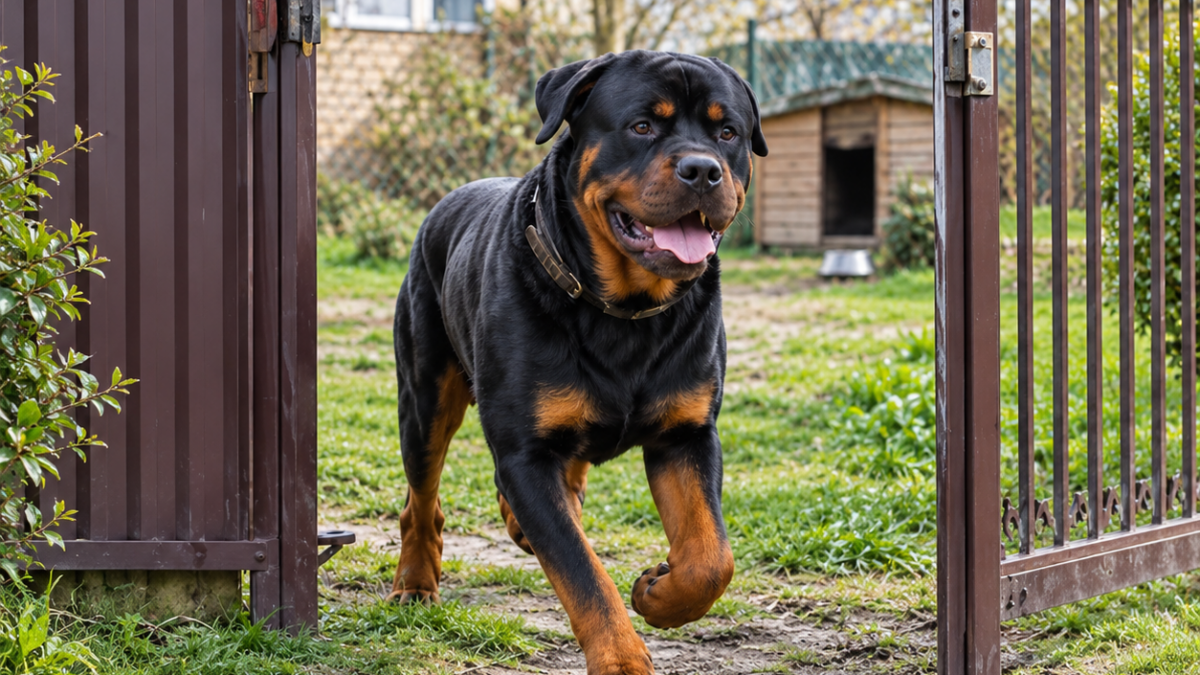
PART 2
I don’t remember locking my front door.
I barely remember the drive.
What I do remember is Marina’s voice repeating inside my head.
There’s someone inside.
The old house stood less than two miles away, but that morning it felt farther.
I turned onto Miller Road, parked crooked beside the ditch, and saw Marina standing near the dirt path.
Her face was pale.
“Where’s Rex?”
“Inside.”
“Did you see who’s in there?”
She shook her head.
“I heard coughing. And Rex keeps whining.”
I started toward the house.
Marina caught my sleeve.
“David, be careful. We don’t know who’s in there.”
She was right.
The building had been abandoned for years. People occasionally talked about teenagers sneaking inside or homeless people using it during bad weather. There could have been anybody in there.
I pulled out my phone.
“Call 911.”
“You’re going in?”
“I’m not leaving Rex.”
“That dog probably weighs more than both of us.”
“Not the point.”
I stepped onto the porch.
The boards groaned under my boots.
“Rex?”
A low whine answered from somewhere inside.
I pushed the damaged front door.
It moved only several inches.
The smell hit me first.
Mold.
Dust.
Old wood.
Then something else.
Human waste.
I covered my nose with my sleeve.
“Rex?”
Another whine.
I squeezed through the opening.
The interior was darker than I expected. Sheets of plywood covered some of the windows, and sunlight entered only through holes in the roof.
Broken furniture had been pushed against one wall.
Empty plastic bottles lay across the floor.
There were footprints in the dust.
Fresh ones.
Then I heard the cough.
It came from the back room.
“Hello?”
No answer.
I moved closer.
“Can you hear me?”
A voice responded.
So weak I barely recognized it as speech.
“Here.”
I rounded the doorway.
And stopped.
Rex was lying on the floor beside an old man.
The man looked seventy-five, maybe eighty. He had a gray beard, badly tangled hair, and a face so thin that his cheekbones seemed almost sharp.
Several blankets covered his lower body.
A plastic bottle containing perhaps an inch of water sat beside him.
Around him were pieces of bread.
Some fresh.
Some hard and dry.
Rex had positioned himself against the man’s side.
The old man had one hand resting on Rex’s neck.
When Rex saw me, his tail hit the floor once.
But he didn’t get up.
The man looked at me.
“You his owner?”
“Yes.”
He swallowed.
“Good dog.”
That was all he could manage.
I crouched.
“Sir, what’s your name?”
His lips moved.
“Arthur.”
“Arthur what?”
“Cole.”
The name felt familiar.
Then I remembered.
Arthur Cole.
Everyone around our neighborhood knew Mr. Cole.
Or at least they used to.
He had lived three streets from me in a small white house with green shutters. For years I had seen him sitting on his porch every morning with a mug of coffee.
He used to wave whenever Rex and I walked past.
Sometimes he kept dog biscuits in his pocket.
About eight months earlier, the house had been sold.
I had assumed Arthur moved away.
Someone told me his nephew had taken him to live closer to family.
“What are you doing here?” I asked.
Arthur closed his eyes.
“Tired.”
“An ambulance is coming.”
At the word ambulance, his eyes opened again.
“No hospital.”
“You need one.”
“No money.”
“Forget the money.”
Rex lifted his head and looked from Arthur to me.
Then he nudged Arthur’s hand.
Arthur managed the smallest smile.
“He found me.”
I looked at the pieces of bread.
“How long has Rex been coming here?”
Arthur’s eyes filled with tears.
“Every day.”
I couldn’t speak.
Behind me, Marina entered the room.
When she saw Arthur, she covered her mouth.
“Oh my God.”
Arthur looked toward her.
“Sorry.”
“For what?”
“Shouldn’t be here.”
Marina knelt.
“You don’t apologize for being alive.”
Arthur turned his face away.
Rex pushed closer to him.
That dog had escaped my yard day after day because an old man was slowly dying inside an abandoned house.
While I had been reinforcing fences and complaining about his behavior, Rex had been coming here.
Checking on Arthur.
Sitting beside him.
And somehow bringing him food.
A piece of bread at a time.
Sirens approached in the distance.
Arthur heard them too.
His fingers tightened around Rex’s fur.
“Don’t take him.”
“I’m not.”
“Promise.”
I looked at Rex.
“I promise.”
The paramedics arrived minutes later.
Getting Arthur out of the house wasn’t easy.
The hallway was narrow, the porch unstable, and Arthur was too weak to walk.
When they lifted him onto the stretcher, Rex stood.
For the first time since I entered the room, he growled.
Not loudly.
But every muscle in his body tightened.
“Rex.”
He looked at me.
“They’re helping him.”
Arthur lifted one hand.
“Rex.”
The growling stopped immediately.
One of the paramedics stared at the dog.
“He listens to him.”
“Apparently better than he listens to me.”
Arthur gave a faint laugh.
That laugh turned into coughing.
The paramedics moved quickly.
Rex followed the stretcher all the way outside.
When they loaded Arthur into the ambulance, Rex tried to climb in after him.
I held his collar.
“Easy.”
He pulled.
“Rex.”
The ambulance doors closed.
Rex began whining.
The sound was different from anything I had heard from him before.
Not frustration.
Not excitement.
Grief.
I knelt and wrapped both arms around his neck.
“I know.”
He stared at the ambulance until it disappeared.
Then he turned toward the abandoned house.
Beside the path lay the piece of bread Marina had seen him carrying.
Rex walked over.
Picked it up.
Then brought it to me.
I cried.
I wasn’t embarrassed about it.
Marina cried too.
I held the bread in one hand and Rex’s collar in the other.
“All this time,” I whispered.
Rex looked at me.
“All this time I thought you were running away from me.”
He leaned against my leg.
“You weren’t running away.”
I rubbed the top of his head.
“You were going to work.”
That afternoon we learned how close Arthur had come to dying.
Severe dehydration.
Malnutrition.
Pneumonia.
A urinary infection.
Dangerously low blood pressure.
The emergency physician told us that another two or three cold nights in that house could have killed him.
Marina and I sat in the hospital waiting room.
Rex was not allowed inside, so my brother picked him up and took him home.
“He kept staring out the window,” my brother later told me.
“Did he eat?”
“No.”
That worried me.
Rex never skipped meals.
The hospital contacted county adult protective services because Arthur’s situation made no sense.
Neither did his story.
Arthur owned a house.
Or at least he had eight months earlier.
He received Social Security.
He had a modest retirement account from more than forty years working at a local machine shop.
Why was he sleeping inside an abandoned building with no electricity?
Why didn’t anyone know?
And where was the nephew who supposedly moved him away?
The first time I was allowed to visit Arthur, he had oxygen tubes beneath his nose and an IV in each arm.
He looked embarrassed to see me.
“I’m sorry about your dog.”
I pulled a chair beside the bed.
“For what?”
“Made him run off.”
“You didn’t make him do anything.”
Arthur smiled.
“You know Rottweilers.”
“I thought I did.”
He looked toward the door.
“Where is he?”
“At home.”
The disappointment on his face was immediate.
“I can probably bring him outside tomorrow if the hospital allows it.”
His eyes brightened.
“Would you?”
“Absolutely.”
Then I asked the question everyone wanted answered.
“Arthur, how did you end up in that house?”
His expression changed.
Fear.
Not confusion.
Fear.
“I don’t want trouble.”
“You nearly died.”
“I know.”
“Who put you there?”
He looked away.
I waited.
Finally he said one name.
“Darren.”
His nephew.
Darren Cole was forty-three years old.
I had met him once.
Tall, clean-cut, expensive truck.
He had come to Arthur’s house several times after Arthur suffered a minor stroke the previous year.
According to Arthur, Darren initially seemed helpful.
He drove him to medical appointments.
Picked up prescriptions.
Handled bank paperwork.
Eventually he convinced Arthur to sign a power of attorney.
“I couldn’t read things right after the stroke,” Arthur explained.
“My eyes were blurry. Darren said he’d take care of the bills.”
“What happened to your house?”
“I thought we were refinancing it.”
My stomach tightened.
“You didn’t know it was sold?”
Arthur shook his head.
“He told me I needed to sign some documents so he could repair the roof.”
Instead, Arthur had apparently signed documents connected to the sale.
The house sold for nearly $240,000.
Arthur saw almost none of it.
Darren told him the money was being placed in an account to pay for assisted living.
Then one morning Darren packed some of Arthur’s clothes into two bags and said he was taking him to a private care home outside the county.
“He drove me around for nearly an hour,” Arthur said.
“Then?”
“He brought me to that house.”
My hands tightened.
“What did he tell you?”
“That it was temporary.”
Arthur swallowed.
“He said the facility wasn’t ready yet.”
“How long did he leave you there?”
“I don’t know.”
“Days?”
Arthur said nothing.
“Weeks?”
His eyes filled with tears.
“Longer.”
The abandoned property had once belonged to a friend of Darren’s father. Darren knew nobody checked it.
At first, he brought groceries.
Water.
Canned food.
Blankets.
Then his visits became less frequent.
The last time Arthur saw him, they argued.
Arthur had demanded to go home.
Darren told him the house was gone.
Arthur threatened to call police.
Darren took his phone.
Then left.
“Why didn’t you walk out?”
“I tried.”
Arthur held up one trembling hand.
“My legs don’t work right since the stroke.”
He had made it as far as the dirt road once.
He fell.
It took him almost an hour to crawl back toward the house.
After that, he became too weak.
“How did Rex find you?”
For the first time, Arthur smiled.
“I heard something scratching at the door.”
The old man had been inside the house for several weeks by then.
He couldn’t remember the exact day.
He heard claws against wood.
Then Rex squeezed through the gap.
“He knew me right away.”
Of course he did.
For years, Arthur had given Rex treats during our morning walks.
I had forgotten.
Rex hadn’t.
“He stayed most of the day,” Arthur said. “Then he left.”
“And came back?”
“Next morning.”
“With bread?”
Arthur nodded.
“First time it was half a hamburger bun.”
Despite everything, I laughed.
“Where was he getting it?”
“Don’t know.”
Over the following weeks, we discovered the answer.
Rex had several sources.
A bakery two blocks from my house placed day-old bread in sealed bags near its back entrance every morning for a local farmer who collected it for livestock.
Rex had learned to pull pieces through a small gap in one damaged bag.
A woman living along his route fed birds every morning.
Rex stole slices from the tray.
Once, security footage showed him picking up an entire wrapped sandwich someone dropped beside a bus stop.
Apparently my well-fed dog had become a professional food scavenger.
But not for himself.
He carried it to Arthur.
Sometimes Arthur ate.
Sometimes he saved pieces.
Rex also learned to push over an old plastic bucket in the yard when it collected rainwater.
It wasn’t enough.
But it helped.
More important than the food was the warmth.
On cold mornings, Rex lay beside Arthur.
The old man buried his hands in Rex’s fur.
“He’d stay until afternoon sometimes,” Arthur said.
“I told him to go home.”
“You think Rex listens?”
Arthur smiled.
“No.”
“I’ve noticed.”
The next day, the hospital allowed me to bring Rex to a courtyard outside Arthur’s floor.
I had never seen Rex behave the way he did when Arthur appeared in a wheelchair.
For three seconds he froze.
Then he pulled so hard I nearly lost the leash.
“Easy!”
Arthur stretched out his hands.
“Rex!”
The dog reached him.
He pressed his entire head against Arthur’s chest.
Arthur started crying.
So did one of the nurses.
Rex licked his face.
Arthur laughed and cried at the same time.
“My boy.”
I stood behind them, suddenly feeling like the third wheel in my own dog’s relationship.
When Rex finally settled, he sat directly beside Arthur’s wheelchair.
Guarding him.
Watching everyone who approached.
Arthur rested his hand on his head.
“You saved me.”
Rex looked up.
Arthur repeated it.
“You saved me.”
That photograph—Arthur in the wheelchair, Rex sitting beside him—eventually became important for another reason.
Because three days later, Darren appeared.
I was in the hospital courtyard with Arthur and Rex when a man in a navy jacket walked toward us.
Arthur’s body changed immediately.
His shoulders tightened.
His face went pale.
Rex stood.
I knew who the man was before Arthur said anything.
“Darren.”
Rex moved in front of the wheelchair.
A low growl came from his chest.
I grabbed his collar.
“Rex.”
Darren stopped several yards away.
“That thing always like this?”
“That thing has a name.”
He ignored me.
“Uncle Arthur, we need to talk.”
Arthur looked at me.
Not at Darren.
That told me everything.
Darren smiled as if nothing was wrong.
“I’ve been worried sick.”
Arthur finally looked at him.
“You left me.”
“No, I didn’t.”
“You took my phone.”
“You were confused.”
Arthur’s hands started shaking.
Darren stepped closer.
Rex growled again.
This time Darren stopped.
“Control your dog.”
I kept one hand on Rex.
“You should probably stay where you are.”
“This is family business.”
“No. Adult protective services would disagree.”
His expression changed.
“You called them?”
“I didn’t have to. The hospital did.”
Darren looked at Arthur.
“What have you told people?”
Arthur said nothing.
“What have you told them?”
The question came sharper.
Rex barked.
One massive, explosive bark.
Several people turned.
Darren jumped.
I leaned close to him.
“You should leave.”
“I came for my uncle.”
“Your uncle doesn’t want to go with you.”
“He’s not competent to make decisions.”
Arthur looked up.
“I’m competent enough to know you stole my house.”
Darren’s face went still.
That moment remains one of my favorite memories of Arthur.
He had been weak.
Ashamed.
Terrified.
But there, with Rex standing between him and the man who abandoned him, something returned to his voice.
Darren tried another approach.
“You signed the papers.”
“You lied about what they were.”
“I didn’t lie.”
“Where’s my money?”
Several nurses had stopped nearby.
Darren noticed.
His face reddened.
“We are not doing this here.”
Arthur leaned back.
“No. We’ll do it in court.”
Darren stared at him.
Then at me.
Then at Rex.
“You people don’t know what you’re getting involved in.”
I smiled without humor.
“Actually, I think we’re beginning to.”
He left.
Rex watched him disappear through the door.
Then turned around and placed his head in Arthur’s lap.
Arthur whispered:
“Good boy.”
The investigation moved quickly after that.
Adult protective services brought in county detectives.
Arthur’s bank accounts were reviewed.
The numbers were worse than expected.
More than $170,000 from the sale of his home had moved through accounts controlled by Darren.
Large cash withdrawals followed.
A motorcycle.
Credit card payments.
A new truck down payment.
Trips.
Expensive electronics.
There was no assisted-living account.
No prepaid care contract.
Nothing.
Darren had not just abandoned Arthur.
He had financially stripped him first.
And then, when the old man became a risk to the scheme, he placed him where he thought nobody would find him.
What Darren did not calculate was a ninety-eight-pound Rottweiler with a good memory.
Detectives searched Darren’s home.
They found financial paperwork.
Arthur’s identification documents.
His missing cellphone.
And something that made the case even darker.
A letter from an assisted-living facility.
Darren actually had contacted one.
The facility had evaluated Arthur months earlier.
They had space available.
The monthly cost was well within Arthur’s means after the house sale.
Darren declined the placement.
Why?
The payment would have come from the money Darren wanted.
Arthur sat silently when investigators explained this.
“He could have put me somewhere safe?”
“Yes.”
“And still had money left?”
“Yes.”
Arthur looked down at his hands.
“He just didn’t want to spend it on me.”
Nobody knew what to say.
Rex did.
He stood, walked across the room, and rested his head against Arthur’s knee.
Arthur smiled sadly.
“At least one of you wanted me.”
The story spread around the neighborhood.
People were furious.
But something else happened too.
They began telling us things.
One neighbor remembered seeing Darren remove furniture from Arthur’s house before it sold.
Another had heard Darren say Arthur was “too far gone to know what was happening.”
A former bank employee remembered Arthur appearing confused during one transaction while Darren answered every question for him.
The bakery owner provided security footage showing Rex stealing bread on multiple mornings.
The first time we watched it, I laughed until I cried.
There was Rex, glancing around like a criminal mastermind, pulling a half loaf through a torn corner of the bag, then trotting away with it.
The bakery owner shook his head.
“I thought raccoons were getting into those bags.”
“Apparently you had a Rottweiler problem.”
“Not a problem anymore.”
The next morning he placed a loaf aside with a handwritten note.
FOR REX. NO STEALING NECESSARY.
Arthur’s recovery took almost two months.
Pneumonia weakened him badly.
Physical therapists worked with him every day.
At first, walking ten feet with a walker exhausted him.
Then twenty.
Then fifty.
Rex visited several times each week.
Those were Arthur’s best days.
The staff learned Rex’s name.
Patients learned his name.
Eventually the hospital arranged temporary therapy-dog permission because his presence visibly motivated Arthur.
“You’ve got to walk to Rex today,” one physical therapist told him.
Arthur gripped the walker.
“How far?”
“End of the hall.”
“That’s blackmail.”
“Correct.”
Arthur looked at Rex waiting twenty yards away.
The dog’s tail thumped.
Arthur stood.
“Fine.”
One step.
Then another.
Rex watched.
Arthur stopped halfway.
“I’m too tired.”
The therapist nodded toward Rex.
“Tell him.”
Arthur looked at the dog.
Rex’s ears lifted.
“Oh, hell.”
Arthur kept walking.
When he reached him, Rex pressed against his legs.
Arthur laughed.
“You manipulative animal.”
Those moments did more for Arthur than medicine alone ever could.
But while he grew stronger, Darren became more desperate.
His attorney claimed Arthur suffered from cognitive impairment and had freely gifted money to his nephew.
The claim might have worked if the records had been less obvious.
It became even harder to believe after a neurologist evaluated Arthur.
His stroke had affected his mobility and temporarily affected vision and speech.
It had not destroyed his ability to understand ownership, money, or decisions.
Arthur knew exactly what had happened.
Then Darren made his worst mistake.
He called me.
I almost didn’t answer the unfamiliar number.
“David?”
“Who is this?”
“You know.”
I sat up.
“Darren.”
“Tell your friend to stop talking.”
“My friend?”
“Marina.”
“What are you talking about?”
“She’s posting things online about me.”
Marina had shared no private case details. She had posted only a photograph of Rex sitting beside Arthur with the caption:
Sometimes heroes have four legs.
No names.
No accusations.
I said:
“Maybe you should discuss that with your lawyer.”
“You think this is funny?”
“No.”
“You people are destroying my life.”
I nearly laughed.
“You left an elderly man in an abandoned house.”
“That is not what happened.”
“It’s exactly what happened.”
“He wanted to be there.”
That stopped me.
“Arthur wanted to live without running water?”
Silence.
“Without electricity?”
Nothing.
“Without his medication?”
“You don’t understand him.”
“And you do?”
“I took care of him for a year.”
“Then where is his money?”
Another pause.
His voice became quieter.
“You’d better be careful.”
There it was.
Not quite a direct threat.
Close enough.
“What does that mean?”
“You have a dangerous dog. Be a shame if the county decided he shouldn’t be around people.”
I looked across the living room.
Rex was asleep beside the fireplace.
“You’re threatening my dog?”
“I’m telling you accidents happen.”
I hung up.
Then I called Detective Morales.
The call had been recorded automatically through the security system connected to my business phone.
Darren had just handed investigators another piece of evidence.
The next afternoon, an animal-control officer arrived at my house.
For one second I thought Darren had succeeded.
Instead, Officer Ruiz smiled.
“He did file a complaint.”
“Of course he did.”
“Said Rex attacked him at the hospital.”
I stared.
“He never touched him.”
“I know.”
“The hospital has cameras.”
“I know.”
“So?”
Ruiz looked toward Rex.
“He’s fine.”
Rex wagged his tail.
Ruiz crouched.
“You’re causing a lot of paperwork, big guy.”
Rex licked his face.
“Terrifying animal.”
The false complaint became another problem for Darren.
His attorney reportedly begged him to stop contacting witnesses.
He didn’t.
He sent Arthur a letter.
He claimed everything could still be “fixed privately.”
Arthur read it twice.
Then gave it to detectives.
The last line said:
Family should protect family.
Arthur stared at it for a long time.
Finally he laughed.
Not happily.
“Now he remembers we’re family.”
Three weeks later, Arthur was released from rehabilitation.
He could not return to his old home because it belonged to someone else.
But the court froze what remained of the proceeds from the fraudulent transactions.
A temporary victim-assistance program helped him move into a small senior apartment less than a mile from my house.
The first thing Arthur asked about was Rex.
“Can dogs visit?”
The manager smiled.
“We’re pet-friendly.”
Arthur looked at me.
“You hear that?”
“I’m already losing custody, aren’t I?”
He laughed.
“Shared custody.”
Rex knew Arthur’s apartment after one visit.
Every time we turned onto the street, he began whining.
Inside Arthur kept a jar of dog biscuits.
A huge jar.
I pointed at it.
“He’s getting fat.”
Arthur shrugged.
“He saved my life.”
“That doesn’t mean he needs twenty treats.”
“Don’t listen to him, Rex.”
Rex looked at Arthur.
Traitor.
Life slowly became normal.
Or something close to normal.
Arthur bought new clothes.
He regained weight.
His beard was trimmed.
He began attending breakfast in the senior community dining room.
Rex visited twice a week.
The residents adored him.
A woman named Dorothy always wore bright red lipstick and kissed Rex directly between the ears, leaving a mark.
I would pick him up afterward looking like he had been attacked by a cosmetics department.
“Who did this?”
Arthur pointed.
“Dorothy.”
Rex looked proud.
“You have no shame.”
Arthur laughed harder than I had ever heard him laugh.
Those ordinary moments mattered.
Because Darren had tried to reduce Arthur’s life to a bank balance.
Rex helped give him ordinary life back.
Then the court date arrived.
Darren faced multiple charges relating to financial exploitation, elder abuse, theft, fraudulent transactions, and abandonment.
The courtroom was fuller than I expected.
Several neighbors attended.
Marina sat beside me.
Arthur entered with a cane.
Rex could not come inside, but a photograph of him was in Arthur’s coat pocket.
Darren sat at the defense table in a dark suit.
He looked smaller than I remembered.
Not physically.
In every other way.
The prosecution began with financial records.
Transaction after transaction.
House-sale proceeds.
Transfers.
Cash withdrawals.
Purchases.
Then came the property documents.
Arthur testified that Darren described them as repair and refinancing paperwork.
The defense attorney challenged him.
“Mr. Cole, isn’t it true that your memory has declined since your stroke?”
“Sometimes I forget where I put my glasses.”
A few jurors smiled.
“Could you have forgotten agreeing to sell the house?”
Arthur leaned toward the microphone.
“I forget glasses. I don’t forget houses.”
Even the judge seemed to suppress a reaction.
The attorney tried again.
“You signed the documents.”
“Yes.”
“No one physically forced your hand.”
“No.”
“So you signed voluntarily.”
“I signed because my nephew told me something different was written on the pages.”
The attorney paused.
Arthur continued.
“I trusted him.”
That word landed harder than any accusation.
Trusted.
The entire case was built around that betrayal.
Then the prosecution showed photographs of the abandoned house.
The collapsed roof.
Broken windows.
Dirty floor.
Blankets.
Plastic bottle.
Pieces of old bread.
And Rex.
One photograph showed him lying beside Arthur just before the paramedics arrived.
The prosecutor asked:
“How were you eating during those final weeks?”
Arthur looked at the picture.
“My dog friend fed me.”
“Rex?”
“Yes.”
“He was not your dog.”
“No.”
“How did he bring food?”
“Bread mostly.”
“Where did he get it?”
“I didn’t know then.”
The prosecutor displayed bakery surveillance footage.
Rex appeared on the screen stealing bread.
A few people laughed softly.
Arthur smiled.
Then his eyes filled.
“That fool dog.”
The prosecutor waited.
Arthur looked toward the jury.
“He had food at home.”
His voice broke.
“He wasn’t stealing because he was hungry.”
Silence filled the courtroom.
“He was stealing because I was.”
Marina grabbed my hand.
I stared at the floor.
The prosecutor let the silence remain.
There was nothing to add.
Detective Morales testified next.
He described finding Arthur’s identification and phone in Darren’s possession.
He described the assisted-living letter.
Then the financial investigator explained that Darren had enough of Arthur’s money available to pay for years of proper care.
Years.
Instead, he bought a motorcycle.
That motorcycle appeared on the evidence screen.
Brand new.
Metallic blue.
Nearly $24,000.
The prosecutor turned toward Darren.
“Mr. Cole’s assisted living placement would have cost approximately $3,400 per month. Correct?”
The investigator nodded.
“Correct.”
“And the defendant declined that placement less than two weeks before purchasing this motorcycle?”
“Yes.”
One juror visibly shook her head.
Darren’s defense claimed he intended to repay everything.
Then prosecutors played part of the phone call he made to me.
His own voice filled the courtroom.
You have a dangerous dog. Be a shame if the county decided he shouldn’t be around people.
Then mine.
You’re threatening my dog?
Then Darren.
I’m telling you accidents happen.
Darren stared straight ahead.
I almost felt embarrassed for him.
Almost.
Then came something none of us expected.
His attorney called Darren himself to testify.
I thought it was a mistake.
It was.
At first, he did well.
He described taking care of Arthur after the stroke.
Cooking meals.
Driving him to appointments.
Handling paperwork.
He painted himself as an overwhelmed caregiver who made financial mistakes while under pressure.
His attorney asked:
“Did you intend for your uncle to die?”
“No.”
“Did you abandon him?”
“No.”
“Why was he at the property?”
“He wanted privacy.”
From behind me, someone inhaled sharply.
His attorney continued.
“Did you believe he had adequate supplies?”
“At first.”
“Why did you stop visiting?”
“I didn’t stop.”
The prosecutor stood for cross-examination.
She carried one folder.
That was all.
“Mr. Cole, when was your final visit to your uncle?”
“I don’t remember exactly.”
“Approximately.”
“Maybe two weeks before he was found.”
She opened the folder.
“Phone-location data places you forty-eight miles away during that entire week.”
Darren shifted.
“Then earlier.”
“How much earlier?”
“I don’t know.”
“Three weeks?”
“Possibly.”
“Four?”
“I don’t know.”
She walked closer.
“You testified that your uncle wanted privacy.”
“Yes.”
“He chose a house without electricity?”
Darren hesitated.
“He wasn’t supposed to be there long.”
“A house without running water?”
“It was temporary.”
“No heat?”
“Temporary.”
“No working phone?”
“I brought him supplies.”
“No access to transportation?”
“He knew I was coming back.”
“When?”
Silence.
She stepped toward the evidence screen.
A text message appeared.
It was from Darren to a friend.
Investigators had recovered it from cloud backups.
Old man is finally out of my hair.
Date: six weeks before Arthur was found.
Another message.
The friend replied:
Where’d you put him?
Darren:
Somewhere safe enough.
The friend:
You going back?
Darren:
When I have to.
The prosecutor turned.
“Was that your uncle?”
Darren looked toward his attorney.
“Answer the question,” the judge said.
“Yes.”
Another message appeared.
Sent three weeks later.
The friend:
Still dealing with Arthur?
Darren:
Not really. Problem might solve itself.
The courtroom went completely silent.
Arthur closed his eyes.
Marina whispered:
“Oh my God.”
Even I had never seen that message.
The prosecutor faced Darren.
“What problem did you expect to solve itself?”
Darren’s face reddened.
“That’s not what I meant.”
“What did you mean?”
“I was frustrated.”
“What problem?”
“No specific problem.”
“You called your uncle a problem.”
“I was stressed.”
“And three weeks later he was found severely dehydrated, malnourished, and suffering from pneumonia in the building where you left him.”
“I didn’t want him hurt.”
“Then why didn’t you call anyone?”
“I thought he was okay.”
“You thought an elderly stroke patient with no phone, no heat, no running water, and almost no food was okay?”
No answer.
She stepped closer.
“Mr. Cole, do you know who kept your uncle alive?”
His attorney objected.
The judge allowed the question within limits.
Darren stared.
The prosecutor looked at the photograph.
“A dog.”
Darren said nothing.
“A dog you later threatened.”
His attorney objected again.
This time sustained.
But it no longer mattered.
The jury had heard enough.
Deliberations lasted four hours.
Arthur and I waited together in a hallway.
He looked exhausted.
“You okay?”
He nodded.
Then shook his head.
“Both.”
I understood.
“I keep thinking about his mother.”
“Your sister?”
“My older sister.”
Arthur stared at the floor.
“She’d be ashamed.”
I didn’t know what to say.
After a while he smiled faintly.
“You think Rex knows we’re here?”
“He knows he didn’t get his afternoon walk.”
Arthur laughed.
“That dog has priorities.”
When the jury returned, Darren stood.
The first verdict was read.
Guilty.
Arthur didn’t move.
Second count.
Guilty.
Third.
Guilty.
By the final count, Marina was crying.
I looked at Arthur.
He had tears running down his face.
But he wasn’t smiling.
Outside the courthouse, I asked why.
“He’s still my nephew,” he said.
Then he looked toward the street.
“But he can’t hurt me anymore.”
That was enough.
Sentencing came later.
Darren was ordered to repay substantial restitution from recoverable assets.
His truck was sold.
The motorcycle was sold.
Several other assets purchased with Arthur’s money were seized or liquidated under the applicable orders.
Funds still frozen from the original house sale were returned to Arthur.
Darren also received a custodial sentence and additional supervision and restrictions after release.
The judge addressed him directly.
“This case is not merely about theft.”
Darren looked up.
“You exploited trust placed in you by a vulnerable family member. You isolated him, deprived him of access to his own resources, and left him under conditions in which death was not merely possible but increasingly likely.”
The judge paused.
“A dog demonstrated more loyalty and humanity toward Mr. Cole than you did.”
Nobody in the courtroom moved.
Darren lowered his head.
Arthur later told me that was the only part of the sentence he remembered word for word.
People called what happened next revenge.
I didn’t.
Neither did Arthur.
But I understood why they used the word.
Darren had bought himself expensive things with Arthur’s money.
One by one, those things disappeared.
The truck.
The motorcycle.
The electronics.
The lifestyle.
The money returned to the man he had tried to erase.
Arthur purchased a small condo.
Nothing fancy.
Two bedrooms.
A tiny patio.
Ground floor so he wouldn’t have to climb stairs.
The first item he bought after moving in was not furniture.
It was a dog bed.
A huge one.
I stared at it.
“You know Rex doesn’t live here.”
Arthur shrugged.
“He might decide to.”
“He has a home.”
“Does he?”
Rex immediately climbed onto the new bed.
Arthur smiled.
“Evidence suggests otherwise.”
The second item Arthur bought was a framed photograph.
The one taken outside the hospital.
Arthur in his wheelchair.
Rex beside him.
He hung it in the living room.
Underneath, he placed a small plaque.
THE FRIEND WHO CAME BACK EVERY DAY.
I stood staring at it.
Arthur approached.
“Too much?”
“No.”
I swallowed.
“Perfect.”
Over the next year, Arthur rebuilt his life.
He joined a local senior woodworking club.
He planted tomatoes on his patio.
He bought an old fishing rod because he wanted to try fishing again.
He complained constantly about the price of groceries.
He developed a rivalry with a neighbor named Frank over whose tomatoes grew faster.
And twice every week, Rex visited.
The residents in Arthur’s complex learned his schedule.
Tuesday and Saturday.
On those afternoons, people somehow found reasons to sit outside.
Rex moved from person to person collecting attention.
Arthur accused him of becoming famous.
I accused Arthur of encouraging it.
Both were true.
One Saturday, Arthur asked me something unexpected.
“Do you ever wonder how he knew?”
“Knew what?”
“That I needed him.”
I looked at Rex sleeping near the patio door.
“He probably smelled you.”
“No.”
“I’m serious. Dogs can track scent.”
Arthur shook his head.
“I mean how he knew to keep coming.”
I had no answer.
Maybe there wasn’t one.
Dogs do not understand bank fraud.
Power of attorney.
Elder abuse.
Property deeds.
Criminal charges.
Rex knew something simpler.
A person he recognized was alone.
That person was hungry.
That person was weak.
So he came back.
The world would be a better place if people understood things that simply.
Two years passed.
Rex turned eight.
Then nine.
His face began showing gray around the muzzle.
He still looked intimidating to strangers, but everyone who knew him understood the truth.
Rex was soft.
He still hated vacuum cleaners.
Still loved tennis balls, though he stopped chasing them as far.
Still took up too much space on my couch.
And he still knew the road to Arthur’s condo better than I did.
If I drove past the turn, he whined.
“I know.”
Whine.
“We’re not going today.”
Whine.
“He has appointments.”
Rex stared.
“You cannot emotionally manipulate me.”
Five minutes later I usually turned around.
Arthur found that hilarious.
“You’re well trained.”
“I am not.”
Rex wagged.
Arthur pointed.
“He disagrees.”
One autumn afternoon, almost three years after we found Arthur, he asked if we could visit the abandoned house.
The property still stood, though the county had finally scheduled it for demolition.
“Why?”
“I don’t know.”
Arthur looked embarrassed.
“I think I need to see it once when I’m not trapped there.”
I understood.
We drove together.
Rex came too.
The dirt road looked smaller than I remembered.
The house looked worse.
The porch had collapsed completely.
Orange warning tape surrounded the structure.
We stayed outside the barrier.
Arthur stood with his cane.
Rex beside him.
For several minutes, nobody spoke.
Arthur finally said:
“I used to think that was where I was going to die.”
Rex looked up at him.
Arthur rested one hand on his head.
“Then this criminal showed up.”
I smiled.
“Bread thief.”
“The worst kind.”
Arthur laughed.
Then his expression became serious.
“You know what I remembered in there?”
“What?”
“Every morning I listened for him.”
He looked at Rex.
“After the first few visits.”
Arthur swallowed.
“I’d wake up and think, just make it until the dog comes.”
I looked away.
“He gave me something to wait for.”
Rex leaned against him.
Arthur closed his eyes.
“People think he saved me with food.”
He rubbed Rex’s ears.
“That helped.”
Then he looked at me.
“But mostly he saved me because I stopped thinking nobody cared whether I woke up.”
There are sentences you hear once and carry forever.
That was one.
The abandoned house was demolished the following week.
Arthur didn’t go watch.
Neither did I.
Some places do not deserve ceremonies.
The field was eventually cleared.
Grass grew over the foundation.
If you drove past without knowing the story, you would never guess an old man had nearly died there.
But Arthur knew.
I knew.
Marina knew.
And Rex knew.
Years moved faster after that.
Arthur turned eighty-two.
Rex turned ten.
Then eleven.
His hips became stiff.
The veterinarian diagnosed arthritis.
We started medication.
Arthur bought a ramp for his condo before I even asked.
“For Rex.”
“He can still do the step.”
“He shouldn’t have to.”
I stared.
Arthur smiled.
“See? I learned.”
That was Arthur now.
He noticed what people needed.
Maybe nearly losing everything had sharpened that part of him.
When Rex’s arthritis worsened, Arthur sat on the floor with him during visits rather than making him stand.
When Rex stopped chasing tennis balls, Arthur rolled them gently across the carpet.
Rex nudged them back.
Two old men, I called them.
Arthur objected.
Rex did not.
Then came the winter Rex turned twelve.
He slowed dramatically.
Some mornings, I had to help him stand.
His appetite remained good, which reassured me.
But eventually bloodwork showed kidney problems.
Nothing catastrophic yet.
Manageable.
The veterinarian adjusted his diet.
Arthur took the news harder than I did.
“He’s old,” I told him.
“So am I.”
“Exactly.”
“That’s not comforting.”
Rex rested his head on Arthur’s foot.
Arthur looked down.
“You’re supposed to outlive me.”
I wanted to joke.
I couldn’t.
Over the next year, Rex had good months and bad weeks.
He still visited Arthur.
But instead of walking from my truck, I sometimes used a support harness.
The residents who had once crowded around to pet the enormous energetic Rottweiler now approached quietly.
Dorothy, the woman with the red lipstick, had died the previous spring.
Arthur pointed to the empty chair on the patio once.
“She loved that dog.”
“Everybody does.”
“Not everybody.”
We both knew who he meant.
Darren was still serving the consequences of what he had done and remained prohibited from contacting Arthur under court orders.
Arthur had stopped asking about him.
That surprised me.
“Don’t you want to know?”
“No.”
“Nothing?”
Arthur looked at Rex.
“Spent enough years thinking about people who leave.”
Then he smiled.
“I prefer the ones who come back.”
Rex wagged once.
That became our phrase.
The ones who come back.
When Arthur had minor surgery, I brought Rex to see him afterward.
When I fractured my wrist, Arthur brought dinner to my house and somehow managed Rex’s medication schedule better than I did.
When Marina lost her husband, Arthur and Rex sat with her for an afternoon.
No speeches.
No advice.
Just presence.
That was the lesson Rex had taught all of us.
Sometimes saving someone does not begin with fixing their life.
Sometimes it begins with showing up tomorrow.
And the day after that.
And the day after that.
Rex did that before any of us understood.
The final spring of his life arrived quietly.
Wildflowers appeared along Miller Road.
Rex still enjoyed short rides.
I lowered the back seat and placed a thick mattress inside so he could lie comfortably.
Sometimes we drove to Arthur’s condo.
Sometimes we simply drove.
Rex kept his nose near the cracked window.
One afternoon Arthur asked:
“Can we go past the field?”
I knew which field.
The old abandoned house was gone.
Only grass remained.
We parked beside the road.
Arthur and I helped Rex out.
He stood for a few seconds.
Then slowly walked toward the edge of the field.
Arthur followed with his cane.
I stayed behind them.
Rex stopped near where the dirt path once began.
He sniffed the air.
Maybe he remembered.
Maybe not.
Arthur rested his hand on Rex’s back.
“You did good, boy.”
Rex turned his head.
Arthur smiled.
“You found me.”
His voice trembled.
“You stubborn, thieving, fence-jumping criminal.”
Rex wagged.
Arthur laughed through tears.
“I owe you everything.”
I walked closer.
Arthur shook his head.
“No.”
He wiped his face.
“Not everything.”
He looked at me.
“I got my house money back. Bought another place. Darren went to prison. Everybody calls that justice.”
He looked down at Rex.
“But this is what mattered.”
“What?”
“I got years.”
He smiled.
“Years he thought I wouldn’t have.”
That was the revenge.
Not Darren losing his truck.
Not the motorcycle being sold.
Not the guilty verdict.
Not the money.
Arthur lived.
He grew tomatoes.
Argued with Frank.
Flirted shamelessly with Dorothy.
Went fishing.
Celebrated birthdays.
Complained about taxes.
Ate pie.
Made friends.
And every one of those ordinary days was something Darren’s cruelty had nearly stolen.
Rex had given them back.
A month later, Rex stopped eating.
I knew immediately.
The veterinarian found an aggressive cancer that had spread beyond what surgery could reasonably fix.
I sat in the examination room with one hand on his neck.
“How long?”
The veterinarian hesitated.
“Could be weeks.”
“Good weeks?”
She looked at Rex.
“Maybe some.”
That was the only question that mattered.
I called Arthur from the parking lot.
He didn’t speak for several seconds.
Then:
“Bring him over.”
We went directly there.
Arthur was waiting outside.
When he saw Rex move slowly toward him, he bent down despite his bad knees.
“No.”
I reached to help.
“Leave me.”
He lowered himself onto the grass.
Rex walked to him.
Arthur wrapped both arms around his neck.
Neither moved.
Eventually Arthur whispered:
“Remember that house?”
Rex breathed against his shoulder.
“You lay beside me when I thought I was going to die.”
Arthur pressed his forehead against Rex’s.
“I guess it’s my turn.”
For the next twelve days, Arthur came to my house every morning.
Every morning.
Sometimes he took the bus.
Sometimes Marina drove him.
Once Frank brought him.
But he came.
He sat beside Rex’s bed.
Fed him tiny pieces of chicken when Rex would eat.
Brushed him.
Talked to him.
Told stories.
“You remember when you stole that whole sandwich?”
Rex’s eyes opened.
“I bet you ate part of that one.”
Tail movement.
“Thought so.”
He told Rex about Walter from the senior complex who cheated at cards.
About Frank’s terrible tomatoes.
About Dorothy’s lipstick.
Anything.
It didn’t matter.
He came.
On the twelfth morning, Rex could no longer stand.
The veterinarian came to my house that afternoon.
Arthur was already there.
I sat on one side of Rex.
Arthur sat on the other.
Rex’s head rested in my lap.
Arthur held one paw.
I was crying before anything started.
Arthur wasn’t.
Not yet.
The veterinarian administered the sedative.
Rex relaxed.
Arthur leaned closer.
“You listen to me.”
Rex’s eyes moved toward him.
“You were never running away.”
Arthur’s voice broke.
“You hear me?”
A tear rolled down his face.
“You were running toward somebody who needed you.”
Rex’s breathing slowed.
“And I needed you.”
Arthur kissed the top of his paw.
“Thank you for coming back.”
Those were the last words Rex heard before he fell asleep.
The veterinarian gave the final medication.
I kept one hand on his chest.
Arthur held his paw.
A few breaths.
Then silence.
My house had never felt so quiet.
Arthur finally cried.
Not gently.
He folded forward and wept into Rex’s fur.
I put my arm around him.
Neither of us said anything.
What was there to say?
The dog who refused to stay inside my fence had held our entire little world together.
We had Rex cremated.
I kept part of his ashes at home.
Arthur asked for a small amount.
He had a plan.
Near the senior complex stood a young maple tree residents had planted the previous year.
Management allowed Arthur to place a small memorial stone beneath it.
No dramatic inscription.
No long explanation.
Just:
REX
HE ALWAYS CAME BACK.
People who didn’t know the story probably thought it meant Rex had been a dog who returned home.
Those of us who knew understood something different.
He came back to Arthur.
Every day.
When there was no reason for him to believe anyone else would.
A year after Rex died, Arthur and I sat beneath that maple tree.
Arthur was eighty-four.
His hands shook more now.
His walking had slowed.
But he was still living independently.
Still growing tomatoes.
Still complaining about everything.
“You know,” he said, “I used to think revenge would make me feel better.”
“Against Darren?”
He nodded.
“When the judge sentenced him, I thought I’d feel something.”
“Did you?”
“For five minutes.”
He laughed.
“Maybe ten.”
Then he touched Rex’s memorial stone.
“This felt better.”
“What did?”
“Living.”
He looked across the courtyard.
“Every morning I wake up in my own bed, make coffee with my own money, open my own door, and decide what I’m going to do.”
He smiled.
“That’s revenge.”
I nodded.
Arthur continued.
“He wanted me gone because I was inconvenient.”
His eyes moved toward Rex’s name.
“Rex disagreed.”
We both laughed.
Arthur died peacefully almost three years later.
He was eighty-seven.
Not in an abandoned house.
Not hungry.
Not cold.
Not alone.
He died in a hospital room with people around him, photographs beside the bed, and a framed picture of Rex on the nightstand.
His final arrangements contained one strange request.
I learned about it from the attorney.
Arthur wanted a small portion of his ashes scattered beneath Rex’s maple tree.
I went alone early one morning.
The sun had just risen.
Birds moved through the branches.
I knelt beside the stone.
REX
HE ALWAYS CAME BACK.
I scattered Arthur’s ashes beneath the tree.
Then I sat there for a while.
I thought about the morning Marina called me.
About my anger every time Rex escaped.
About all the gates I repaired.
All the lectures I gave him.
All the times I asked:
What are you looking for out there that you don’t have here?
I finally understood the answer.
Nothing.
Rex wasn’t looking for anything for himself.
Somewhere beyond my fence was a man who had been forgotten.
A man who was hungry.
A man who was cold.
A man who believed nobody cared whether he lived through another night.
And somehow, my dog had decided that was unacceptable.
Rex did not understand why Arthur had lost his home.
He did not know Darren’s name.
He knew nothing about stolen money, legal documents, or betrayal.
He simply knew Arthur.
The old man who used to carry treats in his pocket.
The man who scratched behind his ears.
The familiar person who now smelled sick and scared and alone.
So Rex did the only thing that made sense to him.
He came back.
He climbed fences.
Pushed gates.
Crossed roads.
Stole bread.
Ignored me yelling his name.
And returned to that ruined house every single morning.
I used to think obedience was one of the greatest virtues a dog could have.
Rex taught me something better.
Sometimes love looks like disobedience.
Sometimes loyalty means refusing to stay where you are told.
Sometimes the creature everyone thinks is running away is actually the only one running toward the person everyone else has left behind.
People around town remembered Rex for years.
The bakery kept his photograph near the counter.
Underneath it, the owner wrote:
THE ONLY THIEF WE EVER MISSED.
Marina kept the photograph she took the day Rex was found beside Arthur.
I kept his collar.
And every now and then, when I pass the place where that old dirt path used to run toward the abandoned house, I slow down.
The house is gone now.
There are new homes nearby.
Children ride bicycles where weeds once grew.
Nobody passing through would know what happened there.
But I do.
I remember a huge black-and-tan Rottweiler moving down that road with a piece of bread held carefully between his teeth.
Not stopping.
Not wandering.
Not lost.
He knew exactly where he was going.
For months, I believed Rex kept leaving because my home wasn’t enough for him.
I was wrong.
Home was more than enough.
That was why he always returned to me.
But love had given him another responsibility.
Someone else needed him too.
And when Rex understood that, no fence I built was ever going to stop him.
The greatest thing my dog ever did began as the behavior I wanted most desperately to correct.
He escaped.
Again and again.
Until one curious neighbor finally followed.
And because she did, an old man was found.
A crime was exposed.
A thief lost what he had stolen.
A forgotten man got his life back.
And all of us learned something from a dog who never spoke a word.
Years later, I can still picture Rex standing at the end of my driveway.
He would glance back at me after slipping through the gate.
I would shout:
“Rex! Get back here!”
His ears would lift.
For half a second, he looked almost apologetic.
Then he turned and ran.
I thought he was ignoring me.
Now I know he was answering something more important.
Someone was waiting.
And Rex always came back.








