PART 2: My Italian Greyhound Hadn’t Seen His Brother Since Puppyhood—Then a Stranger Sent Me One Photo
PART 2
For a few seconds I could not speak.
The photograph was not sharp.
It had been taken casually, probably by Rachel’s husband while she was trying to keep Biscuit from climbing out of her arms.
But there was no question.
That was my old blue jacket.
My car was parked behind me.
And the little gray puppy twisting around in my arms had Ollie’s white chest.
Rachel spoke first.
“You were there.”
“I remember you.”
“You do?”
“Not you exactly.”
I laughed awkwardly.
“That sounds terrible.”
“No, I get it.”
“I remember someone holding another puppy.”
“That was me.”
I looked down at Ollie again.
He had no idea his history had just reappeared on my phone.
He was busy pushing his nose under my elbow because I had stopped scratching him.
Rachel asked, “Do you think they’d remember each other?”
That question landed differently.
Until then, the discovery had felt like a coincidence.
Funny.
Interesting.
Almost unbelievable.
But suddenly there were two living animals involved.
Two puppies who had once shared warmth, food, play, sleep, and everything else that made up their first ten weeks.
Then one morning, strangers carried them in different directions.
Four years passed.
Would any part of that still exist?
“I have no idea,” I said.
“Neither do I.”
There was a pause.
Then Rachel said, “We should find out.”
I agreed too quickly.
We spent the next two days exchanging everything.
Puppy photos.
Vet records.
Old videos.
Stories.
The more we compared, the stranger it became.
Ollie slept with both front paws crossed.
So did Biscuit.
Ollie refused to go outside if the pavement was wet unless absolutely necessary.
Biscuit apparently considered rain a personal attack.
Ollie stole socks but never damaged them.
Biscuit collected gloves.
Ollie made a strange chirping sound when excited.
Biscuit made something Rachel described as “a tiny squeaky dinosaur noise.”
I asked her to send a video.
She did.
I played it.
Ollie’s head shot up from the couch.
The sound coming from my phone was almost identical to his.
He walked over.
Tilted his head.
Then whined.
I replayed it.
Ollie stared at the speaker.
“Okay,” I whispered.
That felt different.
I sent Rachel a video of Ollie doing the same sound when I came home.
She called me thirty seconds later.
“Biscuit just ran into the room.”
“What?”
“He heard Ollie.”
“Did he react?”
“He’s standing beside the phone.”
Neither of us said the obvious thing.
It might mean nothing.
Dogs respond to dog sounds.
Italian Greyhounds can have similar vocalizations.
Same breed.
Same genetics.
Same developmental stage.
We knew all of that.
Still, the possibility had begun to grow.
We planned the reunion for the following Saturday.
The question was where.
Neither of us wanted the first meeting in one dog’s home, where territory might complicate things.
So we chose a quiet fenced field rented by local dog owners.
Neutral space.
No other dogs.
Enough room to move away if either felt uncomfortable.
Rachel lived about forty miles from me.
Close enough that the reunion was easy.
Far enough that four years had passed without our paths crossing.
The night before, I barely slept.
That embarrassed me.
Ollie had no idea anything was happening.
He spent the evening under his heated blanket, snoring.
I sat beside him looking through the old breeder paperwork.
There were seven puppies listed in the litter.
I had never thought much about them after adoption.
That sounds cruel when I say it now.
It was not intentional.
You bring home one puppy.
The puppy becomes your entire focus.
House training.
Feeding.
Vaccinations.
Chewed things.
Sleepless nights.
The litter becomes background history.
But now I found myself wondering about those first weeks.
Did Ollie sleep beside Biscuit every night?
Were they the ones wrestling in the videos the breeder had sent?
Which puppy had shared the same bed?
Which one had stolen food from the other?
I searched an old email account.
The breeder had sent three short videos before pickup day.
I had not watched them in years.
In the first, seven puppies tumbled around a blanket.
I could identify Ollie by his chest marking.
A second gray puppy was beside him.
Maybe Biscuit.
The quality was too low to be certain.
In another, the puppies were asleep in a pile.
Ollie was almost completely underneath another puppy.
Again, gray.
Again, possible.
I sent the clips to Rachel.
She called immediately.
“That’s Biscuit.”
“You’re sure?”
“Look at the white toe on the back foot.”
I paused the video.
There it was.
Biscuit had one small white toe on his right rear foot.
The puppy lying across Ollie had the same mark.
I watched the clip again.
Two brothers asleep together.
Four years earlier.
Before either of us knew them.
Rachel said quietly, “They really were close.”
“Maybe all the puppies slept like that.”
“Probably.”
Neither of us wanted to exaggerate.
That became important from the beginning.
We had already seen enough sentimental animal stories where people declared that dogs were “crying tears of recognition” or “remembering each other instantly” when the behavior could mean ten different things.
I did not want to turn Ollie and Biscuit into something they were not.
If they met and behaved like strangers, that would be fine.
Interesting, even.
If they disliked each other, we would respect that.
We agreed not to force interaction.
No holding them nose-to-nose.
No dramatic introductions.
Leashes loose.
Let them decide.
Saturday arrived cold and clear.
Perfect Italian Greyhound weather if your definition of perfect included sweaters.
Ollie wore a dark green fleece.
I drove to the field with him curled in the passenger seat.
Halfway there, I looked at him.
“You’re meeting someone.”
He opened one eye.
“Possibly your brother.”
The eye closed.
“Good talk.”
Rachel’s car was already parked when I arrived.
I saw her standing beside the fence.
She was holding Biscuit.
For one second, my brain did exactly what it had done when I first saw his photograph.
Ollie?
Then Biscuit moved.
Subtle differences appeared.
He was slightly taller.
A little darker across the shoulders.
His face was narrower.
But from a distance, the resemblance was startling.
Ollie saw him through the windshield.
His body went rigid.
That got my attention.
Ollie liked other dogs, especially other sighthounds.
He often became excited.
But this was different.
No barking.
No jumping.
He simply stared.
His ears moved forward.
Then back.
Then forward again.
I opened the door.
Ollie jumped down.
Rachel set Biscuit on the ground.
We stayed about twenty feet apart.
Biscuit saw Ollie.
He froze too.
Rachel looked at me.
I whispered, “Don’t do anything.”
“I’m not.”
Both dogs stood completely still.
Then Ollie pulled once toward Biscuit.
Not hard.
I loosened the leash.
Biscuit began moving.
Slowly at first.
Rachel walked with him.
The distance closed.
Fifteen feet.
Ten.
Five.
Neither dog barked.
At three feet, Ollie’s tail moved.
Italian Greyhound tails are not built for dramatic wagging.
But it moved.
Biscuit’s did too.
They approached nose-first.
Sniffed faces.
Shoulders.
Sides.
The usual canine inspection.
Then Biscuit suddenly bounced sideways.
Play bow.
Ollie jumped backward.
For one second I thought he was frightened.
Then he launched forward.
They started running.
Not fighting.
Not cautious exploration.
Running.
Circles around us.
Across the field.
Back.
One chasing.
Then the other.
Rachel and I stood there holding useless leashes because we had unclipped them the moment we realized both dogs were comfortable.
Biscuit made the chirping sound.
Ollie answered.
Rachel looked at me.
“That.”
“I heard it.”
They ran another lap.
Then stopped nose-to-nose.
Ollie touched Biscuit’s cheek.
Biscuit leaned against him.
Not dramatically.
Just body contact.
Then they ran again.
Rachel started laughing.
I realized I was too.
For fifteen minutes, they barely acknowledged us.
That alone was unusual.
Ollie was attached to me in the way Italian Greyhounds often attach themselves to their people.
He checked where I was constantly.
At the field, he forgot.
Biscuit apparently did the same with Rachel.
Yet now both dogs were focused on each other.
Did they recognize each other?
I could not prove it.
I still cannot.
Dogs recognize familiar individuals through scent, memory, behavior, and many things humans do not fully perceive.
Four years is a long separation.
Maybe they recognized a littermate scent pattern.
Maybe they simply found another dog with extremely compatible social behavior.
Maybe shared genetics made their play style unusually matched.
Maybe all of those things mattered.
What I can say is what I saw.
There was no awkward adjustment.
No prolonged caution.
No conflict.
They moved together almost immediately.
And after the running stopped, the stranger thing happened.
Rachel had brought two blankets.
We placed them near a bench.
The dogs walked over.
Ollie circled one.
Biscuit followed.
Then both tried to lie on the same blanket.
There was plenty of room.
Two blankets.
They chose one.
Ollie curled first.
Biscuit stepped over him.
Turned twice.
Then lowered himself so closely against Ollie that their ribs touched.
Their heads faced opposite directions.
Ollie’s chin rested across Biscuit’s shoulder.
Within minutes, both were asleep.
Rachel stared.
“I have never seen him do that this quickly with another dog.”
“Neither have I.”
We stood in silence.
That was the photograph.
The one that eventually became everyone’s favorite.
Not the running.
Not the first nose touch.
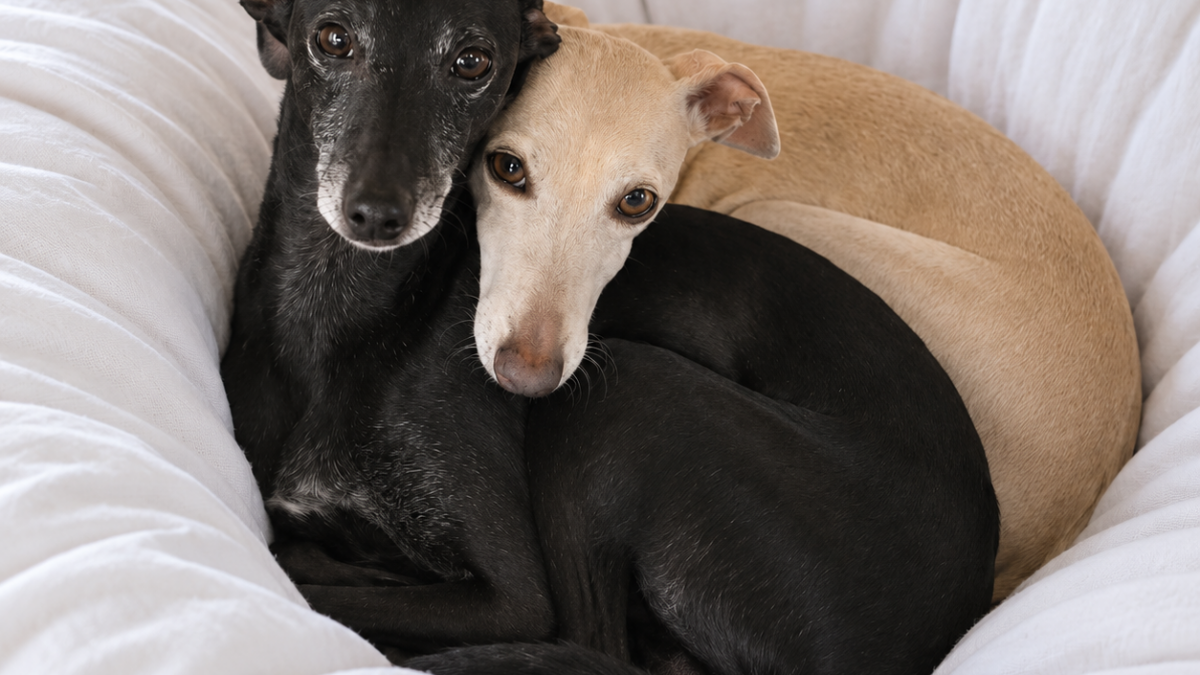
Two adult Italian Greyhounds sleeping pressed together on one blanket after four years apart.
It looked almost identical to the old breeder video.
I put the two images side by side later.
Puppies.
Adults.
Same general shape.
Same arrangement.
One partly across the other.
That was the moment the story stopped feeling like a coincidence to me.
Again, I do not mean I suddenly believed they had spent four years consciously mourning each other.
There was no evidence of that.
Ollie had been happy.
Biscuit had been happy.
Both had loving homes.
Neither had lived as if something were missing.
But whatever familiarity had existed between them seemed easy to rebuild.
Maybe easier than rebuild.
Resume.
That was the word Rachel used.
“They’re not starting something,” she said. “They’re resuming it.”
I knew what she meant.
We stayed at the field almost three hours.
When it was time to leave, the dogs created the first problem.
Ollie followed me to the gate.
Biscuit followed Ollie.
Rachel called Biscuit.
He looked at her.
Then at Ollie.
Then at her again.
Eventually he went.
Ollie stood beside my car watching Biscuit enter Rachel’s.
His ears were forward.
Biscuit watched through the window.
I put Ollie in my car.
Before starting the engine, I looked at him.
“So?”
He curled into the passenger blanket.
Typical.
On the drive home, he slept.
I expected some dramatic behavior afterward.
Searching.
Whining.
Restlessness.
Nothing.
Ollie ate dinner.
Carried one sock into the living room.
Buried himself under a blanket.
Life continued.
That actually reassured me.
The reunion had not destabilized him.
It had simply been good.
Rachel texted that Biscuit was equally normal.
We planned another visit.
Then another.
Within two months, the dogs had met four times.
The pattern repeated.
Initial excitement.
Running.
Sniffing.
Play.
Then sleep.
Always together.
Not once did they choose separate beds when a shared one was available.
That became their routine.
The humans talked.
The dogs folded themselves into a pile.
One afternoon Rachel brought Biscuit to my house.
That was the first test on Ollie’s territory.
I expected more tension.
Ollie barked when Biscuit entered.
Biscuit stopped.
Then Ollie recognized him—or at least changed his assessment immediately.
The barking stopped.
He ran forward.
Biscuit ran too.
They disappeared down the hallway.
A crash followed.
Rachel looked at me.
“Should we worry?”
“Probably.”
We found them in the bedroom.
Ollie had jumped onto the bed.
Biscuit had followed.
Both were digging under the same blanket.
The crash had been a pillow falling.
Rachel stared.
“They have no dignity.”
“They’re Italian Greyhounds.”
“Fair.”
That visit revealed another similarity.
Ollie had a strange bedtime ritual.
He circled exactly three times before burrowing beneath a blanket.
Not always.
But often enough that I noticed.
Biscuit did the same.
Three circles.
Then nose under fabric.
Rachel started counting.
“One.”
“Two.”
“Three.”
Biscuit disappeared.
We looked at each other.
“Genetic?” she asked.
“Maybe.”
“Learned before adoption?”
“Maybe.”
“Coincidence?”
“Also maybe.”
We laughed.
The brothers became a collection of maybes.
That was part of what made them interesting.
People wanted certainty.
“They definitely remembered.”
“They definitely knew.”
“They definitely missed each other.”
I resisted those claims.
The truth was better because it was real.
Two dogs from the same litter were separated as puppies.
Years later, their owners discovered the connection.
When reunited, the dogs showed immediate social comfort and developed a remarkably easy relationship.
They repeatedly chose physical closeness.
They matched each other’s play style.
They settled together.
That was observable.
Anything beyond that was interpretation.
And still, what we observed was enough to make everyone smile.
The strangest part was how the reunion changed us.
Not the dogs.
Us.
Rachel and I had been strangers.
Now we spoke almost every week.
Our husbands eventually met.
Then our families.
What began as two dogs sharing DNA turned into two households sharing weekends.
We learned each other’s routines because the dogs forced us to.
Rachel drank coffee without sugar.
I drank too much of it.
Her husband, Mark, liked grilling.
Mine, Daniel, believed every grilling problem could be solved by buying another thermometer.
They became friends almost immediately.
Soon the visits stopped being “dog reunions.”
They became dinner.
Holidays.
Walks.
A weekend trip to a cabin.
Ollie and Biscuit were simply part of the arrangement.
At the cabin, something happened that became another story we told repeatedly.
There were four dog beds.
Four.
We brought extras because Italian Greyhounds treat sleeping surfaces as serious infrastructure.
Biscuit inspected all four.
Ollie inspected two.
Then both climbed into the smallest one together.
Their legs hung over the edges.
Daniel pointed.
“That cannot be comfortable.”
Neither dog moved.
Mark said, “They disagree.”
That night, I woke around two and found Ollie missing from our bed.
That never happened.
I walked into the living room.
Moonlight came through the windows.
Biscuit and Ollie were asleep together on the couch.
No humans.
No blankets arranged for them.
They had chosen each other.
I stood there longer than necessary.
Then returned to bed.
Daniel opened one eye.
“Where is he?”
“With Biscuit.”
“Traitor.”
I smiled.
“Apparently.”
The next morning, they were still there.
Rachel took the photo.
That became the second favorite.
The brothers eventually became known among our friends as “the twins,” even though they were littermates rather than identical twins.
Their personalities were not actually identical.
Once the novelty wore off, the differences became obvious.
Ollie was more cautious.
Biscuit more impulsive.
Ollie hated unfamiliar men until properly introduced.
Biscuit believed strangers existed to provide lap space.
Ollie stole fabric.
Biscuit stole food.
Ollie was frightened of thunder.
Biscuit slept through storms.
Ollie learned tricks quickly if food was involved.
Biscuit learned which human could be manipulated into giving food without requiring tricks.
But beneath those differences, their physical rhythms remained strangely compatible.
They ran at the same speed.
Turned at similar moments.
Preferred the same sleeping temperature.
Reacted to certain sounds almost identically.
Once, a smoke detector chirped because of a low battery.
Both dogs vanished beneath separate blankets at the exact same second.
Rachel and I watched.
“Genetics?”
She asked it every time now.
“Maybe.”
It became our answer to everything.
One year after the first reunion, we contacted the breeder.
Not angrily.
Just curious.
She remembered the litter.
Barely.
She had bred several more since then.
When we sent recent photographs, she recognized the markings.
“Ollie and Biscuit,” she said.
“You remember the names?”
“The puppy names were different.”
Of course.
Ollie and Biscuit were names we gave them.
She searched old records.
Then sent us the original litter notes.
Seven puppies.
Each marked with colored ribbon during the first weeks.
Ollie had worn green.
Biscuit blue.
The notes included weights.
Feeding observations.
Tiny comments.
Next to Ollie:
**Often sleeps with Blue male.**
Next to Biscuit:
**Usually follows Green male.**
Rachel called me immediately.
“Did you see it?”
“Yes.”
We sat with that.
The breeder had written those notes before either puppy had a permanent name.
Before they belonged to us.
Even then, apparently, they chose each other often enough for someone to notice.
Again, not proof of some mystical bond.
Puppies form temporary preferences.
They change.
Litter dynamics evolve.
But the note mattered emotionally because it connected the old videos to the dogs we knew.
The closeness had not been invented by reunion day.
It had existed early.
The breeder sent one more picture.
Seven puppies asleep.
This time the image was clearer than the old video.
Green ribbon and blue ribbon lay pressed together at the edge of the pile.
Ollie and Biscuit.
I printed it.
Rachel did too.
Our houses eventually displayed the same pair of images.
Puppies together.
Adults together.
People visiting my home would ask about it.
Then I would tell the story.
Not dramatically.
Usually while Ollie slept under a blanket nearby.
One visitor once said, “That’s kind of sad.”
“Why?”
“Because they lost four years together.”
I had never thought about it that way.
For a moment, I almost agreed.
Then I looked at Ollie.
He had not lost those years.
He had lived them.
He had me.
Daniel.
Walks.
Warm beds.
Food.
Trips.
Safety.
Biscuit had Rachel and Mark.
His own life.
His own routines.
The separation was not tragedy.
That distinction mattered.
Their story worked because both dogs had been loved apart.
The reunion added something.
It did not repair damage.
Nothing had been broken.
They simply regained access to a relationship no one realized could still matter.
That felt more beautiful than sadness.
At six years old, Ollie injured his front leg jumping off a couch.
Very Italian Greyhound.
Not a fracture, thankfully.
A ligament strain.
Rest.
Pain medication.
No running for two weeks.
Ollie considered this unacceptable.
The problem appeared when Biscuit visited.
Normally they ran immediately.
I warned Rachel.
“No chasing.”
She laughed.
“How exactly do you plan to explain that?”
“We’re keeping Ollie leashed.”
Biscuit entered.
Both dogs became excited.
Ollie tried to launch himself.
I stopped him.
He whined.
Biscuit bounced.
Ollie whined louder.
Then something unexpected happened.
After a few minutes, Biscuit stopped trying to initiate play.
He walked to Ollie.
Sniffed the injured leg.
Then lay down.
Ollie settled beside him.
For the rest of the afternoon, Biscuit did not demand running.
They slept instead.
Did Biscuit understand the injury?
Possibly.
Dogs respond to changes in movement, posture, scent, and behavior.
I did not need to assign a human thought to it.
What mattered was that he adjusted.
Rachel noticed too.
“He’s never this calm here.”
“Neither is Ollie.”
They stayed pressed together for nearly three hours.
That evening, after Biscuit left, Ollie did something unusual.
He carried one of his blankets to the door.
Dropped it there.
Then slept on it.
I almost texted Rachel that he missed his brother.
I stopped.
Maybe he did.
Maybe he was tired.
Maybe the blanket happened to be there.
It is easy to turn animals into poems when you love them.
I tried to remember they were dogs.
That did not make the affection less meaningful.
The following year, Biscuit faced his own problem.
He became terrified of fireworks after a neighborhood celebration.
Previously, loud sounds had not bothered him much.
After one particularly intense night, that changed.
Rachel called me.
“He won’t go outside after dark.”
We talked about desensitization.
Veterinary support.
Routine.
Avoiding exposure during major fireworks.
Then she asked, “Can Ollie come over?”
“For what?”
“Biscuit walks better when another dog is with him.”
We tried.
The first evening, Biscuit stopped at the doorway.
Ollie walked out.
Turned.
Looked back.
Biscuit followed.
They made it to the sidewalk.
A distant bang sounded.
Biscuit froze.
Ollie startled too but recovered.
Then kept moving.
Biscuit followed.
Again, no miracle.
No cure.
But over several visits, walking beside Ollie helped Biscuit rebuild confidence.
That created a new routine.
During fireworks season, we coordinated walks.
The dogs helped each other in ways neither family could deliberately manufacture.
By then, the brothers were eight.
Their running slowed slightly.
The naps became longer.
Their bodies remained impossibly thin because Italian Greyhounds are designed like question marks.
Gray hairs appeared around both muzzles at nearly the same time.
Rachel sent me a picture.
**Biscuit is going gray.**
I responded with Ollie.
**Same.**
She called.
“Do they have to age together too?”
Apparently.
The visits continued.
Sometimes every week.
Sometimes a month apart.
Once, because of work and travel, nearly three months passed.
That became the longest separation since reunion.
I wondered whether the greeting would change.
It did not.
Biscuit arrived.
Ollie heard the car door.
He ran to the window.
By the time Rachel knocked, Ollie was whining.
I opened the door.
The dogs collided in the hallway.
Not aggressively.
Just too much enthusiasm in too little space.
They ran to the living room.
Around the couch.
Back.
Then both disappeared under one blanket.
Rachel looked at the clock.
“Four minutes.”
“What?”
“From reunion to blanket.”
“Efficient.”
Half an hour later, they were asleep.
Same position.
Shoulder to shoulder.
The time apart seemed irrelevant.
That became one of the most consistent things about them.
No social rebuilding.
No hesitation.
No “getting reacquainted.”
They resumed.
At nine, Ollie developed a heart murmur.
Mild.
The veterinarian wanted monitoring.
Italian Greyhounds can have age-related cardiac issues, and I immediately became anxious.
Echocardiogram.
Blood pressure.
Repeat examinations.
The cardiologist said we were early.
Monitor.
No medication yet.
I told Rachel.
She became quiet.
“Biscuit had one noted last month.”
I stared at the phone.
“Seriously?”
“Yes.”
Same age.
Similar murmur.
Not shocking genetically.
Still unsettling.
The brothers began receiving cardiac checks within weeks of each other.
We joked that even their veterinary bills were synchronized.
The first year, both remained stable.
The second, Ollie required medication.
Biscuit did too several months later.
Their lives continued.
Shorter runs.
More blankets.
More careful exercise.
The reunion story became less about puppyhood and more about aging side by side.
I had not expected that.
When we found them again, I thought we were recovering one charming piece of their past.
Instead, we gave them access to each other’s future.
That meant more.
At ten, Biscuit developed dental disease and needed several extractions.
Ollie visited two weeks later.
Biscuit was fully recovered but still eating soft food.
Ollie immediately tried to steal it.
Brotherhood remained imperfect.
Rachel pushed him away.
“Your brother had surgery.”
Ollie stared at the bowl.
“No sympathy.”
I laughed.
“Genetic?”
She threw a napkin at me.
At eleven, Ollie’s arthritis became noticeable.
He hesitated before stairs.
Stopped jumping onto high furniture.
We added ramps.
Biscuit remained more agile for another year.
During visits, he still tried to initiate chasing.
Ollie sometimes participated.
Sometimes not.
When Ollie refused, Biscuit eventually learned to settle beside him.
Their relationship adapted.
No one taught them.
The same basic connection simply changed form.
Puppies had wrestled.
Adults had raced.
Seniors slept.
The sleeping was always there.
Just increasingly dominant.
The most frightening moment came when Ollie was twelve.
He collapsed briefly after getting excited at the door.
One second upright.
Next second on his side.
I thought he was dying.
By the time we reached the emergency clinic, he was alert again.
Cardiac arrhythmia.
Medication adjusted.
More monitoring.
I called Rachel from the parking lot.
She answered immediately.
“How bad?”
“Manageable, they think.”
“Do you need us?”
I almost said no.
Then I looked at Ollie in the carrier.
“Yes.”
Biscuit arrived the next afternoon.
We kept everything calm.
No running.
No dramatic greeting.
Rachel carried Biscuit inside.
Placed him down.
Biscuit walked to Ollie.
They smelled each other.
Ollie’s tail moved.
Then both went to the blanket.
They slept.
I sat on the floor nearby.
Rachel joined me.
For the first time, the old reunion photograph hurt.
Not because I regretted anything.
Because suddenly I understood there would eventually be a last version of it.
A last visit.
A last nap.
A last time both brothers were alive in the same room.
I hated knowing that.
Rachel knew what I was thinking.
“Don’t.”
“I didn’t say anything.”
“You didn’t have to.”
I looked at the dogs.
“How do you not think about it?”
“You think about today instead.”
That was easier to say than do.
But she was right.
Today, both were sleeping.
Today, both were comfortable.
Today, nothing had ended.
So I stayed there.
The collapse did not repeat for months.
Ollie stabilized.
Biscuit developed more advanced heart disease the following year.
Medication increased.
Rachel became the anxious one.
We traded roles.
She called after every coughing episode.
I repeated things veterinarians had told me.
Check breathing rate during sleep.
Watch appetite.
Energy.
Collapse.
Comfort.
Do not let fear turn every normal day into an emergency.
Then I would hang up and worry about Ollie anyway.
We were both terrible at following our own advice.
At thirteen, the brothers could no longer handle long trips as easily.
The forty miles between us suddenly mattered.
Car rides tired them.
So Rachel and I met halfway more often at Daniel’s sister’s house, which had a quiet yard and no stairs.
The brothers cared nothing about location.
A room.
A blanket.
Each other.
Enough.
Their greetings became less physical.
Nose touches.
Tail movements.
Then immediate sleep.
One afternoon, Rachel said, “Do you remember the first reunion?”
“Of course.”
“They ran for an hour.”
“Fifteen minutes.”
“It felt like an hour.”
We watched the old dogs curled together.
“Now they need a nap because somebody opened a door.”
“That’s age.”
Biscuit lifted his head at the sound of his name.
Ollie did not.
His hearing had started fading.
Biscuit’s followed several months later.
Of course.
The pattern became almost funny.
One developed something.
The other followed.
Not every time.
Enough to notice.
Cataracts.
Hearing loss.
Arthritis.
Heart medication.
Senior diets.
The shared genetics that had given us matching ears and strange chirps now appeared in less charming ways.
Still, both dogs remained happy.
Warm.
Loved.
Annoyingly demanding.
At fourteen, Biscuit began having more difficult nights.
Restlessness.
Coughing.
Occasional breathing changes.
His cardiologist adjusted medication.
For a while, that helped.
Then Rachel called one morning.
I knew from her voice.
“We’re at the emergency hospital.”
“What happened?”
“He couldn’t breathe.”
My hand tightened around the phone.
“What are they saying?”
“Heart failure.”
Congestive heart failure.
Fluid.
Oxygen.
Diuretics.
The words came too fast.
Ollie was asleep beside me.
I looked at him while Rachel spoke.
“They’re keeping Biscuit overnight.”
“Okay.”
“Do you think Ollie should come tomorrow?”
I hesitated.
The practical part of my mind said no.
Biscuit was fragile.
Hospitalized.
Stress mattered.
Travel mattered.
We needed veterinary guidance.
“Ask the cardiologist.”
She did.
Biscuit improved overnight.
Enough to go home with stronger medication.
The veterinarian recommended quiet.
No visitors the first day.
So we waited.
Two days later, I drove Ollie to Rachel’s house.
He slept most of the ride.
At the door, he woke.
Biscuit was lying on a thick bed in the living room.
He looked thinner.
More tired.
Ollie approached slowly.
Biscuit lifted his head.
Their noses touched.
That was all.
Then Ollie walked around the bed.
Circled.
Lowered himself beside Biscuit.
Biscuit leaned into him.
Rachel sat on one side of the room.
I sat on the other.
Neither of us spoke.
The brothers slept for nearly two hours.
I took one photograph.
Only one.
I felt guilty doing even that.
But some part of me knew.
That was not their last meeting.
But it was the first time the possibility of a last meeting entered the room with us.
Biscuit recovered enough to have several more good months.
Walks.
Meals.
Blankets.
Another visit.
Then another.
The next winter was harder.
His kidneys began struggling under the medication needed for his heart.
The balancing act became complicated.
Treat the heart aggressively and risk the kidneys.
Protect the kidneys and risk fluid accumulation.
Rachel’s veterinarian explained it carefully.
There was no perfect choice.
Only adjustment.
Comfort.
Time.
Ollie was dealing with similar problems, though slightly less advanced.
Rachel and I stopped joking about synchronized medical histories.
It was no longer funny.
One January evening, she called.
“Biscuit stopped eating.”
I closed my eyes.
“Today?”
“Since yesterday afternoon.”
“Vet?”
“We went.”
“And?”
She became quiet.
“They think we’re close.”
I looked at Ollie.
He was asleep beneath the same green blanket he had worn to the first reunion.
It had faded over the years.
One corner was torn.
I had never thrown it away.
“Do you want us there?”
“Yes.”
The next morning, we drove to Rachel’s.
The weather was freezing.
Ollie wore two layers.
He moved slowly across the driveway.
Inside, Biscuit lay in Rachel’s lap.
His breathing was calm but shallow.
Ollie approached.
Biscuit raised his head.
For a few seconds, both stared.
Then Ollie walked closer.
They smelled each other.
Biscuit’s tail moved once.
Ollie stepped onto the blanket.
Circled.
Three times.
One.
Two.
Three.
Then he lay down.
Biscuit shifted toward him.
Shoulder to shoulder.
Exactly as they had done at the field thirteen years earlier.
Rachel started crying.
I did too.
Mark left the room because he could not.
Daniel stood by the window.
The veterinarian arrived at noon.
We had discussed whether Ollie should remain.
There is no universal right answer.
Some animals become stressed by euthanasia procedures.
Others benefit from being allowed to investigate afterward.
We followed the veterinarian’s guidance and watched Ollie carefully.
He remained calm.
Biscuit received a sedative while lying beside Rachel.
Ollie was several feet away by then, wrapped in his own blanket.
Biscuit relaxed.
Rachel held his face.
“You were such a good boy.”
His eyes closed.
The final medication was given.
Biscuit’s breathing stopped.
The room became completely still.
We waited.
Then the veterinarian allowed Ollie to approach.
I did not push him.
He walked over on his own.
Smelled Biscuit’s face.
Shoulder.
Side.
Then returned to the face.
He stood there perhaps twenty seconds.
No crying.
No dramatic reaction.
Then he walked away.
He went to the blanket they had shared.
Circled.
Lay down alone.
That was harder to watch than anything else.
I sat beside him.
Rachel stayed with Biscuit.
For a while, the whole house seemed split into two kinds of grief.
Human grief.
Dog silence.
We did not pretend to know what Ollie understood.
That mattered.
He may have understood death differently from us.
He may simply have registered that Biscuit no longer smelled or behaved like a living dog.
What we observed afterward was enough.
For several days, Ollie was quieter.
He slept more.
At home, he searched the guest room where Biscuit usually slept during visits.
He smelled the blanket.
Waited near the door once when a car pulled into the driveway.
Then the behavior faded.
He kept eating.
Kept sleeping.
Kept demanding warmth.
Life continued.
Rachel could not bear the old photos at first.
Then, weeks later, she sent me one.
The original reunion.
Ollie and Biscuit asleep on the field blanket.
She wrote:
**I’m glad we found you.**
I stared at the message.
Then replied:
**Me too.**
There was nothing else to say.
Ollie lived another eleven months.
Longer than we expected.
His heart remained fragile.
So did his kidneys.
But he had good days.
Enough of them.
Rachel visited often.
At first, I worried it might upset her.
Instead, she said seeing Ollie helped.
“He still has Biscuit’s face sometimes.”
She was right.
Not always.
But certain expressions.
Certain angles.
The same ears.
The same way the paws crossed while sleeping.
One afternoon she brought Biscuit’s old blanket.
“I don’t know if this is a bad idea.”
We let Ollie choose.
He smelled it.
Long.
Then stepped onto it.
Circled three times.
Lay down.
Rachel cried.
I nearly did too.
He slept there for the rest of the afternoon.
The blanket stayed with us.
By autumn, Ollie’s breathing worsened.
The cardiologist adjusted medications again.
Temporary improvement.
Then his appetite fell.
The pattern was too familiar.
I called Rachel before I called anyone else.
“I think we’re there.”
She came over that evening.
Ollie was lying beneath his heated blanket.
When Rachel sat down, he lifted his head.
She reached toward him.
Ollie smelled her hand.
Then rested his chin on it.
Rachel closed her eyes.
“Hey, brother.”
The word nearly broke me.
Not because Ollie was her dog.
He wasn’t.
But for thirteen years after the reunion, our families had belonged to each other partly because the dogs did.
Biscuit was gone.
Now Ollie was leaving too.
The veterinarian came to my house the next morning.
Daniel sat beside me.
Rachel and Mark came.
Ollie ate a tiny piece of chicken.
Then another.
Refused the third.
We laughed softly because even at the end he remained particular.
I placed Biscuit’s blanket beneath him.
Not for symbolism.
Because he liked it.
Ollie settled.
Three circles first.
Of course.
Then down.
The veterinarian gave the sedative.
Ollie’s body relaxed.
I put my hand on his chest.
Rachel touched one paw.
Mark stood behind her.
Daniel rested his hand on my shoulder.
The room was quiet.
I thought about adoption day.
Two puppies.
Two families.
Two cars leaving in different directions.
None of us knowing we would meet again.
I thought about the photograph that started everything.
Biscuit beneath the gray blanket.
The face that looked too familiar.
The breeder paperwork.
The first field.
The running.
The shared bed.
The old note:
**Often sleeps with Blue male.**
**Usually follows Green male.**
The final medication entered.
Ollie took one breath.
Then another.
Then stopped.
His chest became still beneath my hand.
For several minutes, none of us moved.
Rachel finally whispered, “They’re both gone.”
I nodded.
“Yes.”
The house felt enormous afterward.
Italian Greyhounds are small dogs.
They somehow occupy entire buildings.
The heated beds.
Blankets.
Tiny sweaters.
Medications.
Food bowls.
The ramps we had added as Ollie aged.
Everything remained.
For months, I kept expecting a narrow gray face to appear around a doorway.
Sometimes grief came through sound.
A tag jingling in a television commercial.
Nails on another dog’s floor.
A blanket moving because of air from the vent.
Sometimes through habit.
I still checked weather before opening the back door as if Ollie needed me to negotiate rain.
Rachel and I continued speaking.
That surprised people.
They assumed our friendship had been about the dogs.
It started there.
It did not end there.
We still had dinner.
Birthdays.
Holidays.
The first time Rachel came over after Ollie died, we both looked toward the living room corner where the brothers always slept.
Empty.
No shared blanket.
No pile of legs.
Rachel sat down.
“This feels wrong.”
“Yes.”
Daniel brought coffee.
Mark started talking about something unrelated.
Slowly the room became normal again.
Not the old normal.
A new one.
Months later, the breeder contacted us.
She was retiring.
While sorting old records, she found another photograph from that litter.
Seven puppies in a pen.
Two stood slightly apart from the others near a blanket.
Green ribbon.
Blue ribbon.
Ollie.
Biscuit.
They were looking in opposite directions but touching along one side.
Rachel printed two copies.
She gave one to me.
I placed it beside the adult reunion photograph.
Puppies.
Adults.
Same closeness.
Different lives between.
I used to think the extraordinary part of their story was recognition.
Did they know?
Did they remember?
People always asked.
I still cannot answer.
Maybe they remembered scent.
Maybe some early familiarity remained stored in ways we do not understand.
Maybe shared genetics produced extraordinary compatibility.
Maybe two dogs who once slept in a pile simply discovered, years later, that they still liked sleeping in a pile.
The uncertainty no longer bothers me.
Because I know what happened after the first reunion.
Thirteen years of visits.
Runs.
Blankets.
Cabin weekends.
Medical appointments.
Old age.
One injured leg.
Fireworks fear.
Heart disease.
Gray muzzles.
Slow walks.
Naps that became longer every year.
That relationship existed whether or not we could scientifically name its origin.
And perhaps the most important thing was not that Ollie and Biscuit remembered being brothers.
It was that, once we discovered they were brothers, we gave them the chance to know each other again.
They used it.
Completely.
The old reunion photograph remains on my wall.
People still stop and ask about it.
Two gray Italian Greyhounds.
Curled together.
Shoulder to shoulder.
Eyes closed.
No visible clue that they had spent four years apart.
Beside it is the puppy photo.
And beneath that, the final one Rachel gave me from the breeder.
Sometimes I look at all three.
I see a line across time.
Before us.
With us.
Then gone.
For years, I thought adoption day had been the moment their lives split permanently.
Two puppies carried toward different cars.
Two families heading in opposite directions.
But permanent turned out to be the wrong word.
Their lives separated.
Then one photograph brought the line back around.
The first time Rachel and I arranged the reunion, we were both obsessed with whether the dogs would remember.
That question feels small now.
Because memory was only the beginning.
What mattered was what they did with the second chance.
They ran.
They played.
They aged.
They comforted each other.
And almost every time the excitement ended, they returned to the same old habit no one had taught them again.
One blanket.
Two narrow bodies.
Shoulder to shoulder.
Fast asleep.
Exactly where, somehow, they always seemed to belong.
The first time I saw the photograph of Biscuit, I honestly thought someone had sent me a picture of my own dog.
The narrow gray face, the white patch beneath the chin, the long delicate legs, even the slightly uneven ears were so familiar that I stared at my phone for several seconds before realizing the blanket beneath him was one I had never seen before.
I looked across the room at Ollie.
He was asleep in his usual position, completely buried beneath a fleece blanket except for one back leg and the tip of his nose.
Then my phone vibrated again.
The woman who had sent the picture wrote, “I think our dogs might be related.”
At first, I laughed.
Italian Greyhounds often resemble one another, especially when they share the same coloring. Owners joke about having identical dogs all the time.
But then we started comparing details.
That was when the joke stopped feeling like a joke.
Ollie had come into my life almost four years earlier.
I picked him up when he was about ten weeks old from a small breeder several towns away. I still remembered the morning clearly because I had been nervous about everything.
Was the carrier big enough?
Would he cry in the car?
Would he eat?
Would he sleep?
Would I somehow ruin a perfectly good puppy within the first twenty-four hours?
When I arrived, several small Italian Greyhound puppies were tumbling around inside a pen.
They were all legs, ears, and impossible amounts of energy.
Ollie stood out because he kept pushing his way through the others until he reached my shoes.
He sat on one of them.
I moved my foot.
He followed it.
Then he climbed partly into my lap.
The breeder laughed.
“Well,” she said, “I think that one has made his choice.”
I picked him up.
He immediately tried to lick my nose.
That was it.
Ollie was coming home with me.
While I signed paperwork, another family arrived.
I barely paid attention because I was completely focused on the puppy squirming in my arms.
But I remember a woman picking up another gray male from the litter.
The second puppy noticed Ollie.
Ollie noticed him too.
Both immediately began twisting toward each other.
“They’re brothers,” the breeder said.
I smiled.
“Looks like they’re not ready to say goodbye.”
Someone laughed.
Then the moment passed.
The other family left.
I left soon afterward.
We never exchanged names.
No phone numbers.
Nothing.
I drove home thinking about food schedules and house training, not about the puppy disappearing in the other car.
For years, that was all the memory meant.
Ollie grew into exactly the kind of dog people warn you Italian Greyhounds can become.
He hated rain.
He hated cold floors.
He hated being excluded from any blanket, bed, couch, chair, or human lap.
If the temperature dropped even slightly, he behaved as if winter had personally declared war on him.
He had dozens of strange habits.
He crossed his front paws when sleeping.
He stole socks but almost never damaged them.
He gathered them into small piles behind the couch.
He made a ridiculous chirping sound when excited.
He would spin three times before disappearing beneath a blanket.
And he wanted physical contact constantly.
If I moved two inches away from him in bed, he moved three inches closer.
None of that seemed important.
It was simply Ollie.
Then one evening, I posted a photograph of him in an online group for Italian Greyhound owners.
He was upside down beneath a gray blanket, looking completely absurd.
A woman named Rachel commented beneath the photo.
“I think I own your dog’s twin.”
I responded with a laughing face.
A few minutes later, she sent me a private message.
Attached was the photograph of Biscuit.
That was the moment I stopped laughing.
I asked the obvious question.
“How old is he?”
Rachel replied almost immediately.
“Four years and three months.”
My stomach tightened slightly.
Ollie was four years and three months old.
I asked for Biscuit’s birthday.
Same date.
Still, I told myself it could be coincidence.
Then Rachel said, “We got him from a breeder near Fairview.”
I sat up.
“So did I.”
She sent the breeder’s name.
Same breeder.
I walked into the kitchen and opened the cabinet where I kept Ollie’s veterinary records and old adoption papers.
His original puppy contract was still inside a plastic folder.
I photographed the page showing his birth date, parents, and litter information.
Rachel sent Biscuit’s.
Same mother.
Same father.
Same litter.
For nearly a minute, neither of us typed anything.
Then Rachel called.
I answered.
“These dogs are brothers,” she said.
“Same litter.”
“Actual brothers.”
I looked at Ollie.
He walked over, put his front paws against my knee, and stared at me because I had apparently stopped paying attention to him for too long.
I picked him up.
“You have a brother.”
Ollie licked my chin.
Rachel laughed through the phone.
“What’s he doing?”
“Nothing useful.”
“Biscuit’s asleep.”
“That sounds related.”
We both laughed.
Then Rachel became quiet.
“Do you think they’d remember each other?”
That question stayed with me.
Could a dog remember a littermate after nearly four years?
Neither of us knew.
We began comparing old photographs.
Then videos.
The similarities became increasingly strange.
Biscuit crossed his front paws while sleeping.
He hated wet pavement.
He collected gloves the way Ollie collected socks.
He made almost the same high-pitched chirping sound.
He burrowed under blankets using exactly the same frantic nose-first movement.
Rachel sent me a video of Biscuit making that noise.
I played it.
Ollie had been asleep across the room.
His head immediately came up.
He walked toward my phone.
Tilted his head.
Then whined.
I replayed the clip.
Ollie stared at the speaker.
I sent Rachel a recording of Ollie.
Minutes later she called.
“Biscuit came running when he heard it.”
That was enough for us.
We arranged a reunion.
Neither of us wanted to do it inside one dog’s house, so we rented a small fenced field where dogs could meet safely off leash.
The night before, I found myself unusually nervous.
Ollie, meanwhile, slept normally.
He had no idea that two humans were planning an emotional family reunion on his behalf.
I searched through old emails from the breeder and found several videos from when the litter was still together.
Seven puppies rolled across blankets and climbed over one another.
I paused one clip.
There was Ollie.
Beside him was another gray puppy.
Rachel noticed the same thing when I sent her the video.
“Look at the back foot.”
I zoomed in.
One white toe.
Biscuit had one white toe on the same foot.
In another video, Ollie and Biscuit were asleep together.
Biscuit was partly lying across Ollie’s back.
The clip lasted only a few seconds.
But it made the reunion feel different.
They had not simply existed in the same litter.
They had apparently spent a lot of time together.
Still, Rachel and I made a rule.
We would not force anything.
No holding them face-to-face.
No dramatic introductions.
No trying to make them interact for photographs.
If they behaved like strangers, fine.
If they ignored one another, fine.
If either dog seemed uncomfortable, we would end the meeting.
Saturday morning arrived cold and clear.
Ollie wore his green fleece sweater.
On the drive, he slept in the passenger seat.
I looked at him at a red light.
“You’re meeting someone important.”
One eye opened.
“Possibly.”
The eye closed.
When we arrived, Rachel was already waiting.
She stood near the fence holding Biscuit.
For one strange second, seeing him in person confused me.
From a distance, he looked almost exactly like Ollie.
Then I noticed the differences.
Biscuit was slightly taller.
His gray coat was darker.
His face was a little narrower.
But the resemblance was undeniable.
Ollie saw him through the windshield.
His entire body became still.
His ears moved forward.
Then backward.
Then forward again.
That reaction made my heart beat faster.
I opened the door.
Ollie jumped out.
Rachel placed Biscuit on the ground.
We remained about twenty feet apart.
Biscuit saw Ollie.
He froze too.
Rachel looked at me.
Neither of us said anything.
Then Ollie pulled gently forward.
I loosened the leash.
Biscuit began moving.
Slowly.
The distance closed.
Ten feet.
Six.
Three.
Their tails began moving.
Then they met.
Nose to nose.
They smelled each other’s faces.
Shoulders.
Sides.
Normal dog behavior.
For several seconds, nothing extraordinary happened.
Then Biscuit suddenly bounced sideways and dropped into a play bow.
Ollie jumped backward.
Then launched forward.
Everything exploded into movement.
The two dogs began running.
Circles around us.
Across the field.
Back again.
Biscuit chased Ollie.
Then Ollie chased Biscuit.
They changed direction at almost exactly the same moment.
Biscuit chirped.
Ollie answered.
Rachel started laughing.
“So much for a cautious introduction.”
Within minutes, we unclipped both leashes.
The brothers raced across the field as though they had been doing it every weekend.
What struck me most was how little attention Ollie paid to me.
Normally, even during play, he checked my location constantly.
That morning, he barely looked at me.
Rachel said Biscuit behaved the same way.
They were completely focused on each other.
Could I prove they recognized each other?
No.
I still can’t.
Maybe they recognized familiar scents.
Maybe their genetics gave them similar play styles.
Maybe they simply liked each other immediately.
But I know what I saw.
There was no awkwardness.
No prolonged uncertainty.
They moved together naturally.
After about fifteen minutes, both finally slowed down.
Rachel had brought two blankets.
We placed them near a bench.
Ollie walked over first.
Biscuit followed.
There were two blankets.
They chose one.
Ollie circled three times.
Then lay down.
Biscuit stepped onto the same blanket.
He circled.
Three times.
Rachel looked at me.
“One.”
“Two.”
“Three.”
Biscuit lowered himself directly beside Ollie.
Their shoulders touched.
Ollie rested his chin partly across Biscuit’s back.
Less than five minutes later, both were asleep.
I stood there staring.
Rachel whispered, “Biscuit never sleeps next to a dog he just met.”
“Ollie doesn’t either.”
I took a photograph.
Later, I placed it beside the old puppy video.
The resemblance between the two moments was almost ridiculous.
Puppies curled together.
Adult dogs curled together.
Four years between the images.
That first reunion lasted almost three hours.
When we finally left, Biscuit watched Ollie from Rachel’s car.
Ollie watched him from mine.
I expected Ollie to act unsettled afterward.
He didn’t.
He ate dinner.
Stole one sock.
Buried himself beneath a blanket.
Life continued.
Biscuit did the same.
So we scheduled another visit.
Then another.
Soon a pattern became obvious.
Every reunion began with excitement.
Running.
Chasing.
Sniffing.
Chirping.
Then, once the energy burned away, the brothers found a blanket.
And slept together.
Always.
Sometimes there were multiple dog beds.
They still chose one.
Once Rachel brought Biscuit to my house.
I had placed two beds in the living room.
Biscuit inspected both.
Ollie inspected one.
Then both crawled into the smaller bed together until their legs hung over the sides.
My husband, Daniel, pointed at them.
“That cannot possibly be comfortable.”
Neither moved.
Rachel laughed.
“They disagree.”
The visits became regular.
Eventually Rachel and I stopped calling them reunions.
They were simply weekends.
Dinner.
Walks.
Coffee.
The dogs happened to be there.
Our husbands became friends too.
The coincidence that brought two dogs together slowly connected two entire families.
One year after their reunion, we contacted the breeder.
She searched through old litter records.
Then she sent us something that made both Rachel and me quiet.
When the puppies were small, the breeder had identified them with colored ribbons.
Ollie had worn green.
Biscuit had worn blue.
Beside Ollie’s early notes was a short comment:
Often sleeps with Blue male.
Beside Biscuit:
Usually follows Green male.
Rachel called immediately.
“You saw that?”
“Yes.”
“They were actually buddies.”
“Looks like it.”
The breeder also sent an old photograph.
Seven puppies were sleeping inside a pen.
Green and Blue were pressed together near the edge.
Ollie and Biscuit.
Before either had those names.
Before either belonged to us.
I printed the picture.
Rachel did too.
People sometimes asked whether I regretted that the brothers had been separated.
I didn’t.
Ollie had a wonderful life during those four years.
So did Biscuit.
They were not rescued from unhappy homes.
Nothing needed repairing.
The reunion added something.
It did not fix a tragedy.
That distinction mattered.
The brothers grew older together.
At six, Ollie injured his front leg jumping from a couch.
He needed rest.
When Biscuit visited, I expected trouble because their normal routine involved running.
At first Biscuit bounced around trying to start a game.
Ollie pulled toward him but could not chase.
Then Biscuit stopped.
He walked over.
Sniffed Ollie’s injured leg.
And lay down.
For the rest of the visit, they slept.
No running.
No rough play.
Just quiet companionship.
Later, Biscuit developed a fear of fireworks.
Rachel discovered that he walked more confidently when Ollie was nearby.
So during fireworks season, we coordinated evening walks.
Ollie would step outside first.
Biscuit followed.
A distant bang might make Biscuit freeze.
Ollie would pause.
Then continue.
Biscuit followed again.
No miracle.
No instant cure.
Just one dog making the world easier for another.
By eight, gray hairs appeared around both muzzles.
Rachel sent me a picture.
He’s getting old.
I responded with one of Ollie.
Apparently together.
Their running slowed.
Their naps grew longer.
At nine, both developed mild heart murmurs within several months of each other.
Not shocking for dogs of the same breed and genetics.
Still strange.
Veterinary monitoring became another shared routine.
At ten, Biscuit needed dental surgery.
When Ollie visited afterward, his main concern was stealing Biscuit’s soft food.
Rachel pushed him away.
“Your brother just had surgery.”
Ollie stared at the bowl.
“No sympathy,” she said.
At eleven, Ollie’s arthritis became more noticeable.
Biscuit remained more energetic.
During visits, he would occasionally try to initiate running.
If Ollie refused, Biscuit eventually settled.
Their relationship changed naturally.
Puppies had wrestled.
Adults had raced.
Old dogs slept.
Sleeping had always been part of them.
Now it became most of their time together.
When Ollie was twelve, he collapsed after becoming excited at the door.
For several seconds, I thought I was losing him.
The emergency veterinarian diagnosed an arrhythmia and adjusted his heart medication.
I called Rachel from the parking lot.
“How bad?” she asked.
“Manageable, they think.”
“Do you need us?”
I almost said no.
Then looked at Ollie.
“Yes.”
Biscuit visited the next day.
We kept everything calm.
He walked toward Ollie.
They touched noses.
Their tails moved.
Then they went straight to the blanket.
Watching them sleep that afternoon, I understood something I had avoided thinking about.
There would eventually be a last visit.
A last nap.
A last photograph.
Rachel knew what was going through my mind.
“Don’t.”
“I didn’t say anything.”
“You didn’t need to.”
“How do you not think about it?”
She looked at the dogs.
“Think about today.”
So I did.
That day, both were comfortable.
Both were alive.
Both were together.
It was enough.
Biscuit’s heart disease worsened first.
At fourteen, he went into congestive heart failure.
Medication bought several good months.
Then his kidneys began struggling under the treatment needed to keep fluid away from his lungs.
Rachel called one January evening.
“He stopped eating.”
The next morning, Ollie and I drove to her house.
Biscuit was lying in Rachel’s lap.
He looked tired.
Ollie approached slowly.
Biscuit lifted his head.
Their noses touched.
Biscuit’s tail moved once.
Ollie stepped onto the blanket.
He circled.
Once.
Twice.
Three times.
Then lay down beside his brother.
Biscuit shifted closer.
Shoulder to shoulder.
Exactly as they had done at the first reunion years earlier.
Rachel cried.
So did I.
The veterinarian arrived later that morning.
Biscuit was sedated while Rachel held him.
Ollie rested nearby.
After Biscuit died, we allowed Ollie to approach on his own.
He smelled Biscuit’s face.
Shoulder.
Side.
Then returned to the face.
He stood there quietly.
Then walked away.
He found the blanket they had shared.
Circled.
Lay down alone.
That was harder to watch than I expected.
For several days afterward, Ollie was quieter.
He searched the room where Biscuit usually slept during visits.
He smelled the old blanket repeatedly.
Then gradually, the searching stopped.
He continued eating.
Sleeping.
Demanding warmth.
Life kept moving.
Rachel visited often.
One afternoon she brought Biscuit’s blanket.
Ollie smelled it for a long time.
Then stepped onto it.
Three circles.
Down.
He slept there for hours.
Ollie lived another eleven months.
His own heart disease eventually worsened.
By autumn, his appetite faded.
The cardiologist adjusted medication, but the improvement did not last.
When I knew we were nearing the end, I called Rachel before almost anyone else.
She came over that evening.
Ollie lay beneath his heated blanket.
When Rachel sat beside him, he raised his head.
She offered her hand.
He smelled it.
Then rested his chin against her palm.
“Hey, brother,” she whispered.
The next morning, a veterinarian came to our house.
Daniel was there.
Rachel and Mark came too.
Ollie ate two tiny pieces of chicken.
Refused the third.
We laughed softly.
I placed Biscuit’s old blanket beneath him.
Not because I believed Ollie understood symbolism.
Because he liked the blanket.
He circled three times.
Then lay down.
The sedative relaxed him.
I kept one hand on his chest.
Rachel touched his paw.
I thought about adoption day.
Two puppies leaving in different cars.
Two families going separate directions.
None of us knowing the story had only paused.
Then Ollie took one final breath.
His chest became still beneath my hand.
For a long time, no one moved.
The house felt impossibly empty afterward.
Italian Greyhounds are small dogs.
They somehow fill entire homes.
The blankets.
Sweaters.
Beds.
Tiny bowls.
Medication.
Ramps.
Everything remained.
Rachel and I continued being friends.
People occasionally seemed surprised.
They assumed the dogs had been the only reason our families spent time together.
They had been the beginning.
Not the whole relationship.
Months after Ollie died, the breeder contacted us again.
She was retiring and sorting old photographs.
She found one more picture from the litter.
Seven puppies inside a pen.
Green ribbon and blue ribbon stood near a blanket.
Their bodies touched along one side.
Rachel printed two copies.
I placed mine beside the adult reunion photograph.
For years, people asked the same question.
“Do you think they really remembered each other?”
I still cannot answer with certainty.
Maybe they remembered scent.
Maybe early familiarity lasted somewhere in their minds.
Maybe their shared genetics created unusually compatible behavior.
Maybe two dogs who once slept together simply discovered that they still enjoyed doing it.
I stopped needing to know.
Because whatever happened during those first minutes at the reunion became less important than everything that followed.
Years of visits.
Running.
Cabin weekends.
Fireworks.
Injuries.
Heart medication.
Gray muzzles.
Slow walks.
Long naps.
Old age.
They were brothers by birth.
But after we found each other, they also had the chance to become companions again.
They used that chance completely.
The photograph from their first reunion is still on my wall.
Two gray Italian Greyhounds curled together.
Shoulder to shoulder.
Eyes closed.
No visible sign that four years had passed between one shared bed and the next.
Beside it is the puppy photograph from the breeder.
Green ribbon.
Blue ribbon.
Pressed together.
When I look at those pictures now, I no longer think about the years they spent apart.
I think about the years they got back.
And I think about the strange way their entire second chapter began.
Not with a dramatic search.
Not with a breeder contacting us.
Not with some carefully planned reunion.
Just one woman sending another dog owner a photograph and joking:
“I think I own your dog’s twin.”
She was wrong.
Biscuit was not Ollie’s twin.
He was his brother.
And somehow, after years apart, the two dogs fell back into the oldest habit they had ever shared.
One blanket.
Two narrow bodies.
Pressed close.
Fast asleep.
[END OF STORY]








