PART 2: My HOA President Broke Into My House While I Was 1,000 Miles Away—She Didn’t Know My Pit Bull Was Behind That Bedroom Door
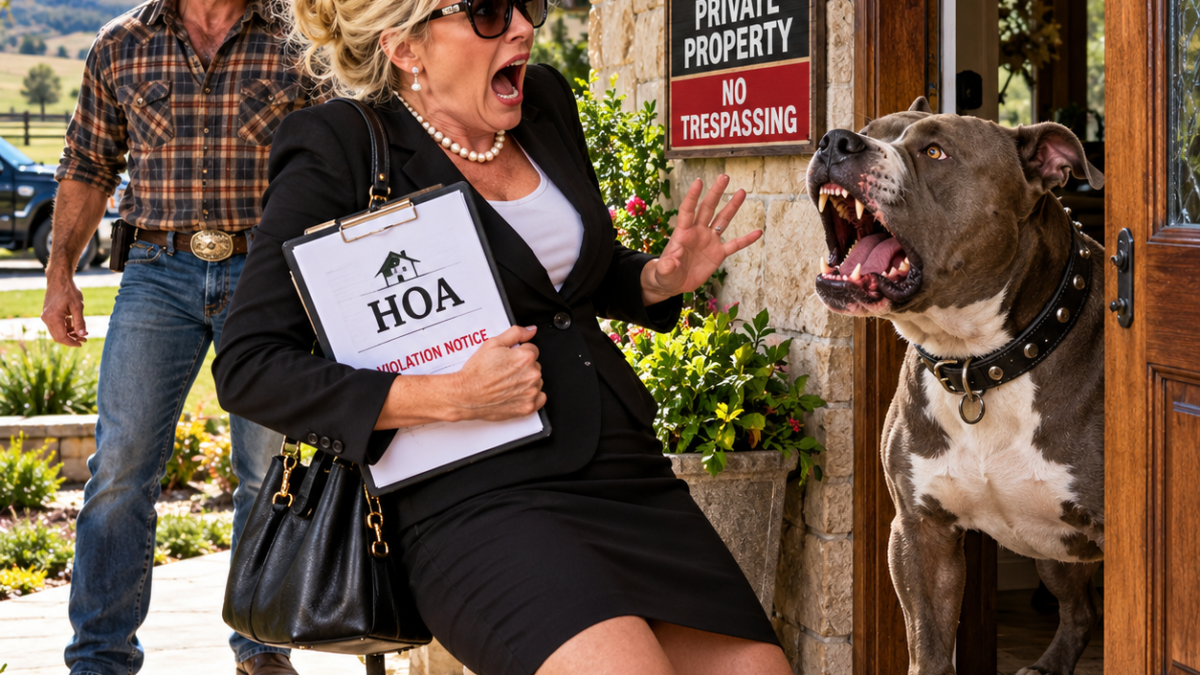
PART 2
I stared at the blank search results until my eyes started burning.
That was the first moment anger gave way to something colder.
If Linda had believed she was performing a legitimate inspection, there should have been paperwork.
Maybe bad paperwork.
Maybe incomplete paperwork.
Maybe an incorrect report.
But something.
Instead, the official record said nothing happened.
Yet I had forty-seven minutes of video showing her inside.
I downloaded the footage again.
Not because I needed another copy.
Because doing something with my hands kept me from calling her.
My mother found me at the kitchen table around six.
“You’re still awake?”
“No.”
“That isn’t an answer.”
“I haven’t slept.”
She looked at my laptop.
Then at me.
“What happened?”
“Someone went into my house.”
Her face changed.
“Who?”
“HOA president.”
Mom pulled out a chair.
“What?”
I played thirty seconds.
Linda crossing my foyer.
Clipboard.
Bruno barking.
My mother’s mouth opened.
“Ryan, call the police.”
“I probably will.”
“Probably?”
“I need to know exactly what I’m reporting.”
“She broke into your house.”
“I know what it looks like.”
“That is what it is.”
“I need to know how she got the code, whether the HOA authorized anything, whether there’s some clause I missed.”
Mom stared at me with the expression parents use when their adult children are trying to sound intelligent while saying something ridiculous.
“She opened your filing cabinet.”
“I saw.”
“You’re protecting her.”
“No.”
“You are.”
I closed the laptop.
“I’m protecting the case.”
That sounded dramatic.
Maybe it was.
But I had spent years managing projects where one poorly documented decision could destroy months of work.
I understood evidence.
I understood processes.
I also understood something about people who live inside bureaucracies long enough to learn where the empty spaces are.
Linda had been HOA president for six years.
She knew what needed to be recorded.
If she left no record, that was probably deliberate.
Mom folded her arms.
“And the dog?”
“He was locked in the bedroom.”
“Thank God.”
“Yes.”
“What would have happened if she opened that door?”
I didn’t answer.
Not because Bruno was some attack dog waiting to tear someone apart.
He wasn’t.
But he was territorial.
A strange person opening the door while I was absent could have created exactly the kind of incident nobody could undo.
Bruno could have been injured.
Linda could have been bitten.
Animal control could have become involved.
And somehow I suspected Linda would have found a way to make him the problem.
That thought turned out to be more accurate than I wanted.
***
I booked the earliest flight home.
Before leaving Mom’s house, I built three folders on my laptop:
**VIDEO**
**HOA DOCUMENTS**
**TIMELINE**
I saved the original camera exports without editing.
Then copies.
Then screenshots showing timestamps.
I downloaded the HOA inspection email.
CC&Rs.
Architectural rules.
Emergency-access clause.
Pet policy.
Everything.
On the flight, I read the governing documents from page one.
All forty-seven pages.
The first time I bought the house, I had signed them without reading more than a few paragraphs.
I was thirty-eight, recently divorced, exhausted, and desperate to close on a place where I didn’t have to negotiate whose furniture stayed and whose memories left.
The title-company employee had placed documents in front of me.
I signed.
Again.
Again.
Again.
At the time, the HOA seemed like background noise.
Monthly dues.
Lawn standards.
Fence colors.
No commercial trucks in driveways overnight.
Now every sentence mattered.
Article 9:
**The Association or its designated agents may conduct reasonable inspections of exterior portions of Lots to determine compliance.**
Exterior.
No interior authority.
Article 12:
Emergency entry in cases involving immediate threat to health, safety, or property.
Documentation required.
Notice required.
Nothing remotely resembling:
**The president may use an old contractor access code while the homeowner is in another state and inspect kitchen cabinets.**
I made a comparison chart.
Authorized action.
Actual action.
Exterior inspection — interior entry.
Emergency access — no emergency.
Written documentation — none.
Owner notice — none.
Management report — none.
The gap was not subtle.
***
Bruno nearly knocked me over when I finally got home.
My dog walker had been in earlier that afternoon, and Bruno was loose when I opened the door.
He hit me in the chest with both front paws.
“Yeah, yeah, I know.”
He whined.
Pushed his head under my hand.
Then ran toward the hallway, back toward me, and toward the hallway again.
“I saw her.”
His tail stopped.
Dogs don’t understand sentences the way humans do.
But they understand tone.
I walked through every room.
Nothing appeared stolen.
That almost made it worse.
The filing cabinet in my office was open about two inches.
I always closed it.
A drawer in the kitchen was slightly off track.
The guest-bathroom medicine cabinet wasn’t fully shut.
My bedroom door had tiny scratches near the lower panel where Bruno had pawed while barking.
I crouched.
Ran my fingers across them.
“Sorry, buddy.”
He leaned into my shoulder.
That was when the violation stopped feeling like a property issue.
This woman had entered the one space Bruno understood as safe and stood outside the door listening to him panic.
Maybe Linda didn’t care.
Maybe she thought of him as another compliance category.
Pet.
Breed.
Noise.
Risk.
Not family.
I changed the keypad code that night.
Then every password connected to the smart-home system.
Then I ordered new cameras.
***
The next morning I called the HOA management company.
Patricia answered.
Professional voice.
I kept mine neutral.
“I need a copy of the inspection report for my address from ten days ago.”
Keyboard clicking.
“May I have your address?”
I gave it.
More clicking.
“What date exactly?”
I told her.
“I’m not seeing an inspection report.”
“Can you check annual inspection records?”
Another pause.
“No report for your address.”
“Any emergency-entry record?”
“No.”
“Any board authorization for interior access?”
Silence.
“Interior?”
“Yes.”
“Our inspections are generally exterior.”
“Generally?”
“I’d need to review the governing documents before answering beyond that.”
Fair.
“Was Linda Ashford assigned to inspect my property that day?”
“I don’t have anything showing she was.”
I thanked her.
Then waited ten minutes.
Called again.
This time I recorded after confirming state law permitted recording my own call.
I asked narrower questions.
Was there a report?
No.
Emergency record?
No.
Authorized interior inspection?
Nothing in their system.
Was the management company aware Linda had entered?
Patricia went quiet.
“Mr. Cooper, if you’re saying someone physically entered your residence, you should probably discuss that with counsel.”
“I’m asking whether your company authorized it.”
“We did not authorize an interior entry.”
There.
Not everything.
Enough.
I saved the recording.
Then emailed Patricia summarizing our call and asking her to correct anything inaccurate.
She responded:
**Your summary is accurate based on the records currently available to us.**
Even better.
***
I should have gone to the police then.
I know that now.
At the time, I hesitated.
Partly strategy.
Partly pride.
Partly the fact that nothing was stolen.
I imagined explaining it to a patrol officer.
“The HOA president came in.”
“Did she have a key?”
“Code.”
“How did she get it?”
“I gave it to the HOA paperwork for contractors months ago.”
“Did the HOA send an inspection notice?”
“Yes.”
“Could she have believed she had permission?”
“No.”
“Are you sure?”
Then Linda gets called.
She says misunderstanding.
Civil dispute.
HOA issue.
Everybody goes home.
Maybe that fear underestimated law enforcement.
Maybe not.
What really held me back was something uglier.
I wanted to understand why.
If she were a burglar, motive would be simple.
Money.
Property.
But Linda didn’t take my television.
She photographed baseboards.
Opened cabinets.
Listened to my dog.
That behavior had purpose.
And purpose meant there might be more.
***
I started with Jim Holloway.
Four houses down.
Seventy-two.
Retired electrician.
He had lived in Briar Ridge—our subdivision—for seventeen years.
I knocked the next morning.
He answered holding coffee.
“Ryan.”
“Got a minute?”
“If this is about my maple tree dropping leaves in your yard, no.”
Despite everything, I laughed.
“It’s about Linda.”
The joke disappeared from his face.
“Come in.”
That reaction told me more than a speech.
We sat at his kitchen table.
I didn’t show footage immediately.
I asked one question.
“Has anything strange ever happened with HOA inspections while you were away?”
Jim’s mug stopped halfway to his mouth.
“Why?”
“Has it?”
He set it down.
“Eighteen months ago.”
“What?”
“I visited my daughter in Oregon.”
“How long?”
“Two weeks.”
“When you came back?”
“My office window was unlocked.”
“Could you have forgotten?”
“That’s what Linda said.”
My stomach tightened.
“Linda knew?”
“I asked at a board meeting.”
“What did she say?”
“That the HOA doesn’t enter interiors without permission and I was probably confusing dates.”
“Was anything missing?”
“No.”
“Anything moved?”
“Papers.”
He looked embarrassed saying it.
“Filing cabinet drawer left open. Desk stuff changed around.”
“Any notice?”
“Water leak.”
He stood.
Returned with a folder.
The notice was hand-delivered.
**EMERGENCY MOISTURE ASSESSMENT.**
Date during his trip.
“Was there a leak?”
“No.”
“Management report?”
“They said none existed.”
“Did you complain?”
“Publicly.”
“What happened?”
Jim leaned back.
“Linda asked if I had been having memory problems.”
My jaw tightened.
“In the meeting?”
“In front of everyone.”
“What did you say?”
“That I knew what I saw.”
“And?”
“She asked whether my daughter had perhaps moved things when she visited.”
“Had she?”
“She lives in Oregon.”
He gave a small, bitter laugh.
“By the end of it, half the room looked like they felt sorry for me.”
I pulled out my phone.
“Can I show you something?”
I played Linda entering my house.
Jim didn’t move.
When the clip ended, his eyes were wet.
“She did it.”
“You think she entered yours?”
“I know she did.”
“But you didn’t see her.”
“No.”
“That distinction matters.”
Jim nodded.
“Yeah.”
Then he gave me two names.
Megan Porter.
George and Betty Sullivan.
“Talk to them.”
***
Megan was a flight attendant.
She traveled constantly.
When I caught her at home, she was rolling a suitcase toward her garage.
“Ryan?”
“Sorry to bother you.”
“If you’re selling solar panels, I will hit you with this suitcase.”
“Linda Ashford.”
Megan stopped.
“Come inside.”
Again.
Same reaction.
She told me about coming home from a four-day rotation and finding the rear door unlocked.
No theft.
No forced entry.
Police report filed.
Case closed.
“Why do you connect it to Linda?”
“I didn’t.”
“Until?”
“Two weeks later she sent a violation about a storage shelf in my laundry room.”
“Interior?”
“Yes.”
“Could it be visible through a window?”
“No.”
“What violation?”
Megan disappeared upstairs.
Returned with an email.
**Interior utility shelving inconsistent with fire-clearance recommendations.**
I read it twice.
“Did the HOA have a rule about that?”
“No.”
“Did you ask?”
“Linda said it was a safety advisory, not technically a violation.”
“Then why send it?”
“Exactly.”
“Did you know she had access to your property?”
Megan nodded.
“The HOA maintains gate keys for emergencies.”
“House key?”
“No. Back-yard gate.”
“So someone could enter your yard.”
“Yes.”
“But not your house.”
“Correct.”
“Do you have smart-lock logs?”
She stared at me.
“I didn’t back then.”
“Police report?”
“Yes.”
That mattered.
A contemporaneous report.
Even though officers had found no suspect.
Megan emailed it to me.
***
George and Betty Sullivan wintered in Florida.
Older couple.
Friendly.
Betty baked something during our conversation because apparently older homeowners cannot discuss crimes without feeding you.
They had no proof.
Only disturbances.
Kitchen drawers.
Closet door.
An interior lamp turned on despite a timer being programmed differently.
Nothing stolen.
At the time, they blamed themselves.
“We’re getting older,” George said.
Betty looked at him.
“You blamed me.”
“I blamed both of us.”
“You said I forgot.”
“Well, you forget things.”
“You forgot our anniversary.”
“That was once.”
I let them argue for thirty seconds because it was the healthiest thing I had seen all week.
Then Betty looked at me.
“Linda knew our Florida schedule.”
“How?”
“She asked.”
“When?”
“Welcome committee.”
“What exactly?”
“How long we stayed away. Whether we had anyone checking the house.”
George’s expression changed.
“We told her everything.”
Neither could prove entry.
But the pattern kept forming.
Absent owners.
No theft.
Interior knowledge.
No official reports.
Targets likely to question their own memory.
***
Then I searched the neighborhood Facebook group.
Two years of posts.
Most boring.
Garage sales.
Lost cats.
Pool closures.
Trash complaints.
Then a deleted thread reference.
The original post was gone, but comments remained in cached notification emails another resident had screenshotted.
**Has anyone else had HOA people enter while they were away?**
Three replies.
One:
**Message me privately.**
Another:
**Delete this before Linda sees it.**
The third:
**You need proof before making accusations.**
Post deleted within hours.
Group administrator at that time:
Carol Whitman.
Current HOA secretary.
I saved screenshots.
Now the issue had widened from:
**Linda entered my house.**
To:
**Multiple homeowners reported unexplained interior access over multiple years, often when away, with no legitimate documentation.**
Still not proof Linda entered every home.
I stayed disciplined.
Jim suspected her.
Megan had circumstantial evidence.
Sullivans had unexplained disturbance.
I had video.
Mine was the anchor.
The others were context.
***
I met Robert Hayes the following week.
Real-estate litigator.
Early fifties.
Gray suit.
Office full of boxes.
He watched twenty minutes of footage.
Then said:
“Why haven’t you called the sheriff?”
“Because I wanted to know whether this was broader.”
“Now?”
“I think it is.”
“That wasn’t the question.”
I leaned back.
“What do you think Linda will say?”
“That she believed the annual-inspection notice authorized entry.”
“It doesn’t.”
“I know.”
“The management company says they didn’t authorize it.”
“Good.”
“She used an old contractor code.”
“Better.”
“Better?”
“For proving intent?”
He nodded.
“If she knew she had ordinary authority, why use stale access information rather than request permission?”
Exactly.
“But implied-consent argument still exists.”
“How strong?”
“I wouldn’t want to defend it.”
“Meaning?”
“Meaning you have good evidence.”
“But?”
“But prosecutors decide criminal cases. Civil case is separate. We don’t get to manufacture a stronger criminal case because we’d prefer one.”
“I know.”
Robert looked at me.
“Do you?”
I didn’t like being asked that.
Which meant it was useful.
“I’m not setting a trap.”
“Good.”
“I am changing locks.”
“Excellent.”
“More cameras.”
“Fine.”
“And documenting future contact.”
“Fine.”
“I’m considering waiting a short period before reporting.”
Robert frowned.
“Why?”
“If she comes back after the code is changed, intent becomes clearer.”
“Maybe.”
He leaned forward.
“But listen carefully. You do not create access for her. You do not provoke another entry. You do not use the dog. You do not leave doors unlocked. You secure your home. If she commits another act despite that, document it. Otherwise, you already have enough to make a report.”
That boundary mattered.
“Understood.”
He looked at Bruno, who had come to the office with me because Robert allowed dogs.
“Especially him.”
Bruno lifted his head.
“I would never use him.”
“Good.”
Robert scratched behind his ears.
“Dogs lose every time humans create bad situations around them.”
That sentence stayed with me.
***
I replaced the front lock.
New deadbolt.
New keypad.
Different garage code.
Changed rear-door hardware.
Installed cameras on the side gate and patio.
I also changed the dog-walker access system so her code worked only during scheduled windows.
My house transformed into a little fortress.
I hated it.
This was the place I had bought to escape the emotional negotiations of divorce.
My ex-wife and I hadn’t ended spectacularly.
No affair.
No violence.
No secret second family.
We just spent years becoming strangers who shared a mortgage.
When we finally separated, every object turned into a discussion.
Dining table.
Couch.
Photographs.
Dog.
Bruno had originally been “ours.”
My ex traveled more than I did back then.
She knew Bruno was bonded to me.
So she let me take him.
The first night in my new house, I slept on an air mattress with Bruno beside me because the bed hadn’t arrived.
That place was the first thing I owned without compromise.
Now I had cameras watching every door because an HOA president believed her title entitled her to cross them.
I resented how much psychological space she had already taken.
***
Two weeks passed.
Nothing.
No Linda.
No suspicious access.
I started wondering if documenting the first incident and reporting it immediately would have been smarter.
Then Tuesday afternoon came.
I opened the mailbox.
HOA envelope.
Hand-delivered.
**NOTICE OF VIOLATION**
My address.
My name.
**Unauthorized Pet Breed Restricted Under Community Guidelines.**
I stopped breathing for a second.
Bruno.
Thirty days to remove him or appeal.
Escalating fines.
Linda’s signature.
I walked inside.
Bruno met me with a tennis ball.
I held the violation in one hand and stared at him.
“You’ve been promoted to criminal.”
He dropped the ball.
Not impressed.
I opened the CC&Rs.
Article 14.
Pets.
No breed ban.
No pit bull ban.
No weight restriction.
Rules against documented aggressive conduct.
Waste.
Excessive nuisance barking.
Bruno had no complaints.
No bites.
No aggression reports.
Then I saw the phrase that made the whole thing more important.
**During a routine property assessment, evidence of a restricted animal was observed on the premises.**
Observed.
Property assessment.
The notice was dated six days after Linda’s interior entry.
The only HOA “assessment” anywhere near that date was the one management said did not exist.
Linda had just tied her official enforcement action to the secret entry.
I called Robert.
Read the letter.
“Email it.”
Twenty minutes later, he called back.
“Keep the original.”
“Obviously.”
“This is useful.”
“How useful?”
“It links her knowledge of Bruno to an alleged assessment.”
“She photographed the bedroom door while he was barking.”
“Yes.”
“But she could say a neighbor told her.”
“Yes.”
“There is no breed restriction.”
“Also useful.”
“Can we nail her now?”
Robert sighed.
“Ryan.”
“I know.”
“You’re thinking like this is television.”
“I’m angry.”
“That’s allowed.”
He paused.
“This strengthens your evidence considerably. But don’t confuse compelling with automatic.”
“What would you do?”
“I would make the criminal report.”
I looked at Bruno.
“What about appeal hearing?”
“You can preserve your HOA rights separately, but don’t let the board become the venue deciding whether a crime happened.”
“Linda controls the board.”
“Exactly.”
The source version of this story had me preparing for a dramatic appeal hearing, then changing course.
Reality was simpler.
The board was not a courtroom.
I didn’t need Linda to confess in a clubhouse.
I needed to stop trying to build the perfect case myself.
Robert was right.
It was time.
***
Before filing, I talked to Jim.
Megan.
The Sullivans.
I did not ask them to change anything.
I asked whether they were willing to speak to law enforcement if contacted.
Jim said yes.
Megan said:
“Finally.”
Betty looked at George.
George looked at Betty.
Then:
“Yes.”
I created a packet.
Cover page.
Timeline.
Unedited video exports.
Still frames.
CC&R sections.
Management email confirmation.
Patricia’s recorded call.
Original pet notice.
Megan’s old police report.
Contact information for potential witnesses.
Then Monday morning, I walked into the sheriff’s office.
Deputy Tom Bradley met me in an interview room.
I expected skepticism.
Instead, he spent forty-five minutes watching footage.
Not all forty-seven minutes.
Enough.
He watched Linda enter.
Cabinets.
Hallway.
Bedroom-door photo.
Office.
Filing cabinet.
Exit.
Keypad code.
Then he read Patricia’s email.
Then pet violation.
He asked:
“Who else had that code?”
“Contractor crew months ago. Submitted through HOA management process. It has since been changed.”
“Could Linda have received permission from anyone else?”
“Not anyone legally authorized to consent to entry into my residence.”
“Ex-wife?”
“No.”
“House sitter?”
“No.”
“Dog walker?”
“No.”
“Anyone staying there?”
“No.”
“Do you own the house solely?”
“Yes.”
“Any emergency?”
“No.”
He closed the folder.
“Why did you wait?”
I answered honestly.
“I worried it would be dismissed as civil.”
He nodded.
“That happens.”
“Was I wrong?”
“You were right to preserve evidence. I wouldn’t recommend people wait on reporting a suspected break-in.”
Fair.
“What happens now?”
“I talk to the management company.”
“Then Linda?”
“Eventually.”
“Can I come?”
“No.”
That surprised me.
“Good.”
He smiled.
“You expected yes?”
“No. The story version in my head did.”
“Stories are dangerous.”
He was right.
I went home.
No parking across from Linda’s house.
No cinematic observation.
No need.
Law enforcement didn’t require me as an audience.
That was healthier.
***
Bradley called two days later.
“We confirmed the management company did not authorize the entry.”
“I know.”
“We needed to confirm it ourselves.”
“Of course.”
“They also confirmed your contractor code was retained in an archived work order accessible to certain board users.”
My hand tightened around the phone.
“Linda had access?”
“She had credentials capable of viewing it.”
There.
A technical trail.
Not merely “somebody may have told her.”
“What now?”
“We interviewed Ms. Ashford.”
I stood.
“What did she say?”
“I can’t give you a full interview summary.”
“Fair.”
“But she initially described the entry as an inspection.”
“Expected.”
“When asked for authorization, she cited the annual-inspection notice.”
“Exterior only.”
“We showed her the provision.”
“And?”
“She then said she believed the contractor code constituted continuing consent for association access.”
I actually laughed.
“Months later?”
“That’s something a court can evaluate.”
“Did she explain Bruno?”
“She said she had received neighborhood concerns about an aggressive breed.”
“Names?”
“I’m not going to litigate her statement with you.”
“Right.”
I sat.
“Any charge?”
“We’re forwarding it.”
That was less satisfying than a patrol car at Linda’s house.
It was also more realistic.
The prosecutor reviewed.
Weeks, not hours.
Evidence was evaluated.
I hated the waiting.
***
Linda did not wait.
Three days after her interview, the HOA emailed all homeowners.
Subject:
**BOARD INTEGRITY AND COMMUNITY HARASSMENT**
No name.
No address.
But everyone knew.
The message claimed a “disgruntled homeowner” had “mischaracterized a routine compliance visit” and had involved law enforcement in what should have remained an internal governance matter.
Linda wrote:
**Board volunteers should not fear criminal accusations for performing their duties in good faith.**
I read it twice.
Then forwarded it to Robert.
His response:
**Save original headers. Do not reply.**
Kelly—no, wrong story. In this one, Megan called.
“You saw it?”
“Yes.”
“She’s talking about you.”
“I know.”
“We should respond.”
“No.”
“Ryan.”
“No.”
“If we don’t, she controls the story.”
“She wants a public fight.”
Megan went silent.
Then:
“Fine.”
Jim did not agree.
He posted:
**For transparency, does “routine compliance visit” include entering private homes without written consent?**
Post deleted within twenty minutes.
Jim screenshot it first.
Then Carol Whitman temporarily suspended his group access for “hostile conduct.”
Linda was tightening control.
That helped her socially for about forty-eight hours.
Then the pet violation leaked.
I had not shared it.
One of the board members had.
Suddenly residents were asking:
When did the HOA adopt breed restrictions?
Answer:
It hadn’t.
Why did Linda say the dog was observed during an assessment?
What assessment?
Why was there no report?
Questions multiplied.
People who had ignored Jim years earlier began remembering their own odd experiences.
A widow on Cedar Lane said Linda once knew about an unapproved interior renovation before permits were publicly visible.
A couple on Maple Circle remembered an “emergency inspection” while they were overseas.
Some stories were probably unrelated.
Rumors grow faster than evidence.
Robert told me to stay away from all of it.
“Every new claim is not automatically true because yours is.”
“I know.”
“Do you?”
“Yes.”
“Then stop reading the neighborhood page at midnight.”
He was annoyingly observant.
***
The prosecutor authorized a misdemeanor trespass charge based on the documented entry.
Not burglary.
Nothing was stolen.
Not some exaggerated felony.
Trespass.
Potential misuse of access information.
The pet violation became contextual evidence of why she was inside and how information from the entry was later used.
Linda pleaded not guilty initially.
Then the HOA board called an emergency meeting.
This time I attended.
Not to prosecute her.
To protect Bruno’s appeal and hear governance issues.
The clubhouse overflowed.
Jim sat beside me.
Megan behind us.
George and Betty across the aisle.
Linda sat at the front table with Carol and three other directors.
No blazer.
Gray sweater.
She looked smaller.
Not defeated.
Prepared.
Carol opened.
“We are here to address community concerns regarding recent allegations and the pending pet violation appeal.”
Linda leaned toward the microphone.
“Before we begin, I want to remind everyone that this board has acted in good faith to preserve property values and community safety.”
Someone shouted:
“Did you go in his house?”
Carol banged the gavel.
“Please.”
Another voice:
“Answer him.”
Linda looked at me.
For the first time since seeing her on camera, we were in the same room.
“Mr. Cooper has chosen to criminalize what should have been an administrative misunderstanding.”
I did not respond.
She continued.
“The association issued notice of an annual inspection.”
Megan called out:
“Exterior.”
Linda ignored her.
“Certain access information was available through prior maintenance records.”
Jim stood.
“So you used an old contractor code?”
Carol:
“Jim, sit down.”
He did not.
Linda said:
“I believed access had been provided.”
I finally spoke.
“You believed a temporary code submitted for a gutter contractor gave you indefinite permission to enter my house?”
The room quieted.
Linda’s mouth tightened.
“This is not a cross-examination.”
“No.”
I held up the pet violation.
“It’s an appeal.”
Carol said:
“Please direct comments through the chair.”
I looked at her.
“Fine. Why does this notice say evidence of Bruno was observed during a routine property assessment?”
Carol looked at Linda.
Linda replied:
“Concerns regarding the dog were independently reported.”
“Then why cite the assessment?”
“Because multiple sources informed the board.”
“Name one rule banning his breed.”
Silence.
Carol shuffled papers.
“Article Fourteen—”
“Permits domestic pets unless there’s documented aggressive behavior.”
More silence.
“Any complaint that Bruno attacked anyone?”
“No,” Carol admitted.
“Bit anyone?”
“No.”
“Escaped?”
“No.”
“Threatened a resident?”
Linda cut in.
“His barking is aggressive.”
“He was barking because you were inside his house while I was a thousand miles away.”
The room erupted.
Carol hammered the gavel.
For the first time, Linda lost control of her expression.
“Your dog created a safety concern.”
“He was behind a closed bedroom door.”
“You left an aggressive animal—”
“He was contained in my home.”
“Enough,” one board member said.
Not Carol.
A man named Steven Patel.
He had barely spoken publicly before.
He looked at Linda.
“Did you try to open the bedroom door?”
She stared.
“No.”
“How do we know?”
“I said no.”
I raised my phone.
“Hallway footage shows she did not.”
That surprised everyone.
Including Linda.
I could have let suspicion grow.
I didn’t.
Evidence cut both ways.
“She never touched the bedroom handle,” I said. “She photographed the door and recorded Bruno barking. That’s what the video shows.”
Steven nodded.
“Thank you.”
Linda looked at me differently after that.
Maybe because I had just corrected a damaging assumption in her favor.
People like Linda expected enemies to behave the way they did.
Control narrative.
Use ambiguity.
Make everything worse for the target.
I refused.
That mattered more than I realized.
***
Steven pushed a folder across the table.
“I have another question.”
Linda looked at him.
“What?”
“Why did you access the archived work order containing Mr. Cooper’s contractor code?”
The room went still.
Carol turned.
“What?”
Steven looked uncomfortable.
“I asked management for system logs after law enforcement contacted us.”
Linda’s face changed.
“Without board authorization?”
“It became a security issue.”
“You had no authority—”
“Neither did you.”
That was the first real fracture.
He continued.
“The logs show your account viewed the Cooper gutter work order twice.”
“When?”
“Once three days before the entry.”
Nobody spoke.
Then again.
“When was the second time?”
“The morning of.”
Someone whispered:
“Oh my God.”
Linda looked at Steven.
“You had no right to circulate privileged administrative information.”
He leaned back.
“It’s not privileged.”
“Management records—”
“Show code access.”
Carol interrupted.
“This should have been discussed in executive session.”
Steven’s voice sharpened.
“It should never have happened.”
That was the moment the board stopped protecting one body.
Now it was individuals protecting themselves.
***
Linda tried to recover.
“The code was available because Mr. Cooper supplied it. The annual-inspection notice had been distributed. I believed—”
Steven interrupted.
“Did management tell you interior entry was authorized?”
“No.”
“Did Ryan?”
“No.”
“Did any owner or tenant?”
“No.”
“So why didn’t you knock?”
“I did.”
I froze.
That was new.
“You knocked?”
“Yes.”
“Camera shows the porch before you enter.”
She stared.
“It may not have captured—”
“Doorbell camera.”
I opened the footage.
Timestamp.
Linda approaches.
No knock.
Punches code.
Enters.
The room turned toward her.
Linda’s face drained.
For six years she had survived by speaking with enough certainty that people assumed memory belonged to her.
The camera removed memory from the argument.
She was not confused.
She was contradicted.
Steven closed his folder.
“I move we suspend President Ashford’s board authority pending resolution of the criminal case and independent review.”
Carol snapped:
“You cannot ambush the president.”
A woman in the audience:
“Apparently she can ambush our houses.”
The room exploded again.
I wanted to enjoy it.
I didn’t.
Because Betty beside George had started crying.
Quietly.
Watching Linda deny knocking had done something to her.
Maybe because it reopened all those years of being told she forgot.
I moved beside her.
“You okay?”
She nodded.
Then shook her head.
“I thought I was losing my mind.”
That sentence erased whatever satisfaction I might have felt.
This wasn’t about defeating a “Karen.”
It was about people who had spent years doubting themselves.
***
The motion to suspend Linda passed three to two.
Carol voted no.
One longtime ally voted no.
Steven and two newer board members voted yes.
Linda stood immediately.
“This board is making a catastrophic mistake.”
She gathered her papers.
Then looked directly at me.
“I hope you’re proud.”
I could have answered.
Didn’t.
She walked out.
Bruno’s violation was tabled.
Two days later, the board formally withdrew it.
No breed restriction.
No aggression evidence.
No valid basis.
I framed nothing.
I shredded the duplicate and kept the original in evidence.
***
The independent review became bigger than I expected.
Steven hired outside counsel with board approval.
Management provided access logs.
Archived emails.
Inspection records.
Emergency-entry files.
Board communications.
What they found did not prove Linda personally entered every suspicious home.
That distinction stayed important.
But it established disturbing governance failures.
Linda had repeatedly accessed homeowner work orders containing lockbox codes, gate codes, contractor schedules, and travel-related notes.
Management had not designed those records for board browsing.
Yet broad privileges had accumulated under her presidency.
She had accessed:
My work order.
Jim’s emergency contact file.
Megan’s maintenance history.
The Sullivans’ seasonal-address records.
Coincidence was getting harder to maintain.
Still, logs did not show physical entry into every residence.
No cameras.
No fingerprints years later.
No confessions.
The only criminal charge remained mine.
Some residents were disappointed.
They wanted a sweeping indictment.
Robert told me:
“Justice isn’t weakened by admitting what you cannot prove.”
I knew.
It still felt unsatisfying.
***
Then Megan found something.
Her old smart thermostat.
She had replaced it the year after her suspected entry.
The manufacturer still retained activity history in an exportable account archive.
Motion-assisted energy logs were not designed as security evidence.
But on the date from her police report, the thermostat registered occupancy during a time Megan’s flight records showed she was out of state.
That did not identify Linda.
Then Megan remembered the rear smart-lock had been installed two months before.
She had believed she didn’t have historical logs.
Cloud account said otherwise.
An access event occurred using a management key code associated with HOA emergency access.
That changed her case.
The sheriff reopened it.
Not immediately as a charge against Linda.
As an unauthorized-entry investigation.
Management records showed Linda had accessed Megan’s file that week.
Circumstantial.
Stronger.
The prosecutor eventually added no new charge because proof of identity was still insufficient.
But the civil side shifted dramatically.
Megan sued the association and Linda.
Jim joined a separate claim regarding misuse of confidential access information.
The Sullivans chose not to.
“We want our life back,” George said.
That was valid.
Not everyone has to become a plaintiff to be brave.
***
Linda’s criminal attorney negotiated.
The footage was clean.
The access log was bad.
Her statement that she knocked contradicted video.
The pet notice undermined the innocent-inspection explanation.
She eventually entered a plea to misdemeanor trespass.
Probation.
Fine.
Community service.
No prison.
Some neighbors complained.
I didn’t.
I had never wanted her locked away for years.
I wanted the boundary restored.
My door meant something again.
The sentence also required compliance with lawful no-contact provisions involving me except through counsel or necessary HOA processes, though by then she had resigned.
That mattered more.
***
Her resignation came the night before the next emergency board meeting.
Email.
Two paragraphs.
**Personal reasons.**
No apology.
No acknowledgment.
Carol read it aloud.
Nobody clapped.
Nobody cheered.
Jim whispered:
“Coward.”
I said:
“Enough.”
He looked at me.
“What?”
“She’s gone.”
“She should say what she did.”
“She pleaded.”
“To your house.”
“Yes.”
“What about mine?”
There was the unresolved wound.
“I don’t know what happened in yours.”
His face hardened.
“You believe me.”
“Yes.”
“Then say it.”
“I believe something happened. I believe your records and experience deserve investigation. I can’t say Linda entered when we can’t prove it.”
Jim looked hurt.
That was one of the hardest moments in the entire story.
Because truth can feel like betrayal when someone needs certainty.
A week later he apologized.
So did I.
Not for accuracy.
For failing to understand what it cost him to hear uncertainty again.
We found a better sentence.
**What happened to Jim was real even if we could not prove who caused it.**
That mattered.
***
The HOA rewrote its right-of-entry policy.
Not because CC&Rs suddenly needed to teach criminal law.
Because vague systems had enabled abuse.
New rules required:
Prior written consent for non-emergency interior access.
Specific date and time window.
Purpose.
Names of persons entering.
Management-company logging.
Emergency entry documented within twenty-four hours.
Code access restricted.
Temporary contractor codes automatically expiring.
Board members prohibited from viewing access credentials without documented operational need.
Annual audit of privileged system access.
No animal violation based solely on breed unless governing documents were lawfully amended and consistent with applicable law.
More importantly, no violation could cite “assessment findings” without an actual assessment report.
Seventy-eight percent of homeowners approved the amendments.
I voted yes.
Then I went home.
Bruno was asleep upside down on the couch.
Restricted breed menace.
I took a picture.
Sent it to Megan.
She replied:
**Terrifying.**
***
The civil settlement came later.
The association’s insurer initially fought.
They argued Linda acted outside board authority.
Our response was obvious:
If she acted outside authority, why did she have system privileges giving her access to homeowner codes?
Why did the board fail to audit those privileges?
Why were archived contractor credentials retained indefinitely?
Why had management never established access controls?
The case became less about one bad president and more about negligent systems.
That mattered to me professionally.
People love stories where one villain causes everything.
Usually systems make villains effective.
Linda had power because nobody limited it.
The association settled my claims.
Not a fortune.
Enough to cover legal fees, security upgrades, documented losses, and compensation for the intrusion.
The monetary amount mattered less than the non-financial terms:
Written acknowledgment that no valid authorization existed for Linda’s interior entry.
Pet violation permanently removed.
Association security procedures revised.
Independent review completed.
Homeowner notification.
I accepted.
Megan’s case resolved separately.
Jim declined litigation after meeting with counsel.
The Sullivans wanted no money.
They wanted their emergency-access data deleted.
It was.
Different people needed different endings.
***
Linda disappeared from neighborhood life.
She still owned her house for almost a year.
I occasionally saw her car.
Never her.
Then a SOLD sign appeared.
Jim called me.
“She’s moving.”
“I saw.”
“Aren’t you going to celebrate?”
“No.”
“Why not?”
“Should I buy fireworks?”
“Yes.”
I laughed.
“No.”
A week before the sale closed, a handwritten envelope appeared in my mailbox.
For one terrible second, I thought she had entered the property again.
Camera proved mail carrier delivered it.
Inside was one page.
Linda.
No lawyer.
No HOA letterhead.
She wrote:
**Mr. Cooper, I do not expect forgiveness. I convinced myself that protecting this community justified actions I would have condemned if someone else had done them. I still believe some of the concerns I had were legitimate, but I understand now that legitimacy of concern does not create permission. I am sorry for entering your home. I am especially sorry that your dog was placed into the dispute because of information I obtained there.**
I read it three times.
Then put it in the evidence folder.
Not because I distrusted it.
Because that was where the whole story lived.
Did I forgive her?
I don’t know.
Forgiveness is an overused word.
I believed the apology was real enough to write.
That mattered.
I also believed she would never have written it if evidence hadn’t forced accountability.
That mattered too.
People can be sorry after consequences.
It doesn’t make the apology worthless.
It just makes it complicated.
***
Months passed.
The neighborhood changed slowly.
Not magically.
HOAs did not become perfect.
Carol remained on the board until the next election and defended some of Linda’s policies.
Residents still argued over parking.
Grass height.
Holiday decorations.
A guy on Oak Court left his boat in the driveway and turned three meetings into constitutional theater.
Normal.
That was healthy.
Power returned to being boring.
Steven became president.
He hated the title.
Good sign.
At his first annual meeting he said:
“If you call me after nine at night about a trash can, I will resign.”
Everybody laughed.
Then he added:
“Unless the trash can is on fire.”
That became unofficial policy.
***
Jim and I became friends.
Real ones.
Not just HOA-war allies.
He helped me rewire my garage lighting.
I fixed his laptop after he clicked something he absolutely should not have clicked.
Megan started leaving Bruno treats when she was home between flights.
The Sullivans invited half the block to a barbecue when they returned from Florida.
For the first time since moving in, I knew my neighbors.
That irony wasn’t lost on me.
Linda had picked isolated households because isolation made them easy to doubt.
Her actions connected us.
Not in a dramatic rebellion.
Coffee.
Dog walks.
Helping with packages.
Watching homes when someone traveled.
The most effective security system turned out to be people noticing when something was wrong.
***
My mother visited the next spring.
First time since the incident.
She stood in the foyer.
“This is where she was?”
“Yes.”
“Kitchen?”
“Yes.”
“Office?”
“Yes.”
“Bedroom hallway?”
“Yes.”
Mom looked toward Bruno.
He was sitting beside her because she was holding cheese.
“You’d have saved him, wouldn’t you?”
“From what?”
“If she’d opened the door and something happened.”
I knew what she meant.
“I would’ve done everything I could.”
Mom scratched Bruno’s head.
“Good dog.”
He leaned into her like he had never scared anyone in his life.
She looked at the cameras.
“So you watch these constantly?”
“Not constantly.”
“How often?”
I avoided eye contact.
“Ryan.”
“Less now.”
That was true.
For months after Linda entered, every motion alert made my stomach drop.
Mail carrier.
Squirrel.
Neighbor.
Wind moving a branch.
I checked all of them.
Fear does not respect the difference between solved and over.
The legal case ended before my nervous system believed it.
Therapy helped.
That surprised me.
I had gone for divorce years earlier and hated it.
This time I went because I kept replaying one thought:
**What if she had opened Bruno’s door?**
Over and over.
What if.
What if.
What if.
My therapist asked:
“Did she?”
“No.”
“Did Bruno attack?”
“No.”
“Was he hurt?”
“No.”
“Then why are you living inside the version that didn’t happen?”
I disliked that question enough to know it mattered.
Slowly, the alternate disaster lost power.
***
Bruno aged.
Dogs are cruel that way.
You spend years believing they will always meet you at the door with the same force.
Then one day they stand up slower.
His muzzle grayed.
Hips stiffened.
He stopped launching himself onto the couch and started looking at me until I lifted his back legs.
Three years after Linda’s break-in, Bruno developed arthritis.
Nothing catastrophic.
Just age.
The dog who once sounded like a monster behind that bedroom door now complained if the floor was cold.
Megan bought him an orthopedic bed.
Jim called it “the emperor’s mattress.”
Bruno agreed.
I still traveled for work, but less.
My dog walker knew every camera angle and complained that she felt like she worked at a casino.
I gave her a new access code every trip.
Automatically expiring.
Lesson learned.
***
One afternoon, while cleaning old files, I found the first violation notice.
**Unauthorized Pet Breed.**
I held it up.
Bruno looked at me from his bed.
“Remember when you almost got evicted for being scary?”
Tail thump.
“You didn’t care?”
Another thump.
I sat beside him.
The notice represented the moment Linda made her biggest mistake.
Not entering.
Not technically.
The entry was already captured.
Her bigger mistake was using what she learned inside.
That created a paper trail.
She transformed hidden behavior into official action.
People who abuse authority often cannot resist doing that.
Secret power is unsatisfying.
They want the record to reflect control.
Linda needed a violation letter.
Needed me to comply.
Needed Bruno removed because his barking had challenged her sense of access.
The letter turned her private overreach into institutional evidence.
Her own paperwork did what my anger never could.
***
Years later, Steven asked whether I would run for the board.
I laughed.
He didn’t.
“No.”
“You’d be good.”
“Exactly why I should not.”
“That makes no sense.”
“I have strong feelings about access controls.”
“We need strong feelings about access controls.”
“I would become unbearable.”
“You already are.”
Fair.
I agreed to serve on a temporary security-policy committee.
Three meetings.
Hard stop.
We reviewed how homeowner data was stored.
Travel notices.
Emergency contacts.
Alarm codes.
Contractor access.
Gate credentials.
The old system was terrible.
Too many users.
Too much retained information.
No automatic expiration.
Little auditing.
Linda had exploited it.
But the system invited exploitation.
We changed it.
The management company adopted a least-privilege model.
Temporary credentials.
Role-based access.
Audit logs.
No board member could casually browse homeowner access information.
That might have been the most personally satisfying outcome.
Not because it punished Linda.
Because it made another Linda harder to create.
***
Megan once asked:
“Do you ever wish Bruno had scared her out immediately?”
We were sitting on my porch.
Bruno asleep between us.
“No.”
“Really?”
“I used to.”
“What changed?”
I looked down at him.
“If he’d been loose and she got bitten, the entire story could’ve become about him.”
Megan nodded.
“Dangerous dog.”
“Exactly.”
“Instead of unauthorized entry.”
“Yes.”
She looked at Bruno.
“He would’ve gotten blamed.”
“Probably.”
Bruno opened one eye.
Megan scratched his head.
“You’re lucky your dad isn’t an idiot.”
I looked at her.
“High praise.”
She smiled.
“I mean you didn’t use him.”
That mattered.
There was a version of the story people liked to imagine.
HOA Karen breaks in.
Pit bull teaches her a lesson.
Instant justice.
Funny headline.
Reality would have been uglier.
Blood.
Police.
Animal control.
Possible euthanasia proceedings.
Trauma.
Lawsuits.
And Linda could have turned herself into the victim.
Instead, Bruno barked behind a closed door.
Cameras recorded.
Paper exposed her.
That was justice I could live with.
***
Jim died five years after the incident.
Heart attack.
Seventy-seven.
His daughter invited me to the memorial.
On a display table she placed old photographs.
Jim in electrician coveralls.
Jim with his wife before she passed.
Jim holding his granddaughter.
And one photo I had never seen.
Our little neighborhood group at the first barbecue after Linda left.
Jim.
Megan.
George.
Betty.
Me.
Bruno sitting in front because of course he refused to look at the camera.
Jim’s daughter found me afterward.
“He talked about you a lot.”
“That worries me.”
“He said you proved he wasn’t crazy.”
The joke left me.
“He was never crazy.”
“I know.”
“He knew too.”
She nodded.
Then:
“But it mattered that someone else knew.”
That sentence stayed with me.
Documentation isn’t only about winning cases.
Sometimes a record gives someone back their own memory.
Jim had been made to doubt himself.
The strongest revenge against that wasn’t Linda’s fine.
It was a room full of people finally saying:
**We believe you.**
***
George and Betty eventually sold.
Not because of HOA drama.
Because stairs in their Florida place annoyed them and they decided one home was enough.
Before leaving, Betty gave me a tin of cookies.
Inside the lid:
**Thanks for asking questions.**
I still have the tin.
No cookies.
Bruno solved that part.
***
Megan became a captain.
Long-haul international flights.
She bought better cameras than mine.
Competitive.
One Christmas she mailed me a screenshot from Tokyo of her front porch.
**No HOA presidents detected.**
I replied:
**Check cabinets.**
She sent an obscene emoji.
Neighborhood healing.
***
As for Linda, I heard almost nothing after she moved.
Once, years later, Steven mentioned she had joined some nonprofit board in another town.
My first reaction was irritation.
Then I stopped.
People are allowed to continue existing after doing wrong.
The goal was never to exile her from society.
If she learned boundaries, good.
If not, hopefully that organization had decent access controls.
I did not investigate.
That was growth too.
***
The house changed.
I redid the kitchen.
Replaced the counters Linda once ran her finger across.
Not because of her.
Because I hated the old laminate.
I painted the hallway.
Replaced the bedroom door after Bruno scratched it too deeply.
For a while I kept the original panel.
Then realized I was preserving evidence from a case that was finished.
I threw it away.
That felt bigger than expected.
The house no longer needed to remain frozen at the scene of the violation.
It could become a home again.
***
Bruno died when he was twelve.
Cancer.
Fast.
The vet gave me options.
I chose not to stretch pain into extra days for myself.
I sat on the floor beside him.
His head in my lap.
Same enormous head that had once shaken a camera microphone with his barking.
By then his bark was barely there.
I told him he had been a good dog.
Ridiculous thing to say.
He knew.
At least I think he did.
Afterward, I came home alone.
The house sounded wrong.
For years, security meant cameras.
Locks.
Codes.
Then I realized Bruno had been part of how home sounded.
Nails on hardwood.
Snoring.
Water bowl.
Tail hitting cabinets.
Silence was the final intrusion.
I walked to the bedroom door.
The replacement door had no scratches.
I almost wished it did.
***
A month later, Megan came over carrying a framed photograph.
Bruno sitting in front of the group barbecue.
Tongue out.
Jim laughing behind him.
George holding a paper plate.
Betty mid-sentence.
Me looking toward someone outside the frame.
On the back, Megan had written:
**He kept the right people out and let the right people in.**
I cried.
No dignity.
Didn’t care.
I hung it beside the front door.
Not the footage.
Not the violation.
Not Linda’s apology.
Bruno.
That became what I wanted to remember.
***
The security recordings still exist.
Three backups.
I probably don’t need them anymore.
Statutes passed.
Cases closed.
Settlement complete.
But I keep them.
Not from fear.
History.
Forty-seven minutes of a woman believing a title gave her access to someone else’s home.
The footage taught an entire neighborhood where authority stopped.
The most powerful clip is not Linda opening the filing cabinet.
Not the keypad.
Not the bedroom photograph.
It’s the first ten seconds.
She enters.
Closes the door behind her.
Looks around.
No panic.
No hesitation.
Comfort.
That confidence explains everything.
She believed nobody would question her.
Jim had questioned her and been dismissed.
Megan reported an intrusion and got no suspect.
The Sullivans doubted themselves.
Other people stayed quiet.
By the time she entered my house, silence felt like permission.
Then a camera happened to be watching.
***
Years later, Steven invited me to speak at a new-homeowner orientation.
I said no.
Then he bribed me with free lunch.
I stood in the clubhouse where Linda once controlled meetings.
About twenty new owners.
I kept it short.
“Read your governing documents.”
A man laughed.
“I’m serious.”
Nobody laughed after that.
“Know what the association can regulate. Know what it can’t. Keep your contact information updated. Never give permanent access codes when temporary ones will work. If the association says it needs interior access, ask for the legal basis and written notice.”
A woman asked:
“Wasn’t there some crazy break-in here years ago?”
I looked at Steven.
He suddenly became fascinated by his notes.
“Something like that.”
“Was that you?”
“Yes.”
“Did your pit bull attack her?”
There it was.
The mythology.
“No.”
She looked disappointed.
“He was behind a closed bedroom door.”
“So what happened?”
“Paperwork.”
That got a laugh.
I smiled.
“Seriously. Cameras. Logs. Governing documents. Management records. Neighbors. Police. Lawyers. Boring things.”
Someone said:
“That’s less exciting.”
“Exactly.”
I looked around the room.
“Exciting is overrated when it’s your house.”
***
That evening, I returned home.
No Bruno.
Still felt strange sometimes.
I opened the front door.
The photograph beside it caught my eye.
I went to the kitchen.
Set groceries down.
The neighborhood outside was ordinary.
A kid rode past on a bike.
Somebody argued with a lawn mower.
Sprinklers clicked.
A package sat on Megan’s porch because she was flying to London.
I picked it up and put it inside my house until she returned.
With permission.
That word had become almost sacred.
Permission.
Such a small thing.
Knock.
Ask.
Wait.
Respect no.
Linda had skipped all four.
That was the entire case reduced to one idea.
***
I once thought the most satisfying ending would be Linda humiliated.
Handcuffed.
Led from a board meeting.
Publicly exposed.
But that never happened.
She was cited.
She hired counsel.
She pleaded.
Resigned.
Moved.
No movie scene.
The satisfaction came later.
Jim knowing he had not imagined things.
Megan getting her case reopened.
The Sullivans receiving control over their access data.
A board learning it wasn’t a government.
A management company fixing permissions.
Bruno living the rest of his life without becoming a weapon in somebody else’s dispute.
My house becoming quiet again.
Those were the consequences that lasted.
***
On the tenth anniversary of buying the house, I refinished the hardwood one more time.
The same floors I had done after the divorce.
I moved furniture into the garage.
Sanded.
Vacuumed.
Stained.
When I reached the foyer, I stopped exactly where Linda had stood on camera.
For years, that spot had been connected in my mind to the moment I watched her walk inside.
Now it was just wood.
I ran the sander across it.
Old finish disappeared.
Scratch marks.
Dirt.
Tiny imperfections.
Everything became pale raw oak.
Then I applied new stain.
By evening, the floor looked completely different.
Not erased.
Renewed.
I sat on the stairs waiting for it to dry and looked at Bruno’s photograph.
Jim’s grin.
Megan in the background.
Betty talking.
George eating.
All the people who had once been isolated in separate houses.
Linda thought privacy meant nobody would compare notes.
She was wrong.
The cameras exposed what she did to me.
The neighbors exposed what her system had done to all of us.
And Bruno?
Bruno never had to attack anybody.
He only had to bark from behind a closed door while a camera kept recording.
That bark was the first sound Linda couldn’t control.
Years later, it was still the sound I remembered most clearly—not because it frightened her, but because it reminded me that even while I was a thousand miles away, my home had not been completely silent.
Someone inside knew she did not belong there.
And eventually, so did everyone else.
[END OF STORY]








