PART 2: My Father Died Suddenly—Then His Dog Did Something at the Grave That Left the Entire Church in Tears
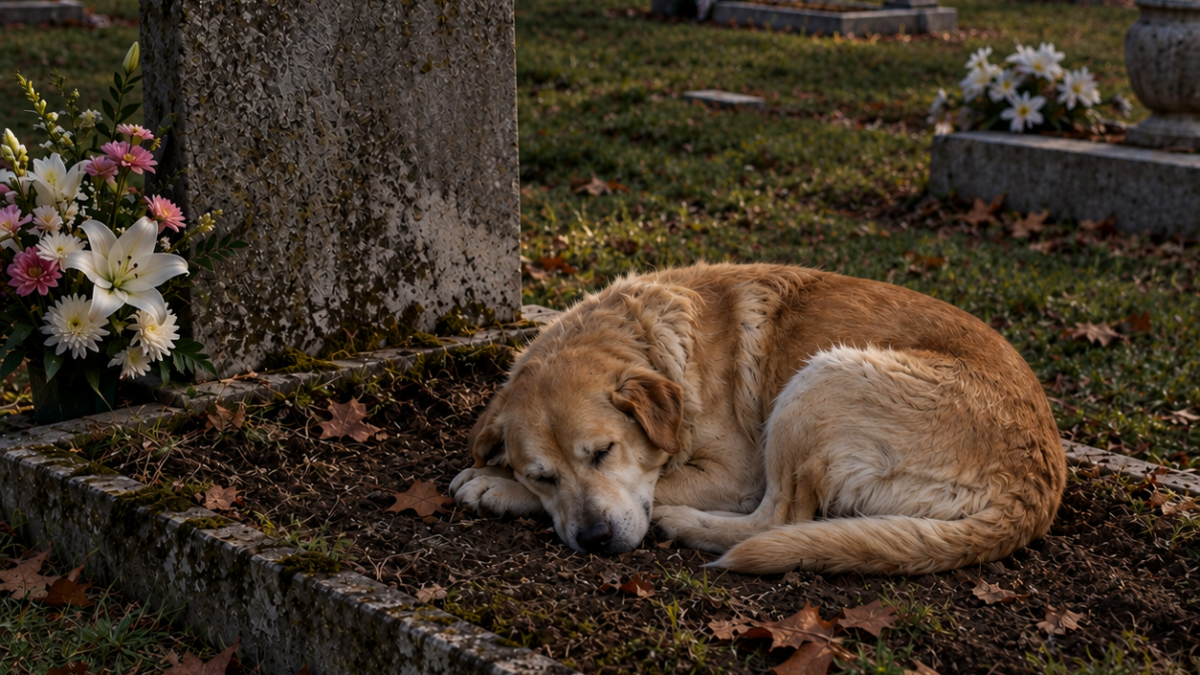
PART 2
Dad never admitted victory.
Neither did Mom.
That was marriage.
Noah’s relationship with my father became something all of us noticed but none of us ever fully understood.
He loved the rest of us.
He liked my mother.
He tolerated me.
He adored my sister Sofia.
But with my father, it was different.
Noah didn’t just love Dad.
He organized his life around him.
If Dad stood up, Noah stood up.
If Dad went into the backyard, Noah waited by the screen door.
If Dad sat in his old recliner after dinner, Noah lay beside it.
And every morning when Dad reached for the faded brown jacket hanging near the front door, Noah was already standing.
Church time.
That was what we called it.
“Your second parishioner is ready,” my mother would say.
Dad would scratch Noah behind the torn ear.
“Come on.”
They walked together.
Always.
There was one rule.
Noah never entered the church.
My father didn’t teach him that.
At least not intentionally.
The first time Dad brought him, Noah stopped at the steps.
Dad tried coaxing him.
“Come on.”
Noah sat.
My father pulled lightly on the leash.
Nothing.
So Dad tied the leash loosely to the railing.
The next day, same thing.
After a few weeks, he stopped using the leash.
Noah would walk to the church, lie near the entrance, and wait.
Forty minutes.
An hour.
Sometimes longer.
People stepped around him.
Children petted him.
The priest eventually started keeping a bowl of water near the side door.
But Noah never crossed the threshold.
He waited for my father.
That was enough.
Years passed that way.
Routine became family history.
When Dad left for church, nobody asked where he was going.
When Noah stood by the door at six-thirty every evening, we knew why.
Sometimes I teased my father.
“You know that dog is more religious than I am.”
Dad smiled.
“Noah is more patient than you are.”
“That’s not difficult.”
“No.”
My mother laughed from the kitchen.
Those are the conversations you don’t know you’ll miss while they’re happening.
That is one of the cruelties of losing someone.
The ordinary things become sacred only after you no longer get them.
My father’s illness came fast.
Too fast.
One week he was walking to church twice a day.
The next he was in a hospital bed.
At first we thought it was pneumonia.
Then the doctors started using words that made the room feel smaller.
Complications.
Organ function.
Rapid decline.
Monitoring.
Possibly.
We need to prepare.
I hated every one of those words.
Dad hated the hospital.
Not dramatically.
He simply kept asking when he could go home.
On the second day, he told my mother, “Noah needs his evening walk.”
She looked away.
“I know.”
“He waits.”
“I know.”
Dad noticed her face.
“Maria.”
She took his hand.
“Daniel, stop worrying about the dog.”
He smiled faintly.
“I’m not worried about him.”
“Then what?”
“He’s worried about me.”
My mother cried.
Dad did not.
At least not then.
I stayed with him that night.
Around two in the morning, he woke and asked the time.
“Two-ten.”
“Morning?”
“Technically.”
He closed his eyes.
“Church in four hours.”
“Dad.”
“I know.”
I moved my chair closer.
For a while, neither of us spoke.
Then he said, “You know what I like about that dog?”
I smiled.
“There are several hundred answers.”
“He never asks where I’m going.”
“What?”
“Noah.”
He opened his eyes.
“He just comes.”
I didn’t understand why that mattered.
Not then.
Dad continued.
“People always want explanations before they trust you. Dogs don’t.”
“That’s because dogs are bad at questions.”
He laughed.
A weak laugh.
But a real one.
Then his face became serious.
“If something happens—”
“No.”
“Lucas.”
“No.”
“Listen.”
I hated him for sounding like a father.
Even there.
Even sick.
“Take care of your mother.”
I looked at the floor.
“And Noah.”
My throat tightened.
“He’ll be fine.”
Dad watched me.
“No.”
He knew the dog better than any of us.
“He won’t understand.”
I swallowed.
“What am I supposed to tell him?”
Dad’s eyes softened.
“The truth.”
I almost laughed bitterly.
“He’s a dog.”
“Exactly.”
I looked at him.
“What does that mean?”
“It means he won’t need all the words you think you do.”
Dad closed his eyes again.
That was the last real conversation we had.
The following afternoon, his condition deteriorated.
By evening, all of us were there.
My mother held his left hand.
Sofia held the right.
I stood at the foot of the bed because I didn’t know where else to stand.
My father died just after eight.
Quietly.
No dramatic final sentence.
No cinematic last breath.
His chest rose.
Fell.
Then didn’t rise again.
That was it.
One moment my father was in the room.
The next, we were standing beside his body trying to understand how something so enormous could happen without the walls moving.
My mother made a sound I had never heard from her before.
Sofia folded into my arms.
I stared at my father’s feet under the hospital blanket.
All I could think was:
He was supposed to walk to church tonight.
Grief is stupid like that.
It chooses details.
The next thing I remember clearly is going home.
Noah was at the front door.
The second it opened, he looked past me.
Then behind me.
Then outside.
His tail moved once.
He waited.
“Noah.”
He stared at the driveway.
My mother entered behind me.
Noah looked at her.
Then at the empty space where Dad should have been.
Mom covered her mouth.
“Oh, God.”
Noah walked around us.
Out onto the porch.
He stood there for perhaps thirty seconds.
Then returned inside.
He went directly to my father’s chair.
Sniffed it.
Circled once.
Lay down.
That was when my mother lost control again.
She sat on the floor beside him.
Noah put his head in her lap.
Neither of them moved for a long time.
The next morning, at six-thirty, Noah stood by the door.
I was drinking coffee in the kitchen.
Mom saw him first.
“No.”
Her voice broke.
Noah looked at the door.
Church time.
I walked over.
“Not today.”
He wagged faintly.
I touched his head.
“No.”
He stood there another ten minutes.
Then went to Dad’s chair.
The evening was worse.
Same time.
Same door.
Same waiting.
My father had built his life out of routines, and Noah had memorized every one of them.
Now the routine remained.
The man didn’t.
The funeral was three days later.
St. Matthew’s was full.
Dad had apparently known far more people than I realized.
Mechanics.
Teachers.
Retired men from the neighborhood.
Families from church.
People I had never seen.
One woman told me Dad had secretly paid her electric bill when her husband was ill.
A young man said Dad had helped him get sober.
Someone else told me my father drove her mother to chemotherapy for four months and never mentioned it.
By the time the service began, grief had changed.
It wasn’t smaller.
It had multiplied.
Every stranger carried a version of my father I hadn’t known.
The priest spoke about faithfulness.
I barely heard.
I watched my mother.
She stared at the casket.
Sofia cried silently beside her.
At some point, my eyes moved toward the church entrance.
For one second, I thought I saw something outside.
Brown.
White.
Then people moved.
I told myself it was nothing.
After the service, we walked behind the casket toward the cemetery beside the church.
It was a small cemetery, older than almost every building around it.
My father had chosen a plot there years earlier.
Mom used to scold him for talking about death.
“Planning is not dying,” he always said.
Now I hated him for being right.
The burial itself passed like fog.
A prayer.
Dirt.
Flowers.
Hands on shoulders.
People saying things I knew were kind but couldn’t absorb.
Then, as the crowd began thinning, Sofia grabbed my arm.
“Lucas.”
“What?”
She pointed.
Near the far side of the cemetery, between two rows of graves, Noah was walking toward us.
I froze.
“What the hell?”
My mother turned.
Her hand flew to her mouth.
Noah kept coming.
No leash.
No collar.
Just walking.
“Isn’t that Dad’s dog?” someone whispered.
“He’s been around since before the service ended,” another person said.
I stared.
“You saw him?”
The man nodded.
“Near the church steps.”
Noah passed everyone.
He didn’t greet me.
Didn’t go to Mom.
He went straight to the grave.
Straight.
No confusion.
No searching.
He stepped onto the fresh earth.
Sniffed once.
Then lay down.
His chest settled over the dirt.
His head rested on his paws.
The cemetery became silent.
I mean truly silent.
A place filled with nearly a hundred grieving people suddenly had no sound except wind moving through trees.
Then Noah made a low noise.
Not a bark.
Not exactly a whine.
Something between the two.
My mother folded against me.
“Oh, Daniel.”
A woman nearby started crying.
Then another.
I felt my own throat close.
“Noah.”
He didn’t move.
I stepped closer.
“Come here.”
Nothing.
I crouched beside the grave.
“Noah.”
His eyes lifted to mine.
And I swear to you, there was recognition there.
Not of death.
I won’t pretend I know what dogs understand about death.
But he knew absence.
He knew scent.
He knew routine had broken.
And somehow, Noah knew my father was beneath him.
I reached for his collar.
He let me touch him.
But when I gently pulled, his body became heavy.
Not aggressive.
Not afraid.
Refusing.
My mother touched my shoulder.
“Leave him.”
“Mom.”
“Leave him.”
I looked at her.
Her face was wet with tears.
“Just for now.”
So we did.
We left food nearby.
Water.
The priest promised to keep an eye on him.
I took my mother home.
Noah stayed.
At sunset, I drove back.
He was still there.
I walked across the cemetery alone.
“Noah.”
His tail moved once.
“That’s enough.”
I crouched.
“You need to eat.”
He had eaten some of the food.
Good.
“You need to come home.”
Noah looked toward the church.
Then back at the grave.
I sat beside him.
“You know he’s not coming out of there.”
The words sounded cruel the moment I said them.
But Dad had told me to tell him the truth.
I touched Noah’s back.
“He’s gone.”
Noah lowered his head.
I sat there until dark.
Finally, I managed to get him into my car.
He didn’t fight.
At home, he slept beside my father’s chair.
I thought maybe that was the end of it.
It wasn’t.
The next morning, Noah was gone.
The backyard gate was closed.
No broken fence.
No obvious way out.
We found him at the cemetery.
The groundskeeper called me.
“Mr. Costa?”
“Yes.”
“Your dog is here.”
“He’s not my dog.”
The words came out automatically.
Then I stopped.
The man hesitated.
“Daniel’s dog.”
“Yeah.”
“He’s at the grave.”
I closed my eyes.
“I’m coming.”
By the time I arrived, Noah had moved.
He was sitting on the church steps.
Exactly where he used to wait.
The groundskeeper, a broad-shouldered man named Henry, stood nearby holding a rake.
“He’s been here since before sunrise.”
“How do you know?”
“I start at five-thirty.”
He pointed.
“Dog was already lying on the grave when I came in.”
I looked at Noah.
“Then?”
“Around six-thirty, he walked over here.”
Six-thirty.
My father’s morning prayer time.
My skin went cold.
“How long did he stay?”
“Until around seven-fifteen.”
That was about how long Dad usually stayed inside.
Henry continued.
“Then he went back to the grave.”
I couldn’t speak.
“He’s waiting for him,” Henry said quietly.
“No.”
I hated the sentence.
“He can’t be.”
Henry looked at me.
“I don’t know what else you’d call it.”
I walked toward Noah.
He stood.
For one hopeful second, his tail moved.
Then he looked behind me.
Checking.
My chest hurt.
“No, buddy.”
He sat again.
That routine continued.
Every morning.
Every evening.
Before sunrise, Noah came to the grave.
Then, at the hour my father used to enter the church, he moved to the steps.
He waited.
At approximately the time Dad normally finished praying, Noah returned to the cemetery.
At first, I thought somebody must be bringing him.
Nobody was.
I checked.
He was slipping out of my mother’s yard through a gap behind an old storage shed, walking more than three blocks alone, and arriving exactly where he wanted to be.
We blocked the gap.
Noah dug under the fence.
We repaired that.
He squeezed through a place near the gate.
We reinforced it.
He stopped eating.
That scared us more.
Not completely.
But enough.
He paced.
Whined.
Stared toward the street.
My mother finally said, “Open the gate.”
“Mom.”
“Open it.”
“He can get hit by a car.”
“Then walk with him.”
So I did.
The next morning at six-fifteen, Noah stood by the door.
I put on my jacket.
“Fine.”
His tail moved.
We walked.
He knew every turn.
At the church, he stopped.
I thought he might wait for me.
He didn’t.
He went directly to the grave.
Lay down.
I stood several feet away.
People started learning his routine.
At first it was only church members.
Then neighbors.
A woman who walked every morning began leaving water.
Henry brought a stainless-steel bowl.
The priest, Father Thomas, started putting food near the side entrance.
“You’re encouraging him,” I told him.
Father Thomas smiled.
“I’m feeding him.”
“He needs to come home.”
“Does he?”
I frowned.
“He’s a dog.”
“Yes.”
“He needs stability.”
Father Thomas looked toward the cemetery.
“Perhaps this is stability.”
I hated that answer because part of me knew he was right.
Noah’s world had been built around my father.
Home wasn’t only the house.
Home was the walk.
The church.
The steps.
The grave.
The places where Daniel still made sense.
About two weeks after the funeral, a video appeared online.
I didn’t know about it until Sofia sent it to me.
It showed Henry standing beside me near the church.
Someone had recorded part of our conversation.
“He comes here every morning,” Henry said in the clip. “Before sunrise. He stays at the grave, then he walks over to the church steps and waits. Same time every day.”
The camera moved toward Noah.
He was lying beside Dad’s grave.
The caption said:
Dog Still Waits for Owner Who Died.
I hated it.
Immediately.
I called Sofia.
“Who posted this?”
“I don’t know.”
“Take it down.”
“I can’t take down someone else’s post.”
“This isn’t entertainment.”
“I know.”
“People are going to treat him like some circus thing.”
“Lucas.”
“No.”
My anger surprised me.
Maybe because grief was easier when it had a target.
“My father died. The dog is confused. That’s not content.”
Sofia stayed quiet.
Then said, “I think people are moved.”
“I don’t care.”
But people were.
The video spread.
First locally.
Then farther.
Visitors started coming.
Most were respectful.
A few weren’t.
One woman tried getting Noah to look at her camera.
Another brought her child too close while he was sleeping.
I snapped.
“Back up.”
She looked offended.
“He’s famous.”
“He’s grieving.”
“He’s a dog.”
I stared at her.
“Exactly.”
Something in my voice made her leave.
After that, Father Thomas placed a small sign near the cemetery entrance.
Please give Noah space. Food and water are provided. Quiet visitors welcome.
That helped.
The church arranged a simple covered shelter near the grave.
Not directly on it.
A few yards away.
Wooden roof.
Raised platform.
Blanket.
A volunteer built it.
Another painted it.
Henry added a water bowl.
My mother brought one of Dad’s old shirts.
She folded it and placed it on the bed.
Noah sniffed it.
Then lay down on top of it.
Mom cried all the way home.
For a while, I fought the whole thing.
I kept trying to solve Noah.
That’s how I thought of it.
Solve him.
Bring him home.
Restore normal life.
Make him stop waiting.
Because watching him wait was unbearable.
Every day felt like proof that none of us knew how to move forward.
Then one Saturday, I decided I was done.
“Noah’s coming with me.”
My mother looked up from the kitchen table.
“He comes with you every day.”
“No. Home with me.”
She studied my face.
I lived about twenty minutes away.
House.
Fenced yard.
Quiet neighborhood.
It made sense.
“He can stay with me for a while.”
Mom sighed.
“Lucas.”
“He cannot live in a cemetery.”
“He doesn’t live there.”
“He sleeps there half the day.”
“He comes back here at night.”
“Sometimes.”
She looked tired.
“He’s eating.”
“That’s not the point.”
“What is?”
I didn’t know.
Maybe the point was that I wanted control over something.
Dad had died too fast.
Mom was shattered.
Noah kept returning to the grave.
I wanted one thing to obey logic.
“He needs to accept it.”
Mom looked at me for a long time.
Then she said, “Do you?”
That stopped me.
“This isn’t about me.”
“It is partly.”
“No.”
“Yes.”
I stood.
“Fine.”
I took Noah with me anyway.
He came willingly.
That made me hopeful.
He sat in the passenger seat.
Head near the window.
Tail moving when I spoke.
At my house, he explored the yard.
Ate dinner.
Lay near the couch.
For two hours, everything seemed normal.
Then sunset approached.
Noah stood.
Went to the door.
“No.”
He looked at me.
“Not tonight.”
He paced.
I ignored him.
He whined.
I put on the television.
He scratched at the door.
“Noah.”
He looked at me.
Then toward the street.
“Stop.”
His breathing changed.
He became restless.
Not panicked.
Determined.
Finally I grabbed the leash.
“Fine. Walk.”
I took him around the neighborhood.
He kept pulling one direction.
Toward town.
Toward the church.
I turned him back.
At home, he refused to settle.
Around nine, I thought he had finally given up.
I opened the back door to take out trash.
That was my mistake.
Noah shot past me.
“Noah!”
He ran.
I followed.
“NOAH!”
He reached my driveway.
I got to him just as a car passed.
I grabbed his collar.
My heart was pounding.
“What is wrong with you?”
He twisted.
Not biting.
Not fighting me.
Trying to continue.
I pulled him toward the house.
“No.”
He looked straight down the road.
I saw something in his face that made me stop.
He knew where he wanted to go.
This wasn’t confusion.
Not anymore.
The next morning, I drove him to the cemetery.
The second I opened the car door, he jumped out.
Ran to the grave.
Lay down.
I stood behind him feeling defeated.
My mother arrived ten minutes later.
She walked beside me.
“Tried?”
I nodded.
“He nearly ran into traffic.”
She looked at Noah.
“I told him Dad’s gone.”
Mom put one hand on my arm.
“He knows.”
“No, he doesn’t.”
“I think he does.”
“Then why keep coming?”
She watched Noah.
“Because knowing someone is gone and stopping loving them are not the same thing.”
I looked away.
Mom continued quietly.
“He isn’t waiting for your father to come back.”
“How do you know?”
“I don’t.”
She took a breath.
“But maybe we’ve misunderstood him.”
I looked at her.
She said the words I would remember for the rest of my life.
“Let him be, Lucas. He’s not waiting for someone who’s gone. He’s staying for someone he loved.”
I didn’t answer.
“Some bonds don’t end when a life does.”
The anger drained out of me.
Not all at once.
But enough.
I sat beside Noah.
For the first time, I stopped trying to move him.
That changed everything.
I started going with him.
Not every day.
But often.
I would arrive with coffee before sunrise.
Noah would be at the grave.
Around six-thirty, he would stand.
Walk to the church.
Lie on the steps.
At first, watching that routine tore me apart.
Then something strange happened.
I began using it.
While Noah waited, I went inside.
I hadn’t been to church regularly in years.
Dad never pressured me.
Maybe that was why I felt guilty about it.
The first morning I entered, Father Thomas saw me.
He smiled but didn’t say anything.
I sat in the back.
Exactly where Dad used to sit.
I knew because I had seen him there at funerals and holidays.
A wooden pew.
Third row from the rear.
Left side.
There was a small scratch in the varnish near the edge.
I put my hand on it.
For forty minutes, I did nothing.
No revelation.
No voice.
No sudden peace.
I just sat.
Then I walked outside.
Noah stood.
For one second, his tail moved the way it had when Dad came through those doors.
He walked toward me.
Stopped.
Then looked behind me.
The old habit.
But weaker now.
I knelt.
“He’s not there.”
Noah came closer.
I touched his neck.
“But I am.”
That morning, we walked home together.
It became another routine.
A different one.
Noah still went to the cemetery.
But sometimes I joined him.
Then church.
Then coffee with Henry.
Sometimes my mother came.
Sometimes Sofia.
People still visited Noah.
But over time, the spectacle faded.
That was good.
A few people continued leaving flowers.
A little girl brought a drawing of Noah and Dad walking toward church.
A veteran from another town drove two hours just to leave a dog biscuit and sit quietly near the grave.
A widow told my mother, “My husband’s dog waited by his truck for months after he died.”
People brought their own grief.
That was what I eventually understood.
They weren’t really coming for Noah.
Not entirely.
They were coming because Noah gave shape to something they couldn’t explain.
How do you keep loving someone who is no longer physically present?
Humans build monuments.
Keep photographs.
Wear wedding rings after spouses die.
Leave voicemail recordings saved for years.
Dogs return to graves.
Different language.
Same question.
What do I do with love that has nowhere to go?
Noah had an answer.
Stay.
So people sat with him.
Quietly.
Father Thomas eventually started calling the area near the grave “Daniel’s Corner.”
Mom hated that.
“Your father would have hated that.”
I laughed.
“He would have charged rent.”
She smiled.
That was one of the first real smiles after he died.
Noah did something else for us.
He forced us to speak about Dad.
Not only the death.
The life.
That distinction saved us.
For the first months, every memory ended at the hospital.
Daniel was sick.
Daniel died.
Daniel’s funeral.
Daniel’s grave.
Noah pulled us backward.
To walks.
To church.
To toast.
To the stupid coffee pot.
To bananas.
To the time Dad tried fixing the bathroom sink and flooded the floor.
To Christmas when Noah stole an entire roast and Dad insisted the dog “looked remorseful.”
“He did not,” Mom said.
“He was hiding under the table,” Sofia said.
“Because Dad was yelling.”
“He wasn’t yelling.”
“He shouted, ‘That was forty dollars!’”
Mom laughed.
Real laughter.
Noah, lying near Dad’s chair, lifted his head.
For a moment, we were a family remembering.
Not a family losing.
A year passed.
On the anniversary of Dad’s death, I expected everything to feel unbearable again.
In some ways, it did.
We met at the cemetery early.
Mom brought flowers.
Sofia brought coffee.
I brought Noah.
Not that he needed bringing.
He was already halfway to the church before I clipped the leash.
At the grave, Noah lay down.
His muzzle had started showing gray.
I hadn’t noticed until that morning.
“That’s new.”
Mom touched his face.
“He’s getting older.”
I hated hearing that.
Noah had become something permanent in my mind.
But nothing is.
That was the whole lesson.
We stood around the grave.
Nobody spoke for a while.
Then Mom said, “Your father would be embarrassed.”
Sofia laughed.
“By what?”
She pointed at the little shelter.
“The attention.”
I smiled.
“He’d say Noah is getting more visitors than he ever did.”
“He would be jealous.”
“No.”
Mom looked down.
“He’d be happy.”
That was true.
Dad loved the dog.
No conditions.
No ownership pride.
He would have wanted Noah safe.
And Noah was.
The church community had made sure of that.
Every morning there was food.
Fresh water.
Blankets in winter.
Shade in summer.
Veterinary care.
One parishioner paid for vaccines.
Another groomed him.
Henry built a wooden platform so rainwater wouldn’t reach the shelter.
We still brought Noah home regularly.
He slept at Mom’s house most nights.
But some nights he refused.
Especially around certain dates.
Dad’s birthday.
Their wedding anniversary.
Christmas Eve.
I know how that sounds.
Maybe coincidence.
Maybe scent.
Maybe schedule memory.
I stopped needing explanations.
Noah didn’t owe me science.
He was allowed his rituals.
The second year changed more than the first.
Noah no longer ran to the church steps every single morning.
Sometimes he stayed at the grave.
Sometimes he walked with me inside the church vestibule.
That shocked everyone.
The first time it happened, I was opening the heavy door when Noah followed.
One paw over the threshold.
Then another.
I froze.
“You know you’re breaking a seven-year rule.”
He sniffed the floor.
Father Thomas looked up from across the aisle.
“Well.”
Noah stopped.
For several seconds, he stared down the nave.
Not frightened.
Not excited.
Then he walked three steps inside.
Stopped.
Turned around.
Went back outside.
Father Thomas smiled.
“Progress?”
I wasn’t sure.
Maybe.
Or maybe Noah had finally understood that Dad wasn’t in there.
The next day, he remained outside.
That felt right too.
By the third year, people in town barely remembered a time before Noah belonged to the church.
Children knew him.
Mail carriers carried biscuits.
Visitors asked Henry if “the cemetery dog” was around.
I hated that name less than I expected.
He had become part of the place.
Not trapped there.
Part of it.
He still loved walks.
Still chased squirrels badly.
Still rolled in disgusting things whenever given the opportunity.
Still stole food.
Still barked at delivery trucks.
Grief had not turned him into a symbol twenty-four hours a day.
He remained a dog.
That mattered.
Sometimes strangers romanticized him too much.
One woman said, “He must never be happy after losing Daniel.”
I corrected her.
“He’s happy all the time.”
She looked surprised.
“But he misses him.”
“Yes.”
Those things can coexist.
That became another lesson Noah taught me.
Grief is not the opposite of joy.
It lives beside it.
Noah could sleep at Dad’s grave at sunrise and chase a tennis ball at noon.
My mother could cry on their anniversary and laugh at dinner.
I could miss my father every day and still build a life.
Loyalty did not require permanent misery.
It required remembering.
When Noah was around ten or eleven, his body began slowing.
He had arthritis.
Nothing severe at first.
Medication helped.
We shortened walks.
Henry moved the water bowl closer.
I started driving him to the church on cold mornings.
Noah hated that.
He preferred walking.
“You are eighty in dog years,” I told him.
He stared at me.
“Fine. Seventy.”
No reaction.
“You look fantastic.”
Tail wag.
“Vain animal.”
He leaned against my leg.
One winter morning, he refused to get out of the car.
That scared me.
We were parked beside the cemetery.
Usually the door opened and Noah was already moving.
That day, he stayed curled on the blanket.
“Noah?”
His eyes opened.
Tail moved weakly.
I crouched beside him.
“You okay?”
He tried standing.
His back legs trembled.
I stopped him.
“No.”
We went to the vet instead.
Arthritis had worsened.
Some age-related kidney changes too.
Nothing immediately catastrophic.
But there it was.
Time.
Again.
Always time.
I hated it.
The vet said, “He may have another year. Maybe more. Maybe less.”
I almost laughed.
Humans love numbers when facing things numbers cannot fix.
I took Noah home.
For several days, he rested.
Then one morning, he walked to the front door.
Six-thirty.
I looked at the clock.
“You’re serious?”
Tail wag.
I clipped on the leash.
We walked slowly.
Very slowly.
The old three-block trip that once took ten minutes took almost thirty.
I tried turning back twice.
Noah refused.
At the church, he went directly to Dad’s grave.
He lay down.
I sat beside him.
“You made it.”
His head rested against my shoe.
The sun rose.
For a while, neither of us moved.
I thought about Dad’s final words.
“He won’t understand.”
Maybe Dad had been wrong.
Or maybe I had misunderstood what he meant.
Noah understood absence in his own way.
What he didn’t understand was abandoning love simply because the person attached to it had died.
Neither did I anymore.
That morning, Father Thomas came outside.
He was older too.
We all were.
He stood beside me.
“How is he?”
“Slowing down.”
He nodded.
“Still coming.”
“Always.”
Father Thomas looked at the grave.
“Your father would be proud of you.”
I shook my head.
“For bringing the dog?”
“For finally sitting still.”
I laughed.
“That’s insulting.”
“It was meant kindly.”
I looked at Noah.
Maybe he was right.
For most of my life, I had tried solving things through movement.
Work.
Plans.
Tasks.
Fixing.
My father had known how to sit.
Pray.
Wait.
Noah knew too.
I was the slow learner.
That spring, Noah stopped sleeping at the cemetery overnight entirely.
He preferred Mom’s house.
He still visited every morning when his body allowed.
If not, we drove.
He would step out carefully.
Walk to the grave.
Lie down.
Then come home.
The routine had changed.
But not disappeared.
Then came the morning he didn’t want breakfast.
Anyone who knows old dogs understands the fear.
Noah loved food.
He had built an entire criminal career around stealing it.
I put chicken in his bowl.
Nothing.
Cheese.
Nothing.
He drank water.
Then lay down.
I called the vet.
Tests showed his kidneys had worsened significantly.
Treatment helped for a while.
A few weeks.
Then another decline.
One evening, I sat beside him at Mom’s house.
His breathing was slow.
Mom rubbed his back.
“He’s tired.”
“No.”
She looked at me.
“Lucas.”
“No.”
I hated that voice.
The same calm voice doctors used with Dad.
“We can change medication.”
“We already did.”
“He ate yesterday.”
“A little.”
“He walked.”
“To the mailbox.”
“He can recover.”
Mom said nothing.
That silence enraged me.
“Don’t.”
“Don’t what?”
“Give up.”
Her face changed.
“I am not giving up.”
“That’s what this sounds like.”
She looked at Noah.
Then at me.
“You did this with your father.”
I froze.
“What?”
“You kept asking for one more treatment.”
I stood.
“Because he was sick.”
“Yes.”
“And you wanted a different answer.”
I stared at her.
Mom’s eyes filled.
“So did I.”
The anger disappeared.
She reached for my hand.
“Sometimes loving someone means fighting for them.”
She looked at Noah.
“And sometimes it means noticing when they’re done fighting.”
I sat again.
Noah lifted his head.
Barely.
His eyes found mine.
“Not yet,” I whispered.
Mom didn’t argue.
The next morning, Noah surprised us.
He stood.
Ate half a bowl.
Walked to the door.
Six-thirty.
Mom looked at me.
I looked at Noah.
“You want to go.”
His tail moved.
So we went.
I drove.
At the church, Noah climbed out slowly.
Henry saw us.
He stopped working.
Father Thomas came outside.
Nobody had called them.
Maybe they just knew.
Noah walked toward the grave.
Slow step.
Pause.
Another.
I stayed beside him but did not touch.
He reached the fresh green grass covering Dad’s plot.
The dirt mound had long ago flattened.
The headstone stood simple and gray.
DANIEL COSTA
Below his name:
Faithful in small things.
Mom chose that.
It fit.
Noah sniffed the base of the stone.
Then lay down.
Exactly where he had lain years earlier after the funeral.
My throat closed.
Mom arrived behind me.
She sat carefully on the grass.
Sofia came fifteen minutes later.
Henry stood at a distance.
Father Thomas remained near the church.
Noah placed his head on his paws.
The sun rose higher.
People began arriving for morning prayer.
They saw us and entered quietly.
Nobody approached.
Around seven-fifteen, Noah lifted his head.
He looked toward the church doors.
For years, that had been the moment he stood and waited.
This time, he remained lying down.
I touched his back.
“You don’t need to.”
His eyes turned toward me.
“You waited long enough.”
Mom started crying.
I kept going because once I started, I knew I had to finish.
“He’s not coming through that door.”
Noah breathed slowly.
“But you knew that, didn’t you?”
His tail moved once.
Maybe I imagined it.
I don’t care.
I put my forehead against his.
“Dad loved you.”
My voice broke.
“So do we.”
Noah closed his eyes.
He slept there for almost an hour.
Then we brought him home.
The vet came that afternoon.
Not because Noah was in immediate distress.
Because I finally understood.
His body was failing.
His good moments were becoming shorter.
His discomfort longer.
I did not want his final memory to be emergency lights.
A metal table.
Panic.
So we planned.
That word again.
Dad would have approved.
We decided that when the time came, Noah would be at home.
But Noah had one more decision to make for us.
Two days later, before dawn, he stood up by himself.
Barely.
Walked to the door.
Mom called me.
“He wants to go.”
I drove over immediately.
Noah was standing beside Dad’s old brown jacket.
The jacket still hung on the same hook.
My mother had never moved it.
Noah sniffed it.
Then looked at me.
I knew.
“No.”
I said it before anything happened.
Mom whispered, “Lucas.”
“He can’t walk there.”
“Then drive him.”
We wrapped him in a blanket.
I carried him to the car.
He was lighter than I remembered.
Old dogs do that.
They become themselves in smaller form.
We drove to St. Matthew’s.
Dark sky.
Empty roads.
Noah lay beside me.
When we reached the cemetery, I opened the door.
He tried getting up.
His legs failed.
I carried him.
For once, he didn’t object.
We crossed the grass.
I placed him beside my father’s grave.
Noah sighed.
Mom sat on one side.
I sat on the other.
The sky slowly changed from black to gray.
At six-thirty, church bells rang.
Noah’s ear moved.
That torn ear.
The one Dad used to scratch.
I smiled through tears.
“You heard that.”
His eyes opened.
He looked toward the church.
Then at me.
I thought about the thousands of mornings he had walked this route.
Young.
Strong.
Following Dad.
Then alone.
Then with me.
Years of waiting.
Years of staying.
I touched his chest.
“Noah.”
His breathing was shallow.
“You don’t have to wait anymore.”
Mom covered her face.
I kept my hand on him.
“He’s not coming out.”
Noah exhaled.
“I know you know.”
The sun touched the top of the church roof.
“You did your job.”
Another breath.
“You stayed.”
His eyes remained on mine.
“You stayed longer than anyone asked you to.”
My voice disappeared for a second.
Then returned.
“So now we stay with you.”
That was the promise.
Dad had not died alone.
Neither would Noah.
We sat beside him as morning came.
At some point, Father Thomas appeared.
He did not speak.
Henry came too.
Then Sofia.
No calls.
No messages.
People simply noticed.
The little group grew.
Not large.
Not dramatic.
Those who knew Noah best.
The veterinarian arrived just after seven.
She knelt.
Checked him.
Looked at me.
We both knew.
Noah was already slipping away.
There would be no intervention.
No rushed treatment.
No fear.
He was comfortable.
So we waited.
Noah’s head rested against the grass covering my father’s grave.
My mother rubbed his shoulder.
I scratched behind his torn ear.
Exactly where Dad always had.
His breathing slowed.
Once.
Twice.
Then there was a long pause.
Noah opened his eyes.
For the last time, he looked toward the church doors.
Then at us.
And exhaled.
That was it.
No dramatic sound.
No struggle.
He simply stopped.
The way my father had.
Quietly.
My hand remained on his fur.
I didn’t cry immediately.
I felt relief first.
Then guilt for feeling relief.
Then grief.
Then something else.
Completion.
That is the only word I have.
Noah had spent years returning to that place.
Not because he failed to understand death.
Because he understood loyalty in a way most of us spend entire lives trying to learn.
He stayed until staying was finished.
My mother leaned forward and kissed his head.
“You can go with him now.”
That destroyed me.
I cried harder than I had at my father’s funeral.
Maybe because grief had finally closed a circle.
Father Thomas placed one hand on my shoulder.
Nobody said anything.
There was nothing left to explain.
The church asked permission to bury Noah near Dad.
There were rules.
Cemetery regulations.
Technical issues.
So we couldn’t place him directly beside the grave.
Instead, with permission from the parish, we buried his ashes beneath the tree near the little shelter the congregation had built for him.
Close enough that from Dad’s headstone, you could see it.
Henry made a small marker.
Nothing elaborate.
It read:
NOAH
HE STAYED.
That was all.
I thought it was perfect.
After Noah died, people continued visiting.
Not crowds.
Not anymore.
Occasional strangers who remembered the story.
Children.
Dog owners.
People grieving someone.
The shelter beside the grave eventually came down.
Weather had damaged it.
We replaced it with a bench.
My mother wanted something useful.
Dad would have approved.
The plaque on the bench reads:
For those who wait, those who remember, and those who stay.
Sometimes I sit there.
Years have passed now.
My mother is older.
Sofia has children.
I have a daughter who knows Grandpa Daniel only through stories.
She knows Noah through even more stories.
Once, when she was seven, she asked me:
“Did Noah think Grandpa was coming back?”
I almost gave her the simple answer.
No.
Then I thought about it.
“I don’t know.”
She frowned.
“But you said he waited.”
“He did.”
“For Grandpa?”
“Yes.”
“So he thought he was coming back.”
“Maybe at first.”
“And later?”
I looked toward the church steps.
“Later I think waiting became something else.”
“What?”
“Remembering.”
She considered that.
Then nodded as if it were obvious.
Children are sometimes smarter about grief than adults.
One Sunday, she ran her fingers across Noah’s marker.
HE STAYED.
“What does that mean?”
I smiled.
“It means when Grandpa disappeared, Noah didn’t forget him.”
“Dogs don’t forget.”
“No.”
She looked at me.
“People do.”
I laughed softly.
“Sometimes.”
“Did you?”
The question landed harder than she knew.
“No.”
She took my hand.
“Good.”
We walked into church.
Years ago, Noah never crossed that doorway.
Now every time I enter, I still glance toward the steps.
Habit.
Memory.
Love.
Call it whatever you want.
I eventually understood something my father had tried telling me in that hospital room.
He said dogs don’t need explanations before they trust you.
Noah never needed us to explain death perfectly.
He didn’t need theology.
He didn’t need promises about heaven.
He needed a place to put his love.
So he placed it where my father had been.
At the grave.
At the church.
In the old routines.
And little by little, the rest of us did the same.
Noah did not make grief disappear.
He gave it somewhere to sit.
That may be why his story reached so many people.
Not because dogs are magical.
Not because he possessed some supernatural understanding.
Because everyone who has loved deeply recognizes the instinct.
When someone dies, the world tells you to move on.
But your body keeps expecting them.
You hear a car and think they’re home.
You reach for the phone.
You buy their favorite food by accident.
You turn toward an empty chair.
You look at a church door.
You wait.
Eventually, you learn that moving forward does not require leaving them behind.
Noah taught me that.
He kept going to the cemetery.
But he still ate.
Played.
Slept.
Loved us.
Chased squirrels.
Stole food.
Rolled in mud.
He carried grief and life together.
That was his gift.
My father was right about faithfulness.
It is rarely one dramatic act.
It is mostly small things repeated.
Morning walks.
Evening walks.
Waiting on steps.
Returning to a grave.
Feeding a dog.
Holding a hand.
Showing up.
Staying.
The last time I saw my father alive, he asked me to take care of Noah because he said the dog wouldn’t understand.
For years, I thought that meant Noah needed me.
Looking back, I think it was the other way around.
I was the one who didn’t understand.
I didn’t understand how to grieve without fighting grief.
How to miss someone without demanding the pain stop.
How to accept that love can continue after the person is gone.
Noah taught me.
The dog Dad rescued from a drainage ditch ended up rescuing all of us.
Not with anything heroic.
He just kept showing up.
Every morning.
Every evening.
Until eventually, so did I.
And that is why, all these years later, when I pass St. Matthew’s before sunrise, I still sometimes slow down.
The steps are empty now.
The grave is quiet.
The old tree beside Noah’s marker has grown tall enough to shade the bench.
Nothing moves except leaves.
But in my mind, I can still see them.
My father walking slowly toward the church in his brown jacket.
Noah beside him.
Dad reaches the steps.
Noah lies down.
Dad looks back once.
“Wait for me.”
Then he goes inside.
For years, Noah did exactly that.
And when his own time came, we were finally wise enough to understand what loyalty had been telling us all along.
Love does not always know how to leave.
Sometimes it stays by a doorway.
Sometimes beside a grave.
Sometimes inside an old house where a coat still hangs by the door.
And sometimes, long after the footsteps are gone, it becomes the path the rest of us use to find our way home.
Years after Noah died, I still found myself taking the long way home just so I could pass St. Matthew’s.
I told myself it was habit.
That wasn’t true.
Habits are things you do without thinking.
I thought about that road every single time.
I thought about the church steps where Noah had waited through summer heat, winter frost, rain, wind, and thousands of ordinary mornings for a man who would never walk through those doors again.
I thought about the cemetery behind the church.
My father beneath the grass.
Noah’s ashes beneath the tree nearby.
And the bench that now stood between them.
For those who wait, those who remember, and those who stay.
I had read those words so many times that I no longer needed to look at the plaque.
Still, whenever I visited, I ran my fingers over the letters.
Maybe that was my version of Noah lying on the grave.
A ritual doesn’t have to make sense to anyone else.
It only has to carry something you don’t know where else to put.
One autumn morning, almost six years after Noah died, I drove to St. Matthew’s before sunrise.
I wasn’t planning to stay long.
My mother had a doctor’s appointment later that morning, and Sofia had asked me to pick up something for her children on the way home.
Life had become full again.
Not the same.
Never the same.
But full.
I parked beside the church.
The cemetery was covered in thin fog.
The old tree above Noah’s marker had grown enormous.
Its branches stretched halfway across the little path leading toward Dad’s grave.
I carried two coffees out of habit.
One for me.
One for—
I stopped.
For a few seconds, I stared at the second cup in my hand.
Dad had been gone for years.
Noah too.
Yet somewhere inside me, I had bought two coffees.
I laughed quietly.
“You guys are expensive even dead.”
The cemetery gave no answer.
I placed the extra cup on the bench.
Then I sat.
The sun had not yet broken over the horizon.
For a while, I watched the church doors.
The same doors Noah used to watch.
I tried imagining what it had felt like for him.
At first, probably expectation.
Any second now.
Daniel will come outside.
Then perhaps confusion.
Why is he late?
Then repetition.
Maybe today.
Maybe this morning.
Maybe tonight.
Eventually, I no longer believed Noah expected Dad to physically return.
I think the waiting itself became the connection.
That realization had changed the way I understood my own grief.
For years I thought healing meant stopping.
Stop checking Dad’s chair.
Stop hearing his voice.
Stop driving past the church.
Stop remembering what he ordered at restaurants.
Stop thinking about him whenever somebody opened a ridiculous steel coffee pot.
But grief doesn’t work like that.
Eventually, memory stops being a wound and becomes a room.
You enter it when you need to.
You sit down.
You stay awhile.
Then you walk back into your life.
Noah had understood that before I did.
Footsteps sounded behind me.
I turned.
An elderly man was walking slowly toward the bench.
He carried a cane in one hand.
In the other was the leash of an equally old golden retriever.
The dog’s muzzle was almost completely white.
“Mind if we sit?”
“Not at all.”
The man lowered himself carefully.
His dog settled beside his shoes.
For several minutes, neither of us spoke.
Then the man noticed Noah’s marker.
“Is this the dog?”
I smiled.
“You’ve heard about him?”
“My wife showed me the video years ago.”
He looked toward Dad’s headstone.
“The one who waited for his owner.”
“Yes.”
The man nodded.
“My wife loved that story.”
There was something in his voice.
Past tense.
I looked at him.
“She passed last winter.”
“I’m sorry.”
He shrugged in the way older men sometimes do when emotion becomes too large for speech.
The golden retriever put her head against his knee.
“My dog, Molly, kept sleeping on her side of the bed.”
I looked down.
Molly’s tail moved once.
“She still does?”
“Every night.”
He smiled sadly.
“I tried moving her bed.”
“Bad idea.”
“Terrible.”
We both laughed.
He stared toward the cemetery.
“My son keeps telling me to get rid of some of her things.”
“Your wife’s?”
“Yes.”
“He means well.”
“I know.”
“But?”
The man sighed.
“I’m not ready.”
I looked at Noah’s marker.
“You don’t have to be.”
He turned toward me.
For a second, I heard my mother’s voice from years earlier.
He’s not waiting for someone who’s gone. He’s staying for someone he loved.
I repeated something close to it.
“Keeping something doesn’t mean you believe the person is coming back.”
The old man’s eyes filled.
“It can just mean the love hasn’t disappeared.”
He nodded.
We sat together until sunrise.
Before he left, he touched Noah’s marker with the end of his cane.
“Good dog.”
Molly sniffed it.
Then they walked away.
I watched them go and realized that Noah was still doing what he had done while alive.
Giving people permission to grieve without embarrassment.
That afternoon, I told my mother.
She was sitting in her kitchen—the same kitchen where Noah once waited near the door for Dad’s evening walk.
She smiled.
“That dog always did like attention.”
I laughed.
“Mom.”
“What?”
“You used to defend him against everybody.”
“I can defend him and insult him. I’m family.”
Fair.
She poured tea.
Her hands shook slightly now.
Age.
Nothing severe.
But enough to remind me that loss never really stops teaching.
“You still miss Dad every day?” I asked.
Mom looked surprised.
“What kind of question is that?”
“I don’t know.”
She stirred sugar into her tea.
“Of course I do.”
“Does it hurt?”
She thought.
“Not the same.”
“How?”
She looked toward the window.
“At first, missing him felt like something had been cut away.”
Her fingers tightened around the cup.
“Now it feels more like carrying something.”
“Something heavy?”
“Sometimes.”
She smiled.
“Sometimes warm.”
I understood.
That evening, before I left, I noticed Dad’s old brown jacket still hanging beside the door.
The same one Noah had sniffed before his final trip to the church.
I touched the sleeve.
“Still here?”
Mom didn’t look over.
“It isn’t hurting anyone.”
“No.”
“And I like it there.”
I smiled.
“So did Noah.”
She laughed quietly.
“Your father hated that jacket.”
“That’s not true.”
“He refused to admit it was falling apart.”
“He called it broken in.”
“He looked homeless.”
“He was fashionable.”
Mom stared at me.
We both started laughing.
That was what grief had become after enough years.
Tears still came.
But laughter came with them.
Dad was no longer trapped inside the hospital room where he died.
He had returned to the kitchen.
The church.
The broken sink.
The stolen roast.
The stupid jacket.
That was healing.
Not forgetting the ending.
Remembering the rest.
A few months later, St. Matthew’s called me.
Father Thomas had retired.
The new priest wanted to renovate part of the cemetery path.
Nothing major.
Better accessibility.
More benches.
Improved drainage.
He wanted to know whether our family would object if Noah’s marker had to be moved several feet.
My first reaction surprised me.
“Yes.”
Immediate.
Sharp.
Then I stopped.
The new priest said, “Mr. Costa?”
“Sorry.”
I rubbed my forehead.
“I know this is irrational.”
“It isn’t.”
“It’s just a marker.”
“No.”
His voice was gentle.
“It’s not.”
That mattered.
We met at the cemetery the next day.
He showed me the plans.
Noah’s ashes would remain exactly where they were.
Only the small stone marker might need to shift about four feet to accommodate the path.
I stood beneath the tree.
For years, I had told myself Noah’s lesson was that love could survive change.
And now I was angry about moving a piece of stone.
I almost laughed.
“Move it.”
“You’re sure?”
“Yes.”
I looked at Dad’s grave.
“He won’t care.”
The priest smiled.
“You sound confident.”
“I knew the dog.”
The project took three weeks.
When it was finished, the cemetery looked better.
The path was wider.
Older visitors could reach the bench more easily.
Wheelchairs could move through without struggling over uneven ground.
Noah’s marker stood beneath the same tree, slightly farther left.
HE STAYED.
Same words.
New position.
Nothing essential lost.
That became another lesson.
Staying does not mean refusing all change.
Sometimes you move four feet and remain completely faithful.
I wish I had understood that earlier.
My daughter, Emma, grew up knowing those cemetery stories.
At first they were almost fairy tales to her.
Grandpa Daniel.
Noah.
The faithful dog.
The church.
She never knew either of them personally.
Yet somehow, both became part of her world.
When she was eleven, she came home from school one afternoon carrying a cardboard box.
I knew immediately this was going to cost me money.
“What’s in the box?”
“Nothing.”
The box moved.
“Emma.”
“Okay, technically not nothing.”
A nose appeared through the opening.
I closed my eyes.
“No.”
She looked offended.
“You haven’t even seen her.”
“I’ve seen enough.”
“She was behind the school.”
“Call animal control.”
“She’s scared.”
A small black-and-white dog stared at me from inside the box.
Too skinny.
Dirty.
One front paw scraped.
Wonderful.
History repeating itself.
“Emma.”
She held the box tighter.
“Grandpa rescued Noah.”
Cheap shot.
I pointed at her.
“Do not weaponize dead relatives.”
“Would Noah want us to leave her outside?”
“Also do not weaponize dead dogs.”
The puppy sneezed.
Emma smiled.
“You’re losing.”
“I know.”
We took her to a veterinarian.
No microchip.
No owner located.
Minor injuries.
Underweight.
Otherwise healthy.
We called her Grace.
Not my choice.
Emma insisted.
Grace stayed.
Of course she did.
The first time we took Grace to St. Matthew’s, she was still young enough to believe every leaf represented an emergency.
She pulled me across the cemetery.
Sniffed Dad’s grave.
Sniffed Noah’s marker.
Then urinated beside the bench.
Emma was horrified.
“Grace!”
I laughed so hard I had to sit down.
“What?”
“That is exactly the kind of respect Noah would have shown.”
“Dad!”
“He was a dog, Emma.”
She grabbed a bottle of water and tried washing the grass.
“Grandpa Daniel is judging us.”
“No.”
I looked at his headstone.
“He probably thinks this is funny.”
Grace eventually settled near Noah’s tree.
Not on his grave.
Not magically.
There was no cinematic recognition.
She simply lay down in the shade.
Emma sat beside her.
“You think Noah would like her?”
“Yes.”
“Really?”
“He liked almost everybody.”
“What about squirrels?”
“Fair point.”
Emma leaned against me.
“Do you think they’re together?”
I knew what she meant.
Dad.
Noah.
I could have given her theology.
I could have given her uncertainty.
Instead I said:
“I hope so.”
She nodded.
“Me too.”
Sometimes hope is the most honest answer available.
Years continued moving.
Henry the groundskeeper retired.
Before he left, the church held a little gathering for him.
He had spent decades caring for the cemetery.
Dad’s grave.
Noah’s shelter.
The water bowls.
The bench.
All of it.
I shook his hand.
“You took care of them.”
He looked embarrassed.
“I cut grass.”
“You did more.”
He waved me off.
Then he reached into his truck.
“I have something.”
He brought out an old metal bowl.
Dented.
Scratched.
I recognized it immediately.
Noah’s water bowl.
The one Henry had placed near the cemetery years ago.
“I thought your family should have it.”
I stared at the bowl.
“You kept this?”
“Found it in storage after they replaced everything.”
I ran my thumb over the rim.
It was ridiculous how quickly tears came.
A metal bowl.
Probably worth five dollars.
Henry cleared his throat.
“That dog had more visitors than half the people buried here.”
I laughed.
“Dad would be furious.”
“No.”
Henry smiled.
“Your dad would’ve bragged about him.”
He was right.
I took the bowl home.
For a long time, I didn’t know what to do with it.
Then Emma suggested planting flowers in it.
So we did.
Every spring, small yellow flowers grow from Noah’s old water bowl beside our front steps.
Grace occasionally tries eating them.
Tradition survives imperfectly.
My mother reached eighty-two.
For her birthday, we gathered at my house.
Sofia.
Her husband.
Their children.
Emma.
Grace.
Too much food.
Too much noise.
Exactly the kind of day Dad would have loved while pretending it exhausted him.
At one point, Mom sat alone on the porch.
I joined her.
“You okay?”
“Fine.”
“You’re hiding.”
“Yes.”
I handed her coffee.
She looked at the flowers growing from Noah’s bowl.
“Where did you get that?”
“Henry.”
Her fingers touched the metal.
“Oh.”
That one sound carried years.
She smiled.
“He used to knock this over.”
“Noah?”
“Yes. When he wanted attention.”
“Sounds right.”
We sat quietly.
Then Mom said, “I’m glad you let him stay.”
I knew immediately what she meant.
The cemetery.
Years earlier.
When I had tried taking Noah away.
“So am I.”
“You were angry.”
“I was.”
“You thought I was being irrational.”
“I did.”
She smiled.
“You said I was encouraging unhealthy behavior.”
I groaned.
“I was grieving.”
“You were annoying.”
“Also true.”
She looked toward the flowers.
“You know, Lucas, I wasn’t sure either.”
“What?”
“Whether letting him go there was right.”
That surprised me.
“You acted sure.”
“Mothers do that.”
“Terrifying.”
“I was afraid people would think we were neglecting him.”
I nodded.
“Some did.”
“I was afraid he’d stop eating.”
“He nearly did.”
“I was afraid he would spend the rest of his life waiting.”
I looked at her.
“Didn’t he?”
Mom shook her head.
“No.”
She smiled.
“He spent the rest of his life loving.”
I sat with that.
There was the distinction.
Waiting suggests life paused.
Noah’s didn’t.
He loved Dad.
And Mom.
And me.
And Sofia.
And church visitors.
And squirrels in a much more hostile way.
He remained connected to someone dead without becoming disconnected from the living.
That was why taking him away had been wrong.
We wanted his grief to look convenient.
He made it honest instead.
Later that year, Mom’s health declined.
Nothing sudden like Dad.
Age.
Heart problems.
A few hospitalizations.
Then one became longer.
I found myself sitting beside another hospital bed decades after sitting beside my father’s.
History has no imagination.
Mom looked smaller beneath the blankets.
But her voice remained sharp.
“You look terrible.”
“Thank you.”
“You need sleep.”
“You’re in the hospital.”
“That doesn’t mean you need to look homeless.”
“Dad’s jacket.”
She laughed weakly.
“Exactly.”
One night, she asked me:
“Will you take me to the cemetery when I get out?”
“You’re getting out?”
“That was not the question.”
“Yes.”
She nodded.
“I want to see them.”
Dad.
Noah.
I didn’t need clarification.
She did get out.
For a while.
I took her to St. Matthew’s in a wheelchair.
The renovated path made it possible.
I remembered being angry about moving Noah’s marker.
Now I silently thanked everyone involved.
Mom sat beside Dad’s grave.
Grace, older now, lay beside her wheelchair.
She touched the headstone.
“Hello, trouble.”
I laughed.
“Dad?”
“Who else?”
We spent almost an hour there.
Before leaving, Mom asked me to push her toward Noah’s tree.
She read the marker.
HE STAYED.
“He did.”
“Yes.”
She looked at me.
“Don’t make everything harder than it has to be when I go.”
I froze.
“Mom.”
“No.”
Her voice sharpened.
“I listened to you talk around your father’s death because you were young.”
“I wasn’t that young.”
“You were young to me.”
Fair.
“I don’t want you fighting reality because you think fighting proves love.”
Those words hurt.
Because they were exactly what I had done with Dad.
And Noah.
“Okay.”
“Promise.”
“I promise.”
She studied me.
“You lie badly.”
“I promise.”
This time she believed me.
My mother died peacefully several months later.
Sofia and I were with her.
Grace was not allowed in the hospital, but Emma brought Mom one of the yellow flowers from Noah’s bowl.
We placed it beside her bed.
After Mom died, I went to St. Matthew’s alone.
Not because I had planned it.
My car simply seemed to know the way.
I sat on the bench between Dad’s grave and Noah’s tree.
For the first time in years, I felt like the young man who had stood at his father’s funeral confused and angry because a dog refused to leave.
“I get it now,” I said.
No answer.
“I really do.”
Wind moved through the leaves.
I thought about Mom’s sentence.
He spent the rest of his life loving.
That was what I wanted.
Not to spend the rest of mine waiting for people who could not return.
To spend it loving them.
There is a difference.
Waiting looks backward and asks for something impossible.
Love looks backward, remembers, then carries something forward.
Dad carried faithfulness.
Noah carried loyalty.
Mom carried both.
What would I carry?
I didn’t know.
Maybe that was fine.
A few weeks after Mom’s funeral, I went back to church.
Sunday morning.
Full service.
I sat in Dad’s old pew.
Third row from the rear.
Left side.
The scratch in the varnish was still there.
I ran my finger over it.
Afterward, I walked outside.
For one irrational second, I expected Noah to be waiting on the steps.
Of course he wasn’t.
Instead, Emma was there.
Grace beside her.
Emma smiled.
“You disappeared.”
“I was inside.”
“I know.”
Grace came toward me.
Old now.
Gray around the muzzle.
She leaned against my leg.
Emma looked toward the cemetery.
“You want to go?”
I nodded.
We walked together.
At Dad’s grave, Emma placed flowers.
One for him.
One for Grandma.
Their names now shared the stone.
Daniel and Maria Costa.
Decades of marriage reduced to dates and letters.
And somehow not reduced at all.
Love does not fit on granite.
We walked to Noah’s marker.
Grace sniffed it.
Then lay down beneath the tree.
Emma laughed softly.
“Like Noah.”
I looked at her.
“No.”
She seemed disappointed.
“Why not?”
“Because she’s Grace.”
I touched her shoulder.
“She doesn’t have to repeat his story for his story to matter.”
Emma considered that.
Then smiled.
“I like that.”
So did I.
For years, I had thought honoring Dad meant keeping his routines.
Then honoring Noah meant preserving his waiting place.
But memory should not force the living into imitation.
The gift of those we lose is not that they teach us to become them.
They teach us something.
Then we become ourselves.
I no longer went to St. Matthew’s every morning.
Dad had.
That was his rhythm.
Noah had followed.
That was his.
Mine was different.
Sometimes I came weekly.
Sometimes I missed weeks.
Sometimes months.
I stopped feeling guilty about that.
Love is not measured by attendance.
Neither is memory.
Then, one spring morning, I noticed something that made me stop.
A young man was sitting on Noah’s bench.
His head was bowed.
Beside him sat a dog.
A brown mixed-breed animal with one floppy ear.
For a moment, the resemblance hit me so hard I couldn’t move.
Not Noah.
Of course not.
Just another dog.
The man wiped his face.
I considered leaving him alone.
Then his dog looked at me and wagged.
Traitor.
I approached.
“Beautiful dog.”
The man smiled weakly.
“Thanks.”
I nodded toward the bench.
“You know the story?”
“No.”
I pointed toward Noah’s marker.
He read it.
HE STAYED.
“What does that mean?”
So I told him.
Not everything.
Just enough.
A man named Daniel.
A rescued dog named Noah.
Church every morning.
A sudden death.
A grave.
A dog who kept returning.
The man listened.
When I finished, he looked down at his dog.
“My brother died two weeks ago.”
“I’m sorry.”
“This was his dog.”
The dog leaned against him.
“I don’t know if I should keep her.”
“Why?”
“I travel for work.”
He rubbed the dog’s chest.
“My brother made me promise.”
There it was.
Promises.
Dogs.
Dead people.
Life refusing simplicity.
“What’s her name?”
“Maisie.”
Maisie wagged.
I crouched.
She sniffed my hand.
“What do you want to do?”
He shook his head.
“I don’t know.”
I thought about Dad asking me to take care of Noah.
About all the years that followed.
Then I gave him the answer I wish somebody had given me.
“You don’t have to decide the rest of your life today.”
He looked at me.
“Take care of her today.”
I touched Maisie’s head.
“Then tomorrow.”
His eyes filled.
“And eventually?”
“Eventually, you’ll know what both of you need.”
He nodded slowly.
Before he left, he read Noah’s marker one more time.
“Good dog.”
“Yes.”
Maisie jumped into his truck.
They drove away.
I stood under the tree alone.
Suddenly I understood something.
Noah’s story had never really been about one dog refusing to move on.
It was about what happens when love outlives routine.
Dad died.
The morning walk remained.
The church remained.
The steps remained.
Noah remained.
Then Noah died.
The tree remained.
The marker.
The bench.
The story.
Then Mom died.
Her words remained.
Someday I will die too.
Emma will remember whatever parts of me matter.
Maybe she will tell her children.
Maybe she won’t.
Memory changes.
That is not betrayal.
The important thing is not preserving every detail forever.
It is allowing love to keep changing the way we treat the living.
Dad rescued Noah.
Noah taught us grief.
Mom taught me acceptance.
Maybe I helped that young man keep Maisie.
Maybe someday Maisie will comfort someone else.
A chain.
Not perfect.
Not visible.
But real.
As I walked toward my car, church bells began ringing.
Six-thirty.
The exact hour Noah once waited.
I stopped.
Old instinct.
I looked back.
For just a moment, I could see them again.
Dad crossing the sidewalk in his brown jacket.
Noah trotting beside him.
Dad climbs the steps.
Noah stops.
Sits.
Dad scratches his torn ear.
“Wait for me.”
The image fades.
The steps are empty.
And for the first time, that emptiness does not feel cruel.
Because I finally understand.
Noah did wait.
Longer than anyone asked.
But the greatest thing he taught me was not how to wait.
It was how to stop waiting without stopping love.
I smiled toward the empty steps.
“Come on, Dad.”
Then toward Noah’s tree.
“You too.”
Not because I believed they were physically following.
Because I had carried them long enough to know the difference.
I got into the car.
Grace and Emma were waiting at home.
There was dinner to make.
Bills to pay.
A leaky faucet I had been ignoring for two weeks.
Normal life.
The same kind of ordinary life Dad had lived so faithfully.
I started the engine.
As I drove away, St. Matthew’s disappeared in the rearview mirror.
I did not turn around.
I didn’t need to.
Some bonds do not survive because we refuse to leave the place where someone died.
They survive because something of that person leaves with us.
My father gave Noah a home.
Noah gave my family a way through grief.
My mother gave me permission to keep living.
And now, every time I love someone patiently, every time I stop long enough to listen, every time I stay when leaving would be easier, some small part of all three of them continues.
That is the ending I understand now.
Noah stayed beside my father until his own body could stay no longer.
But love did not stay behind with them.
It walked home with us.








