PART 2: Louisiana Was Tied Beneath a “Do Not Abandon Dogs Here” Sign—Then We Saw What She’d Been Through
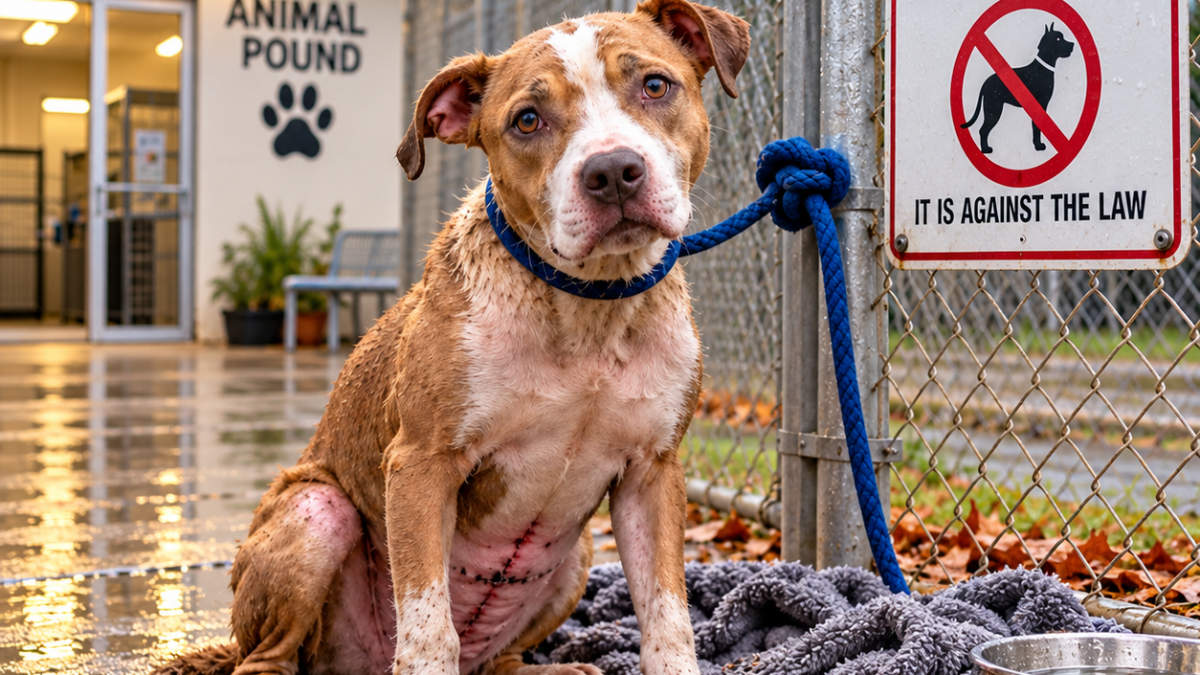
PART 2
I stayed beside her longer than I had planned.
There were calls I needed to make.
Transport notes to finish.
Medical information to organize.
People imagine rescue work as a series of emotional moments—someone sees a suffering animal, opens their arms, and everything becomes better.
The truth is less cinematic.
Rescue is often spreadsheets, phone calls, medication schedules, foster availability, mileage, clinic appointments, photographs, health certificates, vaccination records, and people asking one another, “Who can drive this dog three hours on Thursday?”
Emotion gets you to the animal.
Logistics keep the animal alive.
Louisiana remained on the blanket while we worked around her.
Every time somebody crossed the room, her eyes followed them.
Not wildly.
She didn’t panic.
She simply watched.
When I stood to grab paperwork from a counter, her head rose.
I stopped.
“I’m still here.”
Her ears moved.
I returned to the chair.
She lowered her head again.
That small reaction stayed with me.
Maybe I was reading too much into it.
We have to be careful in rescue not to turn every movement into a human story.
A dog looking at a door doesn’t necessarily mean she’s thinking, *Please don’t abandon me again.*
Dogs aren’t narrating their lives the way we are.
But behavior still tells you things.
Louisiana was alert to departures.
That much was clear.
The first thing we needed was a complete veterinary assessment.
The fact that she had been spayed only the day before raised immediate concerns.
We didn’t know where the procedure had been performed.
We didn’t know what instructions had been given.
We didn’t know whether she had pain medication.
We didn’t know whether she had been licking the incision while tied outside.
We didn’t know how much rain, mud, or debris had reached the area.
I hated how often the answer was, “We don’t know.”
I wanted a file.
A history.
A name before Louisiana.
Something.
Instead, all we had was a dog and whatever her body could tell us.
At the clinic, Louisiana stood beside me.
Her posture was tired but not collapsed.
The veterinarian crouched before touching her.
“Hi, sweetheart.”
Louisiana sniffed her fingers.
Tail movement.
Tiny.
But there.
The veterinarian smiled.
“She’s social.”
“Very.”
“That’s a good thing.”
“I know.”
Then I added, “It also makes me mad.”
The veterinarian glanced at me.
“Why?”
“Because somebody had a dog who still likes people and left her outside.”
She nodded slowly.
“I get it.”
The exam started with the basics.
Temperature.
Heart rate.
Respiration.
Gums.
Hydration.
Body condition.
Eyes.
Ears.
Skin.
The vet’s fingers parted Louisiana’s fur.
“Fleas.”
“A lot.”
“Yeah.”
Louisiana shifted.
I put one hand near her shoulder.
“It’s okay.”
The vet checked the spay incision.
I held my breath.
“How does it look?”
“Recent. A little irritated, but I’m not seeing obvious dehiscence.”
I exhaled.
“Meaning?”
“It hasn’t opened.”
“Good.”
“But she needs to stay clean and quiet. Watch for swelling, discharge, increasing redness, heat, pain, fever, lethargy, poor appetite.”
I had already started writing.
The vet smiled.
“You rescue people write everything down.”
“Because otherwise we panic at two in the morning.”
“Fair.”
Louisiana looked at both of us as if our conversation was irrelevant.
Then she tried to sniff the treat jar.
The vet noticed.
“Hungry?”
Louisiana’s ears lifted.
I laughed.
“Apparently.”
A treat came out.
Louisiana took it gently.
Chewed.
Then stared at the same hand.
The veterinarian gave her another.
“Good appetite is encouraging.”
“She’s going to exploit you.”
“She deserves at least two.”
Louisiana agreed.
The rest of the exam was surprisingly uneventful.
No catastrophic finding.
No emergency beyond what we already knew.
Young dog.
Recent surgery.
Flea burden.
Dirty coat.
Stress.
Need for routine care and recovery.
That should have made me feel better.
Instead, it made the abandonment harder to understand.
There was no hidden, impossible diagnosis.
No devastating disease that might have overwhelmed someone.
At least, none that we could see.
What Louisiana needed wasn’t extraordinary.
She needed the kind of care dogs require every day.
That was all.
We treated the fleas appropriately.
Cleaned her carefully.
Made sure the incision remained dry and protected.
Provided food and water.
Then moved her back into a quiet rescue setting.
The first night, I didn’t want anyone overwhelming her.
No crowd of volunteers.
No constant handling.
No parade of sympathetic faces leaning into her space.
Kindness can become stressful when thirty people try to deliver it at once.
Louisiana needed boredom.
Safe, predictable boredom.
We gave her fresh bedding.
She sniffed it.
Turned once.
Lay down.
I crouched outside the enclosure.
“That’s yours.”
She looked at me.
“The blanket too.”
Her head lowered.
“No rain tonight.”
One slow blink.
“No gate.”
Another.
“And people know where you are.”
I turned to leave.
Louisiana’s head came up.
I stopped.
The movement hit me harder than it should have.
I sat back down.
“Five more minutes.”
Her head lowered again.
Those five minutes became twenty.
Eventually, her breathing deepened.
Her eyelids stayed closed.
I slipped out quietly.
The next morning, the volunteer on duty called.
“She slept.”
“All night?”
“Almost.”
“Eat?”
“Yes.”
“Incision?”
“Still looks okay.”
“Any vomiting?”
“No.”
“Any diarrhea?”
“Not so far.”
“Any panic?”
There was a pause.
“Not exactly.”
“What does that mean?”
“She watches the door.”
I drove over later.
Louisiana was lying on the same blanket.
Her head came up the second I entered.
Tail movement.
“Hi.”
I sat.
Another volunteer crossed the room.
Louisiana watched her.
The volunteer went through a doorway.
Louisiana kept looking at the empty opening.
Ten seconds.
Fifteen.
Twenty.
Then she glanced at me.
“It’s okay.”
The volunteer returned carrying laundry.
Louisiana’s shoulders relaxed.
The dog didn’t jump up.
Didn’t whine.
She just watched the person return.
I wrote that down mentally.
People leave.
People come back.
Maybe that was the lesson.
Not something we’d teach deliberately.
Something routine would teach for us.
Over the next few days, Louisiana started showing us pieces of herself.
At first, she was quiet.
She accepted food.
Accepted treatment.
Accepted gentle touch.
Then one morning, a volunteer tried to give medication.
Louisiana turned her head away.
The volunteer tried again.
Louisiana closed her mouth.
I laughed.
“What?”
“She has an opinion.”
The volunteer stared at me.
“That’s funny to you?”
“Yes.”
“Help.”
I held a small piece of food.
Louisiana looked at it.
Medication disappeared inside.
She swallowed.
Then immediately searched for another piece.
“Smart dog.”
The volunteer crossed her arms.
“She played me.”
“Also a good sign.”
The longer Louisiana felt physically better, the more personality arrived.
One afternoon, somebody placed a soft squeaky toy near her.
Louisiana ignored it.
The volunteer squeaked it.
Her ears lifted.
Another squeak.
Head tilt.
We all smiled.
“What’s that?”
Louisiana stood.
Walked closer.
Sniffed.
The toy squeaked again.
She jumped back.
Then froze.
The volunteer held still.
Louisiana approached.
Nose.
Paw.
The toy rolled.
She pounced.
That first pounce was awkward because she was still healing, and we immediately slowed things down.
“No crazy stuff yet.”
Louisiana picked up the toy.
Tail wagging.
“Seriously. You just had surgery.”
She carried it two steps.
Dropped it.
Looked at us.
Then picked it up again.
That was the first time I saw her face lose the exhausted look completely.
For a few seconds, the gate disappeared from her body.
She wasn’t a dog who had been abandoned.
She was simply young.
Curious.
Interested.
Alive.
We kept play controlled while the incision healed.
That was harder than expected.
Once Louisiana discovered toys, she wanted movement.
She wanted to shake them.
Chase them.
Drag them.
One volunteer held up a stuffed rabbit.
Louisiana’s eyes widened.
“No.”
Tail wag.
“You have to rest.”
Wag.
The toy moved slightly.
Louisiana crouched.
“Don’t you dare.”
Play bow.
I laughed.
“Where was this dog three days ago?”
Apparently waiting underneath all the stress.
As her health stabilized, we began thinking about foster placement.
Safe-house care is valuable, but a home teaches you different things.
Kennels don’t tell you whether a dog understands a television.
Whether she sleeps through a dishwasher.
Whether she steals laundry.
Whether she panics if someone goes to work.
Whether she knows stairs.
Whether she curls up on a couch or destroys it.
And Louisiana needed more than survival.
She needed practice living.
An experienced foster volunteered.
Before committing, she called me.
“Tell me everything.”
“Young female pit bull mix.”
“I know that.”
“Recently spayed.”
“Okay.”
“Fleas treated.”
“Okay.”
“Friendly.”
“Good.”
“Watches doors.”
Silence.
“How much?”
“Enough that we’ve noticed.”
“Separation anxiety?”
“Too early to call it that.”
“Destructive?”
“Not so far.”
“Dog-friendly?”
“Promising, but introductions need to be managed.”
“House-trained?”
“Unknown.”
“Favorite thing?”
“Food might be winning.”
The foster laughed.
“That’s workable.”
Then she asked the question I liked most.
“What does she need from me?”
Not:
What happened to her?
Not:
How sad is she?
What does she need?
“Predictability,” I said.
“Okay.”
“And time.”
“I have that.”
“Then I think you’re a good fit.”
Louisiana’s transition into foster care was quiet.
We packed food.
Medical records.
Medication.
A blanket carrying familiar scent.
A few toys.
Her foster stared at the bag.
“She owns more stuff than I do.”
“That’s rescue.”
Louisiana was secured safely in the vehicle.
During the ride, she looked out the window.
Then rested her head.
At the foster home, she hesitated at the doorway.
We didn’t pull.
Her foster stood inside.
“Come on, girl.”
Louisiana sniffed the threshold.
One paw.
Pause.
Then another.
She entered.
The first thing she investigated was a shoe rack.
“Promising,” I said.
The foster laughed.
“Those may need relocation.”
Louisiana moved into the living room.
Sniffed a table.
A chair.
The rug.
Then she noticed the mirror.
She froze.
Another dog stared back.
Her body stiffened.
The foster stepped beside her.
“That’s you.”
Louisiana leaned closer.
Reflection leaned closer.
She sniffed.
Bumped her nose against the glass.
Jumped backward.
We laughed.
Louisiana looked at us.
Then at the mirror.
Approached again.
This time she licked it.
Her foster wiped the glass.
“Great. First house rule already broken.”
Within fifteen minutes, Louisiana found the couch.
She placed two paws on it.
The foster looked at me.
“What’s the rescue policy on furniture?”
“Depends entirely on how much self-control the foster has.”
Louisiana climbed up.
Turned twice.
Lay down.
The foster sighed.
“So none.”
“Apparently.”
That first night, Louisiana didn’t sleep on the couch.
She chose a blanket beside the foster’s bed.
At around two in the morning, the foster woke.
Louisiana was sitting up.
Watching.
“Hey.”
Tail tap.
“You okay?”
Louisiana stared.
The foster lowered a hand.
Louisiana moved closer.
Placed her chin across the fingers.
Then lay down again.
The foster told me about it the next morning.
“I don’t know what she wanted.”
“Maybe nothing.”
“She just checked whether I was there.”
“Maybe.”
Again, we resisted inventing too much.
But we noticed.
Louisiana followed her foster through the house.
Kitchen.
Laundry room.
Hallway.
Bathroom.
At one point, the foster closed the bathroom door.
A shadow appeared beneath it.
Then a nose.
She texted me:
**Privacy officially canceled.**
I replied:
**Congratulations on dog ownership.**
The foster answered:
**I thought I was fostering.**
That distinction was already becoming dangerous.
Louisiana’s routine strengthened.
Breakfast at the same time.
Medication.
Short controlled walks while healing.
Rest.
Quiet enrichment.
Dinner.
Bedtime.
Dogs often become calmer when the world becomes predictable.
Predictability removes decisions.
No need to wonder whether food comes.
No need to wonder where water is.
No need to wonder whether this sleeping place will still be yours tomorrow.
Louisiana began relaxing visibly.
Her muscles weren’t always prepared to move.
She sprawled.
A front leg stretched one direction.
Back legs another.
One evening, her foster sent a photograph.
Louisiana was upside down on the couch, belly exposed, head hanging partly off a cushion.
**Graceful.**
I smiled.
Deep relaxation isn’t dramatic.
But after seeing her tied outside, that photograph felt like a milestone.
Then her incision healed.
And the real Louisiana arrived.
The foster called me one evening.
“You sent me a lunatic.”
I laughed.
“What happened?”
“She is running laps.”
“Inside?”
“Where else?”
A thump sounded through the phone.
“What was that?”
“Possibly furniture.”
“Possibly?”
“Hold on.”
I waited.
Then heard:
“Louisiana!”
Another thump.
The foster returned to the phone.
“She has a stuffed giraffe.”
“Is that bad?”
“It was on a shelf.”
“How high?”
“Apparently not high enough.”
I started laughing.
“You wanted personality.”
“I’ve changed my mind.”
Behind her, Louisiana barked.
The foster said, “Don’t encourage her.”
I heard another squeak.
A week earlier, Louisiana had been recovering quietly.
Now she had zoomies.
That was a better problem.
We increased appropriate exercise gradually once her veterinarian cleared her.
Walks.
Sniffing.
Training.
Food puzzles.
Toys.
Structure.
The foster worked on “sit.”
Louisiana learned quickly.
Then began sitting automatically whenever food appeared.
“Sit.”
Already sitting.
“Good.”
Treat.
The next day, the foster opened the refrigerator.
Louisiana sat.
“No.”
Tail wag.
“I did not ask.”
Still sitting.
“There’s no treat.”
Louisiana remained.
Eventually, the foster laughed.
“Fine.”
One tiny snack.
Louisiana had discovered negotiation.
Then came “wait.”
That command mattered around doors.
Not because we wanted to symbolically reverse the gate.
Because door safety is practical.
A dog who bolts through an open entrance can disappear in seconds.
The foster placed a leash on Louisiana.
Approached the door.
“Wait.”
Louisiana surged forward.
Door closed.
Reset.
Again.
“Wait.”
Louisiana leaned.
Door closed.
Third attempt.
She paused.
“Good.”
Door opened a few inches.
Louisiana moved.
Closed.
Over and over.
Eventually:
“Wait.”
Door opens.
Louisiana remains.
“Okay.”
She steps through.
The foster sent me the video.
I watched twice.
The first photograph of Louisiana outside the pound had shown a dog tethered because she had no choice.
Now she sat beside an open door.
No rope preventing movement.
No gate trapping her.
She stayed because she understood the person beside her.
That was trust taking a practical form.
We kept looking for information about her previous owner.
We checked records where possible.
Asked questions.
Nothing solid emerged.
One clue came from the spay.
Someone had clearly arranged the procedure.
But without reliable identifying paperwork connecting Louisiana to an individual, it led nowhere useful.
That frustrated me.
Why spay a dog and then abandon her the next day?
Was there some housing crisis?
Did a landlord force a decision?
Did the person think leaving her outside the pound guaranteed immediate intake?
Had someone else in the household made the decision?
We didn’t know.
A volunteer said, “Maybe whoever did it thought they were doing the right thing.”
I looked at her.
“Tying her outside?”
“I didn’t say they were right.”
I understood the point.
People sometimes act irresponsibly without intending cruelty.
They convince themselves:
It’s a shelter. Someone will find her.
She’ll be fine.
I can’t deal with this anymore.
That doesn’t remove the danger created.
But it can explain how ordinary people make terrible choices.
I had to let that possibility exist.
If I turned the unknown person into a monster, I would only be inventing another story.
Louisiana’s condition was enough.
Wet.
Fleas.
Fresh surgery.
Tied outside.
Those were facts.
We didn’t need more.
The foster became increasingly attached.
That was obvious.
She sent updates constantly.
Louisiana sleeping.
Louisiana sitting.
Louisiana with the giraffe.
Louisiana looking offended because dinner was seven minutes late.
Louisiana on the couch.
Louisiana on the foster’s bed.
I called.
“You’re failing.”
“What?”
“Foster failing.”
“No.”
“She’s in your bed.”
“Temporarily.”
“You bought her a new blanket.”
“She needed one.”
“You bought her three toys.”
“They were on sale.”
I laughed.
“Sure.”
The foster became quiet.
“I do love her.”
“I know.”
“But I can’t keep every dog.”
“No.”
“If I keep her, I lose a foster spot.”
“Also true.”
This is one of the least understood parts of fostering.
Letting a dog go to a permanent home can hurt badly.
But that departure creates space for another dog who needs the same bridge.
Good fosters are not people who feel nothing.
They are people who feel everything and still let the process work.
Louisiana’s story began attracting adoption interest.
The original photograph spread.
People saw her tied under the warning sign and reacted emotionally.
Applications came.
Some were promising.
Some were not.
One person wrote:
**I saw her story and started crying. I need her.**
Emotion isn’t disqualifying.
But “I need her” worried me more than “What does she need?”
We asked questions.
Housing.
Experience.
Current pets.
Veterinary history.
Work schedule.
Plans for training.
Financial preparation.
What happens if she develops medical problems?
What happens if she doesn’t get along with the resident dog?
What happens if she chews something expensive?
What happens when the emotional rescue story is six months old and Louisiana is just a dog who woke you at 5:30 because she has diarrhea?
That is where adoption lives.
Not in the photograph.
In Tuesday morning at 5:30.
One applicant lived in a building with breed restrictions.
Another had not told the landlord.
Immediate no.
One household had several dogs and wanted to “see what happens” by putting everyone together immediately.
No.
Another wanted an outdoor dog.
Definitely no.
The foster became frustrated.
“How hard is it to find one normal person?”
“Very.”
Louisiana was chewing a toy nearby.
“She doesn’t seem worried.”
“She has outsourced worrying to us.”
Weeks passed.
Louisiana’s body changed.
The coat that had looked dull became healthier.
Her skin cleared.
The flea problem became history.
Her energy improved.
Her eyes seemed brighter.
She gained muscle.
There was no dramatic medical miracle because there had never been a terminal illness.
Her transformation came from basic care delivered consistently.
Food.
Warmth.
Exercise.
Veterinary attention.
Routine.
That ordinary care made the gate photograph look more shocking over time.
Because the dog hadn’t needed something extraordinary.
She’d needed someone to stay.
Then we received an application from a woman who had owned rescue dogs before.
Her message was less emotional than most.
That was a good sign.
She wrote:
**I’ve read Louisiana’s history. I’d like to know her current routine, energy level, medical needs, behavior around other dogs, and what your foster thinks she still needs help with.**
I reread it.
Then sent it to the foster.
Her response:
**Oh no.**
I laughed.
**Why oh no?**
**That sounds like a real adopter.**
Exactly.
We spoke with the applicant.
She asked specific questions.
“Does Louisiana settle after exercise?”
“Yes.”
“Any resource guarding?”
“None observed, but we still manage food responsibly.”
“Crate trained?”
“Working on it.”
“Separation issues?”
“Improving. She watches departures but can settle.”
“Medical concerns from the spay?”
“Healed.”
“Skin?”
“Fleas resolved. No major ongoing issue noted.”
“Children?”
“We’ll discuss based on her interactions and household specifics.”
“Car rides?”
“Pretty good.”
Then:
“What does she love?”
I smiled.
“Soft toys.”
“Anything else?”
“People.”
Pause.
“Couches.”
The applicant laughed.
“That’s dangerous.”
“Very.”
“I have two couches.”
“She’ll appreciate the inventory.”
We checked references.
Veterinary care history was consistent.
Housing stable.
No breed restriction.
The home was prepared for a dog.
There was no pressure to adopt instantly.
The applicant said something I remember.
“I don’t want to take her because I feel sorry for her.”
“Good.”
“I mean, I do feel terrible about the gate.”
“Of course.”
“But that isn’t enough reason to bring a dog home.”
Exactly.
She wanted Louisiana because her lifestyle fit the dog we had now.
Not the photograph from before.
We arranged a meeting.
The foster brought Louisiana.
The potential adopter didn’t rush forward.
She talked to us first.
Louisiana approached on her own.
Sniffed the woman’s shoes.
Then her hand.
Tail movement.
“Hi, Louisiana.”
No squealing.
No hugging.
Just calm.
Louisiana moved closer.
The woman scratched beneath her chin.
Louisiana leaned.
The foster looked away.
I saw tears already building.
We took a walk together.
Louisiana moved comfortably.
The woman handled the leash without pulling.
At one point Louisiana stopped to sniff for a long time.
The woman waited.
Didn’t yank.
Good.
A dog passing across the street caught Louisiana’s attention.
She watched.
The potential adopter redirected gently.
Good.
We returned.
Louisiana lay near everyone’s feet.
The applicant asked about training.
Not whether Louisiana “loved her.”
That mattered.
Love can grow.
Skills and expectations matter from day one.
Before leaving, the woman crouched.
“I’ll see you again, okay?”
Louisiana sniffed her face.
No dramatic sign.
No instant cosmic bond.
Perfect.
We wanted a decision made after thought.
Not after adrenaline.
Two days later, the woman called.
“I’d like to adopt her if you still think I’m a good match.”
I asked, “What did you think about after the meeting?”
She laughed.
“Is this a test?”
“Yes.”
“Fine. Exercise schedule. Training class. Where I’ll keep food. Which vet I’ll use. Whether the backyard gate is secure enough. Vacation plans. Pet insurance. Whether my couch covers are washable.”
I smiled.
“The last one is critical.”
“I figured.”
“And?”
“And I still want her.”
That was the answer.
We prepared adoption paperwork.
The foster became miserable.
Not because she thought the placement was wrong.
Because it was right.
She called me the night before.
“I can’t do this.”
“Yes, you can.”
“She is sleeping on my leg.”
“Move your leg.”
“I can’t. She looks comfortable.”
“Then suffer.”
“This is your fault.”
“Probably.”
The foster’s voice cracked.
“What if she thinks I’m abandoning her?”
That question landed harder.
I chose my answer carefully.
“You’re not tying her somewhere and disappearing.”
“I know.”
“You’re taking her to another safe person. You’re going to stay for the transition. She’ll have her bed, blanket, food, toys. And you’ve prepared her to trust.”
Silence.
“Still hurts.”
“I know.”
“What if she waits at the door for me?”
“She might.”
That was important.
No false promise.
Louisiana might be confused.
She might watch.
Transitions can be stressful even when they’re good.
“But people will keep coming back through that door.”
The foster breathed out.
“Okay.”
Adoption day came.
Louisiana knew the routine was different.
Dogs notice bags.
Movement.
People acting strange.
Her foster packed her things.
Food.
Blanket.
Medical file.
Favorite toys.
The stuffed giraffe.
Of course.
“She cannot leave without this.”
I held up the toy.
“It’s disgusting.”
“It’s emotional support.”
“It smells terrible.”
“Do not judge.”
Louisiana grabbed it.
Decision made.
The adopter arrived.
We reviewed everything.
Medication history.
Food.
Microchip.
Veterinary records.
Training cues.
Walk schedule.
Emergency contacts.
The foster kept petting Louisiana.
Finally, paperwork was signed.
Then came the leash.
The foster held it.
Her hand tightened.
Louisiana stood beside her.
The adopter waited quietly.
The foster crouched.
“Okay, girl.”
Louisiana licked her chin.
The foster laughed and cried simultaneously.
“You had to do that.”
Louisiana’s tail wagged.
“I love you.”
Those words were allowed.
They weren’t a contract Louisiana had to understand.
They were simply true.
The foster handed the leash over.
That image hit me.
A leash changing hands.
At the pound gate, a tether had been used to leave Louisiana behind.
Here, a leash connected her to someone who was taking responsibility.
Same basic object.
Completely different meaning.
Louisiana walked toward the adopter’s vehicle.
Looked back once.
The foster waved.
Then Louisiana climbed inside.
Safely secured.
The door closed.
The foster watched the car leave.
Then she started crying harder.
“I hate fostering.”
“You’ll do it again.”
“No.”
“Yes.”
“No.”
Two weeks later, she sent me a picture of another dog in her house.
I replied:
**Interesting.**
She responded:
**Shut up.**
Louisiana’s first update came only hours after adoption.
A picture.
Couch.
Naturally.
She was stretched across it as though the closing documents included furniture ownership.
Message:
**Four hours in. I apparently live in her house.**
The next morning:
**Breakfast eaten. Backyard inspected. One squirrel officially considered suspicious.**
Then:
**She slept beside my bed. No accidents. Watched me go to the mailbox, but settled after.**
I forwarded everything to the foster.
The foster replied with heartache disguised as humor.
**Tell her I said she’s a traitor.**
Louisiana’s adopter built routine immediately.
Morning walk.
Breakfast.
Quiet time.
Training.
Rest.
Evening exercise.
Dinner.
Relaxation.
Bed.
No constant excitement.
No attempt to compensate for her past by giving her everything she wanted.
Boundaries are part of safety too.
A dog doesn’t need chaos disguised as love.
Louisiana learned that begging did not always produce food.
That couch privileges existed but jumping on visitors did not.
That “wait” still mattered.
That toys could be hers without being guarded.
That the front door could open without becoming an emergency.
The first week, Louisiana followed her adopter from room to room.
By week three, sometimes she couldn’t be bothered.
That was progress.
One afternoon, the adopter sent a home-camera clip.
She left for five minutes.
Louisiana watched the door.
Five seconds.
Ten.
Then walked toward the couch.
Climbed up.
Circled.
Lay down.
When the adopter returned, Louisiana greeted her enthusiastically.
But those five minutes hadn’t become a crisis.
I watched the clip again.
Then again.
Maybe nobody else would understand why it mattered.
I did.
The gate had made absence dangerous.
The home made absence temporary.
That difference takes repetition to learn.
People leave.
Come back.
Leave.
Come back.
Again.
Again.
Until the nervous system stops treating every closing door like the start of another abandonment.
Louisiana continued training.
Her adopter enrolled her in a basic manners class.
The first session produced predictable results.
Louisiana wanted to greet everyone.
Dog.
Human.
Instructor.
Possibly furniture.
The instructor laughed.
“She’s social.”
“Very.”
“Food motivated?”
The adopter held up a treat.
Louisiana immediately sat.
“Extremely.”
Training progressed quickly.
Sit.
Down.
Wait.
Leave it.
Come.
Loose-leash work.
Nothing glamorous.
Skills that make life easier.
One evening, her adopter called.
“She did something.”
I braced automatically.
“Good something or vet something?”
“Good.”
“Okay.”
“I dropped food.”
“And?”
“She waited.”
“Really?”
“Looked at it, looked at me, waited.”
“How long?”
“Three seconds.”
I laughed.
“Basically a PhD.”
“Exactly.”
These small victories built a dog who could move confidently through the world.
Louisiana’s body became stronger.
Her coat shone.
The old flea infestation became something we mentioned only in paperwork.
Her spay scar faded.
Photographs from intake looked increasingly disconnected from the dog in front of us.
In one newer picture, Louisiana was running through a yard with a ball.
Ears back.
Mouth open.
Legs extended.
In another, she was asleep upside down.
In another, her head rested in the adopter’s lap while both watched television.
No one had staged these as transformation photos.
That’s why I liked them.
They were ordinary.
The best rescue endings often are.
One morning, Louisiana had an upset stomach.
Nothing dramatic.
But her adopter called the vet.
Followed instructions.
Adjusted food temporarily.
Monitored hydration.
Stayed home.
Louisiana recovered.
That mundane episode mattered to me.
Why?
Because the real test of commitment isn’t adoption day.
It is the first inconvenience.
The first bill.
The first mess.
The first sleepless night.
The first time the dog disappoints you.
The first time your schedule has to change.
The person who abandoned Louisiana had faced some moment when keeping responsibility felt harder than walking away.
We would never know what it was.
Now Louisiana lived with someone who responded to inconvenience by caring more carefully.
That’s the second chance.
Not a sentimental photograph.
Behavior repeated over time.
Months passed.
Louisiana’s former foster visited.
Before the meeting, she was nervous.
“What if Louisiana ignores me?”
“Then you’ll survive.”
“What if she loses her mind?”
“Then you’ll also survive.”
The adopter opened the door.
Louisiana saw the foster.
For half a second, stillness.
Then chaos.
Tail.
Whole body.
Running.
Louisiana launched herself toward her.
The foster dropped to her knees.
“You remember me!”
Louisiana licked her face.
I laughed.
“Apparently.”
The foster buried her face against Louisiana’s neck.
“I’m not crying.”
“You definitely are.”
“Nobody asked you.”
Louisiana bounced away.
Grabbed the stuffed giraffe.
Returned.
The foster gasped.
“You still have that disgusting thing?”
The adopter laughed.
“I’ve washed it.”
“Ruined.”
Louisiana shoved the toy toward her.
The foster took it.
For several minutes, Louisiana moved between both women.
No conflict.
No confusion.
Her past foster wasn’t a threat to her current home.
Love hadn’t become scarce.
That mattered.
Dogs can hold multiple safe relationships.
Louisiana didn’t have to choose between the person who helped her recover and the person who gave her permanence.
Both could matter.
At the end of the visit, the foster stood.
Louisiana watched.
This time there was no panic in anyone.
“Bye, baby.”
Louisiana’s tail wagged.
The foster walked through the door.
Louisiana followed for a few steps.
Stopped.
The door closed.
She looked at it.
Then turned back toward her adopter.
The adopter picked up a toy.
Louisiana ran toward her.
The foster heard about that later.
She cried again.
“Why are you sad?”
“I’m not.”
“You sound sad.”
“I’m happy.”
“Those sound identical over the phone.”
Maybe they are sometimes.
Louisiana’s story continued settling into normal life.
The adopter learned that Louisiana hated steady rain.
A dog once discovered soaked outside a shelter now stood at the front door during bad weather and looked personally insulted.
“Go potty.”
Louisiana stared at the rain.
“Come on.”
No movement.
“You are a dog.”
Louisiana stepped backward.
Her adopter sent me a video.
I laughed.
The caption said:
**Apparently she has retired from outdoor hardship permanently.**
Good.
Let rain be annoying now.
Let weather be something she could refuse for thirty seconds because somebody would still be standing behind her with a towel.
Louisiana also discovered blankets.
Not simply sleeping on them.
Organizing them.
Her adopter would arrange a couch blanket.
Louisiana would dig.
Circle.
Pull.
Fold it into some impossible pile.
Then lie partly off it.
“Why?”
No answer.
Another ordinary behavior.
Another thing that had nothing to do with abandonment.
As time went on, fewer updates mentioned the gate.
That was intentional.
The gate had become useful for fundraising attention and rescue awareness, but we didn’t want Louisiana’s entire identity built around the worst thing someone had done to her.
She wasn’t “gate dog” forever.
She was Louisiana.
Dog who loved soft toys.
Dog who sat automatically for refrigerator access.
Dog who hated rain.
Dog who owned a giraffe.
Dog who considered personal space negotiable.
Dog who believed couches existed for her benefit.
The transformation wasn’t from broken to whole.
She had never been broken.
She had been placed in a bad situation.
Remove the situation.
Provide care.
The dog continues.
That difference matters.
Too often rescue language turns animals into damaged objects repaired by heroic humans.
Louisiana didn’t need us to manufacture resilience.
She already had it.
We simply needed to stop making survival unnecessarily difficult.
One year after the abandonment, someone sent me the original photograph again.
I hadn’t looked at it in months.
Louisiana tied under the sign.
Wet coat.
Low posture.
Gate behind her.
I stared.
Then opened the newest picture from her adopter.
Louisiana wore a ridiculous winter sweater.
She stood on the couch with a toy in her mouth.
Her eyes bright.
Tail blurred.
I put the images side by side.
The difference wasn’t only physical.
It was context.
In the first picture, Louisiana had no control.
Tied.
Waiting.
Dependent on a stranger finding her.
In the second, the entire room existed around her comfort.
A water bowl.
Toys.
A bed.
Furniture she claimed.
A person behind the camera who knew what she ate, how she slept, when she needed the vet, which toy she preferred, and what sound she made when she wanted to go outside.
Belonging is detail.
That’s what people miss.
A shelter dog becomes family through hundreds of tiny facts.
She likes this food.
She hates thunder.
She sleeps here.
She wakes at this time.
She limps after too much exercise.
She needs this medicine.
She likes this person.
She fears that sound.
She wants the blue toy, not the red one.
Knowledge becomes responsibility.
Responsibility becomes relationship.
Louisiana was known now.
That was the opposite of being left without a note.
A few months later, I visited.
Louisiana met me at the door.
She paused.
Sniffed.
Tail.
“Hey.”
She pressed against my knees.
I crouched.
“Do you remember me?”
She licked my chin.
“I’ll take that as yes.”
Her adopter laughed.
Inside, I saw the life built around her.
Pictures on the wall.
Leash on a hook.
Treat jar.
Dog shampoo.
Medication reminders from past vet visits tucked in a drawer.
A blanket covered half the couch.
The stuffed giraffe remained alive somehow.
Barely.
One ear missing.
I held it up.
“This thing should be euthanized.”
The adopter took it from me.
“Don’t say that in front of her.”
Louisiana grabbed it.
The three of us laughed.
Later, the adopter showed me something.
“Watch.”
She walked toward the front door.
Louisiana remained on the couch.
The door opened.
Louisiana raised her head.
Her adopter stepped outside.
Door closed.
Louisiana watched.
Three seconds.
Five.
Then head down.
I stared.
The adopter came back.
Louisiana’s tail wagged.
She didn’t jump up.
Didn’t race.
Just acknowledged.
“She doesn’t follow every time anymore.”
“That’s huge.”
“I know.”
We stood there watching Louisiana do absolutely nothing.
And I felt proud.
Nothing was the victory.
No panic.
No waiting.
No fear.
A door closed.
Life continued.
That is what security looks like.
The adopter sat beside me.
“I think about the gate sometimes.”
“So do I.”
“Do you think she remembers?”
I looked at Louisiana.
“I don’t know.”
“Would you want her to?”
“No.”
Silence.
Then I added, “But remembering isn’t the same for dogs as it is for us.”
“What do you mean?”
“They can carry associations. Fear. Habits. Reactions. But I don’t think she’s sitting there replaying the photo.”
The adopter smiled.
“Good.”
Louisiana rolled onto her back.
We both laughed.
“Definitely not.”
Over the next years, Louisiana’s story became less about rescue and more about aging normally.
The greatest gift.
She matured.
Energy softened.
Training settled.
Her adopter learned which trails she liked.
Louisiana learned which cabinet held treats.
She gained veterinary records that had nothing to do with abandonment.
Routine dental checks.
Vaccines.
A small skin irritation one summer.
A minor paw injury after playing too hard.
Normal things.
Each appointment added another layer to her history.
Not:
Unknown dog tied outside.
Now:
Established patient.
Owner listed.
Emergency contact.
Medical notes.
Weight history.
Preventive care.
Home address.
Details.
Proof that someone would answer the phone if the clinic called.
One winter, Louisiana developed stiffness after a particularly active day.
Her adopter scheduled a vet appointment.
Nothing severe.
Rest.
Monitoring.
The vet said something about watching her activity.
The adopter called me afterward.
“She is offended.”
“By what?”
“Rest.”
“Unacceptable.”
“She keeps bringing me the ball.”
Louisiana had once been forced to sit still outside a shelter.
Now her biggest injustice was being medically advised not to play fetch for two days.
I loved that.
A rescue friend once asked which part of Louisiana’s story affected me most.
I expected myself to say the gate.
Or the sign.
Or learning she’d been spayed the day before.
Instead I said, “The couch.”
She laughed.
“The couch?”
“Yeah.”
“Why?”
“Because she sleeps on it without watching the door.”
That’s the thing.
Trauma is dramatic.
Healing often isn’t.
Healing is sleeping through footsteps.
Eating without checking who is watching.
Letting someone touch the side of your body without tensing.
Walking through a doorway and knowing you’ll return.
Playing.
Misbehaving.
Becoming ordinary.
Louisiana became beautifully ordinary.
Her adopter eventually moved to another home.
That transition worried us more than Louisiana.
New house.
New smells.
New doors.
Would old insecurity return?
The adopter prepared carefully.
Louisiana’s bed moved first.
Blankets.
Toys.
Food bowls.
The giraffe.
Of course.
When Louisiana arrived, she entered slowly.
Sniffed.
Walked room to room.
Then found the couch.
Different couch.
Same concept.
Climbed up.
Lay down.
The adopter sent one message:
**Home established.**
I laughed.
Maybe by then Louisiana understood home wasn’t a building.
It was continuity.
The same person.
Same routines.
Same voice.
Same leash.
Same expectation that dinner would happen.
The first night in the new house, Louisiana slept beside the adopter’s bed.
By night three, she had upgraded herself onto it.
No major regression.
No panic.
Dogs can surprise us with how adaptable they become once the foundation is strong.
Years earlier, Louisiana’s world had changed because someone disappeared.
Now her world could change around the person who stayed.
That was the difference.
At some point, the original shelter sign was replaced or moved.
I heard about it secondhand.
The physical place changed.
Louisiana’s story remained part of rescue memory.
But I stopped feeling anger every time I thought about the words:
Do Not Drop Off At Gate.
The sign represented a rule.
Rules matter.
But signs don’t save dogs.
People do.
The officer who arrived.
The staff who brought Louisiana inside.
The volunteers.
The rescue.
The foster.
The adopter.
The veterinarian.
The person who cleaned bedding.
The person who drove.
The person who sent records.
The person who answered the phone.
Nobody did everything.
Everyone did something.
That chain gave Louisiana her future.
I never wanted the story to imply one organization magically saved her.
Rescue is rarely magic.
It’s coordination.
And exhaustion.
And people making room where there wasn’t much.
Louisiana’s rescue involved Louisiana too.
Her willingness to keep engaging mattered.
Her ability to adapt mattered.
Her social nature helped.
But if she had growled?
If she had hidden?
If she had been afraid?
She would still have deserved help.
That’s something I always wanted people to understand.
A traumatized animal does not need to perform gratitude to earn rescue.
Louisiana happened to be affectionate.
That made her easy to love.
But kindness shouldn’t depend on ease.
One afternoon, years after the gate, Louisiana met a foster dog in her home.
The adopter had begun occasionally helping with short-term rescue placements.
I laughed when she told me.
“Look what Louisiana started.”
The foster dog was shy.
Hung near doorways.
Louisiana was calm.
Didn’t crowd.
The new dog watched her.
Louisiana walked to the couch.
Climbed up.
Slept.
Eventually, the foster dog lay on the rug nearby.
The adopter sent a photo.
Two dogs.
One secure.
One uncertain.
Caption:
**Louisiana is teaching the new kid how to do nothing.**
I saved it.
That was full-circle enough for me.
Louisiana couldn’t explain safety to another dog.
But she could model it.
Eat.
Sleep.
Wake.
Person still there.
Repeat.
Routine becomes evidence.
Evidence becomes trust.
The new foster eventually relaxed.
Louisiana probably deserved none of the credit.
We gave it to her anyway.
When Louisiana reached another adoption anniversary, her adopter made her a simple meal and bought a new toy.
Not a party.
Not a public spectacle.
Louisiana didn’t care about dates.
Dogs are free from anniversaries unless humans turn them into snacks.
She received a new stuffed animal.
Ignored it.
Chose the old giraffe.
Of course.
The adopter sent me a picture.
Louisiana sleeping with the battered toy.
I wrote back:
**Throw that thing away.**
Response:
**I value my life.**
Fair.
That evening, I looked again at the first photograph.
Gate.
Rain.
Tether.
Sign.
Then the giraffe photo.
No need for dramatic comparison text.
The difference spoke for itself.
One dog waiting to be noticed.
The same dog sleeping so deeply she trusted tomorrow to arrive.
I never found out how long Louisiana waited outside.
That question remained.
Hours?
A night?
Weekend?
Nobody could honestly answer.
Early in the rescue, that uncertainty tortured me.
Later, I realized counting those hours wouldn’t change their weight.
One hour was too long for a recovering dog to be left unsecured from reliable care.
Three days would be worse.
But Louisiana’s life eventually contained far more time after the gate than before it.
That’s what mattered.
Years of mornings.
Years of meals.
Years of couch naps.
Years of veterinary appointments.
Years of opening doors.
One ugly stretch of waiting became small inside a much longer history of being expected.
That was the second chance.
Not forgetting what happened.
Outgrowing it.
The final time I visited her that year, rain was falling.
Louisiana stood inside the front door.
Her adopter held the leash.
“Come on.”
Louisiana stared outside.
Rain.
Then back at us.
“No.”
I laughed.
“She still hates it?”
“With passion.”
“Understandable.”
The adopter opened the door wider.
Louisiana backed up.
“Bathroom break.”
No movement.
“Louisiana.”
Tail wag.
“You cannot negotiate weather.”
Eventually, she stepped outside with the expression of a dog filing a formal complaint.
She finished quickly.
Then raced back.
Her adopter dried her with a towel.
Louisiana leaned into it.
Warm.
Dry.
Impatient.
I stood there thinking about the wet coat from years before.
Then Louisiana shook, spraying water across the hallway.
“Hey!”
We laughed.
She ran to the couch.
Jumped up.
Turned.
Collapsed onto the blanket.
Her adopter pointed.
“See? Traumatized by rain.”
Louisiana yawned.
Within minutes she was asleep.
I watched the door.
Then her.
What struck me wasn’t how much she’d changed.
It was how completely she belonged to the present.
She wasn’t Louisiana-at-the-gate.
She wasn’t a symbol.
She wasn’t waiting for anyone to explain why she’d been left.
She was annoyed because it was raining.
That was enough.
Before I left, I crouched beside the couch.
Louisiana opened one eye.
“Hey, girl.”
Tail thump.
“Remember when everybody was worried you wouldn’t have anywhere to go?”
She closed the eye.
“Yeah, you don’t care.”
Her adopter smiled.
“She has dinner in forty minutes. That’s her current crisis.”
“Much more important.”
I scratched Louisiana’s chest.
She rolled slightly toward my hand.
Then went back to sleep.
At the front door, I put on my jacket.
The adopter opened it.
Rain outside.
Louisiana did not move.
Not even her head.
I stopped.
Years earlier, movement near a door had captured her attention.
Someone leaving meant uncertainty.
Now I walked outside.
The door began closing.
Louisiana stayed asleep.
That was my favorite ending.
Not adoption day.
Not the first toy.
Not the first tail wag.
A closing door.
And a dog who no longer believed she needed to watch it.
I stepped onto the porch.
Behind me, the door shut.
Inside was Louisiana’s bed.
Food.
Toys.
A veterinarian who knew her history.
A person who knew her habits.
A battered stuffed giraffe.
A couch permanently covered in dog hair.
And a dog sleeping deeply enough that someone leaving the room wasn’t worth waking for.
The next person through that door would come home.
Louisiana knew that now.
She had learned it one ordinary day at a time.
The door closed behind me, and Louisiana never lifted her head.
That stayed with me.
Not the first photograph.
Not the warning sign.
Not even the moment she finally climbed onto a couch and acted as though it had always belonged to her.
That closing door became the image I carried most clearly.
Years earlier, a door had separated Louisiana from safety.
Someone had tied her outside and walked away, leaving her on the wrong side of a place that existed to help animals exactly like her.
Now a door closed, and Louisiana simply kept sleeping.
She didn’t need to see who had left.
She didn’t need to make sure they were coming back.
She had learned something much larger than any training command.
She had learned permanence.
A few weeks after that visit, her adopter sent me another message.
There was no emergency.
No problem.
No medical update.
Just a photograph.
Louisiana was asleep in the middle of the bed, stretched sideways so completely that there was almost no room left for a human.
The message underneath said:
Apparently I pay the mortgage so she can have a king-size mattress.
I laughed.
Then I noticed something else in the picture.
The bedroom door was open.
Louisiana wasn’t facing it.
Her back was turned toward the hallway.
It was such an ordinary detail that most people would never notice.
I did.
There had been a time when she tracked every doorway.
Now she could sleep with her back toward one.
That was trust.
Months passed.
Louisiana settled deeper into adulthood.
She didn’t lose her playful side, but the frantic puppy energy softened.
She no longer believed every object on the floor needed investigation.
Most objects.
Not every object.
She still carried toys from room to room.
The old stuffed giraffe somehow continued surviving despite years of abuse.
Its fabric had faded.
One leg had been repaired twice.
Its stuffing had been replaced more than once.
An ear was missing completely.
Every time her adopter tried to substitute a newer toy, Louisiana showed mild interest, then returned to the giraffe.
“I don’t understand,” her adopter told me during a call.
“You shouldn’t.”
“I bought her a brand-new toy yesterday.”
“And?”
“She carried it for maybe thirty seconds.”
“Then?”
“She went looking for the giraffe.”
“That’s loyalty.”
“It’s disgusting.”
“So is love.”
She laughed.
Louisiana also became increasingly particular about comfort.
Cold floor?
Unacceptable.
Hard surface?
Insulting.
Blanket folded incorrectly?
Immediate renovation.
Her adopter bought a new orthopedic bed.
Louisiana sniffed it.
Walked around it.
Then slept on the couch.
The next night, she used the bed.
The adopter sent me a picture with the message:
Apparently it required a 24-hour inspection period.
Life had become full of those stories.
Tiny complaints.
Minor inconveniences.
Silly routines.
Exactly the kind of things nobody imagines when they first see an abandoned dog tied outside a shelter.
That’s why I loved hearing them.
The dramatic part of Louisiana’s life was getting smaller.
The ordinary part kept growing.
There were annual veterinary appointments.
At one checkup, the veterinarian compared Louisiana’s current records to the early rescue notes.
“Hard to believe she’s the same dog.”
Her adopter smiled.
“She acts like she was born on my couch.”
Louisiana sat beside the exam table.
Tail tapping.
The veterinarian ran a hand along her back.
“Healthy weight.”
“Good.”
“Coat looks excellent.”
“Good.”
“Any concerns?”
The adopter thought.
“She snores.”
The veterinarian laughed.
“Not medically concerning.”
“Her feelings about rain are getting worse.”
“Also probably not medical.”
Louisiana looked between them.
The veterinarian offered a treat.
She took it.
“Anything else?”
“She steals my pillow.”
“That’s behavioral.”
“Can you prescribe something?”
“No.”
Louisiana received another treat.
The visit ended.
Nothing serious.
No urgent problem.
Just maintenance.
I thought about how different that was from her first veterinary exam.
Back then, every question began with uncertainty.
How long had she been outside?
Was the incision contaminated?
Did she have medication?
Where had she been treated?
Who had abandoned her?
Now the questions were simple.
How is she eating?
How active is she?
Any changes in behavior?
Routine care had replaced crisis care.
That’s what rescue is supposed to become.
One year, Louisiana’s adopter decided to take a short vacation.
For the first time since adoption, Louisiana would stay overnight with someone else.
That sounded small.
It wasn’t.
Her adopter called me before leaving.
“I’m worried.”
“About Louisiana or you?”
“Both.”
“She’s staying with someone she knows.”
“I know.”
“She has her bed?”
“Yes.”
“Giraffe?”
“Obviously.”
“Food?”
“Packed.”
“Medication?”
“None.”
“Emergency numbers?”
“Three copies.”
I laughed.
“You are the anxious one now.”
“Probably.”
The sitter was a close friend Louisiana had met many times.
Still, the first evening, Louisiana walked from room to room.
She checked the front door.
Then the hallway.
Then the guest room.
She eventually settled on her bed.
When her adopter called to check in, the sitter said, “She’s fine.”
“Is she looking for me?”
“A little.”
Her adopter’s voice tightened.
“Should I come back?”
“No.”
“Are you sure?”
“She’s currently eating a treat.”
Silence.
“Oh.”
Then:
“Send me a picture.”
The picture showed Louisiana lying comfortably beside the sitter’s feet.
The next morning, she ate breakfast.
Went for a walk.
Played.
Slept.
Her adopter returned the following evening.
Louisiana heard the car before the door opened.
She raced toward the entrance.
The moment her person stepped inside, Louisiana’s entire body began moving.
Tail.
Hips.
Shoulders.
Everything.
Her adopter dropped the bag.
“Hi, baby.”
Louisiana pushed against her legs.
Licked her hands.
Circled.
Returned.
The reunion lasted several minutes.
Then something happened that mattered more than the excitement.
Louisiana walked away.
Picked up the giraffe.
Climbed onto the couch.
Settled.
Her person had returned.
The world was correct again.
No collapse.
No lingering panic.
No desperate refusal to leave her side.
Just relief.
Her adopter told me later, “I think she knew I was coming back.”
Maybe.
Or maybe she had simply learned through thousands of smaller departures that this person returned.
Either way, the result was the same.
Louisiana could experience absence without believing it was permanent.
That might have been one of the greatest gifts she received.
Not constant presence.
Confidence in return.
As Louisiana grew older, her relationship with the front door changed completely.
In the early months, it had been something to monitor.
Later, it became the place where walks started.
Where packages arrived.
Where friends came in.
Where her adopter returned from work.
Where nothing terrible happened.
One winter afternoon, snow had fallen heavily outside.
Louisiana stood near the door while her adopter put on boots.
“Ready?”
Louisiana looked outside.
Snow.
Cold.
She backed away.
Her adopter laughed.
“You liked snow last year.”
Louisiana turned toward the couch.
“No.”
No movement.
“You have to go out.”
Louisiana climbed onto the couch.
“You cannot solve this by becoming furniture.”
Apparently she could try.
Eventually, she went outside.
Did what she needed to do.
Then immediately returned.
Her adopter dried her paws.
Louisiana leaned against the towel.
A minute later, she was under a blanket.
I received the video with the caption:
Hard to believe this dog once survived outside when she now considers 28 degrees a human-rights violation.
I laughed for several minutes.
Again, good.
Let discomfort be something she could complain about now.
She had earned the right to be dramatic.
Another year brought something none of us expected.
Louisiana became a calming influence for another rescued dog.
Her adopter agreed to temporarily foster a young female who had been removed from a neglect situation.
The new dog was nervous inside the house.
Every sound made her jump.
She hesitated at doorways.
Wouldn’t lie down if people were moving.
Louisiana approached once.
Sniffed.
The young dog froze.
Louisiana stepped away.
No pressure.
That first night, the foster dog slept near a wall.
Louisiana slept on the couch.
The next day, the younger dog watched Louisiana’s routines.
Louisiana ate.
Nothing bad happened.
Louisiana drank water.
Nothing bad happened.
Louisiana walked past the vacuum.
Nothing bad happened.
Louisiana slept while someone went outside.
Then that person returned.
The foster dog watched all of it.
Within days, she started lying closer to Louisiana.
Her adopter sent me a photo.
Louisiana was sleeping on the floor.
The new dog was curled several feet away.
Caption:
Apparently Louisiana is conducting group therapy by napping.
I smiled.
Louisiana had no idea she was helping.
She wasn’t trying to teach resilience.
She was simply living without fear.
Sometimes that’s enough.
Animals watch each other.
Safety can become contagious.
Two weeks later, the younger dog climbed onto the couch beside Louisiana.
Louisiana opened one eye.
Looked at her.
Then went back to sleep.
That was permission.
The younger dog stayed.
When she eventually went to her own adoptive home, Louisiana didn’t seem especially concerned.
The foster bed disappeared.
Life returned to normal.
But her adopter told me, “I think Louisiana helped her.”
“I think so too.”
“Funny.”
“What?”
“Someone once had to teach Louisiana that houses were safe.”
She paused.
“Now she’s doing it for somebody else.”
That sentence stayed with me.
Healing doesn’t always stop with the animal who receives it.
Sometimes it changes the next life too.
As Louisiana entered her senior years, her body started slowing.
Not dramatically.
Gradually.
The first sign was stairs.
She used to race up them.
Then she started walking.
Later, she paused before the first step.
Her adopter noticed.
A veterinary examination suggested early age-related joint changes.
Nothing unusual.
They discussed weight management.
Exercise.
Supplements if appropriate.
Pain monitoring.
The usual senior-dog considerations.
Her adopter called me after the appointment.
“She’s getting old.”
There was something in her voice.
I knew that tone.
“Yeah.”
“I don’t like it.”
“Nobody does.”
Louisiana was still healthy.
Still playing.
Still demanding couch space.
But age introduces a different kind of fear.
Not the crisis fear of rescue.
A quieter one.
The knowledge that permanence was never literal.
All we can really promise animals is consistency for as long as they are here.
Louisiana’s adopter had given her that.
Years of it.
Her walks became shorter.
Sniffing became more important than distance.
She might spend two minutes investigating one patch of grass.
Her adopter learned to stop rushing.
“Come on, Louisiana.”
No movement.
“There’s another blade of grass ten feet away.”
Louisiana continued sniffing.
Eventually, the adopter laughed.
“Fine.”
Older dogs change the pace of a household.
You begin measuring outings differently.
Success isn’t miles.
It’s interest.
Appetite.
Comfort.
Choice.
Louisiana still had plenty.
The giraffe remained.
Barely.
At some point, the adopter removed it to wash and repair the seam.
Louisiana searched.
Living room.
Bedroom.
Toy basket.
Back to living room.
Her adopter realized what was happening.
“Oh no.”
Louisiana looked at her.
“The giraffe is in surgery.”
Tail still.
“That was a poor choice of words.”
The dog continued searching.
The adopter finished the repair faster than planned.
When the toy returned, Louisiana grabbed it.
Walked to her bed.
Lay down.
The adopter sent me a picture.
Emergency resolved.
I wrote:
Patient stable?
Response:
Emotionally, yes.
I could see the old toy beneath Louisiana’s chin.
So many years.
So many ordinary nights.
Objects become markers of time.
The giraffe had traveled from foster care into adoption.
From young Louisiana to senior Louisiana.
It had survived moves.
Vacations.
Storms.
Another foster dog.
Countless washes.
It was ugly.
Perfect.
One rainy afternoon, her adopter called me again.
“You remember how she used to watch the front door?”
“Of course.”
“She can’t hear it as well anymore.”
Louisiana’s hearing had started fading with age.
The adopter could sometimes enter without waking her.
That felt strange.
For years, the sound of the door had meant something.
Now Louisiana might remain asleep.
Her adopter worried at first.
Then realized there was something gentle about it.
The dog no longer needed to hear the door.
She had already learned the lesson.
Someone would return.
Hearing it wasn’t necessary anymore.
Louisiana’s world gradually became quieter.
But not smaller.
She still had scent.
Touch.
Routine.
Her person’s presence.
She followed less often.
Not because attachment weakened.
Because she trusted enough to stay where she was comfortable.
If her adopter went upstairs, Louisiana might remain on the couch.
If she entered another room, Louisiana didn’t automatically follow.
That independence had taken years.
The dog who once had every reason to monitor human movement had learned she could rest.
One evening, the adopter sent me a short video.
She stood in the kitchen preparing dinner.
Louisiana slept in the living room.
The front door opened because a family member came inside.
Louisiana didn’t wake.
People spoke.
Shoes came off.
The door closed.
Still asleep.
Then a food package opened in the kitchen.
Louisiana’s head snapped up.
I laughed aloud.
Hearing wasn’t gone.
Apparently it had become highly selective.
I called.
“So doors don’t work, but cheese wrappers do?”
“Medical mystery.”
“Remarkable.”
Louisiana wandered into the kitchen.
Senior gait.
Bright eyes.
She sat.
Automatically.
Some training never disappears.
Her adopter gave her an appropriate small treat.
Louisiana swallowed.
Then remained sitting.
“Still negotiating.”
Always.
A few months later, I visited again.
Louisiana took longer to reach the door.
Her muzzle had more gray.
Her movements slower.
But when she recognized me, the tail started.
“Hey, old girl.”
She leaned against my legs.
I rubbed her shoulders.
The body beneath my hands carried time now.
Muscle softer.
Joints older.
But the same Louisiana.
Inside, the couch had steps beside it so she didn’t have to jump.
“She uses those?”
“Sometimes.”
“Sometimes?”
“Other times she waits until I help her.”
“Manipulation.”
“Absolutely.”
Louisiana walked toward the couch.
Stopped.
Looked at her adopter.
The woman sighed.
“See?”
She helped Louisiana up.
Louisiana settled.
We laughed.
The dog looked satisfied.
Some things never change.
We spent the afternoon talking while Louisiana slept.
At one point, her adopter asked me a question I hadn’t expected.
“Do you ever think about the person who left her?”
I considered it.
“Not much anymore.”
“Me either.”
“That’s good.”
“I used to.”
“I know.”
“I used to imagine finding them.”
“What would you say?”
She thought.
“I don’t know.”
Louisiana shifted in her sleep.
Her adopter looked at her.
“Maybe nothing now.”
I understood.
Years earlier, we wanted accountability.
Explanation.
Anger needs somewhere to go.
But Louisiana’s life had become so much larger than the abandonment that the unknown person barely fit into it anymore.
Why give them more space?
They had made one decision.
Terrible.
Other people had made thousands afterward.
Those thousands won.
Her adopter said, “I think the best revenge, if you can call it that, is that she never needed them again.”
I smiled.
“Probably.”
No confrontation required.
No public humiliation.
No dramatic justice scene.
Louisiana sleeping on a couch at fifteen pounds heavier than when she arrived, surrounded by blankets and loved enough to have custom steps beside the furniture—that was enough.
When I got ready to leave, Louisiana woke.
I crouched.
“Bye.”
She sniffed my hand.
Tail tap.
Then she lay back down.
I opened the door.
Cold air moved in.
Louisiana didn’t lift her head.
I walked outside.
Door closed.
The same ending again.
A dog secure enough to let someone leave.
Years earlier, that would have felt impossible.
Eventually, age brought harder days.
That’s part of every real rescue story too.
We don’t save animals from mortality.
We save them from being unloved while they live it.
Louisiana had occasional stiffness.
Her appetite became slightly more particular.
Vet visits increased.
Her adopter monitored comfort closely.
Some mornings Louisiana wanted a full walk.
Others she wanted only the yard.
Choices mattered.
No one forced youth back onto her body.
They adjusted life around the dog she had become.
Soft bedding.
Shorter walks.
More frequent checkups.
Rugs on slippery floors.
Help into the car.
One day, her adopter called after an appointment.
The veterinarian had said Louisiana was doing well for her age but needed more support for joint pain.
They started a plan.
Within weeks, movement improved.
The adopter sent me a video.
Louisiana trotted—actually trotted—toward the kitchen.
Caption:
Medication apparently restored her ability to hear dinner.
I laughed.
The old dog still had jokes left in her.
That winter, Louisiana stopped caring about snow entirely.
The adopter cleared a small path in the yard.
Louisiana used it.
Quickly.
Then returned inside.
Blanket.
Giraffe.
Nap.
Nobody expected adventure anymore.
Comfort had become the adventure.
One morning, sunlight spread across the living-room floor.
Louisiana moved from her bed and lay directly inside the warm patch.
Her adopter took a photograph.
Gray muzzle.
Eyes closed.
Old giraffe nearby.
No dramatic pose.
She sent it to me without words.
I saved it.
That became my favorite photograph.
Not because it showed how far Louisiana had come in some obvious before-and-after way.
Because nothing was happening.
She was warm.
She was sleeping.
Safe.
Known.
Old enough to have become gray in a home.
Think about that.
The dog tied outside a shelter had been given enough time to become old somewhere she belonged.
That is not guaranteed in rescue.
That is the dream.
Not eternal youth.
Not endless dramatic triumphs.
Enough ordinary years for the dog to age.
I looked at the photograph often.
The gate picture showed Louisiana at a moment when someone had treated her future as disposable.
The sunspot picture showed what the future actually contained.
Years.
Thousands of meals.
Hundreds of walks.
Vet appointments.
Toys.
Rainy mornings.
Sick days.
Healthy days.
Visitors.
Moves.
Another foster dog.
A shredded giraffe.
Couches.
Beds.
Doors opening.
Doors closing.
People coming back.
One abandonment couldn’t compete with all that.
Eventually, when Louisiana’s hearing was poor and her joints were slower, she developed one final habit.
Every evening, her adopter sat beside her bed for a few minutes.
No training.
No medicine necessarily.
Just presence.
Louisiana would rest her head across the woman’s foot.
Sometimes she slept.
Sometimes she watched.
The adopter told me, “I think she likes knowing I’m there.”
I said, “I think you like knowing she’s there.”
She laughed softly.
“That too.”
They sat together.
No one rushing.
No one preparing for a dramatic ending.
Just acknowledging age honestly.
That was another lesson Louisiana’s life had taught us.
You don’t need to pretend loss isn’t coming to love an old dog well.
You simply refuse to let tomorrow’s grief steal today’s comfort.
One night, rain tapped against the windows.
Louisiana slept.
Her adopter stood to check the front door.
Locked.
She returned.
Louisiana hadn’t moved.
The woman sat beside her again.
Louisiana opened one cloudy, aging eye.
Saw her.
Closed it.
That image feels like the true completion of her story.
Not the shelter gate.
Not rescue intake.
Not adoption.
A senior dog opening her eye and finding the same person where she expected them to be.
The promise had been kept long enough that checking was almost unnecessary.
Louisiana had spent the beginning of her rescue story unable to control who stayed.
By the end, she didn’t have to.
The person stayed because she wanted to.
The dog slept because she knew it.
Years after Louisiana was found tied beneath that warning sign, the sign itself no longer mattered to her life.
Neither did the gate.
Neither did the unknown hands that fastened her there.
Those things remained facts.
They were not the conclusion.
The conclusion was quieter.
Louisiana grew old.
She became gray.
She complained about rain.
She negotiated for treats.
She kept a disgusting stuffed giraffe far longer than any toy deserved.
She helped another nervous dog settle into a house.
She learned doors were not warnings.
She learned footsteps leaving were followed by footsteps returning.
She learned that sleeping deeply was safe.
And eventually, the young dog who once had nowhere to go became an old dog who knew exactly where every room in her home led.
Kitchen.
Couch.
Bed.
Backyard.
Front door.
Home.
One evening, her adopter sent me another photograph.
Louisiana was asleep near the front entrance.
The door stood only a few feet away.
Her back faced it.
The battered giraffe was tucked beneath her chin.
Sunlight reached across the floor and touched the gray fur around her muzzle.
Under the photograph was one sentence:
She doesn’t wait by the door anymore. She just sleeps there because the sun is warm.
I stared at those words.
Then I thought about the first time we’d seen her.
Wet.
Flea-covered.
Fresh from surgery.
Outside a door she couldn’t open.
Waiting for a person who had already decided not to return.
That was no longer what a doorway meant.
Now a doorway was just part of the house.
Sometimes someone walked through it.
Sometimes Louisiana slept beside it.
Sometimes sunlight came through.
Nothing more.
And maybe that was the greatest thing the second chance gave her.
Not a life without closed doors.
A life where closed doors stopped meaning she had been left behind.
[END OF STORY]
:::








