PART 2: I Went to the Shelter to Donate Old Towels—Then the Scarred Cat Everyone Passed By Chose Me
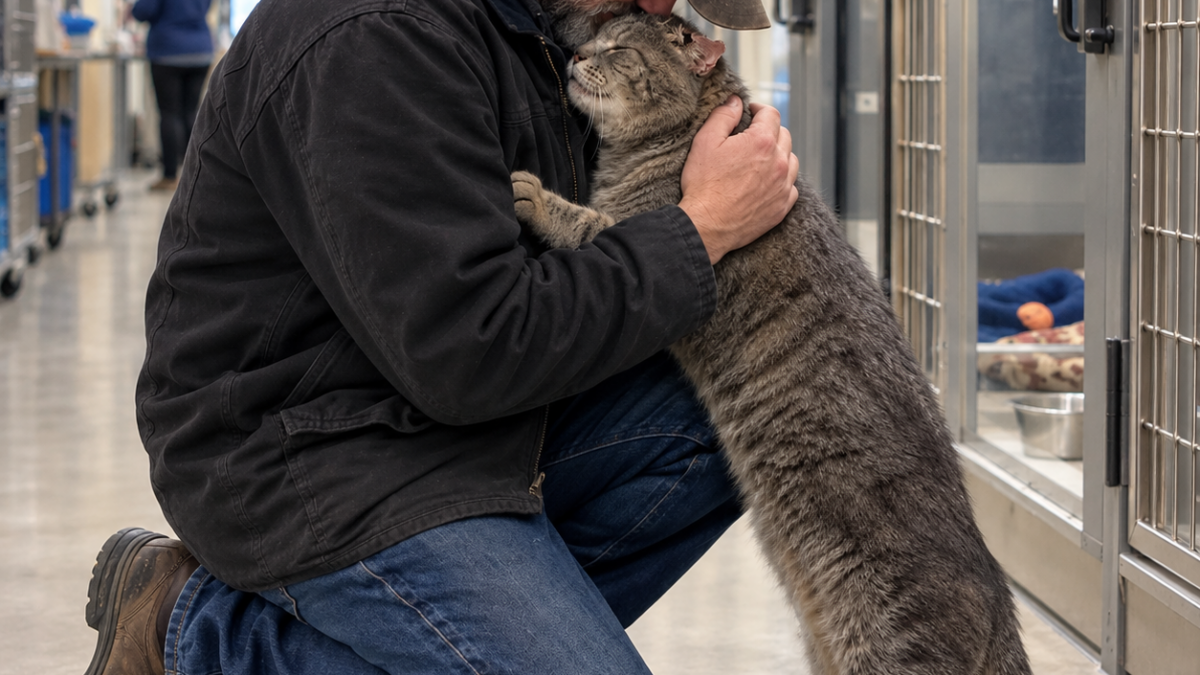
The shelter cat looked like he’d spent half his life winning fights nobody else had survived, and when his yellow eyes locked onto mine through the plexiglass, I stopped walking even though I had absolutely no intention of adopting anything. A few minutes later, that fifteen-pound, scar-faced tomcat pushed out of his kennel, planted one enormous paw on my boot, and drove his forehead into my chest so hard I had to catch myself against the wall. I still told myself I could walk away from him, but by the time I reached my silent house that evening, I had begun to suspect the animal everyone else avoided had noticed something about me I had spent years hiding.
I was fifty-eight years old, working overnight shifts at an industrial freight depot outside Spokane, and I had gone to the county shelter for one reason.
Towels.
My daughter, Maren, had been telling me for weeks to clean out the hallway linen closet.
“Dad, you have towels in there older than I am.”
“That’s impossible.”
“I’m thirty-one.”
“Exactly.”
She wasn’t amused.
Finally, she told me shelters always needed old towels and blankets. So on a cold Saturday morning, I loaded two garbage bags into my pickup.
Drop them off.
Go home.
Simple.
I’d become very good at simple.
My marriage had ended years earlier. Maren lived three states away. Most nights I came home after midnight, reheated leftovers, turned on the television, and sat in my armchair without really watching anything.
I just needed sound.
Because when the front door closed behind me, the silence could feel heavier than the house itself.
Whenever coworkers asked how I was doing, I gave them the same answer.
“I’m fine.”
It was convenient.
Automatic.
And completely untrue.
After I handed over the towels, a shelter employee named Keely walked me toward the exit through the adoption wing.
I was almost outside when I noticed him.
A huge gray-brindled cat sat behind a plexiglass door, staring directly at me.
Not at Keely.
Not at the family passing behind us.
Me.
I stopped.
“Good Lord.”
Keely laughed.
“That bad?”
I pointed.
“That cat looks like he came to collect money I owe.”
“That’s Rourke.”
He was enormous without being fat—thick shoulders, broad muzzle, battered ears, scarred cheeks, pale scratches across his face.
He looked like a nightclub bouncer who had been working the door since 1998.
“How long has he been here?”
Keely’s smile faded.
“Too long.”
She told me he’d lived on the streets for years.
Freezing winters.
Fights.
Infections.
Repeated veterinary treatment.
He’d survived all of it.
But surviving hadn’t made people want him.
Most adopters stopped for kittens.
Small cats.
Pretty cats.
Animals that looked good in photographs.
Rourke looked like he had opinions about unpaid debts.
“He’s actually one of the sweetest cats here,” Keely said.
I looked at her.
“That guy?”
“Open the door.”
I thought she was joking.
She wasn’t.
I reached for the latch.
The door opened.
Rourke remained still.
For one second, neither of us moved.
Then he stood.
One step.
Another.
Another.
He walked straight to me.
Stopped at my boots.
Placed one massive paw on my foot.
Then lifted his head and slammed his forehead into my chest.
Hard.
The impact rocked me backward.
Then a deep vibration started.
I stared at Keely.
“Is that him?”
She smiled.
“That’s his purr.”
It sounded like a diesel engine trying to start in January.
Rourke shoved harder against me.
“That’s how he says hello,” she said. “He does it when he chooses somebody.”
I lowered one hand.
My fingers touched the rough fur between his ears.
His eyes closed.
Something inside my chest shifted.
Because this battered old street cat wasn’t asking for food.
He wasn’t asking for a toy.
He simply pressed himself against me like he wanted one thing.
For me not to leave.
And before I could stop myself, I wondered how many people had opened that door before me, touched those scars, and then done exactly that.
PART 2
I kept my hand on Rourke’s head for another minute.
Maybe two.
It’s strange how long a minute can feel when something simple becomes unexpectedly personal.
He wasn’t doing anything dramatic.
No frantic meowing.
No claws hooked into my coat.
No desperate attempt to follow me out.
He just stood there, leaning his weight into my chest as if he had decided this was where he wanted to be for a while.
I looked at Keely.
“Does he do this with everybody?”
She tilted her head.
“Not exactly.”
“What does that mean?”
“He likes people.”
“Clearly.”
“But he usually takes a little time.”
Rourke’s purr continued vibrating through my jacket.
Keely smiled.
“You apparently skipped the interview.”
I looked down at him.
“Poor judgment.”
His ear moved.
I scratched beneath his chin.
That was my mistake.
The purr became louder.
“Okay,” I muttered. “Don’t make this weird.”
Keely laughed.
“You’re talking to the cat now.”
“I’m aware.”
Eventually, I stepped backward.
Rourke stopped purring.
His eyes opened.
That shouldn’t have bothered me.
It did.
I told myself there were practical reasons I couldn’t adopt him.
Plenty.
“I work nights.”
Keely nodded.
“My schedule’s terrible.”
Another nod.
“I’ve never had a cat.”
She still didn’t argue.
“My house isn’t huge.”
Nothing.
“I don’t even know what cats need.”
She leaned against the wall.
“You don’t have to convince me.”
That irritated me more than if she’d tried to sell me on him.
“I’m not trying to convince you.”
“I know.”
Rourke sat at my boots.
His tail wrapped around his paws.
I looked down.
“Somebody else will take him.”
Keely didn’t answer immediately.
When she did, her voice was careful.
“I hope so.”
That word landed differently.
Hope.
Not expect.
Not probably.
Hope.
“How long is too long?” I asked.
“Depends on the shelter. Depends on space. Depends on the cat.”
I didn’t like where the conversation was going.
“Is he in danger?”
“Not today.”
“That’s not what I asked.”
Keely folded her arms.
“He’s an older-looking adult with scars and chronic medical history. He’s not the first cat most people choose.”
I stared at Rourke.
He stared back.
His face was ridiculous.
Powerful.
Battered.
Intimidating.
He had the expression of someone who’d already decided how much interest he was charging.
And somehow, behind all of that, he wanted his forehead scratched.
I crouched one last time.
“Somebody younger is going to come get you.”
Rourke leaned toward my hand.
“Somebody with more time.”
Purr.
“Somebody who actually knows cats.”
His eyes closed.
I stood.
“I have to go.”
Keely only said, “Okay.”
I walked away.
Every step toward the exit felt slightly wrong.
Outside, cold air hit my face.
I loaded nothing into the truck because I’d arrived carrying only towels and left with empty hands.
Exactly as planned.
I drove home.
I told myself that should have felt good.
It didn’t.
That evening, I heated leftover meatloaf.
Didn’t bother putting it on a plate.
I ate from the plastic container while the television shouted from the living room.
Some game.
Some commentator.
Some crowd roaring through the speakers.
I couldn’t have told you who was playing.
I kept seeing yellow eyes.
Scarred cheeks.
One enormous paw planted on my boot.
I turned the television louder.
It didn’t help.
The house still felt empty beneath the noise.
At nine-thirty, Maren called.
I almost didn’t answer.
Then remembered I’d sent her one photograph from the shelter—a quick picture of Rourke sitting behind plexiglass.
I picked up.
“Hey.”
Her first words were, “So when are you bringing him home?”
“I’m not.”
She laughed.
“Sure.”
“I’m serious.”
“Why?”
“Because I don’t need a cat.”
“That wasn’t my question.”
I leaned back in the armchair.
“I work nights.”
“Cats don’t generally require bedtime stories at eight.”
“He’d be alone.”
“Dad, you’re home most of the day.”
“I sleep most of the day.”
“Excellent. Cats have been preparing for that schedule for thousands of years.”
I frowned.
“He’s old.”
“You’re fifty-eight.”
“Thank you.”
“You’re welcome.”
“I’ve never had an animal.”
“You’ve also never owned a dishwasher.”
“I own a dishwasher.”
“You use it as storage.”
“That’s beside the point.”
She became quieter.
“Did you like him?”
I stared at the dark window across from me.
“He was all right.”
“Dad.”
“What?”
“You sent me five pictures.”
“I sent two.”
“Four.”
I opened my phone.
Apparently, I had sent four.
“That proves nothing.”
Maren laughed.
Then she asked, “Did he like you?”
I thought about the headbutt.
The purr.
The way his eyes had closed under my hand.
“Maybe.”
“Maybe?”
“Keely said he chose me.”
“Keely?”
“Shelter employee.”
“First-name basis already.”
“Don’t start.”
There was silence for a moment.
Then Maren’s voice softened.
“Why don’t you want him?”
I knew the list.
Schedule.
Experience.
Money.
Responsibility.
House.
All reasonable.
Instead I said, “He doesn’t need an old man like me.”
The silence on the phone changed.
Not empty.
Careful.
“Dad?”
“Yeah?”
“I think you and that cat have something in common.”
I closed my eyes.
“What?”
“Neither of you wants to admit you’re softer than you look.”
I opened my eyes again.
The television flickered silently now because at some point I had muted it without realizing.
“Very funny.”
“I’m not joking.”
“I’m fine.”
“There it is.”
“What?”
“Those two words.”
I didn’t answer.
Maren sighed.
“I worry about you.”
“You don’t need to.”
“I know.”
“Then don’t.”
“That’s not how daughters work.”
I rubbed my forehead.
“I go to work. I pay my bills. I eat.”
“Cold meatloaf out of a container?”
I looked down at the container in my hand.
“How do you know that?”
“Because I know you.”
That irritated me because it was true.
She continued.
“I’m not saying adopt a cat because you’re lonely.”
“Good.”
“I’m saying maybe stop pretending you aren’t.”
I looked around the room.
Armchair.
Coffee table.
Television.
One plate from yesterday in the sink.
The house hadn’t always felt this way.
When Maren was young, there had been backpacks in hallways.
Music from upstairs.
Shoes by the door.
Arguments about curfew.
The sound of my wife moving around the kitchen before our marriage fell apart.
I used to complain about noise.
Then I got exactly what I thought I wanted.
Peace.
Turns out peace and absence can look similar from across the room.
“I have to work tonight,” I said.
Maren understood the conversation was over.
“Okay.”
“I’ll call you Sunday.”
“You said that last Sunday.”
“I’ll actually do it.”
“Love you.”
“Love you too.”
Then, just before she hung up:
“Go get the cat.”
“Maren.”
The line went dead.
I looked at Rourke’s picture again.
He looked terrible.
I smiled despite myself.
The following day, I slept badly.
Every time I woke, I thought of the shelter.
I told myself Rourke had probably been adopted already.
That thought should have relieved me.
Instead, I felt something unpleasant in my chest.
I got ready for work at ten that night.
At the freight depot, the shift was ordinary.
Forklifts.
Metal loading docks.
Diesel smell.
Radios crackling.
Men shouting over machinery.
I liked that environment because silence wasn’t possible.
Around three in the morning, my coworker Dale found me staring at a manifest without reading it.
“You asleep standing up?”
“No.”
“You’re getting old.”
“You’re older.”
“True.”
He looked closer.
“You okay?”
The answer appeared automatically.
“I’m fine.”
He nodded and walked away.
Two words.
Maren’s voice came back.
There it is.
I hated that.
My shift ended shortly after sunrise.
Normally I drove straight home.
That morning, I took the wrong exit.
At least that’s what I told myself.
Then I took another road.
Then another.
The shelter came into view.
I gripped the steering wheel.
“This is stupid.”
I parked anyway.
The shelter had just opened.
Keely was near the front counter.
She looked up when I walked in.
Something like recognition flashed across her face.
“Morning.”
“Morning.”
I shoved my hands into my jacket pockets.
“I was nearby.”
She looked through the glass doors at the parking lot.
“You live on the other side of town.”
I stared at her.
“Rourke still here?”
She smiled slightly.
“Go see.”
That annoyed me.
“Can you just answer?”
“Go see.”
I walked toward the adoption wing.
My heart was beating harder than it had any right to.
I turned the corner.
Reached his kennel.
Stopped.
Empty.
No Rourke.
No bedding.
No food dish.
Nothing.
I stared through the plexiglass.
For several seconds, I felt stupid.
Of course.
Somebody had adopted him.
Good.
That was what I wanted.
I had literally told him somebody younger would come.
Somebody with more time.
Somebody better prepared.
So why did disappointment hit me so hard I actually grabbed the edge of the kennel door?
“No.”
The word escaped before I could stop it.
I looked around.
Maybe wrong kennel.
No.
Name card gone.
Bed gone.
Rourke gone.
My chest tightened.
A family would be good.
Children maybe.
A sunny house.
Someone who knew cats.
That should have made me happy.
Instead, I felt like I’d missed something I hadn’t known I wanted until it disappeared.
I turned to leave.
Keely was standing at the end of the hallway.
“Everything okay?”
I shrugged.
“Yeah.”
She looked at me.
I corrected myself.
“Rourke’s gone.”
Her expression changed.
Then she smiled.
“He’s in the exam room.”
I blinked.
“What?”
“Final booster.”
I stared at her.
The relief that hit me was so immediate and ridiculous that I had to look away.
Keely saw all of it.
“Oh,” she said.
“Don’t.”
“I didn’t say anything.”
“You’re thinking loudly.”
She laughed.
Then I heard a sound from around the corner.
A rough, gravelly meow.
Another.
I turned.
A veterinary technician appeared with Rourke beside her.
They had him on a loose shelter lead for the short walk from the exam room.
Rourke’s head came up.
His yellow eyes found me.
He froze.
The technician looked down.
“What’s up, big guy?”
Then Rourke moved.
Straight toward me.
The technician barely had time to loosen her grip.
Rourke came faster than I’d seen him move before.
Not graceful.
Not kitten-fast.
More like fifteen pounds of determined street cat heading toward a destination.
I dropped to one knee.
He hit my chest.
Hard.
Both front paws came up against me.
His head drove under my chin.
That diesel-engine purr started instantly.
I wrapped my arms around him without thinking.
Rough fur.
Heavy body.
Scarred cheeks.
Warmth.
“Yeah, yeah.”
My voice cracked.
I didn’t care.
“I came back, didn’t I?”
Rourke shoved his forehead harder against me.
Keely stood behind us.
She didn’t say a word.
Smart woman.
I buried my face in the fur along his neck.
He smelled faintly like antiseptic and shelter bedding.
I whispered, “You’re making this difficult.”
Purr.
“Very difficult.”
Rourke didn’t move.
That’s when I knew.
Not because I believed in fate.
Not because I thought animals magically identify the exact person who needs them.
Maybe Rourke would have loved plenty of people.
Maybe I happened to be there.
Maybe I had projected half the meaning onto him myself.
It didn’t matter.
I had left.
He had stayed in my head.
I had returned.
And the sight of an empty kennel had told me the truth before I was ready to say it.
I wanted him.
I stood slowly.
Keely raised an eyebrow.
“Need directions to the exit?”
I gave her a look.
“Where are the adoption papers?”
Her smile widened.
“Thought so.”
An hour later, I signed my name.
Rourke became mine.
Or I became his.
That distinction became less clear very quickly.
The first stop was a pet store.
I had no idea what I was doing.
The employee asked, “What kind of cat?”
“Large.”
“How large?”
“Fifteen pounds.”
“Long-haired?”
“No.”
“Age?”
“Adult.”
“Activity level?”
I thought about Rourke moving toward me.
“Selective.”
The employee stared.
“I mean, I don’t know.”
We started with food.
Bowls.
Litter box.
Litter.
Scratcher.
Carrier.
Toys.
Then beds.
I found a memory-foam bed that cost more than some furniture I’d owned in my twenties.
I stared at the price.
Then at Rourke’s carrier in the cart.
“Don’t get used to this.”
A rough meow came from inside.
I bought the bed.
At home, I placed it in the living room.
Soft.
Thick.
Expensive.
Perfect for an older cat who’d survived years on pavement, dirt, concrete and whatever else the streets offered.
I opened the carrier.
Rourke stepped out.
He sniffed the air.
Looked around.
Walked toward the bed.
My chest warmed.
“See? Worth every—”
He sniffed it.
Turned.
Walked past.
Jumped onto the sofa.
I stared.
“You have got to be kidding me.”
Rourke circled twice.
Collapsed.
I pointed at the bed.
“That cost one hundred and—”
He started grooming one paw.
“Fine.”
Five minutes later, he was asleep.
That first evening, I turned on the television out of habit.
Rourke sat at the opposite end of the couch.
He watched me.
I watched the screen.
Ten minutes later, he moved one cushion closer.
I pretended not to notice.
Five minutes after that, another.
Eventually, his shoulder touched my thigh.
Then his enormous chin lowered onto my knee.
His eyes closed.
The purr began.
I froze.
The television kept shouting.
Some political argument.
Some commercial.
Some meaningless noise I’d used for years to make the house feel occupied.
I picked up the remote.
Pressed power.
Silence.
Complete.
I waited for the old feeling.
That hollow pressure.
The awareness of every empty room.
It didn’t come.
Rourke’s purr vibrated against my leg.
I put my hand on his back.
The house was silent.
But for the first time in years, the silence didn’t feel like proof that I was alone.
It felt peaceful.
That first night, I expected Rourke to sleep in the expensive bed.
He slept in the armchair.
My armchair.
I found him there when I came downstairs dressed for work.
He occupied the entire seat.
“Move.”
One eye opened.
“That’s mine.”
Eye closed.
I waited.
Nothing.
“Great.”
I sat on the sofa to tie my boots.
Before leaving, I crouched beside him.
“I’ll be back in the morning.”
His eyes opened.
For a second, guilt surfaced.
Rourke had spent years outside.
Now, within twenty-four hours of adopting him, I was leaving for an entire overnight shift.
Maybe this had been selfish.
Maybe he needed someone with normal hours.
Maybe I should have listened to myself.
I stood slowly.
Then Rourke yawned.
Rolled onto his side.
Went back to sleep.
Apparently my departure was less emotionally devastating than I had imagined.
At work, I checked the clock constantly.
At four in the morning, Dale noticed.
“You got somewhere to be?”
“Home.”
He looked surprised.
“Since when?”
I ignored him.
After shift, I stopped for coffee and then changed my mind because that would delay me.
When I unlocked the front door, I heard something.
Thump.
Pause.
Thump.
Thump.
Heavy paws down the hallway.
Rourke appeared.
He walked straight toward me.
Rubbed his face against my steel-toed boot.
Then my leg.
Then headbutted my knee.
I laughed.
“Okay.”
Purr.
“I was gone eight hours.”
More rubbing.
“You survived.”
Rourke looked up.
I crouched.
He shoved his forehead into me.
That became our routine.
Night after night.
I left.
I came back.
Rourke greeted me as though I’d returned from war.
The first week had complications.
Because of course it did.
On day three, he knocked a water glass off the coffee table.
I heard the crash from the kitchen.
Ran in.
Broken glass.
Water.
Rourke sitting nearby.
“What happened?”
He looked at me.
“You did this.”
Blank stare.
“I live alone. There’s literally no second suspect.”
Rourke began washing his paw.
I cleaned the glass.
Two days later, a small decorative bowl went down.
Then a stack of mail.
Then the television remote.
That one felt intentional.
Maren laughed when I told her.
“He’s making changes.”
“He’s vandalizing my house.”
“You adopted him.”
“You told me to.”
“I did not tell you to put breakable things within paw range.”
“You’ve never even owned a cat.”
“I have the internet.”
“Very useful.”
Then she asked, “How are you?”
“I’m fine.”
Silence.
I heard her smile through the phone.
“What?”
“Nothing.”
“Say it.”
“You sound different.”
“I have a cat breaking things.”
“Exactly.”
Rourke’s first veterinary visit as my cat made me more anxious than I expected.
The shelter had told me about his history.
Old fight wounds.
Previous infections.
A few dental concerns.
Scars that would never disappear.
Nothing immediately dangerous.
Still, sitting in the clinic waiting room with his carrier beside me made responsibility feel real.
A technician called his name.
Inside the exam room, Rourke emerged with complete confidence.
The veterinarian ran a hand across his shoulders.
“He’s built like a brick.”
“That’s the professional term?”
“Very technical.”
She checked his teeth.
Ears.
Heart.
Weight.
Old scars.
Rourke tolerated everything.
Then she said, “You know he’s probably older than the shelter can prove.”
“How old?”
“Hard to say exactly.”
“Ten?”
“Possibly.”
“Older?”
“Possible.”
I looked at Rourke.
He was sniffing a cabinet.
The thought bothered me.
I had only just found him.
Suddenly I was doing math.
How many years?
How many left?
The vet noticed my expression.
“He’s doing well.”
“I know.”
“Don’t borrow trouble.”
I looked at her.
“Is that a medical term too?”
“Extremely.”
She gave Rourke a treat.
He swallowed it.
Then stared at her hand.
I sighed.
“He’s manipulative.”
“Also healthy.”
We went home.
I tried not to count years.
That became harder because Rourke settled into my life so quickly.
Morning, when I returned from shift, he’d greet me.
Then breakfast.
Then he would follow me into the kitchen.
Then upstairs.
Then back down because apparently I walked too slowly.
When I slept during the day, he usually joined me.
Not on the bed at first.
Near the bedroom doorway.
After two weeks, on the foot of the bed.
After a month, against my leg.
After two months, on my chest.
Fifteen pounds directly over my lungs.
The first time, I woke thinking I was having a heart attack.
Then opened my eyes.
Rourke’s face was six inches from mine.
“Move.”
Purr.
“I can’t breathe.”
Purr.
“Rourke.”
He lowered his head.
I shoved gently.
Nothing.
I finally rolled sideways enough that he slid off.
He looked deeply offended.
“You almost killed me.”
He climbed back toward my shoulder.
No remorse.
I began talking to him.
More than I realized.
At first, practical statements.
“Breakfast.”
“Move.”
“Get down.”
“No.”
Then full conversations.
“Work was terrible.”
Rourke sat on the counter even though he wasn’t supposed to.
“Dale nearly dropped an entire pallet because nobody knows how to listen to a radio.”
Rourke blinked.
“And then management wants to know why overtime is high.”
Slow blink.
“Exactly.”
The dangerous part was that he was a good listener.
Never interrupted.
Rarely offered useless advice.
Occasionally walked away, which was honestly fair.
I started coming home with stories.
That was new.
Before Rourke, the details of my day disappeared because there was nobody to tell.
Maren called one Sunday.
“What are you doing?”
“Cleaning cat hair off the couch.”
“Living the dream.”
“Your fault.”
“Where is he?”
“Watching me.”
“Put me on speaker.”
I did.
Maren said, “Rourke.”
His ears moved.
“Tell Dad he’s lucky.”
Rourke meowed.
I stared at the phone.
Maren screamed with laughter.
“Oh my God.”
“Coincidence.”
“He agrees with me.”
“Absolutely not.”
She laughed harder.
I found myself laughing too.
Long enough that my stomach hurt.
When we hung up, I realized something.
Our calls had gotten longer.
Not because Rourke was the only thing we talked about.
He had simply given us an easier place to start.
How’s Rourke?
Then work.
Then her job.
Then people she was dating.
Then memories.
Then things we’d both avoided.
One night, months after the adoption, Maren asked about my marriage.
Not hers.
Mine.
“You ever talk to Mom?”
“Sometimes.”
“Do you miss her?”
I stared at Rourke sleeping in the armchair.
“Sometimes.”
Maren was quiet.
“Why didn’t you ever say that?”
“What good would it do?”
“I don’t know.”
“Exactly.”
“Dad, not everything has to solve something.”
I smiled.
“You’ve become very philosophical.”
“You adopted a street cat and started having emotions. Anything is possible.”
I laughed.
Rourke opened one eye.
“Go back to sleep.”
Maren heard.
“See?”
“See what?”
“You’re talking to him like he’s family.”
I didn’t answer.
Because by then he was.
Winter came.
Spokane cold isn’t the same as some places, but I kept thinking about what Keely had told me.
Rourke had lived outside through winters.
I would watch snow collect near the windows and look at him asleep in the memory-foam bed he had finally accepted.
It took three months.
Three months before he decided my expensive purchase wasn’t offensive.
He curled inside it one snowy afternoon.
I took a picture.
Sent it to Maren.
FINALLY.
Her reply:
Proud of you. He has trained you well.
I stared at Rourke.
“You could’ve used this sooner.”
He stretched.
That winter showed me how deeply some habits remained inside him.
If wind rattled something outside, his body sometimes stiffened.
If another cat appeared near the window, Rourke became completely still.
Not playful.
Alert.
Street-cat alert.
Once, during a storm, something crashed in the alley.
Rourke woke instantly.
He crouched low.
Eyes wide.
Every muscle ready.
I sat on the floor.
“It’s okay.”
He looked at me.
I didn’t reach.
Just stayed.
A minute passed.
Then two.
Finally, Rourke walked over.
Headbutted my shoulder.
I scratched behind his ear.
He relaxed.
Healing, I learned, did not mean forgetting every survival reflex.
Rourke was safe.
His body occasionally needed reminding.
I understood that more than I wanted to.
I had my own reflexes.
“How are you?”
Fine.
“You lonely?”
No.
“Need anything?”
I’m good.
Maybe survival looks respectable when humans do it.
Still survival.
One Saturday, Maren came home.
I cleaned the house more thoroughly than necessary.
Bought groceries.
Changed the guest-room sheets.
Rourke watched all of it.
“You are not allowed to embarrass me.”
He knocked a pen off the kitchen table.
“I’m serious.”
The front door opened around noon.
“Dad?”
I came from the kitchen.
Maren stepped inside.
We hugged.
It was good.
Awkward for half a second because we weren’t a family that hugged long.
Then Rourke appeared.
Maren stopped.
“Oh my God.”
“What?”
“He’s enormous.”
“I told you.”
“No. You sent pictures. Pictures lied.”
Rourke stood in the hallway.
Scarred face.
Broad chest.
Battered ears.
Maren whispered, “He looks like he runs security for organized crime.”
I laughed.
“I said loan shark.”
“Same family.”
Rourke approached.
Maren crouched carefully.
“Hi, handsome.”
He sniffed her hand.
Then walked past.
She stared.
“He rejected me.”
“He has standards.”
“Dad.”
Five minutes later, Rourke returned.
He sat beside her.
She touched his cheek.
Purr.
Maren smiled.
“There.”
“Don’t get arrogant.”
By evening, Rourke was stretched across the living-room rug.
Belly exposed.
Paws loose.
Utterly defenseless.
Maren stood in the kitchen doorway.
“Dad.”
“What?”
“Look at him.”
“I see him every day.”
“No. Look.”
I did.
The same cat who had looked like a street enforcer behind shelter plexiglass was upside down with one back paw hanging in the air.
I smiled.
“He has no dignity.”
Maren laughed.
“He looks even more like a nightclub bouncer in person.”
I scratched Rourke’s thick gray cheek.
“Yeah.”
Then, without thinking, I said, “People tend to get him wrong.”
Maren stopped smiling.
I looked at Rourke.
Scars.
Battered ears.
Massive head.
The appearance that had caused strangers to walk past.
Then I looked at my daughter.
“Guess they probably did the same with me.”
She stared.
I immediately wished I could put the words back.
Not because they weren’t true.
Because they were.
Maren crossed the kitchen.
She hugged me.
Hard.
I went stiff automatically.
Then hugged her back.
Rourke woke.
Looked at us.
Apparently decided the scene required supervision.
He stood.
Walked over.
Wedged himself between our legs.
Maren started laughing into my shoulder.
“He’s jealous.”
“Or he thinks this is a medical emergency.”
Rourke’s purr filled the room.
That evening, after Maren went to bed, I sat in the armchair.
Rourke climbed onto my lap.
I had stopped pretending the chair belonged solely to me.
I ran my hand across his scars.
Each one had a history I would never know.
Fights.
Accidents.
Disease.
Cold.
Whatever had happened before the shelter.
Rourke couldn’t tell me.
And maybe it didn’t matter.
I used to think knowing the past explained a creature.
Now I wasn’t sure.
Rourke had been shaped by what happened to him.
He was also more than it.
So was I.
Months became a year.
The house changed.
Not physically.
Mostly.
There were cat toys everywhere.
A scratching post in the living room.
Another bed upstairs.
The expensive first bed near the radiator.
A food mat because Rourke apparently believed eating was an athletic event.
But the real change was sound.
Heavy paws down the hallway.
A gravelly meow from the kitchen.
The scratch of litter.
A crash from another room followed by my voice:
“Rourke!”
Sometimes the sound of purring before I even opened my eyes.
The television stayed off more.
That surprised me.
It wasn’t a conscious decision.
I simply stopped needing it.
Some nights after work, I came home, ate, and sat quietly.
Rourke beside me.
No television.
No radio.
Nothing.
Just the refrigerator cycling.
Cars far outside.
Rourke breathing.
The silence had changed.
Maybe because silence isn’t loneliness.
Not always.
Loneliness is absence without connection.
Rourke created connection simply by existing in the same room.
My coworkers noticed changes too.
One night Dale caught me looking at cat food on my phone during break.
He stared.
“What is happening?”
“Nothing.”
“Are those cat treats?”
“No.”
He leaned closer.
“Those are absolutely cat treats.”
I locked the phone.
“Mind your business.”
“You own a cat?”
“Yes.”
Dale looked delighted.
“No.”
“What?”
“You hate cats.”
“I never said that.”
“You once called my cat a tiny home invader.”
“Accurate description.”
“What kind?”
“Mixed.”
“All cats are mixed with what?”
“I don’t know.”
“Picture.”
“No.”
“Picture.”
I finally showed him.
Dale stared.
“That’s not a cat.”
“What?”
“That’s a retired prison guard.”
I laughed so hard another coworker looked over.
Within a week, half the night shift knew about Rourke.
People asked for updates.
Someone brought a toy.
Dale brought treats.
I pretended to be annoyed.
I wasn’t.
For years, conversations at work had stopped at weather, schedules and overtime.
Now people asked about my life because Rourke had accidentally given them an opening.
And I answered.
Not deeply.
Not at first.
But enough.
A strange thing happened.
The more connected my house became, the more connected I became outside it.
Maybe loneliness had made me defensive.
Maybe I had spent so long expecting people to leave that I’d stopped giving them much reason to stay.
Rourke didn’t fix that.
He wasn’t a therapist.
He was a cat.
He slept.
Ate.
Destroyed paper.
But caring about him required me to participate in something.
Feed.
Observe.
Schedule.
Return.
Be expected.
Expectation can be a powerful thing.
Someone notices whether you come home.
Even if that someone is fifteen pounds and covered in old scars.
Rourke’s age eventually began showing more clearly.
He slept longer.
Jumped less easily.
The veterinarian found early arthritis.
Nothing catastrophic.
We added steps near the sofa.
A supplement.
Later, medication.
I hated the first visible signs of decline.
Maren reminded me, “He’s allowed to get old.”
“I know.”
“You can’t rescue him from age.”
“I know.”
“Dad.”
“I know.”
But knowledge and acceptance aren’t the same.
One morning, Rourke hesitated before climbing into the armchair.
I reached to help.
He glared.
“Fine.”
He made it himself.
Pride remained healthy.
The vet said his heart sounded good.
Blood work acceptable for his age.
Dental issues managed.
The old infections hadn’t left major damage.
Still, I began noticing time.
I tried not to count.
Had I adopted him three years ago?
Four?
How old had he actually been at the shelter?
Nobody knew.
For an animal with an uncertain past, age becomes an estimate.
That bothered me.
I wanted numbers.
Certainty.
Then remembered something the first veterinarian had said.
Don’t borrow trouble.
So I stopped calculating whenever I caught myself.
Rourke didn’t care what year it was.
Dinner happened at five.
That was sufficient.
One winter evening, a storm knocked out power.
The house became completely dark.
No television.
No lights.
No refrigerator hum.
I lit candles.
Rourke sat near my feet.
The silence was deeper than usual.
Years earlier, that would have unsettled me.
I would have found an excuse to leave.
Driven somewhere.
Sat in a diner.
Anything.
Instead, I wrapped a blanket around my shoulders.
Rourke climbed into my lap.
We sat.
Snow hit the windows.
His purr filled the dark.
I remembered the night after the shelter when I’d turned off the television for the first time.
That had been the beginning.
Not of happiness exactly.
Of tolerating my own life without needing noise to cover it.
Maybe that was more important.
Maren called.
“You have power?”
“No.”
“You okay?”
I looked at Rourke.
“Yeah.”
“You need anything?”
“No.”
Then I corrected myself.
“Actually, stay on the phone a while.”
There was a pause.
“Okay.”
We talked.
For almost an hour.
Nothing urgent.
Her work.
My work.
Rourke.
Weather.
A man she was seeing.
A vacation she wanted to take.
When the call ended, I realized I hadn’t said “I’m fine” once.
A year later, Maren got engaged.
She told me over video call.
I cried.
Not dramatically.
Enough.
“Don’t tell anyone.”
“Dad, you are literally crying on video.”
“Technical issue.”
She laughed.
Rourke jumped onto the desk.
His face filled the camera.
Maren screamed.
“There’s my brother.”
“Absolutely not.”
She addressed him.
“Rourke, I’m getting married.”
He sniffed the phone.
“He’s thrilled.”
“He wants food.”
“Same thing.”
The wedding brought more changes.
Travel.
People.
Noise.
Rourke stayed with a trusted neighbor who knew him well.
I worried more than necessary.
Called twice.
Neighbor sent pictures.
Rourke in armchair.
Rourke eating.
Rourke looking bored by my absence.
Maren told me, “He’s fine.”
“I know.”
“Enjoy my wedding.”
“I am.”
“You’ve checked your phone six times.”
“I’m waiting for something.”
“A cat update.”
“Possibly.”
She shook her head.
Then smiled.
At the reception, we danced.
I hadn’t danced in years.
I was terrible.
Maren didn’t care.
At some point she leaned close and said, “You know, you really are different.”
I almost gave the old answer.
I’m fine.
Instead I asked, “Better or worse?”
“More here.”
That was all.
More here.
Present.
Maybe that’s what Rourke taught me without meaning to.
Being alive and being present aren’t always the same thing.
I’d been surviving my routines.
He made them matter.
When I returned from the wedding, Rourke greeted me at the door.
He walked more slowly by then.
Still, he came.
Thump.
Thump.
Thump.
Heavy paws.
Head against my leg.
Purr.
I knelt.
“Yeah.”
Rough cheek against my hand.
“I missed you too.”
He headbutted my chest.
Hard enough that I laughed.
Years changed us both.
My hair grayed more.
Rourke’s muzzle lightened.
I eventually reduced my night shifts.
Not because of Rourke alone.
Age.
Seniority.
A supervisor role that came with slightly better hours.
Still, I liked being home evenings.
Rourke did too.
We developed a ritual.
Dinner.
My chair.
Rourke nearby.
Sometimes television.
Often not.
Maren called Sundays.
Actually called.
And I answered.
One evening, she asked, “Do you remember the towels?”
“What towels?”
“The towels that started this.”
I laughed.
“Oh.”
“You were so irritated with me.”
“You were harassing me.”
“I was helping.”
“You had no idea.”
“No.”
Neither of us had.
That was the funny part.
No one had planned anything.
She wanted me to clean a closet.
I wanted her to stop nagging.
The shelter needed towels.
Rourke happened to be sitting behind plexiglass.
Sometimes lives change through decisions too small to notice while making them.
Not destiny.
Sequence.
One action puts you near another possibility.
Then you choose.
I had nearly chosen to keep walking.
Then chosen to leave.
Then chosen to return.
Rourke had been patient enough to survive my indecision.
As he grew older, sleep became his dominant hobby.
He still greeted me.
Still demanded breakfast.
Still knocked things off tables occasionally, though less often because jumping required more effort.
I moved things lower for him.
Added another step.
Soft rugs.
Warm beds.
I thought often about how he’d spent years without any of that.
Then stopped.
Rourke didn’t need me grieving his past every day.
He needed me paying attention to his present.
One autumn morning, he didn’t eat breakfast.
That frightened me.
Rourke had ignored pain before.
Ignored weather.
Ignored my furniture rules.
He had never ignored breakfast.
I crouched beside him.
“Hey.”
He looked tired.
I called the vet.
Same day.
Blood work.
Exam.
Imaging.
Nothing catastrophic initially.
Dehydration.
Possible GI upset.
Age-related changes.
Treatment.
Monitoring.
He ate that evening.
Half a bowl.
I almost celebrated.
The episode passed.
But it reminded me how deeply the fear of losing him had been waiting underneath ordinary life.
I sat beside his bed that night.
“You can’t leave yet.”
Rourke looked at me.
I hated the sentence immediately.
Of course he could.
Someday he would.
Love doesn’t create ownership over time.
I corrected myself.
“Stay as long as you feel like staying.”
He closed his eyes.
Purr.
The vibration was softer now.
Still there.
Months later, his arthritis worsened.
Medication helped.
We adjusted again.
No big jumps.
More warm bedding.
Vet monitoring.
I learned the language of senior animals.
Good days.
Bad days.
Appetite.
Mobility.
Grooming.
Interaction.
Comfort.
Quality of life.
The same categories I’d once never thought about became central.
I found myself brushing Rourke because he couldn’t always reach parts of his coat comfortably.
He hated the brush near his back legs.
Loved it on his cheeks.
“You’re difficult.”
Purr.
“Selective.”
Purr.
“Expensive.”
Purr.
One afternoon, Maren visited with her husband.
Rourke was asleep in the armchair.
She stopped.
“He looks older.”
“Because he is.”
She sat beside him.
Rourke opened his eyes.
Saw her.
Closed them again.
“Wow.”
“That’s affection.”
“Clearly.”
She stroked his head.
“Dad?”
“Yeah?”
“You okay?”
The old reflex rose.
I’m fine.
I swallowed it.
“I’m scared.”
Maren looked at me.
“About losing him?”
“Yeah.”
She nodded.
“That makes sense.”
“I know it’s coming.”
“So?”
“So knowing should make it easier.”
“No.”
She put her hand over mine.
“It just makes it known.”
I stared at Rourke.
“He’s the first thing waiting when I come home.”
“I know.”
“I don’t know what the house is going to feel like.”
Maren squeezed my hand.
“Different.”
“That’s helpful.”
“I didn’t say empty.”
I looked at her.
She continued.
“Because you’re not the same person you were before him.”
Rourke shifted.
His head rested against my arm.
Maren smiled.
“He already changed the house.”
She tapped my chest lightly.
“And this.”
I rolled my eyes because fathers have obligations.
But I heard her.
Rourke gave us more time.
Not forever.
Never forever.
But enough.
Enough for seasons.
Enough for routines to become history.
Enough that I stopped thinking of him as the shelter cat.
He was simply Rourke.
One cold morning, I woke before my alarm.
The room was quiet.
Rourke lay beside me.
His breathing slow.
I put a hand against his side.
He opened his eyes.
I smiled.
“Morning.”
His head moved toward my hand.
Purr.
Soft.
I thought about our first meeting.
The headbutt.
The force of it.
The diesel-engine purr.
He had been physically powerful then.
Now his bones were easier to feel.
His movements careful.
But when I scratched between his ears, his eyes closed exactly the same way.
There are things age doesn’t take.
Recognition.
Trust.
The shape of a familiar hand.
A place where sleeping feels safe.
That day, Rourke ate breakfast.
Then stole my chair.
I pretended to complain.
As always.
Some routines deserve to survive as long as possible.
Eventually, Maren asked if I regretted adopting an older cat.
“No.”
“Even knowing you’d get less time?”
I thought about it.
“Less than what?”
She waited.
“Less than if I’d adopted a kitten?”
“Yeah.”
I looked at Rourke sleeping.
“Maybe.”
Then I shook my head.
“But I didn’t meet a kitten.”
I met him.
That’s the mistake we make when we measure love by potential duration.
As if ten future years automatically mean more than three real ones.
Rourke had been there.
Scarred.
Unwanted.
Looking at me.
I had been there too.
Lonely.
Pretending not to be.
Maybe the available time had always been enough.
Not because loss wouldn’t hurt.
Because the alternative was never having those years at all.
I wouldn’t trade them.
Not one.
The freight depot eventually moved me permanently to day supervision.
My coworkers acted like I’d retired.
Dale said, “You finally joined civilization.”
“I still work with you.”
“Fair.”
I started coming home before dark.
Rourke noticed immediately.
The first week, he looked confused.
I walked in at five.
He appeared.
Stared.
“Yes, I’m early.”
Meow.
“Don’t sound disappointed.”
He rubbed my leg.
I laughed.
The new schedule gave us evenings.
Real ones.
Sunlight through windows.
Dinner before midnight.
Occasional visits from neighbors.
Maren calling while I was awake rather than half-asleep.
My life expanded gradually enough that I didn’t notice until one evening the television had been off for three days.
Three days.
Years earlier, I couldn’t tolerate thirty minutes.
I looked at Rourke.
“You broke the television habit.”
He yawned.
The house was quiet.
But not empty.
Even when Rourke slept in another room, the silence no longer threatened me.
Because I’d learned something important.
Being alone and being abandoned are not the same thing.
Rourke had probably learned that too.
He could sleep in another room without checking where I was.
I could sit in silence without needing a machine to pretend someone was talking.
Connection had taught both of us how to tolerate distance.
One evening, I found the original photograph I’d taken at the shelter.
Rourke behind plexiglass.
Huge head.
Scarred face.
Yellow eyes fixed on me.
I held the phone beside the armchair.
Rourke was asleep upside down.
One paw curled.
Mouth slightly open.
Completely undignified.
I laughed.
“You fooled me.”
One eye opened.
“You looked dangerous.”
Eye closed.
The photograph made me think of all the people who had passed his kennel.
I no longer felt angry at them.
Not everyone was supposed to take Rourke home.
Maybe they had children.
Dogs.
Rental restrictions.
Different needs.
Maybe they simply wanted another cat.
People are allowed to choose.
What mattered was someone eventually stopped.
I happened to be that person.
And he happened to stop me too.
Years after the towel donation, Keely sent me a message.
She had my contact because I’d occasionally sent shelter updates.
How’s the loan shark?
I smiled.
Sent a picture of Rourke in the armchair.
Retired.
She replied:
Looks comfortable.
I looked at the expensive bed sitting empty nearby.
Too comfortable.
Then I added:
Thank you for telling me to open the door.
Her response came quickly.
You opened it. He did the rest.
That sounded right.
The door was the important part.
Not metaphorically.
Literally.
A latch.
One ordinary action.
Open.
Then a cat had a choice.
He walked toward me.
I eventually chose to walk back.
That’s how it happened.
Not magic.
Two stubborn creatures making small decisions in each other’s direction.
The final years of Rourke’s life were slower.
Gentler.
More medical.
That’s the part sentimental rescue stories sometimes skip.
They end at adoption because adoption photographs are easier than aging.
But adoption isn’t the ending.
It’s where responsibility begins.
There were vet bills.
Medication.
Accidents outside the litter box once his joints hurt.
Special food.
A dental procedure I worried about for weeks.
Nights when he seemed uncomfortable.
Mornings when I called the clinic the minute it opened.
There were also naps.
Sunlight.
Warm blankets.
Sunday calls with Maren.
Headbutts.
The purr.
Always the purr.
Softer with age.
Still unmistakably Rourke.
One winter, he stopped jumping onto the sofa entirely.
I bought pet stairs.
He ignored them.
Naturally.
I tried showing him.
“Look.”
Rourke stared.
“Step.”
Nothing.
I put a treat on the first step.
He ate it.
Then walked away.
“You are impossible.”
Later that night, I saw him use the stairs when he thought I wasn’t watching.
I whispered, “Fraud.”
He climbed onto the couch.
Settled.
Purr.
The last lesson he taught me was the hardest.
Love isn’t proved by holding on forever.
Sometimes it is proved by paying attention closely enough to know when you’re holding on for yourself.
But that day was not yet here.
So I stopped rehearsing it.
Again and again.
That became my work.
Stay in the day.
Rourke ate.
Rourke slept.
Rourke purred.
Rourke wanted my chair.
Today is enough.
When his body eventually began failing more noticeably, Maren came home.
She didn’t wait for me to ask.
She arrived with a suitcase.
“I can stay a few days.”
“You have work.”
“I have leave.”
“You don’t need to—”
“Dad.”
I stopped.
“Okay.”
Rourke recognized her.
He couldn’t walk far by then, but his head lifted.
Maren sat beside him.
“Hey, bouncer.”
Tail—cats don’t wag, but his paw flexed.
She scratched his cheek.
The purr started.
Faint.
Still there.
I sat opposite her.
For a long time, neither of us said much.
No television.
No need.
Rourke slept between us.
Years earlier, the silence inside my house had felt unbearable.
Now my daughter and I sat in that same silence, listening to one old cat breathe.
Nothing about it was empty.
It was full of everything that had happened since the shelter.
Eventually, Maren whispered, “He picked well.”
I looked at her.
“Him?”
“You.”
I shook my head.
“I almost left him.”
“But you came back.”
Those words.
I had whispered them into Rourke’s fur the second time I saw him.
I came back, didn’t I?
I looked down at the old cat.
“Yeah.”
Maren smiled through tears.
“You did.”
Later that evening, Rourke woke.
He pushed his forehead weakly against my hand.
Not the full-force collision from the shelter.
Just enough.
I bent closer.
“I’m here.”
Purr.
“You don’t have to check.”
His eyes closed.
Maren’s hand rested on my shoulder.
The house was completely quiet.
Peaceful.
Not because loss wasn’t near.
Because love was.
When I think about Rourke now, I don’t think first about the hardest day.
I think about the beginning.
Two bags of old towels in the bed of my pickup.
A daughter nagging her father.
A shelter hallway.
A plexiglass door.
A cat built like a bowling ball staring directly at me.
I think about the way he placed one enormous paw on my boot.
The way he headbutted my chest.
The ridiculous purr.
I think about driving away.
And the empty kennel that showed me what I’d been too stubborn to admit.
Then I think about everything that came after.
Coffee-table objects sacrificed to gravity.
Hair on every piece of furniture.
Vet receipts.
The expensive bed he ignored.
The armchair he stole.
Maren laughing.
Coworkers asking for pictures.
Quiet evenings.
Storms.
Snow.
Phone calls I stopped cutting short.
A house becoming a home again without changing addresses.
I had believed I was doing a small favor when I drove to that shelter.
Old towels.
That was all.
I had believed I had nothing to offer an animal except a roof and food.
Rourke didn’t care.
He didn’t ask whether I was emotionally available.
Didn’t ask whether I’d healed from divorce.
Didn’t ask whether I was lonely.
He walked over and pressed his scarred head against me.
Then waited to see what I would do.
I had spent years believing strength meant needing very little.
Rourke had spent years surviving on the streets with a face that made him look untouchable.
Neither of us had actually wanted to be untouchable.
We’d simply gotten good at it.
He was first to admit it.
Not with words.
With one massive paw on my boot.
A forehead against my chest.
A purr.
I needed longer.
But I got there.
Eventually, I stopped turning on the television when I came home.
Eventually, I stopped answering every personal question with “I’m fine.”
Eventually, I learned to tell Maren when I missed her.
Learned to ask people to stay on the phone.
Learned to let coworkers know things about me that didn’t involve freight schedules.
Learned that silence could mean peace instead of absence.
Rourke did not perform those changes.
I did.
But sometimes a relationship gives you a reason to begin.
That was his gift.
Years earlier, I thought I was giving a battered shelter cat a second chance.
A warm house.
Food.
Soft places to sleep.
A person who came back.
I didn’t understand that Rourke was giving me the same things in another form.
A house that felt warm again.
A reason to come home.
Someone waiting.
A softer place inside myself I had spent years refusing to use.
Connection.
Presence.
A second chance to participate in my own life.
Maren once told me Rourke and I had something in common.
Neither of us wanted to admit we were softer than we looked.
She was right.
I still hate telling her that.
And if Rourke had understood English, I’m certain he would’ve hated it too.
He had a reputation to maintain.
Nightclub bouncer.
Loan shark.
Debt collector.
Fifteen pounds of scarred authority.
But I knew the truth.
Behind those battered ears and that giant head was a cat who wanted somebody to stay.
And behind the steel-toed boots, night shifts, empty armchair, and automatic “I’m fine” was a man who wanted exactly the same thing.
Neither of us knew how to ask.
So Rourke asked first.
He walked across that kennel.
Put his paw on my boot.
Pressed his forehead against my chest.
And refused to move.
Everything that came after started there.
One stubborn heart recognizing another.
And neither of us walking away for good.
:::








