PART 2: I Went to Adopt the Shelter’s Most Popular Labrador—Then I Saw the Boxer Hiding Behind Him
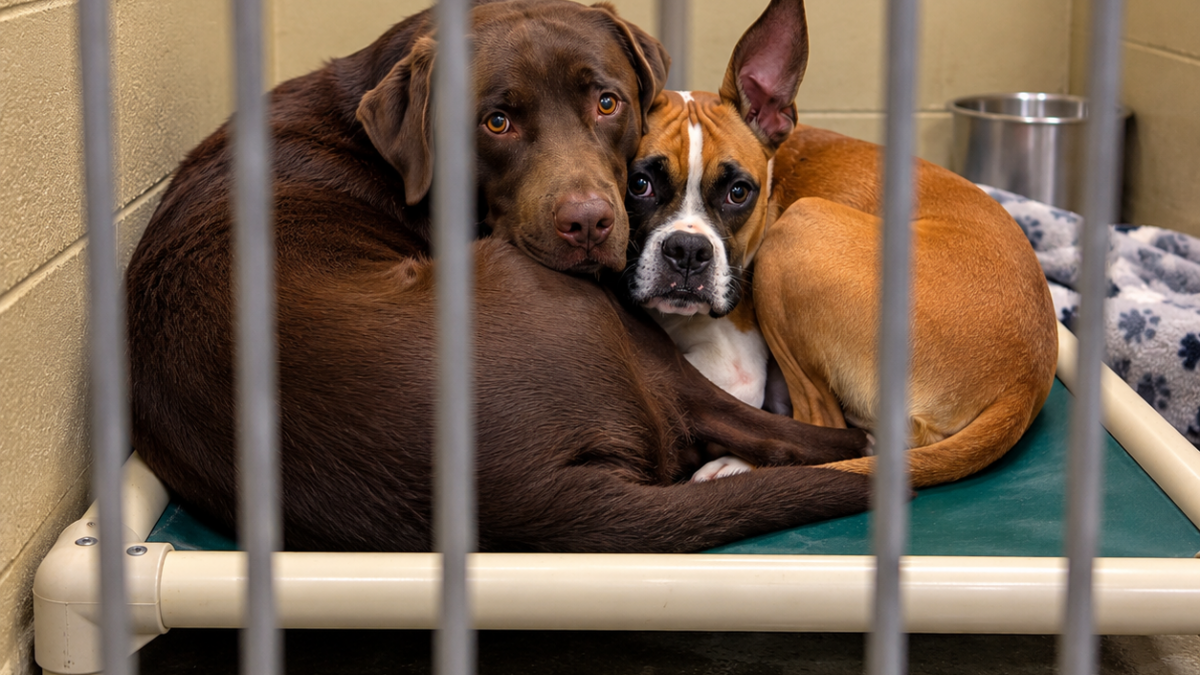
I went to the shelter expecting to leave with the friendly chocolate Labrador everyone wanted, but the moment he stepped sideways and revealed the terrified Boxer hiding behind him, the simple adoption I had planned stopped feeling simple at all.
The shelter worker told me seven different families had already tried to take Cooper home, yet every one of them changed their minds when they learned that the trembling dog behind him had spent nearly three years depending on him just to feel safe.
Then she opened a folder of rescue photographs, slid one picture across the desk toward me, and quietly explained what Cooper had done when animal control first tried to remove him from the abandoned warehouse where Daisy had been dying alone.
A year after my divorce, I had become very good at pretending silence didn’t bother me.
I taught seventh-grade history in Lexington, Kentucky, came home to a small townhouse, heated something for dinner, answered a few emails, and usually left the television running just so the rooms didn’t feel completely empty.
Friends told me I was adjusting.
Maybe I was.
But every night I unlocked the front door and felt the same thing.
Nothing was waiting on the other side.
That was why I agreed to meet Cooper.
My coworker Amy had seen his adoption post and practically shoved her phone into my hand.
“Look at him.”
The chocolate Labrador in the picture had bright eyes and a grin so ridiculous it made me laugh.
“He looks insane.”
“He looks happy.”
“I said what I said.”
She pointed at me.
“You need that dog.”
I finally filled out an application.
The following Saturday, I drove to the shelter expecting something easy.
Cooper did not disappoint.
The instant I reached his kennel, he launched himself at the door with his tail swinging hard enough to move his entire body.
“There he is,” the volunteer beside me said. “Our celebrity.”
I crouched.
Cooper shoved his nose through the bars and licked both my hands.
I laughed.
“Subtle.”
“He has never been accused of subtlety.”
For perhaps thirty seconds, I was already imagining him in my life.
Morning walks.
Weekend hikes.
A dog asleep beside the couch while I graded papers.
Then Cooper suddenly stopped bouncing.
He turned sideways.
That was when I saw her.
A fawn Boxer sat in the rear corner.
Thin body.
White stripe down her face.
One ear folded strangely.
She had been almost completely hidden behind Cooper.
She didn’t bark.
Didn’t approach.
She simply watched me.
“Who’s she?”
The volunteer’s expression changed.
“That’s Daisy.”
Cooper glanced over his shoulder.
Daisy’s body loosened slightly.
I noticed.
“Are they together?”
“Very.”
“How long?”
“Almost three years.”
I looked at her again.
“Three years in the same kennel?”
“Not always this exact kennel, but yes. Together.”
Cooper returned to the gate.
Daisy stayed where she was.
The volunteer sighed.
“There’s something you should know before you get attached.”
That sentence should have warned me.
Instead I followed her into a small office overlooking the exercise yard.
She opened a thick folder.
“Animal control found them three winters ago near an abandoned grain warehouse outside town.”
She showed me a photograph of Cooper standing in snow beside a rusted building.
“He was the first one they saw. Friendly even then. Hungry, but mobile.”
“What about Daisy?”
“They didn’t know Daisy existed.”
She turned the page.
“Every time they tried to get Cooper into the truck, he ran back toward the warehouse.”
“Why?”
“They eventually followed him.”
The next photograph made my stomach tighten.
Daisy lay beneath broken pallets and rusted equipment, painfully thin, one hind leg tucked beneath her.
“She was injured,” the volunteer said. “Could barely walk. Terrified of people.”
“And Cooper stayed?”
“For however long they were out there.”
She looked through the office window.
“He could have left. He didn’t.”
I stared at the photographs.
“What happened after they came here?”
“Daisy shut down. Wouldn’t walk for us. Wouldn’t take treats from our hands. Shook whenever Cooper left her sight.”
“So you kept them together.”
“We had to.”
The volunteer closed the folder.
Then she said the sentence that finally explained why Daisy had learned to hide behind a dog everybody loved.
“People keep applying for Cooper.”
I looked at her.
“And not Daisy.”
She nodded.
“How many?”
Her eyes dropped briefly to the paperwork.
“Seven families.”
Outside the office window, Cooper raced across the yard after a tennis ball.
Daisy stood near the gate, watching him.
Then Cooper turned.
The moment he ran back toward her, Daisy took her first uncertain steps onto the grass.
I watched her follow.
And suddenly I understood that if I chose Cooper, I wasn’t only choosing which dog came home with me.
I might also be deciding what happened to the one who had never learned how to be left behind.
PART 2
I stayed at the window longer than I meant to.
Cooper reached the far end of the yard, grabbed the tennis ball, and came racing back like he had been launched from something.
Daisy took four awkward steps after him.
Then stopped.
Cooper circled.
He dropped the ball.
Daisy watched.
He nudged it toward her.
She ignored the ball completely.
Instead, she moved closer to him.
The volunteer beside me said, “That’s pretty much their relationship.”
“What do you mean?”
“Cooper thinks life is a party. Daisy thinks life is something that might hurt her. Somehow they meet in the middle.”
I looked at her.
“And you let people adopt him without her?”
Her mouth tightened slightly.
“We haven’t.”
“But seven families applied.”
“Yes.”
“And?”
“We explained they’re a bonded pair.”
“And all seven walked away?”
“Some immediately. Some tried to convince us Daisy would adjust without him. One family offered to take Cooper first and ‘come back for Daisy later.’”
I could hear what she thought of that idea.
“What did you say?”
“No.”
I looked back outside.
Daisy had settled beside Cooper while he chewed the tennis ball.
“What if nobody takes both?”
The volunteer didn’t answer immediately.
That was worse than any answer.
“We keep caring for them.”
“For how long?”
“As long as we can.”
“That’s not what I meant.”
“I know.”
She sat down across from me.
“Bonded pairs are difficult.”
“Because people want one dog.”
“Or they can only afford one. Or their landlord has a limit. Or they already have pets. There are legitimate reasons.”
“But Cooper could get adopted tomorrow.”
“Probably.”
“And Daisy?”
She looked through the window.
“Daisy is the complication.”
I hated the word even though I knew she wasn’t using it cruelly.
Complication.
I had come there specifically because I didn’t want one.
My entire plan had been built around avoiding complication.
One dog.
Healthy.
Friendly.
Easy.
I had spent the previous year trying to simplify my life after my marriage collapsed.
The divorce itself had not been dramatic in the way people imagine dramatic divorces.
No affair exposed at Thanksgiving.
No police.
No screaming neighbors.
Just two people who gradually became more polite and less close until we finally had a conversation neither of us could avoid.
My ex-wife, Laura, had said, “I don’t think we make each other happy anymore.”
The worst part was that I couldn’t argue.
Afterward, we divided furniture, books, kitchen equipment, savings, and memories with humiliating practicality.
She moved to Cincinnati.
I stayed in Lexington.
The townhouse I bought was deliberately small.
One bedroom upstairs.
A second room I used as an office.
Tiny fenced yard.
No extra space.
No extra obligations.
I told myself I was starting over cleanly.
Now I was staring at two dogs.
One of whom looked as if a closing cabinet might destroy her emotionally.
The volunteer asked, “Would you like to meet them in the yard?”
Both.
Not him.
Them.
I rubbed my palms against my jeans.
“Sure.”
Cooper made the decision for me once we stepped outside.
He ran directly into my legs.
I staggered.
“Good lord.”
The volunteer laughed.
“He likes you.”
“Is this liking? It feels like assault.”
Cooper shoved the tennis ball against my knee.
I threw it.
He exploded across the grass.
Daisy stayed near the fence.
I deliberately did not approach her.
The volunteer noticed.
“That’s good.”
“What is?”
“Most people walk right toward her because they want to prove they’re gentle.”
“And she hates that?”
“She tolerates it badly.”
“So what do I do?”
“Pretend she isn’t there.”
“That seems rude.”
“She’ll appreciate your manners.”
I sat on a bench.
Cooper returned.
Ball.
Throw.
Return.
Ball.
Throw.
Return.
After the sixth throw, I realized Daisy had moved.
Not close.
But closer.
She stood perhaps fifteen feet away.
I looked at Cooper instead.
He dropped the ball at my feet.
I picked it up.
Daisy stepped closer.
Cooper ran.
I threw.
Daisy watched him.
Then watched me.
The volunteer said quietly, “Don’t look right at her.”
“I’m trying not to.”
“You’re doing fine.”
Five minutes passed.
Then ten.
Cooper eventually became tired enough to lie under the bench with his tongue hanging out.
Daisy stood eight feet away.
Then six.
Then four.
I kept my hands resting loosely on my knees.
She approached from the side.
I could hear her breathing before I could see her without turning.
Her nose touched the edge of my shoe.
I stayed still.
She sniffed my jeans.
Then my hand.
I turned my palm upward but didn’t move it toward her.
Daisy froze.
For a second I thought I had ruined it.
Then she leaned forward.
Her nose touched my fingertips.
Once.
Lightly.
Then she retreated straight to Cooper.
I exhaled.
The volunteer smiled.
“That’s more than some people get on the first visit.”
“That was it?”
“That was huge.”
Daisy sat beside Cooper.
He didn’t move.
She pressed one shoulder against his back.
I stared at them.
Something uncomfortable began happening inside me.
I was getting attached.
Not only to Cooper.
To the problem.
I hated that.
I stayed almost two hours.
Before leaving, I stood outside the kennel.
Cooper came forward immediately.
Daisy stayed behind him.
I scratched Cooper through the bars.
“I’ll be back.”
Then I realized I was talking to both of them.
The drive home felt longer than the drive there.
I had planned to spend it imagining Cooper in my house.
Instead, I kept thinking about Daisy.
Seven families.
Seven people willing to take the dog she depended on.
Seven times shelter staff had to protect the bond because adopters saw one dog as desirable and the other as baggage.
When I reached home, the townhouse looked smaller than usual.
Two dog beds.
Two bowls.
Two vet bills.
Two sets of vaccinations.
Two dogs shedding on furniture.
Two dogs needing boarding if I traveled.
Two dogs instead of the uncomplicated one-dog life I had imagined.
I stood in the kitchen and said out loud, “Absolutely not.”
The empty room did not argue.
That night I dreamed about the warehouse.
I had not been there, obviously.
My brain built it from photographs.
Rust.
Snow.
Broken boards.
Cooper running backward through darkness.
Leading people toward Daisy.
I woke at 4:17 a.m.
“Ridiculous.”
I rolled over.
At 4:24, I opened my phone.
The shelter website still had their profile.
COOPER & DAISY — BONDED PAIR.
Cooper’s picture came first.
Of course it did.
The charismatic one.
Then Daisy.
Her photo showed her sitting slightly behind him.
Even in the adoption picture, Cooper was between her and the camera.
I closed my phone.
At school Monday, Amy found me in the teacher lounge.
“Well?”
“No.”
Her face fell.
“You didn’t like Cooper?”
“I loved Cooper.”
“Then what happened?”
“He has a dog.”
She blinked.
“What?”
“There are two dogs.”
“You knew shelters had multiple dogs, right?”
I glared.
She laughed.
“Explain.”
I told her.
By the end, Amy was no longer smiling.
“So they have to go together?”
“Yes.”
“And you don’t want two.”
“No.”
She stirred sugar into her coffee.
“You’re going back.”
“I’m not.”
“You are.”
“I have a mortgage.”
“So?”
“Two dogs cost money.”
“True.”
“I work full-time.”
“Also true.”
“One of them is traumatized.”
“Very true.”
“Excellent. Glad we agree.”
She sipped her coffee.
“You’re going back.”
I pointed at her.
“This is why people dislike English teachers.”
“I teach science.”
“Worse.”
She smiled.
“You’re already talking about Daisy more than Cooper.”
I hated that she was right.
I went back Wednesday.
I told myself it was to gather information.
That was technically true.
The shelter worker from Saturday was there.
Her name was Marissa.
She looked surprised.
“You came back.”
“Don’t sound so shocked.”
“I wasn’t sure.”
“Neither was I.”
She brought Cooper and Daisy into the yard again.
Cooper remembered me.
There was no dignity in the reunion.
He sprinted directly into my knees and almost knocked me backward.
“Still subtle.”
Daisy remained behind.
But this time she did not stay at the far fence.
She watched Cooper greet me.
Then walked closer on her own.
“What’s her medical situation?” I asked.
Marissa handed me the folder.
“Her old leg injury healed. There’s some arthritis risk long-term, but right now she moves well.”
“Medication?”
“Not routinely.”
“Other dogs?”
“Cooper, obviously. She can tolerate some calm dogs, but she doesn’t need another social circle.”
“Cats?”
“Unknown.”
“House-trained?”
“Mostly. But shelter behavior doesn’t guarantee home behavior.”
“Destructive?”
“Not especially.”
“Separation?”
“That’s the big one.”
I looked at her.
“With Cooper?”
“Without Cooper.”
“What happens?”
“She panics.”
“How bad?”
“Shaking. Pacing. Vocalizing. She once injured a nail trying to get through a gate when he was taken to the clinic without her.”
My stomach dropped.
“That bad?”
“Better now than at first. But yes.”
“Could she eventually improve?”
“Probably. With the right training. But we would never recommend starting by separating them.”
I looked across the yard.
Cooper had found a stick.
Daisy had found Cooper.
Always.
“What about leaving them alone together?”
“They settle.”
“So Cooper is basically her medication.”
Marissa smiled slightly.
“Inaccurate medically. Fair emotionally.”
I spent another hour with them.
Daisy let me touch her neck once.
Then backed away.
I didn’t follow.
The third visit happened Saturday.
By then, I had started making lists.
Costs.
Food.
Insurance.
Training.
Emergency vet fund.
Pet deposit—none, because I owned the townhouse.
Fence repairs.
Crates.
Beds.
I called my veterinarian.
“How stupid is two dogs?”
The receptionist laughed.
“Depends on the dogs.”
“One is a Labrador.”
“So food budget goes up.”
“One is a Boxer with anxiety.”
“Training budget goes up.”
“Fantastic.”
“You adopting them?”
“I’m investigating.”
“Sure.”
I also called a trainer recommended by the shelter.
Her name was Denise.
I described Daisy.
She said, “Don’t adopt her because you feel sorry for her.”
That stopped me.
“I don’t think I am.”
“Good. Pity is useless at six in the morning when she refuses to go outside because a garbage truck scared her.”
“That specific?”
“I work with rescue dogs.”
She asked about my schedule.
Home.
Yard.
Tolerance for slow progress.
Whether I traveled.
Whether I had realistic backup care.
Then she asked, “Why do you want them?”
“Cooper seems perfect.”
“And Daisy?”
I looked through my kitchen window.
The backyard fence needed one board replaced.
“She stayed.”
“What?”
“Cooper could have left her at that warehouse. He didn’t.”
Denise waited.
“And?”
“I don’t know.”
“Yes, you do.”
I rubbed my forehead.
“I think I know what it feels like when life gets small and you need somebody around.”
There was a pause.
Denise’s tone changed.
“That’s not a terrible reason. But remember something.”
“What?”
“You’re not Daisy.”
“I know.”
“And Cooper is not therapy equipment for either of you.”
“I know.”
“Then go slowly.”
The fourth time I visited, Daisy walked to me before Cooper did.
Not because she suddenly loved me.
Cooper was drinking water.
I sat on the bench.
Daisy approached.
Sniffed my hand.
Then stayed.
I touched the side of her face.
Her muscles tightened.
I stopped.
She looked at me.
I waited.
Then she leaned forward again.
Marissa watched from the gate.
“That’s new.”
I looked at Daisy.
“What?”
“She usually leaves after the first touch.”
Daisy’s nose pressed against my knuckles.
My chest tightened.
“Great.”
Marissa laughed.
“That doesn’t sound happy.”
“It’s becoming expensive.”
By the end of that visit, I knew.
I still spent three more days pretending I didn’t.
Tuesday afternoon, I called the shelter.
Marissa answered.
“Hi.”
“It’s me.”
“I recognize the number.”
“That seems invasive.”
“You’ve called four times.”
“Right.”
A pause.
“I want them.”
Silence.
“Both?”
“Do not make me say it twice.”
Marissa laughed.
Then her voice softened.
“Both.”
“Yes.”
“Are you sure?”
“No.”
“That’s actually more reassuring than immediate certainty.”
“I have conditions.”
“Go ahead.”
“If you discover Daisy secretly hates teachers, I want a refund.”
“Denied.”
“If Cooper eats my couch—”
“He probably won’t.”
“Probably?”
“Read your contract.”
I closed my eyes.
“This is a mistake.”
“Probably.”
“Marissa.”
She laughed again.
“We’ll start the final process.”
The adoption did not happen immediately.
That was good.
The shelter required another meeting, home verification, veterinary planning, and a transition strategy because Daisy’s anxiety made a sudden change risky.
Denise visited my house before the dogs did.
She walked through every room.
“Where are they sleeping?”
“I bought two beds for the living room and two for upstairs.”
“Four beds?”
“They were on sale.”
She looked at me.
“You’re already gone.”
“Focus.”
We decided initially they would sleep downstairs.
Quiet area.
Crates available but not forced.
Baby gates.
No crowd of friends coming to meet them.
No dramatic “welcome home” party.
No expectations beyond eating, drinking, bathroom breaks, and decompression.
“Cooper will probably act like he owns the place by lunchtime,” Denise said.
“And Daisy?”
“Daisy decides on Daisy’s schedule.”
The first home visit happened without adoption.
Marissa brought them.
Cooper entered my townhouse and lost his mind.
He sniffed the couch.
Kitchen.
Stairs.
Back door.
Trash can.
My shoes.
Then tried to climb halfway onto the dining table because one chair was pulled out.
“Perfect dog,” I said.
Marissa laughed.
Daisy did not cross the doorway.
She stood outside.
Cooper returned.
Daisy watched him.
He went inside again.
She took one step.
Stopped.
I sat on the living-room floor and looked away.
Five minutes passed.
Then I heard nails against hardwood.
Daisy had entered.
One step.
Two.
She immediately moved toward Cooper.
He was smelling a lamp.
She stayed beside him.
They explored that way.
Cooper first.
Daisy behind.
Room by room.
When Cooper went upstairs, Daisy refused.
Fine.
Nobody forced it.
Cooper came back down.
Daisy relaxed.
After forty minutes, Cooper drank from the new bowl.
Daisy watched.
Then drank too.
After an hour, Cooper lay on the rug.
Daisy circled him three times and lowered herself beside him.
I stared.
Marissa whispered, “Don’t make a big deal.”
“I’m not.”
“You’re crying.”
“I have seasonal allergies.”
“In October?”
“Very aggressive allergies.”
She smiled.
That night after they left, the house felt worse than before.
I had heard paws inside it.
Then silence returned.
I knew then that I was in trouble.
Three weeks later, Cooper and Daisy came home permanently.
I drove them myself.
No transport service.
No dramatic goodbye.
Marissa loaded their things into the SUV.
Blankets.
Food.
Medical records.
A battered tennis ball Cooper insisted belonged to him.
Daisy climbed into the back only after Cooper was already inside.
She sat pressed against him.
I looked at them in the mirror.
“Everybody ready?”
Cooper panted.
Daisy stared at Cooper.
“Excellent communication.”
The first fifteen minutes went well.
Then Cooper vomited in the back seat.
I pulled over.
“You have got to be kidding.”
Cooper looked relieved.
Daisy looked horrified.
I cleaned what I could with paper towels from the emergency kit.
“First family memory.”
Cooper wagged.
Daisy remained pressed into the corner.
When we arrived home, Cooper recognized the place.
He jumped out.
Daisy would not.
I waited.
Cooper stood outside.
She looked at him.
Then carefully climbed down.
The first evening was exactly what Denise had warned me about.
Cooper explored everything again.
Daisy paced.
Door.
Cooper.
Window.
Cooper.
Kitchen.
Cooper.
Me.
Back to Cooper.
I didn’t try to pet her.
At nine, Cooper fell asleep.
Daisy remained standing.
At ten, she finally lay beside him.
At eleven, I turned off the television.
Daisy stood immediately.
I turned it back on.
She lay down.
“Okay.”
Apparently television stayed on.
At 1:12 a.m., I woke on the couch with the remote under my hip.
Cooper was upside down on the rug.
Daisy was awake.
Watching me.
I whispered, “You okay?”
Her ears moved.
I closed my eyes again.
The first week nearly broke my confidence.
Daisy refused the backyard if I stood too close to the door.
She startled when the furnace turned on.
The garbage truck sent her under the kitchen table.
A neighbor slammed a car door and she urinated on the floor.
I cleaned it without reacting.
Later, alone in the kitchen, I leaned against the counter and wondered if I had made an enormous mistake.
Cooper wandered in.
He shoved his head under my hand.
“You’re not helping.”
Tail wag.
Daisy stood in the hallway.
Watching.
I sat on the floor.
She did not approach.
That night I called Denise.
“I don’t think she likes me.”
“She moved into your house six days ago.”
“Still.”
“What does she do when you enter a room?”
“Sometimes leaves.”
“Sometimes?”
“Sometimes stays.”
“Progress.”
“She peed when the garbage truck came.”
“She was scared.”
“I know.”
“You sound like you expected to understand her by now.”
I didn’t answer.
Denise said, “You spent a year living alone after a divorce and didn’t magically become fine. Why does Daisy get six days?”
That irritated me because it was accurate.
“I didn’t pee when trucks came.”
“You have other coping skills.”
“Debatable.”
She laughed.
“Stop measuring affection. Measure safety.”
“How?”
“Did she eat?”
“Yes.”
“Sleep?”
Eventually.”
“Use the yard?”
Mostly.”
“Can she rest in the same room as you?”
“With Cooper.”
“Great.”
“That doesn’t feel like enough.”
“It is.”
So I stopped asking Daisy to love me.
That changed everything.
I stopped holding out treats every five minutes.
Stopped calling her name repeatedly.
Stopped trying to create breakthrough moments.
I made breakfast.
Opened the yard.
Walked Cooper.
Walked Daisy with Cooper.
Came home.
Went to work.
Returned.
Repeated.
Routine.
Daisy began learning the shape of my days.
At 6:15, alarm.
6:30, yard.
6:45, breakfast.
7:20, short walk.
7:45, I left.
A dog walker came midday.
3:45, I returned most school days.
Walk.
Dinner.
Television.
Bed.
Predictability.
Two weeks in, Daisy stopped jumping when the furnace started.
Three weeks in, she began waiting near the kitchen when I prepared food.
One evening, while I graded papers on the couch, something touched my foot.
I looked down.
Daisy.
She had lain beside the couch instead of beside Cooper.
Cooper was across the room asleep.
I froze.
Daisy’s back rested lightly against my shoe.
I did not move for twenty minutes.
My left leg went numb.
Worth it.
The next night she went back to Cooper.
I tried not to be offended.
A month later, my friend Amy visited.
We planned carefully.
Amy ignored Daisy completely.
Cooper greeted her like she had returned from war.
“Hello to you too.”
Daisy stayed behind the dining table.
Amy sat on the couch.
We talked.
Ten minutes.
Twenty.
Daisy appeared in the doorway.
Amy kept talking about school.
A student had tried to submit an essay obviously generated from a study guide about the wrong historical event.
I laughed.
Daisy moved closer.
Amy never looked directly at her.
Eventually Daisy smelled her shoe.
Then retreated.
Amy waited until after Daisy left.
“That was her?”
“Yes.”
“She’s beautiful.”
“Don’t say it loudly. She’ll get arrogant.”
By the end of the visit, Daisy accepted one treat from Amy’s open palm.
After Amy left, Daisy ran to the window.
Watched her car leave.
Then looked at me.
I smiled.
“You survived company.”
Cooper brought me a sock.
“Where did you get that?”
He ran.
The first major setback came during a thunderstorm.
Lexington gets storms that seem to arrive directly on top of the roof.
The first thunder hit after midnight.
I woke to something crashing downstairs.
Then Cooper barked.
I ran down.
Daisy was nowhere.
“Daisy?”
Another thunderclap.
Cooper ran toward the kitchen.
I followed.
The lower cabinet beneath the counter stood partly open.
Daisy had forced herself into the narrow space beside the trash bin.
She was shaking so hard the cabinet door rattled.
My instinct was to reach.
I stopped myself.
Denise’s voice in my head:
Don’t corner fear.
Cooper came beside me.
He pushed his nose toward the cabinet.
Daisy’s eyes were wide.
I sat on the floor several feet away.
“It’s okay.”
Thunder.
Daisy flinched violently.
Cooper lay down.
Not beside me.
Beside the cabinet.
His body stretched across the floor.
Daisy watched him.
I went to the living room, brought one of their blankets, and placed it nearby.
Then I stayed.
No pulling.
No forcing.
No speeches.
After almost an hour, Daisy crawled out.
She went directly to Cooper.
Then, unexpectedly, she turned toward me.
She stood there trembling.
I held my hand low.
Daisy stepped forward.
Her head pressed against my chest.
It was the first time she had ever initiated full contact.
I wrapped one arm around her loosely.
Not trapping.
Just there.
Thunder rolled again.
She stayed.
Cooper leaned against my other side.
I sat on the kitchen floor at two in the morning with both dogs pressed against me and suddenly remembered what Marissa had said.
Cooper thinks life is a party.
Daisy thinks life is something that might hurt her.
Somehow they meet in the middle.
Now I was in the middle too.
The next morning, my back hurt so badly I could barely stand.
Daisy followed me into the kitchen.
I looked down.
“You realize I have furniture.”
Her tail moved once.
I stared.
“Did you just wag?”
She walked away.
“Coward.”
That tiny wag became the beginning of a new Daisy.
Not instantly.
But noticeably.
She started greeting me at the door with Cooper.
At first, Cooper reached me first while Daisy stood several feet behind.
Then she came closer.
Then one afternoon she reached me before him.
I dropped my school bag.
Daisy froze.
I froze too.
Then she pressed her nose into my hand.
Cooper arrived a second later and destroyed the moment by jumping on me.
“Thank you, Cooper.”
He wagged violently.
Daisy stepped away.
But not far.
Training helped.
Denise came every Saturday for several weeks.
We worked on confidence rather than obedience first.
Walking over different surfaces.
Approaching new objects.
Choosing to enter rooms.
Simple cues.
Touch.
Sit.
Wait.
Nothing forced.
Daisy learned faster than expected once she stopped being terrified of making mistakes.
That realization hurt.
“What happened to her before the warehouse?” I asked Denise one afternoon.
“No idea.”
“Someone must have done something.”
“Maybe.”
“She reacts like—”
“Careful.”
I looked at her.
“What?”
“Don’t invent trauma.”
“But she clearly has trauma.”
“Yes. You know she was injured, abandoned or lost, survived in a warehouse, and spent months afraid. You don’t know who hurt her or how.”
I nodded.
“People like stories with villains.”
“I don’t.”
“You do when the alternative is uncertainty.”
Again, annoyingly accurate.
So I stopped trying to create Daisy’s missing history.
She didn’t need me to identify every person who might have failed her.
She needed me not to become another one.
Cooper required less emotional strategy but considerably more physical management.
He discovered garbage.
Shoes.
The backyard hose.
A bag of hamburger buns I foolishly left on the counter.
One Sunday I entered the kitchen and found the empty plastic bag on the floor.
Cooper sat nearby.
Daisy sat behind him.
I looked at both.
“Who did this?”
Cooper wagged.
Daisy looked away.
“Interesting.”
I picked up the bag.
“Cooper?”
More wagging.
“Daisy?”
She walked out.
“Accessory after the fact.”
Later I checked the small camera I had installed to monitor them when I was gone.
Daisy had stolen the buns.
Cooper had merely participated enthusiastically.
I replayed it three times.
The frightened Boxer who once refused to leave a kennel had jumped onto the counter.
I sent the clip to Marissa.
Her response came immediately.
“OH MY GOD.”
Then:
“I HAVE NEVER BEEN SO PROUD OF THEFT.”
I laughed.
Daisy had become a criminal.
A minor one.
But it felt like healing.
Misbehavior requires confidence.
Several months after adoption, the shelter invited us to an alumni event.
I almost declined.
Crowds were difficult for Daisy.
Marissa suggested we come early before the event became busy.
So we did.
Cooper recognized the shelter immediately.
His body exploded with excitement.
Daisy stopped beside my SUV.
Her posture changed.
Low.
Uncertain.
I knelt.
“You don’t have to.”
Cooper pulled toward the entrance.
Daisy watched him.
Then looked at me.
For the first time, I wondered whether returning was unfair.
Maybe the shelter did not represent safety to her.
Maybe it represented waiting.
Kennels.
People passing.
Families choosing Cooper.
I stood.
“We can leave.”
I meant it.
Then Daisy stepped forward.
One step.
Then another.
Cooper went inside.
Daisy followed.
I followed her.
Marissa saw us and covered her mouth.
“Daisy?”
Cooper reached her first.
Naturally.
He jumped.
She laughed and hugged him.
Then she looked at Daisy.
Daisy stayed near my leg.
Marissa did not approach.
“Hi, sweetheart.”
Daisy’s ears shifted.
I said, “She steals bread now.”
Marissa’s eyes filled.
“No.”
“Hamburger buns.”
“Daisy?”
Daisy looked up.
Marissa laughed through tears.
“That is the best update I’ve ever heard.”
We went into the old exercise yard.
Cooper ran exactly as he had the day I met him.
Daisy walked beside me.
Not behind Cooper.
Beside me.
Halfway across the yard, Cooper found a tennis ball.
He sprinted toward us.
Daisy suddenly took off after him.
Full run.
No hesitation.
No careful checking.
I stopped walking.
Marissa whispered, “Look at her.”
Daisy chased Cooper across the grass.
He turned.
She changed direction with him.
They circled once.
Twice.
Then Daisy did something I had never seen.
She grabbed the tennis ball before Cooper could reach it.
Cooper stopped.
He looked personally betrayed.
I laughed.
Daisy ran away with the ball.
Marissa wiped her eyes.
“That dog wouldn’t touch toys.”
“She does now.”
Cooper chased her.
Daisy ran faster.
People later told me the adoption changed their lives.
That language always bothered me slightly because it made the story sound too clean.
The truth was messier.
My life changed because I had to wake earlier.
Spend more money.
Vacuum constantly.
Find dog hair in places dog hair had no logical reason to exist.
Plan travel differently.
Repair one section of fence after Cooper discovered the neighbor’s barbecue smelled interesting.
Pay for training.
Clean vomit.
Manage Daisy’s fears.
Apologize to one delivery driver after Cooper enthusiastically greeted him with muddy paws.
It was not a movie montage of happiness.
It was responsibility.
But responsibility filled the house.
That was the part I had not expected.
Before them, I had mistaken emptiness for freedom.
No one needed me.
I could stay late at school.
Eat cereal for dinner.
Spend Saturday doing nothing.
Leave town without arranging anything.
Technically, I had freedom.
What I lacked was attachment.
Now I came home because two animals expected me.
Some days that felt inconvenient.
Most days it felt like belonging.
And I slowly realized I had not adopted dogs because I needed them to rescue me from my divorce.
That would have been unfair.
But building a life around caring for something other than myself had given shape to days that had become shapeless.
Healing did not arrive as a revelation.
It arrived as routine.
Morning walks.
Food bowls.
Daisy sleeping near my desk while I graded papers.
Cooper dropping toys onto student essays.
Saturday training.
Sunday hikes.
The occasional stolen sock.
My first Christmas with them, I bought two ridiculous stockings.
Amy came over.
She looked at the fireplace.
“You’ve become one of those people.”
“I don’t know what you mean.”
“The dogs have stockings.”
“They were discounted.”
“Their names are embroidered.”
“That was included.”
She picked up Cooper’s.
“This has treats already.”
“He checks.”
“He checks the stocking?”
“Daily.”
Cooper appeared behind her.
Amy looked at me.
“Of course he does.”
Daisy entered quietly.
No hiding.
Amy sat.
Daisy walked directly to her and nudged her hand.
Amy froze.
I smiled.
“You may pet the citizen.”
Amy scratched Daisy’s chest.
“She remembers me.”
“Apparently.”
Daisy leaned closer.
Amy’s eyes softened.
“Look at her.”
I did.
Healthy weight.
Bright eyes.
One ear still folded oddly.
Scar near the old hind-leg injury.
But relaxed.
Home.
A few weeks later, something happened I had once thought impossible.
Cooper needed a dental procedure.
Nothing serious, but he had to spend most of the day at the veterinary clinic.
The old shelter notes about Daisy’s separation panic came immediately to mind.
I called Denise.
“What do I do?”
“Prepare.”
“For disaster?”
“For Daisy having feelings.”
“That sounded judgmental.”
“It was.”
We planned carefully.
Cooper left early.
Daisy watched me put him in the SUV.
The moment I returned alone, she searched.
Living room.
Kitchen.
Back door.
Upstairs.
Then back to me.
She paced.
My chest tightened.
“Easy.”
She whined.
For several minutes, I worried we were about to recreate the old panic.
I sat on the couch.
Daisy continued pacing.
Then stopped.
Looked at me.
I did not call her.
She walked over.
She stood against my knee.
Then lay down at my feet.
I stared.
Denise had told me not to turn every success into a ceremony.
I violated that internally.
Daisy stayed beside me for almost an hour.
She missed Cooper.
Obviously.
She checked the door repeatedly.
But she did not collapse.
When Cooper returned that afternoon, Daisy went insane.
She ran circles around him.
Smelled every inch.
Boxed him with her front paws.
Cooper tolerated the inspection for thirty seconds before grabbing a toy.
That evening, I called Marissa.
“You’ll never guess.”
“What?”
“She stayed home without Cooper.”
Silence.
“How bad?”
“She paced.”
“And?”
“Then lay beside me.”
Marissa became quiet.
“That’s huge.”
“I know.”
“Do you?”
I looked toward the rug.
Cooper and Daisy lay several feet apart.
Not touching.
Daisy was asleep anyway.
“Yes.”
For years, Cooper had been her entire safety system.
Now he was still her best friend.
Still the dog she loved.
But he was no longer the only thing between her and terror.
She had a house.
A routine.
And, somehow, me.
That mattered because bonds should be shelter, not cages.
Cooper had saved her by staying.
But eventually, safety meant Daisy learning she could survive even when he left the room.
The following spring, my ex-wife Laura contacted me.
We had not seen each other in nearly a year.
She was passing through Lexington and wanted to pick up a box of old photographs we had somehow overlooked during the divorce.
“Sure.”
I gave her a time.
Only afterward did I realize she had never met the dogs.
When she arrived, Cooper greeted her like a lifelong relative.
Laura laughed.
“Oh my God.”
“That’s Cooper.”
“He’s enormous.”
“He considers that praise.”
Then Daisy appeared.
Laura looked at her.
“And that’s the shy one?”
“Was.”
Daisy stood beside me.
Laura smiled.
“She’s beautiful.”
Daisy sniffed her hand.
Then moved away.
Laura watched her.
“You got two.”
“Apparently.”
“I thought you wanted one.”
“So did I.”
She looked around the townhouse.
Dog beds.
Toy basket.
Leashes.
Photographs.
“You seem good.”
The sentence caught me off guard.
“I am.”
She nodded.
“I’m glad.”
And I realized I meant the next thing I said.
“Me too.”
There was no resentment.
No fantasy of reconciliation.
No need to prove anything.
She took the photographs.
Cooper tried to leave with her because he believed every open car door was an invitation.
I stopped him.
Laura laughed.
“Take care.”
“You too.”
When the door closed, Daisy stood beside me.
I looked down.
“You know, a year ago that would’ve been emotionally devastating.”
Daisy yawned.
“Good talk.”
Cooper brought me a shoe.
My life moved on.
The shelter continued posting updates.
The first anniversary post included a photograph from adoption day beside a recent photograph from my backyard.
In the first, Daisy leaned into Cooper.
In the second, she stood several feet ahead of him, nose lifted toward the camera, while Cooper was blurry in the background.
Comments flooded in.
People called the dogs lucky.
I understood why.
But the word still felt incomplete.
They had been lucky that animal control followed Cooper into the warehouse.
Lucky that the shelter kept them together.
Lucky that Marissa and the staff refused seven easier adoptions that would have separated them.
Lucky I had enough space and money for two dogs.
Yes.
But I was lucky too.
Not in the sentimental sense that they had magically fixed my life.
They hadn’t.
They complicated it.
They made it louder.
More expensive.
Messier.
And infinitely less empty.
One evening, almost eighteen months after adoption, I was reading on the couch when Cooper stood up abruptly.
He walked toward the kitchen.
Daisy remained asleep.
I noticed only because it was unusual.
Cooper disappeared around the corner.
Daisy opened one eye.
Did not move.
I smiled.
That tiny choice would mean nothing to anyone who had not known her history.
To me, it was enormous.
Cooper had left the room.
Daisy stayed.
Several minutes later he returned carrying a dish towel he had stolen.
I pointed.
“Drop it.”
Cooper froze.
Daisy opened both eyes.
He ran.
I chased him into the kitchen.
“Cooper!”
Daisy followed.
Not because she needed to know where he was.
Because the game looked fun.
That difference was everything.
The years added themselves quietly.
Cooper developed a little gray beneath his chin.
Daisy’s arthritis required occasional medication after long walks.
I became the teacher students knew had two dogs because their pictures appeared on classroom slides whenever I needed a harmless example.
Once, during a lesson about primary sources, a student raised his hand.
“Mr. Reynolds?”
“Yes?”
“Why is your dog on a Civil War slide?”
I looked at the screen.
Cooper’s face occupied the corner.
“Technical error.”
Another student said, “That’s the dog that ate your homework, isn’t it?”
“He did not eat homework.”
“Didn’t he eat a textbook?”
“One corner.”
The room erupted.
I had once come home to silence.
Now even my students knew the names of the animals waiting there.
A few years after the adoption, the shelter invited me to speak briefly at a fundraiser about bonded pairs.
I resisted.
“I’m a history teacher, not a motivational speaker.”
Marissa said, “You talk to thirteen-year-olds voluntarily.”
“That is different.”
“How?”
“I’m paid.”
She laughed.
I finally agreed.
I stood in front of perhaps sixty people with Cooper and Daisy beside me.
Cooper attempted to greet the front row.
Daisy stayed near my leg.
But she did not shake.
Did not hide.
Did not retreat behind Cooper.
I told the audience about meeting him first.
How he moved aside.
How I saw her.
How the folder changed my understanding.
How seven families had wanted one dog.
How I almost became number eight.
Then I looked down.
Daisy was watching me.
I said, “I thought taking two dogs meant taking on twice the responsibility.”
A few people smiled.
“It did.”
More laughter.
“What I didn’t understand was that I wasn’t adopting two separate animals who happened to share a kennel. I was stepping into a relationship that already existed.”
Cooper sat down.
For once.
“Cooper had spent years teaching Daisy that someone could stay.”
My throat tightened unexpectedly.
“And my job wasn’t to replace that.”
I looked at Daisy.
“It was to make their world big enough that staying no longer meant being afraid of everything else.”
Afterward, a woman approached me.
She was considering adopting a bonded pair of senior dogs.
“Two scares me,” she admitted.
“It should.”
She laughed nervously.
“I thought you were supposed to convince me.”
“No.”
I became serious.
“Two dogs cost more. They need more care. If you aren’t ready, don’t do it because their story makes you sad.”
She nodded.
“But if the only thing stopping you is that you imagined bringing home one…”
I shrugged.
“Sometimes plans change.”
She adopted them a week later.
Marissa sent me the picture.
I stared at it for a long time.
Two gray-faced dogs asleep together on a couch.
Cooper had once led rescuers to Daisy.
Years later, their story had indirectly kept another pair together.
That felt like a circle I didn’t need to explain.
As Cooper grew older, something else changed.
He began relying on Daisy.
It happened gradually.
His eyesight dimmed.
Nothing severe at first.
Then arthritis made stairs harder.
The dog who had spent years charging into every room began pausing before steps.
Daisy noticed.
On walks, she slowed.
Not dramatically.
She simply stopped pulling ahead.
If Cooper paused, she waited.
One evening he misjudged the back step.
Daisy turned immediately.
She stood beside him until he found his footing.
I watched from the doorway.
The relationship had reversed without either dog announcing it.
Cooper had once been her courage.
Now Daisy was becoming his map.
That realization hit me harder than almost anything from the early rescue story.
People like clean roles.
Rescuer.
Rescued.
Protector.
Protected.
But long relationships don’t stay that simple.
People trade places.
Animals do too.
Cooper had carried Daisy through fear.
Now, as age slowed him, she stayed beside him.
Not because she was terrified without him.
Because she loved him.
Those are not the same thing.
One morning, I found them sleeping on the living-room rug.
Cooper’s head rested across Daisy’s paws.
She was awake.
Watching the front window.
I sat nearby.
Daisy looked at me.
Her tail tapped once.
“Your turn, huh?”
She lowered her head beside his.
That image became one of my favorite photographs.
Not because it was dramatic.
Because it contained years.
Warehouse.
Shelter.
Seven rejected adoptions.
My first visit.
Thunderstorms.
Training.
Stolen bread.
Aging.
Home.
Eventually Cooper needed more veterinary care.
We managed arthritis.
Adjusted walks.
Put nonslip rugs over the hardwood.
I installed a ramp for the back step.
The first time Cooper used it, Daisy walked beside him even though she could still manage the step easily.
I laughed.
“You don’t have to use that.”
She ignored me.
They crossed together.
Of course they did.
There was one winter night when Cooper’s pain flared badly enough that I slept downstairs beside him.
Daisy stayed on his other side.
Around three in the morning, Cooper shifted and whimpered.
I sat up.
Daisy’s head lifted instantly.
I placed my hand on his shoulder.
“It’s okay.”
Daisy moved closer.
For a few seconds I was back in the kitchen during that thunderstorm years earlier.
Except the positions had changed.
Then, Daisy had trembled while Cooper and I stayed beside her.
Now Cooper hurt, and Daisy stayed.
I called the vet first thing in the morning.
Medication changes helped.
He improved.
We gained more good months.
Then more.
I learned not to count them greedily.
I had spent enough time with shelter staff to know where all long dog stories eventually go.
That knowledge makes ordinary days more valuable, not less.
Cooper still wanted tennis balls.
He just stopped chasing them quite as far.
Daisy still stole socks.
She simply became easier to catch.
Sunday walks became shorter.
Couch time became longer.
The house slowed with them.
Then came the afternoon Cooper stopped eating.
Not one meal.
That happens.
Then dinner.
The next morning too.
We went to the vet.
Blood work.
Imaging.
Examination.
The veterinarian spoke carefully.
I listened more carefully.
There was no immediate catastrophe.
But Cooper’s body was old.
Several issues were converging.
We began supportive treatment.
He rallied.
A week later, he ate with enthusiasm and I almost cried over chicken and rice.
Daisy never left him.
Not with panic.
With presence.
She could go into the yard alone now.
She could sleep in another room.
She could handle Cooper being away for appointments.
But when he was home, she chose him.
Every time.
One evening, I sat on the rug beside them.
Cooper’s breathing was slow.
Daisy rested with her nose against his leg.
I said, “You know, you two really ruined the one-dog plan.”
Cooper’s tail moved weakly.
Daisy looked at me.
“I’m serious.”
I scratched Cooper’s ear.
“I could’ve had a normal Labrador.”
He closed his eyes.
Daisy leaned against my other leg.
“Instead I got an entire emotional crisis.”
Her tail thumped.
I laughed softly.
“Worth it.”
Cooper stabilized again.
We were not at the end yet.
That was important.
I refuse to turn aging into a countdown.
We adjusted.
More vet visits.
More rugs.
More rest.
Still joy.
Still food theft.
Still barking at delivery trucks.
Still mornings when Cooper woke before me and stood beside the bed breathing loudly until I opened one eye.
“You have a bladder. I understand.”
Daisy waited behind him.
Some things never changed.
The shelter invited us back for another photo several years after adoption.
Marissa was still there.
When she saw Cooper moving slowly across the yard, her expression softened.
“Oh, buddy.”
He recognized her voice.
Tail wag.
Daisy walked beside him.
Marissa crouched.
Cooper reached her first.
Again.
Daisy came immediately after.
Not behind.
Beside.
Marissa touched Daisy’s face.
“You don’t remember hiding from me, do you?”
Daisy leaned into her hand.
Marissa looked at me.
“She used to shake when I changed her water.”
“I know.”
“And now?”
“She terrorizes delivery drivers by requesting belly rubs.”
Marissa laughed.
We recreated the old adoption photo as best we could.
Cooper and Daisy on the grass.
Me between them.
Except Daisy would not sit behind Cooper.
Every time we positioned them, she moved forward.
Finally the photographer said, “Just let her stand where she wants.”
Daisy stood beside me.
Cooper on my other side.
The photograph was perfect.
Later, Marissa showed me the first shelter picture.
Cooper forward.
Daisy behind.
Then the new one.
Three bodies in one line.
No one hiding.
I stared at them.
“That’s the whole story.”
Marissa nodded.
“Pretty much.”
By then, my divorce felt like something that had happened to another version of me.
Not because it stopped mattering.
It shaped me.
But it no longer defined the room I walked into every night.
The townhouse had become crowded with evidence of life.
Dog beds.
Old tennis balls.
Vet receipts.
A basket of leashes.
Scratches near the back door.
Photographs.
One torn corner of a rug Cooper had damaged years earlier that I never replaced because eventually it became part of the house.
I had gone to the shelter because I wanted less silence.
I got that.
More importantly, I learned that companionship is not the absence of loneliness.
It is the willingness to build routines around someone else’s needs and let them build around yours.
Cooper and Daisy had practiced that before I ever met them.
He stayed when she could not move.
She followed when he showed her the world was survivable.
Later, when he slowed, she waited.
Then all three of us adjusted again.
I had not rescued their bond.
Their bond existed long before me.
The shelter had protected it.
I had simply been lucky enough to become part of it.
One Sunday evening, years after the day I first walked into the shelter, I sat on the living-room floor sorting old photographs.
Cooper was asleep near the couch.
Daisy lay beside him.
I found the picture Marissa had shown me on that first visit.
The warehouse.
Daisy under the broken pallets.
Cooper nearby.
I placed it next to the recent photo from the shelter.
The difference hurt in a good way.
I looked at Cooper.
Gray-faced now.
Then Daisy.
Also graying.
“You two have been together a long time.”
Cooper slept.
Daisy lifted her head.
I held up the warehouse photo.
“You looked terrible.”
She stared.
“Very judgmental eyes.”
Tail tap.
I put the photograph down.
Then Daisy stood.
She walked to me.
Lowered herself.
And placed her head in my lap.
No Cooper needed between us.
No careful approach.
No trembling.
Just Daisy.
I ran my hand along the white stripe on her face.
Across the room, Cooper opened his eyes.
He saw us.
His tail moved once.
Then he went back to sleep.
That moment felt like the answer to a question I had been asking since the beginning.
Had I adopted Daisy because of Cooper?
At first, yes.
Had Daisy accepted me because of Cooper?
Almost certainly.
But somewhere along the years, the relationship became ours too.
Not borrowed.
Not conditional.
Not secondhand.
Ours.
The frightened dog behind the Labrador had stopped seeing me as another person who might take him away.
I had become someone who stayed.
And perhaps that was why their story had struck me so hard on that first afternoon.
Because before I understood Daisy, I had spent a year learning my own version of what it meant when someone left.
Different circumstances.
Different species.
Not equivalent.
But the feeling of suddenly facing a life you had expected to share with someone else—that I understood.
The difference was Cooper had taught Daisy something I had been slower to learn.
Being left once does not mean everybody leaves.
That lesson took years.
For both of us.
The shelter still occasionally reposted our old story.
Whenever they did, people wrote that Cooper was a hero.
Maybe.
They wrote that I was a hero for adopting both.
That made me uncomfortable.
I was not.
Heroes do difficult things without receiving much in return.
I received plenty.
Company.
Routine.
Affection.
Purpose.
Comedy.
A reason to walk every morning whether I wanted to or not.
Two warm bodies sleeping in the living room while I worked.
A Labrador who believed every stranger was a future friend.
A Boxer who eventually learned the same thing, but on her own terms.
There was nothing selfless about loving them.
The shelter staff had made the harder decision.
Seven times they could have placed Cooper and freed one kennel space.
Seven times they refused because doing what was easiest for the organization would have broken Daisy.
That was the part I never forgot.
One afternoon, years after the adoption, I asked Marissa:
“Were you ever tempted?”
“To separate them?”
“Yes.”
She thought about it.
“Of course.”
The honesty surprised me.
“Really?”
“We were full. Cooper had applicants. Daisy had none.”
“So why didn’t you?”
Marissa looked at me.
“Because every time we took him out of sight, Daisy fell apart.”
She paused.
“There are ideals, and there is the animal standing in front of you.”
I nodded.
“We had to make the decision for those two dogs, not for our adoption statistics.”
“That probably cost you other adoptions.”
“Maybe.”
“Do you regret it?”
She smiled.
“Look at them.”
Cooper was sleeping at my feet.
Daisy sat beside him.
“No.”
Neither did I.
The final years with dogs are never as long as you want.
That truth sat in the background as Cooper aged.
Still, I refused to let fear of losing him turn every day into anticipatory grief.
He was alive.
He wanted dinner.
He wanted the sunny patch beside the window.
He wanted Daisy.
He wanted me.
That was enough for each day.
Daisy seemed to understand this better than I did.
She did not mourn him while he was still there.
She simply stayed.
When he walked, she walked.
When he slept, she slept nearby.
When he struggled, she slowed.
The dog who had once needed Cooper to move first had learned how to walk beside him.
Not behind.
Never again.
One late autumn evening, I opened the back door.
Cooper stepped carefully onto the ramp.
Daisy walked beside him.
They reached the yard.
Cooper stopped to smell the air.
Daisy stopped too.
Leaves moved along the fence.
The sun was low.
I stood in the doorway watching them.
For a moment, I saw both versions at once.
The dogs from the warehouse.
The dogs from the shelter.
The dogs in my yard.
Cooper turned toward Daisy.
She touched her nose to his cheek.
Then they continued across the grass together.
I thought about the day I had entered that shelter determined to make one uncomplicated decision.
One friendly Labrador.
That was the plan.
Instead, Cooper stepped aside.
And I saw Daisy.
Everything that mattered came after that.
The folder.
The warehouse.
Seven failed chances.
One frightened nose against my fingertips.
Two dogs in the back seat of my SUV.
Thunderstorms.
Stolen bread.
Training.
Laughter.
A house growing noisier.
Daisy learning that Cooper could leave the room.
Me learning that solitude and peace were not the same thing.
Cooper growing older.
Daisy learning to wait for him.
Three lives changing shape around one another.
I had thought adoption meant choosing a dog.
Sometimes it does.
That day, it meant recognizing a promise that had already been made before I arrived.
Cooper had made it under a broken warehouse roof.
He had stayed.
The shelter made it again every time someone wanted him without Daisy.
They kept them together.
Then, eventually, the promise became mine.
No one gets left behind.
Years after I first reached through those kennel bars, Daisy no longer needed Cooper between herself and the world.
But every evening, given every place in the house she could choose, she still curled up near him.
Not because she was afraid to be alone.
Because she wanted to be there.
That difference was the happiest part of the whole story.
And when I sat down beside them, Daisy would usually lift her head, Cooper would thump his tail, and both dogs would make just enough space for me on the rug.
The townhouse was never silent anymore.
Even when no one barked, there was breathing.
Tags shifting.
Paws moving in sleep.
The small ordinary sounds of a life being shared.
I went to the shelter looking for one Labrador because I thought I needed a dog to make my empty house feel less lonely.
Instead, I found a Boxer hiding behind him and learned that some of the strongest lives are built around a much simpler decision.
Someone stays.
Then someone else learns to stay too.
And eventually, the place they stay becomes home.
[END OF STORY]








