PART 2: I Took Home the Senior Dog Everyone Kept Passing By—Then He Finally Exhaled in My Car
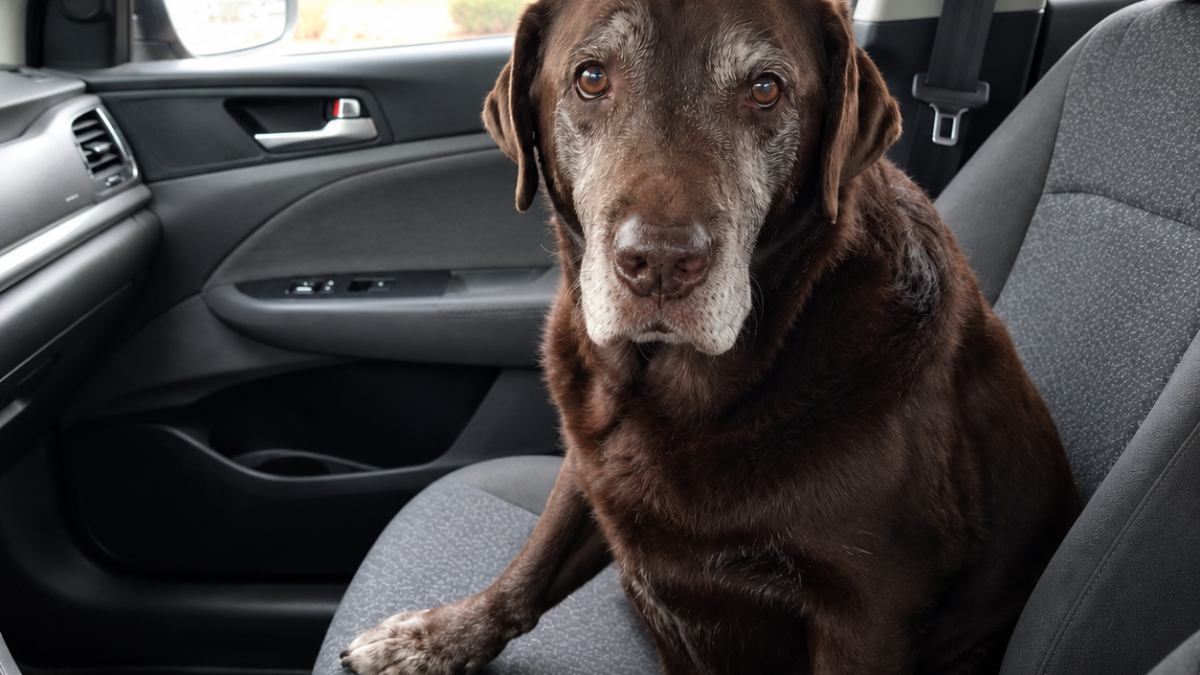
Walter had spent nearly eight months watching younger dogs leave the shelter while nobody chose him, and when I finally opened the passenger door of my car for the ten-year-old Chocolate Lab mix, he climbed in so carefully that it felt less like excitement and more like a dog asking permission to believe he was actually allowed to leave.
He didn’t bark, pace, whine, or press his nose to the glass the way I expected—he simply sat beside me with his silver muzzle pointed toward the windshield, carrying a silence so heavy that I found myself wondering how many times in his life he had already learned not to expect anyone to come back for him.
Then, halfway home, Walter shifted just close enough for his shoulder to touch the center console, I scratched behind his ear, and the long breath he released made me realize there was something about his past the shelter paperwork had never been able to explain.
My name is Ellen Parker, and when I walked into the county shelter that afternoon, I was not looking for the oldest dog in the building.
If I’m being truthful, I wasn’t even certain I was ready to adopt.
My house had been quiet since my daughter moved across the country for work, and I had spent months convincing myself that quiet was exactly what I wanted.
No schedules.
No muddy paws.
No vet bills.
No dog waking me before sunrise.
Then I saw kennel 14.
Walter was lying near the back wall while a family stood in front of the neighboring kennel admiring a six-month-old retriever.
The puppy bounced against the gate.
The children laughed.
Walter lifted his head.
Watched them.
Then lowered it again.
A volunteer named Megan came beside me.
“That’s Walter.”
“How old?”
“About ten. Maybe eleven.”
“How long has he been here?”
She hesitated.
“Two hundred and thirty-seven days.”
I turned.
“You know the exact number?”
“We all do.”
Walter’s muzzle had gone almost completely silver. White hairs dusted his eyebrows, and arthritis had stiffened the way he rose when Megan opened the kennel.
He came toward us slowly.
No jumping.
No pulling.
He sniffed my hand once.
Then sat.
“That’s it?” I asked.
Megan smiled sadly.
“That’s Walter.”
“What happened to him?”
“We don’t know everything.”
She explained that he had arrived as an owner surrender through a family member after the person who had primarily cared for him could no longer keep him.
“Why?”
“The paperwork is vague.”
“Medical?”
“Partly. Housing changed too.”
“Was he abused?”
“Nothing documented.”
Walter looked toward the shelter aisle when another family entered.
His ears lifted.
The family passed us.
He watched them disappear.
Then looked down.
That tiny movement stayed with me.
“Does anyone ask about him?”
“Sometimes.”
“And?”
“They see the age.”
Megan rubbed Walter’s shoulder.
“Then they start doing math.”
“What math?”
“How many years he might have left. How much veterinary care he may need. How soon saying goodbye might come.”
I looked at Walter.
“That seems backward.”
“I know.”
Forty minutes later, I was signing adoption paperwork.
Megan stared at me across the counter.
“You came in saying you were only looking.”
“I changed my mind.”
“I noticed.”
When Walter reached the parking lot, he stopped beside my car.
I opened the passenger door.
He looked at the seat.
Then at me.
“You can get in.”
Nothing.
Megan helped support his hips.
Walter climbed slowly onto the seat.
Then sat completely still.
As I pulled away, I expected some reaction when the shelter disappeared behind us.
There wasn’t one.
At the first red light, I glanced over.
Walter stared ahead.
Not frightened.
Not happy.
Just quiet.
I reached across the console.
“Hey, old man.”
My fingers touched behind his ear.
Walter leaned toward them.
Barely.
Then he released a long, deep sigh and lowered his head onto the seat.
Within minutes, his eyes closed.
I drove the rest of the way home with one hand on the wheel and the strange feeling that, for the first time in months, Walter had stopped waiting for someone to change their mind.
But when we reached my driveway and I opened his door, he looked at the house, then back at the car—and refused to get out.
PART 2
For a moment, I simply stood there with Walter’s leash in my hand.
He was still sitting in the passenger seat.
The car door was wide open.
My house was twenty feet away.
Nothing stood between him and the front porch.
Yet he would not move.
“Come on.”
Walter looked at me.
Then looked toward the windshield.
“Home’s this way.”
Nothing.
I tugged the leash once.
Very gently.
Walter’s body stiffened.
I stopped immediately.
“All right.”
I crouched beside the car.
“You don’t know that word yet.”
Home.
I had used it as if it meant something to him.
To me, it meant the little brick house where I had lived for seventeen years.
To Walter, it was probably just another building a stranger wanted him to enter.
I sat down on the edge of the driveway.
Walter watched.
Five minutes passed.
Then ten.
My neighbor, Carol, came outside carrying her mail.
She stopped at the end of her driveway.
“New dog?”
“Possibly.”
She looked at Walter.
“He lives in the car?”
“Currently.”
Carol nodded.
“Reasonable.”
Then she went inside.
Walter finally put one front paw onto the door frame.
I stayed quiet.
Second paw.
His back legs were harder.
He hesitated.
I remembered Megan mentioning arthritis.
I moved closer.
“Can I help?”
Of course he couldn’t answer.
I placed one hand beneath his chest and the other near his hips.
Walter tensed.
“Easy.”
I lifted just enough.
He stepped down.
The moment all four paws touched the driveway, he stood completely still.
His nose started moving.
Grass.
Leaves.
Someone grilling two houses over.
A truck passing on the road.
The faint smell of rain from damp pavement.
Walter took one step.
Then stopped again.
I had expected adoption day to feel celebratory.
Instead, it felt delicate.
Like carrying a full glass across a dark room.
Every movement mattered.
I let him choose the pace.
He sniffed the mailbox.
The edge of the flower bed.
A crack in the driveway.
We took nearly seven minutes to travel twenty feet.
At the front step, Walter stopped again.
One step.
That was all.
But he stared at it as if I had built a wall.
His hind legs trembled slightly.
“Arthritis?”
He looked at me.
“Right. Stupid question.”
I walked inside and grabbed the old wooden board I used when moving heavy planters.
Not elegant.
But wide enough.
I laid it over the step to make a temporary ramp.
Walter stared at that too.
“You’re difficult.”
His tail moved once.
I froze.
“Did you just wag?”
Nothing.
“I saw it.”
Walter walked up the board.
Inside the house, he stopped on the entry rug.
Everything was new.
The refrigerator humming.
The clock ticking.
My shoes beside the door.
The scent of coffee from that morning.
Walter sniffed the air.
Then looked at me.
I had prepared for a dog in the general sense.
Food.
Water.
Bed.
Collar.
Leash.
Toys.
But I had not prepared for Walter.
I had bought a large padded bed and placed it beside the living-room couch.
Walter walked past it.
He chose the rug near the front door.
He circled twice.
Lay down.
Head between his paws.
“You have a seventy-dollar orthopedic bed.”
No reaction.
“You’re sleeping on a twelve-dollar rug.”
Walter closed his eyes.
Apparently the financial discussion was over.
That first evening, he followed me nowhere.
If I moved into the kitchen, he stayed by the front door.
If I went upstairs, he stayed.
If I sat on the couch, he remained on the rug.
He was not frightened of me.
He simply seemed unwilling to assume he was included.
That was harder to watch than fear.
At six, I filled his bowl.
Walter stood when he heard the food.
Good.
Something motivated him.
He approached slowly.
Stopped three feet from the bowl.
Looked at me.
“Go ahead.”
Nothing.
I moved away.
Walter took one step.
Stopped.
I went into the hallway where he could no longer see me.
Only then did I hear him eating.
That bothered me.
Not enough to diagnose anything.
Enough to remember.
When Walter finished, he returned to the front door.
Same rug.
Same position.
That night, I left the living-room light on and went upstairs.
At 11:30, I came down.
Walter was still by the door.
At 1:10, I checked again.
Same place.
At three, I gave up pretending I wasn’t worried.
I brought a pillow downstairs.
Slept on the couch.
Walter opened his eyes when I entered.
“Don’t make this weird.”
He put his head back down.
Around five in the morning, I woke because something touched my hand.
Walter.
Standing beside the couch.
His nose against my fingers.
I didn’t move.
He sniffed.
Then walked away.
That was all.
It felt enormous.
The next morning, I called Megan.
“How was night one?”
“He sleeps by the door.”
“Common.”
“Why?”
“Could be habit. Could be anxiety. Could be he’s waiting.”
“For what?”
She hesitated.
“Hard to know.”
I sat at the kitchen table.
“Did he do that at the shelter?”
“Sometimes.”
“Facing the kennel door?”
“Yes.”
“Was someone visiting him?”
“Not regularly.”
“What does that mean?”
“Ellen.”
“What?”
“You’ve had him less than twenty-four hours.”
“I know.”
“Don’t start inventing trauma.”
That irritated me.
Mostly because I had already started.
“What should I do?”
“Routine.”
“That’s it?”
“Food same time. Walk same time. Let him learn what happens next.”
“He won’t use the bed.”
“Then let him use the rug.”
“He won’t eat if I’m standing nearby.”
“Then don’t stand nearby.”
“He doesn’t follow me.”
“Why does he need to?”
I was silent.
Megan continued.
“You adopted Walter, not an idea of Walter.”
I sighed.
“You sound like a therapist.”
“I work in animal rescue. Same job, more barking.”
I laughed.
“Give him time.”
So I did.
The first week was uneventful.
Which turned out to be exactly what Walter needed.
Breakfast at seven.
Short walk at seven-thirty.
Medication for arthritis with food.
Nap.
Another walk around noon.
Dinner at five-thirty.
Final bathroom break before bed.
Nothing surprising.
Walter learned the kitchen first.
Food helped.
Then the hallway.
Then the living room.
The stairs remained off limits.
I moved my bedroom downstairs into the small office.
Not permanently, I told myself.
Just until I built a better ramp arrangement or determined whether stairs were safe.
By day four, Walter stopped sleeping directly beside the front door.
He moved three feet toward the living room.
Day six, another two feet.
I did not point this out.
By day eight, one front paw rested on the expensive bed.
His body remained on the rug.
“Commitment issues.”
Walter sighed.
On day ten, he climbed fully onto it.
I took a picture.
Sent it to Megan.
She replied:
Do not wake him by celebrating.
I wrote:
I know.
She answered:
You definitely celebrated.
She knew me too quickly.
Walter’s first real walk around the neighborhood lasted eleven minutes.
Not because he couldn’t go farther.
Because he stopped constantly.
Every mailbox.
Every tree.
Every patch of grass.
At first, I thought he was simply sniffing.
Then we passed a blue pickup truck parked on the curb.
Walter stopped.
His head lifted.
His body changed.
Not fear.
Attention.
He stared at the truck.
When a man came out of the house beside it, Walter’s tail moved.
Once.
Then twice.
The man got into the truck and drove away.
Walter watched until it disappeared.
Something tightened in my chest.
I wanted to ask him.
Did somebody once drive a truck like that?
Did you know that sound?
Were you expecting someone?
Instead, I said, “Come on.”
Walter looked at me.
Then followed.
That became one of the strange things about living with an older rescue dog.
He arrived with a vocabulary I had not taught him.
A history of objects.
Sounds.
Smells.
Habits.
I would discover pieces without knowing what they meant.
Walter knew “sit.”
“Stay.”
“Outside.”
“Ride.”
“Cookie.”
Definitely cookie.
He also knew the sound of a can opener.
The first time I opened soup, Walter appeared from the living room at a speed that did not match his arthritis.
I looked down.
“You understand this.”
Tail wag.
Full wag.
I laughed.
“What did somebody feed you?”
He sat.
Perfectly.
I gave him nothing because soup was not appropriate.
Walter looked betrayed.
“I’m sorry.”
He remained seated.
“No.”
Still seated.
“You’re manipulating me.”
His eyebrows lifted.
Those silver eyebrows became one of his best weapons.
I gave him a dog treat.
Negotiation successful.
Walter knew furniture rules too.
For two weeks, he never tried to get on the couch.
Not once.
I assumed he preferred the bed.
Then one evening I patted the cushion.
“Want up?”
He froze.
I patted again.
“You can.”
Walter approached.
Put one paw on the couch.
Stopped.
Second paw.
He looked at me.
“Come on.”
With effort, he climbed.
Then sat rigidly at the far end.
Almost as if expecting to be told to get down.
My chest hurt.
I turned toward the television.
No excitement.
No petting.
No pressure.
Ten minutes later, Walter lay down.
Twenty minutes after that, his head rested against my leg.
He fell asleep.
From that night forward, the couch belonged to him.
Naturally.
The first veterinary visit came three weeks after adoption.
Dr. Sam Patel had treated my previous dog years earlier.
He examined Walter slowly.
“Weight’s decent.”
“Shelter put some on him.”
“Heart sounds good.”
“Good.”
“Teeth need monitoring.”
“Okay.”
“Hips are arthritic.”
“I know.”
“Probably lower spine too.”
I looked at Walter.
“How bad?”
“Not terrible for ten.”
“What do we do?”
“Weight management. Joint medication. Moderate exercise.”
“Swimming?”
“If he likes it.”
I glanced down.
“Do you like swimming?”
Walter wagged.
Dr. Patel laughed.
“He’s a Lab mix. Statistically, he’ll either love water or dramatically betray the breed.”
Bloodwork showed mild age-related changes but nothing alarming.
I had spent the entire appointment waiting for catastrophe.
That was my first lesson in adopting an older dog.
Age is not a diagnosis.
Walter was old.
He was also alive.
And right then, reasonably healthy.
I had been doing exactly what potential adopters did at the shelter.
Calculating future loss while sitting beside present life.
On the drive home, Walter put his head against the center console.
I scratched his ear.
Same place as adoption day.
He sighed.
I smiled.
“Yeah.”
The long sigh had become familiar.
Sometimes after dinner.
Sometimes after climbing onto the couch.
Sometimes while lying in sunlight.
At first, I interpreted every sigh as emotional release.
Eventually I realized Walter was also simply a world-class sigher.
Old dogs have opinions.
The next major change happened one month after adoption.
Someone knocked on my front door.
Walter was asleep on the couch.
The knock came again.
He stood.
I expected barking.
Instead, Walter moved toward the door quickly.
Tail wagging.
Not alarmed.
Excited.
I opened it.
A delivery driver stood there.
Male.
Mid-fifties.
Baseball cap.
Walter pushed his nose toward the opening.
“Easy.”
The driver smiled.
“Chocolate Lab?”
“Mix.”
“I had one growing up.”
Walter sniffed his hand.
Then his pants.
The man rubbed Walter’s ears.
Walter leaned into him.
Hard.
When the driver walked away, Walter stood at the open door.
Watching.
His tail slowed.
Then stopped.
He remained there after the truck left.
I closed the door.
Walter looked at me.
Again, that expression.
Waiting.
That night, I went through every piece of shelter paperwork.
Owner surrender form.
Intake notes.
Vaccinations.
Behavior evaluation.
Medical exam.
Previous information:
Name: Walter.
Estimated age: 10.
House-trained: Yes.
Good with adults: Yes.
Dogs: Neutral to friendly.
Cats: Unknown.
Reason for surrender:
Owner unable to continue care.
That was almost all.
One emergency contact number had been crossed out.
Previous veterinarian: blank.
I called Megan the next morning.
“Can you tell me more about his surrender?”
“What are you looking for?”
“Anything.”
“Why?”
“I think he keeps waiting for somebody.”
Silence.
“Ellen.”
“I’m not inventing trauma.”
“You might be.”
“Then give me facts.”
“I can check what we have.”
“When?”
“I’m working.”
“Right.”
She laughed.
“I’ll call later.”
She called at four.
“I found an intake note.”
I sat.
“What?”
“Walter was brought in by the adult son of his previous owner.”
“Why?”
“The owner had gone into long-term care.”
I closed my eyes.
“Alive?”
“At the time of surrender, yes.”
“When was that?”
“About nine months before you adopted Walter.”
“Name?”
“I can’t give you private information without authorization.”
“Can you tell me whether Walter had been with that owner long?”
“The son said about eight years.”
Eight.
That landed hard.
Walter had spent most of his life with one person.
Then suddenly shelter.
“What happened to the owner?”
“I don’t know.”
“Did the son visit Walter?”
“Not according to records.”
“Did he try to rehome him himself?”
“Apparently, for a short time.”
“Why couldn’t he keep him?”
“Housing. Another dog. Work.”
I got angry.
Immediately.
“How convenient.”
Megan’s voice sharpened.
“Stop.”
“What?”
“You don’t know him.”
“He left an old dog in a shelter.”
“He surrendered Walter instead of abandoning him.”
“That’s a low bar.”
“Sometimes a shelter is the responsible option.”
I hated hearing that.
Because she was right.
Again.
“People can love an animal and still reach a situation they can’t manage.”
“Walter waited eight months.”
“I know.”
“That’s what bothers me.”
“That isn’t necessarily the son’s fault.”
I looked at Walter sleeping nearby.
“No.”
It was easier to invent a villain than accept ordinary tragedy.
An aging owner.
Long-term care.
A son with limits.
A dog caught between circumstances.
No cruelty required.
Only loss.
After that, Walter’s behavior made more sense.
The front door.
The blue truck.
Men of a certain age.
The quiet waiting.
He had probably spent years believing one specific person would come home.
Then one day, that pattern ended.
I never told Walter his owner was not coming.
Obviously.
But I did something else.
I made routines stronger.
Morning walk at seven-thirty.
Dinner at five-thirty.
Evening couch at seven.
Bed at ten.
Walter began predicting them.
At 5:26, he appeared in the kitchen.
At 6:58, he stared at the leash.
At 9:55, he stood and walked toward the bedroom.
Predictability replaced waiting.
That sounds small.
It wasn’t.
One morning, two months after adoption, I overslept.
I woke at 7:42.
Walter stood beside the bed.
Staring.
“Oh.”
Tail wag.
“Sorry.”
Walter sneezed.
“I know.”
Another sneeze.
“You’ve become very demanding.”
He turned toward the door.
The dog who once seemed uncertain whether he belonged in the house now considered my punctuality unacceptable.
I loved it.
Walter began making friends.
Carol from next door became his favorite because she kept treats in her coat pocket.
He learned the sound of her garage door.
Whenever it opened, Walter walked toward the window.
“She’s married,” I told him.
No concern.
“Her husband likes you too.”
Walter waited.
“Homewrecker.”
Carol occasionally joined us for walks.
One morning she said, “He looks younger.”
“He’s manipulative. Don’t encourage him.”
“No, seriously.”
I looked.
Walter’s coat had improved.
His weight stabilized.
His eyes seemed brighter.
But I think what made him look younger was expectation.
He expected breakfast.
Walks.
Carol.
The couch.
Me.
Those expectations changed his face.
Not dramatically.
Just enough.
Walter’s first real joy came in water.
That spring, I took him to a quiet lake where dogs were allowed off-season.
I kept him on a long line.
The moment Walter smelled the water, his pace changed.
He pulled.
Not hard.
But enough to surprise me.
“You know this?”
His tail wagged furiously.
We reached the shoreline.
Walter stepped in.
One paw.
Two.
Then kept going.
Within seconds, water reached his chest.
He looked back.
I laughed.
“You do know this.”
Walter pushed forward.
Started swimming.
Slow.
Steady.
Perfectly comfortable.
His arthritis disappeared in the water.
He swam parallel to shore for maybe thirty seconds.
Then returned.
Shook directly beside me.
Water everywhere.
“Walter!”
He looked delighted.
That was the first time I saw him truly playful.
Not simply content.
Playful.
He waded in again.
Grabbed a floating stick.
Brought it halfway back.
Dropped it.
Stared at me.
I threw it.
Walter swam.
Again.
We stayed only twenty minutes because I didn’t want him sore.
Back in the car, Walter fell asleep before I started the engine.
I took a picture.
Silver muzzle.
Wet ears.
Head against the console.
Sent it to Megan.
Her reply came immediately:
There he is.
I stared at those words.
There he is.
As if Walter had been present all along but hidden beneath waiting.
At home, he slept six hours.
The next morning, he was stiff.
I panicked.
Dr. Patel laughed.
“You took a ten-year-old arthritic dog swimming after months of shelter inactivity.”
“I kept it short.”
“He’s sore.”
“You sure?”
“Yes.”
“What if—”
“Ellen.”
I stopped.
“Let him rest.”
“Should I bring him in?”
“If he isn’t improving tomorrow.”
Walter improved by afternoon.
I apologized by feeding him an extra treat.
Dr. Patel would have disapproved.
Sometimes medicine and guilt negotiate.
By month four, Walter rarely slept near the front door.
The rug became just a rug.
One evening, I noticed it had been empty for days.
Walter now slept beside my bed.
Sometimes on the couch.
Sometimes directly in the middle of the kitchen while I tried to cook.
A senior dog’s confidence is measured partly by how inconveniently he begins positioning himself.
Walter became extremely inconvenient.
That summer, Megan called.
“I have a strange question.”
“Okay.”
“Walter’s previous owner’s son contacted us.”
My body tightened.
“Why?”
“He found an old folder.”
“What folder?”
“Veterinary records. Photos. Some information.”
I sat down.
“Did he ask for Walter back?”
“No.”
The speed of that answer relieved something I hadn’t admitted was there.
“He saw our adoption update. He knows Walter has a home.”
“What does he want?”
“To give you the records if you want them.”
I looked at Walter.
He was asleep beneath the dining table.
“Yes.”
Two days later, I met a man named Brian in the shelter lobby.
Mid-forties.
Tired face.
He held a manila folder and a small cardboard box.
“You’re Ellen?”
“Yes.”
He looked toward the parking lot.
“Is Walter here?”
“No.”
I had decided not to bring him.
I didn’t know how he would react.
Brian nodded.
“Probably better.”
His eyes went red.
Immediately.
That softened me.
He handed me the folder.
“Dad kept everything.”
“Your father?”
“Thomas.”
That was Walter’s person.
Brian sat.
I sat across from him.
“My dad got Walter when Walter was maybe two.”
“Rescue?”
“Friend of a friend.”
“What happened?”
Brian rubbed his hands together.
“Dad had a stroke.”
I waited.
“Bad one.”
“I’m sorry.”
“He lived alone.”
“With Walter.”
“Yeah.”
Brian looked down.
“I found him after almost a day.”
My chest tightened.
“Walter was there?”
“Wouldn’t leave Dad.”
I swallowed.
Brian continued.
“Hospital said Dad wasn’t going home.”
“So you took Walter.”
“For a while.”
“What happened?”
“My landlord gave me thirty days.”
“Because of Walter?”
“Weight limit.”
“Couldn’t you move?”
The question came out sharper than I intended.
Brian looked at me.
“I had two kids. Shared custody. One income. Lease had eight months left.”
I shut my mouth.
He continued.
“I tried.”
“I’m sorry.”
“No.”
His voice cracked.
“You’re allowed to ask.”
He rubbed his face.
“I called everyone. Family. Friends. Rescue groups. Some were full.”
“And the shelter?”
“Last option.”
“Your father?”
“Dad died three weeks after Walter was surrendered.”
I closed my eyes.
There it was.
The goodbye Walter had never understood.
Brian stared at the floor.
“I couldn’t bring Walter to the hospital.”
“No.”
“Dad couldn’t speak much anyway.”
“I understand.”
“No, I mean…”
He looked at me.
“I promised Dad I’d take care of him.”
His voice broke.
“I failed.”
The anger I had carried toward this stranger disappeared so quickly I felt ashamed.
“You got him somewhere safe.”
“I put him in a kennel.”
“You found him a shelter.”
“For eight months.”
“You didn’t control that.”
Brian wiped his face.
“I stopped looking at the shelter page after a while.”
“Why?”
“Couldn’t.”
He pointed toward the box.
“Those are his things.”
Inside were photographs.
Walter younger.
Chocolate coat dark and glossy.
Walter sitting beside an older man with white hair.
Walter on a dock.
Walter wearing a ridiculous Christmas bandana.
Walter asleep in a recliner with his head on Thomas’s leg.
I stopped.
The recliner.
The man.
Walter’s eyes.
Suddenly I understood the front door.
The blue trucks.
The delivery driver.
He had spent eight years with this man.
Then the man disappeared.
No explanation.
No return.
“Can I keep these?”
“They’re yours.”
“No.”
I pushed the box slightly back.
“They’re Walter’s.”
Brian looked at me.
Then nodded.
“Right.”
He reached into the folder.
“One more thing.”
A veterinary record listed Walter’s birth estimate, previous vaccinations, arthritis diagnosis.
Then a handwritten note from years earlier.
Patient loves swimming. Owner reports difficult to get him out of lake.
I laughed.
“What?”
“Nothing.”
“What?”
“I discovered that recently.”
Brian smiled.
For the first time.
“Dad took him every summer.”
That explained the lake.
Not all history was pain.
That mattered.
Sometimes I had been so focused on Walter’s losses that I forgot he had probably experienced years of love before them.
The shelter was not proof his whole life had been tragic.
It was one chapter.
A hard one.
But not the only one.
Brian hesitated.
“Could I see him someday?”
I did not answer immediately.
“Maybe.”
“I understand.”
“I need to think about what’s best for Walter.”
“Absolutely.”
He stood.
“Thank you for taking him.”
I looked at the photographs.
“Thank you for bringing these.”
At home, I placed Thomas’s picture on the coffee table.
Walter noticed it.
Or maybe he noticed my attention.
He approached.
Sniffed the frame.
Then licked the glass.
I sat on the floor.
“Oh.”
Walter sniffed again.
His tail moved.
Slowly.
I did not know whether dogs recognize a person in a flat photograph.
Experts debate things like that.
But Walter knew something.
Maybe scent remained on the old frame.
Maybe my reaction changed his.
Maybe coincidence.
I stopped needing to define it.
I put the photograph on a low shelf near Walter’s bed.
He never seemed obsessed with it.
But sometimes I caught him sleeping beneath it.
Two weeks later, I invited Brian to meet us at a park.
Neutral place.
Walter saw him from twenty yards away.
Stopped.
Brian froze too.
Neither moved.
Then Walter’s nose lifted.
His tail moved.
Once.
Twice.
Then faster.
He walked.
Not ran.
Walter was too dignified for that.
But he walked directly toward Brian.
Brian dropped to his knees.
“Hey, buddy.”
Walter sniffed his face.
His jacket.
Then pressed his head against Brian’s chest.
Brian cried.
I looked away.
Some moments belong partly to other people.
Walter stayed with him several minutes.
Then something happened that relieved all of us.
Walter turned.
Looked for me.
Saw me.
Walked back.
Stood beside my leg.
Brian laughed through tears.
“Guess I know where I rank.”
I smiled.
“He remembers you.”
“I know.”
“But he knows home too.”
Brian nodded.
“That’s good.”
From then on, Brian visited every few months.
No confusion.
No attempt to reclaim.
Just a person connected to Walter’s first life allowed to become part of his second.
He told me stories.
Walter used to steal hamburger buns from Thomas’s kitchen.
Walter once jumped from a dock before Thomas removed his leash and pulled him into the water.
Walter hated vacuum cleaners.
Walter had slept beside Thomas’s recliner every evening.
The more I learned, the less mysterious Walter became.
And somehow more meaningful.
He hadn’t been born sad.
He had loved.
Been loved.
Lost.
Waited.
Then loved again.
That was different from the tragic story I had invented.
Real life usually is.
Walter’s first adoption anniversary came quietly.
I bought him a dog-safe cupcake.
Carol came over.
Brian sent a new toy.
Megan stopped by after work.
Walter ate the cupcake in eleven seconds.
Then stared at us.
“That was the celebration,” I told him.
Silver eyebrows rose.
“No.”
Megan laughed.
“He has trained you badly.”
“He lived eight months in your shelter. You owe him cake.”
“Fair.”
At night, after everyone left, Walter climbed onto the couch.
He rested his head on my thigh.
I scratched behind his ear.
The same spot from the car ride.
He sighed.
I thought about his first ride home.
How still he had been.
How carefully he had climbed into that seat.
How uncertain.
I whispered, “One year.”
Walter slept.
We went back to the lake the following spring.
This time I brought a flotation vest.
Walter objected to the vest.
“I know you can swim.”
Stare.
“You’re eleven.”
Stare.
“I’m the adult.”
Walter turned his back.
Eventually he wore it because treats exist.
He swam more slowly.
Still happily.
Brian came with us.
He stood on shore.
“This feels like Dad.”
I looked at him.
“Good or bad?”
“Both.”
Walter emerged from the water and shook himself directly beside Brian.
Brian laughed.
“Okay. Mostly good.”
Old age did not arrive suddenly.
Walter had already been old when I adopted him.
That created a strange illusion.
Every gray hair seemed preexisting.
Every slow morning expected.
Then, around twelve, changes became clearer.
He slept more deeply.
Walks shortened.
Stairs became impossible.
The makeshift ramp I had created on adoption day became permanent.
Then professionally built.
Dr. Patel adjusted arthritis medication.
We added rugs.
Joint injections.
A lower bed.
Walter continued stealing food when opportunities appeared.
That was how I measured quality of life.
The day he stopped attempting kitchen crimes would worry me.
At twelve and a half, he stole half a turkey sandwich from Carol.
Excellent prognosis.
At thirteen, his hearing weakened.
I would call.
Nothing.
Clap.
Sometimes.
Open treat bag.
Immediate response.
Selective deafness remained medically difficult to distinguish.
His eyesight clouded slightly.
He began bumping into dark furniture at night.
I added nightlights.
My house slowly became arranged around one old dog.
Rugs.
Ramps.
Water bowls.
Lights.
Beds.
Medication schedules.
People sometimes said, “That’s a lot.”
It was.
So was having any relationship.
Care is inconvenient.
That doesn’t make it burdensome.
There is a difference.
One winter evening, Walter stood by the front door.
I assumed bathroom.
Opened it.
He didn’t move.
Instead, he looked toward the driveway.
Snow fell lightly.
He stood there several minutes.
I remembered the shelter.
The door.
The waiting.
I sat beside him.
“You waiting for Thomas?”
Walter’s ear moved.
I don’t know.
Maybe he just smelled a rabbit.
But I sat anyway.
After a while, Walter turned.
Walked back to the couch.
That was one of the last times I saw him wait at the door.
Brian visited on Walter’s fourteenth birthday.
Fourteen was an estimate.
Could have been thirteen and a half.
Could have been fifteen.
We chose the shelter intake date plus approximate age.
Walter didn’t care.
Cake existed.
Brian sat on the floor.
“You are ancient.”
Walter licked frosting.
“Dad would not believe this.”
I asked, “What?”
“That he made fourteen.”
Walter had survived Thomas by more than four years.
Brian looked at me.
“I used to feel guilty about that.”
“What?”
“Walter living.”
I stared.
“That makes no sense.”
“I know.”
He rubbed Walter’s ear.
“Dad wanted more time too.”
That silenced me.
Brian continued.
“Sometimes I felt like Walter getting old somewhere else meant Dad missed all of it.”
I understood.
Grief can make another person’s survival feel unfair without making you wish them harm.
“You think he’d want Walter to have stopped?”
“No.”
“Then there you go.”
Brian smiled.
“You’re annoyingly practical.”
“Age.”
Walter sneezed.
We both laughed.
That spring, Walter stopped swimming.
He still walked into shallow water.
Stood there.
Let small waves move around his legs.
But he didn’t push off.
I didn’t encourage him.
He knew his body better than I did.
We sat at the lake together.
Walter in water up to his ankles.
Me on shore.
Brian took a photograph.
Walter looked toward the horizon.
Silver muzzle.
Cloudy eyes.
Old.
Beautiful.
I framed it beside Thomas’s photograph.
The two lives together.
At fifteen—or close enough—Walter’s kidneys began failing.
Slowly at first.
More water.
More urination.
Weight loss.
Bloodwork.
Diet changes.
Medication.
Dr. Patel was careful.
“This can be managed for a while.”
“How long?”
“Depends.”
“I hate that answer.”
“I know.”
Walter still ate.
Still walked.
Still demanded dinner early.
So we managed.
Three months.
Six.
Nearly a year.
Then one morning, Walter left breakfast untouched.
I stared at the bowl.
“Walter.”
He looked at me from his bed.
“Come on.”
I added chicken.
Nothing.
Cheese.
He sniffed.
Turned away.
My chest tightened.
I called Dr. Patel.
Bloodwork was worse.
Kidneys.
Anemia.
General decline.
“We can hospitalize him.”
“For what?”
“IV fluids. Nausea control.”
“Would he feel better?”
“Possibly.”
“For how long?”
“Ellen.”
“How long?”
“I don’t know.”
I looked at Walter.
He hated the clinic more now.
Confusion had increased with age.
At home, he knew every smell.
Every path.
Every bed.
I asked, “Can we treat at home?”
“To a point.”
“Then do that.”
We did.
Subcutaneous fluids.
Anti-nausea medication.
Pain control.
Walter rallied.
A little.
He ate chicken that evening.
I cried.
Then laughed because crying over a dog eating chicken seemed ridiculous after four years together.
Three weeks later, he stopped again.
This time, I knew.
Brian came.
Megan too.
Carol.
Not all at once.
Walter had never liked crowds.
Megan sat beside him.
“Hey, old man.”
Walter opened his eyes.
Tail moved once.
She covered her mouth.
“You were supposed to have maybe a year or two.”
I looked at her.
“What?”
“That’s what everyone said when he was waiting.”
“Who?”
“Potential adopters.”
My throat tightened.
Megan wiped her face.
“They’d ask how old he was. Then say they couldn’t handle losing him soon.”
Walter had been with me almost five years.
Five.
Years.
I thought about all the people who had passed his kennel because they feared heartbreak.
The heartbreak came.
Of course it did.
But between adoption and grief there had been nearly five years.
Five summers.
Five Christmases.
Hundreds of walks.
Lake trips.
Couch naps.
Stolen sandwiches.
Visits with Brian.
Morning routines.
Thousands of ordinary minutes no one could have received if fear had made the decision.
That night, Walter struggled to stand.
His hind legs slipped.
I helped with the harness.
He looked embarrassed.
Or I projected that.
“Nothing to apologize for.”
We went outside.
Slowly.
Walter stood in the yard.
Cold air.
Stars.
He sniffed.
Then lay down.
I sat beside him in the grass.
My knees hurt.
I didn’t care.
For almost an hour, we stayed there.
No dramatic conversation.
I talked about stupid things.
Carol’s new fence.
Brian’s daughter starting college.
The leak in my bathroom faucet.
Walter listened.
Or slept.
Both were fine.
At one point, he shifted.
His shoulder touched mine.
Exactly the way it had touched the center console on adoption day.
A small movement.
Quiet trust.
I put my arm around him.
“You did okay.”
His ear moved.
“You know that?”
Walter sighed.
Long.
Deep.
The same sigh.
I started crying.
The next morning, Dr. Patel came to the house.
I had already decided.
That didn’t make deciding easier.
Walter lay on his favorite bed near the window.
Thomas’s photograph sat on the shelf above him.
Brian arrived carrying something.
An old blue blanket.
“Dad’s.”
I looked at him.
“Walter used to sleep on it.”
We placed the blanket beneath Walter’s head.
His nose moved.
He sniffed.
Then exhaled.
Brian sat on one side.
I sat on the other.
For a while, none of us spoke.
Finally Brian whispered, “Tell Dad I’m sorry.”
I looked at him.
Walter breathed slowly.
“You don’t need to put that on him.”
Brian cried.
“I know.”
I took his hand.
“You did what you could.”
For years, Brian had carried the same thing Walter seemed to carry when I first adopted him.
Waiting for a different ending to the past.
There wasn’t one.
Thomas had died.
Walter had gone to the shelter.
Brian had been unable to keep him.
Those facts couldn’t change.
But they also weren’t the end.
Walter had been loved before.
Loved after.
Both could be true.
Dr. Patel gave the sedative.
Walter relaxed gradually.
His head sank deeper into Thomas’s blanket.
I scratched behind his ear.
Same place.
Always.
“Remember the car?”
Brian looked at me.
“What car?”
“First day.”
Walter’s eyes were half closed.
“He wouldn’t get out when we got home.”
Brian laughed softly.
“That sounds like him.”
“I sat in the driveway for ten minutes.”
“He made Dad wait for everything.”
“Good.”
I leaned close.
“You were worth waiting for.”
Walter took one slow breath.
Then another.
His paw rested against my leg.
Dr. Patel waited until he was completely asleep.
I nodded.
The final medication went in.
Walter breathed out.
Stopped.
No struggle.
No fear.
Just stillness.
I kept my hand on his ear.
Brian leaned over the old blue blanket.
Dr. Patel listened.
Then quietly said, “He’s gone.”
The room did not change immediately.
That surprised me.
The clock kept ticking.
A car passed outside.
The refrigerator started.
Walter’s water bowl sat near the wall.
His leash hung by the door.
Everything looked exactly like a house with a dog in it.
Except the dog was gone.
Grief entered through routine.
At five-thirty that evening, I stood up to make dinner.
Walter’s dinner.
Then remembered.
The next morning, I woke at seven.
Waited for him to appear.
Nothing.
At 7:30, my body wanted to reach for the leash.
Nothing.
The first week was filled with those collisions.
Habit running into absence.
Carol came over.
Sat in my kitchen.
Neither of us talked much.
At one point she looked toward the empty bed.
“I miss that old thief.”
“He stole your sandwich once.”
“Twice.”
“I only knew about once.”
“He and I had an arrangement.”
“Traitor.”
She smiled.
Then cried.
Walter’s ashes came home two weeks later.
I placed them beside Thomas’s photograph.
Not because Walter belonged to Thomas more.
Not because he belonged to me more.
Because both lives were his.
That mattered.
Brian visited a month later.
He stood in front of the shelf.
“You kept Dad’s picture.”
“Of course.”
He nodded.
Then handed me another photograph.
It was from our last lake trip.
Walter standing in shallow water.
Me beside him.
Brian behind us.
Three parts of his life in one frame.
I put it beside the others.
Months passed.
The rugs remained.
The ramp remained.
I eventually moved the water bowls.
Not all at once.
One.
Then another.
The bed stayed longest.
Five months.
One morning I washed the cover.
Drove to the shelter.
Megan met me in the lobby.
“You sure?”
“No.”
“That wasn’t the question.”
“Then yes.”
We donated Walter’s bed to the senior-dog room.
I avoided kennel 14.
For about thirty minutes.
Then I went.
A small white dog occupied it.
Twelve years old.
Cloudy eyes.
She was sleeping.
Megan appeared beside me.
“No.”
“I didn’t say anything.”
“You’re thinking.”
“I am looking.”
“Dangerous.”
The little dog woke.
Walked toward the gate.
Sat.
I crouched.
“Hi.”
Megan smiled.
“Her name is Daisy.”
“I am not adopting a dog today.”
“Okay.”
“How long has she been here?”
“Four months.”
I glared at Megan.
“That was manipulative.”
“You asked.”
Daisy sniffed my hand.
I went home alone.
That was important.
Walter had not created an obligation to immediately fill his place.
I needed grief to be grief.
Not an empty slot to solve.
Three months later, I returned.
Daisy was still there.
Older dogs live by different rules.
People saw her cloudy eyes.
Medication.
Age.
Future grief.
I stood outside her kennel.
Megan said nothing.
I looked at Daisy.
Then at the hallway Walter had once waited in.
I thought about five years.
Not the last day.
Five years.
The car ride.
The lake.
Thomas’s photograph.
Brian kneeling in the park.
The stolen sandwich.
The first couch nap.
Walter standing in water.
That long sigh.
Five years had never been promised.
Neither were five minutes.
Daisy came to the gate.
I opened my palm.
She rested her chin in it.
I sighed.
Megan laughed.
“Paperwork?”
“Don’t ruin the moment.”
That afternoon, I drove home with another senior dog beside me.
Not Walter.
Never Walter.
Daisy paced for the first ten minutes.
Then curled up.
At a stoplight, I looked over.
Different face.
Different eyes.
Different history.
I scratched behind her ear.
She sneezed.
“Okay.”
When we reached my driveway, Daisy jumped out before I could help her.
So much for symbolism.
She walked directly toward the front door as if she owned the place.
I laughed.
Walter had needed ten minutes to leave the car.
Daisy needed none.
That was the point.
Older dogs are not one story.
They do not arrive carrying identical sadness.
Some wait.
Some rush.
Some hide.
Some steal sandwiches on day one.
Age tells you how many years have passed.
It does not tell you who the dog is.
Years later, I still think about Walter’s first car ride.
That silence.
The silver muzzle.
The way he stared through the windshield.
The tiny movement toward the console.
Then the sigh after I touched his ear.
At the time, I imagined he was laying down eight months of shelter disappointment.
Maybe he was.
Or maybe he was simply tired.
I don’t need to know anymore.
What I know is what came afterward.
He learned the house.
He claimed the couch.
He returned to water.
He saw Brian again.
He carried Thomas’s memory without having to lose his new home.
He grew older.
He became inconvenient.
Demanding.
Loved.
And when his life finally ended, it did not end in kennel 14 while strangers calculated whether loving him would hurt too much.
It ended at home.
On a familiar bed.
With an old blanket beneath his head.
A man from his first family on one side.
A woman from his second family on the other.
No waiting.
No wondering who would choose him.
Walter had already been chosen.
And for nearly five beautiful years, he knew it.
Walter had spent nearly eight months watching younger dogs leave the shelter while nobody chose him, and when I finally opened the passenger door of my car for the ten-year-old Chocolate Lab mix, he climbed in so carefully that it felt less like excitement and more like a dog asking permission to believe he was actually allowed to leave.
He didn’t bark, pace, whine, or press his nose against the glass the way I expected—he simply sat beside me with his silver muzzle pointed toward the windshield, carrying a silence so heavy that I found myself wondering how many times in his life he had already learned not to expect anyone to come back for him.
Then, halfway home, Walter shifted just close enough for his shoulder to touch the center console, I scratched behind his ear, and the long breath he released made me realize there was something about his past the shelter paperwork had never been able to explain.
My name is Ellen Parker.
The afternoon I met Walter, I was fifty-eight years old and had spent almost a year telling everyone in my life that I enjoyed living alone.
That was not completely false.
My daughter, Rachel, had taken a job in Oregon the previous spring. She was thirty-one, independent, excited about the move, and guilty enough about leaving that I made a point of pretending my empty house was exactly what I had been waiting for.
“Mom, you should travel.”
“I might.”
“You could take that pottery class.”
“I hate pottery.”
“You’ve never tried it.”
“Exactly. I have successfully avoided it for fifty-eight years.”
She laughed.
Then she moved two thousand miles away.
For the first few weeks, I enjoyed the quiet.
I left dishes in the sink overnight.
Watched terrible television.
Ate cereal for dinner without anybody commenting on nutritional balance.
Then the novelty faded.
The house became too organized.
That sounds strange, but it was true.
Nothing moved unless I moved it.
No extra coffee cup appeared beside the sink.
No shoes ended up in the hallway.
No music came from another room.
The silence began following me.
I had owned dogs before.
Our last dog, Molly, a yellow Lab mix, had died three years earlier at fourteen. I had sworn I would eventually get another dog.
Eventually became one of those words you can hide behind forever.
Then one rainy Tuesday, my friend Carol called.
“You need to get out of your house.”
“I am out of my house.”
“You’re talking to me from your kitchen.”
“How do you know?”
“Because I can hear your refrigerator.”
I looked at the refrigerator.
“That is invasive.”
“The county shelter needs people to walk dogs.”
“I’m not adopting.”
“I didn’t say adopt.”
“You were about to.”
“I was about to say volunteer.”
“You don’t volunteer at the county shelter.”
“No, because I have three cats and one of them already hates me.”
I laughed.
Carol continued.
“Just go.”
So I went.
That was how Walter entered my life.
Not because I woke that morning determined to save a senior dog.
I went because my friend was tired of hearing my refrigerator during phone calls.
The county shelter sat behind the municipal maintenance yard in a low concrete building that always smelled faintly of disinfectant, wet fur, and industrial laundry detergent.
A volunteer named Megan met me near the desk.
She was maybe thirty-five, with dark hair twisted into a messy knot and a coffee cup that looked permanently attached to her hand.
“First time?”
“Yes.”
“Looking to volunteer?”
“That was the plan.”
“Dangerous plan.”
“Why?”
“People come in to walk dogs. They leave with dogs.”
“I’m not adopting.”
Megan smiled.
“Everyone says that.”
“I actually mean it.”
“Good. Makes it more interesting.”
She walked me through the kennel area.
Noise hit first.
Barking.
Metal doors.
Water bowls scraping concrete.
A young shepherd mix launched himself happily against one gate.
A hound sang at nothing.
Two puppies were wrestling with a towel while a family watched them.
Then I reached kennel 14.
Walter was lying toward the back.
He did not bark.
Did not stand.
He watched people pass.
That was all.
His coat was deep brown, though age had scattered lighter hairs across his shoulders. His muzzle was almost completely silver. Thin white markings sat above his eyes like eyebrows.
His adoption card read:
WALTER
Chocolate Labrador Mix
Approx. 10 Years
Gentle
House-Trained
Enjoys Slow Walks
Prefers Quiet Home
Below that was a handwritten note:
Loves treats.
I smiled.
“At least somebody wrote the important part.”
Megan stopped beside me.
“That’s Walter.”
“How long?”
She knew what I meant.
“Two hundred thirty-seven days.”
I turned.
“You know exactly?”
“We all know.”
“Why?”
Megan looked through the kennel door.
“Because he’s one of the longest residents.”
Walter lifted his head.
A family walked toward us.
Two children.
Parents.
The little boy pointed through the bars.
“Look at the brown dog.”
Walter stood.
Slowly.
His back legs were stiff.
He came toward the gate.
The mother read his card.
“Ten?”
Her husband leaned closer.
“Yeah.”
They looked at Walter.
Then at another kennel.
The little girl said, “Can we see the puppy again?”
They walked away.
Walter remained standing at the gate for several seconds.
Then he turned.
Walked back to his blanket.
Lay down.
I felt something ugly twist inside my chest.
“Does that happen a lot?”
Megan did not pretend to misunderstand.
“Yes.”
“People won’t adopt him because he’s ten?”
“Some people won’t.”
“That’s ridiculous.”
“Some are scared.”
“Of what?”
“Money. Medical issues. Losing him soon.”
I looked at Walter.
“So instead they leave him here.”
Megan’s expression changed.
“Be careful.”
“With what?”
“Judging people because they know what they can handle.”
I opened my mouth.
Closed it.
She was right.
Still, it hurt to watch.
“Can I meet him?”
Megan smiled.
“Thought you weren’t adopting.”
“I’m meeting.”
“Right.”
She clipped a leash to Walter’s collar and brought him into a small visitation room.
Walter walked slowly.
No pulling.
No jumping.
Once inside, he sniffed the corners.
Then came toward me.
I held out my hand.
He sniffed.
I waited for something.
Tail wag.
Lean.
Lick.
Nothing.
Walter simply sat.
“Hi.”
He looked at me.
His eyes were dark brown and clear despite his age.
There was no dramatic sadness in them.
That was almost what made them harder to read.
He looked tired.
Not physically only.
Familiar with waiting.
Megan sat across from us.
“He’s easy.”
“Too easy.”
“What does that mean?”
“He doesn’t ask for anything.”
She nodded.
“I know.”
“Was he always like this?”
“We don’t know.”
“What’s his history?”
“Owner surrender through family.”
“Why?”
“Primary owner couldn’t continue caring for him.”
“Died?”
“The original paperwork didn’t say.”
“Medical?”
“Possibly.”
I looked at Walter.
“Did the family keep him?”
“For a short time.”
“Then?”
“Couldn’t.”
“Why?”
“Housing restrictions were mentioned.”
I started to ask another question.
Megan interrupted.
“Ellen.”
“How do you know my name?”
“Volunteer form.”
“Right.”
“You are already trying to solve his entire past.”
“I’m asking.”
“Walter doesn’t need you to solve his past.”
I rubbed the old dog’s shoulder.
Walter did not lean away.
Did not lean in.
Just allowed it.
“What does he need?”
“Someone to care what happens next.”
That sentence followed me around the shelter.
I walked three other dogs.
A young terrier who believed leashes were optional.
A beautiful two-year-old shepherd who knew six commands and probably understood taxes.
A goofy hound who barked at his own reflection in the window.
All of them were wonderful.
I kept thinking about Walter.
At lunch, I went back to kennel 14.
He was asleep.
Megan noticed.
“You know what you’re doing, right?”
“Checking on him.”
“No.”
I looked at her.
“You’re comparing every other dog to him.”
“I am not.”
“You are.”
I sighed.
“I don’t want a senior dog.”
“Okay.”
“I want years.”
“Then don’t adopt him.”
“I want hiking.”
“So choose a younger dog.”
“I don’t want a dog with immediate vet bills.”
“Then don’t adopt him.”
Her lack of argument irritated me.
“You’re not very persuasive.”
“I’m not supposed to be.”
“Shelters want dogs adopted.”
“Not to the wrong home.”
I stared through the gate.
Walter slept with his nose tucked beneath one paw.
Megan said, “If all the reasons not to adopt him matter more than the reasons you want him, walk away.”
“That sounds harsh.”
“It’s fair to both of you.”
I went home alone.
The next morning, I thought about Walter while making coffee.
That afternoon, I returned.
“I forgot something,” I told Megan.
“What?”
“I don’t know yet.”
She handed me Walter’s leash.
He walked with me outside.
Slowly.
We followed a path around the shelter property.
Walter stopped at every tree.
Not nervous.
Thorough.
He walked maybe half a mile.
His back legs stiffened near the end.
I shortened the route.
When we returned, he drank water and lay beside my chair.
Still no dramatic affection.
I scratched behind his ear.
He closed his eyes.
That was enough.
I came back Friday.
Then Saturday.
On Saturday, an older couple met Walter.
I stayed away.
This was important.
I did not own him.
They sat with him nearly thirty minutes.
The woman rubbed his head.
Walter rested against her foot.
I felt jealous.
That embarrassed me.
Megan saw.
“Problem?”
“No.”
“You look like somebody stole your parking spot.”
“I’m fine.”
“They’re nice.”
“I’m sure.”
“They have senior-dog experience.”
“Wonderful.”
“They may apply.”
“Great.”
Megan drank coffee.
“You could apply too.”
“I haven’t decided.”
“Then don’t be angry if somebody else does.”
I hated her.
The couple left without completing paperwork.
I hated myself for feeling relieved.
“Why didn’t they adopt?”
Megan shrugged.
“Their current dog has health problems. They decided adding another senior might be too much.”
Reasonable.
Responsible.
Painful anyway.
I sat outside Walter’s kennel.
He came forward.
Pressed his nose briefly against the bars.
That was the first time he had initiated contact with me.
I put two fingers through.
Walter sniffed.
Then remained there.
I drove home thinking about arithmetic.
Ten years old.
Labs often lived twelve to fourteen.
Maybe Walter had four years.
Maybe two.
Maybe six months.
Nobody knew.
I realized I was trying to calculate whether loving him would offer enough return on investment.
That thought disgusted me.
Relationships do not become worthless because they have endings.
I knew that.
I had lost my parents.
A marriage had ended in divorce years earlier.
Molly had died.
Rachel had grown up and moved away.
Every meaningful thing changes.
Avoiding attachment had never prevented loss.
It only prevented what came before it.
The following Monday, I completed an adoption application.
Megan said nothing.
Just slid me the forms.
When I finished, she looked through them.
“Own your home?”
“Yes.”
“Fence?”
“Backyard.”
“Other pets?”
“No.”
“Work schedule?”
“I work from home three days a week. Office two.”
“Plan for those two?”
“Carol offered midday walks.”
“You already asked her?”
“Apparently.”
Megan smiled.
“Veterinary reference?”
“Dr. Sam Patel.”
She looked up.
“Your previous dog lived to fourteen.”
“Yes.”
“Senior care?”
“Yes.”
“End-of-life decisions?”
I hated that the form included the question.
“Yes.”
Megan put the papers down.
“Still want him?”
“No.”
She blinked.
I smiled.
“I’m terrified.”
“Good answer.”
Two days later, the adoption was approved.
Walter’s shelter fee had been sponsored by someone months earlier.
I found that almost heartbreaking.
A stranger had paid for him.
Still nobody came.
Until me.
On adoption afternoon, several staff members appeared near the lobby.
Too many for coincidence.
Walter wore a new blue collar.
Megan clipped on his leash.
“Ready?”
“No.”
She laughed.
“Walter?”
Walter walked beside us.
At the exit doors, he paused.
Looked back toward the kennel hall.
Maybe I imagined meaning.
Maybe he simply heard barking.
I didn’t know.
“Come on, old man.”
He followed.
At my car, Walter stopped again.
The passenger seat was low enough, but his hips were stiff.
Megan helped support him.
He climbed in.
Sat upright.
No frantic sniffing.
No bouncing.
No excitement.
Megan leaned through the open door.
“Hey.”
Walter looked at her.
“You’re not coming back tonight.”
Her voice cracked slightly.
I looked away.
She rubbed his chest.
“Try not to make her life too easy.”
Walter blinked.
Megan closed the door.
I drove.
For the first few miles, Walter watched the windshield.
At a stoplight, I looked over.
His silver muzzle was pointed straight ahead.
He seemed smaller outside the shelter.
Not physically.
Without kennel walls defining him, he looked like an old dog who had no idea where he was going.
I touched behind his ear.
“Hey.”
Walter leaned toward me.
Barely.
Then sighed.
Long.
Deep.
His body loosened.
He lowered himself onto the seat.
By the time I reached my neighborhood, he was asleep.
I drove slowly.
Not because I needed to.
Because I didn’t want to wake him.
Then we reached my driveway.
I opened his door.
Walter looked at the house.
Then back toward the interior of the car.
He did not move.
“Come on.”
Nothing.
I waited.
Five minutes.
Ten.
I sat on the driveway.
My neighbor Carol came outside.
“So this is the old man.”
“Apparently he lives in my Honda.”
“Economical.”
“Go away.”
Walter finally moved toward the door.
His rear legs shook when he tried stepping down.
I supported his hips.
He stiffened.
“Easy.”
Four paws touched the driveway.
Walter stood still.
Nose working.
He sniffed my flower bed.
Mailbox.
Grass.
The base of the porch rail.
Each thing received careful inspection.
We reached the front step.
He stopped.
I looked at his hips.
“Right.”
I found an old board in the garage.
Laid it across the step.
Temporary ramp.
Walter sniffed.
Walked up.
Inside, he froze on the entry rug.
The house was quiet.
Too quiet.
I realized I had never heard it through someone else’s ears.
Clock ticking.
Refrigerator humming.
Air vent.
A neighbor’s lawn mower.
Walter listened.
Then walked three feet.
Stopped.
I had bought an orthopedic bed.
He ignored it.
Walked to the rug beside the front door.
Circled.
Lay down.
“You know that bed cost seventy dollars.”
Walter closed his eyes.
“Good talk.”
I set out water.
Food.
Walter drank while I stood nearby.
But when I put dinner down, he only stared.
“Eat.”
No movement.
I stepped away.
Walter approached.
I stopped in the kitchen doorway.
He stopped eating.
Interesting.
I walked around the corner.
Chewing resumed.
So I stayed out of sight.
That first evening, Walter remained near the front door.
If I went into the kitchen, he stayed.
If I went upstairs, he stayed.
If I sat on the couch, he watched but did not follow.
At ten, I showed him the bed again.
He chose the rug.
I went upstairs.
At 11:30, I checked.
Same place.
At one, same.
At three, I brought a pillow downstairs and slept on the couch.
Around five, something cold touched my fingers.
I opened my eyes.
Walter stood beside me.
He sniffed my hand.
I didn’t move.
He stayed maybe five seconds.
Then returned to the rug.
That tiny decision meant more to me than if he had jumped into my lap.
The next morning, I called Megan.
“He sleeps by the door.”
“That can happen.”
“Why?”
“New environment. Familiar exit.”
“Or waiting.”
“Maybe.”
“For his previous person?”
“Maybe.”
“You don’t know.”
“No.”
“That’s annoying.”
“I’m comfortable with uncertainty.”
“I’m not.”
“I’ve noticed.”
I made coffee.
Walter watched from the living room.
Megan said, “Routine, Ellen.”
“That’s your answer for everything.”
“Because routine works.”
“Should I move his bed near the door?”
“Yes.”
“Should I encourage him away?”
“No.”
“Should I close off the entry?”
“No.”
“Should I—”
“Feed him.”
I did.
Then waited around the corner.
During the first week, Walter explored in expanding circles.
Entryway.
Living room.
Kitchen.
Hallway.
Never stairs.
That was fine.
I moved into the downstairs office rather than leave him sleeping alone.
I told myself it was temporary.
It became permanent.
His first walk around the block took almost twenty minutes because every scent required investigation.
He knew leash manners.
Knew to stop at curbs.
Knew “wait.”
Someone had trained him.
That made his history feel closer.
At one corner, a blue pickup idled outside a house.
Walter stopped.
Tail lifted.
A man in his sixties came down the driveway.
Walter’s tail moved.
The man opened the truck.
Got inside.
Drove away.
Walter watched.
For a long time.
“Someone you know?”
He kept staring.
I tugged gently.
Walter followed.
That night, he slept beside the front door again.
I began imagining things.
Maybe his owner drove a blue truck.
Maybe he had been abandoned beside one.
Maybe every passing vehicle made him think someone was coming.
Megan warned me.
“Don’t turn missing information into tragedy.”
“But his behavior means something.”
“Yes. It means he noticed a truck.”
“You’re impossible.”
“Stories feel satisfying. Dogs don’t always give us satisfying stories.”
I knew.
Still, I wondered.
Walter slowly learned my schedule.
Breakfast at seven.
Morning walk seven-thirty.
Lunch bathroom break around noon.
Dinner five-thirty.
Evening walk six.
Couch time afterward.
Final trip outside around ten.
At first, I created the schedule for him.
Within weeks, Walter enforced it on me.
At 5:22 one evening, he entered the kitchen.
Sat.
Stared.
“It is not five-thirty.”
Stare.
“You can’t tell time.”
Stare.
“Stop.”
Silver eyebrows.
I laughed.
“Five minutes.”
Walter sighed.
By week three, the orthopedic bed migrated from the front door toward the living room because Walter himself had migrated.
First, he slept with front paws on the bed.
Then half his body.
Then all of it.
One afternoon, I found him upside down enough that his legs were against the wall.
“Comfortable?”
Walter opened one eye.
“Apparently.”
I sent a photograph to Megan.
She replied:
That doesn’t look like the same dog.
It did.
But I knew what she meant.
His body looked less guarded.
At the shelter, Walter slept as if ready to stand.
At home, he sometimes slept deeply enough to twitch and make muffled sounds.
Dreaming.
The first time he barked in his sleep, I nearly fell off the couch.
Walter woke.
Looked at me.
“Was that necessary?”
He put his head down.
At his first veterinary visit, Dr. Patel recognized my anxiety immediately.
“You adopted an old dog.”
“Yes.”
“Then why are you shocked he has old-dog problems?”
“I’m not shocked.”
“You brought a notebook.”
“I like records.”
“You highlighted questions.”
“Efficient.”
He looked at Walter.
“Save me.”
Walter wagged.
Traitor.
The examination was reassuring.
Moderate arthritis.
Some stiffness in the lower back.
Dental wear.
A small fatty lump that tested benign.
Bloodwork surprisingly good.
Dr. Patel said, “For ten, he’s doing well.”
I seized on the wording.
“For ten?”
“Ellen.”
“What?”
“Stop hearing a countdown in every sentence.”
I looked down.
Walter leaned against my leg.
“People kept passing him because he was old.”
“And?”
“I don’t want to miss something.”
“Then bring him for checkups.”
“That’s it?”
“Feed him properly. Keep him lean. Exercise him. Love him. Monitor changes.”
He wrote down a joint medication.
“And stop conducting his autopsy while he’s alive.”
I stared at him.
“That was rude.”
“It was medically necessary.”
Walter’s relationship with the couch developed accidentally.
For weeks, he never tried climbing up.
Then one rainy evening, I patted the cushion.
“Come here.”
Walter stared.
I patted again.
His front paws rose.
He froze.
Looked at me.
“You’re allowed.”
He climbed with difficulty.
Sat rigidly at the opposite end.
I turned on television.
Pretended nothing happened.
Ten minutes later, Walter lay down.
Twenty minutes later, his head touched my thigh.
I looked down.
He was asleep.
The rain hit the windows.
My house no longer sounded empty.
That simple fact scared me.
Because once a house learns another heartbeat, losing it becomes imaginable.
I almost pushed the thought away.
Then remembered why Walter had waited eight months.
People had done the same math.
I scratched his ear.
Present first.
Future later.
The next major piece of Walter’s past arrived through paperwork.
I had called the shelter again asking whether they knew more.
Megan finally found an intake note stored in an older system.
Walter had been surrendered by the adult son of his primary owner.
The owner had entered long-term medical care.
Walter had lived with him for approximately eight years.
That changed everything.
Eight years.
Walter hadn’t bounced between bad homes.
He had belonged somewhere.
He had known somebody.
Probably loved them.
Then suddenly they vanished.
“What happened to the owner?” I asked.
“Not in the record.”
“Alive?”
“At surrender, apparently.”
“Did the son keep Walter?”
“Temporarily.”
“Why not permanently?”
“Housing restrictions. Work.”
“Did he visit?”
“No recorded visits.”
I felt anger.
“Eight years and then a kennel.”
Megan interrupted.
“Don’t.”
“What?”
“You don’t know their circumstances.”
“He left him.”
“He brought him somewhere safe.”
“The shelter.”
“Yes.”
“For eight months.”
“That wasn’t necessarily predictable.”
I hated how reasonable she was.
“It still happened to Walter.”
“Yes.”
That was true too.
Circumstances can be understandable and still hurt the one caught inside them.
Walter never needed to know whose fault anything was.
He only needed a life afterward.
So I built one.
We began walking the same route every morning.
Walter made friends with Carol.
Mostly because Carol carried treats.
“I thought you liked me,” she said one day.
Walter stared at her pocket.
“He loves your personality.”
“Clearly.”
He learned that the mail carrier was harmless.
That the vacuum was an enemy.
That squirrels were worth observing but not chasing.
That rabbits were apparently worth attempting to chase despite arthritis.
The first time he lunged toward one, I nearly lost the leash.
“Walter!”
The rabbit escaped.
Walter stood proudly.
“You are ten.”
Tail wag.
“You have arthritis.”
Wag.
“You can barely get on the couch.”
Walter looked toward the bush.
“Ridiculous.”
That evening, he needed an extra pain pill.
Actions have consequences.
His first thunderstorm surprised me.
I expected fear.
Walter slept through half of it.
Then one loud crack woke him.
He lifted his head.
Looked toward me.
I said, “We’re fine.”
He sighed.
Went back to sleep.
Molly had been terrified of storms.
Walter wasn’t.
Another reminder that age did not turn every dog into the same story.
Then came the lake.
I chose a quiet access point.
No crowds.
Long leash.
Shallow shoreline.
Walter smelled water from the parking lot.
I had never seen him move so quickly.
“Easy.”
He pulled.
“Walter.”
His tail was going.
Not polite little movements.
Full-body wagging.
We reached the edge.
He stepped in immediately.
No hesitation.
Water to ankles.
Knees.
Chest.
Then he pushed off.
Swam.
My mouth dropped open.
“You know how to do that.”
Of course he did.
Chocolate Lab mix.
Still, watching him changed something.
His arthritic body became fluid.
No stiffness.
No careful step.
Walter swam parallel to shore.
Turned.
Returned.
Shook water all over me.
I laughed so loudly a fisherman turned around.
Walter grabbed a stick floating nearby.
Carried it toward shore.
Dropped it three feet from me.
I picked it up.
“Do you fetch?”
I threw.
Walter swam after it.
Brought it back.
This time closer.
“Where have you been hiding this dog?”
He wagged.
We stayed twenty minutes.
I wanted longer.
His joints did not need longer.
Back in the car, Walter fell asleep with wet ears and a ridiculous expression.
I sent a picture to Megan.
There he is, she wrote.
That sentence got me.
There he is.
As if the shelter dog had not been empty.
Only compressed.
Waiting for enough safety to unfold.
We went to the lake twice a month during warm weather.
Walter always knew when we turned onto the access road.
He would stand in the back seat.
Tail going.
I eventually bought a waterproof seat cover.
Carol called my car “Walter’s limousine.”
By month four, he stopped sleeping near the front door completely.
One night, I realized I couldn’t remember the last time he had done it.
The rug remained.
Just a rug.
That felt like healing, though I was careful with that word.
Walter did not need to forget anyone to feel safe with me.
He could carry one home and learn another.
That became important later.
The call came from Megan in July.
“Walter’s surrender contact reached out.”
My stomach tightened.
“Why?”
“He saw an adoption post.”
“Does he want Walter?”
“No.”
Immediate relief.
I hated myself a little for it.
“What does he want?”
“He found Walter’s old veterinary records. Photos too.”
“Can I have them?”
“He asked if you wanted them.”
“Yes.”
“Okay.”
Then she added, “He’d like to meet you.”
I hesitated.
“Without Walter first.”
“That’s what I suggested.”
We met at the shelter.
His name was Brian.
Mid-forties.
Work boots.
Faded baseball cap.
A manila folder tucked under one arm.
He looked uncomfortable.
“You’re Ellen?”
“Yes.”
“I’m Brian.”
We shook hands.
He placed a small cardboard box on the table.
“That’s Walter’s stuff.”
I sat.
“Your father owned him?”
“Yeah.”
“Name?”
“Thomas.”
Brian looked down.
“Dad got Walter when Walter was maybe two.”
“How?”
“Somebody from church knew a family that had to give him up.”
“So Walter had another home before Thomas.”
“Briefly, I think.”
“Then eight years with your dad?”
“About that.”
“What happened?”
I already knew some.
I wanted his version.
“Stroke.”
His voice changed.
“Bad one.”
“Your father?”
“Yeah.”
Brian rubbed his hands together.
“I hadn’t heard from him since the night before. Went over after work.”
He stopped.
I waited.
“Found him on the floor.”
My chest tightened.
“Walter was there?”
“Right next to him.”
“How long?”
“Could’ve been eighteen hours.”
“Oh.”
“Walter wouldn’t move when EMTs came.”
Brian stared at the table.
“They had to pull him away.”
I looked toward the kennel hallway.
It suddenly made sense in a way I wished it didn’t.
“What happened after?”
“Hospital.”
“Your father recovered?”
Brian shook his head.
“Enough to be awake. Not enough to go home.”
“Long-term care.”
“Yes.”
“And Walter went with you.”
“For six weeks.”
“Why only six?”
Brian exhaled.
“Apartment complex.”
“Pet restriction?”
“Weight limit. Twenty-five pounds.”
“Couldn’t you—”
I stopped.
Brian saw the question anyway.
“I tried.”
“I’m sorry.”
“No. Ask.”
“I don’t need—”
“I tried.”
His jaw tightened.
“I have two kids. Shared custody. Their school district. Lease. One income. Dad’s medical stuff. My sister lived three states away and had two dogs already.”
He looked directly at me.
“I called everybody.”
The anger I had carried toward an imaginary careless son began collapsing.
“Rescues?”
“Full.”
“Friends?”
“Some tried. Nobody permanent.”
“Shelter?”
“Last call.”
His voice broke.
“I promised Dad I’d take care of him.”
I looked down.
“You got him somewhere safe.”
“I put him in a cage.”
“You surrendered him to a shelter.”
“Same building from his perspective.”
That was true.
Brian wiped his eyes roughly.
“Dad died three weeks later.”
I closed my eyes.
Walter had waited for a person who was never coming.
Not because Thomas abandoned him.
Because Thomas died somewhere Walter could not follow.
“Did Walter ever see him again?”
“No.”
“Did your father ask?”
Brian nodded.
“Every time I visited.”
“What did you tell him?”
“That Walter was okay.”
“Was he?”
“At my place, yes.”
“And after the shelter?”
Brian looked away.
“I stopped visiting the shelter page.”
“Why?”
“I couldn’t.”
He tapped the box.
“Dad had pictures.”
I opened it.
Walter young.
Brown muzzle instead of silver.
Walter sitting on a dock beside an older man with thick white hair.
Walter in snow.
Walter sleeping in a recliner with his head across Thomas’s lap.
Walter wearing reindeer antlers and looking deeply betrayed.
I laughed.
Brian smiled.
“Dad did that every Christmas.”
“He looks offended.”
“He was.”
Another photograph showed Walter chest-deep in a lake.
There it was.
Swimming.
An old veterinary note confirmed it.
Owner reports patient loves water; difficult to persuade him to leave lake.
I covered my mouth.
Brian looked confused.
“I took him swimming.”
“He still loves it?”
“Like he’s six again.”
Brian laughed.
Really laughed.
That was our first good moment.
He gave me the folder.
Vaccination history.
Previous medications.
A dental cleaning.
Arthritis diagnosed years earlier.
Nothing mysterious.
Nothing sinister.
Just the medical record of a dog who had been cared for.
That mattered more than I expected.
I had spent months unconsciously rewriting Walter’s entire past through the lens of the shelter.
But he had experienced years before it.
Good years.
Routine.
Water.
Christmas humiliation.
A man’s recliner.
The refrigerator opening.
Maybe his quietness wasn’t the product of lifelong disappointment.
Maybe it came from one enormous loss after a lifetime of security.
Both were sad.
But they were different.
Brian hesitated.
“Could I see him?”
“Not today.”
He nodded quickly.
“I understand.”
“I want to think about how to do it.”
“Whatever’s best for him.”
His answer reassured me.
He wasn’t trying to reclaim.
He wanted to reconnect.
I brought the photographs home.
Placed Thomas’s picture on the coffee table.
Walter noticed me sitting on the floor.
He came over.
Sniffed.
I held the frame lower.
Walter’s nose touched the glass.
He sniffed repeatedly.
Then licked it once.
I started crying so suddenly I laughed at myself.
“Oh, Walter.”
He looked at me.
I placed the photograph on a low shelf near his bed.
Walter slept beneath it that night.
Maybe coincidence.
I let it be enough.
Two weeks later, Brian met us at a quiet park.
Walter saw him from across the grass.
Stopped.
His nose lifted.
Brian crouched.
Did not call.
Walter stared.
Then the tail started.
Slow.
Faster.
He walked directly toward Brian.
Brian’s face crumpled.
“Hey, buddy.”
Walter sniffed his hands.
Jacket.
Face.
Then pushed his head beneath Brian’s chin.
Brian wrapped both arms around him.
I turned away.
Some reunions shouldn’t have a spectator staring directly through them.
When I looked back, Brian was crying into Walter’s neck.
Walter stood calmly.
Tail moving.
Five minutes later, Walter turned.
Looked for me.
I was fifteen feet away.
He came over.
Pressed his shoulder against my leg.
Brian laughed.
“Well.”
I scratched Walter’s ear.
“He remembers you.”
Brian nodded.
“And he knows where home is.”
The relief in his face was almost painful.
“Good.”
From then on, Brian became part of Walter’s life again.
Not every week.
That would have been too much for everyone’s schedule.
Every couple of months.
Sometimes lunch at my house.
Sometimes the park.
Sometimes the lake.
He told stories.
Walter once ate six hamburger buns before Thomas noticed.
Walter hated inflatable lawn decorations.
Walter barked at snowmen.
Walter had slept at the foot of Thomas’s bed until arthritis made stairs difficult.
Thomas eventually slept downstairs too.
I laughed when I heard that.
“I did the same thing.”
Brian looked at me.
“Dad would’ve liked you.”
That touched something unexpectedly deep.
Walter’s two lives stopped feeling separate.
The past was no longer competition.
Thomas had not been replaced.
I wasn’t temporary.
Love had room for both.
Walter’s first year with me passed faster than the eight months before it.
That was how time worked.
Waiting stretches it.
Living compresses it.
His adoption anniversary arrived in autumn.
Megan brought him a small dog-safe cake.
Carol gave him a stuffed duck.
Brian mailed an old tennis ball launcher Thomas had once used at the lake.
Walter cared about the cake.
Everything else secondary.
Megan sat on my couch.
“He looks good.”
“He is.”
“Still sighing?”
“Professionally.”
Walter sighed from his bed as if demonstrating.
Megan laughed.
“See?”
I looked at her.
“Did he do that at the shelter?”
“All the time.”
“So the first car sigh wasn’t a symbolic release from eight months of emotional burden?”
“Could’ve been.”
“Megan.”
“He’s a dog, Ellen.”
“I built an entire spiritual interpretation around that sigh.”
“That sounds like a you problem.”
Walter slept.
No concern for my narrative embarrassment.
At eleven, he remained medically stable.
Arthritis slowly progressed.
Dr. Patel added another medication.
We started underwater treadmill sessions during winter.
Walter considered therapy a scam until he realized chicken was involved.
The technician, Jasmine, adored him.
“He’s polite.”
“He’s manipulative.”
Walter sat beautifully for her.
“See?”
“You brought chicken.”
“So?”
“He would file taxes if you paid him in meat.”
Walter’s muscles improved.
His walks remained modest.
Half mile.
Sometimes less.
He no longer needed distance.
He liked information.
Sniffing.
A twenty-minute walk might cover three blocks.
At first, I found that boring.
Then I learned to stop measuring movement by miles.
Walter knew which house had a beagle.
Which tree squirrels used.
Where somebody had spilled birdseed.
He knew Carol’s car.
Brian’s truck.
The mail carrier.
He knew mornings.
Seasons.
The exact cupboard holding treats.
Senior dogs are often described as slow.
Walter wasn’t slow in attention.
He simply didn’t waste movement.
At twelve, his hearing began fading.
The first clue came when I entered the house and Walter didn’t wake.
I panicked.
Dropped my purse.
He startled.
Looked at me.
I knelt.
“Walter?”
Normal.
Dr. Patel tested.
“Mild hearing loss.”
I immediately imagined complete deafness.
He interrupted me.
“He’s not there yet.”
“Can we prevent it?”
“Age-related? Not necessarily.”
“What do I do?”
“Visual cues. Don’t startle him. Stomp lightly if approaching from behind so he feels vibration.”
I taught hand signals.
Walter already knew some.
Sit.
Wait.
Come.
Thomas had apparently used them.
Another gift from the past.
Eventually, Walter responded more reliably to a raised hand than his own name.
Unless I opened cheese.
Cheese transcended audiology.
Cloudiness appeared in his eyes around the same time.
Not severe blindness.
Age.
We added nightlights.
He began hesitating at the back step.
I replaced the temporary ramp from adoption day with a real one.
A carpenter built it.
Walter inspected the work.
Carol stood beside me.
“Your dog has better accessibility than most public buildings.”
“He pays rent.”
“No, he doesn’t.”
“Emotional rent.”
Walter peed on her hydrangea the next morning.
Rent settled.
At twelve and a half, he stole half a turkey sandwich from Carol’s patio table.
I received a photograph of Walter with bread stuck to his whiskers.
Carol texted:
Your criminal has struck.
I replied:
Evidence insufficient.
She sent security-camera footage.
Case closed.
The fact that Walter still stole food reassured me.
I measured his health with inappropriate metrics.
Appetite.
Curiosity.
Annoying behavior.
Willingness to steal sandwiches.
At thirteen, he had his first serious scare.
He collapsed briefly in the yard.
One second he was standing.
Next, down.
I screamed his name.
Walter tried getting up.
Couldn’t.
I called the emergency hospital.
Carol drove because my hands shook too badly.
Tests.
Bloodwork.
Heart scan.
Abdominal ultrasound.
Hours.
No obvious catastrophic cause.
Possible fainting episode.
Medication interaction considered.
Dehydration.
Age.
The veterinarian kept him overnight.
I went home alone.
That was the first night in years the downstairs bedroom felt like it had before Walter.
Empty.
I lay awake listening for his nails.
Nothing.
At six the next morning, the hospital called.
“He ate breakfast.”
I cried.
The veterinarian sounded surprised.
“Good crying?”
“Yes.”
Walter came home that afternoon.
I overmanaged him for three weeks.
No long walks.
Constant monitoring.
I watched him sleep.
Checked breathing.
Followed him outside.
Dr. Patel finally said, “You’re making yourself miserable.”
“He collapsed.”
“Yes.”
“It could happen again.”
“Yes.”
“You’re not helping.”
“No.”
I knew.
He softened.
“Ellen, vigilance has a point of diminishing returns.”
I looked at Walter.
“What if I miss something?”
“You will miss things.”
I hated him.
“No one sees every moment.”
“I work from home.”
“Still.”
“What am I supposed to do?”
“Live with the dog.”
Not monitor.
Live.
That became harder as Walter aged because every good day felt fragile.
Then Brian said something that corrected me.
We were at the lake.
Walter was fourteen now.
He no longer swam far.
He waded chest-deep.
Stood.
Enjoyed the water.
Brian watched him.
“You know Dad used to do this.”
“What?”
“Worry.”
“About Walter?”
“About everything.”
Brian smiled.
“Last year Dad was healthy, he kept saying Walter was getting old.”
“He was.”
“He was nine.”
I laughed.
“Ancient.”
“Dad worried he’d lose Walter.”
The smile disappeared.
“Then Walter lost Dad.”
We stood quietly.
Brian continued.
“Worry didn’t buy either of them time.”
That stayed with me.
Walter came out of the water.
Shook.
I got soaked.
Good.
Present.
At fourteen, Walter became famous in our neighborhood.
Not internet famous.
Better.
Real-life famous.
The kids two houses down called him Grandpa Dog.
The mail carrier carried biscuits.
Carol kept a bed on her porch.
A teenager named Noah sometimes walked him when my knee hurt.
Walter attended a neighborhood cookout and stole exactly one hot dog.
Nobody admitted who allowed it.
I suspected Carol.
Walter slept through fireworks that summer because his hearing had weakened enough.
For once, aging gave him an advantage.
Brian brought his daughter, Lily, to meet him.
She was sixteen.
She sat on the grass.
“Dad talks about you a lot.”
Walter sniffed her shoe.
“He says Grandpa loved you more than people.”
Brian protested.
“I never said more.”
Lily smiled.
“You implied it.”
Walter lay beside her.
Lily rubbed his neck.
“So you knew him.”
That sentence changed the mood.
Brian looked away.
Lily had been young when Thomas died.
Walter was one of the last living connections to her grandfather’s ordinary life.
Not hospital.
Not funeral.
Walter.
A dog in a lake.
A dog stealing bread.
A dog sleeping by a chair.
That gave Walter another role I hadn’t expected.
Memory carrier.
Not intentionally.
Just by still being alive.
Lily began visiting with Brian more often.
She brought old photographs.
Asked stories.
The past became something we could talk about without becoming trapped there.
One afternoon, she found a picture of Thomas and Walter sitting on a dock.
She asked, “Can we go there?”
Brian knew the lake.
Same one I had independently discovered Walter loved.
We went.
The old dock had been replaced, but location remained.
Walter walked slowly to the edge.
Stopped.
Sniffed.
Brian sat beside him.
Lily took a picture.
Three generations, in a way.
Thomas absent.
Walter present.
Brian.
Lily.
Me behind the camera.
I thought about shelter kennel 14.
Nobody who passed Walter could have known he carried this many relationships.
That’s the trouble with adoption cards.
Ten years old.
Chocolate Lab mix.
Gentle.
House-trained.
Those words couldn’t hold a life.
At fifteen, Walter’s kidneys began showing decline.
At first, numbers.
Creatinine.
BUN.
Urine concentration.
Then behaviors.
Drinking more.
Asking outside at night.
Losing weight despite eating.
Dr. Patel changed food.
Walter refused the prescription diet.
Entirely.
“He needs kidney food.”
“Tell him.”
Walter stared at the bowl.
I mixed chicken.
He ate around some.
Crafty.
We compromised through veterinary-approved additions.
The goal became maintaining nutrition without making every meal a battle.
I kept a chart.
Dr. Patel mocked it less now.
Weight.
Food.
Water.
Medication.
Good days.
Bad days.
He said, “Quality of life is not a spreadsheet.”
“I know.”
“You’re using one.”
“It helps me notice trends.”
“That’s fair.”
I appreciated him admitting it.
Walter remained himself.
That mattered more than lab results.
He still asked for walks.
Short.
He still enjoyed water, though swimming stopped.
He still watched Carol’s driveway.
Still stole food if given opportunity.
Still waited near the kitchen at 5:22.
The schedule held.
Even when other things failed.
Then winter made everything harder.
Cold stiffened his hips.
We used warm compresses.
A heated bed.
Sweaters.
Walter tolerated clothing with the dignity of a man forced into a costume at a corporate party.
Carol bought him a red plaid coat.
He looked ridiculous.
Everyone loved it.
His back legs weakened.
I used a support harness.
The first few times, Walter tried moving away.
Then accepted it.
Eventually he waited for me to position it before getting up.
That kind of trust can break your heart if you think about it too much.
I stopped thinking.
Lift.
Walk.
Outside.
Back.
Routine.
One February morning, Walter slipped in the kitchen.
I had covered most flooring with runners.
Not one small section between the sink and refrigerator.
His hind legs slid apart.
He yelped.
I dropped everything.
He could stand afterward but limped badly.
X-rays showed no fracture.
Soft-tissue strain.
“Rest,” Dr. Patel said.
“He already rests.”
“More.”
Walter recovered.
I bought another rug.
Soon, the house barely showed hardwood.
Rachel came home for a visit.
She stood in the entry.
“Mom.”
“What?”
“Your house is ninety percent carpeting now.”
“Safety.”
“You used to hate rugs.”
“People evolve.”
Walter walked toward her.
Rachel crouched.
“Hi, old man.”
He remembered her from earlier visits.
Tail wag.
She hugged him carefully.
Later, after dinner, she said, “You seem different.”
“Older?”
“Also that.”
“Thank you.”
“I mean… happier.”
I looked at Walter asleep beside the couch.
“He helped.”
Rachel smiled.
“You always said you adopted him because he needed somebody.”
“He did.”
“And?”
“I needed something to care about that happened every day.”
She nodded.
That was as close as I got to explaining it.
Walter didn’t cure loneliness.
He occupied time honestly.
Breakfast needed serving.
Arthritis medication needed giving.
Walks needed taking.
Bodies create obligations.
Obligations create structure.
Sometimes structure gives grief or loneliness somewhere to move.
My house stopped feeling like a waiting room for visits.
It became a place where life happened daily.
Walter was part of that.
By late spring, kidney values worsened.
Dr. Patel added fluids.
I learned to give them at home.
Needle under loose skin.
Bag hanging from a cabinet hook.
Walter hated the first session.
So did I.
“I cannot do this.”
Dr. Patel said, “You already are.”
Walter stood while fluid collected beneath his skin.
He looked like he had a temporary camel hump.
I apologized repeatedly.
Dr. Patel said, “Stop apologizing. He thinks something is wrong.”
“Something is wrong.”
“You know what I mean.”
At home, Carol helped.
Walter eventually associated fluid sessions with peanut butter afterward.
Another corrupt medical system.
For several months, treatment helped.
Walter ate better.
Energy improved.
We took one last lake trip in September.
I didn’t know it was last.
You rarely do.
Walter rode in the back seat.
Brian and Lily met us there.
Walter walked slowly into the shallows.
Water reached his ankles.
Then knees.
He stopped.
Did not swim.
I almost encouraged him.
“Go on.”
Then stopped myself.
Walter did not need to prove anything.
He stood.
Wind moved over the lake.
Brian sat on the dock.
Lily skipped stones.
Walter watched.
I took a photograph.
Later, it became one of my favorites.
Not because something dramatic happened.
Because nothing did.
An old dog standing in water he loved.
People who loved him nearby.
Ordinary.
Enough.
His fifteenth birthday was mostly symbolic.
Megan came.
So did Carol.
Brian.
Lily.
Rachel joined by video call.
Walter ate a small dog-safe cake.
Slowly now.
But completely.
Megan rubbed his ears.
“You know, people said he might only have a year.”
I looked at her.
“Who?”
“Potential adopters.”
My chest tightened.
“How do you know?”
“I talked to some.”
“What did they say?”
“Mostly versions of the same thing.”
She looked at Walter.
“I can’t handle losing him soon.”
Walter had been with me almost five years.
Five years.
I sat with that.
Nearly five years after eight months of being passed over because people were afraid there might not be enough time.
“How much time would’ve been enough?” I asked.
Megan shrugged.
“That’s the trap.”
Brian said, “You don’t get guarantees with puppies either.”
He was right.
A young dog could get sick.
Have an accident.
A person could.
Thomas had.
Walter had been the one expected to die first.
Thomas went first.
Life refuses our calculations.
Walter’s decline accelerated after his birthday.
Not immediately.
Small things.
He slept through breakfast time.
Then needed encouragement to eat.
Sometimes wandered into the wrong room and stood there as if forgetting why.
Cognitive decline, Dr. Patel said.
Mild.
Maybe.
At night, Walter occasionally woke and paced.
I added a small light.
Talked softly.
He would eventually settle.
Once, at two in the morning, he stood beside the front door.
I opened it.
Walter didn’t step outside.
He looked toward the driveway.
Snow falling.
No cars.
No people.
I sat beside him.
“Waiting?”
Walter stared into the dark.
“For Thomas?”
His ear moved.
I immediately regretted speaking the name as if I knew what was happening inside his head.
Maybe he needed to pee.
Maybe smelled a deer.
Maybe old brains wander through familiar paths.
We sat anyway.
After ten minutes, Walter turned around.
Went to his bed.
The next morning, normal.
Some things do not need interpretation.
By January, he lost another six pounds.
I could feel his spine more clearly.
His silver muzzle had spread into a fully gray face.
His eyes cloudier.
Yet when Carol entered with treats, Walter became suspiciously youthful.
“See?” she said. “He’s fine.”
I knew she was joking.
We both wanted it true.
The morning he refused breakfast, the room changed.
Not because Walter had never skipped food.
Because I knew.
I placed chicken in the bowl.
He sniffed.
Turned away.
Cheese.
Nothing.
Peanut butter.
One lick.
Then he lay down.
I called Dr. Patel.
Blood tests were worse.
Kidneys failing.
Anemia.
Dehydration despite fluids.
Nausea.
“We can hospitalize him.”
“What would that do?”
“IV fluids. More aggressive treatment.”
“Would it reverse this?”
He hesitated.
“No.”
“Could he feel better?”
“For some period, possibly.”
“Days?”
“Maybe.”
“Weeks?”
“Maybe.”
“Months?”
“Unlikely.”
I looked at Walter.
He hated unfamiliar places more now.
Hearing and vision poor.
At the clinic, he looked lost.
“What would you do?”
Dr. Patel hated that question.
I knew.
He answered anyway.
“I’d decide what you’re trying to buy.”
I looked at him.
“Time.”
“What kind?”
The question hurt.
He continued.
“Hospital time is still time. But it may not be the kind you want.”
I swallowed.
“So home.”
“If you can manage symptoms, yes.”
We went home.
For three weeks, Walter rallied.
Fluids.
Nausea medication.
Favorite foods.
Short walks.
One sunny afternoon, he even stole a piece of toast.
I celebrated.
“Criminal behavior!”
Walter swallowed.
Carol looked confused.
“What?”
“He stole.”
“That’s good?”
“At this point, yes.”
We laughed.
Those weeks were not false hope.
They were good weeks.
Important distinction.
A temporary improvement does not become meaningless because it is temporary.
Then he stopped eating again.
This time permanently.
I knew before the vet came.
Walter tried standing after drinking.
His back legs collapsed.
I caught him with the harness.
He looked at me.
Not frightened.
Tired.
I lowered him onto the bed.
“You don’t have to.”
I sat on the floor.
He rested his head against my knee.
I called Brian.
“Today?”
“Maybe tomorrow.”
Silence.
“I’ll come.”
Megan visited that afternoon.
She sat on the floor beside Walter.
He opened his eyes.
Tail moved.
One slow thump.
Megan covered her mouth.
“Hey.”
Another thump.
“You old jerk.”
I laughed through tears.
“He likes compliments.”
She rubbed his ear.
“You were supposed to leave the shelter years ago.”
Walter breathed.
“I’m sorry it took so long.”
I shook my head.
“Don’t do that.”
“What?”
“Apologize for something you fixed.”
“I didn’t fix it.”
“You kept him alive there.”
Megan looked down.
Shelter workers carry their own guilt.
Every long-stay animal becomes a question.
What else could we do?
Better photos?
Different events?
Different wording?
More outreach?
But shelters are full of limited resources and impossible math too.
Walter had waited.
Then left.
Both were true.
Carol came at five.
Brought turkey.
Walter took one bite.
She cried.
“You stole my sandwiches for years, and now you’re turning down turkey?”
He did not respond.
She kissed his head.
Brian arrived after six.
Lily with him.
Walter smelled Brian’s hand.
Tail moved.
Brian sat.
“Hey, buddy.”
Lily knelt.
Her face already wet.
She placed Thomas’s old blue blanket beside Walter.
“I brought this.”
Brian looked at her.
“I thought it was in storage.”
“I got it.”
They spread it beneath Walter’s head.
His nose moved.
He inhaled.
Then sighed.
That sigh.
I nearly lost control.
Brian stroked Walter’s cheek.
“Dad used to tuck that around you during thunderstorms.”
“He wasn’t scared of storms with me.”
Brian smiled.
“Dad was.”
I laughed.
Of course.
Maybe the blanket had always been for Thomas.
We sat around Walter and told stories.
Not goodbye speeches.
Stories.
The six hamburger buns.
The turkey sandwich.
The first lake.
The reindeer antlers.
The shelter cake.
Carol admitted she had intentionally left the second sandwich within Walter’s reach.
“I knew it.”
“He looked hungry.”
“He was overweight that month.”
“Worth it.”
Lily showed Walter a photograph of Thomas.
“Grandpa loved you.”
Walter’s eyes were closed.
I looked at Brian.
He was crying silently.
Then he said, “I need to tell him something.”
We stayed.
He leaned closer.
“Walter.”
Walter breathed.
“I’m sorry.”
I knew what was coming.
“I’m sorry I couldn’t keep you.”
I touched Brian’s arm.
He continued.
“I’m sorry you waited there.”
His voice broke.
“I promised Dad.”
I said softly, “Brian.”
He shook his head.
“I need to say it.”
Walter’s ear moved slightly.
Brian put his forehead against the dog’s head.
“I hope you know I didn’t throw you away.”
That sentence destroyed me.
Because Walter could never absolve him in words.
Because guilt asks questions the dead and animals often cannot answer.
I took Brian’s hand.
“You brought him somewhere he could be found.”
He looked at me.
“He waited eight months.”
“And then I got almost five years.”
“That doesn’t erase—”
“No.”
I squeezed his hand.
“It adds.”
He cried harder.
We sat until late.
Dr. Patel was scheduled for the next morning.
Nobody said euthanasia repeatedly.
We all knew.
That night, Brian and Lily slept in the guest room.
I slept on the floor beside Walter.
At three, he woke.
I opened my eyes.
“Hey.”
Walter tried lifting his head.
I helped.
Water.
He drank a little.
Then looked toward the door.
I used the support harness.
We went outside.
Cold night.
Clear sky.
Walter stood in the yard.
Legs shaking.
I stayed beneath his hips.
He sniffed.
Walked three steps.
Stopped.
Lay down.
I sat beside him in the grass.
The same shoulder that had touched the center console nearly five years earlier leaned into me.
I put my arm around him.
“You did okay.”
His ear twitched.
“You know that?”
Walter breathed slowly.
“I spent a lot of time wondering about your story.”
He looked into darkness.
“I thought your eyes meant you had suffered your whole life.”
I scratched his chest.
“I was wrong.”
Walter sighed.
“You had Thomas.”
Another breath.
“You had Brian.”
Another.
“You had lakes.”
I laughed softly.
“You had hamburger buns.”
Tail movement.
“And then you had me.”
I swallowed.
“Lucky you.”
Walter’s body relaxed against mine.
“I’m glad I didn’t do the math.”
That was what I needed to tell him.
“I almost did.”
I looked at his gray face.
“I almost looked at ten years old and decided loving you would end too soon.”
Tears blurred the yard.
“I would’ve missed five years trying to protect myself from one morning.”
Walter rested his head.
We stayed outside almost forty minutes.
When we returned, he slept deeply.
The next morning, everyone was quiet.
Dr. Patel arrived at ten.
Walter was on his bed near the window.
Thomas’s blue blanket beneath him.
Sunlight across his front paws.
Rachel called by video from Oregon.
I held the phone.
“Hi, Walter.”
His ear moved.
Rachel cried.
“Good boy.”
I put the phone beside him for a moment.
Then ended the call.
Dr. Patel examined Walter gently.
No need.
Still, ritual mattered.
Heart.
Gums.
Breathing.
Pain.
He looked at me.
“You’re sure?”
“No.”
He nodded.
“Okay.”
That answer helped.
I wasn’t sure.
I was decided.
Different things.
Certainty is too much to demand from grief.
I sat beside Walter.
Brian on the other side.
Lily near his feet.
Carol behind me.
Megan couldn’t come that morning but had said goodbye.
Dr. Patel prepared the sedative.
I touched behind Walter’s ear.
The first place.
The car.
That sigh.
“Hey, old man.”
Walter opened his eyes.
For one second, they looked clear.
Maybe light.
Maybe wishful thinking.
“I’m right here.”
Dr. Patel gave the first medication.
Walter’s body gradually loosened.
His head became heavy in my hand.
Brian rested one palm against his shoulder.
“Tell Dad I’m sorry,” he whispered.
I looked at him.
Then said, “Tell Thomas Brian loved you both.”
Brian covered his face.
Walter slept.
Completely.
No nausea.
No weak legs.
No effort.
I kissed his forehead.
“You can stop keeping the schedule.”
My voice cracked.
“No dinner at five-thirty.”
Carol made a broken laugh behind me.
“No walk.”
I stroked his cheek.
“No waiting.”
That word nearly ended me.
For months before I adopted him, Walter had waited.
Then for almost five years, he had expected.
There was a difference.
Waiting is uncertainty.
Expectation is belonging.
Dinner comes.
The door opens.
The person returns.
The bed remains.
The lake happens again.
Walter had gone from waiting to knowing.
That was what I held onto.
I nodded to Dr. Patel.
The final medication entered the catheter.
Walter took one breath.
Then another.
Long exhale.
Stillness.
Dr. Patel listened.
Seconds passed.
Then he removed the stethoscope.
“He’s gone.”
Nobody moved.
A refrigerator motor started in the kitchen.
A truck passed outside.
The clock above the mantel ticked.
Walter’s leash hung beside the door.
The world was offensively normal.
I kept touching his ear.
Brian leaned over the blue blanket.
Lily held his paw.
Carol cried openly.
Dr. Patel quietly packed his things and gave us room.
Room.
Time.
No rush.
Eventually Brian said, “He looks peaceful.”
I nodded.
“He is.”
I didn’t know if dead bodies could be peaceful.
But Walter’s looked free of effort.
That was enough.
After everyone left, the house became silent again.
Not the old silence.
Worse.
Because now silence had a shape.
Walter-shaped.
At five twenty-two that evening, I looked toward the kitchen automatically.
No dog.
At five-thirty, I stood.
Then remembered.
I opened the refrigerator anyway.
Closed it.
Sat on the floor.
The grief was not dramatic.
It was procedural.
No pill to hide in food.
No water bowl to refill.
No leash.
No ramp support.
No light left on at night.
At seven, I turned on the television and stared at the empty couch cushion.
At ten, I went to the downstairs bedroom.
I almost said, “Come on.”
That was the first day.
The second was worse.
Then different.
Carol came every morning for a week.
She never asked how I was.
She brought coffee.
Sat.
Good friend.
Brian called.
We talked about Thomas.
Not Walter at first.
Thomas.
Brian told me his father had loved crossword puzzles.
Terrible westerns.
Black coffee.
Walter had stolen socks from him too.
That made me laugh.
Two weeks later, Walter’s ashes came home.
I placed them on the shelf beside Thomas’s photograph.
Some people might have found that strange.
I didn’t.
Those years had belonged to Walter too.
Brian visited a month later.
He stood in front of the shelf.
“Dad would like that.”
“Good.”
He handed me a photograph.
From the last lake trip.
Walter in shallow water.
Me beside him.
Brian and Lily on the dock.
One dog.
Two families.
I framed it.
The house changed gradually.
I removed one water bowl.
Then another.
The ramp stayed.
Why remove something useful?
Rugs stayed too.
My knees liked them.
Walter’s bed remained for five months.
One morning, I washed the cover.
Folded it.
Put it in the car.
Drove to the shelter.
Megan met me.
She understood immediately.
“You sure?”
“No.”
“Want to wait?”
“No.”
We carried the bed to the senior-dog room.
An old beagle used it that afternoon.
Megan sent me a photograph.
He was asleep upside down.
I smiled.
Then cried.
Good.
The bed had a job again.
I avoided kennel 14 until I didn’t.
A small white dog was inside.
Female.
Twelve.
Cloudy eyes.
Her card said Daisy.
She woke when I approached.
Came forward.
Slowly.
Sat.
I crouched.
“Hi.”
Daisy sniffed through the bars.
Megan appeared.
“No.”
“I haven’t said anything.”
“I know that face.”
“I’m looking.”
“Walter started with looking.”
“This is not Walter.”
“No.”
Important.
I stood.
Went home.
Alone.
That mattered too.
Grief deserves its own space.
I did not want another dog because the house was empty.
I wanted to reach a day when another dog could be another dog.
Not an anesthetic.
Three months later, I went back.
Daisy was still there.
“Why?”
Megan shrugged.
“Twelve.”
Of course.
“Medical?”
“Early kidney disease. Cataracts. Heart murmur that needs monitoring.”
I looked at Daisy.
She wagged.
“What’s she like?”
“Bossy.”
“That’s different.”
“Very.”
“House-trained?”
“If weather is acceptable.”
“What weather is acceptable?”
“Unclear.”
Daisy barked at us.
Megan smiled.
“She has opinions.”
I sat outside the kennel.
Daisy pushed her nose through the gap.
I held my fingers near it.
She licked me.
Immediate.
No waiting.
No solemn silence.
No deep mystery.
Daisy wanted out.
Now.
I laughed.
“You are definitely not Walter.”
She barked again.
Megan said, “Thank God.”
I looked at her.
She shrugged.
“You don’t need another Walter.”
No.
I didn’t.
Walter had been himself.
Complete.
Unrepeatable.
That afternoon, I filled out adoption paperwork.
Megan watched.
“What?”
“Nothing.”
“Say it.”
“I told you when you first came here.”
“What?”
“People come in to walk dogs.”
I laughed.
“Shut up.”
When Daisy left the shelter, she did not hesitate at the doors.
She dragged me.
At the car, she tried climbing before I opened it properly.
“Wait.”
No.
I lifted her.
She immediately began investigating every surface.
Sniffing.
Pacing.
She attempted to get into the back seat.
Then front.
Then my lap.
“Absolutely not.”
At a stoplight, she barked at a motorcycle.
I started laughing.
The contrast was so complete it hurt and healed at the same time.
Walter’s first drive had been silence.
Daisy’s sounded like an argument.
When we reached my driveway, she jumped down.
Walked directly up the ramp Walter once needed coaxing to use.
At the front door, she barked.
“Okay.”
Inside, Daisy inspected every room within six minutes.
She found Walter’s old favorite couch.
Jumped up.
Turned three times.
Went to sleep.
I stood there.
A tiny old white dog occupying the same cushion.
Different.
Completely different.
I sat beside her.
No betrayal.
That surprised me.
Walter’s place in my life did not shrink because another animal entered the house.
Memory is not a chair with one occupant.
Years later, Daisy’s adoption reminded me of something I had almost missed with Walter.
Senior dogs are not sad dogs by definition.
Walter had seemed quiet because of who Walter was, what he had lost, and where he had spent the previous eight months.
Daisy was twelve and behaved like a tiny union organizer.
She demanded blankets.
Rejected rain.
Stole crackers.
Barked at people wearing hats.
Age alone explained almost nothing.
I began volunteering at the shelter regularly.
Not as a heroic mission.
I cleaned bowls.
Folded laundry.
Walked dogs.
Sat with seniors.
I watched the same pattern Walter had lived through.
People stopped.
Read age.
Hesitated.
Sometimes walked away.
I stopped judging them as harshly.
Megan had taught me that.
Not every person can manage end-of-life care.
Not every home can afford chronic medication.
Not everyone is emotionally able to choose a short horizon.
But I learned to ask one question when people said, “I’m scared I’ll lose him too soon.”
“What are you afraid of losing?”
Sometimes they would say, “The dog.”
I would nod.
“And if you walk away?”
That question was enough.
Not pressure.
Just clarity.
You cannot avoid losing a relationship you never allow yourself to have.
You can only avoid the relationship.
Walter’s story became one we occasionally shared with adopters.
Not the sentimental version.
The actual one.
Ten-year-old dog.
Eight months in shelter.
Adopted.
Lived nearly five more years.
Swam.
Reunited with previous family.
Developed kidney disease.
Died at home.
Sometimes people heard five years and said, “That’s longer than I expected.”
Exactly.
Sometimes a dog labeled “senior” gives you half a decade.
Sometimes six months.
Sometimes one year.
Puppies offer no guarantees either.
That became one of Walter’s quiet lessons, though I hated turning him into a lesson.
He was a dog, not a metaphor.
He liked lakes.
Stole bread.
Manipulated people with eyebrows.
Had terrible breath near the end.
Slept sideways on couches.
His value did not depend on teaching anybody anything.
Still, knowing him changed me.
Years after he died, Brian and I remained friends.
Lily went to college.
She kept one of Walter’s photographs in her dorm room.
Thomas and Walter on the dock.
She told me once, “I barely remember Grandpa’s voice, but I remember Walter.”
Animals sometimes preserve people in strange ways.
Not facts.
Atmosphere.
A dog at someone’s feet can hold an entire room in memory.
Brian eventually stopped apologizing for surrendering Walter.
Not suddenly.
Gradually.
One afternoon, we sat at the lake while Daisy complained because she disliked water.
Brian said, “I think Dad would forgive me.”
I looked at him.
“For what?”
“Exactly.”
That was progress.
We sat quietly.
Daisy barked at a goose.
Walter would have ignored it.
Different dog.
Different life.
A few years later, the shelter renovated the senior wing.
They asked donors to sponsor kennels.
I sponsored kennel 14.
Not with a memorial plaque describing Walter’s suffering.
I chose simple words:
FOR THE ONES WHO STILL HAVE TIME.
Megan cried when she saw it.
I pretended not to.
One afternoon, a family stood outside kennel 14 looking at a thirteen-year-old Lab mix.
A boy around nine crouched.
The dog came forward.
The father read the card.
“Thirteen is pretty old.”
I was folding blankets nearby.
I did not interfere.
The boy said, “So?”
His father smiled.
“So he might need more help.”
The boy shrugged.
“Grandpa needs help.”
I looked down quickly because tears arrived without permission.
They adopted that dog.
I never told them Walter’s story.
They didn’t need it.
Their story was starting.
Mine with Walter had ended years earlier.
Yet sometimes I still heard that sigh.
Especially in the car.
A dog settling.
A long exhale.
Nothing mystical.
Just breath.
But it took me back.
Passenger seat.
Silver muzzle.
The shelter disappearing behind us.
My hand reaching across the console.
Walter leaning slightly closer.
At the time, I wondered whether he understood he had been adopted.
I still don’t know.
Maybe dogs understand departures through patterns, not paperwork.
The shelter door.
A car.
A house.
The same person still there tomorrow.
Then the next day.
Then the next.
Maybe adoption wasn’t one moment Walter understood.
Maybe it was a conclusion he built slowly.
Breakfast arrived.
I returned from work.
The bed stayed.
The leash stayed.
His photograph stayed.
He got sick and still stayed.
Brian visited and left, but Walter remained home.
No one took him back.
Maybe belonging is something animals learn the same way people do.
Repeated evidence.
One ordinary day after another.
I once believed the important part of Walter’s story was the afternoon I chose him.
Years later, I think the important part was every morning afterward when he woke and found the same life waiting.
The first day was dramatic to me.
The next seventeen hundred days mattered more to him.
That is what I remember when someone asks why I adopt senior dogs now.
Not because older dogs are more grateful.
I don’t believe that.
Not because they somehow know they have been “saved.”
I don’t know what they understand.
Not because every senior dog is calm.
Daisy destroyed that theory.
I do it because age is information.
Not a verdict.
Walter was ten.
That did not mean “almost gone.”
It meant he had already lived ten years.
Some with Thomas.
Eight difficult months in a shelter.
Then nearly five with me.
Those years did not compete.
They accumulated.
His life was bigger because all of them happened.
The shelter once reduced him to an index card because that was all the space available.
Chocolate Lab mix.
Ten years.
Gentle.
House-trained.
Enjoys slow walks.
The card was accurate.
It was also absurdly incomplete.
It did not say he could smell a lake from a parking lot.
It did not say he knew what a can opener meant.
It did not say he would eventually steal Carol’s turkey sandwich twice.
It did not say his first owner was named Thomas.
It did not say a man named Brian carried years of guilt for loving him and being unable to keep him.
It did not say Walter’s tail would move when he smelled an old blue blanket.
It did not say a teenage girl would use him to remember her grandfather.
It did not say he would take over my couch.
Or my schedule.
Or that I would eventually cover every hardwood floor in rugs because his old legs deserved traction.
Cards never contain enough.
Neither do first impressions.
The dog I brought home seemed resigned.
Later, I learned he could be demanding.
He stared when dinner was late.
Groaned theatrically if asked to move.
Stole.
Manipulated.
Ignored commands when more interesting smells existed.
That made me happier than his calmness ever did.
It meant I eventually knew enough of him to be annoyed.
Love becomes real somewhere between tenderness and inconvenience.
On Walter’s final morning, I had thought the great tragedy was that his time had ended.
Years later, I understood the counterweight.
His time had happened.
That was the thing fear almost cost me.
Not his death.
His life.
The five years before it.
I could have walked past kennel 14.
Someone else might have chosen him.
Or not.
Maybe he would have waited another month.
Six.
Maybe his health would have deteriorated there.
I do not let myself build that version.
I learned that from rescue.
Stay with the version that happened.
I walked in because Carol heard my refrigerator over the phone.
I saw an old dog watching a family choose a puppy.
I came back.
Then came back again.
I did the arithmetic.
Then ignored it.
Walter climbed into my car.
He sighed.
He refused to leave the car when we got home.
Then eventually he entered.
He chose the rug.
Then the bed.
Then the couch.
Then my room.
He stopped waiting beside the door.
He found water again.
He found Brian again.
He became part of my neighborhood.
He grew older.
He died at home.
And after enough time had passed, I returned to the shelter and met another dog who had nothing in common with him except age.
That was the complete shape.
Not rescue.
Not loss.
A life continuing through transitions.
The last photograph I keep of Walter is not from his final day.
I never took pictures that morning.
I didn’t want a camera between us.
The photograph sits on my hallway table.
Walter at the lake.
Maybe fourteen.
Standing in shallow water.
Silver face turned slightly toward the wind.
Brian sits on the dock behind him.
Lily is farther back.
I am not in the frame.
I took it.
For years, I thought that meant the photograph was missing me.
Now I like it better that way.
I know where I was.
Right there.
Watching him.
The picture catches the thing I almost denied both of us when I saw his age on that kennel card.
More life.
Not endless.
Never promised.
But more.
Walter had already lost one home.
He had spent eight months inside another place that was never meant to be permanent.
Then he entered my car and sat so quietly I thought the silence meant defeat.
It didn’t.
I know that now.
Walter was not finished.
He was between chapters.
And so was I.
The road home was only eighteen minutes long.
But somewhere along it, an old dog leaned toward my hand, closed his eyes, and began the last homecoming of his life.
This time, when the ride ended, nobody brought him back.
This time, the bed stayed.
The bowls stayed.
The person stayed.
And eventually, after enough mornings proved it, Walter stopped sleeping beside the door.
He had finally learned there was no reason to wait there anymore.
[END OF STORY]








