PART 2: I Slammed on the Brakes When I Saw a Starving Dog Dragging a Box Across the Highway—Then I Heard Something Crying Inside
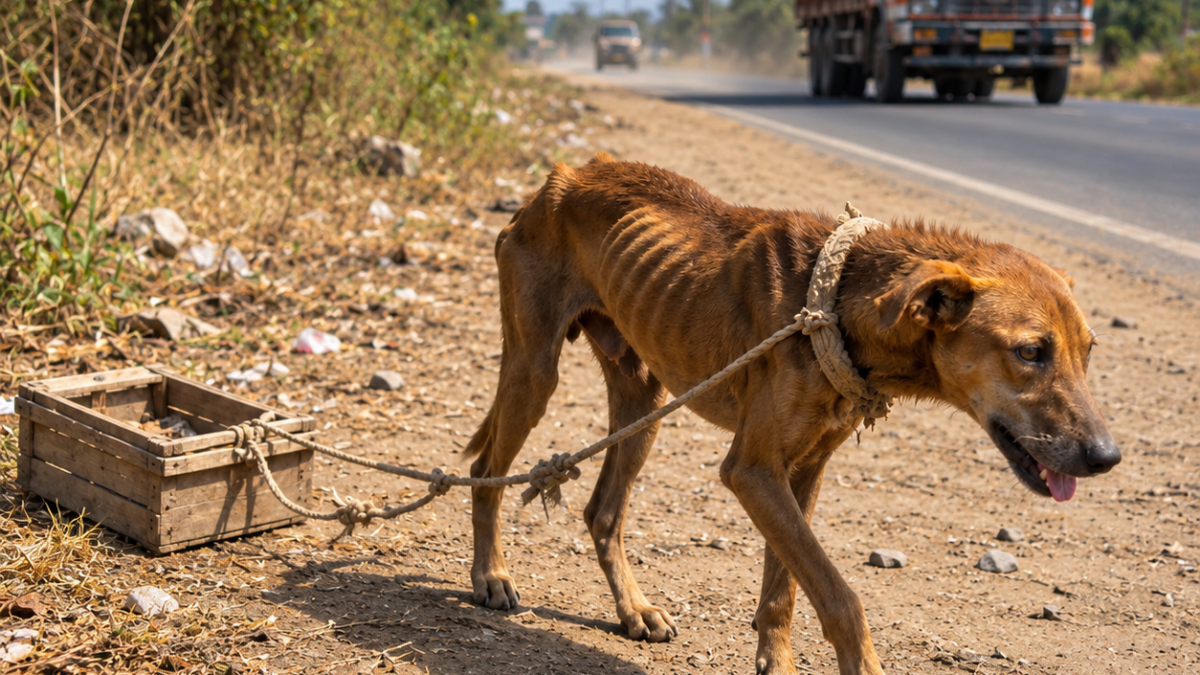
PART 2
The drive home took twenty-three minutes.
I remember because I watched every minute change on the dashboard clock.
Twenty-three minutes can be nothing.
A commercial break.
Part of a commute.
Half a television episode.
That evening, twenty-three minutes felt like a lifetime.
Every red light made me angry.
Every slow driver became an enemy.
Every second without a sound from the box made me glance into the rearview mirror.
The mother dog was curled around the puppies so tightly that I could barely see them.
I had given her the rest of the water.
She drank only a little.
Then she pushed her nose back toward the smallest puppy.
Still nothing.
“Come on.”
I don’t know whether I was talking to the puppy or myself.
“Come on.”
My phone buzzed.
Anika.
I answered through the van’s hands-free system.
“How far?”
“Ten minutes.”
“Did you call a vet?”
That question made my chest tighten.
“No.”
“Ravi.”
“I don’t know where to take them.”
“There’s an emergency clinic on Miller Street.”
“At this hour?”
“I checked.”
Of course she had.
That was Anika.
I forgot anniversaries.
She solved problems.
“I’m calling them now,” she said.
“We can’t afford an emergency vet.”
The words came out before I could stop them.
Silence.
Then:
“I know.”
I gripped the steering wheel.
We were not poor enough to be desperate.
But we were close enough that an unexpected bill could turn an entire month upside down.
Our rent had gone up.
The van needed brakes.
Anika had recently cut her hours to help care for her mother.
I knew exactly how much was in our checking account.
Not enough.
She knew too.
Still, she said:
“Bring them home first.”
“Okay.”
“We’ll figure the rest out.”
That sentence became the theme of the next several weeks.
We’ll figure it out.
Sometimes adults don’t actually know what they’re doing.
We simply make the next necessary decision and hope another one becomes visible afterward.
When I pulled into our apartment lot, Anika was already outside.
Arms crossed.
Hair tied back.
Still wearing the blue dress she had probably put on for dinner.
The dinner I had forgotten.
The moment I opened the van, her anger disappeared.
She saw the mother dog.
Saw the bleeding paws.
Saw the box.
“Oh my God.”
“I know.”
“Put them inside.”
“What about Mr. Keller?”
“Ravi.”
Our landlord lived on the first floor.
He had a talent for appearing whenever somebody broke even the smallest building rule.
No pets without approval.
No animals over thirty pounds.
No temporary fosters.
No exceptions.
“Anika—”
“Put them inside.”
I carried the box.
She helped the mother.
We barely made it through the front door before Anika was on her knees.
“Blankets.”
I ran.
“Towels.”
I brought every clean towel we owned.
“Warm water.”
I filled a bowl.
Then she reached into the box.
The smallest puppy was cold.
So cold.
Anika lifted him carefully.
His head fell against her palm.
Her face changed.
“Ravi.”
I crouched.
“What?”
“I don’t know.”
She put two fingers against his chest.
Nothing.
Moved them.
Waited.
I held my breath.
Then her eyes widened.
“There.”
“What?”
“I felt something.”
“Heartbeat?”
“I don’t know.”
She lowered her face closer.
For a second, neither of us moved.
Then the puppy twitched.
A tiny movement.
Barely visible.
Anika inhaled sharply.
“He’s alive.”
I almost fell backward.
“He’s alive?”
“Barely.”
She wrapped him in a warm towel.
“Call the clinic.”
I called.
A tired woman answered.
I explained everything too quickly.
Five puppies.
Starving mother.
Highway.
Cold.
One barely breathing.
The technician interrupted.
“Do not give cow’s milk.”
I looked at the small bowl we had almost prepared.
“Okay.”
“Keep them warm. Warm, not hot.”
“Okay.”
“Bring them in if you can.”
I looked at Anika.
She heard.
“How much?” I asked.
The technician hesitated.
That hesitation told me enough.
“An exam fee is—”
She named the amount.
Then possible supportive care.
Medication.
Fluids.
Testing.
I stared at the wall.
Anika saw my face.
“We go.”
“Anika.”
“We go.”
“We have rent in eight days.”
“We go.”
I lowered the phone.
“We might not have enough.”
She looked down at the puppy in her hands.
Then at me.
“Then we won’t have enough.”
That was all.
We packed them into the box again.
The mother refused to move until every puppy was inside.
Then she climbed after them.
At the emergency clinic, a technician met us at the door.
She saw the box.
“Oh.”
That single sound frightened me.
People who work in animal medicine learn not to overreact.
When they do, you notice.
They took the puppies first.
Then the mother.
I stood in reception holding an empty cardboard box stained with dirt and blood.
Anika took my hand.
We waited.
Thirty minutes.
Then forty-five.
Then an hour.
Finally, a veterinarian came out.
She looked exhausted.
“Are you the people who found them?”
“Yes.”
She sat.
That scared me more.
“The mother is severely underweight and dehydrated. Her paws are damaged, but I don’t see obvious fractures.”
“Puppies?”
“Four are weak but responding.”
“And the little one?”
The vet paused.
“He’s alive.”
I exhaled.
“But?”
“He’s the most critical.”
Anika squeezed my hand.
“Can you save him?”
“We’re trying.”
Trying.
Another adult word for we don’t know.
The veterinarian continued.
“They appear to be roughly three weeks old. Maybe slightly younger. That’s an estimate.”
“Why were they in a box?”
“I can’t answer that.”
“Could the mother have put them there?”
The veterinarian looked at me.
“Possibly, but given the condition of the box and the rope around her neck, I’m concerned they may have been abandoned together.”
Anger rose so fast I felt dizzy.
“Somebody tied her?”
“I said I can’t know exactly what happened.”
But the possibility was enough.
Someone may have left a nursing dog and five puppies near a highway.
In a box.
I imagined the van passing another ten seconds later.
Imagined another truck.
Imagined rain.
Cold.
Traffic.
I stood.
“I want to find whoever did this.”
The vet looked at me.
“I understand.”
“No, I mean—”
Anika touched my arm.
“Ravi.”
I stopped.
The veterinarian had seen this before.
You could tell.
People wanting justice before the patient was stable.
Anger before triage.
She spoke gently.
“Right now, the most useful thing you can do is decide what happens next.”
“What do you mean?”
“The puppies need supportive care and frequent feeding if their mother can’t produce enough milk.”
“She stays with them.”
“Absolutely.”
“Can they come home?”
“If they stabilize.”
Anika asked the question I had been avoiding.
“How much will tonight cost?”
The veterinarian gave us an estimate.
My stomach tightened.
It was nearly half our monthly rent.
Anika didn’t speak.
Neither did I.
The vet looked between us.
“There may be rescue organizations that can help.”
“I’ll call every one of them,” I said.
She nodded.
“For now, let’s get them through tonight.”
I paid the deposit.
My card almost felt hot in my hand.
On the drive home, the passenger seat where Anika sat was empty of animals.
For the first time since the highway, the van felt wrong.
Too quiet.
We reached our apartment just before midnight.
Anika walked inside without speaking.
On the table was our anniversary dinner.
Or what had been intended as one.
Two plates.
Candles.
A small cake.
The food was cold.
The candles had never been lit.
I stood in the doorway.
“Oh.”
Anika looked at the table.
Then at me.
“You forgot.”
“I did.”
“Again.”
“I did.”
She sat.
I remained standing.
“I’m sorry.”
“I know.”
That response hurt worse than anger.
“You should be angry.”
“I was.”
“Was?”
She leaned back.
“Ravi, six hours ago I was furious because you forgot dinner.”
She laughed tiredly.
“Now we just spent half our rent trying to keep a puppy alive.”
“That doesn’t make forgetting okay.”
“No.”
She looked at me.
“But maybe tonight isn’t the night I want to fight about it.”
I pulled out the chair opposite her.
For a while, we ate cold food.
No candles.
No music.
No romantic speech.
Halfway through the meal, I said:
“Happy anniversary.”
Anika stared.
Then laughed.
A real laugh.
“You’re unbelievable.”
“I know.”
“You didn’t even buy me flowers.”
“I bought you five puppies and a starving dog.”
“You absolutely did not buy those.”
“Technically they cost more than flowers.”
She covered her face.
For the first time that night, I believed we might be okay.
Not the dogs.
Us.
At two in the morning, the clinic called.
The smallest puppy had responded to warming and glucose support.
Still critical.
But alive.
Anika sat up in bed.
“Did she say alive?”
“Yes.”
She closed her eyes.
I heard her whisper:
“Thank God.”
The next morning, I was late for work.
My supervisor was furious until I showed him one photograph.
The mother dog curled around the box.
He stared.
“You found that?”
“Yesterday.”
“You should’ve called.”
“I was busy.”
He looked at me.
Then shook his head.
“Go.”
“What?”
“Go to the clinic.”
“I have deliveries.”
“I’ll split the route.”
“You hate splitting routes.”
“I do.”
He pointed toward the door.
“Before I change my mind.”
I left.
The mother dog lifted her head when I entered the clinic.
I could see immediately that she was still exhausted.
But she looked different.
Cleaner.
Bandages around her paws.
Water nearby.
The rope was gone.
I crouched several feet away.
“Hey, girl.”
Her tail moved.
Just once.
That was the first time.
“What are we calling her?” the technician asked.
I looked at the dusty brown coat.
“Mitti.”
The technician smiled.
“What does that mean?”
“Earth. Soil.”
“Because she’s brown?”
“Because she’s stubborn.”
I had no idea whether that made sense.
It did to me.
Mitti.
Earth.
Something that survives being walked on.
Something that still grows things.
The puppies had temporary names written on their chart.
Red.
Blue.
Green.
Yellow.
And Tiny.
I objected immediately.
“Tiny?”
The technician shrugged.
“You got a better name?”
I looked through the incubator wall.
The smallest puppy moved one paw.
“Hope.”
The technician smiled.
“Hope?”
“No.”
I thought again.
“Lucky.”
Too obvious.
Anika arrived behind me.
“Arjun.”
I turned.
“What?”
“The little one.”
“Why Arjun?”
She shrugged.
“It sounds like a fighter.”
Arjun.
The puppy whose heart we could barely feel.
It stuck.
Over the next two days, all six animals stabilized enough to leave the hospital.
That was the good news.
The bad news was that the veterinarian handed us a printed sheet of instructions that looked like a small novel.
Feedings.
Temperature monitoring.
Medication for Mitti.
Paw care.
Weight tracking for each puppy.
Signs of distress.
Emergency symptoms.
When I read it, I looked at Anika.
“We are not qualified.”
She folded the paper.
“We weren’t qualified to be married either.”
“Still debatable.”
She elbowed me.
The first night at home was chaos.
One puppy cried.
Then another.
Then all five.
Mitti became anxious whenever one was more than two feet away.
Anika slept beside the box.
I slept on the floor beside Anika.
At three in the morning, Arjun stopped nursing.
Panic.
We called the clinic.
Warm him.
Try again.
He latched.
Relief.
At four, another puppy crawled beneath the towel.
At five, Mitti vomited.
At six, my alarm rang.
I turned it off.
Anika opened one eye.
“Work?”
“Apparently.”
“You look dead.”
“I feel dead.”
She smiled faintly.
“Happy anniversary week.”
I threw a pillow at her.
The apartment changed quickly.
Our living room became a nursery.
Newspapers.
Towels.
Water bowls.
Medicine.
A borrowed scale.
A cardboard barrier to keep wandering puppies contained.
I learned to identify them by markings.
One had white toes.
One had a stripe on the chest.
One had a dark patch near the eye.
Arjun was the smallest.
Always.
Every morning we weighed them.
The other four gained steadily.
Arjun gained almost nothing.
Then lost six grams.
Anika stared at the scale.
“No.”
I checked again.
Same number.
“Maybe the scale—”
“It isn’t the scale.”
We went back to the vet.
The veterinarian examined him.
“He’s struggling.”
“What do we do?”
“Supplemental feeding. More frequent monitoring.”
“Will he make it?”
She looked at us.
“I don’t know.”
That sentence again.
I hated how familiar it had become.
When we returned home, Mitti immediately counted her puppies.
I know that sounds like projecting human behavior.
Maybe it is.
But she went nose to nose.
One.
Another.
Another.
Then Arjun.
She licked him longer than the others.
I sat on the floor.
“She knows.”
Anika looked over.
“Of course she knows.”
We started feeding Arjun around the clock.
Every two hours.
Then every three as he strengthened.
We set alarms.
I began doing morning delivery routes on less sleep than I had during college.
One afternoon I parked my van at a customer’s house and woke up ten minutes later with my forehead against the steering wheel.
My supervisor called.
“You alive?”
“Debatable.”
“You need a day off.”
“I need money.”
“You also need not to put the van into somebody’s swimming pool.”
“Good point.”
He gave me Saturday.
I spent it cleaning puppy mess.
Adulthood is full of humiliations.
We still had one major problem.
Mr. Keller.
The landlord.
For the first week, we hid the dogs.
That sounds ridiculous considering five puppies have no respect for secrecy.
Whenever he came upstairs, we became commandos.
Blankets over the pen.
Television louder.
Treats for Mitti.
Prayers.
Once, Mr. Keller stood outside our door while Arjun began squeaking like a broken toy.
Anika coughed loudly.
I turned on the blender.
Mr. Keller knocked.
I froze.
“Ravi?”
I opened the door six inches.
“Mr. Keller.”
“What are you blending?”
“Smoothie.”
“At nine at night?”
“I’m very health conscious.”
A puppy barked.
A tiny, unmistakable sound.
Mr. Keller’s eyes narrowed.
“What was that?”
I panicked.
“My phone.”
“Your phone barks?”
“New ringtone.”
Behind me, Anika silently mouthed:
Idiot.
Mr. Keller stared.
Then walked away.
I closed the door.
Anika hit my shoulder.
“Your phone?”
“I had no time.”
“New ringtone?”
“It was innovative.”
“Terrible liar.”
“Still married.”
“Barely.”
We knew it could not last.
The confrontation came twelve days after the rescue.
I returned from work and found Mr. Keller standing inside our apartment.
The door was open.
Anika stood near the puppy pen.
Mitti was between them.
Not aggressive.
Alert.
Mr. Keller looked furious.
I dropped my keys.
“Mr. Keller.”
He pointed.
“What is this?”
There are moments when lying becomes insulting.
So I stopped.
“A dog and five puppies.”
“I can count.”
“Four puppies are going to homes eventually.”
His eyes widened.
“Eventually?”
“We’re working on it.”
“You signed a lease.”
“I know.”
“No animals over thirty pounds.”
“I know.”
“No unauthorized pets.”
“I know.”
“No fostering.”
“I know.”
“Then explain why there are six animals in my building.”
Mitti watched him.
Her ribs were less visible now, but still too easy to see.
Bandages wrapped her paws.
One puppy stumbled over another.
Mr. Keller looked down.
His face remained hard.
“You have forty-eight hours.”
Anika went pale.
“Please.”
“I have other tenants.”
“They’re not causing damage.”
“That is not the point.”
“I’ll pay a deposit.”
“With what money?”
That hurt because he knew our situation.
I stepped forward.
“We found them on Highway 12.”
“I heard.”
“You heard?”
“Everybody in the building heard.”
Fair.
“They would have died.”
Mr. Keller exhaled.
“Ravi, I’m not saying you should’ve left them.”
“Then what are you saying?”
“I’m saying this apartment isn’t an animal shelter.”
He turned toward the door.
“Forty-eight hours.”
When he left, Anika sat on the floor.
Mitti came to her.
Put her head against Anika’s knee.
“What do we do?”
I didn’t know.
The rescue groups I had contacted were full.
One could take two puppies.
Another maybe Mitti, but only after medical clearance.
Separating them too early felt wrong.
We called everyone.
Friends.
Coworkers.
Family.
Animal organizations.
Nothing.
That night, I lay awake beside Anika.
“I messed this up.”
“No.”
“We should’ve taken them directly to a shelter.”
“They might have been separated.”
“At least they’d have somewhere legal.”
She rolled toward me.
“You stopped.”
“What?”
“You stopped the van.”
I said nothing.
“If you hadn’t, we wouldn’t be having this problem.”
“That sounds bad.”
She smiled.
“But five puppies and a mother might be dead.”
Silence.
“I prefer this problem.”
So did I.
The next morning, something unexpected happened.
My supervisor sent the photo of Mitti and the puppies to our company group chat.
By lunchtime, three drivers had offered help.
One woman donated puppy food.
Another paid part of the vet bill.
A warehouse employee knew somebody who volunteered with a foster network.
By evening, two potential adopters had contacted us.
Then the story spread beyond work.
A customer recognized me.
“Are you the highway dog guy?”
I stared.
“I hope that’s temporary.”
She laughed.
“My daughter wants one of the puppies.”
“She’s twelve.”
“How do you know?”
“Because she emailed me three times.”
The community started helping.
Not dramatically.
Five dollars here.
A bag of food there.
Old blankets.
A heating pad.
One couple offered to foster two puppies once they were old enough.
For the first time, I felt like we might actually solve the impossible mess we had created.
Then Arjun crashed.
It happened in the middle of the night.
One moment he was sleeping.
The next Anika touched him and screamed my name.
“Ravi!”
I ran from the bathroom.
Arjun was limp.
“What’s wrong?”
“He’s cold.”
I grabbed the towel.
“Call the clinic.”
She did.
We warmed him while driving.
Anika held him against her chest.
“Come on.”
Her voice broke.
“Come on, baby.”
Mitti was frantic when we took him away.
She tried following us.
We couldn’t bring all six again.
I closed the apartment door while Mitti whined behind it.
That sound followed me down the stairs.
At the clinic, they took Arjun immediately.
Anika and I sat in the same waiting area where we had sat the first night.
Same chairs.
Same vending machine.
Same terrible fluorescent lights.
“This is our fault,” she whispered.
“No.”
“We should have kept him at the clinic longer.”
“They said he could come home.”
“We missed something.”
“We followed every instruction.”
She covered her face.
I reached for her.
She pulled away.
Not from me.
From everything.
“I can’t do this.”
I understood.
We had loved Arjun for less than three weeks.
That should not have been enough time to feel like losing him would destroy the room.
It was.
The veterinarian emerged almost an hour later.
“He’s stabilized.”
Anika stood so quickly the chair moved.
“What happened?”
“His glucose dropped dangerously low.”
“Why?”
“He’s tiny. He’s still vulnerable.”
“Is he dying?”
The veterinarian paused.
“No.”
We both exhaled.
“But he needs more support.”
“We’ll do it.”
The vet looked at us carefully.
“You are doing it.”
That sentence mattered.
“You didn’t fail him.”
Anika cried.
I did too.
Not dramatically.
Just enough that I stopped pretending I was the person holding everything together.
We left Arjun overnight.
When we returned home, Mitti went to the door.
Looked behind us.
No puppy.
She searched my hands.
My clothes.
Then the box.
She began pacing.
Anika knelt.
“He’s okay.”
Mitti whined.
“I know.”
Anika buried her face against the dog’s neck.
“He’s okay.”
Mitti stayed awake most of the night.
So did we.
The next afternoon, we brought Arjun home.
The second Mitti saw him, something happened that I will never forget.
She pushed past me.
Nosed the blanket.
Arjun squeaked.
Mitti began licking him frantically.
He disappeared beneath her face.
Anika laughed and cried at once.
“Okay, okay, he needs air.”
Mitti ignored her.
Arjun crawled toward the warmth of his mother.
Nursed.
Then slept.
That was the night I stopped calling him the smallest puppy.
He had a name.
A life.
A history.
He was Arjun.
Days later, Mr. Keller returned.
I opened the door expecting eviction paperwork.
Instead, he stood there holding a plastic bag.
“What’s that?”
“Food.”
“For you?”
He looked irritated.
“For the dogs.”
I blinked.
“What?”
He stepped inside.
The puppies were awake.
One immediately attempted climbing over the pen.
Mr. Keller stared.
“That one always does that?”
“That’s Ruby.”
“You named them?”
“Yes.”
“That was a mistake.”
“Probably.”
He walked closer.
Ruby fell over.
Another puppy climbed across her.
Mr. Keller’s mouth twitched.
Not a smile.
Almost.
Then he looked at Mitti.
She stood.
Mr. Keller crouched cautiously.
Mitti sniffed him.
He held out a treat.
She took it.
He stared at the bandages on her paws.
“Those are from the highway?”
“Yes.”
He sighed.
“Forty-eight hours was yesterday.”
“I know.”
Anika came from the kitchen.
“We’re finding homes.”
“I know.”
He looked at the puppies again.
One peed on the newspaper.
Mr. Keller pointed.
“That.”
“We clean it immediately.”
“You better.”
He stood.
I waited.
Finally he muttered:
“Keep them.”
I thought I had misunderstood.
“What?”
“Until they’re old enough to go.”
Anika’s eyes widened.
“And Mitti?”
He looked at the mother dog.
Mitti sat.
Tail moved.
Mr. Keller exhaled.
“We’ll discuss the paperwork.”
Anika smiled.
“Thank you.”
“Keep the place clean.”
“We will.”
“No barking after ten.”
“They’re puppies.”
“That sounds like your problem.”
He headed toward the door.
Then turned.
“Which one nearly died?”
I pointed at Arjun.
Mr. Keller stared.
“That little thing?”
“Yes.”
Arjun walked three steps.
Fell over.
Got up.
Mr. Keller shook his head.
“Terrible survival instincts.”
Then he left.
I looked at Anika.
She looked at me.
We started laughing.
Our landlord had surrendered.
Not because we defeated him.
Not because we threatened him.
Because he looked closely.
That became the pattern of the entire rescue.
People changed when they looked closely.
On the highway, Mitti looked like a stray blocking traffic.
Closer, she was a mother dragging her children toward safety.
The box looked like trash.
Closer, five lives were inside.
Mr. Keller saw a lease violation.
Closer, he saw bleeding paws.
I had seen an interruption to my route.
Closer, I saw something I could not drive away from.
Over the next month, the puppies transformed.
Ruby became the fearless one.
She climbed everything.
Blankets.
Boxes.
People.
Her brother Theo was the loudest.
Milo was the calm one.
Daisy wanted constant contact.
And Arjun remained smaller.
But no longer fragile.
His body filled out.
His legs strengthened.
His eyes brightened.
The puppy who once could barely breathe started attacking my shoelaces.
“Remember when we paid hundreds of dollars to save you?”
Arjun pulled harder.
“This is gratitude?”
He growled playfully.
Anika laughed.
“He’s dangerous.”
“Clearly.”
Mitti changed most of all.
Her ribs disappeared beneath healthy weight.
The wounds on her paws closed.
Her coat became soft.
The frightened expression faded.
At first she slept beside the puppies constantly.
Then she began exploring.
The kitchen.
Our bedroom.
The balcony.
She developed a particular love for the patch of afternoon sunlight near the window.
Sometimes I found her there alone.
Sleeping deeply.
Not the sleep of exhaustion.
The sleep of safety.
There is a difference.
The first puppy left at nine weeks.
Daisy.
A retired couple adopted her.
Anika cried after their car disappeared.
“You know this is the goal.”
“I know.”
“You said we can’t keep six dogs.”
“I know.”
“You’re crying anyway.”
“I know.”
I hugged her.
Mitti searched for Daisy that evening.
That was hard.
But she settled after a while.
Then Theo left.
Then Ruby.
Then Milo.
Each goodbye became slightly easier.
Not because we loved them less.
Because we saw the families.
Good people.
Prepared.
Patient.
People who had heard their story and understood that adoption was not a cute photograph.
It was responsibility.
Then only Arjun remained.
And Mitti.
Technically Arjun also had an approved adopter.
A young man named Sanjay.
Nice apartment.
Stable job.
Experience with dogs.
Everything looked right.
On the morning he was supposed to pick Arjun up, I woke with a knot in my stomach.
Anika noticed.
“You’re quiet.”
“I’m always quiet.”
“No.”
She looked at Arjun sleeping near my foot.
“You don’t want him to go.”
“He has a good home.”
“That wasn’t what I said.”
I said nothing.
Anika smiled.
“You’re terrible at this.”
“At what?”
“Letting go.”
“I let four go.”
“And nearly checked their adopters’ criminal histories.”
“Responsible screening.”
“You asked one man for his employer’s phone number.”
“He could have lied about having a job.”
“He owns the company.”
“Could still lie.”
She laughed.
I looked down at Arjun.
“I just…”
“What?”
I remembered holding his nearly motionless body on the highway.
Then the first hospital.
The glucose crash.
The tiny feedings.
The nights.
I had carried him through too many almosts.
Almost dead.
Almost stable.
Almost gone again.
Maybe part of me thought if I gave him away, the universe would realize it had unfinished business.
Anika sat beside me.
“He feels like ours.”
“Yes.”
“Then maybe he is.”
I looked at her.
“What about the adopter?”
“We call him and tell him the truth.”
“That we became emotionally incompetent?”
“Exactly.”
Sanjay was disappointed.
I expected anger.
Instead, he laughed.
“I wondered if this would happen.”
“What?”
“You talked about Arjun for forty minutes during the home visit.”
“That was relevant medical history.”
“You showed me fifteen photos.”
“All relevant.”
He laughed again.
“Keep him.”
“I’m sorry.”
“Don’t be.”
A week later, he adopted another puppy from a rescue group.
That relieved my guilt.
Arjun stayed.
Mitti did too.
There was never really a discussion about Mitti.
Nobody asked whether she was ours.
She simply became ours the night Anika told me to bring them home.
Mr. Keller added both dogs to the lease.
He pretended to resent the paperwork.
Then began keeping treats in his pocket.
Mitti loved him.
Traitor.
Our finances took months to recover.
The vet bill sat on our credit card.
Donations covered part.
We covered the rest.
There were weeks when Anika and I argued.
Real arguments.
Not cute ones.
Money.
Sleep.
Work.
Responsibilities.
I once accused her of spending too much on dog food.
She reminded me I was the idiot who stopped the van.
Fair.
She once accused me of caring more about Mitti than our marriage.
That one hurt.
Because part of it was really about something older.
I had forgotten the anniversary before Mitti.
I had forgotten dinners.
Conversations.
Things Anika asked me to do.
Work had become my excuse for everything.
The dogs didn’t create those cracks.
They revealed them.
One evening, three months after the rescue, Anika stood by the kitchen sink.
“You know what bothers me most?”
“What?”
“You remember every medication time.”
I knew immediately where this was going.
“Anika.”
“Every vet appointment.”
“I have reminders.”
“You track Arjun’s weight.”
“He almost died.”
“I know.”
She turned toward me.
“But you forgot our anniversary.”
I had no defense.
I started to speak.
Stopped.
She continued.
“I’m not jealous of dogs, Ravi.”
“I know.”
“I’m angry because you proved you can pay attention when something feels urgent enough.”
That landed.
Hard.
I looked at Mitti sleeping near the table.
Then at my wife.
“You’re right.”
She blinked.
Maybe she expected another excuse.
I had given enough of those.
“You’re right.”
I repeated it.
“I treated you like you’d always be there.”
Her face changed.
I stepped closer.
“I don’t want to do that anymore.”
She looked down.
“Neither do I.”
That became another rescue I hadn’t expected.
Mitti had dragged a box across a highway.
Somehow she dragged our marriage back into focus too.
Not magically.
Dogs do not repair relationships.
People do.
We started eating dinner together without phones.
I changed routes when possible on important dates.
I put our anniversary in three calendars.
Anika mocked me.
I deserved it.
The following spring, almost a year after the rescue, we drove back to Highway 12.
Not intentionally.
My company assigned me the same route.
Anika came because she had the day off.
Mitti and Arjun were in the back.
When we approached the place, I knew immediately.
The shoulder.
The curve.
The cracked sign.
I slowed.
“That’s it.”
Anika looked outside.
“Where you found them?”
“Yes.”
I pulled over.
We got out.
Mitti jumped down.
Arjun followed.
The evening looked almost exactly the same.
Orange sky.
Dry heat.
Long road.
Except there was no box.
No blood.
No desperate mother dragging children toward nowhere.
Mitti sniffed the shoulder.
I watched her carefully.
She showed no obvious fear.
Maybe she remembered.
Maybe not.
Arjun urinated on a weed.
Anika laughed.
“Deep emotional moment ruined.”
“That’s his gift.”
We walked a little farther.
Then I noticed something half buried near the ditch.
A piece of rope.
Old.
Weathered.
Probably not hers.
Could have been from anything.
Still, my stomach tightened.
I picked it up.
Anika saw my face.
“Don’t.”
“What?”
“Don’t turn every object into evidence.”
I looked at her.
“I still want to know who left them.”
“I know.”
“If someone dumped them—”
“I know.”
“They could have killed them.”
“I know.”
“What if they did it to another dog?”
That was the real fear.
Not revenge.
Prevention.
We had reported the original situation.
There had been no useful camera footage.
No clear witness.
No way to identify who had abandoned them, assuming someone had.
For months, that bothered me.
I wanted a name.
A face.
A person to blame.
Eventually, I had to accept that some wrongs never produce a satisfying villain.
Sometimes the only justice available is what happens afterward.
Five puppies lived.
Mitti lived.
Five families changed.
Ours most of all.
That had to be enough.
But fate—if you believe in that kind of thing—gave us one more answer.
A few months later, a local animal welfare volunteer contacted me.
She had heard Mitti’s story.
“Do you still have the rope?”
“What rope?”
“The one that was around her neck when you found her.”
I did.
I had placed it in a plastic bag after the clinic removed it.
I don’t know why.
Maybe anger.
Maybe evidence.
Maybe I simply couldn’t throw it away.
The volunteer asked to see it.
She had been investigating reports of backyard breeding and abandonment in the area near Highway 12.
Several dogs had been found with similar cheap rope collars.
My pulse quickened.
“You think they’re connected?”
“I don’t know.”
There it was.
The sentence of the year.
But authorities eventually inspected a rural property several miles from where I found Mitti.
Multiple dogs were removed because of poor conditions.
Some had untreated injuries.
There were records suggesting litters had been sold informally.
Was Mitti definitely from there?
Nobody could prove it.
No microchip.
No unique identifying records.
No witness placing her there.
So I refused to turn suspicion into certainty.
But the investigation had real consequences.
The surviving dogs received veterinary care.
The operator faced animal-welfare violations.
The property could no longer continue operating the same way.
When I heard, I felt something close to closure.
Not because someone suffered.
Because other dogs got out.
That was the only kind of revenge I wanted anymore.
The kind where cruelty loses access to another victim.
Months became years.
Arjun grew into a dog who looked nothing like the tiny body Anika had once held inside a towel.
He became broad-chested.
Energetic.
Completely convinced he owned every piece of furniture.
He still slept beside the window most evenings.
Mitti preferred the rug nearby.
Anika and I kept joking about the anniversary.
Every year, she would say:
“You forgot once.”
“Several years ago.”
“Trauma has no expiration date.”
“You got two dogs.”
“I did not ask for those.”
“You kept them.”
“Because I’m compassionate.”
“And I’m irresponsible?”
“Correct.”
Every anniversary after that first rescue, we did something small for an animal organization.
Not because we wanted to become activists.
Not because we thought one story made us experts.
It simply felt right.
One year we donated food.
Another year we covered a vaccination clinic.
Another year we paid part of an emergency vet bill for a family who genuinely had no money.
Anika called it our “forgotten anniversary tax.”
I accepted the sentence.
On the fifth anniversary of finding Mitti, we invited the puppy families over.
All five siblings.
Daisy.
Theo.
Ruby.
Milo.
Arjun.
The apartment complex had a small courtyard by then.
Mr. Keller had renovated part of it.
Dogs were allowed with registration.
I still suspect Mitti changed his mind.
He denies it.
The reunion was chaos.
Five adult dogs running.
Owners laughing.
Mitti stood in the center looking deeply confused.
At one point all five dogs surrounded her.
Sniffing.
Jostling.
Tails moving.
For a few seconds, I saw the box again.
Not physically.
In memory.
Five tiny bodies.
Cold.
Silent.
Barely breathing.
Then I looked at them now.
Healthy.
Loud.
Annoying.
Alive.
Anika stood beside me.
“You’re crying.”
“No.”
“You definitely are.”
“Dust.”
“In both eyes?”
“Extremely aggressive dust.”
She laughed.
The same joke from years earlier.
I wiped my face.
One of the puppy owners, the retired woman who adopted Daisy, brought an old photograph.
The one we had posted while seeking homes.
Mitti lying beside all five puppies.
Arjun almost invisible among them.
She held it beside the dogs in the courtyard.
“Look.”
I couldn’t.
Not at first.
Eventually I did.
That photograph contained our entire before.
The courtyard contained the after.
That night, after everyone left, Mitti slept for almost twelve hours.
She was older now.
Gray around her muzzle.
Her paws had long since healed, but one pad remained slightly scarred.
Sometimes I touched it.
Not because she needed me to remember.
I did.
Arjun dropped beside her.
He was still her smallest puppy in some strange emotional sense, even though he was now larger than she was.
He rested his chin across her back.
Mitti opened one eye.
Tolerated him.
Closed it again.
Anika sat by the window.
I joined her.
“Good day.”
“Very.”
“You know what I keep thinking?”
“What?”
“The box.”
She looked toward the dogs.
“What about it?”
“Mitti dragged it.”
“Yes.”
“How far?”
“We’ll never know.”
I had wondered about that for years.
A few feet?
A hundred yards?
Half a mile?
Did she find the cardboard somewhere?
Had someone placed them in it?
Had she been trying to pull them off the road?
Toward people?
Toward shade?
No answer.
But she had dragged them until I saw her.
That was enough.
“She couldn’t save them by herself,” I said.
Anika leaned against me.
“No.”
“But she tried.”
“Yes.”
That was perhaps the part of the story that stayed with me most.
Mitti did not know whether anyone would stop.
She did not know what a delivery van was.
She did not know veterinary clinics existed.
She didn’t know Anika would say yes.
She simply knew her puppies were failing.
So she pulled.
One inch.
Then another.
Fell.
Stood.
Pulled again.
Her whole world had become one task:
Keep moving the box.
Years later, when life became difficult, I thought about that.
Not in a sentimental poster kind of way.
Mitti wasn’t giving motivational speeches.
She was exhausted.
Terrified.
Hurting.
Sometimes perseverance is not inspiring while you’re doing it.
Sometimes it is ugly.
Bleeding paws.
Collapsed legs.
No guarantee.
One more inch anyway.
Our marriage had moments like that.
Work did.
Money did.
Caring for aging parents did.
Life rarely gives you a view of the finish line.
Sometimes you drag the box because stopping is worse.
Mitti grew old slowly.
The first sign was that she stopped jumping onto the couch.
Then she paused before climbing stairs.
The veterinarian said arthritis.
Medication helped.
Arjun adjusted in ways that surprised us.
He stopped crashing into her during play.
Walked more slowly beside her.
Sometimes waited at the stairs.
Anika noticed first.
“He knows.”
“Knows what?”
“She’s old.”
I watched them.
Maybe.
Dogs don’t need vocabulary to recognize change.
Mitti had protected Arjun when he couldn’t survive alone.
Now he stayed close when her legs became weak.
That felt right.
On the seventh anniversary of the highway rescue, we drove them to a quiet park.
Mitti walked slowly through the grass.
Arjun carried a tennis ball.
The evening sky turned orange.
Same color as that first sunset.
I hated that my mind always returned there.
But memory has favorite doorways.
Anika sat on a bench.
I lowered myself beside her.
Mitti lay near our feet.
Arjun dropped the ball.
I threw it.
He ran.
Mitti lifted her head and watched.
There was a time she had dragged five puppies across asphalt.
Now one of those puppies sprinted through grass because he could.
I touched her shoulder.
“You did that.”
She looked up.
“Mostly you.”
Her tail moved.
When Arjun returned, he dropped the ball in front of her.
Mitti sniffed it.
Then looked away.
Old lady priorities.
We laughed.
That evening became one of my favorite memories.
Nothing dramatic happened.
Nobody almost died.
No landlord appeared.
No emergency clinic.
No desperate phone calls.
Just two dogs.
A wife.
A husband.
A park.
Peace.
Sometimes after surviving chaos, peace feels almost suspicious.
You keep waiting for the next emergency.
Eventually, you learn to let ordinary happiness happen.
Mitti’s final year was gentle.
That mattered.
Her kidneys weakened.
Arthritis worsened.
We added rugs to the apartment so she wouldn’t slip.
Mr. Keller eventually replaced part of the hallway flooring because she struggled on the smooth surface.
He claimed it was scheduled maintenance.
Nobody believed him.
One afternoon, he saw Mitti walking slowly beside me.
“How old?”
“We don’t know exactly.”
He nodded.
“Good dog.”
Mitti wagged.
I smiled.
“Remember when you tried evicting her?”
“I tried evicting you.”
“Important distinction.”
“Still time.”
He scratched Mitti’s head.
She leaned into him.
Traitor until the end.
When her final decline came, it happened without drama.
She ate less.
Slept more.
One morning she looked at breakfast, then at me, and lay down.
Anika knew.
I knew too.
We took her to the vet.
Tests.
Numbers.
Words.
Kidneys.
Age.
Comfort.
Quality of life.
Possible hospitalization.
Temporary improvement.
No cure.
I sat on the floor beside Mitti.
Arjun was allowed into the room.
He lay beside her.
The veterinarian gave us time.
Anika whispered:
“Not today.”
I wanted to agree.
Every part of me wanted one more week.
One more park.
One more anniversary.
But I remembered something.
Mitti on Highway 12.
Falling.
Standing.
Dragging the box.
She had fought because her puppies needed her.
She had nothing left then and still pulled.
Now she was tired for a different reason.
Her puppies were safe.
Her work was done.
Love did not require us to make her drag herself through one more impossible mile for our sake.
I looked at Anika.
She knew what I was thinking.
“No.”
Her face broke.
I held her hand.
“We promised her safety.”
“I know.”
“This is part of it.”
She cried.
So did I.
We took Mitti home for one final night.
The veterinarian gave medication to keep her comfortable.
We laid blankets near the window.
Her favorite place.
Arjun stayed beside her.
We ordered takeout and barely touched it.
At sunset, the sky turned orange.
Of course it did.
I almost laughed at the cruelty of symbolism.
Anika sat on the floor.
Mitti’s head in her lap.
“You remember when I said we couldn’t bring animals home?”
I smiled through tears.
“Yes.”
“I was right.”
“Clearly.”
“We became disgusting dog people.”
“Also correct.”
She scratched Mitti’s ears.
“Worth it.”
I looked at the old dog.
“Yeah.”
Mitti breathed slowly.
The next morning, the veterinarian came to us.
Mr. Keller somehow learned.
He knocked before the vet arrived.
He stood in the doorway holding a small bag.
Treats.
Of course.
“She can’t really eat.”
“I know.”
He looked embarrassed.
“I thought…”
He stopped.
Mitti lifted her head.
Her tail moved weakly.
Mr. Keller knelt.
She sniffed his hand.
He touched her forehead.
“Good girl.”
Then he left without looking at us.
The veterinarian arrived.
Arjun stayed.
Some people say animals don’t understand death.
Maybe.
I know only what I saw.
When Mitti was gone, Arjun sniffed her.
Then lay beside her body.
For several minutes.
No panic.
No barking.
Just quiet.
Anika held me.
I held her.
The dog who had once dragged a box full of dying puppies across a highway left the world inside a warm apartment, surrounded by the family she had built.
That was the ending she deserved.
We cremated her.
Her ashes came home in a simple wooden box.
For months, Arjun sometimes slept beneath the shelf where we placed it.
Coincidence.
Probably.
It didn’t matter.
He lived five more years.
Long enough to become gray himself.
Long enough that strangers never believed he had once been the tiny puppy we thought was dead.
Every anniversary, Anika still said:
“You forgot our anniversary.”
I eventually stopped defending myself.
“Yes.”
“Worst husband.”
“Probably.”
“Best wrong turn.”
I’d look at Arjun.
“Probably.”
When he died years later, peacefully, old and deeply spoiled, we placed his ashes beside Mitti’s.
Two boxes.
Mother.
Son.
The first family we ever rescued.
Or maybe the family that rescued us.
I still drive Highway 12 sometimes.
Different van now.
Different route schedule.
The road has been repaved.
New guardrails.
More traffic.
The shoulder where I found Mitti looks ordinary.
Most important places do.
There is no sign.
No memorial.
Nobody passing would know a starving dog once dragged five puppies across that asphalt while traffic moved around her.
I prefer it that way.
Stories don’t need monuments to matter.
Sometimes when I pass the spot, I slow down slightly.
Not enough to annoy the drivers behind me.
Usually.
I look toward the shoulder.
And I remember the box.
The sound.
That first tiny whimper.
My phone buzzing with four missed calls from Anika.
Everything I thought mattered that evening.
Everything I almost prioritized instead.
People ask whether I believe things happen for a reason.
I don’t know.
I am suspicious of answers that make suffering sound necessary.
Mitti did not need to starve so I could learn a lesson.
Her puppies did not need to almost die so my marriage could improve.
Cruelty is not meaningful simply because something beautiful grows afterward.
But once suffering exists, we get a choice about what we do next.
That part matters.
Someone failed Mitti.
Maybe several people.
I never learned exactly who.
I wanted revenge for a long time.
I wanted a name.
An explanation.
Consequences.
Eventually I realized the most satisfying answer had already happened.
Mitti survived.
Every puppy survived.
The people responsible—whoever they were—had treated those lives as disposable.
They were wrong.
Daisy became the center of an elderly couple’s home.
Theo slept in a child’s bed every night.
Ruby became a hiking dog.
Milo lived beside a lake with a family that sent us Christmas photos.
Arjun lived with us until his face turned white.
And Mitti, the dog left thin enough that every rib showed, became an old lady who refused dry food unless Anika mixed chicken into it.
That was revenge.
Not pain returned.
Value proven.
Life continued.
The box was meant to be an ending.
It became a beginning.
Every now and then, one of the puppy families still sends a photograph.
They are older now.
Some already gone.
Time eventually collects every rescue story.
But it cannot undo them.
Daisy had years.
Theo had years.
Ruby.
Milo.
Arjun.
Mitti.
Years that did not exist in the moment I heard that first cry.
I keep one photograph on our living room wall.
Not the highway photograph.
Not Mitti starving.
Not the puppies inside the box.
I don’t want suffering to be the image that defines them.
The photograph was taken at the reunion.
Mitti sits in the center.
Five grown dogs around her.
Anika kneeling behind them.
Me on one side.
Mr. Keller accidentally visible in the background holding a bag of treats while pretending he did not want to participate.
Everyone healthy.
Everyone alive.
Underneath the frame, Anika once slipped a tiny handwritten note.
I didn’t notice it for weeks.
It said:
The anniversary you forgot became the day our family began.
I never removed it.
Years later, when people ask me about the most important delivery I ever made, they expect some funny work story.
I tell them it wasn’t a package.
It was a broken cardboard box.
I was supposed to deliver parcels that evening.
Instead, Mitti delivered something to me.
Responsibility.
Attention.
The understanding that sometimes the thing interrupting your plans is the thing you will remember long after the plans themselves disappear.
I can no longer remember what restaurant Anika had booked for that anniversary.
I don’t remember what I had planned to buy her.
Probably nothing, given my track record.
But I remember Mitti’s eyes.
I remember those bleeding paws.
I remember her standing between me and the box even though she could barely stand at all.
I remember Anika saying:
Bring them.
Two words.
Our entire life changed because of them.
Sometimes I wonder what would have happened if she had said no.
I know myself.
I probably would have taken them to the clinic anyway.
Maybe a shelter.
Maybe called somebody.
But they would not have come home.
Mitti would not have slept by our window.
Arjun would not have destroyed my shoes.
Mr. Keller would never have become the secret supplier of dog treats.
Our marriage might still have survived.
Probably.
But it would have missed something.
We would have missed something.
The older I get, the less I believe that a full life is made only from the things we plan.
Birthdays.
Anniversaries.
Jobs.
Vacations.
Schedules.
Some of the most important parts arrive looking like inconvenience.
A missed dinner.
An unexpected bill.
An animal in the road.
A box you almost mistake for trash.
One evening, many years after Mitti and Arjun were gone, Anika and I sat beside the same window where they used to sleep.
Our apartment had changed.
New furniture.
Different paint.
Mr. Keller had retired and sold the building to his daughter.
We could have moved long ago.
We never did.
Anika looked toward the empty patch of floor.
“You still see them there?”
“Yes.”
“Me too.”
She smiled.
“Arjun used to snore.”
“Mitti snored louder.”
“No.”
“Absolutely.”
“Liar.”
I took her hand.
There was no dog beside us now.
No emergency.
No puppies.
Just two older people sitting in a quiet room.
“Happy anniversary,” I said.
She looked suspicious.
“You remembered.”
“I have three reminders.”
“Romantic.”
“I learned.”
She leaned her head on my shoulder.
After a while, she said:
“You know, I was really angry that night.”
“I know.”
“I thought you didn’t care.”
I swallowed.
“I did care.”
“I know that now.”
Silence.
Then:
“But sometimes caring and paying attention are different.”
I looked at her.
That was it.
The lesson of Mitti’s entire story.
She had cared for her puppies more than anything in the world.
But caring alone wasn’t enough.
She needed somebody else to pay attention.
To notice.
To stop.
How many forms of love fail because we assume caring is enough?
Marriage.
Friendship.
Animals.
Family.
You can love someone and still miss the thing they are trying desperately to tell you.
Mitti’s paws told a story.
Her body told a story.
The box told a story.
I was simply lucky enough to look.
I squeezed Anika’s hand.
“I’m paying attention.”
She smiled.
“Finally.”
Outside, traffic moved below our window.
Ordinary cars.
Ordinary evening.
Somebody honked.
A child laughed somewhere in the building.
Life.
Full.
I thought about Highway 12 one final time.
A brown dog falling onto hot pavement.
Dragging herself up.
Pulling a box another inch.
She had no idea where the road led.
No idea whether help was coming.
No idea whether all five puppies would survive.
She only knew she could not stop.
Until one van did.
That is how I remember Mitti now.
Not abandoned.
Not starving.
Moving.
Always moving.
One more inch.
One more step.
Until somebody finally saw her.
And whenever I think about that forgotten anniversary, I don’t remember the dinner I missed.
I remember my wife answering the phone angry.
I remember telling her there was a dog.
I remember the silence.
Then the sigh.
Then the two words that changed everything.
“Bring them.”
So I did.
And for years afterward, every time I opened our front door and saw Mitti sleeping safely inside, with Arjun curled nearby, I thought the same thing.
Thank God I hit the brakes.








