PART 2: I Inherited My Uncle’s Ranch—Then Found the HOA Had Secretly Built Vacation Cabins on It and Pocketed the Rent
PART 2
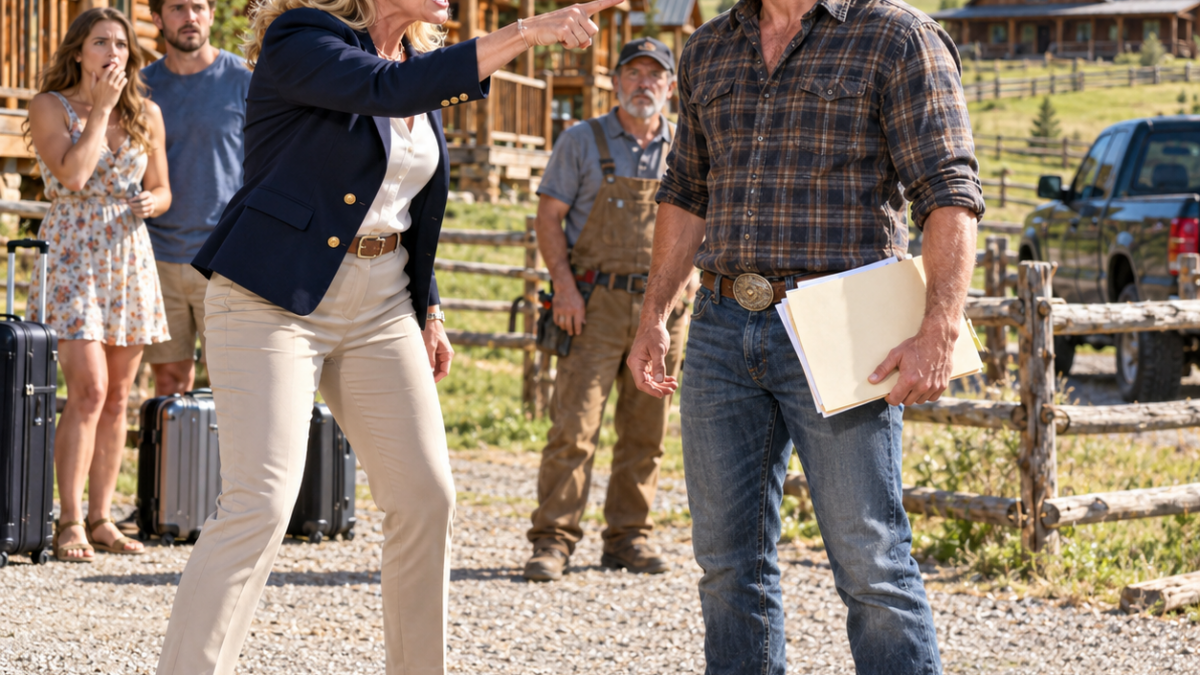
Gayla turned toward her SUV.
I let her take three steps before I spoke.
“By the way.”
She stopped.
I kept the phone in my hand.
“The county says your name is on the boundary adjustment.”
She slowly faced me again.
For the first time since she’d arrived, the confidence had slipped.
Only slightly.
But I saw it.
“The matter was processed through the appropriate administrative channels.”
“My uncle supposedly signed off on it.”
“Correct.”
“Except the county employee I just spoke to says your signature is on the filing.”
Her jaw tightened.
“Then you should take your concerns up with the county.”
“I plan to.”
She lifted her chin.
“Until a formal review is completed, Cedar Ridge expects full cooperation with its community charter.”
I almost laughed.
“There is no community charter governing this ranch.”
“You inherited property adjacent to our community.”
“No. I inherited property your community built cabins on.”
“That’s your interpretation.”
“It’s the deed’s interpretation.”
Gayla walked toward her SUV.
I called after her.
“And one more thing.”
She stopped again.
“No more guests.”
She turned sharply.
“You don’t have the authority to interfere with lawful HOA operations.”
“I own the dirt underneath those cabins.”
“That’s disputed.”
“The only thing disputed right now is how much trouble you’re in.”
She got into her SUV and slammed the door hard enough to shake the mirror.
Gravel flew behind her as she left.
I stood on the porch until the white vehicle disappeared between the pines.
Then I walked inside and locked the door.
I didn’t sleep much that night.
I kept hearing Uncle Walter’s voice in my head.
Not something profound.
Just something he’d told me when I was sixteen and trying to fix a fence without replacing a rotten corner post.
“Bad foundations don’t improve with decoration.”
At the time he had been talking about wood.
Now I was looking at three beautiful cabins sitting on a rotten foundation of paperwork.
The next morning I drove to the county clerk’s office.
I didn’t want screenshots.
I didn’t want somebody telling me what a computer showed.
I wanted certified documents.
A clerk named Marshall listened while I explained the problem, then disappeared into the records room.
Twenty minutes later he returned carrying a thin folder.
“This is the boundary adjustment.”
He placed it in front of me.
The document looked legitimate.
County formatting.
Parcel description.
Survey references.
Legal language.
At the bottom was a signature attributed to Walter Ellery.
I stared at it.
It wasn’t his.
Not even close.
Walter’s signature had been shaky during his final healthy years, but it still had a distinctive long downward stroke through the y in Ellery.
This signature was smooth.
Elegant.
Almost decorative.
“This is supposed to be my uncle’s signature?”
Marshall nodded.
“That’s what the filing says.”
“Who notarized it?”
He turned the page.
“Denise Coington.”
My head lifted.
“Coington?”
“Yes.”
“Any relation to Gayla?”
“I don’t know.”
“Can I get the notary registration?”
“That’s public.”
He printed another page.
Denise Coington had registered as a notary several years earlier.
I photographed everything, paid for certified copies, and drove directly to the sheriff’s department.
The deputy at the front desk listened for less than two minutes before calling a supervisor.
Detective Marcus Lynch was a broad-shouldered man in his mid-fifties who looked permanently tired.
He read the documents silently.
Then he looked at me.
“Tell me about your uncle’s condition.”
“Parkinson’s. Severe by then.”
“Could he sign his name?”
“No.”
“You certain?”
“He couldn’t button his own shirt.”
Lynch leaned back.
“And these cabins were built after this filing?”
“Yes.”
“And somebody’s been renting them?”
“Yes.”
“For how long?”
“I don’t know yet.”
“Who receives the money?”
“I intend to find out.”
He tapped the notary page.
“If Denise Coington is related to Gayla and knowingly notarized a false signature, that’s a problem.”
“What kind?”
“The kind that gets prosecutors interested.”
He picked up his phone.
“I’m sending this to the DA’s property-fraud unit.”
I stood.
“Detective, they’re still taking reservations.”
His expression sharpened.
“Document everything. Don’t destroy anything, don’t remove anybody’s property, and don’t get into a physical confrontation.”
“I wasn’t planning to.”
“Everybody says that before they do something stupid.”
“Fair.”
Outside the sheriff’s office, I called Erica Sloan.
Erica was a real-estate attorney in Denver and one of the few people I trusted to tell me when I was about to make a bad decision.
She answered on the fourth ring.
“Vance?”
“You busy?”
“Yes.”
“Want to hear something insane?”
“No.”
“Good. My uncle died, left me a ranch, and I found out an HOA forged a property-line change and built vacation cabins on it.”
There was silence.
Then:
“Start from the beginning.”
I told her everything.
When I finished, she said, “Send me the deed, boundary filing, cabin addresses, HOA information, and every photo you have.”
“You think I have a case?”
“I think somebody may have handed you several cases at once.”
“What are you checking?”
“Title filings. Corporate registrations. Utility accounts. Construction liens. Insurance records.”
“Anything else?”
“Rental revenue.”
“How?”
“If they’re operating short-term rentals, the money leaves tracks.”
That evening I sat in Walter’s office surrounded by paperwork.
He had kept everything.
Veterinary receipts from fifteen years earlier.
Fence invoices.
Tax notices.
Letters from equipment dealers.
Old seed catalogs.
Near midnight, I found an envelope postmarked two years earlier.
The sender was Cedar Ridge HOA.
Inside was a notice telling Walter to “cease unauthorized personal use of collective recreational improvements.”
I read the sentence twice.
They had built cabins on his land and then told him to stay away from them.
The notice threatened “administrative action” if he interfered with guests.
There was no signature.
Just a P.O. box.
I felt sick.
Walter had been dying while these people turned part of his ranch into a business.
Had he understood what was happening?
Had he tried to fight?
Had they counted on him being too weak?
My phone rang at 12:07 a.m.
Erica.
“You awake?”
“Unfortunately.”
“I found the management company.”
I sat straighter.
“What company?”
“Pinehaven Management LLC.”
“Never heard of it.”
“You weren’t supposed to.”
“Who owns it?”
“Registered agent is Gayla Coington.”
My hand tightened around the phone.
“When was it formed?”
“Four months after the boundary adjustment.”
“So she changed the line, formed an LLC, then started renting cabins?”
“That’s what it looks like.”
“Can you see revenue?”
“Some.”
“How much?”
“Give me until morning.”
I looked through the window toward the dark southern pasture.
Three tiny porch lights glowed between the trees.
“They did this right in front of him.”
Erica’s tone softened.
“Vance.”
“He was dying in this house while they were making money twenty minutes downhill.”
“I know.”
“No, you don’t.”
There was a pause.
Then she said, “You’re right. But anger makes people sloppy. We need them to be sloppy, not you.”
I closed my eyes.
“Fine.”
“Tomorrow, document the cabins. Outside first. Don’t interfere with guests.”
“What if people show up?”
“Tell them there is an ownership dispute and they need to contact whoever took their money.”
“That’ll go well.”
“Law rarely does.”
The next morning I walked down to Whitetail Retreat with my phone recording.
Fresh towels.
New firewood.
Wi-Fi equipment labeled CEDAR RIDGE GUEST.
A welcome basket.
Printed rules.
I photographed the electric meter and utility markings.
The second cabin was empty too.
At the third, a rusty golf cart appeared on the gravel lane.
A man in a neon green polo jumped out.
“You can’t be here.”
“Who are you?”
“Darren. Property manager.”
“For who?”
“Cedar Ridge.”
He lifted a clipboard.
“This cabin has guests arriving this afternoon.”
“Not anymore.”
He stared at me.
“What?”
“Bookings need to stop.”
“You can’t cancel reservations.”
“I’m not canceling anything. I’m telling you the cabins are sitting on property Cedar Ridge doesn’t own.”
He laughed nervously.
“Gayla owns this section.”
“No.”
“She told me—”
“I don’t care what Gayla told you.”
I took the certified deed copy from my jacket.
“I own it.”
His smile vanished.
“I just manage cleaning and check-ins.”
“Then you’re not the person I have a problem with.”
“I didn’t know anything.”
“I believe you.”
He looked toward the cabins.
“What happens now?”
“You call Gayla.”
“And say what?”
“Tell her the man she tried to throw off his ranch just found her property manager.”
He pulled out his phone.
I added, “And Darren?”
He looked at me.
“Stop accepting new bookings.”
That afternoon Detective Lynch called.
“The DA’s interested.”
“How interested?”
“They’re preparing requests for notary records and related filings.”
“Good.”
“If we prove the signature was fabricated and that somebody profited from it, this gets much bigger.”
“They profited.”
“You have numbers?”
“Not yet.”
I received them before sunrise.
Erica sent a spreadsheet.
I opened it at the kitchen table with a mug of coffee going cold beside me.
Two years.
Booking income.
Cleaning fees.
Weekend surcharges.
Holiday pricing.
Special-event packages.
More than one hundred thirty thousand dollars in gross receipts routed through Pinehaven Management.
I called her immediately.
“Are you sure?”
“I traced booking platform payouts and related business filings.”
“All to Gayla?”
“Pinehaven’s operating account. She controls it.”
“Over a hundred thirty thousand.”
“And that’s just what we can document quickly.”
I looked toward the south window.
“She’s been charging people to vacation on my uncle’s land.”
“Yes.”
“With cabins built using a forged property change.”
“Yes.”
“What do we do?”
“We stop thinking of this as an HOA argument.”
“What is it?”
“Fraud with landscaping.”
By noon, two sheriff’s deputies, a county zoning officer, and an inspector were standing outside the cabins.
They posted cease-and-desist notices.
Utility use was restricted pending inspection.
The rental operation was officially suspended.
Gayla arrived ten minutes later.
She came out of her SUV so fast she forgot to close the driver’s door.
“What is this?”
One deputy held up a hand.
“Ma’am, stay back.”
“These are HOA facilities.”
“Not today.”
She turned on the zoning inspector.
“You don’t have authority to close these.”
He pointed toward the notice.
“County issued.”
“This is harassment.”
That was when she saw me.
Her face changed.
“You.”
“Me.”
“You have no right to disrupt reservations. Do you have any idea what kind of liability you’re creating?”
I looked at the cabin behind her.
“Probably less than forging a dying man’s property records.”
Her lips parted.
The deputy stepped between us.
“Mr. Ellery.”
I nodded and backed up.
Gayla pointed at me.
“You think you’re going to take everything we’ve built?”
“No.”
My voice came out calmer than I felt.
“I think you’re going to explain why you built it.”
The final cabin door was sealed.
Gayla stood beside her SUV watching.
For the first time, she looked genuinely uncertain.
I should have felt victorious.
Instead I kept thinking about Walter.
He should have been standing there.
It should have been his land to defend.
But that was exactly why I wasn’t finished.
The prosecutor moved quickly once the financial trail arrived.
Within forty-eight hours Gayla received a subpoena.
Then Erica called with something worse.
I was in the barn sorting Walter’s old tools when the phone rang.
“They found construction payments.”
“Good.”
“No. Ugly.”
I set down a wrench.
“Talk.”
“Pinehaven paid a contractor connected to the cabin project.”
“So?”
“The company doesn’t exist.”
I waited.
“The tax identification number does.”
“Whose?”
“A contractor who died four years ago.”
I stared at the barn wall.
“You’re kidding.”
“I wish.”
“So she used a dead man’s identity?”
“Potentially. And there’s more.”
Of course there was.
“The original construction money didn’t come from Pinehaven.”
“Where did it come from?”
“Cedar Ridge HOA reserve accounts.”
That sentence landed harder than everything before it.
“She used homeowners’ dues?”
“Yes.”
“To build rental cabins on land the HOA didn’t own?”
“Yes.”
“And then she routed profits into her LLC?”
“That’s what the available records indicate.”
I walked to the barn door.
Across the pasture, clouds were building over the ridge.
“So she robbed Walter and her own neighbors.”
“That’s one way to put it.”
“What would you call it?”
“Potential embezzlement, fraud, false filings, maybe wire offenses depending on transactions, possibly identity-related charges.”
I watched wind move through the grass.
“Good.”
“Vance.”
“What?”
“Don’t say what you’re about to say.”
“I hope they bury her.”
“Let the evidence do it.”
It almost did.
But Gayla wasn’t ready to disappear quietly.
The following afternoon, a man in a navy blazer drove up to the ranch.
He carried a leather folder and smiled like somebody who charged by the hour for smiling.
“Mr. Ellery?”
“Yes.”
“My name is Peter Rollins. I represent Cedar Ridge Homeowners Association.”
“Former cabin operator?”
His smile thinned.
“I’d like to provide notice that the association intends to pursue judicial review regarding the historic interpretation of the southern parcel.”
“Historic interpretation.”
“Yes.”
“You mean the part Gayla forged?”
“My client disputes that characterization.”
“The sheriff doesn’t.”
He extended an envelope.
“We intend to initiate a quiet-title proceeding.”
I didn’t take it.
“If a court wants me served, they can serve me.”
“I’d encourage you to cooperate.”
“I’d encourage your client to stop sending strangers onto my porch.”
His expression hardened.
“You’re creating substantial economic damages.”
“Your clients created those damages.”
“That’s for a judge to decide.”
“Then let’s let one decide.”
He finally lowered the envelope.
“You may want to consider a negotiated settlement.”
“How much?”
His eyes brightened slightly.
I continued.
“How much do they plan to pay me in back rent?”
That wasn’t what he expected.
“We’re not discussing damages today.”
“Then we’re not discussing anything.”
I pointed toward the driveway.
He left.
That evening, Travis from zoning arrived in an old Ford pickup.
He carried a map tube.
“I shouldn’t technically be bringing originals out here.”
“That’s encouraging.”
“Copies.”
“Better.”
We spread the maps across Walter’s kitchen table.
The original county plat showed the ranch exactly as the deed did.
Then Travis placed a newer digital overlay beside it.
A shaded hook extended into the southern acreage.
Cabins sat inside that hook.
“This overlay is what made the system think Cedar Ridge owned the site.”
“Who uploaded it?”
“That’s the problem.”
He opened a notebook.
“Timestamp was 2:43 a.m. on a Sunday.”
“County employees work Sunday mornings?”
“No.”
“Who had access?”
“Two administrators.”
“Names?”
“One still works there. One retired.”
“Which login was used?”
Travis looked uncomfortable.
“The retired one.”
“When did he retire?”
“Before the upload.”
I leaned back.
“So somebody used a former employee’s credentials.”
“That’s what internal audit is investigating.”
“Was the overlay recorded with the state?”
“No.”
“Filed with the county recorder?”
“No.”
“Supported by a legitimate deed?”
“No.”
“So legally?”
“It’s a digital ghost.”
I looked at the map.
“Somebody altered a computer system, then used that fake line to support construction.”
“That’s the theory.”
“Gayla have access?”
“Not directly.”
“Then she had help.”
Travis didn’t answer.
He didn’t need to.
That night Erica and I prepared a civil action.
Quiet-title confirmation.
Illegal encroachment.
Unjust enrichment.
Fraudulent leasing.
Accounting.
Damages.
Preservation of records.
And most importantly, a full audit of Cedar Ridge HOA’s financial accounts.
The court approved expedited financial preservation.
Then the sheriff executed a search warrant at Gayla’s house.
By evening, the entire county knew.
Somebody recorded deputies carrying boxes through her front yard.
The video spread everywhere.
I didn’t care about the comments at first.
Then Cedar Ridge homeowners began showing up at my ranch.
The first were Robert and Mary Kavanaugh.
Late sixties.
Nervous.
Carrying peach cobbler.
Mary held the dish like a peace offering.
“We wanted to apologize.”
“For what?”
“We believed her.”
I invited them inside.
They sat at Walter’s kitchen table.
Robert removed a folder from under his arm.
“Gayla told us the cabins were a community investment.”
“Investment for who?”
“Apparently her.”
He pushed the folder toward me.
HOA statements.
Newsletters.
Special assessments.
Three years earlier, Cedar Ridge’s monthly dues had increased.
The stated reason was “recreational expansion and long-term landscape improvement.”
“Did residents vote?”
Mary shook her head.
“Gayla said the board had authority.”
“How much money?”
Robert gave me copies of annual statements.
Enough that my stomach tightened.
“She told us cabin revenue would eventually reduce dues,” Mary said.
“Did it?”
“No.”
“Did you ever see revenue reports?”
“No.”
I looked at them.
“Would you speak with investigators?”
Mary looked at Robert.
Then back at me.
“Yes.”
They were the first.
Over the next four days, five more homeowners came.
Then nine.
Then thirteen.
People brought records.
Violation letters.
Assessment notices.
Emails.
Board minutes.
One man named Bryce Calder came carrying an accordion folder.
He was a former Marine with a gray beard and a voice that stayed calm even when he was furious.
“Gayla tried to revoke my voting rights.”
“For what?”
“I refused to sign a neighborhood petition supporting a dues increase.”
He handed me a letter.
The language was ridiculous.
**Failure to support neighborhood cohesion may result in reconsideration of association voting privileges.**
I looked up.
“She wrote this?”
“Signed it herself.”
“That isn’t leadership.”
“No.”
I handed it back.
“That’s a dictatorship with landscaping.”
Bryce laughed for the first time since he arrived.
Then his expression hardened.
“She scared a lot of people, Vance.”
“How?”
“Fines. Inspections. Threats of liens. Pool suspensions. Letters to employers in one case.”
“She contacted someone’s employer?”
“A woman challenged a board expense. Gayla accused her of harassment and sent the complaint to the woman’s office.”
“That’s insane.”
“People stopped asking questions.”
There it was.
The whole system.
Walter had been sick and isolated.
Cedar Ridge residents had been intimidated.
County records had been quietly changed.
Everybody was kept separate.
That was how Gayla operated.
One frightened person at a time.
Erica filed to freeze HOA-controlled accounts pending audit.
The judge granted the motion.
Two nights later, my mailbox was smashed.
At first I assumed kids.
Then the main house lost power.
I went outside with a flashlight.
The exterior breaker had been deliberately switched off.
Nothing stolen.
Nothing damaged.
Just darkness.
A message.
I restored power, called the sheriff, and installed two more trail cameras.
The third night, my phone alerted at 1:18 a.m.
Movement near the southern pasture.
I opened the camera feed.
Two figures.
Hoodies.
One carrying something rectangular.
I zoomed.
A gas can.
My body went cold.
I called 911.
Then I took Walter’s old shotgun from the cabinet.
I didn’t chase anyone.
Didn’t step into the woods.
I stood on the porch with the lights on until patrol cars came up the driveway.
By the time deputies searched the area, the figures were gone.
They found boot prints near the former cabin parking area.
One deputy watched the footage three times.
“You recognize them?”
“No.”
“You think Gayla sent them?”
“I think guessing is your job.”
He smiled slightly.
“Fair answer.”
The sheriff increased patrols.
Erica called the next morning.
“Gayla’s attorney is withdrawing.”
“The oily one?”
“That’s not his legal name, but yes.”
“Why?”
“Noncooperation. Failure to provide documents. Breakdown in attorney-client relationship.”
“So even her lawyer wants out.”
“More likely he doesn’t want his license near whatever she’s hiding.”
Hours later, the county clerk sent another development.
Denise Coington’s notary commission had been permanently revoked.
Forensic review concluded the signature attributed to Walter was not authentic.
Worse for Gayla, records suggested Denise had notarized documents without Walter being present.
The DA expanded the investigation.
I was repairing an old gate hinge when Detective Lynch called.
“We’re moving.”
“On Gayla?”
“Yes.”
“What charges?”
“Several. I can’t discuss everything yet.”
“When?”
“Vance.”
“Right.”
I didn’t ask again.
Gayla was arrested outside the Cedar Ridge Community Center during a monthly meeting.
I didn’t go.
Bryce later sent me the video.
Gayla walked out arguing with two deputies.
She claimed the investigation was politically motivated.
She demanded to call county officials.
She said Cedar Ridge residents would suffer because of “outsiders.”
Then Lynch stepped forward.
He said something too quiet for the phone camera.
Gayla stopped arguing.
The cuffs went on.
For several seconds, nobody in the crowd spoke.
Then somebody clapped.
One person.
Slow.
Another joined.
Then another.
Within moments dozens of homeowners were applauding as the cruiser drove away.
I watched the video once.
Then deleted it.
Revenge sounds satisfying when you imagine it.
Watching somebody’s life collapse is different.
I wanted accountability.
I wanted the ranch back.
I wanted Walter’s name cleared.
But seeing Gayla in handcuffs didn’t bring Walter back.
That distinction mattered.
A week later, a handwritten envelope arrived.
No HOA logo.
No legal language.
Inside was a letter signed by more than thirty Cedar Ridge homeowners.
They apologized.
They said they had not known the cabins were illegal.
They explained that many residents had also been deceived and were working to recover misused money.
They promised to cooperate with the county.
The last line stayed with me.
**We understand if you never forgive Cedar Ridge, but please know that many of us were controlled by the same person who tried to take your uncle’s land.**
I folded the letter.
Then I placed it in Walter’s desk beside his deed.
The cabins came down two weeks later.
The county required removal because the structures had been built using invalid land authorization and permits tied to the false boundary information.
I expected demolition to feel triumphant.
Instead, it felt like a funeral.
Bryce came with work gloves.
So did Robert Kavanaugh.
Several Cedar Ridge residents volunteered to help remove furniture and landscaping after authorities cleared the contents.
I watched them carry chairs, tables, grills, bedding.
People who had unknowingly paid to build the cabins were now helping dismantle them.
Bryce stood beside me as an excavator tore through the wall of Whitetail Retreat.
“You okay?”
“Yeah.”
“Doesn’t look like it.”
“My uncle should’ve seen this.”
“The demolition?”
“No.”
I looked toward the ranch house.
“He should’ve seen somebody believe him.”
Bryce was quiet.
“You think he tried to complain?”
“I found that warning letter.”
“The one telling him to stay away?”
“Yeah.”
“Then somebody knew he objected.”
That thought had been eating at me.
Gayla’s people hadn’t simply assumed Walter didn’t care.
They had warned him off his own property.
The last log wall fell.
Dust rose.
Bryce nodded toward the rubble.
“Your uncle sees it now.”
“I don’t know if I believe that.”
“Neither do I.”
He shrugged.
“But some days it’s useful.”
Three weeks after Gayla’s arrest, the county scheduled a public hearing regarding zoning-record manipulation.
I wore Walter’s old canvas ranch jacket.
The elbows were worn.
A faded cattlemen’s association patch was stitched over the pocket.
When I was a kid, Walter claimed officials treated you differently if you dressed like somebody who expected answers.
I don’t know whether that was true.
But I wanted him in the room somehow.
Erica flew in.
Travis sat near the front with several binders.
The commissioner opened the hearing.
“Parcel fourteen-G, commonly known as Ellery Ranch.”
A projector displayed the maps.
Original boundary.
Digital overlay.
Timestamp.
Access logs.
Travis explained the discrepancy.
The forged adjustment had never been recorded with the state.
No valid transfer existed.
No lawful authorization supported the digital change.
Then came the detail that changed the entire case.
“The overlay was uploaded using the credentials of a former zoning technician,” Travis said.
The commissioner leaned forward.
“Former?”
“Yes.”
“When had that employee left county employment?”
“Seven months before the upload.”
The room stirred.
“Name?”
Travis hesitated.
The commission attorney nodded.
“Hal Vickers.”
Erica slid me a note.
**Public-integrity investigators already have him.**
The commissioner turned toward me.
“Mr. Ellery.”
I walked to the podium.
For a moment I looked at the room instead of my notes.
“My uncle owned that ranch for decades.”
My voice sounded strange through the microphone.
“He wasn’t rich. He wasn’t politically connected. Toward the end of his life, he wasn’t even physically capable of defending himself.”
Nobody moved.
“Somebody took advantage of that.”
I pointed toward the displayed map.
“They altered a boundary, built rental cabins, used HOA money, collected private profits, and then told my uncle to stay away from structures sitting on his own land.”
I looked toward the commissioners.
“This isn’t a paperwork mistake.”
I paused.
“A paperwork mistake is spelling a name wrong.”
A few people shifted.
“This required somebody to create a false signature. Somebody notarized it. Somebody changed a county database. Somebody issued permits based on it. Somebody funded construction. Somebody collected rent.”
I felt anger rising but kept my voice steady.
“And everybody involved counted on one thing.”
The commissioner watched me.
“That an old sick rancher couldn’t fight back.”
Silence.
“He died before he got the chance.”
I placed both hands on the podium.
“So I’m here instead.”
Nobody interrupted.
“I want the false overlay removed from every county system.”
The commissioner nodded.
“I want the official record to show that Walter Ellery never transferred that land.”
Another nod.
“And I want investigators to determine who helped Gayla Coington do this.”
The county attorney whispered to the commissioner.
She turned back to me.
“The overlay will be removed immediately. The matter is being referred to the state attorney general and the Office of Public Integrity.”
I stepped away.
That should have been enough.
But after the hearing, a man in a brown suit approached me in the parking lot.
He introduced himself as an investigator with the state’s public-integrity office.
“We’re reviewing possible internal assistance.”
“I figured.”
“Your attorney mentioned you kept copies of communications.”
I handed him the flash drive Erica had prepared.
“Everything.”
He took it.
“We may contact you.”
“I hope you find out who was protecting her.”
He looked toward the courthouse.
“People who manipulate government records usually aren’t doing it for free.”
Two days later, Cedar Ridge’s interim leadership asked me to attend a residents’ meeting.
My first reaction was no.
Then Bryce called.
“They’re voting to dissolve the HOA.”
That changed my mind.
The Cedar Ridge Community Center looked completely different without Gayla.
No reserved parking.
No president’s table.
No security volunteer checking names.
Fifty or sixty residents filled the room.
A woman named Lorna Hayes stood at the front.
“We found an operating agreement Gayla never circulated.”
She handed copies around.
A clause gave the HOA president unilateral authority over reserve accounts.
“Was this approved?” Erica asked.
Lorna shook her head.
“We can’t find any legitimate vote.”
“How was it inserted?”
“We think proxy ballots.”
“From whom?”
Lorna swallowed.
“Some names belong to former residents.”
“How former?”
“One had moved two years earlier.”
“And others?”
She hesitated.
“Two were dead.”
The room erupted.
Bryce stood.
“Let her finish.”
Lorna raised a notarized resolution.
“Enough residents have now voted to dissolve Cedar Ridge HOA under the governing documents.”
She looked toward me.
“Forty-three signed.”
Someone in the back called, “Forty-four.”
Laughter broke the tension.
Lorna corrected herself.
“Forty-four.”
Erica reviewed the resolution.
“Assuming procedural requirements are completed, this appears sufficient.”
A strange sound moved through the room.
Relief.
Not celebration.
Relief.
People who had spent years afraid of fines, letters, inspections, and assessments suddenly realized the thing they feared could disappear.
Outside, Bryce followed me to my truck.
“We collected some money.”
“For what?”
“Your legal expenses.”
“No.”
“Vance—”
“Keep it.”
“This started because of your ranch.”
“It started because your HOA president stole from all of us.”
“You paid lawyers.”
“You paid dues that built illegal cabins.”
“We want to help.”
I leaned against my truck.
“Then use that money to fix your neighborhood.”
Bryce looked at me.
“No HOA?”
“No HOA.”
He smiled.
“We might actually like each other.”
“Don’t get carried away.”
Two days after that meeting, the remaining cabin foundations were removed.
I didn’t watch.
I spent the day repairing fencing in the north pasture.
Around three in the afternoon, Travis drove up.
He stopped beside me but didn’t get out.
“Thought you’d want to know.”
I rested my arms on the fence post.
“What?”
“They arrested Hal Vickers this morning.”
“The retired zoning guy?”
“Yeah.”
“For the overlay?”
“And more.”
He looked tired.
“Investigators found monthly payments from Pinehaven Management.”
“How much?”
“Close to forty thousand over two years.”
“For what?”
“Consulting.”
“What consulting?”
“None anyone can document.”
I let out a breath.
“So Gayla paid him.”
“Looks that way.”
“And he changed the records.”
“That’s what prosecutors allege.”
I looked down the fence line.
“What charges?”
“Conspiracy. Record falsification. Financial offenses. State’s talking about a broader racketeering theory depending on what else they uncover.”
Travis drummed his fingers on the steering wheel.
“I’ve worked zoning for eleven years.”
“Sorry to hear that.”
He smiled faintly.
“I always thought corruption would look more dramatic.”
“What did you think it would look like?”
“Cash envelopes.”
“And instead?”
“Spreadsheet permissions.”
That stayed with me.
Corruption hadn’t arrived at Walter’s ranch wearing a mask.
It arrived as paperwork.
A boundary overlay.
A notary stamp.
A permit.
An LLC.
An HOA assessment.
Every piece looked ordinary alone.
Stacked together, they stole land.
Erica came to the ranch that weekend.
By then the southern slope was bare again.
No cabins.
No mulch.
No decorative signs.
Just disturbed earth.
We sat on Walter’s porch with two glasses of rye.
“You know,” she said, “most people would’ve sold.”
“The ranch?”
“Yeah.”
“To who?”
“Anybody. Developer. County. Cedar Ridge residents.”
I looked toward the dark tree line.
“Walter didn’t.”
“You’re not Walter.”
“No.”
She waited.
“I spent most of my life thinking he was stubborn for no reason.”
“And now?”
“I think maybe he knew some things aren’t worth selling just because somebody offers money.”
Erica raised her glass.
“To stubborn old men.”
I touched mine against hers.
“To expensive attorneys.”
“Careful. I bill for insults.”
The following weeks were quiet.
Real quiet.
My mailbox remained intact.
Nobody touched the breaker.
Trail cameras recorded deer, raccoons, one fox, and Bryce walking onto the property at six one morning because he’d forgotten to tell me he was bringing fence posts.
The county sent a formal apology.
Then a proposed settlement addressing unauthorized use and administrative failures.
I didn’t celebrate that either.
Money couldn’t give Walter back the final years he spent being treated like an intruder.
But the settlement did something important.
It put the county’s responsibility in writing.
I kept that document.
Not framed.
Not displayed.
Filed beside the forged boundary adjustment.
Truth next to the lie.
Then one afternoon, Detective Lynch called.
“We found something in Gayla’s seized files.”
“What?”
“A letter from your uncle.”
I stopped walking.
“What letter?”
“It appears he sent it about two and a half years ago.”
“To Gayla?”
“Yes.”
“What did it say?”
“Better if you read it yourself.”
I drove to the sheriff’s office.
Lynch handed me a copy.
Walter’s handwriting filled less than half a page.
Shaky.
Uneven.
But unmistakably his.
**Mrs. Coington,**
**You have no permission to build or bring guests onto the south pasture. The property remains mine. Remove whatever you have placed there and stop sending notices telling me where I may go on my own ranch.**
**I have not signed any boundary transfer.**
**Walter Ellery**
I read it three times.
“He knew.”
Lynch nodded.
“He knew enough.”
“And she received this?”
“We found it in a file containing Pinehaven records.”
I looked at him.
“So she knew he disputed everything.”
“Yes.”
“She kept renting anyway.”
“Yes.”
I stared at Walter’s signature.
It took effort.
You could see it in every trembling letter.
He had used whatever strength remained in his hand to tell her no.
And she ignored him.
That letter changed the criminal case again.
Gayla could no longer plausibly claim she believed Walter approved the boundary change.
She had written proof that he denied it.
Erica called it knowledge.
Lynch called it evidence.
I called it Walter finally getting to testify.
Months passed.
Cases moved slowly.
Denise Coington entered a plea connected to the false notarization.
Hal Vickers faced charges tied to record manipulation and payments.
Gayla’s financial records revealed additional irregularities beyond the cabins.
Investigators found HOA money used for personal travel disguised as “community development research.”
Restaurant charges.
Consulting fees.
Luxury purchases.
A landscaping vendor partially owned by someone related to her.
Residents who once worried about being fined for leaving trash cans visible were now reading forensic audit summaries showing thousands disappearing into accounts they had never heard of.
Cedar Ridge formally dissolved its HOA.
The neighborhood created a voluntary maintenance cooperative instead.
No fines.
No architectural police.
No secret bank accounts.
Residents contributed to snow removal, common drainage, and the little community center.
Every expense was published.
Bryce sent me the first budget.
At the bottom he had written:
**Look, actual numbers. Revolutionary concept.**
I laughed.
Walter would have liked him.
Then winter came.
The first snow covered the southern pasture completely.
For the first time since I inherited the ranch, there was no evidence the cabins had ever existed.
I walked out there alone after dawn.
Snow filled the old foundation depressions.
The pines stood silent around me.
I carried a bundle of steel boundary stakes.
Real ones.
Surveyed.
GPS logged.
Recorded correctly.
I drove the first stake into the frozen ground.
Then another.
Then another.
Not because I thought Cedar Ridge residents would ever try to take the land again.
They wouldn’t.
I did it for whoever came after me.
Paper disappears.
People die.
Computer systems change.
Memory gets weak.
Boundaries deserve witnesses.
When spring arrived, I decided not to rebuild cabins.
Everyone assumed I would.
The county settlement and recovered funds would have made it easy.
Erica even asked.
“You could build legitimate rentals.”
“I know.”
“There’s demand.”
“I know.”
“Pine Hollow tourism is growing.”
“I know.”
She narrowed her eyes.
“You’re very annoying.”
“I know.”
“What are you doing with the land?”
“Putting it back.”
“Back to what?”
“Walter’s pasture.”
I reseeded native grass.
Repaired drainage.
Planted young pines where construction had cleared trees.
The only structure I added was a small open-sided shelter near the tree line.
A bench beneath it faced west.
I mounted Walter’s old ranch sign there.
**ELLERY RANCH**
Nothing else.
That summer, Mary Kavanaugh visited.
She stood at the overlook for a long time.
“You could make money here.”
“I’ve heard.”
“Gayla would’ve.”
“That’s why I’m not Gayla.”
Mary smiled.
Then her eyes filled.
“She made us believe everything had to earn money.”
I looked at her.
“What do you mean?”
“The cabins. Special assessments. Community events. Even the pool. She turned every part of the neighborhood into some financial argument.”
She sat on the bench.
“I forgot places can just be places.”
I sat beside her.
“So did I.”
Mary handed me an envelope.
Inside was a photograph.
Walter.
Older.
Thin.
Standing beside the original southern fence.
“Where did you get this?”
“Our grandson took it.”
“When?”
“About three years ago.”
The timing made my stomach tighten.
“He’d wandered over while visiting us.”
She nodded.
“Walter talked to him.”
I looked at the picture.
“What did he say?”
“He told him those cabins weren’t supposed to be there.”
I closed my eyes.
Mary continued.
“We thought he was confused.”
That hurt her to say.
“We all did.”
I didn’t answer.
“Vance, I’m sorry.”
“You didn’t forge anything.”
“But we believed Gayla instead of him.”
“She had documents.”
“Fake ones.”
“You didn’t know.”
Mary stared across the field.
“He did.”
“Yes.”
“And nobody listened.”
I studied Walter’s face in the photograph.
He wasn’t smiling.
But he stood straight.
Proud.
Even then.
“I listened eventually.”
Mary nodded.
“Maybe that’s enough.”
I wasn’t sure.
But I wanted it to be.
The criminal proceedings stretched into the following year.
Gayla eventually appeared in court looking nothing like the woman who had marched onto my porch.
No sunglasses.
No expensive white outfit.
No clipboard.
Just a plain suit and a defense attorney.
The prosecutor laid out the structure.
Fraudulent boundary documents.
False notarization.
Digital zoning manipulation.
HOA reserve funds.
Cabin construction.
Pinehaven Management.
Rental proceeds.
Payments to Hal Vickers.
Walter’s warning letter.
Witness intimidation became part of a separate investigation, though prosecutors were careful about what they could directly connect.
I sat behind Erica.
Bryce sat two seats away.
Mary and Robert came too.
Gayla avoided looking toward us until Walter’s letter was introduced.
Then she turned.
For half a second, our eyes met.
I expected anger.
Instead, I saw exhaustion.
Maybe fear.
Maybe shame.
I don’t know.
I no longer cared enough to interpret her.
At one point her attorney argued that Gayla had believed the property adjustment was authorized under historic community-development plans.
The prosecutor held up Walter’s letter.
“You received this?”
Gayla answered quietly.
“Yes.”
“And Mr. Ellery wrote, ‘I have not signed any boundary transfer’?”
“Yes.”
“And after receiving it, did Pinehaven Management continue accepting rental payments?”
Her attorney objected.
The judge ruled.
Gayla eventually answered.
“Yes.”
That one word meant more to me than the arrest video.
Because Walter had finally been believed in a room where Gayla couldn’t wave him away.
I didn’t need her humiliation.
I needed the truth entered into the record.
That happened.
The final criminal outcomes were complicated.
Some counts changed.
Some people negotiated pleas.
Some matters remained under separate investigation.
But Gayla lost control of Cedar Ridge.
Pinehaven was dissolved.
Recovered assets were directed toward restitution and legal claims.
Hal Vickers lost whatever reputation his county career had given him.
Denise lost her notary authority and faced the consequences of signing her name to something she had no right to certify.
The county reformed its GIS access rules.
Administrative credentials were tightened.
Boundary changes required cross-checking against recorder data.
One scandal forced procedures that should have existed from the beginning.
Erica called that institutional reform.
Walter would have called it locking the barn after the horse got out.
Both were accurate.
A year after I inherited the ranch, Cedar Ridge held a neighborhood picnic.
Not an HOA event.
No mandatory fee.
No board table.
No sign-in sheet.
Bryce invited me.
I almost didn’t go.
Then Mary threatened to bring food to the ranch until I surrendered.
So I went.
Kids ran across the community-center lawn.
Somebody grilled burgers.
Two men argued about college football.
A woman was collecting voluntary donations for road salt.
Normal people doing normal things.
Lorna found me near the lemonade table.
“We have something for you.”
“No.”
“You don’t even know what it is.”
“Experience has taught me to say no early.”
She laughed.
Bryce carried over a wooden box.
Inside was the original decorative sign from Whitetail Retreat.
Or what remained of it.
Someone had sanded away the cabin name.
In its place they’d carved:
**WALTER’S SOUTH PASTURE**
Below it:
**NOT FOR RENT**
I stared at it.
Bryce grinned.
“Too much?”
“Absolutely.”
“Good.”
I ran my thumb across the carved letters.
“Who made this?”
“Robert.”
“He’s better at woodworking than paying HOA dues.”
“Everybody’s better at something.”
We mounted the sign near the bench on my ranch.
Not because I needed another boundary marker.
Because it made me smile.
A few weeks later, I received the final county compensation check.
I deposited part of it.
Then I did something Erica called financially irrational.
I donated a portion to establish a small legal-aid fund for elderly rural property owners facing deed, boundary, or title disputes.
“You realize you don’t have to spend your settlement solving everybody else’s problem,” Erica said.
“I know.”
“Then why?”
I looked at Walter’s letter.
“Because somebody should answer the phone when the next old man says someone is stealing his land.”
She didn’t argue after that.
We named it the Walter Ellery Property Defense Fund.
I almost changed the name when I saw it printed.
Walter would have hated the attention.
Bryce said that made it perfect.
The fund’s first case involved an eighty-one-year-old widow whose neighbor had slowly moved a fence almost thirty feet onto her acreage over several years.
Nothing dramatic.
No corrupt HOA.
No shell company.
But she couldn’t afford a survey or lawyer.
We paid for both.
She got her boundary restored.
When Erica told me, I sat on the porch for a long time.
That felt better than watching cabins fall.
Much better.
The ranch changed too.
I moved into Walter’s house permanently.
I repaired the roof.
Rebuilt the north barn doors.
Restored his old tractor even though buying another one would’ve been cheaper.
I kept his office mostly the same.
The deed stayed in the safe.
So did the county apology.
Walter’s letter to Gayla.
The residents’ apology.
The forged boundary form.
I wanted the whole story preserved.
Not just the part where I won.
One rainy evening, I found another envelope behind an old tax ledger.
It had my name on it.
Walter’s handwriting.
I sat at his desk before opening it.
Inside was only a short note.
**Vance,**
**If the ranch comes to you, don’t let anybody tell you dirt is worthless because it isn’t developed. People who say that usually want to develop it for themselves.**
**Keep what matters. Sell what doesn’t. Know the difference.**
**Walter**
I laughed until my eyes watered.
That was him.
No goodbye.
No emotional confession.
Just advice and suspicion of developers.
I read the note again.
**Know the difference.**
That became harder than I expected.
What mattered?
The fifty acres?
The house?
Walter’s reputation?
Winning?
Punishing Gayla?
At first I thought revenge meant making her lose everything she took.
Then I watched Cedar Ridge residents volunteer to fix their own neighborhood.
I watched Mary cry over a photograph of the man she wished she had believed.
I watched Walter’s letter entered into evidence.
I watched bare grass return where rental cabins once stood.
And I understood.
The land mattered because Walter had protected it.
But the deeper thing worth keeping was the idea that somebody weak, old, isolated, or inconvenient still deserved to be heard.
Gayla’s real crime wasn’t simply taking dirt.
She decided Walter didn’t matter.
His ownership didn’t matter.
His refusal didn’t matter.
His illness made him useful.
His silence made him expendable.
That was what I couldn’t forgive.
Years earlier, Walter had taught me another lesson.
We were fixing a gate after cattle pushed through during a storm.
I wanted to replace the latch.
He told me the latch wasn’t the problem.
“The post moved.”
I didn’t understand.
He pulled the post straight.
Suddenly the gate closed perfectly.
“You fix the wrong thing,” he said, “you’ll keep fixing it forever.”
Gayla was the latch.
The real problem was bigger.
Systems that trusted uploaded lines without checking deeds.
HOA boards that allowed one person to control reserve funds.
Residents too intimidated to demand records.
Officials using dormant credentials.
Notaries willing to certify lies.
Everybody assuming somebody else had verified everything.
The county eventually fixed some of those posts.
Cedar Ridge fixed others.
And I fixed mine.
The southern pasture became the quietest part of the ranch.
Deer returned first.
Then wild turkeys.
One spring morning, I found hoofprints around the bench.
I took a picture and sent it to Bryce.
He replied:
**HOA violation. Unauthorized deer. Fine them.**
I wrote back:
**Board meeting Tuesday.**
That joke became a tradition.
Every time something happened in Cedar Ridge—a trash can stayed out overnight, somebody painted a door purple, a teenager parked on the street—Bryce texted me:
**Emergency HOA meeting.**
I always answered:
**Denied.**
The neighborhood did fine without one.
Better than fine.
Property values stabilized after the scandal.
The community center remained open.
Residents created committees when actual shared work needed doing.
Committees dissolved when the work ended.
Nobody built an empire around lawn height.
And nobody touched my ranch.
On the second anniversary of Walter’s death, I walked the southern boundary before sunrise.
Fog settled low between the pines.
I stopped where Lakeside Nest had stood.
There was grass now.
No foundation.
No parking pad.
No keypad.
Nothing.
I could still picture the laminated guest instructions in the window.
**WELCOME. ENJOY YOUR STAY.**
People had slept there, cooked breakfast there, toasted anniversaries there.
None of those guests knew they were participating in anything wrong.
That mattered too.
Fraud creates circles of victims.
Walter.
Me.
Cedar Ridge residents.
Even vacationers who paid honestly for something dishonest people had no right to sell.
Gayla had turned everybody into pieces of a system that benefited her.
That morning I finally stopped seeing the cabins as things stolen from me.
They were evidence of what happens when nobody checks whether authority is real.
I knelt and pressed my hand against the ground.
Cold soil.
Wet grass.
Walter used to say land didn’t care who shouted loudest.
Paper changed.
People lied.
Fence posts rotted.
But the hill stayed where it was.
A month later, Erica drove out again.
We sat on the porch.
She handed me a thick folder.
“Final civil accounting.”
“Do I want to read it?”
“No.”
“Summary?”
“Recovered rental proceeds, restitution allocations, settlement credits, and some legal costs.”
“How much did Gayla actually make?”
“Less than she thought after everything came apart.”
“Good.”
Erica gave me a look.
“What?”
“You still enjoy a little revenge.”
“I’m human.”
She smiled.
“The county also finalized title confirmation.”
She handed me another document.
It was cleaner than everything before it.
Official seal.
Survey reference.
No ghost overlay.
No false boundary.
No footnote.
**Owner: Vance Ellery.**
I read the legal description.
Every acre Walter left me.
I folded it.
“Feels different?”
“No.”
“No?”
“The land was already mine.”
Erica nodded.
“That’s exactly what a property attorney hates hearing after two years of work.”
I laughed.
She poured coffee.
“What are you going to do with it?”
“The ranch?”
“The rest of your life.”
I looked toward the repaired barn.
“I don’t know.”
“Good.”
“Why?”
“Means you’re finally done reacting.”
She was right.
For two years, every decision had been a response.
Gayla did something.
I countered.
County found something.
We filed.
Someone threatened us.
We documented.
Investigator called.
We answered.
Now the ranch was quiet.
Nobody needed me angry.
I could just live.
So I did.
I raised a small cattle herd.
Not enough to become rich.
Enough to make Walter’s old pasture useful again.
I rented a few acres to a local farmer for hay.
Legally.
With a real lease.
Erica insisted on twelve pages.
I told her Walter would’ve used a handshake.
She reminded me Walter’s handshake culture had nearly resulted in three cabins.
Fair point.
I also opened the southern pasture to Cedar Ridge families twice a year.
Spring picnic.
Autumn bonfire.
Free.
No booking platform.
No Pinehaven Management.
No laminated rules except one sign Bryce made:
**PLEASE DON’T BE AN IDIOT.**
Erica said it wasn’t legally sufficient.
We kept it anyway.
The first autumn bonfire drew almost seventy people.
Children roasted marshmallows where Whitetail Retreat once stood.
Mary brought peach cobbler.
Robert brought folding chairs.
Lorna organized food.
Travis came after work.
Even Detective Lynch stopped by in plain clothes.
Bryce handed him a hot dog.
“You arrest anybody tonight, you’re cleaning up.”
Lynch looked around.
“I’m off duty.”
“Convenient.”
Later, people left.
The fire burned low.
I stayed behind gathering trash.
Bryce helped.
“You ever miss the cabins?”
“No.”
“Would’ve made a nice guest place.”
“No.”
“Could’ve kept one.”
“No.”
He laughed.
“You’re consistent.”
I looked at the embers.
“They were built to prove Walter didn’t matter.”
Bryce stopped.
“As long as one was standing, I’d see that.”
He nodded slowly.
“Fair.”
We worked quietly.
Before leaving, he said, “For what it’s worth, I think Walter would’ve liked what you did.”
“You never met him.”
“Doesn’t matter.”
“How?”
“Look around.”
He pointed toward the trampled grass, the folding tables, the remains of a community fire.
“Gayla built cabins to make people pay for being here.”
He slapped my shoulder.
“You gave the field back.”
Then he left.
I stood alone.
Sometimes another person can explain your own decision better than you can.
The following winter, the Walter Ellery Property Defense Fund handled its seventh case.
Then its ninth.
Then its twelfth.
Small cases mostly.
A farmer facing a fraudulent easement claim.
An elderly couple confused by a developer’s option agreement.
A widow pressured into signing access rights she didn’t understand.
Nobody became famous.
No arrests on television.
No dramatic HOA presidents in handcuffs.
Just ordinary people who needed somebody competent beside them before they signed something irreversible.
That was Walter’s real revenge.
Not Gayla’s sentence.
Not the demolished cabins.
Not the restitution money.
His name became attached to helping other landowners say no.
I wish he had lived long enough to know.
One afternoon, I visited his grave.
I’m not much for talking to headstones.
Walter definitely wasn’t.
Still, I stood there with my hands in my jacket pockets.
“You were right about the developers.”
Wind moved through the cemetery trees.
“Also, your tractor was a disaster.”
Nothing.
“I rebuilt it anyway.”
Still nothing.
I smiled.
“They listened to you eventually.”
That was the part I needed to say.
I placed a small copy of the Walter Ellery Fund letter beside the stone.
“People listen now.”
Then I left.
By the third year, people in Pine Hollow had mostly stopped talking about the scandal.
New families moved into Cedar Ridge who barely knew what had happened.
The old community center still had a framed newspaper article about the investigation, but nobody treated it like a shrine.
That was healthy.
A community shouldn’t define itself forever by the worst person who controlled it.
Gayla had already taken enough years from them.
I didn’t follow every update in her case.
Erica did.
Sometimes she’d mention an appeal or restitution hearing.
I listened.
Then returned to whatever ranch problem needed solving.
Water line.
Fence.
Calf.
Broken tractor.
Real problems.
Simple problems.
Problems without shell companies.
Every once in a while, a stranger recognized my name.
“You’re the guy whose HOA built rental cabins on his ranch.”
“Wasn’t my HOA.”
“You know what I mean.”
Unfortunately, I did.
Some people asked whether the story was exaggerated.
It wasn’t.
If anything, the strangest parts were the ones difficult to explain.
How ordinary the fraud looked.
How confidently Gayla spoke.
How official forged papers appeared.
How many decent people simply assumed someone else had checked.
One man asked me what I would have done differently.
I thought about it.
“Called the county before confronting Gayla.”
“Why?”
“Because watching her face when I did was almost worth the trouble.”
He laughed.
I didn’t tell him the real answer.
I would have visited Walter more.
That was the part I couldn’t fix.
He had been alone.
Maybe not completely.
But enough.
I had been busy.
Work.
Relationships.
Bills.
Life.
There was always a reason not to drive four states.
Then he died.
And I inherited all the questions I hadn’t asked him.
Did he know Gayla forged the line?
Did he know Denise notarized it?
Did he suspect somebody inside zoning helped?
Was he afraid?
Did he ever think I would come back?
His letters answered pieces.
Never everything.
That’s grief.
You can solve the crime and still never solve the person you lost.
One summer evening, I sat beneath the shelter on the southern ridge reading Walter’s short note again.
**Keep what matters. Sell what doesn’t. Know the difference.**
Behind me, cattle moved slowly through grass.
Downhill, Cedar Ridge porch lights appeared one by one.
I realized the neighborhood no longer looked like the enemy.
That surprised me.
When I first arrived, I saw Gayla everywhere.
The cabins.
SUV.
HOA sign.
Residents watching.
Everything felt hostile.
Now I saw Mary’s kitchen light.
Bryce’s old pickup.
Kids biking near the community center.
People.
That’s another thing corruption steals.
It makes victims suspicious of one another.
Gayla benefited when Walter distrusted Cedar Ridge residents and Cedar Ridge residents dismissed Walter.
Once people talked directly, her power collapsed.
That lesson stayed with me.
A few months later, Cedar Ridge residents voted—not as an HOA, just neighbors—to rename their little access road nearest the ranch.
They invited me to the meeting.
I refused.
They did it anyway.
One morning, I drove into town and saw a new county road sign.
**WALTER WAY**
I nearly drove into the ditch.
I called Bryce.
“What did you idiots do?”
He laughed.
“Beautiful, isn’t it?”
“Walter would’ve hated that.”
“Exactly why we picked it.”
“Take it down.”
“No authority.”
“I own land next to you.”
“Not an HOA.”
I hung up on him.
The sign stayed.
Eventually I liked it.
I never told him.
Years after the first day I found those cabins, a young couple stopped at the ranch.
They had bought a Cedar Ridge house from the original owners.
The husband looked embarrassed.
“Can I ask you something?”
“Sure.”
“We heard there used to be rentals on your property.”
“Yep.”
“Were they really illegal?”
“Very.”
“Did the HOA really forge the boundary?”
“Former HOA leadership did.”
His wife looked toward the pasture.
“Where were the cabins?”
I pointed.
“Down there.”
She stared.
“There’s nothing.”
“That’s intentional.”
They thanked me and left.
That conversation stayed with me.
There’s nothing.
Exactly.
No monument to Gayla.
No abandoned cabin.
No fake boundary marker.
No rental sign.
Nothing.
The land had absorbed the damage.
Grass covered the scars.
Trees grew.
Rain softened excavation marks.
Every year, the place looked more like Walter’s ranch and less like the scene of a crime.
That’s what healing looked like.
Not forgetting.
Recovering.
By then, the Walter Ellery Fund had helped more than thirty property owners.
Erica turned it into a proper nonprofit legal partnership with several county attorneys contributing hours.
She pretended this was simply professional responsibility.
I knew better.
One evening after a fund meeting, she looked at the photograph of Walter hanging in the office.
“You think he’d approve?”
“No.”
She laughed.
“Why?”
“He’d ask why we spent money on a sign.”
“Then he’d approve secretly.”
“Probably.”
I studied the photograph.
Walter wore that same canvas jacket.
Weathered face.
Half smile.
He looked like a man who trusted very few things.
Land.
Work.
Family, even when he didn’t say it.
Maybe that was why he left the ranch to me.
Not because I was the perfect heir.
I wasn’t.
Maybe because he hoped I would eventually understand what he had spent a lifetime protecting.
The last piece of the old cabin business disappeared when Pinehaven Management was formally dissolved and remaining assets distributed through court-supervised proceedings.
Erica emailed me the notice.
I printed it.
Then placed it in Walter’s safe.
The file was getting thick.
Deed.
Forged adjustment.
Walter’s protest letter.
Gayla investigation records.
County apology.
Settlement.
Title confirmation.
Pinehaven dissolution.
I labeled the folder:
**SOUTH PASTURE**
Nothing dramatic.
Walter would’ve approved.
That evening, rain came through Pine Hollow.
Hard rain.
The kind that drums against a metal roof and turns the creek brown.
I sat on the porch.
The power stayed on.
Mailbox stood straight.
No SUV came up the driveway.
No strangers with clipboards.
No guests looking for a rental cabin.
Just rain.
I realized that was the ending I’d wanted from the beginning.
Not handcuffs.
Quiet.
The freedom to sit on my own porch without somebody explaining why my property belonged to them.
The next morning, sunlight broke through.
I walked the southern pasture.
Water drops hung from the pines.
I stopped beside the steel boundary stake.
The GPS marker cap still looked new.
Beyond it sat Cedar Ridge.
On my side, ranch land.
Clear.
Accurate.
Honest.
I crouched and pressed the stake with my hand.
Solid.
Uncle Walter once told me land remembers.
At the time, I thought it was one of those old-man sayings that sounded wiser than it really was.
Now I understood.
People can alter maps.
They can upload fake boundaries at 2:43 in the morning.
They can forge signatures.
They can use a dead contractor’s tax number.
They can create shell companies.
They can collect rent.
They can tell a dying man he isn’t allowed to use his own property.
They can threaten whoever comes after him.
They can even convince an entire neighborhood that a lie is normal.
But sooner or later, somebody looks at the deed.
Somebody compares the signatures.
Somebody checks the timestamp.
Somebody follows the money.
Somebody asks why.
And the truth is still sitting exactly where it always was.
Under the cabin.
Under the landscaping.
Under the paperwork.
Under the lies.
That was what Gayla never understood.
She thought ownership was whatever she could get entered into a computer.
Walter knew better.
Ownership was history.
Evidence.
Responsibility.
And sometimes stubbornness.
A lot of stubbornness.
I stood and looked over the pasture.
Three luxury cabins once stood there.
They earned more than a hundred thousand dollars for people who had no right to build them.
Gayla thought that money proved she had won.
Instead, every booking became part of the evidence.
Every payment created another financial record.
Every permit created another signature.
Every lie required another document.
The bigger she built the scheme, the more proof she left behind.
That might have been the most satisfying part.
She defeated herself.
I only opened the folders.
Cedar Ridge survived.
Better than survived.
Without Gayla, people learned they didn’t need someone controlling them to have a community.
Without the cabins, my ranch became a ranch again.
Without the false boundary, the county records finally matched the ground.
And without Walter, I learned something I wish I had understood while he was alive.
A quiet man isn’t always a weak man.
Sometimes silence just means he’s saving his breath for the things that matter.
Walter had said no.
Gayla ignored him.
So I said it louder.
Years later, people still ask whether I got revenge.
I suppose I did.
But not the kind they expect.
I didn’t take Cedar Ridge’s houses.
I didn’t bankrupt innocent residents.
I didn’t build a fence around the entire ranch just to prove I could.
I didn’t keep their money.
I didn’t become the thing I hated.
My revenge was simpler.
Gayla told Walter his property belonged to her HOA.
Today the HOA she controlled no longer exists.
Gayla told residents the cabins were a community investment.
Today the cabins are gone.
She created Pinehaven to profit from the land.
Pinehaven is dissolved.
She relied on a forged boundary.
The county erased it.
She paid an insider to help keep the lie alive.
Investigators found the payments.
She told Walter to stay away.
Today his name is on the road leading past the neighborhood.
And she told me to leave my own ranch.
I’m still here.
That’s enough revenge for me.
On warm evenings, I sit beneath the shelter on Walter’s south pasture.
Sometimes I hear children playing in Cedar Ridge.
Sometimes Bryce drives by and raises one hand through his truck window.
Sometimes Mary brings peach cobbler.
Sometimes nobody comes.
Those are my favorite nights.
The sun drops behind the pines.
The ranch becomes quiet.
And where three illegal vacation cabins once stood, there’s nothing but grass moving in the wind.
Exactly the way Walter left it.
Exactly the way it should be.
I inherited his ranch thinking he’d left me fifty acres, an old house, and more work than I wanted.
What he really left me was a responsibility.
Protect what matters.
Question anybody who tells you truth is inconvenient.
Never confuse official-looking paperwork with proof.
And when somebody tries to convince you that you’re powerless because they’re louder, richer, better connected, or backed by an organization with an impressive name—
check the deed.
Follow the money.
Stand your ground.
Because sometimes the person ordering you off the property is standing on land that belongs to you.
Sometimes the organization claiming authority exists only because everyone has been too frightened to challenge it.
And sometimes an old man’s shaky signature can tell the truth more clearly than a hundred polished legal documents.
Walter couldn’t stop them by himself.
He tried.
That matters to me.
But when I finally came home, I finished what he started.
The false boundary disappeared.
The crooked insiders were exposed.
The HOA that funded the scheme dissolved.
The shell company collapsed.
The rental cabins came down.
The neighbors got their money and their voices back.
And Walter Ellery got his ranch back.
Maybe a few years too late for him to walk it.
But not too late for his name.
Not too late for the truth.
And not too late for me.
I stood on the southern ridge one final evening before the first frost of the season.
The grass had turned gold.
A deer crossed near the old cabin site.
It stopped, looked at me, then disappeared into the pines.
Down by the shelter, Walter’s old ranch sign moved slightly in the wind.
**ELLERY RANCH**
Below it, Bryce’s ridiculous addition still read:
**WALTER’S SOUTH PASTURE — NOT FOR RENT**
I smiled.
Then I turned toward home.
Behind me, the land remained quiet.
No keypads.
No guests.
No HOA notices.
No lies.
Just fifty acres, an old ranch house, a stubborn family name, and boundaries nobody would ever secretly redraw again.
Because Gayla had learned the lesson Walter already knew.
You can steal money.
You can manipulate records.
You can fool officials for a while.
You can even build three cabins and rent them to strangers.
But land has a longer memory than people do.
And sooner or later, the truth comes home.








