PART 2: I Inherited My Grandpa’s 900-Acre Lake Ranch—Karen Built a Mansion on My Land, Then Her Own Paper Trail Destroyed Her in Court
PART 2
I called Grandpa’s estate attorney at 7:03 the next morning.
His name was Martin Bell, and he had handled Harold’s affairs for almost twenty years. Martin was the sort of attorney who never sounded rushed, even when he was delivering bad news.
When I told him about Marie’s mansion, there was a silence on the line long enough to make my stomach tighten.
“Jose,” he finally said, “there is no sale in Harold’s estate records.”
“You’re sure?”
“I drafted his estate plan. I reviewed his property holdings annually. He never authorized a transfer of lakefront acreage.”
“Marie says she has a deed.”
Another pause.
“There is something I should have told you.”
I stood up from the motel chair.
“What?”
“About three years ago, someone attempted to place a transfer instrument into the county property file.”
My grip tightened around the phone.
“Who?”
“I don’t know who physically submitted it. The recorder’s clerk rejected it because the signature did not match Harold’s historical records.”
I looked at Grandpa’s three sentences lying on the bed.
“What happened after she rejected it?”
“She was pressured to accept it anyway.”
“By whom?”
“I was never given a name.”
“And did she?”
“No.”
I exhaled.
Martin continued.
“Two months later, she was pushed into early retirement.”
That was the first moment I realized I wasn’t dealing with an ordinary boundary dispute.
Someone hadn’t misunderstood a survey.
Someone had tried to manufacture ownership.
I drove straight to the county recorder’s office.
The building was an old brick courthouse annex with polished floors, fluorescent lights, and framed photographs of former commissioners lining the hallway.
I gave the woman behind the counter Grandpa’s full name and property identification number.
She typed.
Frowned.
Typed again.
“I’m not finding the original file.”
“You’re the county recorder.”
“Older documents get misplaced.”
“Misplaced?”
“It happens.”
I placed my copy of Grandpa’s deed on the counter.
“I need a certified copy from the county archive.”
“You’ll have to submit a records request.”
“How long?”
“Four to six weeks.”
Before I could answer, the door opened behind me.
Marie walked in.
She wasn’t alone.
A man in a gray suit followed her.
The clerk’s entire posture changed.
“Mrs. Hargrove. Good morning.”
Marie glanced at me once, then looked away as though I were a stain on the wall.
“I need certified copies of my lake property documents.”
“Of course.”
Five minutes later, the clerk returned with them.
No request form.
No waiting period.
No four-to-six-week search.
Marie took the folder, thanked her, and walked past me.
As she passed, she said quietly, “You should go back to Austin.”
I turned.
“Why?”
She stopped.
“Because Harold is gone.”
There are sentences you remember because they are clever.
There are others you remember because they reveal something ugly.
That one stayed with me because Marie said it without anger.
To her, Grandpa’s death wasn’t a tragedy.
It was an opportunity.
I went to the sheriff’s office next.
I filed a complaint alleging trespass, fraudulent property claims, and unauthorized construction.
The deputy behind the desk listened politely and did absolutely nothing.
“Civil matter.”
“She built an eight-thousand-square-foot house on my land.”
“If both parties claim ownership, a court determines title.”
“What about the permit?”
“Code enforcement.”
I called code enforcement from the parking lot.
Six to eight weeks for an inspection.
I asked whether an 8,000-square-foot unpermitted mansion might qualify for faster attention.
I spent ten minutes on hold.
Then the call disconnected.
I tried attorneys.
The first had a conflict.
The second suddenly had no availability.
The third sounded interested until I said the name Hargrove.
Then he became extremely polite.
By the fifth refusal, I understood.
Marie’s former husband, Richard Dawson, had spent twelve years as county commissioner.
Twelve years meant appointments.
Contracts.
Campaign donors.
Business relationships.
Favors.
People who owed him.
People he owed.
I had entered a county where one family’s influence had been accumulating longer than I had been paying attention.
That night, someone pushed an envelope under my motel door.
I heard the paper scrape against the carpet.
By the time I opened the door, the hallway was empty.
The letter inside threatened me with a $500,000 defamation suit if I continued accusing Marie Hargrove of fraud.
It was printed on legal letterhead.
**Derek Hargrove, Attorney at Law.**
I read the letter twice.
Something about it felt wrong.
So I searched the name.
Derek Hargrove wasn’t an attorney.
He was a real estate broker.
More importantly, he was Marie’s brother-in-law.
The legal letterhead was fake.
I should have been relieved.
Instead, I felt cold.
People who are secure in their ownership don’t send fake legal threats to motel rooms.
I photographed everything, placed the original inside a plastic sleeve, and wrote down the exact time I had received it.
Then I started a notebook.
Every interaction.
Every call.
Every threat.
Every name.
Every date.
That notebook would eventually become almost two inches thick.
The next morning, a deputy appeared at my motel.
“Mr. Phillips?”
“Yes.”
“We received a welfare concern.”
“A what?”
“Someone reported that you’ve been behaving erratically.”
His tone was friendly.
His questions weren’t.
Was I depressed?
Was I angry?
Did I own weapons?
Had I thought about hurting myself?
Had I considered confronting Mrs. Hargrove?
I answered carefully.
“No.”
“No.”
“No.”
“No.”
Then he asked whether I understood that falsely accusing respected members of a community could have serious consequences.
That was when the purpose of the visit became clear.
They weren’t checking on me.
They were building a version of me.
Unstable outsider.
Angry grandson.
Harasser.
Potential threat.
If I raised my voice, they would write it down.
If I threatened anybody, even casually, they would remember it forever.
So I thanked the deputy for his concern.
After he left, I locked the motel door and sat at the edge of the bed staring at Grandpa’s note.
**Don’t let them scare you.**
I didn’t know yet that those words were only the beginning.
Around noon, I went to a diner near the highway.
I had barely touched my coffee when the waitress asked, “You Harold Phillips’s grandson?”
I looked up.
“How did you know?”
“You’ve got his eyes.”
She smiled sadly.
“He sat at that end of the counter every Thursday for twenty-something years.”
An elderly woman three stools away lowered her newspaper.
She had silver hair, glasses hanging from a chain, and the kind of eyes that make you feel as though they have already decided whether you are worth trusting.
“You’re Jose Phillips,” she said.
It wasn’t a question.
She walked over and sat across from me.
“My name is Margaret Pearson.”
The name meant nothing to me.
Then she said, “I worked in the county recorder’s office for forty years.”
I stopped breathing for half a second.
Margaret wrapped both hands around her coffee.
“Your grandfather never sold that land.”
The noise of the diner seemed to fall away.
“You were the clerk.”
She nodded.
“Three years ago, transfer papers came into my office. They supposedly carried Harold’s signature. I had seen that man’s signature hundreds of times. Property taxes. easements. agricultural filings. Affidavits. Those papers weren’t right.”
“What did you do?”
“I refused to certify them.”
“What happened?”
“I received a call from the commissioner’s office.”
“Richard Dawson?”
She looked toward the window.
“I’m telling you what I can prove.”
That answer told me enough.
“They wanted the document recorded. I refused again. Two months later, I was informed my position had been eliminated.”
“After forty years?”
“Budget restructuring.”
Her mouth tightened.
“My replacement was twenty-eight.”
I asked whether she had kept anything.
For the first time, Margaret smiled.
“Your grandfather used to tell me that people who depend on paperwork should never trust only one copy.”
She reached into her purse.
The envelope she gave me contained photocopies from the planning department.
The permit for Marie’s property had been approved in seventy-two hours.
Normal applications took weeks.
The permit number itself looked wrong.
Margaret tapped it.
“See the prefix?”
I nodded.
“Doesn’t match the department sequence used that year.”
“What does that mean?”
“It means someone generated this outside the normal intake process.”
She stood.
“Find an independent surveyor. Not from this county.”
“Margaret—”
“And stop trying to convince people here.”
She looked straight at me.
“They already know who they’re afraid of.”
Then she walked out.
I returned to Austin the next morning.
For three days I did nothing publicly.
No confrontations.
No angry posts.
No calls to Marie.
I went to work at the software company where I had spent the last nine years, attended meetings, fixed bugs, reviewed code, and behaved like my life hadn’t become completely insane.
At night, however, my kitchen table turned into an investigation room.
Grandpa’s survey on one side.
Tax records on the other.
Margaret’s photocopies in the middle.
I created a digital timeline.
Every transaction.
Every permit.
Every hospitalization.
Every county official.
Every Hargrove connection I could document.
The first expert I hired was Bradley Walker, a retired civil engineer who performed private surveys two counties away.
He met me at the ranch at dawn.
Marie’s gate was still locked.
Bradley looked at it.
“Friendly folks.”
“You have no idea.”
We accessed the western portion of Grandpa’s ranch through an older cattle road that was unquestionably outside Marie’s claimed parcel.
For six hours Bradley walked the terrain with GPS equipment.
Around noon, he called me toward a drainage ditch.
“Jose.”
Something in his voice made me run.
He pointed into weeds and mud.
Two old iron survey markers were lying there.
Not naturally displaced.
Pulled out.
Thrown away.
Bradley crouched beside them.
“These have been removed intentionally.”
“Can you prove where they belonged?”
He lifted his GPS unit.
“I already did.”
Nine days later, he sent me the certified report.
Marie’s mansion sat 247 feet inside Grandpa’s boundary.
Not two feet.
Not ten.
Two hundred forty-seven.
Her swimming pool was mine.
Her garage was mine.
Her driveway was mine.
The hill beneath her foundation was mine.
Bradley had photographs, historical comparisons, coordinates, monument data, satellite overlays, and field notes.
Whoever built that mansion had either ignored the boundary or deliberately moved it.
I immediately began filing public-record requests.
Permit applications.
Inspection files.
Internal county correspondence.
Land transfers.
Planning department emails.
State archive backups.
Original patents.
Every request went certified mail.
Every receipt was saved.
If someone wanted to bury me in procedure, I would become better at procedure than they were.
Margaret had been right about the permit number.
Every legitimate construction permit issued that year followed a predictable code.
Marie’s did not.
The contractor listed was Hargrove Development LLC.
The owner was Craig Hargrove.
Marie’s brother-in-law.
The same family that had sent the fake attorney letter.
Then I found Diane Mercer.
She was the county planning officer who had approved the permit.
Before joining the county, she had worked for a real estate company connected to Hargrove developments.
That was suspicious.
What I found next was worse.
The permit application required proof of ownership.
Someone had entered Grandpa’s identification information.
Most of it was correct.
The final two digits were wrong.
It looked like someone had copied the number from an old document and guessed the portion they couldn’t read.
I checked the date on the alleged deed.
March 15, 2019.
Then I opened Grandpa’s medical file.
March 15, 2019.
I stared at the hospital report.
Grandpa had suffered a cardiac episode the previous evening.
He had been sedated.
Nurses documented tremors so severe that he needed help signing medical consent forms.
According to Marie’s deed, on that same day, my grandfather had somehow negotiated and executed a sophisticated lakefront real estate transfer.
It wasn’t improbable.
It was absurd.
I hired a forensic document examiner.
Two days after receiving the original-quality copies, she called.
“Mr. Phillips, the signature is not authentic.”
I gripped the kitchen counter.
“How certain are you?”
“Very.”
“What did they do?”
“It appears someone traced a genuine signature from an older document. The stroke speed is inconsistent with natural handwriting. There are hesitation points. More importantly, under magnification I found graphite beneath portions of the ink.”
“Pencil?”
“Yes.”
My skin prickled.
“They sketched his signature first?”
“And traced over it.”
She paused.
“This was deliberate.”
I should have felt victorious.
Instead, I thought about Grandpa lying in a hospital bed while somebody sat somewhere practicing his name.
That image made me angrier than the mansion ever had.
A building could be removed.
But forging the hand of an old man while he was sick felt different.
Personal.
Predatory.
I wanted to drive back to the ranch.
I wanted to stand at Marie’s front door and tell her exactly what I knew.
Instead, I called a Houston attorney named Nathan Cross.
Nathan specialized in real estate litigation and government corruption cases.
Unlike the local attorneys, he didn’t hesitate when I said Hargrove.
He listened for nearly forty minutes.
When I finished, he said, “You have an excellent property case.”
“That doesn’t sound enthusiastic.”
“Because the property case is the easy part.”
“What’s the hard part?”
“Proving Marie personally knew the deed was fraudulent.”
“The mansion is hers.”
“That establishes benefit. Not necessarily intent.”
I sat back.
Nathan continued.
“Her brother-in-law can say he handled the paperwork. The planning officer can say she relied on documents presented to her. Marie can claim she believed everything was legitimate.”
“She threatened me.”
“That proves hostility after the dispute started.”
“So what do we need?”
“Something tying her to the process before construction.”
That became our target.
Nathan filed regulatory complaints.
One regarding the fake legal letterhead.
One regarding permit irregularities.
One regarding the deed.
Then we waited for records.
Three weeks later, a county FOIA response arrived.
Most of it was useless.
Routine emails.
Inspection schedules.
Department memos.
Then, buried in an attachment, I saw a personal email address copied on a planning discussion.
I recognized Marie’s name.
My heart started pounding.
The message had been sent two weeks before the permit was formally entered.
Marie had written to Diane Mercer.
**Push it through quickly. I’ll handle Richard if there are questions.**
I called Nathan.
He read it twice.
Then he said, “Do not forward this to anyone except me.”
“What does it give us?”
“Direct coordination.”
“So we file now?”
“No.”
I almost laughed.
“What else could we possibly need?”
“Control.”
He explained that Marie’s greatest advantage was the narrative she had created.
Respected resident.
Generous donor.
Community leader.
Victim of harassment.
If we filed immediately, she could retreat behind attorneys.
Nathan wanted her confident.
People who think they cannot lose speak carelessly.
So we kept digging.
County commission minutes from October 2018 produced another gift.
Six months before the fraudulent deed date, somebody had asked during a public planning meeting about development near Grandpa’s property.
The commissioner responded that Harold Phillips still owned the land and it was not available for development.
Marie was listed among attendees.
She had heard it.
She knew Grandpa still owned the property months before she supposedly “bought” it.
Nathan was finally satisfied.
Then Marie escalated.
A neighbor sent me a screenshot from a private community page.
Marie had posted my photograph.
Under it, she warned residents about a “dangerous outsider” making fraudulent claims against long-established lake families.
Comments piled up.
Scammer.
Predator.
Con man.
Someone claimed I had been driving around looking for vacant houses to steal.
Another claimed I had filed fraudulent lawsuits before.
None of it was true.
But truth moves slowly.
Fear does not.
When I returned to the area, a hardware-store owner who had known Grandpa for decades refused to serve me.
A young employee waited until nobody was watching and whispered, “Mrs. Hargrove knows everybody.”
“So?”
She glanced toward the office.
“So everybody knows what happens if you cross her.”
Two days later, Child Protective Services called me.
Someone had anonymously accused me of neglecting children in my custody.
“I don’t have children,” I told the caseworker.
There was a long pause.
Then she sighed.
“I suspected something like that.”
The report was closed.
I documented it anyway.
That Friday, someone spray-painted GO HOME across the driver’s side of my truck.
The motel security camera had somehow been turned away.
I photographed it.
Filed a report.
Added it to the binder.
That was when I began to understand the difference between anger and revenge.
Anger wants immediate satisfaction.
Revenge wants the other person to hurt.
But justice requires patience.
And Grandpa’s note hadn’t told me to punish anyone.
It told me to keep the land.
So I waited.
Marie’s biggest mistake came from vanity.
She hosted a charity fundraiser at the mansion.
Afterward she uploaded a video tour.
Grand foyer.
Imported stone.
Custom kitchen.
Lake view.
Infinity pool.
She talked about the house as if she had personally carved it from the hillside.
At four minutes and eleven seconds, she walked past a wall containing framed documents.
I paused the video.
Zoomed in.
One frame contained the building permit.
The strange permit number was visible.
So was the description.
**Accessory structure — 400 square feet.**
I stared at the screen.
Then I started laughing.
Not because anything was funny.
Because sometimes corruption survives for years only to be destroyed by ego.
Marie had built approximately 8,000 square feet.
Her framed permit authorized 400.
She had hung evidence of the discrepancy on her wall.
Then broadcast it herself.
Nathan answered on the first ring.
“You need to see the video.”
“I’m opening it.”
Silence.
Then:
“Oh, my God.”
“There’s more.”
In the comments, someone had asked Marie how long she had dreamed of building the house.
She had replied:
**More than ten years.**
The alleged purchase had happened far more recently.
Nathan exhaled slowly.
“She just documented pre-existing intent.”
“So now?”
“There’s a county commission meeting next Tuesday.”
I knew what he was thinking before he said it.
Land-use review was on the agenda.
Marie had already requested public-comment time.
She intended to accuse me publicly.
Nathan wanted her to do it.
“If she commits to her story on camera,” he said, “we answer with the documents.”
“You want me to sit there while she calls me a criminal?”
“I want you to let her talk until she has nothing left to say.”
Five days.
I could wait five days.
Marie had already spent weeks trying to make me lose control.
I wasn’t going to give her what she wanted four days before the finish line.
On Sunday, the local newspaper published an article about unusual permits issued by the planning department.
Marie’s name wasn’t included.
It didn’t need to be.
People began asking questions.
For the first time, residents who had attacked me online started wondering why Marie had never simply released the documents she claimed proved everything.
Nathan called Monday morning.
“Richard Dawson is making calls.”
“How do you know?”
“Because three people have contacted me independently asking whether tomorrow’s meeting can legally be postponed.”
I smiled.
“They’re scared.”
“They’re uncertain.”
Nathan corrected me.
“For people accustomed to controlling everything, uncertainty is worse.”
That night, I stayed at a motel thirty miles away.
Nathan’s evidence packets sat untouched on my desk.
I already knew every page.
Exhibit One: certified survey.
Exhibit Two: removed boundary markers.
Exhibit Three: forged deed analysis.
Exhibit Four: Grandpa’s hospital records.
Exhibit Five: anomalous permit.
Exhibit Six: Marie’s email.
Exhibit Seven: commission minutes proving prior knowledge.
Exhibit Eight: Marie’s own video.
Exhibit Nine: her public comment about planning the mansion years before she claimed to own the land.
The evidence didn’t shout.
It didn’t threaten.
It simply existed.
And that was enough.
The next evening, the county commission chamber was standing room only.
A regional television camera was set up near the wall.
Reporters filled the back row.
Marie sat three seats from the front.
Cream blazer.
Pearl earrings.
Perfect hair.
Real attorney beside her this time.
Richard Dawson sat behind them.
Marie turned once, noticed me, and smiled.
That smile said she still believed the room belonged to her.
The meeting began.
Forty minutes of routine business passed.
Then the commission chair announced land-use review.
Marie’s hand went up immediately.
She walked to the microphone.
“Thank you, Commissioners.”
Her voice was warm.
Measured.
Practiced.
She described herself as a longtime resident who had been subjected to harassment by an outsider.
She said her home had been legally purchased.
Properly permitted.
Lawfully built.
She said I was trying to steal property from a woman who had served her community for decades.
She even referred to the emotional distress my “campaign” had caused her family.
I sat still.
Nathan sat beside me.
“Let her finish,” he whispered.
Marie spoke for nearly seven minutes.
When she returned to her seat, several supporters applauded.
The chair asked whether anyone wished to respond.
I stood.
The walk to the podium felt longer than it was.
I looked around the room.
Some people glared.
Some looked curious.
Margaret Pearson sat near the rear.
When our eyes met, she gave one tiny nod.
I faced the commissioners.
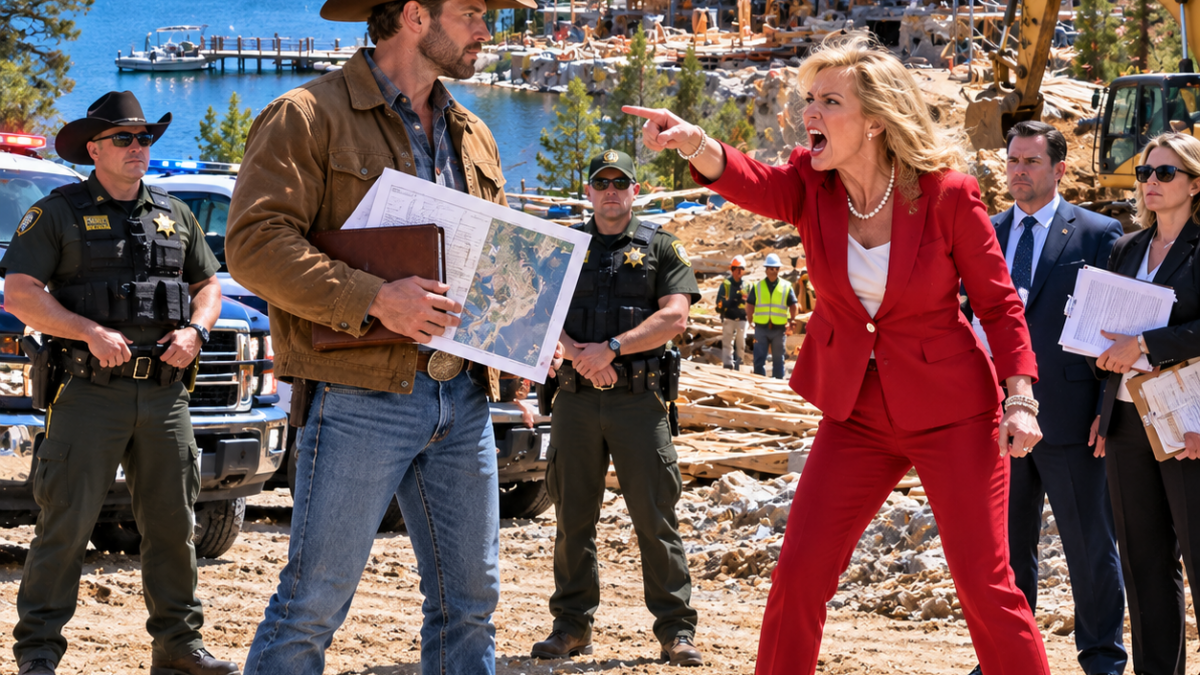
“My name is Jose Phillips. Harold Phillips was my grandfather. He owned approximately nine hundred acres along this lake for more than fifty years.”
Marie folded her arms.
“He never sold the parcel where Mrs. Hargrove built her home.”
Her attorney leaned toward her.
I placed the survey on the projector.
“This certified independent survey places the mansion two hundred forty-seven feet inside my grandfather’s legal boundary.”
Murmurs began.
Next exhibit.
“The original boundary markers were removed and discovered in a drainage ditch.”
Next.
“This is the deed Mrs. Hargrove relies upon.”
Marie looked toward Richard.
“And this is the forensic examiner’s report concluding Harold Phillips’s signature was traced.”
The room changed.
People stopped shifting.
Stopped whispering.
They started listening.
I put Grandpa’s medical record on the screen.
“The deed is dated March 15, 2019.”
Next page.
“On March 15, 2019, Harold Phillips was hospitalized following a cardiac event and sedated.”
A commissioner leaned toward the screen.
I continued.
“The permit used for construction authorized a four-hundred-square-foot accessory structure.”
Then I displayed an aerial photograph.
“The completed residence is approximately eight thousand square feet.”
Someone behind me muttered, “Jesus.”
Marie’s attorney whispered to her.
She shook her head violently.
Then came the email.
I read only one sentence.
“Push it through quickly. I’ll handle Richard if there are questions.”
Every face turned toward Richard Dawson.
He stared straight ahead.
Finally, I played Marie’s own mansion video.
Her smiling face appeared on the screen behind me.
When the framed permit came into view, I paused it.
Four hundred square feet.
Eight thousand constructed.
Then I displayed her public statement saying she had planned the mansion for more than ten years.
I closed the binder.
“I’m not asking this commission to believe me because my grandfather was respected here.”
Silence.
“I’m asking you to read the records your own county produced.”
Marie exploded.
“This is ridiculous.”
Her attorney grabbed her wrist.
She stood anyway.
“That permit is valid.”
The chair raised his gavel.
“Mrs. Hargrove—”
“Everybody knows how these things work!”
Her voice echoed through the chamber.
“You know the right people, things get done.”
“Marie,” her attorney hissed.
She pulled away from him.
“I have given more to this county than that man ever will!”
She pointed at me.
“That old man was supposed to sell us that land!”
Nobody moved.
Marie’s attorney went pale.
Richard Dawson’s face changed instantly.
Marie seemed to realize what she had said.
But she wasn’t finished.
“Richard told me it was handled.”
Her attorney closed his eyes.
I heard a reporter typing behind me.
The chair leaned toward his microphone.
“Mrs. Hargrove, are you stating that former Commissioner Dawson had direct involvement in obtaining the property?”
Her lawyer stood.
“My client will make no further statements.”
“Are you stating,” the chair continued, “that you knew the permitted dimensions differed from the structure actually built?”
“My client declines to answer.”
Richard stood and headed toward the side exit.
Two reporters followed.
The chair looked at the evidence packet.
Then at Marie.
“This commission will immediately refer these materials to the district attorney and request an independent audit of permits issued during the relevant period.”
Marie sank back into her chair.
The chair wasn’t finished.
“We will also forward possible public-corruption concerns to state authorities.”
For the first time since I had met her, Marie Hargrove looked small.
Not poor.
Not powerless.
Small.
The meeting adjourned into chaos.
Cameras moved toward us.
Residents shouted questions.
Marie’s attorney tried to steer her toward a side exit.
She passed within a few feet of me.
Then stopped.
“You think you won?”
I said nothing.
Her eyes were wet with fury.
“Harold owed us.”
Still nothing.
“That land should have been ours.”
Her attorney grabbed her elbow.
“Marie, stop talking.”
She looked at me one last time.
I didn’t smile.
That seemed to bother her more than anything.
The next morning Nathan filed the civil action.
Quietly.
No press conference.
No victory statement.
Petition to quiet title.
Fraud allegations.
Damages.
Injunctive relief.
Request for removal of unauthorized structures.
The district attorney opened a criminal investigation less than two weeks later.
And once investigators began interviewing people, the system that had protected Marie started doing what corrupt systems often do when consequences become real.
It turned on itself.
One planning employee produced archived messages.
Another admitted Richard had personally called concerning the permit.
A former inspector revealed he had been instructed not to visit the construction site.
Margaret gave a sworn statement describing pressure placed on her to record the forged transfer.
Then investigators found something even Nathan had not expected.
The original deed image submitted for recording contained metadata showing it had been scanned at an office belonging to Hargrove Development.
Craig Hargrove blamed Diane Mercer.
Diane blamed Richard.
Richard’s attorney announced that his client had been “misled by individuals seeking to exploit his public position.”
Marie blamed everyone.
Nobody blamed Grandpa.
Because Grandpa was dead.
And dead men are convenient scapegoats until the paperwork survives them.
Six weeks after the commission meeting, Marie entered a no-contest plea to felony counts involving fraudulent documents and related misconduct.
The criminal judge imposed probation, substantial financial penalties, community-service requirements, and restitution obligations.
She avoided prison.
Some people online complained that the sentence was too light.
At first, part of me agreed.
Then Nathan reminded me that the criminal case was only half of it.
“The house,” he said, “is still sitting on your land.”
The civil trial began four months later.
That courtroom was smaller than the commission chamber.
No cheering crowd.
No public speeches.
No theatrics.
Just two legal teams, a judge, witnesses, and several tables covered in documents.
Marie looked different.
The polished confidence had disappeared.
Her hair was still perfect.
Her clothes were still expensive.
But she kept her eyes on the table.
Her attorney argued that Marie had relied on professionals and believed in good faith that the property belonged to her.
Nathan stood.
“Then why were the boundary monuments removed?”
No answer.
“Why was the landowner’s identifying information incorrectly copied into the application?”
Objection.
Overruled.
“Why did Mrs. Hargrove email a county employee before the permit entered the official system?”
Another objection.
Overruled.
“Why did she tell that employee she would ‘handle Richard’?”
Silence.
Then Margaret testified.
She walked slowly to the witness stand.
Seventy-two years old.
Forty years of county service.
She told the judge exactly what happened when the false transfer was first presented.
“I knew Harold Phillips,” she said. “I knew his signature. That wasn’t it.”
“Were you pressured to record the document?”
“Yes.”
“Did you?”
“No.”
“What happened afterward?”
“My job disappeared.”
Marie looked down.
Bradley testified next.
Survey coordinates.
Boundary monuments.
Historical plats.
Satellite references.
Two hundred forty-seven feet.
No ambiguity.
The forensic examiner explained the graphite.
The hesitation marks.
The traced strokes.
Then Nathan called me.
I raised my right hand and swore to tell the truth.
He began with Grandpa.
“How long did Harold Phillips own the ranch?”
“More than fifty years.”
“Did he ever tell you he had sold the lakefront portion?”
“No.”
“Did he ever discuss Marie Hargrove?”
That question stopped me.
“Not by name.”
Nathan approached the witness stand.
“Did he leave you any warning?”
Marie’s attorney objected.
The judge allowed limited testimony because the letter was part of the estate record and relevant to the history of the dispute.
I unfolded Grandpa’s note.
My voice tightened as I read it.
“Keep the land. Don’t trust them. They will come for it.”
The courtroom became painfully quiet.
Nathan let the silence remain.
Then he asked the question I had feared.
“Mr. Phillips, what are you asking this court to do?”
I looked toward Marie.
For months, I had imagined this moment.
I had imagined wanting revenge.
I had pictured bulldozers tearing apart her mansion while she watched.
I had pictured the gate ripped from its hinges.
I had pictured telling her exactly how it felt to lose something.
But sitting there, holding Grandpa’s handwriting, revenge suddenly felt cheap.
“I want the property returned to the condition it was in before the illegal construction.”
Nothing more.
Nothing theatrical.
Just that.
Marie’s attorney argued demolition would be economically wasteful.
He proposed that I be forced to sell Marie the occupied acreage.
That almost broke my composure.
Forced to sell.
After everything.
Nathan rose slowly.
“Your Honor, the defendant asks this court to reward an intentional encroachment by transforming fraud into compulsory purchase rights.”
He gestured toward the exhibits.
“If someone can forge a deed, build a luxury residence 247 feet inside another person’s property, manipulate permits, and then obtain ownership merely because demolition is inconvenient, property law becomes a business model for theft.”
The judge stared at Marie’s counsel.
“I agree.”
Those two words changed everything.
The written decision came nine days later.
Title belonged to me.
The deed Marie relied upon was invalid.
The mansion constituted an unauthorized encroachment.
Marie was given two options.
Purchase the affected land at independently appraised value plus a thirty-percent equitable penalty and associated damages.
Or remove every unauthorized structure within 180 days.
The estimated purchase amount exceeded $1.2 million.
After criminal-defense costs, civil attorneys’ fees, fines, and debts secured against the mansion, Marie couldn’t finance it.
She chose demolition.
The judge also awarded me $150,000 covering legal expenses, physical damage to the property, survey restoration, and documented harassment-related losses.
When Nathan called with the final order, I stood in my Austin kitchen holding the phone.
“You got it,” he said.
I didn’t answer.
“Jose?”
“I’m here.”
“You won.”
I looked toward the cardboard box containing Grandpa’s files.
“No.”
Nathan waited.
“Grandpa won.”
Demolition was scheduled for spring.
Marie had the full 180 days.
I could have sought faster enforcement.
I didn’t.
She had already lost the house.
Her reputation.
Her influence.
The illusion that certain rules applied only to other people.
I didn’t need to stand over her while it happened.
A reporter from the Herald called.
“What does it feel like to destroy Marie Hargrove’s dream home?”
“I didn’t destroy it.”
“But the court ordered demolition because of your lawsuit.”
“The court ordered removal because it was built on land she didn’t own.”
“Do you feel vindicated?”
“I feel tired.”
“What do you want people to learn from this?”
I almost gave him a speech.
Then I remembered Grandpa.
“Keep your records.”
The reporter laughed, thinking I was joking.
I wasn’t.
The mansion came down in May.
I stayed in Austin.
A neighbor sent me photographs.
First the windows disappeared.
Then the roof.
Then the stone walls.
The pool was drained and broken apart.
The private dock was removed.
Truck after truck hauled debris away.
Three years of arrogance disappeared in three days.
When the final load left, crews graded the slope and reseeded it with native grass.
I deleted the photographs.
I didn’t want my last memory of Grandpa’s hill to be rubble.
The broader investigation continued.
Richard Dawson resigned from several civic boards.
State investigators uncovered multiple instances in which he had pressured county staff to accelerate projects connected to friends and donors.
Three other landowners came forward.
One elderly couple said they had spent years fighting a mysterious easement change that benefited a developer connected to Richard.
Another family produced correspondence showing unusual pressure to sell lakefront acreage.
Diane Mercer lost her county job.
Licensing authorities opened a disciplinary case.
Two additional employees were terminated after the independent audit found irregularities.
Fourteen permits were flagged for deeper review.
The county changed procedures.
No single official could approve large lakefront projects anymore.
Ownership verification required independent review.
Permit records had to be automatically archived off-site.
And the recorder’s office adopted protections preventing one administrator from silently altering historical files.
Margaret called me after the reforms were announced.
“You know what Harold would say?”
I smiled.
“Probably that they should have done it right the first time.”
She laughed.
“That sounds like him.”
Then her voice softened.
“He talked about you.”
“What?”
“Before he got sick.”
I sat down.
“What did he say?”
“That you left because you needed to build your own life. He was proud of that.”
A knot formed in my throat.
Grandpa and I had loved each other, but we had never been men who said much.
We fixed things together.
We sat in boats together.
We drove fence lines together.
That was how we communicated.
Margaret continued.
“He said someday the ranch would need someone who understood that owning land and deserving land are different things.”
I rubbed my eyes.
“I don’t know if I deserve nine hundred acres.”
“Good.”
I laughed weakly.
“Good?”
“People who are absolutely certain they deserve everything are how this whole mess started.”
Almost one year after the county commission meeting, I drove back to the ranch alone.
October.
Cool morning.
Thin mist over the lake.
The black iron gate Marie installed was gone.
So were the cameras.
So was the sign threatening trespass charges.
I drove Grandpa’s road slowly.
The live oaks were exactly where they had always been.
The old farmhouse appeared around the bend.
Roof sagging.
Paint faded.
One porch step broken.
Home.
But I kept driving toward the lake.
I parked near the hill where Marie’s mansion had stood.
For a long moment, I stayed inside the truck.
Then I stepped out.
Grass covered the slope.
Real grass.
Wildflowers had started returning near the shoreline.
The lake was silver beneath the morning sun.
A blue heron stood ankle-deep in the shallows.
If someone had arrived without knowing the story, they never would have guessed an 8,000-square-foot mansion had stood there.
I carried two things down the hill.
Bradley’s framed copy of Grandpa’s 1987 survey.
And a new brass boundary marker.
At the GPS coordinate where one of Grandpa’s original markers had been removed, I knelt in the dirt.
I drove the replacement deep into the ground.
The mallet struck brass.
Once.
Twice.
Again.
The sound traveled across the quiet lake.
When it was finished, I ran my thumb over the top.
A month earlier, Martin had mailed me the final boxes from Grandpa’s farmhouse storage.
Inside one box, beneath photographs of Christmas dinners and fishing trips, I found another envelope.
My name was written on it.
**Jose.**
The letter inside was dated years before Grandpa died.
I had carried it with me that morning.
I sat beside the boundary marker and opened it.
Grandpa’s handwriting wandered across the page.
Age had already begun shaking his hand.
But every word was readable.
He wrote that people had been circling the property for years.
That they were waiting for him to become weak.
He mentioned the Hargroves.
The Dawsons.
He said he had kept every deed, every survey, every tax record.
Then came the line that finally broke me.
**Don’t let them make you angry. Just find the evidence and let it speak.**
I had spent almost a year thinking I was protecting Grandpa’s land.
Sitting there beside the lake, I realized he had been protecting me too.
He knew what anger could do.
He knew men sometimes destroy themselves trying to punish the people who hurt them.
He hadn’t left me instructions for revenge.
He left me a way through it.
At the bottom he had written:
**The land will be yours. Keep it safe. I’m proud of you already.**
I read those words several times.
Then I cried.
Not loudly.
There was nobody there to hear me anyway.
I cried because I had spent a year wishing I could call him.
To ask where he kept the old plat maps.
To ask whether Margaret’s story surprised him.
To complain about lawyers.
To tell him someone had built a swimming pool where we used to watch deer come down for water.
To hear him say, in that impatient voice of his, “Then quit complaining and fix it.”
The wind moved through the live oaks.
For a second, it sounded like the porch screen door at the farmhouse.
I folded the letter.
Put it back in the envelope.
Then I walked to the water.
The old dock Grandpa and I had used still stood farther down the shoreline.
Not Marie’s polished private dock.
Grandpa’s.
Uneven boards.
Rusty cleats.
One railing leaning slightly to the left.
I sat at the end.
When I was eight years old, Grandpa had brought me there before sunrise.
I remembered complaining that fishing was boring.
“You’re doing it wrong,” he said.
“How do you do fishing wrong?”
“You keep expecting something to happen.”
I stared at him.
“That’s the point.”
“Nope.”
He looked across the water.
“The point is learning how to sit still long enough to notice when something does.”
I hadn’t understood him then.
I did now.
Marie had moved quickly.
Forged papers.
Fast permits.
Influence.
Threats.
Smears.
Every move designed to create an immediate result.
I had won because Grandpa taught me the opposite.
Sit still.
Pay attention.
Keep the paper.
Wait for the mistake.
By noon I returned to the farmhouse.
The place looked worse up close.
Roof leak over the kitchen.
Rotting porch rail.
Barn doors barely hanging straight.
Fencing down near the south pasture.
A fallen oak blocking one of the old trails.
Nine hundred acres sounds romantic until you inherit nine hundred acres of maintenance.
I opened the front door.
The smell hit me immediately.
Cedar.
Dust.
Old coffee.
Grandpa.
His coat still hung behind the door.
For several minutes I stood there with my hand on the doorknob.
Then I started working.
I opened windows.
Swept floors.
Put a bucket under the leak.
Made a list.
Roof.
Porch.
Barn.
Fence.
Dock.
Road.
Electrical panel.
Water heater.
By sunset, the list covered two pages.
I sat at Grandpa’s kitchen table.
The same table where he used to spread tax bills every January and complain that government paperwork reproduced when nobody was watching.
I placed his framed survey on the wall.
Not as evidence anymore.
As history.
The lawsuits were over.
Marie still made payments on the judgment.
Richard was still dealing with investigators.
The county continued reviewing questionable permits.
Those things mattered.
But they no longer belonged in the center of my life.
For months, every morning had started with a case.
Every phone call had felt like a threat.
Every stranger in that county had seemed either dangerous or afraid.
Now there was only work.
Real work.
Repairing what had been neglected.
The following spring, I hired local contractors to stabilize the farmhouse.
I made one rule.
Every permit would be displayed openly.
Margaret found that hilarious.
She visited one Saturday carrying a pecan pie.
“You trying to make a point?”
“No.”
I looked toward the plastic sleeve containing the renovation permit taped inside the window.
“Maybe.”
She walked the property with me.
When we reached the place where Marie’s mansion had stood, wildflowers covered most of the slope.
Margaret stared toward the lake.
“She could’ve had a beautiful place somewhere else.”
“I know.”
“That’s the stupidest part.”
She shook her head.
“She had money. Connections. She could have bought land legally.”
“Why didn’t she?”
Margaret thought about that.
“Because buying something means admitting somebody else owns it first.”
That sentence stayed with me.
People assumed the story was about a mansion.
It wasn’t.
It was about entitlement.
Marie didn’t steal because she had no alternatives.
She stole because somewhere along the way she stopped believing permission applied to her.
A year later, I received a letter from her.
No attorney’s letterhead.
No threats.
Just my name.
I almost threw it away unopened.
Instead, I sat on Grandpa’s porch and read it.
Marie did not apologize immediately.
The first paragraph explained how much she had lost.
The house.
Friends.
Money.
Social standing.
Then came excuses.
Richard had assured her everything would be handled.
Craig had managed construction.
Diane had processed permits.
Lawyers had told her not to ask too many questions.
I nearly stopped reading.
Then I reached the last page.
**I spent most of my life thinking influence was the same thing as respect. I know now they are not.**
I read that twice.
Then:
**You had every opportunity to humiliate me publicly after the ruling. You didn’t. I don’t understand why.**
That part made me laugh.
Because the answer wasn’t complicated.
I didn’t need her humiliation.
I needed Grandpa’s land.
Marie wrote one more thing.
**I am sorry about your grandfather’s signature. Whatever else I tell myself, I knew enough to know that should never have happened.**
I folded the letter.
I never responded.
Forgiveness does not always require conversation.
And forgiveness does not mean pretending damage never occurred.
Sometimes it simply means refusing to carry somebody else’s ugliness farther than necessary.
The ranch slowly came back to life.
I repaired the farmhouse.
Rebuilt the south fence.
Restored Grandpa’s dock.
Leased part of the pasture to a neighbor who raised cattle.
I placed conservation restrictions on the most sensitive shoreline so no future owner could turn it into dense development.
Bradley returned to install permanent survey monuments along the disputed boundary.
Margaret attended when we placed the final one.
“So nobody moves them again,” she said.
“That’s the idea.”
She smiled.
“Harold would approve.”
One evening, months later, I drove down to the lake after a storm.
The sunset broke through the clouds.
Everything turned orange.
The hill where Marie’s mansion had stood was empty except for grass.
I could see deer near the tree line.
A few ducks moved across the water.
I thought about how different the story could have ended.
I could have reacted at the gate that first day.
Could have yelled at the deputy.
Could have threatened Marie.
Could have forced my way onto the property.
One angry moment would have given them exactly what they needed.
Instead, I had gone back to a motel.
Opened a box.
Read a survey.
That tiny decision changed everything.
Because powerful people often depend on one assumption.
That everyone else will become emotional before they become organized.
Marie expected me to fight her personality.
I fought her paperwork.
She expected accusations.
I brought coordinates.
She expected shouting.
I brought hospital records.
She expected me to tell people she was lying.
I let her own email tell them.
And when she finally stood inside a public meeting believing she could talk her way through anything, I let her keep talking until the truth came out of her own mouth.
That was the revenge people wanted to hear about.
But it wasn’t the part I remembered most.
The part I remembered was Grandpa’s ranch after all the noise stopped.
The screen door.
The broken porch.
The old dock.
The brass boundary marker catching sunlight.
And the handwritten letter I kept in a drawer beside the kitchen table.
Years later, whenever someone asked whether watching Marie’s mansion being demolished had felt satisfying, I told them the truth.
I never watched it.
The most satisfying moment came much later.
It happened on a cool October morning when I finished repairing the farmhouse porch.
I sat in Grandpa’s old chair with a cup of coffee.
The ranch stretched toward the lake.
No mansion.
No security cameras.
No threatening signs.
No deputies.
No attorneys.
Just nine hundred acres of Texas earth, exactly where it had always been.
For the first time since Grandpa died, I could finally hear the place again.
Wind through oak branches.
Water against the shoreline.
A screen door creaking behind me.
I looked toward the hill.
Someone had once spent millions of dollars trying to prove that money and influence could rewrite ownership.
Grandpa had defeated them with a box of old papers.
I lifted my coffee toward the lake.
“Kept it,” I said quietly.
Nobody answered.
But that was all right.
I didn’t need an answer.
The land was still there.
The house was still standing.
The truth had survived every forged signature, every favor, every threat, and every person who had believed power could make facts disappear.
And for the first time since I inherited the ranch, I wasn’t fighting to get home anymore.
I was home.
[END OF FULL STORY]








