PART 2: I Inherited My Grandfather’s Bankrupt Farm—Then the HOA Put Guards at the Gate and Claimed It Was Theirs
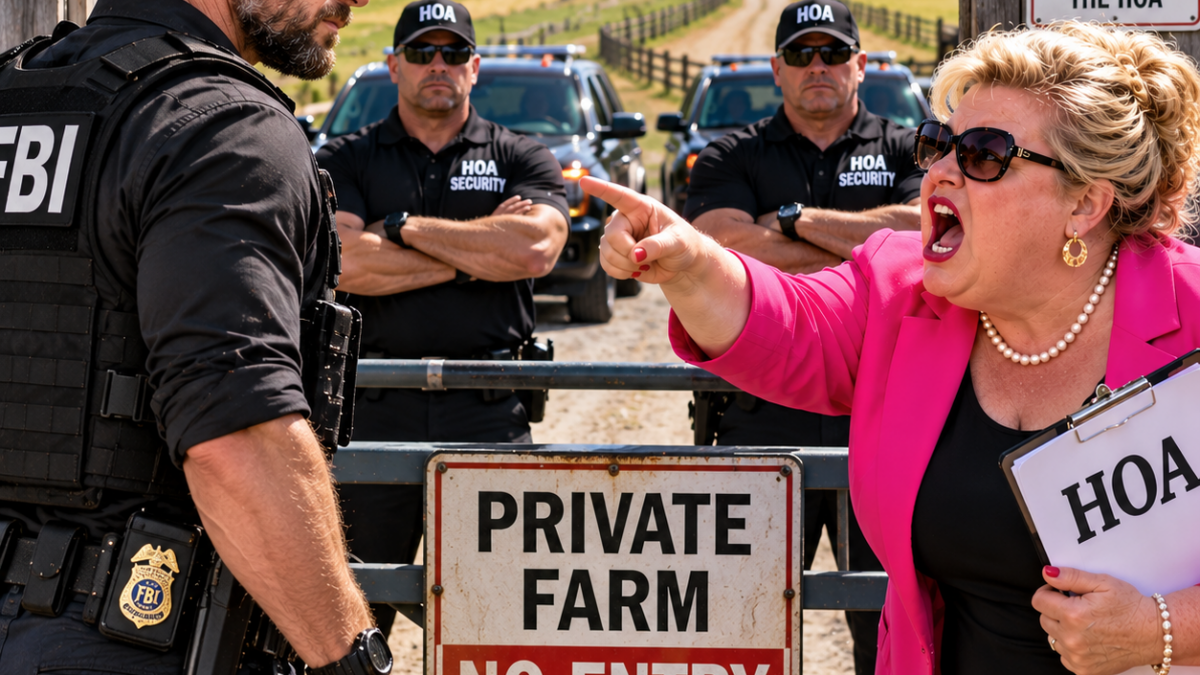
PART 2
The first thing I did the next morning was go to the Madison County Recorder’s Office.
It opened at 8:30.
I was sitting in the parking lot at 8:14 with coffee in one hand and my grandfather’s parcel number written on a legal pad.
The building looked like every small county records office I’d ever visited during an investigation.
Brick exterior.
Fluorescent lights.
Metal filing cabinets that probably predated half the staff.
The clerk behind the counter introduced herself as Janet Cooper.
“What are you looking for?”
“Everything recorded against Henry Bailey’s farm in the last three years.”
“Liens?”
“Liens, transfers, management agreements, easements, deeds, anything.”
She typed.
Clicked through several screens.
Then turned the monitor slightly.
“There isn’t much.”
The deed showed Henry Bailey as owner until death.
The estate transfer remained pending probate completion but clearly identified me as beneficiary.
Property taxes were current.
No mortgage.
No judgment liens.
And most importantly—
No Meadowbrook Estates HOA lien.
I leaned closer.
“Search again under Meadowbrook Estates.”
She did.
Nothing.
“Heartland Asset Management.”
Nothing recorded as a lien.
“Victor Shaw.”
Nothing.
I pulled Brenda’s assessment statement from my folder.
“She claims there’s more than forty-seven thousand dollars in secured debt.”
Janet frowned.
“If an association had recorded a lien against the parcel, it would appear here.”
“Could one be pending?”
“I can check.”
Nothing.
“What about this?”
I showed her the property management agreement.
She searched Henry’s parcel.
“No recorded management agreement.”
“Ever?”
“Not in the county index.”
That mattered.
A lot.
An unrecorded agreement could still exist between parties in some circumstances, but Brenda had presented it as the legal foundation for physically excluding the owner’s heir from the land.
Yet she had never filed it where anyone outside her organization could scrutinize it.
I asked Janet for tax history.
That was when things became stranger.
For decades, Henry Bailey paid his own taxes.
Then eighteen months before his death, the payer changed.
HEARTLAND ASSET MANAGEMENT LLC.
I stared at the screen.
“Who authorized them to pay?”
Janet shrugged.
“Anyone can pay someone else’s property taxes. The county cares that the bill is paid.”
“Does paying taxes give them ownership?”
“No.”
“Any tax sale?”
“No.”
“Delinquency?”
“No.”
“So there was no reason for a third party to intervene.”
“Not according to our records.”
I ordered certified copies.
Outside, I sat in my car and called Helen Chavez.
Helen and I had worked financial crimes together for years.
She answered, “You on leave or pretending to be?”
“Complicated.”
“That means pretending.”
“I need corporate checks on some Nebraska entities.”
“Official?”
“Not yet.”
She was quiet.
“Alexander.”
“I know.”
“You inherited the farm. Personal conflict.”
“I know.”
“Then tell me what you need and don’t do anything stupid.”
“Heartland Asset Management LLC. Victor Shaw. Meadowbrook Estates HOA. Brenda Holloway.”
“Give me an hour.”
I drove back toward the farm.
This time, I stopped a hundred yards from the entrance.
No guards.
No Lexus.
The gate was still chained.
Then movement near the barn caught my eye.
A pickup sat beside the machine shed.
Two men were loading equipment.
My grandfather’s hay baler.
His red tool chest.
Then the old John Deere tractor he had owned since 1992.
My first impulse was physical.
Get out.
Walk down there.
Stop them.
The farm had been described as “bankrupt” during probate because cash reserves were low and several repair obligations remained outstanding.
But bankruptcy didn’t mean abandoned.
And it certainly didn’t mean free equipment.
I reached for my phone.
Then stopped.
Who were the men?
Were they acting under Brenda’s forged agreement?
Had equipment already been sold legitimately before Henry died?
I didn’t know.
So I did what training had taught me.
Observe first.
Truck plate.
Faces.
Company logo.
Times.
Equipment serial numbers visible through zoom.
I took photographs until the pickup and trailer drove away.
The hardest part was watching.
My grandfather had taught me to drive that tractor when I was eight.
He sat behind me with one hand on the fender and said, “Don’t fight the wheel. Tell it where you want to go.”
Now strangers were hauling it down the road while I sat inside a car doing nothing.
I hated myself for about thirty seconds.
Then I reminded myself why.
Evidence over emotion.
Back at the motel, I opened the estate medical records.
Henry had lived with Parkinson’s for eight years.
Eighteen months before death, he was diagnosed with cognitive impairment that later progressed into Alzheimer’s.
Eighteen months.
Exactly when Heartland started paying the property taxes.
That was the first point where coincidence stopped looking like coincidence.
Helen called at 4:17.
“Heartland Asset Management was formed three years ago.”
“Registered agent?”
“Victor Shaw.”
“The HOA lawyer.”
“Supposed lawyer. Still checking him.”
“Officers?”
“Layered through another LLC. I’ll keep digging.”
“Other properties?”
“I found at least three rural parcels connected to Heartland transfers.”
“In Nebraska?”
“Two Nebraska. One South Dakota.”
“Original owners?”
“Elderly.”
I sat down.
“Dead?”
“Two died before transfer completed. One entered assisted living.”
I looked at Henry’s last letter.
“They’re trying to take the farm.”
Helen continued.
“There may be nothing criminal here. Asset management companies buy distressed property all the time.”
“Do they send fake HOA charges first?”
“Do you have proof they’re fake?”
“No lien.”
“That helps.”
“Unrecorded agreement.”
“Helps more.”
“Signature is wrong.”
“Needs expert review.”
“I know.”
“Alexander, hand this off if it becomes real.”
“I will.”
“You mean after you decide it’s real.”
“That too.”
She sighed.
“Send me the documents.”
The next morning, somebody slid an envelope under my motel door.
No stamp.
No postmark.
Victor Shaw letterhead.
CEASE AND DESIST.
It accused me of interfering with property under lawful management.
I was ordered to stop contacting Meadowbrook representatives and “associated community members.”
Seventy-two-hour deadline.
At 11:40, someone knocked.
Sheriff Raymond Alvarez.
Late fifties.
Weathered face.
Calm eyes.
He showed me identification before I asked.
“Mr. Bailey?”
“Yes.”
“Got a complaint from Brenda Holloway.”
“About?”
“Harassment. Trespassing. Interference.”
“I haven’t crossed the gate.”
“I figured.”
That surprised me.
He handed me a complaint copy.
“I’m not charging anybody. I’m letting you know the complaint exists.”
“Why?”
“Because Brenda asked me to.”
“Does she often ask?”
He gave me a careful look.
“Small county.”
“That’s not an answer.”
“No.”
He started toward the door.
I said, “Sheriff.”
He stopped.
“Have you ever seen Meadowbrook hire private guards to prevent an owner from entering property?”
His expression tightened.
“You asking personally or professionally?”
“Personally.”
“Then personally, I’d tell you to get a lawyer.”
“And professionally?”
“I’d tell you ownership disputes are civil until somebody commits a crime.”
“What about forged documents?”
His eyes stayed on mine.
“Then bring evidence.”
Good answer.
After he left, I studied Brenda’s complaint.
Filed 9:15 that morning.
Victor’s threat had been delivered before sunrise.
Sheriff by lunch.
Coordination.
That afternoon, my motel reservation disappeared.
The manager avoided eye contact.
“Corporate instructed us to refund you.”
“Why?”
“Potential liability.”
“What liability?”
“Ongoing litigation.”
“I’m not in litigation.”
He rubbed his forehead.
“Sir, I just manage the desk.”
“Who called corporate?”
“I don’t know.”
“Brenda Holloway?”
“I don’t know.”
“Victor Shaw?”
His silence answered enough.
Three pressure points in a single day.
Threat letter.
Law enforcement contact.
Lodging removed.
I sat in my rental car with the heater blasting and realized I had seen this structure before.
Not in HOA cases.
Fraud cases.
Pressure works best when it doesn’t feel coordinated.
One problem becomes two.
Two become five.
Legal fear.
Financial fear.
Social isolation.
Exhaustion.
Eventually, the victim accepts the easiest exit.
I had spent twelve years studying people who built those exits.
Brenda thought I was walking toward hers.
I checked county maps and found the nearest longtime neighbor.
Martha Jennings.
Her farmhouse sat half a mile from Henry’s eastern boundary.
She opened the door but left the storm chain latched.
“Yes?”
“My name is Alexander Bailey.”
Her eyes changed.
“Henry’s grandson.”
“You knew him?”
“Forty-two years.”
She unlatched the door.
“Come in.”
Her kitchen smelled like coffee and cinnamon.
She poured me a cup before asking why I had come.
Then she looked at the folder in my hand.
“So Brenda finally came for the whole farm.”
“You knew?”
“I knew she’d been circling.”
“Why didn’t anyone tell me?”
Martha stared at me.
“Your grandfather tried.”
That hurt.
She didn’t soften it.
Good.
I deserved it.
“He wrote.”
“You answered?”
“Eventually.”
“Not fast enough.”
“No.”
Martha sat across from me.
“They wore him down.”
“How?”
“Same way they wore down Earl Thompson. Same way they tried with me.”
She disappeared into another room and returned carrying a shoebox.
Inside were Meadowbrook notices.
Assessments.
Legal threats.
A management agreement.
I pulled it free.
“Martha Jennings.”
Her signature appeared at the bottom.
“Did you sign this?”
“No.”
I put Henry’s agreement beside it.
Same typeface.
Same clauses.
Same notary.
Linda Price.
Same oddly smooth signature style.
Martha watched my face.
“My son came down from Omaha when I showed him. He hired a lawyer. Brenda backed off.”
“What happened to people who didn’t have someone?”
“Some sold.”
“To Heartland?”
“Or companies I never heard of.”
“And guards?”
Martha’s mouth tightened.
“Derek Nash.”
“Who’s he?”
“Runs Heartland Security.”
“Connected to Brenda?”
“Connected enough.”
She leaned closer.
“Alexander, don’t underestimate him.”
“Why?”
“Because Brenda scares people with paper.”
Martha looked toward the window.
“Derek scares them in person.”
I photographed everything she allowed.
Before leaving, I asked, “Why didn’t you go public?”
“With what?”
“These documents.”
She gave me a sad smile.
“Public to who?”
That was the problem.
Each victim held one fragment.
One family thought the HOA was abusive.
Another thought a lawyer had cheated them.
Another thought their father made a bad decision.
Another suspected forged paperwork.
Without the pattern, each piece looked survivable.
Together, they looked engineered.
I found another motel thirty miles away and checked in under the reservation name Alex B.
Not a false identity.
Just not enough for Brenda’s network to locate easily.
Helen called that evening.
“Victor Shaw is not licensed in Nebraska.”
I sat up.
“What?”
“Admitted Kansas twelve years ago. Suspended eight years ago for misappropriation of client money. Never reinstated.”
“He’s sending legal threats as attorney at law.”
“Yep.”
“Anything on Derek?”
“Heartland Security. Prior aggravated assault conviction. Served eighteen months. Later record relief under state procedure, but federal systems still show it.”
“Properties?”
“Seven.”
I stopped writing.
“Seven what?”
“Seven rural property transfers tied to Heartland and related entities over four years.”
“States?”
“Nebraska and South Dakota.”
“Original owners?”
“Every one over seventy.”
I closed my eyes.
There it was.
Federal jurisdiction was starting to form.
Interstate activity.
Corporate shells.
Potential wires.
Maybe bank fraud.
But “starting to form” wasn’t enough.
Helen continued.
“One former owner’s son still lives near Lincoln. Benjamin White. His father Earl Thompson lost a farm two years ago after a Meadowbrook dispute.”
“Send me the address.”
“Alexander.”
“What?”
“You’re investigating a scheme involving your own inheritance.”
“I’m interviewing a witness as a private party.”
“That distinction lasts about another fifteen minutes.”
“I know.”
“Call Omaha.”
“Soon.”
“Soon is what agents say right before internal affairs asks why they waited.”
“I know.”
The next morning, I drove to Benjamin White’s house.
He opened the door looking like a man who had spent years expecting bad news.
When I gave Henry’s name, he stared.
“Same people?”
“I think so.”
He let me inside.
His kitchen table was already covered with documents before I removed mine.
“I kept everything,” he said.
“You were expecting someone?”
“No.”
He looked down.
“Hoping.”
Earl Thompson’s story matched Henry’s almost step for step.
Unexpected HOA assessments.
Legal notices.
Management agreement.
Heartland tax payments.
Then a deed transfer.
But Benjamin had something I didn’t.
Bank records.
“The farm sold for four hundred twenty thousand after they took it.”
“Where did the money go?”
“Not to Dad.”
He pushed statements toward me.
Heartland Asset Management.
Wire to Prairie Holdings LLC in South Dakota.
Then another transfer.
Final destination:
HOLLOWAY FAMILY TRUST.
I stopped breathing for a second.
Not literally.
It just felt that way.
Brenda’s family trust.
Money from an elderly man’s farm.
Across state lines.
Through shell companies.
Wire transfers.
I photographed every page.
“You understand what this could mean?” I asked.
Benjamin laughed bitterly.
“I understood two years ago. Nobody else did.”
“Your attorney?”
“Ran out of money before discovery.”
“What about your father?”
“He died thinking he signed something he couldn’t remember signing.”
Benjamin looked down.
“He thought getting old made him stupid.”
I had no response.
He continued.
“My father was stubborn. Sometimes impossible. But he was not stupid.”
“I believe you.”
“If you prove this…”
His voice caught.
He stopped.
I waited.
Finally, he said, “I don’t care about the money anymore.”
“You should.”
“I care that he wasn’t wrong.”
That landed harder than anything else.
Victims of sophisticated fraud often blame themselves.
The perpetrator takes money.
Then shame finishes the job.
I packed the documents carefully.
Driving back toward Madison County, I called Helen.
“I have wire transfers.”
“How good?”
“Heartland to South Dakota entity to Holloway Family Trust.”
“How documented?”
“Bank statements obtained during civil litigation.”
“Get provenance.”
“I will.”
“Call Omaha.”
“I’m calling after one more thing.”
She cursed.
“What?”
“The pending deed.”
“What pending deed?”
She became quiet.
Then said, “Actually, that’s what I was about to tell you.”
Heartland had submitted a corrective deed application on Henry’s farm three weeks before I arrived.
The application claimed the existing ownership record failed to reflect Heartland’s equitable interest created through tax payments and the management agreement.
It was still under review.
Twelve days until administrative processing.
“They knew you were coming,” Helen said.
“Probate notice.”
“Probably.”
“They accelerated.”
“Yes.”
If approved, it wouldn’t magically make Heartland indisputable owner.
But it would poison title.
Create litigation.
Freeze financing.
Create years of delay.
Exactly what Brenda wanted.
I finally called the Omaha field office.
Special Agent in Charge Patricia Reeves answered after my identity was confirmed.
I gave her the short version.
Then the long version.
At the end, she said, “You know you’re conflicted.”
“Yes.”
“You should have called earlier.”
“Yes.”
“You’ve already gathered evidence.”
“As a private heir until interstate financial activity became apparent.”
“Cute distinction.”
“Accurate distinction.”
“Maybe.”
I could hear her writing.
“What do you have right now?”
“Seven properties. Two states. Shell entities. Forged-looking management agreements. Unlicensed attorney. Suspicious notary. Interstate wires ending in Holloway Family Trust.”
“Direct communication linking Brenda?”
“Not yet.”
“Recorded confession?”
“No.”
“Cooperator?”
“No.”
“Then we build.”
That was the answer I wanted.
And feared.
Because “we build” meant the case was no longer mine.
Reeves assigned Agents Morrison and Tan.
I gave them everything.
From that moment, I was technically a witness and victim with professional expertise, not lead investigator.
That frustrated me more than I expected.
Morrison noticed.
“You hate sitting outside.”
“I hate not knowing.”
“Welcome to being a civilian.”
“Terrible experience.”
He smiled.
“You can still help organize your personal records. We’ll handle subpoenas, interviews, and evidence.”
“What about the farm?”
“Get independent civil counsel.”
I hired Nebraska property attorney Susan Keller.
She reviewed the corrective deed application.
“This is aggressive nonsense.”
“Can you stop it?”
“I can object.”
“Will that stop it?”
“It should trigger review.”
“Should?”
She looked at me.
“You work federal cases, right?”
“Yes.”
“Then you know no lawyer who says ‘guaranteed’ deserves trust.”
Fair.
Susan filed objections supported by probate records, unrecorded management agreement concerns, and competency evidence.
That bought time.
But Brenda didn’t know the FBI had entered.
I wanted to preserve that.
Reeves agreed.
“For now, you stay Alexander Bailey, overwhelmed grandson.”
“I can do overwhelmed.”
“I’ve seen your case files. That part may require acting.”
Brenda called the following day.
“Mr. Bailey, we really need to resolve this.”
“I’m starting to understand that.”
“I’m glad.”
“I can’t afford years of litigation.”
Her tone softened immediately.
Predators hear weakness like dogs hear whistles.
“We don’t want that either.”
“What do you want?”
“A clean transfer.”
“For what?”
“We can discuss settlement.”
I let silence stretch.
“When?”
“Monday.”
“Where?”
“Meadowbrook community center.”
“Fine.”
After hanging up, I called Reeves.
“I think she’ll put the transfer in front of me.”
“Good.”
“I want a wire.”
“Not your decision.”
“I know.”
She hated how fast I answered.
Two days later, authorization came.
Before the meeting, a courier delivered a settlement package from Victor Shaw.
Twenty-two pages.
Forgive fictional debt.
Release fictional legal fees.
Pay me $10,000.
In exchange, I would transfer the entire farm to Heartland Asset Management.
A property worth well over $300,000 even in poor condition.
Page nineteen said I acknowledged the transfer was voluntary and free of coercion.
I read that sentence three times.
They had built a document designed to manufacture consent after weeks of denying access, threats, security guards, sheriff complaints, hotel pressure, and fake debt.
Intent.
That clause didn’t prove the entire conspiracy.
But it showed sophistication.
They knew coercion was an issue.
They were drafting around it.
Then Helen called.
“Linda Price.”
“The notary?”
“Commission expired four years ago.”
I stood.
“Never renewed?”
“No.”
“So Henry’s management agreement—”
“Invalid notarization.”
“Earl Thompson deed?”
“Same stamp.”
“Others?”
“Several.”
“Does Linda know?”
“Agents are locating her.”
The next morning, I met Morrison and Tan.
The wire transmitter was smaller than I expected.
Morrison taped it inside my shirt.
“Don’t perform.”
“I know.”
“Don’t bait them into crimes.”
“I know.”
“Don’t give speeches.”
“I know.”
“Do not reveal your credentials unless we move.”
“I know.”
Tan looked at him.
“He definitely gives speeches.”
“I do not.”
They both stared.
“Fine.”
At 9:55, I entered Meadowbrook’s community center.
Brenda sat at the head of a conference table.
Victor Shaw to her left.
Derek Nash standing near the wall.
The arrangement was deliberate.
Legal authority.
HOA authority.
Physical intimidation.
Three forms of pressure.
Brenda smiled.
“Alexander. Please sit.”
I did.
Victor opened the settlement folder.
“This is the simplest path forward.”
I flipped through it slowly.
“Ten thousand dollars.”
Brenda folded her hands.
“Given the farm’s liabilities, that is generous.”
“What liabilities?”
“Back taxes.”
“Paid.”
Her smile paused.
“By Heartland.”
“Exactly.”
“Maintenance lien.”
“No lien exists.”
“Unrecorded association claims may still be valid.”
“Legal fees.”
“No lawsuit exists.”
Victor leaned forward.
“Mr. Bailey, you’re focusing on technicalities.”
I looked at him.
“Like having a law license?”
His face changed.
Brenda said, “What?”
I kept my eyes on Victor.
“When were you admitted in Nebraska?”
“I practice multi-jurisdictionally.”
“That wasn’t the question.”
“I’m authorized to advise Meadowbrook.”
“As what?”
He leaned back.
“My professional status is not relevant to your property obligations.”
“It becomes relevant when you sign letters ‘attorney at law.’”
Derek moved slightly away from the wall.
Brenda’s voice hardened.
“You came here to negotiate.”
“I did.”
“Then negotiate.”
I lifted the management agreement.
“My grandfather signed this?”
“Yes.”
“Personally?”
“Yes.”
“You saw him?”
“I was present.”
That mattered.
I asked, “Who notarized it?”
Brenda glanced at Victor.
“Linda Price.”
“Her commission expired four years ago.”
Victor went pale.
Derek looked toward the door.
Brenda recovered faster.
“That would be Linda’s administrative issue.”
“Interesting.”
I placed Earl Thompson’s document beside Henry’s.
“Same expired stamp.”
Nobody spoke.
Then Benjamin’s bank statements.
I didn’t show every page.
Only enough.
“Heartland sold his father’s farm.”
Victor said, “That’s unrelated.”
“Money moved through Prairie Holdings.”
Brenda stopped blinking.
“Then into Holloway Family Trust.”
Silence.
Real silence.
Not negotiation silence.
Recognition.
Derek unfolded his arms.
Brenda finally said, “Where did you get that?”
I didn’t answer.
She looked at Victor.
Then Derek.
Then me.
“You’ve been digging into private financial information.”
“Bank statements used in litigation.”
“You had no authority.”
“I didn’t need authority to receive documents from their owner.”
Victor whispered, “We should stop.”
Brenda ignored him.
“You think you understand what happened here?”
“I understand enough.”
“No, you don’t.”
Her voice sharpened.
“People like Henry stop maintaining these properties. Farms decay. Taxes get missed. Structures become hazards. Families disappear until there’s money involved.”
“You’re describing my grandfather?”
“I’m describing a pattern.”
“A profitable one.”
Her eyes narrowed.
I continued.
“Heartland pays taxes.”
“Because somebody has to.”
“Then management agreements appear.”
“Because owners request help.”
“Then property transfers.”
“When owners cannot meet obligations.”
“And money ends up in your family trust.”
“That is an investment structure.”
There.
Not denial.
Explanation.
I leaned back.
“So Heartland is your investment?”
“I have interests.”
“Beneficial interest?”
Victor said, “Brenda.”
She snapped, “He already has the statements.”
I felt the transmitter against my chest and knew Morrison had heard the same thing.
I asked, “How many farms?”
Brenda stared at me.
“You came here to settle yours.”
“How many?”
“You want advice?”
“No.”
“Take the ten thousand.”
“My farm is worth over three hundred.”
“It’s worth what someone can successfully defend.”
That sentence hung between us.
I said, “What does that mean?”
She smiled again.
But now it looked different.
Ugly.
“It means title disputes take years. Lawyers cost money. Out-of-state heirs get tired. Records get complicated.”
Victor closed his eyes.
Brenda continued.
“Your grandfather understood that eventually.”
“My grandfather had Alzheimer’s.”
“And still signed.”
Derek said quietly, “Brenda.”
She waved him off.
“You can fight. Maybe you win. After what? Three years? Five? Fifty thousand in legal bills?”
She pushed the settlement toward me.
“Or sign today.”
I looked down.
“Voluntarily.”
“Yes.”
“Without coercion.”
“Yes.”
“Even though you locked me out.”
“For asset protection.”
“Sent guards.”
“For security.”
“Filed a sheriff complaint.”
“Because you were disruptive.”
“Got my motel reservation canceled.”
For the first time, surprise crossed her face.
I had guessed.
Her reaction confirmed it.
I said, “That was you.”
She recovered too late.
“This county protects its own.”
There it was again.
Pressure admitted as culture.
I slowly closed the settlement folder.
Brenda sighed.
“Alexander, nobody wants to hurt you.”
Derek’s presence made that line almost funny.
Victor said, “Take the deal.”
I looked at each of them.
Then I asked one last question.
“What happens if I refuse?”
Brenda’s eyes went cold.
“Then you learn why everyone else eventually stopped refusing.”
That was enough.
Not a full confession.
Not every element.
But enough layered with documents, wires, financial records, and interstate transactions.
Morrison’s voice came through the tiny receiver in my ear.
“Stand by.”
I reached inside my jacket.
Brenda’s expression changed.
I placed my credentials on the table.
Federal Bureau of Investigation.
Special Agent Alexander Bailey.
Victor Shaw pushed backward so quickly his chair hit the wall.
Derek turned toward the door.
It opened before he reached it.
Agents Morrison and Tan entered.
“Don’t move.”
Derek froze.
Brenda stared at my badge.
Then at me.
Then back at the badge.
Her mouth opened.
Nothing came out.
For eight days, she had treated me like an inconvenience.
An heir.
A target.
Someone to isolate and pressure.
Now she whispered, “You’re FBI.”
“Yes.”
Victor stood.
“I want counsel.”
Morrison looked at him.
“Probably a licensed one.”
Even I almost smiled.
Brenda’s face hardened.
“You entrapped me.”
“No.”
“This is illegal.”
“No.”
“You used your federal authority to settle a family property dispute.”
Reeves entered behind the agents.
“No, Ms. Holloway.”
Brenda looked at her.
Reeves continued.
“The FBI is investigating interstate fraud involving multiple elderly property owners, shell companies, forged instruments, bank transfers, and coordinated intimidation.”
Brenda’s shoulders lowered.
Only slightly.
But I saw it.
Victor stopped talking.
Derek stared at the carpet.
Morrison moved first.
“Brenda Holloway, stand and place your hands behind your back.”
She didn’t.
“Ms. Holloway.”
“This is absurd.”
“Hands behind your back.”
“You have no idea who you’re dealing with.”
Morrison’s expression didn’t change.
“Actually, we’ve spent several days finding out.”
The cuffs closed.
The sound was quieter than I expected.
That was the moment Brenda’s four-year operation stopped being theory.
Agents executed warrants.
Heartland offices.
Victor’s home.
Derek’s security company.
HOA records.
Corporate storage.
Financial accounts.
Linda Price cooperated almost immediately.
Her story was pathetic in the way many fraud accomplice stories are.
Money problems.
Brenda offered cash.
Linda’s commission expired.
She kept stamping documents anyway.
At first, she told herself they were harmless administrative corrections.
Then the amounts increased.
She knew signatures were questionable.
She kept going.
Derek’s employees were interviewed.
Two described assignments to block property owners.
Another admitted they had removed Henry’s equipment and taken it to a Heartland storage yard.
My grandfather’s tractor was recovered three days later.
I stood beside it while federal evidence technicians photographed serial numbers.
The paint was chipped.
One tire was nearly flat.
But it was his.
I put my hand on the steering wheel.
For a few seconds I was eight years old again.
Henry behind me.
“Don’t fight the wheel.”
I looked away before anyone noticed.
Sheriff Alvarez came to the farm that afternoon.
The chain had been removed under court order.
He stood beside me near the gate.
“You knew all along?”
“Not all along.”
“FBI?”
“Yes.”
He shook his head.
“Brenda is going to hate that.”
“I’m trying not to care.”
He looked toward the farmhouse.
“I should have looked harder.”
“At what?”
“Complaints.”
“You had individual civil disputes.”
“I had a pattern I didn’t see.”
“So did everyone.”
He nodded.
“Still doesn’t feel good.”
“No.”
“Your grandfather complained once.”
I turned.
“To you?”
“Not directly. Deputy took a call. Henry said people were taking paperwork and telling him he owed money. Deputy thought it was confusion from the dementia.”
That hurt.
“Did he mention Brenda?”
“I don’t know yet. We’re pulling old call logs.”
I looked toward the farmhouse.
“How many times do old people tell the truth and everybody decides it’s confusion?”
Alvarez didn’t answer.
Neither of us wanted the number.
Tips poured into Omaha.
Other families.
Other counties.
One South Dakota widow produced a management agreement with the same expired notary stamp.
Another family had security footage showing Heartland employees entering a barn.
A bank compliance officer supplied suspicious activity reports linked to Prairie Holdings.
Subpoenas tied shell companies together.
Heartland Asset Management.
Prairie Holdings.
Midlands Agricultural Recovery LLC.
Different names.
Same money.
Same beneficiaries.
The Holloway Family Trust had received hundreds of thousands.
Victor Shaw had drafted documents.
Derek Nash supplied intimidation.
Brenda identified targets through HOA and community relationships.
People living alone.
Cognitive decline.
Children far away.
Farms with little mortgage debt.
Properties valuable enough to steal but complicated enough that heirs might accept a cheap settlement.
My grandfather had been almost perfect.
Widowed.
Parkinson’s.
Cognitive decline.
Grandson in Washington.
No nearby child watching the paperwork.
But Henry had one thing Brenda miscalculated.
He kept writing.
Letters.
Notes.
Dates.
He had mailed me one warning.
Investigators later found another letter in his desk.
Never sent.
Alexander,
Brenda says the farm owes money I don’t remember owing.
A man named Victor tells me I signed papers.
Maybe I did and forgot.
That scares me more than anything.
If I signed them, I failed you.
If I didn’t, then they’re lying.
I don’t know which is worse.
I had to stop reading.
Because Benjamin’s father had felt the same thing.
Maybe I signed.
Maybe I forgot.
Fraud hadn’t just stolen property.
It had attacked memory.
They targeted people whose confidence in their own minds was already fragile.
Then used that fragility against them.
That became the part of the case that angered Reeves most.
“This isn’t just financial fraud,” she said during one meeting.
“It’s psychological exploitation.”
The U.S. Attorney’s Office charged aggressively.
Wire fraud.
Bank fraud.
Conspiracy.
Money laundering.
Fraud involving vulnerable adults.
Additional state forgery and property charges were coordinated separately.
Defense lawyers attacked everything.
They attacked me hardest.
Conflict of interest.
Biased federal agent.
Personal revenge.
Improper investigation.
The bureau had anticipated it.
Reeves testified that after federal jurisdiction became apparent, I was removed from lead investigative authority.
Morrison and Tan handled warrants.
Independent agents collected evidence.
Financial records came through subpoenas.
Victim interviews were repeated formally.
My original observations were preserved, then independently corroborated.
The case didn’t depend on me.
That was important.
Brenda’s attorneys filed a motion to suppress the recorded meeting.
Denied.
They argued civil negotiation had been transformed into criminal entrapment.
The judge found no inducement to commit new crimes.
Brenda had voluntarily made statements regarding existing conduct.
The meeting recording stayed.
Victor Shaw’s defense collapsed faster.
Practicing law without authorization while participating in forged transfers was difficult to explain as clerical error.
He began negotiating.
Linda cooperated fully.
Derek held out longer.
Then prosecutors showed him messages where Brenda described him as “security muscle.”
He changed lawyers.
Three months after arrest, Brenda’s defense team approached prosecutors.
Plea negotiations began.
Benjamin called me.
“She’s pleading?”
“Possibly.”
“So there won’t be a trial?”
“Possibly.”
“I wanted her to hear what she did to Dad.”
I understood.
“Victim statements still happen at sentencing.”
“That’s not the same.”
“No.”
He was quiet.
“Is a plea good?”
“For certainty? Usually.”
“For justice?”
“That depends what you need justice to look like.”
“I need my father’s name clean.”
“That part doesn’t require a trial.”
“How?”
“We prove the documents were forged.”
“We?”
“The case.”
He laughed.
“You really are learning not to run it.”
“Slowly.”
The plea came two months later.
Brenda admitted involvement in a conspiracy using fraudulent instruments and interstate financial transactions to obtain property from vulnerable owners.
She did not admit every allegation.
Defendants rarely do.
But she admitted enough.
Heartland was not a legitimate neutral management company.
Victims were targeted.
Documents were used to create false claims.
Funds were routed through affiliated entities.
The family trust benefited.
Victor pleaded guilty separately.
Derek admitted conspiracy and intimidation conduct.
Linda’s cooperation earned probation recommendation.
Sentencing was six months after the morning at Meadowbrook community center.
Federal courthouse in Omaha.
I sat beside Benjamin.
Martha attended.
Several South Dakota families traveled in.
Sheriff Alvarez sat behind us.
Brenda entered wearing gray.
No designer blazer.
No HOA pin.
No Lexus keys.
She looked older.
Judge Catherine Webb spent nearly an hour reviewing victim impact.
Benjamin spoke first.
“My father died believing he had ruined his family’s future.”
He looked directly at Brenda.
“You didn’t just take his land. You made him doubt his own mind.”
Brenda looked down.
Martha spoke.
“You sent people to scare me because you thought being old meant being alone.”
Then it was my turn.
I carried Henry’s letter.
At the podium, I unfolded it.
I read only four lines.
They’re trying to take the farm.
I don’t know what to do.
But you will.
You’re FBI.
You’ll know.
I folded the paper.
“My grandfather trusted me because of my job.”
I paused.
“But this case should never have required an FBI agent in the family.”
The courtroom stayed silent.
“He should have been safe because his deed was real.”
I looked toward Brenda.
“Because no one should be able to turn age, illness, isolation, and bureaucracy into a property acquisition strategy.”
That was all.
Judge Webb sentenced Brenda to nine years in federal prison.
Three years supervised release.
Restitution exceeding $1.2 million across confirmed victims.
Asset forfeiture.
The Holloway Family Trust was seized to satisfy orders where legally available.
Victor Shaw received six years.
Derek Nash received four.
Linda Price received probation and substantial community service after cooperation.
She lost any ability to serve as a notary again.
The criminal case ended faster than the property cleanup.
That took months.
Courts unwound fraudulent deeds.
Title insurers reviewed claims.
Counties corrected records.
Some properties had already been sold to innocent third parties.
Those cases required money instead of physical return.
Earl Thompson’s farm was recovered.
Benjamin called me the morning the court order became final.
“I’m standing in Dad’s barn.”
I didn’t answer.
He continued.
“It still smells like diesel.”
I smiled.
“What are you going to do with it?”
“Fix the roof.”
“Then?”
“Complain about how much roofs cost.”
“That sounds appropriate.”
He became quiet.
“Thank you.”
“You gave us the bank records.”
“You connected them.”
“No.”
I looked at Henry’s farm from my motel window.
“They connected themselves.”
Martha received reimbursement for fraudulent assessments and a written acknowledgment that the agreement bearing her name was invalid.
She framed the invalidation letter.
“I’m not sentimental,” she told me.
“Obviously.”
“It’s for Brenda.”
“She can’t see your wall.”
“I know.”
“Then how is it for Brenda?”
“Don’t ruin it.”
Fair.
The corrective deed application against Bailey Farm was formally rejected three days after Brenda’s arrest.
Susan Keller called.
“Your title is clear.”
“For real?”
“For real enough that I’ll bill you if you ask again.”
I went to the farm.
For the first time since Henry died, no guards stood there.
No chain.
No Heartland signs.
I opened the gate myself.
The hinge squealed.
Same sound I remembered from childhood.
I drove slowly toward the farmhouse.
Everything looked worse up close.
Porch board rot.
Broken gutter.
Barn siding loose.
Fence down near the creek.
Bankrupt farm was not an exaggeration in practical terms.
Henry had land.
He didn’t have cash.
Repairs would cost more than the estate held.
For several minutes, I stood in the kitchen wondering whether saving the farm only meant inheriting a financial burden.
Then I saw pencil marks on the pantry doorway.
ALEX — AGE 8
ALEX — 10
ALEX — 12
My height each summer.
Henry had never painted over them.
I touched the twelve-year-old line.
That answered the question.
Not whether I should keep every acre forever.
But whether I should walk away before deciding for myself.
I took extended leave.
Not permanent.
Just enough.
We repaired the farmhouse first.
Martha knew every contractor worth hiring and every contractor worth avoiding.
“You FBI people are useless with roofs,” she told me.
“I investigate financial crimes.”
“Exactly.”
Benjamin came up for a weekend and helped repair the barn.
He stood beside Henry’s recovered tractor.
“This the famous one?”
“Famous to me.”
“Runs?”
“Probably.”
“Probably is not a mechanical diagnosis.”
We replaced the battery.
Changed fluids.
Cleaned fuel lines.
After three attempts, the engine turned over.
Smoke coughed from the exhaust.
Then the tractor settled into that uneven diesel rhythm I remembered from childhood.
I laughed.
Benjamin slapped the hood.
“There you go.”
I climbed into the seat.
The steering wheel felt smaller than when I was eight.
For a second, Henry was behind me.
Don’t fight the wheel.
I drove one slow circle around the barn.
Martha stood on the porch shaking her head.
“You look ridiculous.”
“Thank you.”
“City boy.”
“I heard Brenda use that.”
“Then she was right once.”
Meadowbrook Estates eventually replaced its board.
Not because the FBI ordered it.
Because residents demanded elections.
Audits uncovered financial mismanagement beyond Brenda’s criminal scheme.
Not all criminal.
Some simply sloppy.
Dues were recalculated.
Vendor contracts rebid.
Outside financial review became mandatory.
Term limits passed.
The new president was a retired nurse named Carol Weaver.
She came to the farm with a folder.
I almost laughed when I saw it.
“No more folders.”
She smiled nervously.
“This one is different.”
“What is it?”
“A formal letter acknowledging the Bailey Farm is not subject to Meadowbrook covenants.”
“That’s useful.”
“And an apology.”
I opened the folder.
The letter was short.
No grand language.
No attempt to defend prior leadership.
Just acknowledgment.
I appreciated that.
Carol said, “Some residents want you to attend the next meeting.”
“Why?”
“To explain what happened.”
“No.”
She looked surprised.
“Why not?”
“Because your new HOA doesn’t need an FBI agent standing at the front reminding everyone of Brenda.”
“But people want closure.”
“Then give them transparent records.”
She thought about it.
“That sounds less dramatic.”
“It usually works better.”
Months later, I returned to Washington.
The bureau expected me back.
Cases had accumulated.
Helen met me outside headquarters.
“You look terrible.”
“Farm repair.”
“More dangerous than organized fraud.”
“Much.”
“You keeping it?”
“Yes.”
“Moving to Nebraska?”
“No.”
“Then what?”
“I hired a local manager.”
She smiled.
“Recorded agreement?”
“Very funny.”
“Notarized?”
“Stop.”
Life returned to something resembling normal.
But Bailey Farm changed how I worked.
In financial crimes meetings, I started asking one question more often.
“What does the victim think they did wrong?”
Agents would answer with money.
They signed.
They trusted.
They waited too long.
I would ask again.
“What do they think they did wrong?”
That mattered.
Because Brenda’s scheme worked partly by convincing victims they had caused their own loss.
Henry thought he forgot signing.
Earl thought age made him careless.
Families thought they failed to manage paperwork.
Fraud becomes stronger when the victim carries the perpetrator’s shame.
A year after sentencing, I returned to Nebraska in late spring.
Planting season.
The farmhouse had been repainted white.
The porch no longer sagged.
Barn roof straight.
Fence repaired.
At the entrance, I installed a simple wooden sign.
BAILEY FARM
No warning.
No legal language.
No cameras visible from the road.
Just the name.
Martha walked over while I was fixing the signpost.
“Crooked.”
“It is not.”
“Left side’s low.”
I checked with a level.
She was right.
I adjusted it.
“Happy?”
“No.”
“That seems healthy.”
She smiled.
We walked toward the porch.
A letter waited in the mailbox.
No sender I recognized.
Inside was a handwritten note.
Mr. Bailey,
My mother received letters from Meadowbrook two years ago. We thought she had misunderstood them. After the Holloway case, we checked her records and found charges that did not belong to her.
We got them corrected.
Thank you.
No name.
I read it again.
That was the part no sentencing order measured.
People checking.
Families believing elderly parents.
Counties reviewing documents.
Neighbors asking questions before signing.
Brenda’s scheme had depended on silence between all of them.
Once the silence broke, the structure collapsed.
That evening, I sat on Henry’s porch.
The sunset stretched across fields that had been in our family longer than any person alive could remember.
I unfolded his last letter again.
The paper had softened at the folds.
They’re trying to take the farm.
I don’t know what to do.
But you will.
You’re FBI.
You’ll know.
For a long time, those words made me feel guilty.
He had reached for me because of what I did professionally.
And I had answered too late.
But sitting there, I noticed something I had overlooked.
He didn’t write:
Save me.
He wrote:
They’re trying to take the farm.
Henry knew his time was short.
He wasn’t asking me to reverse age.
Or Parkinson’s.
Or Alzheimer’s.
He wanted the land protected long enough that somebody who loved it could choose what happened next.
That part I had done.
Not alone.
Helen.
Morrison.
Tan.
Reeves.
Benjamin.
Martha.
Susan.
Sheriff Alvarez.
Bank investigators.
County clerks.
People who saved papers.
People who testified.
Even Linda, late and compromised, eventually told the truth.
Justice had not arrived because I flashed a badge at the gate.
If I had done that on the first morning, Brenda would have shut down.
Victor would have disappeared.
Documents might have vanished.
Shell companies might have moved money.
The strongest evidence came because they believed they were still in control.
But that lesson had another side.
My badge could not become a shortcut.
That was why independent agents had to take over.
Why Reeves made the decisions.
Why the U.S. Attorney built the case.
Why evidence mattered more than my certainty.
The badge opened doors.
Process kept them open.
Night settled over the fields.
I could hear the repaired tractor cooling beside the barn.
Metal clicking softly.
A truck passed on the county road.
No security guards.
No Lexus.
No chain on the gate.
Just farm sounds.
Wind.
Cattle in the distance.
An old house settling.
I went inside and found one of Henry’s notebooks in a kitchen drawer.
Most pages were farm expenses.
Fuel.
Seed.
Repairs.
Near the end, his handwriting became harder to read.
One page contained only three lines.
Alex will know what to do.
Need keep papers.
Don’t sign anything Brenda brings.
I smiled despite myself.
Even near the end, he knew more than they gave him credit for.
I closed the notebook.
The following morning, Benjamin visited.
We drank coffee on the porch.
He looked across the field.
“You ever think about how close they got?”
“All the time.”
“If you hadn’t come when you did…”
“The corrective deed might have complicated everything.”
“No.”
He shook his head.
“I mean if Henry hadn’t written you.”
I looked down at my cup.
“Then maybe they win.”
Benjamin nodded.
“My dad didn’t have anyone he trusted who understood the papers.”
“He had you.”
“Too late.”
“Same with me.”
We sat quietly.
Then he said, “I’m going to put a plaque in Dad’s barn.”
“What will it say?”
“Earl Thompson was not confused.”
I looked at him.
He smiled.
“Too much?”
“No.”
“Henry need one?”
I looked toward the farmhouse.
“No.”
“Why?”
“His name is already on the gate.”
That afternoon, I walked down the driveway.
The wooden sign stood straight now.
BAILEY FARM.
The exact spot where Brenda’s security guards had once blocked me.
I remembered the first conversation.
Property under HOA management.
Forty-seven thousand dollars.
Protective control.
Official language wrapped around theft.
She thought power came from speaking confidently enough that nobody questioned the paper.
Henry questioned it.
Martha questioned it.
Benjamin questioned it.
Eventually, so did everyone else.
I rested my hand on the gate.
Then pushed it open.
No chain stopped it.
No guard stepped forward.
The road to the farmhouse was muddy from spring rain.
I didn’t care.
I walked instead of driving.
Halfway up, I turned and looked back at the entrance.
The sign was small against the open land.
Nothing dramatic.
No federal seal.
No warning about trespassing.
No reminder of Brenda.
Just our name.
Three generations had stood on that land.
Henry believed he was going to lose it because his body and memory had weakened.
Brenda believed weakness meant permission.
She was wrong.
The farm remained.
Earl Thompson’s family had theirs back.
Martha still lived next door and still corrected everyone.
The other victims finally knew the truth.
And Henry Bailey had not signed away his life’s work because he became confused.
Somebody forged his name.
That mattered.
I reached the porch.
The morning sun reflected off the farmhouse windows.
Inside, Henry’s old coffee mug sat on the shelf where I had placed it after cleaning the kitchen.
I poured coffee into it.
Carried it outside.
And sat in his chair.
For years, I thought protecting people meant arriving before the damage happened.
The job teaches you otherwise.
Sometimes you arrive afterward.
Sometimes the money is gone.
Sometimes the victim is gone.
Sometimes all you can save is the truth about what happened.
And sometimes that truth is enough to return a farm.
The wind moved through the fields.
Somewhere behind the barn, the tractor started.
Benjamin shouted something I couldn’t hear.
I stood and walked toward the sound.
The farm still needed work.
Fence posts.
Drainage.
Machinery.
Seed.
Bills.
Real problems.
Honest problems.
For the first time since I arrived in Nebraska, nobody was inventing new ones.
I crossed the yard toward the barn while morning spread across Bailey Farm.
This time, the gate behind me was open.
This time, the gate behind me was open.
For the first few months after that spring morning, I kept expecting the farm to feel completely different.
I thought clearing Henry’s title, getting the equipment back, watching Brenda Holloway go to federal prison, and seeing the forged documents officially declared worthless would somehow erase what had happened.
It didn’t.
Some mornings I still drove up the county road and slowed before the entrance because my mind expected to see black uniforms standing beside a chain.
There was never anyone there.
Just the wooden sign.
BAILEY FARM.
The first winter after Brenda’s sentencing, snow covered the lower pasture and turned the barn roof white. I came back from Washington for two weeks because the manager I had hired, Tom Randall, needed help deciding whether to repair the north machinery shed or tear it down.
Tom was fifty-eight, broad-shouldered, quiet, and incapable of giving a short answer about soil.
He had worked neighboring farms most of his life and had known Henry casually.
The first day I hired him, he looked at me and said, “I don’t work for federal agents.”
“Good.”
He raised an eyebrow.
“I need someone who works for the farm.”
That earned me the first hint of a smile.
We repaired the shed.
Not because it was financially smart.
It probably wasn’t.
The structure leaned slightly and had been patched so many times that nobody could identify the original lumber anymore.
But Henry had built half of it himself.
On the inside wall, under several layers of dust, I found his handwriting.
TRACTOR PARTS—DON’T MOVE.
Below that, probably written years later:
ALEX MOVED THEM.
I laughed so hard Tom came inside to see what was wrong.
“What?”
I pointed.
He read it.
“You move them?”
“I was probably twelve.”
“Then Henry had a good memory.”
I stood there with one hand against the wall.
That was one of the strangest parts of returning to the farm after the criminal case ended.
For months, every object had been evidence.
The gate proved exclusion.
The tractor proved unauthorized removal.
The farmhouse records established capacity issues.
Henry’s letters demonstrated fear.
His signature became something experts enlarged on courtroom screens.
Then the case ended, and those same objects slowly became ordinary again.
A tractor became a tractor.
A gate became a gate.
A letter became something my grandfather wrote to me.
I needed that transition more than I realized.
Benjamin White visited during that winter.
His father’s recovered farm was less than two hours away, and he had begun restoring it too.
We sat in Henry’s kitchen while snow hit the windows.
He brought a photograph.
The plaque he had promised to put in Earl Thompson’s barn was finished.
EARL THOMPSON
HE WAS NOT CONFUSED.
HE WAS CHEATED.
AND THE TRUTH OUTLIVED THE LIE.
I read it twice.
“That last line wasn’t part of your original plan.”
“My daughter added it.”
“How old?”
“Sixteen.”
“Smart.”
“Smarter than me.”
He took the photograph back carefully.
“We found Dad’s notebooks.”
My hand stopped around my coffee mug.
“What kind?”
“Farm books. Feed costs. Repair schedules. Nothing important to the case.”
“That sounds important.”
Benjamin nodded.
“I know that now.”
He stared into his cup.
“Before all this, every time I thought about the last year of Dad’s life, all I remembered was the lawsuit.”
I understood immediately.
“The fraud replaced everything else.”
“Exactly.”
He rubbed his thumb against the rim of the mug.
“I forgot he used to call me every Sunday and complain about fuel prices.”
I smiled.
“Henry complained about seed.”
“They all complain about seed.”
“And diesel.”
“And rain.”
“And no rain.”
Benjamin finally laughed.
Then his expression changed.
“I hate that Brenda got so much of his last year.”
“She didn’t get all of it.”
“No.”
He looked around Henry’s kitchen.
“Neither did she get this.”
That became something I thought about often.
Fraud cases measure loss in dollars because courts need numbers.
Property value.
Stolen proceeds.
Restitution.
Interest.
Legal expenses.
Those things matter.
But Brenda’s scheme took something harder to calculate.
Attention.
Time.
Memory.
The final months of people’s lives became dominated by documents that should never have existed.
Henry should have been worrying about whether the barn roof survived another winter.
Instead, he was worrying that he had signed away the farm and forgotten doing it.
Earl Thompson should have been complaining to Benjamin about tractor maintenance.
Instead, he died ashamed.
There was no line on Brenda’s restitution order for that.
A year after the arrests, the Omaha field office completed its final review of the Holloway network.
Nine properties had ultimately been connected to some part of the scheme.
Seven had strong enough evidence for direct restitution findings.
Two others involved questionable transactions but not enough proof to establish criminal acquisition.
That distinction frustrated some families.
It frustrated me too.
One woman called me after prosecutors told her they couldn’t prove her mother’s property transfer had been fraudulent.
“But it looks exactly like the others,” she said.
“I know.”
“Same letters.”
“Yes.”
“Same company.”
“Yes.”
“Then how can they say it wasn’t stolen?”
“They’re saying they can’t prove beyond the available records that the transfer was criminal.”
“That sounds like lawyer garbage.”
“Sometimes lawyer garbage is the difference between suspicion and proof.”
She was quiet.
Then she said, “I hate that answer.”
“So do I.”
That was another thing the case taught me.
Exposure does not guarantee restoration.
Some records disappear.
Some witnesses die.
Some limitations periods expire.
Some transactions become too tangled.
Justice is not a machine where you insert evidence and receive fairness.
It is slower, narrower, and less satisfying than that.
But narrow justice is still better than broad assumptions.
If we had treated every suspicious transfer as criminal simply because Brenda had touched it, we would have become careless in the opposite direction.
That was something Henry would have understood.
He hated government waste.
He distrusted easy claims.
And he never signed anything without reading it twice.
Which made the forged agreement even more insulting.
That spring, Meadowbrook Estates invited the victims and their families to a public meeting.
I refused at first.
Carol Weaver, the new HOA president, called me herself.
“I’m not asking you to give an FBI presentation.”
“Good.”
“I’m asking you to sit in the room.”
“Why?”
“Because some residents still don’t understand how much happened.”
“They can read the court records.”
“They won’t.”
“That sounds like their problem.”
Carol sighed.
“You sound like Henry.”
That stopped me.
“You knew him?”
“Not well.”
“Then how do you know what he sounded like?”
“He once argued with me for twenty minutes because I told him the Christmas lights on his tractor were excessive.”
I laughed.
“He put Christmas lights on the tractor?”
“Every year.”
That memory came back slowly.
Colored lights around the cab.
I had forgotten.
I agreed to attend.
The meeting took place in the same beige community center where Brenda had tried to buy my farm for ten thousand dollars.
Walking inside was stranger than I expected.
Same hallway.
Same carpet.
Same smell of coffee.
Different people behind the table.
No Victor Shaw.
No Derek Nash near the door.
No Brenda smiling at the head of the room.
Carol opened with financial statements projected on a screen.
Actual numbers.
Vendor contracts.
Legal expenses.
Reserve balances.
Then she said, “Before we discuss next year’s budget, we need to acknowledge what this association became under prior leadership.”
Nobody moved.
She described the audit.
The false assessments.
The conflicts of interest.
The properties targeted.
She did not call Brenda a monster.
I appreciated that.
She said something better.
“We gave one office too much authority and asked too few questions.”
An older man raised his hand.
“That makes it sound like all of us did this.”
Carol looked directly at him.
“No. Brenda committed the crimes.”
Then she added, “But systems survive because other people decide silence is easier.”
The room became uncomfortable.
Good.
Martha sat beside me.
She whispered, “I like her.”
“I can tell.”
“You should marry her.”
I stared at Martha.
“She is sixty-seven.”
“You’re not twenty.”
“I’m leaving.”
“You’re FBI. Sit down.”
I stayed.
One homeowner stood and admitted he had watched Henry argue with Brenda at a meeting years earlier.
“I thought Henry was confused,” he said.
His voice shook.
“He kept saying the numbers were wrong.”
I looked down.
The man continued.
“I told him to go home.”
No one spoke.
He looked toward me.
“I’m sorry.”
I wanted to say it was fine.
That was the polite response.
It wasn’t true.
So I said, “Thank you for saying it.”
That was enough.
After the meeting, several residents approached with stories.
Small things.
A notice that never made sense.
A neighbor who moved suddenly.
A strange security visit.
Information that would have been useful years earlier.
I did not blame them individually.
Most people see only one piece of a pattern.
That had been Brenda’s protection.
She knew each victim would think their problem was private.
The most dangerous fraud schemes are often the ones where everybody holds ten percent of the truth.
Nobody realizes the person next door holds another ten.
When I returned to Bailey Farm that night, the porch light was on.
Tom had left it for me.
I stood at the gate and looked toward the house.
For a moment, I imagined Henry standing there.
Not sick.
Not frightened.
The version from my childhood.
Work shirt.
Old cap.
Hands black from machinery grease.
“What took you so long?” I could almost hear him say.
The answer was complicated.
Work.
Distance.
Pride.
Assumption.
I had convinced myself Henry preferred being alone.
Maybe he had convinced himself the same thing about me.
Families can waste years waiting for the other person to make the first call.
The hardest part was accepting that Brenda had not created that distance.
She only exploited it.
That distinction mattered because I needed somewhere to put my anger.
It would have been easy to blame her for everything.
She deserved blame for plenty.
But not for the years I failed to visit.
Those belonged to me.
So the following morning, I did something I had avoided.
I drove to the cemetery.
Henry’s grave was beside my grandmother’s.
Simple stone.
HENRY JAMES BAILEY
1944–2025
FARMER, HUSBAND, GRANDFATHER
I stood there holding no flowers.
Henry would have considered flowers a waste of money anyway.
“I kept it,” I said.
The wind moved through the cemetery grass.
“I should’ve come sooner.”
No answer.
Obviously.
But saying it mattered.
“I read your letters too late.”
I looked toward the road.
“I’m sorry.”
I stayed maybe five minutes.
That was enough.
On the way back, I stopped at a hardware store and bought Christmas lights.
It was April.
The cashier looked at me.
“Clearance.”
“Exactly.”
That December, I wrapped them around Henry’s tractor.
Tom thought I had lost my mind.
Martha loved it.
Benjamin drove up with his daughter.
Carol Weaver came from Meadowbrook.
Even Sheriff Alvarez stopped by.
At dusk, I connected the extension cord.
The tractor lit up in red, green, blue, and white.
Martha clapped.
Tom said, “That is the ugliest thing I’ve ever seen.”
I looked at him.
“You’re fired.”
“You can’t run this place without me.”
“Unfortunately true.”
Benjamin’s daughter took a picture.
Then she asked, “Why did your grandfather do this?”
“I don’t know.”
“That’s not a good story.”
“No.”
I looked at the tractor.
“He probably thought it was funny.”
That was enough for her.
The following year, I reduced my workload in Washington.
Not retirement.
Not yet.
But fewer long-term field assignments.
I had spent most of adulthood believing work would wait for nothing.
Henry’s death changed that.
Cases continue.
Institutions replace people.
There is always another investigation.
Another deadline.
Another emergency.
Family does not work that way.
Bailey Farm became the place where I forced myself to remember that.
I spent more weekends there.
Sometimes working.
Sometimes doing absolutely nothing useful.
That last part took practice.
One Saturday, Martha found me sitting on the porch.
“No laptop?”
“No.”
“No phone?”
“Inside.”
“Are you dying?”
“Trying something new.”
She sat beside me.
For ten minutes we watched clouds.
Then she said, “Boring.”
“Very.”
“Good.”
She was right.
Boring had become valuable.
The farm had experienced enough drama.
Two years after Brenda entered prison, Benjamin finished restoring his father’s property.
He invited me to a small gathering.
No reporters.
No officials.
Just family and neighbors.
The plaque was mounted inside the barn.
His daughter had added a second small line underneath:
WE BELIEVED HIM TOO LATE, BUT WE BELIEVE HIM NOW.
Benjamin stood staring at it.
“I almost didn’t put that part.”
“Why?”
“Feels like admitting failure.”
“It is.”
He looked at me.
“That supposed to help?”
“Failure admitted becomes information.”
“You FBI people make everything sound like training.”
“Occupational damage.”
He smiled.
Then he touched the plaque.
“I wish Dad could see this.”
“I know.”
Benjamin looked across the barn.
“But I think this is the closest we get.”
I understood.
Restoring land did not restore people.
But it gave memory somewhere physical to live.
That was why Bailey Farm mattered to me.
Not because land is sacred by itself.
Land can be sold.
Leased.
Divided.
Developed.
Protected.
What mattered was choice.
Henry had earned the right to decide what happened to his farm.
Brenda tried to steal that decision.
Saving the farm meant giving it back.
To him, after death.
Then to me.
And someday, to whoever came after me.
I eventually created a family land trust.
Not because I expected another Brenda.
Because inheritance without structure creates vulnerabilities.
The trust required independent legal review for any transfer.
No single manager could sell the entire property.
Any future beneficiary facing cognitive impairment would receive independent representation before major decisions.
Helen read the documents.
“You have become paranoid.”
“Prepared.”
“Paranoid with better stationery.”
“Maybe.”
“You realize Henry would hate a thirty-eight-page trust.”
“He would complain.”
“For days.”
“Then sign after reading every page.”
She laughed.
“That sounds right.”
I kept Henry’s original deed in a safe.
Beside it, I kept the forged agreement Brenda had used.
Not the evidentiary original.
That remained archived under court procedures.
A certified copy.
Real deed.
Fake agreement.
Two documents.
Same property.
One built over generations.
One invented in minutes.
Sometimes I looked at them together.
The difference wasn’t the quality of paper.
The forged document looked more professional.
Better formatting.
Cleaner signature.
Legal phrases.
That was the point.
Fraud often looks more organized than truth.
Truth is messy.
Old deeds.
Bad handwriting.
Coffee stains.
Receipts.
Memories.
People who disagree about details.
The lie was polished.
Henry’s real signature trembled.
I came to love that trembling signature.
It proved he was still himself.
Imperfect.
Aging.
Real.
On the third anniversary of his death, I drove the tractor to the far field.
No particular reason.
The soil had been turned recently.
Spring wind moved across the rows.
I stopped near the highest point on the property and shut off the engine.
Silence settled slowly.
That was where Henry had once told me the farm would be mine.
I was twelve.
I didn’t understand what inheritance meant.
I only cared that he let me drive.
“You take care of this someday,” he had said.
I remembered answering, “I’m not gonna be a farmer.”
He laughed.
“Didn’t say you had to be.”
I finally understood that conversation.
Taking care of something does not always mean doing what the previous generation did.
Sometimes it means keeping the choice alive.
I leased most of the productive acreage to a local family.
Kept the farmhouse.
Protected the creek area.
Maintained the barns.
Used one section for agricultural training through a community program.
Henry might have complained about some of it.
That was fine.
I no longer needed to preserve him by pretending he would agree with every decision I made.
People are not honored by turning them into statues.
They are honored by remembering them honestly.
Henry was stubborn.
Generous.
Bad at apologizing.
Suspicious of accountants.
Terrible with computers.
A patient teacher with machinery.
An impatient teacher with everything else.
He loved the farm.
He loved me.
Neither of us said that often enough.
One afternoon, a package arrived from the federal records unit.
Inside was a duplicate set of photographs released after the case archive was finalized.
One photo showed Brenda’s original gate blockade.
Two guards.
Chain.
Me standing on the other side.
I had forgotten that one of the agents later recovered security footage showing the confrontation from a nearby camera.
I studied the image.
I looked tired.
Angry.
Smaller somehow.
Brenda stood near the Lexus holding her folder.
Confident.
The strangest thing about the picture was how permanent the situation looked.
Gate locked.
Property controlled.
Her people inside.
Me outside.
If someone had frozen the story there, Brenda had won.
That reminded me how dangerous snapshots can be.
A bad day feels permanent while you are living it.
A lost court hearing.
A threatening letter.
A locked gate.
A forged document.
A bank balance.
A diagnosis.
You see one frame and mistake it for the ending.
I put the photograph in Henry’s old desk.
Not on the wall.
The farm didn’t need a shrine to Brenda.
She had occupied enough space.
Years later, people in Madison County still occasionally recognized me as “the FBI grandson.”
I hated the nickname.
Martha encouraged it.
At the diner where people once whispered that I had abandoned Henry and returned only for money, the waitress eventually apologized.
Her name was Beth—not related to Benjamin.
She set coffee in front of me and said, “We believed Brenda.”
“I know.”
“She told everyone Henry’s grandson was trying to sell to developers.”
“I know.”
“We were rude.”
“The eggs were definitely cold.”
She laughed.
“I did that on purpose.”
“I suspected.”
“Sorry.”
I took a drink.
“Coffee’s better now.”
“That’s because I’m afraid you’ll arrest me.”
“I’m FBI, not food enforcement.”
“Government missed opportunity.”
We both laughed.
That was closure too.
Not everybody needed punishment.
Some people simply needed the truth long enough to admit they were wrong.
Brenda served her sentence.
Victor served his.
Derek served his.
Linda completed probation.
I never visited any of them.
Never wrote.
Never searched prison records beyond what my professional obligations required.
For a while, anger made me think I would want Brenda to understand exactly what she had done.
Eventually, I realized sentencing had already answered that question legally.
Whether she understood it emotionally was not mine to manage.
The farm did not need her remorse to exist.
Neither did I.
The last document connected to the entire case arrived almost four years after Henry died.
A final restitution accounting.
Every recoverable asset distributed.
Every confirmed victim payment recorded.
Every outstanding civil issue marked closed or transferred.
I read it at the kitchen table.
At the bottom:
MATTER CONCLUDED.
Two words.
Four years of fear, fraud, death, investigation, arrests, courtrooms, property restoration, and grief reduced to two words.
Matter concluded.
I folded the document.
Then I took it outside.
Martha was walking up the driveway carrying a pie.
“What’s that?”
“Final case paperwork.”
“Good.”
“I thought I’d feel something.”
“You do.”
“What?”
“Hungry.”
She handed me the pie.
We sat on the porch.
No discussion of Brenda.
No discussion of courts.
We argued about whether Tom had planted corn too early.
Normal problems.
Honest problems.
Exactly what I once wanted.
As the sun dropped, a truck approached the gate.
The driver slowed to read the sign.
BAILEY FARM.
Then kept going.
I watched until the taillights disappeared.
Martha looked at me.
“What?”
“Nothing.”
And for once, it really was nothing.
No guards.
No threat.
No shell company.
No forged signature waiting in a folder.
Just a truck passing a farm.
I went inside after dark and placed the final restitution accounting in the bottom drawer of Henry’s desk.
Next to his letters.
Then I noticed the original five-line note I had carried with me during the investigation.
They’re trying to take the farm.
Alexander, I don’t know what to do.
But you will.
You’re FBI.
You’ll know.
I read it one last time.
Then I turned the page over and wrote beneath it:
They didn’t take it.
I dated the line.
Signed my name.
My handwriting was nothing like Henry’s.
Steadier.
Cleaner.
Different generation.
Same family.
I put the note back in the drawer.
The next morning was planting weather.
Tom arrived before seven.
Benjamin had driven up to help.
Martha appeared despite nobody inviting her.
We loaded seed.
Checked equipment.
Argued about fuel.
At one point, Benjamin climbed onto Henry’s tractor.
“You driving?”
I looked at the field.
Then at the steering wheel.
“No.”
“You sure?”
“Yeah.”
I pointed toward his sixteen-year-old daughter, who had come with him.
“Let her.”
Her eyes widened.
“Me?”
“You know how?”
“No.”
“Neither did I the first time.”
She climbed into the seat.
I stood beside the tractor and showed her the controls.
She gripped the wheel too tightly.
“Relax.”
“I am relaxed.”
“You’re strangling it.”
She loosened her hands.
I heard Henry’s voice in my own before I realized what I was saying.
“Don’t fight the wheel. Tell it where you want to go.”
Benjamin looked at me.
Neither of us said anything.
His daughter started forward.
Slow.
Uneven.
Then steadier.
The tractor moved across the field while the morning sun came over the barn.
I watched her make the first turn.
Not perfect.
Good enough.
Martha stood beside me.
“Henry would like that.”
“Yeah.”
“He’d still tell her she was doing it wrong.”
“Definitely.”
We watched the tractor continue.
For years, Bailey Farm had been described in paperwork.
Distressed asset.
Managed property.
Corrective deed subject.
Victim property.
Restitution asset.
Evidence.
Inheritance.
But standing there that morning, none of those words mattered.
It was dirt under boots.
Diesel smoke.
Seed.
A teenager learning not to fight a steering wheel.
A barn roof that still needed painting.
Coffee waiting in the kitchen.
People arguing about weather.
Life continuing without permission from Brenda Holloway, Heartland Asset Management, a federal court, or anybody else.
I looked toward the gate.
Open.
Just as it had been when this chapter finally began to end.
Then I turned back toward the field.
The tractor was getting smaller in the distance, moving in a slightly crooked line.
I smiled.
Henry would have hated the crooked line.
He would have loved everything else.
And for the first time, I could think about him without thinking about the people who tried to take his farm.
That was when I knew we had finally gotten all of it back.
Not just the land.
Not just the title.
Not just the money.
The memory.
The future.
The ordinary life they had interrupted.
The field stretched ahead of us.
The gate stayed open.
And Bailey Farm kept going.
[END OF STORY]








