PART 2: I Inherited 500 Acres—Then an HOA Ordered Me Off My Own Land. Now Their Entire Subdivision Pays Me Rent
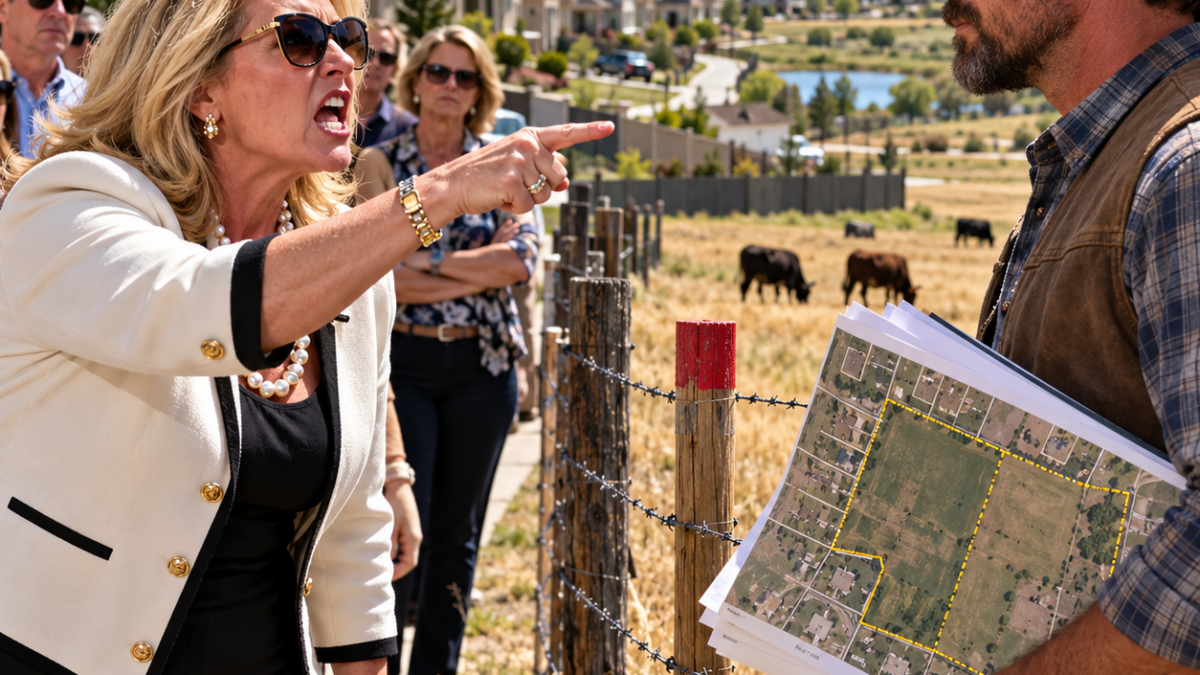
PART 2
The Fair Grove County Clerk’s office looked exactly like the kind of place where a secret could survive for twenty years simply because nobody wanted to dig through enough old paper to find it.
The next morning, I stood at a scratched laminate counter beneath fluorescent lights while a dusty ceiling fan turned lazily overhead.
A clerk named Marlene clicked through records on a computer that looked older than my first toolbox.
“Parcel number?”
“Eighty-two B.”
She typed.
Stopped.
Typed again.
Then leaned closer to the screen.
“Huh.”
That was not the sound I wanted to hear from a county employee looking at my property records.
“What?”
“Give me a second.”
She opened another database.
Then another.
Finally, she rotated the monitor toward me.
A boundary map filled the screen.
Five hundred acres outlined in blue.
Inside that outline sat almost the entire Crescent Ridge subdivision.
Roads.
Homes.
Clubhouse.
Pond.
Park.
Utilities.
All of it.
Marlene tapped the screen.
“According to this, the parcel was never subdivided by the recorded owner.”
“You mean Jasper.”
“Yes.”
“And it was never sold?”
She shook her head.
“No deed transfer.”
“Lease?”
“No.”
“Development agreement?”
“Nothing recorded here.”
“Easement?”
She searched again.
“There are two old agricultural access easements near the western boundary. Nothing that would authorize residential construction.”
I leaned both hands against the counter.
“You’re telling me somebody built a gated community on land they never bought?”
“I’m telling you what the records say.”
“What about taxes?”
“That’s another strange part.”
She pulled up the payment history.
“Paid every year.”
“By Crescent Ridge?”
“No.”
She squinted at the screen.
“Payments came from a trust account established about fifteen years ago. Jasper Maddox Land Trust.”
My uncle.
Whatever else had happened, Jasper had kept paying the taxes.
Every year.
Quietly.
Faithfully.
Long after luxury houses began appearing on his land.
“Could he have known?”
Marlene lifted one shoulder.
“The records can’t tell you that.”
“Can you print everything?”
“All of it?”
“All of it.”
She looked at me for a moment.
“Mr. Maddox, you need a property attorney.”
“I know one.”
“Get a good one.”
I smiled without humor.
“The one I know scares me a little.”
“Perfect.”
Carla Domings practiced real-estate law from an old brick building downtown, above a dentist and across from a pawn shop.
I knew her because four years earlier she had helped me recover nearly fourteen thousand dollars from a customer who refused to pay for a full restoration on a 1969 Camaro.
She had destroyed his excuses in thirty minutes.
Carla was five-foot-four, usually wore black, and possessed the social warmth of a framing hammer.
When I walked into her office carrying three folders and a rolled parcel map, she glanced at me over her glasses.
“Xavier Maddox.”
“Carla.”
“Last time I saw you, you were threatening to put a mechanic’s lien on a Camaro.”
“Worked, didn’t it?”
“It worked because I stopped you from doing three illegal things first.”
“Details.”
She pointed at the chair.
“What did you break now?”
“I inherited five hundred acres.”
That got half her attention.
“There’s an HOA subdivision built on it.”
That got the rest.
She slowly lowered her pen.
“Start over.”
So I did.
I showed her the deed.
Tax history.
Parcel map.
Photos from Crescent Ridge.
The gate.
The clubhouse.
The houses.
And finally Deborah Van Holt.
Carla didn’t interrupt for almost ten minutes.
Then she stood and walked to a bookshelf.
“What?”
“Quiet.”
She pulled down a thick reference volume, opened her laptop, and began searching.
I waited.
Five minutes later she whispered, “Oh, hell.”
“Good oh hell or bad oh hell?”
“There is no good version.”
She turned the laptop toward me.
“Your uncle’s title chain is clean. I’m not seeing any recorded conveyance from Jasper to a developer, HOA, builder, municipality, trust, or holding company.”
“So they don’t own it.”
“Slow down. We establish that in court. But right now, on the records I’m seeing, no—they do not appear to own it.”
I leaned back.
“How does a subdivision get building permits without proof of land ownership?”
“It shouldn’t.”
“But they did.”
“Yes.”
“So?”
“So somebody either made a catastrophic mistake…”
She looked at the documents again.
“…or somebody manufactured paperwork.”
The room suddenly felt colder.
“You think fraud.”
“I think we don’t use that word publicly until we have evidence.”
“You just used it.”
“I’m your lawyer. I get privileges.”
She tapped the parcel map.
“We file a quiet-title action. We ask the court to confirm ownership. At the same time, we demand every development document tied to Crescent Ridge—permits, zoning applications, deeds, utility approvals, variances, infrastructure agreements.”
“And then?”
“Then we discover what kind of monster you inherited.”
I looked at the map.
“What happens to the families?”
“That depends.”
“I’m not throwing innocent people into the street.”
“Good.”
“But I’m also not letting whoever did this walk away.”
Carla gave me the smallest smile.
“Also good.”
She leaned back in her chair.
“If your documents hold up, you have leverage. Serious leverage. But understand something, Xavier. People have spent millions of dollars based on the assumption that this development was legitimate. Banks financed homes. Families bought them. Contractors built infrastructure. The county issued permits. Once we challenge the foundation under all of that, everyone starts protecting themselves.”
“Meaning?”
“Meaning every lawyer within fifty miles is about to bill overtime.”
Two days later, Carla filed the quiet-title action.
Then the first threat arrived.
Not the kind involving broken windows or anonymous phone calls.
Those came later.
This one came on expensive legal stationery.
**CEASE AND DESIST.**
Crescent Ridge HOA accused me of harassment, trespassing, interfering with residents, and making “unsubstantiated ownership claims.”
Carla read the letter.
Then she laughed.
Not a chuckle.
A full laugh.
“What’s funny?”
“They’re accusing the record owner of trespassing on the recorded owner’s property.”
“So it’s useless?”
“No. It’s useful.”
“How?”
“It tells us they’re scared.”
She flipped to the second page.
“They want you intimidated before discovery begins.”
“I’m not intimidated.”
“I know. That’s one of your more dangerous personality defects.”
While Carla fought through the paperwork, I went back to the land.
This time I stayed away from the main entrance.
I followed the western boundary through woods and crossed behind what residents called the golf course, although it was really a private nine-hole layout wrapped around rows of houses.
For the first time, I understood how much money had been poured into Crescent Ridge.
Stone drainage channels.
Underground irrigation.
Decorative bridges.
Fiber-optic boxes.
Professional landscaping.
Someone had not built this place carelessly.
They had built it confidently.
That made the missing land purchase even harder to understand.
Near the southern boundary, I found something that wasn’t on the promotional map.
A high metal fence.
Fresh concrete around the posts.
Security cameras.
A generator building.
Utility cabinets.
A sign read:
**PRIVATE PROPERTY**
**HOA MAINTENANCE ACCESS ONLY**
I checked Carla’s parcel overlay.
The fenced utility lot wasn’t merely sitting on my land.
It sat beyond the original development footprint approved by the county.
I photographed everything.
The cameras.
The fencing.
The utility boxes.
The warning signs.
When I sent the pictures to Carla, she called immediately.
“Do not go inside that fence.”
“I didn’t.”
“Do not touch anything.”
“I didn’t.”
“And do not become one of those clients who says, ‘You never specifically told me not to climb through the window.’”
“No windows.”
“Xavier.”
“I’m leaving.”
The county began producing records the following week.
The first batch raised questions.
The second batch changed everything.
A man named Damon Cho met us in Carla’s office on a Tuesday afternoon.
He wore plain clothes and carried two thick file folders.
“District Attorney’s Office,” he said.
I looked at Carla.
She looked unsurprised.
“You called them?”
“I made inquiries.”
Cho sat down.
“We’re investigating possible permitting fraud associated with Crescent Ridge.”
He opened a folder.
“Several original applications reference a land conveyance from Jasper Maddox to a development entity.”
“There wasn’t one,” I said.
“We know.”
He slid a photocopy across the desk.
It looked like a deed.
My uncle’s name appeared at the bottom.
I knew instantly something was wrong.
Jasper’s signature on old birthday cards had always leaned sharply to the right.
This signature looked slow and upright.
Cho pointed at the notarization.
“According to this document, the transaction occurred eight years ago.”
“So?”
“The notary stamp used here had been retired five years before the date on this deed.”
Carla’s face changed.
Not dramatically.
Just enough.
“That’s forged.”
Cho nodded.
“That’s our preliminary conclusion.”
I stared at the page.
Someone hadn’t forgotten to buy my uncle’s land.
Someone had created a fake document pretending they had.
Cho continued.
“The developer used this deed when applying for permits.”
“Who?”
“Milstone Development.”
The name meant nothing to me then.
It would soon mean everything.
“Who signed the applications?”
“Several individuals. We’re sorting out who knew what.”
“And Deborah?”
“We’re looking at the HOA’s role.”
Carla crossed her arms.
“What about federal money?”
Cho looked at her.
“You already found that?”
“I saw an infrastructure-grant reference in the permit index.”
He nodded.
“Milstone and the HOA later used ownership documents when applying for infrastructure funds.”
“What does that mean?” I asked.
“If they knowingly used fraudulent documents transmitted electronically or through interstate banking systems…”
Carla answered before he could.
“Wire fraud.”
Cho nodded.
I sat back.
Until that moment, part of me had still believed there might be some ridiculous administrative explanation.
A lost deed.
A filing mistake.
An old agreement nobody recorded correctly.
That illusion disappeared.
My uncle’s land had not been accidentally developed.
Someone had lied to develop it.
And if Cho was right, they had kept lying afterward.
“What do you need from me?” I asked.
“Anything showing knowledge. Communications. Statements. Residents who were told specific things about ownership. HOA meeting material.”
I thought about the people who had watched Deborah confront me.
“Residents might talk.”
“Maybe.”
“They’ll talk if they understand they’re victims too.”
That Saturday, I did something Deborah probably hated more than any lawsuit Carla could file.
I invited the neighborhood to a barbecue.
I rented a pavilion outside Crescent Ridge on county parkland, bought enough burgers and hot dogs for a small army, and put flyers in every mailbox I was legally allowed to reach.
**MEET THE LANDOWNER.**
**NO LAWYERS. NO HOA SPEECHES. JUST QUESTIONS AND ANSWERS.**
About twenty people came.
Some stood with their arms crossed.
Some looked embarrassed.
Others looked frightened.
A retired firefighter named Anthony Mercer walked over while I was flipping burgers.
“You really own the ground?”
“That’s what the records say.”
“And our houses?”
“You own your house. The land underneath is the dispute.”
He rubbed his jaw.
“My wife is losing sleep.”
“I’m sorry.”
“She thinks you’re going to bulldoze the neighborhood.”
I nearly dropped the spatula.
“Who told her that?”
“HOA email.”
Of course.
I set the spatula down.
“Anthony, I have no intention of throwing families out. I want the people who created this mess held responsible.”
He watched me for several seconds.
“You mean that?”
“Yes.”
He finally nodded.
“I always thought something was strange about this place.”
“What?”
“How fast it got built.”
He glanced toward the other residents.
“The developer kept saying it was a ‘legacy development.’ Whenever anybody asked about the original landowner, we were told everything had been settled years ago.”
“Did you see a deed when you bought?”
“No. Title company handled everything.”
“Would you tell that to an investigator?”
Anthony looked back at me.
“If my family was lied to, I want to know who lied.”
By the end of the barbecue, six residents had agreed to speak with Cho.
Then the case exploded.
Two former county employees were charged.
One with forgery-related offenses.
Another with bribery.
Milstone executives were subpoenaed.
A former project manager named Roger Klene became a person of interest.
And Deborah Van Holt—the woman who had ordered me off my own land—was subpoenaed over documents bearing her signature.
Crescent Ridge went from polished suburb to panic zone almost overnight.
Emergency meetings were announced.
Then canceled.
Then rescheduled.
Rumors flew through neighborhood message boards.
Some residents blamed me.
Some blamed the county.
Most blamed the HOA.
Three houses were listed for sale within forty-eight hours.
Then Carla called.
“Court order came in.”
I was under a pickup replacing a rusted exhaust bracket.
I slid out.
“What order?”
“Quiet title.”
I sat up.
“And?”
“You won.”
For several seconds I didn’t speak.
Carla continued.
“The court recognizes your title to the parcel.”
“The whole five hundred?”
“The whole five hundred.”
I looked around my little rented garage.
Three service bays.
Peeling paint.
A coffee machine held together with electrical tape.
Five years of wondering whether I would make rent every month.
Somewhere forty minutes away, hundreds of people were living on land a judge had just confirmed belonged to me.
“What now?” I asked.
“Now,” Carla said, “you decide what kind of man you want to be.”
That question stayed with me.
Because legally, I had options.
Some aggressive.
Some destructive.
Some profitable.
But the people living in Crescent Ridge weren’t the ones who forged Jasper’s name.
They had taken mortgages.
Raised children.
Planted gardens.
Paid dues.
Trusted professionals who told them everything was legitimate.
I wanted accountability.
Not collateral damage.
So we started with the thing that belonged most clearly to the HOA itself.
The clubhouse.
The pool.
The tennis courts.
Those facilities occupied land for which the HOA could show no legitimate ownership interest whatsoever.
We served formal notice.
Thirty days to negotiate a lease or surrender possession.
The reaction was immediate.
The clubhouse was Crescent Ridge’s palace.
Wine tastings.
Holiday brunches.
Board elections.
Fundraisers.
Private parties.
Every petty rule Deborah ever issued seemed to have originated from that building.
And now a notice was taped to its front door stating that its continued use required permission from me.
Forty-eight hours later, the HOA sued me.
Their complaint claimed the clubhouse property had been “gifted in perpetuity for the benefit of Crescent Ridge residents.”
Carla read the sentence twice.
Then she laughed so hard she had to remove her glasses.
“What?”
“I admire desperation when it becomes creative.”
“Could it be true?”
“No.”
“How do you know?”
“Because gifts of real property leave paperwork.”
She slapped the complaint onto her desk.
“And because they somehow forgot this miraculous gift existed until two days after we threatened eviction.”
Their normal law firm had disappeared.
The new complaint came from a small out-of-town practice known for representing troubled developers.
Carla noticed immediately.
“They’re changing strategy.”
“To what?”
“Survival.”
Then she showed me the court order we had obtained that morning.
Financial discovery.
Ten years of HOA books.
Bank accounts.
Vendor contracts.
Assessment records.
Board expenditures.
Everything.
“If they collected money from residents to maintain property they knew they didn’t own,” Carla said, “we may be looking at misuse of funds.”
The word “may” lasted about twenty-four hours.
I went to the clubhouse with authorized access after counsel arranged entry during discovery.
Inside, everything smelled like lemon polish and chlorine.
The place was immaculate.
Too immaculate.
Almost staged.
The office contained rows of labeled filing cabinets.
I opened one marked **VENDOR CONTRACTS**.
Landscaping.
Pool maintenance.
Fountain services.
Security.
Road repair.
At first, nothing seemed strange.
Then I began noticing dates.
The same dates.
Again and again.
Then signatures.
The same handwriting.
One landscaping invoice claimed fifteen thousand dollars for “seasonal decorative mulch layering.”
Another listed thousands for “fountain calibration.”
I photographed each document as instructed.
Then I found a locked cabinet.
The authorized key opened it.
Inside were three folders.
**MILSTONE DEV**
**PERMIT ADJUSTMENTS**
And one marked only:
**DV**
I knew whose initials those were.
The DV folder contained bank statements.
Not HOA statements.
Personal ones.
Deborah Van Holt.
Transfers appeared from HOA-controlled accounts into accounts bearing her name.
At first, two hundred dollars.
Then five hundred.
Then eighteen hundred.
Then larger amounts.
One deposit for twenty-two thousand dollars carried the notation:
**SPECIAL ASSESSMENT OVERFLOW**
I stared at it.
Families had received letters threatening late fees and liens if they failed to pay special assessments.
Meanwhile, money labeled as “overflow” had apparently landed in Deborah’s private account.
I stopped touching the papers.
Called Carla.
And waited.
When she arrived, she examined three pages.
Her expression became hard.
“Photographs only. We preserve chain of custody and turn this over.”
“You think she stole it?”
“I think the investigators are about to become extremely interested.”
The Milstone folder was worse.
It contained correspondence between Deborah and Roger Klene.
Some of the pages looked like printouts of encrypted messages.
Others were ordinary emails.
One discussed keeping old permitting files “sealed.”
Another mentioned “legacy ownership exposure.”
Then I found the sentence that erased any remaining doubt.
**If the county audits us, we’re finished.**
Carla read it.
“Call Cho.”
By sundown, the documents were in the hands of investigators.
Within days, federal agents joined the case.
Special Agent Marston from the Department of Justice financial-crimes team met us in a plain conference room.
He had the posture of a man who wasted neither movement nor words.
“These records change the scope,” he said.
“How much?”
“Potential bank fraud. Mail fraud. Wire fraud. Coordinated misuse of HOA funds.”
Carla leaned forward.
“Racketeering?”
“Possibly.”
I looked between them.
“RICO?”
Marston nodded once.
“If we establish an ongoing enterprise involving multiple people committing qualifying offenses, yes.”
The word sounded unreal.
I had inherited land.
Now federal investigators were discussing racketeering.
Subpoenas hit Crescent Ridge the following morning.
The HOA board’s control over finances was suspended.
Dues were frozen.
Records were seized.
The clubhouse was sealed temporarily.
News vans appeared outside the gate.
I avoided cameras.
Carla handled public statements.
Her message never changed.
“The legitimate homeowners of Crescent Ridge are not Mr. Maddox’s enemy. He intends to provide residents a fair legal path forward. The investigation concerns those responsible for the fraudulent development and financial misconduct.”
That mattered.
Because fear was spreading.
Parents wondered whether their houses were worthless.
Retirees wondered whether they had lost their life savings.
Young couples wondered whether banks would call their mortgages.
I knew what it was like to have nothing stable beneath you.
I wasn’t going to use that fear as a weapon.
Then Greg Penner called.
Greg was vice president of the HOA board.
He wanted immunity.
We met in Carla’s office with a recorder running.
Greg looked like he had aged ten years in two weeks.
His shirt collar was wrinkled.
His eyes were bloodshot.
His hand shook while he poured water.
“I didn’t know about the deed,” he said.
Carla didn’t react.
“I joined the board three years ago. Deborah controlled historical records.”
“Then explain this.”
Carla slid a meeting minute across the table.
The board had approved a large dues increase the previous year.
Purpose:
**LEGACY LAND TAX OBLIGATIONS.**
“What land taxes?” Carla asked.
Greg swallowed.
“Deborah said there were old county balances.”
“Did you verify them?”
“No.”
“You approved hundreds of thousands of dollars in assessments without confirming the debt?”
“She told us the matter was sensitive.”
“What does that mean?”
“She said questioning it could expose the HOA to litigation.”
I leaned forward.
“Greg, were those assessments actually paying taxes?”
He looked down.
“I don’t know.”
“You were vice president.”
“I know.”
His voice cracked.
“I know.”
For the first time, I saw less of an HOA board member and more of a frightened man who had signed documents he never bothered to understand.
That didn’t excuse him.
But guilt had degrees.
Carla offered him exactly what she offered everyone else.
Tell the truth.
Provide records.
Cooperate.
Let prosecutors decide the rest.
Greg did.
His testimony filled several gaps.
Deborah had controlled vendor selection.
Deborah had discouraged audits.
Deborah had repeatedly told board members that historic property documents were confidential.
Deborah had pushed emergency assessments through with minimal discussion.
And when residents questioned her, she reminded them that nonpayment could result in liens.
Two weeks later, Deborah Van Holt walked out of an upscale fitness club wearing a white tennis skirt and oversized designer sunglasses.
Three unmarked vehicles were waiting.
Residents later sent me videos.
An agent approached.
Deborah stepped backward.
Another agent came around the other side.
The sunglasses came off.
The handcuffs went on.
For years she had issued violation notices over trash cans, mailbox colors, lawn height, fence stains, basketball hoops, and flower beds.
Now she was standing beside a government sedan while an agent read charges involving fraud, conspiracy, and embezzlement.
I expected satisfaction.
Instead, I mostly felt tired.
Anthony called me.
“You watching?”
“No.”
“She’s under arrest.”
“I heard.”
There was a pause.
“I thought you’d sound happier.”
“She didn’t do this alone.”
I was right.
Roger Klene vanished before investigators could arrest him.
For almost a week nobody knew where he was.
Then federal agents found him in Nevada preparing to board a private aircraft.
That arrest changed the mood.
People who had been afraid to speak began calling investigators.
Former subcontractors.
Bookkeepers.
A title-office employee.
Two old Milstone staffers.
Even residents.
At the next community meeting, nearly every chair was filled.
Carla and I stood at the front of the room.
I had expected hostility.
Instead, an elementary-school teacher named Denise Walker raised her hand.
“I’ve paid HOA dues for six years,” she said. “I followed every rule because I thought that was what protected the neighborhood.”
She looked around.
“My husband and I didn’t steal this land. None of these families did.”
“No,” I said. “You didn’t.”
“But I don’t want another HOA.”
People murmured.
Denise continued.
“I don’t want another person like Deborah deciding they own the community because they control the paperwork.”
Someone clapped.
Then another.
Within seconds, half the room joined.
Carla explained the legal mechanism for dissolution.
It wouldn’t happen by magic.
There were votes.
Notices.
Legal procedures.
Resident approvals.
But Crescent Ridge had something most neighborhoods never had.
A shared enemy that had managed to make everyone equally angry.
By the end of the month, the required votes were secured.
Crescent Ridge HOA was dissolved.
I expected to feel victorious.
Instead, watching residents sign the final papers felt strangely emotional.
These were people who had once watched me from their porches like I was an intruder.
Now Anthony stood beside me.
Denise brought coffee.
Kids chased each other across the lawn while parents discussed road maintenance.
For eight years, Crescent Ridge had technically been a subdivision.
That evening, it became a neighborhood.
Carla helped me establish a land trust.
Residents could lease the ground beneath their homes for modest rates while we worked through long-term options.
Nobody faced surprise eviction.
Nobody was charged predatory rent.
Money collected by the trust went toward roads, water systems, common areas, and infrastructure.
The books were public to residents.
Every expenditure documented.
Every annual budget reviewed.
No private “emergency assessments.”
No mystery vendors.
No president with unchecked access to community funds.
People still argued.
Of course they did.
One meeting lasted forty minutes because two neighbors disagreed about replacing maple trees near the walking trail.
But they argued in public.
With numbers everyone could see.
That was progress.
I kept fifty acres near the northern ridge for myself.
There was an old rise overlooking most of the property.
I built a modest house there.
Nothing enormous.
Three bedrooms.
Wide porch.
Tin roof.
And behind it, the workshop I had wanted since I was twenty-two.
Four lifts.
Paint booth.
Machine area.
Enough floor space for full restorations.
I called it Maddox Custom Garage.
Word spread.
Apparently being “the mechanic who accidentally inherited the ground underneath an entire subdivision” was excellent advertising.
Within six months I had a waiting list.
One chilly morning, I heard tires crunching over my gravel driveway.
Anthony stepped out carrying a cardboard box.
“What’s that?”
“Neighborhood conspiracy.”
“I’ve had enough conspiracies.”
“This one’s legal.”
He handed me the box.
Inside was a wooden plaque.
Hand-carved.
Nothing fancy.
**XAVIER MADDOX**
**HE STOOD HIS GROUND AND LET US KEEP OUR HOMES**
I read it twice.
Anthony shifted awkwardly.
“Denise wanted something longer.”
“Of course she did.”
“We voted her down.”
I laughed.
Then I looked at the plaque again.
“Tell everybody thank you.”
“You tell them Saturday. Cookout.”
“Another one?”
“Apparently you started a tradition.”
After he left, I hung the plaque above my workbench.
I thought the story was over.
It should have been.
Deborah was charged.
Milstone was under investigation.
The HOA was gone.
Residents were safe.
My land was secure.
I had my garage.
For the first time in years, my life felt like it had stopped fighting me.
Then Carla called at 5:42 one morning.
I answered half asleep.
“This better involve fire.”
“It involves half a million dollars.”
I sat up.
“Whose?”
“That’s what we’re trying to determine.”
The forensic audit of Crescent Ridge finances had uncovered seven years of payments to a company that did not appear to exist.
The invoices called them **contracted utility services**.
The company had no state registration.
No public office.
No tax identification number matching the records.
No employees anyone could identify.
Yet the HOA had wired nearly half a million dollars through an intermediary account.
“Where?”
Carla hesitated.
“Cayman Islands.”
That woke me completely.
“So Deborah was sending dues offshore?”
“We don’t know exactly whose money ended up where.”
“But this is bigger.”
“Yes.”
“How much bigger?”
“Financial Crimes is coming back.”
By noon, federal investigators had reopened sealed records.
Marston met us at a county evidence facility.
Computer screens covered one wall.
Bank statements filled another.
He handed Carla several pages.
“Crescent Ridge wasn’t just being skimmed.”
“What was it being used for?” I asked.
“A washing machine.”
I stared at him.
“For money?”
He nodded.
“Transactions from unrelated real-estate deals flowed through shell entities connected to vendors billing Crescent Ridge. Money was mixed with legitimate community expenditures, routed through intermediary accounts, then dispersed.”
Carla’s arms folded slowly.
“Laundering.”
“That’s where the evidence points.”
“How many developments?”
“Three with nearly identical payment structures so far.”
“So Crescent Ridge wasn’t unique.”
Marston shook his head.
“No.”
That bothered me more than anything else I had heard.
All this time I had thought my uncle’s property had attracted one crooked developer and one power-hungry HOA president.
But what if Crescent Ridge had been a model?
What if somebody had done this before?
A decrypted email provided the answer.
It mentioned a zoning inspector.
A payoff.
A consulting arrangement after retirement.
Then another message contained the Milstone name again.
Milstone wasn’t just the developer associated with Crescent Ridge.
It was connected through partnerships and shell companies to several projects across the state.
The next evening, I drove the southern boundary.
I wanted to look at the fenced utility lot again.
The place bothered me.
It always had.
A black SUV sat beside the access road.
Its engine was running.
I slowed.
The driver’s window lowered.
“Easy,” Anthony said.
I exhaled.
“What are you doing out here?”
“Waiting for you.”
“That sounds healthy.”
“A guy came to my house.”
“When?”
“This morning.”
My humor disappeared.
“What guy?”
“Fifty-something. Expensive suit. Drove a Mercedes.”
“What did he want?”
“He asked whether I’d consider selling my lot.”
“To who?”
“He said ‘interested parties.’”
“The HOA doesn’t exist anymore.”
“I told him.”
Anthony reached into the passenger seat and handed me a card.
White.
No phone number.
No address.
Nothing on the front.
On the back, one word was embossed in silver.
**MILSTONE**
My skin went cold.
“Did he threaten you?”
“No.”
“Did he give you a number?”
“No.”
“Name?”
“No.”
“That wasn’t an offer.”
“What was it?”
I turned the card over.
“They’re checking who’s scared.”
Carla agreed.
The next morning, we filed an emergency petition asking the county to freeze active development permits tied to Milstone while the fraud investigation proceeded.
We included financial records.
Decrypted communications.
Shell-company information.
Within forty-eight hours, pending Milstone applications were suspended.
Then somebody broke into Carla’s office.
They didn’t steal computers.
Didn’t take cash.
Didn’t remove case files.
They smashed furniture.
Broke a window.
And poured bleach across boxes of copied documents.
Carla called me from the sidewalk.
When I arrived, glass covered the carpet.
A filing cabinet had been overturned.
The air smelled chemical and sharp.
“You okay?”
“I wasn’t here.”
“What did they take?”
“Nothing we can tell.”
“Then why do it?”
She stared through the broken window.
“To make sure we understand they can reach the room.”
Two days later, my mailbox was torn open.
Inside were shredded photographs.
I pieced three together on my workbench.
My garage.
My porch.
My truck.
Somebody had photographed my property from the road.
Then one of the Crescent Ridge residents found all four tires slashed.
A note had been tucked under her windshield wiper.
**STAY QUIET.**
That changed things.
Until then, this had been fraud.
Ugly.
Expensive.
Criminal.
Now somebody was trying to frighten witnesses.
Marston took it seriously.
Cameras went up around my property.
Additional patrols began near Carla’s office.
Residents were told to report unfamiliar vehicles.
I started leaving my porch lights on.
For the first time since the case began, I wondered whether I had underestimated these people.
One night I sat alone on my porch overlooking Crescent Ridge.
Lights glowed in hundreds of windows.
Families ate dinner in houses that had become evidence in a federal investigation.
A dog barked somewhere near the park.
A lawn sprinkler clicked.
Everything looked ordinary.
That was the frightening part.
Organized wrongdoing rarely looks like a movie.
Sometimes it looks like clean streets.
Fresh mulch.
A polished clubhouse.
Perfect accounting folders.
People smile.
Forms get signed.
Money moves.
And anybody who asks the wrong question gets told they are causing trouble.
I thought about Uncle Jasper.
Had they threatened him?
Had he known?
Why hadn’t he stopped them?
I had no answer.
The next break came from Roger Klene.
Damon Cho called me shortly after lunch.
“We got cooperation.”
“From who?”
“Klene.”
I stopped tightening a bolt.
“The developer?”
“Former project manager.”
“What happened?”
“He wants a deal.”
“Why?”
“Because he’s terrified.”
Cho told me Klene had begun naming people.
County employees.
Contractors.
Developers.
Consultants.
A city councilman who allegedly helped move zoning changes.
“He says Milstone executives told him nobody could ever talk.”
“Or what?”
Cho paused.
“Klene claims one of them told him they’d bury him in a foundation pour.”
I stared across my workshop.
“That serious?”
“He believed it.”
“What’s he getting?”
“Reduced exposure if he provides substantial assistance. Protective measures if necessary.”
“And his testimony?”
“It may give federal prosecutors enough to pursue a broader racketeering case.”
Three mornings later, Milstone headquarters was raided.
Helicopter footage was on the evening news.
Agents carrying evidence boxes.
Executives escorted out.
Computers seized.
Doors sealed.
The photographs spread everywhere.
For weeks I had tried not to enjoy watching people fall.
That morning, I made an exception.
Not because I wanted revenge against everyone inside that building.
Because somebody there had written a plan that depended on ordinary people being too poor, too frightened, or too exhausted to fight back.
At the garage, Anthony arrived carrying sandwiches.
“From the neighborhood.”
“You people know I can cook, right?”
“Denise says mechanics forget to eat.”
“She teaching now or running my life?”
“Both.”
Residents began dropping things at Carla’s office.
Coffee.
Food.
Cards.
One elderly woman knitted a small quilt with **TRUTH PREVAILS** stitched across the center.
Carla hung it behind her desk.
“You becoming sentimental?” I asked.
“Say that again and I bill you for this conversation.”
For the first time in months, we laughed without forcing it.
But one mystery remained.
The fenced utility compound.
We had asked repeatedly for detailed access records.
The utility board cited safety rules.
Restricted systems.
Infrastructure concerns.
Carla kept pushing.
After the Milstone raid, opposition vanished.
Federal agents obtained access.
I went with them only because the land was mine and because Marston believed I might identify older property features.
We entered through the metal gate.
The generator shed looked ordinary.
Concrete floor.
Electrical panels.
Backup systems.
Fuel monitoring equipment.
Then one agent noticed that the rear wall dimensions didn’t match the exterior measurements.
They removed a panel.
Behind it was another wall.
And a narrow door.
The stairwell beyond dropped underground.
Nobody spoke.
At the bottom was a concrete room.
Filing cabinets lined two walls.
Server equipment sat behind a cage.
Several hard drives were connected to a dormant local network.
Marston stopped me at the entrance.
“Don’t touch anything.”
“For once, I wasn’t planning to.”
The technology team worked for hours.
By evening they had recovered directories of old planning files.
Alternate surveys.
Internal memos.
Draft permits.
Corporate correspondence.
The truth had been sitting underground less than a mile from families paying HOA dues.
And it was worse than anything I had imagined.
Milstone knew the land belonged to Jasper.
They had known before the first road was cut.
Internal surveys identified him by name.
Emails discussed attempts to contact him.
One memo described him as:
**elderly, isolated, low probability of active challenge.**
I read that sentence until the words blurred.
They hadn’t overlooked my uncle.
They had profiled him.
They believed he was weak.
Another memo outlined the strategy.
Develop quickly.
Create a paper trail.
Maintain possession.
Delay ownership disputes.
Prepare an adverse-possession theory if necessary.
The details were messy and legally questionable, but the intention was clear.
Build enough.
Wait long enough.
Make the development so expensive and complicated that whoever challenged it would be crushed by the cost of fighting.
“They were counting on Jasper dying,” I said.
Marston looked at the document.
“Yes.”
“And without heirs.”
“That appears to have been part of their assumption.”
I felt something inside me change.
Until then, the case had been business.
Even the threats felt like part of a fight I had chosen.
But reading my uncle reduced to a risk calculation made it personal in a way Deborah’s insults never had.
Jasper may have been difficult.
Silent.
Distant.
Stubborn.
But he had been family.
And these people had looked at an aging man living alone and decided his isolation made him easy to erase.
Then the agents found a memo dated only two months before Deborah’s arrest.
It concerned me.
**MADDOX HEIR**
I read it standing beneath fluorescent lights in that underground room.
The memo stated that if the new Maddox owner would not cooperate, Milstone should increase pressure through regulatory complaints, litigation expenses, and community opposition.
The final sentence said:
**If he resists, bury him in litigation until he folds. We have done it before.**
I handed the page back to Marston.
“Done it before.”
He nodded.
“That line matters.”
“To the other developments?”
“Yes.”
“How many people did they do this to?”
“We’re finding out.”
I walked outside.
Night had fallen.
The generator compound lights cast hard shadows across the fence.
Beyond it, Crescent Ridge looked peaceful.
I called Carla.
“They knew.”
“I heard.”
“They knew about Jasper.”
“I know.”
“They knew about me.”
“Yes.”
“They planned all of it.”
Carla was quiet.
Then she said, “And now we can prove it.”
That was the real revenge.
Not shouting at Deborah.
Not locking the clubhouse.
Not collecting rent.
Proof.
Documents.
Signatures.
Transfers.
Witnesses.
Their own words.
The kind of evidence arrogance leaves behind when powerful people become convinced nobody will ever see inside the locked cabinet.
The federal case expanded.
Five additional developments came under investigation.
Thirty-nine defendants were eventually named across related proceedings and indictments.
The trials would take years.
Some people fought the charges.
Some cooperated.
Some blamed subordinates.
Some claimed they had signed documents without understanding them.
I stopped trying to follow every excuse.
My responsibility was Crescent Ridge.
And Crescent Ridge had begun changing faster than I expected.
The old clubhouse reopened after the evidence hold ended.
Residents voted to make it a community center.
No private board lounge.
No president’s office.
No locked records room.
Children used one space for tutoring.
Retirees organized card nights.
Anthony ran a first-aid class once a month.
Denise started a free book exchange near the front entrance.
A wall that had once displayed HOA violation policies now held community notices.
Lost dog.
Babysitter available.
Garage sale.
Food-drive donations.
Road-maintenance schedule.
Normal things.
Human things.
Nobody received a fine for leaving their trash can visible six hours too long.
Nobody got threatening letters over the shade of brown on a fence.
Nobody had to request permission before planting flowers.
Shared infrastructure still had to be paid for.
Roads didn’t repair themselves.
Water systems still required maintenance.
But the residents could see every dollar.
The land trust published expenses.
Three bids were required for major work.
Community meetings were recorded.
No vendor was approved without ownership information.
Nobody ever wanted another secret again.
Eventually, residents began asking about purchasing their individual land parcels.
I could have demanded market value.
The property had increased dramatically in value after the title issues stabilized.
I could have made more money than I ever expected to see.
Carla showed me projections.
Then I looked at the names.
Anthony.
Denise.
Young families.
Retirees.
People who had already paid mortgages for homes they believed included legitimate land rights.
I remembered the first barbecue.
The fear in their faces.
I closed Carla’s spreadsheet.
“I’m not making them pay twice for someone else’s crime.”
She studied me.
“You understand you’re giving up a lot of money.”
“I’ll survive.”
“You could sell each parcel at current market value.”
“I know.”
“You could be extraordinarily wealthy.”
“I have a house.”
“Yes.”
“A garage.”
“Yes.”
“Enough land.”
“More than enough.”
“And nobody can raise my rent.”
She smiled.
“True.”
We designed an option that allowed qualifying residents to purchase long-term interests at reduced values based on circumstances, with payment structures that did not force families out.
Some preferred to lease.
Some bought.
Some moved.
But for once, each decision was made with honest paperwork.
No forged deeds.
No hidden clauses.
No fake tax obligations.
No one telling them not to ask questions.
One afternoon, Denise came to my garage with her husband.
They had signed their final documents.
She held the folder against her chest.
“So that’s it?”
“That’s it.”
“We actually own what they told us we owned six years ago?”
“This time you have paperwork that isn’t fictional.”
Her husband laughed.
Denise didn’t.
Her eyes filled with tears.
“I used to think Deborah was protecting property values.”
I leaned against the workbench.
“A lot of people did.”
“I defended her once.”
“You didn’t know.”
“She fined my neighbor three hundred dollars because his wife was getting chemotherapy and he let their grass grow too high.”
I didn’t know what to say.
Denise wiped her cheek.
“I never apologized to them.”
“So apologize.”
“They moved.”
“Call them.”
She nodded.
Then she smiled a little.
“You always make things sound simple.”
“They usually aren’t.”
“No.”
She looked at the folder.
“But sometimes they should be.”
After she left, I thought about that.
Sometimes fairness isn’t complicated.
People make it complicated because complexity gives dishonest people places to hide.
Jasper understood land.
I think that was why he never sold.
He trusted dirt more than contracts.
Maybe he had learned enough about people to know why.
Months later, an estate archivist helping with the remaining trust records found a sealed envelope in one of Jasper’s safe-deposit boxes.
My name was written on the front.
Not typed.
Written.
I recognized his handwriting immediately.
Sharp.
Leaning right.
The same handwriting that proved the forged deed had always looked wrong to me.
I sat alone at my kitchen table before opening it.
Inside was a single sheet.
Jasper had never wasted words.
The letter was exactly what I would have expected from him.
**Xavier,**
**If you’re reading this, the land is yours.**
**I kept it because my father kept it, and his father before him. People have tried to buy pieces of it for years. Some people think anything can be taken if the owner is tired enough.**
**Don’t become like them.**
**Land is useful only if the people on it can live with themselves.**
**Do what seems fair.**
**—Jasper**
I sat there for a long time.
He knew.
Maybe not everything.
But enough.
He knew people wanted the land.
He knew somebody might pressure whoever came after him.
And for reasons I would never completely understand, he trusted me with the decision.
The next morning, I took the letter to the ridge.
Fog sat low over Crescent Ridge.
Porch lights blinked off one by one as people woke.
School buses moved along the main road.
Somewhere below, Anthony was probably already awake.
Denise would soon be getting ready for school.
The neighborhood wasn’t perfect.
No neighborhood is.
Two residents were currently feuding over a drainage ditch.
Someone kept leaving dog waste near the walking trail.
The community board had spent three meetings arguing about whether the park needed another trash can.
I loved every ridiculous problem.
Because those were normal problems.
Nobody was stealing land.
Nobody was laundering money.
Nobody was threatening witnesses.
Nobody was hiding forged deeds underground.
Normal felt luxurious.
The legal consequences continued in the background.
Deborah eventually appeared in court without the designer sunglasses.
The first time I saw her again, she looked smaller.
Not physically.
Just stripped of the authority she used to wear around her like armor.
Her lawyer asked whether I would submit a victim-impact statement regarding the financial losses tied to the land and the interference with my rights.
I wrote one.
I didn’t ask for cruelty.
I didn’t ask the judge to destroy her life.
I wrote about Anthony.
Denise.
The families threatened with assessments.
The residents who believed their homes might disappear.
I wrote about Uncle Jasper’s forged signature.
I wrote about ordinary people being treated as revenue sources and obstacles.
Then I wrote the final sentence:
**The worst thing they stole was not money or land. It was the belief that the rules applied equally to everyone.**
Carla read it.
For once she didn’t make a joke.
“Keep that sentence.”
At sentencing-related proceedings, Deborah admitted enough of her conduct that the performance finally ended.
No clipboard.
No cold smile.
No speeches about protecting the community.
Just facts.
Unauthorized transfers.
False representations.
Coordination with others.
The woman who once told me I was “upsetting the community” had helped nearly destroy it.
Roger Klene’s cooperation exposed more names.
Several county officials lost pensions or positions depending on their conduct and the eventual outcomes of their cases.
Milstone collapsed under litigation, asset freezes, investigations, and creditor claims.
Projects stalled.
Executives who once believed lawsuits were weapons discovered what it felt like to answer subpoenas themselves.
I never got joy from every arrest.
But I did feel something each time another piece of the network fell.
Closure.
Not the dramatic kind.
Something quieter.
Like removing rusted bolts one at a time until a broken part can finally be replaced.
The fenced utility site was eventually cleared of Milstone’s hidden records infrastructure.
The underground room remained.
Residents debated what to do with it.
Anthony wanted to seal it permanently.
Denise wanted to turn it into an archive.
Someone suggested a wine cellar.
That suggestion received exactly one vote.
Mine.
Eventually, we kept a small section as secure storage for community infrastructure documents.
The rest was filled and closed.
“No secret rooms,” Denise said.
“Agreed.”
At the first spring festival after the last major Milstone indictments, the old golf course looked nothing like the place I had first walked through while checking boundary lines.
Food trucks lined the path.
Kids ran between inflatable games.
A local band played classic rock from a temporary stage.
Anthony grilled enough meat to feed three counties.
The clubhouse doors were propped open.
No security guard checked addresses.
No resident badges.
No board members guarding the entrance.
Carla stood beside me drinking lemonade.
“You ever think it would turn into this?”
“No.”
“What did you expect?”
“Lawsuits.”
“You got those.”
“Headaches.”
“Definitely got those.”
“Maybe a check.”
Carla laughed.
“And instead?”
I looked around.
A group of teenagers were helping an elderly man carry folding chairs.
Two women who had once screamed at each other during a land-trust meeting were serving desserts at the same table.
Children fed ducks at the pond.
Anthony saw me watching and raised his spatula like a salute.
“I got a neighborhood.”
Carla nodded.
“You gave them one.”
“No.”
I watched Denise chasing two students away from an electrical cable near the stage.
“They did that.”
Carla took another sip.
“You gave them room.”
Maybe.
Toward sunset, the band stopped.
Someone tapped a microphone.
I immediately became suspicious.
Anthony stepped onto the stage.
“Xavier!”
“No.”
People laughed.
“Get up here.”
“No speeches.”
“That’s why you need to come up.”
I shook my head.
The crowd started clapping.
Carla shoved me.
“You bill by the hour and this is what I get?”
“Move.”
I walked onto the stage.
Anthony handed me the microphone.
I stared at several hundred faces.
Some familiar.
Some new.
I remembered many of them watching me from their porches the first day.
I remembered Deborah pointing toward the gate.
**You’re upsetting the community.**
Funny how things change.
Anthony held up another wooden plaque.
“Oh, come on.”
“This one wasn’t my idea.”
Denise yelled from the crowd.
“It was absolutely his idea!”
More laughter.
Anthony turned the plaque around.
It said:
**CRESCENT RIDGE**
**ESTABLISHED BY DEVELOPERS**
**SAVED BY ITS RESIDENTS**
**STILL STANDING BECAUSE ONE MAN REFUSED TO LEAVE HIS OWN LAND**
I covered my eyes.
“You people are terrible.”
“Speech!” somebody shouted.
“No.”
“Speech!”
I looked at Carla.
She looked delighted by my suffering.
So I raised the microphone.
“The first time I came through that gate, your HOA president told me I didn’t belong here.”
The crowd quieted.
“She was right about one thing.”
Anthony raised an eyebrow.
“I didn’t belong here.”
A few people looked confused.
“This wasn’t my community. I didn’t build these houses. I didn’t raise kids on these streets. I didn’t spend years paying mortgages here. I was just the guy whose name happened to be on an old deed.”
I looked toward the homes visible beyond the trees.
“But a deed can tell you who owns land.”
I paused.
“It can’t tell you who makes a place worth living in.”
Nobody moved.
“I spent most of my life fixing machines. And with machines, when something breaks, you usually have two choices. Hide the damage and hope it lasts…”
I smiled.
“…or tear the bad part out and rebuild it correctly.”
Someone clapped.
“This place had a lot of bad parts.”
Laughter.
“Some of them are currently talking to federal prosecutors.”
Bigger laughter.
“But the houses weren’t the problem. The families weren’t the problem. The people who asked questions weren’t the problem.”
I found Denise in the crowd.
Anthony.
Greg too, standing near the back. His cooperation had spared him the worst legal consequences, though he would carry the embarrassment for a long time.
“The problem was that a few people decided ownership meant control, authority meant secrecy, and ordinary people were too distracted to notice.”
I lowered the microphone slightly.
“They were wrong.”
Applause rolled across the lawn.
“And for the record…”
I pointed toward Anthony’s grill.
“…whoever burned those ribs should be investigated next.”
Anthony shouted something unprintable.
The whole crowd broke apart laughing.
That was the moment I knew it was over.
Not legally.
Courts would continue.
Appeals would continue.
Accounting claims would continue.
But in the way that mattered, Milstone had lost.
They had planned to take five hundred acres because they thought an old man was alone.
They forged documents because they thought paper could manufacture truth.
They built houses because they thought construction could manufacture ownership.
They created an HOA because they thought authority could manufacture obedience.
They hid money because they thought complexity could manufacture invisibility.
They threatened people because they thought fear could manufacture silence.
And then they made one mistake.
They assumed everybody would stay isolated.
I inherited land.
Anthony brought witnesses.
Denise brought residents together.
Carla brought the law.
Cho brought the evidence.
Marston followed the money.
Even Greg, after years of looking the other way, eventually brought testimony.
That was what destroyed Milstone.
Not me.
People comparing notes.
People opening files.
People refusing to shut up.
People deciding their neighbor’s problem might someday become theirs.
Late that night, after the festival ended, I walked alone toward the ridge above Crescent Ridge.
The music had stopped.
Food trucks were gone.
Workers folded the final tables.
Below me, porch lights glowed across the hillside.
Eight years earlier, those lights had illuminated houses built on a lie.
Now they looked different.
Not because the houses had changed.
Because the truth underneath them had.
My phone buzzed.
A payment notification from the land trust.
Quarterly lease receipts.
I laughed.
Technically, the title everybody loved was true.
I inherited five hundred acres.
Found an entire subdivision sitting on them.
And now some residents paid me rent.
But the rent was never the victory.
The victory was that nobody was being robbed anymore.
The money kept the roads paved.
The water flowing.
The community spaces maintained.
And every resident could see exactly where each dollar went.
I sat on the grass.
Pulled Jasper’s letter from my jacket.
I carried it more often than I admitted.
**Don’t become like them.**
That sentence mattered more than the deed.
It would have been easy to become greedy.
Easy to look at frightened homeowners and see dollar signs.
Easy to tell myself that because something terrible had been done to my family, I was entitled to squeeze everything possible from people who had nothing to do with it.
That would have made me a different version of Milstone.
They saw land first and people second.
Jasper’s letter reminded me to reverse the order.
I folded it again.
Wind moved through the trees.
Down below, somebody laughed on a porch.
A dog barked.
A garage door closed.
Normal sounds.
The following summer, I finished restoring a 1970 Chevelle for a customer from Tennessee.
When he arrived to pick it up, he stood outside my shop staring down at Crescent Ridge.
“This the famous HOA place?”
“That depends.”
“The one built on your property?”
“Yeah.”
He whistled.
“So all those people pay you rent?”
“Some.”
He grinned.
“Man, if that were me, I’d charge them everything they could afford.”
I looked at him.
“Then I’m glad it wasn’t you.”
His grin faded.
I handed him the keys.
He never brought it up again.
Years from now, most people probably won’t remember Milstone.
They won’t remember the forged deed.
They won’t remember Deborah’s sunglasses.
They won’t remember the news vans.
Maybe somebody will buy one of the houses and never know why the neighborhood records are unusually transparent.
Maybe children growing up there will think community meetings have always been open.
Maybe they’ll wonder why older residents react so strongly whenever somebody suggests creating another HOA.
That’s fine.
The best victories don’t always need monuments.
Sometimes the evidence of victory is simply that life becomes boring again.
My garage became successful enough that I hired three mechanics.
Then five.
I bought the small neighboring parcel to expand—not because I needed more land, which Carla found hilarious, but because I wanted room for a restoration school.
We partnered with a local vocational program.
Teenagers came out twice a week.
I taught them welding.
Engines.
Electrical systems.
How to diagnose a problem before throwing parts at it.
Anthony volunteered occasionally despite knowing almost nothing about cars.
Mostly he told firefighter stories and stole donuts.
Denise arranged student visits.
Carla never volunteered.
She said children made her nervous.
Nobody believed her.
At Christmas, Crescent Ridge held a neighborhood dinner inside the former HOA clubhouse.
Someone hung mistletoe over the exact doorway where the old rule board had once been posted.
I walked inside carrying two trays of food.
Anthony pointed at the wall.
“Remember when this place had seventeen pages of facility regulations?”
“Only seventeen?”
“Deborah added three after you showed up.”
“Glad I inspired her.”
Denise overheard us.
“She actually held a special meeting after your first visit.”
“What for?”
“To discuss ‘hostile external ownership claims.’”
I stared at her.
“You’re kidding.”
“No.”
“What did she say?”
“That you were attempting to destabilize the neighborhood.”
Anthony laughed.
“Technically true.”
Denise shook her head.
“No. He destabilized the criminals.”
I looked around the room.
Children ran between tables.
A group of older residents played cards.
Someone had set up a projector showing pictures from the spring festival.
I thought about the first time I had entered this building.
Locked doors.
Perfect files.
Hidden bank statements.
Fear beneath polish.
Now the office Deborah once used had been converted into a tutoring room.
Her desk was gone.
Her filing cabinet was gone.
The wall behind it was covered in drawings from children.
One showed a house.
A tree.
A huge yellow sun.
And four stick figures holding hands.
Across the top, in crooked letters:
**MY NEIGHBORHOOD**
I stood there longer than I meant to.
Denise came beside me.
“You okay?”
“Yeah.”
“You look like you’re about to cry.”
“Grease in my eye.”
“You’re ten feet from the garage.”
“Persistent grease.”
She smiled.
“You did good, Xavier.”
I shook my head.
“We did okay.”
“No.”
She pointed at the drawing.
“That family almost moved when the scandal started.”
I knew them.
Young couple.
Two daughters.
“They thought they were going to lose everything,” she said. “They stayed because of the lease plan.”
I swallowed.
“Good.”
“Their oldest drew that.”
I looked again.
My neighborhood.
Not my HOA.
Not my property.
Not my investment.
My neighborhood.
Maybe Uncle Jasper would have understood.
Maybe that was exactly what he meant.
**Land is useful only if the people on it can live with themselves.**
That night I drove home slowly.
At the top of the ridge, I stopped.
The subdivision spread below me.
Five hundred acres had changed my life.
But not because the land was valuable.
Not because people paid rent.
Not because Milstone lost.
It changed my life because for the first time, I understood the difference between owning something and deserving it.
Milstone had papers saying they owned what they didn’t.
Deborah had authority she used like ownership.
I had a legal deed.
But none of those things, by themselves, made anybody worthy of control.
What mattered was what you did once power landed in your hands.
They used power to take.
I decided to use mine to repair.
That decision cost me money.
It brought lawsuits.
Threats.
Sleepless nights.
It put federal agents in my life and cameras around my house.
It made me read more legal documents in two years than I had read books in the previous twenty.
I would make the same decision again.
Every time.
Because they did finally pay.
Deborah paid with the authority she abused.
Milstone paid with the empire it built on deception.
Corrupt officials paid with careers and reputations.
The people who moved dirty money paid when investigators followed every transfer.
And yes, Crescent Ridge residents paid rent where lease arrangements remained.
But unlike the old HOA dues, that money wasn’t disappearing into shell companies or somebody’s private account.
It came back to the roads beneath their tires.
The water entering their homes.
The park where their children played.
The community center where they gathered.
That mattered.
One evening, years after the first phone call from Jasper’s lawyer, I sat on my porch with another cold beer.
Same kind of evening.
Very different porch.
My garage lights glowed behind me.
Crescent Ridge shimmered below.
The wooden plaque Anthony gave me hung inside the workshop.
Jasper’s letter was locked safely in my desk.
I thought about my old rental.
The failing air compressor.
The unpaid invoices.
The phone call I almost ignored.
Five hundred acres had sounded like winning the lottery.
It wasn’t.
Lottery winners receive money.
I inherited a fight.
A responsibility.
A question.
What do you do when you discover something valuable belongs to you—but innocent people are already standing on it?
Milstone answered that question one way.
Take everything.
Hide everything.
Crush whoever objects.
I answered it another.
Find the truth.
Protect the innocent.
Make the guilty pay.
Then build something better out of what remains.
From the road below came the sound of laughter.
I lifted the bottle toward the lights.
“Not bad, Jasper.”
The wind moved across the ridge.
For half a second, I almost imagined the old man answering.
Probably something short.
Probably something sarcastic.
Instead there was only the land.
Quiet.
Settled.
Finally honest.
The first time I arrived at Crescent Ridge, Deborah Van Holt stood in front of me and pointed toward the gate.
**Leave. You don’t belong here.**
She had been so certain.
So confident.
She believed the walls, the security system, the clubhouse, the board, the lawyers, and the paperwork made Crescent Ridge hers.
Years later, almost everything she controlled was gone.
The HOA was gone.
The hidden accounts were exposed.
Milstone was dismantled.
The fake documents were evidence.
The secret utility room had been emptied.
And the residents she once ruled over had built a community without her.
I still owned the land.
Some of them still paid me rent.
But whenever someone asked me what I got from the whole fight, I never talked about money.
I told them I got my uncle’s land back.
I got my garage.
I got neighbors I never expected.
And I got to watch people who had built an empire by betting on fear discover something they should have learned long before they met me.
You can forge a signature.
You can manipulate a permit.
You can buy an official.
You can intimidate a witness.
You can hide money.
You can even build an entire subdivision on land that isn’t yours.
But eventually, somebody opens the right drawer.
Somebody checks the old map.
Somebody follows the wire transfer.
Somebody refuses to leave.
And when that happens, every lie you stacked on top of the first one starts collapsing under its own weight.
They thought Uncle Jasper’s five hundred acres were forgotten.
They thought I was just a broke mechanic who would take a settlement and disappear.
They thought Crescent Ridge residents would turn against me.
They thought enough lawyers could exhaust me.
Enough threats could scare me.
Enough paperwork could bury me.
They were wrong about all of it.
The land stayed.
The families stayed.
The truth stayed.
Their empire didn’t.
And every time I drive through the Crescent Ridge entrance now, I still glance at the place where that old brass HOA sign used to hang.
It was removed years ago.
The residents replaced it with a simple wooden one.
No gold lettering.
No threats about private property.
No HOA logo.
Just three words:
**WELCOME TO CRESCENT RIDGE.**
And underneath, in smaller letters:
**NEIGHBORS FIRST.**
That sign tells the story better than I ever could.
Because in the end, revenge wasn’t taking their homes.
It wasn’t becoming richer than Deborah.
It wasn’t watching Milstone executives walk out in handcuffs.
The best revenge was letting everything they tried to control survive without them.
The neighborhood they used as a machine for money became a real community.
The land they tried to steal remained in the Maddox family.
The residents they expected to manipulate learned how to protect themselves.
And the mechanic they planned to “bury in litigation” built his workshop on the ridge above the empire they lost.
Sometimes, on quiet evenings, I can hear music drifting from the community center.
I sit on my porch and listen.
Nobody asks my permission to play it.
Nobody needs to.
That was the whole point.
They built their kingdom on my land.
They told me to leave.
They forged my uncle’s name.
They stole from their own neighbors.
They tried to scare everyone who discovered the truth.
And when everything finally came crashing down, I could have taken almost anything I wanted.
Instead, I chose the one outcome they never understood.
I let the good people stay.
I made the guilty people answer.
And I made sure nobody would ever be able to secretly own Crescent Ridge again.
That was enough.
More than enough.
Because they may have built the houses.
But when the lies were finally gone, we built something better.
A place people could actually call home.








