PART 2: I Heard a Whimper Behind a Blue Trash Bin—Then I Saw What a Mother Dog Was Hiding
PART 2
I stopped breathing for a second.
Not because she growled.
She didn’t.
Not because she snapped.
She never showed her teeth.
She simply tried to stand.
Her legs shook so violently that she could barely support her weight, but she positioned herself between Megan and the puppies anyway.
Megan froze.
“Okay,” she said softly. “Okay, Mama.”
The dog stared at the puppy in Megan’s hands.
Her body leaned forward.
Then her rear legs gave out.
She sank back into the leaves.
Megan immediately lowered the puppy close enough for her to sniff.
“See? Baby’s okay.”
The mother touched the puppy’s head with her nose.
Only then did some of the tension leave her body.
Megan looked at me.
“She’s not fighting us.”
“No.”
“She’s checking.”
That was exactly what it felt like.
She wasn’t trying to keep us away because she hated people.
She wanted to know what we were doing with the only things she still cared about.
The volunteer with Megan introduced himself as Daniel.
He unfolded a thick fleece blanket and spread it beside the burlap sack.
“We move the whole family together.”
Megan nodded.
“One puppy at a time, where she can see.”
We did exactly that.
The first puppy went onto the dry blanket.
Then the second.
The mother watched every movement.
The third squeaked loudly when Daniel lifted him.
The mother’s head came up immediately.
“Right here,” Daniel whispered.
He placed the puppy beside his siblings.
The fourth was the smallest.
When I picked her up, I was shocked by how little she weighed.
Warmth should have been radiating from a newborn body.
Instead, she felt cool even through my hands.
“Is this one okay?”
Megan touched the puppy’s mouth and gums.
“She needs warmth.”
I held her against my jacket.
The mother watched me.
“I’m not taking her.”
I crouched so she could see.
The puppy moved weakly.
The mother sniffed her.
Then I placed her with the others.
Once the puppies were together, we needed to move their mother.
That proved harder.
Megan slid a towel beneath her chest.
Daniel supported her hips.
I held the puppies close enough for her to see.
“Ready?”
The mother tried to stand.
Her legs folded almost immediately.
Megan caught her.
“Nope. We’re carrying you.”
For the first time, the dog made a sound directed at us.
Not a bark.
A tiny whine.
Her eyes stayed fixed on the puppies.
“They’re coming,” I told her.
We wrapped her in the larger blanket.
Daniel lifted from behind.
Megan supported the front.
I followed with the puppies bundled against my chest.
The mother twisted her head toward me the entire way.
At the van, we placed the puppies first in a padded crate lined with warmed towels.
The mother went beside them.
Before Megan closed the crate, she guided each puppy back against the mother’s belly.
Almost instantly, they began searching for milk.
The mother lowered her head around them.
Her whole body seemed to soften.
I stood in the rain staring into the vehicle.
“What happens now?”
“Emergency vet.”
“Can I come?”
Megan looked surprised.
“You don’t have to.”
“I know.”
I grabbed my keys.
“I’m coming.”
The drive felt much longer than it actually was.
I followed the rescue van through gray morning traffic, watching its taillights as if losing sight of them might somehow make the family disappear again.
At the veterinary clinic, the staff were already waiting.
The puppies went in first.
Then the mother.
I stood outside the treatment room while three people worked around her.
The fluorescent lighting was unforgiving.
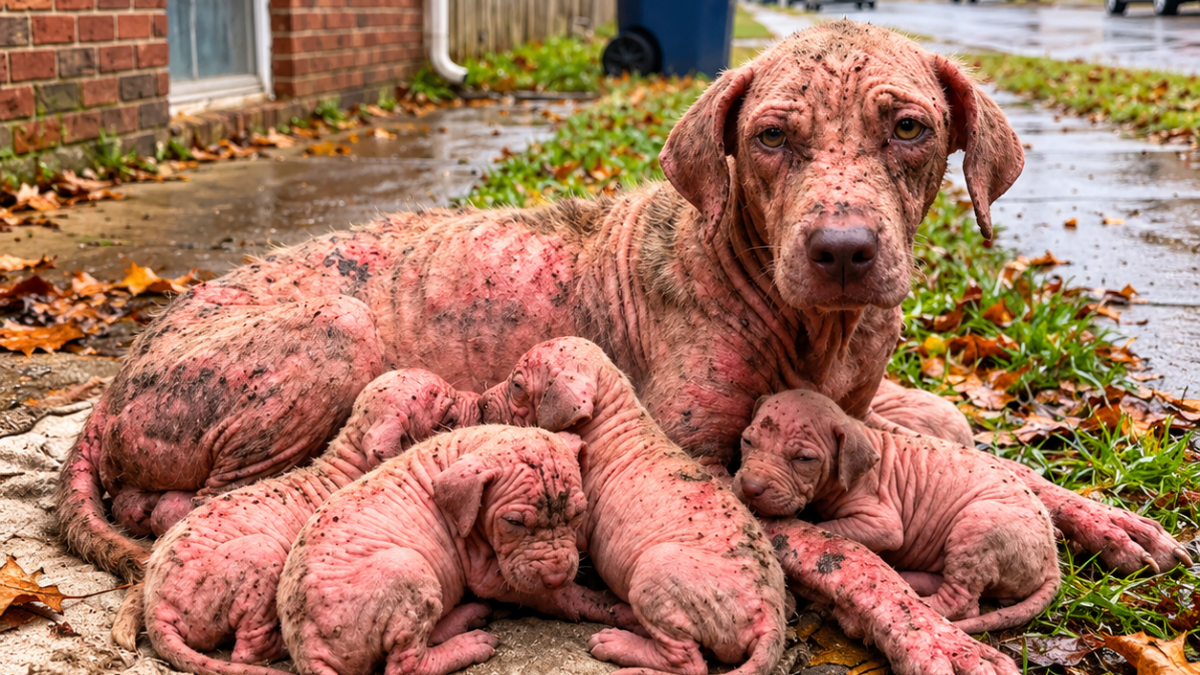
Behind the trash bin, rain and mud had blurred some of the details.
Under clinical lights, everything became painfully clear.
Her ribs.
Her spine.
The hollows around her hips.
The inflamed skin.
Scabs.
Crusted blood near one shoulder.
Her nails were long.
The skin around her ears looked irritated.
There was almost no healthy coat left across much of her body.
Dr. Elena Foster examined her carefully.
“What do we know?”
Megan answered.
“Found outside this morning. Four neonatal puppies. Unknown duration. Unknown owner.”
“Eating?”
“Unknown.”
“Vomiting?”
“Unknown.”
“Stool?”
“Nothing reliable.”
Dr. Foster looked toward me.
“You found them?”
“Yes.”
“How long had they been there?”
“I don’t know.”
“Had you seen her before?”
“No.”
“Anyone in the neighborhood?”
“I hadn’t asked yet.”
She nodded.
“We’ll worry about history later.”
The mother tried to turn toward the sound of a puppy crying.
Dr. Foster noticed.
“Keep the babies where she can see them.”
A technician moved the puppy basket closer.
The mother immediately settled.
“She’s still nursing,” I said.
“She is.”
“How?”
Dr. Foster looked at me.
“Because her body is prioritizing milk production over itself.”
I stared at the dog.
“So the puppies are taking what little she has?”
“I wouldn’t phrase it that way. They’re doing what newborn puppies have to do.”
“But it’s draining her.”
“Yes.”
“Can she survive that?”
“If we support her properly, hopefully.”
Hopefully.
I hated that word.
“What’s wrong with her skin?”
“Could be mange. Could be bacterial or fungal infection. Could be a combination. We need tests.”
“Contagious?”
“Possibly. We’ll use precautions until we know.”
“And the puppies?”
“They’ll be examined too.”
I looked toward the smallest one.
“The little female was cold.”
“We’re warming them gradually.”
Dr. Foster’s expression stayed measured.
That frightened me.
“Are they going to make it?”
“I don’t know yet.”
I looked back at the mother.
She was licking one puppy’s back.
Even on the exam table.
Even while shaking.
Mother first.
Patient second.
For some reason that made me angry.
Not at her.
At whoever or whatever had allowed her to reach this condition.
I wanted to know who she belonged to.
I wanted an explanation.
I wanted someone to tell me how a nursing mother covered in sores had ended up behind a trash bin on my street.
But there was no answer that morning.
There was only treatment.
They weighed her.
Far below a healthy weight.
Bloodwork showed anemia and signs consistent with severe malnutrition and infection.
She was dehydrated.
Parasites were strongly suspected and later confirmed.
Skin scrapings and additional tests were taken.
The puppies were also underweight.
Not catastrophically, but enough that the veterinary team wanted to monitor every feeding.
The smallest female caused the most concern.
Dr. Foster handed me a notepad.
“If you’re staying, you can help.”
“Tell me what to do.”
“We weigh every puppy before and after nursing.”
I looked at the tiny animals.
“All four?”
“Every feeding.”
“How often?”
She told me.
My eyes widened.
“Welcome to newborns.”
That was the beginning.
The mother needed a name for the medical records.
Megan asked me.
“You found her.”
“That doesn’t mean I should name her.”
“Somebody has to.”
I looked through the kennel door.
The dog lay on clean bedding.
Four puppies lined her belly.
Despite the fluids running into her leg and the exhaustion in her face, she kept nudging them into position.
“Maggie.”
Megan smiled.
“Maggie?”
“It just fits.”
So Maggie became her name.
The puppies received temporary colored collars for identification.
Red.
Yellow.
Green.
Blue.
The tiny female was Yellow.
For the first twenty-four hours, our entire world became numbers.
Maggie’s temperature.
Maggie’s hydration.
Her blood count.
Food intake.
Each puppy’s weight.
Each nursing session.
Urination.
Stool.
Body temperature.
Things I had never thought about suddenly felt life-or-death important.
Yellow lost a little weight after the first feeding.
I panicked.
“She lost.”
The technician looked.
“A small fluctuation.”
“But you said they need to gain.”
“Over time.”
“How much time?”
She smiled.
“You’re going to make yourself crazy if you react to every gram.”
“I already am.”
That night, I went home for exactly two hours.
The blue trash bin was still beside the house.
The burlap sack remained in the leaves.
I stood there under the porch light.
Without Maggie and the puppies, the space looked impossibly small.
How had five living animals fit there?
I picked up the sack.
It was soaked through.
The underside smelled of mud and mildew.
There was no shelter.
No bowl.
No food.
Nothing that suggested anyone had deliberately set up a safe nesting space.
I put the sack in a trash bag.
Then I went inside and sat at my kitchen table.
I should have slept.
Instead, I stared through the window toward the side yard.
How long?
That question would follow me for weeks.
How many nights had Maggie spent there?
How many times had people driven past?
How many mornings had I walked out my own front door without hearing anything?
Guilt is irrational sometimes.
Maggie was hidden.
Quiet.
Behind a bin.
I couldn’t have known.
Still, I kept thinking about the weather three nights earlier.
Cold.
Windy.
I imagined her curling around those puppies.
I put my face in my hands.
At 11:47 that night, Megan texted.
**All stable. Yellow nursed well. Maggie ate half her meal.**
I slept.
Barely.
The next morning, I returned before work.
Maggie was awake.
When I entered the isolation area wearing a gown and gloves, her eyes followed me.
“Hey.”
Her head lifted.
I stopped.
“You remember me?”
Her tail moved.
Barely.
One tap against the bedding.
I looked toward the technician.
“Did you see that?”
“Yes.”
“She wagged.”
“Yes.”
“Has she done that for anyone else?”
The technician smiled.
“Don’t become competitive.”
Too late.
I crouched beside Maggie.
She sniffed my gloved hand.
Then rested her chin on it.
Same as behind the trash bin.
Only now she was warm.
Dry.
Fed.
The puppies were sleeping in a pile against her belly.
Dr. Foster came in with results.
Skin tests indicated a severe mite infestation with secondary infection.
The exact treatment plan had to account for nursing puppies and Maggie’s overall weakness.
“So baths?”
“Yes.”
“Medication?”
“Yes.”
“Pain?”
“We’ll manage it.”
“How long until she looks better?”
Dr. Foster gave me the same look veterinarians seem to give people who want biology to obey emotion.
“Weeks before dramatic improvement. Possibly months for full coat recovery.”
“And the puppies?”
“We monitor. They may need treatment depending on findings and symptoms.”
I looked at their pink skin.
“They already look bald.”
“They’re newborns. Don’t diagnose them with your eyes.”
That made me laugh despite everything.
Maggie’s first medicated bath took almost an hour.
Her skin was painful enough that we moved slowly.
At one point, water touched a raw patch beneath her chest.
She flinched.
I immediately stopped.
Dr. Foster said, “Give her a second.”
Maggie looked toward the puppy basket.
All four were asleep under warming blankets.
I placed my hand against her neck.
“They’re right there.”
She stopped trembling.
We continued.
After the bath, she looked worse.
Wet skin showed every lesion.
Every rib.
Every scarred patch.
I hated seeing her that way.
Megan stood beside me.
“This is the part people don’t show.”
“What?”
“Recovery before it looks pretty.”
She was right.
People love before-and-after photos.
They show suffering.
Then transformation.
They skip the middle.
The middle is exhausting.
The middle is medicine at inconvenient hours.
Vomiting.
Diarrhea.
Weight that barely changes.
A sore that looks worse before it heals.
A puppy who loses two grams and sends everyone into panic.
A mother who refuses food one morning.
Then eats later.
The middle contains no guarantee that an after photo is coming.
Maggie lived in that middle for weeks.
Her appetite improved slowly.
At first, she ate because food was placed directly beside her.
She refused to move far from the puppies.
We gave calorie-dense food in frequent portions rather than overwhelming her system.
After several days, she began standing when meals arrived.
That was our first big victory.
Megan carried the bowl in.
Maggie’s head lifted.
Then she stood.
Her legs still looked too thin.
But she walked toward the bowl.
I laughed.
“She stood for food.”
Megan set it down.
“Strong motivation.”
Maggie ate quickly.
Then returned to the puppies.
Within a week, she had learned the meal schedule.
She would hear footsteps in the corridor and look toward the door.
If the wrong person entered without food, disappointment was obvious.
One technician said, “I feel judged.”
“You are.”
Maggie’s personality began emerging before her fur did.
She was gentle but stubborn.
She hated having her ears cleaned.
Loved soft blankets.
Would eat almost anything except one particular canned diet that we thought smelled terrible too.
She tolerated baths but looked personally betrayed afterward.
And she was obsessed with her puppies.
Too obsessed at first.
Whenever anyone lifted one for weighing, Maggie tried to follow.
Once she nearly pulled out her IV.
After that, we moved the scale beside her enclosure.
“You win,” I told her.
She watched Yellow being weighed.
“You have control issues.”
Maggie licked my wrist.
“I’m taking that as agreement.”
The puppies changed faster.
Eyes opened.
First Blue.
Then Green.
Then Red.
Yellow took another day.
Their bodies became stronger.
They no longer looked like tiny pink creatures searching blindly.
They began pushing against each other.
Crawling.
Trying to stand.
Yellow remained smallest.
That made me watch her obsessively.
One morning, she seemed quieter.
I immediately called the technician.
“She’s not moving like the others.”
The technician examined her.
Temperature okay.
Nursing reflex present.
Weight slightly increased.
“She’s fine.”
“You’re sure?”
“Yes.”
“Completely?”
“No medical professional should ever say completely.”
I stared.
She laughed.
“She’s okay right now.”
Right now.
That became enough.
Maggie’s bloodwork improved.
Her anemia started resolving.
Hydration stabilized.
Parasites were treated.
Her skin remained the long battle.
Some scabs fell away.
Other areas developed new irritation.
We adjusted treatment.
No straight line.
Then came the first setback.
Maggie stopped eating breakfast.
That by itself was unusual.
By noon, she still refused food.
Dr. Foster examined her.
Temperature elevated.
One mammary gland felt firmer than the others.
“Mastitis?” Megan asked.
“Possibly developing.”
My stomach dropped.
“What does that mean for the puppies?”
“First, we treat Maggie.”
“Can they still nurse?”
“Depends on how this progresses.”
The thought of removing the puppies terrified me.
Not because they couldn’t be bottle-fed if necessary.
Because I had watched Maggie organize her whole body around them.
They were the reason she moved.
The reason she tolerated us.
The reason she seemed to keep going.
If we took them away abruptly, what would happen to her emotionally?
Dr. Foster must have read my face.
“We’re not separating unless medically necessary.”
“Okay.”
“But you need to understand that if her health requires it, we will.”
“I know.”
Maggie received treatment.
We monitored the affected gland closely.
The puppies were prevented from nursing that area temporarily while continuing elsewhere under veterinary guidance.
For two days, Maggie looked miserable.
I sat with her.
“You don’t have to do everything.”
Her eyes followed me.
“You already got them this far.”
Yellow crawled over Maggie’s leg.
Maggie immediately licked her.
I sighed.
“You are not listening.”
Of course she wasn’t.
The infection responded.
Maggie’s fever dropped.
Her appetite returned.
The puppies continued gaining.
Crisis passed.
Another piece of middle.
By week three, the puppies could wobble on their feet.
Watching them learn to walk was ridiculous.
Red would stand.
Take two steps.
Fall sideways.
Green climbed over siblings rather than around them.
Blue seemed convinced that Maggie’s tail was a toy.
Yellow surprised everyone.
She was still smallest.
She was also the most determined.
The first puppy to climb out of the low nesting area?
Yellow.
I found her halfway over the edge.
“Excuse me.”
She continued.
I picked her up.
Maggie watched.
“Your daughter is escaping.”
Maggie yawned.
“No concern?”
I returned Yellow.
She immediately tried again.
That was when we gave the puppies proper names.
Red became Archie.
Green became Finn.
Blue became Milo.
Yellow became Daisy.
Maggie didn’t care what we called them.
She responded only to squeaks.
Daisy’s survival became symbolic in my head even though I tried not to make it so.
She had been coldest.
Smallest.
The puppy I carried against my jacket in the rain.
Now she was the one climbing barriers.
I liked that.
Maggie began gaining weight visibly around the same time.
Her hips were still too prominent.
But her sides no longer caved so dramatically.
Muscle returned gradually.
Her face softened.
The most striking change was her eyes.
At first, every movement made her watch.
Not panic.
Watch.
Who touched a puppy?
Who opened a door?
Where was the food?
Could someone take something?
By week four, she slept while we handled the puppies.
That was huge.
I lifted Archie to weigh him.
Maggie opened one eye.
Then closed it.
“Trust?”
Megan said, “Exhaustion?”
“No.”
I smiled.
“Trust.”
This time I felt allowed to say it.
Her fur began coming back.
Not evenly.
Tiny dark hairs appeared along her shoulders first.
Then soft fuzz across her back.
The skin underneath looked healthier.
Megan photographed her once a week from the same angle.
Week one was devastating.
Week two still looked terrible.
Week three showed subtle changes.
Week four—
I stared.
“Is that really her?”
“Same dog.”
“Her face looks different.”
“Weight.”
“And eyes.”
Megan nodded.
“Eyes too.”
I saved the comparison picture.
Then stopped looking at the intake image for a while.
Maggie was becoming more than that photograph.
The puppies began eating softened food.
That changed everything.
Until then, Maggie carried the nutritional burden.
Now they could gradually rely less on her.
The first group feeding was chaos.
Four puppies walked into the dish.
Archie stepped directly into the food.
Milo licked Archie’s foot.
Daisy climbed over Finn.
Maggie watched from nearby with an expression I could only interpret as exhaustion.
I laughed.
“Are you questioning your life choices?”
She looked at me.
One puppy crawled toward her.
Maggie stood and moved six inches away.
“That is the first boundary I’ve seen you set.”
The puppies followed.
Maggie moved again.
Motherhood was changing.
She began choosing short periods away.
At first, thirty seconds.
Then several minutes.
She would lie on the other side of the enclosure.
Still watching.
But resting.
We encouraged that.
Maggie needed to become an individual again.
Not only a mother.
Her first walk without the puppies was short.
I clipped the leash on.
She looked back.
“They’re sleeping.”
She refused to move.
Megan stayed with the puppies.
“Go,” Megan told her.
Maggie looked between us.
I stepped forward.
She followed.
Three steps.
Looked back.
“Still there.”
Outside, sunshine hit her face.
It was the first clear day in almost a week.
Maggie lifted her nose.
Smelled the air.
Then stopped in grass.
For several seconds she simply stood.
No babies.
No treatment.
No exam.
No bath.
Just Maggie.
She walked perhaps fifty yards.
Then turned toward the clinic.
“Done?”
She pulled lightly.
“Done.”
We returned.
The puppies were exactly where she left them.
Maggie inspected every one.
Then lay down beside them.
The next walk lasted longer.
Then longer.
By week five, she appeared to enjoy them.
Her tail rose.
She sniffed bushes.
One afternoon, she rolled in clean grass.
Actually rolled.
I laughed so loudly Megan came outside.
“What happened?”
I pointed.
Maggie was on her back.
Legs in the air.
Rubbing herself against the lawn.
Megan smiled.
“She’s itchy?”
“No.”
“Maybe.”
“Let me have this.”
Maggie stood.
Shook.
Then wagged.
Not a tiny movement.
Full tail.
Side to side.
Megan looked at me.
“Okay.”
“Okay what?”
“You can have it.”
That walk became another mental photograph I kept.
The mother behind the trash bin had curled around her puppies because cold leaves were all she had.
Five weeks later, the same dog rolled in grass because it felt good.
That was healing too.
We still didn’t know where she came from.
Animal control scanned for a microchip.
Nothing.
We posted a found-dog notice without revealing details that might allow someone to falsely claim her.
No legitimate owner came forward.
I spoke with neighbors.
One woman two houses down remembered seeing a thin dog at night about a week before I found Maggie.
“Was she pregnant?”
“I couldn’t tell.”
“Anyone with her?”
“No.”
Another neighbor thought he had seen her near an alley farther away.
Nobody knew more.
Security cameras along the street provided little.
One camera had recorded a dog crossing at night several days before the rescue, but the image was too dark to confirm identity with certainty.
There was no evidence that anyone had deliberately placed Maggie behind my trash bin.
She may have chosen the hiding spot herself.
That possibility changed how I thought about those days.
Maybe she had searched for somewhere protected to give birth.
The narrow area between my house and fence blocked some wind.
The trash bin hid her from the sidewalk.
The burlap sack may have been something she found nearby.
Maybe, from Maggie’s perspective, it was the safest place available.
That made it sadder somehow.
Not that someone had necessarily abandoned her there.
That a mother dog in terrible condition had looked at a muddy space behind a garbage bin and decided:
This will have to do.
I wanted more answers.
We never got them.
Instead, Maggie gave us new questions.
What kind of home did she need?
Would she be ready for adoption after the puppies were weaned?
Could she live with other dogs?
Did she know houses?
Was she house-trained?
Did she fear men?
Children?
Cars?
There was only one way to find out.
Foster care.
Once Maggie and the puppies were medically safe to leave the clinic environment, they moved to a foster home with a woman named Claire.
Claire had a spare room converted for nursing mothers and puppies.
Warm floors.
Washable bedding.
A baby gate.
Access to a fenced backyard.
The first evening, I visited.
Maggie stood in the center of the room.
Her puppies were attacking a stuffed toy.
Claire sat on the floor.
“She won’t lie down.”
“New environment.”
“Probably.”
I entered.
Maggie immediately approached me.
That made my chest tighten.
“Hi.”
She leaned against my leg.
Claire smiled.
“She knows you.”
I sat.
Maggie lowered herself beside me.
The puppies ran over.
Daisy bit my shoelace.
“You’ve become aggressive.”
Daisy tugged harder.
Claire laughed.
“You were worried she wouldn’t make it.”
“I remember.”
Daisy won the shoelace battle.
Maggie watched.
No anxiety.
Just observation.
The first night in foster care went surprisingly well.
Maggie slept in a dog bed instead of on the floor.
The puppies slept piled together.
At 3 a.m., Claire checked the monitor and saw Maggie awake.
For a second, I imagined the old survival vigilance.
Then Claire sent the next clip.
Maggie walked to the water bowl.
Drank.
Returned to bed.
Lay down.
Normal.
I watched that ten-second recording repeatedly.
Three in the morning meant something different now.
No rain.
No mud.
No hiding.
Water waiting.
Bed waiting.
People nearby.
The puppies flourished.
At six weeks, they were nearly impossible to contain.
Archie was the boldest with people.
Finn liked shoes.
Milo was calmer.
Daisy had become the smallest tyrant in Missouri.
She climbed everything.
Claire sent a photograph of Daisy standing on top of a dog bed while three siblings looked up at her.
Caption:
**Management has changed.**
Maggie seemed relieved as the puppies became independent.
She still corrected them.
Still groomed them.
Still responded when someone cried.
But she spent more time away.
She learned the couch.
The first time she climbed onto it, Claire texted me:
**Your trash-bin dog now requires cushions.**
I drove over that weekend.
Maggie was stretched across the couch.
Full-body stretch.
Eyes closed.
I stood in the doorway.
“Seriously?”
Her tail moved without her head lifting.
“I remember when you slept on burlap.”
Nothing.
“You’ve changed.”
She opened one eye.
Claire said, “Don’t shame her for success.”
“Fair.”
Her skin continued improving.
The sores healed.
Scabs disappeared.
The red inflammation faded.
Her new coat thickened.
It came in softer than I expected, mostly tan and cream with darker markings across her back and face.
The first time Claire bathed her after most of the lesions had healed, Maggie splashed water everywhere and attempted to leave the tub.
I laughed.
“This is actually better.”
“How?”
“She has opinions now.”
Claire tried keeping Maggie still.
Maggie shook.
Water hit both of us.
Claire stared.
“Wonderful.”
Maggie wagged.
“Definitely better.”
By the time the puppies were eight weeks old, they no longer resembled the pink fragile newborns I had found.
They were round.
Loud.
Fast.
Vaccinated according to schedule.
Eating independently.
Ready for carefully screened homes when medically appropriate.
That part was harder than I expected.
Not because we lacked applicants.
We had too many.
The rescue posted a family photo after the worst medical concerns had passed.
People fell in love.
Especially with the puppies.
Everyone wanted a puppy.
Maggie received fewer applications.
That bothered me.
People saw four cute young dogs with their whole lives ahead.
Then their mother.
Older.
History of skin problems.
A body still recovering.
I found myself becoming defensive.
“Maggie is the reason any of them are here,” I told Megan.
“I know.”
“She nearly killed herself feeding them.”
“I know.”
“And people only ask about the puppies.”
Megan looked at me.
“That happens.”
“It shouldn’t.”
“No.”
She closed her laptop.
“But we don’t need everyone to want Maggie.”
I looked at her.
“We need the right person.”
That slowed me down.
The puppies found homes first.
Archie went to a couple with a fenced yard and an older dog.
Finn went to a family whose teenage son immediately became his favorite person.
Milo went to a retired teacher.
Daisy received the most applications.
I wanted to be overly protective.
The tiny cold puppy from the rain had become emotionally important to me.
Megan noticed.
“You cannot keep rejecting people because they aren’t you.”
“I’m not.”
“You rejected one because they said they liked her color.”
“That was not the only reason.”
“You underlined it.”
“They were superficial.”
“They also had excellent vet references.”
I sighed.
Eventually Daisy went to a young couple named Erin and Marcus who had previously raised a special-needs dog into old age.
When they came for the final meeting, Daisy climbed onto Marcus’s shoe and fell asleep.
That helped.
The puppy departures changed Maggie.
The first one left.
She searched briefly.
Sniffed the empty area.
Then settled.
The second left.
She noticed.
After Milo left, only Daisy remained.
Maggie became more attentive to her.
That worried me.
When Daisy’s adoption day came, we planned carefully.
Maggie got a long walk while Daisy departed.
When she returned, the puppy room was empty.
Maggie walked in.
Sniffed.
Looked at Claire.
Then at me.
My chest hurt.
“They’re okay.”
Maggie checked every corner.
Then returned to the doorway.
She stood there for a long time.
That night, Claire slept in the room with her.
Maggie whined twice.
Then climbed onto the dog bed.
By morning, she ate breakfast.
By the third day, she seemed calmer.
By the end of the week, something remarkable happened.
Maggie started playing.
Not with puppies.
For herself.
Claire had a rope toy.
She tossed it casually.
Maggie watched.
Claire tossed again.
Maggie ran after it.
Picked it up.
Brought it halfway back.
Stopped.
Then shook it violently.
Claire recorded.
I watched the video.
“Is that Maggie?”
“No, I replaced her.”
“She never played.”
“She does now.”
The mother dog identity had been necessary.
It had kept her puppies alive.
Now she was learning who she was without four bodies pressed against her.
She liked rope toys.
Car rides, surprisingly.
Cheese.
Couch corners.
Sunlight.
She disliked thunder.
Hated the vacuum.
Loved people once introduced slowly.
And she followed Claire into the kitchen every single time a refrigerator opened.
Her own adoption applications began increasing as new photos showed her transformation.
That made me nervous for a different reason.
Maggie was beautiful now.
Her coat had returned enough that casual observers might never guess how ill she had been.
I did not want someone choosing the healthy-looking version while ignoring the history.
Then a woman named Susan applied.
She was fifty-eight.
Widowed.
Adult children living elsewhere.
Worked from home as an accountant.
One calm older dog named Henry.
Her application contained one sentence that caught me:
**I’m interested in Maggie, not because I feel sorry for what happened to her, but because the foster notes make her sound like exactly the kind of dog I enjoy living with.**
I read it twice.
Then called.
“What kind of dog is that?”
Susan laughed.
“Apparently one who steals couch space and follows people into kitchens.”
“Accurate.”
“And doesn’t enjoy thunderstorms.”
“Also accurate.”
“My old dog hates them too.”
“Maggie may have recurring skin needs.”
“I read that.”
“Medication, possibly.”
“Fine.”
“She’s still learning some household things.”
“So am I.”
That made me smile.
Their first meeting was quiet.
Susan didn’t kneel dramatically.
Didn’t cry.
Didn’t say, “Poor baby.”
She walked with Maggie.
Sat on a bench.
Maggie sniffed her.
Susan scratched her chest.
Henry came for the second meeting.
He was twelve.
Big.
Gray.
Unimpressed.
Maggie approached.
Henry sniffed.
Walked away.
Maggie followed.
Henry gave one look over his shoulder that seemed to say:
Please stop.
Susan laughed.
“They’ll be fine.”
We did a home visit.
Maggie inspected every room.
Found the couch.
Jumped up.
Turned twice.
Lay down.
Susan looked at me.
“Is that approval?”
“Unfortunately, she has claimed your furniture.”
Susan sat beside Maggie.
Maggie placed her head on Susan’s leg.
I looked away for a second.
Decision made.
Maggie’s adoption happened nearly five months after I found her behind the bin.
By then, she had a full coat across most of her body.
A few thin patches remained.
Her ribs were no longer visible.
Her bloodwork had improved dramatically.
She wore a red collar.
Susan held the leash.
Claire cried.
I cried.
Megan pretended she had something in her eye.
Maggie walked toward Susan’s car.
Then stopped.
Turned.
Came back to me.
I crouched.
She pressed her forehead into my chest.
That was worse than if she had simply left.
I wrapped my arms around her.
“You did everything you had to do.”
Her tail moved.
“You kept them alive.”
Another wag.
“Now go be selfish for a while.”
Susan laughed softly behind me.
“I can provide that.”
I stood.
Maggie walked to her.
Climbed into the back seat.
Henry was already lying there.
He looked annoyed when Maggie sat partly on him.
Susan closed the door.
The car left.
I went home.
The blue trash bin was still beside the house.
For months, every time I saw it, my mind replayed that morning.
Eventually, I moved it.
Not because I wanted to forget.
Because I no longer wanted the worst moment to occupy the same physical space forever.
I cleaned the leaves.
Removed the old debris.
Planted a small patch of ground cover beside the wall.
Nothing ceremonial.
I just wanted the corner to look lived in again.
Updates from the puppies arrived.
Archie became enormous.
Finn learned how to open a laundry-room door.
Milo slept in the retired teacher’s bed despite having three dog beds.
Daisy remained small and fearless.
Erin sent a photo of her standing in a hiking backpack wearing a tiny safety harness.
I stared.
“That was the freezing puppy.”
Megan smiled.
“Not anymore.”
Maggie’s updates were my favorite.
Week one:
Maggie and Henry on opposite ends of the couch.
Week two:
Closer.
Month one:
Both touching.
Month two:
Maggie using Henry as a pillow.
Susan wrote:
**He has stopped objecting. Resistance was ineffective.**
Maggie’s first thunderstorm in the new home was difficult.
She paced.
Panted.
Tried hiding beside the bathtub.
Susan didn’t force her out.
She brought a blanket.
Sat on the bathroom floor.
Henry eventually joined them.
Susan sent a photo after the storm.
Maggie asleep against her leg.
**We survived.**
That mattered.
Healing does not mean fear disappears.
It means fear no longer has to be faced alone.
Her skin flared once during the following summer.
Susan caught it early.
Vet visit.
Treatment.
Resolved.
No crisis.
No dramatic decline.
The past had taught everyone what to watch.
Maggie gained a little too much weight.
The dog who had nearly starved became slightly chubby.
Her veterinarian recommended reducing treats.
Susan called me.
“This feels morally wrong.”
“What?”
“Telling Maggie she can’t have another biscuit.”
I laughed.
“She will survive.”
“She looks betrayed.”
“Good.”
“You’re cruel.”
Maggie barked in the background.
I smiled.
“Tell her I remember when we celebrated every gram.”
Susan’s voice softened.
“I know.”
Then she said something that stayed with me.
“Now we get to worry about normal things.”
Exactly.
Normal worries are a privilege.
Too many treats.
Mud on the couch.
A chewed slipper.
Thunderstorm anxiety.
Annual vaccines.
Whether the dog is becoming lazy.
Whether Henry gets enough space.
These were problems I wanted for Maggie.
Not hypothermia.
Not starvation.
Not infected skin.
Not newborn puppies crying in wet leaves.
Years passed.
The puppies became adults.
Maggie’s face softened with age.
Susan occasionally arranged reunions with one or two puppies when logistics allowed.
We never forced all five dogs into some dramatic family event.
Dogs do not necessarily maintain human-style concepts of motherhood once puppies mature.
But Maggie seemed comfortable around them.
At one reunion, Daisy approached.
Maggie sniffed her.
Daisy immediately stole Maggie’s toy.
Maggie chased her.
Susan laughed.
“Family resemblance.”
I watched the two dogs run across the yard.
Daisy was no longer small.
Maggie’s coat was thick.
If someone had told me on the rainy morning that I would someday watch them fighting over a toy in sunlight, I might not have believed it.
But there they were.
Years later, Henry died.
He was very old.
Susan called me afterward.
“Maggie is looking for him.”
I closed my eyes.
“How?”
“Checks his bed. Waits near the back door.”
“Eating?”
“Yes.”
“Sleeping?”
With hesitation.
We talked.
Susan moved Henry’s bed but did not remove it immediately.
Maggie slept there for several nights.
Then slowly returned to her own.
A few months later, Susan adopted another senior dog.
Not because Henry could be replaced.
Because he couldn’t.
The new dog’s name was Otis.
Maggie greeted him with the same lack of drama Henry had once shown her.
Sniff.
Walk away.
Otis followed.
Maggie looked irritated.
Susan sent me a photo.
**History repeats itself. She has become Henry.**
I laughed.
Age had turned Maggie into the calm older dog.
The mother who once had nothing left to give had somehow kept finding room for others.
Still, I tried not to turn every ordinary behavior into a symbol.
Sometimes Maggie was simply a dog.
She stole Otis’s bed.
She barked at mail trucks.
She begged.
She rolled in disgusting things.
She once dug a hole beneath Susan’s hydrangea and emerged with mud covering her face.
Susan texted:
**Brave mother. Survivor. Destroyer of landscaping.**
I saved that photo.
Maggie aging affected me more than I expected.
Gray appeared around her muzzle.
Her walks shortened.
Arthritis developed mildly.
Susan added rugs across slippery floors.
Later, a ramp beside the porch.
Maggie used it immediately.
Unlike some dogs I knew, she had no concern for pride when convenience was available.
She also became deeply attached to warm blankets.
Winter photographs almost always showed only her nose.
One anniversary morning, Susan sent me a picture at nearly the same hour I had found her years earlier.
Maggie asleep.
Wrapped in fleece.
Otis beside her.
The message:
**Cold rainy morning here. She refused to get out of bed. Thought you’d appreciate that.**
I did.
I stood beside my kitchen window looking toward the place behind the trash bin.
Rain fell softly.
For a moment, the years collapsed.
I heard the whimper.
Saw the burlap.
Felt the cold puppy against my jacket.
Then I looked at Susan’s photo again.
Maggie refused to leave a warm bed.
That was the kind of full-circle moment nobody could manufacture.
No inspirational slogan needed.
She had earned the right to dislike rain.
One summer, Daisy’s family brought her to visit.
Daisy had become a confident, athletic dog.
She still climbed everything.
Maggie was slower.
Daisy ran circles.
Maggie watched.
Then Daisy came over and lay beside her.
I sat nearby.
Erin asked, “Do you think Maggie knows that’s her baby?”
“I don’t know.”
“Really?”
“Dogs don’t tell us.”
Maggie sniffed Daisy’s face.
Daisy licked her.
Maybe recognition.
Maybe familiarity.
Maybe just two dogs who liked each other.
It was enough.
I had learned to stop demanding human explanations from animals.
They already give us plenty if we watch honestly.
Maggie’s health remained good for years.
Then age began asking for more.
A heart murmur appeared.
Mild at first.
Monitored.
Then arthritis worsened.
Medication helped.
Her skin required more attention during allergy season.
Susan handled everything.
One afternoon, she called.
“Remember when you told me she was stubborn?”
“Yes.”
“She refuses to come inside.”
“Why?”
“Sun.”
I laughed.
Maggie was lying in the yard.
Warm afternoon.
Refusing to move.
Susan had sent Otis inside.
Maggie stayed.
“Let her have ten minutes.”
“I have a meeting.”
“Maggie doesn’t respect accounting.”
“She never has.”
Eventually Susan attended the video meeting from the porch.
Maggie slept beside her.
That was senior life.
Adapt plans to dog.
Years after the rescue, Megan and I looked through old photographs while preparing an anniversary report for the organization.
She opened Maggie’s intake image.
I had not seen it in a long time.
The impact was immediate.
Raw skin.
Sharp ribs.
Four newborn puppies.
I stared.
“Was she really that thin?”
“Yes.”
“I remember. But…”
“It changes when you know her now.”
She clicked to a recent photo.
Maggie asleep on Susan’s couch.
Gray face.
Full body.
Blanket.
Otis partly visible.
The difference looked impossible.
Megan said, “Same dog.”
I nodded.
“Same mother too.”
“What do you mean?”
“She was already who she needed to be before we helped her.”
Megan looked at me.
I struggled to explain.
“We didn’t teach her to protect those puppies. She was already doing it. We just gave her enough support to stop destroying herself in the process.”
Megan nodded slowly.
“That’s fair.”
The thing I admired most about Maggie was not that she endured suffering.
I stopped romanticizing that.
No animal should have to prove courage by surviving neglect.
What mattered was what happened when suffering ended.
She relaxed.
Played.
Set boundaries.
Left the puppies to eat on their own.
Claimed couches.
Became irritated by rain.
Loved toys.
Gained too much weight.
Those things meant she no longer had to be heroic.
She was allowed to be ordinary.
Then came the winter Susan called me with a different tone.
“Maggie isn’t eating.”
Every old fear returned.
“How long?”
“Since last night.”
“Vet?”
“Appointment in an hour.”
“Anything else?”
“Very tired.”
I drove there.
Not because Susan asked.
Because I needed to.
Maggie was lying in her bed.
Gray face.
Eyes open.
Tail moved when I entered.
“Hey, Mama.”
Susan smiled sadly.
“I still call her that sometimes.”
“So do I.”
Maggie tried to stand.
Her legs trembled.
I crouched.
“Stay.”
She ignored me.
Stood anyway.
Walked two steps.
Pressed her head into my hand.
Same gesture.
Years earlier.
Wet leaves.
Rain.
Her face in my palm.
I swallowed.
“You remember me?”
Susan said, “Of course she does.”
We never really know.
But I chose to believe it.
The veterinarian found age-related kidney changes and dehydration.
Not catastrophic.
Treatable for the moment.
Fluids.
Medication.
Diet adjustment.
Maggie improved.
That gave us another year.
A good year.
Short walks.
Long naps.
Food negotiations.
Warm days in the yard.
Then her body began declining again.
This time more steadily.
Susan kept a quality-of-life journal.
Meals.
Mobility.
Sleep.
Pain.
Interest.
Good days.
Bad days.
That impressed me.
Love can become selfish near the end.
We want another week.
Another month.
Another birthday.
The journal forced honesty.
Was Maggie still enjoying her life?
For months, yes.
Then one week, fewer good entries.
She stopped wanting the yard.
Stopped finishing meals.
Needed help standing.
Medication relieved some discomfort but not enough.
Susan called.
“I think we’re close.”
I drove over.
Maggie lay beneath a blanket.
Otis slept nearby.
Susan sat on the floor.
“I hate this.”
“I know.”
“What if I’m too early?”
I sat beside her.
“What did the vet say?”
“That there’s no recovery from where we are. We can manage symptoms, but…”
Her voice broke.
“She’s tired.”
Maggie opened her eyes.
Susan rubbed her face.
“I promised myself I wouldn’t wait until she was suffering just because I couldn’t let go.”
That was love too.
Not dramatic.
Not heroic.
Responsible.
The veterinarian came to the house two days later.
Maggie had eaten a little breakfast.
Cheese.
Of course.
Susan gave her more than she was technically supposed to have.
No one objected.
I brought one thing with me.
A new burlap sack.
Not the old one.
That was long gone.
This one was clean.
Soft.
Decorative, actually.
Susan looked confused.
“What is that?”
“I almost didn’t bring it.”
“Why?”
I sat down.
“When I found her, she was lying on one.”
Susan’s eyes filled.
“I know.”
“I kept thinking that I hated that image.”
Maggie slept near us.
I touched the fabric.
“So I thought maybe we could make it mean something else.”
Susan understood.
We spread the clean burlap beneath Maggie’s favorite fleece blanket.
Not against her skin.
Just underneath.
A layer beneath warmth.
The old life transformed rather than erased.
Maggie opened her eyes when we moved her.
Her head came up.
Then settled again.
Otis sniffed the blanket.
Lay beside her.
The veterinarian explained the process.
Susan already knew.
Still listened.
I stayed near Maggie’s head.
Susan held her paws.
“You were supposed to be temporary,” Susan whispered.
Maggie breathed slowly.
“I said I’d foster senior dogs someday. Then you showed up and took over everything.”
Her voice cracked.
I placed my hand against Maggie’s cheek.
“You did enough.”
That sentence was for both of them.
Maggie had done enough behind the trash bin.
Enough nursing.
Enough protecting.
Enough surviving.
Susan had done enough too.
Vet visits.
Medicine.
Storm nights.
Senior care.
Love does not earn immortality.
Nobody failed because life ended.
The sedative made Maggie drowsy.
Her body relaxed.
Susan leaned close.
“You’re safe.”
Maggie’s eyes closed.
The same way they had closed against my palm on that cold morning.
Only this time her body was warm.
Full.
Old.
Loved.
The four puppies she had nearly starved herself protecting were grown somewhere in safe homes.
Archie was healthy.
Finn was healthy.
Milo was healthy.
Daisy was healthy.
Maggie did not need to curl around anyone anymore.
She could rest.
When the veterinarian gave the final medication, Maggie’s breathing slowed.
Susan cried into her fur.
I kept my hand under her head.
Otis remained beside her.
And Maggie left quietly.
At home.
On a warm bed.
With full bowls in the kitchen.
Afterward, I stepped outside.
Rain had started.
Of course it had.
A light gray rain.
The kind from that first morning.
I stood beneath the porch roof.
Susan came beside me.
Neither of us spoke for a while.
Then she said, “She hated rain.”
I laughed through tears.
“Eventually.”
Susan looked back through the window.
“She learned.”
“What?”
“That she didn’t have to sleep in it.”
That sentence stayed with me.
The puppies’ families all received the news.
Daisy’s family sent a photograph the next day.
Daisy asleep on a blanket.
Erin wrote:
**We told her about her mom tonight. I know she doesn’t understand the words, but we wanted to say them anyway.**
Archie’s family sent another.
Finn’s.
Milo’s.
Four adult dogs.
Four separate lives.
All because a nearly hairless mother refused to stop nursing them behind a trash bin.
Weeks later, Susan gave the rescue Maggie’s red collar.
We placed it in a memory cabinet.
No dramatic display.
Just her name.
The rescue already had enough sad photographs.
I didn’t want Maggie remembered only through suffering.
The photo we chose for the cabinet showed her on Susan’s couch.
Gray face.
Healthy body.
One paw hanging over the edge.
Looking mildly irritated because someone interrupted her nap.
Underneath, we wrote:
**MAGGIE**
Nothing else.
No “abandoned mother.”
No “mange survivor.”
No “hero.”
Just her name.
She had earned that.
Years have passed since the morning I heard the whimper.
The blue trash bin is gone now.
A storm cracked the lid and I eventually replaced it with a black one.
For a while I felt strangely guilty.
As if changing the bin meant changing the story.
Then I realized Maggie had changed everything about that corner herself.
The place where I once found suffering became just the side of my house again.
Leaves collect there.
I rake them.
Nothing cries beneath them.
That is a good thing.
Daisy visited once as an older dog.
Erin brought her while passing through town.
Daisy was gray around the muzzle.
That stopped me.
The tiny puppy I had tucked inside my jacket was old.
I knelt.
“Yellow.”
Erin laughed.
“You still call her that?”
“Sometimes.”
Daisy approached.
Sniffed me.
Then leaned against my legs.
I scratched behind her ears.
For a moment, I saw Maggie.
Not literally.
Their markings were different.
Their bodies different.
But something in the way Daisy leaned against a hand reminded me.
Erin noticed my expression.
“What?”
“Nothing.”
I smiled.
“She’s doing well.”
“She’s spoiled.”
“Good.”
Daisy pulled toward the front yard.
“Still climbs things?”
“Everything.”
I laughed.
Of course.
We walked around the side of the house.
Daisy stopped near where the old bin had stood.
Sniffed.
Nothing more.
No dramatic recognition.
No supernatural moment.
Just a dog smelling leaves.
I appreciated that.
The meaning belonged to me.
Not to her.
She did not need to carry her mother’s hardest morning.
Maggie had carried enough for both of them.
Before Erin left, Daisy climbed into the back seat.
I looked at the older dog.
Healthy.
Secure.
Annoyed because departure delayed dinner.
The smallest puppy had grown old.
That fact alone felt like a victory.
People sometimes ask why I remember Maggie more vividly than other rescues.
I have helped dogs with worse injuries.
Dogs who required more surgery.
Dogs whose cases led to prosecution.
Maggie’s story never gave me a villain.
No person confessed to abandoning her.
No camera showed someone leaving her.
No courtroom delivered a satisfying consequence.
Maybe she had been dumped.
Maybe she had been stray for a long time.
Maybe she became lost while already sick.
We never proved it.
I used to find that frustrating.
Now I don’t.
Justice was never the strongest part of Maggie’s story.
Continuity was.
She kept four lives going when her own body was nearly empty.
Then other people took over.
A neighbor heard a sound.
A rescue came.
A veterinary team treated her.
A foster opened a home.
Four families raised puppies.
Susan gave Maggie years she could never have imagined behind that bin.
The chain did not require one extraordinary hero.
It required people doing the next necessary thing.
Stop.
Look.
Call.
Carry.
Feed.
Treat.
Wait.
Adopt.
Stay.
The last photograph I keep on my phone is not from the rescue.
It is from Susan.
Maggie in old age.
Wrapped in a cream blanket.
Gray muzzle resting on a pillow.
Eyes closed.
Sunlight through a window.
There is a full water bowl in the corner.
A bag of food near the kitchen doorway.
Otis’s tail barely visible beside her bed.
Nothing in the image would mean much to a stranger.
To me, it contains everything missing from the first scene.
Dry.
Warm.
Fed.
Safe.
Not hiding.
Not protecting newborns with a body that had no reserves left.
Not watching for danger.
Sleeping.
The first morning I found Maggie, I thought the most heartbreaking thing was how hard she was trying to keep four puppies alive.
Years later, I understood something else.
The best ending was not that she kept fighting forever.
It was that eventually she didn’t have to.
Someone else carried the puppies.
Someone else prepared the food.
Someone else watched the door.
Someone else stayed awake during storms.
And Maggie learned to sleep.
[END OF STORY]








