PART 2: I Found Two Dogs Guarding Each Other in a Storm—Months Later, Their X-Rays Exposed the Place They Escaped From
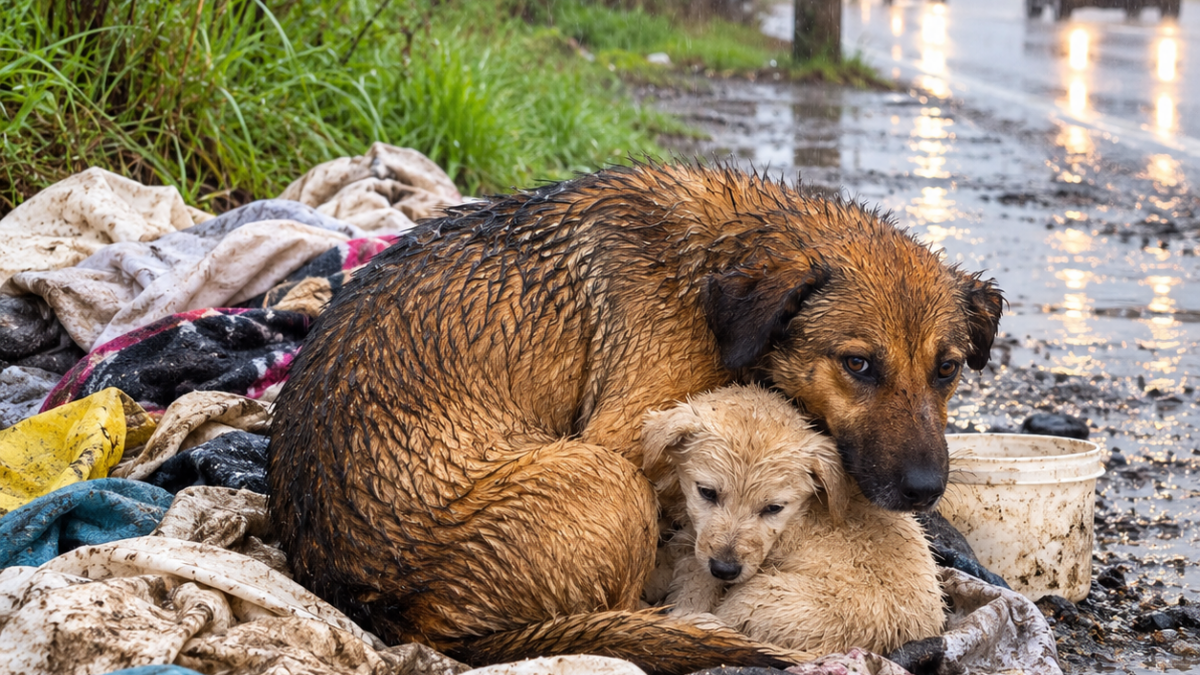
PART 2
For a few seconds, nobody in the examination room moved.
I looked from Dr. Bennett to the X-ray and then down at Daisy.
She was lying on a padded blanket beside the table, her cream-colored head resting against my shoe.
Rusty stood directly over her.
He had positioned himself there the moment the technicians finished taking the images.
Not beside her.
Over her.
His chest angled toward the door.
His body between Daisy and every person who entered the room.
I had seen him do it a hundred times at home.
At the front door.
In the yard.
During thunderstorms.
Whenever someone unfamiliar came into the house.
Until that moment, I had always interpreted it as anxiety.
Now, looking at those X-rays, I wondered whether I had misunderstood him completely.
Dr. Bennett pointed again.
“See these areas?”
I moved closer.
There were faint irregularities along several ribs.
“I see them.”
“They’re healed fractures.”
My throat tightened.
“How many?”
“More than one.”
I swallowed.
“Could she have been hit by a car?”
Dr. Bennett did not answer immediately.
That pause made the room feel smaller.
“An accident is possible in almost any trauma case,” she said carefully. “But the pattern here concerns me.”
“What does that mean?”
She adjusted the image.
“These injuries happened at different times.”
I stared at her.
“Different times?”
“Yes.”
The words settled heavily.
Not one accident.
Not one terrible day.
More than one injury.
More than one period of healing.
I crouched beside Daisy.
She opened her eyes.
Her tail did not move.
She looked exhausted.
I placed my hand gently near her shoulder.
“You poor girl.”
Rusty lowered his nose and touched the top of her head.
It was a tiny movement.
Almost tender.
Dr. Bennett watched him.
Then her eyes traveled toward his neck.
“Can I look at him again?”
I stood.
“Rusty?”
His ears shifted.
Dr. Bennett did not approach directly.
By then, she had already realized that fast movements around Daisy changed Rusty’s body language instantly.
She turned sideways and held out her hand.
Rusty sniffed it.
Then allowed her closer.
She parted the thick fur around his neck.
I had seen those scars since the first morning.
Some were thin.
Others broader.
They disappeared beneath his coat unless you knew where to look.
I had assumed old neglect.
Maybe an ill-fitting collar.
Maybe an accident.
Dr. Bennett’s expression changed.
She moved farther along his shoulder.
“These aren’t recent.”
“I know.”
“They look consistent with repeated pressure or restraint.”
I stared.
“What kind of restraint?”
“A heavy chain is one possibility.”
The room went silent again.
Rusty looked toward Daisy.
Then toward the door.
I remembered every night he had paced my hallway.
Every check of every room.
Every time he planted himself between Daisy and a noise.
The pattern suddenly looked different.
“Do you think he was chained?”
Dr. Bennett nodded slowly.
“I think it’s possible.”
“Near her?”
She looked at the healed fractures on Daisy’s scan.
Then back at Rusty.
“I can’t prove what he witnessed.”
That was the responsible answer.
I knew it.
But my mind had already begun building pictures I wished I could stop.
Rusty unable to reach her.
Rusty listening.
Rusty straining against a chain.
Rusty learning that his only job, if he ever became free, was to make sure nothing ever reached Daisy again.
I pressed both hands against the edge of the exam table.
“That’s why he guards her.”
Dr. Bennett’s voice stayed quiet.
“Maybe.”
Rusty touched Daisy again with his nose.
Maybe.
That word was important.
We did not know their entire past.
We would never know every detail.
But we knew enough now to understand that whatever had happened before the roadside had left physical evidence.
Then one of the veterinary technicians entered.
Her name was Rachel.
She was carrying Daisy’s old harness.
I had brought it because Daisy had worn it the morning she became sick.
Rachel looked confused.
“Can I ask where you got this?”
“That harness?”
“Yes.”
“She was wearing it when I found them.”
“You never changed it?”
“I loosened it and cleaned it. Why?”
She turned the harness over.
“I was checking the lining because there’s a hard spot here.”
I stepped toward her.
“What kind of hard spot?”
“I’m not sure yet.”
She ran one finger along the underside.
The harness was old.
Faded.
One strap had been repaired with uneven stitching.
Rachel pulled gently at the seam.
Something shifted inside.
Dr. Bennett came closer.
Rachel found a small opening between the fabric layers.
She reached in with tweezers.
A tiny object slid out.
At first I thought it was a broken piece of plastic.
Then Rachel wiped it.
A waterproof tag.
Small enough to disappear completely inside the harness.
There were faded letters on one side.
And a name.
I stared at it.
“I’ve never seen that before.”
Rachel looked at me.
“Neither have I.”
Dr. Bennett took the tag.
She read the name aloud.
I did not recognize it.
But Rachel did.
Her eyebrows lifted.
“Wait.”
“What?”
“I know that name.”
My stomach tightened again.
“From where?”
She took out her phone but stopped before searching.
“I think it was in the news.”
Dr. Bennett gave her a look.
“About what?”
“A breeding facility.”
I felt cold despite the warm clinic.
Rachel looked at me.
“One that got shut down—or partly shut down. I don’t remember exactly.”
The room suddenly seemed full of questions.
I looked at Rusty.
He was staring at the tag in Rachel’s hand.
Probably because all of us were.
Daisy had closed her eyes again.
I crouched.
The world outside that room kept moving.
Phones ringing.
A dog barking somewhere farther down the hallway.
A printer running.
But inside, everything had changed.
Three months earlier, I had believed I found two abandoned dogs.
Now there was a possibility that I had found two survivors.
And survivors suggested something different.
Abandonment meant someone left them.
Escape meant they had gotten themselves out.
That distinction mattered.
Dr. Bennett told Rachel not to handle the tag more than necessary.
“If this is connected to an investigation, we should document exactly where it was found.”
She looked at me.
“Do you still have photographs from the morning you found them?”
“Yes.”
“Original files?”
“Yes.”
“Location data?”
“Probably.”
“Good.”
My heart started pounding.
“Do you really think the police will care about a tag?”
“I think we should let them decide.”
Daisy needed treatment first.
That remained the priority.
The X-rays had begun with concern about why she suddenly became sick and painful.
Further examination showed inflammation and complications connected to old trauma that required treatment and eventually surgery.
Dr. Bennett explained everything carefully.
I listened.
But part of my attention remained on the small waterproof tag sealed into an evidence bag on the counter.
Rusty sensed my tension.
He came toward me.
For all his size and scars, Rusty rarely demanded affection.
He usually accepted it cautiously.
That afternoon, he pressed his head against my hand.
I scratched beneath his jaw.
“I know.”
His eyes held mine.
“We’re going to take care of her.”
His gaze shifted immediately to Daisy.
Always Daisy.
When the veterinary team prepared her for treatment, Rusty refused to move.
Rachel tried coaxing him with food.
Nothing.
I tried.
“Come on, Rusty.”
Nothing.
Daisy was being wheeled toward another room.
Rusty’s breathing accelerated.
He followed until the leash stopped him.
Then he pulled.
Not wildly.
But with determination.
I knelt beside him.
“Rusty.”
He looked at me.
“She’s coming back.”
He stared after Daisy.
“I promise.”
The words hurt because suddenly I wondered how many times he had watched someone take her away before.
I sat on the floor with him.
Exactly there in the hallway.
People walked around us.
Rusty stayed facing the door Daisy had disappeared through.
He would not lie down.
For nearly forty minutes, he stood.
Waiting.
When Rachel finally returned, Rusty’s ears shot forward.
“Daisy’s stable.”
I let out a breath.
Rusty watched the door.
Rachel smiled sadly.
“He doesn’t believe me.”
“He believes seeing her.”
Eventually they allowed us a brief visit.
The second Rusty saw Daisy, his whole body changed.
His shoulders dropped.
His breathing slowed.
He approached the edge of her recovery enclosure.
Daisy lifted her head weakly.
Rusty pushed his nose against hers through the bars.
I turned away because tears had filled my eyes.
Dr. Bennett stood beside me.
“They’re very bonded.”
“That seems like an understatement.”
She nodded.
“I agree.”
We returned home late that night without Daisy.
It was the first time Rusty had entered my house without her.
I had never seen him look lost before.
Guarded.
Afraid.
Suspicious.
Yes.
Lost?
Never.
He ran directly to the fireplace blankets.
Empty.
Then the bedroom.
Then kitchen.
Then hallway.
Then front door.
“Rusty.”
He ignored me.
He searched again.
He went to the room where Daisy sometimes slept during the afternoon.
Empty.
Then returned to the front door and stared at it.
“She’s at the hospital.”
Rusty looked at me.
“I know you don’t understand.”
He paced.
I sat beside him.
“I wish I could explain it.”
He remained standing.
Midnight came.
Then one.
At 2 a.m., the familiar sound began.
Paws against the hallway floor.
Only this time, he checked every room twice.
Then three times.
He returned to Daisy’s empty bed.
Sniffed.
Went to the front door.
I could not take it anymore.
I carried Daisy’s blanket into the living room and laid it beside Rusty.
He smelled it.
Then slowly lowered himself.
I sat near him.
“You saved her long before I knew her, didn’t you?”
Rusty closed his eyes.
I rested one hand near his paw.
“I’m trying to return the favor.”
That was the closest either of us came to sleeping.
The next morning, I called the clinic before they could call me.
“How is she?”
Rachel laughed softly.
“I guessed it was you.”
“Sorry.”
“She’s stable.”
“Eating?”
“Not yet.”
“Pain?”
“Controlled.”
“When can I see her?”
“We’ll call after rounds.”
Rusty stood beside me during the entire conversation as though he understood every word.
After I hung up, he stared.
“She’s okay.”
He did not move.
“I know. You don’t trust phones.”
I grabbed his leash.
“Come on.”
For the first time since Daisy had gone to the clinic, he showed interest.
We walked.
Normally Rusty scanned everything.
Cars.
Fences.
Driveways.
That morning he kept turning toward my SUV.
When we eventually drove to the clinic, he climbed in before I finished opening the door.
At the hospital, he dragged me toward the entrance.
“Slow down.”
Nothing about Rusty was slow.
Rachel met us.
“Somebody remembers.”
Rusty sniffed the air.
Then looked down the hall.
“Can he see her?”
“Yes.”
Daisy looked better.
Still weak.
But awake.
When Rusty approached, her tail moved.
Only once.
Rusty licked her face.
I nearly lost whatever composure I had left.
“You two are going to kill me.”
Rachel smiled.
“They’re pretty incredible.”
While Daisy recovered, the clinic contacted the sheriff’s department.
I expected bureaucracy.
Forms.
Maybe a polite thank-you.
Instead, two deputies arrived that afternoon.
One carried a folder.
The other asked to see the tag.
They photographed the harness.
Documented where the tag had been found.
Then asked me to describe the morning I found Rusty and Daisy.
I told the story.
6:58 a.m.
Heavy rain.
Rural road.
Approximate location.
Rusty covering Daisy.
His reluctance to let me approach.
No houses immediately nearby.
No collars with obvious identification.
The deputy stopped me.
“You still have the photographs?”
“Yes.”
“Can you show the original timestamps?”
I opened my phone.
The first picture was taken after I had gotten both dogs into the SUV.
Rusty sat beside Daisy.
Wet.
Dirty.
Watching me.
The deputy studied it.
Then the next.
Then another.
He asked me to send copies.
“Is the breeding place really connected?”
He looked toward Dr. Bennett.
“It was part of an investigation.”
“Was?”
“It closed.”
“Because of animal cruelty?”
He chose his words carefully.
“There were allegations and documented violations involving neglect and improper treatment.”
“What happened to the animals?”
“Some were removed.”
“Some?”
He nodded.
I hated that answer.
“What about the rest?”
“That’s part of what we’re trying to determine.”
My skin went cold.
The second deputy opened his folder.
There was an old property map.
Several rural parcels highlighted.
The breeding operation itself was several counties away from where I found Rusty and Daisy.
“That doesn’t make sense,” I said.
“Not automatically.”
“How would they travel that far?”
“We don’t know that they did.”
I looked confused.
The deputy pointed toward several highlighted properties.
“The person connected to the old operation had relationships with other properties.”
“What kind?”
“We’re still looking.”
Rusty stood beside Daisy.
The deputy looked at him.
“Mind if I photograph the scars?”
I hesitated.
“For evidence?”
“Yes.”
I put my hand on Rusty’s shoulder.
“Only if we can do it slowly.”
The deputy nodded.
Dr. Bennett helped.
Rusty allowed the photos.
Neck.
Shoulders.
Old scar lines.
Then Daisy’s medical records.
Healed ribs.
Treatment notes.
Harness.
Tag.
One detail at a time, their bodies became testimony.
I hated that.
I wanted their bodies to belong only to them.
Not to an investigation.
Not to whoever hurt them.
But if those scars could help another animal, then perhaps there was some justice in allowing them to speak.
The deputies left.
I stood outside the clinic afterward in cold afternoon air.
My hands shook.
Until then, everything had been hypothetical.
Now people with badges were asking questions.
Saving evidence.
Looking at maps.
Something real had begun.
Rusty came outside with me while Daisy remained under observation.
He stood at my side.
I looked down.
“You know what’s funny?”
His ears lifted.
“I thought I rescued you.”
Rusty stared at the parking lot.
“But I’m starting to think you rescued each other.”
The investigation moved slowly.
Much more slowly than emotion wanted.
I wanted answers immediately.
Who owned them?
Who injured Daisy?
Who chained Rusty?
How did they escape?
How long had they traveled?
Where exactly had they come from?
Was anybody still keeping animals in those conditions?
But investigations do not move at the speed of anger.
Evidence has to be verified.
Records checked.
Properties visited.
Names matched.
Statements taken.
I learned to wait.
Meanwhile, Daisy had surgery.
The procedure addressed complications tied to injuries and damage that had become painful.
I stayed at the clinic until they told me to go home.
Rusty would not leave voluntarily.
Eventually, I had to physically guide him into the SUV.
He sat facing the clinic doors all the way until we turned onto the highway.
At home, his pacing returned.
This time, I did not try to stop it.
I understood.
This was how Rusty survived uncertainty.
Check.
Listen.
Guard.
Wait.
At 2:17 a.m., he came into my bedroom.
Normally, he never climbed onto the bed.
He stood beside it.
I opened my eyes.
“Rusty?”
He looked toward the hallway.
Then at me.
I sat up.
“She’s okay.”
He remained.
I patted the floor beside the bed.
Rusty lay down.
For the first time, he chose to sleep near me instead of the front door.
That meant more than I can explain.
Rusty trusted almost nothing enough to stop guarding Daisy.
With Daisy gone, he had chosen my room.
Maybe he trusted me to guard with him.
Or maybe, for one night, he needed someone else to be awake too.
I stayed awake longer than necessary.
The next afternoon, Dr. Bennett called.
“Daisy’s doing well.”
My knees almost weakened.
“When can Rusty see her?”
She laughed.
“I knew that would be question number two.”
“What was number one?”
“Whether Daisy was okay.”
“Fair.”
We visited that evening.
Daisy looked tired but comfortable.
Rusty approached slowly this time.
Maybe he sensed her condition.
He sniffed her.
Then lay beside the recovery kennel.
He stayed there the entire visit.
When it was time to leave, he resisted.
I knelt.
“She’s coming home.”
Rusty watched Daisy.
“Not today.”
He still did not move.
“Soon.”
Eventually, he followed me.
Daisy came home several days later.
I prepared the living room like a recovery ward.
Soft bedding.
Medication schedule.
Water within reach.
No jumping.
No rough activity.
Rusty inspected everything.
Then Daisy entered.
He came toward her so quickly I thought I might have to block him.
Instead, he stopped several feet away.
Waited.
Daisy walked slowly toward her bed.
Rusty followed at exactly her pace.
She lay down.
He lay beside her.
For the first time in days, he fell asleep immediately.
No checking doors.
No hallway patrol.
Not until later.
That night, around two, I woke expecting paws.
Nothing.
I checked the living room.
Rusty was asleep beside Daisy.
His head on his paws.
I stood there watching them.
Maybe the patrols had never been about my house.
Maybe they had always been about Daisy.
As long as she was beside him and safe, he could rest.
The sheriff’s department called a week later.
A deputy asked if I could meet.
He arrived carrying the same folder, now thicker.
“I can’t share everything yet.”
“Then what can you tell me?”
“The tag was authentic.”
I sat straighter.
“It came from that breeding operation?”
“Yes.”
“What does that mean?”
“It means Daisy was associated with them at some point.”
“And Rusty?”
“No tag. But given their bond and physical condition, we’re treating them as potentially connected.”
I looked toward the living room.
Rusty and Daisy were sleeping.
“Did they escape?”
“We can’t prove exactly how they got onto the road.”
My heart sank.
Then he continued.
“But there’s reason to believe several animals were moved from the original facility before enforcement actions were completed.”
“Moved where?”
“To private properties.”
My stomach tightened.
“Nearby?”
“Some.”
The deputy opened the folder.
He could not give me addresses.
But he showed me enough to understand.
Properties connected through relatives, employees, and associates.
A network.
Not necessarily one organized operation.
But enough overlap to concern investigators.
“What happens now?”
“We follow what we can document.”
“Are there still dogs?”
“We don’t know yet.”
I looked down.
“That’s not good enough.”
He met my eyes.
“I agree.”
The fact that he agreed made me angrier, not less.
He stood.
“Your dogs may help us establish a timeline.”
“My dogs.”
The words came out before I thought.
He smiled slightly.
“Yes.”
I had been calling them Rusty and Daisy from the first day.
But something about hearing someone else say *your dogs* settled something inside me.
Whatever happened next, nobody was taking them back into that world.
I asked, “Could anyone claim them?”
The deputy understood immediately.
“We’ll deal with ownership questions if they arise. Right now, document everything and keep cooperating with the clinic and shelter authorities.”
“That’s not a no.”
“No.”
My fear must have shown.
He softened.
“But given the circumstances, nobody is simply showing up and walking away with them.”
That night I checked my locks twice.
Rusty watched me.
I laughed bitterly.
“Now I’m doing your job.”
He followed me to the front door.
For several weeks, little happened.
At least nothing I could see.
Daisy recovered.
That became my focus.
At first, she walked slowly.
Rusty matched every step.
If she stopped, he stopped.
If she lay down, he settled.
When she began eating normally again, Rusty’s appetite improved too.
It was almost as if he had been waiting for permission to relax.
Then came the tennis ball.
I had bought toys soon after finding them.
Neither dog cared.
They had lived in my house for months without understanding what a toy was supposed to be.
One afternoon after Daisy’s recovery had progressed, I rolled a tennis ball across the yard.
Daisy watched.
The ball stopped.
She approached.
Sniffed.
Looked at me.
I rolled it again.
She followed.
Rusty stayed near the porch.
I tried once more.
Daisy put one paw on the ball.
It rolled.
She hopped after it.
I froze.
Because it was the first playful movement I had ever seen from her.
“Daisy.”
She grabbed the ball.
Actually picked it up.
Then dropped it.
I laughed.
Rusty stood.
Daisy chased the ball again.
Her tail started moving.
I covered my mouth.
There are moments when an animal’s recovery becomes visible in a way blood tests cannot measure.
Daisy running after that tennis ball was one.
She was no longer simply safe.
She had enough energy left over for joy.
Rusty watched her.
Then something extraordinary happened.
He lay down.
Not alert.
Not chest high.
He rolled partly onto one side and rested his head.
Daisy ran ten yards away from him.
He let her.
Before surgery, Rusty had barely allowed Daisy out of his immediate reach.
Now he watched her play.
That was trust too.
Not trust in me.
Trust in the world.
Maybe just a little.
The sheriff called the following week.
“We served inspection orders on two properties.”
My pulse jumped.
“Animals?”
A pause.
“Yes.”
“How many?”
“I can’t give you everything yet.”
“Were they okay?”
Another pause.
“Some needed immediate veterinary care.”
I closed my eyes.
Rusty was lying beneath the table.
Daisy had the tennis ball.
“Did the tag lead you there?”
“It contributed.”
That mattered.
A tiny piece of waterproof material hidden beneath an old harness.
Something nobody had noticed for months.
Evidence carried unknowingly by a frightened dog.
“What happens to them?”
“The animals?”
“Yes.”
“They’re being assessed.”
“Will they be returned?”
“Not while the legal process is ongoing.”
I exhaled.
“How many properties are left?”
“I can’t discuss that.”
Of course.
After the call, I went outside.
I needed air.
Rusty followed.
Daisy came too, ball in her mouth.
I sat on the steps.
Daisy dropped the ball beside me.
Rusty stood facing the yard.
“You two did that.”
Neither reacted.
“You know that?”
Daisy picked up the ball again.
“Dogs are getting help because somebody found what you carried.”
Rusty looked toward the road.
I put my hand on his back.
“You protected her long enough to get out.”
His ears shifted.
“And somehow that helped others get out too.”
That was the closest thing to revenge I wanted.
Not suffering returned.
Not violence.
Not some fantasy of punishment.
The people who treated animals as objects lost control over the animals they thought could never speak.
Rusty and Daisy spoke through scars.
Through X-rays.
Through an old harness.
Through a location timestamp.
Through survival.
And people listened.
More animals were removed from connected properties over the following weeks.
I did not meet most of them.
I only saw photographs later.
Thin dogs.
Dirty kennels.
Old chains.
Veterinary teams.
Transport crates.
People carrying animals toward vehicles.
One photograph stopped me.
A brown dog being carried away while another dog watched from a crate.
For a second, I saw Rusty in that dog’s eyes.
I closed the image.
I could not look any longer.
The deputy who had first interviewed me called again.
“Thought you’d want to know.”
“What?”
“The evidence from your case is now part of the reopened investigation.”
I sat down.
“Our case.”
“Rusty and Daisy.”
I looked at them.
Daisy sleeping.
Rusty nearby.
“Are charges coming?”
“There are legal steps I can’t predict.”
I appreciated the honesty.
“Then tell me one thing.”
“If I can.”
“Are the animals out?”
“The ones we located at those properties are.”
That was enough.
For that day, it was enough.
Months passed.
Legal investigations became something happening beyond my walls.
That was good.
Rusty and Daisy had already spent too much of their lives connected to those people.
Their future deserved to become boring.
I wanted boring desperately.
Morning walks.
Breakfast.
Sunshine.
Daisy’s ball.
Rusty’s obsession with checking the fence line.
Evening by the fireplace.
Normal problems.
Daisy stealing my socks.
Rusty barking at the delivery truck.
Mud on the floor.
Vet bills for ordinary things.
One afternoon, Daisy stole a sandwich from the kitchen counter.
I caught her halfway into the hallway.
“Daisy.”
She froze.
Sandwich in her mouth.
Rusty stood behind her.
I put my hands on my hips.
“Seriously?”
Daisy’s tail moved.
Rusty looked at the sandwich.
“Don’t even think about becoming an accomplice.”
Daisy swallowed what she could before I reached her.
I laughed despite myself.
“That cost eight dollars.”
Rusty licked one crumb off the floor.
“Unbelievable.”
That ridiculous moment almost made me cry afterward.
The first food Daisy took from me had been carefully offered while she trembled.
Now she committed sandwich theft.
Good.
Let her become mischievous.
Let her become inconvenient.
Let her learn that life contained consequences as trivial as being scolded for stealing lunch.
Rusty changed more slowly.
His scars were visible long after Daisy’s energy returned.
Not physically.
Emotionally.
He still patrolled.
He still woke around two.
Not every night.
But enough.
I began keeping track.
At first, seven nights a week.
Then five.
Then three.
Sometimes he woke, checked the hallway, and returned.
Sometimes he stayed at the door until morning.
I never stopped him.
That vigilance had kept Daisy alive.
You cannot simply tell a nervous system, “Your job is over.”
It has to learn.
One night, I heard Rusty pacing.
I stepped into the hallway.
“Everything okay?”
He stopped.
Looked at me.
Daisy was asleep in the bedroom.
Rusty glanced toward her.
Then toward the front door.
I walked over and opened it slightly.
Quiet porch.
Empty driveway.
Rain starting softly.
Rusty sniffed.
I closed the door.
“Nothing out there.”
He remained.
I sat beside him.
“You know what?”
Rusty looked toward me.
“You don’t have to guard this place.”
His ears moved.
“That’s my job.”
No reaction.
“I’ve got locks.”
He looked unconvinced.
“Cameras.”
Nothing.
“Insurance.”
Still nothing.
I laughed.
“Fine. You win.”
We sat together.
Eventually, he lay down.
I rested my back against the wall.
At some point, I fell asleep.
When I woke, morning light was entering the window.
Rusty was still beside me.
Daisy stood in the hallway staring at both of us.
“What?”
She wagged.
Rusty stretched.
I realized something.
He had not finished the patrol.
He had stopped because I joined him.
Maybe safety did not mean abandoning his old job all at once.
Maybe it meant learning someone else could share it.
That became our pattern.
If Rusty woke, I sometimes checked the house with him.
Kitchen.
Living room.
Door.
Then I would say, “All clear.”
At first, he ignored me.
Eventually, after a check, he started returning to bed.
Then there came a night when I woke at 2:11.
I listened.
No paws.
I looked toward the dog beds.
Daisy asleep.
Rusty beside her.
Both still.
I smiled.
One quiet night became two.
Then a week.
Then another.
I stopped checking the clock.
That was how healing arrived.
Not dramatically.
Through the absence of something.
One day you realize the behavior that once defined every night simply has not happened lately.
Around the same time, Rusty began playing.
Daisy was responsible.
Of course.
She had become obsessed with tennis balls.
One afternoon, she ran past Rusty carrying one.
He watched.
She returned and bumped him intentionally.
Rusty stepped away.
Daisy did it again.
He ignored her.
Again.
Finally Rusty grabbed the ball.
Daisy froze.
I laughed.
“Well.”
Rusty held it.
Daisy barked.
Rusty ran.
I could hardly believe what I was seeing.
Daisy chased.
Rusty circled the yard.
Not protecting.
Not escaping.
Playing.
His body looked completely different in motion.
Loose.
Awkward.
Almost puppy-like despite his scars.
They ran until Daisy collapsed in the grass.
Rusty stood over her.
For one second I saw the roadside again.
Rusty covering Daisy with his body.
Rain pouring.
Fear.
Then Daisy rolled onto her back and kicked at him playfully.
Rusty jumped away.
I started laughing through tears.
The image had rewritten itself.
He was no longer standing over a helpless dog because danger was coming.
He was standing over his best friend because they were playing.
That was the kind of revenge I understood.
The past could keep the scars.
It did not get to keep the meaning of every movement.
One afternoon, Dr. Bennett came outside after a routine follow-up.
She watched Daisy walk.
“No pain?”
“None I can see.”
“Appetite?”
“Too good. She stole my sandwich.”
Dr. Bennett smiled.
“Excellent clinical sign.”
“Very expensive clinical sign.”
She examined Rusty too.
Healthy.
Strong.
Still scars.
Always scars.
But when she touched his neck, he did not freeze.
“He’s changed.”
I nodded.
“He sleeps now.”
“Through the night?”
“Mostly.”
She looked genuinely pleased.
“That may be the biggest improvement.”
I knew what she meant.
The body rests only when the mind believes it can stop watching.
Rusty had finally started giving himself permission.
Before leaving, I asked Dr. Bennett a question I had been avoiding.
“Do you think they remember everything?”
She considered it.
“Not like a person telling a detailed story.”
“What do they remember?”
“Associations. Smells. Sounds. Places. Emotional responses. Animals can carry learning from trauma for a long time.”
I looked toward Rusty.
“Can it disappear?”
“Some responses fade. Some remain.”
“That’s depressing.”
“Not necessarily.”
She pointed toward Daisy chasing her tennis ball.
“Recovery isn’t forgetting.”
Then toward Rusty lying calmly in the grass.
“It’s being able to experience the present without the past controlling every moment.”
I never forgot that.
Recovery isn’t forgetting.
That sentence changed the way I saw them.
I had spent months hoping the old behaviors vanished.
Maybe that was not necessary.
Rusty did not have to forget chains to enjoy sleeping beside a fireplace.
Daisy did not have to forget pain to chase a ball.
Their past could remain part of them without owning them.
That was enough.
Nearly a year after I found them, a final update came from the sheriff’s department.
The investigation had expanded based on several sources of evidence, including veterinary records and material from connected properties.
More animals had been removed.
Some responsible individuals were facing legal consequences through the ongoing process.
The deputy could not give me everything.
He did not need to.
“Remember the first time we talked?” he asked.
“Yes.”
“You wanted to know if the tag mattered.”
“I remember.”
“It mattered.”
I looked down at Daisy’s old harness.
I had kept it after investigators finished documenting it.
It sat in a sealed storage box.
I never put it on her again.
“What happens now?”
“For your dogs?”
“Yes.”
“They live their lives.”
I smiled.
“That’s it?”
“If everything is resolved on the ownership side, yes.”
“That sounds too simple.”
“Sometimes simple is the good outcome.”
He was right.
No courtroom spectacle could mean more to Rusty and Daisy than being left alone to live.
The legal system could handle the past.
I wanted the dogs to handle tennis balls.
The anniversary of their rescue arrived during another storm.
Of course it did.
Rain pounded the roof almost exactly like that first morning.
I stood at the living room window.
For a moment, I could see it all again.
The road.
The ditch.
Two shapes beside the shoulder.
Rusty lifting his head.
Daisy beneath him.
I looked toward the couch.
Empty.
“Rusty?”
No response.
“Daisy?”
I checked the kitchen.
Nothing.
Then I found them through the back window.
On the covered porch.
Daisy stood near the edge watching the rain.
Rusty was beside her.
Not over her.
Beside.
I opened the door.
“What are you two doing?”
Daisy turned.
Tennis ball in mouth.
Of course.
Rusty looked at the rain.
I remembered how both dogs had trembled in that weather.
Now Daisy walked to the edge of the porch.
Dropped her ball.
It rolled into the wet grass.
“No.”
She looked at me.
“Absolutely not.”
Daisy ran into the rain.
“Daisy!”
Rusty followed.
I stood under the porch roof laughing.
Daisy grabbed the ball.
Then ran in circles.
Rusty chased her.
Water sprayed from their paws.
Within seconds, both were soaked.
I shook my head.
“You cannot be serious.”
Daisy ran back.
Dropped the wet ball directly against my shoe.
“Great.”
Her tail moved wildly.
Rusty stopped beside her.
Rain dripped from his muzzle.
The scars were still there.
But the expression beneath them had changed.
That was when the first morning returned to me most clearly.
Rusty’s eyes then:
*Are you safe?*
Rusty’s eyes now:
*Throw the ball.*
I laughed.
I picked it up.
“You win.”
I threw.
Both dogs ran.
The storm had once been part of the worst day I knew from their lives.
Now it was weather.
Dr. Bennett had been right.
Recovery did not require forgetting.
It required the present becoming strong enough to compete.
A few months later, I woke before sunrise.
For some reason, I checked the clock.
6:58 a.m.
Exactly the time I had first seen them.
I lay quietly for a moment.
Then looked toward the floor.
No dogs.
I smiled.
That was unusual.
I walked downstairs.
The back door was closed.
The kitchen empty.
I found them in the living room.
Daisy asleep on her side.
Rusty beside her.
No one guarding the door.
No body positioned defensively.
Rusty was asleep on his back.
All four paws relaxed.
For a dog like Rusty, that position meant everything.
Vulnerability.
No readiness to run.
No readiness to fight.
No readiness to shield Daisy.
I sat on the floor several feet away.
Daisy opened one eye.
Her tail thumped.
Rusty did not wake.
I whispered, “Let him sleep.”
Daisy closed her eye again.
Sunrise began entering through the curtains.
I watched them.
One year earlier, Rusty would not sleep deeply enough to miss a sound.
Now I could sit beside him and he stayed asleep.
That was the happy ending.
Not the investigation.
Not the evidence.
Not even the other animals being rescued, though that mattered enormously.
For Rusty, victory was sleep.
For Daisy, victory was play.
For me, victory was seeing both happen at the same time.
Later that morning, Daisy brought me the ball.
Rusty followed.
We went outside.
The grass was wet from overnight rain.
Daisy rolled in it.
Rusty sniffed the fence.
I threw the ball.
Daisy ran.
Rusty chased her.
Nothing remarkable happened.
No deputies.
No veterinary emergency.
No hidden evidence.
No revelation.
Just two dogs in a backyard.
That ordinary scene felt more powerful than every dramatic moment that had come before it.
Someone, somewhere in their past had treated their lives as disposable.
Maybe as inventory.
Maybe as animals that could be restrained, bred, injured, moved, or discarded.
But here they were.
Not inventory.
Rusty.
Daisy.
Individuals.
Loved.
Known.
Protected.
Free.
That was their revenge.
Not hurting the people who hurt them.
Outliving what those people tried to make of them.
Daisy was no longer the frightened cream-colored dog curled beneath Rusty in the rain.
She was the thief who stole sandwiches and refused to return tennis balls.
Rusty was no longer only the scarred shepherd who stayed awake every night guarding her.
He was the dog who had discovered naps.
The dog who sometimes let Daisy steal his bed.
The dog who learned to lean against my knee while I drank coffee.
The dog who finally understood that if he fell asleep, the world would still be safe when he woke.
That transformation did not happen because the past became less terrible.
It happened because the future became better.
I sometimes wondered how Rusty and Daisy escaped.
That remained the greatest unanswered question.
Had a gate been left open?
Had a chain broken?
Had Rusty pulled free?
Had Daisy followed him?
Had they traveled together for hours?
Days?
Had Rusty chosen every road based only on getting Daisy farther away?
We would never know.
At first, that frustrated me.
I wanted the complete story.
Then one evening I understood that perhaps I already had the part that mattered.
Whatever opened the way, Rusty did not leave Daisy behind.
I had seen proof of that myself.
On the roadside, he could have run when I approached.
He did not.
When I picked Daisy up, he followed.
When she got sick, he led me toward the car.
At the clinic, he stayed beside her.
During recovery, he matched her pace.
Rusty’s entire life seemed organized around one rule:
If Daisy goes, I go.
I used to think that was sad.
Eventually, I saw something beautiful in it.
Their bond began as survival.
But it did not have to remain only survival.
Now Daisy chased Rusty because she wanted his tennis ball.
Rusty slept beside her because he liked being there.
They had earned the right for their relationship to become ordinary too.
One summer evening, I sat in the backyard while they played.
The sky was orange.
Daisy finally dropped her ball.
Rusty lay in the grass.
She walked over and collapsed beside him.
For a few minutes, they watched nothing in particular.
I stayed quiet.
Rusty’s head lowered.
Daisy rolled onto one side.
Soon both were asleep.
No fear.
No guarding.
No checking doors.
No waiting for footsteps.
Just peace.
I remembered Dr. Bennett holding the X-rays.
“These injuries are old.”
Then the harness.
The tag.
The deputies.
The investigation.
The other animals carried toward safety.
All of that began because two dogs survived long enough to appear beside my road.
I sometimes imagine what would have happened if I had kept driving.
I hate thinking about it.
So I don’t stay with the thought long.
Instead, I remember the movement that caught my eye.
Rusty lifting his head.
That one motion changed multiple lives.
His.
Daisy’s.
Mine.
And possibly the lives of animals I would never meet.
Months later, one of the deputies sent me a brief message after the investigation reached another milestone.
It said:
“Thought you should know—the evidence held.”
I read it twice.
Then I looked at Rusty.
He was sleeping.
I did not wake him.
He had already testified enough.
His body had carried evidence for years.
Now he was allowed to rest.
Daisy walked over with her tennis ball.
I smiled.
“Not inside.”
She dropped it at my feet.
“Daisy.”
Tail wag.
I picked it up.
“Fine.”
We went outside.
Rusty followed slowly.
No hurry.
Daisy exploded across the yard.
Rusty trotted after her.
I threw the ball.
She chased it.
Halfway across the yard, Rusty stopped.
Instead of following, he lay down in the sun.
His eyes closed.
Daisy ran farther away.
He did not get up.
Did not check.
Did not guard.
I stared at him.
There are transformations so quiet you only recognize them when you remember what used to happen.
The roadside Rusty could not allow Daisy to be uncovered for even a few seconds.
The Rusty in my backyard could let her run fifty feet away while he slept.
Why?
Because Daisy was safe.
And finally, Rusty believed it.
I walked over and sat beside him.
He opened one eye.
“You figured it out.”
His tail moved once.
“You don’t have to save her every minute.”
Rusty closed his eye.
Daisy ran past with the ball.
I laughed.
“Actually, she may need saving from her own decisions.”
Rusty remained asleep.
He had officially retired.
A year after I found them, I framed one photograph.
Not the roadside.
I never wanted that to be the image defining them.
Not the X-rays.
Not the tag.
The photograph I chose showed Rusty asleep in the grass while Daisy lay upside down beside him, tennis ball trapped between her front paws.
Sunlight covered both dogs.
Nothing in the image suggested trauma.
Nothing demanded pity.
They simply looked happy.
I placed it near the front door.
The door Rusty once guarded every night.
Now he walked past it without stopping.
Sometimes he slept with his back to it.
That might sound insignificant.
It wasn’t.
A guard turns his back only when he believes somebody else has control.
Rusty finally trusted the house.
Trusted me.
Maybe trusted life.
At least enough.
One evening, I was locking the front door when he appeared.
Old habit made me expect him to sit facing outward.
Instead, he walked past me into the bedroom.
Daisy was already there.
I followed.
They climbed onto their beds.
Rusty circled once.
Lay down.
His back toward the doorway.
Daisy rested her head against his shoulder.
I turned off the light.
“Good night.”
Rusty’s tail tapped once.
I closed my bedroom door halfway.
For years—or however long his old life had lasted—Rusty may have learned that darkness meant he needed to watch.
Now darkness meant sleep.
That was the ending I wanted.
Not vengeance.
Rest.
Not fear transferred to somebody else.
Safety returned to him.
The people connected to their past could answer investigators.
Rusty did not need to spend another night thinking about them.
Daisy did not need to understand what an X-ray showed.
Neither dog needed to know that a tiny tag hidden in an old harness helped reopen questions adults had failed to answer.
Their part was over.
They had survived.
They had escaped—or somehow reached freedom together.
They had stayed alive through a storm.
They had trusted me just enough.
They had carried the truth out with them.
Now they got to be dogs.
That was enough.
More than enough.
Sometimes visitors ask about Rusty’s scars.
I no longer tell the entire story immediately.
I say, “He had a difficult life before he came here.”
Then I let Rusty decide whether he wants to meet them.
Daisy usually makes the decision first.
She arrives with a tennis ball.
Always.
Rusty follows if he feels like it.
Nobody looking at them today would guess how I first found them.
And I like that.
Trauma may explain them.
It does not own them.
One rainy morning, almost exactly a year and a half later, I drove the same country road.
I had not planned to.
A detour sent me that way.
The rain was lighter.
When I reached the stretch where I had found them, my hands tightened around the steering wheel.
I slowed.
The ditch looked ordinary.
Grass.
Mud.
Fence line.
Nothing there.
I pulled onto a safe turnout farther ahead.
For several minutes, I sat in my SUV.
I could see that first morning perfectly.
Rusty in the rain.
Daisy beneath him.
My breakfast sandwich torn into pieces.
The look in his eyes.
I cried.
Not because the memory was only sad.
Because I knew where those dogs were now.
Home.
Probably sleeping.
Maybe Daisy was destroying another tennis ball.
Maybe Rusty was stretched in front of the fireplace.
That road did not get to keep them.
Whatever they escaped did not get to keep them either.
I drove home.
When I opened the front door, Daisy came running.
Ball in mouth.
Rusty followed more slowly.
His tail wagged.
I crouched.
Daisy pushed the ball into my hand.
Rusty leaned against my shoulder.
I wrapped one arm around him.
“You have no idea where I just was.”
His tail moved.
“Probably better that way.”
I stood.
Daisy dropped the ball again.
I laughed.
“All right.”
We went into the backyard.
The rain had stopped.
Clouds were breaking apart.
Sunlight touched the wet grass.
Daisy ran.
Rusty followed.
Then stopped halfway.
He looked back at me.
There was a time when that look would have asked a question.
*Are you safe?*
*Can I trust you?*
*Is something coming?*
Not anymore.
Now his eyes were calm.
Familiar.
Certain.
I smiled.
“Go.”
Rusty turned and ran after Daisy.
No chains.
No road.
No one to guard against.
Just open grass.
And the dog he had once shielded with his own body was racing ahead of him, strong enough to leave him behind.
Rusty let her.
That was how I knew he finally understood.
She was safe.
He was safe.
They were home.
And whatever happened before that storm had finally lost the right to decide what came next.








