PART 2: I Found Three Puppies Buried Under a Collapsed Woodpile—Then I Saw What Their Mother Had Done to Keep Them Alive
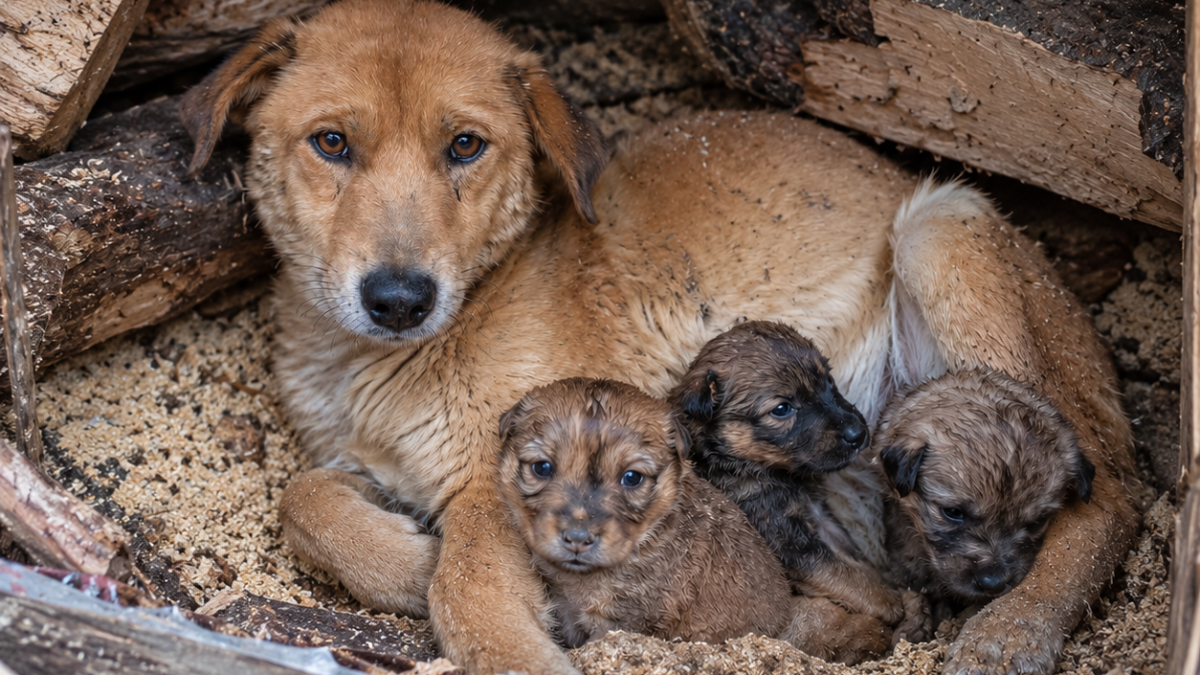
PART 2
For a moment, none of us moved.
Rainwater dripped from the broken roof boards. Somewhere in the trees behind us, a branch snapped and fell with a dull crash.
I looked at the rope again.
It was old nylon, dark with mud, but the knot around the post was unmistakable.
Not tangled.
Not caught.
Tied.
Mark swore under his breath.
Ana leaned closer to the dog’s neck.
“Don’t cut it yet.”
“Why?”
“I need to see where the pressure is.”
The dog’s collar had twisted when the structure collapsed. The rope pulled backward from it, pinning her neck at an awkward angle while the timber pressed across her hindquarters.
Ana slid two fingers beneath the collar.
“Still room. Good.”
The dog’s eyes followed her hand.
No growl.
No snap.
Only exhaustion.
I opened my jacket enough for her to see the puppies.
The smallest one gave a weak squeak.
Her ears lifted.
She immediately tried to rise.
Her entire body jerked.
She cried out.
“Hey.”
I placed my hand gently against her shoulder.
“No. They’re safe.”
Her breathing came fast and shallow.
Ana pointed to the beam.
“We move that first. Slowly.”
Mark and the other volunteer, Lucas, positioned a lifting jack beneath the thickest section while I held the dog’s head steady.
“One inch,” Ana said.
Mark pumped the handle.
The beam rose.
The dog trembled violently.
“Stop.”
Ana reached beneath her body.
Her face changed.
“What?”
“Her rear leg is trapped farther back than I thought.”
“Broken?”
“Almost certainly.”
She felt along the dog’s abdomen.
“And I don’t like how tight her belly is.”
Internal injury.
I didn’t ask.
I knew enough from years of dealing with injured animals around roads and logging sites to understand what that could mean.
Ana glanced toward the puppies.
“We need her at the clinic.”
“How fast?”
“Fast.”
We raised the beam another few inches.
Ana guided the dog’s trapped leg free.
I saw the angle of it and looked away.
Not because I couldn’t handle blood.
Because I already knew how much pain she must have been carrying while lying there with those puppies against her.
Once she was clear, Ana cut the rope.
Mark wrapped the line around his gloved hand.
“Keep this.”
I looked at him.
“For animal control.”
The words made something hard settle in my chest.
We slid the mother onto a rigid stretcher.
The instant we moved her away from the wreckage, she twisted her head toward me.
Toward my jacket.
“She wants the puppies,” I said.
“I know,” Ana replied.
“Can they ride beside her?”
“Not loose.”
We placed the pups in a small insulated carrier with warmed towels. Ana set it close enough that the mother could smell them.
Her breathing slowed slightly.
“What do we call her?” Lucas asked.
Ana gave him a look.
“We don’t.”
“Why not?”
“Because every time we name one, somebody falls in love.”
Mark nodded toward me.
“Too late for him.”
“I’ve known her for fifty minutes.”
“You’re carrying her puppies inside your coat.”
“I was keeping them warm.”
“Sure.”
Under different circumstances, I might have laughed.
I didn’t.
We loaded the dog into Ana’s rescue van.
Before the doors closed, she looked at me.
“You coming?”
I looked at the clearing.
Technically, I still had storm damage to inspect.
A blocked road.
Two hazardous trees.
Half a day of paperwork.
Then the mother dog lifted her head weakly toward the puppies again.
“I’m coming.”
The drive to Ana’s clinic took twenty-eight minutes.
It felt like an hour.
I followed in my county truck while Ana’s emergency lights flashed ahead of me.
At the clinic, two technicians were waiting outside.
They took the mother directly into the treatment room.
Ana handed me the puppy carrier.
“Warm room. Now.”
The three pups were weighed.
One pound, fourteen ounces.
Two pounds, one ounce.
One pound, ten ounces.
The smallest was dangerously cold.
A technician named Megan rubbed him gently through a towel while another prepared warmed fluids.
“How old?” I asked.
“Maybe two weeks,” Megan said. “Could be closer to three. Eyes are just opening.”
“Can they survive without her?”
She looked through the treatment-room door.
“Let’s not decide that yet.”
I could see Ana moving quickly around the mother.
IV line.
Oxygen.
Blood pressure cuff.
Clippers clearing mud and fur.
The dog was so thin beneath the dirt that her ribs appeared as soon as they cleaned her.
That surprised me.
I had assumed the puppies and the storm were the immediate problem.
Then I realized the storm had only revealed a problem that had been developing much longer.
Ana came out fifteen minutes later.
“She’s in shock.”
“How bad?”
“Bad.”
“Internal bleeding?”
“Maybe. We’re doing X-rays and ultrasound now.”
“Her leg?”
“Fractured tibia. Possibly pelvis too.”
I ran a hand over my face.
“She’s nursing three puppies with that?”
“She was nursing them before the collapse.”
“How can you tell?”
“Her body condition.”
Ana glanced toward the warming box.
“She’s underweight enough that those pups have been taking almost everything she has.”
“Can they nurse now?”
“Not yet.”
“Why?”
“She needs stabilization. And I’m worried about trauma around her abdomen.”
The smallest puppy cried.
Ana looked toward the sound.
The mother heard it through the door.
Even sedated and half-conscious, she raised her head.
Ana stopped.
“So much for keeping everybody calm.”
She opened the treatment-room door enough for the mother to see the carrier.
The dog stared at it.
Her tail moved once against the table.
One weak thump.
Something in my chest tightened.
Ana noticed.
“Don’t.”
“Don’t what?”
“Get attached.”
“I’m not.”
She raised one eyebrow.
“Sergey.”
“I’m standing here.”
“You followed an ambulance twenty-eight minutes away from your job.”
“Rescue van.”
“Same point.”
I looked at the dog.
“What happens now?”
“Now I find out if she has internal bleeding.”
She disappeared back into the room.
I sat beside the puppy incubator.
The smallest pup was male.
The other two were one male and one female.
Their coats were variations of their mother’s red-brown coloring, though the female had a white patch across her chest.
They rooted against the blankets instinctively.
Looking for her.
Megan handed me a small bottle.
“Ever fed a neonatal puppy?”
“No.”
“Want to learn?”
“I’m working.”
She looked at my mud-covered uniform.
“Clearly.”
Twenty minutes later, I was holding the smallest puppy at the correct angle while he struggled to latch onto the bottle.
“Not like a human baby,” Megan warned. “Keep him belly-down.”
“I heard you.”
“You’re holding him too upright.”
“I’m adjusting.”
“He’s two pounds and already winning.”
“Very funny.”
The puppy found the nipple.
His tiny paws began kneading against my fingers.
For the first time since the clearing, something inside me loosened.
Then Ana came back.
Her face erased it immediately.
“We need surgery.”
I stood.
“What did you find?”
“Fluid in the abdomen.”
“Blood?”
“Most likely.”
“From what?”
“Could be spleen. Could be liver. I won’t know until I’m in there.”
“And the leg?”
“Later.”
“Can she survive anesthesia?”
Ana crossed her arms.
“She may not survive without it.”
I looked through the window.
The dog lay beneath a warming blanket.
“Do it.”
Ana looked at me carefully.
“You don’t own her.”
“I know.”
“We need legal authorization.”
Animal control had already been contacted because of the rope.
Until an owner could be identified, emergency care could be authorized under the clinic’s agreement with the county.
Mark arrived with photographs from the clearing.
He had taken pictures before anything was disturbed further.
The rope.
The knot.
The collar.
The destroyed shelter.
A plastic food bowl found several feet away.
An empty twenty-pound dog-food bag trapped beneath another piece of timber.
And something else.
A blue plastic storage tote.
“What’s that?” I asked.
“Found behind the shack.”
Inside were two stained blankets and several empty cans.
“Someone was keeping her there.”
“Or dumping food,” Mark said.
Ana barely glanced at the pictures.
“Handle that with animal control. I have a dog to save.”
They took her into surgery.
I stayed.
I told myself I remained because the puppies needed help.
That was partly true.
I also couldn’t leave.
While Ana operated, Megan taught me to feed the pups properly.
We gave them temporary names because writing “Puppy 1, Puppy 2, Puppy 3” on every chart became ridiculous.
The smallest male became Finn.
The larger male became Bear.
The female became Maple.
“Those are terrible names,” I said.
Megan looked offended.
“You have better ones?”
“No.”
“Then congratulations. Finn, Bear, Maple.”
“And the mother?”
Megan glanced toward surgery.
“She needs one.”
“No.”
“You’re the one who found her.”
“That doesn’t mean I name her.”
“Red coat.”
“So?”
“Ruby.”
“No.”
“Ruby.”
“I’m not participating.”
She wrote RUBY on the whiteboard.
I stared at it.
“You did that deliberately.”
“Yes.”
Two hours passed.
Then three.
At some point my supervisor called.
“Are you coming back?”
“I’m at the veterinary clinic.”
Silence.
“You’re where?”
I explained.
He sighed.
“Are the trees still going to be fallen tomorrow?”
“Probably.”
“Then finish what you’re doing.”
That was all he said.
At the three-hour mark, Ana walked out.
There was blood on the front of her surgical gown.
I stood so fast the chair scraped backward.
“She’s alive.”
I didn’t realize I had been holding my breath until then.
“What happened?”
“Small tear in the spleen. Slow bleeding, but enough combined with shock to become dangerous.”
“You fixed it?”
“Yes.”
“And everything else?”
“Her pelvis is bruised but not fractured. The lower leg definitely is.”
“So another surgery?”
“Possibly. First she has to recover from this one.”
“Will she?”
Ana removed her cap.
“I don’t know.”
I hated that answer.
But again, it was the honest one.
We brought the puppies close when Ruby began waking.
They did not nurse.
Not that night.
Ruby was too weak, and Ana wanted strict control over the pups’ feeding until she knew the mother’s condition was stable.
At almost midnight, I finally left.
Before going, I stood beside Ruby’s kennel.
Her eyes opened.
“Your babies are okay.”
Her gaze shifted toward the incubator.
“I promise.”
I reached toward her.
Then stopped.
She didn’t know me.
I was a stranger who had pulled her out of the only shelter she had known.
So I rested my hand outside the bars instead.
Ruby slowly moved her nose toward it.
She smelled my fingers.
Then closed her eyes.
I drove home in silence.
My house had been quiet for almost three years.
That was how long it had been since my old shepherd mix, Max, died.
He had lived to fourteen.
Afterward, I told everyone I wasn’t getting another dog.
People assumed grief was the reason.
It wasn’t only that.
My job kept me away for long hours.
Winter storms.
Wildfire season.
Search operations.
Trail emergencies.
I had convinced myself another dog deserved someone whose schedule made sense.
Still, when I unlocked my front door that night, I found myself listening for paws that had not crossed that floor in years.
Nothing.
I heated soup.
Forgot about it.
Sat at the kitchen table.
Then my phone buzzed.
Ana.
I answered immediately.
“What happened?”
“She’s awake.”
“That’s good.”
“She’s trying to stand.”
“That doesn’t sound good.”
“It isn’t.”
A pause.
“Puppies?”
“Sleeping.”
“Ruby?”
Ana went quiet.
I smiled despite myself.
“You called her Ruby.”
“Go to bed, Sergey.”
The next morning, I returned before work.
Ruby looked worse.
At least I thought she did.
Her eyes were dull.
Her body trembled.
Ana corrected me.
“She’s better.”
“This is better?”
“She’s no longer bleeding internally.”
Fair point.
Finn, Bear, and Maple were stronger.
Their cries certainly were.
When they heard movement, all three began squealing.
Ruby lifted her head.
Ana looked at the monitors.
“Let’s try something.”
She placed Ruby on padded bedding and positioned the puppies beside her.
The reaction was immediate.
Ruby smelled Finn first.
Then Bear.
Then Maple.
She began licking them.
Not casually.
Frantically.
Every inch she could reach.
The puppies crawled toward her belly.
Ruby shifted despite the pain in her leg.
“Easy,” Ana whispered.
Finn found a nipple.
Then Bear.
Maple struggled.
Ruby nudged her with her nose.
Within a minute all three were nursing.
Megan turned away and pretended to organize supplies.
I did the same thing.
Ana looked at both of us.
“You know I can see you.”
“No idea what you mean,” I said.
Ruby closed her eyes while the puppies fed.
Her breathing slowed.
For ten minutes, that small treatment room became completely still.
Then Ana touched my arm.
“She can’t do this full-time yet.”
“I know.”
“We supplement.”
“I know.”
“You also need to go to work.”
I looked at my watch.
I was already late.
“I know.”
She smiled.
“Go.”
I returned to the clearing that afternoon with an animal-control officer named Rachel Morris.
Mark met us there.
The storm damage looked different now.
Less like an accident.
More like evidence.
Rachel photographed the rope again.
“You’re certain this was attached to the dog before the collapse?”
“I cut it myself,” Ana had already documented.
Mark pointed to the knot.
“And the rope was under the beam.”
Rachel crouched.
“How long had the dog been here?”
“No idea.”
I showed her the food bowl and tote.
Rachel examined the area.
Then she walked around the rear of the ruined shack.
“Sergey.”
I joined her.
Tire tracks were still visible in the soft ground beneath the trees.
Not from our vehicles.
These came from an older narrow-wheelbase vehicle.
Probably a small truck or SUV.
“Could be anybody,” I said.
“Could be.”
She took pictures anyway.
A few yards farther back, Mark found cigarette butts near a stump.
Then an empty bottle.
Then a torn receipt trapped beneath wet leaves.
Rachel carefully lifted it.
Most of the printing had bled away.
One thing remained visible.
A date.
Twelve days before the storm.
And the name of a gas station seventeen miles south.
“That prove anything?” I asked.
“No.”
She bagged it.
“But we keep it.”
The important discovery came near the post.
Under the mud was a metal tag.
Not a dog tag.
A rabies-vaccination tag.
Rachel cleaned it carefully.
There was a clinic number.
“That could identify her.”
My pulse jumped.
Rachel called.
The tag number belonged to a female mixed-breed dog vaccinated eighteen months earlier.
Name: Rosie.
Owner: Helen Ward.
Address: forty miles away.
Rosie.
Not Ruby.
For some reason, that bothered me.
I had known her one day.
But Ruby had become real in my head.
Rachel noticed.
“What?”
“Nothing.”
“You look disappointed.”
“Megan named her Ruby.”
Rachel smiled.
“Tell Megan not to get attached.”
“Apparently everybody keeps telling everybody that.”
Rachel called the number associated with Helen Ward.
Disconnected.
The address, however, existed.
We drove there.
A small white house stood at the end of a gravel road.
An elderly man answered.
“Helen?”
He shook his head.
“Moved two years ago.”
“Do you know where?”
“Assisted living.”
He looked at the rabies tag in Rachel’s hand.
“What’s this about?”
“A dog registered to her.”
The man’s face changed.
“Rosie?”
“You know the dog?”
“Sure. Little reddish thing.”
“She isn’t little.”
“She was when Helen got her.”
“Do you know what happened to her?”
“Helen gave her to her nephew after she got sick.”
“What nephew?”
He thought.
“Derek.”
“Last name?”
“Cole, maybe. Something like that.”
Rachel wrote it down.
“Do you know where he lives?”
“No.”
The man frowned.
“Rosie okay?”
I answered before Rachel could.
“She’s alive.”
He studied my face.
“That doesn’t sound like okay.”
“No.”
The next day, Rachel located Helen Ward.
She was eighty-one and living in a care facility after a stroke.
Her speech was slow but clear.
When Rachel showed her a photograph of Ruby—Rosie—before surgery, Helen began crying.
“That’s my girl.”
I stood near the window.
Rachel sat beside her.
“When did you last see her?”
“Two years.”
“Who took her?”
“My sister’s boy.”
“Derek?”
Helen nodded.
“Couldn’t bring Rosie here.”
“Did Derek agree to keep her?”
“Yes.”
“Did he ever say anything about giving her away?”
“No.”
Helen’s hands trembled.
“He sent pictures at first.”
“When was the last one?”
She thought.
“Long time.”
“Do you still have them?”
Her daughter had saved several on an old tablet.
The most recent was seven months earlier.
Rosie stood in a fenced yard.
Healthy.
No puppies.
Rachel copied the image.
“Did you know she wasn’t spayed?”
Helen looked embarrassed.
“My husband always handled that. After he died…”
She shook her head.
“I thought Derek would.”
“What did Derek tell you recently?”
Helen looked at the blanket over her knees.
“That she was fine.”
“When?”
“Two weeks ago.”
I looked at Rachel.
Two weeks.
The receipt near the shack was twelve days old.
Rachel’s face stayed neutral.
“Did he send a picture?”
“No.”
“What exactly did he say?”
Helen’s eyes filled.
“He said she was running around his yard like always.”
My hands tightened.
Rachel asked gently, “Would you be willing to show us his number?”
Helen did.
On the drive back, I said very little.
Rachel glanced over.
“You’re angry.”
“He told an eighty-one-year-old woman her dog was fine.”
“We don’t know he left Rosie there.”
“Who else had her?”
“We investigate first.”
“And if it was him?”
“Then we deal with it.”
She was right.
I knew she was right.
I still wanted to drive straight to his house.
Instead, I went to the clinic.
Rosie—Ruby—was awake when I arrived.
I stood beside her kennel.
“So your real name is Rosie.”
Her eyes opened.
“Apparently we’ve been lying to you.”
Her tail moved.
I tried it.
“Rosie.”
Nothing.
“Ruby.”
Tail.
I stared.
“No.”
Tail again.
Ana walked past.
“What are you doing?”
“Scientific research.”
“Of course.”
I said, “Rosie.”
Nothing.
“Ruby.”
Her tail thumped once.
Ana smiled.
“Case closed.”
“Her name was Rosie for years.”
“Maybe she likes Ruby better.”
I crouched.
“Ruby.”
She looked directly at me.
“All right.”
From that point forward, she was Ruby at the clinic.
Helen called her Rosie.
Both were true.
Two days after the first surgery, Ruby’s blood count began dropping again.
My first thought was bleeding.
Ana shook her head.
“No evidence.”
“Then what?”
“Could be destruction of red blood cells, could be dilution after fluids, could be her body catching up with everything.”
“Do you need a transfusion?”
“Maybe.”
By evening, maybe became yes.
The clinic kept a list of blood-donor dogs.
A large Labrador named Duke came in with his owner.
I watched the bag of dark red blood hang beside Ruby’s kennel.
“How many things can go wrong with one dog?” I asked.
Ana didn’t look away from the monitor.
“As many as can go right.”
“That makes no sense.”
“It will later.”
Ruby tolerated the transfusion.
The next morning, her gums were pinker.
She ate chicken from Ana’s hand.
By afternoon, she stood on three legs long enough to reach her puppies.
Everyone celebrated.
Then Finn stopped eating.
Megan noticed first.
“He feels cooler.”
Ana checked him.
His blood sugar was low.
He had lost weight overnight.
Ruby tried licking him while Ana examined him.
“Could be infection,” Ana said.
“From what?”
“He’s a neonatal puppy. At this age, almost anything.”
Finn went into a warmer.
Megan started fluids.
I watched his tiny body beneath the blanket.
I had convinced myself once Ruby survived surgery, the worst was over.
That was a mistake.
Puppies that young could disappear quickly.
Strong in the morning.
Gone by evening.
“What can we do?”
Ana looked at me.
“We are doing it.”
I stayed after work.
Finn remained weak.
Ruby became increasingly agitated whenever he cried.
She tried rising.
Her fractured leg dragged beneath her.
“She’ll hurt herself,” I said.
“I know.”
We moved Finn’s warmer closer to her.
Ruby lay with her nose against the clear wall.
Finn slept inches away.
At midnight, he finally took formula.
At two in the morning, another small feeding.
At six, he crawled toward the front of the warmer and cried loudly enough to wake everybody.
Megan called me while I was driving to work.
“He’s being obnoxious.”
“That’s good?”
“Very.”
Three days later, Finn returned to his mother.
Ruby licked him so intensely he rolled onto his back.
He complained.
She ignored him.
Bear and Maple piled on top of him.
The family was together again.
That same day, animal control found Derek Cole.
Rachel called me only because I was part of the original discovery and she wanted a formal statement about the clearing.
“Did he admit it?” I asked.
“He admitted bringing her to the forest.”
My jaw tightened.
“Why?”
“He says he intended to return.”
“To a dog tied to a collapsing shack?”
“He claims the shack wasn’t collapsed when he left.”
“That makes it better?”
“No.”
“What about the puppies?”
“He says he didn’t know she was pregnant until she delivered.”
“How long had she been there?”
“Approximately three weeks.”
I closed my eyes.
Three weeks.
“Why leave her there?”
Rachel paused.
“He moved into a rental that didn’t allow dogs.”
“That’s it?”
“He says he contacted two shelters and they were full.”
“So he tied her in the forest.”
“He says he brought food every few days.”
The plastic bowl.
The cans.
The receipt.
“How often?”
“We’re still sorting that out.”
“He told Helen she was fine.”
“Yes.”
“What happens to him?”
“Sergey.”
“What?”
“You know I can’t promise charges or outcomes before the investigation is finished.”
“He left a nursing dog tied to a post during storm season.”
“I know.”
I looked through the clinic window.
Ruby slept while three puppies nursed.
“Does Helen know?”
“Yes.”
“How is she?”
Rachel was quiet.
“Not good.”
That hurt more than I expected.
Derek had not only failed Ruby.
He had made an elderly woman believe the dog she loved was safe.
Ana found me standing in the hallway after the call.
“Bad news?”
I told her.
She leaned against the wall.
“Three weeks?”
“That’s what he says.”
“Explains her weight.”
“He says he fed her.”
“Not enough.”
“He says shelters were full.”
Ana’s expression hardened.
“Then you keep calling.”
“I know.”
“You call rescues. You call friends. You ask the veterinarian. You post online. You surrender the dog properly. You don’t tie her to rotten lumber.”
“I know.”
She looked through the glass.
“People confuse being out of options with being out of convenient options.”
That sentence stayed with me.
Derek was eventually charged under state animal-cruelty and abandonment statutes.
Not with some dramatic felony that put him away for years.
Reality is often less satisfying than people want.
He received fines, probation, mandatory animal-care education, and a court order restricting animal ownership for a period of time.
Helen refused to speak with him.
That consequence was not on any legal document.
I suspect it hurt him more than the fine.
But all of that came later.
At the clinic, we still had four animals whose future was uncertain.
Ruby needed orthopedic surgery.
Ana waited until her bloodwork stabilized.
One week after the rescue, Dr. Larson, a veterinary orthopedic surgeon, repaired the fractured leg with a plate and screws.
The surgery went well.
Recovery did not.
Ruby hated confinement.
She wanted her puppies.
She wanted to walk.
She wanted everyone to stop touching her leg.
Within twelve hours she had figured out how to twist around her protective collar.
“Smart,” Megan said.
“Annoying,” Ana replied.
Ruby stared at them.
I swear she looked pleased.
For the next several weeks, her world became a carefully controlled routine.
Short supported bathroom breaks.
Medication.
Physical therapy.
Nursing sessions.
Supplemental puppy feeding.
Rest.
More rest.
Ruby had no interest in rest.
Once she began feeling stronger, she attempted to follow me every time I left the room.
The first time it happened, I thought she wanted water.
I stepped toward the door.
She stood.
“Stay.”
I moved.
She hopped after me on three legs.
“Ruby.”
Another hop.
Ana appeared.
“She’s following you.”
“No, she isn’t.”
I walked left.
Ruby turned left.
I walked right.
Ruby turned right.
Ana crossed her arms.
“You were saying?”
“She associates me with her puppies.”
“The puppies are behind her.”
I looked at Ruby.
She wagged.
“Traitor.”
From then on, whenever I arrived, she knew the sound of my boots.
Her head came up before I reached the room.
Sometimes she whined.
Sometimes her tail hit the bedding.
I started timing my lunch breaks so I could visit.
My coworkers noticed.
One afternoon, my supervisor caught me leaving with a bag of boiled chicken.
“That for you?”
“Yes.”
He looked at the bag.
“No seasoning.”
“I’m eating healthy.”
“You hate boiled chicken.”
I stared at him.
He smiled.
“How’s the dog?”
“Fine.”
“Puppies?”
“Fine.”
“You taking her?”
“No.”
He laughed and walked away.
I was not taking her.
I repeated that often.
To Ana.
To Megan.
To Mark.
To myself.
My schedule was wrong.
My house had no fenced yard.
I worked long days.
Ruby deserved stability after everything she had survived.
Those were facts.
Then, three weeks into recovery, Ana asked me to help with a temperament assessment.
“Why me?”
“Because she trusts you.”
“That seems like a reason not to use me.”
“I need to see how she responds outside the medical room with someone familiar.”
We brought Ruby into a quiet fenced exercise yard behind the clinic.
Her injured leg was still supported, but she had begun placing a little weight on it.
I sat on a bench.
Ana unclipped the leash.
Ruby looked around.
For the first time since I found her, she stood somewhere that was not a treatment room or collapsed shelter.
She smelled the grass.
Then the fence.
Then the air.
A truck passed on the road.
She flinched.
I stayed still.
A minute later she walked toward me.
She rested her head against my knee.
Ana wrote something on her clipboard.
“What?”
“Nothing.”
“What did you write?”
“Clinical observation.”
“You smiled.”
“I smile clinically.”
Ruby looked up at me.
I scratched behind her ears.
Ana said, “You know Helen can’t take her.”
“I know.”
“And once the puppies are weaned, Ruby needs placement.”
“I know.”
“We have foster applications.”
“Good.”
“She’d probably do well in a quiet home.”
“Good.”
“Possibly someone who spends time outdoors.”
I looked at her.
“No.”
“I didn’t say you.”
“You were about to.”
“I was describing a type.”
“Describe somewhere else.”
Ana laughed.
The puppies developed faster than Ruby recovered.
Their eyes opened fully.
Then their ears.
Then their personalities.
Bear was fearless.
He crawled everywhere first.
Maple learned that humans meant food and screamed whenever anybody entered.
Finn, the smallest, preferred sleeping against Ruby’s neck.
By five weeks, they were wrestling.
By six, they were chewing everything.
Megan lost one shoelace.
Ana lost a pen.
I lost the corner of a field notebook.
“These animals are destructive,” I complained.
Ana looked at me.
“You work in a forest.”
“Trees don’t eat paperwork.”
At seven weeks, the puppies received their first vaccines.
At eight, they were almost ready for adoption.
That created a problem nobody expected.
Ruby became anxious whenever a puppy left the room.
Even for ten minutes.
She would pace as much as her healing leg allowed.
Whine.
Stare at the door.
Ana worried.
“She’s been through separation trauma.”
“Can we keep them together longer?”
“A little. But not indefinitely.”
“What happens when they leave?”
“We make it gradual.”
The first step was moving the puppies into a pen across the room for short periods.
Ruby hated it.
Then into the adjoining room.
She hated that more.
But each time, they came back.
That mattered.
She began learning that disappearance did not always mean abandonment.
The first puppy adopted was Bear.
A family with two older children applied.
They had a fenced yard.
Another dog.
Veterinary references.
Everything looked good.
Still, I disliked them immediately.
Not because they did anything wrong.
Because they were taking Bear.
Megan noticed.
“You’re scowling.”
“I’m evaluating.”
“You’re standing twenty feet away with your arms crossed.”
“Observation is part of evaluation.”
“The father is a firefighter.”
“Firefighters can make mistakes.”
“The mother works from home.”
“Could be irresponsible.”
“Their previous dog lived to sixteen.”
“Suspiciously old.”
Megan laughed.
“You’re impossible.”
Bear left on a Saturday.
Ruby watched the family carry him out.
She whined.
I sat beside her.
“He’s okay.”
She went to the door.
“He’s not coming back.”
Wrong choice of words.
Her head snapped toward me.
I corrected myself.
“He’s going somewhere safe.”
For twenty minutes she paced.
Then Maple bit Finn’s ear, Finn screamed, and Ruby returned to being a mother.
The next morning, Bear’s new family sent a photograph.
He was asleep beside their older dog.
I showed Ruby the phone.
She smelled it.
“See?”
Her tail moved.
I knew she did not understand photographs the way I wanted her to.
The picture was for me.
Maple left six days later.
Her adopter was a retired nurse named Joanne who had recently lost an elderly spaniel.
Joanne cried before Maple even reached the car.
“She’s going to be spoiled,” I said.
Joanne nodded.
“Absolutely.”
Ruby handled the second departure better.
She searched for Maple.
But only briefly.
Then there was Finn.
The fragile one.
The puppy who almost died.
The one who slept against Ruby.
No one wanted to be the first person to say it.
Separating him would be hardest.
Ana received several excellent applications.
She delayed the decision.
I noticed.
“You’re keeping him.”
“No.”
“You’re delaying.”
“I’m selecting carefully.”
“Megan told me you bought a puppy gate.”
“Megan talks too much.”
“Ana.”
She looked at Finn.
He was chewing the leg of her office chair.
“I may foster him.”
I laughed.
“Foster.”
“Temporarily.”
“Of course.”
“Don’t start.”
Finn never left Ana’s house.
The paperwork eventually caught up with what everyone knew from day one.
That left Ruby.
Nine weeks after rescue, her final orthopedic check showed excellent healing.
The plate was stable.
She could use all four legs.
She still limped slightly when tired.
Dr. Larson expected that to improve.
Her puppies were gone.
Her body had regained weight.
Her coat had become thick and coppery.
The dog under the logs had disappeared.
In her place stood a beautiful medium-sized mixed breed with dark eyes, white toes, and a habit of leaning her entire weight against anyone she trusted.
Her profile went online.
“Ruby, approximately four years old. Gentle. Quiet. Loyal. House-training unknown. Best suited to a patient home.”
Applications came.
The first family had three dogs.
Too much.
The second lived in an apartment and worked twelve-hour shifts.
Not ideal.
The third sounded perfect.
A middle-aged couple.
No other pets.
Large fenced yard.
One spouse worked from home.
They visited.
Ruby was polite.
She took treats.
Allowed petting.
Everything went well.
I should have been happy.
Instead, when I left the clinic that afternoon, Ruby stood at the window watching me cross the parking lot.
I drove halfway home.
Then pulled onto the shoulder.
“What are you doing?” I asked myself.
No one answered.
I started the truck again.
Drove home.
Walked through the quiet rooms.
My old dog’s collar still hung on a hook in the mudroom.
I had never removed it.
Max.
Fourteen years of muddy paws, hair in the truck, chewed gloves, trail walks, and waiting at the window.
For three years, I had told myself not having another dog was practical.
That evening, practicality felt suspiciously similar to fear.
My phone rang.
Ana.
“They want her.”
I knew who she meant.
“The couple?”
“Yes.”
“They’re good?”
“Very.”
I sat at the kitchen table.
“When?”
“They could take her next weekend.”
“That fast?”
“That is seven days.”
“I know how calendars work.”
Ana waited.
“What?”
“Nothing.”
“You’re doing that thing.”
“What thing?”
“Where you’re hoping I’ll say something so you don’t have to.”
I looked toward Max’s collar.
“I work too much.”
“Yes.”
“My yard isn’t fenced.”
“True.”
“I’m gone during storms.”
“Yes.”
“I told you I’m not adopting her.”
“You did.”
“So why are you quiet?”
“Because Ruby isn’t my decision.”
I closed my eyes.
“What if I’m wrong for her?”
“That’s a real question.”
“Thank you.”
“You want an easy answer?”
“No.”
“Good. Because there isn’t one.”
Ana continued.
“You work long days sometimes. But you can arrange help. You already take dogs with you in the truck on appropriate days. A fence can be built. Your supervisor knows your schedule. You live five minutes from the forest station.”
“That sounds like you’re arguing for me.”
“I’m arguing against excuses disguised as facts.”
I hated when she did that.
“What about the couple?”
“They’re excellent.”
“Then Ruby should go with them.”
“Maybe.”
I said nothing.
Ana sighed.
“Come tomorrow.”
“Why?”
“Because I’m asking.”
I arrived at eight.
The clinic was quiet.
Ruby was in the exercise yard.
Ana handed me a leash.
“Take her.”
“Where?”
“Walk.”
We walked the gravel path behind the clinic.
Ruby moved beside me.
Not ahead.
Not pulling.
Beside me.
At the edge of the tree line, she stopped.
Wind moved through the pines.
Her body stiffened.
Maybe she remembered.
Maybe I imagined it.
Then she looked at me.
I crouched.
“You okay?”
Ruby stepped forward and pressed her forehead against my chest.
I held her face between my hands.
For the first time since Max died, I allowed myself to picture another dog in my house.
Ruby by the stove.
Ruby in the truck.
Ruby sleeping near the door.
Ruby waiting for me to come home.
The picture scared me.
That was when I finally understood the problem.
I wasn’t afraid I couldn’t give Ruby a good home.
I was afraid of loving another dog enough to eventually lose her.
That fear belonged to me.
Not her.
I returned to the clinic.
Ana sat behind the desk.
“Well?”
“I need a fence.”
She tried to hide her smile.
“A good one.”
“Yes.”
“And somebody has to let her out if I’m gone all day.”
“Yes.”
“And if I’m deployed overnight, she needs somewhere she knows.”
“My house.”
I stared.
“You planned this.”
“I planned nothing.”
“You already have Finn.”
“They know each other.”
Ruby walked to Ana.
Then back to me.
I exhaled.
“Tell the couple I’m sorry.”
Ana’s face became serious.
“Only if you are certain.”
I looked down.
Ruby leaned against my leg.
“I am.”
The fence went up six days later.
My coworkers helped.
So did Mark.
Even my supervisor arrived carrying a post-hole digger.
“You’re all enjoying this too much.”
He grinned.
“You said you weren’t getting another dog.”
“I changed my mind.”
“Apparently.”
Ruby came home the following Saturday.
I expected some dramatic moment.
There wasn’t one.
She walked through my front door.
Smelled the entryway.
Inspected the living room.
Found the kitchen.
Drank from the bowl.
Then stood in the middle of the hallway as though asking what happened next.
“This is it,” I told her.
She looked at me.
“Not exciting.”
Tail wag.
“Bedroom’s down there. You’re not allowed on the bed.”
That rule lasted three nights.
The first night, Ruby slept beside the front door.
The second, beside my bedroom.
The third, I woke at two in the morning to find her standing over me.
“Ruby.”
She stared.
“No.”
She placed one paw on the mattress.
“No.”
Second paw.
“Absolutely not.”
Ten seconds later, she curled at the foot of the bed.
I looked at the ceiling.
“This is temporary.”
Ruby sighed.
It was not temporary.
Life with her settled into rhythms I had forgotten I missed.
Morning walk.
Breakfast.
Truck rides when appropriate.
Afternoons sleeping near the forest office.
Evenings on the porch.
At first, she panicked if I tied anything near her.
A leash looped around a chair leg sent her backward.
The sound of rope dragging across wood made her freeze.
So I stopped using long lines.
We worked slowly.
A trainer helped.
No force.
No flooding.
Just repetition.
Leash on.
Treat.
Leash off.
Safe.
Door closes.
Door opens.
Safe.
I leave for ten minutes.
I return.
Safe.
Storms were harder.
The first strong wind after her adoption sent Ruby under my kitchen table.
Rain hit the windows.
Branches moved outside.
She trembled.
I sat on the floor.
Did not drag her out.
Did not tell her there was nothing to fear.
There was.
She knew what storms could do.
So I stayed.
After twenty minutes, she crawled closer.
After forty, she put her head on my leg.
We sat there until the storm passed.
In spring, Ana brought Finn over.
Mother and son recognized each other immediately.
Finn was nearly Ruby’s size by then.
He charged across the yard.
Ruby met him halfway.
For twenty minutes they ran until Ruby tired and lay in the grass.
Finn dropped beside her.
Ana smiled.
“You realize this means we have to keep visiting.”
“Terrible.”
“Finn likes it.”
“Ruby tolerates him.”
Ruby licked Finn’s entire face.
Ana looked at me.
“Clearly.”
We stayed in touch with the other adopters.
Bear grew into a sixty-pound red dog who loved children and hated vacuum cleaners.
Maple slept in Joanne’s bed and gained a reputation at her neighborhood park for stealing tennis balls.
Finn became Ana’s clinic greeter.
Ruby saw all three again on the first anniversary of the rescue.
We arranged it at a fenced field.
I wasn’t sure she would recognize them.
She did.
The moment Bear came through the gate, Ruby’s tail began moving.
Maple followed.
Then Finn.
Within seconds, four red-brown dogs were running circles around us.
Helen Ward came too.
Rachel brought her from the care facility with permission from her daughter.
I had not seen Helen since the investigation.
Ruby had not seen her in almost three years.
We kept expectations low.
Dogs change.
People change.
Memory is complicated.
Helen sat in a wheelchair near the gate.
Ruby was twenty yards away.
Then Helen said one word.
“Rosie.”
Ruby stopped.
Every part of her body went still.
Helen tried again.
“Rosie-girl.”
Ruby turned.
For two seconds, nothing happened.
Then she ran.
Not recklessly.
Not like a puppy.
But faster than I had seen her move since the injury.
She reached Helen and pressed herself against the wheelchair.
Helen buried both hands in her coat.
“My baby.”
I looked away.
So did Ana.
Rachel made no attempt.
Helen held Ruby’s face.
“I’m sorry.”
Ruby licked her chin.
“I thought you were safe.”
Another lick.
“I should’ve checked.”
I crouched nearby.
“Helen.”
She looked at me.
“This wasn’t your fault.”
“I gave her away.”
“To someone you trusted.”
“I should’ve known.”
“You couldn’t know what he would do.”
Helen looked at Ruby.
“Are you happy?”
Ruby leaned against her.
Helen smiled through tears.
“I think that’s a yes.”
We stayed two hours.
Before leaving, Helen asked me something.
“What do you call her?”
“Ruby.”
She laughed.
“Ruby?”
“Megan named her before we knew.”
“Does she answer?”
“Better than Rosie.”
Helen scratched beneath Ruby’s chin.
“Well, you always were stubborn.”
Then she looked at me.
“Keep Ruby.”
I nodded.
“I will.”
“No.”
She gripped my wrist with surprising strength.
“I mean keep her safe.”
I looked at Ruby.
“I will.”
The second year was easier.
Ruby’s limp became barely visible.
Her fear of storms never disappeared entirely, but she learned where to go.
My kitchen table became her shelter.
Eventually she stopped shaking.
She would simply lie there until the wind settled.
I sat with her when I could.
When I couldn’t, she had blankets.
Music.
And proof from dozens of previous storms that the door would still open afterward.
Derek completed his probation.
I saw him once.
At a gas station.
He recognized me before I recognized him.
For a few seconds, we stood on opposite sides of a fuel pump.
He looked thinner than the photograph Rachel had shown me.
“You’re the ranger.”
“Yes.”
“You took Rosie.”
“I found her.”
His mouth tightened.
“I didn’t mean for that shack to fall.”
I stared at him.
“That’s what you tell yourself?”
“I fed her.”
“Every few days.”
“I was going to find somewhere.”
“You had three weeks.”
“You think shelters just take dogs whenever you want?”
“No.”
I stepped closer.
“I think you don’t tie a nursing dog to a post and drive away.”
His face reddened.
“I didn’t know there’d be a storm.”
“That isn’t the point.”
“I checked on her.”
“Not often enough.”
He looked away.
For a moment, my anger wanted something dramatic.
An apology.
A confession.
Some perfect line that would make him understand.
Real life rarely gives you that.
Derek simply looked tired.
“I screwed up.”
“Yes.”
“I know that.”
I waited.
He glanced at my truck.
Ruby was sitting inside.
Her head visible through the rear window.
“Is that her?”
“Yes.”
He took one step.
Ruby stiffened.
I raised my hand.
“Don’t.”
He stopped.
“Does Helen know?”
“Yes.”
His jaw moved.
“She won’t talk to me.”
“That’s between you and her.”
He looked at Ruby again.
“She looks good.”
“She is.”
I opened my truck door.
Ruby moved behind me.
Derek said quietly, “Tell Helen—”
“No.”
He looked at me.
“If you want to tell Helen something, you do the work of telling her yourself.”
“She won’t answer.”
“That may be the consequence.”
I got into the truck.
Ruby placed her head on my shoulder as I started the engine.
I did not feel victorious.
Only finished.
Some stories do not need revenge.
Sometimes the consequence is simply seeing the life an animal has without you and understanding you were the danger it had to survive.
Years passed.
Bear moved with his family to Colorado.
Maple stayed with Joanne until Joanne suffered a hip fracture, then spent six weeks with Ana before going home.
Finn became famous among the clinic clients for stealing gloves.
Ruby became gray around the muzzle.
My house changed too.
The old silence disappeared.
There were bowls near the kitchen.
Dog hair in the truck.
Leashes by the door.
A bed in my office.
Another bed in the living room.
A third bed she ignored because apparently furniture was better.
My coworkers stopped asking whether she belonged to me.
Instead, new employees asked how long I had owned her.
I always answered differently.
Sometimes I said, “A few years.”
Sometimes I told the story.
One autumn morning, almost five years after the storm, I inspected the same clearing.
The old logging shack had been removed completely.
County crews had cleaned the hazardous timber.
Grass covered the area where Ruby had been pinned.
I brought her with me.
She climbed out of the truck slowly.
Age had reached her hips.
Not badly.
Just enough that I noticed.
Ruby smelled the ground.
Walked toward the place where the support post once stood.
Then stopped.
I watched her carefully.
Her tail was neutral.
No shaking.
No panic.
She smelled a patch of grass.
Then looked back at me.
“That’s it,” I said.
She returned.
No dramatic recognition.
No visible memory.
Maybe that was a gift.
I sat on a fallen tree.
Ruby rested beside me.
I thought about the first time I saw her.
Mud.
Blood.
Collapsed wood.
Three puppies hidden beneath her body.
For years, I had told people she protected them.
That was true.
But Ana once corrected me.
“She didn’t make some conscious heroic decision the way humans write it,” she said. “She was their mother. She did what her body told her to do.”
At first, that sounded less romantic.
Eventually, I understood it was more extraordinary.
Ruby did not need to understand sacrifice.
She only needed to refuse to leave her puppies.
Even trapped.
Even hurt.
Even starving.
I scratched her neck.
The old collar scar had faded years earlier.
“Ready?”
Ruby stood.
We went home.
At age ten—or approximately ten, since nobody knew exactly—Ruby developed a small lump near her shoulder.
I felt it one evening.
Everything inside me tightened.
Ana examined her the next morning.
“Probably fatty.”
“Probably?”
“We sample it.”
“Today?”
“Yes.”
“Results?”
“Sergey.”
“What?”
“You’ve become worse than my most anxious clients.”
“Results?”
“Two days.”
It was benign.
I celebrated by buying Ruby an expensive steak.
Ana found out.
“You know dogs shouldn’t eat an entire steak.”
“She didn’t.”
“How much?”
“Most.”
“Sergey.”
“She survived being crushed by a logging shack.”
“That does not make her immune to pancreatitis.”
Ruby sat beside me looking innocent.
“See what you’ve created?” Ana asked.
I looked at Ruby.
“She seems fine.”
“She’s manipulative.”
“Also fine.”
At eleven, Ruby slowed.
At twelve, she developed arthritis.
Medication helped.
Rugs appeared over my wood floors so she would not slip.
A ramp appeared beside the porch.
Then beside the truck.
I told everyone I installed them because I was practical.
Nobody believed me.
Helen died that winter.
Her daughter called.
“She kept Ruby’s picture beside her bed.”
I sat at the kitchen table while Ruby slept nearby.
“Thank you for telling me.”
“Mom worried about her until the end.”
“She didn’t need to.”
“I know.”
“She was safe.”
“I know.”
After the funeral, Helen’s daughter mailed me an envelope.
Inside was an old photograph.
Helen, younger, sitting on her porch.
A red puppy lay in her lap.
On the back, in shaky handwriting, she had written:
**Rosie, first summer home.**
I framed it.
Placed it beside a newer photograph of Ruby sleeping in my truck.
Two names.
Two homes.
One dog.
Finn died at thirteen from cancer.
Ana called me after midnight.
I drove to her house.
Ruby was too old to come.
Ana sat on the floor beside Finn’s empty bed.
“I knew this part would happen.”
“Yes.”
“It doesn’t help.”
“No.”
The next morning, I brought Ruby over.
She smelled Finn’s blanket.
Walked through the rooms.
Then lay beside Ana.
They stayed that way for almost an hour.
Bear died the following year.
Maple six months later.
Ruby was the last.
“Of course she is,” Ana said.
“Why of course?”
“Too stubborn.”
That was our running explanation for everything.
Why she survived the collapse.
Stubborn.
Why she survived surgery.
Stubborn.
Why she learned to walk again.
Stubborn.
Why she lived to an age none of us expected.
Stubborn.
By then, Ruby no longer climbed onto my bed.
I lifted her.
She no longer jumped into the truck.
Ramp.
She no longer walked miles through the forest.
We walked to the mailbox.
Then halfway.
Then just around the yard.
She remained happy.
That mattered more than distance.
She ate.
She watched birds.
She followed me from room to room.
She still hid beneath the kitchen table during storms.
And every evening, she slept beside my chair.
One spring, almost thirteen years after I found her, Ruby stopped finishing breakfast.
One day was not enough to panic.
Two was.
Ana examined her.
Bloodwork.
Ultrasound.
Kidney disease.
Advanced.
My stomach dropped.
“How long?”
“You know I can’t answer that.”
“Months?”
“Maybe.”
“We treat?”
“Yes.”
Fluids.
Diet.
Medication.
Monitoring.
For a while, it worked.
Ruby rallied.
Summer came.
She spent warm mornings on the porch.
She turned down expensive kidney food until I mixed in exactly the amount of chicken Ana allowed.
“You negotiate with her too much,” Ana said.
“She has seniority.”
“In your own house?”
“Especially there.”
Autumn arrived.
Ruby began having more difficult days.
Her legs weakened.
Her appetite faded.
Still, every time I wondered whether it was time, she would have one good morning.
Eat breakfast.
Walk outside.
Lean against me.
It is remarkable how much hope a single good morning can create.
And how easily hope becomes selfishness.
One October evening, a storm moved through.
Wind hit the house.
Rain struck the windows.
Ruby went beneath the kitchen table.
I sat beside her as I had done countless times.
She did not tremble.
She simply rested her head on my leg.
A powerful gust shook the windows.
Ruby opened her eyes.
Then closed them.
I stroked the white fur around her muzzle.
“You know this one ends too.”
Her breathing remained slow.
“It always ends.”
For the first time, I realized I was not talking about the storm.
The next morning, Ruby could not stand without help.
I called Ana.
She arrived at the house that afternoon.
No clinic.
No metal table.
No bright lights.
Just Ruby’s brown bed beside the living-room window.
Ana examined her quietly.
When she finished, she sat across from me.
“We can increase medication.”
“For how long?”
“I don’t know.”
“Will she feel better?”
“Maybe temporarily.”
“Will she walk?”
“Probably not normally.”
“Eat?”
“Maybe.”
I looked at Ruby.
She was awake.
Watching me.
“What would you do?”
Ana hated that question.
I knew she did.
But she answered.
“I would ask whether you’re buying Ruby good days or buying yourself more days.”
That hurt.
Because I knew.
I put my hand on Ruby’s head.
She leaned into it.
The same way she had in the clinic yard all those years earlier.
“I promised Helen I’d keep her safe.”
Ana’s eyes filled.
“You did.”
“Does this count?”
“This is part of it.”
I looked out the window.
No storm now.
Only a quiet gray afternoon.
“Today?”
“If you’re ready.”
“I’m not.”
“I know.”
“Is she?”
Ana looked at Ruby.
“I think she’s tired.”
That was enough.
We moved Ruby’s bed closer to the window.
I opened it slightly.
Cool forest air entered the room.
Wet leaves.
Pine.
Earth.
The smells she had lived with most of her life.
I found Helen’s photograph.
Placed it nearby.
Then I took Max’s old collar from the mudroom hook.
I had never understood why I kept it there for so many years.
I placed it beside Ruby’s leash.
Two dogs.
Two chapters of my life I had once been afraid to lose.
Ana prepared the first injection.
Ruby rested with her head in my lap.
“You remember that clearing?” I whispered.
Her ear moved.
“Probably not.”
I scratched beneath her chin.
“You were a mess.”
Ana laughed softly through tears.
“Sergey.”
“She was.”
Ruby’s tail tapped once.
“Three puppies under a pile of wood. Broken leg. Bleeding internally. Starving.”
I bent closer.
“And you still tried to get to them.”
Ruby looked at me.
I don’t believe dogs understand speeches.
I’m glad they don’t.
They understand voices.
Touch.
Presence.
The important things.
“I’ve got you now.”
Ana gave the sedative.
Ruby relaxed gradually.
Her head became heavier in my lap.
I kept one hand over her chest.
The second injection came later.
There was no panic.
No struggle.
No storm.
Ruby’s last breath left quietly beneath my hand.
For a long time, I stayed on the floor.
Ana did too.
Nobody rushed me.
Finally, I said, “The house is going to be quiet again.”
Ana looked toward Ruby.
“For a while.”
“I’m not getting another dog.”
Even then, she almost smiled.
“I’ve heard that before.”
Three months later, I returned to the clearing alone.
Snow covered the ground.
I carried nothing dramatic.
No plaque.
No memorial stone.
The forest did not need one.
I walked to where the old shack had stood.
The support post was gone.
The logs were gone.
Young grass and saplings had taken their place.
I stood there thinking about how close I had come to missing the sound.
One weak whimper.
If the wind had been louder.
If I had already reached my truck.
If I had decided it was a branch.
Everything after that depended on a few seconds.
Bear’s family.
Maple and Joanne.
Finn sleeping beside Ana.
Helen holding Rosie again.
Ruby at the foot of my bed.
Ruby in my truck.
Ruby under the kitchen table during storms.
Thirteen years.
All of it had been hidden beneath a pile of wet timber.
I thought that was the part people misunderstood about rescue.
They saw the photograph from the beginning and the photograph from the end.
The broken dog.
Then the healthy dog.
Before.
After.
They did not see everything in between.
The midnight bottle feedings.
The transfusion.
The fear.
The orthopedic surgery.
The dog who panicked at rope.
The first night in a new house.
The first thunderstorm.
The first time she learned someone leaving could come back.
The years of ordinary breakfasts.
The vet appointments.
The gray muzzle.
The final afternoon.
Rescue was not one moment.
Finding Ruby was one moment.
Saving her took years.
I turned toward the truck.
Snow had begun falling lightly.
Before leaving, I looked once more at the place where I had first seen that strip of reddish fur beneath the logs.
For years, I remembered Ruby as the dog pinned there.
Eventually, that stopped being the image that came first.
Instead, I saw her standing on my porch in summer.
Older.
Healthy.
Sunlight across her red coat.
Looking toward the driveway because she had heard my truck long before anyone else.
That was Ruby.
Not the rope.
Not the collapsed shack.
Not the man who abandoned her.
Not even the injuries she survived.
Those things happened to her.
They did not become her.
Back at home, her brown bed still sat beside the window.
I had not moved it.
For several more weeks, I stepped around it automatically.
One evening, Ana came over carrying a cardboard box.
“What’s that?”
“Clinic storage.”
“I don’t want more of Ruby’s medical records.”
“It isn’t.”
She opened the box.
Inside were photographs.
Ruby with her puppies.
Finn in the warmer.
Bear asleep on my uniform jacket.
Maple biting Megan’s shoelace.
Ruby during physical therapy.
Ruby standing for the first time after surgery.
Ruby in the exercise yard.
And one photograph I had never seen.
I was sitting on the clinic floor.
Ruby lay beside me.
Her head rested across my boot.
I looked exhausted.
She looked worse.
“When was this?”
“Third week.”
“Who took it?”
“Megan.”
I held the photograph.
“I don’t remember.”
“You were there every day.”
“I remember that.”
Ana sat at the table.
“You know what I remember?”
“What?”
“You telling everybody she wasn’t your dog.”
I laughed.
“I was right at the time.”
“For approximately six minutes.”
I looked at the photo again.
Ruby’s body was still thin.
Her leg bandaged.
Three puppies sleeping in a pen behind us.
Yet her eyes were closed.
She trusted enough to sleep.
I placed the photograph beside Helen’s.
A week later, I finally moved Ruby’s bed.
Not because I wanted to erase her.
Because I no longer needed an empty bed in the room to prove she had been there.
The marks she left were everywhere.
Scratches on the truck ramp.
Dog hair beneath furniture no vacuum seemed capable of reaching.
A chewed corner of an old field notebook.
Photographs.
Stories.
People who still asked about her.
And somewhere far beyond my house, three bloodlines of puppies whose lives existed because their mother had refused to stop protecting them beneath a collapsed pile of wood.
The following spring, I was inspecting trails when I heard whining near a drainage ditch.
I stopped.
For one ridiculous second, I almost laughed.
“No.”
The sound came again.
I climbed down.
A young black dog was tangled in old fencing.
No collar.
No person nearby.
He froze when he saw me.
I crouched.
“Easy.”
His eyes stayed on my hands.
Something about that expression was painfully familiar.
I called Ana.
She answered.
“What did you find?”
“A dog.”
She was silent.
“Don’t.”
“I didn’t say anything.”
“I can hear you thinking.”
“Is he hurt?”
“Minor, I think.”
“Bring him in.”
“I’m not adopting him.”
“Of course not.”
“Ana.”
“I said nothing.”
It took twenty minutes to cut him free.
When I opened the truck, he hesitated.
Then climbed inside.
He sat where Ruby used to sit.
I stared at him.
“This means absolutely nothing.”
His tail hit the seat.
Once.
Then again.
I shut the door.
On the drive to the clinic, I glanced at him in the mirror.
For the first time since Ruby died, the cab did not feel completely empty.
I still missed her.
I always would.
But grief, I had learned, was not a locked door unless you made it one.
Years earlier, I had been afraid another dog would eventually break my heart.
Ruby had.
Completely.
And I would still choose every day I had with her again.
Every storm.
Every vet bill.
Every sleepless night.
Every muddy paw print.
Every goodbye.
At a traffic light, the black dog leaned forward and touched his nose to my shoulder.
I looked at him.
“No promises.”
Tail.
“You’re going to the clinic.”
Tail.
“They’ll find you a home.”
Tail.
“Somebody else’s home.”
He sat down.
I sighed.
Ahead of us, Ana’s clinic appeared.
And suddenly I remembered Ruby beneath the fallen timber all those years ago, barely able to lift her head but still trying to look toward her puppies.
That had been the first thing she taught me.
Love did not always look like holding on.
Sometimes it meant protecting something until it was strong enough to continue without you.
Sometimes it meant letting puppies leave.
Sometimes it meant letting an old dog go.
And sometimes, when the forest became quiet enough, it meant hearing another small sound and choosing to follow it.
The light turned green.
I drove forward.
[END OF STORY]








