PART 2: I Found Him Curled Against a Wall at 3 A.M.—Months Later, I Barely Recognized the Dog in Front of Me
PART 2
Dr. Harris took the page from her.
I watched her eyes move across the numbers.
She didn’t say anything at first.
That silence frightened me more than a dramatic reaction would have.
“What?”
She looked at the technician.
“Run it again.”
The technician nodded.
I stepped closer.
“What did it show?”
“His packed cell volume is lower than I expected.”
“How low?”
“Low enough that I want confirmation before we decide whether he needs more aggressive support.”
“Blood transfusion?”
“Possibly.”
The word hit me harder than I expected.
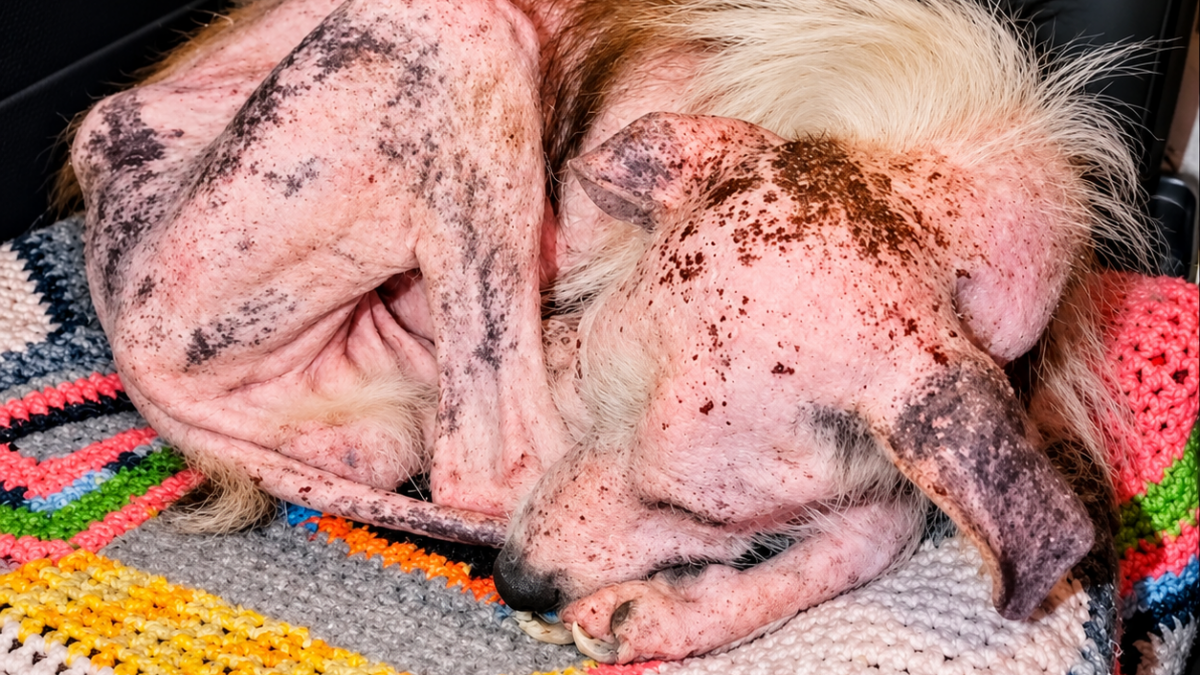
Less than three hours earlier, Dobby had been curled against a wall in a house most people had forgotten existed.
Now we were discussing whether his body had enough red blood cells left to carry oxygen.
I looked through the treatment-room glass.
He was lying on his side beneath a warming blanket.
His chest rose slowly.
He still watched every person who passed.
“Can I sit with him?”
Dr. Harris nodded.
“Don’t interfere with the catheter.”
“I won’t.”
I pulled a chair beside him.
Dobby’s eyes moved toward me.
“You’re causing a lot of trouble for somebody I met two hours ago.”
One ear shifted.
I smiled weakly.
“Good. That means you heard me.”
Rachel brought coffee and set it beside me.
I didn’t touch it.
The repeat blood test confirmed the first result.
Severe anemia.
Not quite at the threshold where Dr. Harris felt an immediate transfusion was unavoidable, but close enough that she wanted his values rechecked frequently.
“What’s causing it?” I asked.
“Probably several things.”
She counted them off.
“Parasites can contribute. Chronic inflammation. Poor nutrition. Blood loss through damaged skin. There could also be something we haven’t identified yet.”
I hated that phrase.
Something we haven’t identified yet.
Dobby already had enough diagnoses.
“How many problems can one dog have?”
Dr. Harris glanced at him.
“A lot when nobody treats the first one.”
That answer stayed with me.
Neglect rarely creates one isolated problem.
Hunger weakens immunity.
Weak immunity allows infections to worsen.
Parasites steal nutrients.
Damaged skin opens the door to bacteria.
Pain reduces appetite.
Dehydration makes everything harder.
By the time an animal looks catastrophically sick, the original problem has often become a whole system of failures.
Dobby was living inside that system.
And now we had to unwind it carefully.
We could not simply pour food into him.
His body was too depleted.
Refeeding too aggressively could create dangerous electrolyte shifts.
So his meals were small.
Measured.
Frequent.
I hated the portions.
The first time a technician placed a tiny dish in front of him, I said, “That’s all?”
“For now.”
“He’s starving.”
“I know.”
“He wants more.”
“He probably will.”
“Then why—”
Dr. Harris cut me off.
“Because saving him means not letting our emotions feed him faster than his body can handle.”
I looked at Dobby.
He had eaten the small portion already.
Now he was licking the dish.
I understood the medicine.
Emotion still hated it.
“We’ll feed again soon,” I told him.
Dobby looked up.
His eyes were enormous against his thin face.
Rachel crouched beside me.
“You realize he doesn’t understand English.”
“I know.”
“You keep explaining everything.”
“I’m explaining it to myself.”
“That makes more sense.”
The first medicated bath was worse.
Dobby’s skin was covered in crusted material, flakes, inflammation, and open scratches.
The treatment was necessary.
But necessary does not mean painless.
We used warm water.
Soft cloths.
No hard scrubbing.
Still, when water touched one raw area near his shoulder, Dobby’s entire body tightened.
I stopped.
“Enough.”
Dr. Harris looked at me.
“We need to continue.”
“He’s hurting.”
“Yes.”
“I don’t want him thinking we’re hurting him.”
“He may.”
That answer bothered me.
Dr. Harris lowered her voice.
“He doesn’t understand medical treatment. We can’t explain antibiotics or mange or skin cultures. All we can do is be as gentle as possible and make sure discomfort leads somewhere better.”
I looked down at Dobby.
He watched my face.
“Slow.”
“We’re already going slow.”
“Slower.”
So we slowed.
A bath that might normally take fifteen or twenty minutes took nearly an hour.
Afterward, we wrapped him in warm towels.
Dobby trembled.
I sat on the floor and held him carefully against my chest.
At first, he stayed rigid.
Then, after several minutes, some of the tension left his body.
His head lowered beneath my chin.
Rachel noticed.
“He leaned into you.”
“He’s tired.”
“That too.”
I didn’t want to call it trust.
Not yet.
I had seen people romanticize rescued animals too quickly.
A terrified dog freezing during contact can look calm.
A shut-down animal can look obedient.
Exhaustion can look like trust.
Dobby had survived by conserving everything.
Energy.
Movement.
Reaction.
I didn’t want to pretend that helplessness meant affection.
Still, when his body softened against me, I let myself enjoy it.
Just a little.
That first night at the clinic, I slept in a chair for maybe forty minutes.
When I woke, my neck hurt and the room was dim.
Dobby was awake.
Watching me.
“Still here.”
His eyes blinked.
I stood and checked the chart attached to his enclosure.
Temperature improving.
Fluids continuing.
No vomiting.
Next blood check scheduled before dawn.
I crouched.
“You and I have terrible schedules.”
Dobby’s nose moved.
I put my hand near the enclosure door.
He didn’t approach.
That was fine.
“Take your time.”
I went back to the chair.
Just before sunrise, his blood count had stabilized.
Not improved.
But not lower.
Dr. Harris looked relieved enough that I noticed.
“That’s good?”
“That’s good for today.”
“Today?”
“I’m not giving you tomorrow yet.”
“You’re very frustrating.”
“So I’ve been told.”
I finally drank the coffee.
It was cold.
It tasted terrible.
It was the best coffee I had ever had.
Because Dobby had made it through the night.
The next day brought new results.
Parasites.
A significant skin infection.
Mange severe enough to explain much of the hair loss.
No obvious organ failure.
That last piece of information felt enormous.
His body was damaged.
It was not finished.
Treatment became a schedule.
Medication.
Food.
Rest.
Skin treatment.
Fluids.
Bloodwork.
Repeat.
Dobby accepted everything with the same unnerving stillness.
He never snapped.
Never growled.
Never fought the technicians.
People praised how “sweet” he was.
I understood what they meant.
But every time someone said it, part of me wanted to say:
He’s not being sweet.
He doesn’t know he’s allowed to object yet.
That distinction mattered.
During the first few days, if we moved his blanket, Dobby stayed where we put him.
If we touched his paws, he tolerated it.
If someone approached too quickly, his body stiffened but he didn’t move away.
He had learned, somewhere, that resistance was useless.
I wanted that lesson gone.
I wanted him to discover that he could choose.
So whenever it was medically safe, we gave him choices.
Which blanket.
Whether to approach.
Whether to accept a hand.
Where to lie.
Tiny choices.
They looked meaningless.
They weren’t.
On day three, I sat several feet from his enclosure with the door open.
Dobby stayed inside.
I had a piece of approved food in my palm.
I did not call him.
Five minutes passed.
Then ten.
Rachel walked by.
“You planning to become furniture?”
“Go away.”
She smiled.
Dobby’s nose moved.
He smelled the food.
One front paw shifted forward.
Then stopped.
I waited.
Eventually he stood.
His legs trembled.
He took one step.
Then another.
He reached the edge of the enclosure.
Stopped again.
I looked slightly away.
Another step.
Then his nose touched my palm.
He took the food.
Immediately retreated.
I smiled.
“There you go.”
Rachel had stopped around the corner.
I knew because I could see half her shoe.
“You’re terrible at hiding.”
She stepped out.
“He chose to come.”
“Yes.”
“That counts.”
“It counts.”
We became obsessed with counting tiny things.
Meals finished.
Steps taken.
Seconds standing.
Tail movements.
Interest in smells.
Sleeping positions.
Dobby’s medical recovery was slow enough that noticing the small things kept us sane.
On day four, he finished an entire measured meal.
I photographed the empty bowl.
Rachel said, “People take pictures of sunsets. You take pictures of dishes.”
“Important dish.”
On day five, he stood long enough for a bedding change.
On day six, his tail lifted when I entered.
Rachel nearly shouted.
“Tail!”
“It lifted.”
“That’s a wag.”
“It absolutely was not.”
“It was emotionally a wag.”
“What does that mean?”
“It wanted to be a wag.”
She wrote on the whiteboard:
TAIL: CONSIDERING HAPPINESS
Dobby stared at her marker.
“That’s defamatory,” I told him.
He sneezed.
“See? He agrees.”
The first true wag happened two days later.
I entered carrying breakfast.
Dobby stood.
His tail moved once.
Stopped.
Then moved again.
I froze.
Rachel was behind me.
“Did you—”
“Yes.”
“Say it.”
“No.”
“Say I was right.”
“You were premature.”
“Say it.”
Dobby wagged again.
Rachel pointed.
“Witness.”
I sighed.
“You were right.”
She celebrated as if Dobby had won a championship.
He cared only about breakfast.
That was another good sign.
Appetite became his first clear personality trait.
When we found him, eating had been survival.
Within two weeks, eating became enthusiasm.
The difference was obvious.
At first, he lowered his head and swallowed mechanically.
Later, he began appearing before meal times.
He learned the sound of the food container.
Learned which technician was easiest to manipulate.
Learned that Rachel occasionally carried chicken.
One morning, Rachel entered without food.
Dobby stood.
Looked at her hands.
Looked behind her.
Then sat back down.
She gasped.
“He only loves me for chicken.”
“I tried to warn you.”
“This relationship was built on lies.”
Dobby turned his head away.
I laughed.
Humor felt strange around him at first.
The whole situation had been too serious.
Then I realized laughter was evidence too.
Not laughter at him.
Laughter because he was becoming ordinary enough to be funny.
That mattered.
At the end of the second week, however, his progress reversed.
He developed a fever.
It started mildly.
Then climbed.
His appetite disappeared.
The brightness we had just begun seeing in his eyes faded.
I watched Dr. Harris examine him.
“What happened?”
“Could be the skin infection.”
“We’re treating that.”
“Treatment doesn’t guarantee a straight line.”
“Could it be something new?”
“Yes.”
I hated that word.
We repeated bloodwork.
Changed antibiotics after updated culture results.
Increased monitoring.
For forty-eight hours, Dobby barely wanted food.
Every medical number became a threat again.
I found myself staring at his intake photograph.
The skeletal body.
The missing fur.
Those eyes.
Maybe I had become hopeful too soon.
Rachel caught me sitting in the hallway.
“You look terrible.”
“Thanks.”
“I mean emotionally.”
“Still thanks.”
She sat beside me.
“He’s had two bad days.”
“He doesn’t have extra weight to lose.”
“I know.”
“What if his body can’t keep doing this?”
Rachel looked through the treatment-room window.
“He’s still doing it.”
“Doing what?”
“Breathing.”
“That’s a low standard.”
“For today, it might be the right standard.”
I looked at her.
She shrugged.
“You taught me that.”
I didn’t remember doing that.
Maybe rescue work teaches everyone the same lessons eventually.
That night, Dobby refused the bowl.
I tried hand-feeding.
Nothing.
I held a small piece near his nose.
His head turned away.
My stomach tightened.
“Come on.”
Nothing.
“Just one.”
Dobby closed his eyes.
I sat there for nearly an hour.
Then I put the food down.
“I’m not going to fight you.”
I leaned against the wall.
A few minutes later, I heard licking.
Dobby had lifted his head.
One bite.
Then another.
I didn’t move.
He ate maybe a quarter of the portion.
It was enough to make me cry.
Not dramatically.
Just silent tears while sitting on a clinic floor at two in the morning watching a nearly hairless dog chew.
Recovery changes your scale of importance.
The fever broke the following night.
His appetite returned the morning after.
I sent Rachel a text before sunrise.
HE ATE EVERYTHING.
She replied instantly.
TAIL?
I looked.
Dobby’s tail moved.
TAIL CONFIRMED.
Her response contained so many exclamation marks that my phone wrapped the line.
The setback frightened us.
But afterward, something changed faster.
His eyes became more alert.
He started watching doors.
Watching food.
Watching people.
He no longer lay wherever we placed him.
If a blanket was uncomfortable, he moved.
If water was too far away, he stood and walked to it.
If a technician touched an irritated area, he pulled his leg back.
The first time he did that, the technician apologized automatically.
Then she smiled.
“Good.”
I understood.
Dobby had discovered he could say no.
That was progress.
Not disobedience.
Not difficult behavior.
Progress.
One afternoon, Dr. Harris needed to examine his rear leg.
Dobby pulled away.
She paused.
“Okay.”
She repositioned.
Dobby pulled again.
“Give him a second.”
I crouched in front of him.
“You’re allowed to hate this.”
His ears lifted.
“We still have to do it.”
Dr. Harris laughed.
“Very reassuring.”
“But you can hate it.”
Dobby stared at me.
Then allowed the examination.
When it ended, he stepped toward me instead of remaining frozen.
I scratched beneath his chin.
“That’s how this works.”
His skin slowly changed.
The angry redness softened.
Crusted areas cleared.
The itching decreased.
Damaged hair continued falling away.
For a while, he looked even more naked.
People who saw photographs during that stage sometimes thought he was worse.
He wasn’t.
The unhealthy coat had to go.
Then, near the end of the third week, Rachel called me over.
“Look.”
“What?”
She touched Dobby’s shoulder.
Tiny dark hairs.
Almost invisible.
I leaned closer.
“No.”
“Yes.”
“New?”
“New.”
I touched the spot gently.
Soft.
Like velvet.
Dobby looked annoyed by our fascination.
“Your hair is coming back.”
He yawned.
Rachel took a picture.
Within days, more appeared.
Along his neck.
Across his back.
Near the base of his tail.
His body was rebuilding itself from the inside out.
Food became muscle.
Medicine became healing skin.
Rest became strength.
Trust became personality.
That last part happened in strange ways.
Dobby learned toys.
At first, he ignored them completely.
A volunteer donated a blue plush octopus.
I placed it beside him.
Dobby sniffed it once.
Then walked away.
I squeezed it.
The toy squeaked.
Dobby jumped backward.
“Sorry.”
He stared at the octopus as if I had intentionally introduced a dangerous creature into his room.
I set it down.
For the rest of the afternoon, he avoided that side of the enclosure.
The next morning, one tentacle was wet.
Rachel found me staring.
“What?”
“He touched it.”
“How do you know?”
“Saliva.”
“You’re investigating toy saliva now?”
“Yes.”
“Normal.”
That afternoon, I entered quietly.
Dobby had the octopus in his mouth.
I froze.
He froze.
For three seconds, neither of us moved.
“Caught you.”
Dobby dropped it.
I sat on the floor.
“Go ahead.”
Nothing.
I looked away.
A few seconds later, the toy squeaked.
I turned.
Dobby had pounced on it.
Not gracefully.
His front legs hit first.
His rear legs followed late.
He almost tipped over.
Then he bit the toy and shook his head once.
The squeaker sounded.
Dobby jumped again.
Then attacked it.
I started laughing.
Rachel heard me from the hall.
“What happened?”
“Come here quietly.”
She appeared.
Dobby shook the toy.
Her face changed.
“Oh.”
That one syllable contained weeks of fear.
We watched him play for less than a minute.
Then he became tired.
He lay down with the octopus beneath one paw.
Rachel wiped her eyes.
“I’m not crying.”
“Obviously.”
“Allergies.”
“In the clinic?”
“Very strong allergies.”
Dobby closed his eyes.
The octopus stayed under his paw.
That toy traveled with him through every stage that followed.
By week four, Dobby was strong enough for short walks outside.
The first one lasted less than five minutes.
I clipped on a harness.
He froze.
Not from weakness this time.
Fear.
I loosened the strap.
“You okay?”
He looked at the doorway.
Outside was bright daylight.
For weeks, his world had been clinic walls.
Before that, the abandoned house.
I opened the door.
Dobby stood several feet away.
Rachel waited outside with treats.
“Chicken diplomacy?”
“Always.”
Dobby took one step.
Stopped.
Another.
His front paws reached sunlight.
He looked down.
Then up.
Wind moved across his skin.
He sniffed.
His nose worked rapidly.
There were cars in the distance.
Grass.
Birds.
Food smells.
Laundry detergent from a nearby building.
Hundreds of things.
Dobby stood completely still.
Not shut down.
Processing.
Then he walked forward.
Onto grass.
He lowered his nose.
Sniffed one spot for almost thirty seconds.
Rachel whispered, “Big day.”
I nodded.
Dobby sneezed.
Then sniffed again.
The first walk consisted mostly of smelling three square yards of grass.
That was enough.
The next day, he went farther.
The day after that, farther again.
His body was getting stronger.
So was his curiosity.
And with curiosity came trouble.
A paper towel roll disappeared.
We found it shredded.
Dobby sat in the middle of the evidence.
“Who did this?”
His tail moved.
“You have no remorse.”
More wagging.
Rachel entered.
She looked at the paper.
Then Dobby.
Then me.
“This is excellent.”
“Excellent?”
“He has enough energy for vandalism.”
“That’s not how medicine works.”
“It is now.”
Dobby picked up a paper scrap.
Rachel pointed.
“See? Thriving.”
At week five, his bloodwork showed significant improvement.
His anemia was resolving.
His weight had climbed.
His hydration was normal.
The parasites were under control.
The skin infection was responding.
The mange treatment was working.
Dr. Harris read the results twice.
“Good.”
I narrowed my eyes.
“Just good?”
“Very good.”
“Better.”
Dobby stood beside us.
His fur was still thin, but enough had returned that his color pattern was beginning to emerge.
Dark along the back.
Lighter underneath.
His ears looked absurdly large.
Rachel said, “He looks like a different dog.”
“No.”
She looked at me.
“What?”
“He looks like the dog he was supposed to be.”
That distinction mattered to me.
We weren’t turning Dobby into something new.
We were removing everything that had hidden him.
Hunger.
Disease.
Fear.
Pain.
Exhaustion.
Underneath all of it was a dog with opinions.
He liked chicken.
Hated baths.
Distrusted brooms.
Loved soft blankets.
Was uncertain about men with hats.
Liked women with quiet voices.
Wanted toys once he understood them.
Hated cold floors.
Preferred drinking from wide bowls.
Snored lightly.
Stole paper.
And had begun following me from room to room.
That last habit developed gradually.
One afternoon, I left his room.
Three seconds later, I heard nails behind me.
I turned.
Dobby stood in the doorway.
“What?”
He stared.
“You were sleeping.”
He walked toward me.
I took two steps.
He followed.
I walked to the laundry room.
He followed.
“You have become supervisory.”
His tail moved.
I returned to his room.
Dobby followed.
Then lay down.
The next day, same thing.
Within a week, I could no longer go to the bathroom without Dobby appearing outside the door.
Rachel laughed.
“Congratulations.”
“For what?”
“You have a stalker.”
“I preferred when he ignored me.”
“No, you didn’t.”
She was right.
The first time Dobby actively sought affection, I almost missed it.
I was answering email at a desk.
He approached from behind.
I assumed he wanted food.
I reached for a treat.
Dobby ignored it.
Instead, he pushed his nose beneath my wrist.
My hand lifted.
He moved under it.
I froze.
“You want this?”
I scratched his neck.
Dobby leaned harder.
Not food.
Not medicine.
Touch.
Choice.
The dog who had once accepted petting because he was too exhausted to resist now requested it.
I sat on the floor.
Dobby climbed partly into my lap.
His body was larger than when we found him.
Still thin.
But warmer.
Stronger.
He pressed his forehead against my chest.
I held him.
This time, I let myself call it trust.
“Okay,” I whispered. “Now I believe you.”
I don’t know how long we sat there.
Long enough for my legs to go numb.
I didn’t move.
By the second month, the clinic was no longer the right environment.
Dobby was medically stable enough to foster.
Emotionally, however, we had questions.
Would he adapt to a house?
Would he panic when left alone?
Would new rooms frighten him?
Could he live with another dog?
How would he react to normal household noises?
We chose Laura.
She had fostered several recovering dogs for us.
Quiet home.
Fenced yard.
No children.
One senior Labrador named Gus who had perfected the art of not caring about anything.
The introduction happened outdoors.
Gus approached slowly.
Dobby froze.
I watched his body.
Tail neutral.
Mouth closed.
No growl.
Gus sniffed Dobby’s shoulder.
Dobby looked at me.
“It’s okay.”
Gus walked away.
Dobby watched.
Then followed.
Laura smiled.
“That was anticlimactic.”
“Anticlimactic is good.”
Inside the house, Dobby stopped at the entrance.
Laura went in.
Gus went in.
Dobby stayed on the porch.
I waited.
“Come on.”
Nothing.
Then I remembered.
Choice.
I sat inside where he could see me.
Five minutes passed.
Laura did not rush.
Ten.
Dobby put one paw across the threshold.
Stopped.
Then the second.
Eventually, all four.
I exhaled.
Laura whispered, “Good boy.”
Dobby looked around.
Living room.
Couch.
Rug.
Coffee table.
Television.
Windows.
A normal home.
He walked three feet.
Stopped.
Sniffed.
Another three.
By the end of the visit, he had explored most of the first floor.
Except the hallway.
It was darker.
Dobby stood at the entrance and refused.
Laura said, “We’ll leave a light on.”
Exactly the answer I wanted.
That night, Dobby slept on the floor beside the expensive bed we had bought him.
Laura texted:
He refuses the bed.
I replied:
Don’t push.
Morning photo:
One paw on the bed.
Second night:
Two paws.
Third:
Half his body.
Fifth:
Dobby curled in the center.
Gus sleeping on the floor beside him.
Laura wrote:
He has discovered capitalism.
I laughed.
The foster home introduced challenges we could never reproduce at the clinic.
The television.
First time a dog barked onscreen, Dobby jumped behind Laura.
Then peeked around her legs.
The vacuum cleaner was unacceptable.
Laura turned it on in another room.
Dobby disappeared.
They stopped.
For days, she simply left the vacuum in a corner.
No movement.
No noise.
Dobby eventually sniffed it.
A week later, she rolled it across the floor without power.
He watched.
Eventually, the sound stopped sending him into hiding.
Brooms were harder.
The first time Laura picked one up, Dobby flattened himself against the wall.
She immediately put it down.
That reaction made my stomach turn.
“Do you think someone hit him?”
Laura asked.
“I don’t know.”
“Could be the movement.”
“Could be.”
We did not invent history.
That mattered.
A scared dog does not automatically prove abuse.
Fear can come from lack of exposure.
A broom is large.
Moves strangely.
Makes noise.
Dobby’s reaction told us he was afraid.
Nothing more.
So we worked with the fear we could see instead of constructing a story we couldn’t prove.
Laura swept only when he was in another room.
Later, she laid the broom flat.
Treat nearby.
Then closer.
Weeks passed before Dobby could stand comfortably while she used it.
No drama.
No forcing.
Just repetition.
Stairs were another puzzle.
Gus went up.
Dobby stood at the bottom.
Looked up.
Looked at me.
I had come for a foster check.
“You want me to carry you?”
He backed away when I bent down.
Okay.
No carrying.
Laura sat halfway up.
Gus looked down from the landing.
Dobby whined.
One paw on the first step.
Then down.
Again.
Eventually he climbed three.
Stopped.
Then four.
At the top, he looked almost surprised.
Laura smiled.
“You did it.”
Dobby immediately walked back down and repeated the process.
Apparently once he understood stairs, he needed to confirm the discovery.
His favorite revelation was the backyard.
The first day, he stepped onto grass and froze.
The clinic walks had taught him grass existed.
A whole private yard was different.
Gus walked past.
Dobby followed.
They sniffed the fence.
Tree.
Patio.
Flower bed.
Then Gus jogged.
Dobby followed.
Something changed.
Dobby ran.
Not the awkward few steps of rehabilitation.
Ran.
Across the yard.
Turned.
Ran back.
Gus chased.
Dobby’s ears flew.
His tail lifted high.
He made a sound I had never heard before.
A bark.
One sharp bark.
Then another.
Laura was filming.
When she sent the video, I watched it at least twenty times.
Rachel came into the office.
“What?”
I handed her the phone.
Dobby crossed the yard.
Full speed.
Rachel’s face softened.
“That’s him.”
“Yes.”
The dog curled against the abandoned wall had been a body trying not to die.
This was Dobby.
Running because running felt good.
Playing because there was time for play.
Stopping because he chose to.
Living beyond survival.
The foster home also revealed his attachment.
Dobby followed Laura constantly.
At first we worried about separation anxiety.
So she practiced leaving for seconds.
Then minutes.
Dobby waited by the door.
Whined once.
Settled.
Ten minutes.
Twenty.
An hour.
He learned people could leave and return.
That lesson may have been as important as anything medical.
One evening, Laura called.
“I think he has a problem.”
My heart jumped.
“What?”
“He steals socks.”
I paused.
“That’s the emergency?”
“He has six.”
“Why do you have six socks where he can reach?”
“That sounds judgmental.”
“Very.”
Dobby had created a pile beneath the dining table.
Not chewing them.
Collecting.
Laura sent a picture.
Dobby lying beside his sock collection.
Gus in the background appearing ashamed by association.
Rachel saw it.
“He needs a job.”
“He has one.”
“What?”
“Sock management.”
More personality.
More ordinary trouble.
Exactly what I wanted.
His fur thickened rapidly in foster care.
At each visit, I had to adjust the picture in my head.
Week one: mostly bare.
Month two: fuzzy.
Month three: real coat.
By the end of the third month, his back was covered.
Some areas were still thin.
His skin still needed monitoring.
But strangers no longer stared because he looked sick.
They stared because his ears were enormous.
At a follow-up, one technician walked into the room.
“Who’s this?”
I smiled.
“Dobby.”
She stopped.
“No.”
“Yep.”
She moved closer.
“That cannot be Dobby.”
Dobby walked toward her.
Tail wagging.
She covered her mouth.
“Oh, my God.”
The entire clinic came out.
Receptionist.
Technicians.
Dr. Harris.
One person compared intake photos on a phone.
Another stared at his coat.
Dr. Harris crouched.
Dobby licked her face.
She laughed.
“You were much more cooperative when you were sick.”
Dobby tried stealing the stethoscope.
Rachel said, “Neurological recovery.”
“That’s not what neurological means.”
“Emotional neurology.”
“Stop inventing medicine.”
Dobby barked.
Everyone laughed.
He had become loud enough to interrupt us.
That felt like success.
Then adoption interest started.
We posted updated photographs.
Applications came within days.
People love transformations.
The before-and-after image was powerful.
I understood why.
But it created a problem.
Some applicants wanted the transformation more than the dog.
One woman wrote a long message about how Dobby’s story had “inspired” her.
On the phone, I asked about his ongoing dermatological care.
Silence.
“Would he need that forever?”
“Possibly intermittent care.”
“Oh.”
“His history also means we want someone patient with fear triggers.”
“He looks normal now.”
I disliked that sentence.
“What does normal mean?”
“You know. Healthy.”
“He is healthier. That doesn’t erase what he learned.”
She withdrew the application the next day.
Good.
Another applicant wanted to feature Dobby on a social media account devoted to rescue transformations.
No.
A family with three small children seemed wonderful on paper.
During the meeting, the children became overwhelmed by excitement.
They surrounded Dobby.
Two hands on his head.
One around his neck.
Dobby froze.
The parents smiled.
“He’s so calm.”
I ended the meeting.
“He’s not calm.”
They looked confused.
“He’s shut down.”
The mother immediately called the children back.
To her credit, she listened.
But the environment was probably too intense.
We did not proceed.
Then Michael and Anna applied.
No dramatic letter.
No inspirational language.
Simple.
Both in their forties.
Quiet household.
Fenced yard.
Previous dog had died at fourteen.
No children.
Stable schedule.
Experience with medication.
They asked for Dobby’s full behavioral history before meeting him.
That impressed me.
Anna arrived first and sat on the floor.
She did not call him.
Dobby stood across the room.
Michael spoke with me.
“What scares him?”
“Fast approaches. Brooms used to. Dark doorways sometimes. Sudden loud noises, depending on context.”
“Any aggression?”
“No documented aggression.”
“Does he like other dogs?”
“He does well with Gus.”
“Cats?”
“Unknown.”
“Crate?”
“Tolerates one but doesn’t seek it.”
“Separation?”
“Improving.”
Anna still waited.
Dobby moved closer.
One step.
Sniffed her shoe.
She kept her hand in her lap.
He sniffed her knee.
Anna looked at me.
“Do I reach?”
“Let him tell you.”
She lowered her hand slightly.
Dobby sniffed.
Then pushed his chin into her palm.
Anna’s eyes filled.
She did not grab him.
Did not hug him.
She simply held her hand beneath his head.
“Hi, Dobby.”
My throat tightened.
It was the same gesture.
The clinic floor.
My palm.
His chin.
Trust offered, not taken.
They visited again.
Dobby brought Anna the blue octopus.
Michael sat on the couch.
Dobby eventually lay near his feet.
Third visit, Dobby fell asleep beside him.
Laura texted me after they left.
He picked them.
I responded:
I think so.
We did a home visit.
Their house was quiet.
They had already placed rugs over slippery floors.
A dog bed sat in the living room.
Another in the bedroom.
Michael pointed toward a hallway.
“We leave this light on?”
“For now.”
“Done.”
Anna showed me a basket.
“Brooms go here behind the door.”
I smiled.
“You don’t have to reorganize everything.”
“We live here too.”
“That’s healthy.”
She laughed.
Dobby explored.
Stopped at one doorway.
Michael walked through.
Sat down.
Waited.
Dobby followed.
That sealed it for me.
They weren’t trying to prove how much they loved him.
They were learning how he needed to be loved.
The adoption was scheduled for almost four months after rescue.
The night before, I visited Laura.
Dobby was sleeping beside Gus.
His coat was thick enough that I could bury my fingers in it.
I sat near him.
“You’re leaving tomorrow.”
His tail moved.
Laura laughed.
“He has no idea.”
“I know.”
“You okay?”
“No.”
“That’s normal.”
“I hate when people say that.”
“Still true.”
I looked at Dobby.
“First night, I thought he might die.”
“And now?”
“He steals laundry.”
“Major progression.”
The next day, Anna arrived with a green collar.
Michael carried paperwork.
I had prepared instructions.
Three pages.
Rachel looked at them.
“You wrote a dissertation.”
“It’s important.”
“Page two has a section called ‘Broom Protocol.’”
“It’s important.”
Michael accepted the papers with complete seriousness.
“I’ll study.”
“Don’t encourage her,” Rachel said.
Dobby wore the green collar.
He looked at the door.
Anna held the leash.
I crouched.
“Okay.”
Dobby approached.
I touched his face.
The fur beneath my hand still felt strange after months of touching bare, damaged skin.
“You don’t owe me anything.”
His tail moved.
“Don’t make them regret this.”
He licked my chin.
Rachel whispered, “That’s not a promise.”
Anna opened the door.
Dobby walked out.
No hesitation.
No looking back.
For one selfish second, that hurt.
I wanted one pause.
One glance.
Proof that leaving me mattered.
Then I understood the better truth.
He walked forward because he felt safe enough to.
He did not need to cling to the place where he had healed.
He was ready for whatever came next.
I watched the car leave.
Rachel stood beside me.
“He didn’t look back.”
“I noticed.”
“That’s good.”
“I know.”
“You’re still crying.”
“I know.”
“Chicken?”
I laughed.
“You’re impossible.”
“Relationship building.”
The first update arrived that evening.
Dobby on the couch.
All four legs pointing in different directions.
Michael’s message:
We were informed this furniture belonged to us. There appears to have been an administrative error.
Next morning:
Dobby asleep beneath their dining table with one of Michael’s socks.
Day three:
Blue octopus in the kitchen.
Day five:
Dobby staring through a window at a squirrel.
Video attached.
The squirrel ran up a tree.
Dobby reached the trunk.
Stopped.
Looked around.
Barked at the tree.
Then sat down.
Michael’s voice behind camera:
“Buddy, it went up.”
Dobby looked at him.
Then back at the trunk.
Caption:
He believes the tree ate the squirrel. Investigation ongoing.
For the first few weeks, I checked my phone too often.
I had to stop myself from asking for updates.
Dobby belonged to them now.
Not to the rescue.
Not to me.
The goal was not permanent access.
It was permanent home.
Anna still sent enough.
He adapted faster than we expected.
The first time they left him alone for two hours, they watched the home camera.
Dobby waited near the door.
Paced briefly.
Then moved to the couch.
Slept.
When they returned, he greeted them wildly.
But no panic.
No destruction.
He had learned one of the hardest lessons for abandoned animals:
Leaving was not always forever.
That lesson deepened over time.
Car rides.
At first, Dobby stayed tense.
Then he learned rides could lead to parks.
Hiking trails.
Laura’s house.
The rescue for checkups.
One Saturday, Michael took him to a quiet lake.
Dobby refused to enter the water.
Michael stepped ankle-deep.
Dobby stood on shore.
Anna filmed.
“Come on.”
No.
Michael moved farther.
Dobby barked.
Then grabbed Michael’s abandoned sandal and ran away.
Anna laughed so hard the video shook.
Caption:
Swimming lesson canceled. Theft successful.
Dobby remained suspicious of water except during one unexpected summer discovery.
A sprinkler.
Anna turned it on while gardening.
Dobby barked.
The water moved.
He chased.
Spray changed direction.
He jumped sideways.
Bit at it.
Ran through.
Came back.
Within minutes, he was soaked.
The dog who disliked baths voluntarily attacked a sprinkler for nearly half an hour.
Michael sent the video.
I watched Dobby race through sunlight and water.
Hair full.
Body healthy.
Tail high.
I cried.
Not because it was sad.
Because joy can hurt when you know what came before.
Six months after adoption, Dobby returned for bloodwork.
Dr. Harris reviewed the numbers.
“Normal.”
I stared.
“Everything?”
“Close enough for me to be very happy.”
“Anemia?”
Resolved.
“Protein?”
Improved.
“Skin?”
Stable.
“Weight?”
Ideal.
I looked at Dobby.
He was trying to investigate a trash can.
Dr. Harris smiled.
“Remember asking whether we could save him?”
“Yes.”
She turned the computer screen.
“There’s your answer.”
I looked at the normal values.
Then at Dobby.
“I wanted something more dramatic.”
“You got a dog stealing trash.”
“Fair.”
She leaned down.
Dobby approached.
Then stole a glove from her pocket.
Dr. Harris stared.
“That’s mine.”
Dobby ran.
I laughed.
“Medical success.”
“Give it back.”
Dobby made us chase him around the room.
That might have been the happiest follow-up appointment of my career.
Nearly a year after rescue, animal control contacted me.
The call came on a Tuesday.
“About the abandoned house.”
I sat down.
“What about it?”
“A former neighbor reached out.”
My pulse increased.
For months, part of me had wanted answers.
Now that possibility was here.
“What did they say?”
“They recognized the property. Gave us a name of someone who stayed there temporarily.”
“Dobby’s owner?”
“We cannot establish that.”
“Did they admit knowing him?”
“They said they saw a dog around.”
“Owned him?”
“Denied.”
“Fed him?”
“Wouldn’t say.”
“Any records?”
“No.”
I stood and walked to the window.
“So what can you prove?”
“Very little.”
“What about the condition of the house?”
“Property violations are separate.”
“I don’t care about the house.”
“I know.”
“That dog almost died.”
“I know.”
“And nobody is responsible?”
“Not based on evidence we currently have.”
I tightened my grip on the phone.
For nearly a year, I had imagined what accountability might feel like.
A name.
A citation.
Charges.
A person forced to explain.
Now we had a name and still no answer.
The law could not punish a suspicion.
And it shouldn’t.
That truth did not satisfy me.
“Anything else?”
“If new evidence emerges, we can review.”
I thanked the officer.
Hung up.
Then sat alone.
Anger returned with surprising force.
I opened Dobby’s intake photo.
Bad idea.
Those eyes.
That body.
That wall.
I wanted someone to own what happened.
Instead, all I had was uncertainty.
My phone buzzed.
Anna.
A video.
Dobby in the backyard.
Sprinkler again.
He attacked the water.
Michael laughed.
Dobby ran in circles.
I watched the video once.
Twice.
Then drove to the abandoned house.
I don’t know why.
Maybe I wanted closure from a building.
The property looked worse.
Boards covered part of the doorway.
Weeds were higher.
More glass broken.
I parked across the street.
For several minutes, I stayed inside the car.
I remembered entering at three in the morning.
Flashlight beam.
The smell.
Rachel saying, “Dog’s here.”
I pictured Dobby curled against the wall.
Then I looked at the video still open on my phone.
Dobby soaked.
Healthy.
Annoying.
Alive.
Something shifted.
The house had become too important in my mind.
It was where I found him.
It was not where his story belonged.
I started the engine.
I never returned.
The next year was beautifully boring.
No crisis.
No viral emergency.
No desperate vet calls.
Dobby became routine.
Morning walks with Michael.
Breakfast.
Follow Anna into her office.
Sleep under desk.
Lunch inspection.
Backyard patrol.
Squirrel surveillance.
Evening couch.
He still collected socks.
Michael bought a hamper with a lid.
Dobby learned to push the lid.
They replaced it.
Dobby learned that laundry sometimes sat temporarily on the bed.
No defense system was perfect.
Thanksgiving brought another update.
Dobby sitting near the dining table.
Green bandana.
Severe expression.
Caption:
Management is refusing reasonable turkey requests. Labor dispute expected.
Christmas:
Dobby under the tree.
Blue octopus beside him.
Valentine’s Day:
Dobby wearing no costume because Anna wrote:
We respect worker dignity in this household.
Rachel responded when I showed her:
“Cowards.”
Spring:
Dobby dug up three flower beds.
Michael:
Abandoned-house survivor defeats expensive landscaping. More at eleven.
Summer:
More sprinkler.
Normal.
Ordinary.
Wonderful.
Then one afternoon, Anna called.
Her voice shook.
My stomach dropped.
“What happened?”
“He got out.”
I stood instantly.
“How?”
“Gate didn’t latch.”
“How long?”
“Ten minutes. Maybe fifteen.”
“Where are you?”
“We’re searching the block.”
“I’m coming.”
I grabbed my keys.
Then I heard Anna shout.
“Wait!”
I stopped.
“What?”
Silence.
Then she started crying and laughing at the same time.
“He’s here.”
“Where?”
“Front door.”
“What?”
“He came back.”
I sat down hard.
Michael took the phone.
“He went down the street. We drove around the corner. When we came back, he was sitting on the porch.”
“Is he hurt?”
“No.”
“Sure?”
“I checked.”
“What’s he doing?”
“Looking annoyed because the door is closed.”
I laughed.
The sound came out shaky.
Anna returned to the phone.
“He came home.”
“Yes.”
“He actually came home.”
That sentence hit me.
Home.
Dobby had once survived inside an abandoned building with no food or water anyone could confirm.
Now an open gate gave him freedom.
He wandered.
Then returned to the front door because he knew what waited inside.
Food.
Beds.
People.
His octopus.
His socks.
Safety.
Trust is easy to misunderstand.
We sometimes think a dog staying beside us proves love.
It can.
But sometimes staying only proves there are no alternatives.
Dobby had an alternative.
The gate was open.
The street continued.
He came back.
That might have been the clearest answer he ever gave us.
Years passed.
His coat became thick.
The last thin areas filled.
People who met him later struggled to believe the intake photographs.
Anna stopped showing them casually.
“I don’t want everyone meeting his worst day before they meet him.”
I loved that.
Dobby was more than a transformation.
He was not a before-and-after graphic.
He was a living dog with preferences that had nothing to do with suffering.
He hated bananas.
Loved cheese.
Slept upside down.
Snored when deeply tired.
Hated rain but loved sprinklers, which made no logical sense.
Barked at delivery trucks.
Liked one particular mail carrier.
Was afraid of a neighbor’s inflatable Halloween ghost.
Ignored fireworks better than thunderstorms.
Stole socks only from Michael, rarely Anna.
We never solved why.
He also became a quiet helper for other dogs.
Not intentionally.
Anna began fostering occasionally.
The first foster was a nervous young female named Penny.
When Penny arrived, she hid behind a chair.
Dobby approached.
We all held our breath.
He stopped several feet away.
Sat.
Waited.
Penny watched him.
Dobby lay down.
Twenty minutes later, Penny moved closer.
By evening, they were sharing space.
Within a week, Penny followed Dobby through doorways she had refused to cross alone.
Anna sent me a video.
Dobby walked into the yard.
Penny hesitated.
Dobby turned.
Waited.
Penny followed.
I replayed it.
Years earlier, humans had waited for Dobby at thresholds.
Now he was doing the same for another dog.
Did he understand?
Probably not the way we did.
He just knew how to move slowly around fear.
That was enough.
Penny was adopted.
Another foster came.
Then another.
Dobby adjusted.
He was not universally patient.
One puppy bit his ear.
Dobby stood up and left the room.
Anna wrote:
Dobby has resigned from childcare.
The puppy followed.
Dobby climbed onto the couch.
The puppy could not.
Problem solved.
As Dobby aged, gray appeared around his muzzle.
The first year it was a few hairs.
Then more.
Anna sent the annual rescue-date photograph.
Dobby standing in the yard.
Green collar.
Gray chin.
I zoomed in.
Immediately called.
“He’s gray.”
“I knew you’d see.”
“Tell him to stop.”
“We tried.”
“What did he say?”
“Stole Michael’s slipper.”
“Defiance.”
I stared at the photo after the call.
When we found Dobby, my brain could barely imagine next month.
Now age itself was evidence of success.
Gray hair meant time.
Time meant years of meals.
Years of sleep.
Years of ordinary mornings.
Aging is painful to witness in animals.
It is also a privilege denied to too many.
Dobby had earned gray.
His medical needs changed.
Arthritis appeared mildly in his hips.
Nothing dramatic.
Joint support.
Weight management.
Shorter hikes.
He still ran when motivated.
Usually by squirrels.
Sometimes by cheese.
The blue octopus became fragile.
One tentacle came off.
Anna repaired it.
Another split.
Michael stitched it badly.
Anna restitched it.
The squeaker stopped working.
Dobby still carried it.
One afternoon, they tried replacing it with a new identical toy.
Dobby sniffed the new one.
Ignored it.
Went looking for the old.
Michael texted:
Sentimentality apparently exists. Also we wasted $14.
The old octopus stayed.
Years after rescue, I visited their home.
Dobby recognized my car.
He was slower coming to the door.
But when he heard my voice, his pace increased.
“Hey, buddy.”
He pressed against me.
I buried my hands in his coat.
Thick.
Soft.
Warm.
My fingers remembered damaged skin.
My eyes saw healthy fur.
Both memories existed at once.
Anna stood behind him.
“He knows you.”
“I hope so.”
“He absolutely does.”
Dobby disappeared.
Returned with the octopus.
I stared.
“You still have that?”
Anna laughed.
“Try taking it away.”
One tentacle was missing.
The blue fabric had faded almost gray.
Dobby dropped it.
I picked it up.
Squeezed.
A pathetic whisper came from the dead squeaker.
Dobby’s ears lifted.
I pulled.
He tugged.
“Still strong.”
His tail wagged.
Then he released it.
Walked toward his bed.
Lay down.
I sat beside him.
Dobby placed his chin across the toy.
My hand moved over his back.
No ribs.
Not visible.
Not sharp beneath the skin.
Just an older dog’s body.
I touched his face.
Dobby closed his eyes.
Same gesture as that first night.
But everything around it was different.
Then Anna showed me something.
“Wait.”
She went to a drawer.
Returned with an envelope.
Inside were two photographs.
The first:
Dobby in the clinic after rescue.
Bare skin.
Bones.
Large eyes.
The second:
Dobby outside in sunlight.
Full coat.
Gray muzzle.
Green collar.
Blue octopus at his feet.
On the back, Anna had written:
Same dog. Different life.
I read it twice.
“Can I keep this?”
“That’s why I printed it.”
I sat in my car afterward holding both photographs.
Same dog.
Different life.
That sentence solved something I had struggled with for years.
People often talk about rescue as if the goal is transformation.
Turn the sad dog into the happy dog.
Turn the sick dog into the beautiful dog.
Before.
After.
But Dobby had always been Dobby.
The dog in the abandoned house was not a lesser version.
He was Dobby under impossible conditions.
The playful dog was not created by us.
He emerged when hunger loosened its grip.
When infection stopped burning his skin.
When doors became safe.
When hands stopped being unpredictable.
When meals became reliable.
When leaving no longer meant abandonment.
Same dog.
Different life.
Eventually, Dobby became a senior.
The change was gradual.
Longer naps.
Shorter walks.
More hesitation before jumping onto the couch.
Michael built a small ramp.
Dobby refused it.
For three days, he continued attempting the couch the old way.
Then one evening, when nobody appeared to be watching, he used the ramp.
Michael sent security-camera footage.
Caption:
He will use accessibility equipment only if dignity can be preserved.
I laughed.
Dobby also began sleeping more deeply.
That mattered to me.
Anna once texted:
He sleeps through anything now.
Photo attached.
Dobby in a bed near the fireplace.
Sunlight across his back.
Mouth slightly open.
Completely relaxed.
I stared at the image.
The first night, Dobby barely allowed sleep to take him.
His eyes opened at every movement.
Even exhaustion couldn’t fully overcome vigilance.
Now doorbells could ring.
Television could play.
Rain could hit the windows.
Dobby slept.
Safety had reached his nervous system.
Not perfectly.
Some fears remained.
The broom still made him move away.
Dark unfamiliar rooms could produce hesitation.
A loud metallic crash once sent him under a table.
Healing did not delete memory.
But memory no longer ran his whole life.
One winter, Anna called.
Not panicked.
Concerned.
“Dobby’s having trouble with the stairs.”
“How bad?”
“Slow.”
“Vet?”
“Appointment tomorrow.”
The diagnosis was arthritis progression.
Expected.
Manageable.
Medication.
Rugs for traction.
Ramp.
They adapted.
Dobby adapted.
That became another lesson.
Love changes shape as animals age.
At first, Dobby needed medicine to survive.
Then patience to learn trust.
Then freedom to play.
Later, he needed support getting into the car.
A softer bed.
Shorter walks.
More time standing.
The needs changed.
Commitment didn’t.
One evening, Michael sent a video.
Dobby stood at the bottom of the porch steps.
He hesitated.
Anna was beside him.
“No rush.”
Dobby placed one paw up.
Then another.
Slowly climbed.
At the top, Anna kissed his head.
Dobby immediately walked past her toward the kitchen.
Michael laughed.
“He endured affection in exchange for dinner.”
Still Dobby.
The annual photographs continued.
Year five:
Dobby in autumn leaves.
Year six:
Dobby beside a foster puppy.
Year seven:
Dobby wearing a raincoat and looking betrayed.
Year eight:
Dobby sleeping beside the fireplace.
Each picture made the abandoned house feel farther away.
Not erased.
Farther.
Then came a difficult spring.
Dobby’s appetite decreased.
At first, Anna assumed he was bored with food.
Then he skipped breakfast entirely.
That was unusual.
Dobby had never voluntarily skipped a meal in years.
They went to the vet.
Bloodwork.
Imaging.
Waiting.
Anna called me.
“He has kidney disease.”
My chest tightened.
“How advanced?”
“Moderate.”
“Treatment?”
“Diet, medication, fluids if needed, monitoring.”
“Prognosis?”
Silence.
I hated myself for asking.
“We don’t know.”
The same answer I had heard so many years earlier.
Time again.
Dobby started a special diet.
He hated it.
Completely.
Michael sent:
Dog who once ate garbage now considers prescription food beneath him.
I called.
“Is he eating?”
“Eventually.”
“Don’t joke if he’s not.”
“He is. Anna adds approved topper.”
Dobby stabilized.
For months, his numbers stayed acceptable.
Then worsened.
Then improved slightly.
Senior medical care became its own rhythm.
Vet visits.
Blood tests.
Water intake.
Appetite tracking.
Good days.
Slower days.
Dobby still enjoyed life.
That was the measure everyone watched.
He still greeted Anna.
Still searched for Michael’s socks.
Still barked at squirrels, even if he no longer chased far.
Still carried the octopus.
Still ate cheese when allowed.
Still chose sunlight.
As long as Dobby wanted Dobby’s life, they supported him.
One afternoon, I visited.
He stood slowly.
Walked toward me.
Pressed his head into my palm.
“Hey, old man.”
His tail moved.
Anna smiled.
“He likes being called that less than Michael does.”
Dobby turned toward the kitchen.
“He still knows dinner?”
“His hearing can decline completely and he’ll hear a refrigerator.”
We sat outside.
Dobby lay in the grass.
I watched his chest rise.
Anna sat beside me.
“Do you think he remembers the house?”
I considered it.
“I don’t know.”
“I hope not.”
“I’m not sure.”
She looked at me.
“Why would you want him to?”
“I don’t want him afraid.”
“Then?”
I watched Dobby sniff the breeze.
“Memory isn’t always a picture. Maybe he remembers hunger as why meals matter. Maybe he remembers uncertainty as why he watches doors.”
“That sounds sad.”
“Maybe.”
I shrugged.
“Or maybe he remembers nothing and just really likes cheese.”
Anna laughed.
“That feels more accurate.”
We cannot know animals’ interior histories.
Sometimes we project because we need stories to make sense.
Dobby never told us what he remembered.
He told us what he wanted now.
Food.
Sun.
His people.
His toy.
A soft place.
That was enough.
The kidney disease progressed the following year.
Slowly.
Then faster.
Dobby lost some weight.
Not catastrophic.
But I noticed.
The old visual memory of ribs frightened me.
Dr. Harris, now grayer herself, reminded me:
“This is not the same situation.”
“I know.”
“You’re comparing an aging dog with a starving dog.”
“I know.”
“Then stop.”
“I’m trying.”
Dobby’s coat remained full.
His eyes still bright.
But age had arrived.
One day, he refused the ramp.
Anna tried encouraging.
Dobby looked at the couch.
Then at her.
She sat on the floor beside him instead.
That became their evening.
No forcing the couch.
No proving anything.
Anna on the rug.
Dobby against her leg.
Michael took a photograph.
It became one of my favorites.
The final months were quiet.
That was a gift.
No dramatic emergency at first.
Dobby slept more.
Ate less enthusiastically.
Still liked special treats.
Still went outside.
Still rested in sunlight.
Michael carried him into the car for vet appointments.
Dobby accepted the indignity.
The blue octopus moved from room to room with him.
Then one morning, Anna called.
Her voice told me before the words.
“He won’t get up.”
I closed my eyes.
“Is he awake?”
“Yes.”
“Responsive?”
“Yes.”
“Vet?”
“Coming here.”
“Do you want me?”
Silence.
Then:
“Yes.”
I drove.
The whole way, I remembered the first drive.
3 a.m.
Dobby in the back seat.
Bare skin.
Eyes watching.
Stay with us.
Now years had passed.
The house I arrived at could not have been more different.
Warm.
Clean.
Plants by the windows.
Photographs on the walls.
Dog beds everywhere.
Dobby lay near the fireplace.
Anna sat beside him.
Michael was on the other side.
The blue octopus rested beneath his chin.
I crouched.
“Hey, buddy.”
Dobby opened his eyes.
His tail moved once.
That broke me.
I touched his face.
His fur was soft.
Still thick except where age had thinned it.
“You remember me?”
Another small movement.
Anna whispered, “He does.”
The veterinarian arrived.
Not Dr. Harris.
Their home vet.
She examined Dobby gently.
Listened.
Touched.
Watched his breathing.
Then sat with them.
The conversation was quiet.
Quality of life.
Kidney failure.
Weakness.
Nausea.
Comfort.
Options.
No one wanted the decision.
Everyone understood it.
Michael asked the hardest question.
“If we wait?”
The veterinarian answered honestly.
“He may have another day. Maybe several. But I’m concerned the next decline could be frightening.”
Anna looked at Dobby.
“He hates being afraid.”
“Yes.”
That sentence decided more than anything else.
Dobby had lived enough of his life afraid.
They did not want fear to be the final chapter.
We moved him to his favorite bed near the window.
Sunlight reached the edge.
Anna opened the curtain farther.
Dobby’s nose moved slightly.
Michael brought a tiny piece of cheese.
Dobby ate it.
We laughed and cried at the same time.
“Of course,” Michael whispered.
Dobby swallowed.
Looked for another.
“One more.”
He ate that too.
Then rested his head.
I sat near his front paws.
Anna stroked his ears.
Michael kept one hand on his back.
The veterinarian prepared medication.
No rush.
No clinic noise.
No fluorescent lights.
No restraint.
Home.
Before anything began, Anna picked up the blue octopus.
“Put it with him?”
Michael nodded.
She placed it beneath Dobby’s front paw.
I thought about the first day he played with it.
How shocked we had been.
How ridiculous that seemed now.
One toy.
Years.
Dobby’s breathing stayed slow.
The first medication made him sleepy.
His body relaxed.
Anna whispered into his ear.
“You’re home.”
Michael kissed his head.
I placed my hand under Dobby’s chin.
The same position.
The first deliberate trust he ever offered me.
His chin in my palm.
I could feel the weight.
Not the nearly weightless head from the clinic.
The head of a dog who had lived.
His eyes closed.
I remembered sitting on the clinic floor years earlier waiting for him to approach.
I remembered telling him he was allowed to hate treatment.
Allowed to move away.
Allowed to choose.
Now the final choice belonged to the people who loved him.
Not whether they wanted him.
They always would.
Whether to ask his body to keep going because they were afraid to let him stop.
They chose him.
Not their fear.
Dobby died quietly.
Sunlight on his paws.
Anna’s hand behind his ear.
Michael beside him.
Blue octopus under one leg.
My palm beneath his chin.
No abandoned house.
No broken windows.
No empty bowl.
No hunger.
No confusion.
He was not alone.
Afterward, nobody moved immediately.
Michael cried openly.
Anna rested her forehead against Dobby’s.
I kept my hand where it was.
The room became very still.
Different from the stillness the first night.
That stillness had meant exhaustion.
This one meant completion.
Eventually the veterinarian gave us time.
Anna stood and walked to the kitchen.
Then came back holding something.
A green collar.
She placed it beside Dobby.
Michael looked at her.
“Keep it.”
She nodded.
We kept the collar.
The octopus went with Dobby.
That felt right.
A week later, Anna brought the collar to the rescue.
She also brought a framed photograph.
Dobby in the backyard.
Older.
Gray.
Healthy.
Underneath, a small engraved plate:
DOBBY
SAME DOG. DIFFERENT LIFE.
I hung it near the office.
Not next to his intake photo.
We stopped displaying that publicly years earlier.
His worst day did not deserve permanent top billing.
The rescue staff gathered around.
Rachel touched the frame.
“He got old.”
I laughed through tears.
“Can you believe it?”
“No.”
Then she smiled.
“We did okay.”
“His family did.”
“We all did.”
That was true.
Rescue is rarely one person.
Someone took the first photograph.
Someone called.
Rachel came at 3 a.m.
Dr. Harris stabilized him.
Technicians cleaned skin.
Volunteers donated.
Laura fostered.
Gus taught him home life.
Michael and Anna gave him years.
The story belonged to all of them.
But most of all, it belonged to Dobby.
He had done the hardest part.
Stayed.
Ate.
Healed.
Tried.
Trusted.
Played.
Aged.
Lived.
Months after he died, Anna called.
“I have something weird to tell you.”
“What?”
“We’re fostering.”
I smiled.
“Again?”
“Yes.”
“Problem?”
“The dog is terrified of doorways.”
I went quiet.
“Really?”
“Really.”
“What are you doing?”
“Leaving lights on. Sitting on the other side. Waiting.”
I smiled.
“Where did you learn that?”
She laughed softly.
“Some dog taught us.”
The foster was eventually adopted.
Then another came.
Michael repaired the old ramp.
They donated Dobby’s unused medical supplies where appropriate.
His beds stayed for a while.
Eventually another dog slept in one.
Anna felt guilty.
Then realized furniture has no loyalty requirements.
Love does not become less real when another animal touches the same blanket.
Dobby’s green collar stayed in the frame.
That was enough.
Years later, I still get asked about him.
People see an old rescue post.
The dramatic intake picture.
The transformation.
They ask:
“What happened to Dobby?”
For a long time, I answered with medical milestones.
Recovered.
Adopted.
Healthy.
Lived many years.
Eventually passed peacefully with his family.
All true.
But incomplete.
What happened to Dobby?
He became annoying.
That is one answer.
He stole socks.
Attacked sprinklers.
Investigated squirrels.
Destroyed flowers.
Manipulated people for cheese.
Refused accessibility ramps when witnesses were present.
Had strong opinions about prescription food.
Collected laundry.
Was suspicious of brooms.
Loved an ugly blue octopus.
He slept on couches he did not own.
He returned home through an open gate.
He taught frightened foster dogs how to cross thresholds.
He grew gray.
He got arthritis.
He became old enough for his humans to complain about him moving too slowly.
That is what happened.
Life happened.
Not just rescue.
That distinction matters to me.
We often freeze rescued animals at the moment they need us most.
The starving dog.
The injured dog.
The abandoned dog.
The dog in the viral photo.
But they do not remain there.
At least we hope they don’t.
Dobby deserved to be remembered as more than something horrible that happened to him.
The dog against the wall was real.
So was the dog stealing socks.
Both belong to the same history.
One should not erase the other.
Sometimes, late at night, I still remember the original call.
2:07 a.m.
Phone vibrating.
Grainy photographs.
Rachel saying, “You sure he’s still inside?”
The abandoned doorway.
Flashlight.
The smell.
Then the shape by the wall.
I remember Dobby lifting his head.
Those eyes.
At the time, I thought they looked confused because someone had finally stopped.
Maybe I was right.
Maybe not.
I will never know.
But I know what his eyes looked like years later.
When Michael came home.
When Anna opened the refrigerator.
When the sprinkler started.
When another frightened dog approached.
When I visited.
They looked interested.
Expectant.
Sometimes demanding.
They belonged to a dog who believed things happened next.
That may be the biggest difference between surviving and living.
In the abandoned house, Dobby seemed to expect nothing.
No meal.
No hand.
No door opening.
No tomorrow worth anticipating.
Later, he expected everything.
Breakfast.
Walks.
Treats.
People returning.
Socks left unattended.
That expectation was trust.
The last photo Anna ever sent me of Dobby alive came about two weeks before he died.
He was sleeping near the fireplace.
Gray muzzle.
One ear folded.
The blue octopus beneath his head.
Sunlight across his front paws.
No caption at first.
Then another message came.
He has had a good life.
I stared at those words.
Not a perfect life.
The beginning was not perfect.
The end was not painless.
Aging never is.
But between those points was something larger.
A good life.
That was the only revenge I ever got against whatever happened before we found him.
Not punishment.
Not a courtroom.
Not a confession.
Dobby survived long enough for the abandoned house to become a tiny percentage of his years.
He spent more time loved than forgotten.
More nights on beds than concrete.
More meals full than empty.
More touches gentle than frightening.
More doors leading home than nowhere.
Whoever failed him did not get the largest part of his story.
Dobby did.
I keep the two photographs Anna gave me in my desk.
Sometimes new volunteers see them.
The intake photo.
Then the backyard photo.
They always say some version of the same thing.
“That can’t be the same dog.”
I understand why.
I used to say that too.
Now I answer:
“It is.”
Same ears.
Same eyes.
Same dog.
Different life.
And whenever I say those words, I remember one last image.
Not the wall.
Not the clinic.
Not even the final bed near the window.
I remember Dobby standing inside Michael and Anna’s front door years earlier when I was leaving after a visit.
Anna opened the door.
Sunlight crossed the threshold.
Dobby stood with his paws just inside.
There had been a time when dark doorways frightened him.
A time when he had to be allowed minutes to decide whether crossing was safe.
That afternoon, he stood easily.
Confident.
Home behind him.
World ahead.
I crouched.
“You know, you scared me half to death when I met you.”
His tail moved.
“You looked terrible.”
Another wag.
“You cost everybody a fortune in sleep.”
He yawned.
Anna laughed.
“I don’t think he feels guilty.”
“He should.”
I reached out.
Dobby pushed his head into my palm.
Same gesture.
Years apart.
I rubbed behind his ear.
“Good life, okay?”
He looked at me.
Then Anna said one word from the kitchen.
“Dinner.”
Dobby abandoned me instantly.
He turned and ran through the house.
Not fast like he used to.
But fast enough.
His nails clicked across the floor.
I heard Michael laugh somewhere near the kitchen.
A cabinet opened.
A bowl moved.
Dobby barked once.
I stood on the porch smiling.
The door stayed open for a few seconds.
Long enough for me to see warm light inside.
Long enough to hear Dobby demanding his meal.
Long enough to understand what I was looking at.
No broken windows.
No trash.
No empty container.
No crumbling wall.
Just a dog running toward dinner because he knew it would be there.
Years earlier, I had carried Dobby out of an abandoned house at three in the morning because his body no longer had enough strength to save itself.
In the end, that was only where I found him.
It was never where he belonged.
[END OF STORY]








