PART 2: I Found an Elderly French Bulldog Dying in a Garbage Dump—Then the Hospital Discovered What Was Hiding in Her Wounds
PART 2
I stared at her.
“What?”
Elena glanced back toward Frenchy.
“We can’t prove it from one examination. But her body gives us reasons to suspect repeated pregnancies.”
I looked at Frenchy’s thin belly.
“What reasons?”
“Changes in her mammary tissue. Her abdominal wall. Old surgical-looking scars that may be related to reproductive care. There are several possibilities, so I don’t want to overstate it.”
“But you think she was bred.”
“I think it’s plausible.”
“How many times?”
“No way to know.”
I sat down.
Frenchy was eating again.
Slowly.
She had a strange way of taking food: one small mouthful, then a pause, almost as if she expected someone to remove the bowl.
Then another bite.
Then another.
I watched her and felt something inside me harden.
There is a particular kind of anger that comes from looking at an old animal and realizing her body may have spent years being useful to somebody.
Useful for puppies.
Useful for money.
Useful until illness made her inconvenient.
Then somehow she ended up among garbage.
I wanted a name.
An owner.
A person to blame.
We had none.
No tag.
No microchip.
No registration information.
No one calling hospitals looking for a missing elderly French Bulldog.
Nothing.
Frenchy might have come from a breeder.
A backyard breeder.
A private home.
A series of homes.
We didn’t know.
And unless someone came forward, we probably never would.
That was difficult for me.
I wanted the past solved immediately.
Elena wanted Frenchy alive tomorrow.
Those were different priorities.
“Right now,” she said, “the wounds matter more than the story.”
I nodded.
I didn’t like it.
But she was right.
Frenchy remained hospitalized.
The next several days became a routine none of us wanted but all of us learned.
Morning wound cleaning.
Medication.
Food.
Fluids if needed.
Skin evaluation.
Nail care, done gradually because the quicks had grown with the nails and cutting too aggressively would cause pain and bleeding.
More wound cleaning in the evening.
The maggots were the worst.
I had assumed once they were removed, that would be the end.
It wasn’t.
Some had buried themselves deep inside pockets of dead tissue.
Even after repeated flushing, hidden larvae appeared.
The first time I saw another one after the team had spent nearly an hour cleaning Frenchy’s back, I nearly lost my temper.
“How?”
Elena remained calm.
“They hide.”
“We cleaned everything.”
“We cleaned everything we could see.”
“So we do it again?”
“Yes.”
“And tomorrow?”
“If necessary.”
Frenchy stayed still.
That disturbed me more than the wounds.
She rarely struggled.
Never snapped.
Never tried to bite.
She would sometimes turn her face toward whoever was holding her, then lower it again.
At first everyone called her sweet.
I did too.
Then a veterinary technician named Rachel corrected me.
“She may be sweet.”
I looked at her.
“What do you mean?”
“She also may have learned resistance doesn’t work.”
That sentence hurt.
We didn’t know Frenchy’s past.
Still, from that moment on, I stopped interpreting stillness as trust.
Trust is a choice.
Frenchy wasn’t choosing us yet.
She was enduring us.
There’s a difference.
So we changed how we handled her.
We warned her before touching.
Let her smell gauze.
Paused when possible.
Offered food after procedures.
Allowed her to reposition herself instead of immediately moving her.
Small things.
Maybe meaningless to someone watching from outside.
They mattered to Frenchy.
On the fourth day, she turned her head toward Rachel’s hand before the wound cleaning began.
Rachel stopped.
Frenchy sniffed.
Then rested her chin on the towel.
Rachel smiled.
“There.”
“What?”
“She asked first.”
We let that moment matter.
Food became Frenchy’s strongest opinion.
Her appetite survived everything.
Pain.
Medication.
Repeated wound care.
Exhaustion.
If the food was good, she wanted it.
The hospital had prescribed a nutrient-dense diet because she needed calories and protein for healing.
Frenchy accepted it.
She also discovered chicken.
That became a problem.
Once she knew chicken existed, she began inspecting every meal for possible upgrades.
I brought a small approved container one afternoon.
Frenchy smelled it from inside the kennel.
Her head lifted.
I smiled.
“You know this smell?”
She stood.
Not quickly.
But she stood.
That was the first time I saw her rise without someone asking.
Her legs trembled slightly.
Her nails had been trimmed as much as safely possible, making standing easier.
She took three small steps.
Then sat.
I crouched.
“Apparently chicken is physical therapy.”
Frenchy looked at the container.
I gave her one piece.
She swallowed.
Then stared at me.
“That’s it.”
Stare.
“You have regular food.”
Stare.
I called Rachel.
“She’s manipulating me.”
Rachel didn’t look up from her chart.
“Good.”
“How is that good?”
“She has a personality.”
That became another turning point.
Frenchy started telling us what she liked.
Chicken.
Soft bedding.
Cool air.
Being scratched carefully under the chin.
She disliked cold stethoscopes.
Disliked being lifted without warning.
Disliked the wound-cleaning solution.
Disliked waiting for food.
Very strongly.
One morning I arrived while breakfast was being prepared.
Frenchy saw me.
Then looked past me toward the technician holding the bowl.
I put a hand to my chest.
“Nice to see you too.”
The technician laughed.
“You are irrelevant.”
Apparently.
The wounds began improving.
Slowly.
The rawest areas developed healthier tissue.
The smell decreased.
No more maggots appeared after several days of repeated cleaning.
The skin remained ugly.
Healing often is.
Pink.
Uneven.
Scabbed.
Hairless.
But alive.
Elena showed me the difference.
“This was dead tissue when she arrived.”
“And now?”
“Healthy granulation tissue.”
“It doesn’t look healthy.”
“It is.”
I smiled.
Medicine was full of things that looked terrible while technically representing improvement.
Frenchy’s bloodwork also improved.
She was anemic, but not critically.
Kidney and liver values required monitoring but gave us no immediate disaster.
There was one more concern.
Her mammary glands.
Given the suspected breeding history, Elena wanted to rule out masses.
The examination found several thickened areas.
My heart dropped.
“Tumors?”
“Could be benign changes.”
“Could be cancer.”
“Yes.”
I stared at her.
“Does she ever get a break?”
Elena didn’t answer.
Further testing was scheduled after Frenchy became stronger.
That night, I went home angry.
Not hospital angry.
Not useful angry.
The kind that sits in your chest and ruins dinner.
I kept seeing Frenchy among trash.
Then on the hospital table.
Then hearing Elena say repeated pregnancies.
I imagined puppies being taken away from her.
I imagined somebody making money.
Then discarding the mother.
I had no evidence for the details my mind created.
That made the anger worse, not better.
I called the rescue director, Melissa.
“I hate not knowing.”
“Knowing what?”
“Who did this.”
“You may never know.”
“I know.”
“Then why are you torturing yourself?”
“Because somebody should answer for it.”
“Maybe.”
“Maybe?”
“Patricia, we don’t even know that one person caused all of it.”
“She was dumped.”
“Probably.”
“Probably?”
“You found her at a dump. We don’t know whether she was physically abandoned there or wandered there after being abandoned elsewhere.”
I went quiet.
Melissa continued:
“Don’t turn uncertainty into a story just because the story gives you someone to hate.”
That annoyed me because it was exactly what I had been doing.
“What am I supposed to do instead?”
“Take care of the dog we actually have.”
Everyone kept giving me that answer.
Eventually I started listening.
Frenchy’s mammary testing did not show an immediate surgical emergency.
There would be monitoring.
Given her age and condition, Elena wanted to prioritize healing the skin and stabilizing her overall health before considering anything invasive.
Again:
Time.
Food.
Wound care.
Rest.
The unglamorous things.
On day eight, Frenchy walked the length of the hospital corridor.
Maybe twenty feet.
The staff treated it like the Olympics.
She moved slowly.
Her back slightly curved.
Feet careful.
But she walked.
I crouched at the far end.
“Come on.”
Frenchy looked at me.
Then toward Rachel, who was holding food.
She walked toward Rachel.
Everyone laughed.
“Traitor.”
Frenchy ate.
By day ten, she barked.
One sharp sound.
At a food cart.
Rachel froze.
“Did she just—”
Frenchy barked again.
I started laughing.
“She found her voice.”
The sound was rough.
Older.
But determined.
She wanted breakfast.
We gave it to her.
The doctors began discussing discharge.
That scared me more than I expected.
The hospital had become safe.
Machines.
Staff.
Routine.
At home, wound care would belong to someone else.
Medication schedules.
Cleaning.
Watching for infection.
Preventing Frenchy from scratching.
Follow-up appointments.
The rescue didn’t have an open foster experienced with her level of care.
Melissa called me.
“You know what I’m going to ask.”
“No.”
“You don’t know?”
“I know. The answer is no.”
“Why?”
“I’m not a medical foster.”
“You’ve been at the hospital every day.”
“That doesn’t make me qualified.”
“We’ll train you.”
“I have two dogs.”
“Both calm.”
“One hates sharing.”
“Which one?”
“Cooper.”
“Cooper hates sharing your couch. He likes dogs.”
“This is manipulation.”
“Yes.”
I looked through the hospital window at Frenchy.
She was sleeping beneath an air vent.
“Temporary.”
Melissa laughed.
“What?”
“Nothing.”
“No. Say it.”
“Every foster says temporary.”
“I mean it.”
“Of course.”
I took Frenchy home three days later.
Not permanently.
I said that aloud several times.
To Melissa.
To the hospital.
To my own dogs.
Especially to myself.
Temporary.
The discharge instructions filled four pages.
Wound cleaning twice daily.
Medication at specific times.
Topical treatment.
Watch appetite.
Monitor urination and bowel movements.
Check skin for swelling, odor, discharge.
Keep bedding clean.
Prevent rough play.
Follow-up in three days.
Then again depending on healing.
I packed everything into my car.
Frenchy sat in a padded carrier.
She watched me through the door.
“Ready?”
No response.
“Good.”
At home, I set up a quiet room.
Soft bed.
Water.
Food.
Washable blankets.
Baby gate.
My dogs, Cooper and Daisy, could smell her immediately.
Cooper stood on the other side of the gate sniffing.
Frenchy stared back.
No growl.
No wag.
Just observation.
Daisy approached.
Sniffed.
Walked away.
“Excellent,” I said. “Nobody cares.”
That was exactly what Frenchy needed.
The first night went badly.
Not medically.
Emotionally.
Frenchy had an accident on the floor.
I heard the movement from the hallway and entered.
She had urinated near the bed.
Before I could say anything, she hurried toward the far corner.
As fast as her little body could move.
She turned her back to me.
Head down.
Face almost against the wall.
I stopped.
“Frenchy.”
No movement.
I got closer.
She tightened.
That was when I understood.
She thought she was in trouble.
My chest hurt.
“No.”
I sat on the floor.
“You’re okay.”
Nothing.
“Frenchy.”
She wouldn’t look.
I cleaned the floor without touching her.
No sharp voice.
No reaching.
No dragging her back.
When I finished, I sat again.
“It’s okay.”
A minute passed.
Then another.
Frenchy turned her head slightly.
“Come on.”
She stayed.
I waited.
Eventually she left the corner.
Not because I called.
Because the room had remained calm.
She walked past me.
Sniffed the cleaned floor.
Then went to her bed.
I cried in my kitchen afterward.
Not because of urine.
Because an old dog had learned that making a mess meant hiding her face.
We had no idea who taught her that.
Maybe nobody had intentionally.
Maybe she was simply afraid.
But the behavior repeated.
Second accident.
Corner.
Head down.
Third.
Same.
Every time:
“It’s okay.”
Clean.
No punishment.
Return to normal.
After a week, she stopped running as far.
After two, she would stand several feet away and watch me clean.
After three, she stayed in the room.
That was one of my favorite improvements.
Not glamorous.
No before-and-after photograph could explain it.
Frenchy had an accident and remained where she was.
She no longer expected the world to change because of it.
Home care revealed more of her personality.
Frenchy was a thief.
Not objects.
Food.
Cooper ate slowly.
Terrible strategy.
Frenchy learned that if she finished first, Cooper’s bowl contained an opportunity.
The first time I caught her, she was halfway across the kitchen with the stealth of a burglar wearing concrete shoes.
“Frenchy.”
She froze.
Cooper looked at me.
Frenchy looked at Cooper’s bowl.
“No.”
One more step.
“Absolutely not.”
She moved faster.
I intercepted her.
She looked offended.
“You ate.”
She stared toward Cooper.
“He eats slowly. That’s his personal failure, not your invitation.”
Cooper continued eating, oblivious.
Frenchy waited.
The second he walked away, she inspected the bowl.
Empty.
She looked at me as if I had caused this.
I laughed.
The dog from the dump had opinions about leftovers.
Good.
The wounds kept healing.
Twice daily, I cleaned her back.
At first Frenchy became stiff when she saw the supplies.
Gauze.
Solution.
Gloves.
By the second week, she knew the routine.
I would say:
“Cleaning time.”
Frenchy would sigh dramatically.
“Yes, I know.”
She would lie on the towel.
Not because she loved it.
Because she knew what happened.
That was trust growing through predictability.
Not affection.
Predictability first.
Some treatments stung.
Frenchy would turn and look at me.
I learned her signals.
Pause.
Let her settle.
Continue.
Afterward, chicken.
Always chicken.
Three weeks after discharge, Elena looked at Frenchy’s back and smiled.
“Look.”
I stared.
“What?”
“Hair.”
A tiny dark patch.
Short.
Soft.
I leaned closer.
“You’re kidding.”
“No.”
There it was.
New fur growing through healed skin.
I called Melissa from the parking lot.
“She has hair.”
“Most dogs do.”
“You know what I mean.”
“How much?”
“Like nine hairs.”
“Excellent.”
“Don’t mock this.”
“I would never.”
She was laughing.
The hair kept coming.
Unevenly.
Some areas remained scarred and sparse.
Frenchy would never look exactly like a young healthy French Bulldog.
She wasn’t young.
And pretending scars should disappear in order for healing to count felt wrong.
Her skin became comfortable.
That mattered more.
With medical restrictions easing, Frenchy started exploring outside.
The first outing was a quiet fenced yard behind a volunteer’s house.
No crowds.
No strange dogs.
I unclipped the leash but left a lightweight line attached.
Frenchy stood.
Looked around.
Then walked.
Slow at first.
She sniffed a plant.
A chair.
The fence.
Daisy trotted past.
Frenchy watched.
Then something unexpected happened.
She ran.
Not far.
Maybe fifteen feet.
A strange little French Bulldog run, half hop and half sprint.
I laughed.
“Frenchy!”
She turned.
Ran the other direction.
Then hopped.
Actually hopped.
Her front paws lifted together.
Her back end bounced.
Daisy joined.
For less than thirty seconds, the old wounded dog disappeared.
In her place was simply a dog playing.
Then Frenchy stopped.
Panting.
French Bulldogs overheat easily, and age made it even more important to be careful.
I immediately guided her inside.
The air conditioner was running.
Frenchy walked directly toward the vent.
Stopped.
Turned around.
Lowered herself onto the cool floor.
I stared.
“You figured that out fast.”
From then on, the air-conditioning vent became hers.
Officially.
If Cooper lay near it, Frenchy stood beside him until he moved.
Not aggressive.
Persistent.
Cooper would eventually sigh and relocate.
“She’s eighty years old emotionally,” I told him. “Respect your elders.”
Frenchy became known for disappearing during play, then being found flattened near cool air.
Her favorite things became embarrassingly ordinary.
Food.
Cold tile.
Soft blankets.
Sun for five minutes.
Then cold tile again.
Daisy.
Stealing Cooper’s leftovers.
My couch.
I tried to enforce a no-dog-on-couch rule.
That rule already barely existed.
Frenchy destroyed it completely.
The first time she attempted to climb, she couldn’t.
Her back legs weren’t strong enough for the height.
She looked at me.
Then the couch.
Then me.
“No.”
Couch.
Me.
“No.”
She put her front paws up.
“Frenchy.”
She stared.
I lifted her.
“Temporary privilege.”
She curled into the cushion.
Cooper climbed up beside her.
Within ten minutes they were asleep.
The temporary privilege lasted permanently.
I had been fostering Frenchy almost six weeks when the first adoption inquiry came.
I should have been happy.
Instead, my stomach dropped.
The applicant was a retired couple.
Good veterinary references.
No children.
One calm dog.
They had experience with French Bulldogs.
On paper, excellent.
Melissa called.
“What do you think?”
“I think we should meet.”
That was the correct answer.
The meeting happened Saturday.
Frenchy liked them.
She accepted treats.
Allowed petting.
Sat beside the woman.
Everything went well.
I disliked them immediately.
Not because they did anything wrong.
Because they might take her.
That was when I realized I was becoming the problem.
After they left, Melissa sat at my kitchen table.
“You want to adopt her?”
“No.”
“Okay.”
“I can’t.”
“Okay.”
“I already have two.”
“Okay.”
“Three dogs is ridiculous.”
“Okay.”
“Stop saying okay.”
“What would you prefer?”
“I don’t know.”
Frenchy slept near the air-conditioning vent.
I looked at her.
“What if they don’t understand her?”
“They have owned senior French Bulldogs.”
“What if they punish accidents?”
“We screen for training philosophy.”
“What if they don’t cool the house enough?”
Melissa stared.
“You are rejecting them based on thermostat anxiety?”
“It matters.”
“I know.”
“They live farther from the hospital.”
“They have another hospital ten minutes away.”
“Not Elena.”
“Patricia.”
“What?”
“You foster so they can leave.”
I knew that.
Still hurt.
The couple ultimately decided not to proceed because their own older dog developed a medical issue.
Relief came first.
Then guilt.
That was when I knew I needed to get myself together.
Frenchy deserved a family chosen for her, not a foster home protecting itself from goodbye.
So we kept looking.
The next application had two large energetic dogs.
Not suitable.
Another family worked twelve-hour days.
Not ideal for Frenchy’s age and medical follow-up.
One person wanted a French Bulldog because “they’re trendy.”
I ended that conversation quickly.
Then an application arrived from a family named the Garcias.
Mother: Elena—not our veterinarian, another Elena.
Father: Marco.
Daughter: Sofia, six years old.
Two small dogs.
They lived thirty minutes away.
Fenced backyard.
Someone home much of the day because Marco worked remotely.
Their previous senior dog had needed medication and regular veterinary care.
Their application answer to “Why Frenchy?” was simple:
**We saw an older dog who seems to like quiet affection and other dogs. That sounds like our house.**
No “rescue hero.”
No dramatic language.
I liked that.
Which scared me.
The first meeting happened at my house.
I had warned them:
“No running toward her.”
“No picking her up.”
“No hugging.”
Sofia nodded very seriously.
“Can I sit?”
“Yes.”
She sat on the floor.
Frenchy entered.
Looked at the adults.
Looked at the child.
Sofia kept her hands in her lap.
Frenchy approached.
Sniffed her knee.
Then walked away.
Sofia looked at me.
“She doesn’t like me.”
“She doesn’t know you.”
“Oh.”
That answer satisfied her.
She didn’t chase.
Didn’t call.
Didn’t try again.
Ten minutes later, Frenchy returned.
Sofia stayed still.
Frenchy sniffed her hand.
Sofia whispered:
“Hi.”
Frenchy sat beside her.
That was all.
No movie moment.
No instant embrace.
Better.
The adults asked questions.
Medical history.
Skin care.
Heat intolerance.
Signs of infection.
Possible mammary monitoring.
Accidents.
Food habits.
I told them everything.
Especially the accidents.
“She sometimes still urinates inside.”
Elena nodded.
“Medical?”
“Sometimes timing. Sometimes age. We’re still monitoring.”
“What do you do when it happens?”
“Clean it.”
Sofia interrupted:
“That’s it?”
I looked at her.
“That’s it.”
“Because she’s old?”
“Because yelling doesn’t clean the floor.”
Sofia considered this.
“Okay.”
I liked her too.
Second meeting:
Frenchy met their dogs on neutral ground.
One was a small terrier named Benny.
The other an elderly mixed breed named Lulu.
Benny sniffed Frenchy excessively.
Frenchy told him to stop with one low grumble.
Benny stopped.
Excellent.
Lulu barely cared.
Even better.
They walked together.
Frenchy tired first.
Marco immediately slowed everyone down.
I noticed.
Third meeting:
Their house.
Cool.
Very cool.
I smiled the second I entered.
Marco noticed.
“Air conditioner.”
“You were warned.”
“We were told she has standards.”
They had put beds in several rooms.
Not because Frenchy needed all of them.
Because they didn’t know where she’d prefer to sleep.
Sofia showed me one small pink bed.
“I picked this.”
I looked at it.
“Frenchy may hate pink.”
Sofia frowned.
“Dogs can hate colors?”
“Probably not.”
“Then we’re good.”
Frenchy ignored the pink bed.
She found the air vent.
Of course.
Marco laughed.
“We could’ve saved money.”
The trial began the following week.
Three days at first.
I delivered Frenchy with medication, food, written instructions, blankets, cleaning supplies, and enough anxiety to qualify as luggage.
Elena looked through the bag.
“You packed six towels.”
“She likes these.”
“You packed three blankets.”
“Different thicknesses.”
“Two kinds of food.”
“She gets bored.”
Marco held up a typed sheet.
“This has twenty-seven bullet points.”
“Important.”
He smiled.
“We’ve got her.”
That sentence almost made me cry.
I left.
Then sat in my car outside their house for twelve minutes.
Melissa called.
“Drive away.”
“How do you know where I am?”
“I know you.”
“I’m checking email.”
“Drive.”
I did.
First update arrived forty minutes later.
Photograph.
Frenchy asleep beside the air vent.
Message:
**She found it.**
I laughed.
Second:
Frenchy exploring backyard.
Third:
Sofia sitting on couch.
Frenchy at opposite end.
No touching.
Good.
That night:
**She had an accident. Went toward a corner afterward. We cleaned it. Sofia told her, “It’s okay, Mami.” She came back out after a minute.**
I stared at one word.
Mami.
I called Elena.
“Mami?”
“Sofia started calling her that.”
“Why?”
“She said Frenchy looks like a grandma but ‘Grandma’ sounded weird for a dog.”
I laughed.
“So Mami?”
“Yes.”
“Does Frenchy respond?”
“To food.”
“Fair.”
The next morning, a video arrived.
Sofia came into the living room.
Frenchy was on the rug.
Sofia sat beside her.
Not too close.
Frenchy moved toward her.
Sofia opened her arms slightly.
Frenchy stepped between them.
Sofia hugged gently.
Very gently.
Only for a second.
Then released.
Frenchy stayed.
My throat tightened.
I watched it again.
And again.
The trial extended from three days to two weeks.
Frenchy didn’t return to my house during that time.
That was intentional.
We wanted to see whether she could settle into the Garcia family’s routine without bouncing back and forth.
She did.
Too well for my selfish feelings.
She learned breakfast time.
Marco’s office schedule.
Where Lulu slept.
Which chair dropped the most crumbs when Sofia ate.
Where the air-conditioning vents were.
She started sleeping on the couch.
The family sent photographs.
Morning.
Sofia’s hair still messy.
Frenchy beside her.
Afternoon nap.
Frenchy between Lulu and a blanket.
Evening.
Marco watching television.
Frenchy asleep against his leg.
Ordinary moments.
Exactly what she should have had.
At the end of the trial, Melissa asked:
“Do you want her back?”
I looked at the latest photograph.
Frenchy was lying in the pink bed she’d originally ignored.
Sofia had tucked a blanket around her.
“No.”
It hurt to say.
But no.
“She’s home.”
The adoption paperwork was signed that Saturday.
I went.
Of course.
Frenchy—now officially Mami—walked into the room wearing a soft harness.
She saw me.
Her whole body changed.
Tail.
Head.
Little hopping steps.
She came toward me.
I crouched.
“There you are.”
She pushed into my hands.
Sofia watched.
“She remembers you.”
“Yes.”
“Will she miss you?”
Children ask the hard questions directly.
“Maybe.”
Sofia looked worried.
“But she’ll live with us.”
“Yes.”
“Can she still see you?”
“If your family wants.”
Sofia turned to Elena.
“Can Mami visit Patricia?”
Elena smiled.
“Of course.”
Sofia looked back.
“Then she doesn’t have to be sad.”
I swallowed.
“Good plan.”
The rescue contract listed Frenchy officially under her new name:
Mami Garcia.
I laughed when I saw it.
“She has a last name?”
Marco shrugged.
“She lives here.”
Fair.
Before leaving, I knelt beside Mami.
Her back had healed.
The worst wounds were closed.
Soft fur covered much of the skin again.
Some scars remained.
They always would.
I rubbed beneath her chin.
“You upgraded.”
Mami leaned into my fingers.
Then looked toward Sofia, who was holding a treat.
Traitor.
She went to the child.
I smiled.
That was exactly what I wanted.
The first few months of adoption were not perfect.
I think people prefer rescue endings when the animal enters a home and all problems disappear.
Real life doesn’t work that way.
Mami still had accidents.
Not often.
But enough.
The first time after final adoption, she hurried toward the laundry room corner.
Sofia followed.
Not too close.
“Mami.”
The dog kept her back turned.
Sofia sat on the floor.
“It’s okay.”
Mami waited.
Then came out.
Elena sent me the story later.
I cried.
Not because it was dramatic.
Because the lesson had survived the transition.
Nobody was angry.
The house remained safe.
Eventually Mami stopped hiding after accidents almost entirely.
She would stand nearby while Elena cleaned.
Sometimes she tried to inspect the paper towels.
That was progress.
Her medical follow-ups continued.
The skin remained stable.
No serious recurrence of the wounds.
Her mammary tissue required observation, but no immediate aggressive disease emerged.
Arthritis became more relevant with age.
So did breathing.
French Bulldogs can have airway problems, and Mami was no exception.
The family managed heat carefully.
Short walks.
Cool mornings.
Air conditioning.
Water.
No overexertion.
Mami strongly supported the air-conditioning policy.
Her favorite vent became a family joke.
Marco placed a small mat near it.
Elena said:
“You’re encouraging her.”
Marco replied:
“She’s elderly.”
Sofia added:
“She’s Mami.”
Argument over.
Mami developed what the family called “the zoomies.”
Not normal young-dog zoomies.
Senior French Bulldog zoomies.
Six seconds of chaotic enthusiasm followed by fifteen minutes of recovery near cold air.
Sofia would laugh and yell:
“She’s running!”
Mami would hop around the yard.
Lulu watched.
Benny tried to join.
Mami usually quit immediately if Benny became too enthusiastic.
Then everyone went inside.
Cool floor.
Water.
Nap.
One summer morning I visited.
Mami was in the yard with Sofia.
The child threw a soft toy.
Mami ran after it.
Not fast.
She reached it.
Sniffed.
Walked away.
Sofia retrieved it.
“You have to bring it back!”
I laughed.
“She has no contract.”
Mami headed for the house.
“She’s tired.”
Sofia nodded seriously.
“AC break.”
Correct.
Inside, Mami went straight to the vent.
Lowered herself.
Sighed.
Sofia lay on the floor beside her.
Two heads in the cold air.
I sat nearby.
This was what stayed with me.
Not dramatic recovery.
Not a before-and-after montage.
A little girl lying beside an old dog near an air conditioner because that’s where the dog wanted to be.
That was family.
Years passed.
Mami became grayer.
Which was impressive because she had already looked elderly when I found her.
Sofia got taller.
The dog beds changed.
Lulu died.
Benny slowed down.
Marco changed jobs.
The family moved to a different house.
Before signing the lease, one of Elena’s questions was:
“Does the central air work well?”
Marco told me that proudly.
“Priorities.”
“Exactly.”
Mami adapted to the new house within a week.
Found the food.
Found the couch.
Found the coldest vent.
Home.
Sofia began school earlier in the mornings.
Every day before leaving, she hugged Mami.
It became routine.
Not a huge dramatic hug.
Usually she would kneel.
Wrap her arms gently around the old dog.
Say:
“Bye, Mami.”
Then leave.
Elena sent me a photograph once.
Sofia in a school uniform.
Backpack on.
Arms around Mami.
Mami’s eyes closed.
I saved it.
Whenever someone later asked me which photograph best showed Mami’s transformation, they expected me to choose the dump picture beside a healthy picture.
I preferred that one.
A morning.
A child late for school.
An old dog receiving the same goodbye she received every day.
The opposite of being discarded isn’t merely being rescued.
It is being expected tomorrow.
Mami grew old enough that arthritis medication became necessary.
Then heart monitoring.
Then more frequent veterinary visits.
The Garcia family never treated medical needs as evidence they’d made a mistake adopting her.
That mattered.
One evening Elena called.
“She’s slowing down.”
“How much?”
“She sleeps almost all day.”
“Eating?”
“Obviously.”
I laughed.
“Then Mami remains Mami.”
“Exactly.”
Food remained the measure.
Mami would sleep twelve hours but wake if someone opened chicken.
Her hearing declined.
Not enough to defeat refrigerator acoustics.
Marco claimed she could hear cheese through walls.
I believed him.
Her breathing grew noisier with age.
They adjusted activity.
Short outings.
Mostly backyard.
Then mostly inside.
She still had occasional bursts.
One day, at what we estimated might have been thirteen or fourteen years old, Mami ran three laps around a picnic table.
Sofia recorded it.
The video lasted eleven seconds.
Then Mami walked directly indoors and collapsed near the vent.
Caption:
**Retired athlete.**
I watched it repeatedly.
The dump felt like another lifetime.
Sometimes I tried to connect the dog in those images with Mami.
I couldn’t.
Not because her body looked entirely different.
The scars remained.
The shape of her ears.
The same face.
But the posture changed.
At the dump, her body seemed to have folded inward.
Make yourself small.
Stay still.
At home, even old, she occupied space.
Beds.
Couch.
Kitchen.
Doorways.
People adjusted around her.
She had expectations.
Breakfast should be served.
The vent should be available.
Sofia should return from school.
Marco should share chicken despite repeated legal opinions from Elena.
Those expectations meant she trusted tomorrow.
That was the real healing.
When Mami’s final illness came, it wasn’t connected to the wounds that had nearly killed her years earlier.
Age caught her.
Heart disease progressed.
Her breathing became harder.
Medication helped for a time.
Then less.
Elena kept me updated.
One Friday night she called.
“She had a bad episode.”
“What happened?”
“Breathing. We went to emergency.”
“Is she home?”
“Yes.”
“What did they say?”
“Heart failure is getting worse.”
I sat at my kitchen table.
“How is Sofia?”
“Pretending to be okay.”
“How old is she now?”
“Twelve.”
Years had passed.
The little girl from the adoption meeting was almost a teenager.
“Does she understand?”
“Yes.”
“Does Mami?”
Elena paused.
“She knows we’re here.”
That answer broke me.
I visited Sunday.
Mami lay in the living room.
Same family.
Different house.
Same dog.
Smaller.
Gray.
Breathing more deliberately.
Sofia sat beside her doing homework.
Some things never change as dramatically as we expect.
I sat on the floor.
“Mami.”
Her eyes opened.
Tail moved.
Barely.
I laughed.
“You remember me.”
Sofia smiled.
“Of course she does.”
I rubbed under Mami’s chin.
She lifted her head.
Then lowered it into my hand.
For several minutes, nobody spoke.
Finally Sofia asked:
“Did she really live in garbage?”
I looked at Elena.
She nodded.
Sofia had known the story, of course.
But children understand old stories differently when they become older themselves.
“Yes.”
“Was she scared?”
“I think so.”
“Did she know you were helping?”
“Not at first.”
“How long until she knew?”
I thought about the hospital.
The wound cleaning.
The chicken.
The first accident at my house.
The corner.
The air vent.
“I don’t know.”
Sofia stroked Mami’s shoulder.
“When did you know?”
“What?”
“That she trusted you.”
That was a better question.
“When she stopped hiding after making a mistake.”
Sofia looked confused.
I explained.
The accidents.
The corner.
Head down.
Waiting for punishment.
Then gradually staying.
Sofia looked at Mami.
“She still does that sometimes.”
“What?”
“Looks at us if she knocks something over.”
“Old habits.”
Sofia frowned.
“I hate whoever did that.”
Elena said quietly:
“Sofia.”
“What?”
“She’s right to be angry,” I said.
Elena looked at me.
I continued:
“But Mami doesn’t need us to spend her last days angry at someone who isn’t here.”
Sofia looked down.
“What does she need?”
I nodded toward the dog.
“What you’ve already been doing.”
Sofia put her book aside.
Lay on the floor.
Wrapped one arm gently around Mami.
That morning goodbye hug.
Except no school.
No rush.
Just staying.
Mami’s final weeks were managed at home as long as possible.
Medication.
Oxygen support available if needed.
Short bathroom trips.
Favorite foods.
No unnecessary stress.
The family discussed quality of life with the veterinarian.
Eating.
Breathing.
Rest.
Comfort.
Interaction.
There were good days.
Then fewer.
Mami still wanted food.
Of course.
That made the decision harder.
People sometimes imagine animals stop everything at once when the end arrives.
Often they don’t.
A dog can want chicken and still be tired of struggling for breath.
A dog can wag and still be suffering.
Love doesn’t make those contradictions easier.
One evening, Mami had another breathing crisis.
The family went to emergency.
Medication stabilized her.
Barely.
The veterinarian explained that another episode could be worse.
The heart was failing.
The lungs were affected.
There was no cure left to reach.
Elena called me from the hospital.
Her voice shook.
“We’re bringing her home tonight.”
“Okay.”
“The vet can come tomorrow.”
I knew what that meant.
“Okay.”
“She ate chicken.”
I laughed through tears.
“Of course.”
The next morning, I went to the Garcia house.
Mami lay in her pink bed.
The same color Sofia had chosen years earlier for another dog bed she’d initially ignored.
A portable fan moved cool air gently nearby.
Her favorite environment until the end.
Marco sat on the couch.
Elena beside him.
Sofia on the floor.
Benny, now old too, lay across the room.
Nobody spoke much.
The veterinarian arrived around eleven.
She examined Mami.
Listened to her chest.
Checked her gums.
Then sat with the family.
No rush.
No pushing.
The decision already existed in the room.
The vet simply gave it language.
Mami was tired.
Her heart was failing.
Breathing was work.
We could keep chasing episodes.
Emergency.
Medication.
Temporary relief.
Then another.
Or we could let the last thing she knew be this room.
This family.
Cool air.
Sofia.
Food smells.
Her bed.
Elena cried.
Marco looked at the floor.
Sofia held Mami.
“Will it hurt?”
The veterinarian answered:
“No.”
“Will she know?”
“She’ll get sleepy first.”
“Can I stay?”
Elena immediately said:
“Yes.”
No one told her to be brave.
No one told her not to cry.
She cried.
So did I.
Before the medication, Sofia asked for chicken.
Marco brought a small piece.
Mami smelled it.
Her eyes opened wider.
Everyone laughed.
“Still you,” Marco whispered.
She ate half.
The other half stayed near her mouth.
The veterinarian gave the first injection.
Mami relaxed.
Her breathing, which had been fast, began slowing.
Not struggling.
Just slowing.
Sofia lay beside her.
Arms around her.
The same morning hug.
Elena rested one hand on Mami’s back.
Careful of the scars that had faded but never disappeared completely.
Marco touched her front paw.
I sat near her head.
I thought about garbage bags.
Maggots.
Open wounds.
The first bowl of food.
The corner after an accident.
The air conditioner.
The day she ran.
The first meeting with Sofia.
The new name.
Mami.
Not Frenchy.
Not the discarded breeding dog.
Mami.
Family.
The final medication went in.
Sofia whispered:
“Good night.”
Mami’s breathing slowed.
One breath.
Pause.
Another.
Then stillness.
Sofia kept holding her.
Nobody moved.
For several minutes, the room stayed exactly as it had been.
Except Mami no longer had to work to breathe.
Eventually Marco said:
“She got chicken.”
Elena laughed through tears.
“She always got chicken.”
I smiled.
That was a better final sentence for her life than anything dramatic I could invent.
She always got chicken.
After Mami died, the family had her cremated.
Sofia chose the photograph for the small memorial frame.
Not a rescue photograph.
Not Mami running.
Not even one of the polished adoption pictures.
She chose an ordinary couch photo.
Mami asleep on her back.
One paw bent.
Sofia’s sock-covered foot visible beside her.
When I asked why, Sofia said:
“She was safe enough to sleep like that.”
I looked at the photograph again.
She was right.
The old dog from the dump had once stayed completely still while strangers removed maggots from her wounds.
Back then, I had mistaken stillness for gentleness.
Years later, Mami’s stillness meant something completely different.
She slept deeply because she expected to wake up in the same home.
Same people.
Same food bowls.
Same cool air.
That difference mattered.
Months later, I drove past the place where I had found her.
I hadn’t planned to.
Road construction sent me that way.
The illegal dump had been partly cleared.
Still ugly.
Still trash along the edges.
For a moment, I considered pulling over.
I didn’t.
There was nothing there that belonged to Mami anymore.
The dump was where I found her.
It wasn’t where her story lived.
Her story lived in the photographs Elena continued sending me even after Mami was gone.
Sofia growing taller beside her.
Mami asleep on the couch.
Benny waiting near the back door.
Marco installing another cooling mat.
Elena laughing because Mami stole food.
Ordinary evidence.
A life.
People sometimes called Mami lucky.
I understood what they meant.
She was found.
She received hospital care.
She recovered.
She was adopted.
But the word always bothered me a little.
Nothing about lying wounded among garbage felt lucky.
Nothing about hidden maggots felt lucky.
Nothing about arriving at old age with a body that suggested years of hard use felt lucky.
What came after wasn’t luck alone.
Patience.
Veterinary skill.
Repeated wound cleaning.
Food.
Medication.
Fostering.
Screening.
A child who knew how to sit still and wait.
Parents willing to take an older dog with a complicated medical history.
A household that turned air-conditioning into a priority because an elderly French Bulldog liked the coldest spot in the room.
A thousand ordinary choices.
That was Mami’s life after the dump.
The transformation wasn’t that her fur returned.
Some did.
Not all.
It wasn’t that scars vanished.
They didn’t.
It wasn’t that she became young.
She couldn’t.
The transformation was expectation.
At first, Frenchy expected pain.
Then she expected food.
Then she expected me to clean her wounds and stop when she needed a second.
Then she expected accidents to be forgiven.
Then she expected the air conditioner to be available.
Then she expected Sofia’s morning hug.
Then she expected people to come home.
By the end, she expected care so completely that she could sleep through ordinary household noise without lifting her head.
That is the image I keep.
Not the garbage dump.
Not the wounds.
Not the maggots.
Mami on a couch.
Old body curled into a blanket.
A little girl’s arm resting nearby.
Cool air moving through the room.
Nothing happening.
Because after everything Frenchy survived, nothing happening was finally a gift.
No one was using her.
No one was leaving her.
No wound needed cleaning.
No hidden maggot appeared.
No food bowl disappeared because she had taken too long.
No accident sent her running toward a corner.
She was simply home.
And every morning, a child came downstairs, wrapped her arms around that old scarred body, and called her Mami.
When I first saw Frenchy lying among torn garbage bags and broken furniture, I thought she was already dead.
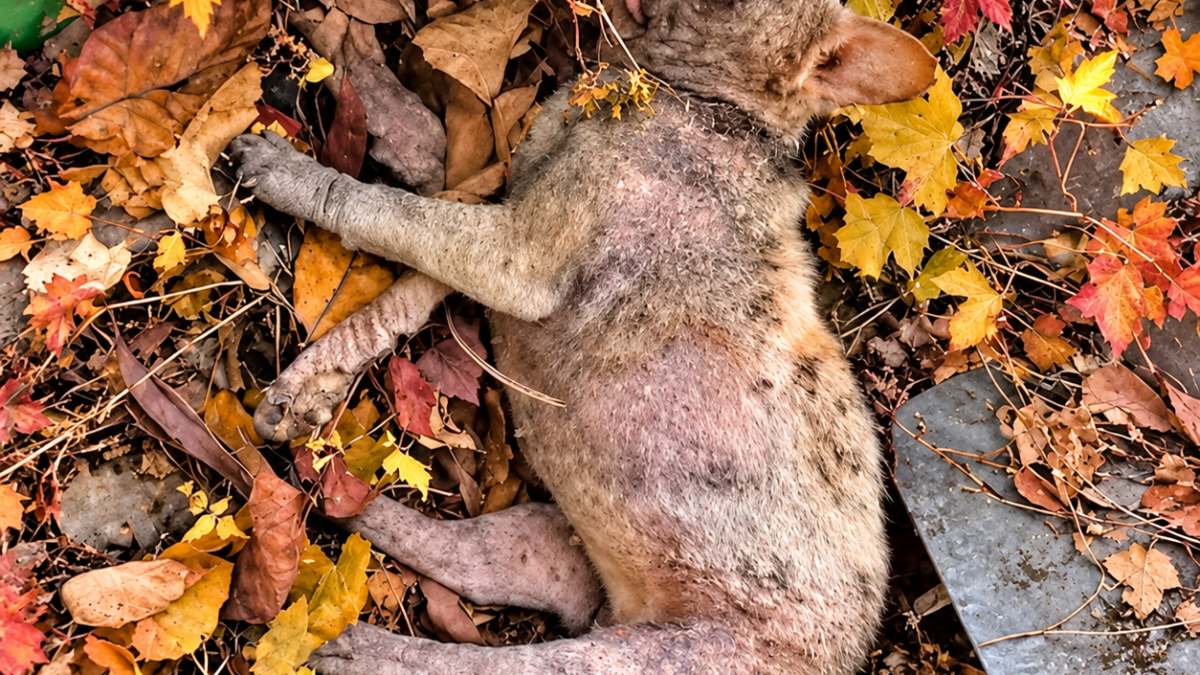
Her small gray body barely moved. Most of the fur across her back was gone, leaving inflamed skin and several raw wounds exposed to the heat and dirt. Her nails had grown so long that some curved beneath her paws. Flies circled above her, and when I stepped closer, I saw something white moving inside one of the wounds.
Maggots.
I stopped for half a second, trying to steady myself.
“Hey, sweetheart.”
Frenchy raised her head.
That tiny movement was enough.
I called a rescue group while crouching several feet away from her. I told them I had found an elderly French Bulldog in terrible condition and that I could see larvae inside her wounds.
“Can she stand?” the volunteer asked.
“I don’t know.”
“Is she conscious?”
“Yes.”
“Can you transport her?”
“I can.”
I wrapped Frenchy in a blanket from my car.
She tensed when I first touched her, but almost immediately her body went soft in my arms. She was frighteningly light.
I drove her to the closest veterinary clinic.
The veterinarian examined her for less than five minutes before looking at me.
“She needs a hospital.”
“Can’t you treat her here?”
“Not safely. The wounds are extensive, and she’s weak. She may need more support than we can provide.”
“How urgent?”
“Go now.”
So I drove again.
Frenchy lay in a towel-lined box on the passenger seat. Every few seconds, I looked over to make sure her chest was still rising.
At the hospital, everything moved quickly.
Fluids.
Bloodwork.
Pain medication.
Clipping damaged hair from around the wounds.
Cleaning.
The first maggots came out easily.
Others didn’t.
Dr. Elena Morris used forceps while a technician flushed Frenchy’s back. Some larvae had burrowed deeper beneath damaged tissue.
I stood nearby until Elena told me gently that I didn’t have to watch.
“I’m staying.”
She nodded.
Frenchy barely moved during the procedure.
At first, I thought that meant she trusted us.
A technician named Rachel corrected me later.
“She may trust us eventually,” she said. “Right now, she may just be too exhausted to resist.”
That stayed with me.
Frenchy was quiet, but quiet didn’t necessarily mean calm.
It could mean she had stopped believing resistance mattered.
The wounds were cleaned again that evening.
More maggots appeared.
Then again the next morning.
More.
Every time I thought the nightmare was over, another hidden pocket was discovered.
“How are there still more?” I asked Elena.
“They can bury themselves deeper than you’d expect.”
“So we keep cleaning?”
“Yes.”
“How many times?”
“As many as she needs.”
Frenchy remained still.
But something else happened that gave us hope.
She ate.
The first hospital meal wasn’t large. Frenchy sniffed the food cautiously, took a bite, paused, and then took another.
Rachel smiled.
“She wants dinner.”
It sounds like such a small thing.
But when an old dog has been found nearly hairless in garbage with open wounds full of maggots, wanting dinner feels enormous.
Frenchy kept eating.
Even after wound cleaning.
Even after medication.
Even when she looked exhausted.
She seemed determined not to miss a meal.
On the third day, I brought a small container of boiled chicken after asking Elena whether it was okay.
Frenchy smelled it before I reached her kennel.
Her head lifted.
“You know what this is?”
She stood.
Not well.
Her legs trembled, and her overgrown nails made her posture awkward.
But she got up.
I laughed.
“Chicken did what medicine couldn’t.”
Rachel shook her head.
“Don’t encourage her.”
Too late.
Frenchy ate every approved piece.
Then stared at the container.
“That’s enough.”
Stare.
“You have real food.”
More staring.
I realized we were finally seeing some personality.
Frenchy wasn’t simply lying there enduring whatever happened anymore.
She wanted things.
Food, mostly.
But wanting something meant she was engaged with the world around her.
The veterinary team carefully shortened her nails over several sessions. They couldn’t simply cut them to normal length immediately because the blood vessels inside had grown along with them.
Her skin slowly improved.
The smell from the infected wounds faded.
Healthy tissue began filling areas that had originally looked almost lifeless.
The maggots finally stopped appearing.
Then Elena noticed something else.
Frenchy’s body showed signs that made the team suspect she might have been bred repeatedly.
We couldn’t prove exactly what her life had been.
There was no microchip.
No owner came forward.
No records explained where she had lived or how she ended up at the dump.
But the condition of her mammary tissue and several changes in her body were consistent with a dog who may have had multiple litters.
I stared through the kennel door at Frenchy.
“So somebody used her for puppies?”
Elena shook her head slightly.
“We can’t say that as a fact.”
“But you think it’s possible.”
“Yes.”
I felt sick.
It was easy to build an entire story in my head.
Frenchy producing puppies.
Someone selling them.
Frenchy getting older.
Her body becoming less useful.
Skin problems appearing.
Medical care costing money.
Then the dump.
Maybe that was exactly what happened.
Maybe parts of it were wrong.
We had no way to know.
Elena reminded me of that.
“Don’t let anger at an imagined past distract you from what she needs now.”
She was right.
Frenchy needed healing more than I needed someone to blame.
Her bloodwork began improving.
Her anemia stabilized.
She gained a little weight.
New fur appeared around the edges of her damaged skin.
The first time I noticed it, I leaned over her like I had discovered gold.
“Hair.”
Rachel looked.
“Yes.”
“Actual hair.”
“Dogs are known for it.”
“Don’t ruin this.”
She laughed.
Frenchy stared at both of us, clearly wondering whether chicken would be involved.
By the second week, the hospital started discussing discharge.
That should have made me happy.
Instead, I panicked.
Frenchy still needed wound cleaning twice a day.
Medication.
Skin monitoring.
Follow-up appointments.
She was old, medically fragile, and not fully house-trained.
The rescue group had limited foster options.
Then Melissa, the rescue director, called me.
“You already know what I’m going to ask.”
“No.”
“You don’t?”
“I know, but I’m saying no.”
She laughed.
“Why?”
“I’m not an experienced medical foster.”
“We’ll train you.”
“I already have two dogs.”
“Your dogs are calm.”
“Cooper hates sharing.”
“Cooper hates sharing your couch.”
“That counts.”
“Patricia.”
I looked through the glass at Frenchy.
She was asleep directly beneath an air vent.
“Temporary.”
Melissa laughed again.
“I mean it.”
“Of course.”
Three days later, Frenchy came home with me.
Temporary.
I repeated that word the entire drive.
Her care instructions filled several pages.
Clean wounds morning and evening.
Medication at specific times.
Watch for odor, swelling, discharge, loss of appetite or lethargy.
Keep bedding clean.
Limit rough activity.
Return for follow-up.
I set up a quiet room.
Soft bed.
Washable blankets.
Food.
Water.
A baby gate between Frenchy and my dogs.
Cooper came first.
He sniffed through the gate.
Frenchy stared.
Daisy approached next.
One sniff.
Then she walked away.
Perfect.
Nobody needed drama.
The first night, Frenchy urinated on the floor.
I heard her moving and entered the room.
Before I could say anything, she hurried toward the far corner.
She turned her back to me.
Lowered her head.
And froze.
I stopped walking.
“Frenchy.”
Nothing.
“It’s okay.”
She pressed herself closer to the wall.
My stomach tightened.
I didn’t know exactly what had happened in her previous home.
But an old dog hiding after an accident tells you something.
Maybe she had been punished.
Maybe someone had shouted.
Maybe fear had become habit for another reason.
Whatever the cause, Frenchy believed she needed to hide.
I cleaned the floor silently.
Then sat down several feet away.
“It’s okay.”
Frenchy stayed in the corner.
I waited.
Eventually, she turned her head.
Then she walked toward her bed.
I didn’t touch her.
I let the room become normal again.
A few days later, another accident happened.
Same response.
Corner.
Back turned.
Head down.
“It’s okay.”
Clean.
Wait.
The next time, Frenchy didn’t go as far.
Two weeks later, she stayed in the room while I cleaned.
That was one of the most meaningful changes I saw in her.
Not fur growing back.
Not wounds closing.
Frenchy made a mistake and no longer believed she had to disappear.
Her personality continued emerging.
She was obsessed with food.
Cooper ate slowly.
Frenchy considered that an invitation.
The first time I caught her moving toward his unfinished bowl, I said:
“Frenchy.”
She stopped.
Looked at me.
Looked at the bowl.
“No.”
One step.
“No.”
Another.
I intercepted her.
“You already ate.”
Frenchy stared at Cooper’s food.
“He eats slowly. That’s his problem, not your opportunity.”
Cooper eventually walked away.
Frenchy immediately checked his bowl.
Empty.
She looked offended.
I laughed until my stomach hurt.
This dog had been found half-dead in garbage, and now she was irritated because another dog had finished his own dinner.
Good.
Frenchy also discovered the air conditioner.
She had already liked the hospital vent.
At my house, she located the coolest spot within two days.
After walks, she went directly there.
After meals, sometimes there.
After playing, definitely there.
Cooper used to sleep near that vent.
Frenchy would stand beside him and stare until he moved.
No growl.
No aggression.
Just pressure.
Eventually Cooper surrendered.
I told him:
“Respect your elders.”
Frenchy lowered herself onto the cool floor like royalty claiming a throne.
As her skin healed, she became more active.
One afternoon, I took Frenchy and Daisy to a quiet fenced yard.
I expected Frenchy to walk slowly.
Instead, she sniffed the grass, watched Daisy trot past, and suddenly started running.
Not graceful running.
French Bulldog running.
Part sprint.
Part hop.
Her front paws lifted together.
Her back end bounced.
I laughed.
“Frenchy!”
She turned and ran the other way.
Daisy joined her.
For maybe twenty seconds, Frenchy looked years younger.
Then she stopped, panting.
I immediately brought her inside.
She went straight to the air conditioner.
Collapsed near the vent.
I sat beside her.
“You’re ridiculous.”
Frenchy looked happy.
That evening, I watched the video again.
The difference between the dog in the dump and the dog hopping across grass was almost impossible to process.
Yet I never wanted her story reduced to a dramatic before-and-after image.
Recovery was hundreds of small moments.
Medication swallowed.
Wounds cleaned.
Food finished.
An accident forgiven.
A dog deciding to leave the corner.
Hair growing through scarred skin.
A twenty-second run.
Then came the first adoption application.
I hated it.
I should have been happy.
That was the whole point of fostering.
But when Melissa called to tell me a retired couple wanted to meet Frenchy, my stomach dropped.
“They have excellent veterinary references,” Melissa said.
“Okay.”
“They’ve had French Bulldogs before.”
“Okay.”
“They’re home most of the day.”
“Okay.”
“Why do you sound angry?”
“I’m not.”
“You are.”
I looked at Frenchy sleeping beneath the air vent.
“What if they don’t keep their house cool enough?”
Melissa paused.
“Are you rejecting them based on air conditioning?”
“It matters.”
“It does.”
“What if she has an accident?”
“We talk about it.”
“What if—”
“Patricia.”
“What?”
“You foster dogs so they can leave.”
I knew.
That didn’t make it pleasant.
The couple visited.
Frenchy liked them.
They were kind.
They listened.
They asked good questions.
I disliked them entirely because they might take her.
Later, they withdrew because their own senior dog developed health problems.
The first emotion I felt was relief.
Then guilt.
That was when I realized I needed to stop making Frenchy’s adoption about me.
She deserved a permanent home.
Not a foster mother inventing reasons everyone else was unsuitable.
A few weeks later, another application arrived.
The Garcia family.
Elena and Marco.
Their six-year-old daughter, Sofia.
Two small dogs.
A fenced yard.
Marco worked from home.
They had experience with an elderly dog who needed medication.
Their application didn’t call themselves rescuers.
They didn’t say they wanted to “save” Frenchy.
They wrote:
She seems like an older dog who wants gentle attention, food and other calm dogs. That sounds like our home.
I liked them immediately.
Which made me nervous.
Before their first visit, I gave rules.
“No picking her up.”
“No running toward her.”
“No hugging her.”
Sofia nodded.
“Can I sit?”
“Yes.”
Sofia sat cross-legged on the floor.
Frenchy walked in.
Sniffed Elena.
Sniffed Marco.
Then Sofia.
The child kept her hands in her lap.
Frenchy walked away.
Sofia looked disappointed.
“She doesn’t like me.”
“She doesn’t know you.”
“Oh.”
That answer was enough.
She didn’t chase.
Ten minutes later, Frenchy came back.
Sniffed Sofia’s hand.
Then sat beside her.
Sofia whispered:
“Hi.”
She still didn’t touch.
That impressed me more than an instant cuddle would have.
The family asked about medical needs.
Skin.
Heat.
Food.
Arthritis.
Possible future mammary problems.
Then I told them about accidents.
“She sometimes urinates inside.”
Elena nodded.
“What do you do?”
“Clean it.”
Sofia looked confused.
“That’s all?”
“That’s all.”
“Because she’s old?”
“Because yelling doesn’t clean the floor.”
Sofia thought about that.
“Okay.”
Their next visit involved the dogs.
Benny, a small terrier, sniffed Frenchy too long.
Frenchy growled once.
Benny backed away.
Excellent.
Lulu, an older mixed breed, barely reacted.
Even better.
The third visit happened at their house.
The moment I stepped inside, I felt cold air.
I smiled.
Marco noticed.
“Air conditioner.”
“You were warned.”
“We’ve been told she has standards.”
Frenchy entered.
Ignored every bed they had bought.
Walked across the living room.
Found the nearest vent.
Lay down.
Marco laughed.
“We could’ve skipped the furniture.”
Sofia had chosen a small pink bed.
Frenchy ignored that too.
“It’s okay,” Sofia said. “Maybe later.”
Good answer.
The trial adoption began the following week.
Three days.
I packed food.
Medication.
Blankets.
Towels.
Medical records.
Wound supplies she barely needed anymore but I included anyway.
A typed list with twenty-seven instructions.
Marco read it.
“Twenty-seven?”
“They’re important.”
“We’ve got her.”
I nearly cried.
After leaving Frenchy there, I sat in my car outside their house.
Twelve minutes.
Melissa called.
“Drive away.”
“How do you know?”
“Because I know you.”
“I’m answering emails.”
“Drive.”
I drove.
Forty minutes later, a photograph arrived.
Frenchy asleep near the air vent.
Message:
She found it.
I laughed.
That evening came another message.
Frenchy had an accident.
She had started toward a corner.
Sofia sat several feet away and said:
“It’s okay, Mami.”
Frenchy eventually came back out.
I stared at the name.
Mami.
I called Elena.
“Sofia renamed her?”
“She started calling her Mami.”
“Why?”
“She says Frenchy looks like a grandma but Grandma sounds weird.”
I laughed.
“Does she respond?”
“To food.”
“Fair.”
The next morning, Elena sent a video.
Sofia came downstairs.
Mami was lying on the rug.
The child sat near her.
Mami got up.
Walked closer.
Sofia opened her arms slightly.
Mami stepped between them.
Sofia wrapped her arms gently around the old dog.
Just one second.
Then released her.
Mami stayed.
I watched it four times.
The three-day trial became two weeks.
Frenchy never returned to my house during that period.
She didn’t need to.
She learned Marco’s work schedule.
Breakfast time.
Which dog bed belonged to Lulu.
Where food crumbs appeared when Sofia ate.
Which couch cushion was softest.
Where every vent was.
Morning photographs began arriving.
Sofia with messy hair hugging Mami before school.
Afternoon photographs.
Mami sleeping with her head against Marco’s leg.
Evening.
Three dogs scattered around the couch.
Ordinary life.
That was the part that convinced me.
Not the hugs.
Routine.
Mami knew what tomorrow looked like.
At the end of the trial, Melissa called.
“Do you want her back?”
I looked at a photograph Elena had just sent.
Mami was asleep in the pink bed she had originally ignored.
Sofia had covered half her body with a blanket.
“No.”
The word hurt.
But it was right.
“She’s home.”
The adoption became permanent that Saturday.
Frenchy officially became Mami.
Mami Garcia.
When I saw the paperwork, I laughed.
“She has a last name.”
Marco shrugged.
“She lives here.”
Fair.
Before leaving, I crouched beside her.
Her back looked completely different.
Most wounds were closed.
Fur had returned in patches.
Scars remained.
I hoped they always would, in a strange way.
Not because she needed reminders.
Because healing doesn’t require pretending damage never happened.
“You upgraded,” I told her.
Mami leaned against my hand.
Then she noticed Sofia holding a treat.
Gone.
I smiled.
Traitor.
Months passed.
Mami still had occasional accidents.
But she stopped hiding.
The first time Elena told me that Mami had urinated on the floor and simply stood nearby while Marco cleaned it, I had to put the phone down for a second.
That was healing.
The family continued veterinary follow-ups.
Her skin remained stable.
No serious new infection.
Her breathing required monitoring because of her breed and age.
Heat was treated seriously.
Short walks.
Cool mornings.
Water.
Air conditioning.
Mami fully supported the plan.
Marco eventually placed a padded mat directly beside her favorite vent.
Elena said:
“You’re encouraging her.”
“She’s elderly.”
Sofia added:
“She’s Mami.”
Discussion over.
Mami developed senior-dog zoomies.
Six seconds of madness.
Then twenty minutes recovering.
She would run across the yard, hop around Benny, then sprint back inside and collapse near cold air.
Sofia laughed every time.
“She’s running!”
That sentence always took me back to the dump.
The dog who could barely raise her head.
Now a child was laughing because she moved too fast.
Years passed.
Mami became grayer.
Sofia grew taller.
Lulu died.
Benny slowed down.
The family moved houses.
Before signing the new lease, Elena checked the cooling system.
Marco later told me:
“Frenchy had property requirements.”
“Mami.”
“Sorry. Mami.”
The new house became home quickly.
Mami located every important resource within a day.
Food.
Couch.
Water.
Coolest vent.
Done.
Every morning, Sofia came downstairs before school and hugged her.
Gentle arms.
“Bye, Mami.”
Then backpack.
Door.
School.
Same routine.
Again.
Again.
Again.
I saved one photograph Elena sent.
Sofia wearing a school backpack.
Mami standing beside her.
The girl’s arms wrapped carefully around that scarred little body.
I used to think Frenchy’s transformation was best shown with two pictures.
Dump.
Home.
I was wrong.
That morning photograph said more.
The opposite of being abandoned isn’t rescue.
It is being expected tomorrow.
Mami grew old.
Older than anyone had expected when I first found her.
Arthritis.
Medication.
More sleep.
Shorter walks.
Her hearing declined.
Her ability to hear the refrigerator did not.
Marco claimed she could detect cheese through walls.
I believed him.
At what we estimated to be thirteen or fourteen, Mami still occasionally ran.
One video lasted eleven seconds.
Three ridiculous laps around a picnic table.
Then straight to the house.
Straight to the vent.
Sofia captioned it:
Retired athlete.
I watched it repeatedly.
Eventually Mami’s heart began failing.
Medication helped at first.
Then breathing became harder.
The episodes frightened the family.
One Friday night, Elena called me.
“We were at emergency.”
My stomach tightened.
“What happened?”
“She couldn’t breathe well.”
“Is she home?”
“Yes.”
“What did they say?”
“The heart disease is getting worse.”
I went to see her Sunday.
Mami lay in the living room.
Small.
Gray.
Tired.
Sofia sat beside her doing homework.
I sat on the floor.
“Mami.”
Her eyes opened.
Her tail moved once.
I smiled.
“You remember.”
“Of course she does,” Sofia said.
I scratched beneath Mami’s chin.
She lowered her head into my hand.
After a while Sofia asked:
“Did she really live in garbage?”
“Yes.”
“Was she scared?”
“I think so.”
“Did she know you were helping?”
“Not at first.”
Sofia looked at Mami.
“How did you know when she trusted you?”
I thought about it.
“The first time she had an accident and didn’t hide.”
Sofia knew exactly what I meant.
“She used to do that here.”
“I know.”
“She doesn’t anymore.”
“I know.”
Sofia wrapped one arm around Mami.
“I hate whoever made her scared.”
I understood.
“So do I sometimes.”
Elena looked toward me.
I continued:
“But Mami doesn’t need us spending these days angry at someone who isn’t here.”
Sofia looked down.
“What does she need?”
I nodded toward her arm.
“That.”
The final weeks were quiet.
Medication.
Favorite food.
Short bathroom trips.
Cool air.
Lots of sleep.
Some good mornings.
Fewer as time went on.
Mami still wanted chicken.
That made everything harder.
People imagine the end as a clear line.
It often isn’t.
A dog can want chicken and still be tired.
A dog can wag and still struggle.
Love doesn’t simplify those contradictions.
One evening, Mami had another breathing crisis.
The family rushed to emergency.
Medication stabilized her.
Barely.
The veterinarian explained that another episode could be worse.
Her heart was failing.
There was no cure left to chase.
Elena called me.
“We’re bringing her home.”
I understood.
The veterinarian arranged to come the next morning.
I arrived early.
Mami lay in her pink bed.
A fan moved cool air nearby.
Marco sat on the couch.
Elena beside him.
Sofia on the floor.
Benny lay across the room.
The veterinarian examined Mami.
Then sat down with the family.
No rush.
No pressure.
Breathing had become work.
They could keep chasing emergency episodes.
Hospital.
Medication.
Temporary improvement.
Then another.
Or let Mami’s last day happen in the room she knew.
The bed.
The family.
Cool air.
Sofia.
Sofia asked:
“Will it hurt?”
“No,” the veterinarian said.
“Can I stay?”
Elena answered immediately.
“Yes.”
Before the first medication, Marco brought chicken.
Mami smelled it.
Her eyes opened wider.
Everyone laughed through tears.
“Still you,” Marco whispered.
She ate half.
The first injection made her sleepy.
Her breathing relaxed.
Sofia lay beside her.
Arms around Mami.
The same morning hug she had given for years.
Elena rested one hand gently on Mami’s back.
Marco touched her front paw.
I sat near her head.
I remembered garbage bags.
Maggots.
The hospital.
The first chicken.
The corner after an accident.
The cool vent.
The little hopping run.
The pink bed.
The morning hugs.
The veterinarian gave the final medication.
Sofia whispered:
“Good night, Mami.”
One breath.
Another.
Then quiet.
Nobody moved for several minutes.
Finally Marco looked at the small piece of chicken still beside her.
“She got chicken.”
Elena laughed while crying.
“She always got chicken.”
That seemed exactly right.
Months later, road construction sent me past the place where I had found her.
The dump had been partly cleared.
I slowed down.
For a second, I thought about stopping.
I didn’t.
Nothing there belonged to Mami anymore.
The dump was where I found her.
It wasn’t where her life was.
Her life was the air-conditioning vent.
The couch.
The backyard.
Benny.
Lulu.
Marco.
Elena.
Sofia.
Chicken.
Accidents nobody punished.
Beds placed in every room.
A child who hugged her every morning.
The wounds healed.
Some scars stayed.
Her fur returned unevenly.
She never became young again.
That wasn’t the transformation.
The transformation was what Mami learned to expect.
At first, she expected pain.
Then food.
Then wound cleaning that ended gently.
Then an accident that didn’t bring punishment.
Then cool air.
Then breakfast.
Then Sofia.
Then people coming home.
She learned that tomorrow could resemble today in all the best ways.
By the end, Mami could sleep deeply in the middle of a busy family room.
People walked around her.
Doors opened.
The television played.
Sofia laughed.
Marco cooked.
Nothing made her lift her head to check whether danger was coming.
That is the picture I remember.
Not Frenchy lying among garbage.
Mami asleep on a couch.
An old scarred body curled into a blanket.
A child nearby.
Cool air moving through the room.
Nothing happening.
Because after everything it took to get her there, nothing happening was finally something precious.
No one needed puppies from her.
No one was leaving her.
No hidden maggots remained inside a wound.
No food disappeared because she had taken too long.
No accident sent her toward a corner.
She was simply home.
And every morning, before school and schedules and all the ordinary noise of a family beginning another day, a little girl wrapped her arms around that elderly dog and called her Mami.
[END OF STORY]








