PART 2: I Found an 8-Week-Old Puppy Waiting Beside a River—She Was Still Looking Down the Path for the Person Who Left Her
PART 2
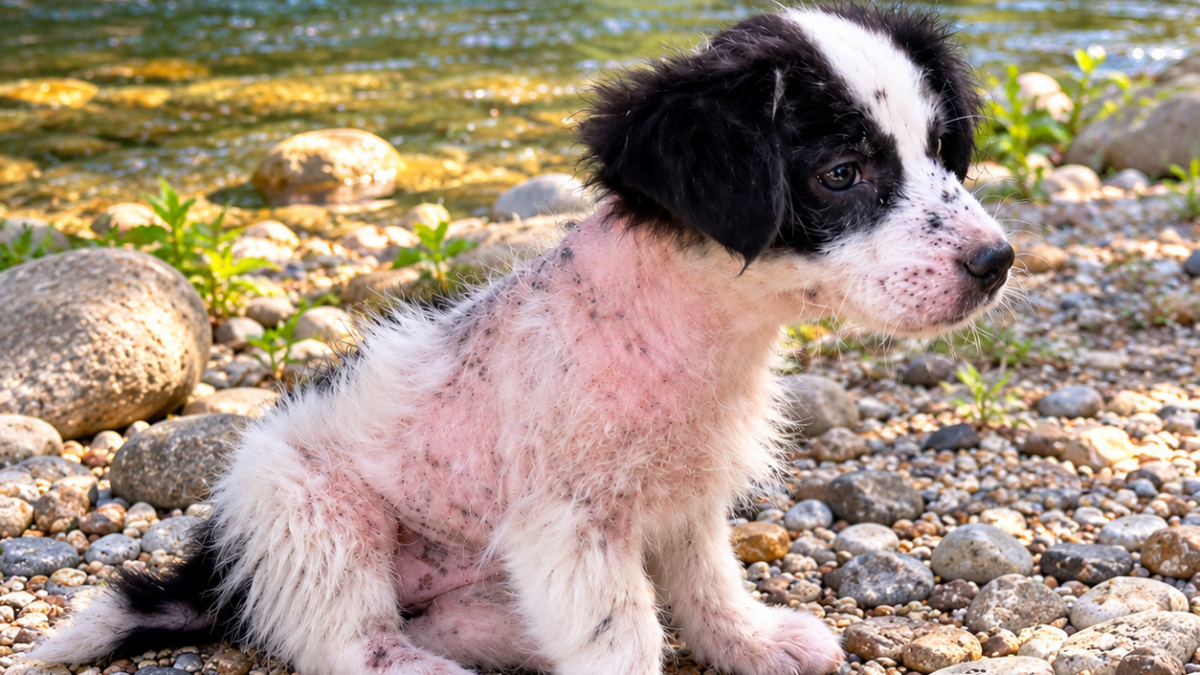
I followed her gaze.
For a few seconds, nobody said anything.
The path looked the same as it had all afternoon—empty, shaded by trees, narrowing into the distance until it disappeared.
No footsteps.
No familiar voice.
No person rushing back saying there had been some terrible mistake.
The puppy kept looking.
One of the rescuers touched my shoulder.
“We should go.”
I nodded.
“Yeah.”
But I didn’t move immediately.
I remember thinking how cruel waiting can be when the one doing it doesn’t know the decision has already been made for them.
She couldn’t understand abandonment.
At eight weeks old, she didn’t know what that word meant.
She only understood that someone had been there.
Then they weren’t.
So she had remained close to the last place where the world had made sense.
I finally carried her toward the vehicle.
Her body was light against my chest.
When we reached the car, I placed her carefully on a blanket.
She sat instead of lying down.
Again, her eyes turned toward the river.
“It’s okay,” I whispered.
I don’t know whether I was talking to her or myself.
The vehicle pulled away.
The puppy kept looking through the gap beside me until the trees disappeared behind us.
Only then did she lower her head.
At the veterinary clinic, everything was unfamiliar to her.
Bright lights.
Metal surfaces.
Voices.
The smell of disinfectant and other animals.
Yet she barely protested.
That concerned me.
A frightened puppy will often squirm.
A curious puppy wants to investigate.
She simply allowed the veterinary staff to handle her.
The veterinarian ran a hand carefully along her back.
“How old are we estimating?”
“About eight weeks,” I said.
“Found where?”
“Beside the river.”
“Alone?”
I nodded.
“For several hours at least. She stayed in almost the same spot.”
The veterinarian glanced at me, then at her.
“All right. Let’s see what she needs.”
Her temperature was checked.
Her gums.
Eyes.
Ears.
Heart.
Lungs.
Abdomen.
Weight.
Then the veterinarian examined the irritated skin more closely.
The puppy flinched when one area was touched.
“Easy,” I whispered.
She looked toward my voice.
The veterinarian continued gently.
After the examination, he straightened.
“The encouraging part is that I’m not seeing anything here that makes me think she can’t recover.”
I released a breath.
“So the skin?”
“Treatable. We’ll need to manage it properly and monitor her response, but this is not a reason to give up on a puppy.”
That sentence hit harder than he probably realized.
Not a reason to give up.
I looked down.
The puppy was sitting between my shoes.
If what we’d been told was accurate, somebody had looked at the same manageable problem and reached the opposite conclusion.
I felt anger rise in me.
“She’s eight weeks old.”
The veterinarian nodded.
“I know.”
“She shouldn’t even know what it means to be alone.”
He didn’t answer.
There wasn’t much to say.
We discussed treatment.
Medication for the skin.
Appropriate nutrition.
A safe, clean environment.
Monitoring.
Follow-up examinations.
Nothing sounded impossible.
No enormous surgery.
No untreatable disease.
No hopeless diagnosis.
She needed care.
That was all.
Care.
The same thing every puppy needs.
When the examination was finished, one of the clinic staff offered her a small amount of food.
At first, she only sniffed it.
“Come on,” I said softly.
She looked at me.
Then back at the bowl.
After a few seconds, she took one bite.
Then another.
Soon she was eating steadily.
One of the staff smiled.
“That’s a good sign.”
I smiled too.
For the first time that day, something felt simple.
She was hungry.
We had food.
She needed somewhere safe.
We had somewhere safe.
She needed treatment.
There was treatment.
Her future didn’t require a miracle.
It required people to stop walking away.
After the clinic, she was transferred to the rescue’s safe house.
I went with her.
The difference between the riverbank and that room was almost absurd.
At the river, she’d had dirt, rocks, brush and silence.
Here there were clean blankets, bowls, soft bedding and people checking on her every few minutes.
We placed her gently on the floor.
For a while, she stood exactly as she had beside the river.
Still.
Watching.
A rescuer sat several feet away.
“She doesn’t know what to do.”
“Can you blame her?”
“No.”
There were toys nearby.
A small rope.
A soft ball.
A stuffed animal.
She ignored all of them.
Her attention remained on the doorway.
I noticed immediately.
“She’s watching the door.”
The rescuer looked.
“Yeah.”
Every time footsteps passed outside, the puppy’s ears moved.
When someone entered, she looked up.
When it wasn’t whoever she expected, she lowered her head again.
That was harder to watch than I expected.
At the river, I’d been focused on getting her out.
At the clinic, I’d been focused on her health.
Now there was nothing distracting me from the emotional part.
She was safe.
But she didn’t know that safety was permanent.
That first evening, I sat on the floor near her bed.
She wasn’t interested in the toys.
She wasn’t interested in exploring.
Eventually, she lowered herself onto the blanket.
Her body curled tightly.
I placed my hand near her.
Not touching.
Just close.
After several minutes, she stretched her nose toward my fingers.
Sniffed.
Then put her head down.
I stayed.
The room gradually became quieter.
People finished their work.
Lights dimmed.
The puppy’s breathing slowed.
Every once in a while, a noise outside made her eyes open.
But she didn’t get up.
Eventually, she slept.
I watched her longer than necessary.
It struck me that this might be the first time since being left by the river that she had fallen asleep without needing to listen for someone.
The next morning, she woke hungry.
That was encouraging.
She ate more confidently.
Then drank.
Afterward, she returned to her bed.
“Still no interest in toys?” I asked.
A caregiver shook her head.
“Not yet.”
I rolled the small ball gently toward her.
It stopped several inches from her paws.
She looked at it.
Then at me.
Then away.
“Okay,” I said. “Later.”
Recovery doesn’t always arrive dramatically.
Sometimes nothing seems to happen.
The animal eats.
Sleeps.
Receives medication.
Gets cleaned.
Receives medication again.
Eats again.
Sleeps again.
From the outside, it can look uneventful.
Inside the body, everything is changing.
Her skin treatment began.
The irritated areas were cleaned gently.
Medication was administered.
Her bedding stayed fresh.
Her nutrition was consistent.
The first few days, she tolerated everything quietly.
Then we noticed a small change.
She started objecting.
During one treatment, a caregiver tried to inspect a sensitive patch.
The puppy pulled her paw away.
“Hey.”
She pulled again.
I smiled.
“That’s good.”
The caregiver laughed.
“You’re calling stubbornness good?”
“Absolutely.”
The puppy looked between us.
“Yesterday she acted like she didn’t care what anybody did.”
“Fair point.”
As she gained strength, she began having opinions.
She wanted her food immediately.
She didn’t like certain parts of her treatment.
She preferred one blanket over another.
She wanted to know where people were going.
And increasingly, she wanted to follow.
At first, she only watched from her bed.
Then one morning, I stood to leave the room.
Tiny footsteps followed.
I turned.
She stopped.
“You coming?”
She looked at me.
I took another step.
She followed.
I smiled.
“Okay.”
We walked slowly down the hallway.
She stayed close behind my heel.
At the doorway to another room, she hesitated.
The old stillness returned for a second.
I crouched.
“You can come in.”
She took one step across the threshold.
Then another.
No river.
No disappearing path.
Nothing bad happened.
A minute later, she was sniffing the floor.
It was the first time I’d seen real curiosity in her.
I didn’t interrupt.
She sniffed a chair leg.
A corner.
A pair of shoes.
Then something moved beside her.
The little ball.
Someone had rolled it gently.
The puppy jumped backward.
We laughed.
She stared at the ball.
It stopped.
She approached cautiously.
Sniffed it.
Touched it with her nose.
The ball rolled.
She jumped again.
Then something beautiful happened.
Her front legs lowered.
Her rear end went up.
A play bow.
Tiny.
Uncertain.
But unmistakable.
I covered my mouth.
One of the caregivers whispered, “There she is.”
The ball moved again.
This time she chased it.
Only a few feet.
But she chased it.
When she reached it, she put one paw on top and looked around as though she’d solved an enormous problem.
“Good girl!”
Her tail moved.
I froze.
The tail moved again.
That first wag lasted only seconds.
It meant everything.
She had arrived at the safe house looking toward doors.
Now, for the first time, something inside the room mattered enough to hold her attention.
The next several days brought more changes.
Her skin gradually became less inflamed.
The treatments started doing their job.
Areas that had looked irritated began calming.
She scratched less.
Her appetite improved.
Her energy increased.
And the ball stopped being suspicious.
It became hers.
At least, that was her opinion.
She carried it awkwardly.
Dropped it.
Chased it.
Lost it beneath blankets.
Barked when it disappeared under furniture.
One afternoon, I heard a sharp little bark from another room.
I walked in.
“What happened?”
A caregiver pointed beneath a cabinet.
“Her ball rolled under there.”
The puppy barked again.
“Are you asking for help?”
She stared at me.
Another bark.
I reached beneath the cabinet and pulled the ball out.
The instant I placed it on the floor, she grabbed it and ran away.
“You’re welcome.”
No gratitude.
Perfect puppy behavior.
Every sign of mischief felt like proof that the sadness I’d first seen wasn’t her personality.
It had been a condition.
A response.
Pain, fear and abandonment had covered the real puppy the same way the skin problem had affected her coat.
As both healed, she emerged.
She liked following people.
She liked food.
She liked stealing things that weren’t hers.
She liked dragging blankets out of carefully arranged beds.
She liked chewing the corners of towels.
And she loved attention.
The puppy who had barely reacted when we approached her beside the river now placed a paw on your leg if she thought you had ignored her for too long.
One day, I was talking to another rescuer while she sat nearby.
We spoke for several minutes.
Suddenly, something scratched my shin.
I looked down.
She had one paw against my leg.
“What?”
Tail wag.
I resumed talking.
Scratch.
I looked down again.
“Excuse me?”
She stood on her back legs and pressed both front paws against me.
The rescuer laughed.
“Apparently this meeting is over.”
I crouched.
The puppy immediately climbed toward my lap.
“You’re becoming demanding.”
Her tail moved faster.
I kissed the top of her head.
“Good.”
The emotional recovery wasn’t completely smooth.
Certain things still triggered that old waiting behavior.
Doors were the biggest one.
If someone she had become attached to walked out, she sometimes sat facing the doorway.
The first time I noticed it, my chest tightened.
I had stepped outside briefly to take a call.
When I returned, she was sitting exactly opposite the door.
Not playing.
Waiting.
I opened it.
Her ears rose.
Then she ran toward me.
I crouched.
“I’m back.”
She pushed against my legs.
I held her.
That pattern repeated.
Someone left.
Someone returned.
Again.
Again.
Over time, the waiting shortened.
She’d watch the door for thirty seconds.
Then investigate a toy.
Or bother another dog.
Or return to her food.
The world was teaching her something new.
People could disappear from sight without disappearing from her life.
Her skin continued improving.
At a follow-up examination, the veterinarian ran his hand over the affected areas.
“Much better.”
“How much longer?”
“We’ll continue treatment and monitor, but she’s responding well.”
I looked at her.
She was trying to investigate something near the examination table.
“So this really was manageable.”
“Yes.”
The word irritated me all over again.
Manageable.
I’d heard that from the beginning.
A treatable problem.
Nothing that justified throwing away a puppy.
I asked the veterinarian, “Could the skin condition have made someone think she was seriously sick?”
“Possibly, if they didn’t know what they were seeing.”
“But they could have asked.”
“Yes.”
They could have asked.
Could have sought help.
Could have contacted a rescue.
Could have found a clinic.
Could have handed her to someone.
Could have done almost anything except leave her beside a river.
But there was no one to confront.
No owner returned.
No explanation arrived.
And eventually I realized that continuing to imagine the person who had abandoned her wasn’t helping the puppy standing in front of me.
She wasn’t staring backward anymore.
So I tried to stop doing it for her.
Her safe-house world expanded.
Once she was medically cleared and it was appropriate, she spent more time around other healthy dogs.
At first, she watched them.
One puppy raced across the room carrying a toy.
She followed the movement with her eyes.
The puppy returned, dropped the toy, then bounced backward.
She remained still.
The other puppy came closer.
Play bow.
Nothing.
Another bounce.
Her tail moved.
The puppy darted away.
She took one step.
Then another.
Then she ran.
It wasn’t graceful.
She was still very young.
Her legs seemed to move faster than her coordination.
But she chased.
The two puppies made a circle around a chair.
One slid.
The other bumped into a blanket.
Then both continued.
I stood against the wall laughing.
Someone beside me said, “Hard to believe she was the puppy by the river.”
I watched her chase her friend.
“Yeah.”
The other puppy stopped.
She ran directly into him.
They tumbled.
Both jumped up.
Her tail never stopped.
That was one of the first days when I realized we no longer needed to coax happiness out of her.
It was happening on its own.
She woke expecting things.
Food.
Play.
Attention.
Exploration.
Her mornings became especially energetic.
At the beginning, mornings had been quiet.
She’d wake slowly and look around, almost checking whether the safe house still existed.
Later, mornings became chaos.
The instant she heard movement, she was up.
Blanket tossed aside.
Tail going.
Ready.
One caregiver joked, “Remember when we wanted her to have more energy?”
I looked at the puppy trying to climb into a food-storage area.
“We were fools.”
The caregiver laughed.
“Complete fools.”
She found a slipper.
“Hey!”
The puppy ran.
Normal.
Beautifully normal.
There were still medical responsibilities.
Her skin needed continued care.
Follow-up checks remained important.
Nobody pretended that improvement meant treatment could simply stop.
But increasingly, medical care became one part of her day rather than the whole day.
That difference mattered.
She wasn’t waking up to be treated.
She was waking up to live.
Treatment simply happened between breakfast and mischief.
We took progress photos.
The comparison became increasingly dramatic.
In the earliest ones, her expression looked distant.
Her posture was still.
The skin condition was obvious.
Later photographs showed a puppy leaning toward the camera.
Tail blurred from movement.
Eyes brighter.
Body stronger.
Coat improving.
It wasn’t only physical.
You could see confidence.
In one photo, she was sitting with a toy between her paws.
In another, she was mid-run.
In another, she had somehow rolled partly onto her back while wrestling with a blanket.
The river puppy was becoming difficult to photograph because she wouldn’t stay still.
That made me laugh every time.
Eventually, conversations began shifting toward her longer-term future.
Where would she live?
What kind of home would fit her?
She was still receiving treatment, so nobody wanted to rush.
But rescue is always moving toward that question.
Saving an animal from danger is the first job.
Giving that animal a stable life is the goal.
I became protective.
Maybe too protective.
Anyone who showed interest had to understand her history.
Her skin condition had been treatable, but follow-up mattered.
She needed normal veterinary care.
Good nutrition.
Patience.
And, more than anything, she needed someone who wouldn’t treat inconvenience as a reason to give her up.
I remember one conversation vividly.
Someone asked, “Is she completely healthy now?”
“She’s doing very well.”
“But will the skin problem come back?”
“It’s something her veterinarian can explain in detail. What matters is that she gets proper care.”
The person hesitated.
“I just don’t want a dog with problems.”
That sentence made my body tense.
I kept my voice calm.
“Then she may not be the dog for you.”
The conversation ended quickly.
Later, another rescuer asked whether I thought I’d been too abrupt.
“No.”
She looked at me.
“Because of how she was abandoned?”
“Yes.”
I watched the puppy chewing a toy several feet away.
“She has already been disposable once.”
The rescuer nodded.
“Not again.”
Not again.
That became our quiet rule.
Nobody had to be perfect.
No adopter had to be wealthy.
Nobody had to promise some fantasy life without problems.
They only had to understand that owning a dog meant staying when things became inconvenient.
Especially when things became inconvenient.
Meanwhile, the puppy had no interest in our serious conversations.
She was busy becoming increasingly ridiculous.
Her favorite game involved carrying a toy just close enough that you thought she wanted you to take it.
The second you reached out, she ran.
“Bring it here.”
She approached.
I reached.
Gone.
“You’re not funny.”
She circled back.
Tail wagging.
The expression on her face suggested she strongly disagreed.
She also discovered water.
Considering where we’d found her, I wondered how she’d react.
At first, we only introduced a shallow container during play.
She approached cautiously.
One paw touched the water.
She pulled it back.
Another attempt.
Splash.
She stared.
Then slapped the surface.
Water jumped onto her face.
She sneezed.
I laughed.
She slapped it again.
Within minutes, she was splashing like she’d invented water herself.
Watching her play, I thought about the river.
For so long, that had been the central image in my mind.
The puppy beside the water.
Waiting.
Now water meant something else.
Play.
Movement.
Noise.
She wasn’t standing still beside it anymore.
She was making a mess.
That mattered.
Weeks passed.
Her coat continued to improve.
Her confidence became unmistakable.
The puppy who once allowed herself to be picked up without resistance now had very clear opinions about when she wanted to be held.
Sometimes she’d climb into your lap.
Other times she’d twist away because there were more important puppy responsibilities.
Such as attacking a leaf.
Or chasing a ball.
Or inspecting a bag that absolutely did not contain anything for her.
I learned to appreciate those rejections.
The first time I met her, she had submitted to whatever happened.
Now she made choices.
That is what safety gives an animal.
The freedom to say yes.
And sometimes no.
Eventually, I returned to the river without her.
I hadn’t planned anything dramatic.
I was in the area with my dogs and found myself walking toward the same stretch of path.
Everything looked smaller than I remembered.
The river moved steadily beside me.
The vegetation was thick.
Birds moved somewhere in the trees.
I stopped where I thought she’d been standing.
For a moment, I could see her again.
Tiny body.
Still posture.
Eyes on the path.
I imagined how many sounds she must have heard during those hours.
Footsteps that weren’t familiar.
Branches shifting.
Water moving.
Maybe vehicles in the distance.
Every sound potentially meaning the person was coming back.
I looked down the path.
Empty.
I realized something then.
I’d spent weeks thinking of that place as where her story nearly ended.
But technically, it was where the direction changed.
Not because the river had saved her.
Not because abandonment had somehow been good.
It wasn’t.
It was cruel and unnecessary.
The change happened because somebody noticed that a puppy wasn’t behaving like a puppy.
Someone stopped.
Then came back.
Then other people showed up.
That was all.
I walked away from the river without looking back.
Later that afternoon, I visited the safe house.
The moment the puppy heard my voice, she came running.
Running.
No hesitation.
She skidded slightly near my feet, recovered, then jumped against my legs.
“Hey!”
I crouched.
She covered my hands with frantic puppy kisses.
One of the caregivers laughed.
“Someone missed you.”
“Apparently.”
The puppy grabbed a toy.
She dropped it beside me.
I picked it up.
She backed away.
“Ready?”
Tail wag.
I tossed it.
She flew after it.
When she returned, another dog followed.
The two immediately started wrestling over who had possession.
Nobody was aggressive.
It was ordinary play.
Noise.
Movement.
Little paws everywhere.
I sat on the floor.
A few minutes later, she abandoned the other dog and climbed partly across my legs.
She was panting.
Happy.
Tired.
Her skin looked so much better that I had to deliberately remember what it had looked like when we’d found her.
I ran a hand gently over her back.
“Look at you.”
She chewed my sleeve.
“Yes, very impressive.”
A caregiver sat beside me.
“She’s coming along.”
“She really is.”
“Still work to do.”
“I know.”
That was important.
Her story wasn’t finished.
Her skin still needed monitoring.
Her future home still needed to be found.
There would be appointments.
Adjustments.
Possibly setbacks.
Recovery isn’t a straight line simply because photographs make it look that way.
But now when I thought about what lay ahead, I wasn’t afraid of it.
The puppy had people around her.
If something changed, someone would notice.
If she needed medication, she’d receive it.
If she needed veterinary care, someone would take her.
If she became frightened, there would be hands she recognized.
The responsibility was shared.
For the first time, her future wasn’t dependent on the willingness of one person who might decide she had become inconvenient.
It belonged to a network of people who had already chosen not to give up.
One evening, I saw something that quietly stayed with me.
The puppy was asleep.
Not curled tightly.
Not facing a doorway.
Not listening.
She was sprawled on her side in the center of a soft bed.
One front leg hung over the edge.
A toy rested near her stomach.
Another was somewhere beneath the blanket.
People were moving around the room.
A door opened.
She didn’t wake.
It closed.
Still nothing.
I stood there watching.
A caregiver noticed.
“What?”
“She didn’t look at the door.”
The caregiver glanced toward it.
Then understood.
“No.”
We both smiled.
That was progress no photograph could fully capture.
The abandoned puppy had stopped monitoring exits.
She trusted the room enough to sleep through people leaving it.
A few days later, she reached another milestone.
We took her outside to a secure area where she could play.
The moment her paws hit the ground, she sniffed.
Then wandered.
She investigated plants.
A stone.
A patch of grass.
A sound somewhere beyond the fence.
Then she ran.
Not toward a path.
Not searching.
Just running because she could.
She made a wide circle.
Another puppy followed.
She changed direction.
They chased each other.
I stood watching as she disappeared briefly behind a small shrub and emerged on the other side.
At eight weeks old, she’d stood beside a river as though movement might cause her to miss the person coming back.
Now she didn’t care whether anyone stayed in one place.
She knew where safety was.
She knew where food was.
She knew where her bed was.
And most importantly, she knew how to return to it herself.
When playtime ended, I called her.
She stopped.
Looked toward me.
For one second, the old image flashed through my head—the puppy staring down a path.
Then she ran straight toward my voice.
I caught her as she reached me.
“Got you.”
She squirmed.
Not because she was frightened.
Because she wasn’t finished playing.
I laughed.
“Okay, okay.”
I set her down.
She immediately ran back toward her friend.
That was exactly where I wanted her to go.
As more time passed, the sadness in her early photographs became harder to connect with the dog in front of us.
She played harder.
Ate better.
Trusted faster.
Her coat improved.
Her skin healed.
Her eyes changed most of all.
The first day, they had seemed fixed on absence.
Now they were constantly tracking possibility.
Who’s coming through that door?
Is that food?
Where did the ball go?
Will that dog play?
What’s inside that bag?
Can I climb onto that?
Should I chew this?
Usually, the answer to the last question was no.
Usually, she tried anyway.
One afternoon, she grabbed a corner of a blanket and began dragging it across the floor.
“Where are you taking that?”
She kept going.
“It’s bigger than you.”
No concern.
She backed up.
Pulled.
Stopped.
Adjusted her bite.
Pulled again.
Eventually she moved it almost completely out of the bed.
Then she lay on the bare floor.
I stared at her.
“You destroyed your own bed for nothing.”
Tail wag.
That puppy had plans now.
Poor plans, sometimes.
But plans.
The most important thing was that the rescue continued to treat her rather than simply celebrating early improvement and assuming the job was finished.
Her veterinarian monitored the skin.
Caregivers followed instructions.
Her nutrition remained consistent.
Photographs documented the regrowth of healthy coat.
Each improvement came from repetition.
Treatment.
Meals.
Rest.
Play.
Clean bedding.
Affection.
Again and again.
Kindness can look very unremarkable when you’re standing inside it.
A bowl being washed.
Medicine measured.
A blanket changed.
A ride to a clinic.
Someone sitting on a floor because a puppy is nervous.
But those ordinary things accumulated.
Eventually, they produced a dog who barely resembled the abandoned puppy we’d carried away.
I thought often about the reason we’d been told she was discarded.
Female.
Skin condition.
Two facts that had apparently reduced her value in somebody’s eyes.
Now those same facts barely mattered.
Yes, she was female.
So what?
Yes, she’d needed skin treatment.
She got it.
The problem hadn’t been the puppy.
The problem had been someone’s willingness to walk away instead of doing something manageable.
Once she was surrounded by people who saw care as a responsibility instead of a burden, everything changed.
There was no revenge.
No dramatic confrontation.
No moment when the person who left her returned and apologized.
And I eventually became grateful that her life didn’t depend on one.
Closure didn’t require them.
Her recovery happened without their permission.
She didn’t need the person who rejected her to admit they’d been wrong.
Her body answered that question every time she healed.
Her tail answered every time it wagged.
Her feet answered every time she ran.
Weeks later, I stood in the safe-house yard watching her play.
She was bigger.
Healthier.
Faster.
Another dog had a toy she wanted.
She chased him.
He changed direction.
She followed.
They raced past me.
The puppy turned sharply and nearly lost her balance.
She recovered and kept running.
One of the rescuers laughed.
“She has no brakes.”
“She didn’t come with any.”
The dogs circled again.
When they finally tired, she trotted toward us with her tongue hanging out.
I crouched.
She came straight into my hands.
No hesitation.
No checking behind her.
I held her for a moment.
Then she wriggled.
I set her down.
She went to the water bowl.
Drank.
Then picked up another toy.
I shook my head.
“Apparently we’re not tired anymore.”
The rescuer smiled.
“This is what we wanted.”
Yes.
This.
Not a grateful dog sitting quietly at our feet forever.
Not a puppy permanently defined by what somebody had done to her.
We wanted inconvenience.
Noise.
Chewed toys.
Stolen blankets.
Dirty paws.
Vet visits.
Food bills.
Playtime.
A life.
And she was giving us all of it.
Sometimes people imagine rescue as one heroic moment.
Someone reaches into danger.
An animal is saved.
Music swells.
The end.
But the moment we picked her up beside the river was only the beginning.
The rescue happened every day afterward.
When somebody cleaned her skin.
When somebody fed her.
When somebody noticed a change.
When someone replaced a dirty blanket.
When the veterinarian rechecked her.
When a caregiver sat with her during a nervous moment.
When another dog invited her to play.
When someone returned through a doorway she had been watching.
Those repeated moments taught her that the world wasn’t only the riverbank.
Eventually, I looked at the early photos less often.
I didn’t need them to remember.
But I also didn’t want that first image to become the only image anyone associated with her.
So I took more.
Her sleeping upside down.
Her chasing a ball.
Her carrying a toy too large for her mouth.
Her sitting beside another dog.
Her coat improving.
Her tail wagging.
Her running.
One photograph captured her mid-step with both front paws off the ground.
I stared at it.
The puppy who once seemed afraid to leave the spot where she’d been abandoned now had all four feet moving toward whatever interested her.
That was the image I wanted to remember.
Not because the river didn’t matter.
It did.
But because it wasn’t where she remained.
Her journey still wasn’t completely over.
She still had treatment ahead.
She still needed the right permanent future.
Nobody could guarantee that every day would be easy.
But that uncertainty no longer frightened me.
Because difficulty wasn’t the same thing as abandonment.
A medical problem could be treated.
Fear could be worked through.
Setbacks could be handled.
What had almost destroyed this puppy wasn’t an impossible condition.
It was somebody deciding not to try.
Now she was surrounded by people who would.
One afternoon, I arrived and found her lying beside the entrance.
For half a second, the sight stopped me.
The posture reminded me of the river.
Still.
Head down.
Then she heard me.
Her head snapped up.
Her tail began hammering the floor.
She launched herself to her feet and ran toward me.
I laughed as she jumped against my legs.
“Okay, okay!”
She bounced away.
Grabbed a toy.
Returned.
Bounced again.
There was no sadness in the waiting anymore.
She hadn’t been staring at the door because she feared someone had vanished.
She’d been resting.
Because she knew people came back.
I sat with her on the floor.
She chewed her toy while pressing one side of her body against my leg.
After a few minutes, she dropped it.
Her eyes became heavy.
I rubbed behind her ears.
“You’ve come a long way.”
Her tail tapped once.
Then stopped.
She fell asleep.
Not long afterward, someone opened the door.
She didn’t move.
Another person walked through.
Still sleeping.
I looked down at her.
Her body was relaxed.
Her skin was healing.
Her belly was full.
Her toy lay between her paws.
Outside, somewhere beyond the safe house, the world was still full of roads, rivers and people making choices I would never understand.
But she wasn’t standing beside that river anymore.
She wasn’t staring into trees.
She wasn’t waiting for the person who had decided that being female and needing treatment made her disposable.
Her world had become larger than the place where she’d been rejected.
Now there were veterinary appointments.
Soft beds.
Regular meals.
Friends.
Toys.
People whose footsteps meant comfort instead of uncertainty.
And more and more, there were ordinary puppy days.
Days when nobody talked about abandonment.
Days when nobody needed to say how lucky she was.
Days when her biggest problem was that another dog had stolen her ball.
Those were my favorite days.
Because the best part of her recovery wasn’t watching her survive what had happened.
It was watching what had happened become less important.
The river remained part of her story.
It did not get to be the ending.
[END OF STORY]
:::








