PART 2: I Found a Two-Month-Old Puppy Duct-Taped to a Tree in the Middle of the Forest—Then He Did Something I Couldn’t Explain
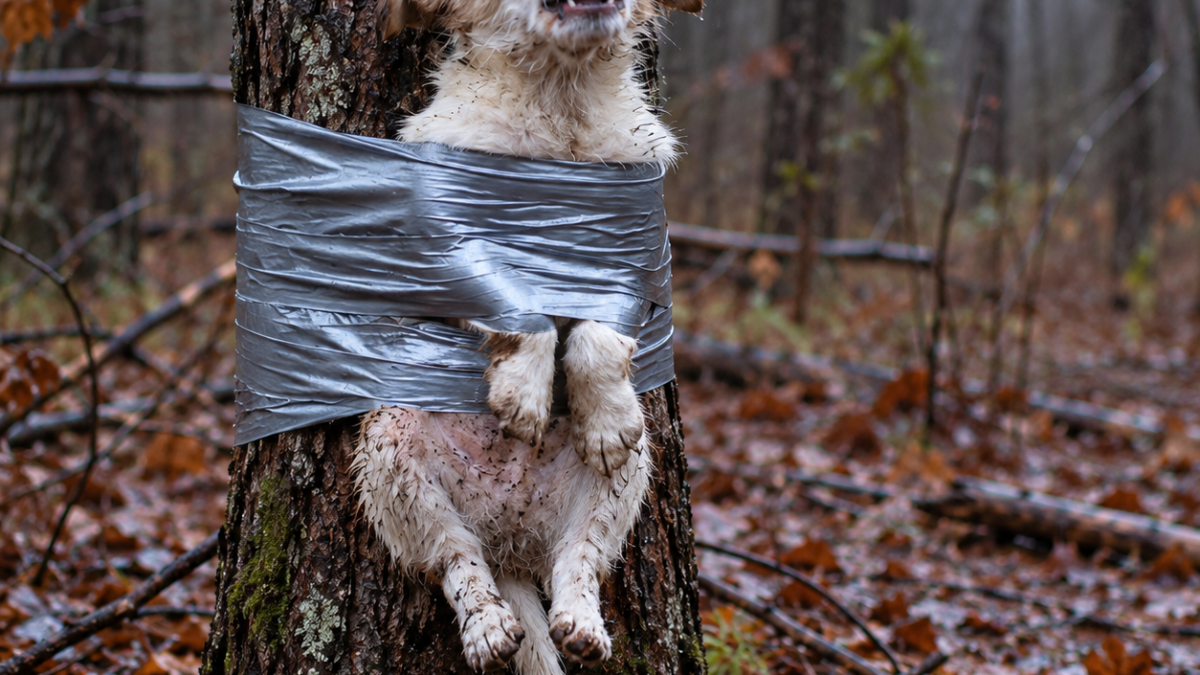
PART 2
I stood absolutely still.
Rain ran off the brim of my cap and down the back of my neck.
For a second, I wondered if I had imagined the sound.
The puppy in my arms had stopped struggling.
His ears were raised as much as exhaustion allowed.
Then the cry came again.
Higher pitched than his.
Farther away.
And immediately the little dog in my jacket began whining.
“Oh, no,” I whispered.
I looked at the strips of tape lying in the mud beside the pine.
One puppy had already been more cruelty than I wanted to understand.
The possibility that he was not the only one made my stomach tighten.
I pulled out my radio.
“Dispatch, this is Ranger Three.”
Static crackled.
Then Carla’s voice answered.
“Go ahead, Three.”
“I’m off Service Road Nine, about half a mile north of the old firebreak.”
“What’s wrong?”
“I found an abandoned puppy.”
There was a short silence.
“All right. Do you need animal control?”
“Yes, but not yet.”
“Not yet?”
“I think there’s another one.”
Carla’s voice changed.
“Another puppy?”
“I can hear something deeper in the trees.”
“Nick, it’s almost dark.”
“I know.”
“And that storm cell is moving back toward you.”
“I know that too.”
I shifted the puppy higher against my chest.
“Call county animal services. Tell them to meet me at the forest station or the veterinary clinic when I know what I have.”
“Want another ranger?”
“Send Mark if he’s still out.”
“He’s twenty minutes south.”
“That’s fine.”
“Nick.”
“What?”
“Don’t disappear into a ravine chasing a noise.”
“I’ll try to schedule my disappearing for a better evening.”
She did not laugh.
“Radio every ten minutes.”
“Copy.”
I tucked the radio away.
The puppy was still staring between the trees.
“All right, little guy.”
I aimed the flashlight where his paw had pointed.
“You show me.”
I expected him to be useless as a guide.
He could barely stand.
But the moment I took two steps toward the sound, he quieted.
When I angled the wrong direction, he began whining again.
I corrected.
He settled.
That happened three times.
It was strange enough that I stopped doubting him.
“You know where we’re going, don’t you?”
His nose rested against the edge of my jacket.
We moved slowly.
The brush was thick, and rain had turned the slope slippery.
Every few yards, I stopped.
Listened.
Sometimes I heard nothing.
Then a faint cry would come through the trees.
Each time, the puppy in my arms answered.
The second voice was getting closer.
About seventy yards from the pine, my flashlight caught something pale beneath a fallen branch.
I moved faster.
Then stopped.
A cardboard box had been shoved under the branches of a toppled spruce and partially covered with leaves.
Rain had collapsed one side.
I set my flashlight on the ground.
Inside were two more puppies.
One was black with a white stripe down her chest.
The other was brown and white.
Both were soaked.
Neither had been taped.
But someone had wrapped a piece of thin cord around the box and tied it to a root, as if even a cardboard box full of puppies needed to be prevented from moving.
The black puppy lifted her head.
The other barely moved.
“Oh, come on.”
I put the first puppy down inside my jacket on the ground beside me.
He immediately crawled toward the box.
I cut the cord.
The black puppy squealed when I lifted her.
The brown-and-white one did not make a sound.
That frightened me.
I touched his gums.
Cold.
Pale.
His breathing was shallow.
“Stay with me.”
I pulled off my flannel overshirt and wrapped the two together.
Now I had three puppies and one jacket.
It was not enough.
I keyed the radio.
“Dispatch.”
“Go ahead.”
“I found two more.”
Carla swore quietly.
“One’s in bad shape.”
“Animal control is coming.”
“Tell them vet clinic instead. I’m heading out.”
“What about another sound?”
I looked around.
The first puppy had become quiet once I reached the box.
“No. I think these are the ones he heard.”
“Mark is five minutes from your Jeep.”
“Good.”
I started back.
Carrying three wet puppies over mud and fallen branches is harder than it sounds.
The white puppy—the one I had cut from the tree—kept trying to crawl toward the others.
I finally tucked all three together inside my jacket and held the bundle against my chest.
His head rested across the black puppy’s back.
That image stayed with me.
He had been taped to a tree.
He could have used his first moment of freedom to lie still.
Instead, he had tried to take me back for the others.
I did not know if they were littermates.
I did not know how long they had been there.
But I knew one thing.
He had not forgotten them.
Mark met me halfway to the road.
He took one look at the bundle.
“What the hell?”
“Three.”
“You said one.”
“I found upgrades.”
He pushed his cap back.
“Are they alive?”
“For now.”
He reached for the two in my overshirt.
“Give me those.”
The brown-and-white puppy had gone limp.
Mark’s face changed.
“Nick.”
“I know.”
We moved fast.
At the Jeep, I cranked the heater.
Mark climbed into the passenger seat holding the puppies while I drove.
The white pup rested in my lap beneath the jacket, something I would normally never allow.
That night I did not care about procedure.
The county veterinary clinic stayed open for us.
Dr. Hannah Reeves met us at the side entrance with a technician.
She had worked emergency rescue cases for years and was usually difficult to rattle.
Then she saw the marks around the white puppy’s body.
“What happened?”
“Duct tape.”
She stared at me.
“Someone taped him to a tree?”
“Yes.”
Her mouth tightened.
“Bring them in.”
The next hour was a blur.
Warm blankets.
Heating pads.
Fluids.
Glucose.
Temperature checks.
The brown-and-white male was the worst.
His temperature was dangerously low.
The black female was dehydrated but responsive.
The taped puppy had skin irritation, bruising around his chest, early swelling in his legs from restricted circulation, and a shallow cut near one shoulder where the tape had pulled fur and skin.
“Anything broken?” I asked.
“Not that I can tell.”
“Internal injuries?”
“We’ll monitor him.”
She looked at the red compression marks.
“He’s lucky.”
I hated that word.
Lucky.
Nothing about a two-month-old puppy taped to a tree felt lucky.
Dr. Reeves seemed to read my face.
“I mean medically.”
“I know.”
The smallest puppy suddenly whimpered.
The white pup, lying in the neighboring kennel, raised his head.
He tried to stand.
His legs shook.
“Easy,” Hannah said.
But he was not looking at her.
He was looking at his brother.
The brown-and-white puppy whimpered again.
The white one dragged himself across the towel until he reached the kennel divider.
He pressed his nose against it.
The brown puppy moved his head toward him.
Hannah stopped working for a second.
“Well,” she said quietly.
“What?”
“I think you found a bonded group.”
“You think they’re siblings?”
“Almost certainly.”
She checked their teeth.
“Same age. Similar size. Same general condition. I’d bet they came from the same litter.”
Animal control arrived around eleven.
Officer Lisa Monroe photographed each puppy.
Then she photographed the tape marks.
Then the pieces of gray tape I had put in an evidence bag.
“Did you touch anything else at the scene?”
“The box. Cord. Tree.”
“You left the box?”
“Yes.”
“Good.”
She looked at me.
“We’ll go back at daylight.”
“I’m going with you.”
“You’ve been on shift since six this morning.”
“I’m going with you.”
She did not argue.
At midnight, Dr. Reeves finally said there was nothing more I could do.
The brown puppy was still critical but stable.
The other two had begun responding to fluids and warmth.
“Go home,” she said.
“I can wait.”
“For what?”
“I don’t know.”
“That’s the problem.”
She took my coffee cup away.
“You’re falling asleep standing.”
I looked through the glass.
The white puppy was curled beneath a blanket.
“You’ll call me?”
“If anything changes.”
“Even if it’s three in the morning.”
“Nick.”
“Even if—”
“I’ll call.”
I went home.
My house had never felt that quiet.
I lived alone then.
My wife, Anna, had died five years earlier after a long fight with cancer.
Our daughter lived two states away with her husband and two children.
I had gotten used to silence.
That night I hated it.
I put my wet clothes in the laundry room.
Then I noticed gray adhesive stuck to the cuff of my shirt.
A tiny strip.
I peeled it off.
White puppy fur clung to it.
I stood there holding that piece of tape for almost a minute.
There was a kind of cruelty I understood professionally.
Illegal traps.
People shooting wildlife from vehicles.
Animals injured by carelessness.
Even abandonment, terrible as it was, had explanations people gave themselves.
Money.
Fear.
Panic.
Stupidity.
But taping a puppy upright to a tree required time.
Someone had wrapped the tape around his body.
Walked around the trunk.
Wrapped it again.
And again.
They had listened to him cry while doing it.
I went to bed angry.
At 2:17 a.m., my phone rang.
I sat up immediately.
“Hannah?”
“The brown puppy crashed about twenty minutes ago.”
My feet hit the floor.
“Is he—”
“He’s alive.”
I stopped breathing.
“We got his temperature back up. Blood sugar was very low. He’s responding.”
“Do you need me?”
“No.”
“Then why did you call?”
“You told me to call if anything changed.”
I rubbed my face.
“Right.”
A pause.
“Nick?”
“Yes?”
“The taped one has been crying every time we move his brother out of sight.”
I looked at the dark bedroom.
“He was trying to find them when I cut him loose.”
“I figured.”
“He led me to the box.”
Another pause.
“That puppy may have saved his brother’s life.”
I looked toward the empty side of my bed.
“Yeah.”
Hannah spoke more gently.
“Get some sleep.”
I tried.
At sunrise, I met Lisa and Mark at Service Road Nine.
The rain had stopped.
The forest smelled washed clean.
That almost made the scene worse.
Cruelty looks wrong in daylight.
We photographed the pine.
The tape marks around the bark were obvious.
Lisa measured their height from the ground.
Twenty-six inches.
She photographed boot prints, though the rain had damaged them.
We recovered the box.
It had once contained a countertop microwave.
One shipping label remained.
Most of the address had been torn off.
But not all of it.
Lisa crouched.
“Don’t touch this.”
I leaned closer.
A partial name remained under the tape residue.
Something ending in “-son.”
“Useful?”
“Maybe.”
Then Mark called from the road.
“Nick!”
We followed his voice.
He stood beside a muddy turnout about forty yards from my Jeep’s original parking spot.
“What?”
He pointed down.
Tire tracks.
Nothing unusual in itself.
But beside them lay a blue plastic cap.
Lisa picked it up with gloved fingers.
“What is it?” I asked.
Mark answered.
“Valve stem cap.”
I frowned.
Most vehicle tire valves used black caps.
This one was metallic blue.
“Could be anybody’s.”
Lisa bagged it.
“Could be.”
That was the phrase I would hear often over the next several weeks.
Could be.
Maybe.
Possibly.
Police work was less satisfying than anger.
Anger wants answers immediately.
Evidence does not care what you want.
The partial shipping label led nowhere at first.
The box had passed through several warehouse systems.
The readable letters matched hundreds of names.
The tire tracks were common.
The cord was sold in every hardware store.
The duct tape had no fingerprints usable after the rain.
Then we checked the forestry cameras.
That was my idea.
A year earlier, we had installed motion cameras near several dumping spots because people kept leaving construction debris in the woods.
There was no camera on Service Road Nine.
But there was one at the intersection two miles south.
I spent most of the next afternoon reviewing images.
Pickup trucks.
A deer.
My Jeep from three days earlier.
A delivery van.
Two teenagers on dirt bikes.
Then, at 5:42 p.m. on the evening I found the puppies, a dark red SUV appeared.
Nothing remarkable.
At 6:19, the same SUV returned.
This time, the camera caught the rear plate well enough to read most of it.
Lisa leaned over my shoulder.
“Run that.”
She called dispatch.
Ten minutes later, we had a registered owner.
Eric Dalton.
Thirty-four years old.
Address fourteen miles away.
No criminal record beyond traffic violations.
“Know him?” Lisa asked.
“No.”
Mark did.
“Works construction.”
“How do you know?”
“He did roofing on my brother’s garage.”
“Animal guy?”
Mark shrugged.
“Not that I know of.”
Lisa folded her arms.
“A vehicle on a forest road isn’t a crime.”
“No.”
“But it’s a start.”
She and a deputy went to the address the next day.
I did not.
That bothered me.
I wanted to see his face.
Lisa told me to stay out of it.
“You’re the witness who found them.”
“I’m also the ranger responsible for that land.”
“And now I’m asking questions. Stay in your lane.”
She was right.
I hated that too.
An hour later she called.
“He says he was driving through.”
“Why?”
“Taking a shortcut.”
“That road adds fifteen minutes.”
“I know.”
“Did he own puppies?”
“He says no.”
“Did you see the SUV?”
“Yes.”
“And?”
“What do you mean?”
“Look at the tires.”
A pause.
“We did.”
My hand tightened around the phone.
“Blue valve cap?”
“No.”
I felt disappointment.
Then Lisa said, “Three black caps and one missing cap.”
I sat straighter.
“Which tire?”
“Rear passenger.”
“Does our blue one fit?”
“We haven’t tested it.”
“But?”
“But.”
That evening, I stopped at the clinic.
The puppies were doing better.
Even the brown-and-white male.
Hannah had started calling them by temporary names because “White Male One, Black Female, and Brown Male” made her miserable.
The taped puppy became Scout.
The black female became Daisy.
The brown-and-white male became Ben.
“Scout?” I asked.
“He found the others.”
“That’s not scouting.”
“It’s close enough.”
I crouched beside his kennel.
Scout struggled to his feet.
His legs were steadier now.
He waddled forward.
Then pressed his nose against my fingers.
“Hey.”
His tail moved.
Once.
Then faster.
Something in my chest shifted.
Hannah saw it.
“No.”
I looked at her.
“No what?”
“You have that face.”
“What face?”
“The foster-failure face.”
“I am not fostering a puppy.”
“Good.”
“I work ten-hour days.”
“Excellent.”
“I live alone.”
“Terrible environment for an animal.”
“I travel across the district.”
“Clearly impossible.”
I pointed at her.
“Stop that.”
She smiled.
Scout licked my finger.
I looked at him.
“This is temporary.”
Hannah wrote something on a chart.
“Of course.”
I should explain that I had not owned a dog since Anna died.
We had one together for thirteen years.
A black Lab named Murphy.
After Murphy died, Anna wanted another.
I said no.
We were already spending too much time at hospitals by then.
After Anna was gone, getting a dog felt wrong.
A dog meant routine.
Home.
Someone waiting when you walked through the door.
I did not want to build that kind of attachment around an empty chair.
Scout knew none of that.
He simply put one paw on my hand.
Three days after the rescue, Lisa called.
“The valve cap fits Dalton’s SUV.”
“That proves he drove through the forest.”
“Correct.”
“Nothing more.”
“Correct.”
I could hear something else in her voice.
“What aren’t you telling me?”
“We spoke to his former girlfriend.”
“About?”
“She lived with him until last week.”
My pulse quickened.
“And?”
“She says there were puppies.”
I stood.
“How many?”
“Three.”
That was the first moment the case stopped being a collection of possibilities.
“What happened to them?”
“She came home and they were gone.”
“What did he tell her?”
“That he gave them away.”
“When?”
“The night you found them.”
I closed my eyes.
“Why were they his?”
“They weren’t exactly.”
Lisa explained.
The puppies belonged to his girlfriend, Megan Harris.
Her dog had accidentally become pregnant before she could be spayed.
The mother had six puppies.
Three had already gone to homes.
Megan intended to keep one and find homes for the final two.
Eric wanted them gone.
“They fought about it?” I asked.
“Repeatedly.”
“What happened last week?”
“She left him.”
“With the mother dog?”
“Yes.”
“And the puppies?”
“She couldn’t take them immediately because her sister’s landlord wouldn’t allow several dogs. Eric agreed to keep them for four days.”
My hand tightened around the phone.
“He agreed.”
“Yes.”
“Then dumped them.”
“That’s what we’re investigating.”
“Why tape Scout to a tree?”
“We don’t know yet.”
That answer mattered.
Abandonment was ugly.
The tape was something else.
Megan came to the clinic that afternoon.
I happened to be there.
I did not know who she was when she walked in.
She was in her late twenties, wearing work clothes, hair pulled into a messy knot.
She saw Scout through the kennel glass.
Her face collapsed.
“Oh my God.”
She covered her mouth.
Scout raised his head.
Daisy stood.
Ben remained curled under his blanket.
The woman began crying.
“Buddy.”
Scout’s ears lifted.
Buddy.
So that was his real name.
The woman crouched.
“Buddy, I’m sorry.”
Scout came toward the glass.
His tail moved.
Hannah opened the kennel only after Lisa confirmed it was allowed.
Megan sat on the floor.
Scout climbed into her lap.
Daisy followed.
Megan held both and cried so hard she could barely speak.
I stood back.
Suddenly the story had another side.
Not an abandoned litter nobody wanted.
These puppies had someone looking for them.
Megan looked up at me when Hannah introduced us.
“You found them?”
“Yes.”
“All three?”
“Scout—Buddy—found the other two.”
She looked down at him.
“What do you mean?”
I told her.
How I found him.
How he pulled toward the woods.
How he cried until I followed.
How he led me to the box.
Megan pressed her face against his head.
“He always slept on top of them.”
Her voice broke.
“Even when there was an entire dog bed, he had to be touching somebody.”
I sat across from her.
“Why would Eric do this?”
She wiped her face.
“I don’t know.”
“You were together?”
“Two years.”
“Was he cruel to animals?”
She hesitated.
That hesitation told me more than an immediate answer.
“He didn’t like them.”
“That’s different.”
“Yes.”
“Did he ever hurt them?”
“I never saw him.”
“But?”
“He got angry when they made messes.”
“How angry?”
She looked toward Lisa.
“I already told her.”
“You don’t have to tell me.”
“No.”
Megan took a breath.
“One time Buddy chewed through a phone charger.”
Scout licked her hand.
“Eric grabbed him by the loose skin on his neck and threw him into the laundry room.”
My jaw tightened.
“Threw?”
“Not hard.”
She immediately heard herself.
Her eyes filled again.
“I know how that sounds.”
I said nothing.
“I told him never to touch them like that.”
“What did he say?”
“That I cared more about dogs than people.”
Lisa had been standing near the door.
She spoke.
“Why did you leave?”
Megan looked at her.
“You know why.”
“I want Nick to understand the timeline.”
Megan’s shoulders dropped.
“The puppies weren’t the only problem.”
She explained that Eric had become increasingly controlling over the final months of their relationship.
He checked her phone.
Complained about her friends.
Got angry when she worked late.
Their last argument started over money and ended with him punching a hole in the laundry-room door.
Megan left the next morning.
“I took Rosie—the puppies’ mother—with me because I could keep one dog at my sister’s temporarily. Eric told me the puppies could stay until Saturday.”
“But they disappeared Friday.”
“Yes.”
“You trusted him?”
She looked at Scout.
“I shouldn’t have.”
That sentence contained so much guilt I stopped pressing.
Lisa did not.
“Did Eric know which puppy you planned to keep?”
Megan looked up.
“Yes.”
“Which?”
Her hand tightened around Scout.
“Buddy.”
The room became very quiet.
I looked at the red marks still visible under Scout’s white fur.
Lisa asked, “Did Eric know Buddy was your favorite?”
“Yes.”
“Did you ever tell Eric you’d take Buddy when you got your own apartment?”
“Yes.”
Lisa’s eyes met mine.
Now the tape made a darker kind of sense.
Maybe the three puppies had not all been treated the same because they had not meant the same thing to him.
The box was abandonment.
Scout might have been punishment.
Not punishment for the puppy.
For Megan.
Eric was arrested two days later after investigators recovered deleted text messages from his phone.
I did not see the messages then.
I heard about them later.
One was to a friend.
She cares more about that stupid dog than she ever did me.
Another came the afternoon he drove into the forest.
She’ll learn not everything waits for her.
The friend replied with a question mark.
Eric never explained.
There was also a photograph.
Taken in the woods.
Scout taped to the tree.
The image made it impossible to claim somebody else had done it.
Eric had taken the photograph himself.
Why?
That became one of the most disturbing parts.
He said later he intended to send it to Megan.
He never did.
Maybe he changed his mind.
Maybe even he saw how bad it looked.
Maybe he simply got distracted.
I do not know.
But the picture existed.
That was enough.
The case against him included animal cruelty and abandonment charges.
Megan also sought a protective order because of threatening messages unrelated to the puppies.
For a while, it seemed simple.
Then Eric hired an attorney.
The story changed.
According to his new version, he had gone into the forest intending to leave the puppies where someone would find them.
Scout had “kept running away,” so he had taped him temporarily while arranging the box.
He claimed he forgot to release him.
When Lisa told me that, I stared at her.
“Forgot?”
“That’s what he says.”
“He wrapped a puppy around a pine tree and forgot.”
“I didn’t say it was persuasive.”
“He photographed it.”
“His attorney says the photograph was meant to prove where he left them so he could retrieve them later.”
“That is the stupidest thing I’ve ever heard.”
Lisa shrugged.
“People are allowed defenses.”
I hated that sentence too.
For the next several weeks, Scout and the others stayed under veterinary and animal-control supervision.
Megan visited every day.
She found a pet-friendly apartment.
Rosie, their mother, came to the clinic once for a supervised reunion.
I was there.
The moment Rosie entered the room, all three puppies lost their minds.
Scout climbed over Daisy.
Ben knocked over a water bowl.
Rosie lay down while all three crawled across her like she had been gone three minutes instead of weeks.
Megan cried.
Hannah cried.
I pretended something was in my eye.
Then came a problem I had not expected.
Megan could not keep four dogs permanently.
Rosie was hers.
Scout was the puppy she had originally planned to keep.
Daisy already had a qualified adopter.
Ben had one too.
That should have settled everything.
Except Scout had started doing something whenever Megan left the clinic.
He cried.
Then he settled.
Whenever I left, he panicked.
The first time, Hannah called me twenty minutes after I drove away.
“You need to come back.”
“Why?”
“Your dog is screaming.”
“He is not my dog.”
“He disagrees.”
“I’m forty minutes away.”
“Then enjoy forty minutes of guilt.”
I went back.
Scout stopped crying the moment I walked into the room.
Megan was there.
She looked at me.
“Oh.”
“What?”
“That.”
“What?”
She smiled through obvious disappointment.
“He picked you.”
“No.”
Scout jumped against the kennel door.
“No.”
Hannah folded her arms.
Megan laughed.
It surprised all of us.
It was the first time I had heard her laugh.
“He really did.”
I crouched.
Scout shoved both front paws through the bars.
“Listen, criminal.”
His tail moved so hard his whole body twisted.
“You have a perfectly good owner.”
Megan sat beside me.
“I think he associates me with before.”
I looked at her.
“And you with after.”
“That doesn’t mean anything.”
“It might.”
I glanced toward her.
“You wanted him.”
“I still love him.”
Scout licked my knuckles.
Megan’s eyes filled, but she smiled.
“Loving something doesn’t always mean keeping it.”
That sentence hit harder than I expected.
Maybe because I had spent five years treating love as something dangerous precisely because you could lose what you kept.
“I’m not taking your dog.”
“He’s legally mine once the case releases them.”
“Exactly.”
“And I can choose his home.”
I shook my head.
“You barely know me.”
“Everyone at this clinic knows you.”
“That is not reassuring.”
Hannah called from the counter.
“He passed the background check.”
I turned.
“You ran a background check?”
“Animal control did.”
“Without asking me?”
Lisa walked through the doorway.
“You filled out a foster form last Tuesday.”
“That was temporary.”
She handed me a clipboard.
“Congratulations. You remain temporarily capable of owning an animal.”
I looked at all three women.
“This is conspiracy.”
Scout sneezed.
Hannah pointed at him.
“He agrees.”
I did not take Scout home that day.
I lasted two more days.
Then the clinic needed space.
Scout needed a foster placement until the court released him.
Megan’s apartment was not ready.
Lisa called.
“You’re the easiest option.”
“That is a terrible reason.”
“Do you have food?”
“No.”
“Hannah gave you food.”
I looked at the bag sitting beside my kitchen door.
“That proves nothing.”
“Crate?”
I looked at the crate Mark had dropped off.
“I hate all of you.”
“Great. I’ll bring him at six.”
At 6:12, Scout walked into my house.
He was wearing a small blue harness.
He stopped in the entryway.
Looked around.
Then peed on my rug.
I stared at him.
He wagged his tail.
“That’s how this relationship starts?”
He sneezed.
The first night, I put his crate in the laundry room.
He cried.
I moved it to the hallway.
He cried.
I moved it beside my bed.
He slept.
At two in the morning, I woke and found his nose pressed through the bars toward me.
“You’re manipulative.”
His tail tapped once.
“Go to sleep.”
Within a week, my house had changed.
There were chew toys under the couch.
Puppy pads by the back door.
A water bowl in the kitchen.
Tiny muddy footprints where there had previously been clean floors and absolutely no joy.
Scout followed me everywhere.
Bathroom.
Kitchen.
Garage.
If I closed a door, he sat outside it.
The first time I put on my ranger jacket, he panicked.
That jacket smelled like the forest.
Maybe rain.
Maybe the night I found him.
He jumped against my leg.
Whined.
Would not let go.
I crouched.
“Hey.”
He licked my chin.
“I’m coming back.”
Those words sounded strange in my own house.
I had not said them to anyone in years.
I’m coming back.
Scout watched me leave.
When I returned that evening, he ran so hard across the living room that he slid into a chair.
I laughed.
Out loud.
Alone.
The sound startled me.
I sat on the floor.
Scout climbed into my lap.
For the first time in years, coming home felt like arriving somewhere instead of simply stopping for the night.
The court case took four months.
Eric eventually pleaded guilty to felony animal cruelty involving Scout and misdemeanor abandonment charges connected with the other puppies.
The strongest evidence was his own photograph and messages.
His attorney argued he had acted impulsively after an emotionally difficult breakup.
The prosecutor did not dispute that.
Impulse explained the timing.
It did not excuse the act.
At sentencing, Megan spoke.
I had not planned to attend.
She asked me to.
So I sat behind her.
Eric looked different in court.
Smaller somehow.
Not physically.
He wore a clean shirt.
His hair was cut.
He looked like an ordinary man.
That mattered to me.
Cruel people are rarely marked in ways that make them easy to identify.
They stand in grocery lines.
Repair roofs.
Borrow tools.
Smile at neighbors.
Eric’s attorney emphasized that he had no previous criminal record.
That he had steady employment.
That he had reacted badly to a painful separation.
Then Megan stood.
Her hands shook.
She did not give a dramatic speech.
She simply described the puppies.
How she had bottle-fed two of them when Rosie became exhausted.
How Scout slept beside her neck.
How she trusted Eric to keep them safe for four days.
Then she said, “He knew Buddy was the one I planned to keep.”
Eric looked down.
“He didn’t tape that puppy to a tree because he forgot about him.”
Her voice shook.
“He did it because he knew I loved him.”
The room was silent.
“That’s the part I need the court to understand.”
She wiped one tear.
“He used something helpless to hurt somebody who had left him.”
Eric’s attorney started to rise.
The judge motioned him down.
Megan continued.
“Buddy survived because a ranger heard him.”
She looked toward me.
“And because even after someone treated him like trash, that puppy still tried to save his brother and sister.”
I lowered my eyes.
“I don’t want revenge.”
Her voice became quieter.
“I want him to understand that being angry at a person does not give you the right to make an animal pay for it.”
Then she sat.
Eric received jail time, probation after release, mandatory counseling, fines, restitution for veterinary costs, and a long-term prohibition on owning or possessing animals.
It was neither as severe as some people wanted nor as light as his attorney requested.
Real consequences rarely feel cinematic.
There was no applause.
No one smiled.
Eric was led away.
Megan exhaled beside me.
“Is that it?”
“For the legal part.”
She nodded.
“What now?”
I knew what she meant.
Scout.
The puppies had officially been released from evidentiary custody.
Daisy’s adopters were ready.
Ben’s were too.
Megan’s new apartment allowed Rosie and one additional dog.
Scout could finally go home with her.
That evening, I packed his things.
His food.
Harness.
Blanket.
The stuffed fox he had nearly destroyed.
I kept telling myself it was temporary.
That had always been the deal.
Megan arrived just after six.
Scout ran to her happily.
He loved her.
There was no question.
She knelt and hugged him.
“Hey, Buddy.”
His tail beat against the cabinet.
I stood near the kitchen.
“His food’s there.”
“Okay.”
“Two cups total per day.”
“I know.”
“He tries to eat sticks.”
“I know.”
“He hates the vacuum.”
“I know.”
“If he gets too excited after eating—”
“Nick.”
I stopped.
She smiled.
“I raised him.”
“Right.”
She looked around.
Then at Scout’s bed beside my chair.
“You want him to stay.”
“No.”
“You’re lying.”
“I’m being practical.”
“You bought him a raincoat.”
“It rains.”
“You bought a dog a yellow raincoat.”
“He gets cold.”
Megan laughed.
Then her face became serious.
“I came here to give you something.”
She held out an envelope.
Inside was the adoption transfer form.
My name was already written in the new-owner section.
I stared at it.
“What is this?”
“You know what it is.”
“Megan.”
“He’s yours.”
“No.”
She looked at Scout.
He had walked away from her and was sitting against my boot.
“He decided that before either of us did.”
“You love him.”
“Yes.”
“You wanted him.”
“Yes.”
“Then take him.”
Tears filled her eyes.
“That’s what I’m doing.”
I shook my head.
“I don’t understand.”
“Yes, you do.”
She wiped her cheek.
“I lost a relationship because I kept accepting things that hurt me because I thought love meant holding on.”
She glanced at Scout.
“I’m trying not to make that mistake again.”
“This is different.”
“A little.”
She crouched.
Scout licked her face.
She laughed through tears.
“You saved his life.”
“I cut tape.”
“You heard him when nobody else did.”
“He led me to the others.”
“Exactly.”
She touched his white forehead.
“He trusts you.”
“He trusts you too.”
“I know.”
She looked at me.
“But when he wakes up scared, he looks for you.”
I had no answer.
Megan stood.
“Rosie needs me.”
She smiled sadly.
“Buddy needs you.”
“Scout.”
“What?”
“I call him Scout.”
Her smile changed.
“Then Scout needs you.”
She signed the transfer.
Then she left.
Scout ran to the door.
My heart dropped.
He whined once.
I almost opened it.
Then he looked back at me.
I sat on the floor.
“Come here.”
He hesitated.
Then ran across the room and climbed into my lap.
I held him.
For several minutes, I could not speak.
“I guess it’s you and me.”
His tail thumped.
That was how Scout became my dog.
Not because I planned it.
Not because I was ready.
Because sometimes readiness arrives after responsibility.
Daisy went to a retired couple with a fenced yard and two grandchildren.
Ben was adopted by a firefighter and his wife.
Megan kept Rosie.
For the first year, we arranged reunions every few months.
The puppies always recognized one another.
Scout and Ben wrestled until they collapsed.
Daisy bossed both of them around.
Rosie tolerated all three with the expression of a mother who had already done enough.
Scout grew fast.
The tiny puppy I carried inside my jacket became a seventy-pound dog with long legs, a white chest, rust-colored ears, and an absurd belief that he still fit in my lap.
He did not.
He tried anyway.
At work, he eventually became something of an unofficial station dog.
Not a working K-9.
He had no special law-enforcement training.
But he loved people.
Especially children.
School groups visiting the forest station always ended up sitting around him.
The first time one child unrolled a piece of duct tape during a craft project, Scout froze.
I saw it immediately.
His body lowered.
His ears flattened.
He backed away.
My chest tightened.
Trauma leaves strange doors inside animals.
You never know which sound will open one.
I knelt beside him.
“It’s okay.”
The teacher quickly put the tape away.
Scout stared at my hand.
Then stepped toward me.
He recovered faster than I did.
After that, I kept duct tape out of sight whenever he was around.
Years passed.
His fear faded.
Not completely.
But enough.
He learned that hands could reach toward him without trapping him.
That trees were for sniffing.
That forests meant long walks, creeks, squirrels, and sticks—not being left behind.
For his first birthday, Mark gave him an entire roll of gray duct tape as a joke.
I stared at him.
“You’re an idiot.”
Mark slowly lowered the gift.
“Yeah, I realized that about three seconds too late.”
We threw it away.
Scout got a steak instead.
Megan eventually married someone else.
A quiet man named Daniel who adored Rosie.
When Rosie died at thirteen, Megan called me.
Scout and I drove over.
She sat on the porch holding Rosie’s old collar.
Scout sniffed the blanket where his mother had slept.
Then lay beside Megan.
For almost an hour, none of us said much.
Before I left, Megan touched Scout’s face.
“You know, I’ve never regretted giving you to Nick.”
Scout looked at me.
I smiled.
“He occasionally regrets it.”
She laughed.
“Still eating sticks?”
“Now he brings them indoors first.”
“Progress.”
Scout was with me when I retired.
By then, gray had appeared around his muzzle.
My daughter had spent years trying to convince me to move closer to her family.
I finally agreed.
Not because I needed help, which I refused to admit even when I did.
Because my grandson wanted to learn fishing and my granddaughter insisted Scout was technically her dog whenever we visited.
I sold the old house.
On my final day at the forest station, I took Scout down Service Road Nine.
I had avoided that exact pine for years.
Not consciously.
At least that was what I told myself.
We had driven past the turnout hundreds of times.
But I had never walked him back to the tree.
That afternoon, I did.
Scout was eleven.
His hips were stiff.
We moved slowly.
The forest had changed.
Storms had taken some trees.
Young pines filled old clearings.
The cardboard box and tape were long gone.
But I remembered the location.
I could have walked to it blindfolded.
The old pine still stood.
There were scars in the bark where branches had broken.
Nothing remained from that night.
Scout approached the tree.
He sniffed the base.
Then one side.
Then the other.
My throat tightened.
Did he remember?
I had no idea.
Memory in dogs does not work like ours.
Maybe the smell was meaningless.
Maybe the tree was only a tree.
I hoped so.
Scout lifted one rear leg and peed on the trunk.
I laughed so suddenly that a bird flew from a nearby branch.
“Well.”
Scout looked at me.
“I suppose that settles that.”
He wagged his tail.
Then he started toward the deeper woods.
Toward the place where the cardboard box had once been.
I followed.
At the fallen spruce—now mostly rotted into the forest floor—Scout stopped.
He sniffed.
Then sat.
I lowered myself beside him.
“You saved them, you know.”
He looked at me.
“Daisy and Ben.”
His ears moved.
“You wouldn’t shut up until I followed you.”
He leaned against my leg.
I put one hand on his shoulders.
“You were two months old.”
He panted.
“And somehow you knew not to leave them.”
For a while we sat there listening to wind in the trees.
I thought about Anna.
About the years after she died.
About the quiet house.
About the night I believed I was simply driving home after a routine patrol.
A sound through a window had changed the next decade of my life.
Scout had needed somebody to hear him.
I had not realized how badly I needed something to call me back too.
A year after I retired, his health began declining.
Arthritis first.
Then kidney problems.
Medication helped for a while.
Scout still wanted his walks, only shorter.
Still followed me into the kitchen.
Still tried to climb onto furniture he had no business climbing onto.
Then one autumn morning, he refused breakfast.
For Scout, refusing food was practically a medical emergency.
The veterinarian ran tests.
His kidneys were failing.
We adjusted medications.
Changed his diet.
For several months, he rallied.
Then winter came.
One evening, Scout struggled to stand from his bed.
I helped him.
He looked embarrassed.
Dogs can look embarrassed.
Anyone who says otherwise has never loved an old one.
“It’s okay.”
He leaned against my leg.
That night I slept on the floor beside him.
The next morning, my daughter came.
She took one look at my face.
“Dad.”
“I know.”
“You don’t have to do this alone.”
“I know.”
Scout lifted his head when my grandchildren arrived.
Even sick, his tail moved.
My granddaughter lay beside him.
“You’re the best dog.”
Scout licked her hand.
We took him to the veterinarian that afternoon.
I had always promised myself I would not make him suffer because I was afraid to lose him.
Promises are easy when loss is theoretical.
Much harder when your dog is lying with his head in your lap.
The veterinarian explained everything.
I already knew.
My daughter sat beside me.
“Dad?”
I looked at Scout.
His rust-colored ears had faded almost gold with age.
The same ears I had seen under my flashlight in the rain.
I put my face close to his.
“Hey, Scout.”
His eyes opened.
“You remember me?”
His tail moved once.
Exactly once.
The same way it had in those first days.
I laughed through tears.
“That’s my boy.”
He died with my hand on his chest.
Quietly.
No fear.
No forest.
No rain.
No tape.
Just voices he knew.
Hands he trusted.
And people who had spent years loving him.
We buried Scout beneath a pine behind my daughter’s property.
My grandson made a wooden marker.
He asked what to write on it.
I thought about several things.
Brave dog.
Good friend.
Best boy.
All true.
None enough.
Finally I said, “Write his name.”
“That’s it?”
“That’s it.”
So he carved:
SCOUT
Years later, I still have one thing from the night I found him.
Not the tape.
I gave all of that to investigators and never wanted to see another piece.
I kept the jacket.
The old brown ranger jacket I wrapped around a terrified puppy while rain fell through the pines.
It hangs in my garage.
There are scratches on one sleeve.
A torn pocket.
A faint stain I never got out.
My daughter has tried to throw it away twice.
I stopped her both times.
One spring afternoon, my youngest grandson found it.
“This was Scout’s?”
“No.”
I smiled.
“It was mine.”
“Why do you keep it?”
I looked toward the pine tree where Scout was buried.
“Because he once fit inside it.”
My grandson laughed.
“No way.”
“He did.”
“He was huge.”
“Not then.”
I took the jacket down.
For a second, I could almost feel that tiny body against my chest.
Cold.
Wet.
Trembling.
Then twisting suddenly toward the forest because two other puppies still needed somebody.
My grandson asked, “Was Scout scared when you found him?”
“Yes.”
“Did he know you were saving him?”
I thought about it.
“Probably not at first.”
“Then why did he trust you?”
That was a harder question.
“I don’t think trust happened all at once.”
I sat beside him.
“I think I just kept showing up.”
He nodded as if that made perfect sense.
Maybe it did.
That evening, we walked to Scout’s tree.
My grandson put a pinecone beside the marker.
“Why a pinecone?”
“He liked trees.”
I laughed.
“He definitely changed his opinion of them.”
“What?”
“Nothing.”
We walked back toward the house.
Halfway there, my grandson ran ahead.
I stayed behind for a moment.
Wind moved through the pine branches.
For just a second, the sound was close enough to that rainy night decades earlier that I stopped walking.
I remembered turning off the Jeep.
Listening.
Hearing that tiny cry.
There are moments that look insignificant when they begin.
You take a different road.
You lower a window.
You stop a vehicle.
You hear something other people might miss.
Then years later, you realize your entire life divided around that moment.
Before I heard Scout.
After I heard Scout.
I used to think I rescued a puppy from a tree that night.
That description is technically true.
But incomplete.
I cut him free.
He led me to his brother and sister.
Then, without either of us understanding it, he spent the next eleven years leading me somewhere too.
Back toward home.
Back toward attachment.
Back toward laughter in rooms that had been quiet too long.
Back toward the possibility that losing something is not a reason to refuse every good thing that comes afterward.
I never needed to put that lesson on a sign.
Scout had already shown me.
A frightened two-month-old puppy, taped to a pine in the middle of nowhere, could still hear his siblings crying.
And the first thing he did after someone finally freed him was try to go back for them.
That was who he was before I knew his name.
It was who he remained for the rest of his life.
Whenever I think about that forest now, I no longer picture the gray tape.
I picture the moment after it fell away.
A tiny white-and-rust puppy wrapped inside my jacket.
Exhausted.
Cold.
Barely able to stand.
But turning his head toward the darkness because someone else was still out there.
And refusing to leave until I listened.
[END OF STORY]








