PART 2: I Found a Tiny Puppy Buried Beneath Filthy Matted Fur—Weeks Later, I Couldn’t Believe It Was the Same Dog
PART 2
I kept one hand on the puppy while I walked toward her.
“What is it?”
She turned the phone toward me.
The screen showed a grainy photograph taken from across the street.
The puppy was in it.
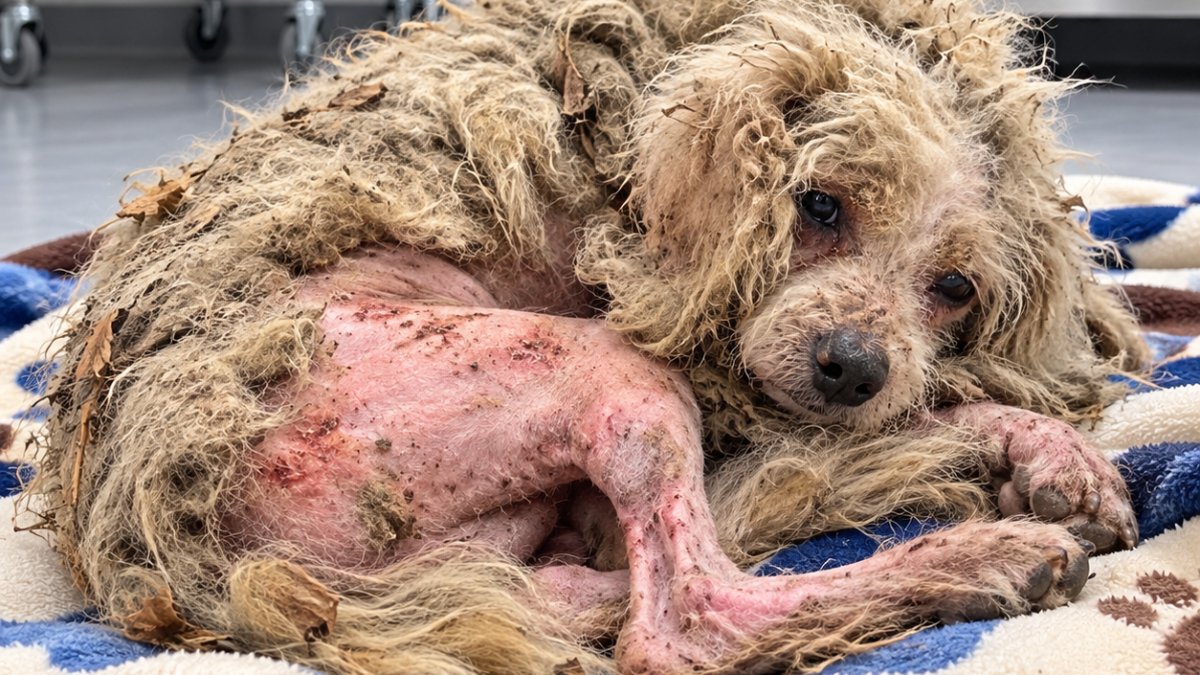
Or at least, the filthy little shape we now knew was a puppy.
He was standing beside the same storefront where I had found him.
The photograph had been posted in a neighborhood group four days earlier.
The caption beneath it read:
“Does anyone know whose dog this is? He’s been hanging around behind the laundromat.”
Four days.
I stared at those words.
Four days that people knew he was there.
Maybe longer.
I scrolled.
There were comments.
Some people had asked whether anyone had called animal control.
One woman said she had left food.
Another person wrote that the dog always ran whenever anyone approached.
Then I saw a comment that made my stomach drop.
“I think somebody dumped him. Saw a dark pickup stop there late last week. Dog appeared afterward.”
I looked at my coworker.
“Can we find the person who posted this?”
“Already messaged her.”
Behind us, the clippers stopped.
The veterinarian had uncovered most of the puppy’s back now.
Without the mats, he looked impossibly fragile.
He wasn’t dangerously thin, but he was much smaller than the filthy coat had made him seem. His skin was pink and inflamed in several places. Around his neck, the hair had been pressed flat and twisted as though something had once rubbed against it for a long time.
The vet examined the area.
“Could have been a collar,” she said. “Could also just be matting. I wouldn’t assume more than we know.”
That mattered.
In rescue work, anger can make you fill in blanks.
You see an animal suffering, and your mind wants a villain immediately.
But animals can’t testify.
You have to separate what you feel from what you can prove.
So I forced myself to breathe.
Right then, the only facts were simple.
A tiny dog had been living beside a street.
His coat had been badly neglected.
He was frightened of people.
And somebody had reported seeing a truck in the area shortly before he appeared.
That was all.
For the moment.
The veterinary team finished shaving him.
When they were done, I almost didn’t recognize him.
His ears looked enormous.
His legs were thin.
His body was barely bigger than both of my hands placed side by side.
The nurse wrapped him in a soft blue towel.
“There you are,” she whispered.
He looked at her.
Really looked.
Then his nose moved toward her fingers.
She offered him a tiny treat.
He took it carefully.
“That’s a good boy.”
His tail didn’t wag.
Not yet.
But he didn’t pull away either.
We named him Milo.
It wasn’t meant to be permanent. Shelter names rarely are. Sometimes adopters keep them. Sometimes they don’t.
But after everything that had been taken off him that afternoon—the dirt, the mats, the debris, the weight of weeks or months without grooming—it felt like he deserved something simple that belonged only to him.
Milo.
On the drive back to the shelter, he curled into the towel in my lap.
Every time the car slowed, he raised his head.
Every time a truck passed, his body tightened.
I noticed it.
I didn’t say anything.
Neither did my coworker.
The shelter was quieter than usual when we arrived.
We prepared a small kennel in the calmest section, away from the barking dogs near the entrance.
A clean bed.
Fresh water.
A shallow bowl of soft food.
A blanket.
Nothing complicated.
Milo stood just inside the kennel after I put him down.
He looked at the bed.
Then at the bowl.
Then at me.
“You can have all of it,” I told him.
He moved directly to the farthest corner.
He curled into himself so tightly that his nose disappeared against his chest.
I sat outside the kennel.
I didn’t reach through the bars.
I didn’t call his name over and over.
I simply sat there.
After about ten minutes, he lifted his head.
After twenty, he looked at the food.
After thirty, he stood.
He took three cautious steps toward the bowl.
Then a metal pan clattered somewhere down the hall.
Milo shot backward.
His body slammed against the corner.
I saw his eyes go wide.
“Easy,” I said softly.
I stayed seated.
Eventually, he came forward again.
He ate four bites.
Then stopped.
That became the pattern during his first days with us.
Four bites.
Five bites.
Sometimes six.
Then retreat.
The other puppies in the yard fascinated him.
We didn’t put him directly into the chaos. We began by letting him watch through the fence.
There was Benny, a ridiculous brown puppy who believed every object on earth had been created specifically for him to chew.
There was Lulu, who could turn a water bowl into a swimming pool in under thirty seconds.
And there was Oscar, a white-and-tan mutt with ears that seemed to have been designed for a dog twice his size.
They wrestled.
Chased.
Fell over.
Got back up.
Milo watched from behind my legs.
Benny ran to the fence.
Milo jumped backward.
Benny dropped into a play bow.
Milo froze.
Benny barked once.
Milo hid behind me completely.
“Not today,” I told Benny.
Benny sneezed and ran away as though deeply offended by the rejection.
I smiled despite myself.
Milo did not.
For him, the world was still a place where unexpected movement meant danger.
So we gave him time.
Every morning, I entered his kennel and sat on the floor.
I brought small pieces of chicken.
The first morning, he wouldn’t take them from my hand.
The second morning, he stretched his neck as far as possible without moving his feet.
The third morning, his nose touched my fingertips.
On the fourth morning, he took the chicken.
I nearly cried over a piece of chicken the size of my thumbnail.
“That’s it,” I whispered. “You decided.”
His eyes stayed on mine while he chewed.
Then he took another.
Progress in rescue is strange.
People imagine dramatic transformations.
A frightened animal suddenly realizing he’s safe.
A tail wagging.
A leap into someone’s arms.
Sometimes that happens.
Usually, healing is much smaller.
A dog eats while you’re in the room.
A dog sleeps without waking every few minutes.
A dog stops pressing himself against the wall.
A dog accepts one touch.
Milo taught me to notice those victories again.
By the end of the first week, he would eat while I sat nearby.
By the second, he no longer retreated every time I stood.
But the yard was harder.
When I finally opened the gate and allowed him into the small-puppy play area, he walked out slowly.
Benny saw him immediately.
I swear that dog had been waiting for this moment.
He raced toward Milo.
“Benny!”
Too late.
Milo spun and ran straight back toward the gate.
Benny stopped several feet away.
Then something happened that still makes me smile.
Oscar walked over to Benny and knocked him sideways.
Not aggressively.
Just enough to interrupt him.
Then Oscar sat.
Benny sat too.
Lulu wandered over, got distracted by a leaf, and forgot everyone existed.
Milo stared at them.
Three puppies.
Waiting.
No chasing.
No pressure.
Milo took one step.
Then another.
Oscar lowered his head.
Milo came close enough to smell him.
Oscar remained still.
Their noses touched.
Milo jumped backward.
But he didn’t run.
“Good,” I whispered.
The next day, he stayed in the yard for seven minutes.
The day after that, twelve.
Then twenty.
He still didn’t play.
But he watched.
And watching was the beginning.
Meanwhile, the woman from the neighborhood group had answered our message.
Her name was Dana.
She owned the laundromat near where I had found Milo.
She came to the shelter carrying her phone and a folder of printed security-camera screenshots.
“I should have done more,” she said before she had even sat down.
“You did something,” I told her. “You fed him. You posted about him.”
“I should’ve caught him.”
“He wouldn’t let us catch him either.”
She looked toward the kennels.
“Can I see him?”
I brought Milo into the quiet room.
The instant Dana saw him without the matted coat, she covered her mouth.
“Oh my God.”
Milo stopped.
Dana crouched.
“That’s him?”
“That’s him.”
“He was so tiny under all that.”
She started crying.
Milo studied her from beside my shoe.
Dana didn’t reach for him.
Smart woman.
She simply sat on the floor.
“I put turkey behind the laundromat every night,” she said softly. “You ate better than my husband last week.”
I laughed.
For the first time, Milo’s tail moved.
Barely.
One little twitch.
Dana saw it.
Her eyes widened.
“Did you see that?”
“I saw it.”
That tiny movement somehow changed the room.
Then Dana opened her folder.
Her security system covered the parking area behind the laundromat.
The video wasn’t perfect.
The camera was mounted high.
The lighting was poor.
But at 11:47 p.m., six nights before I found Milo, a dark pickup had entered the lot.
It remained there for three minutes.
A man stepped out.
The angle hid his face.
He moved toward the rear of the truck.
Then he bent down.
A small shape appeared near his feet.
The man returned to the truck.
The small shape followed.
The man opened the driver’s door.
The puppy tried to put his front paws against the running board.
The man pushed him away with his foot.
Not violently enough to knock him across the ground.
But deliberately.
The truck drove away.
Milo ran after it.
He disappeared beyond the edge of the camera.
I watched the footage twice.
Then a third time.
Dana was silent.
My coworker Rachel whispered, “That’s him.”
I knew.
The walk.
The coat.
The size.
It was Milo.
Animal control received the footage that afternoon.
There was no dramatic arrest.
No squad cars racing through town.
Real justice rarely moves like television.
An officer took statements.
They requested additional footage from nearby businesses.
They enhanced the clearest frames they could.
One camera had captured part of the license plate.
Another had captured the truck turning onto the main road.
The investigation began.
But I refused to let Milo’s life become only about the person who had failed him.
His real story was happening every day inside our shelter.
And on Tuesday morning, Milo did something none of us expected.
I was filling water bowls when I heard Rachel shout from outside.
“You need to get out here!”
My stomach dropped.
I ran.
Milo was in the puppy yard.
Benny had stolen a rope toy from Lulu.
Lulu was chasing Benny.
Oscar was chasing Lulu.
And behind all three of them—
Milo was running.
Not away.
With them.
His little legs moved so fast they looked ridiculous.
The wind lifted the soft new fuzz growing over his back.
Benny turned.
Milo changed direction.
Oscar bumped into him.
Milo rolled once in the grass.
I held my breath.
Three weeks earlier, a sudden collision would have sent him running to a corner.
Instead, Milo sprang back to his feet.
Then he chased Oscar.
Rachel grabbed my arm.
“Look at him.”
“I’m looking.”
“No, really look.”
Milo’s mouth was open.
His tongue hung sideways.
His tail was up.
And he was happy.
There are moments in rescue when everyone stops pretending they’re tough.
That was one.
Rachel cried.
I cried.
Dana, who happened to be visiting that morning, cried harder than both of us.
Benny ran directly through a water bowl and splashed mud onto Dana’s pants.
She didn’t even notice.
Milo raced toward us.
For half a second, an old instinct seemed to return.
He slowed.
His ears shifted back.
Four people were standing there.
Watching him.
Then I crouched.
“Come on, buddy.”
Milo looked at me.
And ran straight into my arms.
I buried my face against his neck.
Weeks earlier, I had held the same dog while his heart hammered with terror.
Now his entire body wiggled because he couldn’t contain himself.
“You did it,” I whispered.
Except he wasn’t finished.
Healing doesn’t move in a straight line.
The next week, a delivery driver entered the shelter wearing heavy work boots and a dark jacket.
Milo saw him.
His tail dropped instantly.
He backed beneath a chair.
I noticed.
So did Rachel.
The driver never went near him.
Still, Milo remained under that chair until the man left.
Another day, a truck backfired outside.
Milo ran to his kennel.
That night, he refused dinner until I sat beside him.
People sometimes misunderstand recovery.
They think a happy photograph means fear has disappeared.
It doesn’t.
Fear can live beside joy for a long time.
The victory is that eventually, joy becomes louder.
Milo’s coat grew back soft and cream-colored with patches of warm brown around his ears.
His irritated skin healed.
His appetite improved.
He gained weight.
And slowly, he became one of the most affectionate puppies in the shelter.
But he was selective.
He didn’t throw himself at strangers.
He observed them first.
He liked quiet voices.
He preferred people who crouched instead of standing over him.
And if someone let him make the first move, Milo would eventually place both front paws on their knee and ask to be picked up.
It felt less like affection he gave automatically and more like trust he awarded.
That made it mean more.
Then, almost a month after the rescue, animal control called.
“We identified the truck.”
I stepped into the office and closed the door.
My pulse quickened.
“Are you sure?”
“We’re sure enough to interview the registered owner.”
The truck belonged to a man named Curtis Hale.
He lived about twelve miles outside town.
Animal control had already visited the address.
There were no other dogs visible on the property when they arrived.
Curtis initially claimed he knew nothing about Milo.
Then officers showed him the camera footage.
His story changed.
He said the dog had belonged to his former girlfriend.
Then he said the dog had been “basically a stray.”
Then he claimed he had only been “dropping him somewhere somebody would find him.”
The officer telling me this sounded exhausted.
“Did he explain the condition of the coat?”
“He said grooming wasn’t his responsibility.”
I closed my eyes.
There it was.
Not some dramatic confession.
Not even shame.
Just responsibility pushed somewhere else.
Animal control continued gathering documentation.
The veterinary photographs mattered.
The timeline mattered.
The security footage mattered.
Dana’s testimony mattered.
Our intake records mattered.
Everything we had carefully documented because we refused to let anger replace evidence now mattered.
Curtis eventually received citations related to abandonment and failure to provide proper care under the ordinances applicable in our area.
The exact legal process took months.
There were hearings.
Continuances.
Paperwork.
His attorney argued that Milo had been fed and therefore had not been neglected.
Our veterinarian explained that food alone did not equal appropriate care when an animal’s coat had become so severely matted that debris, moisture, and irritation were trapped against the skin.
Dana appeared at one hearing.
So did I.
Curtis barely looked at us.
But there was one moment I will never forget.
Outside the hearing room, he finally turned toward me.
“You people act like I killed the dog.”
His voice wasn’t loud.
That almost made it worse.
I looked at him.
“No.”
He waited.
I said, “The dog survived.”
He rolled his eyes.
I didn’t.
“And you don’t get credit for that.”
His expression changed.
For weeks I had imagined what I might say if I ever met the person who had left Milo behind.
In my imagination, I gave some perfect speech.
Something devastating.
Something that would make him understand exactly what he had done.
Standing there, I realized I didn’t need one.
Milo’s condition when we found him was evidence.
Milo’s fear was evidence.
The security footage was evidence.
And eventually, Milo’s happiness would become evidence too.
Not evidence in court.
Evidence of something Curtis would never be able to erase.
He had left that little dog beside a street as if his life were disposable.
Milo was about to become someone’s entire world.
That would be the only revenge worth having.
Finding the right adopter, though, was harder than I expected.
Applications came quickly after we posted Milo’s photographs.
He had become adorable.
There was no denying it.
His new coat made him look like a tiny stuffed animal.
People saw his bright eyes, little brown ears, and crooked smile.
They wanted him.
But wanting a cute puppy and understanding a frightened dog were not the same thing.
One family visited with three energetic children.
They were kind.
They meant well.
But all three rushed toward Milo at once.
He hid behind my chair.
The parents tried to calm them.
Milo never came out.
Another adopter wanted a dog she could take immediately to crowded cafés, outdoor concerts, and weekend festivals.
Maybe Milo could have learned to enjoy those things someday.
Maybe not.
We didn’t know.
I couldn’t promise the life she wanted.
Then there was an older man named Henry.
He lived alone.
When he met Milo, he sat quietly for forty minutes.
He didn’t touch him once.
Milo eventually sniffed his shoe.
Henry smiled.
“That enough for today?”
I liked him immediately.
But Henry had steep stairs throughout his house and had recently undergone surgery that made bending difficult.
He admitted he might not be ready for a puppy.
“I think I wanted him because I understand being scared,” he told me.
Then he looked at Milo.
“But understanding him means being honest about what I can give him.”
I shook Henry’s hand.
“That may be the kindest thing anyone’s said all week.”
Two days later, a woman named Claire submitted an application.
Thirty-four years old.
Elementary-school librarian.
Lived in a small house with a fenced yard.
No other pets.
No young children.
Worked close enough to come home during lunch.
Her application looked good.
That didn’t mean much by itself.
I had read perfect applications from people who became impatient within five minutes of meeting a nervous dog.
Claire arrived on a Thursday.
She wore jeans and an old green sweater.
She carried nothing.
No squeaky toy.
No bag of treats.
No attempt to purchase instant affection.
“Where is he?” she asked.
“In the quiet room.”
Before we went in, I explained Milo’s history.
Not every detail of the investigation.
Just what mattered.
“He may not come to you.”
“That’s okay.”
“He may hide.”
“Okay.”
“He doesn’t like people reaching over his head.”
“Then I won’t.”
“He may need several visits.”
Claire nodded.
“As many as he needs.”
That answer made me pay attention.
We entered the room.
Milo was on a blanket.
He looked at Claire.
Claire sat on the floor across from him.
Then she looked at me.
“What does he usually like to do?”
“Observe.”
She smiled.
“I work in a library. I’m comfortable with silence.”
For twenty minutes, nothing happened.
Claire didn’t call Milo.
She didn’t pat the floor.
She didn’t stare at him.
She talked to me about books.
Milo watched.
At the twenty-five-minute mark, he stood.
At thirty, he crossed half the room.
Claire kept talking as though she hadn’t noticed.
Milo approached her left side.
He sniffed the sleeve of her sweater.
Claire stopped speaking.
She looked at me.
I nodded slightly.
She kept her hands in her lap.
Milo sniffed her knee.
Then he sat beside her.
Claire’s eyes filled with tears.
She didn’t move.
After another minute, Milo leaned his shoulder against her leg.
That was it.
I knew.
Claire knew too.
“Oh,” she whispered.
Milo looked up.
“Hi.”
His tail tapped the floor once.
Then twice.
I swallowed.
“Would you like to come back tomorrow?”
Claire laughed softly through her tears.
“I’ll come back every day if you let me.”
And she did.
Friday.
Saturday.
Monday.
Tuesday.
Each visit, Milo reached her faster.
On Tuesday, he climbed into her lap.
Claire sat perfectly still until he fell asleep.
She stayed like that for almost an hour.
Her leg went numb.
She didn’t care.
The adoption was scheduled for the following Saturday.
I thought that would be the hardest day.
I was wrong.
Friday evening was harder.
I stayed late.
The shelter had gone quiet.
Milo sat beside me in the office while I finished paperwork.
His coat had grown enough that I could run my fingers through it.
No mats.
No grime.
No dried leaves.
Just soft fur.
He rested his chin on my shoe.
“You know you’re leaving tomorrow, right?”
Milo blinked.
“I suppose nobody explained that part.”
His tail tapped once.
I looked down at him.
The first time I had seen him, he had stood alone beside a road, covered in a coat so filthy that I hadn’t known where the mats ended and his body began.
Now he slept with his belly exposed.
He chased other puppies.
He stole Benny’s toys.
He barked at the mop.
He had recently discovered that shoelaces were apparently his mortal enemies.
He was a puppy.
Finally.
Not a case.
Not evidence.
Not a victim.
A puppy.
I reached down and scratched behind his ear.
“I’m going to miss you.”
He lifted his head.
Then, with perfect timing, he licked my hand.
I laughed.
“Yeah. That was rude.”
Saturday morning, Claire arrived fifteen minutes early.
She had already puppy-proofed her house.
She showed us photographs of a small bed beside her couch and another in her bedroom.
She had installed a gate.
She had bought the food our vet recommended.
She had even placed rugs across the hardwood floor because I once mentioned Milo seemed uncertain on slippery surfaces.
“You remembered that?”
“Of course.”
Milo heard her voice from the hall.
He ran.
I had never seen him do that for a visitor.
He rounded the corner, saw Claire, and launched himself at her legs.
Claire dropped to her knees.
Milo climbed into her arms.
His tail whipped so fast it blurred.
Everyone at the front desk stopped what they were doing.
Rachel whispered, “Well, I guess he made his decision.”
Claire looked at me.
“Are you sure?”
I knew what she meant.
Not about the paperwork.
About me.
About whether I could let him go.
I smiled.
“No.”
She looked worried.
Then I laughed.
“But that’s the job.”
I knelt beside them.
Milo turned and put one paw on my leg.
I scratched his chest.
“You found your person.”
Claire’s voice broke.
“I promise I’ll take care of him.”
I believed her.
Still, when the door closed behind them, I cried.
There is a strange selfishness in rescue.
You spend weeks begging an animal to trust you.
Then the reward for succeeding is watching him leave.
People say, “I could never foster. I’d keep them all.”
I understand that feeling.
But the goodbye is the point.
You make yourself temporary so somebody else can become permanent.
That afternoon, Claire sent the first photograph.
Milo was asleep beneath her coffee table.
An hour later, another.
Milo was standing in the backyard, staring suspiciously at a garden statue shaped like a rabbit.
Then a short video.
Claire rolled a ball.
Milo watched it pass.
She rolled another.
He chased it halfway.
Stopped.
Looked back.
Then continued.
I watched the clip three times.
Two days later, Claire called.
My stomach dropped when I saw her name.
Adoption returns often begin with a phone call.
“He’s scared.”
“He won’t eat.”
“He cries at night.”
“He snapped.”
“I didn’t know it would be this difficult.”
I answered immediately.
“Is everything okay?”
Claire sounded breathless.
“Yes. Sorry. Everything’s fine.”
I exhaled.
“What happened?”
“You need to hear this.”
There was rustling.
Then silence.
Then Claire called from across the room.
“Milo!”
A bark answered.
I sat up.
“Milo, come here!”
Tiny paws thundered across the floor.
Claire laughed.
“He learned his name.”
I laughed too.
“That’s why you called?”
“Yes.”
“Claire, I thought something was wrong.”
“Oh my God. I’m sorry.”
“No. It’s okay.”
She lowered her voice.
“He came running.”
“I heard.”
“I know that sounds stupid.”
“It doesn’t.”
“It feels important.”
“It is.”
She was quiet for a moment.
“He knows where home is now.”
That one got me.
I stared at the intake kennel where Milo used to curl into the corner.
“Yeah,” I said. “He does.”
The updates continued.
At first, Milo followed Claire from room to room.
If she closed a door, he waited outside.
If she showered, he lay on the bathmat.
If she walked to the mailbox, he watched from the window until she returned.
Separation frightened him.
So Claire worked carefully.
Ten seconds outside.
Come back.
Thirty seconds.
Come back.
One minute.
Come back.
Never making departures dramatic.
Never making returns overwhelming.
Teaching him one ordinary repetition at a time:
People can leave.
People can also come back.
That lesson took weeks.
Some days went backward.
One afternoon, Claire dropped a metal mixing bowl in the kitchen.
Milo disappeared beneath the dining table and refused to come out for twenty minutes.
Claire sat several feet away and read a book aloud.
Eventually, his nose appeared.
Then his head.
Then the rest of him.
He climbed into her lap.
She finished the chapter.
Another evening, a dark pickup parked across the street.
Milo saw it through the front window.
He began trembling.
Claire closed the curtains.
She didn’t drag him away.
She didn’t force him to investigate.
She sat beside him.
“He remembered,” she told me later.
“Maybe,” I said. “Or maybe the sound or shape reminded him.”
“What do I do?”
“What you did.”
“Nothing?”
“You stayed.”
There are times when staying is not nothing.
For Milo, staying was proof.
Weeks passed.
His world expanded.
First the backyard.
Then the sidewalk directly in front of Claire’s house.
Then half a block.
Then an entire block.
Then a quiet neighborhood park early in the morning.
Claire allowed him to retreat whenever he needed to.
She carried treats but never used them to lure him into something frightening.
Milo learned that he had choices.
That mattered more than people realize.
Fear grows when an animal believes escape is impossible.
Confidence grows when he learns he can say no and still be safe.
One Saturday, Claire brought him back to visit the shelter.
I heard barking from the lobby.
Not frightened barking.
Demanding barking.
I walked out.
Milo stood at the end of his leash.
His coat had filled in completely.
He wore a small blue harness.
For one second, we stared at each other.
Then he exploded.
He ran toward me so hard that Claire nearly dropped the leash.
I crouched.
Milo crashed into my chest.
“Oh, look at you!”
He licked my chin.
His entire body twisted with excitement.
Rachel came around the desk.
“Milo?”
He saw her.
Another explosion.
Within thirty seconds, he had greeted every person who had cared for him.
Then we took him to the puppy yard.
Benny had already been adopted.
Lulu too.
Oscar was still waiting.
Oscar saw Milo.
He froze.
Milo froze.
Then both dogs sprinted.
They collided in the middle of the grass and began wrestling like no time had passed.
Claire covered her mouth.
I smiled.
“Remember when he used to stand in the corner?”
She shook her head.
“I can’t imagine it.”
“I can.”
That was the strange part.
I could still see both versions of him.
The puppy hiding beneath filthy fur.
And the dog racing across the yard.
They were the same dog.
One hadn’t replaced the other.
The second had simply been waiting for enough safety to appear.
While Milo played, the legal case continued.
Curtis challenged the citations.
There was another hearing.
This time, photographs from Milo’s intake were placed into the record.
The matted coat.
The irritated skin.
The debris.
The veterinary notes.
Then investigators presented still frames from the laundromat footage.
Curtis’s attorney argued there was no proof the dog in the video was Milo.
Our vet explained identifying physical features visible before shaving.
Dana testified about feeding Milo.
I testified about finding him.
Then the hearing officer asked Curtis a simple question.
“If this wasn’t your dog, why did you initially tell the officer the dog belonged to your former girlfriend?”
Curtis shifted in his chair.
He had an answer.
Then another.
Neither helped him.
The abandonment citation stood.
So did the neglect-related penalties that could be supported by the evidence.
There were fines.
There were restrictions concerning future animal ownership under the local resolution of the case.
Nothing dramatic enough for a movie.
But it was real.
Documented.
Permanent.
Outside, reporters from one local station waited because Milo’s story had begun circulating online.
I didn’t speak to them.
Dana did.
She said one sentence that stayed with me.
“People keep asking why I didn’t catch him sooner. The better question is why anyone thought leaving him there was acceptable in the first place.”
Curtis walked past while she was speaking.
He heard her.
He kept walking.
I thought that would feel like revenge.
It didn’t.
Justice and revenge are different things.
Justice can happen on paper.
Revenge is personal.
And I realized I didn’t want Milo connected to Curtis forever through anger.
I wanted Milo’s life to become so full that Curtis became irrelevant.
That happened sooner than I expected.
Claire started bringing Milo to the library after closing hours.
Not during public programs.
Not at first.
Just quiet evenings while she shelved books.
Milo followed her between the aisles.
He learned the building.
He discovered that the carpet beneath the children’s reading area was an excellent place to sleep.
He became fascinated by the stuffed-animal display.
One night, a coworker brought her teenage daughter, Emma, who was going through a difficult year.
Emma sat on the carpet reading while Claire worked.
Milo approached her.
He placed his chin on her knee.
Emma stopped reading.
“Can I pet him?”
Claire told her to let Milo decide.
Milo decided.
He climbed beside her.
For forty minutes, the girl read aloud while Milo slept.
Afterward, Emma asked whether she could visit again.
That gave Claire an idea.
Months later, after training and careful evaluation, Milo began participating in a small reading-support program.
Not as a certified therapy animal immediately—that process takes time and depends on the program—but as Claire’s supervised companion during quiet practice sessions.
Children who felt embarrassed reading aloud to adults sometimes relaxed around him.
Milo didn’t correct them.
He didn’t laugh when they stumbled.
He didn’t rush them.
He knew something about needing patience.
One boy named Eli refused to read during his first session.
He sat with a book closed in his lap.
Milo sat three feet away.
Ten minutes passed.
Eli finally opened the book.
Milo moved closer.
Eli read one sentence.
Then another.
Milo placed a paw on the book.
Eli laughed.
It was the first sound he had made since arriving.
Claire sent me a picture afterward.
The caption read:
“He’s helping somebody else learn not to be afraid.”
I had to put my phone down for a minute.
A year after I found Milo, we organized a shelter fundraiser at the park.
Claire asked if she could bring him.
“Obviously.”
When they arrived, I barely recognized the confident dog trotting beside her.
He greeted volunteers.
He sniffed other dogs politely.
He accepted treats from strangers.
He still preferred people who approached slowly.
He still watched large trucks.
He was still Milo.
Healing had not erased his boundaries.
It had given him a life bigger than them.
Dana came too.
The second Milo saw her, his tail began wagging.
She knelt.
“Well, look at you.”
Milo kissed her nose.
Dana started crying immediately.
“You ate so much turkey behind my laundromat.”
Claire laughed.
“That explains why he thinks deli meat is a constitutional right.”
We stood together while Milo moved between us.
At one point, a truck engine rumbled nearby.
Milo looked toward the sound.
His body stiffened.
Claire noticed.
She lowered her hand beside him.
She didn’t grab.
She waited.
Milo looked at the truck.
Then at Claire.
Then he leaned against her leg.
A few seconds later, Oscar—adopted by another family by then—ran past wearing a ridiculous red bandana.
Milo forgot the truck entirely.
He chased Oscar across the grass.
Dana laughed through her tears.
“That.”
“What?”
She pointed toward him.
“That’s the part I wish the man who left him could see.”
I understood.
But I shook my head.
“No.”
She looked at me.
“He doesn’t deserve to.”
Milo sprinted past us.
The dog who once wouldn’t eat more than a few bites while someone stood nearby now stopped at the treat station and tried to convince three different volunteers that no one had fed him in his entire life.
The dog who once flattened himself in a kennel corner now climbed onto a low bench beside Claire like he owned the park.
The dog who once watched other puppies play now started the games.
That was the revenge.
Not suffering returned for suffering.
Not cruelty answered with cruelty.
A life reclaimed.
Every laugh Claire made because of him.
Every child who read beside him.
Every afternoon he slept in a patch of sunlight.
Every meal he finished without looking over his shoulder.
Every time a door opened and the person he loved came back through it.
Curtis had treated Milo like something disposable.
Milo became irreplaceable.
There was no punishment I could have invented that felt more complete than that.
Near the end of the fundraiser, Claire handed me a small photo album.
“What’s this?”
“For you.”
The first page showed Milo on adoption day.
The second showed him asleep under the coffee table.
Then Milo in the yard.
Milo with his first toy.
Milo covered in leaves.
Milo wearing a raincoat he clearly hated.
Milo sleeping beside a stack of library books.
Milo beside Emma.
Milo beside Eli.
Milo on Christmas morning, surrounded by shredded wrapping paper.
Milo sitting in Claire’s lap on the anniversary of his adoption.
On the last page was a picture I hadn’t seen.
Claire stood on the same street where I had found him.
Milo was beside her.
He wasn’t cowering.
He wasn’t hiding.
He stood on clean pavement wearing his blue harness, looking toward the camera.
Behind them was the laundromat.
I stared at the picture for a long time.
“When did you take this?”
“Last week.”
“You brought him back there?”
“Only because he was ready.”
“How did he react?”
Claire smiled.
“At first, he stopped.”
I looked at her.
“He recognized it?”
“I don’t know. Maybe the smells. Maybe nothing. But he stood still for a while.”
“What happened?”
“I waited.”
Of course she did.
“And then?”
“He sniffed the sidewalk. Walked over to the grass. Peed on a bush.”
I laughed.
“That sounds right.”
“Then he pulled me toward the laundromat because Dana was standing outside with turkey.”
I laughed harder.
Claire’s eyes softened.
“He didn’t want to leave when we first got there. I thought maybe I’d made a mistake.”
My laughter faded.
“What changed?”
“She opened the door.”
“Dana?”
Claire nodded.
“Milo looked at me. Then he walked toward her.”
I looked again at the photograph.
Same street.
Same dog.
Different ending.
That night, after the fundraiser, I stayed at the shelter later than everyone else.
I often did that.
There is a specific kind of quiet that settles over an animal shelter after closing.
Dogs shift against blankets.
Water bowls scrape occasionally.
Someone dreams and makes a tiny sound.
I walked past the kennel where Milo had spent his first night.
Another puppy occupied it now.
A scared little hound mix.
She pressed herself against the back wall when she saw me.
I sat outside the door.
No touching.
No pressure.
Just presence.
After a while, she lifted her head.
I thought about Milo.
People sometimes ask how we keep doing this.
How we look at neglect, abandonment, fear, and cruelty without becoming consumed by it.
I don’t have a perfect answer.
Some days anger follows me home.
Some nights I remember animals we couldn’t save.
Some cases stay with you.
But then there are dogs like Milo.
They remind you that rescue is not defined by the worst thing a human did.
It is defined by what happens afterward.
The hands that become gentle.
The meals that arrive every day.
The doors that open.
The people who return.
The frightened puppy who eventually runs.
Months later, Claire invited me to Milo’s second adoption anniversary.
She called it his “home day.”
There were six people.
Two dogs.
A cake for the humans.
A dog-safe treat shaped like a bone for Milo.
Dana came.
Rachel came.
Henry—the older man who had considered adopting Milo—came too. He had eventually adopted a calm senior dog from us named Rosie, and the two of them were inseparable.
Milo raced from person to person.
When he reached me, he stopped.
For one absurd second, he became still.
Then he put both paws against my leg.
I picked him up.
He settled against my chest.
He was heavier now.
Healthy.
Warm.
Soft.
I ran my fingers through the fur behind his ears.
No mats.
I could feel his heartbeat.
Steady.
I remembered that first drive to the clinic.
His heart had hammered against my arm.
Same heart.
Different reason for being held.
Claire stood nearby.
“He remembers you.”
“I hope so.”
“I know he does.”
Milo looked toward her voice.
His tail began wagging.
I lowered him.
He immediately ran back to Claire.
And surprisingly, that didn’t hurt anymore.
It felt right.
Later, everyone gathered in the backyard.
Milo and Rosie ran circles around a table.
Oscar arrived with his family.
Within seconds, the two dogs were wrestling.
I watched Milo roll onto his back.
Oscar bounced away.
Milo jumped up and chased him.
Around them, people laughed.
For a moment, I pictured the little dog by the roadside.
Filthy.
Matted.
Watching every movement.
Afraid to come near a piece of bread because taking food meant approaching a human.
I wished I could somehow go back to that afternoon.
Not to change anything.
Just to kneel beside that terrified little animal and tell him what was coming.
I would tell him:
There will be a woman who learns exactly how you like to be touched.
There will be a house where your bed stays in the same place every night.
There will be a yard where nobody chases you unless you ask them to play.
There will be food tomorrow.
And the day after that.
And the day after that.
There will be doors that close without trapping you.
Cars that leave without abandoning you.
Hands that reach toward you without hurting you.
There will be children who trust you with their nervous voices.
There will be friends who wait when you are frightened.
There will be a name you eventually recognize as your own.
There will be someone who says it from another room—
“Milo!”
—and you will run toward her because you know exactly who is calling.
Near sunset, Claire brought out the little photo album again.
A new picture had been added to the back.
It had been taken that afternoon.
Milo was racing across the yard.
All four paws were off the ground.
Oscar was behind him.
Rosie was farther back.
Milo’s mouth was open in what looked almost like a smile.
I stared at it.
Claire touched my arm.
“You okay?”
“Yeah.”
“You look like you’re about to cry.”
“I am.”
She laughed.
Milo ran toward us.
I crouched.
This time he didn’t hesitate.
He came straight into my hands.
I scratched beneath his chin.
He leaned into my touch exactly the way he had leaned into the veterinary technician’s hand on that first afternoon.
Except now there was no trembling.
No stiff body.
No frightened eyes calculating an escape route.
Just Milo.
I looked at Claire.
“Do you know what I thought when we shaved him that first day?”
“What?”
“I thought the mats were hiding how tiny he was.”
Claire glanced down at him.
“They were.”
“They were hiding something else too.”
“What?”
I smiled.
“This dog.”
Milo twisted free and raced back toward his friends.
For so long, fear had covered almost everything about him.
His curiosity.
His affection.
His silliness.
His confidence.
His ability to trust.
We hadn’t created any of those things.
We had simply given them enough safety to come out.
That is the part people often miss when they talk about rescue.
We say we saved them.
Sometimes that is true.
But often, beneath the dirt, fear, hunger, and neglect, there is already an entire personality waiting.
You don’t build it.
You uncover it.
Patiently.
One meal.
One quiet afternoon.
One safe touch.
One returned trust at a time.
Milo’s former owner would never be the most important person in his story.
Not after everything that came next.
Curtis had one terrible chapter.
Claire got the rest of the book.
And as I stood in that backyard watching Milo disappear into a tumbling pile of dogs, I realized that was the ending I had wanted without knowing how to ask for it.
Nobody could undo the nights Milo spent alone.
Nobody could make his fear retroactively disappear.
Justice could acknowledge what happened.
It could assign consequences.
It could put responsibility where it belonged.
But healing did something justice alone could never do.
Healing gave Milo a future larger than his past.
The last time I saw him that summer, Claire was leaving the shelter after dropping off donated blankets.
Milo sat in the passenger seat.
The window was partly open.
He recognized me immediately.
His head popped up.
His tail began thumping against the seat.
I walked toward the car.
“Hey, troublemaker.”
Milo shoved his nose through the opening.
I scratched his forehead.
Claire smiled.
“He still remembers this place.”
I looked through the windshield toward the road.
For a moment, I remembered another car.
Another afternoon.
Another version of Milo.
The puppy stiff in my arms, terrified because he had no way to know whether being placed in a vehicle meant rescue or another abandonment.
Now, when Claire opened the driver’s door, Milo bounced excitedly.
He knew where the car was taking him.
Home.
Claire started the engine.
Milo turned in a circle and settled into his seat.
“See you soon,” she said.
“Drive safe.”
They pulled away.
Milo looked back through the window.
I raised my hand.
Then the car turned the corner.
I stood there smiling long after it disappeared.
Because somewhere inside that car was a tiny dog who once believed every approaching hand might be dangerous.
Now he slept beside the person he trusted most.
He ran across yards with friends.
He greeted familiar people with a wagging tail.
He helped nervous children find their voices.
He had food, blankets, toys, veterinary care, and a home where nobody considered him disposable.
And every ordinary day of that life became part of his victory.
The man who abandoned him had once driven away believing Milo was no longer his problem.
He was right about one thing.
Milo was no longer his.
He belonged to himself first.
And then, by choice, to the people who had earned his trust.
That was more powerful than revenge.
That was justice with a heartbeat.
And whenever I remember the filthy little shape standing beside that road, I no longer see the dog we found.
I see the dog who was waiting underneath.
I see him running.
[END OF FULL STORY]








