PART 2: I Found a Tiny Kitten Collapsing Beside the Road—Then He Did Something I Still Can’t Forget
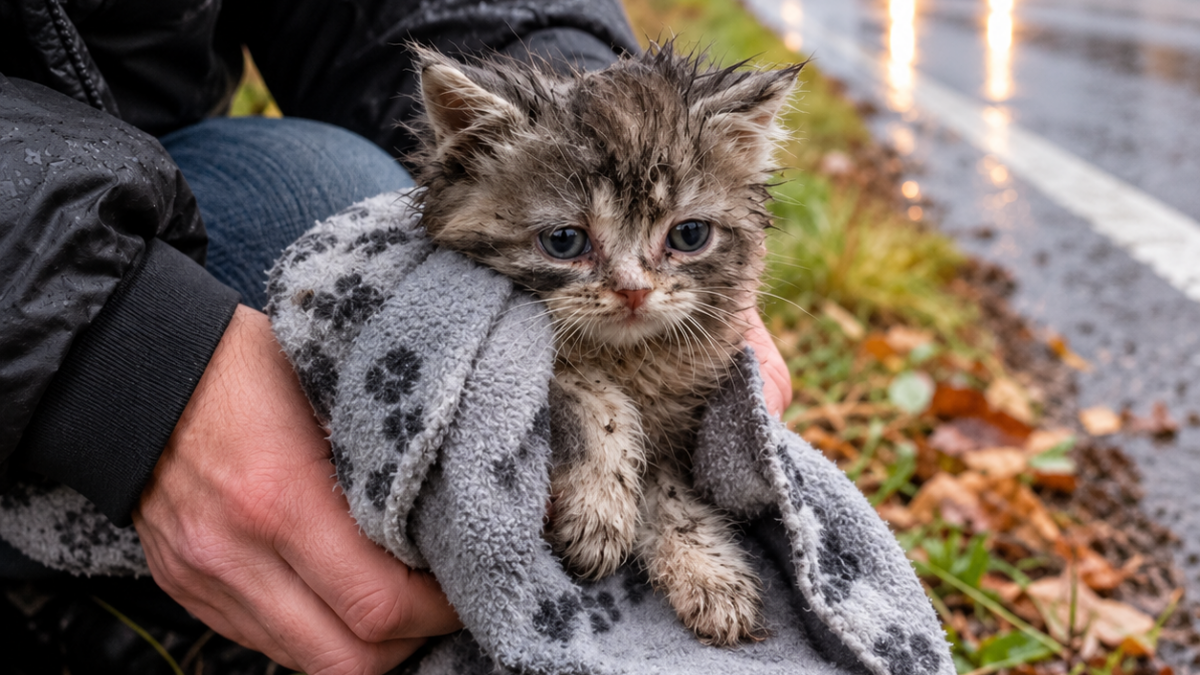
PART 2
The emergency veterinary clinic was about twenty minutes away.
That night, it felt much farther.
Every red light seemed to stay red too long.
Every car ahead of us seemed to be moving at half the speed it should.
I kept one hand beneath the kitten’s chest and the other around the jacket.
His body was still cold.
Too cold.
At first, his trembling continued.
Then it gradually weakened.
That should have reassured me.
Instead, I remembered something I’d once heard—that when a very cold animal stops shivering, it doesn’t always mean they’re improving.
Sometimes it means they no longer have enough energy to keep doing it.
“He’s stopped shaking.”
“Is that good?”
“I don’t know.”
I hated saying that.
I touched his side.
Breathing.
Still there.
“Come on.”
His ear moved slightly.
“You stay with me.”
I didn’t know whether speaking helped him.
It helped me.
At one point, his eyes opened halfway.
I leaned closer.
“There you are.”
They closed again.
I tightened the jacket.
By the time we reached the clinic, I had already unfastened my seat belt before the car stopped.
I carried him through the doors.
A receptionist looked up.
“I found a kitten beside the road.”
Her expression changed immediately.
“How old?”
“I don’t know. Tiny. He collapsed.”
A technician appeared almost at once.
“Let me see.”
I loosened the jacket.
The kitten’s head rested against the fabric.
The technician placed two fingers against his chest, then touched his ears and paws.
“He’s very cold.”
“I know.”
She looked toward the treatment area.
“We’re taking him back now.”
“Can I come?”
“Not yet.”
She took him carefully.
My arms suddenly felt empty.
The treatment-room door closed.
I stood there still holding the muddy jacket as though I had forgotten what to do with it.
The receptionist asked questions.
Where did you find him?
What time?
Was he in the roadway?
Did you see another cat?
Any blood?
Any obvious injuries?
Had he been hit?
“I don’t think so.”
“Any vomiting?”
“I just found him.”
“Do you know how long he was outside?”
“No.”
That word kept coming.
No.
No history.
No age.
No owner.
No clue how long he’d been there.
No explanation for why a kitten that young was alone near a busy road.
We filled out what we could.
Then we waited.
The waiting room smelled faintly of disinfectant, wet coats and animal shampoo.
A small dog sat inside a carrier across from us.
Somewhere behind the doors, another dog barked twice.
Phones rang.
People came and went.
Normal clinic sounds.
But all I could think about was the kitten.
The way his legs had folded.
The sharp ribs beneath his fur.
The little purr.
Then nothing.
After about fifteen minutes, a veterinarian walked into the waiting area.
“Are you the people who brought in the gray kitten?”
“Yes.”
She sat.
That scared me.
People delivering simple good news usually don’t sit first.
“He’s alive,” she said.
I realized I had been holding my breath.
“Okay.”
“He’s extremely underweight and significantly dehydrated.”
I nodded.
“His body temperature is dangerously low.”
“How low?”
She gave me the number.
It meant little to me, but her tone told me enough.
“We’re warming him slowly,” she continued. “Too quickly can create other problems.”
“His blood sugar?”
“Very low.”
“Can you fix it?”
“We’re treating it.”
I looked at the closed treatment door.
“Was he hit by a car?”
“We don’t see obvious evidence of major trauma. No visible fractures. No active bleeding. But he’s weak enough that we’re being careful.”
“Is he going to make it?”
She paused.
There it was again.
The pause.
“I can’t promise that yet.”
My hand tightened around the jacket.
“But he’s responding to warming and glucose.”
“That’s good?”
“Yes.”
“How old is he?”
“Five or six weeks, possibly a little older. He’s small enough that malnutrition may make age difficult to judge.”
Five or six weeks.
He should have been with a mother.
Littermates.
Inside somewhere.
Not fighting to stay conscious beside a highway.
The veterinarian continued.
“He has a significant flea burden.”
“I saw some.”
“His gums are pale. I suspect anemia. Fleas alone can cause serious anemia in very small kittens, especially if they’re already undernourished.”
“Can you treat that?”
“We’re running bloodwork. We’ll know more soon.”
“Can I see him?”
“Give us a little more time.”
I nodded.
She stood.
“One step at a time.”
One step.
The phrase felt cruelly appropriate.
The kitten hadn’t been able to take one without collapsing.
We sat again.
Twenty minutes later, a technician came to ask whether he had a name.
“No.”
“We need something on the chart.”
For some reason, hearing him reduced to “gray stray kitten” bothered me.
He needed something.
Even if temporary.
I thought about the sound he’d made against my chest.
That tiny purr.
Almost lost beneath the traffic.
“Whisper.”
The technician smiled.
“Whisper?”
“Yeah.”
“That works.”
So the kitten became Whisper.
At least to us.
When the veterinarian returned later, she looked less worried.
Not relaxed.
Less worried.
“His temperature is coming up.”
“Good.”
“He’s more responsive.”
“Can we see him?”
“For a minute.”
Whisper lay inside a warmed enclosure on soft towels.
Without the mud hiding him, he looked even smaller.
His fur was gray with a small white patch under his chin.
His ears seemed far too large for his head.
His eyes opened when I approached.
“Hey.”
One ear twitched.
I placed my fingers near the opening.
Whisper sniffed.
Slowly, he moved his head forward until his cheek touched my finger.
The veterinarian stood beside me.
“He remembers you.”
“Maybe he remembers the jacket.”
“Maybe.”
Whisper closed his eyes.
I scratched very gently between his ears.
A faint vibration began.
Purr.
I laughed quietly.
“You’re doing that again.”
His body remained weak.
But that sound was stronger than before.
The vet smiled.
“That’s encouraging.”
We stayed only a few minutes.
Whisper needed rest more than company.
Before leaving, I asked every question I could think of.
What happens tonight?
What if he crashes?
When will you call?
Can I call?
How often?
The veterinarian was patient.
“We’ll monitor temperature, blood sugar, hydration, appetite and his blood values. If anything changes significantly, we’ll contact you.”
“Even overnight?”
“Yes.”
I gave them my number twice.
Walking outside without him felt wrong.
The jacket sat on the passenger seat.
Mud stained the sleeves.
Several gray hairs clung to the inside.
At home, I tried sleeping.
I couldn’t.
Every time I closed my eyes, I saw the roadside.
The grass.
Headlights.
Whisper trying to stand.
Then falling.
Around two in the morning, I checked my phone.
No missed calls.
Good.
At three-thirty, again.
Nothing.
At five, I finally slept.
The phone rang at seven-thirty.
I sat upright before recognizing the number.
The clinic.
“Hello?”
“Whisper made it through the night.”
My eyes closed.
“Okay.”
“He remained stable.”
“Did he eat?”
“A little.”
“On his own?”
“Some assisted feeding, some licking from a dish.”
“Temperature?”
“Better.”
“Blood sugar?”
“Improved.”
“Bloodwork?”
“Still anemic, but not at the point where the veterinarian thinks he needs a transfusion right now.”
“Right now?”
“We’re monitoring.”
There was always another phrase designed to prevent hope from becoming certainty.
Right now.
For now.
So far.
Still.
Rescue, I learned quickly, lives inside those words.
Whisper wasn’t safe because he’d survived one night.
But he had survived one night.
That mattered.
We visited later that day.
He looked different.
Not dramatically.
His eyes tracked movement better.
When the technician touched his dish, Whisper lifted his head.
“He recognizes food.”
“Good.”
“Very good.”
He ate perhaps a teaspoon while we watched.
It didn’t seem like much.
Everyone acted as though he’d finished a banquet.
“Good boy.”
Whisper stopped licking and stared.
“Keep going.”
He ate again.
His tiny stomach rounded slightly.
I smiled.
That first day became a collection of small victories.
Temperature nearly normal.
Blood glucose stable.
A little food.
Urination.
Standing briefly.
I began understanding why veterinary staff celebrate things nobody else talks about.
When a life is fragile, ordinary body functions become milestones.
Day two, Whisper stood for almost ten seconds.
Then sat.
Day three, he walked across the warm enclosure.
The technician filmed it.
Three steps.
Pause.
Two more.
I watched the video repeatedly.
The kitten who couldn’t stand beside the road was walking.
Badly.
But walking.
The veterinarian called that afternoon.
“He’s responding well to treatment.”
“Does that mean he’s going to survive?”
She laughed softly.
“You really want me to say that.”
“Yes.”
“I think his chances are much better than they were the first night.”
Not the sentence I wanted.
Close enough.
They treated him for parasites once he was stable enough.
The fleas were addressed with a product appropriate for his age and size.
Nutrition had to be careful.
His stomach hadn’t been receiving enough.
Giving a starving animal too much too quickly can create its own problems.
So meals were small.
Frequent.
Measured.
Whisper considered this unacceptable once his appetite returned.
By day four, he had opinions.
That thrilled me.
When the technician removed his dish after the scheduled feeding, he made a small squeak.
She laughed.
“Complaints department is open.”
Another squeak.
“You ate.”
He looked toward the dish.
I smiled.
“Good.”
Sick animals conserve energy.
Healthy kittens protest.
His blood values remained a concern, but improvement continued.
Pale gums gradually became pinker.
His body temperature stabilized without as much external heat.
The shaking stopped for the right reason now.
He began grooming himself.
Poorly.
The first attempt involved licking one front paw twice before falling asleep.
Still.
Progress.
On day five, Whisper saw me enter and tried to walk toward the front of the enclosure.
I crouched.
“Hey.”
He approached.
No retreat.
No fear.
He pressed his nose toward my fingers.
Then climbed one tiny paw onto my hand.
I stared at the veterinarian.
“Can I hold him?”
“For a few minutes.”
She wrapped him in a towel.
I sat.
Whisper settled against my chest.
The first time I’d held him, he had been cold enough to frighten me.
Now he was warm.
That difference almost hurt.
I put one finger along the side of his face.
The purr started.
Stronger.
Steadier.
“That engine is improving.”
The veterinarian laughed.
“He knows his person.”
“I’m not his person.”
She looked at me.
“Okay.”
“I’m serious.”
No response.
“We found him. That’s all.”
She continued writing on the chart.
“I’m not adopting a kitten.”
Still nothing.
“Why is everyone ignoring me?”
The technician walking past smiled.
“Experience.”
I understood what they thought.
I also knew reality.
An animal is a commitment.
Potentially fifteen or twenty years.
Food.
Veterinary care.
Litter.
Vaccinations.
Emergency expenses.
Travel arrangements.
Daily responsibility.
We hadn’t gone looking for a cat.
Stopping at the roadside didn’t automatically mean we were the right permanent home.
That distinction mattered.
I refused to make an emotional decision simply because Whisper had almost died in my jacket.
So I contacted local rescue organizations.
They were full.
That wasn’t surprising.
Autumn kitten season had stretched resources.
One coordinator said they could probably find a foster within a week once Whisper was medically cleared.
“Good.”
I meant it.
Mostly.
Whisper stayed hospitalized a little longer than originally hoped because the veterinarian wanted his weight, hydration and anemia to improve further.
Every day, he became more kitten and less patient.
A toy mouse appeared in his enclosure.
The first day, he stared.
Second day, he pawed it.
Third day, he attacked.
Not well.
He rolled sideways after one pounce.
But the intention was unmistakable.
The veterinarian sent a video.
Whisper grabbed the mouse by its tail, shook it once, then fell asleep on top of it.
I laughed.
By the end of that week, he was ready to leave intensive care.
The rescue still hadn’t arranged the foster.
“Maybe three or four days,” the coordinator told me.
I looked at Whisper through the enclosure.
“What happens until then?”
“He can possibly board here, but if somebody can foster temporarily, that would be better.”
Temporarily.
Dangerous word.
I said it anyway.
“He can stay with us.”
The coordinator paused.
“Are you sure?”
“For a few days.”
“Do you have other animals?”
“No.”
“Good. You’ll need a separate room, low-sided litter box, appropriate kitten food, medication schedule, monitoring, follow-up appointment—”
“I have the discharge papers.”
“Have you ever cared for a kitten?”
“No.”
Another pause.
“We’ll talk.”
The conversation lasted nearly forty minutes.
By the time Whisper came home, we had turned a quiet spare room into something halfway between a nursery and a tiny hospital.
Soft bed.
Blankets.
Low litter tray.
Food.
Water.
Digital kitchen scale to track weight.
Carrier left open.
A few safe toys.
Nothing with strings left unsupervised.
No access to the rest of the house until we understood how he handled things.
The veterinarian handed me his medication.
“Same time every day.”
“Got it.”
“Small meals.”
“Got it.”
“Call if vomiting, diarrhea, severe lethargy, refusal to eat, difficulty breathing, sudden weakness—”
“Got it.”
She smiled.
“You look terrified.”
“I am.”
“Good.”
“Good?”
“Means you’ll pay attention.”
Whisper came home in a carrier.
He hated the drive.
At the first traffic noise, his body flattened.
His eyes widened.
I felt something twist inside me.
Maybe he remembered.
Maybe he simply disliked movement.
I didn’t know.
I put one finger through the carrier door.
“It’s okay.”
Whisper sniffed.
Then pressed against it.
When we reached home, I carried the carrier into the spare room and opened the door.
Whisper remained inside.
I sat on the floor several feet away.
No reaching.
No coaxing.
“Take your time.”
Five minutes.
Then a gray nose appeared.
One paw.
Second paw.
Whisper stepped onto the blanket.
Sniffed.
Turned back toward the carrier.
Then forward.
He explored perhaps three feet before tiring.
I expected him to return to the carrier.
Instead, he walked toward me.
One tiny step after another.
Climbed onto my knee.
Curled into the fold of my shirt.
And fell asleep.
I looked down.
“Temporary.”
He didn’t respond.
“Just making sure we’re clear.”
Purr.
That first night, I woke three times.
Not because Whisper cried.
Because I kept checking.
At one in the morning, he was asleep.
At three, asleep.
At five, eating.
I stood in the doorway watching him.
He looked up.
Food on his chin.
“You scared me for nothing.”
He returned to breakfast.
The first week at home became a schedule.
Feed.
Medication.
Weigh.
Clean litter.
Rest.
Play for short periods.
Watch for signs of fatigue.
Write everything down.
Whisper’s weight climbed slowly.
A few grams one day.
More the next.
One morning, none.
I panicked.
Called the clinic.
The veterinarian asked several questions.
Eating?
Yes.
Active?
Yes.
Stool?
Normal.
Temperature?
Normal.
“Weight can fluctuate slightly.”
“So don’t panic?”
“I didn’t say that. I know you’re going to panic.”
She was learning me.
Whisper didn’t care about numbers.
Once he felt stronger, his world expanded.
He discovered that blankets could be attacked from underneath.
He discovered toes.
Unfortunately.
He discovered that moving shoelaces were prey.
He discovered dust.
Every speck required investigation.
The first time he saw his reflection in a mirror, he froze.
Another kitten stared back.
Whisper arched slightly.
The reflection did too.
He stepped sideways.
So did the enemy.
Then Whisper approached.
Sniffed the glass.
Licked it.
Mystery solved.
I laughed hard enough that he stared at me.
“You are terrifying.”
Whisper walked away.
By week two, the medical crisis felt farther away.
His gums were healthier.
His coat changed.
That surprised me.
When we found him, his fur had seemed dull gray.
With nutrition, grooming and parasite treatment, silver undertones appeared.
The white patch beneath his chin became clearer.
His eyes were greener than I’d realized.
He had been there all along.
We just couldn’t see him under exhaustion.
At the follow-up appointment, the veterinarian placed him on the scale.
“Look at that.”
“Good?”
“Very good.”
She checked his heart.
Lungs.
Abdomen.
Mouth.
Gums.
“Anemia is improving.”
“How much?”
She showed me the numbers.
They meant little without explanation.
She explained.
I listened.
“So he’s out of danger?”
“He is much more stable.”
“That’s not what I asked.”
She smiled.
“He’s acting like a kitten.”
As if summoned, Whisper attacked the paper covering the exam table.
He bit one corner and pulled.
The paper tore.
The veterinarian laughed.
“That’s my professional assessment.”
Whisper shredded another piece.
“Can you prescribe something for that?”
“No.”
The rescue called later that week.
“We have a foster opening.”
My stomach tightened.
“Good.”
The woman sounded experienced.
She had fostered kittens before.
No other sick animals.
Safe room.
Vet access.
Exactly what I had wanted.
“We can transfer him Saturday.”
“Okay.”
“Does that work?”
“Yes.”
I hung up.
Whisper sat on the windowsill.
He had recently learned to climb there using a chair.
Sunlight crossed his fur.
He watched something outside.
I walked into the room.
“You’re leaving Saturday.”
Whisper turned.
“Don’t look at me like that.”
He wasn’t looking any particular way.
That’s the danger of animals.
Humans supply half the dialogue.
That night, he slept on my jacket.
The same jacket.
I’d washed it after the rescue.
It remained slightly stained around one cuff.
Whisper had discovered it hanging low on the back of a chair and dragged part of it down.
Now he was curled into it.
Purring.
I stood there.
“Seriously?”
His paw covered his nose.
I told myself it meant nothing.
Soft material.
My scent.
Warmth.
Normal cat behavior.
All true.
Saturday came.
I packed his things.
Food.
Medication.
Records.
Blanket.
Toy mouse.
Whisper sat inside the cardboard box I was trying to use.
“Move.”
He bit the edge.
“This is not for you.”
He remained.
I lifted him out.
He climbed back in.
“Whisper.”
Purr.
I was becoming annoyed because annoyance was easier than the other thing.
The foster was expecting him at noon.
At ten-thirty, I still hadn’t left.
“Are you ready?”
“No.”
I looked at Whisper.
He had fallen asleep inside the box.
“That’s not what I meant.”
“I know.”
I sat.
Whisper woke.
He walked out of the box and climbed onto my lap.
No hesitation now.
No frightened backing away.
He rubbed his face beneath my chin.
Purr.
I scratched behind his ears.
“You don’t know what’s happening.”
Probably true.
“You’ll like her.”
Purr.
“She’s better at kittens.”
Purr.
“She knows what she’s doing.”
He pushed harder.
I closed my eyes.
Someone sat beside me.
“Do you actually want him to go?”
I didn’t answer.
“That’s not the same as whether you should keep him.”
“I know.”
“Do you?”
Whisper’s paw rested on my wrist.
“I don’t know.”
That was a lie.
I knew.
The rescue coordinator received my call twenty minutes later.
“We’re not coming.”
A pause.
“Problem?”
“No.”
“Whisper sick?”
“No.”
“Then what happened?”
I looked at the kitten biting my jacket zipper.
“We want to adopt him.”
Silence.
Then laughter.
“What?”
“I was wondering when you’d say it.”
“You could have told me earlier.”
“Would you have listened?”
No.
Probably not.
The paperwork was completed properly.
Whisper was microchipped.
Vaccinations followed the veterinarian’s schedule.
When he was old enough and medically ready, he was neutered.
The temporary rescue kitten became ours.
That should sound like an ending.
It wasn’t.
Adoption ended the emergency story.
Then real life started.
Real life with Whisper included a broken coffee mug on day three.
I heard the crash.
Ran into the living room.
Whisper sat on the table.
Broken mug below.
“What happened?”
He looked at me.
“You.”
Blink.
“There are no other suspects.”
He washed one paw.
The next week, a pen disappeared beneath the refrigerator.
Then three more.
Whisper developed a strong belief that any small object near an edge existed to be pushed over it.
Coins.
Bottle caps.
Paper clips.
Keys.
Once, my phone.
“Absolutely not.”
Whisper stared.
“You are not allowed to experiment with gravity using electronics.”
He slowly extended one paw toward the remote.
“Whisper.”
Paw stopped.
I walked away.
The remote hit the floor.
I turned.
Whisper was already leaving.
He grew quickly.
Not into a large cat.
The veterinarian believed his rough beginning may have contributed to his smaller frame, though genetics could easily explain it too.
He remained compact.
Lean.
Long-legged for a while.
His ears eventually stopped looking oversized.
Mostly.
What he lacked in size, he replaced with confidence.
The kitten terrified of my hand by the roadside became the cat who believed every human lap belonged to him.
Visitors entered.
Whisper investigated.
If approved, he climbed onto them.
One friend came over wearing black pants.
Whisper sat on her for an hour.
When he moved, the pants were gray.
She stared.
“Your cat destroyed my clothes.”
“He improved them.”
Whisper rubbed his face against her hand.
She immediately forgave him.
Traitor.
His purr remained distinctive.
Not especially loud.
Deep.
Steady.
Sometimes I could feel it before I heard it.
Every time, I remembered the car.
That first fragile vibration against my sweater.
There were nights when I placed my hand gently over his side just to feel the difference.
Warm body.
Strong breathing.
No shaking.
No cold.
Whisper’s first winter indoors affected me more than him.
The first freezing night, rain turned to sleet.
Wind pressed against the windows.
Whisper discovered the radiator.
He stretched beside it.
Rolled onto his back.
Paws in the air.
Completely relaxed.
I took a picture.
Later, I found an older photograph from the clinic.
Same gray fur.
Different animal.
In the first, Whisper was curled tightly beneath towels because he couldn’t stay warm.
In the second, he was sprawled like an animal mildly inconvenienced by excessive comfort.
I put the pictures side by side.
Then closed them.
I didn’t want to make his entire life into a before-and-after image.
Whisper didn’t know he was a rescue story.
He knew breakfast arrived.
The radiator was warm.
The windowsill had birds.
The couch belonged to him.
That was enough.
We never discovered where he came from.
For weeks after finding him, I checked local lost-pet pages.
Posted responsibly.
Called nearby clinics.
Asked whether anyone reported a missing gray kitten.
Nothing.
No mother.
No littermates.
No owner.
That uncertainty bothered me.
I imagined possibilities.
Some cruel.
Some accidental.
Maybe he had been dumped.
Maybe a feral mother moved her litter and something separated them.
Maybe he climbed into a vehicle and fell out somewhere else.
Maybe he wandered much farther than seemed possible.
Maybe somebody scared him.
The truth was simple.
We didn’t know.
And I refused to invent abuse simply because his fear made the story more dramatic.
A five-week-old kitten alone beside fast traffic had plenty of reasons to be terrified.
He didn’t need a villain.
One afternoon, months after his rescue, I drove past the road where we’d found him.
I recognized the sign.
My hands tightened on the wheel.
I slowed.
There was nothing there.
Wet grass.
Guardrail.
Traffic.
Ordinary.
For a second, I saw him anyway.
Tiny gray body.
Legs giving out.
Then a truck passed.
The image vanished.
At home, Whisper greeted us at the door.
Not because he’d been waiting tragically.
Because dinner was late.
He chirped.
Walked toward the kitchen.
Looked back.
“Hello to you too.”
Another chirp.
He sat beside his bowl.
I laughed.
“Good.”
Let hunger mean dinner was ten minutes late.
Let cold mean he wanted the radiator turned up.
Let fear mean the vacuum cleaner appeared.
He’d had enough serious problems.
Whisper loved windows.
He had several favorite observation posts.
The living-room window provided birds.
The bedroom window offered neighbors and parked cars.
The kitchen window had squirrels.
Squirrels were an insult.
The first time one ran along the fence, Whisper’s entire body vibrated.
His jaw made rapid clicking sounds.
I stared.
“What are you doing?”
He clicked again.
The squirrel escaped.
Whisper looked offended.
This became daily entertainment.
He also loved boxes.
Every box.
Size irrelevant.
If his body didn’t fit, he tried anyway.
One Christmas package arrived barely larger than a shoe box.
Whisper put his front half inside.
His back half remained outside.
He settled.
I took a picture.
“Comfortable?”
Purr.
Apparently.
The cardboard obsession eventually created a rule.
Before throwing away any box, check for cat.
We learned that after spending twenty minutes looking for him while he slept inside a shipping carton near the pantry.
“Whisper?”
Nothing.
I searched bedrooms.
Under beds.
Behind curtains.
Closets.
The carrier.
Nothing.
Fear rose quickly.
Windows closed.
Doors closed.
Impossible for him to have escaped.
Still.
“Whisper!”
Silence.
Then something rustled in the pantry.
I opened the door.
A gray head emerged from a box.
He yawned.
I stared.
“You heard me.”
Whisper blinked.
“We were screaming your name.”
He climbed out, stretched, and walked past.
That night, I understood another part of cat ownership.
They are perfectly capable of allowing humans to experience full emotional collapse for entertainment.
Years passed.
Whisper became woven into the house so gradually that I stopped noticing when habits began.
Every morning, he waited outside the bedroom.
Not because the door was closed.
Because breakfast required supervision.
He would walk three feet ahead.
Look back.
Walk.
Look back.
As if there were any possibility I could forget where the kitchen was.
If I moved too slowly, he chirped.
“Yes.”
Chirp.
“I’m coming.”
Another.
“You’re not starving.”
He disagreed.
After breakfast, he washed himself in exactly the same patch of sunlight whenever it was available.
Then slept.
Midday brought play.
Evening brought laps.
At night, he sometimes slept on the bed.
More often, he slept on the old jacket.
I stopped hanging it properly.
It became Whisper’s.
The fabric faded.
One zipper pull disappeared.
Probably his work.
Every time I considered getting rid of it, I saw him curled there.
So it stayed.
We changed.
Whisper didn’t only become healthier.
He changed our routines.
Vacations required planning.
Late nights required someone feeding him.
Veterinary appointments appeared on calendars.
We learned where the emergency carrier was.
What food upset his stomach.
Which treats he liked.
Which ones he refused with insulting precision.
He hated one brand so much he sniffed it, looked directly at me, and walked away.
“You’re a former roadside kitten.”
No reaction.
“You once nearly starved.”
Tail flick.
“This costs more than my lunch.”
He left.
Security changes priorities.
Whisper could afford preferences now.
I loved that.
One year after his rescue, the veterinarian sent a reminder for his annual exam.
I stared at the date.
A year.
It didn’t seem possible.
At the clinic, Whisper weighed far more than he had that first night.
Still healthy.
Not overweight.
Teeth looked good.
Heart and lungs normal.
Bloodwork, where indicated, reassuring.
The veterinarian from his emergency intake happened to walk past.
She stopped.
“Is that Whisper?”
I smiled.
“It is.”
She came closer.
Whisper sniffed her hand.
Then headbutted it.
She laughed.
“You were a terrible patient.”
“He’s still terrible.”
“Look at you.”
Whisper climbed partly into her arms.
The vet looked at me.
“I remember thinking he might not make it.”
My chest tightened.
“I remember you refusing to say he would.”
“That too.”
She rubbed his head.
“You did all right, little guy.”
Whisper purred.
I corrected her.
“He did most of it.”
That evening, I took the old jacket from the chair.
Whisper immediately claimed it.
One full year.
I sat beside him.
“Happy roadside anniversary.”
He slept.
Probably healthier not to understand human anniversaries.
The second year passed faster.
Then the third.
Whisper’s kitten body became adult.
His face broadened slightly.
The white patch under his chin remained.
His green eyes stayed bright.
He developed one small nick on an ear after misjudging a jump near a chair—not serious, but enough that the veterinarian gave me an unimpressed look when I explained.
“He fell?”
“He attempted something.”
“What?”
“I don’t know. He refuses to provide a statement.”
Whisper stared from the exam table.
The veterinarian smiled.
“Consistent witness.”
Whisper entered middle age with no dramatic change.
That itself was remarkable.
No chronic disease from his terrible start appeared.
No known long-term complication from the anemia.
He grew into an ordinary adult cat.
That word—ordinary—became one of my favorites.
Ordinary meant no emergency clinic.
No blood sugar checks.
No weighing every meal.
Ordinary meant annual appointments.
Hairballs.
Nail trimming.
Dental discussions.
Trying to keep him off countertops and losing.
One summer, Whisper gained too much weight.
Not dangerously.
Enough that the veterinarian noticed.
She ran her hands along his sides.
“He’s getting comfortable.”
I looked at Whisper.
“Tell him.”
“Reduce treats a little.”
Whisper’s ears moved.
“Did you hear that?”
No response.
“Medical orders.”
The new feeding plan created conflict.
At 6:00 PM, Whisper arrived.
Dinner.
At 5:45 the next day, he arrived.
“No.”
Chirp.
“Six.”
Chirp.
I pointed at the clock.
“Time exists.”
Whisper sat.
Waited.
At 5:50, another chirp.
“You’re not negotiating.”
At 5:55, he put one paw on my leg.
“Manipulation.”
At 5:58, I surrendered.
The veterinarian never needed to know.
Whisper also became a surprisingly effective comfort animal without ever being trained as one.
Bad day?
He found a lap.
Argument?
He appeared.
Illness?
He slept nearby.
He didn’t understand sadness.
He understood stillness.
If someone sat quietly long enough, Whisper considered the situation available.
He’d climb up.
Turn twice.
Purr.
One winter, I had a terrible flu.
Fever.
Cough.
No appetite.
Whisper spent almost two days on the bed.
He left for food and litter.
Returned.
At one point, I woke with his paw resting on my arm.
“You’re not a doctor.”
Purr.
“You charge less.”
Purr.
“Fair.”
He stayed.
Maybe because the bed was warm.
Maybe because my inactivity made me excellent furniture.
Motives didn’t matter.
Presence did.
Whisper aged.
Slowly.
The first gray hairs appeared around his muzzle.
Easy to miss on a gray cat.
His jumps became more measured.
The top of the bookshelf, once a favorite destination, eventually stopped attracting him.
The windowsill remained.
He still attacked shoelaces occasionally.
Mostly when trying to remind us he retained standards.
At his senior checkup, the veterinarian discussed joint health.
Nothing alarming.
Just age.
“Consider steps if he starts hesitating.”
“He doesn’t hesitate.”
At home that evening, Whisper stood below the bed.
Looked up.
Paused.
I watched.
He jumped successfully.
Then glared at me.
“I saw nothing.”
A month later, I bought pet steps.
Whisper ignored them.
Of course.
I put treats on each step.
He ate the first.
Second.
Third.
Reached the bed.
Success.
The next day, he jumped from the other side.
“This is personal.”
Eventually, he used them.
Only when nobody seemed to be watching.
His senior years brought more appointments.
Blood pressure.
Bloodwork.
Dental monitoring.
Weight.
Kidney values.
Thyroid checks as recommended.
Normal preventive care for an aging cat.
I became the person I once would have laughed at.
I kept a folder.
Records organized by date.
Medication instructions.
Vaccination certificates.
Receipts.
Whisper had more documentation than some adults.
“You’re bureaucratically impressive.”
He slept through the compliment.
One autumn evening, almost exactly many years after the night we found him, rain started early.
Cold.
Steady.
The sound against the window brought the memory back harder than usual.
Whisper lay beside the radiator.
Older now.
Gray muzzle.
Paws tucked.
I sat on the floor.
Traffic hummed faintly from a main road several blocks away.
Whisper opened his eyes.
I put my hand near him.
He pushed his forehead into it.
Still that same movement.
The one he’d made weakly against my chest in the car.
Only now there was strength.
Habit.
Recognition.
I pulled the old jacket from the chair.
It looked terrible.
Faded.
One seam repaired.
Whisper moved onto it automatically.
“You remember this?”
No answer.
I knew memory doesn’t work the way we want it to.
Maybe the jacket meant nothing except smell and softness.
That was okay.
I remembered enough.
He didn’t need to.
I thought again about the question we’d never answered.
Where did he come from?
After all those years, it mattered less.
At the beginning, I wanted a complete story.
A cause.
An explanation.
Someone responsible.
Later, I understood that missing information didn’t prevent a complete life.
Whisper didn’t need his origin solved.
He needed a future.
He had one.
The veterinary clinic eventually renovated.
The old waiting room disappeared.
New floors.
New exam rooms.
The veterinarian who had treated Whisper that first night reduced her hours.
During one later appointment, she came in specifically because she’d seen his name on the schedule.
“Still here.”
Whisper stared at her.
“I mean you,” she said.
He sniffed her fingers.
She examined him.
Older.
Some stiffness.
A minor dental issue.
Nothing immediately serious.
Afterward, she sat beside the table.
“You know, I still remember your jacket.”
I laughed.
“The muddy one?”
“You looked terrified.”
“I was.”
“You kept asking if he was going to live.”
“You wouldn’t answer.”
“I couldn’t.”
“I know.”
Whisper stepped onto my arm.
She smiled.
“Look at him now.”
I did.
That’s the strange thing about long rescue stories.
Eventually, the original emergency becomes almost impossible to connect to the life in front of you.
The kitten who couldn’t hold up his head was now a senior cat annoyed because the exam table paper made noise.
Enough years can turn survival into history.
Whisper’s hearing became less sharp first.
Subtle.
He no longer came running every time a cupboard opened.
Then I realized he still came for the treat container.
Selective hearing remained a possibility.
One day, I entered the room and he didn’t wake.
I stood there watching his chest.
Up.
Down.
Up.
Down.
I hated the fear that returned.
Even after all those years, part of me was still in the car.
Checking whether he was breathing.
I walked closer.
Touched his back.
Whisper woke with an offended chirp.
“Sorry.”
He stretched.
I realized then that the roadside had left something in me too.
Whisper had moved on completely.
I still sometimes checked.
That’s what rescue can do.
You meet an animal at their most vulnerable, and some part of you keeps guarding that version long after they stop needing protection.
I had to learn to let him become old without treating every deep sleep like an emergency.
He deserved that dignity.
So did I.
At fifteen—or whatever his true age was—Whisper spent more time sleeping.
We never knew exactly how old he’d been when found.
The estimate gave us a range.
Dates mattered less to him.
Comfort mattered.
We added rugs to slippery floors.
Kept food and water easy to reach.
Steps near favorite furniture.
More frequent vet checks.
Whisper remained demanding about meals.
That reassured me.
One morning, he refused breakfast.
My heart went immediately into my throat.
“Whisper?”
He sniffed.
Walked away.
I called the veterinarian.
Same day.
Exam.
Bloodwork.
Mild gastrointestinal issue, possibly temporary.
Supportive care.
Monitoring.
By evening, he ate a small amount.
I nearly celebrated.
“You ate.”
Whisper looked at me.
“Good boy.”
He ate more.
The episode passed.
But it reminded me of another truth.
Rescue does not defeat mortality.
It changes what happens before it.
We had not saved Whisper from every future illness.
We had saved him from dying alone beside the road when he was barely old enough to live.
Everything after that was extra.
Years.
Thousands of meals.
Warm winters.
Sunlit windows.
Broken mugs.
Vet visits.
Arguments about treats.
Boxes.
Jackets.
Purring.
That is what “saved” actually looked like.
Not immortal.
Given time.
One day, a young family visited.
Their little girl sat carefully on the floor.
Whisper was old enough to move slowly around strangers now.
He approached.
The girl didn’t grab.
Held out one hand.
Whisper sniffed.
Then sat beside her.
She whispered, “He’s small.”
“He always was.”
“Was he a baby here?”
I smiled.
“Very small.”
She scratched his head.
Whisper purred.
“He’s happy.”
I looked at him.
“Yeah.”
The simplicity of her answer struck me.
Children don’t always need origin stories.
Cat.
Warm.
Purring.
Happy.
Enough.
Whisper developed early kidney changes in old age.
Nothing unusual for a senior cat.
The veterinarian explained everything carefully.
Diet.
Hydration.
Monitoring.
Bloodwork.
Possible progression.
I listened.
Asked questions.
Took notes.
That night, Whisper ate his new food with suspicion.
He looked at me.
“Doctor’s orders.”
He sniffed again.
Walked away.
“We are not doing this.”
Eventually, with the vet’s guidance, we found an option he accepted.
Life adjusted.
Water bowls multiplied.
A fountain appeared.
Whisper hated it for three days.
Then decided it belonged to him.
Monitoring became routine.
Good months.
Then some numbers changed.
Treatment adjusted.
Still, Whisper continued living.
Sleeping in sunlight.
Purring.
Demanding food.
One winter morning, snow covered everything outside.
Whisper sat on the windowsill.
The old cat watched flakes fall.
I took a photograph.
He was thin again.
Not the frightening thinness from kittenhood.
Age.
Disease.
Time.
The image hurt.
Then Whisper turned.
Chirped.
Walked toward the kitchen.
Dinner request.
I smiled.
“Coming.”
That became my approach.
Don’t reduce the old cat to numbers.
Creatinine.
Weight.
Age.
Don’t reduce the kitten to rescue.
See the animal today.
What does he want?
Does he eat?
Does he seek affection?
Does he groom?
Does he use the litter box comfortably?
Does he enjoy sunlight?
Does he purr?
Quality of life lives in specifics.
Whisper taught me that from both ends of his life.
One evening, I sat on the couch.
Whisper climbed the steps.
Slowly.
He reached the cushion.
Turned.
Lay beside me.
His head settled on my thigh.
Purr.
Softer now.
Still steady.
I touched his white chin.
“I heard this before I knew your name.”
His eyes closed.
“You almost scared me to death.”
Purr.
“I guess you still do.”
He pressed closer.
Rain began outside.
Of course.
October had become inseparable from rain and Whisper in my mind.
I looked toward the window.
Then at the old jacket folded on the chair.
Still there.
Whisper eventually moved from my lap to it.
He curled into the fabric.
That image became one of my favorites.
Old cat.
Old jacket.
Both surviving longer than expected.
Time softened everything.
The roadside remained.
But it no longer felt like the center of his story.
The center moved.
Home.
Years later, when Whisper’s health declined more noticeably, we worked closely with his veterinarian.
I won’t turn that part into unnecessary drama.
Old animals deserve privacy too.
There were good days.
Less-good days.
Adjustments.
More comfortable beds.
Medication.
Extra water.
Shorter jumps.
More sleep.
And still, there were mornings when Whisper acted personally offended that breakfast was late.
Those mornings were gifts.
One afternoon, he sat in the patch of sunlight beneath the window.
I joined him on the floor.
He leaned against my knee.
His body was lighter.
I could feel bones more easily.
Not like the kitten on the road.
Different.
The beginning and end of life sometimes resemble each other physically, but emotionally they were nothing alike.
Back then, he had been cold, alone and frightened.
Now he was warm.
Home.
My hand on him.
No traffic inches away.
No mud.
No uncertainty about whether anybody would stop.
He started purring.
I closed my eyes.
The sound carried me across all those years.
Car.
Clinic.
First meal.
Temporary foster.
Adoption.
Broken mug.
Radiator.
Boxes.
Annual exams.
Senior steps.
Sunlight.
Same purr.
Different life.
Later that week, I found the original photograph from his first hospitalization.
I hadn’t looked at it in years.
Whisper beneath towels.
Eyes tired.
Body tiny.
I compared it with a picture taken the day before.
Senior Whisper sleeping on the jacket.
Both gray.
Both resting.
Everything between those photographs invisible unless you knew.
That is the problem with before-and-after pictures.
They show two moments.
They don’t show the middle.
The middle is where life happens.
The middle was the whole point.
Whisper’s middle had been long.
Rich.
Ridiculous.
Ordinary.
Exactly what I wanted for him.
One night, rain tapped against the glass.
I sat beside Whisper’s bed.
He was sleeping.
His breathing slow.
I placed the old jacket beneath part of him because he still seemed to prefer it.
He opened his eyes.
Green, cloudier with age but still his.
“Hey.”
His head moved.
I lowered my hand.
Whisper pressed his cheek into my fingers.
A purr started.
Quiet.
Not the strong adult motor.
Closer to the first one.
Small.
Fragile.
I felt tears before I could stop them.
“You know,” I whispered, “this is how you got me.”
Whisper blinked.
“That ridiculous little purr.”
His eyes closed.
I stayed.
No rushing.
No attempt to make the moment mean more than it already did.
Just presence.
When people ask me what I remember most about finding Whisper, they expect the roadside.
The collapsing legs.
The mud.
The clinic.
Those things are there.
But they’re not the first thing anymore.
The first thing is the purr.
Because that was the contradiction that defined him.
His body was failing.
Trust wasn’t.
I don’t know whether he trusted me specifically.
Maybe any warm human would have received that purr.
Honestly, I hope so.
It means he hadn’t learned to stop reaching.
I simply happened to be the person who heard it.
Whisper was never a miracle kitten in the magical sense.
Medicine saved him.
Nutrition.
Heat.
Fluids.
Parasite treatment.
Veterinary judgment.
Time.
Care.
Nothing supernatural.
What felt miraculous was ordinary life being returned to an animal who almost didn’t get one.
He became annoying.
Picky.
Possessive about boxes.
Manipulative about food.
Opinionated about veterinarians.
All the things a safe cat has time to become.
That’s the victory.
I once thought rescue meant transforming a suffering animal into a grateful one.
I learned better.
Whisper did not owe gratitude.
He owed nothing.
The best outcome was that he became secure enough to have preferences.
Secure enough to ignore me.
Secure enough to sleep through my calling his name.
Secure enough to reject food he didn’t like.
Secure enough to assume tomorrow’s breakfast would happen.
One late October afternoon, sunlight appeared briefly after rain.
Whisper moved toward the window.
I helped him onto his favorite cushion.
He settled.
Outside, cars moved along a distant road.
He watched for a while.
Then stopped.
His eyes closed.
I touched his head.
That old jacket was folded beside him.
He put one paw over the sleeve.
The purr began.
I thought about the bundle beside the road I’d mistaken for garbage.
How easy it would have been to keep driving.
Then I corrected myself.
Not how easy.
How possible.
Life contains countless moments we don’t see.
Animals we miss.
People we pass.
Decisions made in seconds.
We happened to see Whisper.
That was enough.
He didn’t need the road to become meaningful.
He needed someone to pull over.
Then a clinic.
Then care.
Then years.
And he got them.
So when I remember that cold October evening now, I don’t end the story where his legs collapsed.
I don’t end it in the emergency clinic.
I don’t even end it on adoption day.
I end it much later.
An old gray cat.
A faded jacket.
A warm window.
Traffic far enough away to be nothing more than background noise.
Whisper sleeping with his face pressed against the sleeve that once wrapped him when he was freezing.
No trembling.
No fear.
No need to run.
No need to be rescued again.
Just an old cat who had been given enough time for the worst night of his life to become one distant memory among thousands of ordinary days.
And when his purr filled the room, quiet but steady, I remembered the first time I’d heard it beneath the sound of passing cars.
Back then, I had thought the purr meant he was thanking me.
Years later, I understood it differently.
It wasn’t gratitude.
It was simply Whisper doing what he had somehow managed to keep doing even when everything else in his tiny body was failing.
Trusting the warmth in front of him.
So I rested my hand beside his paw.
He pushed his head gently against my fingers.
And this time there was no cold asphalt beneath him.
Only home.
[END OF STORY]
:::








