PART 2: I Found a Pregnant Dog Collapsed Beside a Dumpster—Then the Vet Told Me How Little Time We Had
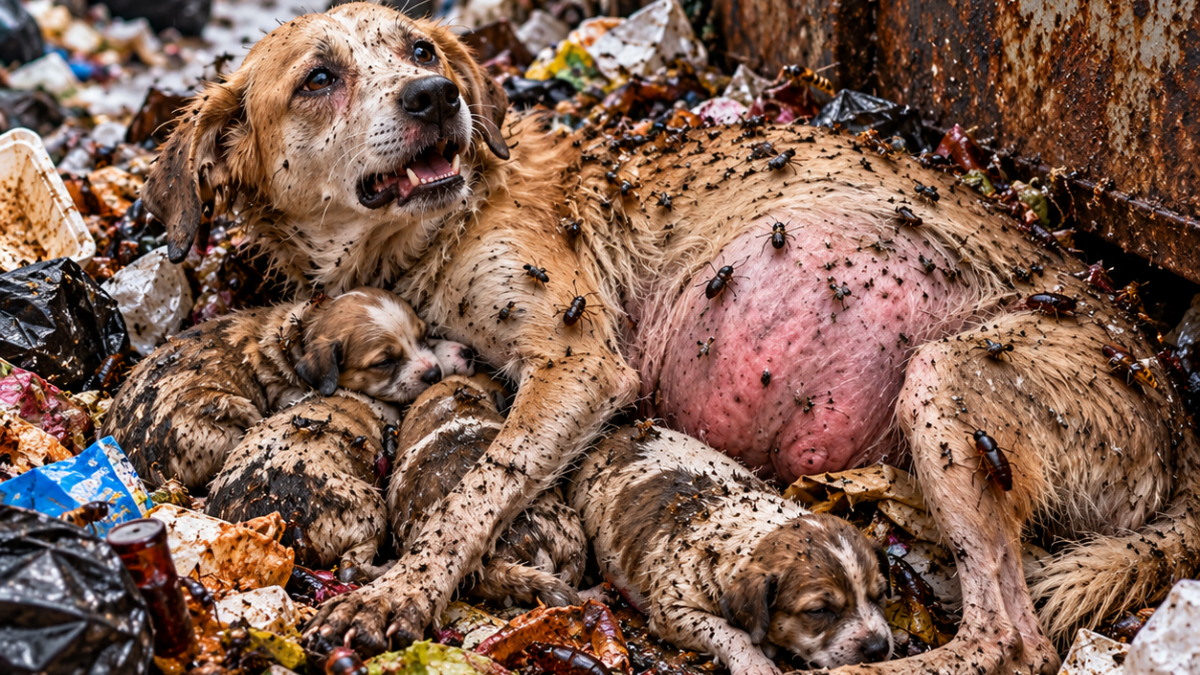
The first time I saw her, she was lying against a filthy dumpster with a belly full of unborn puppies, flies circling her exhausted body while cars passed twenty yards away as if nothing living were suffering there.
She tried to stand when I approached, but her legs trembled so badly that she sank back onto the trash-stained pavement, and that was when I realized this wasn’t simply a stray dog looking for food—this was a mother running out of strength before her babies had even entered the world.
Then she lifted her head, looked straight at me with the most defeated expression I had ever seen on an animal, and before I could touch her, I noticed something beneath her tail that told me we might have arrived far later than I thought.
I volunteer with a small rescue outside Louisville, and that afternoon I had been driving home after picking up donated dog food when my phone rang.
A woman named Teresa had called our emergency number.
“There’s a pregnant dog behind the grocery store,” she said. “She’s been there since morning.”
“Is she walking?”
“Barely.”
“Any bleeding?”
“I don’t know. She won’t let me get close.”
I changed direction immediately.
The dumpster sat behind a strip mall, surrounded by broken cardboard, spoiled food, plastic bags, and the sweet rotten smell of garbage baking in summer heat.
The dog was exactly where Teresa said.
Tan coat.
White chest.
Swollen belly.
Too thin everywhere else.
Her ribs showed above an abdomen so large it seemed to belong to another body.
I parked several yards away.
“Hey, mama.”
Her eyes opened.
She did not bark.
Did not growl.
She only watched.
I crouched instead of walking directly toward her.
Teresa stood behind me.
“I brought water.”
“Did she drink?”
“A little.”
“What about food?”
“She sniffed it.”
That worried me.
Pregnant dogs should be hungry unless stress, illness, heat, or labor has taken over.
I placed a bowl several feet from her.
She looked at it.
Then at me.
“Come on, sweetheart.”
Nothing.
I moved closer.
Her body tensed.
I stopped.
“Okay. Your rules.”
For ten minutes, I did almost nothing.
That is sometimes the hardest part of rescue.
People want action.
Grab the dog.
Lift the dog.
Save the dog.
But frightened animals do not understand our intentions, and fear can turn help into another threat.
Eventually she sniffed my fingers.
Her nose was dry and warm.
When I touched the side of her neck, she flinched but did not move away.
Teresa whispered, “Can you get her out?”
“I think so.”
I slid a towel beneath her front end.
That was when she tried to stand.
Her legs shook violently.
She took one step.
Then collapsed against me.
“Oh, God.”
I caught her shoulder.
Her head rested against my chest.
She was lighter than she should have been.
Under the weight of those puppies, there was almost nothing left of her.
“We need the vet now.”
Teresa helped clear the back of my SUV.
We used blankets to lift the dog carefully.
As we moved her, I saw a thin string of discharge beneath her tail.
My stomach tightened.
Teresa saw my face.
“What?”
“She may be close.”
“To having them?”
“Maybe.”
The dog panted rapidly during the entire drive.
I kept one hand near her while Teresa drove my SUV and I sat in the back.
“Stay with me.”
She looked at me.
I don’t know whether animals understand promises.
But I made one anyway.
“You are not having those puppies beside a dumpster.”
At the emergency clinic, two technicians met us with a stretcher.
The veterinarian examined her immediately.
Temperature.
Heart rate.
Hydration.
Bloodwork.
Then he ran the ultrasound probe over her swollen abdomen.
Dark shapes appeared across the screen.
Puppies.
More than one.
More than three.
I stopped counting.
The veterinarian watched the monitor without speaking.
“Are they alive?”
He nodded.
“I’m seeing heartbeats.”
I exhaled for what felt like the first time in an hour.
“Is she okay?”
“She’s exhausted and dehydrated. She’s underweight. We need fluids and monitoring.”
Then he shifted the probe.
His expression changed.
“How close is she?”
He looked at the screen again.
Then at the clock.
“Closer than I’d like.”
“What does that mean?”
He turned toward me.
“It means I don’t think you’re taking her anywhere tonight.”
PART 2
I stared at him.
“She’s in labor?”
“Not active labor yet, but she’s very close. Her body is preparing.”
“How close?”
“I can’t give you an exact hour.”
He glanced toward the dog.
“She’s already stressed, depleted, and dehydrated. Moving her again would gain us nothing.”
The dog lay on a thick blanket beneath the exam table.
Her breathing was fast.
The technicians had already started fluids.
One of them had cleaned the worst of the dirt from her legs and belly.
The difference was small.
But seeing clean fur beneath the grime made her look suddenly less like a piece of the alley and more like somebody’s dog.
I crouched beside her.
“We need a name.”
The technician smiled.
“Already?”
“I can’t keep calling her ‘the pregnant dog behind the dumpster.’”
Teresa, who had followed us inside, stood near the door.
“What about Hope?”
I shook my head.
“Too much pressure.”
The veterinarian laughed quietly.
Teresa thought.
“June?”
It was June.
Simple.
Normal.
Exactly the kind of name I wanted.
I touched the dog’s cheek.
“June?”
Her eyes moved toward me.
“Okay. June.”
The name stayed.
For the next several hours, our entire world became a small treatment room.
June rested.
Drank a little.
Refused food.
Panting came and went.
The veterinary team monitored the puppies.
Heartbeats remained present.
That was the good news.
The harder news was that June was in poor physical condition for what her body was about to attempt.
“How thin is too thin?” I asked.
The vet looked at her.
“She’s thin enough that I’m concerned.”
“Could she deliver naturally?”
“Possibly.”
“That doesn’t sound confident.”
“It isn’t supposed to.”
He explained the problem carefully.
Pregnancy demands enormous energy.
Labor demands more.
Nursing demands even more after that.
June had been surviving on scraps.
We did not know for how long.
Her body had been feeding growing puppies while receiving almost nothing reliable in return.
“You can correct dehydration,” I said.
“Yes.”
“But not nutrition overnight.”
“Exactly.”
I looked at the ultrasound monitor.
“How many?”
“We’re estimating seven, maybe eight. Ultrasound isn’t ideal for exact fetal count.”
Eight.
I thought about the dumpster.
Eight little bodies possibly beginning life against garbage bags and insects.
“What if labor goes wrong?”
“We intervene.”
“C-section?”
“If medically necessary.”
“Is she strong enough?”
The veterinarian paused.
“That would carry risk.”
Everything carried risk.
Waiting.
Surgery.
Labor.
Doing nothing.
There are rescue cases where the answer becomes obvious the moment the animal arrives.
Broken leg? Stabilize it.
Infection? Treat it.
Starvation? Refeed carefully.
June’s problem was more complicated because her body was not fighting only for itself.
It was preparing to bring several new lives into the world while barely holding enough strength for one.
By late evening, the clinic had dimmed.
Most routine appointments ended.
The emergency side remained active.
I should have gone home.
One of the technicians said, “We’ll call you.”
I nodded.
Then remained sitting.
She smiled.
“You aren’t leaving, are you?”
“No.”
“I figured.”
Teresa eventually went home after making me promise to update her.
Before leaving, she knelt near June.
“You picked the right parking lot today.”
June was too tired to respond.
I sat in a chair beside her kennel.
At 11:18 p.m., she began nesting.
At least, she tried.
She scratched weakly at the blankets.
Turned.
Lay down.
Stood again.
Panted.
I called for the technician.
“Is this it?”
She watched June.
“Could be starting.”
My stomach tightened.
June looked at me.
I reached through the kennel door and rested my fingers near her paw.
“Okay, mama.”
Her paw moved until it touched my hand.
The first puppy arrived just after midnight.
There was no dramatic announcement.
June strained.
The technician moved closer.
Then a tiny wet body appeared.
For one terrible second, the puppy did not move.
My heart stopped.
Then the technician cleared the airway.
The puppy squeaked.
June lifted her head immediately.
Something changed in her eyes.
Exhaustion remained.
Fear remained.
But instinct cut through both.
She began licking the puppy.
“Good girl,” I whispered.
The tiny pup squirmed toward her belly.
I laughed.
Then cried.
I didn’t realize I was crying until the technician handed me tissues.
“One.”
“How many more?”
“As many as she’s carrying.”
“That was not reassuring.”
The second puppy came thirty-eight minutes later.
Then the third.
June became more exhausted with each one.
We offered water.
She took only a little.
The fourth puppy required more help.
June strained repeatedly without progress.
The veterinarian came in.
He checked her.
Monitored.
Waited.
I stood uselessly against the wall.
“Is something wrong?”
“Maybe not yet.”
Yet.
I hated that word.
Another contraction.
Nothing.
June whimpered.
I had not heard her make that sound before.
The veterinarian looked at the clock.
Then at the monitor.
“Come on, girl.”
June pushed again.
A puppy appeared.
The technician assisted.
Seconds felt like minutes.
Then the puppy was free.
Weak.
Too quiet.
The team worked immediately.
Rubbing.
Clearing fluid.
Stimulating.
June tried to lift her head.
I stood beside her.
“You stay here.”
She ignored me.
Her eyes followed the puppy.
Then came a squeak.
Tiny.
Thin.
But alive.
June dropped her head against the blanket.
“Four,” I whispered.
The vet looked at me.
“We’re not done.”
I knew.
But June’s exhaustion was becoming obvious.
The fifth puppy arrived naturally.
The sixth followed faster.
Then everything stopped.
June lay panting.
The ultrasound had suggested more.
“How long between puppies is normal?” I asked.
“It varies.”
“How long is too long?”
“It depends on contractions, fetal position, maternal condition, fetal heart rates.”
I stared at him.
“You veterinarians hate simple answers.”
“Bodies hate simple rules.”
Another hour passed.
No puppy.
June’s contractions weakened.
The veterinarian checked heartbeats.
His face became serious.
“What?”
“One fetal heart rate is lower than I want.”
My stomach dropped.
“What do we do?”
“We give her a little more time, but not much.”
June lifted her head.
Her eyes found mine.
I had known her for less than twelve hours.
Still, the thought of losing her felt unbearable.
The vet returned to the monitor.
“Come on, June.”
Another contraction.
Weak.
Then another.
Nothing.
Finally he stood.
“We’re intervening.”
“Surgery?”
“We need to.”
My mouth went dry.
“You said surgery was risky.”
“It is.”
“What about waiting?”
“At this point, I believe waiting is riskier.”
That was the entire decision.
Not safe versus dangerous.
Dangerous versus worse.
I bent beside June.
The technicians began moving quickly.
“Hey.”
June panted.
“You already did six.”
Her eyes remained on me.
“That’s enough. Let them help you with the rest.”
The team wheeled her toward surgery.
The six puppies remained in a warmed area under staff supervision.
Tiny bodies.
Tiny noises.
Their mother disappeared through double doors.
And suddenly the room felt colder.
I sat beside six newborn puppies and waited to find out whether they would still have a mother when morning came.
The surgery took less time than it felt.
Time behaves badly in waiting rooms.
Twenty minutes becomes an hour.
A phone vibrating makes your heart jump.
Footsteps become news before anybody speaks.
When the veterinarian finally came through the door, I stood.
“June?”
“She’s alive.”
My knees almost gave.
“And the puppies?”
“Two more.”
“Alive?”
“One is strong.”
He paused.
“The other needed significant support, but we have a heartbeat.”
Eight.
The estimate had been right.
Eight puppies.
Eight lives that had been hours away from beginning beside a dumpster.
“What happened?”
“Uterine inertia. She was exhausted. She didn’t have enough strength left for effective labor.”
I looked through the surgery doors.
“So if she’d been outside…”
The veterinarian did not answer.
He didn’t need to.
June had been surviving beside garbage with almost no reserve.
Without help, labor might have become the final demand her body could not meet.
I thought of Teresa’s phone call.
There’s a pregnant dog behind the grocery store.
Such an ordinary sentence.
The kind people hear and tell themselves someone else will handle.
Someone else.
Someone else.
Someone else.
Until there is nobody.
“What happens now?”
“Recovery.”
“For June?”
“For all nine of them.”
Nine.
June plus eight.
I had arrived planning to help one pregnant dog.
Apparently rescue mathematics had other ideas.
The weakest puppy remained under close monitoring.
He was smaller than some of the others.
A male with a white patch on his chest.
The technician temporarily marked him so we could track feeding and weight.
I called him Eight.
“Creative,” she said.
“I’m exhausted.”
“Fair.”
June woke slowly from anesthesia.
The moment she became alert enough, she started searching.
Not standing.
She could barely lift her head.
But her nose moved.
Her ears shifted toward puppy sounds.
“We’ll bring them once she’s stable enough,” the technician said.
June whined.
“I know, sweetheart.”
Several hours later, they placed the puppies beside her.
June’s entire body softened.
I watched eight newborns search clumsily for milk.
One squeaked.
Another crawled over a sibling.
June lowered her head.
For the first time since I found her, she looked peaceful.
Not healthy.
Not recovered.
Peaceful.
There is a difference.
Her body still showed every sign of neglect.
Hip bones.
Ribs.
Raw patches from insects and dirt.
But she was on clean bedding.
Air-conditioning instead of heat.
Fresh water.
Medical care.
And her babies were alive.
I sent Teresa a photograph.
Her reply arrived immediately.
“All of them?”
“All eight.”
Then:
“And mama?”
“Still with us.”
Teresa called me.
She was crying before I answered.
“I kept thinking about her all night.”
“So did I.”
“Can I come see them?”
“Not yet. Let her rest.”
“Of course.”
She became quiet.
Then said, “What if I had just kept driving?”
I knew what she meant.
“What if I had assumed somebody else would call?”
“Don’t do that to yourself.”
“But—”
“You called.”
“That’s what matters.”
I wish I could say the rescue became easy after that.
It didn’t.
Birth was only the first crisis.
June needed nutrition.
Careful nutrition.
You cannot simply dump unlimited high-calorie food into a severely underweight dog and assume more is better.
The veterinary team made a feeding plan.
Small, frequent meals.
High-quality food.
Supplements as appropriate.
Constant water.
Monitor stools.
Monitor temperature.
Monitor incision.
Monitor milk production.
And weigh the puppies.
Every day.
Then twice daily because I became neurotic.
The smallest puppy—Eight—lost weight initially.
That frightened all of us.
The veterinarian said, “We may need supplemental feeding.”
“What does that involve?”
“You’re about to become very familiar with nighttime alarms.”
He was right.
June and the puppies moved into one of our experienced foster homes five days later.
Mine.
That part had not been planned.
Our normal neonatal foster, Carol, was already caring for another litter.
Two other homes had resident dogs that would make June’s stress worse.
I had a spare bedroom.
So my spare bedroom became a maternity ward.
Plastic flooring cover.
Whelping box.
Washable blankets.
Scale.
Thermometer.
Food.
More laundry than I had believed physically possible.
June entered my house cautiously.
The puppies arrived in a separate secure box.
I opened the door to the room.
June sniffed.
Clean blankets.
Water.
Food.
Quiet.
No insects.
No traffic.
No garbage.
She walked to the whelping box.
Smelled each puppy.
Then stepped inside.
She circled once.
Lay down.
Exhaled.
I sat in the doorway.
“You like this better than the dumpster?”
June closed her eyes.
I took that as yes.
The first night, I slept on the floor.
Not because she needed me to.
Because I didn’t trust myself not to check every thirty seconds.
At 1:00 a.m., all eight puppies were breathing.
At 1:17, still breathing.
At 1:42, I checked again.
June opened one eye.
“You’re judging me.”
She closed it.
At 2:10, Puppy Eight failed to latch.
I panicked.
I warmed the supplemental formula exactly as instructed.
Measured carefully.
Followed the veterinary instructions.
Tiny amount.
Slowly.
He swallowed.
I exhaled.
At 3:15, he latched.
I nearly celebrated.
By morning, I looked like I had been awake for a week.
June looked better than I did.
That felt unfair.
The next two weeks revolved around weight charts.
Puppy One.
Two.
Three.
Four.
Five.
Six.
Seven.
Eight.
Eventually they received temporary names because numbers became impossible once their personalities appeared.
The largest male became Moose because he shoved everyone away from milk.
A little brown female became Penny.
The loudest became Siren.
The smallest remained Eight for so long that the name stuck.
June ate constantly.
At first, she would finish every bowl and then search the floor.
Not casual hunger.
Scarcity.
She ate like the food might disappear.
I started placing meals on schedule.
Same times.
Same bowl.
Same room.
Gradually, she learned something she may never have known on the street.
Another meal would come.
One afternoon she ate half her food and walked away.
I stared at the bowl.
“Are you sick?”
I checked her temperature.
Normal.
Called the vet.
“She left food.”
There was a pause.
“How much?”
“Half.”
“Any vomiting?”
“No.”
“Lethargy?”
“No.”
“Puppies nursing?”
“Yes.”
“Maybe she’s full.”
The concept offended me.
“She’s never full.”
“Maybe now she is.”
I looked at June.
She was asleep beside eight nursing puppies.
Full.
Safe.
Sleeping.
I sat down and cried over half a bowl of kibble.
Rescue makes people emotional about strange things.
June’s skin improved.
The raw patches healed.
Her coat gained shine.
Her hips remained visible for weeks, but muscle slowly returned.
And something else changed.
Her face.
The dog beside the dumpster had watched everything with exhausted suspicion.
The foster-home June began greeting me.
At first, only her eyes followed.
Then her tail.
One morning, I opened the bedroom door and her tail thumped three times.
“Good morning.”
Thump.
“You realize I’m bringing breakfast.”
More thumping.
“Love is conditional. Understood.”
The puppies opened their eyes.
That changed the room overnight.
Suddenly eight potatoes became eight tiny criminals.
They learned to crawl.
Then walk.
Then fall.
Then bite.
Everything.
Blankets.
My shoelaces.
Each other.
June’s ears.
The edge of the whelping box.
At four weeks, the room sounded like a small riot.
I sat inside one afternoon while Moose attacked my sock.
Siren barked at absolutely nothing.
Penny attempted to climb over June’s back.
Eight sat in the food dish.
I called Teresa.
“This is your fault.”
She laughed.
“What?”
“You made the phone call.”
“You’re welcome.”
“There are eight monsters in my house.”
“Send pictures.”
“No.”
I sent twenty-three.
Teresa visited after the veterinarian approved limited contact.
June remembered her.
I knew it immediately.
Teresa entered quietly.
June stood.
Sniffed.
Tail wag.
Teresa crouched.
“Oh, mama.”
June walked to her.
Pressed her head against Teresa’s chest.
Teresa started crying.
“I’m the one who saw her,” she whispered. “But you’re the one who saved her.”
“No.”
I shook my head.
“You stopped.”
That mattered.
There is a tendency in rescue stories to focus on whoever carries the animal away.
But most rescues start earlier.
Someone notices.
Someone refuses to look away.
Someone calls.
Without Teresa, June might never have reached my SUV.
Without the vet team, she might not have survived labor.
Without foster support, the puppies might not have thrived.
Rescue is rarely one hero.
It is usually a chain of people who each refuse to be the broken link.
At six weeks, the puppies received their first major veterinary checks.
Everyone was growing.
Even Eight.
Especially Eight.
He had transformed from the puppy we feared losing into the one most likely to start trouble.
The technician held him.
“This is your weak one?”
“Formerly weak.”
Eight bit her badge.
“Clearly.”
June watched the entire examination carefully.
Not aggressive.
Alert.
When one puppy squealed during handling, she stood.
I touched her shoulder.
“It’s okay.”
She looked at me.
Then sat.
Trust.
That word sounds dramatic.
Usually it looks boring.
A dog sitting instead of panicking.
A dog allowing someone to handle her puppies.
A dog eating without guarding.
A dog sleeping while a door opens.
Small behavior.
Huge meaning.
Once the puppies were weaned, we scheduled June’s spay after she had recovered enough physically.
That was another important step.
No more litters.
No more carrying puppies while starving.
No more body giving what it did not have.
After surgery, June came home wearing a recovery suit.
She hated it.
I thought she looked adorable.
“You look ridiculous.”
June stared.
“I’m sorry.”
She turned away.
The betrayal was obvious.
When the puppies reached adoption age, applications arrived.
Lots of them.
Puppies are popular.
Pregnant street mothers are not.
That reality hurt.
People wanted Moose.
Penny.
Eight.
The cute ones.
The tiny ones.
The clean, healthy puppies who had never known the dumpster.
Far fewer asked about June.
I shouldn’t have been surprised.
I was.
One adopter came to meet Penny and barely looked at June.
Another family said:
“Oh, is that the mom?”
As though June were part of the furniture surrounding the puppy they wanted.
I became defensive.
Probably too defensive.
Our adoption coordinator, Leah, pulled me aside.
“You’re glaring at people.”
“I am not.”
“You absolutely are.”
“They ignore her.”
“They came for puppies.”
“She made the puppies.”
“They are aware.”
“They should show respect.”
Leah laughed.
“You cannot require ceremonial respect for canine motherhood.”
“I can try.”
She pointed toward June.
“Your job is to find her the right home, not punish everyone who wants a puppy.”
Again, annoyingly reasonable.
We screened applications carefully.
The puppies left one by one.
Moose went to a family with two teenagers.
Penny went to a retired couple who had recently lost an older dog.
Siren went to a woman who laughed when we warned her the puppy was vocal.
“I have three children. She’ll fit.”
Eight received more applications than all the others.
Of course.
The near-death puppy became absurdly handsome.
A young couple adopted him after several meetings.
Before they left, I held him against my chest.
“You were supposed to be the fragile one.”
Eight licked my nose.
June smelled him.
He climbed over her front leg.
Then he left.
After each adoption, June checked the room.
I worried.
Was she searching?
Did she understand?
We moved gradually.
No abrupt emptying of the litter.
Still, every departure changed the sound of the house.
Eight puppies.
Seven.
Six.
Five.
Three.
One.
Then none.
The first night without puppies, June stood in the empty room.
I had removed the whelping box but left one bed.
She smelled the floor.
Walked to the corners.
Then looked at me.
My heart broke.
I sat down.
“They’re okay.”
Of course she did not understand the words.
Maybe she understood my tone.
June walked toward me.
Then did something she had never done before.
She climbed partly into my lap.
June was not small.
My legs disappeared.
I wrapped my arms around her.
“You did good.”
Her head rested beneath my chin.
“You did really good.”
We stayed like that for a long time.
Then a week later, June discovered the couch.
This became a crisis entirely of her own making.
I had gone into the kitchen.
When I returned, she was standing with her front paws on the cushion.
“June.”
She froze.
“You know the rule.”
We had never established a couch rule.
June looked at me.
Then climbed all the way up.
She circled twice.
Lay down.
I stared.
“You just gave birth to eight puppies and survived the street, so you think laws don’t apply to you?”
Tail wag.
Apparently yes.
I sat beside her.
That became the rule.
June was allowed on the couch.
Her adoption profile went live.
We used photographs that showed who she had become.
Healthy coat.
Bright eyes.
Soft expression.
One picture of her upside down on the couch.
No dumpster images first.
I insisted.
The worst day of her life should not be the only way people met her.
The profile said she was affectionate, calm, food-motivated, house-trained with routine, and happiest near people she trusted.
Applications remained slow.
Then came one from a woman named Margaret.
Fifty-eight.
Widowed.
Worked from home doing bookkeeping.
No other pets.
Fenced backyard.
She wrote:
“I am not looking for a puppy. I want the mother.”
I read that sentence four times.
Leah looked over my shoulder.
“You’re crying.”
“No.”
“You are.”
“Allergies.”
“In November?”
“Severe.”
Margaret came to meet June.
I prepared myself to dislike her.
That was unfair.
June had become mine emotionally even though I knew she was a foster.
Margaret entered the room and did not immediately kneel.
Good.
She sat.
June smelled her.
Margaret looked at me.
“Should I touch her?”
“Let her decide.”
“Okay.”
No argument.
June approached.
Sniffed.
Walked away.
Margaret smiled.
“She’s thinking.”
I liked that.
After ten minutes, June returned.
Margaret offered her hand low.
June sniffed.
Then pressed her forehead against Margaret’s knee.
My stomach dropped.
Traitor.
Margaret scratched her gently.
“What does she like?”
“Food.”
“That’s relatable.”
“Soft blankets.”
“Also relatable.”
“Quiet evenings.”
Margaret smiled.
“I think we’re compatible.”
I asked too many questions.
Leah later told me I had conducted an interrogation.
“What happens if she has an accident?”
“Clean it.”
“What if she doesn’t eat the first day?”
“Call you if I’m concerned.”
“What if she hides?”
“Let her hide safely.”
“What if she needs expensive veterinary care someday?”
Margaret paused.
“Then I pay for veterinary care.”
Simple.
No heroic speech.
No promises that sounded too perfect.
Just responsibility.
The home visit went well.
The yard was secure.
The house quiet.
June’s future bed sat near Margaret’s desk.
There was another bed in the bedroom.
“Two?” I asked.
“I like options.”
I knew immediately she was dangerous.
That is exactly how dog people begin.
June’s transition happened slowly.
One day visit.
Then another.
An afternoon.
Then an overnight trial.
Margaret sent updates.
“June ate dinner.”
“June stole my chair.”
“June barked once at the mail carrier, then looked surprised by her own voice.”
The overnight message arrived at 10:43 p.m.
“She is asleep beside my bed.”
Photo attached.
June lay curled on a thick blanket.
I stared at the screen.
The same dog I had found sleeping beside garbage was now sleeping beside someone who had bought her two beds before the adoption was even final.
I cried.
This time I didn’t blame allergies.
The adoption became official the following week.
Margaret arrived with a new collar.
Blue.
Simple.
A small tag read:
JUNE
MARGARET’S DOG
I laughed.
“Very subtle.”
“I wanted the legal status clear.”
June wagged.
I knelt.
“You understand you’re firing me?”
June licked my chin.
Margaret smiled.
“I think you’ll survive.”
“I’m not sure.”
We loaded June’s bed.
Food.
Medical paperwork.
Favorite blanket.
The ridiculous stuffed duck she had recently become obsessed with.
June jumped into Margaret’s car.
Then turned.
She looked at me through the open door.
I touched her face.
“You know what?”
Tail wag.
“The dumpster was never your home.”
June sniffed my hand.
“This is.”
Margaret drove away.
The foster room felt enormous afterward.
I sat on the floor for a while.
No puppies.
No June.
No laundry pile.
No food bowls.
Quiet.
But unlike the night I found her, quiet no longer meant danger.
It meant everyone was where they were supposed to be.
Updates came regularly.
June became deeply attached to Margaret.
She followed her from room to room.
Slept beside the desk while she worked.
Demanded breakfast at exactly 7:00.
Developed a personal hatred of squirrels.
Loved car rides.
Hated rain.
The dog who once lay in filth apparently considered wet grass beneath her feet unacceptable.
Margaret sent a video.
June stood at the back door while rain fell.
Margaret said, “Go potty.”
June looked outside.
Then at Margaret.
Then sat.
I laughed for almost a minute.
A year earlier, rain would have been the least of June’s problems.
Now she had standards.
Good.
Let her.
Puppy updates arrived too.
Moose became enormous.
Penny slept under her adopter’s dining table every night.
Siren remained appropriately loud.
Eight became a healthy, energetic young dog who had absolutely no idea anyone once doubted he would survive his first night.
Teresa kept asking about all of them.
Eventually we organized a small reunion in a fenced private field.
Not all eight could come, but five did.
June arrived with Margaret.
The moment she stepped out of the car, she looked nothing like the dog behind the dumpster.
Healthy weight.
Shiny coat.
Blue collar.
Tail high.
The grown puppies were chaos.
June tolerated approximately three minutes of their enthusiasm before giving them the expression every exhausted mother eventually learns.
Enough.
We laughed.
Eight ran past.
Moose tried to initiate play.
June walked directly to Margaret and leaned against her leg.
Margaret looked down.
“Had enough parenting?”
June stared at the puppies.
Then turned away.
Absolutely.
Teresa stood beside me.
“She looks incredible.”
“She is.”
Teresa became quiet.
“I almost didn’t call that day.”
I looked at her.
“What?”
“I was late picking up my son. I remember thinking somebody else would probably notice.”
“But you called.”
“Yes.”
She watched June.
“I keep thinking how close I came to not doing it.”
I understood.
But guilt was not the right ending.
“You noticed.”
She nodded.
“You acted.”
“That was enough?”
I looked at the field.
Five healthy young dogs running.
June beside Margaret.
“It started everything.”
Years passed.
June aged beautifully.
A little gray appeared around her muzzle.
She gained exactly enough weight that her veterinarian eventually said the sentence none of us expected during those first days.
“She could lose a couple pounds.”
Margaret called me immediately.
“She called June fat.”
“What did you do?”
“Defended her honor.”
“Did the vet give you a diet plan?”
“Yes.”
“So you’re following it.”
Margaret sighed.
“Probably.”
June’s life became wonderfully ordinary.
Annual exams.
Walks.
Couch naps.
Squirrel surveillance.
Rain negotiations.
Nothing viral.
Nothing dramatic.
Exactly what I wanted.
One afternoon, Margaret brought June to a rescue fundraising event.
A large photograph from her first rescue day hung on a display board.
Dumpster.
Trash.
Swollen belly.
Exhausted eyes.
Beside it was a current photograph.
June on Margaret’s couch wearing a ridiculous birthday hat.
People stopped.
Stared.
Some asked:
“Is that really the same dog?”
Margaret answered every time.
“Yes.”
Eventually she moved the birthday photograph slightly forward so it covered part of the dumpster image.
I noticed.
“Why’d you do that?”
She shrugged.
“I’m tired of strangers meeting her through the worst day of her life.”
I smiled.
“I said the same thing during her adoption profile.”
“Then we agree.”
June sat between us.
A family walked past.
A little girl stopped.
“Can I pet her?”
Margaret looked at June.
June stepped toward the child.
“Yes.”
The girl stroked June’s back.
June leaned against her.
No fear.
No trash.
No insects.
No desperate pregnancy.
Just an older dog enjoying attention.
That image stayed with me longer than the rescue photograph.
The original story people remembered was about a pregnant dog abandoned beside a dumpster.
But that was only the beginning.
June’s real life happened afterward.
The nights she slept safely.
The food she learned would always return.
The puppies she raised.
The couch she claimed.
The woman who chose her not because she produced cute puppies, but because she wanted the mother.
That last part mattered to me.
People love beginnings.
Puppies.
Fresh starts.
Young animals.
June had already lived enough life to arrive carrying scars and history.
Margaret chose all of it.
Not pity.
Commitment.
When June eventually reached her senior years, her arthritis worsened.
Margaret added rugs.
Then a ramp.
Pain medication.
Shorter walks.
More naps.
June became increasingly spoiled.
I approved.
One winter afternoon, Margaret called.
Her voice sounded different.
“June’s at the vet.”
My stomach tightened.
“What happened?”
“She collapsed this morning.”
I sat down.
“How bad?”
“They’re running tests.”
“I’m coming.”
“You don’t have to.”
“I know.”
I drove anyway.
June lay on a blanket in the clinic when I arrived.
Older.
Gray.
Tired.
Margaret sat beside her.
June saw me.
Her tail moved once.
That tiny movement transported me years backward.
Dumpster.
Heat.
Swollen belly.
Her head against my chest.
I crouched.
“Hey, mama.”
Margaret laughed through tears.
“You still call her that.”
“Always.”
The veterinarian eventually explained that June’s aging body was dealing with several serious problems.
No simple fix.
We treated what could be treated.
She improved enough to go home.
For several months, she had good days.
Many.
We did not count them aggressively.
June did not know she was living on borrowed time.
She knew breakfast.
Margaret.
Sunlight.
Blankets.
Squirrels.
That was enough.
Then came a morning when Margaret called again.
“She won’t stand.”
I knew.
I hated knowing.
We met at the house.
June lay on her favorite bed beside Margaret’s desk.
The stuffed duck, replaced several times over the years, sat nearby.
Margaret touched June’s head.
“She’s tired.”
I sat on the other side.
“So are you.”
Margaret nodded.
We had discussed quality of life with the veterinarian.
The signs were clear.
Love was no longer measured by how desperately we could keep June breathing.
It was measured by whether we could protect her from needless suffering.
The veterinarian came to the house.
June stayed on her bed.
No sterile room.
No stress.
Margaret held her.
I touched one paw.
Before the medication was given, Margaret whispered:
“You’re safe.”
My throat closed.
Those were the words every rescuer wants an abandoned dog eventually to understand.
June’s eyes remained on Margaret.
Her breathing softened.
And eventually, after a life that had once seemed likely to end beside a dumpster, June died in a quiet room with clean blankets, a full stomach, and two people touching her gently.
Nothing about losing her felt fair.
But nothing about her final moment felt abandoned.
That distinction mattered.
Afterward, Margaret kept June’s blue collar.
I kept one photograph.
Not the dumpster.
Not the newborn puppies.
The photograph from the reunion.
June standing beside Margaret while her grown puppies blurred in motion behind her.
Her face looked slightly annoyed.
Completely healthy.
Completely safe.
Completely herself.
Teresa received a copy too.
Months later, she called.
“There’s another dog.”
I sat upright.
“Where?”
“Different place. Not pregnant. But skinny.”
“Send location.”
She laughed softly.
“You trained me.”
“No.”
I grabbed my keys.
“June did.”
That rescue ended differently.
They all do.
But Teresa noticed.
Again.
That was June’s quiet legacy.
Not a slogan.
Not a social-media post.
A woman who almost kept driving once now stopped every time something looked wrong.
Our rescue also established a small maternity foster program after June.
We realized how unprepared many shelters and independent rescuers were for late-stage pregnant dogs.
We assembled kits.
Whelping supplies.
Scales.
Formula.
Heating equipment.
Emergency veterinary contacts.
Foster training.
We called it the June Project internally.
Margaret laughed when I told her.
“She would expect royalties.”
“She gets naming rights.”
“She would prefer snacks.”
Probably.
Over the following years, several pregnant dogs passed through the program.
Some delivered easily.
Some required medical help.
One had only two puppies.
Another had eleven.
Every time a nervous foster called at midnight and asked, “Is this normal?” I remembered sitting beside June as her first puppy arrived.
Every time a mother dog finally slept on clean blankets, I remembered that dumpster.
And every time puppies left for homes while their mother waited, I remembered insisting that June deserved to be seen as more than the animal who made them.
We began photographing mothers differently.
Not only nursing.
Not only beside puppies.
Playing.
Sleeping.
Looking at people.
Being dogs.
Their motherhood mattered.
It was not their entire identity.
Several mother dogs found homes because adopters came specifically asking for them.
“I don’t want a puppy,” one man said.
I smiled.
“Good answer.”
Years after June died, I drove past the grocery store where Teresa had found her.
The strip mall had changed.
One business closed.
Another opened.
The dumpster had been replaced.
For a second, I almost didn’t recognize the location.
I pulled into the parking lot.
Not because I expected anything.
Just memory.
I walked behind the building.
Clean pavement.
New metal dumpster.
No dog.
Good.
That was exactly what I wanted.
I stood where June had once been lying.
I tried to picture her there.
Strangely, it had become difficult.
The image that came first now was Margaret’s couch.
June upside down.
Gray muzzle.
One paw in the air.
Safe enough to sleep without watching every movement around her.
That pleased me.
The worst photograph had finally lost.
I had spent years telling June’s story whenever people asked about pregnant strays, fostering, or why stopping matters.
But over time, I became more careful with how I told it.
I stopped saying:
“She was helpless.”
June wasn’t helpless.
She had survived long enough to carry eight puppies almost to term while living on the street.
She was vulnerable.
Those are not the same thing.
I stopped saying:
“We saved nine lives.”
That made it sound too clean.
We helped.
Veterinarians helped.
Teresa helped.
Fosters helped.
Adopters helped.
June did the hardest physical work.
And I stopped ending the story at rescue.
Getting an animal off the street is not the whole victory.
Sometimes it is ten percent.
The real work begins after the dramatic photograph.
Medication.
Meals.
Laundry.
Behavior.
Appointments.
Midnight feedings.
Screening adopters.
Following up.
Growing old.
Staying.
June taught me that too.
The day we found her was visually heartbreaking.
But the most meaningful part of her life was everything ordinary that came after.
The bowl that filled every morning.
The door that remained open to the yard.
The person who returned home every evening.
The soft bed.
The ridiculous duck.
The fact that nobody ever put her outside and disappeared.
That is what rescue is supposed to build.
Not simply escape from suffering.
A life after it.
I still have one of June’s old foster blankets.
Margaret gave it back to me after June died.
It is faded now.
One corner has a hole.
Probably from one of the puppies.
Maybe Eight.
Maybe Moose.
I keep it in a cabinet with other rescue supplies.
Every few months, another frightened dog sleeps on it.
They do not know who June was.
They don’t need to.
It is just a blanket.
Clean.
Soft.
Warm.
But whenever I spread it inside a crate or place it beside a recovering dog, I remember the first time I wrapped June in a towel beside that dumpster.
I remember how little she weighed beneath the puppies.
How her legs collapsed.
How her head rested against me in the SUV.
How I promised:
“You are not having those puppies beside a dumpster.”
At the time, that was the biggest promise I thought I could make.
I was wrong.
The real promise lasted years.
She would eat tomorrow.
And the next day.
She would receive treatment.
Her puppies would be safe.
She would be more than their mother.
She would be chosen.
She would grow old.
And when the end eventually came, nobody would walk away because caring had become inconvenient.
That was the life waiting on the other side of the dumpster.
June could not see it that afternoon.
Neither could I.
All I saw was one exhausted pregnant dog surrounded by garbage and insects, looking up as if she had stopped expecting anything good from the people passing by.
Then one person noticed.
Another answered the phone.
A veterinarian opened the clinic door.
And a chain began.
Years later, the dumpster is gone.
June is gone.
Her puppies are old enough now that several have gray around their muzzles.
But the chain is still moving.
Teresa still stops.
Our fosters still answer midnight calls.
The June Project still keeps scales, blankets, formula, and clean bedding ready for the next mother who arrives with nowhere safe to rest.
And every time one of those dogs finally lowers her head onto a clean blanket and falls asleep because someone else has taken over the worrying for a while, I think of June.
Not beside the trash.
Not frightened.
Not starving.
I remember her on Margaret’s couch, refusing to go outside because it was raining.
That is how I choose to keep her.
A formerly homeless dog so completely convinced she belonged somewhere that she considered bad weather beneath her standards.
The first day I met her, she had nowhere safe to give birth.
By the end of her life, she had a favorite side of the couch.
There is no more satisfying distance I can imagine between two places.
The first time I saw her, she was lying beside a dumpster with her belly swollen from pregnancy, her coat soaked with grime, and flies circling the raw patches along her skin.
For several seconds, I honestly thought she was dead.
Cars moved through the grocery-store parking lot less than fifty yards away. Shopping carts rattled across the pavement. People carried bags to their trunks, shut doors, and drove off.
Yet behind the building, among torn garbage bags and broken cardboard, a heavily pregnant dog was stretched against the concrete as if she had simply run out of strength.
The woman who called our rescue was waiting when I arrived.
Her name was Teresa.
“I saw her this morning,” she said. “I thought somebody would come for her.”
“Did anyone?”
She shook her head.
“I came back after lunch. She hadn’t moved.”
I crouched several yards from the dog.
“Hey, mama.”
One eye opened.
That tiny movement relieved me more than it should have.
“She’s alive.”
Teresa swallowed.
“She tried to stand when I brought water.”
“Did she drink?”
“A little.”
There was a shallow plastic container beside the dumpster. The water inside was already dirty.
I poured fresh water into another bowl and pushed it toward her.
The dog watched me.
No growling.
No barking.
Almost no reaction at all.
That frightened me more than aggression would have.
A frightened dog can still have energy.
This dog looked empty.
Her belly was enormous, but everywhere else she was painfully thin. Her hip bones showed. I could count ribs along her sides. The hair around her lower back was patchy, and several areas of skin were red and irritated.
“Come on,” I whispered. “Let me help you.”
I moved closer.
She lifted her head.
Then tried to stand.
Her front legs straightened.
Her back legs trembled.
For half a second, she was upright.
Then her body folded.
I caught her against my knees.
“Oh, sweetheart.”
Her head landed against my chest.
She did not struggle.
Did not try to escape.
She simply stayed there breathing rapidly.
That was when I felt how little of her existed beneath the pregnancy.
She should have been much heavier.
The puppies were taking everything her body still had.
“We’re going to the clinic,” I told Teresa.
She nodded immediately.
We spread a blanket on the back of my SUV.
Lifting a pregnant dog requires care, especially when you do not know how close she is to labor, so we moved slowly.
When I slid one arm beneath her chest, I noticed discharge beneath her tail.
My stomach tightened.
“Teresa.”
“What?”
“She may be close to delivering.”
Her face changed.
“Here?”
“Not if I can help it.”
We got the dog into the SUV.
Teresa offered to drive while I sat in the back with her.
As soon as the vehicle started moving, the dog panted harder.
I rested one hand beside her neck.
“You’re okay.”
She looked at me.
I knew nothing about her.
No name.
No age.
No idea where she came from.
No idea whether she had ever lived in a home.
Maybe someone had owned her once.
Maybe she had slipped through a gate months earlier.
Maybe she had been deliberately abandoned after becoming pregnant.
I had no evidence for any of those possibilities.
The only thing I knew was what lay in front of me.
She was pregnant.
She was exhausted.
And if Teresa had not stopped, she might have tried to give birth beside that dumpster.
“You’re not doing that,” I whispered.
Her eyes remained on me.
“You’re not having those babies back there.”
The emergency clinic was expecting us.
Two technicians met us with a stretcher.
Within minutes, the dog was inside an exam room receiving fluids.
The veterinarian, Dr. Harris, examined her while I answered the only question I could answer honestly.
“Do you know anything about her history?”
“No.”
“Owner?”
“Unknown.”
“Previous pregnancies?”
“Unknown.”
“How long has she been stray?”
“No idea.”
He nodded.
Not impatiently.
Veterinarians who work with rescue animals hear “I don’t know” constantly.
He listened to her heart.
Checked her gums.
Temperature.
Hydration.
Then he gently examined her abdomen.
“She’s very depleted.”
“I can see that.”
“I mean physiologically. This pregnancy has taken a lot out of her.”
“Are the puppies alive?”
“We’ll check.”
The ultrasound machine came in.
The room became quiet.
Dr. Harris ran the probe over her abdomen.
Images appeared.
Small bodies.
Tiny movements.
Then the sound I had been desperate to hear.
Heartbeats.
More than one.
I let out a breath.
“How many?”
“Ultrasound isn’t ideal for exact counting.”
He moved the probe.
“Seven, maybe eight.”
“Eight?”
“Possibly.”
I looked at the dog.
“You were hiding an entire family in there?”
Her eyes were half closed.
Dr. Harris checked another heartbeat.
“Most appear viable right now.”
“Most?”
He looked at the screen.
“I’m cautious until they’re delivered.”
That was fair.
“What about her?”
“She needs fluids, nutrition, rest, and monitoring.”
“Can she go to foster tonight?”
He looked at me.
“No.”
The answer was immediate.
“She’s too close?”
“Yes.”
“How close?”
He checked her again.
“I don’t think she’s leaving this building before those puppies arrive.”
I sat beside her.
The clinic staff asked what we were calling her.
Teresa suggested Hope.
I shook my head.
“Too symbolic.”
She laughed softly.
“What about June?”
It was June.
I looked at the dog.
“June?”
One ear moved.
“Good enough.”
So she became June.
For the next several hours, her entire world changed.
Instead of hot concrete, she had clean blankets.
Instead of dirty water, she had a fresh bowl.
Instead of flies landing on her skin, technicians cleaned the irritated areas and examined them.
She received fluids.
Small amounts of easily digestible food were offered.
She sniffed but barely ate.
That concerned me.
Dr. Harris was less surprised.
“She may already be entering early labor.”
June began panting more heavily around ten that night.
At eleven, she scratched at the blankets.
Turned.
Lay down.
Stood.
Turned again.
The technician looked at me.
“Nesting.”
My stomach flipped.
“This is it?”
“Looks like we’re getting closer.”
I should have gone home.
Instead, I stayed in a chair beside her.
There are nights when rescue feels heroic from the outside.
This was not one of them.
Mostly, it was fluorescent lights, bad coffee, laundry, medical terms I kept asking people to repeat, and a frightened dog breathing beside me.
Around midnight, June began having stronger contractions.
I moved away so the veterinary team had room.
The first puppy came just after twelve.
For one second, there was no sound.
I stopped breathing.
Then a technician cleared fluid.
The puppy squeaked.
June’s head lifted immediately.
Exhaustion disappeared from her expression for one brief instant.
She began licking the newborn.
“That’s your baby,” I whispered.
The tiny puppy crawled toward her belly.
Something inside me broke open.
Less than twelve hours earlier, June had been lying in garbage.
Now her first puppy was nursing on clean bedding under veterinary supervision.
The second puppy arrived thirty-eight minutes later.
Then the third.
June did well at first.
Tired, but focused.
She cleaned each puppy.
Shifted her body carefully.
Allowed them to nurse.
By the fourth, the strain became obvious.
She pushed.
Nothing.
Another contraction.
Nothing.
June whined.
I stood.
“Is that normal?”
Dr. Harris checked her.
“We’re watching.”
That phrase became my enemy.
Watching.
Waiting.
Monitoring.
Every word meant there was nothing useful I could do.
June strained again.
A puppy finally appeared.
The technician assisted.
The little body was limp.
“Come on.”
Nobody answered me.
They were working.
Rubbing.
Clearing fluid.
Stimulating.
June tried to turn her head toward them.
Then a tiny squeak came.
I put my hand over my mouth.
“Alive?”
“Yes.”
The puppy was returned to June.
She licked it weakly.
The fifth arrived.
Then the sixth.
After that, June stopped progressing.
The room changed.
The relaxed voices became shorter.
More focused.
Dr. Harris checked the monitor.
“How many remain?”
“At least one. Probably two.”
June lay on her side, panting hard.
“What’s happening?”
“She’s exhausted.”
“Can she rest?”
“She can rest briefly, but we need to watch fetal heart rates.”
Another fifteen minutes.
Then twenty.
No puppy.
Dr. Harris checked again.
His expression tightened.
“What?”
“One fetal heart rate is dropping.”
I felt cold.
“What do we do?”
“We give her a short window.”
“And then?”
“If there’s still no effective labor, we go to surgery.”
My eyes moved to June.
“You said anesthesia was risky.”
“It is.”
“And surgery?”
“Also risky.”
“What about waiting?”
“At some point, waiting becomes more dangerous.”
Another contraction came.
Weak.
Nothing.
June looked at me.
I wish I could claim there was some clear communication in her eyes.
There wasn’t.
She was simply exhausted.
I moved closer.
“You already got six here.”
Her breathing remained rapid.
“Let them help with the rest.”
Dr. Harris made the decision minutes later.
“We’re going in.”
The technicians moved quickly.
June was transferred toward surgery.
The six newborn puppies were placed in a warmed area.
Their tiny cries followed her out of the room.
Then the doors closed.
I sat beside six puppies who had been alive for less than two hours and waited to learn whether their mother would come back.
That was probably the longest hour of my rescue work.
Eventually, Dr. Harris appeared.
I stood so fast my chair scraped the floor.
“June?”
“She’s alive.”
My knees weakened.
“And the puppies?”
“Two more.”
“Both?”
“One is strong. The other required more resuscitation, but we have a heartbeat.”
Eight.
Eight puppies.
“And June?”
“She’s stable for now.”
“What happened?”
“Uterine inertia. Her body simply didn’t have enough effective contraction left.”
I looked through the door toward recovery.
“If she’d still been outside…”
Dr. Harris didn’t answer.
There was no need.
June had already been running out of strength when I found her.
Labor required more than she had left.
Without medical intervention, we might have lost puppies.
We might have lost her.
Possibly both.
The smallest puppy struggled through the first night.
He was tiny enough that we monitored him constantly.
Someone marked his chart as Puppy Eight.
The name stuck because I was too exhausted to invent anything better.
June woke slowly.
As soon as she became aware enough to hear the puppies, she tried to lift her head.
“They’re here.”
She whined softly.
Once she was stable, the puppies were placed with her.
June sniffed them.
One.
Two.
Three.
Then all the others shifted together until the clean blanket seemed to move.
June lowered her head.
Her eyes closed.
That was the first moment I saw her truly rest.
Not collapse.
Rest.
There is a difference.
Five days later, June and the puppies were cleared to leave the hospital.
That created another problem.
Our experienced neonatal foster home was already full.
Another foster had dogs that would make June too anxious.
I had a spare bedroom.
That is how I ended up bringing nine dogs home.
Technically eight of them were the size of potatoes.
They compensated with noise.
I covered the spare-room floor.
Set up a large whelping area.
Bought washable blankets.
A scale.
Heating supplies.
Formula for emergencies.
More laundry detergent than I thought one person could use.
June entered the room slowly.
She inspected the blankets.
Water.
Food.
Then the puppies.
She stepped into the whelping area and lay down.
Her entire body relaxed.
I sat in the doorway.
“No dumpster.”
June closed her eyes.
The first weeks were exhausting.
The puppies needed daily weight tracking.
Puppy Eight needed supplemental feeding.
I set alarms throughout the night.
1:00 a.m.
2:30.
4:00.
Sometimes I woke before them because I imagined crying.
June watched me with increasing suspicion.
At two one morning, I leaned over the whelping box counting puppies.
“One, two, three…”
June opened one eye.
“…seven, eight.”
She closed it again.
“You think I’m crazy.”
No response.
“Fair.”
June ate like she believed every meal might be her last.
The first few days, she emptied the bowl almost immediately.
Then searched the floor.
I fed her according to the veterinary plan.
Frequent meals.
High-quality food.
Appropriate calories for nursing.
She gained slowly.
Too quickly would not have been healthy either.
Her skin began healing.
The raw areas dried.
Her coat changed.
At first dull and brittle.
Then softer.
Shinier.
The puppies transformed even faster.
Their eyes opened.
Then they started crawling.
Then walking.
Then committing crimes.
By four weeks, the spare room was chaos.
The largest male bullied his way toward every food dish.
I called him Moose.
A small female became Penny.
The loudest became Siren because she could produce an impossible amount of sound from such a tiny body.
Puppy Eight stayed Eight.
I considered changing it.
Nothing else fit.
The weak puppy who nearly didn’t survive became the most determined one in the litter.
He climbed first.
Escaped the puppy enclosure first.
Stole my shoelace first.
One afternoon I found him asleep inside June’s food bowl.
I took a photograph.
“You almost gave us a heart attack on your first night.”
Eight yawned.
“Ungrateful.”
June became a different dog too.
At first she existed almost entirely as a mother.
Nurse.
Clean.
Watch.
Sleep.
Repeat.
But as the puppies grew more independent, pieces of June began appearing.
She liked soft blankets.
She loved chicken.
She disliked the vacuum cleaner.
She hated being wet.
That last discovery made me laugh harder than it should have.
One rainy afternoon, I opened the back door.
June stopped.
She looked outside.
Then at me.
“Bathroom.”
She stepped backward.
“You lived beside a dumpster.”
June sat.
“In the rain.”
She remained seated.
“And now wet grass is unacceptable?”
Tail wag.
I laughed.
“Fine. Princess.”
We went out through the covered side yard.
Apparently street survival had not eliminated standards.
Teresa visited once the puppies were old enough and June was comfortable with more people.
The moment Teresa entered, June stared at her.
Teresa crouched.
“Do you remember me?”
June approached.
Slowly.
Then pushed her head against Teresa’s chest.
Teresa started crying.
“Oh, mama.”
June stayed.
Teresa looked at me.
“I keep thinking about that morning.”
“What part?”
“I almost didn’t stop.”
I knew where this was going.
“I was late.”
She rubbed June’s ears.
“I thought somebody else would notice.”
“But you did.”
“Eventually.”
“You came back.”
She nodded.
“If I hadn’t…”
“Don’t.”
She looked at me.
“You called.”
That mattered more than the almost.
Rescue stories are full of things that nearly went wrong.
Nearly does not save anyone.
Action does.
The puppies grew.
By eight weeks, all of them were healthy enough to begin their adoption process.
Applications arrived immediately.
Puppies always get attention.
Moose had twelve applications.
Penny had nine.
Eight had so many that our adoption coordinator stopped reading them to me individually.
June had two.
That bothered me more than it should have.
Leah, our adoption coordinator, noticed.
“You’re doing the face.”
“What face?”
“The judgmental foster face.”
“People keep asking for the puppies.”
“That’s generally how puppies work.”
“They barely look at June.”
“June is an adult dog.”
“She produced all of them.”
“That is not how adoption preference works.”
I folded my arms.
“She deserves better.”
“She deserves the right adopter. Not every adopter.”
She was right.
I still hated it.
One family came to meet Moose.
June was in the room.
The mother said, “Oh, is that the mom?”
“Yes.”
Then she immediately turned back to Moose.
I found myself staring at her.
Leah touched my elbow.
Later, in the hall, she whispered, “Stop.”
“I didn’t say anything.”
“Your face said several things.”
“She ignored June.”
“She came for Moose.”
“June made Moose.”
Leah stared.
“You want them to bow?”
“It would be respectful.”
She laughed.
“You need sleep.”
Maybe.
The puppies left gradually.
We did not want June’s entire litter disappearing in one day.
Moose went first.
Then Penny.
Then Siren.
Each family was screened carefully.
References.
Home situation.
Veterinary plans.
Expectations.
No impulse adoptions because a puppy photograph was cute.
Eight left near the end.
His adopters were a young couple who had met him twice.
Before they left, I held him.
He had become solid.
Heavy.
Healthy.
“You were supposed to be the fragile one.”
He bit my sleeve.
“Exactly.”
June sniffed him.
Eight climbed over her paw.
Then he went into the carrier.
The car left.
June stood at the door for several seconds.
My chest hurt.
“You did good.”
She looked at me.
I didn’t know whether dogs count puppies.
I didn’t know how she understood their departures.
I only knew the room became quieter.
Eventually one puppy remained.
Then none.
The first night without them, June walked into the old whelping room.
The box had been removed.
A bed remained.
She smelled the corners.
The floor.
The blankets.
Then looked at me.
I sat.
She walked over.
And climbed halfway into my lap.
June was not a lap dog by size.
Nobody informed her.
I wrapped both arms around her.
“You did good.”
Her head settled beneath my chin.
For the first time since I had known her, June’s life no longer revolved around pregnancy or motherhood.
She could simply be a dog.
That was when her personality really arrived.
June loved couches.
Specifically my couch.
I discovered this after returning from the kitchen and finding her standing with her front paws on the cushions.
“June.”
She froze.
“You know you’re not supposed to be up there.”
This was a lie.
We had never discussed couches.
June climbed the rest of the way up.
Circled twice.
Lay down.
I stared at her.
“You survived the street and raised eight puppies, so now laws don’t apply?”
Tail thump.
Apparently.
I sat beside her.
That was the end of the couch rule.
We created her adoption profile.
I refused to make the dumpster photograph the first image.
Leah agreed.
The first picture showed June lying upside down on my couch, paws loose, eyes half closed.
Safe.
Her description mentioned her history but did not make suffering her identity.
Adult female.
Affectionate.
Gentle.
Food motivated.
Learning to trust.
Good with calm routines.
Enjoys soft beds.
Dislikes rain.
Applications came slowly.
I told myself I didn’t mind.
I was lying.
The longer June stayed, the more mine she felt.
Then an application arrived from a woman named Margaret.
Her first sentence was:
“I am not looking for a puppy. I want to meet the mother.”
I read it three times.
Leah grinned.
“You’re doing another face.”
“What face?”
“The one where you pretend you’re not emotional.”
“I’m evaluating.”
“You’ve read the first sentence three times.”
Margaret was fifty-eight.
Widowed.
Worked from home.
Fenced yard.
No other animals.
Her previous dog had died eighteen months earlier at age fourteen.
She wrote that she had waited because she did not want to adopt simply to fill an empty space.
I liked that.
Then I became suspicious because liking an application scared me.
Margaret came on Saturday.
She entered quietly.
June watched from across the room.
Margaret did not kneel dramatically.
Did not call.
Did not hold out both hands.
She sat in a chair.
“What should I do?”
“Nothing.”
“Good. I’m talented at that.”
June sniffed the room.
Then Margaret’s shoe.
Walked away.
Returned.
Margaret waited.
Finally June rested her forehead against Margaret’s knee.
My stomach dropped.
“Oh, traitor.”
Margaret looked at me.
“What?”
“Nothing.”
She scratched June carefully.
“What does she like?”
“Chicken.”
“Who doesn’t?”
“Blankets.”
“Excellent.”
“Couches.”
“I own two.”
Dangerous answer.
“She hates rain.”
Margaret nodded.
“So do I.”
I interviewed her like I was hiring someone for a federal agency.
“What if she has an accident?”
“I clean it.”
“What if she doesn’t eat?”
“For one meal? I watch. Longer or with other symptoms, I call you or the veterinarian.”
“What if she hides?”
“Give her safe space.”
“What if she gets expensive?”
Margaret looked confused.
“Dogs get expensive.”
I had no response.
The home visit was almost annoyingly good.
Two beds.
One beside Margaret’s desk.
One in the bedroom.
Secure fence.
Quiet street.
No obvious hazards.
June visited twice.
Then stayed an afternoon.
Then overnight.
Margaret sent updates without being asked.
“June ate.”
“June inspected the kitchen.”
“June stole my desk chair.”
“June heard the mail carrier and barked once, then scared herself.”
At 10:43 p.m. during the overnight trial, Margaret sent a photograph.
June was asleep beside the bed.
Not curled tightly.
Not watching the door.
Sleeping.
I stared at the picture.
The dog I had first seen beside trash was now sleeping in a home where somebody had purchased her two beds before the adoption was final.
That was the moment I knew.
June had found her person.
The adoption became official the next week.
Margaret arrived with a blue collar.
The tag read:
JUNE
MARGARET’S DOG
I laughed.
“Subtle.”
“I wanted everyone informed.”
June wagged.
We loaded her food.
Bed.
Medical paperwork.
Blanket.
A stuffed duck she had become obsessed with.
Then came the part I hated.
Goodbye.
I knelt beside the car.
June stood inside.
I touched her face.
“You know I found you first.”
She licked my hand.
“Ungrateful.”
Margaret smiled.
“You can visit.”
“I know.”
I looked at June.
“The dumpster was never home.”
Her ears shifted.
“This is.”
Margaret drove away.
The house became quiet.
No June.
No puppies.
No endless laundry.
I sat on the floor of the empty foster room.
For the first time in months, nothing needed me at midnight.
It felt terrible.
And wonderful.
Because everybody was safe.
Margaret sent updates often.
June became queen of the house.
She slept beside Margaret’s desk while she worked.
Demanded breakfast at seven.
Learned where treats were stored.
Patrolled the backyard for squirrels.
Refused wet grass.
Stole Margaret’s pillow.
Her life became ordinary.
That was the best outcome I could imagine.
The puppies grew too.
Moose became enormous.
Penny became a couch dog.
Siren remained loud.
Eight turned into an athletic, healthy troublemaker.
Nobody looking at him could have guessed how close he had come to not surviving his first night.
About a year later, we organized a small reunion.
Five puppies attended.
June arrived with Margaret.
Her coat shone.
Her ribs were invisible beneath healthy weight.
She wore the blue collar.
The grown puppies rushed her.
June tolerated the reunion for approximately three minutes.
Then she looked at Margaret and walked away.
“Done parenting?” Margaret asked.
June leaned against her.
We laughed.
Teresa stood beside me.
“She doesn’t even look like the same dog.”
“She is.”
Teresa wiped her eyes.
“I still think about the dumpster.”
“So do I.”
“Do you ever wonder who left her?”
“Yes.”
“Do you want to know?”
I watched June.
For a second, I considered it.
If someone had abandoned her deliberately, part of me wanted anger.
A name.
Consequences.
An explanation.
Then June rolled onto her back while Margaret rubbed her belly.
“No.”
Teresa looked surprised.
“No?”
“If evidence ever turns up, fine. But I’m not building her life around someone we may never find.”
That had taken me time to learn.
Rescue can become obsessed with villains.
Sometimes there is one.
Sometimes there isn’t.
Sometimes we simply do not know.
June didn’t need revenge to be safe.
She needed care.
She had it.
Years passed.
Gray appeared around her muzzle.
Margaret called me once after a veterinary check.
“The vet insulted June.”
“What happened?”
“She said June could lose five pounds.”
I laughed.
“She’s overweight?”
“She said ‘slightly.’”
“You’re following the diet.”
Silence.
“Margaret.”
“She likes snacks.”
“She also likes having knees.”
“I know.”
June lost the weight.
Reluctantly.
Her senior years were comfortable.
Arthritis eventually appeared.
Medication helped.
Rugs covered slippery floors.
A ramp replaced the back step.
Walks shortened.
Naps lengthened.
Margaret spoiled her thoroughly.
I approved of all of it except excessive treats.
Then one winter morning Margaret called.
“June collapsed.”
My stomach dropped.
“Where are you?”
“At the vet.”
“I’m coming.”
June lay on a blanket when I arrived.
Older.
Gray.
Still June.
When she saw me, her tail moved once.
I crouched.
“Hey, mama.”
Margaret laughed through tears.
“You still call her that.”
“Always.”
Tests showed several age-related problems.
No simple solution.
We treated what could be treated.
June improved enough to go home.
For months, she continued having good days.
Sun.
Food.
Short walks.
Couch naps.
Then came the morning when she could no longer stand comfortably.
Margaret called.
I knew from her voice.
We met at the house.
June lay beside Margaret’s desk.
The stuffed duck sat nearby.
The veterinarian had already discussed quality of life.
There was no cure left to chase.
Only comfort.
Margaret touched June’s head.
“I don’t want her last day to be pain because I wanted one more day.”
That sentence hurt because it was love in its hardest form.
The veterinarian came to the house.
June stayed on her bed.
No stressful car ride.
No bright clinic.
Margaret sat on one side.
I sat on the other.
Before the final medication, Margaret leaned close.
“You’re safe.”
June looked at her.
That was the only ending I needed.
The dog who had once lain beside a dumpster because she had nowhere safe to rest died years later on a soft bed inside a quiet home with two people touching her gently.
Nobody left.
Afterward, Margaret kept the blue collar.
She gave me one of June’s old blankets.
I still have it.
It is faded now.
A corner is torn.
Probably from one of the puppies.
I use it occasionally for frightened foster dogs.
They do not know who June was.
To them, it is simply something soft.
But whenever I spread that blanket inside a crate, I remember the promise I made in the back of my SUV.
“You are not having those puppies beside a dumpster.”
At the time, I thought that was the rescue.
Get her away.
Get her medical care.
Help her give birth safely.
I was wrong.
That was only the beginning.
Rescue was the next meal.
And the meal after that.
It was midnight puppy weights.
Skin treatment.
Surgery.
Laundry.
Adoption applications.
Training.
A blue collar.
Years of ordinary mornings.
A ramp when she became old.
And, finally, making sure the last place she ever rested was safe.
Teresa still calls me sometimes when she sees an animal in trouble.
She laughs and says June trained her.
Maybe she did.
Our rescue later created a small foster program specifically for pregnant dogs and nursing mothers.
We keep scales.
Formula.
Heating supplies.
Whelping boxes.
Emergency veterinary contacts.
We train fosters not only for birth, but for what comes afterward.
Because the dramatic moment is rarely the hardest part.
The long part matters more.
June’s name ended up on that program.
The June Project.
Margaret said June would have preferred the program be named after snacks.
Probably true.
Several mother dogs have passed through since.
Some arrive frightened.
Some starving.
Some give birth immediately.
Others make us wait for days.
Each time one finally settles onto clean bedding, I think of June.
Not the dumpster version.
That image used to be the first one in my mind.
It isn’t anymore.
Now I see her standing at Margaret’s back door refusing to go outside because the grass was wet.
That is the image I want.
A dog so thoroughly convinced she belonged somewhere that she had developed complaints.
A dog who once had no clean place to deliver her puppies eventually had opinions about weather.
That distance between those two lives means more to me than any rescue photograph ever could.
The grocery store still exists.
The dumpster has been replaced.
I drove past it one afternoon years after June died.
For some reason, I pulled into the lot.
I walked behind the building.
There was nobody there.
No dog.
No blanket.
No flies circling an exhausted body.
Just pavement.
Good.
I stood there for a minute.
I tried to picture June as I first saw her.
Thin.
Pregnant.
Head lowered.
For the first time, I couldn’t hold the image clearly.
Margaret’s couch replaced it.
Blue collar.
Gray muzzle.
June asleep upside down.
I smiled.
The worst day of her life had finally stopped being the strongest memory.
That felt like victory.
People sometimes ask me what saved June.
They expect one answer.
The truth is messier.
Teresa noticed.
I answered.
The veterinary team stayed open.
Dr. Harris made the surgical decision.
Fosters helped.
Donors paid bills.
Adopters gave homes to eight puppies.
Margaret chose the mother.
June survived.
Remove any one of those pieces and the ending might be different.
Rescue is rarely one heroic person carrying an animal into the sunset.
Most of the time, it is a chain.
Someone notices.
Someone answers.
Someone drives.
Someone treats.
Someone cleans.
Someone feeds.
Someone pays.
Someone adopts.
Someone stays.
June’s chain began behind a grocery store.
It is still moving.
Teresa still stops.
The maternity program still takes calls.
Families who adopted June’s puppies still send photographs.
Several of those puppies have gray around their muzzles now.
Eight, the weakest one, eventually became an elderly dog himself.
His adopter once sent me a photograph of him asleep beneath a blanket.
I stared at it for a long time.
The puppy whose heartbeat we feared losing had lived long enough to become old.
That may be one of the most beautiful things rescue can give an animal.
Not simply survival.
Enough years to become ordinary.
Enough years to become gray.
Enough years for the emergency that began the story to become something far behind them.
I keep June’s photograph on my desk.
Not the first one.
Not the dumpster.
The photograph from the puppy reunion.
Her grown babies are blurred behind her.
June stands beside Margaret.
Healthy.
Slightly annoyed.
Obviously ready to go home.
Whenever somebody sends me another picture of a pregnant stray and asks whether we have space, I look at June.
Then I check the foster list.
Sometimes the answer is yes.
Sometimes we have to call another organization.
Sometimes rescue work feels impossibly limited.
We cannot take every dog.
We cannot undo every abandonment.
We cannot guarantee every ending.
But June taught me not to underestimate what can begin when one person refuses to keep driving.
That is all Teresa did at first.
She stopped.
She looked twice.
She made a call.
June could not ask.
Her puppies could not ask.
But someone noticed.
And because somebody noticed, eight puppies were born under medical care instead of beside garbage.
Their mother survived.
She healed.
She learned what it felt like to have food left in the bowl because she was full.
She learned couches.
She learned rain was optional.
She learned Margaret.
She grew old.
And when her body finally became tired for the last time, she did not look down a parking lot waiting for somebody who had disappeared.
She looked at the person who had stayed.
That is the ending I carry with me.
Not a pregnant dog surrounded by trash.
An old dog on a clean bed.
A blue collar nearby.
A hand on her head.
And Margaret whispering the words June had spent most of her life earning the right to believe:
“You’re safe.”
[END OF STORY]








