PART 2: I Found a Mother Cat Tied to a Post in the Rain—Her Five Kittens Were Shivering Beside Her
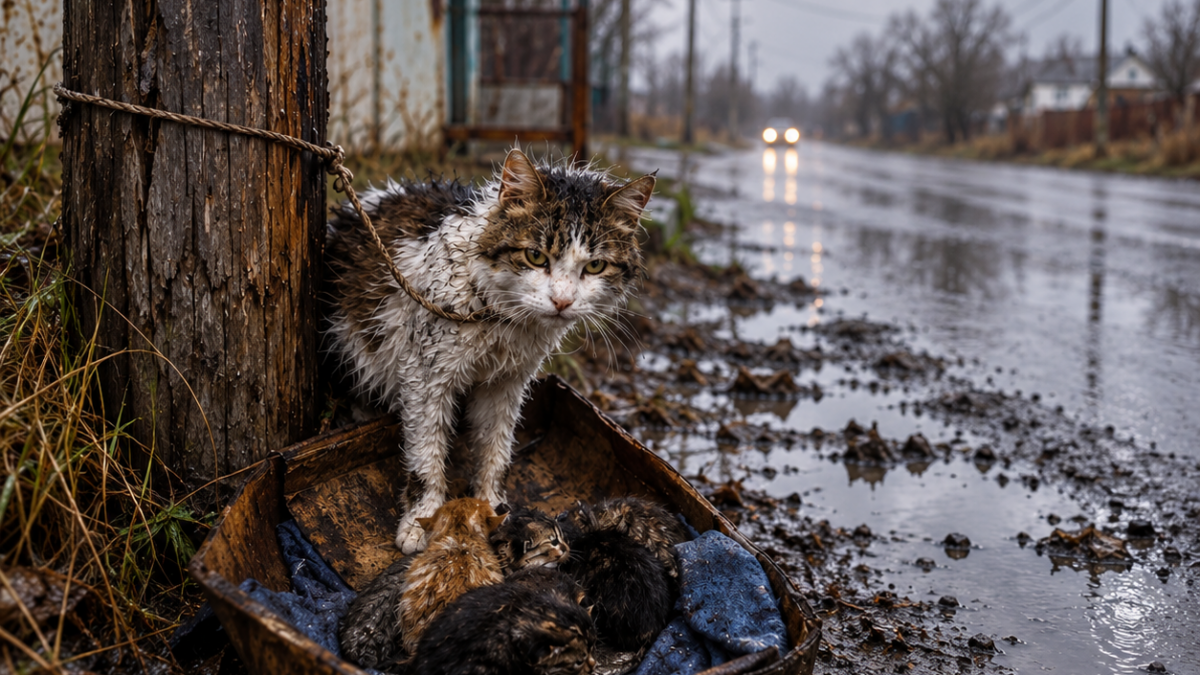
PART 2
“No.”
The word came out louder than I meant it to.
The mother cat immediately lifted her head.
I pressed one finger against the kitten’s chest, terrified that my hands were too clumsy, too large, too human for something that weighed only a few ounces.
Nothing.
“Come on.”
I rubbed him through the towel.
His head rolled weakly against my thumb.
“No. You don’t get to quit now.”
I grabbed my phone and called the emergency veterinary hospital across town.
A woman answered almost immediately.
“Emergency veterinary clinic.”
“I found a cat with five kittens outside. One of the babies is freezing cold. He was breathing, but now I can barely tell if he is.”
“Do not give him any more formula.”
I stopped.
“I already gave him some.”
“That’s okay. Just stop now. Is his body cold?”
“Yes.”
“Is he responsive?”
“Barely.”
“Bring the mother and all the kittens in. Keep them warm during transport, but don’t use anything hot enough to burn them.”
“I’m leaving now.”
I didn’t bother changing my clothes.
I layered towels inside the laundry basket, placed the kittens together, and carried their mother over.
She surprised me by climbing into the basket voluntarily.
She curled around them immediately.
Even Pip—the name would come later, but in my mind he was already different from the others—was pulled close against her belly.
I carried all six animals downstairs.
The rain had eased, but the air was bitter.
I placed the basket on the passenger seat, turned the heater up, and drove.
Every stoplight felt endless.
At one red light, I reached over and touched the towel.
“Stay with me.”
The mother looked at me through the opening.
Her eyes were exhausted but alert.
“I’m trying,” I told her.
I didn’t know whether I meant her, the kitten, or myself.
The emergency clinic doors opened automatically as I ran toward them.
A veterinary technician was waiting with a warm blanket.
“Is this the cold kitten?”
“Yes.”
She lifted him carefully.
The mother scrambled up.
Her front paws hooked over the side of the basket.
“It’s okay,” I said. “They’re helping him.”
The technician paused.
“She can see him.”
She carried the kitten into the treatment room but kept the door partly open.
A veterinarian came in less than a minute later.
Her badge said Dr. Elena Reyes.
She listened to the kitten’s chest with a tiny stethoscope.
I stood against the wall because I felt as though I might fall over.
“Is he alive?”
“Yes.”
I closed my eyes.
“His heart rate is low, and he’s severely hypothermic.”
“Can you save him?”
“We’re going to try.”
She placed him inside a warming unit and started glucose support.
The mother cat cried from inside the basket.
It was the first strong sound I had heard from her.
Dr. Reyes looked over.
“She’s calling him.”
“I think so.”
“Let’s get the others checked too.”
The four larger kittens were cold and underweight, but responsive.
Then Dr. Reyes examined their mother.
Once her wet fur was parted around the neck, the wound looked worse under the bright clinic lights.
There were several raw sections where the rope had broken the skin.
Dr. Reyes touched the area gently.
The cat flinched but didn’t fight.
“She’s dehydrated,” Dr. Reyes said. “Severely underweight. Fleas. Her gums are pale.”
“Anemic?”
“Possibly. Fleas can contribute, especially in animals that are already malnourished.”
I stared at her ribs.
“How could anyone leave her out there like that?”
Dr. Reyes didn’t answer.
She had probably learned not to answer questions nobody in the room could answer.
Instead, she ran a scanner over the cat’s shoulders.
“No microchip.”
“Does that mean nobody owns her?”
“It means we don’t know.”
She cleaned the wound.
The cat’s ears flattened.
I moved closer without thinking.
“It’s okay.”
She turned toward my voice.
Dr. Reyes noticed.
“She trusts you more than she trusts us.”
“I met her six hours ago.”
“Apparently that was enough.”
They treated the wound, gave her fluids, and put her in a kennel with four kittens.
The smallest remained in the incubator.
I sat outside the treatment room.
At six in the morning, my alarm went off.
Work.
I stared at the screen.
Then I called my supervisor.
“Tom?”
My voice sounded awful.
“Yeah?”
“I’m not coming in.”
“You okay?”
“I found a cat.”
Silence.
“A cat?”
“And five kittens.”
Another silence.
“Are you calling out because you found six cats?”
“One of them almost died in my hand.”
His tone changed.
“Take the day.”
“Thank you.”
“You need anything?”
“No.”
Then I looked toward the treatment room.
“Actually, maybe sleep.”
He laughed softly.
“Can’t help with that.”
Neither could I.
I sat there until Dr. Reyes came out again around seven.
I stood so quickly my knee hit the coffee table.
“He’s warmer,” she said.
“Good?”
“Good.”
“Is he breathing normally?”
“Better.”
“Can I see him?”
She smiled.
“In a minute.”
Then a sound came through the treatment-room door.
A thin, irritated squeak.
I covered my mouth.
“That’s him?”
“That’s him.”
I started laughing.
It came out half laugh, half sob.
Dr. Reyes nodded.
“That’s exactly the kind of complaining we want.”
When they let me see him, he looked impossibly small beneath the blanket.
His paws were moving.
His eyes were still closed.
The mother could hear him from her kennel.
She stood.
The technician carried the warming tray close enough for them to smell each other.
The mother pushed her face toward him.
He squeaked.
She answered with a quiet chirp.
I turned away for a second.
I had known them less than a day.
That fact already felt irrelevant.
Dr. Reyes kept the family at the clinic for several hours.
Around noon, she gave me a list of instructions.
“You’re taking them home?”
I blinked.
“I assumed I was.”
“You understand the mother may belong to someone.”
“Someone tied her to a post.”
“I agree that what you described is concerning. But animal control needs to handle the legal part.”
“What happens until then?”
“If you’re willing, they can remain in temporary foster care with you.”
I stared at her.
“I have never fostered anything.”
She looked toward the kennel.
“You’ve kept six animals alive through the worst night of their lives.”
“That sounds less like fostering and more like panic.”
“Sometimes there isn’t much difference.”
I laughed despite myself.
The clinic connected me with a local rescue called Second Chance Paws.
A coordinator named Anna called before I even left.
“I hear you’ve acquired a family.”
“I did not acquire them.”
“You brought six cats into an apartment.”
“I found them tied outside.”
“That’s usually how the sentence starts.”
I liked her immediately.
She arranged for supplies.
Kitten formula.
A digital scale.
Flea treatment safe for a nursing mother.
High-calorie kitten food for the cat.
Heating pads designed for animals.
Clean bedding.
“Most important thing,” Anna said, “weigh the kittens at the same time every day.”
“All of them?”
“Yes.”
“How do I tell them apart?”
“Take pictures. Note markings. Or name them.”
“I’m not naming them.”
Anna laughed.
“Sure.”
By that evening, all six were back in my apartment.
I turned my bedroom into a nursery.
The mother chose the corner beside my closet.
I gave her a low-sided box lined with towels.
She moved the kittens there herself.
One by one.
She picked each baby up carefully by the scruff and carried it from the laundry basket to the new nest.
When she reached the smallest, she paused.
She licked his head several times before moving him.
I sat on the floor watching.
“You worried about him too?”
She gave me a look that somehow felt like an answer.
That night I named her Maggie.
The name simply came out.
“Maggie, you need to eat.”
Her ears turned.
I said it again.
“Maggie.”
She looked at me.
And that was it.
She had a name.
The kittens followed.
The largest, a black-and-white male with an enormous appetite, became Bean.
The little tabby that constantly crawled in the wrong direction became Clover.
The loudest was Pepper.
A sleepy gray male became Louie.
And the smallest—the one whose body had gone still in my hand—became Pip.
Anna called that evening.
“You named them.”
“I needed labels for the weight chart.”
“Of course.”
“It was administrative.”
“Absolutely.”
I could hear her smiling.
For the next few days, my life narrowed down to six animals.
Maggie ate like she was trying to make up for weeks of hunger.
At first, I had to divide her meals because she ate so fast she made herself sick.
The first time that happened, I panicked and called Anna.
“She threw up.”
“Did she immediately try to eat again?”
“Yes.”
“She probably ate too quickly.”
“So she isn’t dying?”
“No.”
“Are you sure?”
“No one who works in rescue ever says ‘sure’.”
That did not help.
But Maggie was fine.
She ate another smaller meal and kept it down.
Her neck wound needed cleaning twice a day.
At first she hated it.
I would sit on the floor beside her with gauze and medication while she backed toward the wall.
“I know.”
Her ears flattened.
“I know you don’t like it.”
The rope had taught her that hands near her neck meant danger.
So I stopped approaching from above.
I sat sideways.
I let her sniff everything first.
I touched her shoulder before moving toward the wound.
Sometimes it took twenty minutes to perform a two-minute cleaning.
But gradually she stopped backing away.
The kittens had their own problems.
Pip wasn’t gaining enough.
Every morning, the scale showed the same thing.
Bean gained.
Pepper gained.
Louie gained.
Clover gained.
Pip gained almost nothing.
Anna came to the apartment.
She picked him up, examined his mouth, and watched him nurse.
“He’s getting pushed off.”
By Bean.
Of course.
Bean looked as though he had been born with elbows.
“What do I do?”
“Give Pip private nursing time.”
“Private nursing time?”
“Take the others out for ten or fifteen minutes and let him have Maggie alone.”
I started doing it several times a day.
It helped.
For the first time, Pip gained steadily.
I celebrated a quarter of an ounce as if he had won an Olympic medal.
I took a picture of the scale and sent it to Anna.
She replied with three words.
That’s my boy.
By the end of the first week, Maggie started waiting for me near the bedroom door.
She still didn’t come to the apartment entrance when I got home.
The outside world remained frightening.
But she knew the sound of my footsteps in the hall.
I’d unlock the door, walk inside, and find her sitting halfway down the corridor.
“Hey, Maggie.”
Her tail would rise slightly.
One evening I sat beside her after feeding the kittens.
I reached out my hand.
She sniffed it.
Then she did something she had never done before.
She pushed her forehead beneath my fingers.
I froze.
She pushed again.
I stroked her between the ears.
A quiet vibration began beneath my palm.
Her purr.
I smiled.
“There you are.”
She closed her eyes.
For several minutes, neither of us moved.
The scar around her neck was still ugly.
But for the first time, she was asking to be touched.
Three days later, I came home and she didn’t meet me.
I knew immediately something was wrong.
“Maggie?”
Nothing.
I went to the bedroom.
She was lying beside the kittens.
Her food bowl from that morning was still half full.
That had never happened.
I crouched.
“Hey.”
She lifted her head.
Slowly.
I touched her ear.
Hot.
When one of the kittens tried to nurse, Maggie flinched and moved away.
I called Dr. Reyes.
“Bring her in.”
The clinic had become familiar enough that the receptionist recognized me.
“You’re the bus-stop family.”
Apparently we had an unofficial name.
Dr. Reyes examined Maggie.
One mammary gland was swollen.
“She’s developing mastitis.”
“What does that mean?”
“An infection or inflammation in the mammary tissue. We caught it early.”
“Can she still nurse?”
“Most likely, but we’ll monitor her closely.”
Then Dr. Reyes examined the neck wound.
One section looked redder than before.
“Secondary infection here too.”
My stomach dropped.
“Did I clean it wrong?”
“No.”
“Could I have prevented it?”
“She was malnourished and exposed to dirty water. Her immune system has been under a lot of stress.”
I looked down.
“Stop.”
I looked at her.
“Stop what?”
“Trying to find a way to blame yourself.”
I hadn’t realized how obvious I was being.
“I should’ve seen she was sick this morning.”
“You were at work.”
“I should have—”
“You found her tied to a post in freezing rain. You cut her loose. You got all six here alive. You cannot control everything that happens afterward.”
I nodded.
But I didn’t believe her yet.
The next forty-eight hours were brutal.
Maggie needed medication.
The kittens needed supplemental feeding so she could rest.
I worked shifts, rushed home during breaks, washed bottles, warmed formula, changed towels, cleaned wounds, monitored temperatures, and wrote everything down because exhaustion made my memory unreliable.
At three in the morning on the second night, I dropped an entire bottle of formula on the kitchen floor.
It shattered.
I stood there looking at the white liquid spreading across the tile.
And then I started crying.
Not dramatic crying.
Not sobbing.
Just exhausted tears.
I slid down against the cabinet and sat on the floor.
“I can’t do this.”
Maggie appeared in the doorway.
She was supposed to be resting.
“Maggie, go lie down.”
She walked toward me.
Slowly.
Then she sat beside my knee.
I wiped my face.
“You’re not supposed to be taking care of me.”
She leaned her head into my arm.
I laughed.
It sounded terrible.
But I laughed.
“All right.”
I cleaned the floor.
Made more formula.
Fed five kittens.
Gave Maggie her medication.
Then I slept for forty minutes.
The next morning, her fever was lower.
That evening she ate an entire bowl.
The day after that, she began purring again.
I thought we were through the worst of it.
Then Pip stopped gaining weight.
At first, I thought the scale was wrong.
I reset it.
Weighed him again.
Same number.
The next morning, less.
I called Anna.
“He’s lost weight.”
“How much?”
I told her.
“How’s his breathing?”
I watched his sides.
“Fast.”
“Clinic.”
That was all she needed to say.
Dr. Reyes listened to Pip’s lungs.
Her expression changed.
It was subtle.
But after weeks of watching veterinarians, I had learned to notice subtle.
“What?”
“I hear some crackling on the right.”
My hands tightened.
“What does that mean?”
“I want an X-ray.”
They took Pip into the back.
Maggie paced inside the carrier.
I sat beside her.
“He’s stubborn.”
She pushed her nose against the door.
“He made it through the first night.”
She cried softly.
“He’s going to make it through this.”
I said it like a promise.
But I didn’t know.
Dr. Reyes returned with the image.
“There’s a small area that may be developing pneumonia.”
I felt sick.
“Could I have caused it?”
She looked at me.
“How?”
“Bottle feeding.”
“Aspiration is one possible cause.”
My stomach dropped.
“But,” she continued, “Pip was compromised from the beginning. His immune system is weaker. He could have inhaled milk while nursing. He could be dealing with an infection related to his poor condition.”
“I fed him.”
“On his stomach?”
“Yes.”
“Slow-flow nipple?”
“Yes.”
“You stopped when he turned away?”
“Yes.”
“Then you followed instructions.”
“But—”
“No.”
Her voice was gentle but firm.
“We treat the kitten in front of us. We don’t invent a courtroom in your head.”
I looked down at Pip.
He was wrapped in a towel.
His ears looked enormous.
“What do we do?”
“Antibiotics. Supportive care. Monitor closely.”
“How closely?”
Dr. Reyes hesitated.
“Very.”
That week became the longest of my life.
I measured Pip’s breathing while he slept.
I counted breaths.
I checked his gums.
I weighed him twice a day.
I panicked when he slept too long.
I panicked when he cried.
I panicked when he didn’t cry.
Anna eventually said, “You’re going to give yourself pneumonia.”
“I’m serious.”
“So am I.”
Maggie stayed close whenever I handled him.
She would lick his ears, then sit beside my leg.
On the third morning, Pip did something that made me laugh.
Bean was nursing.
Pip wanted the same spot.
Instead of choosing another, he climbed over Bean.
Bean pushed back.
Pip pushed harder.
The two tiny kittens wrestled like exhausted worms until Pip finally shoved his brother aside.
Bean squealed.
Pip latched on.
“That is incredibly rude,” I said.
Maggie looked at me.
“But encouraging.”
At his next checkup, Dr. Reyes listened to his lungs for a long time.
Then she smiled.
“Much better.”
I nearly hugged her.
“Much?”
“Much.”
The X-ray a week later showed the infection resolving.
Pip began gaining again.
The first morning he reached a milestone weight Anna had given me, I took four pictures of the scale.
I sent all four.
Anna replied:
I only needed one.
I wrote:
I needed four.
The kittens’ eyes were fully open now.
Their ears stood up.
Their personalities began to emerge.
And my quiet apartment disappeared.
Pepper was the first to figure out how to climb over the edge of the nesting box.
He got halfway.
Fell backward.
Tried again.
Maggie watched him with the exhausted expression of a mother who already knew exactly what kind of child she had.
By the next afternoon, he escaped.
I found him under my dresser.
“How?”
He screamed.
“That is not an answer.”
Clover became obsessed with shoelaces.
Bean became obsessed with food.
Louie became obsessed with sleeping in locations that made me think I had lost him.
Once I searched the entire bedroom for fifteen minutes before finding him asleep inside the sleeve of a sweater on the floor.
Pip became the explorer.
For a kitten who had almost died twice, he had very little respect for danger.
One morning he climbed onto the lowest shelf of a bookcase.
I watched.
“Don’t.”
He climbed higher.
“Pip.”
Higher.
“You are not physically qualified to make that decision.”
He jumped.
Missed.
Landed in a pile of laundry.
Then walked away like everything had happened according to plan.
Maggie had become another animal entirely.
She gained weight.
Her coat became soft.
The raw wound on her neck closed.
A thin scar remained beneath the fur.
The first time she played with a toy, I nearly missed it.
I was washing dishes when I heard something hit the wall.
I looked down the hallway.
Maggie was crouched near a small cloth mouse Anna had brought.
She tapped it.
It slid.
She jumped after it.
Stopped.
Looked around.
As if embarrassed.
I leaned against the doorway.
“Go ahead.”
She stared at me.
I looked away on purpose.
A few seconds later, I heard the toy skitter across the floor again.
I smiled into the sink.
Animal Control Officer Daniels called during the fourth week.
“We checked cameras around Miller Road.”
I sat at my kitchen table.
“And?”
“The repair shop camera didn’t cover the bus stop. The convenience store system had overwritten most of the footage before we requested it.”
My heart sank.
“So nothing?”
“Not nothing. We have the report. We have your photographs. We have the veterinary documentation.”
“But no person.”
“Not yet.”
“Can you tell how long she was there?”
“No.”
“Someone had to see.”
“Possibly.”
The frustration in my chest surprised me.
“I keep thinking about whoever tied her there.”
“I understand.”
“No, I mean I keep imagining them going home afterward. Eating dinner. Going to sleep.”
Daniels was quiet.
Then he said, “People sometimes expect investigators to give them a reason that makes cruelty make sense.”
I didn’t answer.
“Usually there isn’t one that helps.”
“What if they come looking for her?”
“Call us.”
“You think they could?”
“It’s possible.”
I looked toward the bedroom.
Maggie was nursing the kittens.
“If someone shows up, I’m not giving her back.”
“Don’t confront anyone. Call us.”
That night I checked the locks twice.
Nothing happened.
No one came.
A week later, Daniels called again.
They had received one small piece of information.
A delivery driver remembered seeing a dark SUV parked near the abandoned stop around early evening the day before I found Maggie.
No plate.
No description of the driver.
No certainty the vehicle was connected.
It wasn’t enough.
I wanted more.
A license plate.
A name.
A confession.
Something.
Instead, the investigation stalled.
At first, I hated that.
I wanted justice in a neat shape.
Someone responsible.
Someone punished.
But the kittens didn’t care about my need for an ending.
They needed food.
Vaccines.
Clean litter.
Socialization.
Veterinary checks.
A safe future.
So I stopped staring backward long enough to handle what was directly in front of me.
At five weeks, the kittens started eating wet food.
The first meal was chaos.
Anna told me to make a shallow plate and let them experiment.
“Experiment” was a generous word.
Pepper walked directly into it.
Bean ate so quickly he got food on his forehead.
Clover stepped backward into the water bowl.
Louie sat beside the plate and screamed because apparently he didn’t understand he was expected to move closer.
Pip climbed on top of Bean.
Maggie sat several feet away watching.
I looked at her.
“You created this.”
She started cleaning one paw.
“Take responsibility.”
She ignored me.
By the end of the meal, all five kittens were covered in food.
I cleaned them one by one.
Pepper objected loudly.
Bean tried to eat the towel.
Pip bit my thumb.
“This is why nobody likes you.”
He purred.
I took a picture of them afterward.
Five round little bodies sleeping in a pile.
I compared it to the photograph from the night I found them.
The difference hurt.
Not because it was sad.
Because it was almost impossible to believe.
Six weeks earlier, they had been wet, cold, and nearly silent.
Now I could barely hear myself think.
The rescue posted their first photos online.
Applications arrived immediately.
I had known this would happen.
I had told myself I was prepared.
I was not.
Anna came over with paperwork.
“Bean and Louie have an excellent application.”
I looked at the two brothers.
“Together?”
“Together.”
“That’s good.”
“It is.”
“Indoor home?”
“Yes.”
“Previous cat experience?”
“Seventeen years.”
“Veterinary references?”
“Excellent.”
“Windows?”
Anna stared at me.
“What about them?”
“Secure?”
“Tung—”
“I’m asking.”
“Their house has windows.”
“You know what I mean.”
She sighed.
“Yes. Secure screens.”
“Okay.”
She watched me.
“What?”
“You’re going to be a nightmare.”
“I’m being responsible.”
“You asked me if the family owns candles.”
“Cats can knock them over.”
“They use electric candles.”
“Good.”
She pinched the bridge of her nose.
Bean and Louie’s prospective adopters arrived on a Saturday.
Susan and Mark were a couple in their early sixties.
Their cat, Henry, had died the previous year at seventeen.
Mark sat on the floor.
Bean walked directly into his lap.
Louie hid beneath a chair.
Mark didn’t reach for him.
He simply waited.
After fifteen minutes, Louie emerged.
He sniffed Mark’s shoe.
Then climbed onto the opposite leg.
Mark looked at his wife.
She covered her mouth.
“Oh, no,” she said.
“What?”
“We’re taking two cats home.”
He smiled.
“I believe that was always the plan.”
I watched them for almost an hour.
They didn’t grab.
They didn’t chase.
They let the kittens make decisions.
When they left, I told Anna, “Them.”
“You sure?”
“No.”
She smiled.
“That’s not what I asked.”
I looked at Bean asleep where Mark had been sitting.
“Yes.”
The adoption was scheduled for the following week.
The night before, I barely slept.
I packed their food.
Medical records.
Favorite toys.
A blanket from the nesting box.
The next morning, Maggie seemed to notice something was different.
She watched while I prepared the carrier.
Bean climbed inside voluntarily because Bean assumed everything might contain food.
Louie resisted.
Eventually they were both settled.
Before I closed the door, Maggie walked over.
She sniffed them through the opening.
Bean reached one paw toward her.
Maggie licked it.
My throat closed.
“Don’t.”
Anna stood behind me.
“Don’t what?”
“Talk.”
“I wasn’t.”
“Continue.”
Susan and Mark arrived.
I explained the feeding schedule.
Then the litter.
Then vaccines.
Then Bean’s talent for stealing food.
Then Louie’s habit of hiding in fabric.
Susan listened patiently.
“We’ll take care of them.”
“I know.”
“You can visit.”
“That might be worse.”
She smiled.
“Send pictures?”
“Please.”
When the carrier disappeared through my apartment door, Maggie walked into the hallway.
She stared after it.
Then she went back to the bedroom.
I followed.
Three kittens remained.
Pepper was wrestling Clover.
Pip was chewing a blanket.
Maggie lay down beside them.
For a while, she seemed fine.
That evening, she walked through the apartment calling softly.
I sat on the floor.
“They’re okay.”
She called again.
“I promise.”
I wished promises worked across species.
Two days later, Susan sent a photo.
Bean and Louie were asleep together on the top platform of a cat tree.
I showed Maggie.
She sniffed the phone.
“See?”
She walked away.
I chose to interpret that as approval.
Clover’s application came from a family with one child, a twelve-year-old girl named Emily.
The parents had made her wait a year before allowing a pet.
At first, I thought that sounded overly strict.
Then I met Emily.
She had read three books about cats.
She had saved allowance money for food and veterinary expenses even though her parents had told her they would pay.
She had written a schedule.
I looked at her mother.
“She made the schedule herself?”
“Yes.”
Emily turned red.
“I know cats don’t follow schedules exactly.”
I laughed.
“No. They absolutely do not.”
Clover hid behind my couch.
Emily sat on the rug.
She didn’t crawl after her.
She didn’t call repeatedly.
She waited.
Ten minutes later, Clover appeared.
Emily held out her hand.
Clover sniffed it.
Then sat beside her.
Emily’s face changed.
Not excitement exactly.
Something quieter.
Care.
I recognized it.
After they left, I approved them.
Pepper’s adopter was easier.
Her name was Dana.
She worked as a veterinary technician.
Pepper climbed her pants within two minutes.
She laughed.
“Oh, you’re a criminal.”
“He is.”
“I’ll take him.”
“You haven’t even asked questions.”
“I read the entire medical record you sent.”
She pulled out her phone.
“I have a cat-proofed apartment, one four-year-old neutered male cat who likes kittens, two covered litter boxes, one open litter box, and health insurance through my employee plan.”
I stared.
“Okay.”
“Anything else?”
“Are your cabinets childproofed?”
She paused.
“No.”
“They will need to be.”
Pepper was hers.
The two adoption days happened within forty-eight hours of each other.
Suddenly, only Pip remained.
The apartment became quieter.
He hated it.
For two days he followed Maggie everywhere.
When she jumped onto the windowsill, he cried beneath it.
When she walked to the kitchen, he followed.
When she slept, he crawled on top of her.
Maggie tolerated him.
Mostly.
One afternoon, Pip attacked her tail for the tenth time.
She turned.
Placed one paw on his head.
Held him against the floor.
Pip screamed as if being murdered.
She released him.
He attacked her tail again.
I laughed.
“You deserve each other.”
Applications for Pip flooded in.
Everyone loved his story.
That made me suspicious.
I didn’t want someone to adopt him because he had almost died.
I wanted them to adopt him because they were ready to care for a cat for the next fifteen or twenty years.
Anna called.
“You rejected the Mitchell application.”
“They travel.”
“Twice a year.”
“For two weeks.”
“They have a professional pet sitter.”
“I don’t like it.”
“You rejected Megan Carter.”
“She has a husky.”
“A cat-friendly husky.”
“She said ‘probably cat-friendly.’”
Anna went quiet.
“All right. That one I agree with.”
“I also rejected the birthday family.”
“So did I. Animals aren’t surprise presents.”
“Good.”
Pause.
“You know what I think?”
“What?”
“You don’t want to adopt Pip.”
“Correct.”
“You just don’t want anyone else to adopt Pip either.”
I looked at him.
He was asleep upside down.
“That’s unfair.”
“It is also accurate.”
“I held him when he stopped breathing.”
“I know.”
“I watched him get pneumonia.”
“I know.”
“What if someone misses something?”
“What if someone doesn’t?”
I said nothing.
Anna softened.
“You saved him so he could have a life, not so you could spend the rest of yours afraid that life might happen to him.”
That sentence stayed with me.
A week later, an application arrived from a woman named Ellen.
Late fifties.
Worked from home.
Owned her house.
Previous cat lived to eighteen.
No other animals.
No small children.
Veterinary references excellent.
I tried to find a problem.
There wasn’t one.
When Ellen came over, she brought nothing.
No toys.
No treats.
I liked that.
She didn’t try to bribe Pip.
She sat on the floor.
“Hi.”
Pip hid behind my leg.
Ellen smiled.
“I respect your decision.”
I laughed.
“He’s dramatic.”
“They usually are.”
She waited.
Pip eventually approached.
She held out one finger.
He sniffed.
Then walked away.
“Well,” she said, “I have been rejected.”
Twenty minutes later, he returned.
He climbed onto her leg.
Ellen didn’t grab him.
She kept talking to me.
“What food is he on?”
I told her.
“Any ongoing respiratory issues?”
“No.”
“What frightens him?”
The question surprised me.
“Loud noises sometimes. He doesn’t like the vacuum.”
“Neither do I.”
“And if he gets cold, he burrows under blankets.”
“I keep my house embarrassingly warm.”
She looked down.
Pip had curled into her lap.
Only then did she gently touch his back.
She looked at me.
“I’d like him. But only if you think I’m right for him.”
I knew.
That was the sentence.
Not I want him.
Not when can I take him?
If you think I’m right for him.
After she left, I approved the application.
Then I sat on the bathroom floor and cried.
Maggie found me.
She walked in.
Sat beside me.
I laughed.
“You and your children have destroyed my dignity.”
She rubbed against my knee.
Pip’s adoption day came a week later.
I packed his blanket.
His favorite toy.
Food.
Medical records.
Medicine he no longer needed but whose empty bottle I had somehow kept.
I threw the bottle away.
Then took it out of the trash.
Then threw it away again.
“This is ridiculous.”
Pip attacked the bag.
“You’re not helping.”
Before Ellen arrived, I placed him beside Maggie.
She cleaned his face.
He bit her ear.
She pushed him over.
He rolled.
Then he curled against her.
I sat beside them.
“You scared me more than anything this small has a right to.”
Pip opened his mouth.
Bit my finger.
“Exactly.”
Ellen arrived with a sturdy carrier.
I inspected it.
Of course I did.
The latch was secure.
Blanket inside.
Identification tag attached.
“Window screens?” I asked.
She stared at me.
Then laughed.
“Anna warned me.”
“I’m serious.”
“All secure.”
“Plants?”
“Cat-safe.”
“Cleaning products?”
“Locked cabinet.”
“Strings?”
“Put away.”
I nodded.
Ellen touched my arm.
“I know what he means to you.”
That almost broke me.
When I placed Pip inside the carrier, he immediately started complaining.
“No. You are not dying.”
He screamed.
“You are going to a beautiful house.”
Scream.
“With a woman who works from home.”
Scream.
“You’re embarrassing me.”
Ellen laughed.
Maggie walked to the carrier.
She sniffed.
Pip pushed his nose against the door.
Maggie chirped.
Then she walked away.
I watched Ellen carry him down the hallway.
The apartment door closed.
Silence.
Actual silence.
I hadn’t heard it in weeks.
Maggie stood in the middle of the living room.
She looked toward the door.
Then at me.
Then she walked through every room.
She checked beneath the couch.
Inside the bedroom.
Beside the nesting box.
She called.
One short cry.
I sat on the floor.
“I know.”
She called again.
“They’re safe.”
She walked toward me.
“Bean and Louie are safe. Clover is safe. Pepper is probably committing a felony. Pip is safe.”
She sat beside me.
For the first time since I found her, Maggie had no kittens to protect.
I wondered whether she knew what to do with herself.
That night, she slept at the foot of my bed.
Around two in the morning, I woke because something touched my leg.
Maggie had moved closer.
Her head rested against my ankle.
I didn’t move.
The next morning, Ellen sent a photograph.
Pip was sitting on her laptop keyboard.
The message said:
My productivity has declined 87 percent.
I laughed.
Another picture came later.
Pip asleep on Ellen’s chest.
Then a video.
Pip running through a hallway.
He looked huge.
Happy.
Healthy.
I watched it twice.
Then five times.
Maggie’s adoption profile went online after she was spayed and fully recovered.
Her pictures were beautiful.
Healthy gray-and-white coat.
Bright yellow eyes.
Soft expression.
The rescue description mentioned that she was affectionate once she felt safe but preferred people who respected her boundaries, especially around her neck.
Applications came.
None felt right.
The first couple arrived on a Saturday.
The man immediately reached over Maggie’s head.
She ducked.
He frowned.
“She’s skittish.”
“She doesn’t like sudden hands near her neck.”
“Does she scratch?”
“No.”
“Bite?”
“No.”
“She just seems nervous.”
I wanted to say, Someone tied a rope around her neck and abandoned her in a storm. What exactly did you expect?
I didn’t.
They adopted another cat.
The next applicant wanted a “lap cat.”
Maggie sometimes sat beside me.
Rarely on me.
That wasn’t good enough.
Another family had two large dogs.
The dogs had never lived with cats.
Anna and I both decided against it.
Weeks passed.
Maggie stayed.
I pretended to worry.
Anna stopped pretending to believe me.
She came over one afternoon with coffee.
Maggie was asleep on the windowsill.
“How many applications did you reject this week?”
“Two.”
“One was perfectly fine.”
“She works ten-hour shifts.”
“Four days a week.”
“Long time alone.”
“She has another cat.”
“Maybe Maggie doesn’t want another cat.”
Anna stared at me.
“What?”
“Nothing.”
“You’re doing the face.”
“What face?”
“The face where you think you know something.”
“I do know something.”
“What?”
“You’re waiting for someone to convince you they deserve your cat.”
“She isn’t my cat.”
Anna turned toward the window.
“Maggie.”
One yellow eye opened.
“Apparently you don’t live here.”
Maggie jumped down.
Walked across the room.
Rubbed against my ankle.
Anna looked at me.
“That’s awkward.”
I laughed.
“I’m fostering her.”
“For how long?”
“Until the right person comes.”
“Describe the right person.”
I started.
“Someone who…”
I stopped.
Anna waited.
Someone who didn’t grab Maggie.
Someone who understood her food.
Someone who knew which side of the bed she slept on.
Someone who never punished her for hiding.
Someone who understood that she liked the faucet dripping.
Someone who knew that she always checked a room before entering.
Someone who never put a tight collar around her neck.
Someone who knew she hated thunder.
Someone who would stay near her during storms.
Someone like…
Me.
I looked down.
“Oh.”
Anna sipped her coffee.
“There it is.”
“I didn’t plan to have a cat.”
“Most animals are notoriously bad at consulting calendars.”
“I work.”
“So do millions of cat owners.”
“My apartment is small.”
“She already lives here.”
“She sheds.”
Anna stared.
“That is your argument?”
“I’m thinking.”
“You have been thinking for three months.”
Maggie jumped onto the couch beside me.
She sat close enough that her body touched my hip.
Then she started purring.
Anna pointed.
“Your witness is testifying.”
I looked at Maggie.
Her neck had healed.
The fur had grown back almost completely.
I could still feel the scar if I touched carefully.
She no longer flinched when I did.
“What do I sign?”
Anna smiled.
“Finally.”
The adoption paperwork was anticlimactic.
Fifteen minutes.
A signature.
A fee the rescue waived because I had covered some of Maggie’s early supplies myself.
Then Anna slid the form toward me.
“Congratulations.”
“That’s it?”
“That’s it.”
Maggie was cleaning her paw.
“She seems overwhelmed.”
“She already thought this was her house.”
I went to a pet store that evening.
I wanted a collar.
Then I stood in the collar aisle and almost left without one.
Every collar looked like the rope.
I knew that was irrational.
Maggie didn’t need my symbolism.
But I wanted something different around her neck.
Something light.
Something safe.
Something that would release if caught.
I chose a soft blue breakaway collar.
At home, I let her smell it.
She batted it once.
I touched it to her neck.
She froze.
My stomach dropped.
I immediately reached for the clasp.
“Never mind.”
Before I removed it, she moved.
Not away.
Toward me.
She sniffed my wrist.
Then sat.
I waited.
She scratched the collar once.
Walked to her food.
Started eating.
I let out the breath I had been holding.
The collar stayed loose.
Two fingers easily fit underneath.
The next week, I ordered a tag.
MAGGIE
My phone number below it.
The first time I heard the tag click against her bowl, something about the sound got to me.
She had identification.
She had an address.
She had someone waiting for her.
Winter arrived.
Maggie hated the first storm.
Rain struck the windows hard enough to wake me after midnight.
I heard her before I saw her.
She was under my bed.
I got down on the floor.
“Maggie?”
Two yellow eyes glowed beneath the frame.
Thunder rolled.
She pressed farther back.
I could have reached for her.
I didn’t.
I sat on the floor.
“You can stay there.”
Another rumble.
“It’s just weather.”
She didn’t care.
I stayed beside the bed for nearly an hour.
Eventually one paw appeared.
Then her head.
She crawled out.
Walked into my lap.
That had never happened before.
I barely breathed.
She tucked herself against my stomach.
I rested one hand lightly on her back.
The storm continued.
But she stayed.
From then on, rain became our ritual.
When storms came, Maggie found me.
Sometimes the couch.
Sometimes the bed.
Sometimes the kitchen.
She didn’t always climb into my lap.
She simply needed to know where I was.
I understood.
Every few weeks, photographs of the kittens arrived.
Bean grew into a huge cat.
Mark sent me a picture of him lying across a newspaper.
The message said:
No one has read local news in three weeks.
Louie remained smaller and much sleepier.
Susan said he slept against Mark’s head every night.
Clover became inseparable from Emily.
There were pictures of homework sessions, window watching, and one disastrous attempt at a Halloween costume.
Clover’s expression said everything.
Pepper became exactly what we expected.
Dana sent a video of him opening a cabinet.
Then another of a childproof latch she installed.
Then another of Pepper apparently figuring out that latch.
I wrote:
You adopted a raccoon.
Dana replied:
I’m aware.
And Pip…
Pip grew.
Every time Ellen sent a picture, I stared at it.
He became lanky.
Long tail.
Ridiculous ears.
Healthy eyes.
He slept beneath Ellen’s chin.
Sat beside her while she worked.
Followed her to the kitchen.
She sent me updates about his checkups.
Weight.
Vaccines.
Everything.
She understood I needed them.
One afternoon, months after his adoption, she called.
Not texted.
Called.
My heart stopped.
“What happened?”
“Nothing.”
“Why are you calling?”
She laughed.
“I need you not to panic.”
“You cannot start a phone call like that.”
“Pip has been coughing occasionally.”
I stood.
“How often?”
“Three times this week.”
“Did you call the vet?”
“We just got back.”
“And?”
“They think it’s irritation, maybe mild allergies. His lungs sound clear.”
I sat down.
“Okay.”
“I knew you’d want to know.”
“Thank you.”
“He’s fine.”
“Okay.”
“He is currently trying to steal a pen.”
I closed my eyes.
“Fine.”
After we hung up, I realized my hands were trembling.
Maggie jumped onto the couch.
She sniffed me.
“Your son has allergies.”
She began cleaning herself.
“Your concern is touching.”
I rested my head against the couch.
Saving an animal did not mean the fear ended when the emergency ended.
Sometimes love meant accepting that you could not keep anything safe forever.
You could only give it the best odds you could.
That lesson took me longer.
Nearly six months after the rescue, Officer Daniels called.
I hadn’t heard from him in weeks.
“We’re closing the active investigation unless new evidence comes in.”
I knew it was coming.
“Nothing?”
“Nothing enough to identify the person responsible.”
I looked toward Maggie.
She was asleep in sunlight.
“What happens to the report?”
“It stays on file.”
“And if someone recognizes her later?”
“They can contact us.”
“Does that happen?”
“Sometimes.”
I hated the word.
Sometimes.
Not yes.
Not justice.
Sometimes.
Daniels seemed to understand my silence.
“I’m sorry.”
“I wanted somebody held responsible.”
“I know.”
“Do you see this a lot?”
“Too much.”
I rubbed my forehead.
“How do you not lose your mind?”
He was quiet.
“Because sometimes somebody stops.”
“What?”
“Someone notices. Someone calls. Someone picks up the box.”
I looked at Maggie.
“You did that.”
After we hung up, I thought about those words.
For months, I had focused on the person who tied the rope.
I imagined them.
Hated them.
Wanted a name.
A face.
Punishment.
But they weren’t in my apartment.
Maggie was.
The kittens were alive.
That did not excuse what happened.
It did not make accountability unimportant.
But I finally understood something.
The cruelest person in Maggie’s life did not get to remain the most important person in her story.
One Saturday in early spring, Ellen asked if I wanted to visit Pip.
I hesitated.
“What if it confuses him?”
“He’s a cat.”
“That doesn’t answer the question.”
“I think you want to come.”
I did.
I drove to Ellen’s house carrying a bag of toys I had absolutely not needed to buy.
Her home was quiet.
Warm.
There was a tall cat tree beside the living-room window.
Blankets on the couch.
Toys everywhere.
Pip’s toys.
I heard running footsteps upstairs.
Then a gray-and-white blur came around the corner.
He stopped.
So did I.
He was much bigger.
For one awful second, I thought he didn’t recognize me.
Then he walked closer.
Sniffed my shoe.
Sniffed my hand.
I crouched.
“Hey, little guy.”
His ears moved.
He stepped forward.
Then climbed directly onto my knee.
I laughed.
“Oh, come on.”
Ellen smiled.
“I’d say he remembers something.”
Pip pushed his head beneath my hand.
His purr started.
I had to look away.
“You’re huge.”
He bit my finger.
I laughed harder.
“There you are.”
We sat on Ellen’s floor for almost an hour.
Pip showed me every bad habit he had learned.
He jumped onto the kitchen counter.
Ellen removed him.
He returned.
She removed him.
He returned.
“Good training,” I said.
“We’re in negotiations.”
Before I left, Pip curled beside Ellen on the couch.
That mattered.
He was happy to see me.
But when he got sleepy, he chose her.
I expected that to hurt.
It didn’t.
It was exactly what I wanted.
I drove home smiling.
Maggie met me at the door.
She sniffed my pants.
Then my hands.
Then my shoes.
Her tail puffed slightly.
“Oh.”
She sniffed again.
“You smell him.”
She looked up at me.
“He’s fine.”
She walked away.
“Wow. No questions?”
Five minutes later she returned and rubbed against my legs repeatedly.
I laughed.
“All right. Maybe you remember him too.”
The anniversary of the rescue arrived without my noticing at first.
I was driving home from work.
Rain had been falling since lunch.
When I turned onto Miller Road, I saw the abandoned bus stop.
My hands tightened on the steering wheel.
I pulled over.
For almost a year, I had passed that stop occasionally.
But I had never stopped again.
That evening I did.
The wooden post remained.
Weathered.
Splintered.
Ordinary.
I stood beside it in the rain.
The scene returned with frightening clarity.
The box.
The rope.
Maggie’s ribs beneath wet fur.
Five tiny bodies trembling.
I could almost hear that weak groan again.
I touched the post.
There was no mark showing where the rope had been.
Of course not.
Wood didn’t remember.
I did.
My phone buzzed.
A message from Ellen.
Pip asleep upside down beside her keyboard.
Caption:
My assistant has finished work early.
I smiled.
Then another message arrived.
Susan.
Bean and Louie curled together in a window.
Then a picture from Emily’s mother.
Clover asleep beside a textbook.
Then Dana.
Pepper sitting inside a cardboard box that said DO NOT OPEN.
I stood beneath the abandoned bus shelter looking at all five.
Safe.
Loved.
Alive.
I drove home.
Maggie was waiting.
She no longer waited halfway down the hall.
Now she sat directly behind the apartment door.
The moment I stepped inside, she complained.
“Yes, I know.”
Another meow.
“I’m late.”
She followed me to the kitchen.
I opened her food.
She began eating immediately.
I remembered the first bowl.
That night she had stared at it, then looked at her babies.
She had refused to take a bite until she knew they were safe.
Now she ate without checking.
That seemed small.
It wasn’t.
Safety changes habits before it changes memories.
I went to the bedroom.
The scarf I had wrapped around the kittens that first night was folded near the end of the bed.
I hadn’t used it again.
At some point, it had become Maggie’s.
She slept on it.
Kneaded it.
Dragged it across the room.
I once tried to put it away.
She found the closet and cried until I gave it back.
So the scarf stayed.
Maggie jumped onto the bed.
Turned in a circle.
Then lay down on it.
I sat beside her.
Her blue collar was slightly worn now.
I replaced it every few months with the same type.
Soft.
Loose.
Breakaway.
I ran my fingers gently over her neck.
The fur had grown back.
The scar remained beneath it.
A thin ridge.
She did not flinch.
“Do you remember?”
Her eyes half closed.
“Probably not the way I do.”
She purred.
I looked through the pictures of the kittens again.
Six lives.
That thought still overwhelmed me.
Not because I believed I had saved them alone.
I hadn’t.
Dr. Reyes saved Pip.
Anna taught me what to do.
Second Chance Paws paid for treatment and found homes.
Officer Daniels documented the case.
Ellen, Susan, Mark, Emily’s family, and Dana gave the kittens lives that had nothing to do with the cardboard box where they began.
A rescue is rarely one heroic moment.
Usually it is dozens of people doing one useful thing.
Stop the car.
Make the call.
Hold the towel.
Clean the wound.
Take the night shift.
Pay the bill.
Foster.
Adopt.
Send the update months later because someone still worries.
Maggie stretched.
Her paw touched my wrist.
I rested my hand beside her.
I had learned not to assume contact.
Even after a year, I let her decide.
She moved closer.
Placed her head in my palm.
That was answer enough.
Another storm rolled through later that night.
Thunder shook the windows.
Maggie lifted her head.
Once, she would have hidden beneath the bed.
Instead, she looked at me.
I lifted the blanket.
“You know the deal.”
She walked underneath.
Curled beside my hip.
The rain grew louder.
I felt her purr through the mattress.
I thought about the bus stop.
One year earlier, the sound of rain had meant cold.
Exposure.
A rope she couldn’t escape.
Babies she couldn’t fully reach.
Now rain meant a warm room.
A blanket.
Food in the kitchen.
A person beside her.
I reached down.
Her tag clicked softly against my hand.
MAGGIE.
My number.
My address.
Her home.
The storm continued.
She stayed asleep.
Months became years.
The kitten group chat never stopped.
That was what Anna eventually called it.
Every few months, someone sent an update.
Bean reached sixteen pounds.
I accused Susan of raising a small bear.
Louie remained twelve pounds and somehow looked bigger because of his fur.
Clover became Emily’s constant companion through middle school.
When Emily had the flu, Clover stayed in bed with her for three days.
Pepper learned to open a sliding closet door.
Dana installed another latch.
Pepper learned to defeat that too.
Pip grew into the tallest of the litter.
The runt.
The kitten I had once held completely inside one palm became all legs and tail.
At his two-year veterinary checkup, Ellen sent me his weight.
I stared at the number.
Then I found the old notebook where I had recorded his first weights.
I compared them.
The difference was absurd.
I sent the picture to Ellen.
She replied:
He says stop discussing his baby weight publicly.
I kept that notebook.
I don’t know why.
The pages were stained.
Some formula.
Some coffee.
One page had a blurry fingerprint where I had written during a sleepless night.
There were dates.
Times.
Weights.
Medications.
Tiny changes that once felt like life or death.
Because sometimes they were.
I kept Maggie’s first veterinary record too.
Underweight.
Dehydrated.
Flea infestation.
Neck trauma.
Possible anemia.
Every line belonged to a cat I barely recognized anymore.
Maggie became confident.
Not fearless.
I don’t think animals—or people—need to become fearless to heal.
But she became comfortable taking up space.
She slept in the middle of my bed.
She demanded breakfast.
She yelled if I closed the bathroom door.
She sat on clean laundry with absolute confidence that nothing I owned outranked her comfort.
When strangers visited, she watched from a distance.
Some earned an introduction.
Some didn’t.
I stopped apologizing for her.
“She’ll come over if she wants to.”
Usually, people understood.
Once, a friend reached quickly toward her.
Maggie backed away.
He laughed.
“Still scared?”
I shook my head.
“No.”
Maggie sat several feet away.
“She just gets to say no now.”
He lowered his hand.
A few minutes later, she approached him herself.
That distinction mattered to me.
She was not a broken animal I had repaired.
She had never been broken.
She had been trapped.
Hungry.
Injured.
Terrified.
Those were circumstances.
Not identity.
The more time passed, the more I understood the difference.
Three years after the rescue, the abandoned bus stop was finally removed.
I discovered it by accident.
I drove down Miller Road and almost missed the spot.
The shelter was gone.
So was the post.
Only a patch of fresh dirt remained.
I pulled over.
For several minutes, I sat inside the car.
I expected to feel something dramatic.
Relief.
Sadness.
Anger.
Instead, I felt strangely calm.
The place where Maggie’s worst night happened no longer existed.
But neither did the life she had before me.
I took a picture of the empty patch.
Then I drove home.
Maggie was asleep on the couch.
I sat beside her.
She opened one eye.
“That place is gone.”
She closed her eye.
“Good talk.”
That evening, Ellen sent a video of Pip chasing a toy.
Susan sent a photo of Bean sitting in a sink.
Emily sent one herself now—she was older—of Clover stretched across her homework.
Dana sent a picture of Pepper inside a grocery bag.
Louie appeared in the background of one of Susan’s photos, asleep as usual.
I saved them all.
Years later, whenever someone asked how I got Maggie, I rarely told the entire story.
The full version felt too large for casual conversation.
I usually said:
“I found her outside.”
That was true.
But not complete.
I found her tied to a post.
I found her protecting five babies while she was starving.
I found a kitten cold enough to stop moving.
I found out how frightening it is to love something before you know whether it will survive.
I found out that rescue can mean medicine at three in the morning, bills you didn’t plan for, urine on towels, formula on your shirt, and crying over a quarter ounce of weight gain.
I found five families I otherwise would never have known.
I found Anna, who still sent me foster photos and occasionally tried to convince me to take another litter.
My answer remained no.
Mostly.
I found a veterinarian who later told me Pip had become one of her favorite survival stories.
And I found Maggie.
Or maybe Maggie found me.
I still remember the first night.
Not because I want to.
Because some moments become permanent.
The wet rope in my hands.
Her thin body swaying.
The box moving.
Five tiny sounds.
The way she tried to stand between me and them even though she could barely stand at all.
That was Maggie.
Long before she knew I was safe, she loved those kittens enough to spend whatever strength she had left on them.
One evening, years after I found her, another storm arrived.
Maggie was older.
A little slower.
There was white beginning to show around her muzzle.
I was sitting on the couch when the first thunder rolled.
She lifted her head from the blanket.
For a second, I waited for her to come toward me.
She didn’t.
She stretched.
Yawned.
Then went back to sleep.
I smiled.
The rain struck the windows.
She kept sleeping.
I thought that might have been the moment I finally understood what healing looked like.
Not forgetting.
Not erasing.
Not pretending something terrible never happened.
Sometimes healing is simply the day the old danger makes a sound and your body no longer believes it has to run.
I walked to the kitchen and opened a can of food.
Maggie appeared immediately.
“Oh, so thunder doesn’t wake you, but canned chicken does?”
She meowed.
“Interesting.”
She ate.
Then followed me back to the couch.
Her old blue collar had been replaced many times, but I always bought the same kind.
Soft fabric.
Breakaway clasp.
Loose around the neck.
Her tag clicked quietly when she jumped beside me.
I touched the place beneath her fur where the scar remained.
She leaned into my fingers.
No fear.
No flinch.
Just trust.
Later that night, I received a message from Ellen.
A picture of Pip.
He was sleeping in a patch of sunlight, even though it was dark where I lived.
She had taken the photo earlier.
Under it she had written:
Just thought you’d want to see your little survivor.
I stared at the picture.
Then at Maggie.
I corrected Ellen silently.
Not my survivor.
Maggie’s.
He had survived because his mother had kept dragging herself toward that cardboard box every time the rain came harder.
Because she had kept nursing five babies when her own ribs showed.
Because she had refused to stop protecting them even when the rope around her neck made every movement painful.
I had entered the story later.
An important part.
But later.
I bent down.
“You did good, mama.”
Maggie opened her eyes.
The kittens were adults now.
They had homes.
Families.
Warm beds.
Veterinary records.
Ridiculous toys.
Birthday photos.
People who worried when they sneezed.
People who knew which food they liked and where they slept.
People who would never leave them in rain.
Maggie’s job was finished.
Years ago.
Maybe she had known that before I did.
She stretched one paw toward me.
I placed my hand beside it.
Her paw rested across one finger.
Outside, rain continued falling.
Inside, nothing needed saving.
And of all the things I remembered from that first terrible night, that was the difference that mattered most.
Back then, Maggie had stayed beside a wooden post because a rope gave her no choice.
Now she could walk anywhere she wanted.
She could leave the room.
Hide beneath the bed.
Sleep on the windowsill.
Ignore me completely.
She had every option.
Instead, she moved closer, tucked her head against my wrist, and closed her eyes.
Nothing held her there.
No rope.
No fear.
No need.
She stayed because she chose to.
[END OF STORY]








