PART 2: I Found a Kitten Frozen Into the River Ice—Then I Learned Who Had Left Him There
PART 2
I didn’t fish that morning.
I ran.
Maybe “ran” is generous for a fifty-three-year-old man wearing insulated boots and carrying a half-frozen kitten under his coat, but I moved faster than I had in years.
My truck was parked about two hundred yards away.
Halfway there, the kitten stopped trembling.
People think that’s a good sign.
It isn’t always.
I knew enough about hypothermia to understand that shivering meant his body was still trying to fight. When the trembling stopped, panic hit me.
“Hey.”
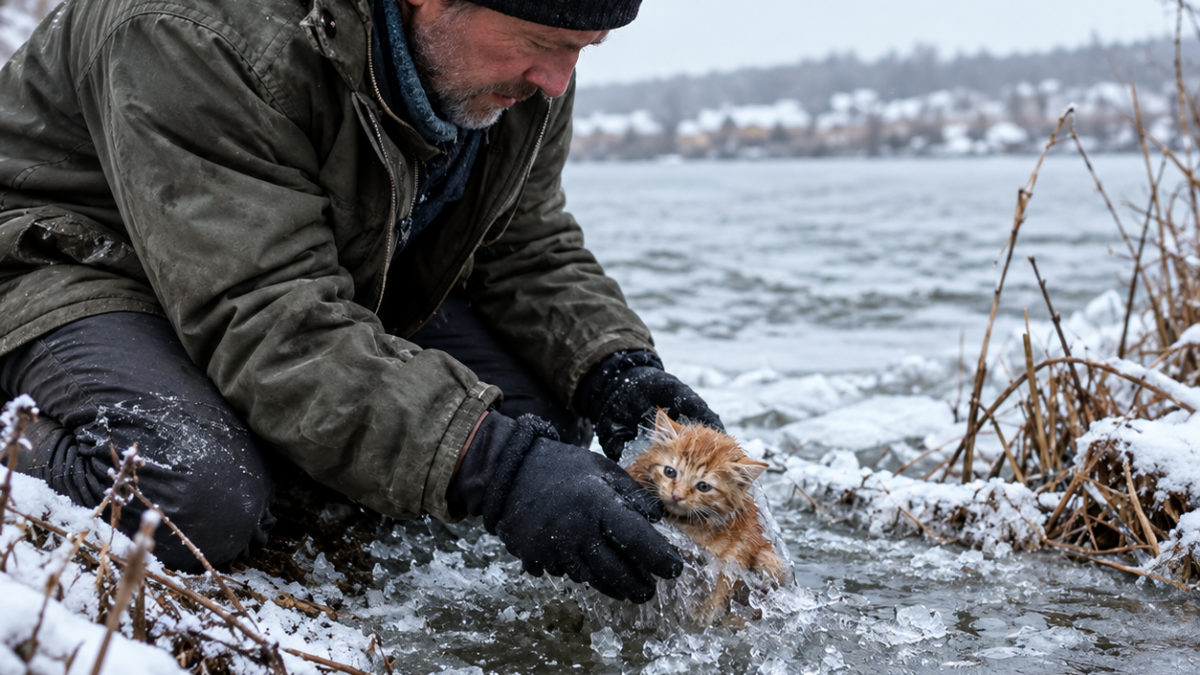
I pulled the scarf open just enough to see his face.
His eyes were closed.
“No, no, no. Don’t you do that.”
I climbed into the truck, turned the heater on full blast, and called the only veterinary clinic in town that had an emergency number.
Dr. Emily Carter answered on the fourth ring.
“Andrei?”
She recognized my number because she’d treated my old Labrador, Molly, for arthritis before Molly died two years earlier.
“I found a kitten.”
“Is it injured?”
“Frozen.”
There was a pause.
“What do you mean frozen?”
“Part of him was stuck in river ice. He’s out now, but he’s barely breathing.”
Her voice changed immediately.
“Do not put him directly against the heater.”
I pulled him away from the vent.
“Okay.”
“Wrap him in dry fabric. Warm him gradually. Can you get here in fifteen minutes?”
“Twelve.”
“Andrei, drive carefully.”
I hung up.
I made it in eleven.
Emily was already waiting by the back entrance when I pulled into the clinic.
She was forty, maybe forty-one then, with dark hair she usually wore in a loose ponytail and the calmest eyes of anyone I’d ever met. That morning, though, the second she opened the scarf, those eyes tightened.
“Treatment room. Now.”
A veterinary technician named Grace took the kitten from me while Emily started issuing instructions.
“Warming pad on low. Warm IV fluids. Check glucose. Rectal temperature.”
Grace looked at the thermometer.
“Emily…”
“What?”
“It isn’t reading.”
Emily took it herself.
She tried again.
Nothing.
“Below the device range.”
I stood near the wall, useless.
“What does that mean?”
Emily didn’t look at me.
“It means he’s dangerously cold.”
“Can you save him?”
“We’re going to try.”
Try.
It’s such a small word when you’re standing there with someone’s life depending on it.
They shaved a tiny patch on his front leg to find a vein.
The first vein collapsed.
Then the second.
Grace whispered something I couldn’t hear.
Emily moved to the other leg.
“Come on, buddy.”
She got the catheter in.
They wrapped him in heated towels and placed warm packs beside him, never directly against the skin. Emily gave him a small amount of glucose.
His gums were almost white.
His heart rate was far too slow.
I watched the monitor like staring hard enough could force the numbers upward.
“Is he in pain?” I asked.
“Right now, he’s probably too cold and exhausted to process much.”
“That’s not what I asked.”
Emily finally looked at me.
“I don’t know.”
I nodded.
It was an honest answer.
For the next hour, we watched his temperature crawl upward.
A fraction of a degree at a time.
Then his body began to shake again.
Grace smiled.
“That’s good.”
I’d never imagined I’d be grateful to watch an animal tremble.
Another twenty minutes passed.
The kitten suddenly lifted his head.
Barely.
But he lifted it.
His mouth opened.
A tiny rasp came out.
I laughed before I could stop myself.
Emily glanced at me.
“He’s still critical.”
“I know.”
But I smiled anyway.
Because the little guy had complained.
And complaining meant he still had something left.
By eight that morning, his temperature had risen enough for Emily to examine him more thoroughly.
There were no obvious fractures.
His paw pads had minor frostbite but still showed circulation.
He was severely dehydrated.
Underweight.
Probably six or seven weeks old.
And there was a shallow abrasion around his neck where the blue cord had rubbed the skin.
Emily held the metal tag beneath the examination light.
“V.H.R.,” she read.
“You recognize it?”
“No.”
She turned it over.
Nothing on the back.
“Could be initials. Could be an inventory tag.”
“Inventory?”
“Some breeders tag litters. Farms tag animals. Rescue groups sometimes use temporary identifiers.”
I looked through the glass door at the kitten lying inside the warming enclosure.
“Whoever tagged him didn’t do a very good job rescuing him.”
Emily’s mouth tightened.
“No.”
Something about the tag bothered me.
Not enough to know why.
Just enough that I slipped it into my coat pocket when Emily finished examining it.
“Can I take him home?”
“Not today.”
“Tomorrow?”
“If he survives today.”
The words hit harder than I expected.
Emily must have seen it on my face.
“Andrei, you did everything right. If you’d arrived twenty minutes later, I don’t think we’d be having this conversation.”
I looked back at the kitten.
“Then don’t let those twenty minutes go to waste.”
“We won’t.”
I left the clinic just after nine.
My fishing rods were still lying in the snow by the river.
For the first time in thirty years, I didn’t care.
I went back for them later.
And that’s when I found the tire tracks.
They weren’t mine.
My truck had been parked near the access road, on packed gravel.
These tracks continued beyond it, down a section where vehicles weren’t supposed to go in winter.
They led toward the spot where I’d found the kitten.
Then they turned around.
I stood looking at them for a long time.
There had been no fresh snow since two nights earlier.
The tracks were clean enough to have been made sometime after the snow stopped.
Maybe they belonged to a maintenance vehicle.
Maybe another fisherman.
Maybe someone had dumped trash.
There were a dozen harmless explanations.
I told myself that.
Then I walked down the bank.
Near the brush, I noticed something I’d missed in the dark.
A cardboard box.
It was mostly crushed beneath snow.
One corner had been soaked and frozen hard.
I pulled it free.
There were holes punched into the sides.
Air holes.
My stomach dropped.
Inside the box was a stained towel.
And another piece of blue cord.
I stared at it.
The same shade.
The same thickness.
The same cheap plastic weave as the cord that had been around the kitten’s neck.
That wasn’t all.
On one side of the box, beneath smeared mud, was part of a printed logo.
Only three words remained readable.
**Valley Hope Rescue.**
V.H.R.
I knew the name.
Everyone in town did.
Valley Hope Rescue wasn’t a shelter exactly.
It was a private nonprofit run by a man named Victor Hale.
He’d started it four years earlier after his wife died.
At least, that was the story.
Victor appeared at community events with rescued dogs.
He hosted donation drives.
Local businesses kept Valley Hope jars beside their cash registers.
Every Christmas, he ran a campaign called “No Animal Left in the Cold.”
People loved him.
I had donated twice.
Once after Molly died.
Once the following year.
I looked toward the river.
Then at the box.
“No animal left in the cold,” I muttered.
For the first time that morning, the freezing temperature wasn’t what made me shiver.
I took pictures before touching anything else.
The box.
The tire tracks.
The cord.
The exact place where I’d found the kitten.
Then I called Emily.
“Is he awake?”
“More than he was.”
“I found something.”
“What?”
“The tag stands for Valley Hope Rescue.”
Silence.
“Are you sure?”
“There’s a box by the river with their logo. Same blue cord.”
“Don’t accuse anyone yet.”
“I’m not.”
“Andrei.”
“I said I’m not.”
“Take pictures and call animal control.”
“I already took pictures.”
“Good.”
I looked down at the tire tracks.
“Emily?”
“Yeah?”
“Do rescue groups dump kittens?”
“No legitimate one does.”
That was the first crack.
I didn’t know it yet, but once I started looking through it, the entire wall was going to come down.
Animal Control Officer Rachel Boone met me at the river an hour later.
Rachel was short, broad-shouldered, and had the permanent expression of someone who had spent fifteen years listening to people give terrible excuses.
She photographed everything again.
She bagged the blue cord.
She lifted the cardboard box with gloved hands.
“Could’ve blown down here,” she said.
“With a towel inside and air holes?”
“Could have.”
“You believe that?”
“No.”
“Then why say it?”
“Because what I believe and what I can prove are two different things.”
I liked her immediately.
She crouched beside the tire tracks.
“Large pickup. Maybe all-terrain tires.”
“Victor Hale drives a truck.”
“So do half the men in this county.”
“His rescue is ten minutes from here.”
“So are forty houses.”
I exhaled.
“You’re very good at being irritating.”
“So I’ve been told.”
She stood.
“I’ll visit Valley Hope.”
“I’m coming.”
“No.”
“Why?”
“Because if this is nothing, you’ve harassed a man over a cardboard box. If it’s something, I don’t want him knowing who found the kitten until I know what I’m dealing with.”
I didn’t like that.
But she was right.
“Call me.”
“I will if I can.”
“If you can?”
“This is an investigation, Andrei. Not neighborhood gossip.”
I stared at her.
She stared back.
Finally I nodded.
“Fine.”
That afternoon, Emily called.
The kitten had eaten.
Only a teaspoon of wet food.
He’d kept it down.
“You sound happy,” I said.
“I am.”
“So he’s going to make it?”
“I didn’t say that.”
“You veterinarians hate optimism.”
“We hate promising things biology hasn’t agreed to.”
I drove to the clinic anyway.
When I entered the treatment room, the kitten was awake.
His eyes were enormous.
Greenish gold.
A little crust had formed around his nose.
His fur, now dry, stuck up in every direction.
He looked like a badly assembled orange dandelion.
“He’s ugly,” I said.
Emily smiled.
“He almost died this morning.”
“Both things can be true.”
She opened the enclosure.
The kitten tried to stand.
His front legs worked.
His back legs wobbled badly.
He made it two steps before collapsing onto the towel.
My chest tightened.
“Temporary?”
“We don’t know.”
I crouched.
He stared at me.
Then, very slowly, he dragged himself forward.
One paw.
Then the other.
Until his nose touched my finger.
I didn’t move.
He sniffed.
Then he bit me.
I jerked my hand back.
Emily burst out laughing.
“That’s excellent.”
“He bit me.”
“That’s fight.”
“He has terrible manners.”
“Good sign.”
The kitten gave a faint squeak.
I touched his head again.
This time he didn’t bite.
“What are you calling him?”
“I didn’t name him.”
“You rescued him.”
“That doesn’t mean I own him.”
Emily raised an eyebrow.
“What?”
“Nothing.”
“Don’t do that.”
“Do what?”
“That face.”
“I’m just wondering how many men drive twelve miles in a snowstorm to visit animals they have absolutely no intention of keeping.”
I looked at the kitten.
He looked at me.
“Finn,” I said.
Emily smiled.
“What?”
“If he needs a name for the chart, put Finn.”
“Why Finn?”
“Fisherman found him.”
“That’s a terrible reason.”
“You asked.”
Finn slept at the clinic for four nights.
By the second day, he could stand for nearly ten seconds.
By the third, he was eating on his own.
By the fourth, he had discovered that scratching Grace’s wrist produced dramatic reactions and therefore became his favorite hobby.
On the fifth morning, Emily called.
“You can pick up your cat.”
“He’s not my cat.”
“Of course.”
“I mean it.”
“Bring a carrier.”
“I don’t own a cat carrier.”
“Then buy your not-cat a carrier.”
I did.
Finn came home with me that afternoon.
My house had been quiet since Molly died.
Too quiet, if I’m telling the truth.
I had convinced myself I liked it that way.
No nails clicking on the hardwood.
No bowl by the kitchen door.
No fur on my jacket.
No one waiting when my truck pulled into the driveway.
Grief does strange things.
At first, you miss the noise.
Then you get used to the silence.
Then you defend the silence because admitting you miss the noise means admitting you’re still lonely.
Finn didn’t care about any of that.
Within fifteen minutes of arriving, he knocked a pen off my desk.
Within thirty, he climbed halfway up a curtain and screamed because he couldn’t figure out how to get down.
Within an hour, he fell asleep inside one of my winter boots.
That night, I placed a blanket in a cardboard box beside my bed.
Finn climbed out.
I put him back.
He climbed out again.
I repeated this six times.
The seventh time, he stared at me as if I were slow.
Then he crawled onto the bed, turned three circles against my ribs, and fell asleep.
“Temporary,” I whispered.
He purred.
The liar was me.
Three days later, Rachel Boone knocked on my door.
Finn was chasing a bottle cap across the kitchen floor.
She watched him skid into a cabinet.
“Looks dead to me.”
“He’s dramatic.”
“He’s a kitten.”
“Same thing.”
Her smile disappeared quickly.
“I visited Valley Hope.”
I poured coffee.
She didn’t sit.
That told me more than her face did.
“What happened?”
“Victor says the tag isn’t theirs.”
“The box literally has his rescue name on it.”
“He says they haven’t used those boxes in months.”
“What about the cord?”
“Says they use red collars now.”
“And the tag?”
“Claims someone could have made it.”
“Could someone?”
“Sure.”
“Would someone?”
She looked at me.
“That’s where it gets interesting.”
I waited.
“Valley Hope’s intake records show no orange kitten matching Finn in the last six months.”
“So?”
“The county database does.”
I frowned.
“What do you mean?”
“Three weeks ago, a woman named Linda Perez surrendered a litter of five kittens to Valley Hope. One orange male. Four females.”
“Where are the other four?”
“Victor says the litter was transferred to an adoption partner.”
“Which partner?”
“He wouldn’t tell me.”
“Can he refuse?”
“He can make me get paperwork.”
“So get it.”
“I am.”
Rachel finally sat.
“But there’s more.”
She pulled out her phone.
A photograph showed five kittens inside a plastic kennel.
One was orange.
Around every neck was blue cord with a small metal tag.
The orange kitten’s tag was visible.
V.H.R.
I felt something cold move through me that had nothing to do with the weather.
“That’s him.”
“Looks like him.”
“Rachel.”
“We need proof.”
“How much more proof?”
“Enough that a defense attorney can’t explain it away in thirty seconds.”
I looked at Finn.
He had stopped playing.
He sat beside my chair, watching us.
“What happened to the females?”
“That’s what I’m trying to find out.”
Two days later, I found Linda Perez.
Rachel hadn’t given me her address.
I wasn’t stupid enough to ask.
But our town had one grocery store, one pharmacy, two gas stations, three churches, and a social media page where people posted everything from lost dogs to complaints about potholes.
I made a simple post.
No accusation.
No mention of Victor.
I uploaded a picture of Finn sitting on my kitchen counter.
**Does anyone recognize this kitten? He was found near the river last week. I’m trying to locate whoever originally cared for him.**
Within twenty minutes, Linda messaged me.
**Please call me.**
She answered on the first ring.
“Where did you get him?”
“By the river.”
“No.”
Her voice cracked.
“I’m sorry?”
“No, that’s impossible. I gave him to Valley Hope.”
“When?”
“January third.”
It was January twenty-seventh.
“Tell me exactly what happened.”
She went quiet.
Then she started crying.
Linda lived outside town on a small property with an old barn. A stray calico cat had appeared the previous fall.
Linda fed her.
Two months later, the cat gave birth inside the barn.
Five kittens.
Linda couldn’t keep them all, so she contacted Valley Hope.
Victor Hale came personally.
“He was wonderful,” she said. “At least I thought he was. He promised they would be vaccinated and placed in foster homes.”
“Did you sign anything?”
“Yes.”
“Do you still have it?”
“I think so.”
“Find it.”
“Andrei?”
“Yes?”
“Where are the girls?”
I didn’t know what to say.
“I don’t know.”
The silence afterward was terrible.
“I gave him all five.”
“I know.”
“He told me they were safe.”
“I know.”
“Did he leave this one at the river?”
“We don’t know yet.”
“But you think he did.”
I looked at Finn asleep beside the woodstove.
“Yes.”
That afternoon, Linda found the paperwork.
She emailed me a copy.
Five kittens listed.
One orange male.
Four calico females.
Valley Hope Rescue had accepted legal custody.
Victor Hale’s signature was at the bottom.
I forwarded it to Rachel.
She called thirty seconds later.
“Where did you get this?”
“Linda Perez.”
“You contacted a witness in an active investigation?”
“I posted a picture of my cat.”
“Your cat?”
“Don’t change the subject.”
Rachel groaned.
“Send me Linda’s number.”
“I already did.”
“And then stop playing detective.”
“I am not playing detective.”
“You found the witness.”
“Accidentally.”
“You posted online asking for one.”
“That’s not the point.”
“Go fishing, Andrei.”
“The river’s frozen.”
“Then find another hobby.”
My other hobby became keeping Finn alive.
His frostbite improved.
The back-leg weakness slowly disappeared.
He developed an appetite that made me wonder if he’d swallowed a second kitten somewhere.
Every morning at five, he walked across my face.
Every evening, he climbed into my lap when I sat beside the woodstove.
I bought him toys.
Then denied buying him toys.
I bought him a proper bed.
He slept in the cardboard box the bed came in.
I bought expensive kitten food recommended by Emily.
He stole a piece of toast from my plate.
Three weeks after I found him, he followed me into the garage while I cleaned my fishing equipment.
I didn’t notice him until I heard a sound behind me.
Finn was standing on the workbench.
Beside the scarf I’d wrapped him in.
I had left it there after washing it.
He sniffed the wool.
Then he froze.
His entire body changed.
Back arched.
Tail puffed.
He backed away from the scarf and hissed.
“Hey.”
I reached for him.
He jumped down and ran beneath the workbench.
It took me ten minutes to coax him out.
That bothered me.
The scarf had been washed.
Whatever scent frightened him shouldn’t have been there.
Unless it wasn’t the scarf.
I looked around.
Old tools.
Fishing line.
Fuel can.
A coil of rope.
And on the shelf behind the scarf—
blue plastic cord.
I stared.
It was the same type used around Finn’s neck.
I’d bought a roll months earlier at Hale’s Hardware.
Victor’s brother owned the store.
Cheap utility cord wasn’t unusual.
Half the town probably owned some.
Still, Finn’s reaction was unmistakable.
I picked up the roll.
He hissed again.
That night, I put it in the shed.
I never used it after that.
A week later, Rachel returned.
This time she accepted coffee.
“Tell me you found the other kittens.”
She looked down at the cup.
“Two.”
“Alive?”
“Yes.”
I exhaled.
“Where?”
“One was adopted by a family forty miles north. The other was transferred to a real shelter.”
“And the other two?”
“Missing.”
“What does Victor say?”
“His paperwork says they were transferred with the others.”
“But?”
“The shelter received one kitten, not three.”
“So he falsified records.”
“Maybe.”
“Rachel.”
She gave me a warning look.
“Fine. Likely.”
“What about the river?”
“We found video.”
I set my cup down.
“Video of what?”
“A traffic camera at the highway intersection recorded Victor’s truck heading toward the river access road at 4:47 a.m. the morning you found Finn.”
My hands tightened.
“And leaving?”
“5:06.”
“I got there around 5:40.”
“Yes.”
For a moment, all I could hear was Finn scratching inside his litter box in the next room.
“That’s enough.”
“No.”
“How is that not enough?”
“Because the camera puts his truck near the area. It doesn’t show him putting a kitten on the ice.”
“The box.”
“His lawyer would say anyone could’ve taken it.”
“The tag.”
“Same.”
“The surrender form.”
“Shows the kitten entered his custody weeks earlier, not where he went afterward.”
I stood.
“You’re waiting for a confession.”
“No. I’m building a case.”
“While he’s still operating a rescue.”
“His facility was inspected yesterday.”
“And?”
Her face changed.
My anger disappeared.
“What did you find?”
She didn’t answer immediately.
“Thirty-two animals.”
“That’s a lot.”
“He’s licensed for eighteen.”
I stared at her.
“Were they okay?”
“Some.”
That one word turned my stomach.
“Define some.”
“Eleven dogs were underweight. Several had untreated skin conditions. Six cats were housed in crates in an unheated storage building.”
“In January?”
“Yes.”
“Why isn’t he in jail?”
“Because neglect statutes aren’t as simple as people think. Food was present. Water was present. Shelter existed. We’re documenting veterinary conditions now.”
“What about the animals?”
“Most have been removed pending review.”
“Most?”
“He surrendered twenty-four voluntarily.”
“And the rest?”
“Complicated.”
“Everything is complicated with you.”
“Because law is complicated.”
“Cold isn’t complicated.”
Her eyes met mine.
“No.”
“Pain isn’t complicated.”
“No.”
“Leaving a six-week-old kitten on river ice isn’t complicated.”
“No.”
I sat down again.
Rachel spoke more quietly.
“That’s why I need to do this correctly.”
I knew she was right.
I hated that she was right.
For the next month, Valley Hope became the subject everyone in town pretended not to discuss while discussing nothing else.
Victor posted a statement online.
He called the inspection a “politically motivated attack.”
He claimed disgruntled former volunteers were spreading lies.
He said the animals were healthy.
He posted an old photograph of himself holding a rescued German shepherd.
Thousands of people had seen similar photos over the years.
Some believed him.
Some didn’t.
Then he made his biggest mistake.
He mentioned Finn.
Not by name.
Not directly.
He wrote:
**A recent accusation involving an orange kitten allegedly found near the river is completely fabricated. No Valley Hope animal was ever abandoned in that location.**
I read that sentence three times.
Then I called Rachel.
“Did you tell him where Finn was found?”
“No.”
“Did Linda?”
“No.”
“Did Emily?”
“She says no.”
“My post only said near the river.”
“Yes.”
“He wrote ‘in that location.'”
Rachel was quiet.
“Interesting.”
“Interesting?”
“Very.”
Then she hung up.
I stared at the phone.
“That’s it?”
Finn jumped onto the table.
“She always does that,” I told him.
He licked his paw.
“I save you from becoming a cat-shaped ice cube and this is my social life now.”
He ignored me.
Three days later, someone slashed two tires on my truck.
I found them flat at six in the morning.
Both driver’s side tires.
Clean cuts.
Not road damage.
I called the sheriff.
Then Rachel.
“Do you have cameras?” she asked.
“No.”
“Get them.”
“You think Victor did this?”
“I think you should get cameras.”
“That wasn’t my question.”
“I know.”
There was no proof.
I replaced the tires.
Installed cameras.
Motion lights.
And for the first time since Finn came home, I started locking my doors.
That made me angry in a way I couldn’t explain.
I had lived in that house for twenty-two years.
I’d left fishing equipment outside overnight.
I’d forgotten keys in my truck.
My nearest neighbor had once walked into my kitchen while I wasn’t home, borrowed a ladder, and left a note beside the coffee machine.
Fear didn’t belong there.
Now it did.
Two nights later, my camera recorded a vehicle slowing near my driveway.
A dark pickup.
It didn’t stop.
The plate was unreadable.
I sent the video to Rachel anyway.
She replied:
**Keep everything.**
So I did.
I saved every clip.
Every strange vehicle.
Every message.
And the messages came.
Most were supportive.
A few weren’t.
Someone sent me:
**You should’ve left that cat where you found it.**
Another:
**People who destroy good organizations get what they deserve.**
No name.
No profile photo.
Fake accounts.
I didn’t tell Linda about those.
I didn’t tell Emily either.
But Emily noticed something anyway.
“You look terrible.”
“Thank you.”
“I’m serious.”
“So am I. Always good to hear.”
She was examining Finn on the stainless steel table.
He now weighed almost five pounds.
His hind legs were fully functional.
His frostbitten paw pads had healed.
The only permanent damage seemed to be a small notch in one ear where tissue had died.
Emily scratched beneath his chin.
“He looks excellent.”
“He wakes me up at four-thirty.”
“Excellent.”
“He knocked a mug off the counter yesterday.”
“Normal.”
“He steals socks.”
“Healthy.”
“He climbed inside the chimney inspection hatch.”
She stopped.
“How?”
“I don’t know.”
“Okay, that one is unusual.”
Finn rolled onto his back.
Emily checked his abdomen.
“He’s ready to be neutered next month.”
“Great.”
She looked at me.
“And you’re ready to tell me what’s going on.”
“Nothing.”
“Andrei.”
I showed her the messages.
She read them without expression.
Then she handed the phone back.
“You need to take this seriously.”
“I am.”
“No, you’re acting annoyed. That’s not the same thing.”
“What do you want me to do?”
“Tell the sheriff. Stop posting publicly.”
“I haven’t accused anyone.”
“Doesn’t matter.”
“I won’t be scared out of my own life.”
“That isn’t what I’m asking.”
“Sounds like it.”
Emily folded her arms.
“You nearly froze your hands off for an animal you’d never seen before.”
“So?”
“So courage isn’t the issue. Judgment might be.”
I almost snapped at her.
Then I noticed she looked scared.
Not for herself.
For me.
That took the air out of my anger.
“I’ll be careful.”
“That’s what stubborn men say five minutes before doing something stupid.”
“I’ll be very careful.”
“Marginally better.”
Finn bit the sleeve of her lab coat.
She looked down.
“Your father is impossible.”
I pointed at her.
“Don’t call me that.”
She smiled.
“Take your son home.”
For a while, things quieted.
Then Linda found the photograph.
It had been taken the day Victor collected the kittens.
Linda had snapped it through her kitchen window.
Victor stood beside his dark pickup.
The cardboard carrier box was visible in the truck bed.
More important, the back of the truck showed a distinctive dent near the left taillight and a sticker on the rear window.
Rachel compared it with traffic-camera footage.
Same dent.
Same sticker.
Same truck.
Still circumstantial.
But the circle was tightening.
Then a former Valley Hope volunteer named Megan Shaw contacted Rachel.
Megan had worked there for eight months.
She had quit in December.
She knew about the kittens.
And she knew about something worse.
Rachel called me that evening.
“I need you not to contact her.”
“I don’t even know who she is.”
“You know now.”
“What did she say?”
“I can’t discuss all of it.”
“You called me.”
“Because one part concerns Finn.”
I waited.
Rachel continued.
“Megan remembers the Perez litter arriving.”
“All five?”
“Yes.”
“Was Finn healthy?”
“Yes.”
The word hit me hard.
He hadn’t been sick.
He hadn’t wandered in half-dead.
He had entered Valley Hope healthy.
“What happened?”
“Two developed respiratory infections.”
“Which two?”
“One calico and Finn.”
“And?”
“Megan says Victor did not want to pay for veterinary treatment.”
My jaw tightened.
“Did she see him dump Finn?”
“No.”
“Then what?”
“She says Victor had a system.”
I didn’t like the way Rachel said that.
“What system?”
“Animals he considered too expensive, too difficult, or unlikely to be adopted would disappear from the intake list.”
“Disappear where?”
“He told volunteers they’d been transferred.”
My hand tightened around the phone.
“And they weren’t?”
“Megan became suspicious. She copied records before she left.”
“How many animals?”
“We’re still checking.”
“How many?”
“At least seventeen.”
I sat down.
Seventeen.
I pictured cardboard boxes.
Riverbanks.
Roadside ditches.
The frozen body I had held against my chest.
“Are they all dead?”
“We don’t know.”
The answer was somehow worse.
“Why didn’t Megan report him earlier?”
“She did.”
“What?”
“She contacted a county office in December.”
“And?”
“The complaint was logged.”
“Then what?”
“It was categorized as an employee dispute.”
I stood again.
“An employee dispute?”
“She didn’t have physical evidence then.”
“She had records.”
“Copies of internal notes that could have had innocent explanations.”
“Seventeen missing animals.”
“On paper, they weren’t missing. They were transferred.”
“To shelters that never received them.”
“We know that now.”
I walked to the window.
Snow had started falling.
Finn was asleep on the back of my couch, warm enough to stretch out.
“I want to see Victor.”
“No.”
“I want to look him in the eye.”
“Absolutely not.”
“Rachel—”
“If you care about Finn, stay away from him.”
That stopped me.
She knew exactly which argument would work.
Two weeks later, Valley Hope Rescue was temporarily closed by county order.
Victor called it government harassment.
Then the local newspaper published its first article.
**Questions Surround Valley Hope Rescue Following Animal Welfare Investigation**
The article was careful.
Painfully careful.
No accusation of dumping.
No mention of Finn’s location.
Just inspection findings, licensing violations, and missing transfer records.
Victor responded with a video.
He stood inside the main kennel building with two dogs behind him.
He looked tired but composed.
“This organization has saved more than six hundred animals,” he said. “Now a small group of people is trying to destroy that work.”
Then he looked directly into the camera.
“There are people in this community who would rather see Valley Hope fail than admit they were wrong.”
It shouldn’t have felt personal.
It did.
Two days later, someone threw a dead fish onto my front porch.
Normally that would have been funny.
I was a fisherman.
But a note had been pushed into its mouth.
**KEEP YOUR NOSE IN THE RIVER.**
I called the sheriff before touching anything.
They took the note.
They photographed the fish.
They checked my cameras.
At 2:13 a.m., a person in a hooded jacket had approached from the road, staying mostly outside the light.
No face.
No vehicle.
Nothing useful.
When Rachel saw the footage, her expression hardened.
“You staying here tonight?”
“Yes.”
“Maybe don’t.”
“I am not leaving my house because somebody delivered seafood.”
“This isn’t funny.”
“I know.”
“Then act like you know.”
Finn sat in the window, watching snowflakes.
I looked at him.
“Where would I go?”
“Hotel. Family. Friend.”
“My sister’s three states away.”
“Emily.”
I looked at Rachel.
“Emily?”
“She’s offered.”
“When?”
Rachel realized she’d said too much.
“Ask her.”
“You two talk about me?”
“Mostly about how irritating you are.”
That evening, I called Emily.
“Rachel says I should stay with you.”
There was a pause.
“Rachel has a big mouth.”
“Did you offer?”
“Yes.”
“Why?”
“Because someone threatened you.”
“Technically they threatened my nose.”
“Andrei.”
“I’ll be fine.”
“Then why did you call?”
I didn’t have an answer.
Maybe because my house suddenly felt too quiet again.
Maybe because every shadow beyond the windows looked like a person.
Maybe because bravery gets easier when no one knows you’re afraid.
“I have Finn,” I said.
“I know.”
“He’ll bother your dog.”
“My dog is afraid of squirrels.”
“Finn is basically a squirrel with knives.”
She laughed.
“Bring him.”
I stayed one night.
Then another.
On the third morning, Rachel called before sunrise.
“We found a camera.”
My heart kicked.
“Where?”
“A hunting camera on private property across from the river access road.”
I stood up so quickly Finn jumped off my lap.
“Does it show Victor?”
“It shows his truck.”
“You already had that.”
“This is closer.”
“How close?”
“Close enough to show someone removing a cardboard box from the bed.”
I stopped breathing.
“Can you identify him?”
“Not clearly.”
“Rachel.”
“But the jacket matches one seen in Valley Hope security footage earlier that night.”
I closed my eyes.
“Is that enough?”
“Not alone.”
“Of course not.”
“Andrei.”
“What?”
“We also executed a search warrant this morning.”
“At Valley Hope?”
“At Victor’s house and office.”
“What did you find?”
“I can’t tell you yet.”
“When can you?”
“When charges are filed.”
“Are charges being filed?”
She paused.
That pause told me everything.
“Yes.”
For the first time in weeks, I slept well.
The charges came four days later.
Animal cruelty.
Falsifying records.
Fraud related to charitable donations.
Obstruction.
Licensing violations.
More charges were possible.
Victor Hale was arrested at 6:20 on a Tuesday morning.
A reporter photographed him outside the sheriff’s office.
He wore a gray coat.
His face looked furious.
Not ashamed.
Furious.
The affidavit became public that afternoon.
I read every page.
Investigators had found falsified transfer forms for nineteen animals.
Several listed shelters confirmed they’d never received them.
Emails showed Victor complaining about veterinary costs.
One message sent to an employee read:
**I’m not wasting $400 on a kitten nobody wants. Make the problem disappear.**
The date was two days after Finn arrived at Valley Hope.
Another message concerned an elderly hound with dental disease.
Another, a cat with a broken leg.
Another, two puppies with mange.
Make the problem disappear.
Those four words stayed with me.
Then came the part that made me put the papers down.
Investigators had searched Victor’s office computer.
They found a spreadsheet.
Animals were listed by intake number.
Beside some names was the letter **T**.
Transfer.
Beside others was **A**.
Adopted.
Beside Finn’s original intake number were two letters.
**RD.**
Rachel later told me what Megan believed they meant.
Road disposal.
It was not an official code.
It was Victor’s.
Finn hadn’t escaped.
He hadn’t wandered.
He hadn’t been lost.
He had been selected.
Placed in a cardboard box.
Driven to the frozen river before dawn.
And abandoned.
Whether Victor had intended the kitten to become trapped in the ice didn’t matter much to me.
He had left a sick six-week-old animal outside in lethal cold.
He had driven away.
That was enough.
What investigators found next was worse.
A maintenance worker reported seeing Victor dispose of animal carriers near remote access roads on at least three occasions.
Search teams checked several locations.
At one site, they found remains.
I won’t describe them.
Some things don’t need details.
Three animals were eventually identified through microchips.
Their records claimed all three had been transferred.
People in town stopped defending Victor after that.
Not everyone.
There are always people who’d rather invent a conspiracy than admit they trusted the wrong person.
But donation jars disappeared from store counters.
Businesses removed Valley Hope signs.
Former volunteers came forward.
A veterinarian produced unpaid invoices.
A bookkeeper provided financial records.
Then the fraud investigation widened.
Over three years, Valley Hope had raised more than $280,000.
A significant portion never appeared to have been spent on animals.
Victor had paid personal truck expenses from rescue accounts.
Home renovations.
Restaurant bills.
A fishing boat.
That part almost made me laugh.
A fishing boat.
He had bought himself a boat with money donated to keep animals safe, then abandoned a kitten beside the river.
I wanted him to know I knew.
I wanted him to see Finn.
That desire frightened me.
Not because I wanted to hurt Victor.
I didn’t.
I wanted something that might have been worse.
I wanted him to feel ashamed.
And I was slowly realizing people like Victor rarely feel the emotion you want them to feel.
So I stopped waiting for remorse.
I wanted accountability instead.
There was one piece missing.
The other two kittens from Linda’s litter.
Rachel had found two females alive.
Finn was alive.
Two were still unaccounted for.
Linda called me almost every day.
Sometimes just to ask about Finn.
Sometimes to cry.
“I should’ve checked the rescue,” she told me once.
“You had no reason not to trust them.”
“I handed them over.”
“You tried to help them.”
“I should’ve known.”
“No.”
“I was responsible.”
“No.”
Her voice broke.
“How can you say that?”
“Because if people who ask for help become responsible for the lies told to them, then the liar gets to disappear from the story.”
She was silent.
I hadn’t planned the sentence.
But once I’d said it, I believed it.
Victor was responsible.
Not Linda.
Not Megan.
Not donors.
Not volunteers who had believed his paperwork.
Him.
That distinction mattered.
In April, snow melted along the riverbank.
I returned to the spot where I’d found Finn.
The ice was gone.
Water moved fast and brown beneath the trees.
Finn was too young and reckless to bring near the river, so he stayed home.
I stood where the brush had been frozen flat three months earlier.
For a long time, I just listened.
No crying.
No cracking ice.
Only water.
I should have felt peaceful.
Instead, I noticed something bright beneath a pile of dead leaves.
Blue.
Plastic.
Cord.
I crouched.
It was only six inches long.
Could have been trash.
Could have washed downstream.
But when I pulled the leaves aside, I found another object.
A small metal tag.
My hands started shaking.
The tag read:
**V.H.R. 1187**
Not Finn’s number.
I called Rachel.
Then I waited without touching anything else.
The search began that afternoon.
Ten volunteers walked the shoreline.
Then twenty.
Animal control.
Sheriff’s deputies.
People from the state wildlife office.
We found nothing else that day.
On the second day, a teenager named Caleb noticed movement beneath an overturned drainage pipe fifty yards from the river.
Inside were two cats.
Alive.
Barely recognizable as the kittens from Linda’s photograph.
They were older now.
Thin.
Terrified.
One had a damaged eye.
The other had lost part of her tail.
But they were alive.
Both wore remnants of blue cord.
Linda arrived at Emily’s clinic forty minutes later.
When she saw them, she covered her mouth and sank into a chair.
“Oh my God.”
Emily wouldn’t let her touch them immediately.
They needed exams.
Flea treatment.
Testing.
Food given slowly.
But through the glass, Linda whispered their old names.
“Maisie.”
One kitten lifted her head.
“Rosie.”
The other turned.
Linda cried harder.
“They remember.”
I stood behind her.
So did Rachel.
For once, Rachel didn’t talk about proof.
She simply placed a hand on Linda’s shoulder.
The cats had survived for nearly four months near an abandoned drainage system, likely feeding on mice and scraps from a nearby campground dumpster.
Someone had put them there.
We couldn’t prove Victor had personally done it.
But the tags, records, and timeline strengthened the case.
More important to Linda, all five kittens were now accounted for.
Alive.
That became the first truly good day of the story.
The trial was scheduled for September.
Victor’s attorney tried to separate the animal cruelty charges from the fraud charges.
Tried to suppress the hunting-camera footage.
Tried to claim employees had acted independently.
Tried to blame Megan.
Tried to suggest members of the public had planted evidence after the story became known.
Then Victor made another mistake.
He called me.
It happened at 9:17 on a Thursday night.
I was home.
Finn was asleep on my stomach while I watched a baseball game.
My phone displayed an unfamiliar number.
I answered.
“Andrei Petrescu?”
“Yes.”
A pause.
Then:
“You’ve caused enough trouble.”
I knew the voice.
I’d heard it in donation videos.
Victor.
I sat up.
Finn complained and jumped onto the couch.
“Victor.”
Silence.
He hadn’t expected me to recognize him that quickly.
“You shouldn’t be calling me.”
“You need to tell them what actually happened.”
“I did.”
“You found a cat. That’s all.”
“I found your cat.”
“He wasn’t mine.”
“Your organization had custody.”
“That doesn’t mean anything.”
“It means quite a lot, apparently.”
His breathing changed.
“You don’t know what it’s like running a rescue.”
“You’re right.”
“People dump animals every day. Sick animals. Pregnant animals. Aggressive dogs. Litters nobody wants. They expect you to fix everything.”
“So you left them on roads?”
“I didn’t say that.”
“You left Finn beside the river?”
“I didn’t say that either.”
My heart was pounding.
The call wasn’t being recorded.
Then I remembered my security system.
The home camera had audio.
But not phone audio.
I needed him talking.
“What did you do with him, Victor?”
“Nothing.”
“He didn’t drive himself there.”
“Maybe one of the volunteers took him.”
“Which volunteer?”
“I don’t know.”
“You kept records.”
“Records get messed up.”
“Did the river mess them up?”
He exhaled sharply.
“That kitten was sick.”
I went still.
The public reports had never specified that Finn had been sick before abandonment.
“How do you know?”
Silence.
“Victor?”
“He was in bad shape when he came in.”
“No.”
“What?”
“Linda photographed him the morning you picked him up. He was healthy.”
Another silence.
Longer this time.
Then Victor said:
“Respiratory infections spread fast.”
My skin prickled.
That detail had never been public either.
Megan knew.
Investigators knew.
Emily knew.
Victor knew.
I kept my voice calm.
“So he got sick at Valley Hope.”
“That’s not what I said.”
“You just said respiratory infections spread fast.”
“I was speaking generally.”
“Then generally speaking, what do you do when a six-week-old kitten gets sick?”
“Don’t get smart with me.”
“What did you do?”
“People like you think money grows on trees.”
There it was.
I barely breathed.
“Four hundred dollars,” I said.
He stopped.
“What?”
“That’s what treatment would’ve cost, wasn’t it?”
“Where did you hear that?”
“Your email.”
Another silence.
Then his voice changed.
The polished charity spokesman disappeared.
“You have no idea what I dealt with.”
“I know Finn weighed less than two pounds when I pulled him out of the ice.”
“You should’ve minded your own business.”
The words landed harder than shouting would have.
I looked at Finn.
He was watching me now.
“You mean I should’ve left him there.”
“That’s not what I said.”
“It’s exactly what you said.”
“No. I said you should’ve minded your business.”
“He was my business the moment I heard him crying.”
Victor laughed once.
There was no humor in it.
“You want a medal?”
“No.”
“Then what do you want?”
I thought about it.
For weeks, I’d imagined what I would say if I ever had Victor on the phone.
I had pictured anger.
Threats.
Some devastating speech.
But none of that came.
“I want you to have to explain it in a room where lying costs you something.”
Then I hung up.
My hands were shaking.
I called Rachel.
She was at my house twelve minutes later.
“Tell me every word.”
I did.
When I repeated the respiratory infection comment, she stopped writing.
“You’re certain?”
“Yes.”
“The infection was not in the public affidavit.”
“I know.”
“Did you record the call?”
“No.”
Her jaw tightened.
“But my doorbell camera might have picked up my half.”
“That helps with timing.”
“Can you get his call records?”
“With the right process.”
She looked almost pleased.
“So I didn’t ruin anything?”
“You came extremely close.”
“That’s comforting.”
“Next time he calls, don’t play prosecutor.”
“Next time?”
“People who make one stupid call often make two.”
Victor didn’t call again.
He didn’t have to.
Phone records confirmed the call came from a prepaid device purchased near his home.
More importantly, investigators recovered deleted messages from an old Valley Hope phone.
One message had been sent the morning Finn disappeared.
Victor to an employee:
**Orange one is gone. Don’t put vet expense through. Mark transferred.**
The employee replied:
**Where did he go?**
Victor:
**Handled.**
That message broke his defense.
Not by itself.
Cases rarely hinge on one cinematic piece of evidence.
But it fit everything else.
The intake form.
The infection.
The expense complaint.
The false transfer record.
The truck near the river.
The box.
The blue cord.
The hunting camera.
My discovery.
And his call.
Victor rejected the first plea offer.
He rejected the second.
He insisted on trial.
I testified on the third day.
I’d never been inside a courtroom except for jury duty.
The room was smaller than I expected.
Victor sat at the defense table wearing a navy suit.
For the first time, I saw him in person.
He looked ordinary.
That disappointed me.
We want cruel people to look cruel.
It makes life simpler.
Victor looked like a man who might help you load lumber into a truck.
He had gray at his temples.
Reading glasses.
A wedding ring he still wore years after his wife’s death.
When I took the witness stand, he looked at me only once.
The prosecutor asked me to describe that morning.
The cold.
The sound.
The brush.
The kitten.
The ice.
I spoke slowly.
“When I found him, his back legs and lower belly were frozen into the surface.”
“Was he moving?”
“Hardly.”
“What did you do?”
“I warmed the ice gradually.”
“Why not break it?”
“I was afraid sharp pieces would cut him.”
“How long did it take?”
“About twenty minutes.”
“What condition was the kitten in after you removed him?”
“Cold enough that the clinic thermometer couldn’t initially register his temperature.”
The prosecutor showed a photograph.
Finn that first morning.
Wet.
Tiny.
Eyes half closed.
Several jurors visibly reacted.
I hated seeing the picture.
The prosecutor asked:
“Do you recognize this animal?”
“Yes.”
“Is he alive today?”
I looked at Victor.
Then back at the prosecutor.
“Very much so.”
A few people smiled.
Then came the defense attorney.
He was good.
Calm.
Polite.
That made him more dangerous.
“Mr. Petrescu, you never saw my client at the river, correct?”
“Correct.”
“You never saw him place the kitten there.”
“No.”
“You cannot personally testify who put that kitten on the riverbank.”
“No.”
“You found a cardboard box bearing Valley Hope’s logo nearby.”
“Yes.”
“Valley Hope distributed hundreds of such boxes over several years, didn’t it?”
“I don’t know.”
“So that box could have been in someone else’s possession.”
“It could have.”
“And blue utility cord is widely available.”
“Yes.”
“And you publicly posted about the kitten before the investigation concluded.”
“I posted a photograph asking if anyone recognized him.”
“So members of the public knew about the animal.”
“Yes.”
“Mr. Petrescu, you became emotionally attached to the kitten, correct?”
I almost smiled.
“Yes.”
“You adopted him.”
“Yes.”
“You were angry.”
“Yes.”
“Very angry.”
“Yes.”
“So angry that you wanted someone punished.”
There it was.
I looked at the jury.
Then at Victor.
Then back at the lawyer.
“I wanted whoever did it identified.”
“That wasn’t my question.”
“I know.”
“You wanted someone punished.”
“When I didn’t know who did it, no.”
“And after you suspected Mr. Hale?”
“I wanted the truth proven.”
“That sounds rehearsed.”
“It isn’t.”
“Did you want revenge?”
The courtroom went quiet.
I thought of the dead fish.
The note.
The slashed tires.
The nights I slept badly.
The image of Finn frozen in the dark.
“At first?”
“Yes or no, please.”
“Yes.”
The lawyer’s eyebrows lifted.
The prosecutor shifted in her seat.
I continued.
“At first I wanted revenge.”
The defense attorney looked satisfied.
“And now?”
“Now I don’t.”
“Why not?”
“Because revenge would require me to become part of the cruelty.”
He frowned.
I kept going.
“I don’t want his tires slashed. I don’t want his house damaged. I don’t want him left outside in the cold. I don’t want him frightened or hurt.”
The judge looked at the defense attorney, but he didn’t stop me.
“What I want is for the truth to follow him farther than his lies did.”
No one moved.
“I want every donor who trusted him to know where their money went. I want every person who surrendered an animal to know whether that animal was actually safe. And I want the next person who thinks an animal’s life is disposable to understand that records remain, cameras exist, witnesses talk, and sometimes the creature you leave to die gets found.”
The defense attorney’s expression hardened.
“No further questions.”
I stepped down.
Outside the courtroom, Rachel caught up with me.
“You rehearsed that.”
“I did not.”
“That last part?”
“No.”
“Annoying.”
“Why?”
“It was good.”
I smiled.
“Are you complimenting me?”
“Don’t make me regret it.”
The trial lasted nine days.
Megan testified.
Linda testified.
Emily testified about Finn’s medical condition.
Investigators presented financial records.
Shelter directors testified that transfer documents bearing their organizations’ names were false.
A former employee admitted Victor instructed staff to create paperwork after animals disappeared.
Then the prosecution introduced the recovered text.
**Orange one is gone. Don’t put vet expense through. Mark transferred.**
Victor’s defense argued “gone” meant transferred.
Then the prosecutor showed there was no transfer.
They argued “handled” meant Victor had delegated the case.
Then the traffic footage placed his truck at the river.
They argued someone else could have been driving.
Then another camera showed Victor buying coffee alone twenty minutes earlier wearing the same jacket seen near Valley Hope that night.
Piece by piece.
Not one dramatic revelation.
A chain.
That was what Rachel had meant all those months earlier.
Proof wasn’t one thing.
It was dozens of small things that left fewer and fewer places for a lie to hide.
The jury deliberated for six hours.
I didn’t stay in the courthouse.
I couldn’t.
I went fishing.
For the first time since January, I returned to my usual spot with my rods.
The weather was warm.
The river moved quietly.
I didn’t catch anything.
At 4:38 p.m., my phone rang.
Rachel.
I answered.
“Well?”
“Guilty.”
I sat down on the bank.
“Which charges?”
“Most.”
“Animal cruelty?”
“Yes.”
“Fraud?”
“Yes.”
“Falsifying records?”
“Yes.”
I stared at the water.
I expected triumph.
Something explosive.
Relief, maybe.
Instead I felt tired.
“That’s it?”
Rachel laughed softly.
“You spent nine months chasing this.”
“I didn’t chase it.”
“You absolutely chased it.”
“I rescued one cat.”
“You found witnesses, irritated law enforcement, annoyed prosecutors, ignored common sense, and nearly got yourself threatened into hiding.”
“I did not hide.”
“You slept at Emily’s house.”
“That was tactical.”
“Sure.”
I smiled.
Then my eyes burned.
I looked away, though no one was there to see.
“Rachel?”
“Yeah?”
“Thank you.”
Her voice softened.
“Take your cat fishing.”
“He hates water.”
“Smart cat.”
Victor was sentenced six weeks later.
The judge did something I hadn’t expected.
Before announcing the sentence, she spoke about the nature of trust.
“When members of a community give money to an organization bearing the word ‘rescue,'” she said, “they are not purchasing a product. They are entrusting vulnerable living beings to people who claim moral responsibility for them.”
Victor stared forward.
The judge continued.
“The cruelty here was compounded by deception. Animals were not merely neglected. Their disappearance was concealed through false records, allowing further donations to be solicited under fraudulent representations.”
He received a prison sentence.
Not life.
Not decades.
But real time.
He was ordered to pay restitution.
He was prohibited from operating, managing, or working for an animal rescue organization for years after release.
The nonprofit was dissolved.
Its remaining assets were seized.
The fishing boat was sold.
That part pleased me more than it should have.
The money went toward restitution and veterinary costs.
There was also a civil settlement.
Several former donors sued.
So did families whose surrendered animals were among those falsely recorded as transferred.
Victor lost his rescue.
His reputation.
His boat.
Eventually, he sold his house.
Some people called that revenge.
I didn’t.
He hadn’t lost those things because I destroyed them.
He lost them because they had been built on choices that finally became visible.
The best part came later.
The Valley Hope property had included a modest kennel building and three acres of land.
After the nonprofit dissolved, the property went into receivership.
For months, no one knew what would happen to it.
Then Linda called me.
“Are you sitting down?”
“No.”
“Sit.”
“I hate when people say that.”
“Sit down.”
I sat.
“The county approved the community proposal.”
“What proposal?”
She was silent.
“You don’t know?”
“Know what?”
Apparently everyone except me had been involved.
Megan.
Rachel.
Emily.
Linda.
Local businesses.
Former donors.
They had formed a new nonprofit.
Not a replacement for Valley Hope.
Something smaller.
Transparent.
Veterinarian-supervised.
Every animal assigned a digital intake number.
Every transfer publicly documented.
Quarterly financial reports posted online.
No private disposal arrangements.
No mystery.
No missing paperwork.
They had bid on the property.
And won.
“What are you calling it?” I asked.
Linda laughed.
“I wanted to tell you before the sign goes up.”
“Tell me what?”
“Finn’s Harbor.”
I didn’t speak.
“Andrei?”
“That’s a terrible name.”
“You’re crying.”
“I am not.”
“You sound like you’re crying.”
“I have allergies.”
“In November?”
“Very aggressive allergies.”
She laughed harder.
I wiped my eyes.
“Why Finn?”
“Because he’s the reason anyone looked.”
“No.”
“What?”
“He isn’t.”
“Of course he is.”
“No. He’s the reason I looked. Megan had already tried. You trusted someone who lied to you. Rachel did the investigation. Emily saved him. People came forward.”
“Fine.”
“So don’t make it about one cat.”
“Too late. Sign’s ordered.”
I groaned.
“What does it look like?”
“Orange lettering.”
“Of course.”
Finn’s Harbor opened the following spring.
I hated the opening ceremony.
Too many people.
Too many cameras.
Someone made me stand beside the sign.
Finn wore a tiny blue bow tie for approximately twelve seconds before attempting to eat it.
Maisie and Rosie were there too.
Both had recovered.
Linda adopted Rosie.
Megan adopted Maisie.
The kitten transferred north remained with his original adoptive family.
The fifth stayed with the shelter that had received her.
All five survived.
That still felt impossible.
Emily stood beside me during the ceremony.
“You clean up well.”
“I own one decent shirt.”
“I know.”
“How?”
“You wore it to court.”
“I have two decent shirts.”
“That was the same shirt.”
I looked at her.
She smiled.
Finn twisted in my arms.
“Take him.”
Emily held out her hands.
He went to her immediately.
Traitor.
She scratched beneath his chin.
“You know, the clinic could use a resident cat.”
“No.”
“I didn’t ask.”
“You were thinking it.”
“I was.”
“He lives with me.”
“So you’ve finally accepted he’s your cat.”
“I accepted that months ago.”
“When?”
I looked at Finn.
He was staring at me over Emily’s arm.
“The first night.”
“I knew it.”
“Don’t be smug.”
“I’m a veterinarian. Smug is part of the training.”
The shelter eventually created a small emergency medical fund.
They named that after Molly.
That one almost broke me.
I had mentioned her only once to Linda.
Apparently she’d remembered.
The Molly Fund covered urgent veterinary care for animals whose treatment might otherwise be delayed because of cost.
No animal would be marked “too expensive” without review.
No one person got to decide a life wasn’t worth four hundred dollars.
The first animal helped by the fund was an elderly beagle with an infected tooth.
The second was a stray cat with a broken pelvis.
The third was a puppy with pneumonia.
The fourth was a six-week-old orange kitten.
Not Finn.
Another one.
Emily sent me a photo.
He was wrapped in a blanket, looking furious.
**Remind you of anyone?** she wrote.
I replied:
**This one looks smarter.**
She sent back:
**Finn agrees.**
Years passed.
People stopped talking about Victor.
That’s another thing you learn.
Scandals feel permanent while you’re inside them.
Then life moves.
A new mayor gets elected.
A storm damages the high school roof.
Someone opens a restaurant.
Someone else’s kid wins a state championship.
People find new things to talk about.
Finn grew into a large orange cat with the confidence of an animal who had no idea he had once been minutes from death.
He loved cardboard boxes.
Hated closed doors.
Attacked shoelaces.
Slept beside my ribs every night.
And despite how he entered my life, he loved winter.
Whenever snow fell, he sat at the window for hours.
The first time he saw the river again was three years after I found him.
I almost didn’t bring him.
Cats and fishing trips aren’t a natural combination.
But Emily had given me a harness.
Finn tolerated it as long as nobody admitted he was wearing one.
So one clear October morning, before the freeze, I carried him down the bank.
The river was quiet.
Leaves turned gold in the trees.
I sat near the same brush.
Finn sniffed everything.
Then he walked toward the water.
I held the leash short.
“That’s far enough.”
He stared at the current.
I wondered if he remembered.
Probably not.
Maybe animals don’t carry stories the way humans do.
Maybe that’s a mercy.
He sat down beside my boot.
For several minutes, neither of us moved.
Then I heard footsteps.
Emily approached carrying two coffees.
“You brought him.”
“You told me to.”
“I suggested it.”
“You veterinarians always change your wording afterward.”
She handed me a cup.
Finn rubbed against her ankle.
We watched the river.
“Do you ever think about that morning?” she asked.
“Sometimes.”
“Do you still hear him crying?”
That surprised me.
I hadn’t told her.
“How did you know?”
“You look toward the bushes every time we come here.”
I took a sip of coffee.
“Sometimes.”
“And?”
“And then I look at him.”
Finn was attacking a dry leaf.
Emily smiled.
“Better sound?”
“Much.”
A breeze moved over the water.
I remembered that frozen morning.
The numb fingers.
The coffee cooling in a metal cup.
The tiny body trapped beneath the ice.
I had believed I was saving one animal.
That was all.
I wasn’t trying to expose anyone.
I wasn’t trying to start an investigation.
I wasn’t trying to close a fraudulent rescue.
I certainly wasn’t trying to change anything.
I had simply heard something suffering and decided not to walk away.
Maybe that’s how change begins more often than we’d like to admit.
Not with speeches.
Not with plans.
Not with heroes.
With someone stopping.
Listening.
Looking closer.
And refusing to pretend they heard nothing.
Finn suddenly lunged at the river.
I grabbed the leash.
“Absolutely not.”
Emily laughed.
“He wants to fish.”
“He can buy his own license.”
Finn sat down and glared at me.
I pointed at him.
“I pulled you out of that river once. I’m not doing it twice.”
He meowed.
Loudly.
Demanding.
Healthy.
Alive.
I smiled.
That was the sound I had wanted to hear all along.
Not silence.
Not gratitude.
Not revenge.
Life.
Years earlier, someone had decided Finn wasn’t worth the cost of saving.
That decision had nearly killed him.
But it had also exposed every lie built around it.
Victor thought leaving a sick kitten beside a frozen river would make a problem disappear.
Instead, that kitten became the one problem he could never bury beneath paperwork.
And in the end, the most satisfying punishment wasn’t the prison sentence, the lost money, or the public disgrace.
It was this:
Finn survived long enough to become proof that Victor had been wrong.
Wrong about his value.
Wrong about whether anyone would notice.
Wrong about whether anyone would care.
And wrong about what one unwanted little animal could change.
I reached down and lifted Finn into my arms.
He immediately tried to steal the drawstring from my jacket.
“Still ugly,” I told him.
Emily looked offended on his behalf.
“He is beautiful.”
“He bit me the first day we met.”
“You deserved it.”
“For saving his life?”
“For calling him ugly.”
Finn began to purr.
I looked across the river where morning sunlight touched the surface.
The water moved freely.
No ice.
No cardboard box.
No desperate sound hidden beneath the wind.
Just a fisherman, a veterinarian, and an orange cat who had once been left to die.
I scratched the small notch in Finn’s ear.
“Ready to go home?”
He pushed his head into my hand.
Home.
That word still surprised me sometimes.
Before Finn, I had thought home was the place where grief eventually learned to be quiet.
He taught me something different.
Home was where a life could arrive half-frozen, terrified, and nearly gone—
and still be given enough warmth to begin again.
So we walked back up the riverbank together.
This time, nobody was left behind.
And nobody ever would be again.








