PART 2: I Found a Freezing Kitten in a Soaked Box Behind My Apartment—Then I Saw What Was Still Taped to the Bottom
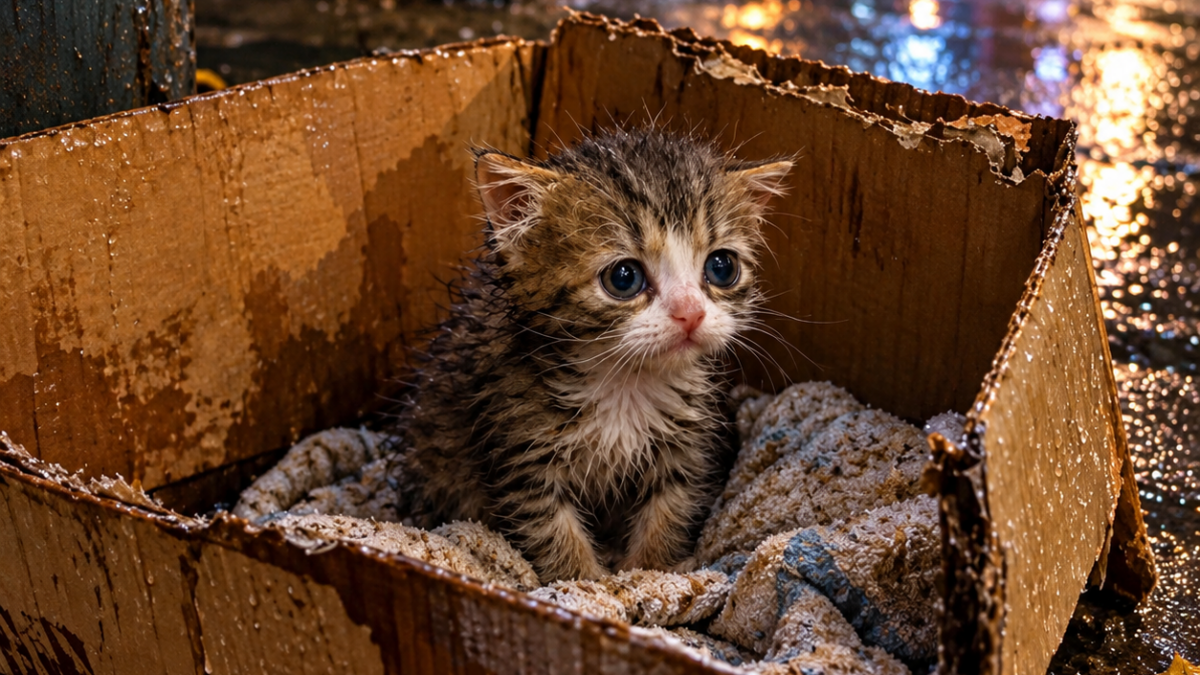
PART 2
For several seconds, I stood in the rain staring at that light.
Apartment 214.
The kitten shifted weakly against my chest.
That snapped me back.
Whoever lived in 214 could wait.
The kitten couldn’t.
I carried him into my building, took the stairs two at a time, and nearly dropped my keys trying to unlock my apartment.
The moment I got inside, I turned the thermostat up and carried him into the bathroom.
I had never rescued a newborn animal before.
I knew enough to understand that warming him mattered, but not enough to trust myself with the details.
So I called the nearest emergency veterinary clinic.
A woman answered on the second ring.
“Emergency veterinary services. What’s happening?”
“I found a kitten outside.”
“How old?”
“I don’t know. Maybe four weeks. Maybe less.”
“Is he breathing?”
“Yes.”
“Alert?”
“Barely.”
“Was he exposed to the rain?”
“He was in a cardboard box by the dumpsters.”
Her voice sharpened.
“How cold does he feel?”
“Very.”
“All right. Do not feed him yet.”
I had already been reaching for a can of tuna.
I froze.
“Why?”
“If he’s hypothermic, feeding too early can cause problems. Warm him gradually. Do you have towels?”
“Yes.”
“A heating pad?”
“No.”
“Hot water bottle?”
“Yes.”
“Wrap it in a towel. Warm, not hot. Keep it beside him, not directly against bare skin. Can you bring him in?”
“Yes.”
“How far away are you?”
“Fifteen minutes.”
“Come now.”
I wrapped the kitten in two dry towels, placed the warm bottle beside him inside a laundry basket, and covered part of the top to hold in heat.
Before leaving, I looked at the ruined box sitting near my front door.
Apartment 214.
My phone said 12:49 a.m.
I took photographs of the box and label.
Then I left.
The emergency clinic was twenty minutes away because of the rain.
I drove thirteen.
The kitten barely moved.
At every red light, I reached into the basket and touched the towel over his body.
“Stay with me.”
Nothing.
“Come on.”
A faint movement.
“Good.”
I kept talking.
I told him things he couldn’t possibly understand.
That my apartment had terrible water pressure.
That I hated my boss’s new scheduling system.
That I had once killed a cactus despite being told they were impossible to kill.
Anything to keep my own fear from taking over.
When I reached the clinic, a technician was waiting at the door.
She took the basket from me immediately.
“What name?”
“I don’t know.”
“For you.”
“Oh. Laura Bennett.”
She nodded toward the kitten.
“For him.”
“He doesn’t have one.”
“We can put ‘stray kitten’ for now.”
I hated the phrase.
Stray.
He hadn’t looked stray.
He had looked discarded.
“I found him in a box.”
The technician looked at me.
“Someone left him?”
“I think so.”
She didn’t answer.
She disappeared through swinging doors.
I stood there in wet clothes, hands empty.
That was somehow worse than holding him.
A receptionist gave me a towel.
“You’re soaked.”
“I didn’t notice.”
“You can sit.”
I did.
At 1:17, a veterinarian came out.
Dr. Hannah Cole.
Late thirties.
Dark hair pulled back.
Expression calm in the way people learn to look when they’re about to tell someone something difficult.
“Laura?”
I stood.
“How is he?”
“He’s alive.”
I exhaled.
“But he’s in serious condition.”
I sat again.
She pulled up a chair.
“He’s severely hypothermic, dehydrated, underweight, and his blood glucose is low. I estimate he’s between four and five weeks old.”
“Can you save him?”
“We’re treating him.”
“That wasn’t my question.”
She held my gaze.
“We have a reasonable chance, but he’s fragile.”
I swallowed.
“Do whatever you have to.”
“Do you own him?”
“No.”
That word hurt more than expected.
“I found him.”
“If he’s a stray, we’ll need to discuss surrender or rescue placement.”
“I’m paying.”
She paused.
“Laura—”
“I’m paying for tonight.”
“You understand emergency care can become expensive.”
“I understand.”
I didn’t.
Not really.
At that moment, I would have signed almost anything.
“What do you need?”
She handed me a form.
I signed.
Then I remembered the box.
“I think I know where he came from.”
Dr. Cole stopped.
“What do you mean?”
I showed her the photograph of the label.
Her eyes narrowed.
“Did you speak to whoever lives there?”
“No.”
“Good.”
I looked at her.
“Good?”
“If someone intentionally abandoned a kitten in those conditions, you don’t know how they’ll react when confronted.”
“I wasn’t planning to confront them.”
She gave me a look.
“What?”
“You have a face.”
“What face?”
“The face of someone planning to confront them.”
I looked away.
“All right. Maybe.”
“Call animal control in the morning.”
“I have their apartment number.”
“Photograph everything. Keep the box. Don’t alter the label.”
“Why?”
“Because if this becomes an investigation, documentation matters.”
Investigation.
Until that moment, I had thought of the kitten as an emergency.
Now I was thinking about a person.
Somebody had put him there.
Somebody had closed those cardboard flaps.
Somebody had carried him through the rain.
Or worse, before the rain began.
I asked, “How long would he have lasted?”
Dr. Cole’s expression shifted.
“I can’t give you an exact number.”
“If I hadn’t heard him?”
She didn’t answer.
She didn’t need to.
At 2:00 a.m., I was still in the waiting room.
At 2:40, Dr. Cole returned.
His temperature had improved.
Blood sugar responding.
No obvious fractures.
No immediate sign of severe respiratory failure.
“He’s fighting,” she said.
I nodded.
“Can I see him?”
“For a minute.”
He was inside a small heated enclosure.
Dry now.
His fur had begun to fluff.
He looked even smaller.
Black coat with a little white patch beneath his chin.
One paw had an IV catheter.
His eyes were closed.
I put one finger against the plastic.
“Hey.”
His ear moved.
That tiny movement destroyed me.
“I’m still here.”
Dr. Cole stood beside me.
“You should go home.”
“I can stay.”
“He needs several hours.”
“I can stay.”
She sighed.
“There’s a chair.”
I slept for maybe forty minutes.
At 6:15, my phone alarm went off because I’d forgotten to disable it.
I opened my eyes confused.
Then remembered.
Kitten.
Box.
Apartment 214.
I checked with the desk.
He was stable.
Not safe.
Stable.
That word would become important to me.
Stable wasn’t cured.
Stable wasn’t guaranteed.
Stable simply meant we had more time.
I drove home as dawn began turning the sky gray.
The rain had stopped.
The cardboard box was exactly where I’d left it inside my apartment.
I put on gloves and examined it more carefully.
The shipping label was from a pet supply company.
That made me stop.
Pet supply.
The recipient name was damaged.
Only the last letters survived.
**…SON**
Apartment 214.
Building C.
I photographed it again.
Then I called animal control.
They transferred me twice before I reached an officer named Maria Sanchez.
I explained everything.
She asked careful questions.
“What time did you find the kitten?”
“About 12:34.”
“Exact location?”
“Behind the north dumpster between Buildings B and C.”
“Inside a box?”
“Yes.”
“Closed?”
“Partially. The flaps were folded.”
“Any food or bedding?”
“No.”
“Any other animals nearby?”
“None I saw.”
“Was the box labeled?”
“Yes.”
I sent her the photographs.
She became quieter.
“Keep the box.”
“The vet said the same thing.”
“Good.”
“Are you going to Apartment 214?”
“Eventually.”
“Eventually?”
“We need to verify who lives there and whether that box actually came from that apartment.”
“It has the address.”
“It proves the box was delivered there at some point.”
I knew what she meant.
Anyone could have reused it.
Still, frustration rose.
“So that’s it?”
“No.”
“Because somebody left a kitten outside in freezing rain.”
“I heard you.”
Her voice wasn’t defensive.
Just steady.
“We do this carefully because careful cases hold up later.”
That shut me up.
“Okay.”
“Do you have cameras in the parking lot?”
I looked toward my window.
One camera over the Building C entrance.
Another above the leasing office.
“I think so.”
“Don’t ask management to erase anything.”
“I wasn’t planning to.”
“Ask them to preserve footage from roughly ten p.m. to one a.m. Tell them animal control may request it.”
My pulse increased.
“You think the camera caught something?”
“I think cameras catch what they’re pointed at. We won’t know until we look.”
At 8:00, the leasing office opened.
I was waiting outside.
The property manager, Denise Harper, unlocked the door and nearly dropped her coffee when she saw me.
“Laura?”
“I need security footage.”
“Good morning to you too.”
“Sorry. Good morning. I need security footage.”
She stared at my wet hair and yesterday’s clothes.
“What happened?”
I told her.
Her expression changed completely.
“A kitten?”
“In a box.”
“Jesus.”
“Apartment 214 is on the shipping label.”
Denise looked toward Building C.
“I can’t give you tenant information.”
“I’m not asking for it.”
“You kind of are.”
“I’m asking you not to erase footage.”
“That I can do.”
She opened the office and sat at her computer.
Our complex cameras didn’t cover everything.
The dumpster itself was partly blocked by a row of garages.
But the walkway from Building C to the parking lot was visible.
Denise clicked through the software.
“What time?”
“I found him at 12:34.”
“We can start at ten.”
We watched accelerated footage.
People coming home.
A delivery driver.
A couple walking a dog.
Rain getting heavier.
11:03.
Nothing.
11:27.
A man crossed toward the parking lot carrying an umbrella.
11:48.
A woman in a hooded sweatshirt walked out of Building C.
My hand touched Denise’s arm.
“Wait.”
She stopped playback.
The woman was carrying something.
A box.
My heart began hammering.
“Can you zoom?”
“Not much.”
She enlarged the image.
The woman held a cardboard box against her body.
One flap was partly open.
She crossed out of camera range toward the dumpsters.
Time stamp:
11:48:17 p.m.
At 11:51:04, she came back.
Without the box.
Denise and I looked at each other.
“Save that.”
“I am.”
“Can you identify her?”
Denise hesitated.
“Yes.”
My stomach tightened.
“Who?”
“I can’t tell you.”
“Denise.”
“Laura, I legally cannot start handing out tenant information.”
“Is she from 214?”
Silence.
That was enough.
I stood.
“Don’t.”
I looked at Denise.
“Don’t what?”
“Go over there.”
“I wasn’t going to.”
“You’re terrible at lying.”
“Apparently everybody tells me that.”
She exported the footage and called Maria.
While we waited, my phone rang.
The veterinary clinic.
My stomach dropped so quickly that I nearly couldn’t answer.
“Hello?”
“Laura, this is Hannah.”
I gripped the desk.
“How is he?”
“Better.”
I closed my eyes.
“Better?”
“His temperature is normal. Blood sugar is stable. He’s eaten a very small amount.”
My knees weakened.
Denise pulled out a chair.
I sat.
“Can I come?”
“Yes.”
“Right now?”
“Yes.”
I was out the door before Dr. Cole finished the sentence.
When I reached the clinic, the kitten was awake.
Not fully.
But awake.
His eyes followed movement.
Dr. Cole lifted him carefully.
“He’s stronger.”
I held out my hands.
“Can I?”
“Sit first.”
I sat.
She placed him against my chest wrapped in a towel.
He weighed almost nothing.
His body was warm now.
Warm.
I hadn’t understood how much that mattered until then.
He sniffed my shirt.
Then made a tiny sound.
Not fear.
Complaint.
I laughed.
“You’re louder today.”
Dr. Cole smiled.
“He’s opinionated.”
“Good.”
The kitten moved his head beneath my chin.
“What happens now?”
“If he continues improving, he could leave tomorrow or the following day.”
“With me?”
“If animal control and the sheltering authority approve foster placement.”
“I want him.”
She tilted her head.
“You met him eight hours ago.”
“I know.”
“You’ve had no sleep.”
“I know.”
“He may have parasites. He’ll need vaccines, neutering later, follow-up care. Kittens are destructive.”
“I own curtains I don’t like.”
She laughed.
“I’ll note your commitment.”
I stroked one finger along his head.
He closed his eyes.
“What do I call him?”
“You tell me.”
Outside the treatment room, rainwater dripped from someone’s umbrella.
I thought about the sound that had stopped me.
That tiny voice under the box.
“Whisper.”
Dr. Cole smiled.
“Whisper?”
“That’s what saved him.”
She wrote it down.
For the first time, the words on his chart weren’t **stray kitten**.
They were:
**Whisper Bennett.**
I took a picture.
Then Maria called.
“Laura.”
“Yes?”
“I received the security footage.”
“You saw her?”
“Yes.”
“Who is she?”
“I can’t discuss identifying details yet.”
“Denise knows.”
“That doesn’t change the process.”
I pressed my lips together.
Maria continued.
“We’re going to speak with the resident.”
“Today?”
“Yes.”
“Can I be there?”
“No.”
“Why?”
“Because you’re a witness.”
“I found him.”
“Exactly.”
I looked down at Whisper.
His tiny paw rested against my wrist.
“Call me after.”
“I will.”
She paused.
“And Laura?”
“Yes?”
“Do not contact Apartment 214.”
“I won’t.”
I meant it.
At least I thought I did.
I went home and slept for three hours.
At 1:17 p.m., pounding on my apartment door woke me.
Not knocking.
Pounding.
I sat upright.
Again.
Three hard blows.
“Laura Bennett!”
A woman’s voice.
My pulse jumped.
I got out of bed and approached without opening.
“Who is it?”
“You know who it is.”
I didn’t.
Then she said:
“You got animal control called on me.”
Apartment 214.
I looked through the peephole.
Woman.
Maybe early thirties.
Brown hair pulled back.
Black rain jacket.
The same build as the figure in the security footage.
She pounded again.
“Open the door.”
“No.”
“You stole my cat.”
I froze.
Your cat.
I unlocked my phone and started recording audio.
“What did you say?”
“You heard me.”
“The kitten in the box?”
“He belongs to me.”
My anger rose so fast I had to grip the door frame.
“He was behind the dumpster.”
“Because I put him there temporarily.”
I stared through the peephole.
“Temporarily.”
“Yes.”
“In thirty-eight-degree rain?”
“I was coming back.”
“When?”
She didn’t answer.
I said, “He was hypothermic.”
“He was fine when I left him.”
“You put a four-week-old kitten in a wet box at midnight.”
“It wasn’t wet then.”
That sentence mattered.
Very much.
I went completely still.
The box wasn’t wet then.
She had just placed herself there before the rain soaked it through.
I asked, “What’s your name?”
“You know my name.”
“I don’t.”
Silence.
“Kelly.”
“Kelly what?”
“This is ridiculous.”
She stepped closer to the door.
“Give me the kitten.”
“He’s at the veterinary hospital.”
That stopped her.
“Why?”
“Because he almost died.”
Silence.
Then:
“I can’t afford a huge vet bill.”
I almost laughed.
Not because it was funny.
Because that was her concern.
“I’m not asking you to pay it.”
“You’d better not.”
I closed my eyes.
“Why did you leave him?”
“He wouldn’t eat.”
“What?”
“He was sick all the time. My kids were upset. I called places and nobody wanted him.”
“So you put him beside the trash?”
“I figured somebody would find him.”
“At midnight?”
“People are always going past.”
“Not in that weather.”
“I didn’t know it would get that bad.”
“There was a storm warning all evening.”
“Stop acting like I’m some monster.”
Her voice cracked.
For the first time, I heard something besides anger.
Panic.
“I have three kids,” she said. “I work two jobs. The mother cat had five kittens. I found homes for four. Nobody wanted the sick one.”
Sick one.
Whisper.
“So you left the one who needed help most.”
“I had no options.”
“You had a phone.”
“No rescue would take him.”
“Did you call animal control?”
“They said they were full.”
“Did you call a vet?”
“With what money?”
That question hit harder than I expected.
Not because it excused her.
It didn’t.
But reality had entered the room.
Money.
Children.
Too many animals.
Bad decisions made under pressure.
Still.
There are lines.
And she had crossed one.
“You could have surrendered him in the morning.”
“They charge fees.”
“Not always.”
“You don’t know my situation.”
“No.”
I looked toward the empty carrier I’d bought on the way home.
“But I know his temperature was dangerously low.”
She didn’t answer.
“You know what the veterinarian told me?”
“What?”
“If I hadn’t heard him, he probably wouldn’t have survived much longer.”
The hallway went quiet.
When Kelly spoke again, her voice was lower.
“I thought somebody would pick him up.”
I almost opened the door.
Not to fight.
To look at her directly.
I didn’t.
“Go home, Kelly.”
“I want my cat.”
“He’s under veterinary care.”
“He’s mine.”
“Tell animal control.”
“They already came.”
Good.
“What did you tell them?”
“That he got out.”
My hand tightened around the phone.
“What?”
Silence.
“You told them he escaped?”
“They were accusing me.”
“But you just told me you put him there.”
“I was upset.”
“You’re still being recorded.”
Silence.
Complete.
Then she stepped back from the door.
“You’re recording me?”
“Yes.”
“Delete it.”
“No.”
“You can’t do that.”
“I’m standing inside my own apartment while you’re pounding on my door.”
“Delete it!”
“No.”
She slammed her palm against the door.
I jumped.
“Kelly, leave.”
“You think you’re better than me?”
“No.”
“Yes, you do.”
“I think Whisper deserved better.”
“His name isn’t Whisper.”
“It is now.”
She said something under her breath.
Then her footsteps moved away.
I stood behind the locked door for another minute.
My hands shook.
Then I called Maria.
“She’s been here.”
“What?”
I played the recording.
Maria didn’t interrupt.
When it ended, she said, “Send that to me.”
“I already am.”
“You okay?”
“Yes.”
“Door locked?”
“Yes.”
“Don’t engage her again.”
“I didn’t open it.”
“Good.”
“Does this prove it?”
“It proves a lot.”
That phrase gave me no satisfaction.
I was too tired.
“What happens to her?”
“We investigate. The prosecutor decides whether charges are appropriate. Animal ownership may be restricted. The housing issue is separate.”
“I don’t want her kids thrown out.”
Maria paused.
“I didn’t say anything about that.”
“I know.”
“You’re thinking ahead.”
“Yes.”
“Don’t.”
Easier said than done.
The next day Whisper came home with me as an emergency foster.
He fit inside one hand.
I had converted my bathroom into something resembling a kitten nursery.
Low-sided litter tray.
Blankets.
Heating pad under half the bedding.
Tiny bowls.
Food recommended by Dr. Cole.
Medicine schedule taped to the mirror.
I sat on the floor and opened the carrier.
Whisper stared at me.
“Welcome to your luxury accommodations.”
Nothing.
“The rent is unreasonable.”
He stepped out.
One paw.
Then another.
He sniffed the towel.
Walked toward the food.
Stopped.
Looked back at me.
“You’re safe.”
He ate.
I cried.
Not dramatically.
Just sat there while tears ran down my face because twenty-four hours earlier I’d held a cold body and begged it not to stop breathing.
Now he was eating.
Tiny bites.
Messy.
Alive.
For three days, my entire life revolved around him.
Feedings.
Medication.
Cleaning.
Watching his breathing.
Checking whether he’d used the litter box.
Panicking every time he slept too deeply.
Calling Dr. Cole about things she assured me were normal.
“His ears feel cool.”
“Laura.”
“What?”
“Cats’ ears can feel cool.”
“He sneezed.”
“One sneeze?”
“Yes.”
“Call me if it becomes frequent.”
“He made a strange noise.”
“What kind?”
“Like ‘rrrp.’”
“That is called being a cat.”
She became less patient by day three.
I liked her more because of it.
Whisper gained weight.
Slowly.
His personality emerged with his strength.
He attacked shoelaces.
Climbed towels.
Slept inside my sweatshirt.
Discovered that my feet moved under blankets and treated them like prey.
The kitten who had been too weak to resist being lifted now bit my thumb because breakfast was four minutes late.
It was wonderful.
Then Kelly’s story became more complicated.
Maria called me a week later.
“We found the mother cat.”
I sat upright.
“Where?”
“In Kelly’s apartment.”
My stomach tightened.
“And the other kittens?”
“Two remain there.”
“She told me she found homes for four.”
“That appears to have been untrue.”
“How many kittens were there?”
“Five total, including Whisper.”
“So three were still there when she said—”
“Yes.”
“Are they okay?”
“Not ideal, but not in Whisper’s condition.”
“What does that mean?”
“The mother is underweight. Flea burden. One kitten has an eye infection. We’re arranging veterinary evaluation.”
“Why wasn’t Whisper with them?”
Maria hesitated.
“Kelly says the mother rejected him.”
“That can happen.”
“Yes.”
“So maybe she really couldn’t get him to eat.”
“Maybe.”
I waited.
“But?”
“We found messages.”
“What messages?”
“She had posted the kittens for sale online.”
My stomach sank.
“Sale?”
“Fifty dollars each.”
“Whisper too?”
“Yes.”
“Anybody interested?”
“Someone asked about him.”
“And?”
“Kelly disclosed that he was smaller and had trouble eating. The buyer declined.”
I closed my eyes.
“So when she couldn’t sell him…”
“I didn’t say that.”
“You don’t have to.”
“Laura.”
“I know. Careful cases.”
“Yes.”
“What happens now?”
“The other cats were removed temporarily pending evaluation.”
“Her kids?”
“Upset.”
That hit me.
Children always stand somewhere near the edges of adult failures.
“What ages?”
“Eight, ten, and thirteen.”
I pictured them coming home to empty rooms.
“Did they know about Whisper?”
Maria paused again.
“Yes.”
“What did she tell them?”
“That someone adopted him.”
I sat very still.
She hadn’t merely carried Whisper outside.
She had gone back upstairs and told her children he had been chosen.
For some reason, that lie angered me almost as much as the box.
Maybe because it meant she knew exactly what her children would think if they learned the truth.
“There’s more,” Maria said.
I almost laughed.
“Of course there is.”
“Her oldest child spoke to the officer.”
“And?”
“He said Kelly tried to give Whisper away to a man in the parking lot that afternoon.”
“Who?”
“Unknown.”
“What happened?”
“The man apparently looked at the kitten and said he looked sick.”
“And refused.”
“Yes.”
“So she tried.”
“Yes.”
That mattered.
Again.
Nothing wanted to stay simple.
Kelly had tried to rehome him.
She had called places.
She had financial problems.
She had three children.
She was overwhelmed.
Then, at some point, overwhelmed became justification.
That mattered too.
A bad situation can explain a decision without making it acceptable.
I understood that more every day.
Two weeks later, Kelly was formally cited under local animal cruelty and abandonment provisions. The case moved through municipal channels rather than becoming the dramatic felony prosecution my angry imagination had initially constructed.
There were hearings.
Reports.
Veterinary statements.
Security footage.
My recording.
Photographs.
The shipping label.
The more evidence accumulated, the less Kelly denied.
But she didn’t apologize.
Not at first.
She did something else.
She blamed me publicly.
I discovered it because a coworker sent me a screenshot.
A neighborhood Facebook group.
Kelly had posted:
**A stranger stole my children’s kitten and is now trying to get me prosecuted because I couldn’t afford emergency veterinary care.**
I stared at the words.
Below it were dozens of comments.
Some supporting her.
Some angry.
Some asking questions.
Then came the part that made my hands cold.
She had posted my first name.
My building.
Not my exact unit.
But close enough.
I called Maria.
“She put this online.”
“Send it.”
“I want to answer.”
“Don’t.”
“She called me a thief.”
“Don’t answer.”
“She said I stole him.”
“Laura.”
“What?”
“Evidence doesn’t become stronger because you argue with people on Facebook.”
I hated how reasonable everyone in this process was.
“What am I supposed to do?”
“Save screenshots.”
“That’s it?”
“For now.”
I saved them.
Then I closed the app.
For approximately twelve minutes.
When I opened it again, the post had grown.
Kelly added a comment:
**She has money and thinks that makes her better than people who struggle.**
That hurt more than the thief accusation.
Because I wasn’t wealthy.
I wasn’t even particularly comfortable.
Whisper’s emergency bill had gone onto a credit card.
I was picking up overtime to pay it.
But none of that mattered online.
Stories flatten people.
Rescuer.
Monster.
Rich woman.
Poor mother.
Victim.
Villain.
Reality was messier.
The comments became uglier.
One person called me heartless for taking a child’s pet.
Another asked why Kelly left a kitten outdoors in freezing rain.
Kelly replied:
**It was sheltered and I planned to return.**
Sheltered.
The cardboard box had partially collapsed from water.
I took a photograph of it.
Then stopped myself.
No.
Maria was right.
The case would speak where it mattered.
Still, something unexpected happened.
A woman named Megan Price commented beneath Kelly’s post.
**Kelly, this isn’t the first kitten from Luna’s litter you tried to abandon. Stop lying.**
The thread exploded.
Kelly deleted the comment.
Too late.
I had screenshotted it.
So had three other people.
I sent it to Maria.
“Who is Megan?”
“I don’t know.”
Maria found out.
Megan lived two buildings away.
She had known Kelly for years.
More importantly, she had photographs.
A week before Whisper was found, Megan had seen a cardboard carrier sitting outside Kelly’s door containing two kittens.
She asked what was happening.
Kelly said she was waiting for someone to pick them up.
No one came.
Megan helped bring them back inside.
According to her statement, Kelly had said:
“I can’t keep feeding cats nobody wants.”
That sentence became important later.
Not because feeding five kittens was easy.
It wasn’t.
Because the kittens hadn’t appeared from nowhere.
The mother, Luna, had belonged to Kelly for three years and had never been spayed.
Animal control records showed she had produced at least one prior litter.
The previous year, neighbors remembered kittens being given away in the parking lot.
I felt my sympathy narrow.
Not disappear.
Narrow.
Being overwhelmed once was one thing.
Repeating the same preventable situation and letting the weakest animal pay for it was another.
Whisper, meanwhile, had no interest in any of this.
He learned to jump.
Badly.
He launched himself at the couch, missed, clung to the fabric, and slowly slid down while glaring at me as if gravity were my invention.
He gained nearly a pound.
His eyes brightened.
His coat became glossy black.
The little white patch beneath his chin looked like he’d dipped his face in milk.
At six weeks, he discovered my Christmas tree.
At seven weeks, he nearly destroyed it.
At eight weeks, Dr. Cole pronounced him “an impressively irritating healthy kitten.”
I took that as excellent news.
Then came the hearing.
Kelly was there.
So was I.
Maria.
Dr. Cole.
Megan.
The apartment complex manager, Denise.
Kelly had an attorney through a legal aid organization.
I was surprised.
Then embarrassed that I was surprised.
Everyone deserves representation.
Even people we’re angry with.
The hearing room was ordinary.
Fluorescent lights.
Plastic chairs.
A seal on the wall.
Nothing cinematic.
But my hands shook anyway.
Kelly sat across the aisle.
For the first time since she’d come to my door, I saw her children.
Three of them.
The youngest held a stuffed cat.
I looked away.
This was not their fault.
The evidence was presented.
Security footage first.
11:48 p.m.
Kelly leaving Building C holding the box.
11:51.
Returning empty-handed.
Her attorney argued that she had intended to place the kitten temporarily in a sheltered area while waiting for someone who had expressed interest.
Maria’s notes documented no evidence of any scheduled pickup.
Then my recording played.
Kelly’s voice filled the room.
**“He was fine when I left him.”**
Then:
**“The box wasn’t wet then.”**
The hearing officer looked toward Kelly.
Her attorney stopped taking notes.
Then came:
**“I figured somebody would find him.”**
I watched Kelly’s face.
She stared at the table.
The veterinary photographs appeared next.
Whisper at intake.
Wet.
Hypothermic.
Underweight.
Eyes half closed.
I hadn’t seen some of those photographs.
My throat tightened.
Dr. Cole testified.
She remained clinical.
That made the details stronger.
Body temperature.
Blood glucose.
Hydration.
Weight.
Estimated duration of exposure.
Risk of death.
No theatrics.
Just facts.
Then Kelly testified.
At first, she repeated the same story.
She had been overwhelmed.
Rescues were full.
Veterinary care was expensive.
Whisper wouldn’t nurse properly.
She had three children.
She worked long hours.
All true or partly true.
Then the hearing officer asked:
“Why did you place the kitten behind the dumpster rather than inside the building entryway?”
Kelly hesitated.
“Pets aren’t allowed in common areas.”
“So you believed violating the apartment rule was more serious than leaving a four-week-old kitten outside?”
Her attorney objected to the phrasing.
The hearing officer reworded.
Kelly said, “I wasn’t thinking.”
That may have been the truest sentence she spoke.
Megan testified next.
Then Denise.
Then me.
Kelly’s attorney asked:
“Ms. Bennett, you dislike my client.”
“I don’t know her well enough to dislike her.”
“You called animal control.”
“Yes.”
“You preserved evidence against her.”
“Yes.”
“You recorded her without informing her at first.”
“She was pounding on my door.”
“You also kept the kitten.”
“I fostered him through the authorized process.”
“And you intend to adopt him.”
“Yes.”
“So you benefit personally from my client losing ownership.”
I understood what he was doing.
It still made me angry.
“I benefit?”
“You gain possession of the kitten.”
I looked toward the hearing officer.
Then back at him.
“I gained a veterinary bill, four weeks of interrupted sleep, holes in my curtains, and a cat who attacks my ankles at five in the morning.”
A few people laughed.
The attorney didn’t.
I continued.
“I also gained him alive. That’s enough.”
He paused.
Then asked, “Did you ever offer to return Whisper after he recovered?”
“No.”
“Why not?”
“Because animal control told me not to.”
“Would you have?”
I thought about it.
“No.”
“Why?”
“Because she left him outside.”
Kelly looked at me.
For the first time, our eyes met.
There wasn’t hatred in hers.
There was something worse.
Shame.
The ruling came several weeks later.
Kelly lost ownership of Whisper and the remaining animals.
Luna, the mother cat, was spayed through the rescue program and eventually adopted by an older couple.
The two healthier kittens went to separate homes.
Kelly received fines, mandatory animal-care education, and restrictions on owning additional animals for a period determined by local authorities.
The complex did not evict her.
I was relieved.
Her children didn’t deserve to lose their home.
What did happen was more fitting.
Denise changed the lease policy for the entire complex.
Residents struggling with unexpected litters could contact management confidentially and receive a list of low-cost spay/neuter programs, shelters, and emergency foster networks.
The leasing office also partnered with a local rescue to hold two weekend clinics each year.
Kelly’s bad decision ended up exposing a gap none of us had thought about.
Consequences didn’t have to stop at punishment.
Sometimes they could close the door behind the next person before they made the same mistake.
That should have been the end.
It wasn’t.
Three months after the hearing, somebody knocked on my door.
Softly this time.
I checked the peephole.
Kelly.
I almost didn’t open.
Then I saw her oldest son standing beside her.
Thirteen.
Thin kid.
Hands shoved into sweatshirt pockets.
I opened the door but kept the chain on.
“What do you need?”
Kelly looked different.
Tired.
No anger.
Her son stared at the floor.
“I wanted to ask something.”
“What?”
“Is Whisper here?”
My body tightened automatically.
Kelly saw it.
“I’m not asking for him back.”
I said nothing.
Her son finally looked up.
“Can I see him?”
That question hit me differently.
I looked at Kelly.
“Why?”
Her son answered.
“Because she told us somebody adopted him.”
Kelly closed her eyes.
“I found out later,” he continued. “About the box.”
I looked at him.
“How?”
“Kids at school.”
Of course.
The internet again.
He swallowed.
“I thought he died.”
Kelly touched his shoulder.
He moved away slightly.
That small motion told me more about their household than anything she could have explained.
“Wait here.”
I closed the door.
Whisper was asleep on the sofa.
Nine months old now.
Longer body.
Bright yellow-green eyes.
Still black except for the white chin.
I picked him up.
He immediately complained.
“Be polite.”
More complaint.
I opened the door and removed the chain.
The boy’s face changed.
“Oh.”
Whisper stared at him.
The boy crouched.
“Hey, little guy.”
Whisper sniffed his fingers.
Then walked directly into his lap.
The boy made a sound halfway between a laugh and a sob.
Kelly looked away.
I suddenly felt very tired of anger.
The boy stroked Whisper carefully.
“I used to feed him with a dropper.”
I looked at Kelly.
That was new.
“He wouldn’t nurse,” she said quietly.
Her son nodded.
“He was the smallest.”
“So you cared for him?”
“For a while.”
He looked at Whisper.
“Mom said he found a home.”
Kelly’s jaw tightened.
“I was ashamed.”
Her son didn’t respond.
Neither did I.
After several minutes, he stood.
Whisper immediately climbed my jeans.
I picked him up.
The boy smiled.
“He likes you.”
“He tolerates me.”
“No. He likes you.”
I looked at Kelly.
“Why are you really here?”
She exhaled.
“To apologize.”
I waited.
She had rehearsed something.
I could tell.
Then she abandoned the rehearsal.
“I was angry at you because you found him.”
That surprised me.
“Why?”
“Because if you hadn’t, I could have kept telling myself somebody probably picked him up.”
I said nothing.
“You found him before I could turn what I did into something nicer in my head.”
That was one of the most honest things anyone had said through the entire case.
“I was drowning,” she continued. “Bills. Kids. Work. Cats. Everything.”
“I know.”
“No, you don’t.”
Her tone sharpened.
Then softened immediately.
“Sorry.”
I didn’t take offense.
She continued.
“I kept telling myself I had no choice.”
“You had bad choices.”
She looked at me.
“Yes.”
“That’s different.”
Her eyes filled.
“I know that now.”
I shifted Whisper in my arms.
He began licking his paw.
“Why the dumpster?”
Kelly covered her face for a second.
“When I put the box down, I told myself it was sheltered behind the wall.”
“It wasn’t.”
“I know.”
“You knew rain was coming.”
“I thought somebody would hear him.”
“That’s not a plan.”
“I know.”
“Did you go back?”
She nodded.
My breath caught.
“When?”
“About one.”
I stared at her.
“You came back?”
“Yes.”
“Why?”
“I couldn’t sleep.”
My pulse increased.
“What happened?”
“There were lights near the dumpster. Then I saw your car leave.”
She had watched me take him.
“You saw me?”
“From my window.”
“And you didn’t come down.”
She looked at the floor.
“No.”
“Why?”
“Because I knew.”
“Knew what?”
“That if I came down and said he was mine, I’d have to explain why he was there.”
The hallway became silent.
The boy looked at his mother.
I watched something settle across his face.
Not shock.
Maybe confirmation.
Kelly wiped her cheeks.
“I watched your car drive away.”
That was the missing piece.
For months, I had imagined Whisper alone until the second I found him.
But Kelly had been upstairs.
Awake.
Watching.
That made me angry again.
Deeply.
“You could have stopped me.”
“I know.”
“You could have told me his age. His feeding problem. Anything.”
“I know.”
“You let me drive him away thinking nobody knew he existed.”
She nodded.
I wanted to shut the door.
Maybe I should have.
Instead I looked at her son.
He was crying silently.
And suddenly I understood that any revenge I could give Kelly had already become smaller than the truth she now had to live with inside her own home.
Her children knew.
Not rumors.
Not my version.
Hers.
That consequence would last longer than a fine.
I said, “Whisper almost died.”
Kelly nodded.
“I know.”
“No. I need you to hear it again.”
She looked at me.
“He almost died.”
“I know.”
“If I hadn’t stopped—”
“I know.”
Her voice broke.
“I know.”
I let the silence stay.
Then I said, “I accept your apology.”
She blinked.
“But that doesn’t make what happened okay.”
“I understand.”
“And I’m not your absolution.”
Her face tightened.
“I know.”
“Good.”
Her son bent and kissed Whisper’s head.
Whisper tolerated it for approximately two seconds before biting his hoodie string.
The boy laughed through tears.
That sound changed the hallway.
Not enough to make it happy.
Enough to make it human again.
They left.
Whisper watched them go.
Then turned toward me and meowed.
“What?”
Another meow.
“You’ve eaten.”
He meowed louder.
“You are living evidence that gratitude is temporary.”
He walked toward the kitchen.
I followed.
A year passed.
Then another.
Whisper became a magnificent, irritating adult cat.
He grew larger than anyone expected.
Dr. Cole said malnourished kittens sometimes surprise you once they’re given a proper chance.
He developed a habit of sitting on top of my refrigerator like a gargoyle.
He hated closed bathroom doors.
He slept across my neck.
He stole bread.
Not meat.
Bread.
I couldn’t explain it.
During storms, however, something changed.
The first time heavy rain hit the windows after he became an adult, Whisper disappeared.
I searched everywhere.
Bedroom.
Closet.
Bathroom.
Under the sofa.
Finally I found him beneath the guest bed.
Crouched low.
Eyes wide.
I lay on the floor.
“Hey.”
He didn’t move.
Thunder rolled.
He flattened himself.
I stayed there.
Didn’t reach for him.
Didn’t force him out.
I just talked.
The same way I’d talked during the drive to the emergency clinic.
About work.
About my terrible cooking.
About nothing.
After twenty minutes, he crawled forward.
One paw.
Then another.
Eventually he pressed against my arm.
I understood then that bodies remember what minds can’t explain.
Maybe he didn’t remember the box.
Maybe he remembered cold.
Or sound.
Or rain.
Maybe I was projecting.
It didn’t matter.
He needed safety.
I stayed.
Three years after the night I found him, the apartment complex built a small covered pet-relief area near the back parking lot.
The dumpsters were moved.
Better lighting installed.
Additional security camera added.
The rescue partnership continued.
Denise kept a stack of low-cost spay-and-neuter vouchers beside the leasing brochures.
One afternoon she called me into the office.
“Look.”
A framed photograph sat on her desk.
Whisper at six months old.
I had sent it to her.
Beneath it was a little sign:
**Found behind Building C — November 17**
I frowned.
“Why is my cat office decoration?”
“He’s community history.”
“He thinks he’s royalty.”
“Same thing.”
A young woman sitting across the office looked at the photograph.
“That’s the dumpster kitten?”
I looked at her.
“You’ve heard of him?”
“Everybody’s heard of him.”
I groaned.
Whisper had become local folklore.
The young woman smiled.
“My cat just had kittens.”
I immediately looked at Denise.
Denise pointed to the vouchers.
The woman laughed.
“I already scheduled the mom to be spayed. I came for foster contacts.”
I stopped.
“Oh.”
She picked up a paper.
“I’m not leaving them outside.”
The sentence wasn’t aimed at anyone.
Still, it landed.
Denise glanced at me.
I looked at Whisper’s photograph.
That felt like the closest thing to revenge I ever needed.
Not Kelly suffering.
Not strangers attacking her online.
Not punishment multiplied until everyone felt righteous.
The real victory was that three years later, another overwhelmed person stood in the same office with too many kittens and a problem she couldn’t afford—and this time there was a path that didn’t end beside a dumpster.
Kelly moved out eventually.
Before she did, she left an envelope with Denise.
My name was on it.
Inside was a veterinary gift card.
Three hundred dollars.
And a note.
Two sentences.
**For the next animal you stop for.**
**I should have stopped for mine.**
I sat in my car holding that note for a long time.
I didn’t cry.
I didn’t feel triumphant.
I just understood that sometimes remorse arrives long after consequence.
I used the gift card six months later.
Not for Whisper.
For a senior orange cat found injured near a shopping center.
Different story.
Different animal.
Same clinic.
Dr. Cole saw the gift card.
“Who gave you this?”
“Long story.”
She looked toward Whisper, who was sitting inside his carrier screaming like he’d been imprisoned for decades.
“All your stories are long.”
“He has a lot to say.”
“He learned from you.”
I ignored that.
Whisper is five now.
Healthy.
Heavy.
Opinionated.
He still sits at the window when it rains.
Sometimes he watches the water slide down the glass.
Sometimes he walks away.
Sometimes thunder sends him under my bed.
And sometimes it doesn’t.
Last November, almost exactly five years after I found him, I worked late again.
The weather turned ugly.
Cold rain.
Wind pushing leaves along the street.
I parked near my building at 12:26 a.m.
For a second, the scene looked so similar that I stopped beneath the parking lot light.
Same season.
Same wet asphalt.
Same exhaustion in my shoulders.
Then I heard something.
A sound from behind me.
I froze.
Meow.
My heart jumped.
I turned quickly.
Nothing near the dumpsters.
Then another meow.
Louder.
I looked up.
My apartment window.
Whisper sat behind the glass.
Watching me.
I laughed so hard I had to put one hand against the car.
“You idiot.”
He meowed again.
Apparently I was late.
I climbed the stairs.
Before my key fully entered the lock, I heard him on the other side.
Scratch.
Meow.
Scratch.
I opened the door.
Whisper stood there with his tail straight up, dry, warm, furious about my schedule, and completely certain that I belonged on the other side of that door.
I picked him up.
He complained.
“You know something?”
Another complaint.
“Five years ago, you couldn’t even keep your head up.”
He put one paw against my mouth.
Fair enough.
I carried him toward the living room.
Outside, rain struck the windows harder.
Whisper turned his head toward the sound.
His body tensed for one second.
Then he looked at me.
I sat down.
He climbed into my lap, circled twice, and settled against my chest.
I could feel his heartbeat through my shirt.
Strong.
Steady.
Ordinary.
That was the part I loved most.
Not miraculous.
Not dramatic.
Ordinary.
A warm apartment.
A full food bowl.
A ridiculous black cat asleep against me while rain ran down the windows outside.
Five years earlier, somebody had put him in a cardboard box and walked away hoping another person would solve the problem.
That night, I happened to hear him.
Now, every time rain begins tapping against the glass and Whisper opens one eye from the safety of my couch, I remember those two frightened eyes staring up from soaked cardboard.
And I remember the tiny sound that almost disappeared beneath the storm.
A whisper.
That was all it took.
I will never forget that night.
Even now, years later, whenever cold rain starts striking the windows and the wind sends wet leaves scraping across the pavement, I remember those two frightened eyes staring up at me from inside a collapsing cardboard box.
It happened late in the fall, a little after half past midnight.
I had just finished an exhausting shift at work and was walking from my car toward my apartment building. I was tired enough that every step felt heavy. My shoes were soaked, my coat was damp at the shoulders, and all I wanted was hot tea, a shower, and a warm bed.
The rain had been coming down for hours.
Streetlights reflected in long yellow streaks across the wet parking lot. Wind pushed leaves into the gutters. Most of the apartments were dark, and the few people still outside moved quickly with their heads lowered against the weather.
I was maybe thirty feet from my entrance when I heard something.
A tiny sound.
So faint that I almost ignored it.
I stopped.
Nothing.
Then it came again.
A meow.
Thin.
Weak.
Almost swallowed by the rain.
I turned toward the dumpsters behind the neighboring building.
“Hello?”
I felt ridiculous calling out into the darkness, but another little cry answered me.
This time I ran.
Behind the second dumpster sat a small cardboard box.
One side had collapsed inward. The bottom was soaked so badly that it sagged toward the pavement, and one flap lifted and fell every time the wind blew.
Something dark moved inside.
My stomach tightened.
I switched on the flashlight on my phone and crouched.
A kitten stared back at me.
He was tiny.
No more than four or five weeks old.
His black fur was plastered against his narrow body. His paws trembled so hard I could see them shaking against the cardboard. His ears were flattened, and his eyes looked enormous in his thin little face.
“Oh, sweetheart.”
I immediately looked around.
There had to be a mother cat somewhere.
I checked beneath the parked cars.
Behind the dumpsters.
Inside a row of bushes beside the fence.
I crouched and called softly.
“Momma?”
Nothing answered.
Only wind.
Rain.
And that weak, broken meow behind me.
When I returned to the box, the kitten had curled himself into the smallest corner.
I slowly extended one hand.
He tried to back away.
There was nowhere for him to go.
“It’s okay,” I whispered. “I’m not going to hurt you.”
He didn’t believe me.
Why would he?
My fingertips touched the fur between his shoulders.
The cold shocked me.
He didn’t feel cool.
He felt almost lifeless.
“Hey.”
I slid my fingers beneath his chest.
He gave one tiny hiss.
Then his legs folded.
His head dropped against the cardboard.
My heart slammed against my ribs.
“No. No, no.”
I picked him up.
“Stay awake.”
His eyes closed.
I pulled off my scarf, wrapped him in it, and pushed him inside my coat against my chest.
For one terrible second, I couldn’t feel anything.
Then a tiny movement brushed my shirt.
Still breathing.
“Good.”
I held him tighter.
“You keep doing that.”
I grabbed the cardboard box with my free hand because I wanted to check whether whoever had left him had put food, a towel, or anything inside.
There was nothing.
No blanket.
No dish.
No note.
Nothing that suggested someone had expected him to survive the night.
Then the soaked bottom tore.
A piece of cardboard fell onto the pavement.
Something white remained stuck underneath.
I bent down.
A shipping label.
Most of the printing had bled in the rain, but the apartment address was still readable.
Building C.
Apartment 214.
I stared across the parking lot.
Building C stood directly opposite me.
One second-floor window still had a light on.
The kitten moved weakly inside my coat.
I looked at that window for maybe three seconds.
Then I turned away.
Whoever lived there could wait.
This kitten couldn’t.
I rushed upstairs to my apartment.
The moment I got inside, I turned up the heat and carried him into the bathroom.
I had never cared for a kitten that young.
I knew enough to understand he needed warmth, but I also knew enough to realize I could make things worse if I panicked and did the wrong thing.
So I called the nearest emergency veterinary clinic.
A woman answered immediately.
“Emergency veterinary services. What’s happening?”
“I found a kitten outside.”
“How old?”
“I don’t know. Maybe a month.”
“Is he breathing?”
“Yes.”
“Alert?”
“Barely.”
“Was he exposed to the weather?”
“He was in a cardboard box behind a dumpster.”
Her voice changed.
“How cold is he?”
“Very.”
“All right. Do not feed him yet.”
I looked at the can of tuna I had already pulled from the cupboard.
“Why?”
“If he’s severely hypothermic, you need to warm him gradually first. Do you have towels?”
“Yes.”
“A heating pad?”
“No.”
“Hot-water bottle?”
“Yes.”
“Wrap it in a towel. Warm, not hot. Put it next to him, not directly against his skin. Can you bring him in?”
“I’m leaving now.”
I made a little nest inside a laundry basket.
Dry towels.
Warm bottle.
My scarf.
Then I placed him carefully inside.
Before leaving, I photographed the soaked box and the shipping label.
I don’t know why.
Instinct, maybe.
Something about that apartment number bothered me.
The drive normally took fifteen minutes.
That night it felt like an hour.
At every red light, I reached into the basket and touched the towel.
“Stay with me.”
Nothing.
“Come on, baby.”
A weak twitch.
“That’s it.”
I started talking to him.
Not because I thought he understood.
Because I was terrified of silence.
I told him about my horrible day at work.
About my broken dishwasher.
About the cactus I had somehow managed to kill even though everyone told me cactus plants were impossible to kill.
I told him anything that came into my head.
When I reached the clinic, a veterinary technician was already waiting.
She took the basket.
“What’s his name?”
“He doesn’t have one.”
“We’ll put ‘stray kitten.’”
For some reason, hearing that bothered me.
“He was in a box,” I said. “I don’t think he was a stray.”
She looked at me.
“You think he was abandoned?”
I showed her the label.
She studied it briefly.
“Keep that.”
Then she disappeared through the treatment doors.
My hands suddenly felt empty.
I sat in the waiting room wearing wet clothes and holding a clipboard I could barely focus on.
Twenty minutes later, a veterinarian came out.
“Laura Bennett?”
I stood immediately.
“I’m Laura.”
“I’m Dr. Hannah Cole.”
“How is he?”
“He’s alive.”
I exhaled.
“But he’s very cold, dehydrated, underweight, and his blood glucose is dangerously low.”
“Can you save him?”
“We’re warming him and giving supportive care.”
“That wasn’t what I asked.”
She looked at me for a moment.
Then she said, “He has a chance.”
That was enough.
“Do whatever you need.”
She explained costs.
Tests.
Fluids.
Observation.
I signed everything.
I didn’t care about the number at the bottom.
At around two in the morning, Dr. Cole let me see him.
He was lying inside a heated enclosure.
Dry now.
His fur had started to fluff around his face.
He looked even smaller.
One tiny front leg had an IV catheter.
I put my finger against the clear door.
“Hey.”
His ear moved.
That tiny movement made my eyes fill instantly.
“I’m still here.”
Dr. Cole stood beside me.
“You should get some rest.”
“I’ll stay.”
“He needs several hours.”
“I’ll stay.”
She sighed.
“There’s a chair in the corner.”
I slept maybe forty minutes.
By sunrise, his temperature had improved.
His blood sugar was coming up.
He had even swallowed a small amount of food.
“Stable,” Dr. Cole told me.
I learned quickly that stable was a beautiful word.
It didn’t mean safe.
It didn’t mean cured.
It meant we had more time.
Before leaving the clinic, I asked again about the shipping label.
Dr. Cole looked at the photograph on my phone.
“If you think he was intentionally abandoned, call animal control.”
“You think I should?”
“Yes.”
“Would they actually investigate one kitten?”
She looked at me.
“One kitten nearly died.”
That answer stayed with me.
I called animal control from my car.
An officer named Maria Sanchez took the report.
She asked me to preserve the box.
Keep the photos.
Write down the exact time and location.
Then she asked something I hadn’t considered.
“Do the apartment buildings have cameras?”
I looked toward the entrance.
“Yes.”
“Ask management to preserve the footage.”
The leasing office opened at eight.
I was waiting outside.
The manager, Denise, nearly spilled her coffee when she saw me.
“Laura? You look terrible.”
“Thank you.”
“What happened?”
I told her.
Her face changed when I mentioned the kitten.
Then I showed her the apartment number.
“I need the camera footage from last night.”
“I can’t give you tenant information.”
“I don’t want tenant information. I need you not to erase anything between ten and one.”
“That I can do.”
She brought me into the office.
We fast-forwarded through hours of grainy security video.
People came home.
A delivery driver left.
A man walked a Labrador.
Then, at 11:48 p.m., a woman stepped out of Building C.
“Stop.”
Denise froze the video.
The woman wore a dark sweatshirt with the hood pulled over her head.
She was carrying a box.
A cardboard box.
My pulse started pounding.
“Play it.”
The woman walked out of camera view toward the dumpsters.
Three minutes later, she came back.
Empty-handed.
I stared at the screen.
Denise whispered, “Oh my God.”
“Do you know who she is?”
Denise hesitated.
“Yes.”
“Apartment 214?”
She didn’t answer.
She didn’t have to.
Animal control came later that morning and collected a copy of the footage.
I went back to the clinic.
The kitten was awake.
For the first time, he actually looked at me when I entered.
Dr. Cole wrapped him in a towel and placed him in my arms.
His body was warm.
I almost started crying again.
“Hey, little man.”
He made a tiny sound.
Not quite a meow.
More like a breath with an opinion.
Dr. Cole smiled.
“He’s getting louder.”
“Good.”
I stroked his head.
“What should I call him?”
“That’s up to you.”
I thought about the sound behind the dumpster.
That tiny voice I could barely hear beneath the rain.
“Whisper.”
Dr. Cole smiled.
“Whisper?”
“That’s what saved him.”
She wrote it on his chart.
For the first time, he wasn’t listed as “stray kitten.”
He was Whisper.
That afternoon I went home and slept for three hours.
I woke to someone pounding on my door.
Hard.
“Laura Bennett!”
I sat up.
Another pounding.
I approached carefully.
“Who is it?”
“You know who it is.”
I looked through the peephole.
A woman in her early thirties.
Brown hair.
Black jacket.
The woman from the security footage.
“You called animal control on me.”
I pulled out my phone and started recording.
“What do you want?”
“My cat.”
My stomach tightened.
“The kitten you left beside the dumpster?”
“He wasn’t abandoned.”
“What would you call it?”
“I put him there temporarily.”
“In freezing rain?”
“I was coming back.”
“When?”
Silence.
“He was sick,” she said. “He wouldn’t eat. I have three kids. I work two jobs. I called rescues. Nobody wanted him.”
“So you put him next to the trash.”
“I didn’t know the rain would get that bad.”
“There was a weather warning.”
“Stop acting like you know my life.”
“I don’t.”
“Then stop judging me.”
I leaned against the door.
She sounded angry.
But underneath the anger was something else.
Exhaustion.
Fear.
Maybe shame.
“What’s your name?”
“Kelly.”
“Kelly, Whisper nearly died.”
“His name isn’t Whisper.”
“It is now.”
“He belongs to my children.”
“Then why was he in a box?”
She didn’t answer.
I heard her breathing outside.
Finally she said, “I thought someone would find him.”
“At midnight?”
“People go past there.”
“Not in that weather.”
“I didn’t know what else to do.”
“You could have left him inside the lobby.”
“Pets aren’t allowed in the lobby.”
That sentence made me stop.
“You were worried about breaking an apartment rule?”
“I didn’t say that.”
“You left a four-week-old kitten outside because the lobby had a no-pets rule?”
“No. That’s not what happened.”
“Then tell me what happened.”
Silence.
Finally:
“I panicked.”
That was probably the first honest thing she said.
She told me the mother cat had five kittens.
Whisper was the smallest.
He didn’t nurse well.
She tried bottle-feeding him.
She tried offering him online.
Nobody wanted the sick kitten.
A rescue told her they were full.
She couldn’t afford an emergency veterinarian.
I listened.
Some of it explained what happened.
None of it excused it.
“There’s a difference between having no good options and having no options at all,” I said.
“You think because you have money—”
“I don’t have money.”
“You took him to an emergency clinic.”
“I put it on a credit card.”
She went quiet.
Then she said, “Give him back.”
“No.”
“You can’t steal my cat.”
“I didn’t steal him. Animal control is handling it.”
“You think you’re better than me?”
“No.”
“Yes, you do.”
“I think he deserved not to freeze.”
She slammed her hand against my door.
I jumped.
“Leave, Kelly.”
“You recorded this, didn’t you?”
I said nothing.
“Delete it.”
“No.”
“Delete it!”
“Go home.”
Her footsteps finally moved away.
My hands were shaking when I called Maria.
The investigation uncovered more than I expected.
Kelly had not found homes for four kittens as she claimed.
Three kittens and their mother were still inside her apartment.
The mother was underweight.
One kitten had an untreated eye infection.
Animal control discovered online posts where Kelly had been trying to sell the kittens for fifty dollars each.
Whisper had been listed too.
One potential buyer asked about him.
Kelly admitted he was smaller and had trouble eating.
The buyer declined.
A neighbor later gave investigators another piece of the story.
A week before I found Whisper, she had seen two kittens in a carrier outside Kelly’s apartment.
Kelly had told her she was waiting for someone to collect them.
No one ever came.
The neighbor convinced her to bring them inside.
Suddenly the box behind the dumpster no longer looked like one desperate decision made on one terrible night.
It looked like part of a pattern.
Kelly was cited for abandonment and neglect.
The other cats were removed temporarily.
Her children were devastated.
That part bothered me more than I expected.
Her youngest son apparently believed Whisper had been adopted.
Kelly had told all three children that someone had taken him to a good home.
She never told them she had carried him into the rain.
Meanwhile, Whisper came home with me as a foster.
He was still small enough to fit in one hand.
I turned my bathroom into a nursery.
Heating pad.
Blankets.
Low litter tray.
Tiny food bowls.
Medication schedule taped beside the mirror.
For the first week, I barely slept.
Every time Whisper became too quiet, I checked whether he was breathing.
Every sneeze became a medical emergency in my imagination.
I called Dr. Cole constantly.
“His ears feel cold.”
“That can be normal.”
“He sneezed.”
“One time?”
“Yes.”
“Laura.”
“He made a weird noise.”
“What kind?”
“Like ‘rrrp.’”
“That is a cat sound.”
By the third week, Whisper was strong enough to become a problem.
He attacked my shoelaces.
Climbed towels.
Bit my fingers.
Knocked over his water bowl and then screamed because his water bowl was empty.
I loved every ridiculous second.
The hearing happened several weeks later.
Security footage showed Kelly carrying the box toward the dumpsters at 11:48.
My recording captured her admitting she had placed him there.
Dr. Cole testified about Whisper’s hypothermia, dehydration, low blood sugar, and how close he had come to dying.
Kelly’s attorney argued that she had been overwhelmed and lacked affordable options.
That was true.
But then the hearing officer asked a simple question.
“Why did you leave the kitten behind a dumpster rather than inside a protected common area?”
Kelly stared at the table.
“I wasn’t thinking.”
The room became quiet.
That sentence mattered.
Because sometimes cruelty doesn’t arrive wearing the face of hatred.
Sometimes it arrives wearing exhaustion.
Fear.
Poverty.
Panic.
And one terrible decision.
But the result for the animal is the same.
Kelly permanently lost ownership of Whisper and the remaining cats.
She received fines, animal-care education requirements, and temporary restrictions on owning additional animals.
The apartment complex did not evict her.
I was glad.
Her children had already lost enough because of decisions they didn’t make.
Instead, management changed something important.
They created an emergency pet-resource program for residents.
Low-cost spay and neuter contacts.
Rescue numbers.
Temporary foster help.
Information about veterinary assistance programs.
No one wanted another frightened person convincing themselves a dumpster was their only option.
Three months after the hearing, Kelly knocked on my door again.
This time softly.
Her thirteen-year-old son stood beside her.
I almost didn’t open it.
Then the boy asked:
“Can I see Whisper?”
Something in his voice stopped me.
I brought Whisper out.
He was almost twice the size he’d been the night I found him.
Healthy.
Bright-eyed.
Full of attitude.
The boy dropped to his knees.
“Hey, buddy.”
Whisper sniffed him.
Then walked directly into his lap.
The boy started crying.
“I used to bottle-feed him.”
I looked at Kelly.
She nodded.
“He tried,” she said. “More than I did toward the end.”
The boy stroked Whisper’s back.
“Mom told us someone adopted you.”
Kelly’s eyes filled.
“I was ashamed.”
Her son didn’t answer.
After several minutes, he stood.
Whisper grabbed one of his hoodie strings and refused to let go.
The boy laughed through his tears.
When he finally released it, Kelly looked at me.
“I owe you an apology.”
I said nothing.
“I hated you because you found him.”
That surprised me.
She continued.
“If you hadn’t found him, I could have told myself someone else did. Someone good. I could have made the story nicer in my head.”
I looked at her.
“But you found him before I could lie to myself.”
She wiped her eyes.
“I came back to the window that night.”
My chest tightened.
“What?”
“Around one.”
“You saw me?”
She nodded.
“I saw your car leaving.”
“You knew I had him?”
“Yes.”
“Why didn’t you come downstairs?”
“Because if I did, I’d have to explain why he was there.”
That hurt more than I expected.
She had been watching.
Whisper had not been completely forgotten.
He had been seen.
And she still stayed upstairs.
“You could have told me he had trouble eating.”
“I know.”
“You could have given me his history.”
“I know.”
“You could have helped him.”
“I know.”
Her voice broke.
I stared at her for a long time.
Then I said, “I accept your apology.”
She looked up.
“That doesn’t make what you did okay.”
“I understand.”
“And I’m not telling you that so you can feel forgiven.”
“I know.”
Her son kissed Whisper’s head.
Then they left.
Whisper watched them walk down the hall.
A second later, he turned toward me and screamed for dinner.
Life continued.
Whisper grew into a large, beautiful black cat with a white patch beneath his chin and absolutely no respect for personal property.
He destroyed two curtains.
Knocked plants from windowsills.
Learned how to open one kitchen cabinet.
Developed an inexplicable obsession with bread.
Not chicken.
Not fish.
Bread.
Years passed.
Kelly eventually moved away.
Before she left, she gave the property manager an envelope with my name.
Inside was a veterinary gift card and a note.
Two sentences.
“For the next animal you stop for.
I should have stopped for mine.”
I kept that note.
Not because it erased anything.
Because it proved people can finally understand the weight of a decision long after everyone else has stopped talking about it.
Whisper is five now.
When storms come, he sometimes hides under my bed.
Maybe he remembers the cold rain.
Maybe he doesn’t.
Animals don’t explain their memories.
I don’t force him out.
I lie on the floor and talk.
Just like that first night.
I tell him about work.
About dinner.
About whatever ridiculous thing happened that day.
Eventually, he crawls toward me.
Last November, almost exactly five years after I found him, I came home late again.
Cold rain was falling.
Wet leaves blew across the parking lot.
For one second, everything looked exactly as it had that night.
I stopped beneath the streetlight.
Then I heard a meow.
My whole body froze.
Another meow.
Louder.
I turned.
Nothing near the dumpsters.
Then I looked up.
Whisper was sitting in my apartment window.
Waiting.
I laughed.
“You idiot.”
He meowed again.
I climbed the stairs.
Before I could get the key fully into the lock, I heard paws scratching on the other side.
I opened the door.
Whisper stood there.
Warm.
Dry.
Healthy.
Furious that I had come home late.
I picked him up.
He complained loudly.
“You know,” I said, “there was a time when you barely had enough strength to make a sound.”
He put one paw against my mouth.
Outside, rain struck the windows harder.
His body stiffened for a second.
Then he looked at me.
I sat down.
Whisper climbed into my lap, circled twice, and pressed himself against my chest.
I could feel his heartbeat.
Strong.
Steady.
Completely ordinary.
And after everything, ordinary was the most beautiful thing in the world.
[END OF STORY]








