PART 2: I Found a Dog Trapped Inside a Shell of Hardened Construction Glue—And the Truth Behind His Suffering Broke My Heart
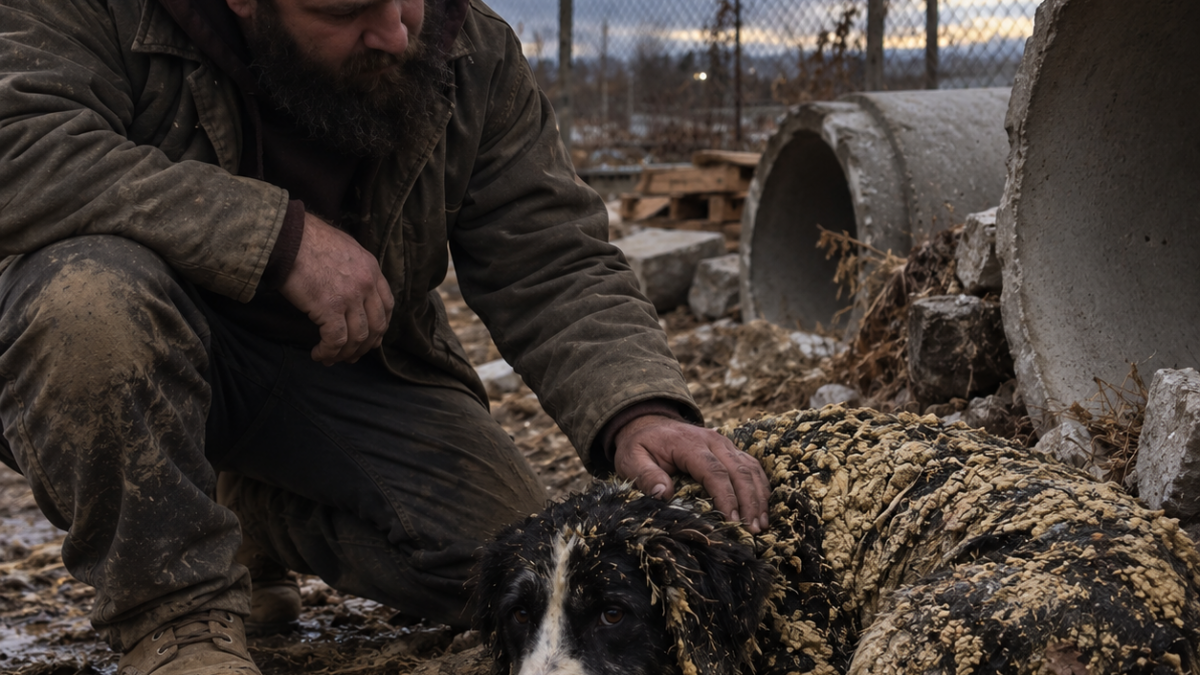
PART 2
Dr. Carter pulled a chair into the consultation room and sat across from me.
“Marcus, that material isn’t just tangled in his fur. Some of it has bonded very close to his skin. If we try to remove it too quickly, we could cause serious injuries.”
I stared at her.
“Then don’t pull it off. Cut it.”
“We’ll remove it as carefully as we can. But there’s something else.”
She paused.
“His body temperature is dangerously low. He’s severely dehydrated, and his heart rate is weaker than we’d like. We don’t know whether any of those chemicals have irritated his eyes, damaged his skin, or caused other complications.”
I looked through the glass toward the treatment room.
The dog lay on a stainless-steel table while two technicians worked around him.
Under the bright lights, he looked even smaller.
“Is he going to die?”
Dr. Carter didn’t answer immediately.
I’ve worked around enough dangerous equipment to recognize that silence.
It’s the kind you hear when somebody knows the truth isn’t going to make you feel better.
“He’s in critical condition,” she finally said. “We’ll do everything we can, but I can’t promise he’ll survive.”
I nodded slowly.
My mouth had gone dry.
“Then do everything.”
“Treatment could be expensive. He’ll need continuous care, and possibly several days of hospitalization.”
“Okay.”
“Marcus, I’m talking about a significant veterinary bill.”
I looked at her.
“Doc, I didn’t carry him out of that place to start negotiating over whether he deserves to live.”
Her expression softened.
“That’s not what I’m asking.”
“I know. I’m sorry.”
I rubbed both hands over my face.
“I just… I can’t leave him halfway.”
She nodded.
“Then we’ll get started.”
She placed the authorization paperwork in front of me.
I signed it without asking for an estimate.
When Dr. Carter left the room, Tyler sat beside me.
For a while, neither of us spoke.
Then he leaned forward, resting his elbows on his knees.
“You know,” he said, “most people would’ve walked right past that dog.”
I stared at the floor.
“I almost did.”
“But you didn’t.”
I didn’t answer.
Because that was the part I couldn’t stop thinking about.
I had been in a hurry.
I had been cold.
I had been thinking about getting home, taking a shower, and watching television until I fell asleep.
If that strange scraping noise had been any quieter, I might have continued walking.
If the wind had been blowing in the opposite direction, I might never have heard it.
And the thought of that dog lying beneath those concrete pipes while the temperature dropped through the night made me feel physically sick.
Tyler put a hand on my shoulder.
“He’s here now.”
I nodded.
But I couldn’t stop seeing that single brown eye staring at me from beneath the hardened mess.
It was after seven when a technician came out with an update.
They had started warming him, given him fluids, and begun carefully removing the material around his face.
The veterinarian wanted him stable enough to tolerate the long process ahead.
“He has an incredible amount of debris stuck to him,” she explained. “Some areas can be trimmed, but others are much more complicated.”
“Can I see him?”
“Not yet.”
“Please.”
The technician hesitated.
Then she said, “I’ll ask Dr. Carter.”
A few minutes later, I was allowed to stand just inside the treatment-room doorway.
I will never forget what I saw.
The dog was lying beneath a warming blanket.
One side of his face had been partially cleaned, revealing a patch of black fur and a small white marking near his muzzle.
A technician was carefully separating hardened clumps from the hair around his neck.
Another monitored his breathing.
An intravenous line ran into one of his legs.
He looked so helpless.
And yet, beneath all that suffering, there was something beautiful about finally seeing a little of the dog he was supposed to be.
His left ear had been freed.
It was black.
Soft.
And slightly bent at the tip.
For some reason, that tiny detail nearly brought me to my knees.
I had spent the past hour looking at him as a medical emergency.
Now I was looking at a young dog who should have been running through grass, sniffing trees, and begging somebody to throw a ball.
Instead, he’d been lying alone on frozen dirt, slowly losing the ability to move.
“Hey, buddy,” I whispered.
His ear twitched.
One of the technicians glanced toward me.
“There’s still a lot of dog underneath all this,” she said.
I smiled weakly.
“Good. Because I want to meet him.”
They worked for hours.
The clock above the waiting-room door moved from eight to nine.
Then ten.
Then eleven.
Tyler bought two cups of coffee from a vending machine.
Mine went cold without me touching it.
Every time somebody came through the swinging doors, I looked up.
Sometimes they brought updates.
Sometimes they were simply passing through.
By midnight, I had learned that the dog’s paws were badly irritated, his skin was inflamed in several places, and some of the hardened material had caused painful sores where it rubbed against his body.
He was also badly underweight.
Nobody could say exactly how long he’d been trapped in that condition.
But the combination of matted debris, weight loss, and weather exposure suggested he had been struggling for far longer than a single day.
At one point, Dr. Carter came into the waiting room still wearing her treatment gown.
“We’ve removed most of the material around his chest and shoulders.”
I stood.
“That’s good, right?”
“It is. But his temperature dropped again, so we’re taking a little more time.”
She looked exhausted.
There was a small streak of yellow adhesive on her sleeve.
“How are you holding up?”
I almost laughed.
“Compared to him? Pretty good.”
She gave me a tired smile.
“He’s fighting, Marcus. That’s what matters right now.”
I sat down again after she left.
Tyler watched me.
“You should go home for a couple of hours.”
“No.”
“They’ll call you if anything changes.”
“I’m staying.”
“Marcus—”
“Tyler, you can go. I mean it.”
He studied my face for a moment.
Then he leaned back in his chair.
“Well, somebody has to make sure you don’t pass out from drinking terrible coffee.”
That was Tyler.
He’d been my friend since we were twenty-two, when we both worked on the same highway crew.
He was the kind of man who complained about helping while already carrying the heavy end.
We sat together as the hours passed.
Shortly after one in the morning, Dr. Carter returned.
This time, her expression was different.
There was exhaustion in her eyes.
But there was also relief.
“We got the last major sections off.”
I stood so quickly that the chair scraped backward.
“All of it?”
“Everything we can safely remove tonight. There are still some small areas we’ll need to manage as his skin heals, but the hardened coating is no longer restricting his movement.”
I pressed my palms together.
“Thank God.”
She nodded.
“He’s still very weak, Marcus. His bloodwork shows the effects of prolonged poor nutrition and dehydration. We’re also concerned about infection and possible chemical irritation.”
“But he made it through?”
“He made it through the procedure.”
I let out a breath I hadn’t realized I was holding.
Then she added, “The next twenty-four to forty-eight hours are important.”
I nodded.
“I understand.”
“Would you like to see him?”
I didn’t trust myself to speak.
I just followed her.
The dog was lying in a recovery kennel beneath a clean blanket.
For the first time, I could see his actual body.
He was a young Border Collie mix.
Mostly black and white, with a narrow face, long legs, and one black ear that stood a little straighter than the other.
His coat had been shaved in uneven patches to remove the hardened mess.
Pink, irritated skin showed along his shoulders and sides.
There were small scars around his legs.
His ribs were far too visible.
He looked fragile.
But he looked like a dog again.
A living, breathing dog.
Dr. Carter opened the kennel door.
“You can sit beside him for a few minutes. Just let him rest.”
I lowered myself onto the floor.
His eyes were closed.
For several minutes, I did nothing but watch his chest rise and fall.
Then I whispered, “Hey, buddy. Remember me?”
One ear moved.
I smiled.
“Yeah. It’s the guy with the ugly beard.”
His breathing remained slow and steady.
“I know tonight’s been rough. I know you’ve had a hard time.”
My throat tightened.
“But you’re not going back there.”
I paused.
“Not ever.”
I stayed until a technician gently reminded me that he needed quiet.
Then I returned to the waiting room.
Tyler had fallen asleep with his arms folded across his chest.
I sat beside him.
For the first time that night, I let myself believe the dog might survive.
I must have dozed off sometime before dawn.
When I woke, pale sunlight was coming through the clinic windows.
A technician was standing in front of me.
“Marcus?”
I sat upright.
“Is he okay?”
She smiled.
“Come see something.”
I followed her down the hallway.
Dr. Carter was standing outside the recovery room, holding a chart.
When she saw me, she stepped aside.
The dog was awake.
His head rested on a folded blanket.
Those brown eyes followed me as I approached.
“Hey, buddy.”
He stared at me.
I crouched beside the kennel.
For a moment, nothing happened.
Then his tail moved.
Just once.
A weak little sweep against the blanket.
I froze.
“Did you see that?”
The technician laughed.
“Oh, we saw it.”
His tail moved again.
Dr. Carter smiled.
“Looks like somebody remembers who brought him here.”
I felt something warm roll down my cheek.
I wiped it away before anyone could notice.
But they noticed.
Of course they noticed.
I was a forty-two-year-old construction worker crying over a dog I’d known for less than a day.
And I didn’t care.
“That’s my boy,” I whispered.
The dog tried to lift his head.
“Don’t move, buddy. You’ve already done enough.”
His tail thumped again.
The technician shook her head, smiling.
“We need a name for his chart. Right now, he’s just listed as an unidentified stray.”
I looked at the dog.
The little guy had survived freezing weather, starvation, a coating of hardened chemicals, and hours of painful treatment.
He’d been through more than any animal should have to endure.
And somehow, he was still wagging his tail.
“Trooper,” I said.
Dr. Carter looked up.
“Trooper?”
“Yeah.”
I gently touched the blanket beside his paw.
“Because that’s exactly what he is.”
The name stuck.
By lunchtime, everyone at the clinic was calling him Trooper.
Even Tyler, who’d spent the previous evening insisting he wasn’t much of a dog person, returned with a small stuffed toy.
It was a ridiculous-looking blue elephant.
I stared at it.
“What’s that?”
“For the dog.”
“He’s not exactly ready to play.”
“I know that.”
Tyler placed the toy on the counter.
“Just figured he might want something when he gets better.”
I looked at my friend.
“You bought him a stuffed elephant?”
“Don’t make it weird.”
I laughed for the first time since finding Trooper.
Then Tyler’s expression grew serious.
“Marcus, we need to talk about that construction site.”
“What about it?”
“You know that stuff didn’t just fall out of the sky.”
I nodded.
The thought had been sitting at the back of my mind all night.
“Somebody dumped it.”
“And somebody left it there.”
Tyler pulled out his phone.
“I took a few pictures while you were carrying him to the truck.”
He showed me the screen.
There were several discarded containers near the concrete pipes.
Broken plastic buckets.
Pieces of insulation board.
A torn industrial bag.
And a long, shallow depression filled with the same pale yellow material that had covered Trooper.
The photographs made my stomach tighten.
“That wasn’t there when I worked across the street last summer,” Tyler said.
“You’re sure?”
“Positive.”
I enlarged one of the pictures.
There was a faded commercial label on a broken container.
Not enough to read everything.
But enough to recognize that it was construction material.
And something else caught my attention.
Several containers were sitting on top of relatively fresh tire tracks.
“That site was shut down years ago,” I said.
“Exactly.”
I looked at him.
“Then why has somebody been using it recently?”
Neither of us spoke.
I had been a heavy equipment operator long enough to know that construction waste doesn’t disappear when a project closes.
Somebody has to remove it.
Somebody has to pay for disposal.
And sometimes, when people think nobody is watching, they decide an empty lot is cheaper than doing the job properly.
I looked toward Trooper’s recovery room.
The dog had barely survived whatever happened in that pile.
I didn’t know whether he’d wandered into it by accident or whether somebody had deliberately left him there.
But I knew one thing.
That mess should never have been accessible to an animal.
And I wasn’t going to pretend otherwise.
That afternoon, I called the county environmental office.
I explained what we’d found and offered to provide photographs.
The woman who answered took down the information.
When I mentioned the dog, she went quiet.
“He’s alive?” she asked.
“Barely.”
She told me an inspector would be assigned to the complaint.
I thanked her.
Then I called the sheriff’s nonemergency number to report the circumstances in case there was evidence of animal neglect or cruelty.
I didn’t accuse anybody.
I didn’t know who was responsible.
And I wasn’t interested in inventing a villain just because I was angry.
I wanted the truth.
Because somewhere between the concrete pipes and the veterinary clinic, that abandoned dog had become my responsibility.
And whatever had happened to him mattered.
The next morning, I went back to work.
I’d slept maybe four hours in two days.
My supervisor, Gary Holloway, took one look at me and frowned.
“You look like you got dragged behind a dump truck.”
“Feel about the same.”
He handed me the day’s equipment checklist.
“Tyler says you rescued a dog.”
“Yeah.”
“Pretty rough shape?”
I nodded.
Gary watched me for a moment.
“Need the day off?”
“No. Sitting around won’t help him.”
He didn’t argue.
Instead, he said, “If the clinic calls, answer your phone. I’ll have somebody cover the machine.”
I looked at him.
“Thanks, Gary.”
“Just don’t run my excavator into a building while you’re worrying.”
I smiled.
“No promises.”
For the next eight hours, I operated machinery while thinking about a dog in a hospital kennel.
I kept seeing his eyes.
Wondering whether he was eating.
Whether he was warm.
Whether he was frightened.
Whether he understood that the people around him were trying to help.
At three fifteen, the clinic called.
I shut down the machine and climbed out.
“Marcus?” Dr. Carter said.
My heart started pounding.
“What’s wrong?”
“Nothing’s wrong. I wanted to give you some good news.”
I leaned against the excavator.
“Okay.”
“Trooper ate a small meal this afternoon.”
I closed my eyes.
She continued.
“Not much, but enough to make us happy. His temperature is holding steady, and his blood pressure looks better.”
I could hear somebody laughing softly in the background.
“Apparently he’s also discovered that one of our technicians has treats in her pocket.”
I laughed.
“That sounds promising.”
“It is.”
Then her tone became more cautious.
“We still have a long road ahead. He has skin injuries that need treatment, and his muscles are extremely weak. But he’s showing us he wants to recover.”
I looked across the construction site where I was standing.
Men were moving lumber.
A cement truck backed toward a foundation.
Everything around me was loud and busy.
But for a moment, all I could hear was Dr. Carter’s voice.
“Thank you,” I said.
“He’s doing the hard part, Marcus.”
I swallowed.
“Yeah. He is.”
When I returned to work, Gary raised an eyebrow.
“Dog okay?”
“He’s eating.”
Gary nodded.
“Good.”
Then he turned away.
But not before I saw him smile.
That evening, I arrived at the clinic still wearing my dusty work boots.
The receptionist looked up.
“Your boy’s waiting.”
I stopped.
“My boy?”
She smiled.
“That’s what everybody calls him now.”
I didn’t correct her.
Trooper was lying with his head resting near the kennel door.
When he saw me, his ears lifted.
Then his tail started moving.
Faster this time.
I crouched.
“Hey, Trooper.”
He pressed his nose toward my fingers.
For a few minutes, I sat there talking about absolutely nothing.
I told him about the excavator I’d been running.
The lousy coffee Gary kept in the break room.
The cold weather.
The diner.
Things a dog couldn’t possibly understand.
But Trooper watched me as though every word mattered.
When I finally stood to leave, he tried to get up.
His legs trembled.
He managed to lift his chest a few inches before sinking back onto the blanket.
“Easy, buddy.”
I knelt again.
“You don’t have to follow me.”
His eyes stayed fixed on me.
And suddenly, I realized something that hurt worse than I’d expected.
He was afraid I wouldn’t come back.
I looked at the technician.
“Can I stay a little longer?”
She nodded.
“Of course.”
I sat down again.
Trooper rested his chin near my hand.
“I’ll be back tomorrow,” I whispered. “You hear me?”
His tail moved.
“Every day if they’ll let me.”
I kept that promise.
Before work.
After work.
On weekends.
Sometimes I only had fifteen minutes.
Other times, I stayed for hours.
But I showed up.
And little by little, Trooper started showing me who he really was.
At first, he could barely stand.
The veterinary team helped him regain strength through carefully monitored movement, supportive care, and a feeding plan designed for his weakened condition.
His skin began healing.
His appetite improved.
The raw patches on his body slowly became less painful.
After several days, he took his first steady steps across the treatment room.
I happened to be there.
Dr. Carter had placed a nonslip mat on the floor.
A technician supported Trooper while he worked his way forward.
One step.
Then another.
His back legs wobbled.
His front paws spread awkwardly for balance.
But he kept going.
When he reached me, I held out both hands.
“Come on, buddy.”
He took two more steps.
Then collapsed gently against my knees.
I laughed.
“Well, that’s one way to finish.”
Dr. Carter smiled.
“He’s going to need time to rebuild those muscles.”
“He’s got time.”
She looked at me.
“Does he?”
I met her eyes.
“As much as he needs.”
That night, when I got home, I walked through my little house and noticed something I’d somehow managed to ignore for years.
How quiet it was.
I’d lived alone for almost a decade.
After my divorce, I’d gotten used to coming home to an empty living room.
No television playing in the kitchen.
No shoes by the front door except mine.
No one asking how my day went.
Most evenings, I ate dinner standing at the counter and went to bed early.
I told people I liked the peace.
And some days, I did.
But sitting beside that recovery kennel had made me realize there was a difference between peace and emptiness.
I stood in my living room and looked toward the corner beside the couch.
It was big enough for a dog bed.
Then I looked toward the fenced backyard.
There was room for a dog to run.
I went into the kitchen and opened the refrigerator.
Mostly leftovers.
A carton of milk.
Some eggs.
Nothing interesting.
I found myself smiling.
“Well,” I muttered, “guess we’ll have to work on that.”
I hadn’t decided to adopt Trooper yet.
At least, that’s what I told myself.
But the next morning, I stopped at a pet store before work.
I bought a collar.
A leash.
A stainless-steel water bowl.
And a soft gray dog bed.
I carried everything into the house and set it beside the couch.
Then I stood there staring at it.
For a long moment, I felt like a fool.
What if Trooper already belonged to somebody?
What if a family was looking for him?
What if he recovered and wanted nothing to do with me?
I didn’t know.
The clinic had checked for a microchip.
There wasn’t one.
Animal control had been notified, and the required stray-hold process was being handled.
There was no collar, no identification, and no missing-dog report that matched him.
But that didn’t automatically make him mine.
I understood that.
So I didn’t say anything about the dog bed.
I just kept visiting.
By the end of the first week, Trooper could walk across the recovery room without assistance.
By the second, he was beginning to trot.
And by the third, he had developed an opinion about almost everything.
He disliked the sound of metal bowls dropping onto tile.
He hated the kennel door closing behind people.
He was suspicious of men wearing heavy work boots.
Except me.
For reasons nobody could explain, my boots didn’t seem to bother him.
Maybe he recognized the sound of my steps.
Maybe he remembered the jacket.
Maybe he simply associated me with the first warm place he’d found in a long time.
Whatever the reason, every time I entered the clinic, his entire body came alive.
His tail whipped back and forth.
His ears perked.
And he made a funny little whining sound that seemed to come from the very bottom of his chest.
The staff started calling it his “Marcus noise.”
One afternoon, a technician named Sophie laughed as I entered.
“You know we can tell you’re here before we even see you.”
“How?”
“Trooper starts singing.”
Sure enough, I heard him from the back room.
A rising, excited whine.
Then the rapid tapping of paws.
Sophie shook her head.
“He’s completely ridiculous.”
I grinned.
“He’s got good taste.”
But recovery wasn’t always easy.
There were bad days.
Days when his skin hurt.
Days when he didn’t want to eat.
Days when he became frightened by sounds nobody else noticed.
One afternoon, somebody dropped a metal tray in the treatment room.
The crash echoed through the clinic.
Trooper panicked.
He scrambled backward, slammed into the corner of his kennel, and curled into a tight ball.
When I reached him, he was trembling.
I crouched outside the kennel.
“Hey, boy. It’s okay.”
He wouldn’t look at me.
Sophie opened the door carefully.
I sat on the floor a few feet away.
I didn’t reach for him.
Didn’t try to force him out.
I just waited.
After several minutes, his nose appeared above the edge of the blanket.
Then one paw.
Then his head.
He watched me.
I held out my hand.
Trooper crawled forward and pressed his face against my palm.
I felt his whole body shaking.
“That’s it,” I whispered. “You’re safe.”
He stayed against my hand until his breathing slowed.
That night, I asked Dr. Carter whether he’d ever stop being afraid.
She thought about it.
“Some dogs recover from frightening experiences quickly. Others need much longer.”
“Could he be scared like that forever?”
“He may always have certain triggers. But that doesn’t mean he can’t have a wonderful life.”
I nodded.
She studied me.
“Marcus, healing isn’t always a straight line.”
I looked through the glass at Trooper.
“Yeah,” I said quietly. “I’m starting to understand that.”
What I didn’t tell her was how much that sentence applied to me.
For years, I’d believed the best way to deal with difficult things was to keep moving.
Work another shift.
Fix another machine.
Find something else to focus on.
I wasn’t good at sitting with pain.
I wasn’t good at admitting when something bothered me.
But Trooper wasn’t going to get better because I told him to toughen up.
He needed patience.
Consistency.
Someone willing to stay beside him even when there was nothing useful to do.
Somewhere along the way, I began learning those things, too.
Meanwhile, the investigation into the abandoned construction site had taken an unexpected turn.
Nine days after I found Trooper, I received a call from a county environmental inspector named Raymond Finch.
“Mr. Reed?”
“Speaking.”
“My name’s Ray Finch. I’m following up on the complaint you filed about the old Ashford construction property.”
I put down the wrench I’d been holding.
“Did you find something?”
“We inspected the site. There’s evidence of recent unauthorized dumping.”
I looked toward the shop door.
“Recent?”
“Yes. Some of the materials appear to have been deposited within the past few months.”
“That place has been abandoned for years.”
“That’s part of the concern.”
He paused.
“We also found containers with partial supplier labels and transportation markings. We’re working to identify where they came from.”
I thought of Trooper.
“Could somebody have known he was out there?”
“We don’t know that yet.”
“Because if they did—”
“Mr. Reed, I understand why you’re upset. But we need to establish exactly what happened.”
I clenched my jaw.
“I get it.”
“Do you still have your original photographs?”
“Tyler does.”
“Please ask him to preserve the originals. Don’t crop them, edit them, or discard anything.”
“Why?”
“Because if this becomes an enforcement case, we need to know what the site looked like before anyone disturbed it.”
I nodded.
“Okay.”
“And one more thing.”
“Yeah?”
“Please don’t go back onto the property.”
I frowned.
“Why not?”
“We’ve secured the area for further examination, and some of the waste may be hazardous.”
I stared at the phone.
“You’re telling me I walked through a place full of potentially dangerous chemicals?”
“I’m telling you we’re still assessing what was dumped there.”
After the call, I stood in the shop for a long time.
I’d operated excavators around concrete plants, demolition sites, and industrial facilities.
I knew how dangerous improper disposal could be.
But I also knew something about shortcuts.
Most of them started with somebody convincing themselves that one little decision wouldn’t matter.
One skipped inspection.
One unsecured gate.
One load dumped where nobody would notice.
Then something went wrong.
And somebody else paid the price.
Trooper had nearly paid with his life.
I called Tyler.
“Ray says they found recent dumping.”
“No kidding.”
“They’re tracing the containers.”
Tyler went quiet.
Then he said, “Marcus, I might have something else.”
“What?”
“Remember that gas station across from the site?”
“Yeah.”
“My cousin used to work there. He says their security camera faces the road behind the fence.”
I straightened.
“Does it still?”
“I don’t know. But I’m going to ask.”
“Don’t do anything stupid.”
Tyler laughed.
“That’s usually my line.”
“I’m serious.”
“So am I. I’ll ask the manager whether they still have footage, and I’ll tell Finch if they do. I’m not breaking into anybody’s office.”
“Good.”
He paused.
“How’s our boy?”
I smiled despite myself.
“Getting stronger.”
“Tell him his uncle Tyler says hello.”
“Uncle Tyler?”
“Don’t make it weird, Marcus.”
That evening, Trooper was waiting at his kennel door when I arrived.
Sophie opened it, and he hurried toward me with his tail waving.
He still looked patchy and thin.
But there was a brightness in his eyes that hadn’t been there before.
I crouched.
He pressed his head against my chest.
“Hey, buddy.”
He made his little happy noise.
I scratched behind his good ear.
“You know something? People are starting to ask questions about what happened to you.”
Trooper licked my wrist.
I smiled.
“Yeah. I figured you’d be more interested in dinner.”
He leaned closer.
I wrapped an arm gently around him.
For a moment, the investigation didn’t matter.
The abandoned site didn’t matter.
The bills didn’t matter.
There was just a dog who had almost died alone and a man who was starting to realize how much he wanted that dog to come home.
Then Sophie entered carrying a clipboard.
“Marcus, do you have a minute?”
I looked up.
“Sure.”
“Dr. Carter wants to discuss Trooper’s next stage of care.”
My heart jumped.
“Is something wrong?”
“No. Actually, the opposite.”
She smiled.
“If he keeps improving, we may be able to discharge him soon.”
I looked down at Trooper.
His tail was still moving.
“Really?”
“Really.”
I felt myself grinning.
Then Sophie added, “Of course, before he leaves, we need to sort out where he’s going.”
My smile faded slightly.
“Right.”
“The stray-hold period is almost over. No owner has come forward, and animal control is preparing to make him available for adoption once he’s medically cleared.”
I nodded.
Sophie studied my face.
“Marcus?”
“Yeah?”
“You know you can apply, right?”
I looked at Trooper.
He was sitting beside my boot, staring up at me.
His ears tilted forward.
He looked as though he was waiting for an answer, too.
“I suppose I could,” I said.
Sophie laughed.
“You’re a terrible liar.”
I grinned.
“Been told that before.”
She handed me the paperwork.
“Dr. Carter said I should give you this.”
I looked at the first page.
An adoption application.
My name was already written at the top in neat handwriting.
I raised an eyebrow.
“Who filled that in?”
Sophie smiled.
“Somebody who got tired of watching you pretend you weren’t going to take him home.”
I laughed.
Then I looked down again.
Trooper placed one paw on my knee.
A small, warm, slightly awkward paw.
I covered it with my hand.
“Well,” I whispered, “looks like we’ve got some paperwork to do.”
But before I could finish filling out the application, I received a phone call that changed the way I looked at everything Trooper had endured.
It came from a number I didn’t recognize.
I answered while sitting in my truck outside the clinic.
“Hello?”
A man’s voice spoke quietly.
“Are you Marcus Reed?”
“Yes.”
“The guy who found that dog?”
My hand tightened around the phone.
“Who is this?”
There was a long silence.
Then the man said, “My name doesn’t matter right now.”
I sat up straighter.
“What do you want?”
“I worked for the company that dumped those chemicals.”
I stared through the windshield.
The clinic entrance suddenly seemed very far away.
“What company?”
The man ignored the question.
Instead, he said something that made the hair on the back of my neck stand up.
“Mr. Reed, I think somebody knew that dog was there before you found him.”
I stopped breathing for a second.
“What did you just say?”
The man swallowed audibly.
“I can’t talk long. I shouldn’t even be calling.”
“Listen to me. If you know something, you need to tell the county.”
“I know.”
“Then why are you calling me?”
Another pause.
“Because I saw the pictures of that dog. And I can’t sleep knowing what happened.”
I gripped the steering wheel.
“Did somebody do that to him?”
“I don’t know how he got into the material. I swear I don’t.”
“Then what do you know?”
The man took a shaky breath.
“I know somebody saw him struggling.”
My chest tightened.
“And?”
“He told us to leave.”
For several seconds, the entire world seemed to go silent.
I could hear the faint sound of traffic beyond the parking lot.
A car door closing.
Somebody laughing near the clinic entrance.
But all I could think about was Trooper lying beside those concrete pipes.
Freezing.
Hungry.
Unable to stand.
And somebody walking away.
I forced myself to speak calmly.
“What’s your name?”
“I can’t—”
“If you’re telling the truth, that dog almost died because somebody decided he wasn’t worth helping.”
“I know.”
“Then help him now.”
The man started crying.
Not loudly.
Just a quiet, broken sound.
“I’ve got two kids, Mr. Reed. My boss said if anybody talked, we’d lose our jobs.”
I closed my eyes.
“I’m not asking you to risk your family for me.”
“Then what are you asking?”
I thought of Trooper placing his paw on my knee.
“I’m asking you to tell the truth to somebody who can do something about it.”
The man was silent.
Then he whispered, “His name is Darren Pike.”
“Who’s Darren Pike?”
“The owner of the disposal company.”
I sat completely still.
“And he’s the one who told you to leave the dog?”
“He’s the one who told us not to get involved.”
The line went dead.
I stared at my phone.
Then I looked toward the clinic doors.
Inside, Trooper was probably curled up on his blanket, waiting for me to return.
For weeks, I’d pictured him alone because nobody knew he was there.
Now I was facing a possibility that made my stomach turn.
Maybe somebody had known.
Maybe somebody had looked at that helpless animal and decided their own convenience mattered more.
And suddenly, saving Trooper didn’t feel like the end of what I needed to do.
It felt like the beginning.
I called Ray Finch before I started my truck.
He listened without interrupting as I repeated the conversation as accurately as I could remember it.
When I finished, he asked, “Did the caller give you a name?”
“No. Just said he worked for the company.”
“Did you record the call?”
“No.”
“That’s all right. Save the phone number and write down what you remember while it’s fresh.”
I looked at the clinic doors again.
“Ray, if somebody actually saw Trooper and walked away, what happens to them?”
“That depends on what the evidence shows. We’re examining the dumping, and the sheriff’s office can investigate the circumstances involving the dog.”
“So they could get away with it?”
“I didn’t say that.”
“Then tell me what I should do.”
“Don’t contact Darren Pike. Don’t confront his employees. Let us establish the facts.”
I tightened my grip on the phone.
“And if somebody tries to make the evidence disappear?”
“That’s why we documented the site and collected what we needed. Mr. Reed, I know you’re angry. But the most useful thing you can do right now is cooperate with the investigation.”
I wanted to argue.
Instead, I took a breath.
“All right.”
“One more thing.”
“Yeah?”
“How’s the dog?”
I looked through the glass entrance.
“He’s getting better.”
“Good,” Ray said. “I’m glad somebody found him.”
After hanging up, I remained in the parking lot.
I had never considered myself an angry man.
I could lose my temper, sure.
Ask anybody who’d ever handed me a broken hydraulic line five minutes before quitting time.
But I wasn’t somebody who went looking for fights.
The thought of Trooper struggling while someone stood there deciding whether he was worth helping brought out something unfamiliar in me.
I wanted to find Darren Pike.
I wanted to look him in the eye.
I wanted to ask him what kind of man could know an animal was suffering and still climb into his truck and drive away.
But I knew what would happen if I showed up at his business screaming.
He’d call the police.
I’d become the story.
And suddenly, the actual evidence would matter less than the angry construction worker who couldn’t control himself.
I had spent enough years on job sites to know that losing control almost never fixes a problem.
So I drove home.
And for the first time in a long time, I sat at my kitchen table and wrote everything down.
The date.
The time.
The caller’s number.
The exact phrases I could remember.
I even wrote down the sounds I’d heard in the background.
A truck engine.
A door shutting.
A man’s shaky breathing.
When I finished, I sent the information to Ray.
Then I took out Trooper’s adoption paperwork.
For the first time that evening, my hands stopped shaking.
There was something comforting about filling in ordinary details.
My address.
My employer.
My veterinarian.
Whether I owned or rented my home.
Whether I had a fenced yard.
I answered everything carefully.
Then I came to a question near the bottom.
Why do you want to adopt this animal?
I stared at the blank space.
I could have written that I liked dogs.
That I had a yard.
That I worked regular hours.
All true.
But none of those answers explained why I was sitting at my kitchen table at nearly midnight, worrying about an animal I’d found beside a concrete pipe.
Finally, I picked up my pen.
Because he shouldn’t have to wonder whether somebody is coming back for him.
I put the pen down.
And for reasons I still can’t fully explain, that one sentence hit me harder than anything else.
The next morning, I brought the completed application to the clinic.
Sophie read it while I waited.
When she reached the final question, she became very quiet.
She looked up.
“You wrote this?”
I nodded.
“Yeah.”
She pressed her lips together.
Then she said, “I think he’s going to be just fine with you.”
I smiled.
“That makes one of us who’s confident.”
“You’ll figure it out.”
“I haven’t owned a dog since I was a teenager.”
“Well, Trooper hasn’t had a decent human in a while. Seems like you’ve both got some learning to do.”
She wasn’t wrong.
I knew how to operate a sixty-thousand-pound excavator in tight spaces.
I could diagnose engine trouble from the sound of a machine.
I could spend twelve hours repairing a hydraulic system without losing patience.
But I had absolutely no idea what kind of food a recovering Border Collie should eat.
I didn’t know how often he’d need exercise.
I didn’t know how to help him through the fear he’d developed.
And I definitely didn’t know what to do with the strange feeling in my chest every time he looked at me.
So I asked questions.
Lots of them.
Dr. Carter explained his feeding schedule, skin care, medication, and follow-up appointments.
Sophie showed me how to introduce a nervous dog to a new space without rushing him.
Another technician explained why a regular routine would help him feel secure.
I wrote things down like I was preparing for a licensing exam.
At one point, Dr. Carter laughed.
“Marcus, you don’t need to memorize an entire veterinary textbook.”
“Well, I’d rather ask a dumb question now than make a dumb mistake later.”
She nodded.
“Fair enough.”
A few days later, Trooper was well enough to spend some supervised time outside.
The clinic had a small fenced exercise yard behind the building.
There was a strip of grass, a couple of benches, and a tree that had already lost most of its leaves.
It wasn’t much.
But to Trooper, it might as well have been a national park.
Sophie opened the back door.
He stepped outside.
Stopped.
And lifted his nose toward the cold morning air.
I stood beside him holding the leash.
For several seconds, he didn’t move.
His eyes traveled across the yard.
The tree.
The grass.
The fence.
The open sky.
Then he took one careful step.
And another.
His tail began moving.
“Go on, buddy.”
He walked toward the grass.
Lowered his nose.
Sniffed.
Then suddenly gave a little sideways hop.
I laughed.
“What was that?”
He did it again.
A small, clumsy bounce that looked almost like he was surprising himself.
Sophie stood in the doorway with both hands over her mouth.
“Marcus, I think he’s trying to play.”
Trooper looked toward me.
Then toward the grass.
Then back again.
I crouched.
“Come here, boy.”
He trotted three steps toward me.
His legs were still weak, and his movements weren’t entirely coordinated.
But he was moving because he wanted to.
Not because he was struggling to escape something.
Not because he was trying to survive.
Because the world had become interesting again.
When he reached me, he pressed his nose against my knee.
I rubbed behind his ears.
“Look at you.”
He wagged his tail.
“You’re getting pretty good at being a dog.”
Sophie laughed.
Then Trooper noticed a yellow tennis ball lying near the bench.
His ears lifted.
He stared at it.
I followed his gaze.
“You want that?”
He moved toward the ball.
Sniffed it.
Touched it with one paw.
Then picked it up.
I almost couldn’t believe it.
The dog who’d been trapped inside his own fur was standing in the grass holding a tennis ball.
I reached for it.
He turned his head away.
“Oh, so that’s how it’s going to be?”
His tail wagged harder.
I laughed.
“All right. I see what kind of guy you are.”
Eventually, he dropped the ball.
I rolled it gently a few feet.
Trooper chased it.
Not fast.
Not gracefully.
But with all the determination in the world.
He reached the ball, picked it up, and stood there proudly.
I clapped.
“That’s it, buddy!”
He carried it back.
And I swear he was smiling.
That was the first time I saw him play.
I didn’t realize until later how important that moment was.
When you’re trying to save a life, survival becomes the only thing you think about.
You want the heart to keep beating.
The lungs to keep working.
The body to recover.
But being alive and actually living are different things.
That afternoon, Trooper reminded me of the difference.
He wasn’t simply getting stronger.
He was beginning to enjoy being here.
Three days later, I learned that Darren Pike had hired a lawyer.
Ray called me during my lunch break.
“I wanted you to know that the company is disputing responsibility for the dumping.”
I put down my sandwich.
“Of course they are.”
“They claim some of the waste may have been left by previous contractors.”
“On a site that’s been closed for years?”
“That’s their position.”
I rubbed my forehead.
“Ray, nobody accidentally drops a truckload of building adhesive and insulation scraps in an abandoned lot.”
“We’re looking into disposal records.”
“What about the man who called me?”
“The sheriff’s investigator has the information you gave us. I can’t discuss witness interviews.”
I stared at my unfinished lunch.
“Do you think he’ll come forward?”
“I hope so.”
That answer stayed with me.
I hope so.
It made me realize how fragile the truth can be when the people holding it are afraid.
A few days later, Tyler called with news.
The gas station manager had checked the available security recordings.
Some older footage had already been overwritten.
But there were recordings from the weeks before Trooper’s rescue.
One showed a commercial truck turning onto the road behind the abandoned property after dark.
Another showed a similar truck leaving less than an hour later.
The manager had preserved the recordings and agreed to provide them to investigators.
“Can you see the company name?” I asked.
“Not clearly.”
“What about the plates?”
“Some of the footage might be good enough. The investigators have it now.”
I closed my eyes.
“That’s something.”
“Yeah.”
Tyler hesitated.
“Marcus, there’s something I need to say.”
“What?”
“Don’t let this take over your life.”
I frowned.
“That dog nearly died.”
“I know.”
“And somebody may have left him out there.”
“I know that, too.”
“Then what are you telling me?”
My friend took a breath.
“I’m telling you Trooper needs you more than Darren Pike needs your anger.”
I didn’t answer.
“Look,” Tyler continued, “I want those people held responsible as much as you do. But every time we talk lately, you sound like you’re ready to go after somebody.”
I leaned against the kitchen counter.
“Maybe I am.”
“Then go after them the right way.”
I looked toward the gray dog bed beside my couch.
The collar was resting on top of it.
The leash hung from the coat hook near the door.
All those little things were waiting for Trooper.
Tyler’s voice softened.
“Don’t lose the good part of this, man.”
I swallowed.
“Yeah.”
“You saved a dog. That’s the good part. Don’t let the people who hurt him take that away from you.”
After we hung up, I sat on the couch for a long time.
Then I drove to the clinic.
Trooper greeted me with his usual excited whine.
I knelt beside him.
He immediately pushed his head under my hand.
“Tyler says I need to quit being so angry.”
Trooper wagged his tail.
“Yeah, I know. He’s annoying when he’s right.”
I rubbed his ears.
“But I promise you something.”
He looked up.
“I’m going to make sure your life is bigger than what happened to you.”
His tail moved again.
And I meant it.
Two days before Trooper was scheduled to come home, a stranger approached me outside the diner.
I had just finished dinner and was walking toward my truck when a dark pickup pulled into the lot.
A man stepped out.
He was tall, maybe fifty, wearing a clean black jacket and expensive-looking boots that had probably never spent a day in actual mud.
He looked at me.
“Marcus Reed?”
I stopped.
“Who’s asking?”
“Darren Pike.”
The name hit me like a sudden gust of cold air.
I stared at him.
He held up both hands.
“Relax. I’m not here to fight.”
I glanced toward the diner windows.
A waitress was wiping down a table inside.
“Then what do you want?”
He smiled.
“Just a conversation.”
“About what?”
“That dog you found.”
I felt my jaw tighten.
He leaned against his truck.
“I hear you’ve been making some pretty serious accusations.”
“I made a report.”
“About my business.”
“About an abandoned construction site full of dumped chemicals.”
He tilted his head.
“And somehow my company got dragged into it.”
“Maybe you should discuss that with the county.”
He smiled again.
It wasn’t a friendly smile.
“See, that’s the problem. People hear a sad story about a dog, and suddenly everybody wants somebody to blame.”
I stared at him.
“Do you know what condition that dog was in?”
“I’ve heard.”
“Then you know why I’m asking questions.”
He shrugged.
“Dogs get into things. Happens all the time.”
Something hot moved through my chest.
I took one step toward him.
Then stopped.
I remembered Tyler’s warning.
I remembered the kennel.
The paperwork.
The little gray bed waiting beside my couch.
I forced myself to speak evenly.
“Mr. Pike, if your company didn’t dump anything there, the investigation will show that.”
His expression changed slightly.
“And if it doesn’t?”
“Then you’ll have some explaining to do.”
He studied me.
“You work for Holloway Construction, right?”
I felt a chill that had nothing to do with the weather.
“Why?”
“Just making conversation.”
“No, you’re not.”
He looked past me toward the diner.
“Small town, Marcus. People do business with each other. Reputations matter.”
I held his gaze.
“Then I suggest you take care of yours.”
For several seconds, neither of us moved.
Finally, Darren pushed away from his truck.
“You’re making a mistake.”
I opened my truck door.
“No.”
I looked directly at him.
“The mistake was leaving dangerous waste where a living creature could get trapped in it.”
His face hardened.
I got inside my truck and shut the door.
My hands were shaking as I drove away.
Not because I was frightened of Darren Pike.
But because I’d wanted, desperately, to grab him by the collar and demand answers.
I knew that wouldn’t help Trooper.
Still, it took everything I had to drive home.
The next morning, Gary called me into his office.
I knew something was wrong when I saw the expression on his face.
He was standing behind his desk holding a folded letter.
“Marcus, sit down.”
I stayed standing.
“What happened?”
He rubbed his chin.
“Got a letter from a law firm.”
My stomach tightened.
“About me?”
“About you and some statements somebody claims you’ve been making about a local disposal company.”
I stared at him.
Gary handed me the letter.
It alleged that I had damaged the company’s reputation through unsupported accusations.
It warned against repeating claims that hadn’t been proven.
It also mentioned my employment.
My name.
The company’s name.
And the possibility of legal action.
I read it twice.
Then I looked at Gary.
“I’m sorry.”
He frowned.
“For what?”
“For getting you dragged into this.”
Gary leaned against the desk.
“Did you threaten anybody?”
“No.”
“Did you make up evidence?”
“No.”
“Did you give the county false information?”
“Absolutely not.”
He nodded.
“Then why are you apologizing?”
I looked down.
“Because Pike came to see me last night. He mentioned this company.”
Gary’s expression darkened.
“He did, huh?”
“Yeah.”
He folded his arms.
“Let me explain something.”
I waited.
“I’ve owned this business for twenty-seven years. You think I’ve never had somebody try to scare me with an expensive letter?”
I almost smiled.
“Probably not.”
“Marcus, you’re one of the best operators I’ve ever had. You show up early, you do your job, and you don’t cut corners.”
He pointed toward the window overlooking the equipment yard.
“Those machines out there? They’re worth millions. I trust you with them because you know the difference between doing something fast and doing something right.”
I swallowed.
“Thanks.”
“So here’s what we’re going to do.”
He picked up the letter.
“I’m sending this to our attorney. You’re going to keep cooperating with the investigators, and you’re going to stop worrying about whether some guy with a nice jacket can scare me.”
I felt my shoulders relax.
“Gary—”
“And another thing.”
“Yeah?”
“That dog gets out of the hospital this week, right?”
“Hopefully.”
“Then you’re taking Friday off.”
I stared at him.
“What?”
“New dog. New routine. You’re going to need time.”
“I can work.”
“I know you can.”
He smiled.
“That’s why I’m giving you the day.”
I looked away before he could see how much that meant to me.
“Thank you.”
Gary waved a hand.
“Now go fix the machine you were supposed to fix before you started worrying about lawyers.”
I laughed.
“Yes, sir.”
Later that afternoon, I sent the letter to Ray and told him about Darren approaching me.
He asked me to document the conversation and preserve the letter.
Then he said something I hadn’t expected.
“Mr. Reed, we may need you to give a formal statement about what you’ve observed and experienced.”
“I’m ready.”
“Good. And keep doing what you’ve been doing. Don’t speculate publicly. Stick to what you know.”
“I can do that.”
I paused.
“Ray, do you have enough to prove anything yet?”
He was quiet for a moment.
“We’re making progress.”
It wasn’t much.
But it was something.
And for the first time, I began to understand that accountability wasn’t going to arrive through one big angry confrontation.
It was going to come from small things.
Photographs.
Records.
Dates.
Truck movements.
People brave enough to tell the truth.
The kind of details a man like Darren Pike probably believed nobody would bother collecting.
That Friday morning, I drove to the veterinary clinic with the gray dog bed in the back of my truck.
I had been awake since five.
Not because I needed to be.
Because I was nervous.
I’d cleaned my house twice.
Checked the backyard fence.
Moved anything Trooper might chew.
Bought the food Dr. Carter recommended.
Placed water bowls in the kitchen and beside the back door.
And read the discharge instructions so many times that I practically knew them by heart.
At nine o’clock, Tyler arrived.
He walked through my front door, looked around, and burst out laughing.
“What?” I asked.
“Nothing.”
“Then why are you laughing?”
He pointed toward the living room.
“You bought three dog beds?”
“One for the living room. One for the bedroom. One for the office.”
“You don’t even use the office.”
“Maybe he will.”
Tyler shook his head.
“You’re in trouble, man.”
I grinned.
“Probably.”
He helped me load the last few supplies.
Then he held up the blue stuffed elephant he’d bought weeks earlier.
“Almost forgot his buddy.”
I took it.
The little elephant had a crooked trunk and one ear bigger than the other.
“That’s an ugly toy.”
“You’re an ugly toy.”
I laughed.
Then I set it gently beside the dog bed.
“Thanks, Tyler.”
He looked at me.
“Ready?”
I took a deep breath.
“Yeah.”
But when I walked into the clinic, my stomach was twisting.
Sophie met me at the front desk.
“Big day.”
“Seems like it.”
She handed me the final paperwork.
Trooper had completed the required stray-hold process, and the rescue and adoption arrangements had been approved.
There were signatures to provide.
Discharge instructions to review.
Medications to take home.
A schedule for follow-up appointments.
I listened carefully to everything.
Then Dr. Carter came out.
She looked at me for a moment.
“Marcus, before you take him home, I want you to understand something.”
I nodded.
“Okay.”
“He’s come a long way. But he’s still recovering.”
“I know.”
“His coat will take time to grow back. He may have areas of sensitive skin. And emotionally, he may need even longer.”
I looked toward the hallway.
“I can handle that.”
She smiled.
“I think you can.”
Then she added, “But don’t expect him to be grateful every minute of every day.”
I laughed.
“Wasn’t planning on it.”
“I’m serious. He may have accidents. He may be frightened. He may have difficult nights.”
“Doc, he doesn’t owe me perfect behavior.”
She went quiet.
I continued.
“He doesn’t owe me anything.”
For a moment, Dr. Carter just looked at me.
Then she nodded.
“All right.”
She turned toward the hallway.
“Let’s bring your boy out.”
A few seconds later, I heard the familiar sound.
That little excited whine.
Then paws tapping against the floor.
Sophie appeared holding a leash.
And there he was.
Trooper.
My Trooper.
He was still thin, though much healthier than when I’d found him.
Some of his fur had started growing back.
His black-and-white face was clean.
His eyes were bright.
And his tail was moving so fast it looked like it might pull the rest of him sideways.
When he saw me, he tried to run.
Sophie laughed.
“Easy, Trooper!”
I dropped to one knee.
He reached me and pressed his entire body against my chest.
I wrapped both arms around him.
“Hey, buddy.”
His tail thumped against my leg.
“Guess what?”
He looked up.
I smiled.
“You’re going home.”
Everybody in the hallway seemed to stop for a moment.
Sophie wiped at one eye.
A technician standing behind her smiled.
Dr. Carter folded her arms and watched quietly.
I clipped the new collar around Trooper’s neck.
It was dark blue.
Simple.
Strong.
A small tag hung from it.
On one side was his name.
On the other was my phone number.
I held the tag between my fingers.
A month earlier, he’d had no identification.
No safe place.
Nobody who knew his name.
Now he had all three.
When we stepped outside, Trooper stopped at the edge of the parking lot.
The morning air was cold.
A truck passed on the road.
Its engine growled.
Trooper flinched.
I knelt beside him.
“Hey. It’s okay.”
His body stiffened.
I didn’t pull the leash.
I waited.
He looked at the truck.
Then at me.
I rubbed his shoulder.
“You’re not going back to that place.”
He swallowed and moved closer.
I opened the passenger door.
Tyler had helped me arrange a secure, comfortable place for him to travel.
Trooper looked inside.
Then backed away.
I could see the fear returning.
Maybe the last vehicle he remembered had been the truck that carried him to the hospital.
Maybe he simply didn’t understand what was happening.
I crouched again.
“No rush, buddy.”
He sniffed the edge of the seat.
Looked at me.
Then slowly placed one paw inside.
“That’s it.”
Another paw.
A pause.
Then, with gentle encouragement, he climbed into his spot.
I secured him and closed the door carefully.
When I walked around the truck, he followed me with his eyes.
The moment I settled into the driver’s seat, he relaxed.
I looked at him.
“Ready?”
He tilted his head.
I laughed.
“Yeah. Me neither.”
We drove home slowly.
I avoided the road near the abandoned construction site.
I didn’t want him anywhere near that place again.
As we passed through town, Trooper watched the world through the window.
Cars.
People.
Trees.
A woman walking a small white dog.
Everything seemed new.
At one red light, he turned toward me and rested his head briefly against my arm.
I smiled.
“Doing okay?”
His tail moved against the blanket.
“Me too.”
When we reached my house, I parked in the driveway and looked at him.
It was a modest place.
One story.
White siding.
A small front porch.
A backyard surrounded by a wooden fence.
Nothing fancy.
But it was warm.
Quiet.
Safe.
I opened the passenger door.
“Welcome home, Trooper.”
He climbed down carefully.
Sniffed the driveway.
Then stopped.
He looked at the front steps.
I walked toward the porch.
He didn’t follow.
I turned.
“Come on, buddy.”
He stood perfectly still.
His ears dropped.
I walked back.
“What’s wrong?”
He stared at the doorway.
For a moment, I thought he might simply be overwhelmed.
Then I noticed what he was looking at.
The dark space beyond the open door.
The unfamiliar room.
A place he didn’t know.
He had spent weeks in a veterinary clinic where people came and went, but the routine was predictable.
Before that, he’d been alone in a frightening place he couldn’t escape.
Now somebody was asking him to enter yet another unfamiliar space.
I sat on the porch step.
“All right.”
Trooper watched me.
“We can take our time.”
He moved closer.
Sniffed my boot.
Then sat beside me.
We stayed that way for almost twenty minutes.
Cars passed.
A bird landed on the fence.
Somewhere down the street, a lawn mower started.
Trooper watched everything carefully.
Eventually, he stood.
Walked toward the open door.
Sniffed the threshold.
Then stepped inside.
One paw.
Two.
Three.
Four.
I followed him.
He stood in the entryway, looking around.
I closed the door softly.
Then I crouched.
“Well, buddy.”
He turned toward me.
I smiled.
“This is your house now.”
He walked into the living room.
Sniffed the couch.
Investigated the rug.
Circled the coffee table.
Then discovered the gray dog bed beside the window.
He stepped onto it.
Turned around twice.
And lay down.
I stood in the doorway watching him.
It was such a simple thing.
A dog lying on a bed.
But I had to put a hand against the wall to steady myself.
Because the last time I’d seen him lying down like that, he’d been trapped beneath a shell of hardened glue on freezing dirt.
Now he was lying on something soft.
In a warm house.
With food in the kitchen.
Water by the door.
And a man who wasn’t going anywhere.
I sat on the floor beside him.
Trooper lifted his head.
Then moved closer until his nose touched my knee.
I scratched behind his ear.
“Yeah,” I whispered. “I know.”
That first afternoon, he slept for nearly three hours.
I sat on the couch with the television turned low, afraid to move too much in case I woke him.
Every few minutes, I glanced toward the dog bed.
His chest rose and fell steadily.
Sometimes his paws twitched.
Sometimes his ears moved.
Once, he made a soft sound in his sleep and stretched his legs.
I wondered what he dreamed about.
The construction site?
The clinic?
The yard where he’d chased his first ball?
I hoped, someday, his dreams would be about ordinary things.
Squirrels.
Tennis balls.
Long walks.
The smell of dinner.
That evening, I followed Dr. Carter’s instructions and gave him his meal.
He ate slowly, then looked around as though expecting somebody to take the bowl away.
I stayed nearby.
“Go ahead, buddy. It’s yours.”
He finished.
Licked the bowl.
Then walked over and leaned against my leg.
I smiled.
“You’re welcome.”
Later, I took him into the backyard.
He explored every corner.
Sniffed the fence posts.
Investigated an old patch of leaves.
Stopped beside the shed and stared at a squirrel on the roof.
The squirrel stared back.
Trooper’s ears went straight up.
I laughed.
“Don’t even think about it.”
The squirrel disappeared.
Trooper looked at me, offended.
“Yeah, I saw him too.”
He wagged his tail.
For the first time since finding him, I felt something settle inside me.
He was going to be okay.
Not immediately.
Not perfectly.
But he was home.
That night, I expected him to sleep in the bedroom.
I’d placed a soft bed near my own and left the door open.
Trooper followed me down the hallway.
He sniffed the bed.
Turned around.
Then walked back toward the living room.
I waited.
A minute passed.
Then two.
Finally, I went to find him.
He was standing beside the front door.
Looking at it.
Completely still.
“Trooper?”
He didn’t move.
I approached slowly.
He turned his head toward me.
There was something in his expression I couldn’t explain.
He wasn’t barking.
He wasn’t scratching.
He wasn’t trying to escape.
He was simply watching the door.
I crouched.
“What’s going on, boy?”
He looked back at it.
Then at me.
I sat on the floor.
For several minutes, he remained standing.
Finally, he walked over and placed his head against my knee.
I wrapped an arm around him.
“Nobody’s leaving you out there again.”
He let out a long breath.
I stayed beside him until his body relaxed.
Then I brought his bed into my room.
I wasn’t going to force him to sleep anywhere he didn’t feel safe.
He followed me.
Circled the bed.
Lay down.
And watched me climb beneath the covers.
For a while, he kept his head raised.
Every time I moved, his ears lifted.
Eventually, I reached down and let my hand rest where he could see it.
“I’m right here.”
He watched me for another minute.
Then lowered his head.
I turned off the light.
Sometime after midnight, I woke to a soft sound.
A faint whine.
I sat up.
Trooper was standing beside the bed.
His body was trembling.
“Hey, buddy.”
I switched on the lamp.
He looked at me with wide eyes.
I reached down.
He pressed his forehead against my hand.
I moved onto the edge of the bed.
He leaned closer.
For the next twenty minutes, I sat there with my hand resting on his back.
I couldn’t know what had frightened him.
A dream.
A sound outside.
The unfamiliar room.
Maybe nothing I would ever understand.
But I understood what he needed.
He needed to know somebody was there.
So I stayed.
When he finally settled, I looked at the clock.
One forty-seven in the morning.
I had work in a few hours.
My back was aching.
My eyes burned.
And I had never felt more certain that I’d made the right decision.
The next day, Tyler came over carrying groceries.
“Figured you might need actual food,” he said.
I looked inside the bags.
Chicken.
Vegetables.
Bread.
Coffee.
And an enormous package of dog treats.
I raised an eyebrow.
“Who are the treats for?”
He grinned.
“Me.”
Trooper appeared from the hallway.
The moment he saw Tyler, his tail started moving.
Tyler crouched.
“Hey, little man.”
Trooper approached cautiously.
Sniffed his hand.
Then leaned forward.
Tyler rubbed his chest.
“Look at you.”
I smiled.
“He remembers you.”
“Of course he does. I’m unforgettable.”
Trooper licked his chin.
Tyler laughed.
“Okay, okay. Personal space.”
We spent the afternoon making sure the backyard fence was secure.
Tyler reinforced a loose section near the shed while I watched Trooper investigate a pile of leaves.
At one point, the dog found a stick.
Not a little stick.
A ridiculous branch nearly as long as he was.
He tried to carry it through the narrow space between two flower beds.
The branch caught.
Trooper backed up.
Turned sideways.
Tried again.
Tyler watched from beside the fence.
“He’s an engineer.”
I laughed.
“An engineer who failed geometry.”
Trooper finally abandoned the branch and came running toward us.
His legs were stronger now.
His movements were smoother.
When he reached Tyler, he sat proudly.
Tyler handed him a treat.
“That’s my boy.”
I looked at him.
“Your boy?”
“Joint custody.”
“Absolutely not.”
He laughed.
But a few minutes later, I noticed something that made me quiet.
Trooper had wandered into a patch of sunlight beside the porch.
He lay down.
Rolled onto his side.
And closed his eyes.
There was no fear in his posture.
No tension.
No frantic searching for an exit.
Just a dog enjoying the warmth.
Tyler followed my gaze.
For a while, neither of us spoke.
Then he said, “Hard to believe that’s the same animal.”
I nodded.
“Yeah.”
He looked at me.
“You okay?”
I kept watching Trooper.
“Getting there.”
Tyler put a hand on my shoulder.
“Good.”
A week after the adoption, Trooper had his first follow-up appointment.
Dr. Carter examined his skin, checked his weight, and watched him walk.
She seemed pleased.
“He’s making excellent progress.”
I smiled.
“He’s eating like a horse.”
“That’s a good sign, as long as we keep his nutrition balanced.”
“He’s also decided my slippers are his personal enemies.”
She laughed.
“That sounds more like a Border Collie.”
I hesitated.
“Can I ask you something?”
“Of course.”
“Those little scars on his legs. Do you think they’ll ever go away?”
She examined one of the healed areas.
“Some may become less noticeable. A few might remain.”
I looked down.
Trooper was sitting beside my chair, watching her hand.
“Does that bother him?”
“Not the healed scars themselves, no.”
I nodded.
She seemed to understand what I was really asking.
“Marcus, it’s natural to wish you could erase what happened to him.”
I swallowed.
“Yeah.”
“But the goal isn’t to pretend it never happened.”
She smiled at Trooper.
“The goal is to make sure it doesn’t define the rest of his life.”
I looked at the dog.
His tail moved against the floor.
“That I can do.”
When we returned home, there was an envelope waiting in my mailbox.
No return address.
My name written across the front.
Inside was a single sheet of paper.
The message was short.
You don’t know what you’re getting involved in. Drop it.
I read it twice.
Then a third time.
I looked toward the street.
A delivery van was passing.
A neighbor was watering plants across the road.
Everything looked ordinary.
But I could feel my heart beating harder.
I called Ray.
He told me to preserve the envelope and contact the sheriff’s office.
I did.
A deputy arrived later that afternoon, photographed it, and took a report.
“Any idea who sent it?” she asked.
“I can think of somebody who’d like me to stop talking.”
“That’s not the same as proof.”
“I know.”
She nodded.
“Keep the original. Don’t confront anyone.”
I looked toward the living room, where Trooper was sleeping.
“Believe me,” I said, “I’ve got more important things to do.”
But that evening, as I stood washing dishes, I noticed headlights slowing outside my house.
A dark truck passed.
For a second, I felt my stomach tighten.
Then the truck continued down the street.
I stood at the sink, staring out the window.
I didn’t like what the investigation was bringing to my front door.
I didn’t like the idea of somebody knowing where I lived and trying to frighten me.
But I liked the alternative even less.
Silence.
Walking away.
Pretending none of it mattered.
I thought of Trooper on the frozen ground.
Of his head leaning against my wrist.
Of the way he had watched me every time I stood to leave the clinic.
Then I looked at the little blue collar hanging beside the back door.
No.
I wasn’t going to drop it.
But I was going to be careful.
The following Monday, an investigator from the sheriff’s office called.
Her name was Detective Leah Moreno.
She asked if I could come in to answer some questions.
I agreed.
Trooper stayed with Tyler while I drove to the sheriff’s office.
Detective Moreno was in her late thirties, with dark hair pulled into a tight ponytail and the kind of direct expression that made me suspect she didn’t have much patience for nonsense.
She introduced herself and led me into a small interview room.
There was a table.
Two chairs.
A recording device.
And a cup of coffee that looked almost as bad as the stuff at work.
She smiled faintly when she saw me looking at it.
“Wouldn’t recommend that.”
I laughed.
“Good to know.”
We sat down.
She asked me to describe the evening I’d found Trooper.
I told her everything.
The wind.
The sound.
The concrete pipes.
The hardened material.
How he’d tried to stand.
How he’d collapsed.
How his head had rested against my wrist.
She listened carefully.
Then she asked about the anonymous phone call.
I repeated the conversation.
Afterward, she opened a folder.
“Mr. Reed, we’ve identified a company that may be connected to the waste at the site.”
“Pike Disposal?”
She looked up.
“I’m not going to confirm the full scope of the investigation, but yes, that company is one of the subjects.”
I leaned forward.
“Did somebody find the man who called me?”
“We’re speaking with several people.”
“Did someone actually see Trooper?”
She held my gaze.
“We have reason to believe someone reported seeing an injured dog at the location before your rescue.”
My heart dropped.
“How long before?”
“We’re still verifying the timeline.”
I stared at her.
“Detective, I need to know.”
“I understand.”
“No, I don’t think you do.”
I heard my voice getting louder.
She remained calm.
“Then explain it to me.”
I swallowed.
I looked down at my hands.
They were calloused and scarred from years of work.
One knuckle was still bruised from a machine repair.
“I keep thinking about him lying out there.”
My voice cracked.
“I keep thinking about how cold it was.”
She said nothing.
“And now you’re telling me somebody might have seen him before I did.”
I rubbed my forehead.
“Every time I picture that, I wonder how many nights he spent waiting for somebody to come back.”
Detective Moreno’s expression softened.
“Mr. Reed, I’m going to tell you something. Not because it changes the evidence, but because I think you need to hear it.”
I looked up.
“Whatever happened before you found him, you didn’t cause it.”
I swallowed.
She continued.
“And you don’t have to punish yourself for the people who failed him.”
For a moment, I couldn’t speak.
Then I nodded.
“Okay.”
She opened another page in the folder.
“We’re looking at possible environmental violations, disposal records, and whether any criminal conduct occurred concerning the animal.”
“What can I do?”
“Be available if we need more information. Preserve any communications. And don’t try to conduct your own investigation.”
I almost smiled.
“Ray told me the same thing.”
“Ray gives good advice.”
I nodded.
She paused.
“And Mr. Reed?”
“Yeah?”
“I’m glad the dog survived.”
I looked down.
“Me too.”
When I returned to Tyler’s house, I found him sitting on the living room floor.
Trooper was sprawled across his lap.
The blue elephant lay nearby.
Tyler looked up.
“How’d it go?”
“Long story.”
He nodded.
“Well, before you tell it, you should know your dog stole half my couch.”
I stared.
“He’s not even on the couch.”
“He was. Then he decided my lap was better.”
Trooper lifted his head.
His tail began moving.
I knelt beside him.
“Hey, buddy.”
He immediately climbed off Tyler and pressed against me.
Tyler sighed.
“Unbelievable.”
I laughed.
“Sorry.”
“Three hours of bonding, and he abandons me the second you show up.”
Trooper licked my hand.
I scratched behind his ears.
Then I looked at Tyler.
“Somebody reported seeing him before I found him.”
Tyler’s smile faded.
“What?”
“Detective says they’re verifying it.”
He sat upright.
“How much before?”
“I don’t know.”
For a while, he said nothing.
Then he looked toward Trooper.
The dog was busy trying to pull the blue elephant out from beneath my boot.
Tyler watched him.
“Look at him.”
I followed his gaze.
Trooper finally freed the toy and carried it triumphantly across the room.
His tail waved.
He dropped it near the couch and barked once.
A sharp, happy bark.
Tyler smiled sadly.
“Whatever those people did, they didn’t get the last word.”
I looked at my dog.
“No,” I said quietly.
“They didn’t.”
By the time December arrived, Trooper had begun settling into a routine.
Every morning, he woke me at six thirty.
Not by barking.
Not by jumping onto the bed.
He would simply stand beside me and stare.
I could somehow feel those eyes before I opened mine.
The first few mornings, I pretended to be asleep.
It never worked.
Eventually, he’d make one quiet sound.
A tiny impatient whine.
I’d open my eyes, and there he’d be.
One black ear standing straight.
The other folded halfway over.
His tail moving hopefully.
“You’re worse than my alarm clock,” I’d tell him.
He’d wag harder.
We’d go outside.
He’d investigate the yard as though something dramatic might have happened overnight.
Then we’d come inside for breakfast.
I prepared his meals according to the veterinarian’s plan and watched him gradually gain weight.
He learned to sit.
To wait.
To come when called.
And, with considerably more difficulty, to leave my work gloves alone.
The first time I caught him carrying one of my gloves across the living room, I pointed at it.
“Trooper. Drop it.”
He froze.
Looked at me.
Then dropped it.
I smiled.
“Good boy.”
He immediately picked it up again.
I stared at him.
He stared back.
Then his tail began moving.
I couldn’t help laughing.
“You’re going to be trouble.”
He seemed pleased with that assessment.
Every evening, we went for a walk.
At first, only around the block.
Then farther.
Eventually, we made it to a small park near the edge of town.
Trooper loved the trees.
The fallen leaves.
The squirrels.
Especially the squirrels.
He approached every new smell as if it were the most important discovery of his life.
Sometimes, when he found an interesting patch of grass, he’d stop so suddenly that I nearly walked right over him.
“Come on, detective,” I’d say.
He’d look up at me.
Then return to his investigation.
But there were still reminders of what he’d endured.
He hated sudden metallic noises.
He became uneasy around piles of construction materials.
And he struggled with being left alone.
The first time I tried stepping outside to take out the trash, he became frantic.
I hadn’t even reached the driveway before I heard him whining through the door.
I went back inside.
He was pacing.
The moment he saw me, he rushed forward and pressed himself against my legs.
“Hey. I’m right here.”
He leaned into me.
I crouched.
“I was just taking out the trash.”
His breathing was quick.
His tail stayed low.
I sat on the floor with him until he settled.
Then I called Dr. Carter.
She recommended working patiently on short separations and predictable returns, keeping the process positive and avoiding anything that overwhelmed him.
I took her advice seriously.
We started with seconds.
Then minutes.
I taught him that a closed door didn’t mean abandonment.
That sometimes I went outside.
Sometimes I went to the garage.
Sometimes I walked to the mailbox.
But I always came back.
Tyler helped during my workdays.
So did a trusted neighbor, Mrs. Bennett, who lived two houses down.
She was seventy-six, widowed, and had a soft spot for animals.
The first time she met Trooper, she crouched beside him and said, “Well, aren’t you a handsome young gentleman?”
Trooper immediately placed his head against her knee.
She looked up at me.
“Oh, Marcus. This one knows how to get what he wants.”
I laughed.
“Don’t I know it.”
Mrs. Bennett began stopping by to check on him when I worked longer shifts.
Soon she was leaving me handwritten notes.
Trooper enjoyed his walk.
Trooper behaved beautifully.
Trooper attempted to steal my mitten.
And once:
Trooper has informed me that you are not giving him nearly enough compliments.
I kept every note.
But the improvement that meant the most came one Tuesday afternoon.
I had returned from work and found Trooper asleep on his bed.
He didn’t hear me open the door.
Didn’t jump up.
Didn’t rush toward me in fear.
He simply slept.
For a moment, I stood there watching him.
Then he opened one eye.
Saw me.
And gave a lazy little tail wag.
He didn’t even bother standing.
I laughed softly.
“Well, look who’s getting comfortable.”
He closed his eye again.
I hung up my jacket.
And something about that moment made my chest ache.
He was no longer checking every second to make sure I hadn’t disappeared.
He was beginning to believe home would still be there when he woke up.
A few days before Christmas, the first real snowstorm arrived.
The forecast called for several inches, strong winds, and temperatures well below freezing.
I came home early.
Made sure the pipes were protected.
Checked the generator.
Brought extra firewood onto the porch.
Trooper followed me through the house, supervising.
When the first snowflakes began falling, he stood at the back door and watched.
His nose pressed toward the glass.
His ears tilted forward.
I opened the door.
Cold air swept into the kitchen.
Trooper took one step outside.
A snowflake landed on his nose.
He blinked.
Then another landed on his head.
He shook himself.
I laughed.
“What do you think?”
He looked at me.
Then at the yard.
Then, without warning, he bounded forward.
Snow flew beneath his paws.
He ran a wide circle around the yard.
Stopped.
Leaped sideways.
Then ran another circle.
I stood in the doorway laughing so hard I could barely breathe.
“Trooper! What are you doing?”
He came racing toward me.
Stopped a few feet away.
Dropped into a playful crouch.
Then bolted off again.
His tail waved like a flag.
He buried his nose in the snow.
Jumped backward.
Sneezed.
Then tried to bite a falling snowflake.
It was the most ridiculous thing I’d ever seen.
And the most wonderful.
I stepped onto the porch.
“Hey, buddy!”
He turned.
I held up a tennis ball.
His ears shot forward.
“Oh, now you’re interested.”
I tossed it across the yard.
Trooper sprinted after it, sending powdery snow into the air.
He found the ball.
Picked it up.
And came racing back.
When he reached me, he dropped it at my feet.
I stared at him.
Six weeks earlier, he’d been lying on frozen ground, unable to stand.
Now he was running through snow because he couldn’t contain his happiness.
I crouched and wrapped my arms around his neck.
He was warm.
Strong.
Alive.
“Look at you,” I whispered.
He licked my cheek.
I laughed.
“Yeah, I know.”
For a long time, we stayed outside playing.
Eventually, the cold became too much, and I brought him in to dry off.
He sprawled on a blanket near the fireplace while I made dinner.
Later, Tyler stopped by.
He found me sitting on the floor beside Trooper, looking through photographs on my phone.
There were pictures from the veterinary clinic.
Trooper lying beneath the warming blanket.
Trooper taking his first steps.
Trooper holding the tennis ball.
Trooper sitting beside his new bed.
And dozens of photographs from the backyard.
Tyler sat beside me.
“That the first picture?”
I nodded.
On the screen was the photograph he’d taken at the construction site.
Trooper was barely recognizable beneath the hardened yellow material.
His eyes were half-closed.
His body curled tightly against the concrete pipes.
Tyler looked at it for a long moment.
Then he glanced toward the dog sleeping beside us.
“That’s hard to believe.”
I nodded.
“Yeah.”
He pointed toward another photograph.
“There’s the little guy with his first ball.”
I smiled.
We kept scrolling.
After a while, Tyler asked, “You ever wish you’d taken a different route that night?”
I looked at him.
“What?”
“Not because you regret finding him. I mean because of all the trouble afterward.”
I thought about the threatening letter.
The investigator’s interviews.
Darren Pike waiting outside the diner.
The money I’d spent.
The sleepless nights.
Then I looked at Trooper.
He was lying on his side with one paw resting against my boot.
“No.”
I put down the phone.
“Not for a second.”
Tyler smiled.
“Figured you’d say that.”
Two days later, Detective Moreno called.
“Marcus, we’ve identified the man who contacted you.”
My heart jumped.
“Is he cooperating?”
“Yes.”
I sat down.
“What’s his name?”
“Caleb Morris.”
I stared at the floor.
“Does he know what happened to Trooper?”
“He’s provided an account of what he witnessed.”
I gripped the phone.
“Tell me.”
She hesitated.
“Marcus, some details may become evidence in a criminal proceeding. I can’t discuss everything right now.”
I closed my eyes.
“Okay.”
“But I can tell you this: his statement supports the possibility that the dog was observed alive before you found him.”
I swallowed.
“How long?”
There was a pause.
Then she said, “Approximately ten days.”
My stomach dropped.
Ten days.
I looked toward the living room.
Trooper was standing by the window watching a bird.
He had no idea what I’d just heard.
Ten days.
I remembered how thin he’d been.
How weak.
How his legs had trembled.
How he’d collapsed against the ground because moving was too painful.
Ten days.
Somebody may have known.
Somebody may have heard him.
And somebody may have chosen not to help.
“Marcus?”
I realized Detective Moreno was still speaking.
“Yeah.”
“I need you to stay calm.”
I laughed once.
It wasn’t a happy sound.
“You’re asking a lot.”
“I know.”
“Did Caleb try to help him?”
She was quiet.
“That’s something he’ll need to explain.”
After we hung up, I sat at the kitchen table.
Trooper eventually wandered in.
He approached slowly.
Then rested his head on my thigh.
I looked down.
His eyes were warm and curious.
I placed a hand on his head.
“Ten days, buddy.”
His tail moved.
I swallowed.
“Ten days somebody could’ve helped you.”
Trooper nudged my hand.
I bent forward and pressed my forehead gently against his.
“I’m sorry.”
He licked my chin.
I wrapped my arms around him.
And for the first time since bringing him home, I cried without trying to hide it.
Not because he was suffering anymore.
But because I finally understood how close he’d come to never getting another chance.
The next morning, I went to work.
I needed something normal.
Something heavy.
Something loud.
Something I could fix.
Gary found me inspecting a bulldozer before the morning shift.
“You all right?”
I nodded.
“Yeah.”
He studied me.
“That didn’t sound convincing.”
I set down the grease gun.
“They found a witness.”
Gary’s expression changed.
“To what?”
“Somebody knew about Trooper before I found him.”
He was quiet.
“How long?”
“Ten days.”
Gary looked toward the equipment yard.
His jaw tightened.
“That’s a long time.”
“Yeah.”
He put a hand on my shoulder.
“Listen to me. You can’t change those ten days.”
I looked down.
“I know.”
“But you changed every day after.”
My throat tightened.
Gary squeezed my shoulder.
“Don’t forget that.”
Then he walked away.
I stood there for a minute before returning to work.
His words didn’t erase the anger.
But they gave it somewhere to go.
I decided that if the investigators needed me, I would be there.
If the court needed testimony, I would testify.
If the company tried to bury the story, I would stick to the truth.
But I wasn’t going to spend the rest of Trooper’s life imagining what he suffered.
I was going to spend it giving him something better.
In January, Detective Moreno asked whether I’d be willing to meet Caleb Morris.
The meeting would take place at the sheriff’s office, with an investigator present.
I hesitated.
Part of me wanted to refuse.
Another part of me wanted to demand that he look me in the eye.
I agreed.
The day of the meeting, I arrived fifteen minutes early.
Caleb entered the room shortly after ten.
He was younger than I’d expected.
Maybe thirty.
Thin.
Dark circles beneath his eyes.
He wore jeans, a faded work jacket, and boots that looked like they’d seen just as much mud as mine.
He didn’t look like a monster.
He looked exhausted.
That almost made it worse.
He sat across from me and folded his hands together.
For a while, neither of us spoke.
Then he said, “Mr. Reed, thank you for meeting me.”
I looked at him.
“Did you see the dog?”
His face changed.
He nodded.
“Yes.”
The word seemed to hang between us.
I leaned forward.
“Was he alive?”
Caleb looked down.
“Yes.”
“Was he trying to move?”
He swallowed.
“Yes.”
I felt my hands tightening.
“Then why didn’t you help him?”
Caleb closed his eyes.
When he opened them, they were wet.
“I’ve been asking myself that every day.”
“That’s not an answer.”
“I know.”
He rubbed both hands over his face.
Then he began talking.
He’d worked as a driver for Pike Disposal for nearly four years.
Mostly hauling construction waste from demolition sites and commercial projects.
He said the company had started falling behind on contracts.
Legal disposal costs had risen.
Pike had taken on jobs he couldn’t afford to complete properly.
Instead of paying approved facilities to handle certain materials, workers were told to leave loads at the abandoned Ashford property.
At first, Caleb believed the company had permission to use the location temporarily.
But the loads kept coming.
Buckets of leftover adhesive.
Insulation scraps.
Broken packaging.
Other construction debris.
Materials that should have been handled through approved disposal channels.
Eventually, Caleb began asking questions.
His supervisor told him to stop.
“Did you know it was illegal?” I asked.
Caleb lowered his head.
“I suspected.”
“That’s another way of saying yes.”
He didn’t argue.
Then he described the day he’d seen Trooper.
He and another employee had arrived to move several containers.
It was late afternoon.
Cold.
Cloudy.
The dog was lying near the concrete pipes.
Caleb initially thought he was dead.
Then he noticed movement.
A faint lift of the head.
A paw scraping against the dirt.
The dog was covered in the same yellow material that had been dumped nearby.
Caleb approached.
He heard him whimper.
He knew the animal was alive.
“Why didn’t you take him?” I asked.
My voice was shaking.
Caleb looked at me.
“I called my supervisor.”
“Why?”
“I didn’t know what the material was doing to him. I was afraid to touch it.”
I stared at him.
“Then why didn’t you call animal control?”
He looked down.
“That’s what I should’ve done.”
The room went silent.
Caleb continued.
His supervisor had contacted Darren Pike.
Pike instructed them to leave the property.
He said the company didn’t need attention from inspectors or police.
Caleb was told the dog probably wouldn’t survive anyway.
He was told it wasn’t their responsibility.
He was told to get back in the truck.
“And you listened,” I said.
Caleb nodded.
I looked at his hands.
They were shaking.
“You left him there?”
“Yes.”
I sat back.
For several seconds, I couldn’t speak.
Then I asked the question that had been haunting me.
“Did he watch you leave?”
Caleb covered his mouth.
Tears rolled down his face.
After a moment, he whispered, “Yes.”
I felt something inside me break.
I stood and walked toward the wall.
Detective Moreno watched but didn’t interrupt.
I pressed both hands against the back of a chair.
Ten days.
The dog had been alive.
He’d been looking at somebody.
Somebody who could have called for help.
Somebody who could have stayed.
And that person had walked away.
I turned toward Caleb.
“You had a phone.”
He nodded.
“You had a truck.”
Another nod.
“You knew where the veterinary clinic was.”
He was crying openly now.
“Yes.”
I shook my head.
“Then don’t tell me you couldn’t help him.”
Caleb looked up.
“I won’t.”
The honesty caught me off guard.
He wiped his face.
“I could have done something, Mr. Reed. I didn’t. That’s the truth.”
For a moment, nobody spoke.
Then he added, “My wife told me I had to come forward.”
I frowned.
“Your wife?”
“She saw the photographs after you rescued him.”
He swallowed.
“She asked me why I kept staring at my phone.”
I sat down again.
Caleb looked at the table.
“I finally told her.”
“What did she say?”
He gave a small, painful laugh.
“She asked me what I would tell our kids if they found an animal like that.”
He wiped his eyes again.
“I didn’t have an answer.”
Detective Moreno moved a box of tissues toward him.
He took one.
“My wife said losing a job would be hard. But teaching our children that being afraid is a good enough reason to leave somebody suffering would be worse.”
I looked away.
Caleb continued.
“I quit. I gave the investigators everything I had. My work messages. Dispatch records. Pictures. I told them about the loads.”
He looked directly at me.
“I know that doesn’t make up for what I did.”
“No,” I said.
“It doesn’t.”
He nodded.
“I know.”
I sat quietly for a long time.
I wanted to hate him.
Part of me did.
But the longer I looked at him, the more I realized how ordinary his failure had been.
He wasn’t a man who had gone looking for a dog to hurt.
He was a man who had seen suffering and allowed fear to convince him that walking away was acceptable.
That didn’t excuse what he’d done.
It frightened me more.
Because it meant cruelty didn’t always require somebody to enjoy causing pain.
Sometimes it only required somebody to decide that helping was too inconvenient.
Eventually, I spoke.
“His name is Trooper.”
Caleb looked up.
“What?”
“The dog. His name is Trooper.”
His face crumpled.
“Is he doing okay?”
I studied him.
Then I took out my phone.
I opened a photograph from Christmas.
Trooper was standing in the snow with a bright orange tennis ball in his mouth.
His coat was growing back.
His ears were lifted.
His tail was blurred from wagging.
I turned the screen toward Caleb.
He stared.
For several seconds, he didn’t move.
Then he began crying again.
“That’s him?”
I nodded.
“That’s him.”
He leaned closer.
“He’s beautiful.”
“Yeah.”
I looked at the photograph.
“He is.”
Caleb wiped his face.
“I’m so sorry.”
I put the phone away.
I didn’t tell him I forgave him.
Not then.
Maybe because I wasn’t ready.
Maybe because I believed forgiveness shouldn’t be something a person receives simply because they ask for it.
But I did say something else.
“Keep telling the truth.”
He nodded quickly.
“I will.”
“Even if it gets uncomfortable.”
“Yes.”
“Even if Darren Pike makes your life miserable.”
Caleb swallowed.
“Yes.”
I stood.
“Then that’s where you start.”
He looked at me.
“Mr. Reed?”
I turned.
“Yeah?”
“Thank you for saving him.”
I stared at Caleb for a long moment.
Then I said, “I wish you had.”
He lowered his head.
I walked out.
The drive home was quiet.
I didn’t turn on the radio.
I didn’t stop for coffee.
I just drove.
When I reached my house, Trooper was sitting beside Mrs. Bennett in the living room.
The moment he saw me, he stood.
His whole body began wagging.
Mrs. Bennett smiled.
“There’s your daddy.”
I almost laughed.
Trooper rushed toward me.
I crouched, and he pushed his head against my chest.
“Hey, buddy.”
He made his happy little noise.
I buried my face in his neck.
For a moment, I could smell the clean fur, the faint scent of grass, and the shampoo from his last veterinary visit.
Nothing like the sharp chemical odor that had filled the truck the night I found him.
Mrs. Bennett watched quietly.
“Rough day?”
I nodded.
“Yeah.”
She stood and collected her purse.
“Well, he’s had a good one.”
She smiled.
“We went for a walk, he ate his lunch, and he spent a good twenty minutes trying to convince me that squirrels are a threat to national security.”
I laughed weakly.
“Sounds about right.”
She patted my arm.
“Whatever happened today, Marcus, you’ve got something good waiting here.”
I looked down at Trooper.
“I know.”
After she left, I sat on the floor with him.
For a while, we did nothing.
Then I told him about Caleb.
Not because I thought he understood the words.
Because I needed to say them.
“Somebody saw you, buddy.”
He rested his chin on my leg.
“And they should’ve helped.”
His tail moved once.
“But they’re telling the truth now.”
I looked at him.
“Maybe that’s how we make sure it doesn’t happen to another dog.”
He closed his eyes.
I rubbed his shoulder.
“Maybe.”
The investigation continued through the winter.
Pike Disposal’s records were examined.
Investigators compared transportation documents with disposal-facility records.
They reviewed photographs, business communications, and footage from cameras near the abandoned property.
The county documented the waste left on the site.
And slowly, a picture emerged.
The dumping hadn’t been a single mistake.
It had happened repeatedly.
Materials from legitimate construction contracts were being diverted to a property where the company had no authorization to dispose of them.
Some invoices claimed waste had been delivered to approved facilities.
But the records didn’t match.
Money had been collected for proper disposal.
The work hadn’t been done.
And Darren Pike had allegedly directed employees to keep quiet when they realized what was happening.
The environmental violations were serious.
But what mattered most to me was one particular piece of evidence.
A message.
Caleb had preserved it on his phone.
It had been sent the day he found Trooper.
His supervisor had written to Darren Pike:
There’s a dog stuck in that foam pile. Looks alive. What do you want us to do?
A reply had come several minutes later.
Leave it alone. Get the truck out of there. No calls from that site.
That message changed everything.
Until then, Pike’s lawyer had been claiming the dog was simply an unfortunate stray who’d wandered into abandoned materials.
Now the investigators had evidence that the company had been informed of a living animal trapped at the dumping site.
And the response had been to keep people away.
Detective Moreno explained that proving criminal responsibility still required more than one message.
Investigators had to establish who sent it, what that person knew, and how the law applied to the circumstances.
But the message gave them something they hadn’t had before.
Evidence of knowledge.
Not just suspicion.
Not just an angry man’s belief.
A record that somebody had been told a dog was suffering and had decided that avoiding attention mattered more.
When Ray told me about the confirmed message, I went into the backyard.
Trooper was chasing his tennis ball.
He ran toward me.
Dropped it at my feet.
And waited.
I picked it up.
My hands were trembling.
He tilted his head.
I looked at him.
“You know something, buddy?”
His ears lifted.
“They thought nobody would ever know you were there.”
I swallowed.
Then I threw the ball.
Trooper took off across the yard.
And I watched him run.
They had been wrong.
By early spring, the county had begun formal enforcement proceedings concerning the dumping.
The sheriff’s investigation had also been referred to prosecutors for review of the evidence involving Trooper.
Pike Disposal was facing the consequences of records that no longer lined up, loads that had never reached their approved destinations, and employee accounts that contradicted the company’s explanations.
Darren Pike continued denying responsibility.
Through his lawyer, he claimed that he had never personally seen the dog and that he hadn’t understood how badly injured the animal was.
He suggested employees had misunderstood his instructions.
He implied the situation had become exaggerated because of publicity surrounding the rescue.
I read those claims in a local newspaper.
Then I looked down at Trooper, who was lying beside my chair.
For a moment, I felt that familiar anger rising.
The newspaper included a photograph from the rescue.
Trooper curled beneath the concrete pipes.
The hardened material covering his legs.
The debris embedded in his coat.
The exhaustion in his eyes.
I held the paper beside the couch.
“Exaggerated,” I muttered.
Trooper lifted his head.
I folded the newspaper.
“No, buddy.”
I scratched his ears.
“There’s nothing exaggerated about you.”
A week later, the county confirmed that the site would be cleaned under an approved remediation plan.
The responsible parties would be pursued for the cost.
The unsafe materials would be removed.
The property would be secured.
And the investigation into the disposal company’s conduct would continue.
That was the first moment I felt something approaching relief.
The place where Trooper had suffered was finally getting attention.
Not because a developer wanted to make money from it.
Not because somebody needed space for another parking lot.
But because people had finally acknowledged that leaving dangerous waste in an abandoned property wasn’t harmless.
It could hurt living things.
It already had.
Still, I knew the cleanup wasn’t the end.
The question of responsibility remained.
And I wanted an answer.
In April, an attorney contacted me about the possibility of recovering Trooper’s veterinary expenses through the legal process.
By then, I’d spent a considerable amount of money.
Emergency care.
Follow-up appointments.
Medications.
Special food.
Supplies.
I’d postponed replacing my aging truck and cut back on nearly everything that wasn’t necessary.
Tyler had offered to help.
Gary had offered, too.
I appreciated it.
But whenever I looked at Trooper, the money felt like the easiest part of the decision.
Machines could be repaired.
Trucks could be replaced.
Savings could be rebuilt.
I couldn’t buy back the life of a dog I had walked past.
When the attorney asked for my receipts, I gathered every one.
They filled a thick folder.
I included the emergency clinic statements.
The medication expenses.
The follow-up care.
Everything related to his recovery.
I wasn’t interested in getting rich.
I wanted the people responsible for the dumping to face the real cost of their decisions.
Not just the disposal fees they’d tried to avoid.
The living consequences.
One afternoon, while I was organizing the paperwork, Tyler stopped by.
He looked at the folder.
“What’s all that?”
“Veterinary expenses.”
He whistled when he saw the total.
“That’s a lot of money.”
“Yeah.”
“You regret spending it?”
I looked at him.
“Ask me when he stops eating my socks.”
Tyler laughed.
Then he became serious.
“You know, when you called me that night, I thought you were bringing home a dead dog.”
I looked up.
“What?”
“I didn’t tell you because you were already worried.”
He sat across from me.
“But when I saw him lying on that ground, I honestly didn’t think he’d make it.”
I looked toward the hallway.
Trooper was sleeping in a patch of sunlight.
Tyler followed my gaze.
“Now look at him.”
I smiled.
“Yeah.”
My friend leaned forward.
“Whatever happens with the court, remember that.”
I nodded.
“The best thing already happened.”
I looked at Trooper again.
For the first time, I understood exactly what Tyler meant.
Darren Pike could lose his business.
The county could collect every penalty it was entitled to impose.
A judge could order repayment.
And none of those things would mean more to me than watching Trooper sleep safely in my living room.
But that didn’t make accountability unimportant.
It made it necessary.
Because the next animal trapped by somebody else’s negligence might not be lucky enough to have a man taking a shortcut at exactly the right moment.
I wanted the dumping stopped before there was a next time.
By summer, Trooper looked almost nothing like the dog I’d carried out of the abandoned site.
His coat had grown back thick and glossy.
Black across his back.
White around his chest and paws.
A little white streak between his eyes.
He’d filled out into a strong, athletic young dog.
His muscles had returned.
His energy seemed endless.
He loved hiking trails, swimming in shallow creek water, and riding in the truck.
He also developed a habit of stealing my spot on the couch.
Every evening, I’d stand up to get a drink.
By the time I returned, Trooper would be curled exactly where I’d been sitting.
I’d point at him.
“Move.”
He’d look at me.
“Trooper.”
His tail would move.
“That’s my spot.”
He’d stretch.
Then close his eyes.
I’d sigh.
Sit beside him.
And somehow end up scratching his ears for the next half hour.
Tyler said the dog had trained me.
He wasn’t wrong.
But there were quieter moments, too.
Moments that reminded me how much trust Trooper had placed in me.
Whenever I came home after a difficult shift, he’d meet me at the door.
Not demanding anything.
Just happy I was there.
Sometimes he’d follow me into the kitchen and sit nearby while I made dinner.
Other times, he’d carry his tennis ball into the room and place it beside my boot.
If I was tired, he’d eventually lie down.
But he always stayed close.
One evening, I came home after a particularly brutal day on the job.
A hydraulic failure had delayed the crew.
The weather had been miserable.
I’d spent hours trying to get machinery running again.
By the time I reached my house, I was exhausted.
I kicked off my boots and sank into the couch.
Trooper approached with his ball.
I looked at him.
“Not tonight, buddy.”
He stood there for a moment.
Then dropped the ball.
Instead of asking me to play, he climbed onto the rug beside my feet.
Rested his head against my leg.
And let out a long, contented sigh.
I looked down.
“Yeah.”
I scratched his ear.
“That sounds about right.”
We stayed that way for nearly an hour.
No television.
No phone.
No conversation.
Just the quiet sound of a dog breathing beside me.
I’d never realized how much comfort could fit inside such a small moment.
The court hearing was scheduled for late summer.
By then, I’d given a sworn statement, provided the veterinary records, and made myself available whenever investigators needed clarification.
The prosecutors had reviewed the evidence involving the illegal disposal, the business records, and the decision not to seek help for Trooper.
I knew the outcome wasn’t guaranteed.
Cases like that depended on evidence and legal standards, not simply on how badly people wanted justice.
But I was prepared to testify.
A week before the hearing, Darren Pike’s lawyer offered to discuss a financial settlement concerning Trooper’s veterinary expenses.
The proposal involved payment toward the bills.
There were also terms that would have restricted what I could say publicly about the dispute.
My attorney explained the proposal carefully.
I listened.
Then I asked, “Does this affect the county’s case?”
“No. Those proceedings are separate. This concerns your private claim.”
I looked at the papers.
“Would agreeing mean I couldn’t talk about what happened to Trooper?”
“Under the proposed terms, it could limit certain statements. We would need to negotiate the language.”
I shook my head.
“Then I’m not signing it like this.”
My attorney nodded.
“That’s your decision.”
I sat back.
“Look, I don’t need to make speeches about Darren Pike.”
“Of course.”
“But I’m not going to agree to pretend Trooper’s rescue never happened.”
He made a note.
“Understood.”
I looked out the office window.
A woman was walking a golden retriever along the sidewalk.
The dog stopped to sniff a flower bed.
Its owner waited patiently.
Such an ordinary sight.
It made me think of the day Trooper had first discovered the clinic yard.
The first time he’d held a tennis ball.
The first night he’d slept in my house.
I turned back.
“If they want to pay what they owe, fine. But the truth isn’t something I’m selling.”
The attorney closed the folder.
“Then we’ll proceed on that basis.”
A few days later, Detective Moreno called.
“Marcus, I wanted to let you know Caleb Morris will be testifying.”
I sat down.
“He’s really going through with it?”
“Yes.”
I thought about the frightened young man I’d met months earlier.
The way his hands had shaken.
The way he’d cried when he saw Trooper’s photograph.
“Good,” I said.
Then I asked, “How’s his family?”
Detective Moreno hesitated.
“I can’t discuss his personal situation in detail.”
“Right. Sorry.”
“But I can tell you he’s cooperating.”
I looked toward Trooper.
He was asleep beneath the kitchen table.
“That’s what matters.”
After we hung up, I stood beside the window.
For months, the case had existed mostly as phone calls, paperwork, and meetings behind closed doors.
Now it was going somewhere public.
Somewhere the evidence would be examined.
Somewhere people would have to answer questions.
And somewhere Darren Pike would no longer be able to dismiss the entire thing as one man’s emotional reaction to finding a stray dog.
For the first time, I felt nervous about what would happen next.
Not because I doubted Trooper’s story.
But because I understood how much the truth mattered.
I didn’t want a dramatic lie.
I didn’t want somebody punished for something the evidence couldn’t establish.
I wanted the people who had actually made those decisions to be held responsible for them.
Nothing more.
Nothing less.
And as the hearing approached, one thought kept returning to me.
On the night I found Trooper, I had been the only person standing beside him.
Now there would be witnesses.
Investigators.
Veterinary records.
Photographs.
Messages.
People who had once been too afraid to speak.
For the first time, the dog who’d been left behind would have the truth spoken for him in a room where someone had to listen.
The morning of the hearing, I woke before my alarm.
It was still dark outside.
Trooper was curled on his bed beside mine, sleeping with one ear folded across his face.
I sat on the edge of the mattress and watched him for a moment.
He looked peaceful.
Healthy.
Completely unaware that somewhere across town, people were preparing to discuss the worst days of his life.
I reached down and scratched behind his ear.
“Big day, buddy.”
His eyes opened.
His tail moved once.
I smiled.
“Don’t worry. You don’t have to do anything.”
He stretched.
Stood.
And immediately walked toward the bedroom door.
I laughed.
“Yeah, breakfast first. I understand.”
I fed him, took him outside, and walked our usual route around the neighborhood.
It was a beautiful morning.
The kind that makes it difficult to believe terrible things happen in the same world.
The sun was coming through the trees.
A few birds were singing.
Mrs. Bennett waved from her porch.
Trooper stopped to investigate a patch of grass.
I let him take his time.
When we returned home, Tyler was already waiting.
He’d agreed to stay with Trooper while I went to court.
“How’s the defendant?” he joked when he saw the dog.
I shook my head.
“Wrong side, genius.”
Tyler grinned.
“Right. How’s the star witness?”
“Busy looking for breakfast number two.”
Trooper rushed toward him.
Tyler crouched and rubbed his ears.
“Don’t worry, little man. Your dad’s going to handle business.”
I knelt beside them.
Trooper immediately pressed his head against my chest.
For a moment, I held him.
Then I whispered, “I’ll be back.”
He looked up.
His tail moved.
And this time, when I stood and walked toward the door, he didn’t panic.
He simply watched me leave.
That small act of trust meant more than I could explain.
Because it told me that somewhere inside him, the fear of being abandoned had finally begun to lose its grip.
I drove to the courthouse wearing the nicest clothes I owned.
Clean jeans.
A pressed blue shirt.
A dark jacket.
My boots were polished, though I still felt more comfortable covered in dust beside an excavator.
The courthouse stood in the center of town, an old brick building with wide stone steps.
When I arrived, several reporters were gathered outside.
I wasn’t used to that kind of attention.
One recognized me.
“Mr. Reed! Can we ask you a few questions?”
I stopped.
“What would you like to know?”
“Do you think Darren Pike should go to jail?”
I looked toward the courthouse entrance.
“I think the court should look at the evidence and decide what the law requires.”
“Are you hoping for revenge?”
That question made me pause.
For months, I’d imagined looking Darren Pike in the eye.
I’d imagined seeing him forced to acknowledge what happened.
I’d imagined making him understand the suffering he’d helped create.
But revenge wasn’t as simple as I’d once thought.
I looked back at the reporter.
“I’m hoping the truth matters.”
Then I walked inside.
The courtroom was smaller than I’d expected.
Wooden benches.
A raised judge’s desk.
The state seal behind it.
A few people sitting quietly near the back.
Gary was there.
So was Mrs. Bennett.
Dr. Carter sat beside Sophie.
I hadn’t known they were coming.
When they saw me, they smiled.
Gary lifted one hand.
I nodded.
Then I saw Darren Pike.
He sat beside his attorney wearing a dark suit.
His hair was neatly combed.
His face looked relaxed.
Almost bored.
For a moment, I remembered him standing beside his truck outside the diner.
The way he’d smiled.
The way he’d talked about reputations.
The way he’d implied my job could become a problem.
He glanced toward me.
Our eyes met.
He looked away first.
I sat down.
And I waited.
The proceedings began with the evidence gathered by the county and investigators.
Ray Finch testified about the abandoned site.
He explained how the property had been closed to active development for years.
How unauthorized waste had accumulated.
How investigators traced some of the materials to commercial construction projects.
And how transportation records failed to match documented disposal.
The photographs appeared on a large screen.
Broken containers.
Insulation scraps.
Adhesive residue.
Debris scattered near the concrete pipes.
I recognized the exact place where I’d found Trooper.
My stomach tightened.
Then came the veterinary photographs.
I looked down.
I had seen those images dozens of times.
But seeing them enlarged in a courtroom was different.
There was Trooper, curled on the ground, covered in hardened material.
Then another photograph showed the adhesive and foam bonded throughout his coat.
Another showed him after the removal procedure.
His shaved skin.
His thin body.
His exhausted eyes.
The room became painfully quiet.
Dr. Carter testified about his condition.
She described severe dehydration, hypothermia, malnutrition, skin irritation, and the painstaking treatment required to free him from the hardened coating.
She explained that the veterinary team couldn’t determine exactly how he’d come into contact with the waste.
There was no medical evidence that someone had deliberately poured chemicals onto him.
That mattered.
I wanted the truth.
All of it.
Even the parts that didn’t make the story easier to tell.
But Dr. Carter was equally clear about something else.
Trooper had been in serious danger.
Without treatment, he was unlikely to have survived much longer.
The attorney asked, “Doctor, was this animal suffering when he arrived?”
Dr. Carter looked directly at him.
“Yes.”
“Was he able to move normally?”
“No.”
“Could he have freed himself from that condition without assistance?”
She paused.
“Not safely, based on what we observed.”
“And in your professional opinion, did he require urgent veterinary attention?”
“Absolutely.”
I looked at Darren.
He was staring at the table.
Then Caleb Morris was called.
I watched him walk toward the witness stand.
He looked nervous.
His shoulders were stiff.
His hands shook slightly as he took the oath.
But he answered the questions.
He described the disposal work.
The instructions from supervisors.
The abandoned property.
The day he found the dog.
His voice faltered when he reached that part.
He took a breath.
Then continued.
“I thought he was dead at first.”
The attorney asked, “What made you realize he wasn’t?”
Caleb swallowed.
“He moved his head.”
“Did you approach him?”
“Yes.”
“What did you see?”
Caleb looked down.
“He was covered in this hard yellow stuff. His legs were stuck. He was trying to move, but he couldn’t get up.”
“Was he making any sounds?”
Caleb nodded.
“What kind?”
“A little whining sound.”
His voice broke.
The attorney waited.
Then asked, “What did you do?”
“I contacted my supervisor.”
The messages were introduced.
I watched the words appear on the screen.
There’s a dog stuck in that foam pile. Looks alive.
Then the reply.
Leave it alone. Get the truck out of there. No calls from that site.
For several seconds, the only sound in the courtroom was somebody shifting on a wooden bench.
Caleb explained that the instructions had been passed down through the company.
He testified about his conversation with his supervisor and what he’d understood Darren Pike wanted.
Then the defense attorney stood.
He questioned Caleb about why he hadn’t helped Trooper himself.
Why he’d continued working.
Why he’d waited until after the rescue to contact investigators.
Caleb didn’t try to make himself look better.
“I was afraid of losing my job.”
“Is that your explanation?”
“Yes.”
“And now you’re blaming somebody else?”
Caleb looked toward Darren.
Then back at the attorney.
“No.”
He swallowed.
“I’m telling you what happened. I made my own decision to leave. That was wrong.”
The attorney paused.
Caleb continued.
“I should’ve called for help. I didn’t. I’ve got to live with that.”
I watched him.
For the first time since meeting him, I felt something other than anger.
Not forgiveness.
Not yet.
But respect for the fact that he was standing there admitting what he’d done.
Then came the question that changed the atmosphere in the room.
The attorney asked whether Caleb could prove Darren Pike had personally seen the dog.
Caleb answered, “No. I can’t say he stood beside the dog.”
The attorney nodded.
“So you don’t know exactly what Mr. Pike saw?”
“No.”
“And you don’t know whether he understood the dog’s condition?”
Caleb looked toward the screen.
“I know what we told him.”
The attorney started another question.
Caleb continued.
“We told him there was a living dog stuck in the waste. We told him it couldn’t move properly.”
He took a breath.
“And we were told to leave.”
Nobody spoke.
The attorney returned to his table.
When I was called to testify, my legs felt heavier than they ever had climbing into a bulldozer.
I walked to the witness stand.
Took the oath.
Sat down.
The questions began simply.
My name.
My occupation.
Where I lived.
Then the night of the rescue.
I described the abandoned site.
The cold.
The wind.
The sound I’d heard near the concrete pipes.
The attorney asked, “What did you see when you approached?”
I looked toward the photograph displayed on the screen.
For a moment, I couldn’t find the words.
Then I said, “I thought it was a pile of trash.”
My throat tightened.
“I didn’t know it was a dog until I saw his eye.”
The room stayed silent.
“He was covered in something hard. It had trapped his fur and restricted his legs. He tried to stand when I came closer.”
I paused.
“He couldn’t.”
The attorney asked, “What did you do?”
“I took off my jacket and covered him.”
“Why?”
I looked down.
“Because he was freezing.”
“What happened next?”
I closed my eyes for a moment.
“He leaned his head against my wrist.”
I swallowed.
“That’s when I knew I couldn’t leave.”
The attorney let the silence settle.
Then asked, “What happened after you transported him to the veterinary clinic?”
I explained the emergency treatment.
The hours of waiting.
The fear that he might not survive.
The first morning.
The tiny tail wag.
The weeks of recovery.
The adoption.
When I finished, the attorney asked one final question.
“Mr. Reed, did you personally see anyone deliberately apply those materials to Trooper?”
“No.”
“Do you know exactly how he became trapped?”
“No.”
“Then what do you know?”
I looked toward Darren Pike.
Then back at the attorney.
“I know I found a living animal suffering in a pile of improperly dumped construction waste.”
My voice steadied.
“I know he needed help. And I know the evidence shows someone had been told about him before I arrived.”
I paused.
“That’s what I know.”
The defense questioned me, too.
They asked whether I’d seen the waste being dumped.
I hadn’t.
Whether I had proof that Darren Pike personally injured Trooper.
I didn’t.
Whether it was possible Trooper had wandered into the material on his own.
“Yes,” I said. “That’s possible.”
The attorney looked almost pleased.
“So you admit this may have been nothing more than an unfortunate accident?”
I looked at him.
“The way he got trapped might have been an accident.”
I paused.
“But leaving him there after somebody knew he was alive wasn’t an accident.”
The courtroom went quiet.
I continued.
“A person can make a mistake without meaning to hurt anybody. But once you know something is wrong, what you do next is a choice.”
The attorney looked down at his notes.
I sat back.
My hands were shaking.
But I felt strangely calm.
Because for the first time, I had said everything that mattered.
I hadn’t exaggerated.
I hadn’t threatened anybody.
I hadn’t turned Trooper into a story he wasn’t.
I had told the truth.
The legal proceedings continued beyond that day.
The evidence concerning the environmental violations and disposal records led to findings against the company.
Pike Disposal faced substantial penalties and responsibility for the cleanup.
The company’s ability to continue taking certain contracts was severely affected.
Investigators also established that records had been falsified to make improperly dumped waste appear as though it had been delivered to authorized facilities.
As the separate criminal case progressed, Darren’s legal position became increasingly difficult.
The messages, employee testimony, transportation records, and site evidence contradicted too much of his original account.
Months later, he entered guilty pleas to charges involving unlawful disposal and false business records.
He also accepted a criminal resolution on a charge arising from his knowing failure to address the trapped animal after being informed of its condition.
The court imposed penalties, supervision, and conditions intended to prevent similar conduct.
Cleanup obligations remained in force.
The settlement of my veterinary-expense claim was completed without requiring me to deny what had happened.
I received reimbursement for the eligible treatment costs I’d paid.
It didn’t come close to compensating Trooper for his suffering.
Nothing could.
But it meant the burden didn’t remain entirely with the person who had stopped to help.
Before the final proceedings ended, I was given the opportunity to explain what the experience had meant to me.
I had written something the night before.
I carried the folded paper in my jacket pocket.
When I stood, I unfolded it.
My hands trembled slightly.
Then I began.
“I work in construction. I’ve spent my life around heavy equipment, and I’ve seen what happens when people ignore safety because they think a shortcut will save money.”
I looked toward the judge.
“Usually, by the time somebody gets hurt, everybody starts saying they didn’t know it could happen.”
I paused.
“But there was a living dog trapped at that site. Somebody knew. Somebody had a chance to make a phone call.”
My voice tightened.
“That phone call could’ve changed everything.”
I looked down at the paper.
“Instead, that dog spent days suffering alone.”
For a moment, I couldn’t continue.
I took a breath.
“When I found him, I didn’t know whether he’d live. I didn’t know his name. I didn’t know where he’d come from. I didn’t know if anyone was looking for him.”
I swallowed.
“But I knew he was alive.”
The room was silent.
“And that should’ve been enough.”
I looked up.
“Today, his name is Trooper. He runs. He plays. He steals my socks. He wakes me up every morning because apparently six thirty is the only acceptable breakfast time.”
A few people smiled.
I did, too.
Then I continued.
“He has a good life now. I’m grateful for that.”
I glanced toward Darren Pike.
“But a happy ending doesn’t erase what happened before it.”
I folded the paper.
“I’m not here because I want anybody to suffer the way my dog suffered.”
I paused.
“I’m here because the next time somebody sees an animal in trouble, I want them to understand that walking away can have consequences.”
My voice became quiet.
“Trooper couldn’t speak for himself.”
I looked toward the judge.
“So I came here to speak for him.”
Then I sat down.
Dr. Carter was wiping her eyes.
Sophie had both hands folded tightly in her lap.
Gary gave me a small nod.
I looked toward Darren Pike.
For the first time since I’d met him, he wasn’t smiling.
I didn’t feel the satisfaction I’d once imagined.
There was no rush of triumph.
No sudden disappearance of everything that had happened.
Mostly, I felt tired.
But underneath the exhaustion was something else.
Relief.
The truth had been heard.
The waste would be removed.
The people responsible could no longer pretend the entire situation was somebody else’s problem.
And Trooper was home.
As I left the courthouse, Darren stepped into the hallway with his attorney.
He saw me.
For a moment, I thought he might say something.
Instead, he stopped.
I stopped, too.
We looked at each other.
The hallway was quiet.
Finally, he said, “You got what you wanted.”
I thought about the months of treatment.
The frightened dog who’d once slept beside my front door.
The expensive bills.
The threats.
The testimony.
The courtroom.
Then I shook my head.
“No.”
Darren frowned.
“What?”
I looked him directly in the eye.
“What I wanted was for somebody to help that dog ten days before I found him.”
His expression changed.
I continued.
“Nobody can give him those days back.”
Then I walked past him.
Outside, the afternoon sunlight fell across the courthouse steps.
Tyler was waiting beside his truck.
Trooper was sitting next to him, wearing his blue collar.
The moment he saw me, his ears shot up.
Then his tail started moving.
“Marcus!” Tyler called. “Somebody’s been waiting.”
Trooper gave an excited bark.
I crouched.
“Come here, boy!”
He ran toward me.
Full speed.
His paws tapped across the sidewalk.
His ears bounced.
His tail waved.
And when he reached me, he pressed his entire body against my chest.
I wrapped both arms around him.
For a long moment, I couldn’t speak.
He licked my chin.
I laughed through tears.
“Hey, buddy.”
His tail thumped against my leg.
“We did it.”
He had no idea what had happened inside.
He didn’t understand courtrooms.
Legal responsibility.
Business records.
Sentencing.
He didn’t know that people had spent months examining the circumstances that nearly killed him.
All he knew was that I’d returned.
And that was enough.
Tyler stood beside us.
“How’d it go?”
I kept one arm around Trooper.
“It’s finished.”
Tyler looked toward the courthouse.
“Good?”
I thought for a moment.
Then I nodded.
“Yeah.”
He smiled.
“Good.”
Trooper pushed his nose into my palm.
I looked down.
“Ready to go home?”
His tail moved faster.
I stood.
And the three of us walked toward the truck.
I didn’t look back.
That night, I made dinner, took Trooper for a walk, and settled onto the couch.
The television was on, but I wasn’t watching it.
Trooper lay on the rug beside my feet.
His tennis ball rested between his paws.
For a while, the house was quiet.
Then he stood.
Walked over.
And rested his head against my knee.
Just for a few seconds.
I looked down.
“Hey, buddy.”
He closed his eyes.
I placed my hand on his head.
The gesture reminded me of the first night at the abandoned site.
How he’d leaned against my wrist.
How that one small movement had made it impossible for me to leave.
I smiled.
“You know, you really changed everything.”
Trooper opened one eye.
His tail moved.
I laughed.
“Yeah. You did.”
He rested his head there a little longer.
Then returned to his bed.
I watched him settle.
And for the first time in months, I felt the anger finally begin to loosen.
Not because what happened had become acceptable.
It never would.
But because it no longer needed to occupy every corner of my life.
There were better things waiting.
Morning walks.
Weekend hikes.
Tennis balls.
Snowstorms.
Long drives.
Ordinary days.
An entire lifetime of things Trooper had almost never experienced.
And I intended to give him as many as I could.
The following spring, we took our first long hiking trip together.
It was a trail through the wooded hills about an hour outside town.
The morning was cool.
The sky was clear.
Trooper practically danced beside me as I prepared his leash.
“Hold on, buddy. We’re not leaving without water.”
He watched impatiently while I packed the truck.
Then we drove toward the mountains.
When we reached the trailhead, Trooper jumped down and lifted his nose toward the trees.
His tail moved.
I smiled.
“All right, explorer.”
We started walking.
He sniffed fallen branches.
Investigated moss-covered rocks.
Watched birds moving through the trees.
Every few minutes, he’d glance back at me.
Making sure I was still there.
Sometimes I wondered whether that habit would ever disappear.
Maybe it wouldn’t.
Maybe there would always be a part of Trooper that needed to check.
But I didn’t mind.
Every time he looked back, I smiled.
“I’m here.”
And every time, he continued walking.
Eventually, we reached a clearing overlooking a valley.
The hills stretched into the distance beneath the morning sunlight.
I sat on a large flat rock.
Trooper wandered nearby, sniffing the grass.
Then he came back and sat beside me.
I rested a hand on his shoulder.
“You know something?”
He looked up.
“I almost didn’t take that shortcut.”
His ears tilted.
I smiled.
“Could’ve stayed on the road. Could’ve gone home. Could’ve eaten dinner and watched football.”
Trooper leaned against me.
I looked out over the valley.
“But then I wouldn’t have met you.”
He rested his head against my leg.
I laughed softly.
“Guess we both got lucky.”
We sat there for a long time.
Just a man and his dog.
The wind moved through the trees.
Birds called somewhere beyond the ridge.
And Trooper watched the world with the relaxed curiosity of an animal who finally believed he belonged in it.
That was when I realized something.
I had spent months thinking about how I’d saved Trooper.
But the truth was more complicated.
Before finding him, my life had become a series of identical days.
Wake up.
Work.
Dinner.
Sleep.
Repeat.
I wasn’t unhappy exactly.
I was just disconnected.
I’d gotten so used to being alone that I’d stopped noticing how much of my life I spent waiting for the next workday.
Trooper changed that.
He gave me reasons to go outside when I was tired.
Reasons to laugh when things went wrong.
Reasons to come home on time.
Reasons to notice the weather, the seasons, and the simple things happening around me.
He made my house feel like a home.
And he reminded me that love doesn’t always arrive when you’re looking for it.
Sometimes it arrives in the most unexpected place imaginable.
Behind a rusted fence.
Beside a concrete pipe.
Covered in dirt and hardened glue.
Barely breathing.
Waiting for somebody to notice.
Five years have passed since that November evening.
Five years.
Sometimes I can hardly believe it.
Trooper is six and a half now.
His coat is thick and beautiful.
His eyes are still bright.
And he has enough energy to make me question whether Border Collies ever actually get tired.
He goes hiking with me whenever the weather allows.
Rides in the truck on errands.
Supervises repairs around the house.
And follows me from room to room as though I’ve hired him to inspect my work.
If I’m fixing a cabinet, he’s there.
If I’m mowing the lawn, he’s watching from the shade.
If I’m making dinner, he’s lying just outside the kitchen, waiting to see whether anything interesting happens.
Tyler still calls himself Uncle Tyler.
Mrs. Bennett still brings treats.
Gary retired last year, but he visits occasionally and insists Trooper is the smartest member of our old construction crew.
Dr. Carter sees him for regular veterinary care.
Every time we visit, Sophie comes out from the back room to say hello.
Trooper remembers her.
He always does.
He greets her with the same little excited whine he used to make when I arrived at the clinic.
She laughs every time.
“There’s that Marcus noise.”
I smile.
“Guess some things never change.”
The old construction property was cleaned and secured years ago.
The waste was removed.
The investigation ended.
The legal proceedings became part of the town’s history, then slowly faded from everyday conversation.
People moved on.
New businesses opened.
Old buildings were repaired.
Life continued.
Sometimes I drive past the street where the abandoned site once stood.
I don’t stop.
I don’t need to.
I know what happened there.
And I know what came afterward.
Trooper doesn’t seem to recognize the place from the road.
Or maybe he does and simply doesn’t care.
Either way, he watches the passing scenery from his safe spot in the truck.
Then he turns toward me.
Usually because he thinks I might have a snack.
I laugh.
“You’re unbelievable.”
His tail moves.
And we keep driving.
Every now and then, someone who remembers the rescue will stop me at the grocery store.
They’ll ask how Trooper is doing.
I’ll show them a photograph.
Usually one of him carrying a ridiculous stick.
Or sleeping upside down on the couch.
Or standing proudly in the snow.
People smile.
Some remember how terrible he looked in those first photographs.
They shake their heads.
“Hard to believe that’s the same dog.”
I always tell them the same thing.
“He’s had a lot of practice being happy.”
And it’s true.
Trooper has built a life out of ordinary joys.
His favorite tennis ball.
The first snowfall.
Fresh grass after rain.
The sound of my truck pulling into the driveway.
A sunny place near the living room window.
And wherever I happen to be sitting.
He doesn’t need anything fancy.
He doesn’t care about the size of my house.
The age of my truck.
How much money I make.
Whether my workday went well.
He just wants to be there.
And after everything he endured, that simple trust still amazes me.
Sometimes, late at night, I look at him sleeping and remember how close we came to losing him.
I remember the freezing construction site.
The hardened shell covering his body.
The frightened eye looking up at me.
The way his legs gave out when he tried to stand.
I remember carrying him to Tyler’s truck.
The awful weightlessness of his body.
The hours in the veterinary waiting room.
Dr. Carter’s worried expression.
The first weak movement of his tail.
I remember every bit of it.
But those memories don’t hurt the way they used to.
Because now, when I look at Trooper, I see so much more.
I see the dog who learned to run again.
The dog who discovered tennis balls.
The dog who barked at his first squirrel.
The dog who fell asleep in my house and finally stopped watching the door.
The dog who taught a lonely construction worker that coming home could be the best part of the day.
And I see something else.
A survivor.
Not because he was forced to endure suffering.
But because he was given the chance to live beyond it.
Last November marked the fifth anniversary of the night I found him.
I didn’t make a big celebration out of it.
I took the day off work.
We drove to our favorite hiking trail.
Walked through the trees.
Stopped beside the creek.
And spent the afternoon doing what Trooper loves most.
Running.
Exploring.
Playing.
At one point, he found a stick that was much too big for him.
Naturally, he decided it needed to come home.
I watched him struggle to carry it between two trees.
It caught on one trunk.
He backed up.
Turned.
Tried again.
I laughed so hard my sides hurt.
“Five years, buddy, and you still haven’t figured that out.”
Trooper looked at me.
Then picked up the stick again.
I shook my head.
“All right. Your call.”
Eventually, he abandoned it for a tennis ball.
A much better decision.
We reached the truck shortly before sunset.
Trooper climbed into his seat.
I secured him and gave him some water.
Then I stood beside the open door for a moment.
He looked at me.
His eyes were warm.
His face completely relaxed.
I thought about the first time I’d lifted him into a truck.
He’d weighed almost nothing.
His body had been cold.
His fur had felt like hardened plastic beneath my hands.
He’d rested his head against my chest because he couldn’t hold it up any longer.
Now he was strong.
Healthy.
Impatient to get home for dinner.
I reached forward and scratched behind his ear.
“Happy anniversary, buddy.”
His tail moved.
I smiled.
“Best shortcut I ever took.”
That evening, I made myself dinner and gave Trooper his meal.
Then we settled into our usual places in the living room.
I sat on the couch.
He lay on the rug beside me.
The television played quietly.
Outside, the wind moved through the bare November trees.
It sounded almost exactly like the wind on the night I found him.
For a moment, I remembered standing beside those concrete pipes.
Cold seeping through my boots.
My jacket wrapped around a trembling dog.
The uncertainty.
The fear.
That desperate little movement when his head touched my wrist.
I looked down.
Trooper was watching me.
His ears tilted forward.
I smiled.
“Hey, old friend.”
He stood.
Walked toward me.
And rested his head against my leg.
Just as he’d done thousands of times before.
He stayed there for a few seconds.
Quiet.
Warm.
Trusting.
Then he looked up at me.
I bent forward and gently kissed the top of his head.
“I know, buddy.”
His tail moved once.
I rubbed his ears.
“You’re home.”
He let out a long, contented sigh.
Then curled up beside my feet and closed his eyes.
I sat there listening to him breathe.
Five years earlier, he’d been alone on frozen ground, trapped inside a prison of hardened construction glue.
Someone had seen him and walked away.
Someone had decided that helping him was too much trouble.
Someone had believed nobody would ever know.
But one evening, I heard a faint sound and stopped walking.
That’s all it took to begin changing his life.
And mine.
People sometimes ask whether I think Trooper remembers what happened to him.
I don’t know.
I hope he remembers very little of the cold, the hunger, and the pain.
I hope those memories have been replaced by the sound of tennis balls bouncing across the yard, the smell of warm blankets, and the feeling of falling asleep in a safe home.
But there’s one thing I hope he never forgets.
That when he needed somebody most, somebody came.
And somebody stayed.
Trooper will never understand how much he changed my life.
He’ll never know about the long nights I spent worrying.
The money I spent without regret.
The angry days.
The courtroom.
The way my hands shook when I first saw him wag his tail.
He doesn’t need to know any of that.
Because every night, when he rests his head against my leg, he tells me everything I need to hear without making a sound.
He’s safe.
He’s loved.
He’s exactly where he belongs.
And when I look at him, I think about the thousands of people who passed that abandoned property without ever noticing what was hidden behind the fence.
I could have been one of them.
I almost was.
But I wasn’t.
And the dog who once lay alone beneath a pile of construction debris now falls asleep every night beside the man who promised never to leave him there.
I made that promise in the freezing darkness of a forgotten construction site.
Five years later, I still keep it.
And as long as Trooper needs me, I always will.








